20.8 C
London
Tuesday, October 6, 2026
Home Blog

Our Reporter Spent 10 Weeks Gambling on DraftKings. Here Are 5 Things He Learned.

0

Online gambling has surged in the U.S. since the Supreme Court allowed states to legalize sports betting in 2018, prompting public health concerns about gambling addiction and calls for stricter consumer protections. Online sportsbooks such as DraftKings and FanDuel have touted “responsible gaming” features as evidence that they are taking appropriate steps to protect consumers from spiraling out of control.

Reporter Jake Pearson put these safeguards to the test. Bankrolled by ProPublica, he mimicked the betting patterns of a problem gambler for 10 weeks, consulting a panel of addiction specialists, recovering gambling addicts and professional sports bettors for advice.

He found that the safety features were overpowered by the app’s product design and promotions that pushed him to continue gambling.

Pearson detailed his entire journey, which you can read here. Here are five takeaways from his investigation.

1. Sports betting is ubiquitous. The industry relies on very active losers.

Today, nearly a quarter of all Americans, and half of men ages 18 to 49, say they have an active sportsbook account, according to the Siena Research Institute. But that rapid growth has come with consequences: About a quarter of active sportsbook account holders surveyed by the organization this year said that they’d lost enough on a bet that they’d have trouble meeting their financial obligations.

Gamblers who lose frequently are the bettors sportsbooks are most interested in, Matthew Gaskell, a British psychologist and expert on gambling addiction, said. Gaskell noted that a relatively small number of active losers account for a substantial amount of sportsbooks’ revenue.

A 2024 study out of Connecticut found that 1.8% of problem gamblers in the state accounted for 51% of sports betting revenue.

DraftKings says its responsible gaming system provides adequate safeguards to protect customers from spiraling out of control. “I think as a business, as an industry, we’re doing a good job of educating people, of raising awareness, of making tools and resources available, of monitoring accounts,” Lori Kalani, DraftKings’ chief responsible gaming officer, told Pearson.

But policymakers aren’t so sure. Lawmakers from Colorado to Massachusetts are now proposing stricter consumer protections.

2. DraftKings has adopted responsible gaming tools. They require users to opt in, limiting their effectiveness.

DraftKings’ responsible gambling safeguards include in-app notifications that encourage gamblers to take a break after they’ve lost money and “time reminders” that tell users how long they’ve been on the app. The app also features a responsible gaming center that allows users to set a budget, track their spending or opt into tools like those that allow them to limit the amount of time and money they spend in a 24-hour period or enact more severe restrictions such as a multiday “cool off.”

But this system largely relies on users to have the wherewithal to opt into the tools — something that experts say can be difficult for someone struggling with gambling addiction.

DraftKings told Pearson that if a customer’s behavior raises too many red flags, the company will proactively close an account. Yet it wouldn’t specify how often this actually happens.

An alert that reads: “You’ve hit $2500 or more in total deposits. Staying on top of your spending keeps the action fun and safe — that’s what we’re all about! You can visit our Responsible Gaming Center anytime to set limits for yourself and access tools for safer play. Because It’s More Fun When It’s for Fun.” A green button reads “Set Deposit Limit,” and a black button reads “I Understand.” In small type below the buttons: “If you or someone you know has a gambling problem, text HOPENY (467369) or call 877-846-7369.”
Screenshot by Jake Pearson/ProPublica

Pearson’s experiment mimicked the behavior of a problem gambler to see when — and if — the company’s safeguards would stop him. The first in-app responsible gaming prompt Pearson received came more than a week after he began gambling on the NBA playoffs, when he’d already lost roughly what a minimum-wage worker in New York City earns in a month. It told him that he’d hit $2,500 or more in deposits and said to “visit our Responsible Gaming Center anytime to set limits for yourself and access tools for safer play.”

But the app’s warning wasn’t triggered by Pearson’s reckless betting. It was legally required. When New York legalized mobile sports betting in 2023, lawmakers required the apps to notify users when they hit $2,500 in total deposits. The pop-up gave Pearson two options: set limits or “I understand.” He clicked the latter and was back in action.

Even as Pearson exhibited red flag after red flag, according to our panel of experts, his subsequent warnings from the app followed the same pattern.

DraftKings says millions of customers have visited its responsible gaming center, but the little data available publicly suggests only a small percentage opt into these tools. Just over 8% of active DraftKings users in Massachusetts were using them as of April, a company official told state regulators this summer. The official added the number was trending up.

Kalani says her 51-person team manually reviews user accounts suspected of problem gambling. Yet even after Pearson deposited $21,600 into his account in less than eight weeks and exhibited just about every sign of compulsive gambling, he didn’t register for a manual review under the company’s criteria.

3. The design of online sports betting platforms can encourage users to gamble more. 

Online gambling companies have created sophisticated technology products designed to squeeze maximum engagement out of users, just as social media companies like Meta did years earlier with users of Facebook and Instagram, according to Darragh McGee, a researcher at the University of Bath.

Indeed, Pearson found that the app’s design encouraged him to keep betting.

A dropdown menu reads “Deposit” and shows dollar amounts for $500, $750, $950 and Other, along with a “Slide to Deposit” button.
Pearson found the app’s quick-tap deposit buttons increased automatically. Screenshot by Jake Pearson/ProPublica. Debit card number redacted by ProPublica.

As he gambled more, he found that the app’s quick-tap deposit buttons increased automatically, making it even easier to mindlessly transfer large sums from his bank into his DraftKings account. And while DraftKings’ safety warnings were sporadic, he was getting up to six push notifications a day notifying him of rewards and betting opportunities.

DraftKings told Pearson it sent him 32 responsible gambling prompts over 10 weeks of gambling, including emails that every DraftKings customer gets. Pearson counted in-app notifications about his betting 14 out of the 71 days he gambled on the app.

4. Perks can also help encourage users to bet more.

DraftKings, like many other sportsbooks, also offers VIP programs that give users perks, including free bets and concert tickets. After Pearson lost $1,800 betting on basketball in one night, chasing his losses with increasingly long-shot bets, he was invited to audition to become a DraftKings VIP. After only three weeks and $5,800 in deposits on the app, Pearson was formally accepted into DraftKings’ VIP program, which assigned him a personal concierge.

That VIP host told Pearson that he would be “keeping an eye out for opportunities and perks tailored specifically” to his account, plus “reminders about Responsible Gaming.” Company representatives offer VIPs special incentives to continue gambling, such as “bonus bets” (free one-time bets using house money) and “deposit matches” (extra house money called DK Dollars that come along with new deposits).

Pearson found that the program rewarded riskier bets. The more money users spend on long-odds wagers, the quicker they accumulate credits needed to “advance” to higher tiers that offer better perks.

Less than a week after Pearson opted into a three-day “cool-off” period — after losing several thousand dollars betting on tennis — Pearson contacted his VIP representative, who helped facilitate his largest deposit match to date: juicing a $5,000 deposit with an extra $1,250 in free DK Dollars.

5. Online gamblers are left to regulate themselves. Experts say more limits are needed.

Lawmakers face a public policy dilemma: While online gambling generates billions of dollars in tax revenue, research shows that gambling disorder diagnoses are rising in states that have legalized.

In New York, sportsbooks like DraftKings have to submit a “problem-gaming plan” to the state regulator but the law leaves the specifics of it up to the companies. The plan must include, among other things, procedures “for identifying users with suspected or known problem-gaming behavior” and for “providing information to users concerning problem-gaming identification and resources.” The exact details are unclear because such plans are not publicly available. (A DraftKings spokesperson wouldn’t provide a copy, and Pearson’s request for it under the state’s open records law with the gaming commission is under review.)

Other countries have already taken aggressive steps to regulate online sportsbooks’ marketing practices and advertisements. But in the U.S., the industry has actively opposed proposed reforms on the federal and state levels — and even seeded a political action committee with $41 million to influence elections this year.

Rob Minnick, a recovering gambling addict and one of the experts we consulted, said that the framework for protecting consumers shouldn’t be entrusted to a publicly traded company that’s driven to grow revenue.

DraftKings told Pearson that all 5,000-plus of its employees are trained on responsible gaming every year and that it’s “not a side initiative. It is embedded across our business and essential to DraftKings’ long-term sustainability.”

“The system worked the way it was supposed to,” Kalani told Pearson.

Critics say that’s the problem.

If you’ve bet on sports with FanDuel or DraftKings, we want to hear from you. You can help us understand how these apps respond to their users’ betting behavior. Use our browser extension to download your betting history, then drop the files here.


Read the Full Investigation

All-electric camping gets a solar upgrade: The 2027 Pebble Flow

0
all-electric-camping-gets-a-solar-upgrade:-the-2027-pebble-flow
All-electric camping gets a solar upgrade: The 2027 Pebble Flow

There is, I think, a pent-up demand for bringing electrification to camping. Anyone who’s had their sleep disturbed by the sound of someone else’s generator running at night would probably agree.

Certainly, any time we cover an electric van, comments are filled with people wondering if and when a camper conversion might appear. Kia showed off such a concept a couple of years ago, as did Winnebago, and Volkswagen is adding a camper trim to its electric ID. Buzz. And then there’s the world of trailers. Colorado Teardrop sadly didn’t make it, and some other electrified trailers remain in development. But for a couple of years, you’ve been able to buy the Pebble Flow. And for 2027, it’s getting an update.

Introduced in 2025, the streamlined Flow is built atop a 45 kWh LFP battery pack that, for 2027, can be recharged by up to 4 kW of solar panels, which Flow says should be sufficient to generate more electricity than you’ll use in an average day of camping. Earlier Flows could be specced with an optional 1.1 kWh panel on the roof; the new kit adds another 2 kWh via four portable panels.

A Pebble Flow trailer being towed by a Rivian.

The Flow has a gross vehicle weight of 6,800 lbs.

Pebble Flow trailer wheel

In-wheel motors and self-leveling struts.

two people relax inside a trailer.

Among the updates for 2027 are the option of twin beds (which convert to a king).

Children play chess inside a trailer

The living area.

Usefully, the LFP battery is bidirectional, with an output of up to 12 kW, which means you can even use it to charge your EV in a pinch.

If you don’t want to wait several days, the pack will AC charge at up to 6.6 kW and will even DC fast charge (0–80 percent in less than a hour, Pebble says). And it can also regeneratively brake, recapturing up to 42 kW thanks to the in-wheel electric motors that help push the trailer along as you tow. And for 2027, Pebble has added a boost setting to this assist, which provides 54 hp (40 kW) of assistance rather than just easing the slack.

This being the mid-2020s, of course there’s some degree of automation, controlled by an updated version of Pebble’s operating system. The onboard Nvidia Orin processor and four surround cameras, plus those powered wheels, mean that the Flow can see your hitch ball and couple itself, plus you can use an iPad app to maneuver it remotely to park it at your chosen site. You can even remotely activate the dumping process for the black water tank.

Of course, all that technology means this is not a budget-level travel trailer; it starts at $159,000 for the Magic Pack or $189,000 for the Founders Edition.

EU monitors ‘very closely’ suspected outbreak of pneumonic plague in Russia

0
eu-monitors-‘very-closely’-suspected-outbreak-of-pneumonic-plague-in-russia
EU monitors ‘very closely’ suspected outbreak of pneumonic plague in Russia


The European Commission is monitoring the suspected outbreak of pneumonic plague in Siberia, Russia, “very closely” and stands ready to coordinate a response among member states if necessary.

The situation came to light following the death on 2 October of a lab worker of the Irkutsk Research Anti-Plague Institute who is said to have broken a test tube containing the plague pathogen. Her death was attributed to a “pneumonia of unknown aetiology”.

The incident prompted precautionary measures in the region. Roughly 200 people who had been in touch with the lab worker have been placed under strict medical observation.

Russian authorities have so far refrained from confirming the existence of a plague outbreak, but the reports have heightened alarm worldwide.

“We are aware of the reports concerning the laboratory incident in Russia, seemingly involving a pathogen causing plague,” a Commission spokesperson said on Monday.

“Public health is always a priority for us, so we are in touch with our experts from the European Centre for Disease Prevention and Control,” the spokesperson added.

“We monitor very closely what is going on.”

Pneumonic plague is a fast-moving lung infection caused by Yersinia pestis that spreads through infectious respiratory droplets during close contact. It has a high mortality rate but can be effectively treated with modern antibiotics.

“We are much better prepared for any pandemics” after COVID, the spokesperson said, noting that countries have antibiotic stocks at hand.

The Commission is using the World Health Organisation (WHO) to get updates from the Russian authorities, whose contacts with their European counterparts are severely restricted since the start of the full-scale invasion of Ukraine.

For now, the executive does not intend to convene a dedicated meeting nor adopt emergency measures.

The response of Brussels mimics that of Washington.

The US State Department has said it is “closely” monitoring the situation and urged Moscow to provide “accurate” information “quickly and openly”. The Commission also stressed the need for “timely and transparent reporting”.

The plague has been absent in Europe for more than 50 years.

CPEC 2.0 will be won or lost on keeping China’s investors safe

0
cpec-2.0-will-be-won-or-lost-on-keeping-china’s-investors-safe
CPEC 2.0 will be won or lost on keeping China’s investors safe

CPEC 2.0 aims to move past the infrastructure-heavy first phase toward industry, agriculture, mining, technology, green development and business-to-business investment. That shift could deepen economic ties between Pakistan and China, but it also changes the nature of the security challenge.

Big infrastructure projects can be guarded behind fixed perimeters. Industrial zones, mines, private businesses and scattered commercial activity cannot.

If CPEC 2.0 is to draw Chinese companies and investors beyond the major state-backed projects, security will have to become broader, more reliant on intelligence and more tightly woven into local governance.

Having worked on CPEC coordination in government, I see this as one of the second phase’s central tests. Pakistan has already committed considerable resources to protecting Chinese personnel and projects. The military, police and specialized units have set up dedicated security arrangements, and movement protocols govern travel in sensitive areas.

Yet repeated attacks show that physical protection alone cannot eliminate the threat.

In March 2024, a suicide attack near Besham, in Khyber Pakhtunkhwa, killed five Chinese nationals working on the Dasu hydropower project, along with their Pakistani driver. That October, two Chinese nationals died in an attack near Karachi airport. Earlier attacks had targeted Chinese interests in Balochistan, Karachi and elsewhere.

The attacks took place in different settings and cannot all be pinned on one group or one motive. That diversity is what makes the problem so hard.

Different threats, different geography

Balochistan is perhaps the hardest case. The province is central to CPEC for its port at Gwadar, its mineral wealth and its location.

It is also home to a long-running separatist insurgency. The Baloch Liberation Army and other militant groups have attacked security forces, infrastructure and Chinese interests.

For these groups, attacking Chinese nationals is more than a tactic. China is tied to the most visible projects and investments, making its citizens and interests symbolic targets.

Security policy must therefore distinguish between guarding a particular road, port or project and addressing the political and economic conditions in which militants find recruits and support.

Gwadar shows why. Its strategic value is immense, but its security cannot be separated from the expectations of the people who live around it. Water, electricity, jobs, fishing rights, freedom of movement and access to economic opportunity shape how locals view large development projects.

None of this justifies violence. But it does mean development and security policy cannot be run separately.

Khyber Pakhtunkhwa poses a different problem. The Dasu attack exposed how vulnerable personnel are on long road corridors through rugged terrain. The militancy there, tied to Pakistan’s western border regions, differs from the separatist insurgency in Balochistan.

Karachi is another matter. Pakistan’s largest commercial center sees millions of movements every day. Chinese engineers, managers and businesspeople working outside traditional CPEC compounds cannot realistically live and work permanently inside fortified zones.

CPEC 2.0 therefore needs several security models, not one.

Security begins before the convoy moves

After attacks, Pakistan has often added guards, vehicles, checkpoints and escorts. Those measures remain necessary, especially in high-risk areas. But more personnel cannot replace intelligence.

The decisive work increasingly happens before a convoy leaves its compound.

Who knows the route? Has it been varied? Has anything unusual been spotted? Are local police, intelligence agencies and project security teams sharing information? Do contractors and private companies follow the same standards as state-backed projects?

These questions grow more urgent as CPEC moves toward private-sector cooperation.

Movement protocols must also be followed consistently. Security is a shared operational responsibility. Pakistani authorities must provide effective protection, but Chinese companies and personnel in high-risk areas must also follow agreed movement and security procedures.

Even a sophisticated system can fail if people travel without coordination or treat established protocols as bureaucratic nuisances.

Both sides need stronger institutional accountability.

Beijing’s concerns are real

The attacks have inevitably raised Chinese perceptions of risk.

Chinese leaders have publicly called for stronger protection of their nationals and projects. After the 2024 Karachi airport attack, reports surfaced of discussions about a deeper Chinese role in security coordination.

Pakistan has legitimate reasons to keep sovereign responsibility for security operations on its soil. But that need not stand in the way of far closer cooperation with China on intelligence, surveillance, threat assessment, technology and prevention.

The goal should not be parallel security systems but an integrated one in which information moves faster than the attackers. CPEC 2.0 raises the economic stakes.

A large state-owned enterprise can absorb heavy security costs. A midsize Chinese manufacturer weighing a factory, farm venture or technology partnership will do the math differently. Its executives will weigh insurance, employee safety, mobility and business continuity before committing capital.

Security is now part of Pakistan’s investment climate, not just a law-and-order issue.

The western frontier

Pakistan’s internal security cannot be wholly separated from what happens across its borders.

For decades, mobile militants, weapons flows and sanctuaries along the Afghanistan-Pakistan border have complicated counterterrorism. Balochistan’s long frontiers with Afghanistan and Iran add to the difficulty.

Pakistan cannot secure CPEC at project gates alone while instability flows across a far larger region.

Better border management, intelligence cooperation and sustained engagement with neighboring states must accompany domestic measures. Pakistan and China also share an interest in keeping instability in Afghanistan from threatening regional connectivity.

But outside factors should not become an alibi for failings at home. Intelligence lapses, poor coordination, weak local policing and disregard for security procedures should be identified candidly when they occur.

From protecting projects to protecting commerce

The first phase taught Pakistan to protect major infrastructure. The second requires it to protect a broader economy.

That means pairing professional security with better governance, intelligence coordination and local participation. Communities around major projects should see real economic benefits: jobs, skills training, local procurement and infrastructure.

Local inclusion is no substitute for counterterrorism, and development will not by itself persuade committed militants to lay down arms.

But an economically excluded community offers hostile narratives more room than one that sees itself as a stakeholder.

CPEC 2.0’s focus on livelihoods, industry and business-to-business cooperation offers a chance to fix this weakness.

Pakistan should therefore judge CPEC security not only by the number of guards deployed or attacks foiled, but also by how quickly intelligence is acted on, how closely movement protocols are followed, how well federal and provincial institutions coordinate, how many local people are employed and whether Chinese businesses can operate without extraordinary restrictions.

China, for its part, should recognize that lasting security cannot come from harder perimeters alone. Local partnerships and sensitivity to community concerns can improve the environment in which Chinese companies work.

Both governments have repeatedly shown the political will to press on with CPEC despite attacks. The question now is whether security can evolve as fast as the corridor itself.

CPEC 2.0 will succeed only if Chinese investors believe they can work safely, Pakistani communities believe they share in the benefits, and militants are denied both the operational space and the grievances they seek to exploit.

Qazi Zaheer Ahmad is a former senior joint secretary, BPS-21, to the Government of Pakistan and served as project director of CPEC (additional charge) from 2020 to 2023. His approximately 37 years of federal service included assignments in planning, development, internal security and foreign affairs.

Jennifer Aniston’s Secret Marriage ‘Fears’ Revealed

0
jennifer-aniston’s-secret-marriage-‘fears’-revealed
Jennifer Aniston’s Secret Marriage ‘Fears’ Revealed


Jennifer Aniston appears happier than ever with boyfriend Jim Curtis, but a new report claims the Friends star may not be ready to walk down the aisle for a third time.

The 57-year-old actress has become increasingly public about her relationship with Curtis, 50, a wellness coach, author and self-described hypno-coach whose work focuses on mindfulness, meditation and personal transformation.

Aniston recently threw her support behind Curtis as he promoted his new book, The Book of Possibility: Release. Align. Become.

She joined him onstage at New York City’s 92nd Street Y on Sept. 2 for a public conversation about the book, which was released Sept. 8. Less than two weeks later, Aniston shared photos on Instagram celebrating both the book and the man behind it.

“I love this book,” she wrote alongside a photo of the cover before posting another image of herself with Curtis and declaring, “And I love this man.”

The affectionate display left little doubt about how serious the romance has become.

But according to a new RadarOnline report citing unnamed sources, Aniston is allegedly much more cautious when it comes to marriage.

“Jen loves Jim, but she doesn’t want to rush down the aisle any time soon,” one source claimed, adding that Aniston is reportedly comfortable with the relationship as it stands.

There has been no public confirmation from Aniston or Curtis that the two are considering marriage, and Aniston has not personally said that she is afraid or unwilling to marry again.

Still, her romantic history helps explain why speculation about another wedding continues to follow her.

Aniston married Brad Pitt in 2000 after becoming one of Hollywood’s most closely watched couples. They announced their separation in 2005 and divorced later that year.

She later married actor Justin Theroux in 2015. The pair announced their separation in February 2018, saying at the time that the decision had been mutual and loving.

Theroux has subsequently pushed back against the idea that their breakup was bitter. In a 2021 interview with Esquire, he said the former couple remained friends and continued calling, texting and FaceTiming after their split.

Aniston has also spent years guarding details of her private life.

That became particularly apparent during her on-and-off relationship with musician John Mayer in 2008 and 2009. After Mayer publicly discussed their breakup, Aniston told Vogue she remained protective of both him and their relationship while making clear she did not expect a repeat of the public spectacle.

Her romance with Curtis has unfolded differently.

The pair were first publicly linked in July 2025 after being spotted together during a trip to Mallorca, Spain. Reports at the time said they had been introduced through mutual friends and had developed a friendship before the relationship became romantic.

Aniston made things unmistakably official several months later.

In November 2025, she shared a black-and-white photo embracing Curtis while celebrating his 50th birthday, writing, “Happy birthday my love. Cherished.”

Curtis has since become considerably more open about their relationship as he promotes his latest book.

In a September interview with The Sunday Times, Curtis said the relationship grew out of “a many-month friendship” and described the transition into romance as more natural and organic than relationships he had experienced in the past.

He said the relationship now gives him feelings of “real joy,” “real presence,” “real calmness” and “real partnership.”

Curtis also discussed Aniston during an appearance on The Jamie Kern Lima Show, describing her as grounded, caring and loving.

Those comments are notable because Aniston historically has kept intimate details of her relationships relatively private.

RadarOnline claims that this increased attention has created some tension behind the scenes. An unnamed source alleged that Aniston sometimes feels “over-exposed” by Curtis publicly discussing their romance.

The outlet went further, claiming some people in Aniston’s circle have questioned whether Curtis’ increasingly prominent connection to one of Hollywood’s biggest stars could also benefit his growing career.

There is no public evidence supporting allegations that Curtis is exploiting the relationship, however.

In fact, Aniston has openly promoted his work herself.

Months before their romance was publicly confirmed, she included Curtis’ 2024 book Shift: Quantum Manifestation Guide in a May 2025 Instagram post. She later took the stage with him at 92NY and promoted The Book of Possibility to her enormous social media audience.

Curtis has spent more than two decades working in the wellness industry and has recently built a larger public profile around hypno-coaching, meditation and self-help.

The couple also appear to share a strong interest in wellness and spirituality, something that reportedly helped bring them together in the first place.

Their relationship began quietly but has become steadily more visible over the past year, from vacations with some of Aniston’s longtime friends to affectionate social media posts and public appearances together.

What has not happened is an engagement.

Despite the latest speculation, neither Aniston nor Curtis has publicly announced plans for marriage, and neither has suggested a wedding is imminent.

For now, the clearest evidence comes from Aniston herself.

Whatever she may think about another trip down the aisle, she is no longer hiding how she feels about Curtis.

She has publicly called him her love, supported his work and told millions of followers exactly where he stands in her life.

“I love this man.”

EU Calls for Halt to Ethiopia-Eritrea Escalation, Warns Fighting Could Spread

0
eu-calls-for-halt-to-ethiopia-eritrea-escalation,-warns-fighting-could-spread
EU Calls for Halt to Ethiopia-Eritrea Escalation, Warns Fighting Could Spread


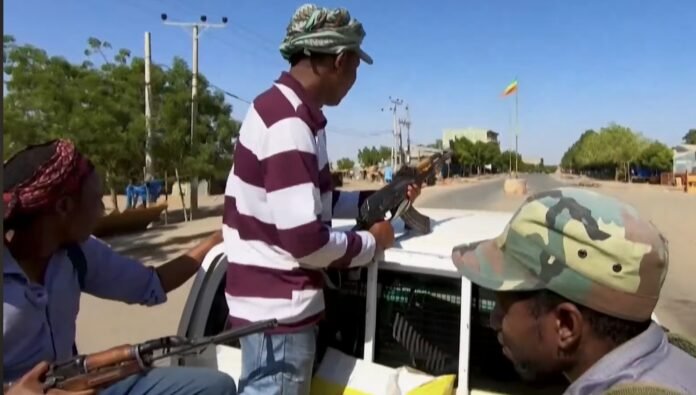
The European Union called for an immediate halt to escalating violence in Ethiopia and urged Ethiopia and Eritrea to defuse their growing confrontation, warning that the conflict could spread across the Horn of Africa. 

The warning follows a sharp deterioration in relations between Ethiopia and Eritrea. Ethiopia closed its embassy in Asmara and expelled 10 Eritrean diplomats on October 1, 2026, citing national security threats. Eritrea responded by severing diplomatic relations with Ethiopia and described the expulsion of its ambassador as “astounding.” The diplomatic rupture followed explosions and drone attacks against defense facilities in Addis Ababa. 

Ethiopia has accused Eritrea, Sudan and Egypt of backing an opposition alliance led by the Tigray People’s Liberation Front, which has fought forces loyal to Ethiopia’s federal government. Eritrea, Sudan and Egypt have rejected the accusation. 

Tensions have also increased over landlocked Ethiopia’s efforts to secure sovereign access to the sea and Red Sea port infrastructure. 

The latest confrontation has shattered the 2018 peace agreement that ended a prolonged military stalemate and led to Ethiopian Prime Minister Abiy Ahmed receiving the Nobel Peace Prize. 

Amid renewed tensions, the EU urged the parties to the Permanent Cessation of Hostilities Agreement to fully implement it through the African Union framework. It also called on all sides to avoid rhetoric or actions that could aggravate the situation. 

The bloc said international humanitarian law must be observed, civilians protected, and humanitarian organizations granted unhindered access to people requiring assistance. 

Outside powers should refrain from interference, respect the sovereignty and territorial integrity of states and encourage diplomatic solutions rather than further escalation, according to the EU. 

The EU also said it was prepared to support diplomatic efforts toward dialogue and peaceful resolution while continuing to promote regional stability, cooperation and economic integration in the Horn of Africa. 


Big Oil asks Supreme Court to kill climate lawsuits before trial

0
big-oil-asks-supreme-court-to-kill-climate-lawsuits-before-trial
Big Oil asks Supreme Court to kill climate lawsuits before trial

The US Supreme Court heard arguments from oil companies on Monday that could help decide the fate of more than two dozen lawsuits accusing the industry of deceiving the public about climate change. The claims seek potentially billions of dollars in damages to help pay the costs imposed by climate-related extreme weather.

Yet the questions before the court did not focus on the merits of these claims but instead on technical legal matters over whether they should proceed at all.

The case being argued was brought in 2018 by the city and county of Boulder against ExxonMobil and Suncor Energy in Colorado state court. While the case and dozens like it have survived multiple appeals in state and federal courts, the oil companies are asking the Supreme Court to declare that federal law preempts state and local governments from bringing such claims.

“This case represents an unprecedented effort to use state law to regulate global conduct,” said Kannon Shanmugam, arguing for Exxon and Suncor. In effect, Shanmugam said, Boulder is attempting to use state law to regulate oil company activity around the world. “If Boulder’s claims are allowed to go forward, some 90,000 municipalities across the country would have the ability to make national and international energy policy by asking juries to impose catastrophic damages on selected fossil fuel producers.”

But Boulder and dozens of other plaintiffs have argued their claims do not attempt to impose any limits on oil companies at all—the Boulder case seeks damages, not an injunction on any activity.

“This case is not about emissions,” said Kevin Russell, who argued the case for Boulder. “It’s about deception.”

Oil companies and conservative groups have been ramping up a campaign to block the lawsuits from proceeding as they inch closer to trial. Some states have enacted laws barring such lawsuits, and Republicans have introduced federal legislation that would shield oil companies from climate liability claims. The Trump administration has also intervened in several state cases, including Boulder’s, to try to block them from moving forward. Many scientists whose work is being cited in the cases have been the subject of more than 100 public records requests from conservative groups seeking information about their work and funders, according to Politico.

The first question that arose at Monday’s hearing, posed by Justice Clarence Thomas, is whether the court has jurisdiction to hear the case at this stage because no ruling has been issued.

The oil companies contend that the proliferating lawsuits are already causing sufficient harm and that the court should decide now whether the cases should proceed. Several justices suggested they thought it might be too early to intervene.

“I think Boulder’s best shot is on the jurisdictional question, whether this case is too early,” Michael Gerrard, faculty director at the Sabin Center for Climate Change Law at Columbia University, said in an interview.

The justices also probed the arguments of whether federal law preempts a state claim about climate change and emissions, either through the Clean Air Act or the Constitution.

Several of the conservative justices seemed inclined to agree that federal law preempts at least some of Boulder’s claims, Gerrard said.

The oil companies’ lawyers have argued that the Clean Air Act preempts any claims against oil companies tied to climate pollution. They also argue that the Constitution itself gives the federal government exclusive control over interstate pollution.

Russell argued that Boulder’s claim does not seek to limit pollution, and that there is nothing in the Clean Air Act or the Constitution that would bar states from taking actions that have a secondary effect of reducing pollution, such as imposing a gas tax or, in this case, seeking damages from oil companies.

Justice Samuel Alito was not at the hearing after recusing himself last week. While Alito gave no explanation for the decision, he had been under pressure to do so because he owns stock in oil companies that are party to other lawsuits that would be affected by the court’s decision.

Alito’s absence leaves open the possibility of a tie vote, which would allow the case to move forward.

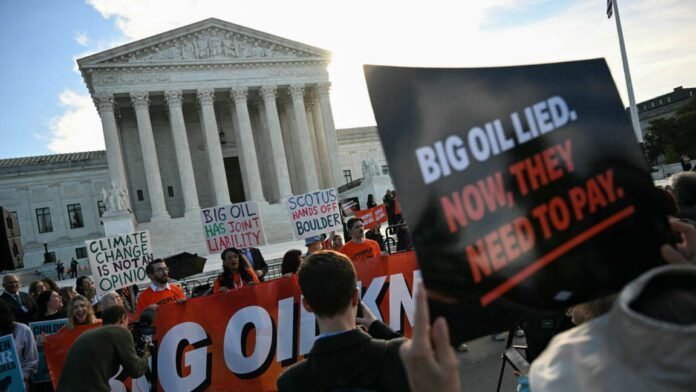
Supporters of the case held rallies outside the court, calling on the justices to let it proceed.

“Boulder, like other cities and counties across the country, is confronting realities associated with climate change every day, from wildfires and floods to drought, extreme heat, and growing pressures on our water and infrastructure,” said Boulder’s city manager, Nuria Rivera-Vandermyde, in a statement after the hearing. “The legal question before the court is whether taxpayers must bear these costs alone or must the defendants also pay their fair share for the harms they have caused.”

Many conservative groups and politicians have filed briefs supporting the oil companies, and the Trump administration presented arguments to the justices on Monday.

Boulder won supportive briefs from not only climate advocacy groups and Democrats but also many academics and former Environmental Protection Agency officials, including some appointed by Republican presidents.

Many of the cases brought by states and local governments have been paused pending the outcome of the Supreme Court’s ruling in the Boulder case. The decision, expected by the end of the court’s term in June, could bring those claims to an abrupt halt or set the stage for trials to finally begin.

Nicholas Kusnetz is a reporter for Inside Climate News. Before joining ICN, he worked at the Center for Public Integrity and ProPublica. His work has won numerous awards and citations, including from the Society of Professional Journalists, the Society of Environmental Journalists, the Overseas Press Club, the Society of American Business Editors and Writers, and others. His articles have appeared in more than a dozen publications, including Wired, The Washington Post, Businessweek, The Nation, and The New York Times. Nicholas can be reached on Signal at nkusnetz.15.

This story originally appeared on Inside Climate News.

Asia’s growth now belongs to Silicon Valley

0
asia’s-growth-now-belongs-to-silicon-valley
Asia’s growth now belongs to Silicon Valley

ASEAN nations are rushing to build AI infrastructure like the data center pictured above, but may lack the electricity to power them. Image: Google

Southeast Asia’s growth next year will be decided at meetings its finance ministers won’t attend.

A few executives in California will soon settle next year’s spending on data centers. Their decisions will do more to shape growth in Vietnam, Malaysia, Thailand and the Philippines than any budget those governments pass.

The World Bank has just raised its forecast for the region, and the factories, skills and supply chains behind it are genuine achievements. Yet AI-related goods account for more than 70% of export growth in those four economies, while growth in other exports is weak or negative.

Six of the region’s economies shipped $1.4 trillion of AI hardware in 12 months. Nearly all of it feeds an investment wave led by a handful of American tech giants, equal to about 6% of US gross domestic product (GDP).

Their capital spending plans have become Asia’s export order book. After the 1997-98 Asian financial crisis, regional governments spent a generation making sure no outsider could again dictate the region’s fortunes.

They built vast reserves, deepened local bond markets and chased customers on every continent to diversify their export bases.

In 1997, the threat came from hot money spread across thousands of funds. Today it rests with the purchasing teams of perhaps five US tech companies.

These companies answer to shareholders in New York, and shareholders eventually ask when a spending boom will pay for itself. When they do, the cuts will land first on suppliers abroad.

Trimming an order from a foreign supplier costs no American jobs and angers no American voters. It is the easiest saving a chief executive can find.

In South Korea, exports jumped 83.5% in September to a record $120.9 billion, half of it chips. Two chipmakers account for 43% of the Kospi’s value. The country’s trade figures and its main stock market now move largely with investment decisions made on another continent.

Central banks across the region will likely set interest rates on forecasts that hinge on Silicon Valley’s corporate guidance, a first.

Finance ministries will plan budgets around export revenue that assumes capital spending keeps rising. Currencies strengthen on chip earnings and squeeze every exporter selling anything else.

Ministers drafting next year’s budgets are, in effect, forecasting the mood of boardrooms they can’t see inside.

Asian governments can’t meaningfully tax these companies, regulate them or vote them out. The World Bank says the cycle is still gaining speed, and each quarter of growth raises the drop the region faces if spending turns.

Yet American capital can’t build a single data center without servers, chips and components from Asian plants.

Few places can match the region’s mix of skilled labor, supplier networks and manufacturing scale and replicating it elsewhere would take a decade. And Asia holds far more bargaining power than it uses.

Instead, governments compete for every new plant, offering tax breaks and subsidies in a bidding war that favors buyers. Each country negotiates alone and cedes a little more pricing power with every deal.

If the region bargained as a bloc, coordinated incentives would end the undercutting, and shared standards on energy, water and land use would set terms that buyers must meet.

More homegrown demand, from regional data centers to governments buying AI services for their citizens, would keep more of what Asian factories make inside Asia.

The region spent 25 years making sure its growth couldn’t be switched off from the outside. Those protections are worth rebuilding now, while the orders still flow.

Nigel Green is founder and CEo of the de Vere Group

Germany’s ex-spy chief arrested for espionage

0
germany’s-ex-spy-chief-arrested-for-espionage
Germany’s ex-spy chief arrested for espionage


Police have arrested the former head of Germany’s BND foreign intelligence agency, August Hanning, on suspicion of espionage, the federal prosecutor’s office announced Tuesday.

Hanning served as the agency’s chief from December 1998 to November 2005, before moving to the Federal Interior Ministry where he worked as state secretary until November 2009. 

According to a statement from the prosecutor’s office, he is facing charges including alleged espionage, disclosure of state secrets, attempted treason, and working as a secret service agent.

The statement added that another former high-ranking employee of the BND had also been arrested on suspicion of providing Hanning with hundreds of classified documents in exchange for payment.

DW’s chief political editor Michaela Küfner, reporting from a government press briefing on the arrest, described the case as Germany’s “biggest espionage scandal of the century unfolding in real time.”

Police arrested Hanning early Tuesday at his home in Nordwalde near the western German city of Münster, according to information from WDR, NDR and the Süddeutsche Zeitung.

Hanning’s alleged accomplice, who was identified only as Manfred D. in line with Germany’s privacy laws, was taken into custody in Bavaria.

Authorities were conducting searches at both suspects’ properties, as well as in Berlin, the prosecutor said.

During Hanning’s tenure as spy head, D. served as his chief of staff. He also subsequently worked under Hanning at the Interior Ministry until 2009.

He is facing charges of “aiding and abetting attempted treason and espionage against the state.”

Marc Henrichmann, who chairs the German parliament’s intelligence oversight committee, said following the arrests that Germany “will not tolerate the betrayal of secrets.”

“Whoever allies themselves with the enemies of our liberal democracy will be found out,” he said in comments to the AFP news agency.

The investigation in Hanning reportedly began due to his connection to a high-profile trial involving businesswoman Christine Block.

2,000 documents allegedly handed over to Hanning

The prosector’s office said Hanning and Manfred D. are believed to have come up with their arrangement in 2010.

From 2012 to March 2026, D. served as chief of staff to Hanning’s successors at the BND spy agency, where he had access to a wealth of classified documents, according to the prosecutor’s statement.

“The current findings suggest that, over the years, Manfred D. provided Hanning with approximately 2,000 documents, many of which contained classified information to be used exclusively by the Federal Intelligence Service for internal purposes,” the statement said.

It added that D. is alleged to have provided Hanning with information until at least mid-2022, and that Hanning used that information in his private consulting work.

Hanning is also accused of being “in close contact with a representative of another foreign intelligence service, to whom he passed on political information, partially based on material provided by Manfred D., for several years,” the statement said.

The prosecutor’s office did not say which foreign intelligence service was involved.

The two suspects are expected to appear before an investigating judge on Tuesday and Wednesday.

More Than 500 U.S. Citizens Have Been Detained, Including Handcuffed or Held at Gunpoint, in Trump’s Immigration Crackdown

0
more-than-500-us.-citizens-have-been-detained,-including-handcuffed-or-held-at-gunpoint,-in-trump’s-immigration-crackdown
More Than 500 U.S. Citizens Have Been Detained, Including Handcuffed or Held at Gunpoint, in Trump’s Immigration Crackdown

“I’m literally a U.S. citizen. I’m literally a U.S. citizen.”

An employee at Target is detained in January 2026 in Richfield, Minnesota.

Video credit: Bring Me The News

Experts have long warned that immigration dragnets and the erosion of civil rights for immigrants will inevitably result in the erosion of rights for citizens.

“I’m a U.S. citizen, please help me.”

A woman is detained for the third time in Key Largo, Florida, while driving a car registered to her partner, an immigrant.

Video credit: Miami Herald

Since the start of this Trump administration, we’ve watched those warnings come true.

This story contains videos and descriptions of violent arrests.

Click to disable videos.

The Trump administration says none of this is happening.

“DHS is NOT arresting U.S. citizens by mistake.” “There are no ‘indiscriminate’ stops.” Allegations of “racial profiling are disgusting, reckless and categorically FALSE.” “The pattern is NOT of law enforcement using force.” “ICE does not zip tie or restrain children.”

But that is precisely what is happening, and at a far larger scale than previously reported.

We know because we have once again done what the government hasn’t:

We have tallied and cataloged every case we can find of an immigration agent holding a citizen during the current administration.

More than 500 cases. That includes:

More than a hundred Americans held after agents questioned their citizenship. Nearly all were people of color.

At least 70 American children and teens detained, some of whom were handcuffed.

Of the more than 300 Americans we tracked as detained for allegedly assaulting or obstructing agents, we found fewer than half were actually charged in federal court, and many of those cases were dropped or dismissed.

At least 63 Americans detained while recording.

36 Americans held for at least a day without being able to contact a lawyer or their family.

Roughly a dozen citizens deported, mostly children.

Collectively, these cases show that as the administration has relentlessly pursued immigrants, federal agents have run roughshod over the constitutional rights of citizens too.

We’re showing you every case — the reality that the administration denies — along with the receipts.

Each box represents a detained citizen.

Jun 2025

A Southern California enforcement operation starts on June 6

Sep 2025

Operation Midway Blitz starts on Sept. 8 in Illinois

Dec 2025

Operation Metro Surge starts on Dec. 1 in the Minnesota

In January 2025, agents held a 21-year-old citizen at gunpoint and put him in handcuffs during a raid at the Philadelphia car wash where he worked.

In April, a 20-year-old was held in a Florida jail for more than 24 hours, despite having proof of his citizenship.

In June, a dual citizen of Mexico and the U.S. was detained while working in California. He was held for four days without access to a lawyer or his family.

During the enforcement surge in Chicago last fall, known as Operation Midway Blitz, there were “no administrative arrests of U.S. citizens,” according to the Department of Homeland Security. “ICE has significant protections in place to ensure U.S. citizens are not arrested, detained, or mistakenly removed.” But we found that federal agents detained more than 120 citizens in Illinois during the height of the surge.

In November, agents took an 18-year-old citizen off the street, eventually dumping him in the woods.

In December, an American in Baltimore was picked up and held for 25 days, unable to see her 5-year-old son over Christmas.

In January, hours after Renee Good’s killing, agents tackled and handcuffed a school staffer in Minneapolis. He was terrified, he recalled: “I feel lucky to be alive.”

In April, when agents stopped a man in Texas, he told them, “I’m a citizen, it’s fine.” He was deported four days later.

In May, a New York teen was thrown to the ground, bloodied and then dumped in an unfamiliar neighborhood. “He just grabbed me and threw me on the floor,” the teen recalled.

In September, agents detained and injured an Illinois man they thought was someone else.

We shared details and footage of many of the incidents with former immigration officials. They reacted with anger and disbelief.

“This is just terrible,” said Eric Balliet, who spent more than two decades at Homeland Security Investigations and Border Patrol, both agencies under DHS, including in President Donald Trump’s first administration.

“I’ve never seen so many U.S. citizen encounters in all my years,” said Darius Reeves, who oversaw the Immigration and Customs Enforcement agency’s Baltimore office before retiring last year. “It’s an embarrassment.”

Do you have information or footage to share related to the administration’s immigration crackdown?

In tallying these detentions, we included anyone who authorities held against their will for any period of time — whether they were handcuffed, held at gunpoint or otherwise prevented from leaving by immigration agents. The courts consider someone detained if they aren’t free to leave.

Immigration agents do have authority to detain Americans in limited circumstances: if they can reasonably suspect they are in the country illegally, or if they allegedly interfered with or assaulted officers.

ProPublica shared its findings and information on each case with DHS. The department defended agents’ conduct. “DHS enforcement operations are highly targeted. We do our due diligence,” the agency said in a statement. It added that anyone who obstructs agents “will of course face consequences which include arrest.”

Explore our list of incidents where citizens were detained.

Jump to list

We compiled our list by scouring social media, court records and local media to confirm and compile incidents.

Our work doesn’t include all of agents’ problematic interactions with citizens. We didn’t count incidents where, say, an agent shot but didn’t detain a citizen. And as with the tally we did last year, the new list is an undercount. For instance, witnesses estimate that more than 200 citizens were detained in an Idaho raid last fall, but we only included the 30 citizens who we were able to identify.

Willy Wender Aceituno, a naturalized citizen who voted for Trump twice, said he never imagined that the immigration crackdown he supported would entangle him.

Then, last November, Border Patrol agents broke his truck window, yanked Aceituno out and threw him onto the pavement of a parking lot, where one agent knelt on his back. (DHS says he “refused to comply” with agents’ commands.)

“ICE isn’t looking for criminals,” Aceituno said. “They’re looking for Latinos. Having papers in this country does not protect you.”

“Upon Probable Cause”

Under the Fourth Amendment, law enforcement generally must have probable cause to arrest someone. But there’s a lower bar, reasonable suspicion, for stopping someone to question them.

The Trump administration has repeatedly said its agents are just questioning citizens, not detaining them — even when they’re in handcuffs or held for hours. DHS also cites a concurring opinion issued last year by Supreme Court Justice Brett Kavanaugh stating that agents can consider factors like “apparent ethnicity” when making stops. Citizens around the country have been detained because, they’ve said, of their skin color, accents or jobs.

Ever since his arrest in November, Aceituno said his U.S.-born daughter carries her passport at college. “She has a Latino face,” he said, adding, “My daughter’s white friends aren’t carrying their passports.”

“Secure in Their Persons, Houses, Papers and Effects”

The Fourth Amendment of the Constitution also prohibits officers from entering homes without a judge’s warrant.

An ICE memo revealed by a whistleblower this year showed that agents had been doing it anyway. The agency asserted that administrative warrants that didn’t involve a judge gave agents the ostensible authority to force their way into homes looking for someone with a final deportation order. Some of those incidents have also resulted in Americans being detained.

In January, Jeyli Salguero, her parents and her sister were asleep at home when armed federal agents broke through the front door and rushed inside.

“The first thing I yelled when I stepped out of my room was that I was a U.S. citizen and I had the right to record,” Salguero recalled. “That’s when they snatched my phone.”

The agents told Salguero’s family they were looking for her brother, who does not live there. After half an hour, the agents released Salguero and her mother, but detained her father, who had temporary protected status, and her sister, who was undocumented. The sister was eventually deported to El Salvador, and her father was later released from detention.

Salguero told us that agents left her and her mom alone in their wrecked house with the Minneapolis winter air coming in through a broken door.

Salguero is one of several plaintiffs who have filed a lawsuit against the government for going into homes without a judicial warrant. DHS has moved to dismiss the lawsuit, saying it has “paused” the policy.

“Against Unreasonable Searches and Seizures”

The Fourth Amendment is also intended to protect people from “unreasonable” use of force during arrests. Previously, we’ve documented how agents have used chokeholds that DHS banned other than when deadly force is authorized. We’ve also documented how immigration agents have broken car windows while pursuing people they believe are in the country illegally. But they’ve been doing it to citizens, too. Many of those citizens have filed lawsuits.

Darren Eichler was working at a Christian cemetery in a Chicago suburb last October when he and his coworkers moved to help a man who was wading in the nearby river. They soon realized — too late — that the man was running from immigration agents, who emerged from the brush near the river and demanded access to a gated area of the cemetery. When the men refused and started filming, agents used bolt cutters to cut open the gate, then fired pepper balls and tackled the men.

Explore incidents where citizens were subjected to crowd control weapons.

Jump to list

Eichler said his face felt like it was on fire and he had trouble breathing. “I pleaded with them for an hour to please call an ambulance.” Eichler told ProPublica. He was eventually brought to a hospital, still handcuffed, while the agents stood over his bed. Eichler’s co-workers were held for several hours at a nearby federal office. No one was charged.

DHS did not respond to ProPublica’s request for comment about the incident.

“The Right of the People Peaceably to Assemble”

The First Amendment protects protesters and those documenting agents’ conduct. The amendment guarantees the freedom to assemble — in other words, to protest peacefully — and the freedom of speech, which courts have interpreted to include recording in public.

The Trump administration has, however, aggressively pursued the arrest and prosecution of citizens who were protesting, often claiming the protesters were assaulting officers or interfering with enforcement activities. We counted more than 300 people accused of assaulting or obstructing officers, about 130 of them at protests.

Top DHS officials, including former Secretary Kristi Noem, went further, claiming that filming ICE agents was interfering with arrests. Last summer, three siblings driving in Texas were detained after they stopped to film an immigration arrest. One of the siblings was a young teen. “They tackled me down and an agent put one knee behind my knee, where I felt a sharp pain,” he told ProPublica. He was separated from his mother, who has a green card. “They were saying my mom wasn’t a U.S. citizen, and I was scared they were gonna take her away.”

The siblings have filed claims for damages with the government. Asked about the incident, DHS said it respects “the First Amendment rights of individuals to observe and express themselves. However, if such actions interfere with or obstruct our operations, ICE will take necessary steps to address the situation.”

Our review did uncover instances that appear to show some protesters or other civilians assaulting officers. One person pleaded guilty to throwing pieces of cinder block at an agent. A woman in California pleaded guilty to pulling off an officer’s mask.

Many protesters were accused of crimes but never actually charged. We found 137 instances of citizens who were charged with federal crimes, most of whom were charged with assaulting or obstructing federal agents. In nearly half of those instances, the charges were dropped or dismissed. Three dozen citizens have been sentenced to prison or probation, and another three dozen cases are pending, as of September 15.

Explore incidents where citizens were detained while recording.

Jump to list

Some of those arrested, like clarinet player Oriana Korol, were initially charged with felony assault before pleading guilty to a misdemeanor — in Korol’s case, for trying to kick an officer. She said she did so after officers shoved her and pepper-sprayed her twice in the face. Just moments before, the band had been playing the “Ghostbusters” theme song as part of a peaceful protest.

Video footage shows agents leading Korol away, handcuffed, while one pulls her tear-gas-soaked mask over her mouth. “Please pull it down,” Korol tells the agents in the video. “I’m going to have an asthma attack. I have asthma. Why are you doing this to me? Please.”

The Rights of Children

Unlike earlier administrations, Trump has detained significant numbers of immigrant children living far from the border. Citizen kids have been swept up too — at least 70 of them. We’ve found about 20 kids who were handcuffed or zip-tied.

DHS said that ICE doesn’t zip-tie or restrain children, or separate families. But agents handcuffed a 15-year-old with disabilities outside a school in Los Angeles in 2025. The agents said they mistook the teen for an alleged gang member. A few months later, officers detained more than a dozen American children during a raid on an Idaho horse track. Anabel Romero said her children are still deeply shaken by their detention.

Romero told us how her 7-year-old son warned his older sister about going to another race this month: “He said, ‘Watch out for ICE, make sure you have your phone to film — I’ll come save you.’”

“Without Due Process of Law”

As the government has rushed to deport people as quickly as possible, Americans have also been swept up and removed from the country too. About a dozen American kids have been deported with their parents, allegedly over their parents’ objections.

DHS said: “Parents are asked if they want to be removed with their children or ICE will place the children with a safe person the parent designates.”

One American adult in Texas was also deported this spring.

The car Brian Morales Garcia was in was pulled over earlier this year in central Texas. Officers didn’t believe him when he said he was a citizen. And they wouldn’t let him get his birth certificate. Morales Garcia was held for four days without being able to call his lawyer or anyone else. Then he was deported to Mexico.

After suing, Morales Garcia was allowed back into the country just last month using his birth certificate.

DHS did not respond to ProPublica’s questions about Morales Garcia’s deportation. In earlier court filings, officials disputed Morales Garcia’s citizenship and claimed he had admitted to being born in Mexico.

“I couldn’t process what they were doing to me.” Morales Garcia told ProPublica. When he was first stopped in Texas, he had told officers, “I’m a citizen, it’s fine.”

Explore All Incidents Where Citizens Were Detained

This is every incident ProPublica could find in which one or more citizens were reportedly detained between January 2025 and September 2026. We asked DHS about each incident. We searched for any federal criminal charges that were brought in relation to each incident and included the most up-to-date status we could find for those cases.

506 citizens

One citizen was injured and detained by ICE agents who were looking for someone who matched his description in Evanston, Illinois. A responding Evanston police officer said one agent had blood on his hands and the citizen was taken to the hospital. DHS claimed the man didn’t cooperate with “lawful commands” and agents detained him until he identified himself.

Two citizens were detained in Alamo, Texas.

Two citizens were detained in Norfolk, Virginia.

One citizen was detained in Laguna Vista, Texas.

One citizen was detained in Olathe, Kansas.

One citizen was detained in Boise, Idaho.

One citizen was detained in Oklahoma City, Oklahoma.

One citizen was detained in Salt Lake City, Utah.

Two citizens who are enrolled members of the Leech Lake Band of Ojibwe were detained in Bemidji, Minnesota, during a worksite raid.

A citizen leaving a coffee shop in Annapolis, Maryland, was handcuffed, denied a phone call and held for almost two hours. DHS said it took the citizen to another location to interview him because “agitators” had gathered.

One citizen was detained in Newark, New Jersey.

A citizen documenting ICE activity in Ventura, California, was tackled and tasered while he was already pinned to the ground.

One citizen was detained in Newark, New Jersey.

One citizen was detained in Newark, New Jersey.

Six citizens were detained in Newark, New Jersey.

0FansLike
0FollowersFollow
0FollowersFollow
0SubscribersSubscribe
- Advertisement -
Google search engine

Recent Posts