12.7 C
London
Tuesday, October 6, 2026
Home Blog

The illusion of America’s withdrawal from Iraq

0

The American withdrawal from Iraq is not an end but a strategic pivot, a calculated transition from direct occupation to remote containment.

By pressuring Iraq to disarm its resistance groups, Washington aims to neutralize Iran’s forward defense line and clear the battlefield for a potential full-scale confrontation with Tehran.

This gambit risks either delivering Iraq into a long-lasting new foreign domination or fracturing the region into warring militias. The celebrations surrounding America’s departure from Iraq are premature, while the real battle for the Middle East’s future has only just begun in a new way.

On September 30, when the last American soldier left Iraq, celebrations echoed not only through Iraqi streets but through the barracks of the American-allied Iraqi national army as well. Local communities and the so-called resistance groups held rallies together.

For a moment, few paused to consider the deep American penetration that remains or the powerful Iran-backed armed groups that operate in Iraqi streets almost like a regular army. For Iraqis, the American absence is more than a symbol of national liberation. Yet the reality and the grand strategy behind this withdrawal demand scrutiny.

The departure of combat forces does not end American influence. It marks a transition to a more nuanced phase of warfare. The objective is no longer territorial occupation.

It is the use of political structures and control over the financial and international infrastructure on which the Iraqi economy depends to function daily. To understand Iraq today, we must look beyond celebrations of national sovereignty and examine the structural dynamics that continue to shape the region.

Neutralization of deterrence

The primary strategic objective of the United States after withdrawal is the neutralization of armed groups that form the backbone of the Axis of Resistance in Iraq.

These groups refuse to lay down their arms. They are not hopeful about integration into the national army, and for that reason they seek to preserve the status quo. Their resistance remains a deterrent against American hegemony in the region.

By withdrawing conventional forces, Washington seeks to eliminate the primary justification for these groups. The logic is simple: If the foreign occupier is gone, the resistance’s raison d’être disappears.

The United States wants to build a narrative in which these groups are no longer liberators resisting occupation, but are instead projected as just a few rogue militias challenging Iraqi sovereignty.

This narrative shift is crucial. It allows Washington to pressure the Iraqi government to eliminate these groups under the argument that the goal is law enforcement and a state monopoly over the use of force.

If the United States can portray them as obstacles to stability rather than guarantors of national security, it can isolate them politically and economically. It can then neutralize their deterrent capability without firing a single shot.

A grand strategy against Iran

The second, and perhaps most significant, aspect of this withdrawal is preparation for a potential large-scale confrontation with Iran. The United States understands its occupation mistakes in Iraq. A conventional attack and military occupation created a power vacuum that Iran quickly filled.

American strategic calculations have changed. Washington knows that any future attack on Iran, especially one targeting the Islamic Revolutionary Guard Corps, could push IRGC forces into Iraqi territory to reorganize and continue the fight.

The withdrawal from Iraq is therefore less a retreat than a tactical repositioning. The United States wants to ensure that if IRGC forces are forced out of Iran, there will be no active, well-armed resistance groups in Iraq capable of receiving them, sheltering them or fighting alongside them.

By attempting to disarm Iraqi resistance groups now, the United States is clearing the battlefield for a future conflict. It is closing the backdoor through which Iran could project power and sustain a guerrilla war against American interests.

This is essentially a preventive measure. It aims to ensure that American forces do not suffer serious damage and that a potential war with Iran remains confined to Iran’s borders.

The United States does not want to fight on multiple fronts. Secret meetings with Arab countries and mobilizing public opinion could help Washington secure allies with firm determination in such a battle.

Obstacles to regime change

Resistance groups also constitute a strategic obstacle to the broader American project of destabilizing and ultimately overthrowing the Iranian government. Their presence in Iraq, Syria and Lebanon creates a multi-front deterrent that keeps the United States engaged and occupied.

They serve as a forward line of defense for Tehran. They ensure that any conflict is fought as far from Iranian territory as possible. If the United States wishes to increase pressure on Iran, it must first confront these proxy forces.

By demanding disarmament, the United States seeks to sever the organs of Iran’s defense strategy. It wants only one cohesive army under government authority in Iraq. Through political and currency-based pressure and economic threats, it can then implement its decisions in the region.

If these groups are disbanded, Iran loses its ability to respond asymmetrically across the Middle East. If Iran becomes isolated and vulnerable, then it becomes a much easier target for regime-change operations. Eliminating the Iraqi resistance is therefore a prerequisite for any successful campaign to alter Tehran’s political landscape.

Seeds of future chaos

Failure to disarm these groups risks sowing future chaos in the Middle East. If armed groups remain intact and operate outside central government control, they may become spoilers in any future political settlement.

They may be accused of provoking civil wars, destabilizing the region and creating permanent insecurity. Such a situation benefits only those who profit from conflict and wars in the region.

The United States argues that the proliferation of armed non-state actors undermines the Westphalian order based on independent sovereign states. From the resistance perspective, their weapons are the only existing guarantee against foreign intervention and internal coups. The tension between these two views creates an unstable and dangerous dynamic.

If the United States succeeds in disarming these groups through political pressure, it may leave Iraq vulnerable to foreign domination. If it fails, the region may become a fragmented landscape of competing militias each seeking power and influence. This potential for chaos is not an unintended consequence.

It is a calculated risk within the American grand strategy. A chaotic Middle East is dangerous but often more manageable for a superpower than a unified region that can challenge its hegemony. In both scenarios, the United States needs a strategic ally with strong geopolitical advantages.

US retreat only in name

The withdrawal of American forces from Iraq is not the end of the American project in the region. Rather, it is a strategic pivot.

Celebrations in Baghdad and Iraqi army barracks are premature if read as signs of genuine independence. The United States has shifted from direct military occupation to remote containment and economic pressure.

The focus now is neutralizing resistance groups that refuse to surrender their arms, opening a path toward a potential confrontation with Iran and ensuring that any future conflict does not draw American forces back into a ground war in Iraq.

The resistance groups continue to regard themselves as the ultimate guarantors of Iraqi sovereignty and the most significant obstacle to American plans for greater influence in the region.

The coming years will determine whether Iraq can genuinely consolidate its independence or will remain a battleground for the competing interests of Washington and Tehran. The absence of American soldiers is just a symbolic liberation. The real battle over the future of the Middle East has only just begun.

The reality is that the American strategy is not to leave the region; it is to reposition itself and rearrange its presence. The resistance groups are the key factor in determining whether this strategy succeeds or fails.

The Middle East stands at a crossroads. Decisions made in the coming months about these armed groups will shape the region’s security architecture for decades to come.

Fateme Jafarbegi is a writer and researcher based in Tehran, Iran. Sajad Ahanger is an occasional writer, poet and political analyst based in Kashmir.


TV Star Dies After Cancer Fight

0
tv-star-dies-after-cancer-fight
TV Star Dies After Cancer Fight


Another World star Mark Mortimer, who spent the final years of the beloved NBC soap playing Nick Hudson, has died following a battle with cancer. He was 59.

Mortimer died Sept. 23 surrounded by loved ones after what his family described as a “fearless journey with cancer,” according to an obituary published by Moss-Norris Funeral Home in his native Illinois.

The actor had been diagnosed with cancer in 2024, but his family said the disease did not come to define the final chapter of his life. Instead, Mortimer and his wife, Christie, turned their experience into an effort to help other families facing similar diagnoses.

For longtime soap fans, Mortimer remains best remembered as Nick Hudson on Another World, a role he took over in 1996 and continued playing until the legendary daytime drama aired its final episode in June 1999.

Mortimer was the third actor to portray Nick, following Kevin McClatchy and future Grey’s Anatomy star Justin Chambers.

Nick was introduced as the son of Michael Hudson, played by Kale Browne, making him the half-brother of twins Vicky Hudson and Marley Love. Mortimer became part of the show during its final years and remained with the cast until NBC brought the soap’s 35-year run to an end.

Another World had been a fixture of American daytime television since its debut in 1964 and became known for pushing the boundaries of traditional soap storytelling.

For Mortimer, the show was more than a breakthrough role. It was essentially his acting school.

In a 1999 interview with Soap Opera Weekly, shortly before Another World left the air, Mortimer spoke about how much he had learned from the veteran performers around him.

“My fondest memory of being on the show was getting an opportunity to work with fine actors like Jensen Buchanan, Eric Morgan Stuart, Anna Stuart — they’ve really been great,” he said.

Mortimer also credited Browne, Thomas Eplin and Tim Gibbs with helping him develop as an actor.

“When I came on the show, I didn’t know much about acting, but they’ve been very helpful to me,” he recalled. “It’s been like one big class for me, which has been really rewarding.”

Mortimer’s life before Hollywood had already taken several turns.

Born April 15, 1967, in St. Charles, Illinois, he served in the U.S. Army before working as a model and eventually pursuing acting.

After Another World ended, Mortimer appeared in an episode of the ABC sitcom Spin City in 1999. His later credits included the 2005 film The Nowhere Man, which would become one of his final screen appearances.

But Mortimer ultimately built a second career far removed from television.

He and Christie, along with business partner Dave Lockhart, launched Inside Out Construction in Illinois in 2003 after Mortimer and his wife discovered a passion for construction work while living in California.

A construction industry profile published years later described the dramatic career transition, noting that Mortimer had gone from modeling and acting to overseeing construction projects in the Chicago area.

The company grew into a long-term family business and became a major part of Mortimer’s life after Hollywood.

His family said Mortimer’s willingness to reinvent himself was one of the qualities that defined him.

“He was an Army veteran, a model, an actor, an entrepreneur and a builder,” his obituary said. “He was a husband, father, son, brother and friend.”

His family remembered him as someone who was willing to take risks, change direction and learn new things throughout his life.

But they said two roles mattered more to Mortimer than all the others: husband and father.

Mortimer met Christie at Hunter Mountain in New York in 2000. The couple went on to spend 25 years together and eventually welcomed their daughter, Hunter, after waiting more than a decade to become parents.

His obituary paints a picture of a devoted father who deliberately organized his work life so he could remain heavily involved in his daughter’s childhood.

That commitment to family became especially important after Mortimer was diagnosed with cancer in 2024.

Rather than focusing solely on his own illness, Mortimer and Christie founded the Integrative Access Foundation, an organization intended to help cancer patients obtain information, support and access to integrative treatment options that may otherwise be financially out of reach.

The foundation says its mission includes helping patients who feel limited by financial or other barriers when exploring additional forms of cancer care.

Mortimer also became involved with Beyond the Diagnosis, a project intended to continue conversations about cancer, caregiving, family, faith and resilience.

His family said Mortimer relied heavily on his Christian faith as his illness progressed and found peace in his beliefs near the end of his life.

“Mark showed those who loved him that courage is not the absence of fear,” his obituary said. “It is choosing to live, love, laugh, hope and trust God even when the road ahead is uncertain.”

Mortimer is survived by Christie and Hunter, as well as his mother, Sharlene Pearson; his father, Emil Mortimer, and stepmother, Belinda; his siblings; extended family members; friends and colleagues.

A visitation was held Sept. 25 at Moss-Norris Funeral Home in St. Charles, Illinois, followed by a funeral service Sept. 26 at Christ Community Church in South Elgin.

His family said he will be laid to rest at St. Charles/Resurrection Cemetery in Farmingdale, New York.

Rather than flowers, the family asked that memorial contributions be directed to the Integrative Access Foundation so Mortimer’s work helping other people facing cancer can continue.

While generations of Another World viewers will remember him as Nick Hudson, his family made clear that Mortimer considered his television career only one chapter of a much larger life.

His legacy, they said, will continue through his wife and daughter, the business he helped build and the cancer organization created from one of the most difficult experiences of his life.

Air Fryer Hot Honey Bacon Pickle Bites

0
air-fryer-hot-honey-bacon-pickle-bites
Air Fryer Hot Honey Bacon Pickle Bites
Air Fryer Hot Honey Bacon Pickle Bites with jalapeño slices, chives, and ranch dip.
Air Fryer Hot Honey Bacon Pickle Bites combine smoky bacon, tangy pickles, and sweet heat with cool ranch on the side.

Print Friendly, PDF & Email

Air Fryer Hot Honey Bacon Pickle Bites pack smoky bacon, tangy dill pickles, fresh jalapeño, and sticky hot honey into one crispy little appetizer. They are bold enough for game day but simple enough to make whenever a salty-crunchy snack sounds good.

Thick pickle chips work especially well because they hold their shape while the bacon crisps around them. A thin jalapeño slice goes against each pickle before everything gets wrapped and secured, giving every bite a fresh pepper flavor without turning the appetizer overwhelmingly hot.

The hot honey Dijon glaze goes on during the final minutes. That gives the bacon time to crisp before the honey hits the heat, so the glaze caramelizes instead of burning. Serve the bites warm with cool ranch dip on the side for an easy contrast between smoky, spicy, tangy, and creamy.


Air Fryer Hot Honey Bacon Pickle Bites with jalapeño slices, chives, and ranch dip.
Air Fryer Hot Honey Bacon Pickle Bites combine smoky bacon, tangy pickles, and sweet heat with cool ranch on the side.

Recipe Yield: 24 bites

INGREDIENTS

24 thick-cut dill pickle chips
24 thin fresh jalapeño slices
12 slices regular-cut bacon, halved crosswise
2 tbsp honey
1 tsp Dijon mustard
1/2 tsp crushed red pepper flakes
1/4 tsp smoked paprika
1 tbsp finely chopped fresh chives
1/2 cup ranch dressing, for serving

INSTRUCTIONS

1. Dry the pickles:
Place the pickle chips between paper towels and press gently until very dry. Removing excess brine helps the bacon crisp instead of steam.

2. Assemble the bites:
Place 1 jalapeño slice against each pickle chip. Wrap each stack snugly with 1 bacon half, overlapping the ends underneath.

3. Secure the bacon:
Insert a toothpick horizontally through each wrapped pickle bite to hold the bacon firmly in place while it cooks.

4. Prepare the Air Fryer:
Preheat the tray-style Air Fryer to 390°F for 3 minutes. Arrange the bites on the Air Fryer tray with space between them for airflow.

5. Air fry the bites:
Air fry for 8 minutes. Carefully turn each bite, then continue cooking for 5–7 minutes, until the bacon is browned and nearly crisp.

6. Make the hot honey glaze:
Meanwhile, stir the honey, Dijon, crushed red pepper flakes, and smoked paprika together in a small bowl until smooth.

7. Glaze the bites:
Brush the bacon lightly with the hot honey mixture. Return the tray to the Air Fryer for 1–2 minutes, until the glaze is bubbling and caramelized and the bacon is crisp.

8. Rest and finish:
Let the pickle bites rest for 3 minutes so the bacon firms slightly. Sprinkle with chopped chives and serve warm with ranch dressing for dipping.


Helpful Tips to Perfect This Recipe

  • Dry the pickles thoroughly: Pickle brine creates steam. Pressing the chips dry gives the bacon a much better chance to become crisp around the edges.
  • Use regular-cut bacon: Thick-cut bacon takes too long to crisp around the pickles. Regular bacon cooks through more evenly without overcooking the jalapeño.
  • Leave room on the tray: Air needs to circulate around every bite. Cook in two batches if your tray cannot hold all 24 without crowding.
  • Glaze near the end: Honey darkens quickly at Air Fryer temperatures. Adding the glaze only after the bacon is nearly crisp gives it a sticky caramelized finish without burning.

Rate This Recipe

Tried this recipe? Your rating helps others and means so much.

Israel Names Ambassador to Congo as Kinshasa Prepares To Move Embassy to Jerusalem 

0
israel-names-ambassador-to-congo-as-kinshasa-prepares-to-move-embassy-to-jerusalem 
Israel Names Ambassador to Congo as Kinshasa Prepares To Move Embassy to Jerusalem 


Israel will open an embassy in Kinshasa and has named Kobi Shoshani as its resident ambassador to the Democratic Republic of the Congo as the Congolese government prepares to relocate its diplomatic mission in Israel to Jerusalem. 

Foreign Minister Gideon Sa’ar approved the new embassy Sunday and selected Shoshani, a career diplomat who previously served as consul general in Mumbai and held other diplomatic posts, to lead the mission. 

The Democratic Republic of the Congo is expected to become the 11th country to establish a diplomatic mission in Jerusalem. 

The two countries had outlined plans for the reciprocal diplomatic moves following a September 1, 2026, meeting in Jerusalem between Congolese President Félix Tshisekedi and Israeli Prime Minister Benjamin Netanyahu. 

A joint declaration issued after the meeting said the governments would continue consultations “with a view to the opening of a resident embassy of the State of Israel in Kinshasa and the transfer of the embassy of the Democratic Republic of Congo from Tel Aviv to Jerusalem.” 

At the time, neither government provided a firm schedule for implementing the plans, and the declaration committed the countries to further discussions. 

Sa’ar later met his Congolese counterpart, Thérèse Kayikwamba Wagner, and said the two diplomatic moves would proceed alongside each other. 

“We will advance the relocation of the Democratic Republic of the Congo’s embassy to Jerusalem,” he said, adding that the process would proceed alongside the opening of an ‘Israeli’ embassy in Kinshasa. 

Israel’s UN Ambassador Danny Danon also welcomed the planned relocation. Danon said Tshisekedi had spoken about his “deep personal connection to Jerusalem” more than a decade ago and was now “turning that vision into reality.” 


Dozens quarantined in Siberia after plague institute lab worker dies

0
dozens-quarantined-in-siberia-after-plague-institute-lab-worker-dies
Dozens quarantined in Siberia after plague institute lab worker dies


A laboratory worker at a plague research institute in ‌Siberia fell ill and died in undisclosed circumstances, prompting authorities to quarantine dozens of people and the head of Russia’s health watchdog to fly to the Irkutsk region.

The death has sparked public health fears on social media, but the authorities said the situation was under control.

The World Health Organization said that based on available information, “the ​public health risk to the general population appears to be low”. New risk assessments would be conducted once further information became ​known, it said.

US President Donald Trump said the death was a “big problem for Russia” and offered to help Moscow deal ⁠with it.

“We’ll help,” Trump said. “Anybody that has that kind of a problem, we’re always willing to help.”

US Secretary of State Marco Rubio said Washington ​was closely monitoring the situation.

Plague is endemic to Siberia, location of the first known prehistoric human outbreak, as the bacterium that causes it, Yersinia pestis, is ​present among the small wild mammals in its vast wilderness and their fleas. It is rare for Russians to fall ill with plague, however, though cases occur every year in other parts of the world — notably Africa.

Plague comes in three forms affecting different parts of the body. Pneumonic plague, an infection of the lungs, prompts the ​patient to cough out infectious airborne droplets.

If identified quickly, it can be treated with antibiotics. But if left untreated, it can be fatal ​in one to six days.

Local media have named the laboratory worker who died as Darya Shipilova, a 28-year-old employee at the Irkutsk Anti-Plague Research Institute of Siberia and the Far East.

There were ‌conflicting reports ⁠about how and where she fell ill, but the authorities said she had died of pneumonia of as-yet unestablished origin.

AUTHORITIES SAY NO NEW CASES REPORTED, ALL CONTACTS TRACED

Russia’s health watchdog, Rospotrebnadzor, told state media the institute had not found evidence of any accidents involving the handling of pathogens after rumours spread on social media that the woman had dropped a test tube containing live bacteria.

Nevertheless, Anna Popova, the head of Rospotrebnadzor, flew to ​Siberia for an emergency meeting over ​the weekend.

According to Russian media ⁠reports, about 200 people who had been in contact with the dead woman were quarantined, parts of the hospital in the town of Shelekhov where she died were cordoned off and an aluminium plant told its workers ​to wear masks.

Rospotrebnadzor, in a later statement quoted by the TASS news agency, said officials in Irkutsk Region had ​found two cases ⁠of COVID and two cases of rhinoviruses among people who had been in contact with her. No other cases of infectious diseases were noted.

Authorities urged people to remain calm and said there was no evidence that the woman’s death was linked to her work.

Igor Kobzev, the governor of the Irkutsk region, said in ⁠a statement ​that she had died of “pneumonia of unknown aetiology”, adding: “Importantly, over the past few days, ​no new cases of staff from the Anti-Plague Institute seeking medical attention have been identified.”

He said the situation was under control and that all known contacts of the dead woman ​had been identified, examined and placed under medical supervision.

Source:  Reuters

Logistics test: sustaining Northeast Asia trilateral deterrence

0
logistics-test:-sustaining-northeast-asia-trilateral-deterrence
Logistics test: sustaining Northeast Asia trilateral deterrence

Originally published by Pacific Forum, this article is republished with permission.

While operational planners in the United States, the Republic of Korea and Japan have made historic strides institutionalizing trilateral security cooperation, the credibility of deterrence ultimately hinges on a more punishing variable: wartime sustainment.

Washington, Seoul, and Tokyo have expanded joint exercises, real-time missile warning data sharing, and regular ministerial consultations. Yet interoperability – the ability of allied systems to communicate and execute coordinated tactical actions – is not interchangeability, and neither guarantees endurance under fire.

A coalition capable of tracking an incoming hypersonic glide vehicle or ballistic missile on the opening day of hostilities may still fail if it cannot replace expended interceptors, repair battle-damaged warships, or refuel dispersed forces two months into an enduring campaign.

The fundamental dilemma is coalition logistics under national sovereignty. The three countries do not possess a combined command authority, unified stockpiles, or an integrated industrial apparatus. National authorities retain final say over the movement, maintenance, and allocation of their defense resources. An adversary seeking to fracture the trilateral alliance need not destroy every frontline combat platform; it merely needs to interdict the fragile supply chains that keep those forces armed and operational.

The tyranny of distance and precision interdiction

Northeast Asia presents a severe sustainment geography. Coalition operations spanning the Korean Peninsula, the Japanese archipelago and surrounding maritime approaches rely on concentrated nodes: deep-water ports, air depots, rail junctions and fuel bunkering sites.

Under modern anti-access and area-denial envelopes, these hubs face constant risk from long-range precision-guided munitions, submarine blockades, electronic warfare and cyber disruptions.

The operational solution cannot rely solely on extreme tactical dispersion, which dramatically inflates fuel consumption, transport requirements and coordination friction. Instead, allied planners must transition toward distributed logistics architectures characterized by redundancy, modular field repair and rapid reallocation.

What is more, to ensure continuous combat power, the coalition must eliminate single points of failure across its distribution network before hostilities commence.

Sovereign silos and munitions exhaustion

Recent global conflicts and prolonged naval engagements – such as the unprecedented burn rates of precision munitions in Ukraine and surface-to-air interceptors during Red Sea counter-drone and counter-missile operations – underscore how rapidly high-end warfare depletes magazines. Possession of advanced fifth-generation platforms is meaningless if magazines run empty within weeks.

Although the US, the ROK and Japan operate complementary platforms – including advanced stealth fighters, Aegis-equipped destroyers and Patriot missile batteries – their inventories remain largely non-interchangeable. Discrepancies in fire-control software, cryptographic standards, technical documentation and safety certifications prevent allied units from cross-loading identical ordnance.

Above all, this is a political obstacle rather than an engineering barrier. In the opening stages of a conflict, national leaders may hesitate to release scarce interceptors to an ally while facing threats to their own homeland. If ammunition transfers require ad-hoc diplomatic negotiations during an escalating crisis, the coalition trades operational velocity for bureaucratic paralysis.

Rather than chasing an unrealistic, unified stockpile, partners should establish pre-authorized national reserve pools. Governments must outline in advance which precision munitions and subcomponents can be released automatically under defined operational contingencies.

The ROK-Japan bilateral fault line

The most delicate vulnerability in this operational architecture lies in ROK-Japan bilateral relations. Trilateral momentum often relies heavily on Washington serving as a diplomatic hub, leaving direct Seoul-Tokyo operational ties brittle. Historical grievances, domestic political polarization and territorial friction over disputed islets have repeatedly spilled into national security ties. While the resumption of the General Security of Military Information Agreement restored basic intelligence sharing, structural gaps persist across several operational areas.

The most glaring gap is the total absence of a mutual logistics agreement. The ROK and Japan maintain acquisition and cross-servicing agreements with the US, and Japan has established bilateral agreements with Australia, the United Kingdom, Canada and France. However, Tokyo and Seoul have never concluded a mutual pact. Consequently, there is no direct legal framework governing reciprocal logistics transfers, refueling, ammunition supply or shared medical and depot support between the ROK Armed Forces and the Japan Self-Defense Forces.

Compounding this legal void are acute sensitivities regarding sovereignty and territorial access. Seoul’s domestic politics remain hypersensitive to any physical Japanese military presence on or near the Korean Peninsula. Current ROK policy requires explicit presidential and parliamentary authorization before Japanese ships or aircraft can enter ROK territorial waters or airspace, even for humanitarian non-combatant evacuation operations or rear-area support during a northern invasion.

Conversely, Tokyo faces constitutional constraints under its pacifist legal charter and complex statutory criteria governing survival-threatening situations before authorizing collective self-defense operations in support of peninsular contingencies.

Divergent strategic priorities further complicate bilateral cooperation. While Seoul prioritizes deterrence and defense against the immediate existential threat posed by Pyongyang, Tokyo’s security architecture is increasingly oriented toward defending its southwestern islands and deterring a Taipei contingency. If a crisis erupts in the Taiwan Strait, the ROK may resist having US Forces Korea drawn directly into conflict, while Japan would expect robust regional logistical support.

Without concrete, institutionalized solutions to these bilateral friction points, the logistical backbone of trilateral deterrence risks breaking under political strain.

Shipyard constraints and forward maintenance

Maintenance, repair, and overhaul represent another vital seam. Modern naval and aerial combat inflicts severe platform attrition. When warships or aircraft sustain combat damage, towing or flying them across the Pacific to continental American facilities guarantees their removal from the fight for months. Northeast Asia hosts premier commercial shipbuilding and aerospace sectors in South Korea and Japan, yet capitalizing on this infrastructure requires addressing statutory and regulatory hurdles.

American statutory law – specifically 10 USC 8680 – restricts the overhaul, repair, or maintenance of American naval vessels homeported in the US at foreign shipyards, subject only to narrow exceptions for voyage repairs, combat damage or short-duration corrective maintenance. Expanding foreign repair capabilities requires deeper statutory relief, streamlined security clearances for allied dry docks, and standardized technical data packages.

Forward-deployed US naval units already utilize private ROK and Japanese shipyards for maintenance but expanding this practice into pre-certified wartime battle-damage repair depots remains critical.

Reciprocal allied overhaul presents an equally pressing challenge. Just as American vessels must tap ROK and Japanese commercial yards, defense planners must resolve whether a ROK naval destroyer can legally and technically receive emergency dry-docking and repairs in Japanese ports, or if Japanese vessels can access maintenance facilities in southern Korean harbors without triggering domestic backlash.

Toward an integrated sustainment framework

Bridging these political and logistical gaps requires practical institutional mechanisms that respect national sovereignty while establishing routine operational coordination. Rather than attempting to establish an unviable supranational command, the three partners should form a standing trilateral coordination cell.

This body would coordinate cross-theater logistics visibility, match allied requests for critical components with available supplier capacity, harmonize diagnostic data for shared platforms, and manage wartime deconfliction for shared transport corridors.

In parallel, a resilient coalition must pre-delegate logistical authority through formal emergency transfer mechanisms. Policymakers should formalize emergency agreements that grant theater commanders pre-approved parameters to release specific stocks of fuel, ammunition, and critical electronics to partner forces during designated contingencies. Resolving competing allied demands through clear prioritization matrices will prevent zero-sum political maneuvering mid-crisis.

Finally, the partners must embrace autonomous resupply in contested littoral waters. Traditional theater resupply depends on large, vulnerable logistics transports that present lucrative targets within adversary missile envelopes. Incorporating uncrewed systems provides an attritable, survivable alternative.

Autonomous low-profile vessels can covertly move critical ordnance and specialized replacement assemblies across the Tsushima and Korea Straits, while heavy-lift logistics unmanned aerial systems enable rapid intra-theater transfers of avionics components and medical supplies between dispersed island outposts and frontline airfields.

Integrating autonomous platforms reduces the risk to crewed logistics vessels while providing responsive, dispersed distribution across contested waters.

Passing the logistics test

Conventional deterrence in the Pacific has long been measured by visible, high-end assets: carrier strike groups, fifth-generation fighter sweeps and advanced missile batteries deployed on the opening day. But deterrence without logistical endurance is an empty posture. A potential aggressor will not only evaluate the initial salvo; it will assess whether the US, the ROK and Japan possess the industrial capacity, legal flexibility and political will to sustain intense combat operations through several months of sustained conflict.

Addressing the logistics test demands political candor before shots are fired. It requires dismantling statutory barriers to foreign repair, establishing pre-authorized munitions transfers, and – above all – confronting the bilateral sensitivities between Seoul and Tokyo that hinder genuine mutual sustainment. By converting peacetime interoperability into wartime interchangeability, the trilateral partnership can ensure its deterrence remains credible, resilient, and unbreakable.

Colonel  Christopher Lee (christopher.s.lee.mil@army.mil) is a US Army foreign area officer specializing in the Pacific region. He holds an undergraduate degree from the United States Military Academy and graduate degrees from Columbia University and UCLA.

F1 in Bahrain… in Malaysia: The race needed a software update to start

0
f1-in-bahrain…-in-malaysia:-the-race-needed-a-software-update-to-start
F1 in Bahrain… in Malaysia: The race needed a software update to start

Well, it’s safe to say no Bahrain Grand Prix has been affected by torrential rain quite like the 2026 race.

For one thing, it was held several thousand miles from Bahrain itself. The ongoing war with Iran ruled such things out, so the Sepang International Circuit in Malaysia stepped in to fill its spot. One of the best examples of a late-’90s “Tilke track”—named for its designer, Herman Tilke—it’s characterized by a couple of long straights and the always-brutal tropical weather that provides one of the toughest physical challenges on the calendar. And this weekend was no exception.

Heavy rain arrived about half an hour before the start time, delaying things significantly. Although the sport has two different kinds of treaded tires for use in the rain, the full wet tire generates so much spray, and such slow lap times, that it’s essentially only useful for circulating behind the safety car. If it’s wet enough to need it, it will be too wet to see where you’re going. The intermediate tire, by contrast, has much shallower grooves and is good for racing on damp but not soaked tracks, although it quickly overheats and degrades as the track dries.

Chaos ensues

The organizers decided on two formation laps behind the safety car; circulating at lower speed would allow the drivers to get an idea of the track conditions and let their intermediate tires pump some water off the track surface, the idea went. But that didn’t take into account a bug lurking in the cars’ software.

Driving slowly behind the safety car with reduced hybrid power in some parts of the track due to the extremely wet conditions convinced several of the cars that they were being tricked into breaking a hard-coded rule meant to prevent cheating, triggering an automatic 60-second shutdown of their electric motors that caused chaos as car after car slowed for the one in front, then took varying lengths of time to reboot their systems.

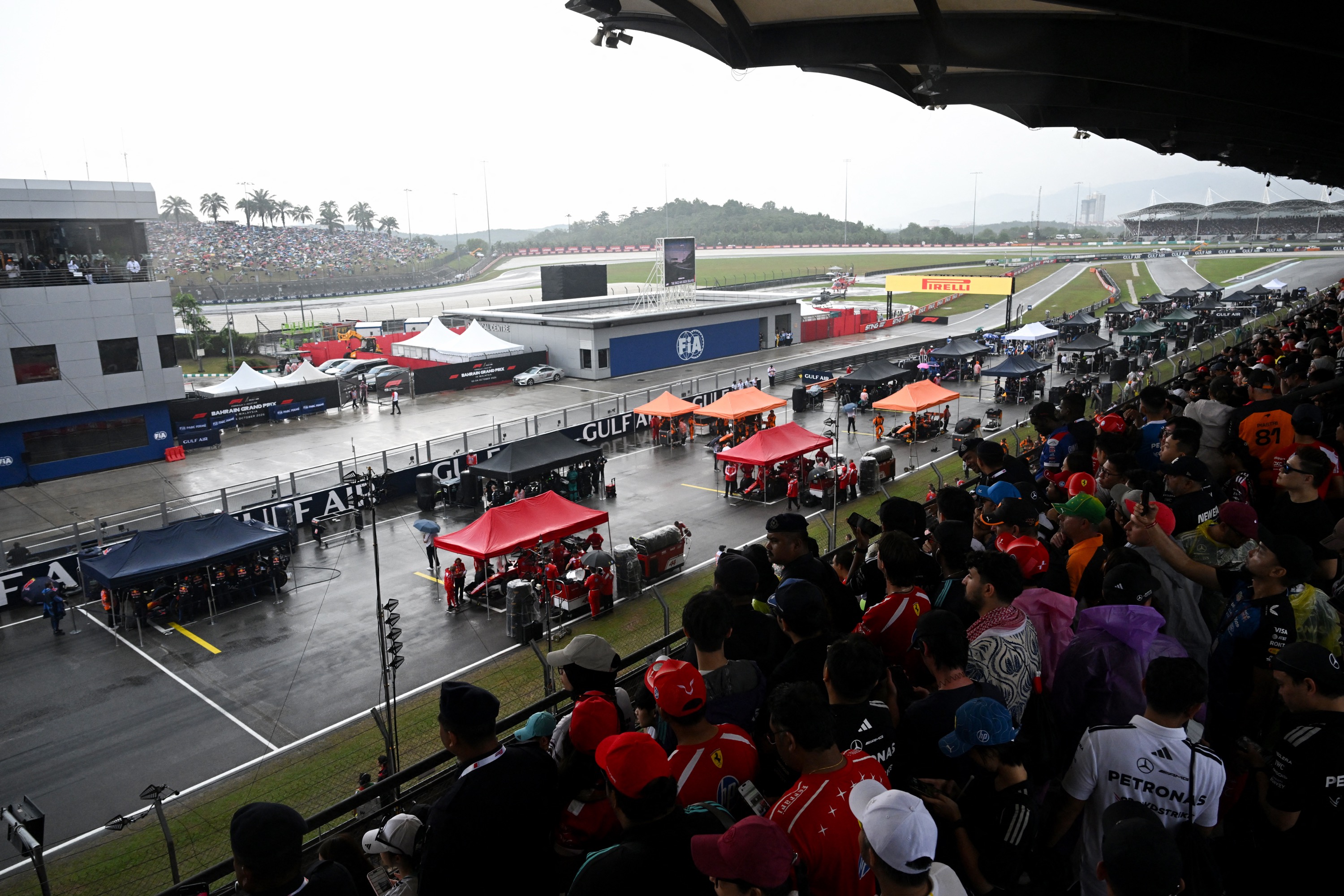
Teams gather around the cars as the start of the race has been delayed due to heave rain at the Formula One Bahrain Grand Prix in Sepang on October 4, 2026. (Photo by JADE GAO / AFP)

The cars assembled on the grid before the first attempt at a race start.

The cars assembled on the grid before the first attempt at a race start. Credit: JADE GAO / AFP

“It was like the Lego race,” said Max Verstappen of Red Bull, referring back to the human-size Lego cars that F1 used for a driver parade at the 2025 Miami Grand Prix. “At some point, we were five-wide on the straight because we couldn’t understand what was going on. Then we did a lap and then I see eight other cars crawling still… I mean that’s not what you want, right, for the sport.”

The race organizers aborted the entire start. The bug had never come up in testing, and the FIA had to hastily write and distribute a software update to fix it. An hour after the first aborted start, the cars lined up on the grid again, ready to finally race.

“In wet conditions, there are some different software settings for the cars for safety reasons to reduce the power in certain sectors from the maximum to a lower level,” explained Nikolas Tombazis, head of single-seater racing at the FIA. “And this year, we’ve had very little wet weather running or none at all, almost. So it wasn’t maybe adequately checked.”

The software was developed by the FIA with the teams and engine makers. “So it’s common software for all cars,” Tombazis said. “And basically there was a combination of events between those software settings and the fact that some cars went incredibly slow during the formation lap and those entered a sort of a bug into the software which was stopping those cars to reaccelerate and to go to normal speeds.”

“And as a result of that, we had quite a few cars affected by that problem and which caused them to stop,” Tombazis said. “Perhaps I should also add that as soon as the formation lap problems happened, we understood the problem very soon afterward and we issued some an updated software to the teams. It took about sort of 20 minutes for the software to be issued. Some explanations teams had to update the software in the car. They had to ask a couple of questions and we had to make sure they all had done that work. So all of that took maybe about 20 minutes or so and so that was what caused that delay for the second start.”

(Indeed, the delay led Verstappen to joke that his team got their update applied faster thanks to their Oracle-supplied data connection.)

More chaos

The delay to the start was long enough that the rain had abated and the puddles of standing water had all drained, leading just over half the grid to gamble that it was dry enough to risk starting on either the soft or medium slick. Only nine drivers opted for the intermediate tire, including Verstappen (on pole), championship leader Kimi Antonelli, and his Mercedes teammate George Russell. Lewis Hamilton, starting second, was among those choosing to start on either the soft or medium slick tire; this was a mistake, as the formation lap proved the track was still much wetter than expected—too wet for slicks, certainly.

So it wasn’t a surprise to see the slick-shod cars quickly left behind as they struggled to put down power on the wet tarmac. Despite being on the intermediates, Verstappen got a terrible start and was left in third, behind both Mercedes.

“I was not surprised because my start was horrendous,” Verstappen said. “Again, dropping the clutch and not having power. The engine just completely died on me. But then you just have to settle in, try not to overreact as well, and just slot in, try to keep your position there. The race is long, a lot of things can happen, and step by step, I could close the gap.”

And he did, passing Russell on lap six and then closing up behind Antonelli quickly thereafter.

KUALA LUMPUR, MALAYSIA - OCTOBER 4: Andrea Kimi Antonelli of Italy driving the (12) Mercedes W17 on track leading the race withe the other cars following behind into turn one during the F1 Grand Prix of Bahrain in Malaysia at Sepang Circuit on October 4, 2026 in Kuala Lumpur, Malaysia. (Photo by Jayce Illman/Getty Images)

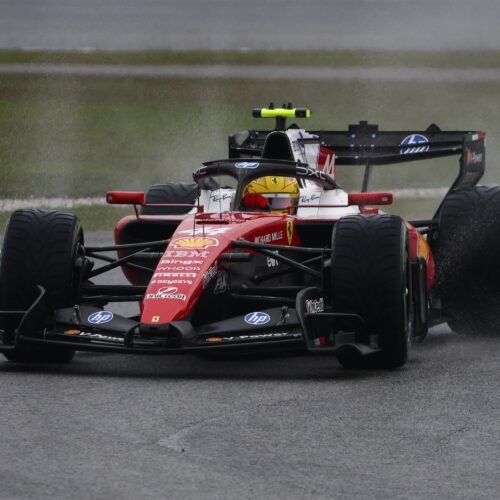
Lewis Hamilton and the other slick-shod cars got left behind at the start as track conditions proved far too wet for their tires.

Lewis Hamilton and the other slick-shod cars got left behind at the start as track conditions proved far too wet for their tires. Credit: Jayce Illman/Getty Images

Meanwhile, at the back of the pack, some of the drivers who started on slicks made stops to change to the intermediates. McLaren’s Oscar Piastri was among the first who quickly began scything through the field; within a lap, he’d caught up and passed everyone who went by as he stopped. Others followed suit, though Hamilton was not among them, telling his race engineer on lap 5 that he’d gamble on the conditions coming back to suit him. It was a decision that would show the depth of experience that the seven-time world champion brings to the sport.

The race restarted on lap 13, and Verstappen pounced on Antonelli, taking the lead, with Russell following into second. Hamilton, meanwhile, was in 15th, although not for long. Within a lap, he was up to 11th. Within 10 laps of the restart, he was in 5th.

Slightly further back, another legend of the sport was also having a good day.

Fernando Alonso’s Aston Martin might have been a laughingstock at the start of the season, as it was multiple seconds slower than the cars of the frontrunners, but the Adrian Newey-designed aerodynamic update that arrived in Hungary closed some of the gap to the rest of the field. And Honda has now introduced a second power unit upgrade that has helped drivability even while at a power deficit to the others. It’s not quite as effective a package as Hamilton’s Ferrari, but Alonso began moving forward, and by lap 40, he was in 10th place, the final points-paying position.

KUALA LUMPUR, MALAYSIA - OCTOBER 4: Fernando Alonso of Spain driving the (14) Aston Martin AMR26 on track during the F1 Grand Prix of Bahrain in Malaysia at Sepang Circuit on October 4, 2026 in Kuala Lumpur, Malaysia. (Photo by Jayce Illman/Getty Images)

Fernando Alonso will race in F1 for at least one more year; he entered the sport in 2001.

Fernando Alonso will race in F1 for at least one more year; he entered the sport in 2001. Credit: Jayce Illman/Getty Images

Up front, Verstappen was building a commanding lead, and Antonelli had overtaken Russell for second, having first asked the team unsuccessfully if they’d simply tell Russell to let him by.

Extra chaos

Then Alex Albon’s Williams suffered a gearbox failure on lap 43, triggering a virtual safety car. Verstappen and Hamilton stopped for tires, followed a lap later by Antonelli, Russell, and the other Red Bull of Isack Hadjar. The broken transmission of the Williams prevented it from being easily moved, so a full safety car was declared, bunching the pack up.

The race would restart on lap 52 (of 55), but not before Russell came to a stop by the side of the track just past the pit exit on lap 50. “Another [power unit] failure, when we were on course for a pretty certain podium. It’s a tough one to take. It’s unfortunately happened too many times this season, and, yeah, this is just where we are,” Russell said after the race as he acknowledged his title chances for 2026 were over.

The final three laps were frenetic. Hamilton passed Hadjar for third, a wonderful recovery drive back to the podium after being more than a minute off the lead at one point during the race. His Ferrari teammate Charles Leclerc trailed behind, also passing the second Red Bull and fully salvaging Ferrari’s day. Ahead of the red cars, Antonelli was closing down on Verstappen but without being close enough to attempt an overtake. And Alonso was making moves, too, ending his day in eighth place, Aston’s best finish of the year.

Everyone knows this looks bad

KUALA LUMPUR, MALAYSIA - OCTOBER 04: Race winner Max Verstappen of the Netherlands and Oracle Red Bull Racing Second placed Andrea Kimi Antonelli of Italy and Mercedes AMG Petronas F1 Team and Third placed Lewis Hamilton of Great Britain and Scuderia Ferrari on the podium during the F1 Grand Prix of Bahrain in Malaysia at Sepang Circuit on October 04, 2026 in Kuala Lumpur, Malaysia. (Photo by)

Kimi Antonelli (R) looks set to join Max Verstappen (M) and Lewis Hamilton (R) as one of F1’s greats.

Kimi Antonelli (R) looks set to join Max Verstappen (M) and Lewis Hamilton (R) as one of F1’s greats. Credit: Clive Mason/Getty Images

On a chaotic day, F1’s biggest talents shone their brightest. Between them, Hamilton, Verstappen, and Alonso have 13 world championships, and this year, Antonelli has given every indication his name belongs alongside theirs, even if he does need to do something about his weakness for exceeding track limits. And the racing we got was actually rather thrilling. But some of that was still overshadowed by all the chaos that had to happen first. And everyone knows where to point the finger.

“The power units are exceptionally complicated. The more complicated you make things, the more there is to go wrong. So that is obviously something we need to bear in mind for the future,” said Russell. “It just proves that we shouldn’t have any of that stuff on the electronic side,” said McLaren’s Lando Norris.

“It is clear the regs are extremely complicated for the drivers, for the teams, for the PUs, for the manufacturers. It is too complicated,” said Williams’ Carlos Sainz. “Again, my only question mark is who, five years ago, decided that this was the direction to go? We are doing the best with what we are given as a sport and as regulations. The FIA and F1 are doing the best they can with what was decided four or five years ago, but clearly what was decided four or five years ago is wrong.”

Next year, the power units will be rebalanced with more power from the V6 and less from the electric motor, with another change coming in 2028. Then it’s all change in 2031 (or perhaps 2030), when F1 will likely go back to V8s and much smaller hybrid systems.

US urges citizens in Saudi Arabia to remain ‘vigilant’ over risk of drone, missile attacks

0
us-urges-citizens-in-saudi-arabia-to-remain-‘vigilant’-over-risk-of-drone,-missile-attacks
US urges citizens in Saudi Arabia to remain ‘vigilant’ over risk of drone, missile attacks

The US Embassy in Saudi Arabia on Monday urged American citizens to remain “vigilant” over the current security situation and the potential for drone or missile attacks, Anadolu reports.

In a security alert on the US diplomatic mission’s website, the embassy and consulates in the country encouraged US citizens to follow guidance provided through national alerts issued by Saudi Arabia’s Civil Defense.

The US mission said there had been no change to its security and operational posture.

“Regular and emergency consular services are available for U.S. citizens,” it added.​​​​​​​

Earlier, US Secretary of State Marco Rubio said that the US intends to uphold its bilateral security commitments with Saudi Arabia amid renewed military confrontations involving Houthi forces in Yemen.

Yemen has been mired in conflict since the Houthis seized the capital Sanaa and several provinces in 2014, prompting a Saudi-led coalition to intervene in 2015 in support of the internationally recognized government. A 2022 truce collapsed this July, and fighting has since escalated.

READ: US intends to ‘live by’ security pact with Saudi Arabia: Rubio

Brazil on the brink: Why Lula is down against Bolsonaro Jr

0

With the Brazilian presidential election headed to a runoff, Luiz Inácio Lula da Silva is down 47% to 45% and faces a massive fight ahead. I wanted to give a quick analysis of what happened and where things are going next.

Lula could still win if he can consolidate support from third parties

Lula lost by only 2%, and several third-party candidates, who took a combined 8% of the vote, have publicly indicated they would not endorse Flavio Bolsonaro in the second round.

Likewise, 29 million Brazilians did not vote in this round of the runoff and may be persuaded to vote for Lula in the second round if they fear Bolsonaro.

On Tuesday, the Brazilian Senate is scheduled to vote on a measure that would shorten the Brazilian workweek from six days to five days. Bolsonaro has opposed this measure, and Lula could use the vote to mobilize workers’ support against the Bolsonaro team.

It’s a tough road ahead for Lula, but not impossible.

What hurt Lula in the first round?

Three primary factors hurt Lula in the first round. First, Lula’s age and the fact that the Workers’ Party (PT) has held the presidency in Brazil for 18 of the last 24 years.

The second is that the Brazilian corporate media constantly manufactured scandals against Lula.

Finally, the role that US President Donald Trump played in training and validating the right-wing in Brazil, while not decisive, provided critical support. Here’s what went wrong for Lula.

1. Lula is 80 & his party ruled Brazil for 18 of the last 24 years

Like former US President Joe Biden, one problem Lula faces right now is that he is 80 years old. He doesn’t look as sharp as he used to, while Flavio Bolsonaro is nearly half his age—45 years younger.

Additionally, Lula’s party, the Workers’ Party (PT), has held the presidency for 18 of the last 24 years. Lula and Dilma, both members of the Workers’ Party (PT), held the presidency from 2002 to 2016. Lula was reelected in 2022 for his record third term. No Brazilian has ever won a third term.

Although the PT has rarely controlled Congress, it is seen as the ruling party because it has held the presidency for 18 of the last 24 years. Voters are likely to associate any problems in the country with the PT, which has held the presidency for so long.

While Brasil defeated Jair Bolsonaro narrowly in 2022, it swung right again, much like the United States. Voters are upset, and they are taking it out on the party in power.

Even worse, Lula failed to recruit young candidates, who may have excited voters to turn out in tight races. In what should have been a competitive Senate election in Rio de Janeiro, the PT recruited 84-year-old Bendedita da Silva, who lost in a landslide to Bolsonaro allies.

Last week, Lula skipped the presidential debate; so did Bolsonaro and its unclear how much this decision might have hurt him. Lacking excitement, nearly 29 million Brazilians did not vote despite it being obligatory in Brazil.

2. Brazilian media manufacturing scandals against Lula

The Brazilian media market is extremely consolidated, and the heads of major networks like Globo have been going after Lula hard. They have been accused of manufacturing scandals against Lula.

Last November, the financial institution Banco Master collapsed amid allegations of massive fraud. The bank was being run like a Ponzi scheme, resulting in the largest financial collapse in Brazilian history, with nearly US$8 billion in investors’ funds lost.

Despite Banco Master CEO Daniel Vorcaro being a very vocal Bolsonaro supporter, the Brazilian media has repeatedly tried to link the scandal to Lula’s Workers’ Party, as Vorcaro cultivated political ties on both sides of the aisle.

Lula’s son, businessman Fabio Luis da Silva, commonly known as “Lulinha,” was scrutinized over large bank accounts worth millions of dollars. For months, Lulinha has offered to open his books and has claimed that he received no special favors from Banco Master. Still, the media repeatedly raised questions about Lulinha’s alleged impropriety.

At one point, media giant TV Globo made a giant infographic web with arrows, showing a complex network linked to Lula. Other reporters widely ridiculed the conspiracy theory map, and TV Globo eventually had to apologize publicly on air.

Then, in May, The Intercept Brasil released a WhatsApp message from Flavio Bolsonaro to Vorcaro, asking him for more than $26 million to fund a strange English-language biopic named Dark Horse, about his father. In the film, Jair Bolsonaro is portrayed by right-wing American actor Jim Caviezel, who played Jesus in the controversial 2004 film The Passion of the Christ.

Polling throughout the spring and summer showed Lula leading as the scandal remained fresh in people’s minds. Then, the Brazilian corporate media went into high gear to attack Lula. They went after Supreme Court Justice Alexandre de Moraes, who led the prosecution that jailed Bolsonaro.

Moraes has accused Brazilian Supreme Court Justice André Mendonca, a Bolsonaro appointee, of failing to follow proper procedure in his handling of the Banco Master scandal, leaking information to the press on Lula’s political allies while hiding information on Bolsonaro’s allies.

Moraes asked the Brazilian Federal police to investigate Mendonça’s violation of federal investigation procedures and for selectively leaking information to the press that would make Lula allies look bad while suppressing information on Bolsonaro allies.

Moraes accused Mendonça of attempting to “steer the production of evidence toward falsely accusing Supreme Court justices of crimes, expressly naming Justices Gilmar Mendes, Dias Toffoli, Luiz Fux, Alexandre de Moraes, and Nunes Marques, as well as the prosecutor general and the director-general of the Federal Police.”

3. Trump trained and emboldened Bolsonaro allies

While I don’t want to underestimate the strength of fascists within Brazil, it’s important to note that Trump and his operatives did help the Bolsonaro family pull off an impressive comeback.

In March 2025, Eduardo Bolsonaro fled to the United States rather than face prosecution in Brasil for his role in trying to orchestrate a coup, and he was granted permanent residency status in July.

While in the United States, Eduardo Bolsonaro has worked closely with Trump officials, including Special Presidential Envoy for Special Missions Richard Grenell, to oust Lula from power.

“It was a privilege to speak with Ambassador Richard Grenell at President Trump’s residence at Mar-a-Lago,” Eduardo Bolsonaro wrote on Instagram following a meeting with Grenel in 2025. “The conservative movement is global—and we are just getting started.”

Eduardo Bolsonaro worked closely with top Trump aides like Brad Parscale, Trump’s director of digital strategy, to learn the social media strategy that led Trump to win reelection.

As president, Trump worked hard to attack Lula. He placed punitive tariffs on Brazil for convicting Jair Bolsonaro, Eduardo’s father, for attempting to assassinate Lula and overthrow his government in 2022. These tariffs hurt Brazil’s economy.

More importantly, Trump’s constant denunciation of the jailing of Bolsonaro validated conspiracy theories of right-wingers that the justice process was flawed. When Alexandre de Moraes, who led Bolsonaro’s conviction, was implicated in the Banco Master scandal, it only reinforced these conspiracy theories.

Ahead of the Brazilian presidential election, the Trump administration has labeled Brazil as a major distributor of cocaine and attempted to paint Lula as weak on taking on drug gangs.

In June, the Trump administration labeled two gangs as “terrorist organizations,” something which the Lula administration has repeatedly resisted because of fears of how the Trump administration could intervene in law enforcement and military matters in Brazil.

Still, every attack on Lula by the Trump administration generated headlines in Brasil and validated the wild claims made by Bolsonaro allies of a flawed Brazilian justice system.

On Friday, the Trump administration closed its embassy in Brasil and all of its consulates in a move that many saw as a scare tactic designed to interfere once again in the Brazilian presidential election.

The same day, the Brazilian federal police and intelligence service ABIN were warning of a possible US coup attempt. It was already known that Trump operatives were training operatives in Brasil, and the Brazilian federal police report described in depth how much Trump’s intervention had shifted things in Brasil.

International media failed to check Brazilian media

Finally, the international media completely ignored the Brazilian presidential election, allowing corporate media within Brasil to dominate the conversation without any accountability from the international media.

There are still three weeks until the next round, and Lula could still win, but it’s gonna take a massive fight. Part of that fight is changing how the international media covers things.

Mike Elk is the senior labor reporter at Payday Report and member of the Washington-Baltimore NewsGuild. He previously served as senior labor reporter at POLITICO and at In These Times Magazine.

–Common Dreams via PayDay Report

Controlling the brain with light earns a physiology Nobel

0
controlling-the-brain-with-light-earns-a-physiology-nobel
Controlling the brain with light earns a physiology Nobel

Over decades of research, scientists have built up a partial picture of what specialized cells within the brain and spinal cord do. By studying how the brain develops, they could identify genes that were active in different populations of neurons and where in the brain those neurons resided. In some cases, these genes could then be used to genetically delete the neurons, allowing us to get some indication of what they might be doing, building on the information we’ve obtained from studies of brains with damaged regions.

But this approach has its limits. The brain is flexible enough to potentially adapt to the loss of some cells, and their loss early in development may alter the development of any neurons they would have normally formed connections with. It would be far more informative to activate and shut down the neurons in an otherwise intact brain.

Today’s Nobel Prize in Physiology or Medicine rewards three people—Karl Deisseroth, Peter Hegemann and Georg Nagel—who developed our ability to do precisely that. Starting from studies of single-celled algae that are attracted to light, these and many other researchers built an entire field of study that we now call optogenetics: using light to alter the behavior of nerve cells marked by the activity of individual genes.

From algae to human cells

Nerve impulses are generated by proteins called ion channels, which sit in the membrane and allow charged atoms to cross it. The nervous system uses a population of ion channels that are only active under specific circumstances, like when they sense a neurotransmitter or experience voltage changes. It’s this fine level of control that allows specialized nerve cells to send impulses only under specific circumstances, keeping the brain from descending into a haze of electrical noise.

So if we want to find out what any of the multitudes of specialized nerve cells might be doing, the easiest way is to hijack this system: force the cell to send ion-based impulses when we tell it to, and see how the animal’s behavior changes.

The Nobel Committee notes that this idea was obvious enough that people tried several methods of doing so before developing optogenetics. But it turns out “the easiest way” did not mean “easy,” and most of these methods didn’t end up widely used because they involved some combination of needing to insert multiple genes, supplying the nerve cells with some very specific chemicals, or using lasers at an intensity that physically damaged the cells.

The ultimate solution, it turned out, was lurking in a single-celled algae called Chlamydomonas. The organism’s single cell is remarkably complicated, having two flagella that help it move around, and an eye spot that detects the light it moves toward. People had been studying the organism for quite some time as a model for basic biological processes.

This is where Hegemann, then working at Berlin’s Humboldt University, entered the picture. He and his coworkers managed to hook an electrode up to a Chlamydomonas and showed that exposing it to a flash of light resulted in a very rapid influx of ions, suggesting the light was triggering an ion channel to open. As other scientists started scanning the messenger RNAs made by Chlamydomonas, Hegemann spotted a couple of genes that were similar to a light-activated ion pump found in an archaeal species.

Suspecting these might be responsible for the ion fluxes in Chlamydomonas, Hegemann used RNA interference to block their activity. This did limit the flow of ions in response to light, clearly implicating these genes in the organism’s light sensing.

At that point, Hegemann started an extended collaboration with Nagel, then at the University of Würzburg, an expert in ion fluxes. They showed that one of the two genes was selective for only letting protons (which you can think of as a hydrogen ion) into the cell, while the other would allow a broad range of positively charged ions through. They were also sensitive to somewhat different wavelengths of light. The proteins also used a chemical relative of Vitamin A to sense light, just as the receptors in our eyes do. Collectively, this class of proteins is now termed “channelrhodopsins.”

Nagel was instrumental in broadening the use of channelrhodopsins, showing that the genes that encode these proteins could work everywhere from developing frog embryos to cultured human cells. He went on to show that, when active in the neurons of a small worm called C. elegans, exposing the worms to light could cause them to alter their behavior.

Lighting up the brain

Deisseroth and his coworkers at Stanford then played key roles in developing this into a broadly useful technology. They showed that the channelrhodopsins work in neurons, and the ion fluxes they trigger are transmitted as nerve impulses. They also found more members of the channelrhodopsin family, some of which are sensitive to different wavelengths of light. A version that allows negatively charged chlorine ions into the cell was also discovered, allowing researchers to selectively shut down nerve cells.

At the same time, Deisseroth and his team worked on the engineering side of the problem, developing compact light sources and small, flexible fiber optics that allowed the system to act in the brains of animals that were free to move about and behave relatively normally.

The result has been nothing short of a revolution in our ability to understand what different populations of nerve cells are doing. If we know a gene is active in a small population of nerve cells, then we can use the mouse version of that gene to activate channelrhodopsin there and start testing how light changes the behavior of the resulting mice.

We’ve described work that relies on optogenetics a dozen times or more. And the Nobel Committee cites its use in everything from understanding how memories are stored to figuring out what signals wake mice from sleep. In one amazing set of experiments they note, a research group took an area of the brain known to be needed for maternal care and showed it contained specialized cells that performed one of a long list of functions, like triggering mothers to search for their pups, or governing physical interactions with them.

Channelrhodopsins have even been used to restore limited light sensing in a patient with a form of blindness in which their rod and cone cells die off.

One of the clearest signs of how significant this development is has been the widespread adoption of optogenetics. While the three people being honored made key contributions to its development, they have only made a relatively small contribution to its use. Instead, the studies we see that rely on optogenetics are largely done by other people who recognized its utility and refined and extended it.

The award is also very timely for the US, where the current administration has been pushing for cutbacks in fundamental research and shifting funding to its priorities in applied fields like AI and quantum computing. It’s hard to imagine a more fundamental scientific question than “how does this bit of pond scum move to ensure it gets enough light for photosynthesis?” And it’s definitely the sort of question that gets asked without any sense that the answers would ultimately have practical applications.

But science’s story, again and again, has been one where seemingly trivial research has revolutionized entire fields of study and ultimately had implications for human health and technology. The Nobel Prize Committee, in honoring a clear breakthrough, has inadvertently provided us with a reminder of that story.

0FansLike
0FollowersFollow
0FollowersFollow
0SubscribersSubscribe
- Advertisement -
Google search engine

Recent Posts