13.1 C
London
Tuesday, October 6, 2026
Home Blog

F1 in Bahrain… in Malaysia: The race needed a software update to start

0
f1-in-bahrain…-in-malaysia:-the-race-needed-a-software-update-to-start
F1 in Bahrain… in Malaysia: The race needed a software update to start

Well, it’s safe to say no Bahrain Grand Prix has been affected by torrential rain quite like the 2026 race.

For one thing, it was held several thousand miles from Bahrain itself. The ongoing war with Iran ruled such things out, so the Sepang International Circuit in Malaysia stepped in to fill its spot. One of the best examples of a late-’90s “Tilke track”—named for its designer, Herman Tilke—it’s characterized by a couple of long straights and the always-brutal tropical weather that provides one of the toughest physical challenges on the calendar. And this weekend was no exception.

Heavy rain arrived about half an hour before the start time, delaying things significantly. Although the sport has two different kinds of treaded tires for use in the rain, the full wet tire generates so much spray, and such slow lap times, that it’s essentially only useful for circulating behind the safety car. If it’s wet enough to need it, it will be too wet to see where you’re going. The intermediate tire, by contrast, has much shallower grooves and is good for racing on damp but not soaked tracks, although it quickly overheats and degrades as the track dries.

Chaos ensues

The organizers decided on two formation laps behind the safety car; circulating at lower speed would allow the drivers to get an idea of the track conditions and let their intermediate tires pump some water off the track surface, the idea went. But that didn’t take into account a bug lurking in the cars’ software.

Driving slowly behind the safety car with reduced hybrid power in some parts of the track due to the extremely wet conditions convinced several of the cars that they were being tricked into breaking a hard-coded rule meant to prevent cheating, triggering an automatic 60-second shutdown of their electric motors that caused chaos as car after car slowed for the one in front, then took varying lengths of time to reboot their systems.
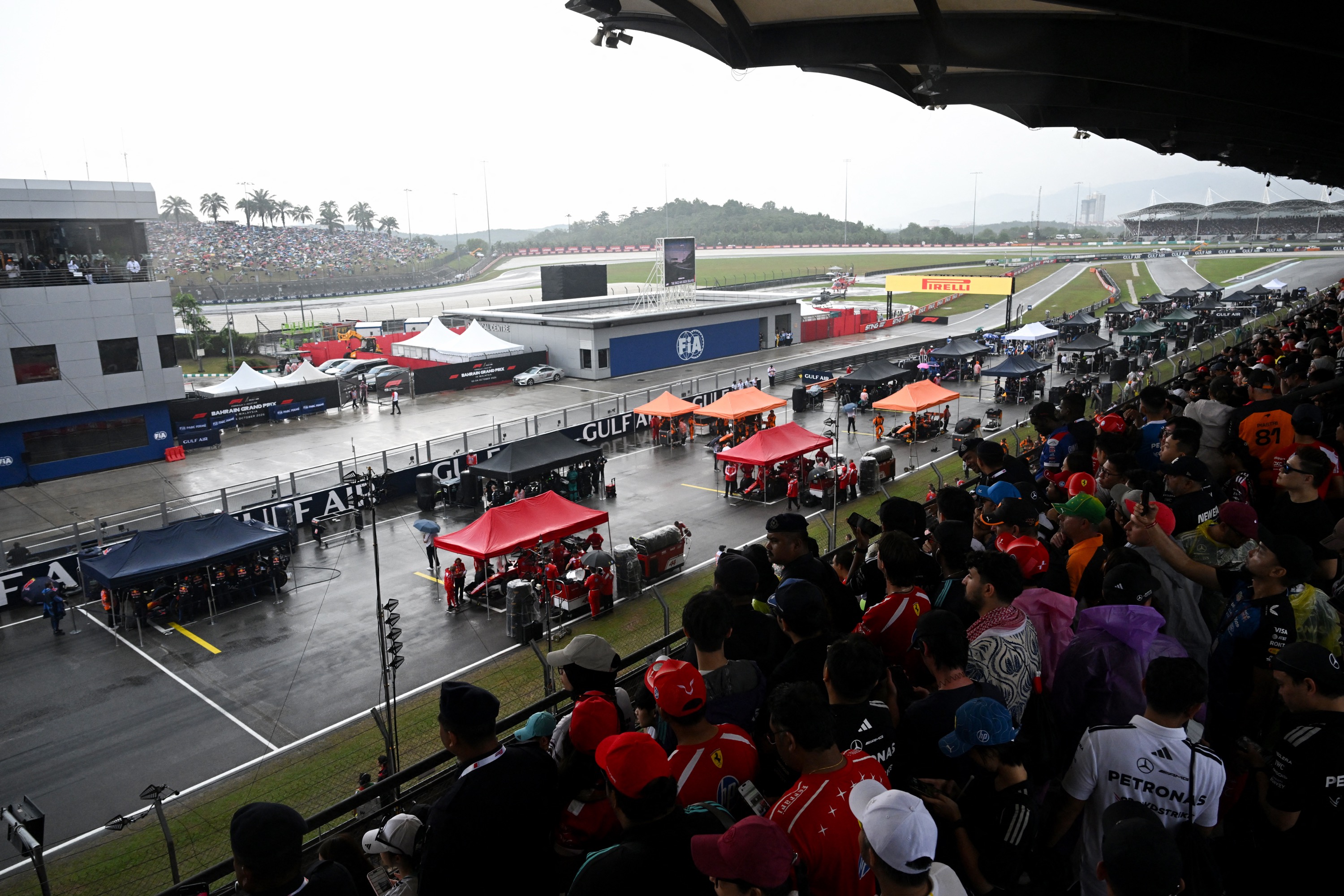
Teams gather around the cars as the start of the race has been delayed due to heave rain at the Formula One Bahrain Grand Prix in Sepang on October 4, 2026. (Photo by JADE GAO / AFP)

The cars assembled on the grid before the first attempt at a race start.

The cars assembled on the grid before the first attempt at a race start. Credit: JADE GAO / AFP

“It was like the Lego race,” said Max Verstappen of Red Bull, referring back to the human-size Lego cars that F1 used for a driver parade at the 2025 Miami Grand Prix. “At some point, we were five-wide on the straight because we couldn’t understand what was going on. Then we did a lap and then I see eight other cars crawling still… I mean that’s not what you want, right, for the sport.”

The race organizers aborted the entire start. The bug had never come up in testing, and the FIA had to hastily write and distribute a software update to fix it. An hour after the first aborted start, the cars lined up on the grid again, ready to finally race.

“In wet conditions, there are some different software settings for the cars for safety reasons to reduce the power in certain sectors from the maximum to a lower level,” explained Nikolas Tombazis, head of single-seater racing at the FIA. “And this year, we’ve had very little wet weather running or none at all, almost. So it wasn’t maybe adequately checked.”

The software was developed by the FIA with the teams and engine makers. “So it’s common software for all cars,” Tombazis said. “And basically there was a combination of events between those software settings and the fact that some cars went incredibly slow during the formation lap and those entered a sort of a bug into the software which was stopping those cars to reaccelerate and to go to normal speeds.”

“And as a result of that, we had quite a few cars affected by that problem and which caused them to stop,” Tombazis said. “Perhaps I should also add that as soon as the formation lap problems happened, we understood the problem very soon afterward and we issued some an updated software to the teams. It took about sort of 20 minutes for the software to be issued. Some explanations teams had to update the software in the car. They had to ask a couple of questions and we had to make sure they all had done that work. So all of that took maybe about 20 minutes or so and so that was what caused that delay for the second start.”

(Indeed, the delay led Verstappen to joke that his team got their update applied faster thanks to their Oracle-supplied data connection.)

More chaos

The delay to the start was long enough that the rain had abated and the puddles of standing water had all drained, leading just over half the grid to gamble that it was dry enough to risk starting on either the soft or medium slick. Only nine drivers opted for the intermediate tire, including Verstappen (on pole), championship leader Kimi Antonelli, and his Mercedes teammate George Russell. Lewis Hamilton, starting second, was among those choosing to start on either the soft or medium slick tire; this was a mistake, as the formation lap proved the track was still much wetter than expected—too wet for slicks, certainly.

So it wasn’t a surprise to see the slick-shod cars quickly left behind as they struggled to put down power on the wet tarmac. Despite being on the intermediates, Verstappen got a terrible start and was left in third, behind both Mercedes.

“I was not surprised because my start was horrendous,” Verstappen said. “Again, dropping the clutch and not having power. The engine just completely died on me. But then you just have to settle in, try not to overreact as well, and just slot in, try to keep your position there. The race is long, a lot of things can happen, and step by step, I could close the gap.”

And he did, passing Russell on lap six and then closing up behind Antonelli quickly thereafter.

KUALA LUMPUR, MALAYSIA - OCTOBER 4: Andrea Kimi Antonelli of Italy driving the (12) Mercedes W17 on track leading the race withe the other cars following behind into turn one during the F1 Grand Prix of Bahrain in Malaysia at Sepang Circuit on October 4, 2026 in Kuala Lumpur, Malaysia. (Photo by Jayce Illman/Getty Images)

Lewis Hamilton and the other slick-shod cars got left behind at the start as track conditions proved far too wet for their tires.

Lewis Hamilton and the other slick-shod cars got left behind at the start as track conditions proved far too wet for their tires. Credit: Jayce Illman/Getty Images

Meanwhile, at the back of the pack, some of the drivers who started on slicks made stops to change to the intermediates. McLaren’s Oscar Piastri was among the first who quickly began scything through the field; within a lap, he’d caught up and passed everyone who went by as he stopped. Others followed suit, though Hamilton was not among them, telling his race engineer on lap 5 that he’d gamble on the conditions coming back to suit him. It was a decision that would show the depth of experience that the seven-time world champion brings to the sport.

The race restarted on lap 13, and Verstappen pounced on Antonelli, taking the lead, with Russell following into second. Hamilton, meanwhile, was in 15th, although not for long. Within a lap, he was up to 11th. Within 10 laps of the restart, he was in 5th.

Slightly further back, another legend of the sport was also having a good day.

Fernando Alonso’s Aston Martin might have been a laughingstock at the start of the season, as it was multiple seconds slower than the cars of the frontrunners, but the Adrian Newey-designed aerodynamic update that arrived in Hungary closed some of the gap to the rest of the field. And Honda has now introduced a second power unit upgrade that has helped drivability even while at a power deficit to the others. It’s not quite as effective a package as Hamilton’s Ferrari, but Alonso began moving forward, and by lap 40, he was in 10th place, the final points-paying position.

KUALA LUMPUR, MALAYSIA - OCTOBER 4: Fernando Alonso of Spain driving the (14) Aston Martin AMR26 on track during the F1 Grand Prix of Bahrain in Malaysia at Sepang Circuit on October 4, 2026 in Kuala Lumpur, Malaysia. (Photo by Jayce Illman/Getty Images)

Fernando Alonso will race in F1 for at least one more year; he entered the sport in 2001.

Fernando Alonso will race in F1 for at least one more year; he entered the sport in 2001. Credit: Jayce Illman/Getty Images

Up front, Verstappen was building a commanding lead, and Antonelli had overtaken Russell for second, having first asked the team unsuccessfully if they’d simply tell Russell to let him by.

Extra chaos

Then Alex Albon’s Williams suffered a gearbox failure on lap 43, triggering a virtual safety car. Verstappen and Hamilton stopped for tires, followed a lap later by Antonelli, Russell, and the other Red Bull of Isack Hadjar. The broken transmission of the Williams prevented it from being easily moved, so a full safety car was declared, bunching the pack up.

The race would restart on lap 52 (of 55), but not before Russell came to a stop by the side of the track just past the pit exit on lap 50. “Another [power unit] failure, when we were on course for a pretty certain podium. It’s a tough one to take. It’s unfortunately happened too many times this season, and, yeah, this is just where we are,” Russell said after the race as he acknowledged his title chances for 2026 were over.

The final three laps were frenetic. Hamilton passed Hadjar for third, a wonderful recovery drive back to the podium after being more than a minute off the lead at one point during the race. His Ferrari teammate Charles Leclerc trailed behind, also passing the second Red Bull and fully salvaging Ferrari’s day. Ahead of the red cars, Antonelli was closing down on Verstappen but without being close enough to attempt an overtake. And Alonso was making moves, too, ending his day in eighth place, Aston’s best finish of the year.

Everyone knows this looks bad

KUALA LUMPUR, MALAYSIA - OCTOBER 04: Race winner Max Verstappen of the Netherlands and Oracle Red Bull Racing Second placed Andrea Kimi Antonelli of Italy and Mercedes AMG Petronas F1 Team and Third placed Lewis Hamilton of Great Britain and Scuderia Ferrari on the podium during the F1 Grand Prix of Bahrain in Malaysia at Sepang Circuit on October 04, 2026 in Kuala Lumpur, Malaysia. (Photo by)

Kimi Antonelli (R) looks set to join Max Verstappen (M) and Lewis Hamilton (R) as one of F1’s greats.

Kimi Antonelli (R) looks set to join Max Verstappen (M) and Lewis Hamilton (R) as one of F1’s greats. Credit: Clive Mason/Getty Images

On a chaotic day, F1’s biggest talents shone their brightest. Between them, Hamilton, Verstappen, and Alonso have 13 world championships, and this year, Antonelli has given every indication his name belongs alongside theirs, even if he does need to do something about his weakness for exceeding track limits. And the racing we got was actually rather thrilling. But some of that was still overshadowed by all the chaos that had to happen first. And everyone knows where to point the finger.

“The power units are exceptionally complicated. The more complicated you make things, the more there is to go wrong. So that is obviously something we need to bear in mind for the future,” said Russell. “It just proves that we shouldn’t have any of that stuff on the electronic side,” said McLaren’s Lando Norris.

“It is clear the regs are extremely complicated for the drivers, for the teams, for the PUs, for the manufacturers. It is too complicated,” said Williams’ Carlos Sainz. “Again, my only question mark is who, five years ago, decided that this was the direction to go? We are doing the best with what we are given as a sport and as regulations. The FIA and F1 are doing the best they can with what was decided four or five years ago, but clearly what was decided four or five years ago is wrong.”

Next year, the power units will be rebalanced with more power from the V6 and less from the electric motor, with another change coming in 2028. Then it’s all change in 2031 (or perhaps 2030), when F1 will likely go back to V8s and much smaller hybrid systems.


US urges citizens in Saudi Arabia to remain ‘vigilant’ over risk of drone, missile attacks

0
us-urges-citizens-in-saudi-arabia-to-remain-‘vigilant’-over-risk-of-drone,-missile-attacks
US urges citizens in Saudi Arabia to remain ‘vigilant’ over risk of drone, missile attacks

The US Embassy in Saudi Arabia on Monday urged American citizens to remain “vigilant” over the current security situation and the potential for drone or missile attacks, Anadolu reports.

In a security alert on the US diplomatic mission’s website, the embassy and consulates in the country encouraged US citizens to follow guidance provided through national alerts issued by Saudi Arabia’s Civil Defense.

The US mission said there had been no change to its security and operational posture.

“Regular and emergency consular services are available for U.S. citizens,” it added.​​​​​​​

Earlier, US Secretary of State Marco Rubio said that the US intends to uphold its bilateral security commitments with Saudi Arabia amid renewed military confrontations involving Houthi forces in Yemen.

Yemen has been mired in conflict since the Houthis seized the capital Sanaa and several provinces in 2014, prompting a Saudi-led coalition to intervene in 2015 in support of the internationally recognized government. A 2022 truce collapsed this July, and fighting has since escalated.

READ: US intends to ‘live by’ security pact with Saudi Arabia: Rubio

Brazil on the brink: Why Lula is down against Bolsonaro Jr

0

With the Brazilian presidential election headed to a runoff, Luiz Inácio Lula da Silva is down 47% to 45% and faces a massive fight ahead. I wanted to give a quick analysis of what happened and where things are going next.

Lula could still win if he can consolidate support from third parties

Lula lost by only 2%, and several third-party candidates, who took a combined 8% of the vote, have publicly indicated they would not endorse Flavio Bolsonaro in the second round.

Likewise, 29 million Brazilians did not vote in this round of the runoff and may be persuaded to vote for Lula in the second round if they fear Bolsonaro.

On Tuesday, the Brazilian Senate is scheduled to vote on a measure that would shorten the Brazilian workweek from six days to five days. Bolsonaro has opposed this measure, and Lula could use the vote to mobilize workers’ support against the Bolsonaro team.

It’s a tough road ahead for Lula, but not impossible.

What hurt Lula in the first round?

Three primary factors hurt Lula in the first round. First, Lula’s age and the fact that the Workers’ Party (PT) has held the presidency in Brazil for 18 of the last 24 years.

The second is that the Brazilian corporate media constantly manufactured scandals against Lula.

Finally, the role that US President Donald Trump played in training and validating the right-wing in Brazil, while not decisive, provided critical support. Here’s what went wrong for Lula.

1. Lula is 80 & his party ruled Brazil for 18 of the last 24 years

Like former US President Joe Biden, one problem Lula faces right now is that he is 80 years old. He doesn’t look as sharp as he used to, while Flavio Bolsonaro is nearly half his age—45 years younger.

Additionally, Lula’s party, the Workers’ Party (PT), has held the presidency for 18 of the last 24 years. Lula and Dilma, both members of the Workers’ Party (PT), held the presidency from 2002 to 2016. Lula was reelected in 2022 for his record third term. No Brazilian has ever won a third term.

Although the PT has rarely controlled Congress, it is seen as the ruling party because it has held the presidency for 18 of the last 24 years. Voters are likely to associate any problems in the country with the PT, which has held the presidency for so long.

While Brasil defeated Jair Bolsonaro narrowly in 2022, it swung right again, much like the United States. Voters are upset, and they are taking it out on the party in power.

Even worse, Lula failed to recruit young candidates, who may have excited voters to turn out in tight races. In what should have been a competitive Senate election in Rio de Janeiro, the PT recruited 84-year-old Bendedita da Silva, who lost in a landslide to Bolsonaro allies.

Last week, Lula skipped the presidential debate; so did Bolsonaro and its unclear how much this decision might have hurt him. Lacking excitement, nearly 29 million Brazilians did not vote despite it being obligatory in Brazil.

2. Brazilian media manufacturing scandals against Lula

The Brazilian media market is extremely consolidated, and the heads of major networks like Globo have been going after Lula hard. They have been accused of manufacturing scandals against Lula.

Last November, the financial institution Banco Master collapsed amid allegations of massive fraud. The bank was being run like a Ponzi scheme, resulting in the largest financial collapse in Brazilian history, with nearly US$8 billion in investors’ funds lost.

Despite Banco Master CEO Daniel Vorcaro being a very vocal Bolsonaro supporter, the Brazilian media has repeatedly tried to link the scandal to Lula’s Workers’ Party, as Vorcaro cultivated political ties on both sides of the aisle.

Lula’s son, businessman Fabio Luis da Silva, commonly known as “Lulinha,” was scrutinized over large bank accounts worth millions of dollars. For months, Lulinha has offered to open his books and has claimed that he received no special favors from Banco Master. Still, the media repeatedly raised questions about Lulinha’s alleged impropriety.

At one point, media giant TV Globo made a giant infographic web with arrows, showing a complex network linked to Lula. Other reporters widely ridiculed the conspiracy theory map, and TV Globo eventually had to apologize publicly on air.

Then, in May, The Intercept Brasil released a WhatsApp message from Flavio Bolsonaro to Vorcaro, asking him for more than $26 million to fund a strange English-language biopic named Dark Horse, about his father. In the film, Jair Bolsonaro is portrayed by right-wing American actor Jim Caviezel, who played Jesus in the controversial 2004 film The Passion of the Christ.

Polling throughout the spring and summer showed Lula leading as the scandal remained fresh in people’s minds. Then, the Brazilian corporate media went into high gear to attack Lula. They went after Supreme Court Justice Alexandre de Moraes, who led the prosecution that jailed Bolsonaro.

Moraes has accused Brazilian Supreme Court Justice André Mendonca, a Bolsonaro appointee, of failing to follow proper procedure in his handling of the Banco Master scandal, leaking information to the press on Lula’s political allies while hiding information on Bolsonaro’s allies.

Moraes asked the Brazilian Federal police to investigate Mendonça’s violation of federal investigation procedures and for selectively leaking information to the press that would make Lula allies look bad while suppressing information on Bolsonaro allies.

Moraes accused Mendonça of attempting to “steer the production of evidence toward falsely accusing Supreme Court justices of crimes, expressly naming Justices Gilmar Mendes, Dias Toffoli, Luiz Fux, Alexandre de Moraes, and Nunes Marques, as well as the prosecutor general and the director-general of the Federal Police.”

3. Trump trained and emboldened Bolsonaro allies

While I don’t want to underestimate the strength of fascists within Brazil, it’s important to note that Trump and his operatives did help the Bolsonaro family pull off an impressive comeback.

In March 2025, Eduardo Bolsonaro fled to the United States rather than face prosecution in Brasil for his role in trying to orchestrate a coup, and he was granted permanent residency status in July.

While in the United States, Eduardo Bolsonaro has worked closely with Trump officials, including Special Presidential Envoy for Special Missions Richard Grenell, to oust Lula from power.

“It was a privilege to speak with Ambassador Richard Grenell at President Trump’s residence at Mar-a-Lago,” Eduardo Bolsonaro wrote on Instagram following a meeting with Grenel in 2025. “The conservative movement is global—and we are just getting started.”

Eduardo Bolsonaro worked closely with top Trump aides like Brad Parscale, Trump’s director of digital strategy, to learn the social media strategy that led Trump to win reelection.

As president, Trump worked hard to attack Lula. He placed punitive tariffs on Brazil for convicting Jair Bolsonaro, Eduardo’s father, for attempting to assassinate Lula and overthrow his government in 2022. These tariffs hurt Brazil’s economy.

More importantly, Trump’s constant denunciation of the jailing of Bolsonaro validated conspiracy theories of right-wingers that the justice process was flawed. When Alexandre de Moraes, who led Bolsonaro’s conviction, was implicated in the Banco Master scandal, it only reinforced these conspiracy theories.

Ahead of the Brazilian presidential election, the Trump administration has labeled Brazil as a major distributor of cocaine and attempted to paint Lula as weak on taking on drug gangs.

In June, the Trump administration labeled two gangs as “terrorist organizations,” something which the Lula administration has repeatedly resisted because of fears of how the Trump administration could intervene in law enforcement and military matters in Brazil.

Still, every attack on Lula by the Trump administration generated headlines in Brasil and validated the wild claims made by Bolsonaro allies of a flawed Brazilian justice system.

On Friday, the Trump administration closed its embassy in Brasil and all of its consulates in a move that many saw as a scare tactic designed to interfere once again in the Brazilian presidential election.

The same day, the Brazilian federal police and intelligence service ABIN were warning of a possible US coup attempt. It was already known that Trump operatives were training operatives in Brasil, and the Brazilian federal police report described in depth how much Trump’s intervention had shifted things in Brasil.

International media failed to check Brazilian media

Finally, the international media completely ignored the Brazilian presidential election, allowing corporate media within Brasil to dominate the conversation without any accountability from the international media.

There are still three weeks until the next round, and Lula could still win, but it’s gonna take a massive fight. Part of that fight is changing how the international media covers things.

Mike Elk is the senior labor reporter at Payday Report and member of the Washington-Baltimore NewsGuild. He previously served as senior labor reporter at POLITICO and at In These Times Magazine.

–Common Dreams via PayDay Report

Controlling the brain with light earns a physiology Nobel

0
controlling-the-brain-with-light-earns-a-physiology-nobel
Controlling the brain with light earns a physiology Nobel

Over decades of research, scientists have built up a partial picture of what specialized cells within the brain and spinal cord do. By studying how the brain develops, they could identify genes that were active in different populations of neurons and where in the brain those neurons resided. In some cases, these genes could then be used to genetically delete the neurons, allowing us to get some indication of what they might be doing, building on the information we’ve obtained from studies of brains with damaged regions.

But this approach has its limits. The brain is flexible enough to potentially adapt to the loss of some cells, and their loss early in development may alter the development of any neurons they would have normally formed connections with. It would be far more informative to activate and shut down the neurons in an otherwise intact brain.

Today’s Nobel Prize in Physiology or Medicine rewards three people—Karl Deisseroth, Peter Hegemann and Georg Nagel—who developed our ability to do precisely that. Starting from studies of single-celled algae that are attracted to light, these and many other researchers built an entire field of study that we now call optogenetics: using light to alter the behavior of nerve cells marked by the activity of individual genes.

From algae to human cells

Nerve impulses are generated by proteins called ion channels, which sit in the membrane and allow charged atoms to cross it. The nervous system uses a population of ion channels that are only active under specific circumstances, like when they sense a neurotransmitter or experience voltage changes. It’s this fine level of control that allows specialized nerve cells to send impulses only under specific circumstances, keeping the brain from descending into a haze of electrical noise.

So if we want to find out what any of the multitudes of specialized nerve cells might be doing, the easiest way is to hijack this system: force the cell to send ion-based impulses when we tell it to, and see how the animal’s behavior changes.

The Nobel Committee notes that this idea was obvious enough that people tried several methods of doing so before developing optogenetics. But it turns out “the easiest way” did not mean “easy,” and most of these methods didn’t end up widely used because they involved some combination of needing to insert multiple genes, supplying the nerve cells with some very specific chemicals, or using lasers at an intensity that physically damaged the cells.

The ultimate solution, it turned out, was lurking in a single-celled algae called Chlamydomonas. The organism’s single cell is remarkably complicated, having two flagella that help it move around, and an eye spot that detects the light it moves toward. People had been studying the organism for quite some time as a model for basic biological processes.

This is where Hegemann, then working at Berlin’s Humboldt University, entered the picture. He and his coworkers managed to hook an electrode up to a Chlamydomonas and showed that exposing it to a flash of light resulted in a very rapid influx of ions, suggesting the light was triggering an ion channel to open. As other scientists started scanning the messenger RNAs made by Chlamydomonas, Hegemann spotted a couple of genes that were similar to a light-activated ion pump found in an archaeal species.

Suspecting these might be responsible for the ion fluxes in Chlamydomonas, Hegemann used RNA interference to block their activity. This did limit the flow of ions in response to light, clearly implicating these genes in the organism’s light sensing.

At that point, Hegemann started an extended collaboration with Nagel, then at the University of Würzburg, an expert in ion fluxes. They showed that one of the two genes was selective for only letting protons (which you can think of as a hydrogen ion) into the cell, while the other would allow a broad range of positively charged ions through. They were also sensitive to somewhat different wavelengths of light. The proteins also used a chemical relative of Vitamin A to sense light, just as the receptors in our eyes do. Collectively, this class of proteins is now termed “channelrhodopsins.”

Nagel was instrumental in broadening the use of channelrhodopsins, showing that the genes that encode these proteins could work everywhere from developing frog embryos to cultured human cells. He went on to show that, when active in the neurons of a small worm called C. elegans, exposing the worms to light could cause them to alter their behavior.

Lighting up the brain

Deisseroth and his coworkers at Stanford then played key roles in developing this into a broadly useful technology. They showed that the channelrhodopsins work in neurons, and the ion fluxes they trigger are transmitted as nerve impulses. They also found more members of the channelrhodopsin family, some of which are sensitive to different wavelengths of light. A version that allows negatively charged chlorine ions into the cell was also discovered, allowing researchers to selectively shut down nerve cells.

At the same time, Deisseroth and his team worked on the engineering side of the problem, developing compact light sources and small, flexible fiber optics that allowed the system to act in the brains of animals that were free to move about and behave relatively normally.

The result has been nothing short of a revolution in our ability to understand what different populations of nerve cells are doing. If we know a gene is active in a small population of nerve cells, then we can use the mouse version of that gene to activate channelrhodopsin there and start testing how light changes the behavior of the resulting mice.

We’ve described work that relies on optogenetics a dozen times or more. And the Nobel Committee cites its use in everything from understanding how memories are stored to figuring out what signals wake mice from sleep. In one amazing set of experiments they note, a research group took an area of the brain known to be needed for maternal care and showed it contained specialized cells that performed one of a long list of functions, like triggering mothers to search for their pups, or governing physical interactions with them.

Channelrhodopsins have even been used to restore limited light sensing in a patient with a form of blindness in which their rod and cone cells die off.

One of the clearest signs of how significant this development is has been the widespread adoption of optogenetics. While the three people being honored made key contributions to its development, they have only made a relatively small contribution to its use. Instead, the studies we see that rely on optogenetics are largely done by other people who recognized its utility and refined and extended it.

The award is also very timely for the US, where the current administration has been pushing for cutbacks in fundamental research and shifting funding to its priorities in applied fields like AI and quantum computing. It’s hard to imagine a more fundamental scientific question than “how does this bit of pond scum move to ensure it gets enough light for photosynthesis?” And it’s definitely the sort of question that gets asked without any sense that the answers would ultimately have practical applications.

But science’s story, again and again, has been one where seemingly trivial research has revolutionized entire fields of study and ultimately had implications for human health and technology. The Nobel Prize Committee, in honoring a clear breakthrough, has inadvertently provided us with a reminder of that story.

Bolsonaro will face Lula in runoff in Brazil’s presidential vote

0
bolsonaro-will-face-lula-in-runoff-in-brazil’s-presidential-vote
Bolsonaro will face Lula in runoff in Brazil’s presidential vote


Right-wing Brazilian Senator Flavio Bolsonaro will face leftist President Luiz Inacio ‌Lula da Silva in a runoff of the presidential election later this month, after he exceeded expectations in Sunday’s first-round vote with a slight lead over the incumbent.

The election, which centered around the cost of living, corruption and insecurity in Brazilians’ daily lives, follows a string of wins across Latin America by right-wing parties aligned with US President Donald Trump.

Bolsonaro’s stronger-than-expected performance, at 47% of votes versus Lula’s 45%, is expected to buoy his campaign and may bolster Brazil’s currency and stock market, ​which have risen on the prospects of the business-friendly challenger. Private surveys in the run-up to the election had forecast Lula leading the first-round vote by around 3 percentage points.

“Brazil wants change ​and I am very happy with the results,” Bolsonaro told reporters in Brasilia after nearly all tallies were reported, heralding “the end of the era of (Lula’s) Workers’ Party.”

The ⁠senator, son of right-wing former President Jair Bolsonaro, who is serving a 27-year sentence for plotting a coup after losing the 2022 election, now heads to an October 25 showdown with the leftist Lula.

Addressing a crowd at a ​hotel in Sao Paulo, Lula said he had been convinced he would win the election in the first round.

“Starting tomorrow, we begin a new campaign,” he said, promising to show voters what he had accomplished as ​president.

Despite growing worries over Brazil’s public finances and sluggish economic growth, the campaign offered meager policy debate, as both leading candidates skipped the major TV debates.

SURPRISE SHOWING

“The pollsters missed badly,” said Robert Muggah, cofounder of think-tank Igarape Institute. “Expect the runoff polls, which show a dead heat, to understate Bolsonaro as well.”

Early on Sunday, Bolsonaro told journalists in Rio de Janeiro he was counting on “a protest vote from people who would otherwise vote for another candidate but are opposed to Lula.”

Thaise Lima, a 41-year-old lawyer ​on her way to vote in Sao Paulo, said her main goal was to get Lula’s Workers’ Party out of office.

“I don’t think Flavio is the best candidate, but I might decide to vote for ​him in the next few minutes,” she said, adding that she wished psychiatrist and author Augusto Cury were a more viable candidate.

Fernando Tempel, 49, a management consultant, told Reuters he was voting for Bolsonaro despite initially planning to vote ‌for Romeu ⁠Zema, the former governor of Minas Gerais state.

“The protest vote foreshadows what is to come in the runoff,” said political analyst Rafael Favetti. “While this should benefit Flavio Bolsonaro now, his growth potential in the second round drops precisely because that support has already been front-loaded.”

ECONOMIC HEADWINDS

Despite Brazil’s falling inequality and unemployment, Lula has struggled to win over voters grappling with the high cost of living, heavy household debt and the threat of crime and more pervasive gang activity.

Bolsonaro has sought to capitalize on cost-of-living concerns, while Lula moved to ban online gambling and, as the race tightened, expanded welfare and proposed fresh debt relief for families.

Rising spending and public debt ​above 82% of GDP have stoked fiscal concerns that ​Brazil’s next president will need to address. The ⁠government lowered its economic growth forecasts for this year and next to 2.0% and 2.3%, respectively.

“I voted for Brazil to start growing again,” said Marciano de Souza e Silva, a 52-year-old public servant in Brasilia who voted for Flavio.

OVERSHADOWED DEBATE

Scandals and fears of foreign interference ahead of the vote largely overshadowed policy debates during the ​campaign.

Controversy surrounding the now-defunct Banco Master engulfed much of Brazil’s political class after Daniel Vorcaro, who ran the bank, was arrested earlier this year and ​accused of a multibillion-dollar fraud ⁠scheme, which he denies.

A federal police investigation has looked into the banker’s ties to figures across Brazil’s political elite, including Bolsonaro, who is being investigated for suspected money laundering that police have tied to the case. Bolsonaro has denied wrongdoing.

Throughout the campaign, Lula’s allies have warned that the Trump administration might refuse to recognize election results if he wins, pointing to an aborted effort to send US officials to Brazil.

Trump has not formally endorsed a candidate, though he hosted Senator ⁠Bolsonaro at the ​White House and praised him publicly.

Reuters reported on Wednesday that Brazilian intelligence officials briefed a French and German delegation on alleged US ​and Russian interference before the election. The US has rejected claims of interference in Brazil’s affairs.

On Sunday afternoon, Brazil’s electoral court chief Kassio Nunes Marques said the election was running smoothly.

Source:  Reuters

Pakistan, Turkey Agree To Rapid Deployment in Saudi Arabia Under Mecca Defence Agreement

0
pakistan,-turkey-agree-to-rapid-deployment-in-saudi-arabia-under-mecca-defence-agreement
Pakistan, Turkey Agree To Rapid Deployment in Saudi Arabia Under Mecca Defence Agreement


Pakistan, Saudi Arabia and Turkey agreed to begin the “rapid deployment” of military forces and capabilities under the Mecca Joint Defence Agreement as Saudi Arabia escalates operations against the Houthis in Yemen.

Following a meeting in Riyadh, the three countries agreed “to move immediately to the practical implementation of the collective defence commitments and to take the necessary measures to provide the agreed military forces and capabilities and ensure their rapid deployment in the Kingdom,” according to a joint statement.

The Mecca Joint Defence Agreement, signed by Pakistan, Saudi Arabia and Turkey on August 7, 2026, established a collective security arrangement modeled on Article 5 of NATO on the principle that any armed attack against any one of the three states shall be regarded as an attack against them all.

Saudi Defense Minister Khalid bin Salman said the meeting reflected a common position among the three countries in response to attacks against Saudi Arabia and the holy sites.

“The emergency meeting of the Strategic Political and Defense Committee of the Mecca Defense Alliance affirms the solidarity and unified stance of our countries in confronting the sinful aggressions that targeted the Kingdom and the Holy Sanctuaries, activating collective deterrence against these aggressions, and against all those standing behind them within the framework of the Mecca Defense Alliance,” Khalid bin Salman posted on X.

Earlier Monday, a Saudi-led coalition deployed about 100 warplanes as Yemeni government forces launched a major campaign against the Houthis and reported capturing the Bab el Mandeb strait on the Red Sea.

President Rashad al-Alimi announced the operation, named “Dawn of Yemen,” with the stated objectives of dismantling Houthi military capabilities, restoring government control over state institutions, recapturing Sana’a and ending the coup.

A spokesperson said the Giants Brigades and Nation’s Shield Forces had taken control of the Bab el Mandeb area. Yemeni government forces also reported advances around Dhu Bab, including the capture of the airport and control of the route connecting Dhu Bab and Mokha.

‘American Idol’ Alum Sobs While Addressing Daughters Amid Murder Trial (Video)

0
‘american-idol’-alum-sobs-while-addressing-daughters-amid-murder-trial-(video)
‘American Idol’ Alum Sobs While Addressing Daughters Amid Murder Trial (Video)


Former American Idol contestant Caleb Flynn broke down in an Ohio courtroom Monday as devastating statements from his two young daughters were read aloud just moments before a judge sentenced him to spend the rest of his life behind bars for murdering their mother.

Flynn, 40, was sentenced Monday, October 5, to life in prison without the possibility of parole for the February killing of his wife, 37-year-old Ashley Flynn, inside the couple’s Tipp City, Ohio, home.

Miami County Common Pleas Judge Jeannine Pratt delivered the punishment less than a week after a jury found Flynn guilty on all nine counts against him, including aggravated murder, three counts of murder, two counts of felonious assault and three counts of tampering with evidence.

But some of the most emotional moments came before the sentence was announced, when Flynn was forced to listen as his daughters described the devastating toll their mother’s death and their father’s actions had taken on their lives.

One daughter’s statement was read in court by her uncle, Matthew Keyt.

“How could you do such a thing? I looked up to you. I loved you with all my heart,” she wrote.

She described Ashley as “the perfect person” before asking her father what their mother had ever done to make him hate her so much.

The girl also confronted Flynn over the affair prosecutors said helped establish a motive for the killing.

“It was your choice to have an affair. It was your choice to lie to everyone,” she wrote. “It was your choice to leave your only two daughters.”

Flynn’s other daughter delivered an equally painful message through her grandmother, Jill Smith.

She urged her father to finally admit what he had done and accept the consequences, while also telling him to repent to God.

Then came a final blow.

“And by the way, I don’t plan on coming to see you,” she wrote.

Flynn wept as he later addressed his daughters himself.

“The day you both were born were days that forever changed my life for the better,” he told them, saying he had never known a love so fierce until becoming their father.

“Please know your daddy is so proud of you,” he added.

Flynn also admitted during his statement that he had failed the vows he made to Ashley and acknowledged lying about numerous things during the years leading up to her death.

But he stopped short of confessing to the murder.

Instead, he continued to insist he was innocent.

“As I stand here before God, who is my ultimate judge, I am not lying when I say I did not kill my wife,” Flynn told the court.

The jury reached a very different conclusion.

Prosecutors said Ashley was asleep in the couple’s bed on February 16 when Flynn shot her twice in the back of the head.

Flynn then allegedly attempted to make the killing look like the work of a stranger who had broken into their home.

He called 911 and claimed an intruder had entered the house and shot his wife before escaping.

Investigators, however, found problems with that account.

Prosecutors said evidence from inside and around the home did not support Flynn’s story of an unknown burglar. Digital evidence also challenged his account of his movements around the time Ashley was killed.

The murder weapon was never recovered, a point Flynn’s attorneys emphasized while arguing that investigators lacked direct evidence proving he pulled the trigger.

But prosecutors presented jurors with another major piece of their case: Flynn’s extensive communications with Alleigha Botner, a younger woman associated with his church with whom Flynn had been having an affair.

The messages revealed a relationship that had become intensely hostile toward Ashley.

Jurors heard evidence that Flynn and Botner discussed wanting Ashley out of the picture and exchanged messages about her death.

One particularly ominous exchange came shortly before the killing, when Flynn wrote words to the effect that he had chosen Botner and would soon be “free,” followed by a message suggesting action would come the following day.

Ashley was killed hours later.

Prosecutors argued the messages helped establish that the murder was not an impulsive act but part of a calculated effort by Flynn to eliminate his wife and begin a new life.

The couple’s daughters were inside the home when their mother was killed.

At Monday’s sentencing, additional testimony described how Flynn allegedly tried to influence what the girls told investigators after Ashley’s death. Prosecutors argued that his efforts to manipulate his own grieving children compounded the cruelty of the crime.

Judge Pratt made clear she agreed.

“Your actions, Mr. Flynn, were abhorrent,” the judge told him.

She described “layers of deceit, manipulation and cruelty” and criticized Flynn for using his religious faith to manipulate people around him.

Pratt ultimately concluded that Flynn presented an extreme risk of harm and imposed the harshest possible outcome: life behind bars with no chance of parole.

Ashley was remembered throughout the case as far more than the victim at the center of a sensational murder trial.

She was a mother, schoolteacher, volleyball coach and active member of her church community whose family described her as deeply devoted to her children and her faith.

The case drew national attention in part because of Flynn’s unusual background.

Years before the killing, Flynn worked as a music pastor and briefly appeared on Season 12 of American Idol in 2013. During his appearance, he spoke publicly about Ashley’s support for his musical ambitions. He did not advance into the competition’s main televised rounds.

More than a decade later, that image of a supportive marriage became a stark contrast to the evidence jurors heard inside the Miami County courtroom.

After an eight-day trial, the jury needed only about two hours to convict Flynn on every count submitted to them.

His attorneys have continued to maintain that the prosecution’s case was circumstantial and have indicated an appeal is expected.

For Ashley’s daughters, however, Monday brought at least one measure of finality.

Their father will never be eligible to leave prison.

And as one daughter made painfully clear in her statement to him, she has no intention of going there to see him.

For rare earth leverage, US caps aircraft parts licenses to China

0

Washington is limiting the parts it licenses to the Commercial Aircraft Corp of China (Comac), the maker of the C919 passenger jet, triggering fears among Chinese pundits that it could ban the US-made engines the jet relies on.

The Trump administration has been using China’s reliance on US aviation suppliers as leverage in trade talks, as Washington seeks to loosen Beijing’s grip on rare earth minerals, Reuters reported on October 1, citing people familiar with the matter. 

The US Commerce Department has capped the parts licensed to Comac to keep the state-owned planemaker from stockpiling, and has slowed export licensing for airplane parts bound for China in recent weeks, the report said. Officials are also weighing a rule that would make it easier to restrict landing gear and other aircraft parts, and a draft included a licensing requirement for aviation hydraulic fluid.

Chinese commentators said China would not worry much about curbs on landing gear and hydraulic fluid for its Boeing fleet, as Washington wants Chinese airlines to buy more Boeing jets. They do, however, fear a renewed US ban on the C919’s LEAP-1C engines, which could disrupt Comac’s mass production plans for several years.

“China may not need to worry too much about whether the US will use Boeing parts to restrict its aviation industry. The first to panic over such a policy would clearly not be China but Boeing, the pride of American industry,” a Henan-based columnist using the pen name “Global War Dispatch” says in an article.

“China’s market is expected to need 8,000 to 9,000 new airliners over the next two decades. Boeing’s lobbyists will naturally try to persuade US lawmakers to change any proposal that so clearly hurts its core interests,” he says.

He says a US cutoff of parts for the C919 would be the real problem, as the jet still buys relatively few parts from abroad and is seen as a strong future rival to Boeing, giving Boeing and other firms a motive to strangle it.

He adds that if Washington, backed by Boeing’s lobby, did cut off the C919’s LEAP-1C engines and other key US parts, China’s most urgent task would be bringing its own CJ-1000A engine into service, which is unlikely to happen before around 2027.

“The CJ-1000A engine still cannot fully replace the LEAP-1C, and there is still a gap before a domestic engine can take over,” a Shaanxi-based columnist using the pen name “Evening Breeze” says. “In the short term, mass production of the C919 will inevitably hit a bottleneck.”

“The US chokehold on the C919’s engines is also a process that will force Chinese manufacturing to become fully independent. But the road is long, and China has to endure the pain of the next few years,” he says.

He adds that the curbs will only speed up China’s push for home-grown alternatives – trading Washington’s short-term gain for long-term risks, as a Chinese breakthrough would make the next round of aviation competition even fiercer.

The C919, a narrow-body rival to the Boeing 737 and Airbus A320, seats 158 to 192 passengers, according to Comac. It won Chinese certification in September 2022 and entered commercial service in May 2023.

Comac in 2009 chose the LEAP-1C, made by CFM International, a joint venture of GE Aerospace and France’s Safran, as the C919’s sole Western engine. The engine won US and European certification in December 2016.

Washington first used jet engines as a bargaining chip during last year’s tariff war, after Beijing hit back at US tariffs by restricting rare-earth exports.

China restricted rare earth exports in April 2025 in response to US tariffs. The two sides agreed in May to cut tariffs for 90 days, but Washington later that month suspended licenses for Comac jet engines and other parts. It lifted the engine suspension in July, after a rare-earth deal in London.

The engine suspension lasted only five weeks, but regulators then reviewed licenses engine by engine rather than in batches, with each approval taking two to three months. Comac cut its 2025 delivery target to about 25 jets from an ambitious 75, Bloomberg reported in September 2025. It ultimately delivered 15, missing even the revised goal by 40% and barely improving on the 13 it had delivered in 2024.

Rare earth shortfall persists

Washington has grown frustrated that China has not restored the flow of critical minerals it promised under last year’s trade truce. US Treasury Secretary Scott Bessent pressed Chinese Vice Premier He Lifeng on the issue in New York on September 20, just days before the Trump-Xi summit in Washington on September 23-25.

Chinese customs data show rare earth magnet shipments to the US fell 21% month on month to 512 metric tons in August. Chinese customs also recorded zero US-bound shipments of yttrium, used in heat-resistant coatings on jet engine turbine blades, in January, May and June.

Washington is pursuing a two-track strategy. In the long run, it is building supply chains outside China. Since July, Trump has barred defense contractors from using minerals sourced from adversary nations from January 2027, blocked exports of tungsten scrap and battery waste and pledged more than US$2 billion for domestic and allied mineral projects.

In the short run, the US is using tariffs and aircraft-part licenses to push Beijing to ship more, while extending the trade truce only two months, to January 10, 2027. 

Following the Bessent-He meeting in New York, Wang Yanan, editor-in-chief of Aerospace Knowledge magazine, posted a photo online on September 21. Taken on June 30, it shows a Y-20 military transport plane with a CJ-1000A mounted under its left wing, beneath a banner celebrating the engine’s first successful certification test flight.

Because people are not allowed to post images of military aircraft online in China without official approval, the release suggested Beijing wanted Washington to see that its engine program was making progress.

Some Chinese pundits are upbeat. They say that the engine could win certification in 2027 and that, once it enters mass production, any Western attempt to choke the C919 by cutting off supplies would backfire, costing Western suppliers the world’s largest narrow-body market for the next two decades. 

Others, however, have poured cold water on hopes that the CJ-1000A can replace the LEAP-1C any time soon.

“The CJ-1000A has entered the final stage of airworthiness certification, but that does not mean it will be installed and put into commercial use right away,” says a Hubei-based columnist called David. “Passing tests in the lab is a long way from carrying passengers safely every day.”

“The engine has so far completed 6,142 hours of extreme ground testing, simulating 10 years of wear in airline service. The imported LEAP engines, by contrast, have logged 88 million hours in real-world conditions, giving them a reliability rate of 99.95%,” he says.

He says the CJ-1000A still has three major hurdles to clear.

  • Type certificate: The engine completed its technical review in May 2026, but no date has been announced for issuing the certificate.
  • Production certificate: This is expected in 2027 at the earliest, as building one qualified prototype differs greatly from mass-producing hundreds of engines.
  • Installation approval: Fitting a new engine to the C919 is the highest level of design change and requires a full supplementary certification.

He says a full switch to domestic engines on the C919 is unlikely before 2030, with the CJ-1000A expected to fly alongside imported engines until then.

Read: US bans Chinese data center gear as Beijing grounds its AI talent

Follow Jeff Pao on X at @jeffpao3

Texas city demands $2M for public records on Flock usage

0
texas-city-demands-$2m-for-public-records-on-flock-usage
Texas city demands $2M for public records on Flock usage

As bipartisan backlash against Flock grows, some cities are asking anti-surveillance advocates and media outlets to pay eye-popping fees—including charging tens of thousands or even millions—to get information about how police departments are using and potentially abusing AI-enabled camera systems that track every vehicle that passes them.

On Monday, the Texas Tribune reported that city officials in a Fort Worth suburb, North Richland Hills, asked one group to pay $2.3 million before it would fulfill a public records request for Flock data. To reach that high fee, officials claimed that searching “about a terabyte worth of communications about errors, misuse, and effectiveness of the Flock system” would take approximately 14 years of labor at a rate of $15 per hour.

Phil Mynona, who filed the request using a pseudonym on behalf of his group, the Texas Privacy Coalition, told the Tribune that the fee seemed “ludicrous” and designed to stifle his public records searches.

Mynona has sought similar records from more than 200 law enforcement agencies across the US, and he said it was impossible to predict how cities assessed fees for Flock records. Some cities provided more than 400,000 pages of documents for free, while others charged $5,000. Other groups, including a Houston news station called KPRC, have seen officials quote up to $121,000 for Flock records, the Tribune reported.

The high price tags may be hiding data that anti-surveillance groups note have triggered audits, arrests, and changes in how law enforcement uses cameras, including decisions to get rid of cameras. Many cops have been found using the cameras to stalk strangers and people in their personal lives, and so far, Flock has yet to introduce meaningful reforms to confront its stalker cop problem.

Texas is a perfect example of how increasing transparency about police use of Flock cameras works to protect the public from invasive searches that serve no lawful purpose. Last week, an ex-Texas cop, Zachary Anthony Klein, reportedly pled guilty to 100 felony counts of misuse of official information, which he agreed to do in exchange for the state not pursuing charges related to stalking several people. Klein’s Flock abuse—along with another cop’s—was outed after USA Today submitted a public records request that sparked a probe, then his arrest. Disturbed by the case, Texas Governor Greg Abbott quickly halted Flock funding and stopped issuing permits, the Tribune noted.

Additionally concerning are officials who deny requests outright. Consider that the Tribune reported that the state Department of Public Safety has sought help from “the Attorney General’s Office to allow it to withhold the entirety” of Flock data that the Texas Tribune has requested. And that denial came after DPS had already responded to an identical request seeking data from prior weeks, the Tribune noted.

Flock misuse recently ruled unconstitutional

Flock maintains that its automated license plate readers (ALPR) are designed for public safety, while courts have largely agreed that cops can reasonably access Flock databases without infringing Fourth Amendment rights. But ongoingly, there are cases dominating the headlines that show a widening web of privacy risks, including not just illegal surveillance by police but also hackers or bad actors improperly accessing data that can be used to track people’s daily movements.

Courts may start to rethink their stance on Flock, with one federal judge in Oklahoma last week ruling that a cop conducted an unconstitutional search when searching a Flock database simply because a woman’s license plate was from California,” 404 Media reported.

That judge, Sara Hill, argued that Flock’s network “is a type of indiscriminate mass surveillance,” with its ALPR technology creating a “large-scale, dragnet-type surveillance system” that should require a warrant to search.

A Flock spokesperson told 404 Media that the company had nothing to do with the case but expects Hill’s ruling to be an outlier that will likely be appealed and overturned.

Importantly, Hill’s decision does not set any precedent, but it could be influential as one of the first to recognize that Flock searches can be unconstitutional. 404 Media said they reviewed audits showing “there are currently more than a hundred thousand warrantless searches of the Flock system every month.” Sometimes innocent people are arrested, including one man jailed for a month based on a Flock alert that he argued should have itself provided the evidence cops needed to see that he was innocent and five miles away from the crime scene.

For members of the public increasingly scrutinizing Flock cameras over unconstitutional searches and other privacy concerns, it’s hard to know basic things, like where the cameras are posted, who’s looking at the footage, how often the data is accessed, and how long the data is stored.

Public records requests can help answer these questions, and sometimes police choose to voluntarily share it, using optional “transparency portals” that Flock builds. Those portals log statistics like total number of cameras, vehicles scanned, or police searches in a given area.

Flock spokesperson Andrew Smith told the Texas Tribune that the portals “give agencies a public-facing way to publish information about their [ALPR] programs, including policies, usage, and access rules to help communities better understand how the technology is being used.”

However, very few agencies seem to be opting in to the sharing. In Texas, there are hundreds of agencies using Flock cameras, and only 59 agencies use transparency portals, the Tribune reported. Of those, just 16 share data with the public.

Without courts requiring warrants or state and local officials requiring more transparency, Flock cameras will continue tracking movements in ways that the public doesn’t fully understand, advocates warn. And new privacy risks may emerge as AI makes it easier to process data across the ever-broadening network.

Michael Soyfer is a lawyer at the Institute for Justice who “has studied Flock camera abuse and is litigating several cases on Fourth Amendment grounds,” 404 Media noted. He suggested that without more transparency on how police are using the cameras, Flock may end up building tools to support some of these police misuses the public dislikes, such as automating the type of alerts used when tracking vehicle movements that have raised false suspicions or caused wrongful arrests.

“We’re seeing that repeatedly with police flagging whatever they’ll call suspicious patterns of movement. Federal agents were using ALPRs to monitor cars making day trips across the border and back to manufacture a basis to stop them, interrogate the drivers, and search them,” Soyfer told 404 Media. “I think Flock is going to automate that, using AI where cops can set alerts for those kinds of travel patterns.”

MCP for agent-to-agent comms may be the riskiest protocol you’ve never heard of

0
mcp-for-agent-to-agent-comms-may-be-the-riskiest-protocol-you’ve-never-heard-of
MCP for agent-to-agent comms may be the riskiest protocol you’ve never heard of

The adoption of AI agents in millions of organizations is creating new opportunities for attackers to make them take malicious actions, such as exfiltrating database contents and sensitive business and personal information.

In the past five months, Google and four other organizations—with little in common except for their use of AI agents—have acknowledged vulnerabilities that exploit one agent inside a targeted network to spread harmful instructions to other internal agents. The technique is a special form of prompt injection that targets not the LLM but a particular agent, such as one for translation or data analysis. Guardrails inside such agents, if they exist at all, are often lax and will send the instructions to other agents down the chain. Because the latter agent explicitly trusts the first one, it follows the directions.

Unexpected and hard to mitigate

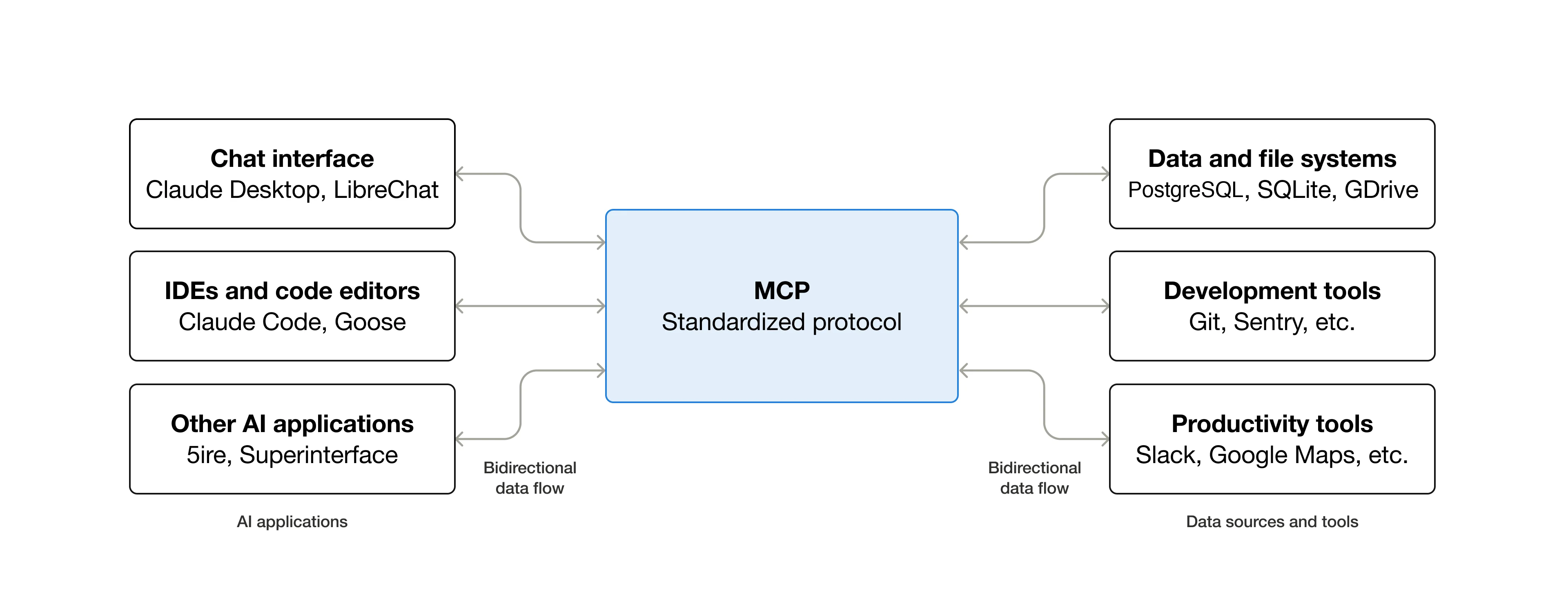
Independent researcher Syed Anas Mohiuddin tested agents from organizations including Google, JP Morgan Chase, Weviate, Rapid7, the French government’s interministerial digital directorate, and the US federal government. His proof-of-concept attacks exploit trust gaps in MCP, short for Model Context Protocol. The standard is one way AI apps and agents communicate with each other inside an internal network. The illustration below shows a simplified MCP in action.

Many special-purpose agents lack the guardrails that might normally mitigate the most harmful consequences of a prompt injection. And since MCP servers store credentials for each agent—and agents are built to trust every other internal agent—an exploit that would have been rejected by the LLM succeeds. In many cases, well-crafted prompts targeting the right agent will lead to a server-side request forgery, a vulnerability that causes a web server to make unauthorized network requests.

“AI agents give attackers a fresh set of connections to walk across,” Douglas McKee, director of vulnerability intelligence at Rapid7, told Ars. “Someone plants text in content, an agent will read it then pass it along to another agent as a normal delegated task, and that second agent runs it because it trusts whoever handed it the work. Every piece in that chain did exactly what it was designed to do, which is what makes this so tricky to catch. Each protocol was built assuming it lived on its own, so each one checks its own front door while nobody watches the hallway in between.”

CVE-2026-97228, the vulnerability Mohiuddin found in Rapid7’s network, carried a severity rating of only 2.7 out of 10. Rapid7 fixed it last month.

The vulnerability affecting Google was more severe, with a rating of 8. It stemmed from an MCP toolbox for databases (googleapis/mcp-toolbox) initializing its HTTP client with no use of a CheckRedirect policy, a series of settings that control how a server is to handle cases of a URL either returning an error or redirecting to a different URL. Google’s HTTP client also failed to validate target IP addresses.

“A crafted path parameter could make the toolbox follow a redirect to an internal endpoint and send requests on the attacker’s behalf,” Mohiuddin explained. Google’s fix involved applying an allow-list of IP ranges and block lists. “It rejects an unsafe base URL at startup instead of on first request. That is what a real SSRF guard looks like. It is also more work than most MCP servers have done.”

Mohiuddin is calling the class of attack “protocol pivoting” because the exploits work when an app or server uses MCP to assign a task to an agent and the agent then forwards malicious instructions to another agent using a different communication method such as Google’s Agent-to-Agent (A2A) protocol, used for inter-agent delegation, or emerging standards such as the Agent Network Protocol. Often, he says, trust or authorization gets effectively lost in translation. He described protocol pivoting as “a multi-step attack in which an adversary gains initial access through one protocol, exploits trust assumptions between protocols, and escalates to capabilities only accessible via a different protocol.”

Markus Vervier, a researcher at X41 D-Sec who has also devised AI attacks that exploit MCP, said the better term remains “prompt injection” and that Mohiuddin’s technique is a simple subclass of that.

“For me this is indirect prompt injection,” he told Ars. “The fact that the malicious prompt can come from a different protocol (e.g., A2A) and manifests when used over another protocol is not strictly required for such attacks to work. It is, of course, unexpected and hard to mitigate in general.”

The fact that the pivoting technique worked across five organizations with nothing in common other than the use of MCP is notable. MCP is new and is already everywhere before it has been sufficiently tested and hardened. In organizations’ rush to build sprawling agentic architectures, they have abandoned a core security principle known as zero trust. Under that model, networks are built with the assumption that one or more nodes may be infected. To mitigate the effects, engineers must design nodes to require authorization before conducting sensitive transactions with other ones.

“The lesson I’d want people to take away is that anything passed from an LLM to your tool should be treated like input from a stranger on the internet, because in a prompt injection scenario that’s exactly what it is,” McKee said. The bugs underneath are old friends like injection and SSRF, and the fixes haven’t changed in 20 years. Credit to the researcher for putting a name on it, because a name is what gets defenders and standards bodies to actually design for it.”

0FansLike
0FollowersFollow
0FollowersFollow
0SubscribersSubscribe
- Advertisement -
Google search engine

Recent Posts