21.1 C
London
Friday, October 2, 2026
Home Blog

UAE Clears Repatriation Flights for 1,800 Stranded Israelis After Overnight Reversal 

0
uae-clears-repatriation-flights-for-1,800-stranded-israelis-after-overnight-reversal 
UAE Clears Repatriation Flights for 1,800 Stranded Israelis After Overnight Reversal 


Around 1,800 Israelis stranded in the UAE are expected to begin returning home aboard Israeli carriers after the UAE restored permission for repatriation flights following overnight security discussions, the Transportation Ministry said. 

Flydubai’s suspension of Israel service following the cockpit attack and attempted hijacking aboard flight FZ1073 from Dubai to Tel Aviv left the passengers without their scheduled flights. 

Plans to bring them back were thrown into uncertainty when the UAE withdrew its authorization overnight. Officials from the Shin Bet, Civil Aviation Authority and Transportation Ministry, along with Israeli Ambassador to the UAE Yossi Shelley, held talks before approval was restored. 

“It was agreed that flights operated by Israeli airlines from Dubai to Israel would begin on Friday,” the Transportation Ministry announced. 

Departures nevertheless faced delays while security arrangements were completed. 

“Due to the need to complete the necessary preparations and coordination with security authorities for the operation of the flights, a delay is expected in the departure of repatriation flights from Dubai,” the ministry said. 

Arkia secured approval and put tickets on sale beginning at $279. The carrier said it would operate one flight Friday and another Saturday. 

“Following extensive discussions and intensive efforts by all parties involved, Arkia has received the necessary approvals to operate flights from Dubai and will operate one flight today and another tomorrow,” the airline said. 

Israir is also expected to participate in Saturday’s operation, with tickets priced at $299 one-way. Five flights operated by the two carriers are expected to leave the UAE that day. 

El Al’s plans were disrupted by the delay. Two Friday departures scheduled for 11:00 a.m. and 1:00 p.m. were canceled, and another flight is likely Saturday night. Service is also scheduled for Sunday, Monday, Wednesday and Thursday next week. 

Demand quickly exhausted El Al’s available seats. Its $249 Lite fares sold out within five minutes. 

Passengers returning on the special flights may take only a small bag aboard. Their checked luggage will follow separately on cargo flights, and carry-on suitcases are prohibited in the cabin. 


Arrest Finally Made in Child Star’s Death

0
arrest-finally-made-in-child-star’s-death
Arrest Finally Made in Child Star’s Death


More than eight months after former Nickelodeon child star Kianna Underwood was killed in a devastating Brooklyn hit-and-run, police say they have finally made an arrest.

Michael Griffiths, a 72-year-old Brooklyn resident, was taken into custody Tuesday in connection with the Jan. 16 crash that killed the former “All That” actress at just 33 years old.

Griffiths has been charged with leaving the scene of an accident resulting in death and leaving the scene of an accident with injury, according to New York City police.

The arrest marks a major development in a case that had remained unresolved since Underwood was struck by two separate vehicles on a Brooklyn street early this year.

Police said Underwood was attempting to cross Pitkin Avenue near Mother Gaston Boulevard in the Brownsville neighborhood when she was hit by a black Ford Explorer.

Investigators say the SUV was traveling westbound on Pitkin Avenue when its driver crossed over the double yellow line while attempting to pass another vehicle that was beginning to turn right.

Police said Underwood was in the crosswalk at the time, although authorities have also said she was crossing against the pedestrian signal.

After the initial impact, Underwood was left lying in the roadway.

That was when tragedy struck a second time.

Police said another vehicle, described as a black-and-gray sedan, then struck Underwood while she was still in the street.

Neither driver stopped after the crashes, according to investigators.

Emergency crews were called to the scene, but Underwood could not be saved. She was pronounced dead at the scene.

Police have identified Griffiths in connection with the SUV, but authorities have not announced an arrest involving the driver of the second vehicle.

Griffiths’ charges involve allegedly leaving the scene following the collision. The charges are allegations, and he has not been convicted.

Underwood was once a familiar face and voice to children who grew up watching Nickelodeon in the late 1990s and early 2000s.

She voiced Fuchsia Glover, Little Bill’s cousin, on the animated Nick Jr. series “Little Bill,” appearing in numerous episodes between 1999 and 2004.

She later joined Nickelodeon’s long-running sketch comedy series “All That,” appearing in seven episodes during the show’s later years.

“All That” became one of Nickelodeon’s best-known programs and helped introduce young viewers to performers who would later become major stars, including Kenan Thompson, Amanda Bynes and Nick Cannon.

Underwood also found success onstage.

She spent roughly a year playing Little Inez during the first national tour of the Broadway musical “Hairspray.”

Her acting career, however, eventually faded from the public spotlight.

In the years before her death, police said Underwood had experienced homelessness.

People who worked near the area where she was killed remembered seeing her in the neighborhood. One local store employee told CBS News New York after her death that he would sometimes give the former actress food or money.

Years before the fatal crash, one of Underwood’s former Nickelodeon co-stars had publicly expressed concern for her.

Angelique Bates, an original cast member of “All That,” posted about Underwood in 2023 in an effort to bring attention to the difficulties she was reportedly facing.

Following Underwood’s death, Bates reflected on how much the former child star had cared about the people who remembered her from television.

“As much as she loved her supporters, as much as she loved the franchise, I think she would have loved to know that that love was reciprocated,” Bates told CBS News New York earlier this year.

Underwood’s death prompted an outpouring of sadness from viewers who remembered her from childhood and were stunned by the circumstances surrounding her later years.

Now, more than eight months after the crash, the arrest gives investigators their first publicly announced suspect in the case.

But unanswered questions remain.

Police have not announced that the driver of the second car has been identified or arrested, meaning the investigation into exactly what happened on Pitkin Avenue that morning may not be over.

Griffiths’ case will now move through the New York criminal justice system as prosecutors pursue the charges stemming from the fatal crash.

As US relations fray, Canada gets serious about its own launch industry

0
as-us-relations-fray,-canada-gets-serious-about-its-own-launch-industry
As US relations fray, Canada gets serious about its own launch industry

A year or two ago, a few Canadian launch companies were trying to develop small rockets, but if we’re being frank, the industry was not particularly notable. Sure, something interesting might eventually happen, but no one outside of a few Canadian space geeks was paying much attention.

But then the Trump Administration started threatening and instituting tariffs. There was talk of making Canada the 51st state. And pretty much every Canadian I know began telling me how enraged they were at their neighbors to the south. It’s hard to blame them.

This has led the Canadian government to reassess all manner of areas where it had previously been happy to rely largely on the US government and American companies for goods and services. This included sovereign access to space. So this spring, the government announced the first awards to three companies—NordSpace, Reaction Dynamics, and Canada Rocket Company—to support work on rockets with “light lift” capability.

Decision to go bigger

The initial awards as part of Launch the North were modest, $8.33 million CAD, but the government has signaled larger awards in the future. Accordingly, one of these three companies, Toronto-based Canada Rocket Company, decided it would skip the small-rocket phase and move directly into a more ambitious medium-launch vehicle.

“The advice we got from having spoken with about 150 engineers, from the director of Starship engineering all the way down to some entry-level folks, is that you’re not going to be able de-risk a rocket development program by building a smaller rocket,” said Hugh Kolias, chief executive of the Canada Rocket Company, in an interview.

“From a technical perspective and an infrastructure perspective, essentially 90 percent of everything you do on that light lift piece gets thrown out the window, and it’s almost like a net new program,” Kolias said. “And everyone said, if you’re not going to try to commercialize light lift, then why even do it in the first place? And that kind of hit us relatively hard.”

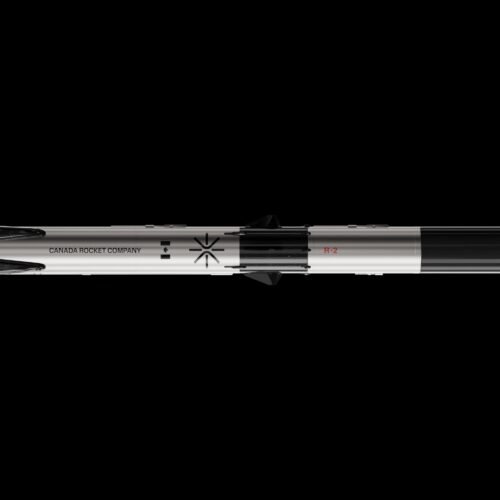
So the company set its sights higher: developing the R-2 rocket, a fairly standard medium-lift vehicle that in renderings somewhat resembles SpaceX’s Falcon 9 rocket. There are nine methane-fueled engines, a gas-generator engine cycle, and landing legs that signal a future path toward reuse of the first stage. It could carry up to 12.5 metric tons to low-Earth orbit. If all goes well, Kolias said, the company could be ready to launch by 2032.

That would be fantastic, but is any of this realistic?

Canada goes defensive

Maybe so, because the mood in Canada is angry. For decades, Canada has relied on the United States, broadly, for defense. Famously, in 1959, the Canadian Prime Minister canceled the Avro Arrow interceptor aircraft under development in the country. Since then, Canada’s aerospace industry has largely languished. The country’s satellites typically go to space on American rockets.

But sovereignty is back in vogue. Earlier this year, Canada unveiled a Defense Industrial Strategy that would ensure the country has a strong industrial and technological base to support defense readiness. Space is one of the 10 capabilities outlined in the report, which includes “space launch” as a priority.

“I think the geopolitics has actually created a fantastic opportunity, not just for us, but for other Canadian industries to finally build real ambitious industries,” Kolias said. “We’re pulling a little bit away from the globalist movement and realizing that there are some core aspects, both economically and from a sovereign or defense and military perspective, that you should own your own destiny.”

Eventually, Kolias said, the Canadian government might put as much as half a billion dollars on the table for a sovereign launch capability, along with some guarantee of launch contracts.

Canada Rocket Company remains small for now with about 30 people—a core of which are Canadian rocket scientists who left to work at places like SpaceX, Blue Origin, and Rocket Lab but have now returned north. But the company has raised $22.5 million to date and is going to market with a Series A fundraise. So growth is coming.

A rendering of the Jeremy Hansen Test Stand.

A rendering of the Jeremy Hansen Test Stand. Credit: Canada Rocket Company

An Artemis-named test stand

After his participation in Artemis II, becoming the first non-American astronaut to fly into deep space, Canadian astronaut Jeremy Hansen became a national hero. Kolias tapped into this space patriotism by naming the company’s rocket engine test facility, near London, Ontario, after Hansen.

On Thursday, the company announced that the $30 million Jeremy Hansen Test Facility will be sited on 50 acres leased from the Greater London International Airport Authority and will include an engine test area with up to three vertical and horizontal test stands for static engine testing, capable of testing engines with more than 1MN in thrust (225,000 pounds of thrust). Kolias said he intends to begin testing the E-1 engine there in about two years.

Hansen has played an interesting geopolitical role over the last year. His flight on Artemis II was an unqualified success, raising the prestige of Canada’s space agency. At the same time, Canada’s achievement came on the wings of America’s space program. So how to feel about this at a time of tension between the two nations? Perhaps it offers some hope that they can remain good neighbors, with warm relations resuming in the future—while Canada also has the capability to launch its own rockets.

Takaichi bends to Washington as Japan’s yields rise

0
takaichi-bends-to-washington-as-japan’s-yields-rise
Takaichi bends to Washington as Japan’s yields rise

Subscribe now with a one-month trial for only $1, then enjoy the first year at an exclusive rate of just $99.

Takaichi’s economic agenda runs into the bond market

Scott Foster reports that Sanae Takaichi is retreating from reflationary policy as US pressure over the weak yen converges with rising JGB yields and domestic fiscal constraints. Her agenda is shifting toward greater prudence even as defense demands, inflation dissatisfaction and AI-driven corporate borrowing keep pressure on rates.

Germany’s recovery is increasingly bought on credit

Diego Faßnacht reports that Germany’s improving headline data masks a recovery increasingly powered by large orders, fiscal expansion and borrowing rather than broad industrial strength. With municipal finances deteriorating and global borrowing costs rising, weak private investment and a shrinking tax base risk becoming fresh drags on growth.

Russia losing faith in a political reset with Europe

James Davis reports that Moscow is increasingly preparing for a prolonged rupture with Europe, reflected in tougher treatment of Western assets and fading hopes that European politics will produce a negotiated reset. With diplomacy yielding little, the Kremlin views battlefield trends as favorable and is widening pressure on Ukraine’s infrastructure and exports.

TCL is right to question Samsung’s use of the term “Mini LED”

0
tcl-is-right-to-question-samsung’s-use-of-the-term-“mini-led”
TCL is right to question Samsung’s use of the term “Mini LED”

What makes a display a Mini LED display?

It’s a question that sounds like it should have a simple answer. But it’s now at the center of a lawsuit between two of the biggest names in TVs, with TCL accusing its longtime competitor Samsung of falsely advertising budget LCD-LED TVs as Mini LED sets.

TCL may have a point. Samsung’s M-series TVs, which range from $300 for a 43-inch model to $2,300 for a 100-inch model, do raise some legitimate questions about what should qualify as Mini LED. More broadly, though, the dispute highlights a problem for shoppers: Without agreed-upon standards for what “Mini LED” actually means, manufacturers have plenty of room to define the technology for themselves.

TCL accuses Samsung of Mini LED “fraud”

In a lawsuit (PDF) filed in the US District Court for the Central District of California in late August, TCL accused Samsung of resorting to “fraud” to compete with TCL’s QM-series of Mini LED TVs. Samsung’s M70H, M80H, and M90H are “merely recycled… pre-existing, low-end, standard LED televisions, [which are Samsung’s entry-level] Crystal UHD line… re-labelled… as ‘Mini LED,’” TCL’s suit says.

“Samsung’s M Models contain none of the technological advancements associated with Mini LED technology, including [full array local dimming],” the complaint reads.

Samsung didn’t respond to questions I sent about specific claims in TCL’s lawsuit. Instead, a spokesperson shared a statement noting that it intends to vigorously defend against the lawsuit.

The FALD debate

TCL argues that M-series TVs don’t have backlights capable of true full array local dimming, or FALD, the most advanced type of backlighting technology available in LCD-LED displays.

A FALD backlight uses dozens to thousands of small LEDs, or Mini LEDs, grouped into different zones, each with individually controllable brightness levels. This helps boost contrast, which is critical for image quality and essential for delivering quality HDR on an LCD-LED display.

According to a specification line titled “Micro Dimming” on the M-series TVs’ product pages, the devices use “Supreme Mini LED Dimming.” The spec sheets (PDF) available for download from those pages include a tiny footnote that clarifies: “Supreme Mini LED Dimming is Software-based (not full-array hardware-based) technology.”

Samsung also uses the term “Supreme Mini LED Dimming” on product pages for its Neo QLED TVs, which TCL accepts as true Mini LED TVs. The Neo QLED spec sheets don’t include the footnote, though.

Software-based dimming without individually addressable LED zones differs from the FALD technology described above. With software-based dimming, a TV typically analyzes each frame of a video, breaking it into different zones and determining each zone’s ideal brightness level. Using that information, the display modifies the frame’s brightness to boost perceived contrast. Critically, though, the display’s brightness level remains uniform across the panel, unlike in a display using a FALD backlight.

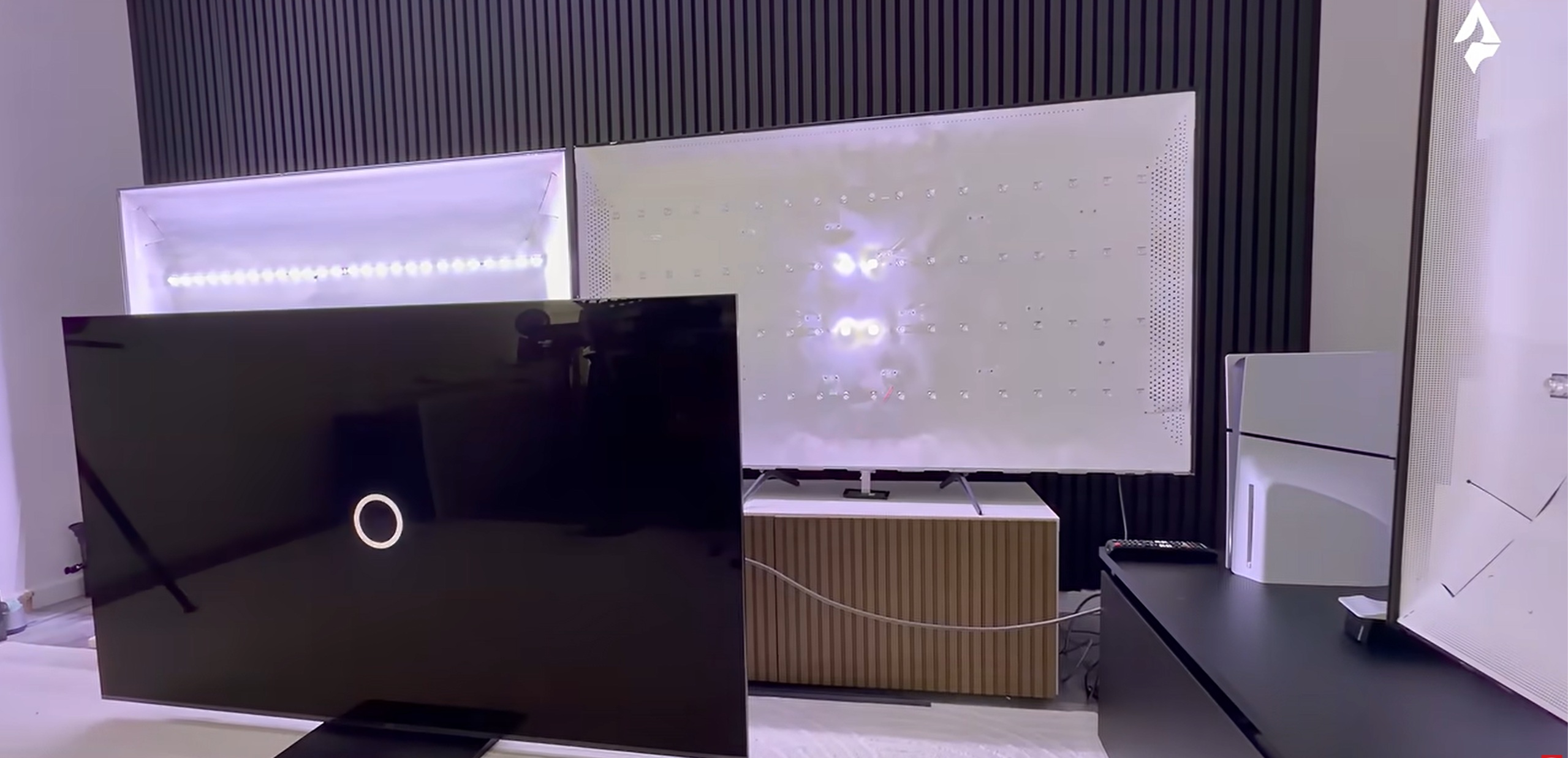
In this shot from AP Tech's video, you can see the differences between how the backlights of the M80H (left) and TCL (right) manage the image shown on the TV in front.

In this shot from AP Tech’s video, you can see the differences between how the backlights of the M80H (left) and TCL (right) manage the image shown on the TV in front.

In this shot from AP Tech’s video, you can see the differences between how the backlights of the M80H (left) and TCL (right) manage the image shown on the TV in front. Credit: AP Tech/YouTube

Software-based dimming was more common on TVs from the 2010s, such as TCL’s P6-series and LG’s UH8500-series. But even then, software-based dimming paled in comparison to FALD, as Reviewed noted in 2016.

Software-based dimming “will never be as effective as a well-designed, hardware-based local dimming solution, especially in scenes that are more susceptible to blooming artifacts,” Guillaume Chansin, associate director of displays and XR at Counterpoint Research, told me.

“However, the software plays an important role to get the most out of the hardware, with some brands able to achieve comparable image quality with fewer LEDs or dimming zones,” he said.

Because displays that support software-based dimming work differently from those that use a backlight with individually addressable LED zones, they’re not what people typically think of when describing “FALD.”

Eric Virey, principal displays analyst at Yole Intelligence, considers FALD a hardware feature first and foremost. It requires a “2D array of LEDs uniformly distributed across the entire area of the display,” along with a good algorithm to help reduce blooming, he said, adding, “To me, a ‘software-based’ Mini LED dimming just doesn’t make any sense if you don’t have that full, 2D-array of LEDs or Mini LEDs in the backlight.”

An LED display with FALD should have better contrast than an equally specced display without it. But experts I spoke with took things further, suggesting that a display shouldn’t be considered Mini LED if it doesn’t support FALD.

“I think that is broadly agreed across the industry that FALD is a key and mandatory feature in Mini LED backlights,” Virey told me via email.

Bob O’Brien, Counterpoint’s research director, also equates Mini LED with FALD.

“Mini LED was originally introduced as an improved FALD technology, with more dimming zones. So among those in the industry, it has always been assumed that a Mini LED TV has FALD capability,” he told me.

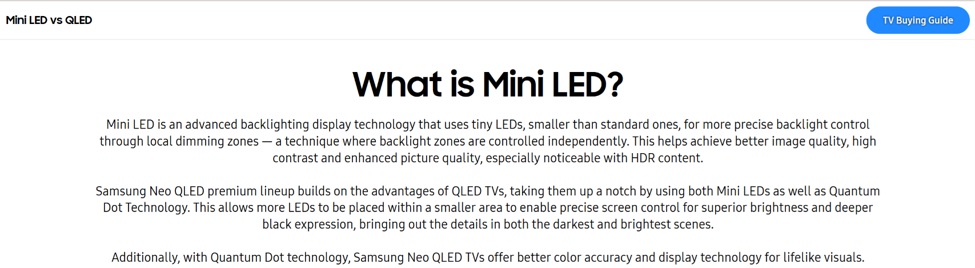
Even Samsung’s own website describing Mini LED suggests that local dimming is essential. “Mini LED is an advanced backlighting display technology that uses tiny LEDs, smaller than standard ones, for more precise backlight control through local dimming zones—a technique where backlight zones are controlled independently,” it says.

A screenshot from Samsung’s website explaining Mini LED.

A screenshot from Samsung’s website explaining Mini LED. Credit: Samsung

In its complaint against Samsung, TCL says it disassembled an M70H and M80H, both Samsung sets, and confirmed they can’t perform local dimming because they lack the necessary LED control chip and circuitry and use the same processor as Samsung’s entry-level Crystal TVs.

How mini should Mini LEDs be?

Although FALD support is key to TCL’s argument, a more obvious question might be whether M-series TVs use actual Mini LEDs. Again, though, there’s no industry-wide rule for what makes an LED “mini.”

I’ve seen Mini LEDs referred to in various size ranges over the years, including 50-300 µm (0.05-0.3 mm), 100-200 µm (0.1-0.2 mm), 100-300 µm, and “typically below 200 µm.”

TCL’s lawsuit claims that Mini LEDs “are generally .1 mm to .3 mm” and that the LEDs in Samsung’s M-series TVs are 0.5 mm. I’ve been unable to find a reputable source that refers to an LED as large as 0.5 mm as a Mini LED. I have even seen LEDs measuring more than 0.2 mm or 3 mm be considered a traditional LED in some cases.

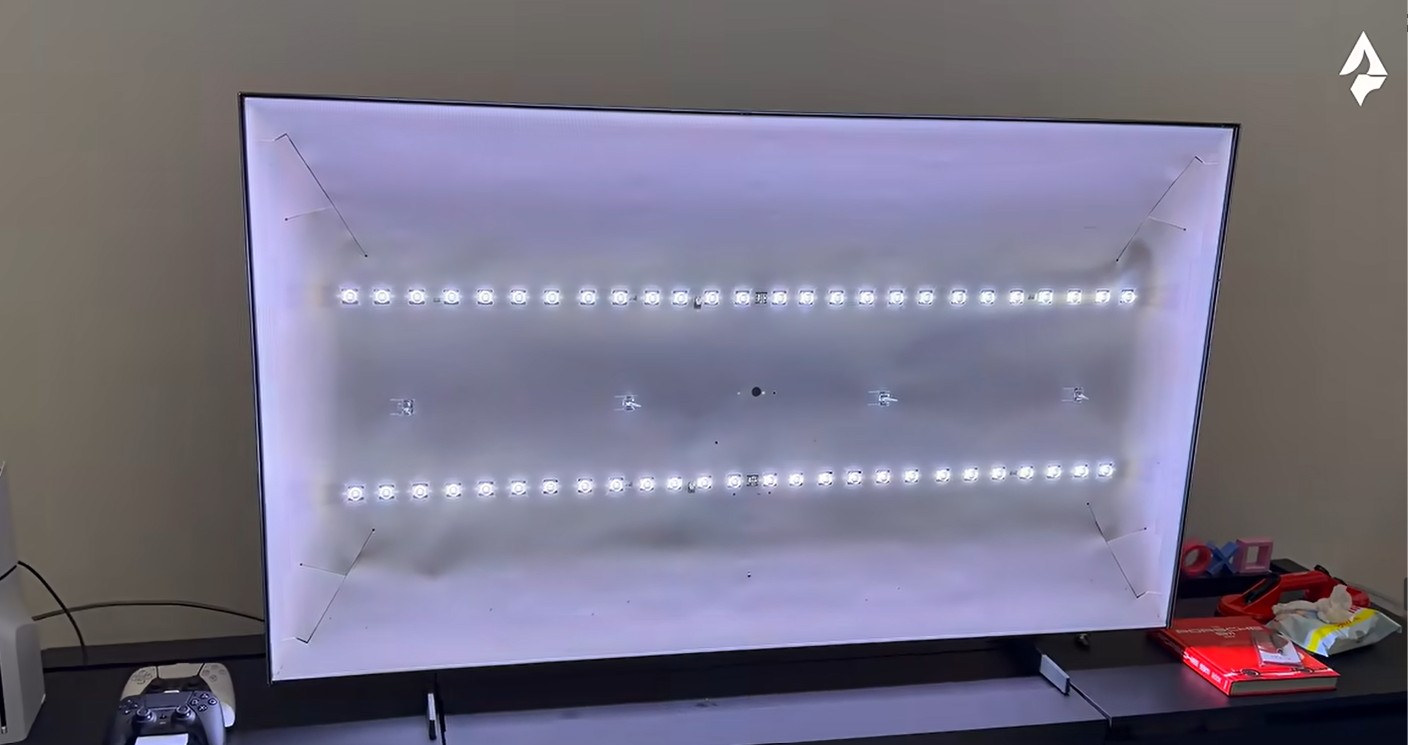
TCL further alleges that M-series TVs have a few dozen LEDs, while some Mini LED displays have thousands. Those LEDs aren’t arranged in an array on a panel; instead, they’re “arranged on two aluminum strips,” the filing says.

A teardown video from YouTube channel AP Tech also shows an M-series TV’s backlight consisting of two rows of LEDs.

M80H's backlight its with two rows of LEDs lit up.

The M80H’s backlight has two rows of LEDs.

The M80H’s backlight has two rows of LEDs. Credit: AP Tech/YouTube

The industry hasn’t established standards for how many LED zones or Mini LEDs a display needs to qualify as Mini LED. That can leave shoppers confused about what they’re actually buying. It also creates a gray area where manufacturers can set their own standards.

“There are no organizations with authority to make and enforce such standards. TV brands have historically exploited the lack of clear standards to be more creative in their marketing,” O’Brien said.

“I think that [TCL’s] claims are legitimate and raise some important question[s] for the entire industry, which lacks a clear definition of what a Mini LED display is,” Virey told me.

The problem can be seen elsewhere in the display panel industry with technologies like QLED.

The industry could try to create standards, but Virey thinks it would lead to  “an endless race.”

“Each time there are new technologies, new marketing terms are invented and can easily be abused,” he said.

M-series performance

While enthusiasts may delight in digging into the complex underpinnings of backlight technology, most people just care about performance. So how are Samsung’s M-series TVs?

There aren’t many reviews. RTINGS found that the M80H had “low” contrast (6,440:1, according to the review site’s testing) that makes “dark scenes look washed out in a dark room.” Regarding HDR performance, RTINGs said, “Content mastered at 600 or 1,000 nits, which is most HDR content, cuts off rapidly at the TV’s peak brightness. This lets the TV get as bright as it can, but there’s less gradation in bright parts of the scene, so highlights can seem to blend together.”

By comparison, Samsung’s $1,200 Mini LED Neo QLED QN80H, which uses individually addressable dimming zones, reached a contrast of 80,000:1 after calibration, according to RTINGs. That translated into visible improvements during actual use. RTINGs reported that the QN80H “looks good in a dark room thanks to its high contrast ratio and great black uniformity, making it a good choice for a home theater room.”

The AP Tech video below shows how an M-series TV and one with FALD handle dimming differently.

TCL’s budget QM6K ($550 MSRP as of this writing), meanwhile, reached a contrast ratio of 118:059:1 after RTINGs’ calibration. But even this set falters in areas where you might expect Mini LED to shine. Its HDR performance, for example, is reportedly lacking.

“Visually, the TV doesn’t impress, although its black levels are quite good due to its impressive contrast and good black uniformity. Unfortunately, there’s more haloing around bright highlights than you’d like, but it’s alright. Its HDR brightness is mediocre at best, so the TV doesn’t provide an impactful HDR experience overall,” RTING’s review says.

Mini LED muddied

TCL has an obvious stake in challenging Samsung’s marketing. The companies are longtime rivals, and casting doubt on Samsung’s claims could help TCL sell more TVs. But the underlying question is still worth asking: What should consumers expect when a TV is marketed as Mini LED?

I’d argue that a TV with slightly smaller LEDs than average but without local dimming shouldn’t be considered Mini LED with local dimming. The important distinction isn’t simply the size of the LEDs; it’s how they’re used to deliver improved contrast and HDR performance.

But even that definition has limits, as small LEDs and local dimming zones aren’t enough to guarantee good performance. TCL’s own budget line of Mini LED TVs can disappoint in areas where the technology should have an advantage, such as HDR support. And compared with Samsung’s more expensive Mini LED TVs, the M-series has worse HDR performance and black levels and is harder to use in a dark room, according to RTINGs’ testing.

That leaves shoppers in an awkward position. Terms like “Mini LED” or “QLED” are now used liberally, but they don’t always tell you how a TV will perform. Manufacturers often fail to disclose basic details, like the size of the LEDs, the number of dimming zones, or accurate contrast and brightness measurements.

For shoppers, then, it’s important to remember that comparative pricing and independent testing are ultimately much more useful than a label on a box.

Authentic Brands approaches Mattel in takeover bid that could top $6 billion

0
authentic-brands-approaches-mattel-in-takeover-bid-that-could-top-$6-billion
Authentic Brands approaches Mattel in takeover bid that could top $6 billion


Authentic Brands Group has approached Mattel about a takeover that could value the Barbie maker at around $6 billion or more, a source familiar with the matter told Reuters.

Authentic Brands was discussing takeover interest of more than $20 per share, the source said. Mattel shares closed up about 18% at $15.04 after the news, which The Wall Street Journal reported first. The company has a market capitalization of about $3.62 billion.

There is no guarantee Mattel will be open to the offer, and no formal sale process is under way, the source said. Mattel declined to comment. Authentic Brands did not immediately respond to a Reuters request for comment.

Leadership change

Mattel shares had closed down about 4% on Wednesday after the company said CEO Ynon Kreiz would leave to become co-CEO of Paramount Skydance and run its combined business with Warner Bros.

Roger Lynch, the former CEO of Conde Nast, the owner of The New Yorker, will succeed Kreiz on or before November 2026. According to the Journal, Lynch’s transition could complicate any deal as he works on his strategy.

Pressure on the toy maker

Consumer goods companies and retailers are battling weak spending as U.S. households face higher fuel costs and interest rates. Mattel has struggled this year with tariff-related costs, even as it continued building an entertainment portfolio around its brands after the success of the 2023 “Barbie” movie. Its shares have dropped 33% so far this year.

In May, Mattel investor Southeastern Asset Management urged Kreiz to explore options, including going private or being acquired by rival Hasbro or a large media company that would value Mattel’s intellectual property more highly than the public market does.

Authentic Brands bought Dockers from Levi Strauss earlier this year, adding to a portfolio that includes Guess and Van Heusen. The company licenses the intellectual property of its brands to partners and has been broadening its acquisition strategy to include kids’ entertainment brands and hospitality.

Turkey, Syria reject claims of meeting between Syrian government, Hezbollah officials

0
turkey,-syria-reject-claims-of-meeting-between-syrian-government,-hezbollah-officials
Turkey, Syria reject claims of meeting between Syrian government, Hezbollah officials

Turkey and Syria on Thursday rejected claims that Syrian government officials and representatives of the Lebanese group Hezbollah had met in Turkey, describing the reports as false, Anadolu Agency reported.

In a statement, the Turkish Communications Directorate’s Center for Combating Disinformation said claims that “Syrian government officials and Hezbollah officials met in Turkey, hosted by the National Intelligence Organization (MIT)” were entirely unfounded.

It said allegations concerning the date, venue, content and participants of the purported meeting “do not reflect any reality and are entirely fabricated and speculative.”

READ: Turkish defence ministry says Israeli actions at Al-Aqsa threaten regional stability

The center urged the public to rely only on statements issued by official authorities and warned against claims circulating through unofficial channels.

The Syrian government also denied that the meeting took place.

“These claims are false, and no such meeting took place,” said the Syrian Information Ministry’s Foreign Media Directorate, according to state-run Alikhbariah TV.

READ: Syria says it arrests Hezbollah cell near Golan

Why China is missing the big AI rally

0
why-china-is-missing-the-big-ai-rally
Why China is missing the big AI rally

TOKYO – China gave global investors one of 2026’s biggest AI thrills. Yet the country that helped ignite excitement about artificial intelligence is home to one of the worst-performing major stock markets. While AI fever has propelled Seoul, Taipei and Tokyo higher, Chinese shares are stuck in reverse.

So what gives? Several forces, actually. Weak household demand, for one. Consumer spending continues to disappoint, weighing on the earnings potential of mainland internet companies, automakers, and retailers.

With the property sector — where 70% of household assets are concentrated — still sliding, it’s hard to see a strong economic-fundamentals argument. Chronically weak consumer spending threatens future profits at internet companies and automakers.

At the same time, China arguably has the wrong kind of AI exposure. Until now, the AI boom has favored chip makers over the cloud and internet companies investing in AI. A dearth of representative hardware manufacturers leaves China at a structural disadvantage relative to South Korea and Taiwan.

China also faces loads of regulatory and geopolitical risks. These include the US-China trade and tech wars, of course. But since President Xi Jinping’s late 2020 tech crackdown, Chinese shares have too often traded at a discount as investors factored in headwinds and the lack of transparency that characterizes the mainland market.

The former challenge is a giant property crisis that’s fueling deflation and slamming business and household spending. The latter is capital markets that aren’t ready for global primetime.

All this helps explain why the Shanghai Shenzhen CSI 300 Index is down nearly 6% this year, while Korea’s Kospi and Taiwan Stock Exchange Weighted Index are both up more than 65%.

This despite China not exactly having an earnings problem. In the April-June quarter, onshore-listed companies reported their biggest profit gain in five years — nearly 26%.  

Chinese bond yields, meanwhile, have tumbled this year even as the yuan gains. This suggests investors lack confidence that Team Xi’s stimulus efforts are enough to revive domestic demand. The 10-year yield is around 1.67%, suggesting hopes that deflation is firmly in the rearview mirror aren’t panning out.

Moody’s Ratings analyst Elaine Xu notes that China’s latest financial policy package should modestly improve credit transmission through policy banks and targeted lending facilities. But, Xu says, “it’s unlikely to materially lift broader credit demand or alter the property sector’s weak trajectory.”

The measures should lower funding costs, expand policy lending tools and reduce effective mortgage costs for eligible first-time buyers, reinforcing a more supportive policy stance as growth slows. This, however, “is consistent with policymakers’ preference for selective easing through the financial system rather than broad-based stimulus,” Xu explains.  

True, the People’s Bank of China recently cut the one-year pledged supplementary lending rate by 25 basis points to 1.5%, broadened the facility’s scope to cover additional infrastructure-related investment and increased relending quotas for technology, private enterprises, farms and small businesses.

These steps, Xu notes, “should improve funding conditions for policy-directed lending and help channel credit towards priority sectors, especially those where state-linked banks and policy banks are central to transmission. Nevertheless, a jump in broader credit growth is unlikely, because targeted funding support does not by itself create stronger private borrowing demand.”

With the economy “very weak,” Charles Wang, chairman of Shenzhen Dragon Pacific Capital Management, doubts Beijing’s plans are “adequate” to revive property or consumption.

Duncan Wrigley, economist at Pantheon Macroeconomics, adds that steps to date “won’t solve China’s structural imbalances, with sluggish domestic demand and high reliance on exports.”

This export reliance is part of the challenge. Since the pre-Xi days of Hu Jintao, Beijing has been pledging to recalibrate growth engines toward domestic demand and away from overseas shipments.

Yet with China’s trade surplus widening – it hit a record $1.2 trillion in 2025, despite US tariffs – economists worry we’ll see Team Xi doubling down on exports at a moment when it should be accelerating structural reforms.

The real problem is China’s K-shaped economy. It’s defined by a booming high-tech export sector alongside a weak domestic property and consumption market. The issue now is that the K-shaped split is only becoming more pronounced.

As exports power ahead, consumer spending and property continue to lag, widening the gulf between China’s external strength and domestic weakness.

That’s a far cry from the narrative that prevailed a year ago, when gains across stocks, bonds and the yuan sparked hopes that China was emerging from the ranks of “uninvestable” markets.

It’s more than that, of course. As Sophie Huynh, a fund manager at BNP Paribas Asset Management, tells Bloomberg, the Chinese yuan also “has totally disconnected from interest-rate differentials since the start of the year, thanks to the firm trade surplus, yuan internationalization and capital inflows.”

What’s needed, analysts say, is for Xi’s Communist Party to make good on its 2013 pledge to give market forces a “decisive” role in Beijing decision-making. This means, in part, taking steps to put the proverbial horse before the cart. Over the last decade, Xi’s party has tended to over-promise and under-deliver on reform.

During the Xi era, China has opened equity markets ever wider to overseas investors. Beijing has done the same with government bonds, which are being added to top global indexes.

Trouble is, access to exchanges in Shanghai and Shenzhen often outpaces the domestic reforms needed to ready China Inc. for the global prime time. While China’s “new economy” grabs the headlines, its “old economy” is getting the wrong kind of global attention at a rough moment for Xi’s party.

Nike this week pointed to China as it cut its sales outlook. Revenues in the sports brand’s second-largest market are down 29% to $5.8 billion since its peak in 2021.

“Our Nike performance business is not yet large enough to offset the pressure we’re seeing in Nike sportswear, Jordan brand, and Greater China,” CEO Elliott Hill said in an earnings call. Reviving things “will take time,” he said.

As Beijing juggles a giant property crisis, near-record youth unemployment, dismal local government finances and weak consumer demand, officials haven’t been shy about calling up the “national team” to save the day.

Xi’s inner circle has reactivated its usual cast of regulators, state-backed investors, insurers and asset managers to circle the wagons after a chaotic tech-share selloff. National-team deployments have a track record of stabilizing Shanghai shares. The most famous came in summer 2015, when shares fell by a third in a few weeks.

That crisis triggered a whole-of-government response: waves of state funding into markets, trading suspensions across thousands of companies, a freeze on IPOs, and rules letting mainlanders pledge homes as collateral for margin loans. Beijing even rolled out marketing campaigns framing stock-buying as a patriotic act.

The team has been called back repeatedly since: during the 2018 margin-call crisis tied to share-pledge financing, in 2021-22 amid Covid, in 2023 when certain exchange-traded funds ran into trouble, in 2025 amid fallout from US President Trump’s tariffs, and now, as global tech stocks wobble again.

One big change between now and 2015 is AI’s role in propelling not just global equities higher but Asian gross domestic product, too.

Take South Korea, where exports jumped 83.5% in September year-on-year to a record $120.9 billion as semiconductor shipments more than tripled. It was the 16th consecutive month of export growth. Such gains are looking more like those from the Asian Tigers era, not those of a mature $1.9 trillion economy.

And these gains would probably be much larger if not for US tariffs and other global challenges. As Korea’s Industry Minister Kim Jung-kwan puts it: “While the achievement of annual exports of $1 trillion is expected, the strengthening of global protectionism and the tense situation in the Middle East region still remain big variables for our exports.”

China, of course, is working from its own playbook, one that even detractors grudgingly admit has a way of beating the odds. Myriad times since 1997, analysts, investors and short sellers predicted a credit-and-debt-fueled crash. It has yet to arrive.

Even so, certain laws of gravity still apply to economies transitioning from state-driven, export-led growth to services, innovation and domestic consumption.

One of those laws states that developing economies should build credible and trusted capital markets before trillions of dollars of outside capital arrive.

Regulators, it follows, must increase transparency, prod companies to raise their governance game, devise reliable surveillance mechanisms like credit rating agencies and strengthen the financial architecture before the world shows up.

On Xi’s watch, China has become less transparent and the media less free. And this is the problem facing Xiconomics: too often China has believed it can build a world-class financial system after, not before, waves of foreign capital arrive.

But as China watches from the sidelines while the Al boom lifts Korean, Taiwanese and Japanese bourses, the world is watching China, too.

It means Team Xi is very much on the clock and has less and less room for error. Over the last decade, China was speeding up Asia’s economic clock. Now AI is doing the same to China, prodding Xi to hasten long-delayed and much-needed reforms.

Follow William Pesek on X at @WilliamPesek

US Sends 3rd Aircraft Carrier to Middle East as President Trump Weighs Iran Strategy

0
us-sends-3rd-aircraft-carrier-to-middle-east-as-president-trump-weighs-iran-strategy
US Sends 3rd Aircraft Carrier to Middle East as President Trump Weighs Iran Strategy


The US is sending a third aircraft carrier and thousands of additional troops to the Middle East as President Donald Trump weighs renewed military action against Iran or a return to negotiations ahead of the midterm elections.

The USS Theodore Roosevelt carrier strike group and USS Makin Island amphibious readiness group left port in early October, the Wall Street Journal reported. The deployments will add roughly 7,000 sailors and 2,000 to 3,000 Marines to the US military presence in the region.

The new forces are scheduled to arrive by late November, although some officials said three aircraft carriers could be assembled in the region as early as the end of October.

Two US carriers, the USS George H.W. Bush and USS George Washington, are already operating in the Middle East. The USS George Washington relieved the USS Abraham Lincoln in August.

About 20 Navy ships are also believed to be operating in the region and assisting with escort operations.

The additional deployment comes as Trump considers whether to resume military action against Iran or pursue talks. It also comes ahead of the US midterm elections.

Last week, Trump rejected a seven-day cease-fire proposal from Iran, calling the offer unacceptable. Tehran had indicated that it would open the Strait of Hormuz during the proposed cease-fire.

Top administration officials have maintained that the US is already getting oil through the critical chokepoint.

With most information hidden, the game Stratego had stumped AI—until now

0
with-most-information-hidden,-the-game-stratego-had-stumped-ai—until-now
With most information hidden, the game Stratego had stumped AI—until now

Deep Blue took down Garry Kasparov at chess in 1997, AlphaGo beat Lee Sedol at Go in 2016, and poker bots have been beating professionals for years. But one classic game called Stratego held out. Even DeepMind, with its exceptional budget, couldn’t build a machine that reliably beat the best human players.

Now, a team of researchers from Carnegie Mellon, MIT, New York University, and Stanford University has done it. Their AI, called Ataraxos, beat Pim Niemeijer, arguably the best Stratego player of all time, 15 games to one, with four draws. And it took just 16 GPUs and a few thousand dollars to train it.

Hidden armies

In Stratego, each player gets 40 pieces representing military ranks, from a marshal down to a spy, plus bombs and a flag. You win by capturing the opponent’s flag. Your opponent knows where your pieces are, but not what they are. Identities are revealed only when two pieces collide in battle—the weaker one is removed, and the identity of the winner is revealed. That makes Stratego an imperfect-information game, just like poker, which computers cracked years ago. “There’s something super distinctive about Stratego, which is that it is a massive amount of hidden information that unfolds over a very long time scale,” said Eugene Vinitsky, a researcher at NYU and co-author of the study.

In some forms of poker, the hidden information is tiny. In Texas Hold’em, “You only have two hidden cards,” said Gabriele Farina, an MIT computer scientist and another co-author. That leaves just 1,326 possible hands, few enough for a machine to weigh them all. “In Stratego, there’s 40 pieces on the board that could be in any order,” Farina said. That’s more than a decillion possible setups. Then there’s the game’s length.

“In chess, usually the game lasts 40 moves, but in Stratego, a game can easily last 2,000 moves,” Farina said. On top of that, Stratego is a game of bluffing. Sometimes you move a weak piece as if it were a marshal, just to scare the opponent off. When players bluff too often, their threats mean nothing; when they never bluff, they become predictable. That balancing act, the team explains, is what stumped earlier AIs like DeepMind’s DeepNash, introduced in 2022.

Learning to guess

Just like DeepNash, Ataraxos learned by playing against itself—163 million games in total. In these self-play sessions, moves that led to wins were reinforced and played more often in future matches, while moves that led to losses were played less, which was the same simple training idea. The difference was in how much Ataraxos adjusted after each game, because hidden information tends to send self-play learning algorithms around in circles. The team addressed this by making big, bold changes in strategy early in training and small, careful ones later.

The even bigger innovation was something DeepNash never had: thinking ahead before each move. AIs like AlphaGo refine their general strategy with a search just before acting. DeepMind couldn’t make that work in Stratego because the search space was too large, leaving it an open question whether it was worth trying.

“This is one of the things that we did figure out how to do,” Farina said. The solution was a second neural network, a belief model, trained to guess the opponent’s hidden pieces based on how they had been moving. This way, instead of iterating through every possible arrangement, Ataraxos samples plausible ones, plays out candidate moves in each, and picks based on how they turned out.

And it shows in its playstyle.

Calm and unbothered

The name Ataraxos comes from the ancient Greek word for a state of calm. “It means somebody that’s calm and unbothered,” Farina explained. He suggests the structure of the AI and its lack of human emotions ensure it doesn’t react impulsively, “even in situations where a human would be losing their mind.” While the human might try big gambles to come back from a significant deficit, Ataraxos would work its way back into the game slowly and methodically.

The strategy it developed also avoids drawing attention to any problems it faces. When Ataraxos estimates its opponent has no reason to suspect a weak spot, it leaves that spot alone, even if it might look like a disaster waiting to happen to anyone who can see both sides of the board.

“For humans, it’s very hard when you know a secret to make decisions ignoring the fact that you know that secret,” Farina said. “For machines, it’s easy.” This, the team says, leads machines to make moves a human would only do while bluffing—and follow up on them much better than humans. “We would watch the bot ‘bluff’ its way back from like a two percent victory probability, very, very casually,” Vinitsky added.

Niemeijer, the human player Ataraxos pulled these miraculous comebacks against, has four world championships and more than 600 weeks as the world’s top-ranked player.

The match

Over three weeks, Niemeijer played 20 online games against Ataraxos, earning $100 for each win. He knew the AI would not adapt to him, which gave him time to hunt for weaknesses. He managed to win just once.

That loss, researchers claim, wasn’t really a flaw. Playing Stratego well requires randomizing the arrangement of your pieces, so luck always plays a role. “Even a perfect strategy, sometimes it will just lose,” Farina said.

The human champion apparently got lucky, but it went both ways. “Sometimes we got lucky,” Vinitsky admitted.

At the 2025 Stratego World Championship, attendees who challenged Ataraxos fared even worse. The AI won 38 of 40 games. In the process, it also changed how people play. “I think this bot has kind of skewed the metagame a little bit,” Farina said.

Players were surprised, for example, by how often it tucked its flag into a corner behind just two bombs, a rarely played setup.

But Ataraxos’s best trick was arguably its price tag.

The price to pay

DeepNash was trained for two to three months on 1,024 of Google’s specialized chips, a run the Ataraxos team estimates would cost $3 million to $4.5 million at 2025 prices. Ataraxos, in contrast, needed 16 GPUs for a week, plus an additional four GPUs for four days to train the belief model.

Farina and lead author Samuel Sokota achieved this efficiency by writing a simulator that runs millions of moves per second on graphics cards. “At the scale that we are in academia, we don’t really have access to an entire field of GPUs,” Farina said.

The algorithm also learned far faster—it played about 34 times fewer games than DeepNash, and still ended up much stronger.

The Ataraxos architecture also worked in learning other games. The same approach beat three world champions at Barrage Stratego, a faster eight-piece variant of Stratego, mastered the cooperative card game Hanabi, and beat the best bots at the Chinese card game dou dizhu. But the team has its sights set on scenarios far more complex than board or card games.

Beyond the board

Board games have fixed rules and clear winners, while real-world problems like negotiations, financial markets, or military conflicts usually don’t. But the Ataraxos team argues the gap is smaller than it looks, since tackling any real problem starts with building a simplified model of it.

“War gaming is a common thing that people do,” Vinitsky said. “You can use the techniques that were derived here to play it forward and see how a strong opponent might respond to what you do.”

Farina and his colleagues are now interested in making their AI more understandable, since Ataraxos, in its current state, can’t explain why it makes the moves it makes. “We work on machines that produce strong but also interpretable and explainable strategies. I think we’re not quite there yet,” Farina said.

Nature, 2026. DOI: 10.1038/s41586-026-11036-y

0FansLike
0FollowersFollow
0FollowersFollow
0SubscribersSubscribe
- Advertisement -
Google search engine

Recent Posts