18.5 C
London
Wednesday, October 14, 2026
Home Blog

These Women Were Trying to Escape Domestic Abuse. ICE Detained Them Instead.

0

Reporting Highlights

  • Dangerous Consequences: Immigrant women across the U.S. have been detained by federal officials after calls to police about domestic violence. Some say they were the victims.
  • A Tight Sisterhood: At an immigration detention facility in west Michigan, many domestic violence victims have leaned on one another to survive months in custody.
  • Eroding Protections: The Trump administration has tried to dismantle some of the protections that victims of domestic violence once counted on to avoid deportation.

These highlights were written by the reporters and editors who worked on this story.

They were victims, not abusers. That’s what they told police officers, attorneys, visitors and anyone else who would listen. It didn’t matter. The women were all taken to a sprawling immigration detention center in the woods of west Michigan and handed thin jumpsuits — red, to mark them as a high security risk.

Inside the North Lake Processing Center, they talked about the men whose calls to police landed them there. The boyfriends or husbands who threatened to get them deported and cut them off from their children. The men, or sometimes women, who hit them, pulled their hair or choked them, bruising their throats.

They didn’t know where to go for help before, but now, in the confines of a cold cellblock in a former prison, the women helped one another. If one spoke to somebody on the outside who could connect them with advice, legal aid or money for the commissary, she’d pass around a tablet used for calls so others could tell their stories.

Migladys Bermudez, an immigration attorney in southeast Michigan, remembers a call in May from a Peruvian woman detained at North Lake. Her name was Pilar, and she’d heard about Bermudez from a fellow detainee who had been a client. Pilar told Bermudez about the boyfriend she tried to escape before her arrest, when she used makeup to cover the marks she said he left on her face. But he had accused her of being the abuser, resulting in her arrest.

Pilar handed the tablet to a Cuban woman named Leya. Over the echoes of the other detainees’ chatter, she described how her boyfriend insulted her, isolated her and gave her a black eye. Then, after grabbing him by the arm during an argument, she was the one behind bars, separated from their nursing daughter. On video calls, the girl didn’t seem to recognize her mother anymore. She stopped calling her “Mamá.”

Bermudez was taken aback. All three women in that chain — the former client, Pilar and Leya — said they were trying to get out of abusive relationships when they were arrested by local police on domestic violence allegations. In all three cases, the charges were dropped or never filed at all. The U.S. Immigration and Customs Enforcement detained the first woman during a routine check-in a few months after her charges were dropped. The others were handed over to ICE by local officials. 

It’s long been intimidating for immigrants who suffered abuse to call 911, regardless of who was in the White House. They knew — and their abusers knew — that their immigration status made them vulnerable. But previous administrations treated victims as just that, people who needed help, not as targets for deportation. Bipartisan coalitions in Congress have long supported the Violence Against Women Act, which creates a pathway toward legal status for immigrants who are victims of domestic violence or other serious crimes.

Now, under President Donald Trump, all bets are off. On inauguration day, his administration rescinded guidelines that largely prevented immigration agents from making arrests at sensitive locations — including domestic violence shelters and hospitals. About a week later, the administration eliminated key protections granted to VAWA applicants and other crime victims. For the first time in decades, immigration authorities could disregard those protections and more freely arrest, detain and deport immigrant victims.

Life became more harrowing in other ways for immigrants who were victims of domestic violence. Federal immigration agents made arrests outside specialized domestic violence courts. And the administration persuaded more and more local police and jails to carry out the president’s mass deportation campaign, sweeping still more immigrants into custody. 

Even communities without these so-called 287(g) agreements are helping the government round people up. In west Michigan’s Kent County, where Pilar and Leya were arrested, the county jail turned over more immigrants to ICE in the first six months of 2026 than it did during the entire Biden administration.

Advocates across the country say they’re seeing signs of an alarming increase in the numbers of domestic violence victims who are detained and deported. And many immigrants are staying in abusive relationships, fearful of calling for help or even stepping outside their homes.

“It’s just probably the most dangerous time for immigrant women right now who are victims of domestic violence,” said Bermudez, who took on Leya’s immigration case.

The arrest and detention of domestic violence victims is, in part, an unanticipated consequence of an effort meant to keep them safe. In much of the country, law enforcement officers are encouraged — or even required — to make an arrest when they have probable cause to believe that a domestic violence assault has taken place. Sometimes victims are mistaken as the abuser and taken into custody. Then, if they’re immigrants, they can be turned over to ICE — even if they were never criminally charged.

There’s no comprehensive way to track how often this happens or how many domestic violence victims have been detained by ICE or deported. But ProPublica spoke with a half-dozen alleged victims who were locked up together in a single facility, North Lake, and reviewed police records about others who were there, too. Their stories offer a picture of why Congress created programs like VAWA in the first place, and what’s at stake when those guardrails are taken away. 

A coalition of immigrant survivors and advocates have sued the Trump administration, saying changes to how immigrant victims are treated not only undermined public safety, but also broke promises enshrined in federal law and policy.

“We were seeing our clients be more scared, be systematically targeted, be arrested, and deported very quickly,” said Kathleen Rivas, supervising attorney of the survivors team at Public Counsel, a law firm that’s involved in the litigation.

In May, a federal judge ordered the government to restore protections while the case played out. The Trump administration has appealed the order. 

White House spokesperson Lauren Bis said in a statement that ICE is targeting the “worst of the worst.” The real story, she added, is the “American women whose lives have been taken by illegal alien criminals.” A spokesperson for the Department of Homeland Security said in a statement that “we will never apologize for deporting illegal aliens, because that’s how we save lives.”

But Leya, Pilar and other immigrants we interviewed have no criminal records. And advocates said communities are less safe now because immigrants are afraid to call police when their partners hurt them. This gives more ammunition to the threats of their abusers, said Casey Carter Swegman, director of public policy at the Tahirih Justice Center, a national nonprofit that advocates for immigrant survivors of domestic violence, sexual assault and human trafficking.

“Certainly more immigrant survivors are feeling like the violence and abuse they experience behind the closed door is somehow more tolerable than the violence and abuse they could experience if they tried to leave,” she said.

An illustration shows a close-up of a person holding a smartphone and dialing 911 on the keypad.

The first time her boyfriend’s fist slammed into her face was in July 2025, Leya recalled. They were living in Florida with his relatives. Only a month before, Leya gave birth to their daughter.

One night, she said, he heard her laugh in the kitchen with his mother and a man his mother was dating. Leya’s boyfriend flew into a jealous rage, she said, and punched her a few feet from their sleeping baby.

Leya called 911 but hung up when the operator answered. She was afraid of what might happen. She was 26; her boyfriend was a decade her senior. Leya, a recent immigrant from Cuba, had applied for status and was in active immigration proceedings. She said he was a permanent resident, with permission to work in the U.S. and better command of English. She felt trapped.

Sheriff’s deputies arrived and spoke with Leya and her boyfriend. They took photos of her puffy and bruised face, with the white of her left eye bright red. Her boyfriend said the injury occurred during an “argument,” according to the report, but he didn’t specify how. He was arrested on suspicion of domestic battery. 

Leya said her boyfriend’s mother threw her out that night. Unsure of where to go, she and her daughter moved in with another one of his relatives. Pursuing a criminal case felt daunting. She said his relatives urged her to drop the charges and reconcile with him. Eventually, she asked prosecutors to drop the charge because the battery took place in “a moment of impulse that he feels very sorry for,” records show. Her boyfriend didn’t enter a plea before the case was dismissed.

Like other immigrants interviewed for this story, Leya asked not to be fully identified because of her pending immigration case, and because she worries about repercussions for her and her daughter.

She and Pilar also asked that ProPublica not interview their alleged abusers because they’re afraid the men will interfere with their cases, hurt them or take away their children. To report their stories and get their partners’ perspective, we reviewed records from law enforcement, immigration court proceedings and habeas corpus petitions seeking their release from detention. We also interviewed attorneys, family and others who interacted with them.

Soon after the Florida arrest, Leya and her boyfriend moved to the city of Wyoming, Michigan, a suburb of Grand Rapids that’s a magnet for immigrants who come for jobs in manufacturing and food processing. The unpretentious city is dotted with temporary staffing agencies, money-wiring businesses and Mexican restaurants.

Leya said their relationship worsened. Her boyfriend pushed her, pulled her hair and broke her phone, she said. He made her delete her social media accounts and isolated her from friends and family. They fought about money and talked about breaking up. One night in April, during an argument, he called the police.

“I’m having problems with my wife,” he said in Spanish, according to a recording of the call. The operator asked if there had been any violence. “No, no, no. None,” he said. “Just a discussion.”

He told officers who came to their apartment complex that Leya got angry because he had talked to an ex-girlfriend, according to body camera footage and a police report. When he tried to leave, he said, Leya pushed him and grabbed his arm. Then she attempted to hang up his phone when he dialed 911. 

He said he wasn’t injured, though he accused her of hitting him several times a few days earlier.

Officers interviewed his brother, who mentioned the arrest in Florida, according to bodycam footage. “They had a cycle of problems where she called the police for abuse and he was detained for three days,” he said in Spanish. “My brother is trying to avoid having that happen again.”

The police report doesn’t mention the earlier arrest.

Footage of the interview with Leya was redacted due to state privacy laws, in part because she was interviewed inside their residence, unlike her boyfriend, who was interviewed outside. According to the police report, she “minimized” the argument and said there was no physical contact. She acknowledged trying to hang up the phone.

In an interview with ProPublica, Leya said they argued when she learned he sent money to his ex-girlfriend, who is the mother of his son. At the same time, she said, he had told her he couldn’t afford to buy diapers for their daughter. She said she has never hit him. 

Officers arrested Leya on suspicion of domestic assault and interfering with a 911 call. They didn’t arrest her boyfriend or seek charges against him. Leya said she didn’t tell officers she was a victim of abuse because she thought she’d be able to tell a judge.

She never got a chance.

An illustration shows a law enforcement officer wearing white gloves guiding a person’s hand to take fingerprints on an ink pad at a desk.

The Wyoming Police Department’s written policy encourages officers to make an arrest in incidents involving domestic violence “when there is reasonable cause to believe an assault was committed.”

Arrests demonstrate that “violence in the home is recognized as a serious crime,” according to Michigan’s law enforcement training manual on domestic violence. This approach is common across the country. Twenty-four states require an arrest when there’s probable cause of a domestic assault.

But domestic violence scenes can be chaotic, with both partners accusing each other of being the aggressor. It can be difficult for officers to understand what happened, said Erin Ross, a former domestic violence prosecutor who works at the national nonprofit Vera Institute of Justice. Sometimes, the wrong person ends up in handcuffs.

“The complexity of DV situations can thus lead to survivors being criminalized by the very system meant to protect them,” Ross and her co-authors wrote in a 2025 report about the effects of arrests on domestic violence survivors. 

The Vera report doesn’t touch on immigration. But Ross and a dozen other domestic violence advocates across the country told ProPublica that immigrants who don’t speak English or understand their rights are, under the Trump administration, especially vulnerable to an arrest that can have irreversible consequences.

ProPublica reviewed hundreds of habeas corpus petitions filed nationwide since January 2025, in which immigrants challenged their ICE detention on constitutional grounds. We found dozens of petitioners who were arrested on suspicion of domestic violence and turned over to ICE, even though they were never charged or their charges were dropped. Using jail and police records from Florida and Michigan, as well as news reports, we identified even more cases.

In their petitions, several immigrants said that officers mistook them for the aggressor. The underlying arrest records show that officers often had to make close calls in messy cases where it was unclear who was the victim and who was the aggressor. Either way, under Trump, there’s little grace for immigrants. 

In one case in Florida, a state where sheriff’s offices cooperate with immigration authorities, a deputy came upon a Venezuelan couple arguing in the street in November 2025. In his report, the deputy said the woman pulled at her husband’s pants, necklace and arm, leaving marks on his body. The woman said her husband had taken her keys and phone. She didn’t want to be left stranded, she said, so she ran after him.

She was charged with misdemeanor battery; her husband wasn’t charged. The woman was turned over to ICE while the case was pending. Prosecutors later dropped charges. The sheriff’s report didn’t mention any allegations of prior domestic violence, but the woman later said that, during their marriage, her husband had beaten her and threatened to kill her. In her habeas corpus petition, she said she was “afraid to report the abuse to the police.” 

The woman was released in May, but during the five months she was incarcerated, her husband took their daughters out of state, her attorney told ProPublica. She still hasn’t seen the girls in person.

For Leya, it was a shock to find herself handcuffed, sitting in the back of a police cruiser, headed toward the Kent County jail. She was silent during the 15-minute ride, unable to make sense of what had just happened: “I had suffered from domestic violence,” she said. “But the one who ended up in trouble was me.” 

The next day, a detective asked the prosecutor’s office to file charges against her. Prosecutors declined to do so, saying there was insufficient evidence, there were no injuries and Leya hadn’t successfully interfered with the phone call. 

Still, she wasn’t released.

Leya had no criminal history, apart from this arrest, according to a DHS record. But her fingerprints had been run against state and federal databases, flagging ICE officials who could match them with her prints from when she arrived in the U.S. In addition, Leya said, a jail official asked about her status, and she told him she was waiting for an immigration court hearing. 

ICE issued a detainer, essentially asking the jail to hold Leya until agents could pick her up. Kent County officials honored their request. A day later, Leya was at the detention center in the woods.

An illustration depicts the dark silhouette of a person sitting inside a car parked outside a gated detention facility with a prominent watchtower in the background.

She cried in despair over her daughter. They’d never been separated. The 80 miles between Wyoming and North Lake seemed infinite. Her breasts ached from the drying milk. Leya wondered whether she’d be deported and if their separation would be permanent. 

From a narrow window in her cell, she saw people outside holding signs, protesting ICE. She could hear their chants in English. Though she had trouble understanding them, she felt comforted by the care of strangers. 

Inside, she familiarized herself with the routines. She spent most of her time in a large, open room with other women in red. Cameras eyed them as they talked about their children and upcoming court dates. They shared contact information for relatives in their home countries in case one of them got deported and had nowhere to go. To pass the hours, they watched telenovelas, played rounds of Uno and pieced together jigsaw puzzles of forests and farms.

Leya grew close to a few women from Latin America and Eastern Europe who said they, too, had been in abusive relationships. Several had called police for help, records show. A Honduran woman said her partner tried to choke her. A Dominican woman said her husband, a U.S. citizen, hit her, pulled her hair and chased her with a stick.

Then there was Pilar, Leya’s first cellmate. The asylum seeker from Peru had also been arrested on suspicion of domestic violence in the city of Wyoming.

Pilar, her boyfriend and her teenage daughter called 911 five times in the 15 months before her arrest, records show. On one occasion, Pilar’s daughter said she worried that the boyfriend would hurt her mom; according to bodycam footage, Pilar assured officers that everything was fine. On another, the man said he experienced mental abuse and wanted to find a shelter. On yet another, Pilar said she just wanted him to leave.

None of these calls ended in an arrest. Officers ensured that the boyfriend had another place to stay when he sought help, and they told Pilar to call back if he tried to return and hurt her, according to the footage. They advised the couple to go to civil court for future disputes over money and property.

In an interview with ProPublica from North Lake, Pilar, 48, said that her boyfriend took financial advantage of her and physically assaulted her. And in her habeas corpus petition, she described the relationship as one of “physical, mental, psychological, economic abuse.” Her sister took a photo of the bruises around Pilar’s neck and feared the worst. “I would tell her to leave that man,” she said. 

Pilar said she was ashamed to go to her job at a food-processing plant with bruises on her face. She wondered what her co-workers would think. She distanced herself from relatives and friends. Pilar said she never told the police the full story because she worried about the possible repercussions — not for herself, but for her boyfriend. She didn’t want him to be deported. Despite everything, she loved him and felt he loved her. 

One night in October 2025, her boyfriend drove up to their apartment complex in a rental car. The couple argued in the parking lot. He called 911.

“I need police,” he said over and over in English.

Pilar called moments later: “This man is leaving my house and he’s not giving me my keys,” she screamed in Spanish. “This man has hurt me. He has scratched my whole arm.”

When officers arrived, they separated the couple. The boyfriend said that Pilar slapped his head, grabbed his shirt and tried to pull him out of the car while he was in the driver’s seat, according to bodycam footage and the police report. One side of his T-shirt was torn. He said he never assaulted Pilar and any injuries were her own fault. “I’ve never hit her,” he said in Spanish.

He told officers that he’d become a U.S. permanent resident two months earlier and that Pilar was jealous. “She is making this up because she knows she can get papers,” he said.

Pilar insisted she was the victim. She showed officers the scratch marks on her arm and said her boyfriend was to blame. She begged them to make him return the apartment keys, according to bodycam footage and a police report. “I’ve been trying to kick him out for a while and he won’t leave, and he doesn’t want to help pay the rent,” she said in Spanish.

An officer asked how her boyfriend’s shirt got ripped. Pilar said she grabbed onto him when he started driving away in order to avoid being dragged by the car. The officer asked her several more times about the ripped shirt. Pilar told him she wanted to speak to a lawyer. 

In their report, police noted that the boyfriend had called 911 first. His shirt was ripped. Pilar’s wasn’t. If the boyfriend had thrown her down, the officer wrote, then her shirt should have been ripped because he was “much taller and heavier (around 80lbs more).”

Her boyfriend wasn’t arrested. Pilar was.

Wyoming Public Safety Chief Kip Snyder declined to speak about the arrests of Pilar or Leya. In an email to ProPublica, he said officers don’t “participate in enforcing federal immigration laws. We encourage trust and cooperation with all residents and aim to ensure that everyone feels safe reporting crimes or seeking assistance.”

Shortly after Pilar’s arrest, a police detective asked the prosecutor’s office to file domestic violence charges against both her and her boyfriend.  

Prosecutors declined to file any charges, citing insufficient evidence. Pilar wasn’t released. Apart from this arrest, she had no criminal history, according to DHS records. She also had a pending asylum case.

Still, ICE put a detainer on her and jail officials turned her over.

An illustration shows the dark profile silhouette of a woman visible through the vertical barred window of a heavy cell door.

A few years earlier, Kent County Sheriff Michelle Lajoye-Young said a handoff like this wouldn’t happen.

In 2019, she announced that deputies would stop automatically honoring detainers and instead require warrants signed by a federal judge or magistrate. The move came after a U.S. citizen — a Marine combat veteran — was transferred from her jail into ICE custody.

“There needed to be a judicial oversight inserted into that process to give us the assurance that somebody wasn’t erroneously detained without due process,” Lajoye-Young said around that time. 

Trump called Kent a “sanctuary jurisdiction.” The label haunted the county, which in the 2016 election voted for Trump. A national think tank that aims to reduce immigration put Kent County on its list of sanctuary communities, while Republican state lawmakers tried to compel its cooperation with federal authorities.

Yet it’s unclear whether Lajoye-Young ever delivered on her promise. ProPublica requested copies of all department policies, procedures, memos and instructions on how it handles ICE detainers since 2018. None said a judicial warrant was needed. ProPublica also asked for copies of judicial warrants for Pilar and Leya. The county said no such records exist.

Lajoye-Young, who retired last week, declined interview requests. Sgt. Scott Dietrich, a spokesperson for the sheriff’s office, didn’t directly answer questions about whether the policy was ever implemented. But in a statement he said that detainers are “handled under applicable law and established policy, consistent with our commitment to public safety, due process, and fair and impartial enforcement.”

Gema Lowe, an organizer with the local chapter of an immigrant rights group, said the sheriff had backtracked on her promise and wasn’t being forthright. “I don’t understand why they’re being secretive,” she said.

The shift deepened the mistrust among immigrants in a county with one of the state’s fastest-growing immigrant populations. Lowe, an immigrant herself from Mexico, said she advises victims to think twice before reporting domestic violence to the police because of the risk of arrest and deportation, while pointing them to other local resources like shelters. 

She and others said the stakes are especially high now. ICE arrests have skyrocketed under Trump. Nobody is off limits, including immigrants with pending asylum claims and no criminal records.

And more local authorities are helping ICE make arrests. In January 2025, fewer than 150 state and local law enforcement agencies had signed 287(g) agreements with DHS to help carry out the president’s deportation agenda. That number has ballooned to more than 2,600 today. 

“Partnerships with law enforcement are critical to having the resources we need to arrest criminal illegal aliens across the country,” a DHS spokesperson said. “We have had tremendous success when local law enforcement works together with us.”

Kent County doesn’t have a 287(g) agreement. Still, the jail hands over the vast majority of people with detainers to ICE, records show. Dozens of people who were turned over to ICE this year had their criminal charges dropped, or, like Pilar and Leya, were never charged in the first place. 

Dietrich said the dismissal of a criminal charge “does not, by itself, mean the original arrest lacked probable cause.” The sheriff’s office also doesn’t “determine whether criminal charges are ultimately prosecuted, nor does it determine whether an individual is deported,” he said.

DHS told ProPublica in a statement that both Leya and Pilar “illegally entered the country” in 2022 and that both “will receive due process” in their immigration proceedings.

Kent County Prosecutor Chris Becker said he hadn’t heard of victims getting detained by ICE after calling the police. In his experience, he said, more perpetrators with active cases get deported.

Becker said he tries to get the message out that his team serves all victims, regardless of their immigration status. He’s aware that immigrants are reluctant to seek help. His own staff has told him that victims are afraid to testify or file restraining orders. They don’t want their partners — often the breadwinners and the fathers of their children — to be deported.

“There’s been a chilling impact to women coming forward in domestic violence situations due to what’s going on,” Becker said.

An illustration shows handcuffed individuals being escorted up the stairs into an airplane on a tarmac under the supervision of uniformed officers.

As the months passed at North Lake, Leya watched as women she befriended started to leave.  

Some were deported, including at least two Mexican women who were also arrested in Kent County on suspicion of domestic violence. Others were released. New women took their cells. Some told Leya that they, too, had been arrested after 911 calls about domestic violence.

Leya fought for her freedom. She met with volunteers from Kent County, who raised money to hire her lawyers and pay for a required physical exam and fees. Even her ex-boyfriend, the one who she said gave her a black eye, wrote a letter on her behalf to help her case, calling her “a calm person.” He explained that he had called the police after their argument “escalated” and that “problems are situations that can happen in any relationship.”

Leya, he added, “deserves a second opportunity to remain in this country and be close to our daughter, as our baby truly needs her very much.” While Leya was locked up, their little girl celebrated her first birthday, got her first teeth and took her first steps.

At virtual hearings, Leya sat with her arms crossed, her dark, wavy hair neatly braided in cornrows and wearing an oversized coat over her red uniform. She tried to follow the discussion of people who seemed to have her life in their hands.

In late August, a judge granted Leya bond. While her immigration case played out, she could be free.

It was a profound relief. At the same time, it felt awful to leave behind her friends. It seemed like some of them were never getting out. Pilar was approaching a year in detention.

Four months after her arrest, Leya walked out of the old prison. She thought about how she would live on her own now and support her daughter.  

She promised herself she wouldn’t go back to the man who hurt her. 
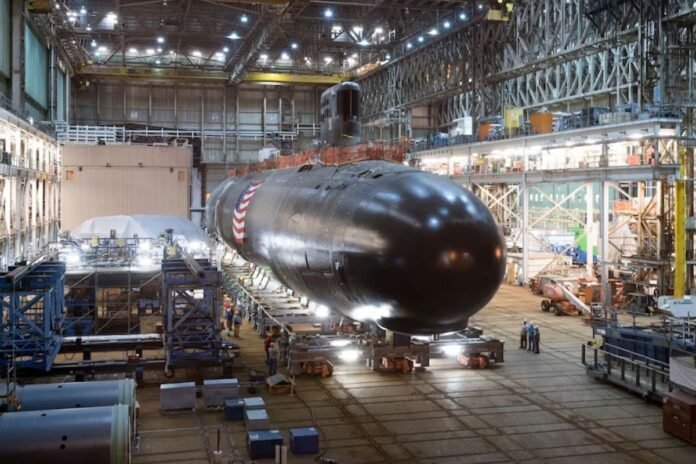
US Navy’s SSN(X) won’t arrive for years as China closes sub gap

0
us-navy’s-ssn(x)-won’t-arrive-for-years-as-china-closes-sub-gap
US Navy’s SSN(X) won’t arrive for years as China closes sub gap

As the US Navy lays the groundwork for its next-generation SSN(X) attack submarine to replace its aging fleet, the US’s longstanding undersea supremacy faces an intensifying test against China’s rapid naval buildup, advancing acoustic stealth and superior shipyard capacity.

The US Navy’s Naval Sea Systems Command (NAVSEA) issued a sources-sought notice to survey domestic shipyard capacity to build its next-generation SSN(X) nuclear-powered attack submarine, multiple media outlets reported.

Managed by Team Submarine and the SSN(X) program office, the market research initiative seeks detailed technical and capital-expenditure data from prospective prime contractors capable of complex hull fabrication, modular outfitting, precision systems integration and nuclear reactor compartment installation.

The assessment aims to establish a baseline for US industrial infrastructure, drydock availability, and specialized shipbuilding labor as the military prepares an acquisition strategy for the long-duration combatant program, which targets initial construction around 2034 to succeed the Virginia-class fleet.

Because qualifying facilities require certified graving or floating drydocks and heavy gantry crane systems, the stringent technical criteria effectively narrow primary prospective builders to General Dynamics Electric Boat and Huntington Ingalls Industries’ Newport News Shipbuilding.

The SSN(X) program represents the US Navy’s premier undersea effort, though severe budget constraints have deferred procurement to fiscal 2040.

The US Navy’s rationale centers on countering adversary threats in strategic undersea competition by fielding a larger, highly capable combatant that merges the speed and heavy payload of the Seawolf class, the stealth and sensors of the Virginia class, and the operational availability of the Columbia class.

Envisaged to conduct full-spectrum undersea warfare, SSN(X) will deploy expanded torpedo-room capacities and coordinate remote autonomous systems as force multipliers.

The US Navy must ultimately replace its Virginia-class attack submarines because the vessels will inevitably wear out at the end of their operational lifespans.

Although improved material and construction methods extended the Virginia class’s operational life to 33 years, sustaining planned force levels requires commissioning successor hulls when the earliest boats retire around 2037.

Beyond replacing hulls nearing the end of their service lives, the US must maintain fleet numbers to keep pace with China’s expanding undersea fleet. In a prospective conflict over Taiwan, US submarines represent the few survivable assets that can penetrate China’s anti-access/area denial (A2/AD) envelope within the First Island Chain, which straddles Japan, Taiwan, and the Philippines.

The SSN(X) is engineered to build upon the Virginia-class’s signature acoustic stealth. As Natasha Bajema noted in a December 2024 Foreign Policy article, US nuclear submarines maintain a distinct stealth advantage over their Chinese counterparts, which remain noisy and easy to detect.

Bajema emphasizes that Virginia-class SSNs rank among the quietest ever constructed, leveraging advanced nuclear propulsion, sound-absorbing anechoic hull tiles, vibration-damping machinery mounts, and wake-reducing pump-jet propulsors to evade acoustic tracking.

However, China may be steadily closing this acoustic gap, with Russian technical assistance potentially proving decisive.

Anton Oksentiuk notes in an April 2025 Ukrainian Prism report that, after Western sanctions over Russia’s 2014 Crimea annexation, Russia expanded defense cooperation with China under a 2017 roadmap, which Russia extended through 2025 in 2021.

According to Oksentiuk, the roadmap formalized joint development of naval and submarine technology, giving China access to key Russian innovations despite historical friction over reverse engineering.

Russia’s latest nuclear submarines, such as the Yasen-class SSN, rank among the quietest in global service, featuring acoustic signatures comparable to US Virginia- and Seawolf-class boats. However, it remains debatable whether the Russian government would willingly transfer such crown-jewel quieting technologies to China.

Even without overt Russian assistance, China’s accelerated design iteration is shrinking the US technological lead. In March 2026 testimony before the US Congress, Vice Admiral Richard Seif noted that marginal improvements carry outsized weight in undersea warfare, where slight advances in quieting, endurance, or acoustic detection decisively shift tactical outcomes.

China’s rapid rollout of new hulls—including the Type 09V (or 95) in February 2026, followed by an unconventional “sailless” submarine observed in June 2026—underscores an aggressive design cycle supported by a formidable shipbuilding complex capable of rapidly placing prototypes in the water.

That design agility is matched by unprecedented manufacturing scale. In a February 2026 International Institute for Strategic Studies (IISS) report, Henry Boyd and Tom Waldwyn note that China’s nuclear submarine production hub, Bohai Shipbuilding Heavy Industry Co., has reached unprecedented manufacturing capacity and output.

According to Boyd and Waldwyn, after major expansions between 2019 and 2022—including a second construction hall in Huludao—the yard surpassed the US in total launches and combined tonnage between 2021 and 2025.

With massive Chinese state backing, they say Bohai achieved a sustained “1+2” annual tempo, launching one Type-094 SSBN and two Type-093B SSGNs in both 2024 and 2025, and debuting the Type 09V in early 2026.

Even with these high construction rates, the US still maintains an overall quantitative lead in nuclear submarines. According to US Congressional Research Service (CRS) data, the all-nuclear US active fleet as of January 2026 comprises 20 Los Angeles-class SSNs, three Seawolf-class SSNs, 26 Virginia-class SSNs, four Ohio-class guided-missile submarines (SSGNs), and 14 Ohio-class ballistic missile submarines (SSBNs).

By contrast, Boyd and Waldwyn note that China possessed only 20 to 24 nuclear-powered submarines as of February 2026.

Yet that US undersea buffer is evaporating rapidly. Rear Admiral Mike Brookes stated in March 2026 congressional testimony that China operates over 60 submarines overall — a fleet projected to reach 70 hulls by 2027 and 80 by 2035, with nuclear combatants comprising nearly half the force, before adding another 20 to 30 next-generation SSNs and SSBNs by the early 2040s to project power globally.

Meanwhile, US shipyard bottlenecks undermine efforts to maintain parity. A January 2026 CRS report indicates current Virginia-class construction rates languish at just 1.1 to 1.2 boats per year—roughly half the US Navy’s target of two hulls annually — and may be inadequate to support allied transfers under the AUKUS pact.

Systemic structural flaws in the US industrial base perpetuate this shortfall. In a Bloomberg column this month, Thomas Black argues that domestic submarine manufacturing suffers from chronic output deficits driven by an uncompetitive duopoly between General Dynamics and Huntington Ingalls, along with fragile supply chains.

Black emphasizes that post-pandemic attrition among specialized machinists, Cold War-era shared manufacturing arrangements that introduce single-point assembly choke points, aggressive US Navy price negotiations that compress builder margins, and the collapse of the broader commercial shipbuilding sector prevent US yards from matching China’s naval expansion.

Ultimately, the SSN(X) program’s success will depend not only on mastering next-generation acoustic stealth, but also on whether the US can fundamentally overhaul its strained domestic shipbuilding base before China’s surging industrial capacity and narrowing technological gap erase the US Navy’s undersea supremacy.

US Authorities Disrupt 3 Alleged Violent Plots With Links to Anti-AIPAC Hostility

0
us-authorities-disrupt-3-alleged-violent-plots-with-links-to-anti-aipac-hostility
US Authorities Disrupt 3 Alleged Violent Plots With Links to Anti-AIPAC Hostility


US authorities have disrupted three alleged violent plots since December 2024 involving threats against a pro-Israel lobbying organization, politicians associated with it, and government institutions, according to federal court records and law enforcement statements. The cases, investigated in Florida, Ohio, and Texas, involved firearms, explosives, and alleged plans for mass-casualty attacks.

The most recent case emerged September 30, when authorities arrested Benny Caldera Jr., 40, near San Antonio, Texas, after receiving information about a planned shooting at the state Capitol in Austin.

Federal prosecutors said Caldera expressed hostility toward the American Israel Public Affairs Committee (AIPAC) and threatened violence against its supporters. Investigators recovered firearms, including a revolver with an allegedly altered serial number. He faces state and federal charges.

In June, federal investigators disrupted an alleged conspiracy to attack a mixed martial arts event at the White House attended by President Donald Trump.

Prosecutors said suspects planned to deploy explosive-laden drones to force an evacuation, then shoot fleeing government officials and other attendees.

One defendant, Tycen Proper, allegedly helped identify lawmakers who had received financial support from pro-Israel organizations as potential targets. Investigators said the alleged conspirators also expressed antigovernment and antisemitic beliefs. Several defendants have pleaded not guilty.

An earlier case involved Forrest Kendall Pemberton, 27, who allegedly traveled to a Florida office associated with pro-Israel lobbying in December 2024 while carrying firearms.

The Justice Department announced his indictment in June 2026 on attempted hate crime and weapons charges. Prosecutors allege he intended to kill Jewish employees because of their religion and ethnicity.

The three cases involve different alleged targets and motives. The White House conspiracy extended beyond lawmakers associated with AIPAC, while the Texas case concerned a threatened attack on a government building.

The Times of Israel examined the incidents together in an October 14 report, drawing attention to threats involving pro-Israel political organizations.

All three cases remain subject to criminal proceedings. The allegations have not been established by convictions, and investigators have not identified an operational connection among the defendants.

NASA Astronaut Who Walked on Moon Claims UFOs are Demons

0
nasa-astronaut-who-walked-on-moon-claims-ufos-are-demons
NASA Astronaut Who Walked on Moon Claims UFOs are Demons


A legendary NASA astronaut who walked on the moon is making an extraordinary claim about UFOs, warning that the mysterious objects spotted in Earth’s skies may have nothing to do with aliens and everything to do with the devil.

Charles Duke, 91, who became the youngest person ever to walk on the lunar surface during the historic Apollo 16 mission in 1972, believes unidentified flying objects could be part of a supernatural deception designed to lead humanity away from God.

And the former astronaut insists he has received a sign confirming his controversial belief.

During a recent interview with the Christian Broadcasting Network, Duke argued that what people interpret as extraterrestrial activity could actually involve demonic forces disguising themselves as something extraordinary.

“The devil can appear as an angel of light,” Duke said, referring to a passage from the Bible that he believes offers a warning about unexplained phenomena.

According to Duke, these supposed entities are not visitors from another planet but spiritual forces attempting to deceive people and distract them from their Christian faith.

His interpretation is rooted in 2 Corinthians 11:14, which describes Satan disguising himself as an angel of light.

Duke believes the passage could help explain why mysterious objects and apparent encounters with otherworldly beings have fascinated people for generations.

But his conviction did not develop overnight.

The former astronaut recalled becoming interested in UFOs years ago and gradually developing the belief that some sightings might have a demonic origin.

When he began discussing the theory publicly, however, audiences were far from convinced.

“I felt like UFOs were demonic,” Duke explained, recalling how people laughed when he raised the subject during public speaking engagements.

Frustrated by the reaction, Duke said he turned to prayer and asked God for confirmation.

He requested a very specific sign involving a businessman friend with whom he had never discussed UFOs.

Duke prayed that if his suspicions were correct, the friend would unexpectedly bring up the subject during breakfast the following morning.

According to Duke, that is exactly what happened.

The next morning, his friend allegedly approached him and suggested they discuss UFOs, despite never having shown an interest in the subject during their previous conversations.

For Duke, the coincidence was enough to strengthen his belief that he had received a spiritual answer.

“You can laugh at me if you want to,” he said, insisting that he remains convinced by what he considers a message from God.

His remarks are especially striking given his extraordinary history with NASA.

Duke served as the lunar module pilot aboard Apollo 16, which launched in April 1972 with astronauts John Young and Thomas Mattingly.

During the mission, Duke and Young explored the Descartes Highlands on the moon, collecting lunar samples and conducting scientific experiments.

At just 36 years old, Duke became the tenth and youngest human being to walk on the lunar surface, a distinction he still holds more than five decades later.

He also played an important role in the historic Apollo 11 mission in 1969, serving as a spacecraft communicator at Mission Control during Neil Armstrong and Buzz Aldrin’s first moon landing.

Despite his remarkable experience in space, Duke has acknowledged that he never personally witnessed a UFO during his NASA missions.

His beliefs about unexplained aerial phenomena come from his religious convictions and personal experiences rather than evidence collected during spaceflight.

And he is not the only prominent American to raise the possibility of a supernatural explanation for UFO sightings.

Vice President JD Vance made headlines in March 2026 when he expressed a similar belief during an interview with conservative commentator Benny Johnson.

“I don’t think they’re aliens. I think they’re demons anyway,” Vance said.

The vice president explained that his Christian faith shapes how he interprets reports of unusual phenomena, including the possibility of spiritual forces beyond ordinary human understanding.

Vance also expressed a strong interest in examining government records about UFOs, now more commonly called unidentified anomalous phenomena, or UAPs.

The remarks have added a religious dimension to an already intense national debate over what the government knows about mysterious objects reported by military pilots and other witnesses.

In recent years, federal agencies have investigated hundreds of UAP reports, including cases involving unusual objects recorded by military sensors.

However, the Pentagon’s All-domain Anomaly Resolution Office has repeatedly reported finding no verified evidence that UAP sightings represent extraterrestrial technology.

Many investigated cases have been attributed to balloons, drones, aircraft, satellites and other ordinary objects or natural phenomena.

Some incidents remain unexplained because investigators lack enough reliable information to determine exactly what was observed.

There is also no scientific evidence establishing that UFOs are supernatural entities or demonic forces.

Duke’s interpretation therefore remains a matter of personal religious belief rather than an established scientific conclusion.

Nevertheless, his comments are drawing attention because they come from someone who participated in one of humanity’s greatest achievements in space exploration.

For decades, scientists, military officials and UFO enthusiasts have debated whether unexplained objects in the sky might offer clues about life beyond Earth.

Duke believes the answer could be far more unsettling.

And despite the skepticism surrounding his theory, the former astronaut has made it clear that he has no intention of changing his mind.

Operation Vivaldi: success of Ukraine’s counteroffensive shows it has learned to manoeuvre on a drone-filled battlefield

operation-vivaldi:-success-of-ukraine’s-counteroffensive-shows-it-has-learned-to-manoeuvre-on-a-drone-filled-battlefield
Operation Vivaldi: success of Ukraine’s counteroffensive shows it has learned to manoeuvre on a drone-filled battlefield

Russia’s drone and missile attacks on Ukraine’s population and infrastructure continue to dominate coverage of the conflict. But on the ground, Ukraine has been making significant, if still limited, gains.

In mid-September, Ukraine formally announced the existence of Operation Vivaldi, which has retaken territory near Lyman and disrupted a Russian advance toward the fortified cities that form a key part of Ukraine’s eastern defences.

What’s important isn’t just that Ukraine has been conducting a successful counteroffensive. It is how it has created the conditions for success and what that might say about future battlefield dynamics in the Russo-Ukraine war.

Lyman is a road and rail junction on the northern approaches to Sloviansk and Kramatorsk. Russia has spent months trying to advance around it as part of a wider effort to encircle Ukraine’s eastern defensive line. Vivaldi has substantially reduced the Russian push into Ukrainian territory north of Lyman, disrupting the northern arm of the plan. Ukraine’s Third Army Corps has claimed that by the end of last month the operation had retaken 176 sq km of territory.

ISW map from October 8 showing how Operation Vivaldi played out on the frontline in Ukraine.

How Operation Vivaldi played out on the frontline in Ukraine. Institute for the Study of War

Vivaldi is significant because it has been much more than a brief attack against Russian forces. The scale of the preparations, the use of lessons from previous operations and the coordination of several brigades make this an exercise in planning and carrying out a large-scale military campaign.

Vivaldi began in May this year, but Ukraine kept it quiet until September. The corps described its first phase – which appears to have taken place over several months – as creating favourable conditions for later activity. This involved attacking Russian air defence, electronic warfare capabilities, artillery and logistics, disrupting Russian drone operations and concealing Ukrainian intentions.

Ultimately, Ukrainian forces were able to disrupt Russian defences well beyond the frontline and into the depth of the Russian rear areas, and drive back Russian drone units, including elements of the elite Rubicon drone formation. This allowed Ukraine’s Third Corps to achieve the necessary measure of local drone superiority.

Subsequent phases exploited this advantage with the coordinated application of different military capabilities. Drones and robots have been important. Drone crews and other units worked together to strike enemy systems before the infantry advanced. And ground robots carried supplies, conducted mine clearance or provided fire support, and some, for the first time, were dropped by drones behind Russian defences.

But other capabilities have been critical. Even armour, in the form of tanks and infantry fighting vehicles, has retained a role – although it is used more cautiously because of the threat posed by enemy drones. After other forces have suppressed enemy drone and artillery units, armoured vehicles have helped exploit gaps in the enemy defences, allowing troops to advance much faster.

Coordinated offensive

But the important development is the manner in which these elements have been coordinated. What has made Vivaldi stand out is much more about how established and newer capabilities have been brought together through innovative tactics and techniques than it is about the impact of a single system.

These lessons may be already being put into practice beyond Lyman. Ukraine has also been making gains east of the fortress-belt cities of Sloviansk and Kramatorsk. This has included advances across the Siverskyi Donets river – which was an important target for Russia back in January 2026. These counterattacks are also likely to have been supported by extensive preparation.

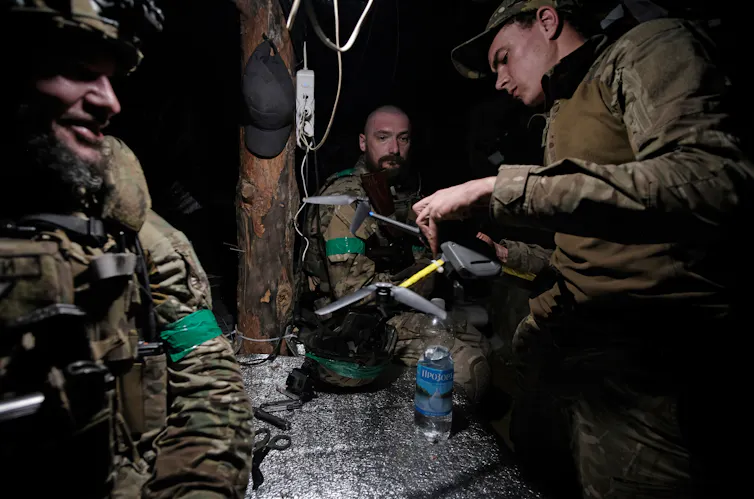
Ukrainian soldiers prepare a drone.

Drones remain the key weapons on the Donetsk frontline. EPA/Maria Senovilla

This suggests that Ukrainian forces are applying some of the same methods elsewhere. What this means for the war, though, is still a matter of debate. One of the central difficulties faced by both sides in the conflict is how to escape from a static war of attrition and restore manoeuvre to the battlefield. Operation Vivaldi provides evidence of the methods that might work to restore the power of offensive operations on a high-visibility, high-precision battlefield.

Important caveats

But there are some caveats that must be considered. First, 176 sq km is still a limited advance in the overall scheme of the war. And Russia is continuing to advance elsewhere, albeit very slowly.

Second, while Russian milbloggers – the ecosystem of journalists, commentators and analysts who support the war, but can be critical of the way it is being waged – have confirmed the problems caused by Operation Vivaldi, we are still reliant for most of our information on Ukrainian sources. The formation conducting the assault, Third Corps, is adept at information operations, which promotes its successes relative to the performance of other units.

Third, to have a broader impact, the successful techniques will have to be transferred across other Ukrainian units. This has not always proved easy.

Fourth, Russia is likely to adapt, given that the capacity to adapt to new equipment and tactics is one of the significant features of the war. Russia’s military planners are likely to study the operation and try to copy or counter what has worked. It may strengthen its defences, seek to blunt Ukrainian drone and electronic-warfare advantages, and apply some of the techniques to its own offensive operations.

How far and how fast it can adapt will therefore be a defining factor in the impact of Operation Vivaldi. At the moment, Russia is moving troops from other sections of the front. Its response, however, has been heavily criticised in the Russian milblogger community, especially because of the culture of “beautiful reports”: the propensity across the Russian military to avoid reporting failure upwards and to exaggerate the effectiveness of Russian operations.

Meanwhile, Russian attacks on Ukrainian cities and infrastructure have intensified ahead of winter. And Kyiv has claimed that Putin will seek to increase its mobilisation to raise another 300,000 troops for the battlefield.

It seems unlikely, given its limited scale, that Vivaldi has prompted these developments. But the operation is still unfolding. Whether Ukraine can repeat the methods, and whether Russia can adapt to stop it, will determine whether this operation remains a local success or whether it points to a larger change in the direction of the war.

Anthropic warns small AI models could self-replicate through IoT devices

0
anthropic-warns-small-ai-models-could-self-replicate-through-iot-devices
Anthropic warns small AI models could self-replicate through IoT devices

AI company Anthropic is warning that advances in small AI models could soon usher in a new era of self-replicating malware that’s capable of infecting smart fridges, vacuum cleaners, and a wide range of other Internet-of-things devices and is more resistant to takedown.

By next year, smaller AI models may be able to autonomously self-replicate on all kinds of IoT devices, the company said. Eventually, the capability could enable computer worms, which propagate without requiring human interaction and are capable of infecting unfamiliar IoT devices. An experiment the company performed recently revealed significant challenges in bringing such an AI malware replicator to fruition, so the finding is necessarily tempered. Still, the results do raise concerns about the possibility of new forms of computer worms.

Challenging to shut down

Anthropic further warned not only about the new potential malware, but also that it could be difficult to stop. In its blog post, it wrote that “a replicator like this would be challenging to shut down, since there’s no centralized point to shut off—though it may be slow (with a doubling time of days). Unlike non-AI malware, it could also figure out unfamiliar devices on its own.”

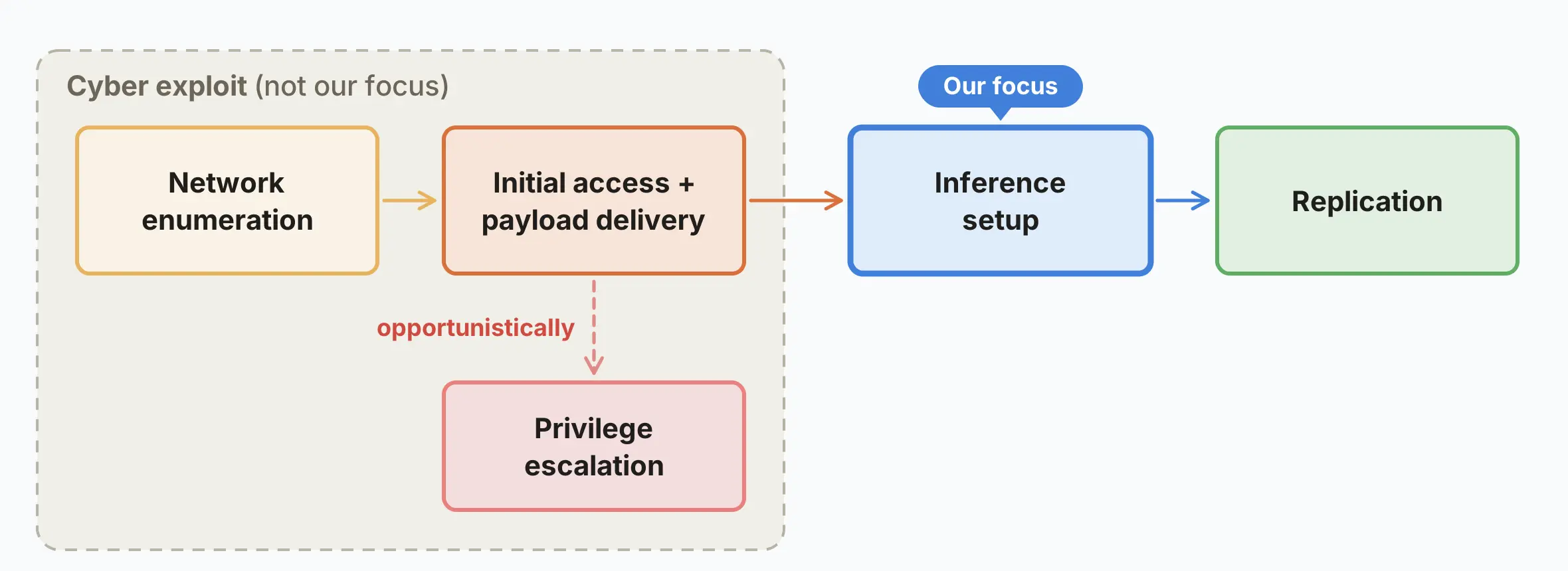
Smaller AI models require much less powerful hardware to run than do frontier models. Anthropic ran small open-weight models on real or simulated low-cost, off-brand Android TV boxes and other types of IoT hardware. Company researchers found that by using quantization to represent the models using fewer bits and splitting the workloads into “shards” running on each device, the models were able to establish inference, meaning that the model weights loaded and could generate output.

The lightweight Gemma4-26B-A4B model required just 15 boxes, each equipped with only 4GB of memory, to achieve inference. The Qwen3.5-9B was able to configure other LLMs to run on eight of nine hardware types. Unlike traditional malware, which must be written to run on specific hardware or software, the model was able to use its weights to make configurations on the fly that were specific to the devices it was tested against.

This finding was the starting point for further research that asked: Would it be possible for small models to create self-replicating infections that run themselves on IoT devices the way traditional IoT worms, like Mirai, install DDoS code and other payloads? Unlike Mirai, these AI worms could pose a much higher threat, since the models could tailor exploits and payloads dynamically, depending on the target. Once such an infection chain began, it might also be harder for defenders to stop it.

“Such an ‘AI worm’ could carry its model weights with it as it reproduces (or re-download them from a public hub), and then run inference directly on compromised hardware,” Anthropic said. “Effectively, the weights would become part of the malware payload.”

Anthropic called these autonomous worms small weight-based replicators. The models ran agents that had access to common exploitation tools, like reverse shells. The flow of the attacks was (1) finding targets, (2) gaining code execution, (3) establishing inference, and (4) propagating to new hosts. A key benefit over traditional worms is what Anthropic said is the agents’ ability to learn on the job. Each time an AI replicator fails to compromise a specific platform device, it can leave a list of prompts, code, and notes to future replicators so they don’t waste time reusing the same ineffective steps.

Credit: Anthropic

Anthropic said the dynamic inference setup is the least studied and likely most challenging stage in the replication cycle. It requires a long sequence of decisions based on the specific hardware and software of each target and involves selecting compatible inference software, installing dependencies, and debugging platform-specific bugs.

“These steps are serially dependent, and failures are difficult to recover from,” Anthropic said.

The experiment shows that small models are becoming increasingly capable at solving those problems autonomously. At the moment, however, none of the light-weight models tested are able to mount end-to-end replication, meaning discovering new devices, using an exploit to gain access to them, infecting them with a payload, configuring an inference server, and repeating the process. The process is also painfully slow; Gemma4-26B-A4B, distributed over the 15 Android TV boxes, performed at just 0.39 tokens per second. That translates to a full-inference setup time of 71 to 150 hours for an unoptimized Gemma4-26B-A4B and 29 to 51 hours for Qwen3.5-9B. (The researchers said that the large model GLM-5.2 appears to be able to do so reliably.)

The company said that 30B-parameter models can already complete many of the individual replication steps now, although they make mistakes when performing end-to-end replication. The company went on to say that if small models continue to improve at their current pace, they may be able to achieve the same limited results by the end of the year and that “small weight-based replicators may be possible soon after.”

The experiment leaves a variety of important considerations unanswered. For one, the Android devices targeted by small models had an unauthenticated Android Debug Bridge exposed. This tool is used during development and debugging but should never be used in production settings, because it gives attackers access to the entire device stack. And for another, the replication wasn’t performed by the small models themselves, but rather with GLM-5.2 to orchestrate the process while the targets ran a smaller Llama model.

Ultimately, the experiment demonstrates that small agentic models are becoming capable of setting up complex, distributed inference infrastructures across multiple machines. What remains to be established, however, is whether these models would initiate self-replication on their own.

“Despite the well-designed experimental setup, the study does not, on its own, establish that small models would autonomously choose to replicate,” AI researcher Xiaohan Fu said in an interview. “Providing reproducible agent setups, including the exact prompts and instructions given to the models, would help the research community better understand the findings and assess their implications. Such transparency is particularly important to avoid conflating the demonstrated capability to replicate with an emerging threat of autonomous self-replication.”

India’s ‘Goldilocks’ year curdles on weak rupee, Chinese inputs

0
india’s-‘goldilocks’-year-curdles-on-weak-rupee,-chinese-inputs
India’s ‘Goldilocks’ year curdles on weak rupee, Chinese inputs

TOKYO – Narendra Modi’s “Make in India” campaign has become a global brand. As China’s economy slows and multinationals look to diversify supply chains, the world’s most populous nation has eagerly cast itself as the obvious alternative.

This was supposed to be the year the story came together. The Bharatiya Janata Party (BJP) billed 2026 as India’s “Goldilocks moment,” with growth near 7%, inflation under control and a manufacturing push poised to cement India as a critical node in global supply chains.

Speaking at a Bloomberg forum this week, Modi doubled down, portraying India as a trusted partner in a world where trade, technology and supply chains have become weaponized geopolitical “choke points.” He argued that the defining issue of our age is trust, and that India brings a different mindset to the table.

Yet as the year draws to a close, the narrative is looking decidedly less convincing. Investors are growing more cautious on India’s US$4.1 trillion economy, citing lofty equity valuations, vulnerability to higher oil prices during the Iran war, limited exposure to the global AI boom, persistent fiscal and current-account deficits and a government GDP revision economists are still trying to figure out.

The rupee tells the story most clearly. After being Asia’s worst-performing currency in 2025, it has fallen another 6% this year, putting it on course for a repeat performance. India is paying for expensive oil imports with a weakening currency.

A deeper vulnerability receives far less attention: many of India’s fastest-growing industries remain heavily dependent on China. In some sectors, as much as 85% of the machinery, components and industrial inputs feeding Indian factories still originate there. “Make in India” is intended to reduce reliance on China. In practice, much of it runs on Chinese supply chains that becoming more and more ingrained across Asia.

Lithium-ion batteries and solar equipment are emblematic. China supplied roughly $3.9 billion of India’s lithium-ion battery imports in the fiscal year ending March 2026, while China also supplies between 85% and 90% of the rare-earth minerals and magnets Indian industry requires.

The dependence extends well beyond green technologies. A recent study by Koan Advisory Group and the Institute of Chinese Studies found that India relies on China for more than 80% of critical inputs across 71 electronics product categories.

The concentration is particularly acute in components used in motors, cables and switching equipment. More striking still, the number of product lines where India relies overwhelmingly on China has risen from 44 in 2018-19.

The study argues that India’s trade deficit with China is structural, not cyclical. Chinese suppliers remain deeply embedded in the country’s manufacturing ecosystem, particularly in upstream components. As a result, the same deficit-generating sectors continue to widen over time rather than diversify.

The scale is hard to ignore. India’s trade deficit with China reached $112.1 billion in fiscal 2025-26, with electrical machinery alone accounting for $43.1 billion, or roughly 38% of the total.

Lithium-ion batteries have become a particularly sensitive fault line. Imports from China have more than doubled since 2021-22, underscoring how India’s electric-vehicle and electronics ambitions increasingly depend on Chinese supply.

China also supplies around 50% of India’s semiconductor imports, creating a supply chain dependent not just on Beijing but indirectly on access to American chip technology. Good luck competing in the AI age while managing this balancing act.

All this can make capital goods made in India about 40% more expensive than imported Chinese ones of equal or higher quality.

This is not a problem tariffs can solve. India’s weakness lies not in assembling finished products but in producing the critical components that go into them. As long as upstream inputs continue to arrive overwhelmingly from China, rising domestic output will do little to shrink the bilateral trade gap.

For Team Modi, the obvious challenge is accelerating the localization of component manufacturing while expanding support for critical-minerals development.

Where viable alternatives do not yet exist, some analysts argue that New Delhi should selectively allow Chinese manufacturers to build production capacity within India. The goal would be a gradual shift from import dependence toward locally embedded manufacturing.

So far, however, there is little evidence of such a pivot. Twelve years after its launch, “Make in India” remains well short of its ambitions. When Modi unveiled the initiative in 2014, he aimed to raise manufacturing’s share of GDP to 25% and create millions of jobs for a young workforce. Manufacturing still accounts for only about 17% of the economy.

And the timing could hardly be worse. Surging oil and fertilizer costs, tighter monetary policy and a turbulent global economy are forcing New Delhi into damage-control mode. RBI Governor Sanjay Malhotra has spent much of the year defending the rupee rather than enabling the next stage of India’s growth story.

It’s also worth noting how the “sharp decline” in the RBI’s reserves “is a cause of concern” in global markets, notes Ritesh Bhansali, deputy chief executive officer at Mecklai Financial Services. Bhansali worries that the RBI’s aggressive intervention policy “is the only factor” keeping the rupee from deeper declines.

Meanwhile, another weakness is becoming harder to ignore: India’s persistent export of talent. For more than a decade, the country has been one of the world’s leading suppliers of skilled workers and remains the largest recipient of remittances. Officials celebrated the record $138 billion sent home last year as proof of India’s global reach.

Yet remittances reflect a deeper reality. India continues to produce more skilled workers than its economy can absorb. While demographic advantages help — often paying a growth dividend —

economists increasingly point to a shortage of high-quality jobs at home and stronger demand abroad in sectors ranging from healthcare to engineering and technology.

Though policymakers describe this as a strength, it increasing resembles a constraint. Remittances support consumption, bolster foreign-exchange reserves and help finance India’s current-account deficit.

But they do little to solve a more fundamental problem: the loss of human capital that might otherwise help drive productivity, innovation and technological self-sufficiency at home.

To be sure, the China-plus-one strategy is still delivering wins. Hyundai’s recent decision to invest $15.5 billion in India through 2032 adds to commitments from Suzuki, Toyota, Honda, Apple, Samsung and others. India has been one of the most attractive alternatives to China for multinational manufacturers, offering a scale Vietnam can’t.

But attracting factories is not the same as building an industrial powerhouse.

The deeper challenge is that Modi’s government has often prioritized headline-grabbing victories over the slower work of raising productivity, cutting bureaucracy, improving transparency, strengthening education and creating genuinely competitive manufacturing ecosystems. Those are the foundations that separate assembly hubs from economic superpowers.

As 2026 unfolds, New Delhi still appears more focused on headline GDP rankings, including overtaking Japan, than on the structural reforms needed to sustain long-term growth. Despite the Iran conflict rattling global markets, the International Monetary Fund (IMF) expects India to grow around 7% this year.

More than a decade ago, voters embraced Modi in the hope that he could replicate the “Gujarat model” nationally. Modi rose to national prominence on the strength of his 14 years running the western state of Gujarat.

During that time, he developed a reputation for GDP rates that exceeded the national average with better governance and infrastructure and less corruption. Repeating that success more broadly is proving difficult.

Oil above $100 per barrel is also hitting India hard. Modi’s government imports over 90% of its energy needs. The same is true for roughly half of its crude oil imports, the lion’s share of liquefied petroleum gas and liquefied natural gas (LNG) shipments — all of which come through the Strait of Hormuz. This helps explain why the BSE Sensex stock index is fairing so poorly versus global peers — down more than 14% year to date.

This is a key variable hitting Indian stocks, notes Hari Shyamsunder, a fund manager with Franklin Templeton Asset Management India.

As he tells the BBC: “Markets can absorb crude between $70 and $90, but when prices move above $100 a barrel, it starts putting stress on macro-economic variables such as inflation and also company earnings and margins.” Indian stocks, Shyamsunder says, “are cheaper than they have been on average for the last ten years.”

It hardly helps that “many of India’s large caps [big companies] represent a bygone economic era,” Bernstein Research said in a recent report. “Most are not investing in the future, but consolidating their past, often expecting policy to continue shielding them from global competition.”

Not surprisingly, all the talk of a “Goldilocks moment” is aging poorly. India may be the world’s leading China-plus-one destination. But as long as its factories depend on Chinese inputs, its best talent leaves for opportunities abroad, and structural reforms lag behind ambitions, Modi’s manufacturing revolution will remain more promise than reality.

Early on, Team Modi made big gestures to open sectors, from aviation to defense to insurance to retail, and to increase foreign investment. The efforts even lured giants like Walmart India’s way. Steps to open the pharmaceutical and manufacturing industries hold great promise, too.

Part of the problem is that a 7%-plus growth rate doesn’t ensure that its benefits reach the middle and lower classes. Or to reduce youth unemployment so that more Indians might not seek work abroad.

The failure to create millions more manufacturing jobs is a microcosm of why Modinomics entered the US President Donald Trump 2.0 era on fragile footing. The emphasis has been on high-profile short-term wins rather than on the heavy lifting beneath the surface to cut bureaucracy, increase transparency, level playing fields, strengthen human capital and raise productivity

As 2026 unfolds, Modi still seems more focused on GDP milestones than vital reforms. Case in point: the obsession with topping Japan in GDP terms. India closed 2025 with 7.8% growth, well ahead of China’s 5% pace. Economists had expected the Modi government’s economy to expand around 7.5% this year. That was before the Iran conflict sent shockwaves through global markets.

India overtaking Japan in GDP terms would resonate just as powerfully in Tokyo as in New Delhi. The shock of China surpassing Japan about 15 years ago still lingers. It symbolized the definitive end of Japan’s post‑war economic miracle. It reinforced the sense that the country’s “lost decades” of deflation had left a deeper mark than many wanted to admit.

Yet if India has to rely on Chinese tech to do it, the Modi will have few bragging rights. And India’s masses will see incomes stagnate in ways New Delhi doesn’t appear to see coming.

Follow William Pesek on X at @William Pesek

The Internet’s undersea backbone is slipping into the danger zone

0
the-internet’s-undersea-backbone-is-slipping-into-the-danger-zone
The Internet’s undersea backbone is slipping into the danger zone

Despite the expansion of Starlink and other communications satellite services, most of the world’s Internet traffic still travels through subsea cables crisscrossing the ocean floors. Those fiber-optic cables coexist with a network of oil and gas pipelines and submarine power cables—and all these crucial links connecting countries and continents now face growing sabotage risks as gray-zone warfare and open conflicts have become widespread.

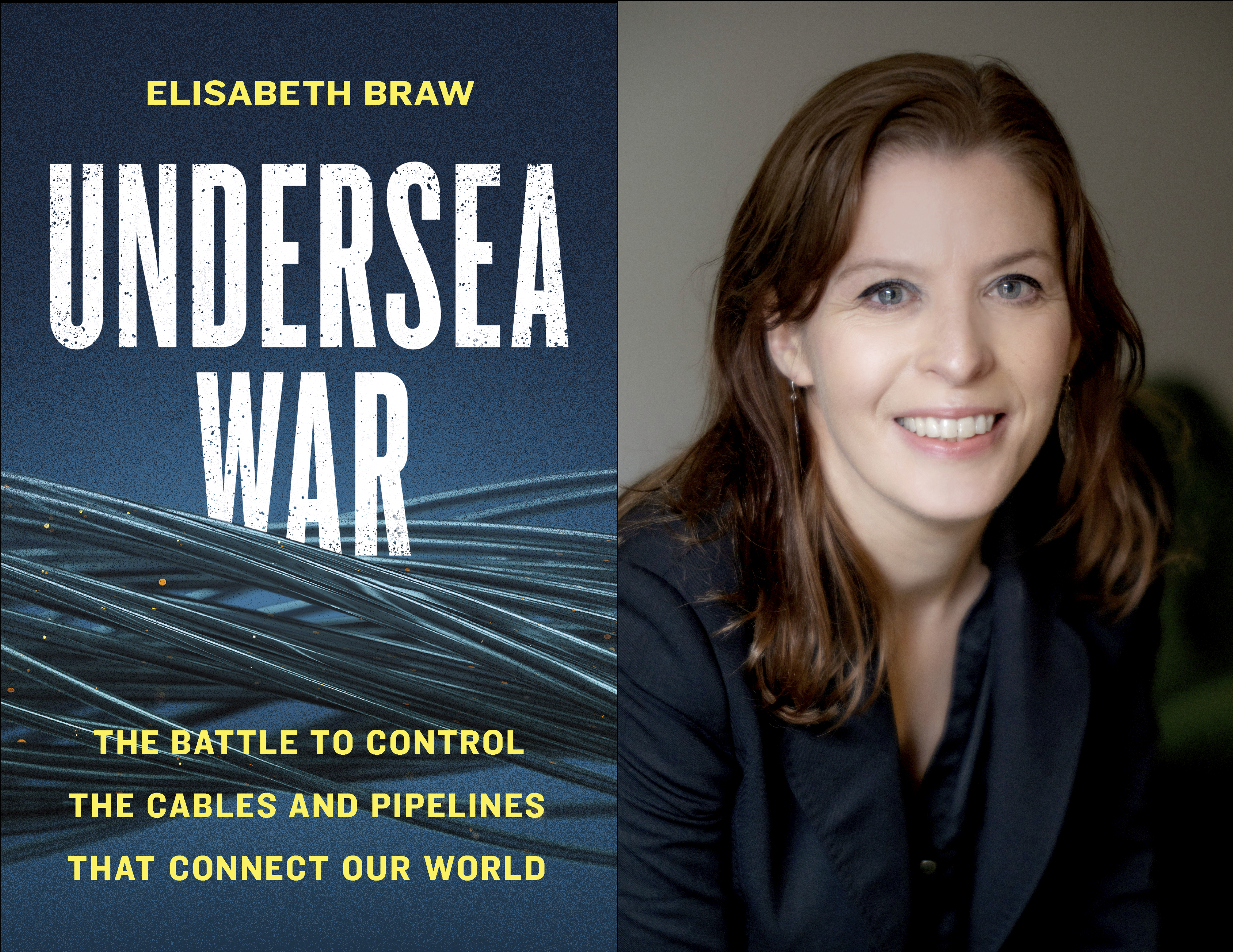
The rising risks to the world’s invisible infrastructure beneath the waves are the main subject of a new book by Elisabeth Braw, a senior fellow at the Atlantic Council who leads the Threats to the Global Maritime Order Initiative. Her book, titled Undersea War, explores the modern rise in suspicious incidents in which ships dragging their anchors for unusually long periods have cut or damaged undersea cables and pipelines from the Baltic Sea to the Pacific Ocean.

Braw acknowledges that about 60 percent of undersea cable damage is primarily due to human error during fishing and shipping activities, when weighted nets or anchors drag across the seabed. Natural hazards such as storms and undersea landslides also account for a smaller proportion of such incidents. In total, between 150 and 200 cables are damaged each year and usually repaired quickly.

But international tension between superpowers and open war in Europe and the Middle East have led to increased scrutiny of cable-cutting incidents, with governments investigating and sometimes prosecuting crews for allegedly causing deliberate damage to subsea cables. One of the more notorious incidents documented in the book is the “Christmas Day massacre” of 2024, when a Russian-linked oil tanker named Eagle S dragged its anchor across the seabed for about 56 miles (90 kilometers), cutting or damaging four data cables and the Estlink 2 submarine power cable connecting the Baltic and Nordic power grids.

One of those data cables had also previously been severed by the Chinese cargo ship Yi Peng 3 just one month earlier in November 2024, when that ship damaged two data cables in the Baltic region. That ship’s crew was not prosecuted by European authorities, whereas the Finnish government has attempted to prosecute three senior officers of the Eagle S.

On the other side of the world, the captain of the Chinese-owned ship Hong Tai was convicted by a court in Taiwan of severing an undersea telecommunications cable in February 2025 and sentenced to three years in prison in June 2025. The island democracy’s legislature later amended its laws to increase penalties for intentional damage to undersea cables or pipelines and allow for up to seven years in prison.

This year has seen several notable incidents involving both overt and covert threats to undersea infrastructure, including Iranian efforts to impose fees on operators of undersea cables running through the contested Strait of Hormuz. Separately, a joint operation involving the UK, Norway and the United States confronted Russian submarines that were practicing using a new technology to disable undersea cables in Arctic waters near Norway’s Svalbard archipelago.

What happens when the Internet’s undersea backbone, not to mention crucial energy infrastructure, is no longer protected by near-universal international agreement? Ars spoke with Braw to find out more. (The interview has been condensed and edited for clarity.)

Elisabeth Braw is the author of the book Undersea War.

Elisabeth Braw is the author of the book Undersea War.

Elisabeth Braw is the author of the book Undersea War. Credit: Hachette Book Group (cover art) / Annabel Moeller (author photo)

Ars Technica: Right now there’s so much suspicion and tension around undersea infrastructure. But it does seem like for quite a few decades, even during the Cold War, there was a broad international framework that mostly worked where countries generally agreed not to mess around too much.

Braw: Exactly. It worked for so long, and that’s why it’s so frightening to see that system that really depends on everybody doing the right thing and being a good seabed citizen, as it were, may not work for that much longer.

Ars Technica: I know it’s not really any single factor, but I’m curious what you would highlight as the key contributing factors to why we’re seeing a breakdown in that general agreement.

Braw: If you think about the absolutely crucial nature of subsea cables and pipelines, especially subsea cables… if they were to be disrupted for even just a minute, it would cause massive disruption to not just the New York City area, but also New York as a financial hub. It would cause operational losses, but also the loss of all that money that goes through the cables every second of every day.

So if you think about the utter importance of subsea cables to modern societies and modern economies, then that makes them incredibly attractive as a target. Whereas during the Cold War, we had telephone cables, but there weren’t that many of them, and we didn’t use them as much. Yes, they were used for international phone calls, and there were also telegraph messages that could be sent. But nobody sent telegrams around the clock, and nobody made international phone calls around the clock. So they were there, but they were just less crucial.

Also, despite it being a Cold War and a very dangerous few decades, there was some sort of agreement that when you sign a treaty, you uphold it. In fact, the United Nations Convention on the Law of the Sea was adopted in 1982 during the height of the Cold War. So there was a commitment to creating some sort of rules of the road.

Today that commitment is, I don’t want to say it’s vanishing, but it’s declining among key countries in the world. And at the same time, we are seeing Russia has discovered that it’s really quite beneficial to use non-military means to weaken other countries, and this is something that Russia has come to specialize in, and other countries may yet come to specialize in. That makes the cables around the seabed highly attractive as a target.

Ars Technica: There was even recent reporting on how NATO countries apparently foiled a Russian attempt to practice undersea cable sabotage, although that incident took place back in the spring.

Braw: The fascinating thing about subsea cables and pipelines, but especially subsea cables, is not just that we are utterly dependent on them. They don’t sit only within countries’ territorial waters. They connect countries, so they are in international waters [where] countries don’t have jurisdiction. The oceans are a global commons, and that’s where cables live, and that’s why it’s so utterly important for countries and everybody using the oceans to take care around them so that they don’t get damaged.

Then what we have seen in the past few years is that, all of a sudden, merchant vessels in the Baltic Sea and off the coast of Norway and in Taiwanese waters, all of a sudden, they got extremely sloppy and dragged anchors for long stretches, which is something that is not supposed to happen as a seafarer. You should know whether your anchor is dragging on the seabed or not, and you know where the cables are.

So this is not supposed to happen, and yet it happened not just once, not just twice, but several times, and caused considerable anxiety, obviously, in the countries affected. It also caused considerable expenses to the operators because they have to get the cables repaired, and in the case of the electricity cables, it’s extremely expensive to repair them and takes a very long time.

We don’t know what has caused these merchant vessels to drag their anchors across the border sea and damage cables, and we may never know because it’s not like those crew members are going to tell us what happened. We just know that these incidents were extremely suspicious.

But then we have what you just brought up, that Russia and other countries may develop tools to damage other countries’ subsea cables using submarines or gadgets or drones attached to submarines, and that’s where we are today. That might yet happen, and that’s why it’s always so concerning when Russian research vessels loiter around subsea cables. What are they doing there? What is it that they are looking at? What is it they are measuring?

China does the same thing. It sends research vessels that loiter in other countries’ waters for long periods of time. And you’re supposed to inform the country in whose waters you are conducting research that you are conducting research and what the nature of your research is, but China doesn’t do that. So what is it that these research vessels are doing? What is it they are researching?

This is all in the context of increasing geopolitical tension, and by the way, also rapid expansion of submarine fleets: Western ones and the Russian one and the Chinese one. But also the expansion of other undersea equipment, gadgets, drones, and so forth.

Ars Technica: Another point your book touched on was everything that’s been happening around the Strait of Hormuz, and how we have seen Iran either threaten to put a fee on companies that want to run undersea cables through there, or threaten to attack them. At the same time, it sounds like a number of companies have rethought undersea cable projects that were intended to run through that region.

Braw: This is another fascinating aspect of the situation for subsea cables. So in the Persian Gulf, in the Strait of Hormuz, there are subsea cables, and they are indispensable not just for the countries connected by them, but also for other nearby countries. For example, one third of India’s westbound Internet traffic or digital connectivity goes through the Persian Gulf. So it just illustrates how important these cables are, and not just to countries that are immediately connected.

In February of this year, the situation was that three cable projects were about to be launched or were being conducted. Then the war began, and you can imagine that when missiles are flying, drones are flying around, it’s impossible to install cables on the seabed. Because if you think about ships, that is dangerous enough, but ships are moving. Installation ships are stationary. You really are like a sitting duck, and so those projects had to be suspended or abandoned and the companies declared force majeure.

But we need subsea cables. So what will happen as the world becomes more contentious, as there are more conflicts, or as more conflicts erupt? How are cable installation crews and cable repair crews supposed to do their work when there are various projectiles and other weapons flying around them or next to them on the ocean? This is where geopolitics is truly clashing with modern economies, and at the front line are cable installation crews and repair crews.

And then you asked about the toll that Iran said it was going to impose. This was a new and, I have to say, unsurprising twist on the Iran war. So everybody has heard about the fact that, a few weeks into the war, Iran said it was going to charge tolls on shipping in the Strait of Hormuz, and that is a violation of UNCLOS, the United Nations Convention on the Law of the Sea. Iran said it was going to do that anyway, and Iran could claim that it didn’t need to uphold UNCLOS, which it has signed but not ratified. But until February, it had upheld UNCLOS, and shipping had worked well in the Strait of Hormuz.

Then in March, Iran could say that it wasn’t bound by UNCLOS anymore because the US and Israel had violated the UN Charter by attacking it. So why should it uphold UNCLOS? And this is the dangerous situation we’re in, where countries can say, “Well, why should I uphold my treaty obligations when such and such country isn’t upholding that?”

So what Iran said a few months into the war—after having imposed tolls on shipping for a while—was that it was going to charge tolls on the subsea cables in the Strait of Hormuz. And yes, it is a violation of UNCLOS. But it could say, “Well, the US has violated the UN Charter, so we get to do as we like too.”

If you think about the implications of that, it’s not just implications for cable operators in the Strait of Hormuz. How would they make payments to Iran? How would that work? And if they don’t make payments, what would happen? But it’s also a question for other cable owners. What if other countries say, “Well, there are cables in our water, so we are going to charge a toll because countries aren’t adhering to UNCLOS anyway, so we might as well.”

It’s not just that you know the world was harmonious, and all of a sudden there were some suspicious cable incidents. It is that the order on the ocean—and even on land too—is deteriorating, and in the midst of all that we are experiencing suspicious cable incidents.

Ars Technica: These undersea cables are obviously of great national interest to governments and may require even military protection in some cases. But at the same time they’re being developed by private operators, including a lot of tech giants. We just saw Meta announcing it was going to lay the first petabit capacity cable across the Atlantic, and that’s part of a much broader buildout of undersea cables. What does this private ownership but public interest collision mean for who takes responsibility, especially as there are increasing threats?

Braw: It’s such an important question. Ever since the first cables were laid on the seabed, they have been privately owned. The cables that then joined them were also privately owned. Then, in the 1900s, postal services in different countries took over the operation of cables. So many cables were state-owned.

Then later in the 1900s, we started seeing more privately owned cables again. And today, virtually all cables are privately owned, typically by consortia. But shorter cables are often owned by one company. And a crucial development is what you also mentioned, that the hyperscalers are building their own cables for their own traffic. So, these are private operators, but [the cables are] critical national infrastructure. And what governments want may be different; in fact, it is different from what operators want.

So people often ask me, “Shouldn’t operators install more cables to make sure that they always have cables that are operational?” And yes, you can say they should, but each cable is an expense in the installation and the operation of the cable. Companies will look at figures and the hard facts, and are likely to conclude in many cases that the risk of their cables being damaged in some malicious way is smaller than the expense of adding more cables, and that’s a commercial calculation, right? Whereas for national governments, it would clearly be in their interest and they would want to see more redundancy. But they don’t own the cables, and commercial operators exist to make money.

The only other alternative is for governments to subsidize new cables. And I write about this in the book as well, what happened with the Matsu Islands [governed by Taiwan]. But we don’t have that sort of money to create backups for every cable on the seabed. So this is the clash, as it were, the interests of cable owners and the interests of national governments.

Ars Technica: It was interesting to see how that first cable, when it was laid, was used to send a message of hope and peace. And then there were also newspapers declaring that having this near-instant communication across the oceans would basically usher in an era of world peace. So again, viewing this technology as finally bringing about world peace when clearly it hasn’t done that.

Braw: One can hope.

MEPs urge EU to shield International Criminal Court from US sanctions

0
meps-urge-eu-to-shield-international-criminal-court-from-us-sanctions
MEPs urge EU to shield International Criminal Court from US sanctions


Fifty-eight members of the European Parliament have urged the European Commission to shield the International Criminal Court (ICC) from US sanctions that threaten to disrupt its operations.

In a letter sent on Tuesday and seen by Euronews, the MEPs called on Commission President Ursula von der Leyen to defend the Netherlands-based court against what they described as “an attack by a foreign power on an entity on EU territory”, warning of “devastating” consequences.

US President Donald Trump’s administration announced sanctions against the ICC last Friday, following repeated criticism of the court over its arrest warrant for Israeli Prime Minister Benjamin Netanyahu and its investigation into the conduct of US troops in Afghanistan.

After an initial six-month grace period, the sanctions could severely hamper the court’s operations by barring US banks and companies from doing business with it, although exemptions are envisaged for some telecommunications, software and payment services.

Given the dominance of US firms in global finance and technology, the restrictions could leave the ICC struggling to pay its bills and conduct financial transactions.

European banks, insurance companies and other intermediary firms with business interests in the US could also be affected, potentially facing secondary penalties if they continue working with the ICC.

The MEPs called for the use of “all instruments at our disposal” to shield the ICC from the sanctions. In particular, they urged the Commission to activate the EU’s Blocking Statute, a mechanism designed to protect European companies and individuals from the extraterritorial effects of foreign sanctions.

The statute can prevent foreign court rulings based on specified laws from being enforced in the EU and allows European companies to seek compensation for losses caused by their extraterritorial application.

The Commission can add foreign laws to those covered by the statute, subject to scrutiny by the European Parliament and EU member states.

The letter was drafted by European People’s Party (EPP) MEP Dirk Gotink and Socialists and Democrats (S&D) MEP Aurore Lalucq, and signed by lawmakers from the EPP, S&D, Renew Europe and the Greens/EFA groups.

The signatories warned that the sanctions threatened Europe’s ability to protect its own citizens and institutions.

In a statement last Saturday, EU foreign policy chief Kaja Kallas described the threat of sanctions against the ICC as “not acceptable”, reaffirming the bloc’s commitment to international law. However, the EU has yet to take concrete action.

The ICC has 125 member states. The United States signed the Rome Statute, which established the court, but never ratified it.

Read more via Euronews

IMF warns of debt-fueled AI spending as bubble fears grow

0
imf-warns-of-debt-fueled-ai-spending-as-bubble-fears-grow
IMF warns of debt-fueled AI spending as bubble fears grow

The AI boom relies on massive spending on data centers. Image: X Screengrab

The International Monetary Fund warned Tuesday that the global economy faces serious risks from Big Tech firms taking on massive debt to fund the buildout of artificial intelligence data centers worldwide.

The IMF’s latest Global Financial Stability Report outlines a number of risks to economic growth in the coming years, including a reliance on AI industry spending that it warns could lead to a new financial crisis.

The report points to the methods the world’s largest data center operators, known as hyperscalers, are using to fund new construction as particularly troubling.

“Hyperscalers have strong earnings from their core businesses,” the report states. “Yet, free cash flows are rapidly declining as hyperscalers try to sustain large AI investment needs, leaving debt financing increasingly necessary.”

The analysis also details the role played by so-called circular financing agreements, in which one company agrees to fund another company’s AI project in exchange for the firm receiving the money buying the investing firm’s products.

These arrangements could create dangerous interdependence within the industry that could spark a financial contagion if one of the firms goes belly up, according to the report.

“While investors… are generally financially sound, distress at key investee firms could present significant ‘wrong-way risk’ to the AI ecosystem,” the report states. “Equity and debt investments in the firms depreciate in value precisely when future revenue streams tied to them are impaired.”

Investment expert Bret Jensen, in an analysis published by Seeking Alpha on Tuesday, examined projected capital expenditures from the five biggest hyperscalers—Oracle, Microsoft, Facebook parent company Meta, Amazon, and Google parent company Alphabet—and highlighted how they have increasingly moved financing off their corporate balance sheets.

“Over the past 12-18 months, there has been a huge increase in debt and equity issuance,” Jensen explained. “The five hyperscalers now have a combined over $1.3 trillion of debt on their balance sheets and roughly US$3 trillion in off-balance-sheet allocations.”

Because of this, Jensen continued, “debt markets are starting to groan” by “signaling a substantial chance of default over the next half-decade on the debt of Oracle.”

Jensen also pointed out that half of this infrastructure was being built for the benefit of frontier AI labs OpenAI and Anthropic, which he described as “unprofitable” and “bleeding cash.”

Dean Baker, co-founder of the Center for Economic and Policy Research argued in an analysis published on Friday that AI is completely propping up the US economy at the moment, as investors are holding out hope that it delivers an unprecedented boom in productivity.

The problem, Baker pointed out, is there is little sign that AI is going to deliver anywhere near the increased productivity needed to make these historic investments pay off.

“If we believe the hype, we are about to see an incredible surge in productivity that will make us ridiculously wealthy,” Baker explained. “To date, there is no evidence to support this view. Productivity growth has been at best on its trend pace the last couple of years.”

“If we don’t see the massive gains in productivity promised by the AI enthusiasts,” Baker added, “then we will almost certainly see a collapse in the stock market, with a serious recession almost guaranteed.”

–Common Dreams

0FansLike
0FollowersFollow
0FollowersFollow
0SubscribersSubscribe
- Advertisement -
Google search engine

Recent Posts