Normally, we try to update you quarterly on what’s going on with the US electric grid since it provides a nice view of developing trends and smooths out some month-to-month randomness. Unfortunately, I was out of the office when last month’s data was released, so this will be a seven-month update on 2026 trends.
The top line item is that energy use is continuing to rise, albeit not as quickly as headlines about data centers might lead people to believe. Beyond data centers, there’s a growing electrification—things like EVs and heat pumps—that is shifting energy demands onto the grid. Despite all of this, electricity use has risen by only 2 percent compared to the same period last year. At this time the previous year, demand had risen by 3 percent compared to the year prior.
Some of this may be due to continued improvements in efficiency, which had largely kept electricity demand stable throughout the early 2000s. And some of it may be because more data centers are generating their own power so that demand doesn’t show up on the grid. So far, the growth in demand hasn’t reached apocalyptic levels.
Slowing solar
The other big story in recent years has been the explosive growth of solar power. The astonishing growth rates we’ve been seeing—over 30 percent year over year in many quarters—would inevitably come to an end as the ever-larger installed base would cause an identical increase to register as a smaller percentage change. But for the first seven months of 2026, there’s a smaller increase in generation.
Through September 2025, solar generated 48 terawatt-hours more than it had the year before. For the same period in 2026, that number was 39 TWh. That’s still good for a growth rate of 22 percent, but it’s a considerable drop-off at a time when demand is growing, and solar is the cheapest way to meet it. Obviously, the federal government is currently hostile to renewables and has removed incentives for their use, which may be slowing down solar’s previously astonishing expansion.
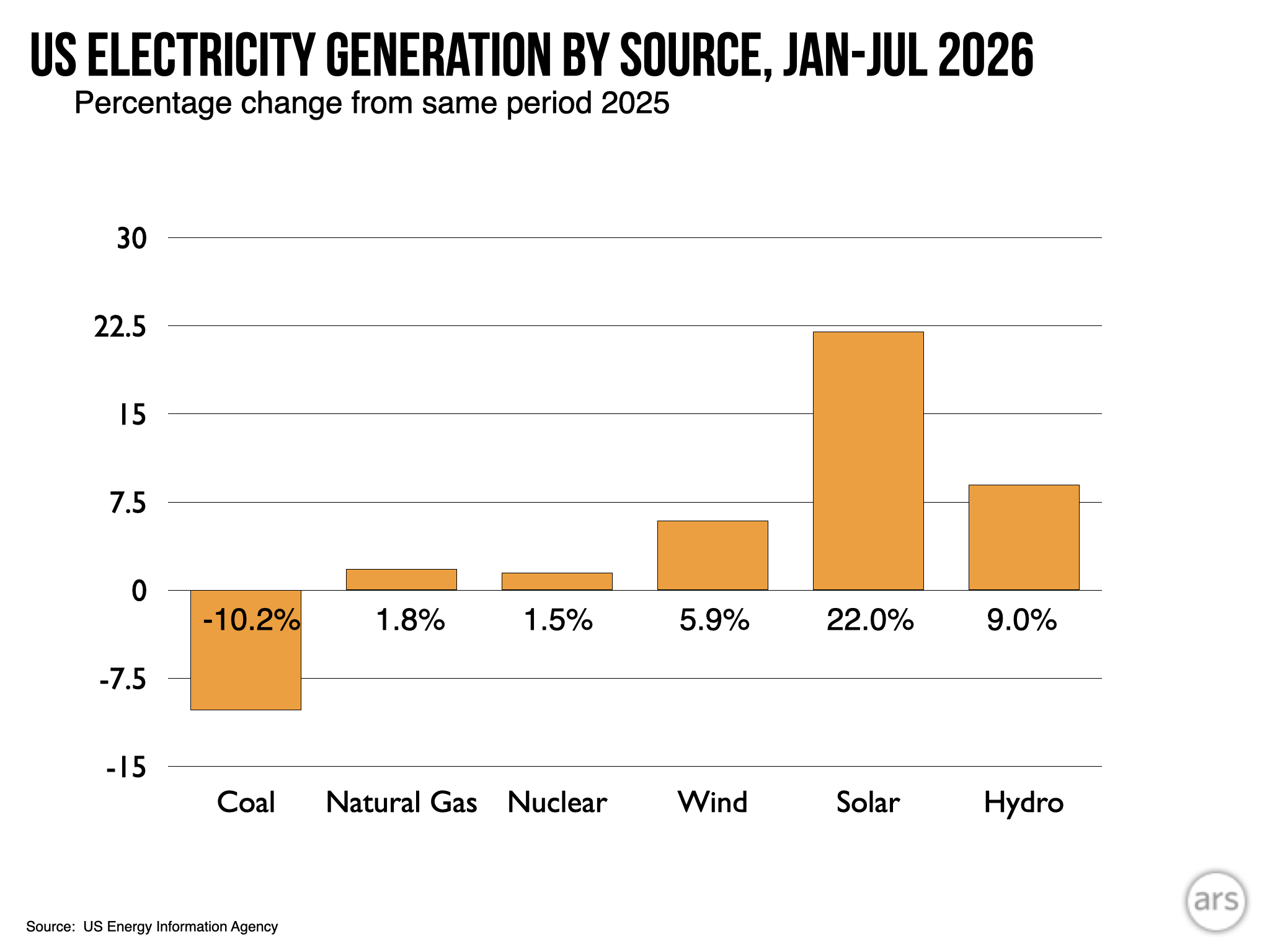
Coal is down and renewables are up, despite the Trump Administration trying to achieve the opposite result.
Coal is down and renewables are up, despite the Trump Administration trying to achieve the opposite result.
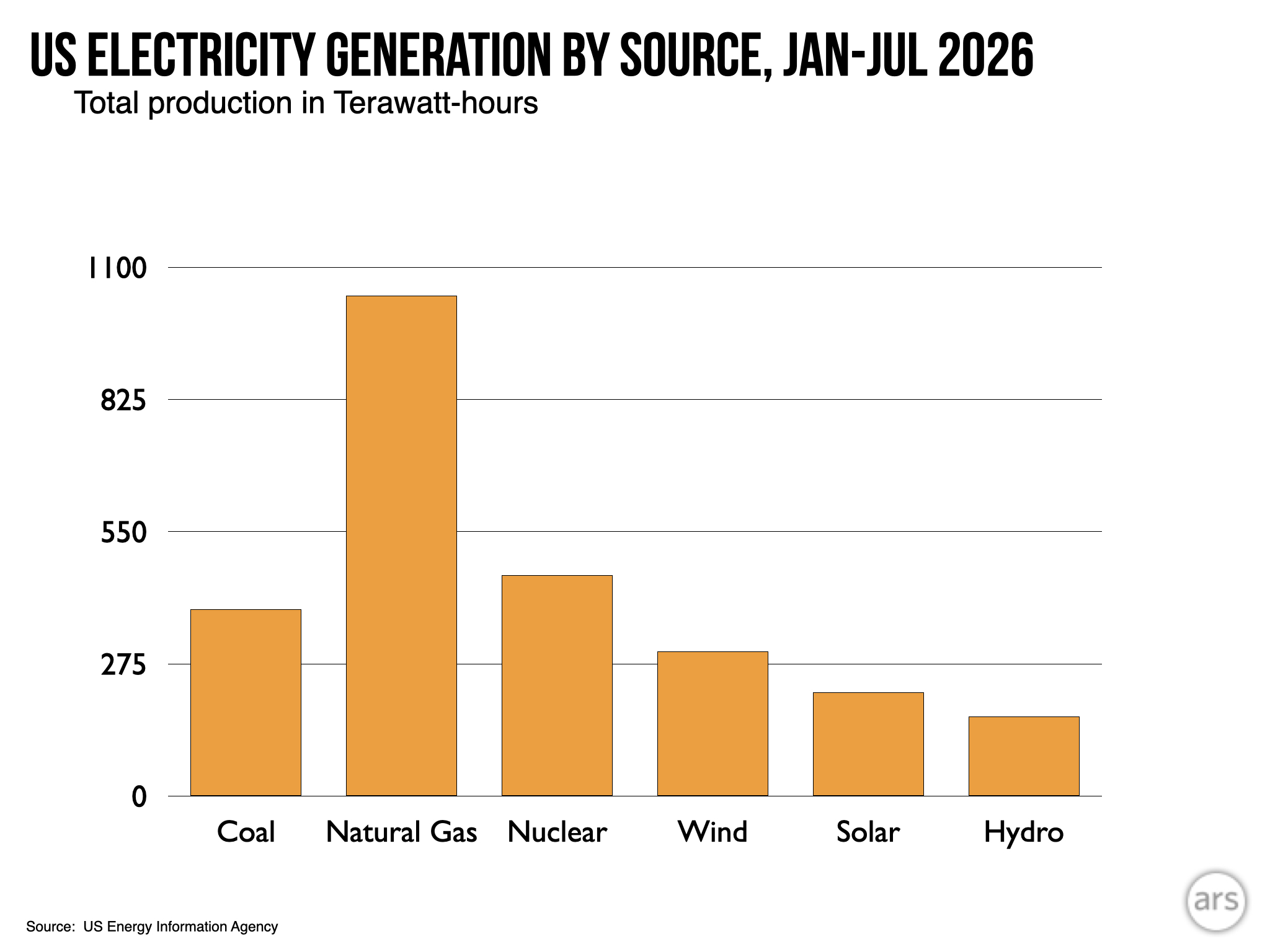
Natural gas still dominates the US grid, but solar and wind have steadily closed in on coal generation.
John Timmer
Natural gas still dominates the US grid, but solar and wind have steadily closed in on coal generation. John Timmer
Coal is down and renewables are up, despite the Trump Administration trying to achieve the opposite result.
Natural gas still dominates the US grid, but solar and wind have steadily closed in on coal generation. John Timmer
Small-scale solar, such as rooftop installations, has been growing at a slower rate, but still managed to increase by over 12 percent year over year. Combined with utility-scale generation, solar produced 72 percent as much electricity as coal over the first seven months of 2026, aided in part by coal declining by a bit over 10 percent from the same period the year before.
Beyond solar and coal, all the changes in major electricity sources were less than 10 percent year over year. Hydro is up by 9 percent, wind by 6 percent, and nuclear and natural gas both by less than 2 percent.
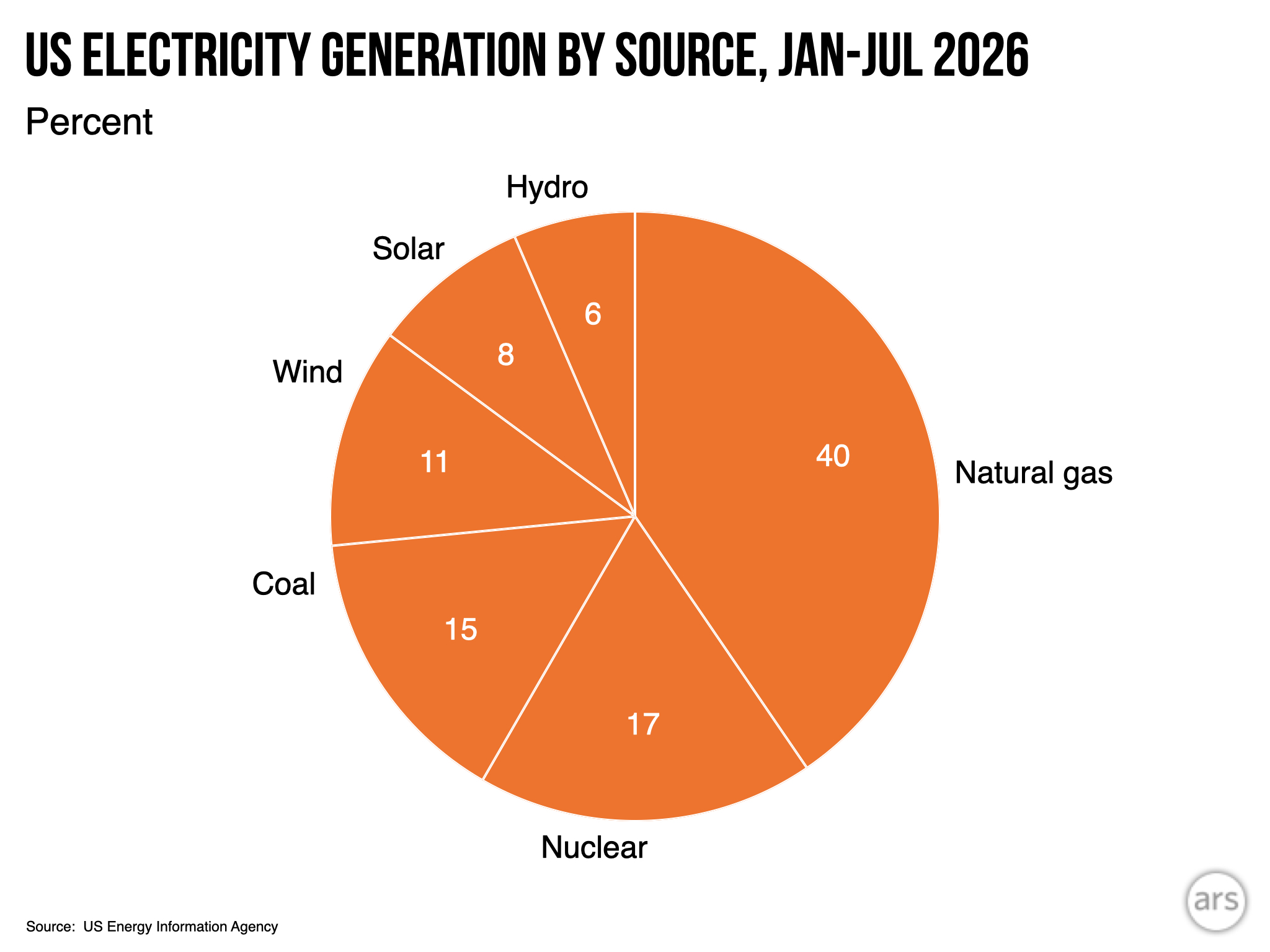
Overall, this leaves us with wind and solar now covering 21 percent of US electricity demand. Through the first seven months of 2026, the growth from these two sources alone was 55 Tw-hr, while demand on the grid rose by 51 TWh. In other words, their growth meant that increased use of electricity could be met entirely by renewable sources. (Again, excluding any on-site generation by data centers and the growth in small-scale solar, neither of which shows up on the grid.)
Share of the US electricity generation by power source. Numbers may not add up to 100 percent due to the existence of minor sources like geothermal and diesel generation.
Credit: John Timmer
Share of the US electricity generation by power source. Numbers may not add up to 100 percent due to the existence of minor sources like geothermal and diesel generation. Credit: John Timmer
Adding in hydro means that renewables now cover 27 percent of demand. With nuclear, that adds up to the US covering 45 percent of its electricity use with non-carbon-emitting sources. For comparison, the EU generates about 30 percent of its electricity using wind and solar, and 65 percent is emissions-free. (That rises to 71 percent if you count bioenergy, which is largely carbon-neutral, but not emissions-free.)
What’s next?
The Energy Information Agency, which provides all the grid data, also keeps track of what they expect to be hooked up to the grid over the coming months, which provides some perspective on what we might expect to see over the next year. The latest version of this highlights a couple of trends and one almost-trend.
The almost comes in the form of two large offshore wind projects that will be completed off the East Coast, including a 2.6 GW monster off Virginia. The Trump administration has paid off developers to stop building anything similar, so these will likely be the last of their kind until the 2030s. Onshore wind development has continued throughout the Midwest and Plains regions.
A map of the US with colored dots indicating the presence of new generating facilities and their technology.
A map of the US with colored dots indicating the presence of new generating facilities and their technology. Credit: US EIA
Those areas, along with the South, are also seeing a lot of solar development. This includes some significant facilities in Michigan and Wisconsin, which were probably too far north for the economics to have worked out just a few years back. Another notable change is that battery installations are starting to spread beyond the hotbeds in California and Texas. Arizona and Colorado are seeing a number of grid battery installs; the new solar in Michigan will be paired with a few, and there’s a large one expected to come online in Georgia.
A smattering of new natural gas plants will be coming online, mostly throughout the Midwest and Texas. No new nuclear or coal plants will be completed; it has now been 13 years since the last new coal plant came online in the US, and none are currently being developed.
The world’s two most powerful men just met. How did it go?
US President Donald Trump welcomed Chinese President Xi Jinping to the White House on Thursday, with talks on trade and artificial intelligence and the growing strategic rivalry between the countries all in the spotlight during an elaborate state visit.
Here are some major takeaways from the talks:
TRADE DEAL EXTENDED, FOR NOW
The US secured an extension of its trade truce this week – but only a short one.
US Treasury Secretary Scott Bessent said the two sides agreed to extend by two months a trade agreement that ended last year’s trade war and was due to expire in November. The extension would give Washington and Beijing “more time to see what we can do on the economic front,” he said.
But rather than locking in a durable agreement, the extension appears to push the central questions — tariffs, Chinese purchases, rare-earth supplies and technology restrictions — into the next round of negotiations.
Bessent said on Wednesday that Beijing was meeting its requirement in the earlier agreement to buy 25 million tons of soybeans but was lagging on its pledge to buy $17 billion in other agricultural goods. US officials have said rare-earth deliveries were also falling short, another sign that significant gaps remain.
For companies, the result is a familiar form of instability: tariff rates remain lower for now, but decisions must still be made against a shifting policy backdrop.
DRESS TO IMPRESS
For Trump, Xi’s White House visit was an opportunity to show off a Washington being remade in his image.
After Xi treated Trump in Beijing to a tour around a Ming dynasty temple and a walled-off garden retreat rarely opened to foreigners, the US president returned the favor with a different kind of spectacle: Troops wearing wigs and tri-corner hats marched in formation and played music in a Rose Garden redesigned to look like a Trump golf club.
Fighter jets and bombers roared overhead during ceremonies staged on Wednesday and Thursday, one so loud it caused Trump to flinch.
When the White House press corps was called to cover the two leaders, it wasn’t to hear them talk about the weighty affairs of state. Instead, it was to watch them tour the Marine One helicopter and the recently redesigned South Lawn of the White House, replete with a large helipad emblazoned with the presidential seal.
Speaking to reporters, Trump brushed away questions about their policy discussions.
“He loves good granite,” Trump said of Xi. “Great meeting.”
XI WANTS US ‘PRUDENCE’ OVER TAIWAN
As expected, Xi pressed Trump on the Taiwan issue, saying, according to China’s official news agency, that China hoped the United States would “handle the Taiwan question with prudence.”
The agency’s English-language service also wrote that Xi hoped the US would oppose Taiwan independence.
That would be a tougher version of Washington’s long-standing formulation that it does not “support” independence. There are no signs that the Trump administration plans to change its wording.
There was no immediate White House readout of the exchange, but US officials have long avoided explicitly stating opposition to Taiwanese independence. Any shift in language would raise questions about Washington’s resolve to defend the island and provoke opposition in Congress.
STRATEGIC RISK
Xi, not for the first time while meeting Trump, invoked the “Thucydides Trap”, an academic theory that competition between a rising power and an established one tends toward war.
While the Chinese leader said the risk “can be overcome,” his reference underscored how concerns about a potential US-China military conflict continue to shadow relations between the world’s two largest powers.
Xi argued that both nations stand to gain from cooperation and lose from confrontation, and he called for regular military dialogue and stronger crisis-prevention mechanisms.
Trump, for his part, drew on the two nations’ shared history to emphasize the potential for cooperation. They could accomplish much by pursuing common interests, he said, invoking their wartime alliance against Japan.
DIFFERENCES ON AI
The two leaders expressed diverging views about artificial intelligence.
Trump, who has declared that AI should be called super intelligence, or SI, said in a social media post that he wants to “to leave it exactly where it is” and rely on the US Department of Justice rather than impose any new guardrails. He insisted that China held the same position.
But Xi said on Thursday that, as leading nations on AI, China and the US must manage its growth.
“We have both the capability and responsibility to develop and manage AI for good, and ensure that the development of AI is always under human control and serves the well-being of the people,” Xi said.
Some of the biggest names in AI were expected to attend Trump’s state dinner at the White House on Thursday for Xi, including Alphabet’s Sundar Pichai, OpenAI’s Sam Altman and Nvidia’s Jensen Huang.
John Travolta and Priscilla Presley Reunite After Explosive ‘Baby’ Claim
John Travolta and Priscilla Presley crossed paths at a star-studded Los Angeles tribute, months after a disputed court allegation dragged both families into an intensely personal controversy.
The two attended the Ramones’ 50th anniversary celebration at Hollywood Forever Cemetery on August 30. RadarOnline reported that they were seen talking during the event, which Travolta hosted.
Their appearance together, however, offers no confirmation of the allegation — or any indication that they discussed it. Presley’s attendance and Travolta’s hosting role were separately reported by the San Francisco Chronicle. (sfchronicle.com)
The controversy dates to a December 2025 amended complaint filed by Presley’s former business associates, Brigitte Kruse and Kevin Fialko, in a contract dispute involving her son, Navarone Garcia.
The filing alleged that Presley’s granddaughter, actress Riley Keough, provided an egg used by Travolta’s late wife, Kelly Preston, to conceive their son Ben, who was born in 2010. The account attributed that information to Michael Lockwood, Lisa Marie Presley’s former husband.
It remains a disputed allegation, not an established account of the family’s history. (ew.com)
Lockwood rejected the story attributed to him when approached by the Daily Mail.
“That just sounds crazy,” he said. “I have not heard anything about it.” (en.newsner.com)
Presley’s legal team also pushed back forcefully. Attorney Marty Singer called the allegations “outrageous” and argued that they had nothing to do with the underlying claims in the case.
Singer accused the former associates of trying to pressure Presley through litigation involving people close to her. Kruse and Fialko’s attorney, Jordan Matthews, defended the filing, saying his clients sought to document work they had performed for the family and resolve the dispute in court. (Us)
That context matters: the claim surfaced in a business disagreement involving other parties. Travolta, Keough and Lockwood were not defendants in that lawsuit, Entertainment Weekly reported after reviewing the filing. Their names appearing in a complaint does not establish the truth of its allegations. (ew.com)
The August gathering had a very different purpose.
According to the official event announcement, the evening celebrated the 50th anniversary of the Ramones’ debut album and supported cancer research at the Ellison Institute.
The concert featured Cretin Family, a lineup bringing together Green Day’s Billie Joe Armstrong, Rancid’s Tim Armstrong, Blink-182 drummer Travis Barker and former Ramones bassist CJ Ramone.
Travolta also had a film connection to the festivities. The program included screenings of Carrie, which marked its own 50th anniversary, and his directorial debut, Propeller One-Way Night Coach. (Rhino Media)
With musicians, actors and other celebrity guests sharing the venue, there was plenty to discuss without revisiting a lawsuit.
For now, the reported conversation between Travolta and Presley remains just that: a conversation at a public event. Neither the encounter nor the photographs reveal what was said, and the family allegation remains disputed.
I Deliberately Bet Like a Problem Gambler. DraftKings Made Me a VIP.
Reporting Highlights
Recklessness Rewarded: I blew $1,800 in one night by chasing my losses with bigger bets, a classic sign of problem gambling. The next day, DraftKings invited me to audition for its VIP program.
Casino Craze: Sportsbooks want to expand into online casinos, where you can lose a lot fast. I played 500 rounds of blackjack in a weekend — about half of my total bets over 10 weeks.
Profit Over Protection: The responsible gaming prompts telling me to pump the brakes were no match for the product design and promotions pushing me to do more gambling.
These highlights were written by the reporters and editors who worked on this story.
It was late May, the French Open was on and DraftKings was pushing me into the action.
A promotion pinged on my phone. “BET & GET,” it boomed, offering to boost my profits if I threw down on tennis, punctuating the point with a cartoon stack of cash. I was already in the middle of a two-hour betting spree, ripping 64 wagers on the clay courts of Paris from my office chair in New York City.
A $75 bet that Claire Liu would win the fifth point of her first set tiebreak against Maria Sakkari? Wrong. How about an easy $300 on Francisco Comesana to win the first game of the second set against Luciano Darderi? Negativo.
I’ll be the first to admit that my backhand needs some work. But this wasn’t about sports. It was about scratching an itch.
For the past six weeks, I’d been gambling like a man out of control, testing the guardrails of one of America’s most popular — and controversial — products: online sports betting. I’d morphed from a prudent, just-for-fun $40 bettor into a “degen” (sports betting slang for a degenerate gambler) who casually yeets $1,500 on a game. I’d feverishly jumped from sport to sport, following playoff basketball bets with live Czech table tennis. And I’d gone hog wild at the online casino, doubling down at the blackjack table. Most of the time, I’d lost — then chased those losses with more bets. Now, I was in the grips of yet another binge.
And as I approached $4,500 in losses in 24 hours, transferring money from my bank directly into my DraftKings account, the company seemed to clock the problem, sending me an in-app notification.
“Take a loss? Now take a beat,” it read. This felt right after the tear I’d been on. To date I’d blown about $12,500 in total on DraftKings. That’s the equivalent of six months of mortgage payments in as many weeks.
I followed the prompt to the site’s “responsible gaming” center, where I opted to limit myself to just two hours per day on the app and barred myself from depositing more than $100 in a 24-hour period. That pause is an essential part of DraftKings’ seemingly paradoxical business model — to make as much money as possible from the nation’s growing ranks of sports bettors without encouraging gambling addiction. The company says these limits are a cornerstone of that strategy.
Yet 30 minutes later, the company pushed me in the other direction. My phone buzzed with the first of four promotional alerts that day. Betting opportunities, they said, were waiting.
This wink-and-a-nod dynamic is now at the center of a fierce public policy debate over online gambling, addiction and consumer protection.
Since 2018, when the Supreme Court allowed states to legalize sports betting, Americans have put more than $600 billion into play. Sports betting is now legal in 39 states and Washington, D.C. Add in prediction markets like Kalshi and Polymarket, and more people are betting on sports than ever before.
That explosive growth has come with consequences: About a quarter of active sportsbook account holders surveyed by the Siena Research Institute this year said that they’d lost enough on a bet that they’d have trouble meeting their financial obligations. As a result, regulators and lawmakers from Colorado to Massachusetts are starting to question whether things have gone too far — and some are now proposing stricter consumer protections.
Amid the mounting scrutiny, major operators like DraftKings have pushed back, arguing that their responsible gaming system provides adequate safeguards to protect their customers from spiraling out of control. “I think as a business, as an industry, we’re doing a good job of educating people, of raising awareness, of making tools and resources available, of monitoring accounts,” Lori Kalani, the company’s chief responsible gaming officer, told me. If a customer waves too many red flags, she said, the company will proactively close the account. But when I asked how often this actually happens, DraftKings wouldn’t say.
So I decided to find out for myself: If I bet like a compulsive gambler, would DraftKings stop me — even if it cost the company money?
I opened an account under my own name and linked it to my debit card. ProPublica bankrolled me. When the app asked me what I did for a living, I disclosed that I was a reporter. I assembled a panel of addiction specialists, recovering gambling addicts and professional sports bettors who pointed me to the telltale wagering habits of someone who’s out of control. And then I got to work.
Over the next 10 weeks, I’d mimic those patterns and come to find out just how much DraftKings would encourage my recklessness — and just how little pushback I’d get as I spiraled downward.
I used the NBA playoffs as my launching pad, and, like much of New York, I was all in on the Knicks. After a week of moderate betting, I waved my first red flag during Game 3 of the Knicks vs. Atlanta Hawks first-round series.
I slept fitfully after my night of loss chasing and awoke at dawn to catch a train to Boston, where I attended a symposium on online gambling put on by the Public Health Advocacy Institute at the Northeastern University School of Law.
There, Matthew Gaskell, a British psychologist and expert on gambling addiction, said that the bettors that companies are most interested in are, well, losers like me. Indeed, a modest set of very active losers account for a substantial amount of sportsbooks’ revenue, he said. (A 2024 study out of Connecticut found that 1.8% of problem gamblers in the state accounted for 51% of sports betting revenue.) And the companies have created sophisticated technology products designed to squeeze maximum engagement out of them, just as social media companies like Meta did years earlier with users of Facebook and Instagram, added Darragh McGee, a researcher at the University of Bath.
In fact, as The New York Times reported, DraftKings employs machine learning and data scientists to identify losing customers and entice them with promotions to keep them going — even if those are exactly the kinds of customers at risk of becoming addicts. DraftKings told the newspaper its promotions are geared toward users who spend a lot of time on the app and that the company “rejects any implication that its marketing practices are unfair or improperly targets customers.”
To keep users loyal, the major operators offer VIP programs, not unlike what airlines or rental car companies do. As a bettor climbs the tiers, the perks get bigger and better, from free bets and swag to primo seats at games, fancy dinners and even concert tickets. A FanDuel VIP in Pennsylvania received a personalized video message from MLB slugger Bryce Harper.
I wanted to be a VIP. I wanted cool perks.
To help get that status, I’d tapped the skills of Isaac Rose-Berman, a precocious 26-year-old professional sports bettor and policy expert at the American Institute for Boys and Men, a think tank that focuses on policy issues impacting dudes. He had a hunch that by chasing losses and displaying other signs of problem gambling I’d eventually get an invite. We just didn’t know when it would come — or how much it would cost.
It happened sooner than either of us thought.
At 5:01 p.m. the day after I lost nearly $1,800 on basketball in one night, during the closing remarks of the gambling addiction symposium, an email popped into my inbox. “Welcome to the DraftKings VIP Showcase,” the subject line read. I couldn’t believe it. My night of loss chasing was being rewarded.
The VIP showcase is basically a three-week tryout. Every week I’d get a new promotion as the company sussed me out to make sure that I was worthy of the title. It wanted to know whether I was actually a big spender, aka a whale, or a wolf in sheep’s clothing — a pro bettor, like Rose-Berman, who, armed with math, can beat the house more often than most by exploiting mispriced odds. Bettors like these, known in the business as sharps, calculate savvy wagers that have as much to do with sports knowledge as with probability. The apps do not like losing money to them and so limit how much they can bet.
For long-term losers like me, though, those limits don’t apply. I’m not a sharp. I’m a square.
And when I read the fine print of the VIP loyalty program, I was floored to see the incentive structure laid out so plainly: The more I spent on long-odds wagers, the quicker I’d accumulate the credits I needed to advance from tier to tier — from bronze, to silver, to gold, to diamond, to Onyx — and thus get closer to the cool perks I so desired. The upshot? Full send every time, baby!
Before I could get started though, I encountered my first in-app responsible gaming prompt since I began betting.
Screenshot by Jake Pearson/ProPublica
In just over a week, I’d gambled away roughly what a minimum-wage worker in New York City earns in a month by chasing my losses and repeatedly tapping my bank account. But the notice wasn’t served to me because of how I’d been betting. It was sent because when New York lawmakers legalized mobile sports betting in 2023, they required the apps to notify users when they hit $2,500 in total deposits.
The law also requires sportsbooks like DraftKings to submit a “problem-gaming plan” to the state regulator but leaves the specifics of it up to the companies. The plan must include, among other things, procedures “for identifying users with suspected or known problem-gaming behavior” and for “providing information to users concerning problem-gaming identification and resources.” But the exact details are unclear because such plans are not publicly available. (A DraftKings spokesperson wouldn’t provide a copy, and my request for it under the state’s open records law with the gaming commission is under review.)
The app’s response to my $2,500 in deposits was tepid. With a click I could either set limits on my betting or avoid doing so altogether. Eager to gamble, I clicked “I Understand” and moved on. That was it, warning resolved. I got on the horn with my panel of experts to map out the next phase of my experiment. It was time to up the ante.
One of my advisers, Joshua Grubbs, who studies gambling disorders at the University of New Mexico, said he’d expect to see someone on my trajectory pick up the frequency of his betting, have longer sessions on the app, jump from sport to sport in search of fast action and start experimenting with more exotic betting products, like parlays and prop bets.
OK, I said. Let’s rip some parlays.
Parlays link multiple events into a single wager, drastically decreasing the likelihood of all parts happening while simultaneously increasing the potential payout. They’re enticing, aspirational bets. And, Grubbs was quick to remind me, they’re known by another name: a sucker’s bet.
DraftKings heavily promotes parlays, offering “profit boosts” that juice their potential payouts.
The companies say these bets make watching a game more fun and exciting. They’re a reason to tune in, and hang on, if you’re not otherwise interested in whatever’s on TV.
Do enough parlays, though, and you become seduced by what’s known as the “near miss” effect — a psychological phenomenon in which your brain basically tricks you into thinking you’ve got skill after almost winning.
Mathematically, however, you’re actually four times more likely to get three out of four legs of a parlay, for example, than all four. Yet every time I got close, I wondered if maybe I just needed to tweak my formula, even as my rational brain recognized that I couldn’t hit a parlay to save my life.
Prop bets play on a different dynamic in your brain. They are wagers on a player’s stats or a specific event within a game that’s divorced from the overall outcome. Among the most controversial forms is the microbet, which offers very fast action — who will win the next point in a tennis match, will the next pitch be a strike. Another one of my consultants, Natasha Schull, an anthropologist at New York University and the author of “Addiction by Design: Machine Gambling in Las Vegas,” said microbetting is as close as you can get in sports betting to playing slots, widely considered to be one of the most addictive forms of gambling.
So I followed Grubbs’ and Schull’s advice to escalate my risk-taking as I bet from my living room couch.
Betting on the couch was fun enough, but I was itching to feel what it was like to have money riding on a game being played right in front of me. So in early May, when my neighbor and I went to see the Yankees play, I decided to give betting IRL a try.
It’s hard to overstate how heavy-handed the sports betting messaging in Yankee Stadium is. When I went to get a hot dog, there were ads from DraftKings’ chief rival, FanDuel, on the monitors that displayed the menus.
I settled into my seat, cracked a cold one and logged into DraftKings. It was time for more microbets. When Yankees shortstop José Caballero was up in the fifth inning, I bet $50 that he’d either get a hit or take a ball on his third pitch. I was right! Easiest $95 I’d ever made.
So I kept going — with less success.
I lost $50 on the next pitch to Caballero, then I went 0-5 at $20 a pop trying to guess what Baltimore Orioles center fielder Leody Taveras would do from the box during his third plate appearance. I’d managed to squander my payday in just a couple of minutes.
Schull told me that since there’s so little lag time between placing your wager and getting your result, you can quickly get into a flow of submitting and repeating bets — exactly the kind of trance she observed in gambling addicts pulling slot machine levers. The result, obviously, is that it’s very easy to lose a lot very quickly.
I’d soon find out that DraftKings knows this, too, though its take on microbetting was far less full of doomerism.
Three days after the Yankees game, on May 7, following yet even more parlay losses, the company served me a “responsible gaming” pop-up video — the first I’d been served in the app since the New York-mandated one on April 25.
“Took a loss? Now take a beat,” it read, directing me on how to visit the “My Stat Sheet” page on the app, where I could set a budget or impose limits on my ability to spend. I clicked “Maybe Later,” and the interruption was over.
But DraftKings’ apparent concern for my well-being was belied by a promotion the company sent me just hours later: A 20% profit BOOST on bets of up to $250 for an unlimited number of live microbets on baseball plate appearances. This was exactly the kind of bet that had led me to lose so quickly at the ballpark. Now the company was encouraging me to run it back at even bigger dollar amounts for as many times as I wanted until the promotion expired later that day. “Bet, settle, repeat!” read the push notification that popped up on my phone. I could practically hear the crank of a slot machine lever.
On May 7, the app served me the first “responsible gaming” pop-up since the New York-mandated one on April 25.Screenshot by Jake Pearson/ProPublicaJust hours later, DraftKings sent me a promotion urging me to place microbets on baseball.Screenshot by Jake Pearson/ProPublica
When I described this bet-pause-promote progression to Kalani, DraftKings’ responsible gaming chief, she told me she’d “take that back” to her team for review but added, “I just don’t think we should be drawing broad conclusions from, you know, your single account, what you did.”
A few days later, exactly two weeks after my first big night of loss chasing during the Knicks game, I was formally accepted into the VIP program and assigned my very own, personal concierge. It had taken only three weeks and $5,800 in deposits on the app. My rep said he’d be “keeping an eye out for opportunities and perks tailored specifically” to my account, plus “reminders about Responsible Gaming.”
I could text him directly. I could reach out for special treatment. Rose-Berman explained to me that this meant I could ask for “bonus bets,” free one-time bets using house money, or, more commonly, “deposit matches,” extra house money called DK Dollars, that fattened up my account when I made a transfer from my bank. He said that sportsbooks are happy to provide these freebies to losers like me because they’ve assessed, rightly, that we’re likely to end up gambling it right back — and that the special treatment will keep us loyal. I’d be earning crowns that I could convert to DK Dollars as I climbed the tiers of the loyalty program, which I could use to bet more or buy merch. I couldn’t help but hope that I’d also get the really cool stuff. A personalized video from a major leaguer? Tickets to a game? Swag?
My rapid ascent to VIP at DraftKings made me wonder how its major competitor, FanDuel, would handle a problem gambler like me. So I repeated the behavior there, placing the same kinds of bets at the same odds over the course of a week on their app.
One night I blew $529 on playoff basketball bets and then chased my losses with a $750 wager on professional hockey, backing the Minnesota Wild in a high-scoring matchup against the Colorado Avalanche. When the Avs won and my money was gone, I found the only remaining live action I could: a cricket match between Indonesia and Malaysia.
Like most Americans, I have no idea what cricket is. But whatever. It was near midnight and this was work, so I deposited $500 and tried to put it all on Malaysia. That bet would’ve netted me $11,000 had Malaysia won, but FanDuel wouldn’t accept it and required me to lower my wager amount. When I later asked the company about this, FanDuel wouldn’t say whether it did so because it didn’t want to lose the money or out of a commitment to responsible gaming. In any event, I put $200 on Malaysia instead and, of course, lost.
The app also put some speed bumps in my way over the course of that night, prompting me with “Reality Check” reminders six times that showed me the amount of time I’d been on the app and the amount I’d wagered thus far.
One of six FanDuel “Reality Checks” I encountered while betting on the app on May 3.Screenshot by Jake Pearson/ProPublica
And unlike on DraftKings, my weeklong betting behavior on FanDuel didn’t result in a VIP invite. When I reached out to FanDuel for comment, the company touted its responsible gaming tools. A company spokesperson added in a statement that FanDuel’s program is “designed to identify potential risk early and empower customers with real-time information about their play.” For some customers, the statement said, “trained specialists” will intervene “or apply protective measures, including limits or exclusion,” though the company didn’t say how often that happens and what it takes, exactly, to trigger those measures. The New York Times reported that FanDuel is one of several operators that have signed up with third-party firms that help gauge customers’ risk for problem gambling to curb it. DraftKings is not among them but said it has its own tools.
Over on DraftKings, things were heating up. A month into my experiment I’d already lost $4,671 — enough scratch to buy a used car (with a lot of miles) — and my bet size was growing, too. I was getting used to risking large sums. I looked back on how nervous I’d been to place $200 bets when I first started and couldn’t believe that I’d been so naive.
I’d been wagering so much, in fact, that the quick-tap deposit buttons in the app had increased to $500, $750 and $950, making it even easier to mindlessly transfer large sums from my bank into my DraftKings account.
The default dollar figures exemplify “dark patterns” aimed at making betting large amounts as frictionless as possible.Screenshot by Jake Pearson/ProPublica. Debit card number redacted by ProPublica.
Computer scientists have a term for this choice of user design: They call it a “dark pattern.” Critics say this is a key way that apps essentially trick you into subscribing to or purchasing things you don’t want or need with just one click.
And boy, was I getting fed opportunities to click. I’d selected the open settings for notifications on DraftKings, and as a result I was just getting pummeled with push alerts to my phone. Sometimes there’d be six in a day, offering BOOSTS. In the app, they’ve even got their own tagline: “BOOSTS DON’T STOP.”
I was hoping for tickets to a game or swag or anything super cool, but so far my VIP rep had hooked me up with only a 12-month ESPN subscription. That and lots of promotions to bet, at all hours. On Saturday, May 16, as I was getting the kids home from my son’s baseball game, DraftKings pushed me an “Exclusive Offer” to double my winnings on any bet up to $250. I pieced together a parlay on the subway, placing the bet as my service cut in and out.
The Yankees were playing the Mets that night, and Rose-Berman had encouraged me to shoot the moon — to climb the tiers of VIP status — so I strung together a five-leg parlay for the full eligible amount. My payout, highlighted in purple at the bottom of my slip, would be $6,250 if it hit.
The Yankees lost, and I hit only one leg of my parlay. As I nursed my wounds I began to wonder: Would I have spent that $250 but for the promotion?
I promise you I wasn’t trying to lose. Sure, I was firing unlikely bets, but I wanted them to win. If you could lose intentionally then you could win intentionally, and gambling wouldn’t exist. Over time most gamblers lose, and like them my performance was trending southward consistently — and fast.
But then, heading into Memorial Day weekend, I got on a hot streak. In statistics, this is called variance, but colloquially we refer to it as luck. Over five days, I notched real wins betting serious cash. After winning $3,869 on parlays from a Yankees game and the thrilling double overtime Spurs win in Game 1 of the Western Conference finals against the Oklahoma City Thunder, I almost forgot that, net, I was still down $8,836. And you know what? I felt like Superman.
To my betting brain, I was flying high. I was hot. I contacted one of my advisers, Rob Minnick, himself a recovering gambling addict who hosts a YouTube channel about problem gambling, and asked what he did after big wins.
He told me to withdraw the deposit I’d made immediately before my hot streak and then bet the winnings left in my DraftKings account with gusto because, hey, it’s just house money.
“I always say on my channel, like all wins are just future losses because when you don’t stop, it eventually gets given back,” he said.
Today, nearly a quarter of all Americans, and half of men ages 18 to 49, say they have an active sportsbook account, according to the Siena Research Institute. And with the advent of prediction markets, millions more are believed to be betting on sports.
But companies like DraftKings and FanDuel don’t just offer sports action: You can also gamble on casino games like blackjack and roulette in the handful of states where that’s legal. The companies call it iGaming, and they want it to be legal everywhere that sports betting is.
“I do think it’s a when, not if, that a lot of these states are going to legalize iGaming,” DraftKings CEO Jason Robins said at a June investor conference. “Customers want it. The tax revenue potential is real. And so we’re seeing a lot of momentum develop in different states.”
New York doesn’t permit that kind of gambling, but New Jersey is one of the roughly half dozen states that does. Since I was headed down the shore for Memorial Day weekend and my DraftKings account was flush from playoff basketball betting, it proved to be the perfect opportunity to try out iGaming.
I logged into my account from the beach on May 22 and was hit with a reminder of the app’s responsible gaming suite of tools, including the option to set a budget. I bypassed the prompt with the swipe of a finger, and there, on the main page, was a shortcut straight to the card table.
New Jersey allows iGaming, so I could access the casino right from DraftKings.Screenshot by Jake Pearson/ProPublica
I explored the expansive casino offerings: I played roulette and tried out blackjack. The cards were dealt on a table that looked straight out of Vegas but for your phone. I didn’t have to think about how much to wager because DraftKings had already done that for me: With the click of a button I could bet as much as $1,000 per hand. And I was struck by how DraftKings cross-promoted iGaming to the sports bettor.
That included “baseball blackjack” and “basketball blackjack” — a regular deck of cards but instead of a felt card table background, there was a baseball diamond or basketball court.
I didn’t think much of that until after I bet on the Knicks and Cavs in Game 3 of the Eastern Conference finals the next day. At the bottom of the receipt of my bet slip, I noticed for the first time a “Suggested For You” section. Mine advertised baseball blackjack and basketball blackjack. The app was drawing me back to the table.
In states where it can offer iGaming, DraftKings has casino games like baseball blackjack.Screenshot by Jake Pearson/ProPublicaThe app suggests sports-themed iGaming like football, baseball and basketball blackjack.Screenshot by Jake Pearson/ProPublica
Not that I needed that hard of a nudge to start playing cards again.
Rose-Berman and I had discussed a strategy for the weekend: To escalate my compulsive betting late into the night, I transitioned from my usual sports fare to even faster, more exotic sports action (read: Czech table tennis) and then, ultimately, to the casino, following the path DraftKings was all but paving for me.
As I devolved in Jersey, Draft Kings promoted me to silver-tier status.
I’d played about 500 rounds of blackjack in a couple of days — accounting for just over half of my total betting activity during 10 weeks on DraftKings. By the end of the holiday weekend, I’d blown close to $3,000 on casino gambling. Before I left the Garden State, I asked my VIP rep whether there was any way to get just the casino stuff off my phone.
Days later he responded, informing me that, no, unfortunately, that wasn’t possible. But he did ask me whether I needed “help with setting in app limits.” I declined the offer.
DraftKings’ Kalani told me I wasn’t the first user to voice this complaint and said the company was working on allowing customers who’d rather just bet on sports to toggle off the casino on their phone.
I came away from my betting mania with an overarching takeaway: that the “responsible gaming” prompts that were served to me were no match for the product design pushing me to do more gambling.
While I was fighting off sleep to play cards, DraftKings occasionally threw me some responsible gaming speed bumps. Just before midnight, for example, a “time reminder” popped up on the blackjack table, telling me I’d been on the app for three hours and 45 minutes.
The pop-ups were barely disruptive: They covered a small part of the screen and could be swept away in a second. The design of the blackjack game, by contrast, facilitated betting big and chasing losses. That’s because DraftKings has made a “Double” button one of the options you’re served after your hand is dealt — literally enabling doubling down in a millisecond with the push of a thumb.
A time reminder from DraftKings.Screenshot by Jake Pearson/ProPublicaThe “Double” button is another “dark pattern.”Screenshot by Jake Pearson/ProPublica
Minnick, who, in addition to hosting a YouTube channel on problem gambling, has co-founded a nonprofit industry watchdog that Rose-Berman advises, told me this dynamic pretty much summed up how he has come to understand the industry’s “responsible gaming” approach.
“It’s like an entire system that’s just built to appear to be doing something good while giving them basically like a free pass to do everything bad by saying, ‘Hey, we told you, you know, you have a responsibility, it’s your fault,’” Minnick said.
In a statement, DraftKings disputed that characterization, saying that all 5,000-plus of its employees are trained on responsible gaming every year and that it’s “not a side initiative. It is embedded across our business and essential to DraftKings’ long-term sustainability.”
But either way, Minnick and others said the framework for protecting consumers shouldn’t be entrusted to a publicly traded company that’s driven to grow revenue. “It’s unfair for us to expect or require a private business to do something that goes against its own mission of generating profit, right?” Minnick said. “Well, if you choose the industry standard, it’s going to be the least effective means.”
By late May, according to my expert panel, I was enthusiastically waving all the red flags of a compulsive gambler. Loss chasing? Check. Regular depositing? Yup. Exotic betting products? Lots of ’em. Long hours on the app and bets of increasing size and frequency? Yes and yes.
Yet the only pushback I got from DraftKings came in the form of responsible gaming prompts that required me to opt in to the app’s tools. The company told me it sent a total of 32 such notices over my 10 weeks of gambling, including emails that every DraftKings customer gets. By my count, I got in-app notifications about my betting on 14 of the 71 days I gambled.
Kalani, who served as DraftKings’ outside lawyer before becoming its responsible gaming chief, says her 51-person team manually reviews user accounts suspected of problem gambling. But I’d never heard from a single one, and I wondered if it was because I wasn’t compulsive enough.
So to erase any conceivable doubts about my status as a problem gambler, I went full “degen,” as sports bettors say when they’re on a particularly wild tear.
This is the moment that I bet feverishly on the French Open. I was fueled with $1,100 I’d won from my second bet ever, on April 16, a $200 wager on the Knicks to win the Eastern Conference finals. Now, six weeks later, I was compulsively betting on tennis, a sport I’d never bet on before. Once I blew my stack, I went straight to the responsible gaming center to set limits on how much I could deposit and how many hours I could be on the app.
The company says it doesn’t want there to be a stigma attached to using responsible gaming tools, but instead wants to encourage its users to budget, impose limits and avoid going off the deep end. DraftKings says millions of customers have visited its responsible gaming center, but the little data available publicly suggests only a small percentage opt into these tools.
As of April, just over 8% of active DraftKings users in Massachusetts were using them, a company official told state regulators this summer. This number was trending up, which was a good thing, the official said.
But when I used the tools, it didn’t take long to see their limitations. Just a half an hour after opting in, I received the first of four push alerts.
When I asked Kalani if the push notifications undermined my efforts to control myself, she dismissed the issue.
“People use our tools all the time, and they also appreciate being offered the same things other customers are also offered,” she said. “I think they are two very different things.” Besides, she said, those kinds of marketing materials aren’t sent to customers who opt into more severe restrictions, like a “cool-off” period.
I knew she was right about that from firsthand experience because I’d opted into a three-day cool-off after blowing another couple of grand on tennis to really communicate to DraftKings that I was struggling.
When you’re cooling off, you literally can’t log in. I’d picked a torturous time to enroll — the NBA Finals were underway as I was headed to a reunion trip with the college bros. I couldn’t have scripted a more stereotypical scenario for betting. The Knicks were playing the Spurs in Game 1, but I couldn’t get in on the action!
When I emerged from betting purgatory, it did seem like DraftKings had taken its foot off the gas. I wasn’t getting push alerts. Some of the bonus perks the app regularly fed me weren’t available. Even the dark patterns deposit buttons had returned to the default amounts of $10, $20 and $50.
So on June 8, ahead of Game 3 in the Knicks-Spurs series, I texted my VIP host to see what the deal was — and to see how firm the guardrails were. I asked whether I could get some extra DK Dollars in exchange for making a big deposit. I wondered if, given the circumstances, he’d invoke responsible gaming. He responded a day later and initially demurred.
But on the advice of a recovering gambling addict I’d been speaking to, I tried another tactic: asking for a bonus bet — just to remind my rep that I was eager for action.
Any bonus bets in the meantime?
Actually, how much were you thinking of bringing on? I may be able to make something work match wise
Nice! Was gonna do 5k
Not one week after coming off my three-day cool-off, my VIP rep juiced my biggest deposit to date with an extra $1,250 in free DK Dollars.
Kalani told me she didn’t see a problem with this, either. It had been me, after all, and not my host, who first made contact following the cool-off. “At that point, again, you’re a VIP customer, and you’re asking for something that we would give to any customer,” she said.
Overall, “the system worked the way it was supposed to” in my case, Kalani said. The range of behaviors and indicators that DraftKings scans for that trigger closing or manually reviewing an account didn’t ping for me, she said.
While I often played late into the night, I wasn’t playing in the wee-est hours, between 1:30 a.m. and 5:30 a.m., she said.
I found this response revealing, though perhaps not in the way she’d intended it to be. I’d deposited $21,600 into my account in less than eight weeks, exhibiting just about every sign of compulsive gambling there is, according to my expert consultants. By DraftKings’ metrics, I didn’t even register for a manual review. Kalani had told me that the company was motivated to retain customers who were betting “within their means and can sustain their own entertainment.”
So I asked Kalani straight up: Does DraftKings ever cut somebody off purely based on their betting history and not because they’ve disclosed that they’ve got a problem? “Yes, we do that all the time,” she told me. She repeated the same answer when I asked her how often. I pressed again, and a spokesperson interjected, telling me he could take the question as a follow-up. I checked in later, but the company told me that “we do not share the specific number of closures.”
Sportsbooks know how to identify and restrict gamblers’ behavior. In fact, they already do so when it comes to sharp bettors like Rose-Berman. Gaming regulators in Massachusetts who crunched the numbers on this last September found that, on average, just 0.64% of gamblers in the commonwealth were limited as of December 2024 and that, within that group, winning bettors were more likely to have their bet maximums lowered than losers.
Sportsbooks could do the same to losers who are digging deeper and deeper holes. In fact, the Times reported, data scientists at DraftKings had developed a tool to identify customers who were headed in this direction, but the company didn’t adopt it. Kalani told the Times that DraftKings’ existing system for identifying problem gamblers was a “better methodology.”
As it stands, the current system relies on users to opt into setting responsible gaming tools like budgets or time limits. That model restricts the tools’ utility to those who have the wherewithal to police themselves, said Brianne Doura-Schawohl, a gambling reform advocate who lobbies statehouses to impose stronger consumer and public health protections on behalf of the Campaign for Fairer Gambling.
To stem the flow of casual money losing and potential addiction, advocates say, the design should be the exact opposite, requiring users to opt out of setting limits, especially since research shows that gambling can impair decision-making.
The argument about responsible gaming tools, while legitimate, misses an even larger public policy question, Doura-Schawohl added. States that have legalized sports betting derive billions of dollars in revenue from it — even as research shows that gambling disorder diagnoses are skyrocketing in those places. That makes it harder for lawmakers to impose stiffer regulations on specific offerings such as VIP programs or prop bets, like microbets, that are huge sources of revenue for companies and thus state coffers, she said. Other countries have already taken aggressive steps to curb some of the industry’s more problematic products, from marketing practices to advertisements. But in the U.S., the industry has actively opposed proposed reforms in Washington as well as statehouses across the country, and it even seeded a political action committee with $41 million to influence elections this year.
“We want regulations like deposit limits, the reconsideration of microbets. Let’s talk about the inundation of advertising that we’re all sick of,” Doura-Schawohl said. “How do the products themselves impact harm? I think VIP is a big problem with that.”
Midway through June, the unimaginable happened: The Knicks won the NBA championship for the first time in more than half a century.
It’s hard to add anything of substance to the canon of what’s already been written about the historic turn. But what I can say is that from a betting perspective, this was very good for me. My first bet, for $100, was on the Knicks to take home the chip. And ahead of Game 5, I had laid down my biggest bet ever: $10,000 on the Knicks — five times my biggest bet to date. As the city erupted in celebration, my account was as flush as ever, with $25,350. I’d erased all of my previous losses and netted a couple grand in profit.
And as it turns out, I was far from alone.
In fact, so many New York fans went big that the unlikely win resulted in sportsbook operators reporting a $48.5 million loss for the week ending after the Knicks secured the championship, the first time that’s happened since state lawmakers legalized online sports betting.
This confusing series of events presented a wrinkle in my experiment: What does the problem gambler who has been a consistent loser do when, by the grace of God, he comes out ahead?
Minnick, Grubbs and Rose-Berman all had the same answer: He keeps on going. “Congrats on becoming a huge world cup fan,” Minnick texted me.
It was good timing. The 48-team tournament was a major betting event, with billions wagered on the regulated apps alone. DraftKings was eager to get me into the action.
For the first time in the 12 days since my cool-off, with my account newly fat with house money, the company turned back on the push notifications notifying me of BOOSTS and betting opportunities. Between 1 p.m. and 8 p.m. on June 16, for example, I got five alerts pushing me to bet. “Defending champs Argentina start their quest for back-to-back glory,” read one. “Can they score 3+ goals vs Algeria (+180)?…” So I threw myself into World Cup betting with enthusiasm. And guess what? I was winning. A lot.
I was up $16,000 on top of my initial investment — astronomical heights. I frankly started to wonder: What if I was really good at this? What if I kept on winning?
My experts knew better. Winning, and winning big, can actually be dangerous for a problem gambler because it instills in that person a false confidence, a validation of their betting behavior. What I experienced was also a representative snapshot of how it really plays out on a problem gambler’s account.
“Most people’s gambling stories aren’t straight down,” Rose-Berman told me. “The whole point is that so much of the asymmetric downside is caused by the initial upside.”
I had to keep going. I was putting more money than ever into play, placing between $3,000 and $7,000 a day on games, going for lucrative, unlikely parlays.
Think about that. That’s well above monthly rent for most people.
But I was hit in the app with responsible gaming prompts on only one of the 10 days that I spent so lavishly on the World Cup, receiving time reminder pop-ups notifying me of how long I’d been on the app, and how much I’d wagered, on June 17.
In fact, DraftKings was egging me on. Because of my VIP status, I’d been able to bet up to $250 to qualify for a profit BOOST. But as I kept spending more and more, DraftKings lifted the qualifying bet amount from $250 to $500 and even $1,000.
I’d recently hit the gold tier of VIP, but I still hadn’t gotten any cool perks as a result of my status. So I texted my host to see if I could get tickets to a World Cup match in New Jersey. No such luck, he said.
That should have been an omen. My fortune was turning.
In all, I’d lost $10,702 and decided enough was enough. I’d eventually withdraw the remainder and return it to ProPublica.
But before closing out my experiment, I wanted to see just how far DraftKings would let me go. So I asked my VIP rep if I could get a match on a (hypothetical!) $25,000 deposit.
If I deposited more, my rep said, he could “look into the account and see what is available to add in.”
Paramount/WBD merger conditions give the public “virtually nothing,” judge is told
Free speech and media advocacy groups urged a judge to block a California settlement with Paramount Skydance that would let the company finalize its $111 billion merger with Warner Bros. Discovery.
Twelve states led by California sued to block the deal in July and were able to delay it when US District Judge Araceli Martínez-Olguín ruled that Paramount combining with Warner Bros. would likely reduce competition substantially and violate antitrust laws. Despite that initial victory, California Attorney General Rob Bonta announced a settlement with Paramount earlier this week and the other states involved in the lawsuit signed on to the deal.
Martínez-Olguín must decide whether to approve the settlement. A coalition of free speech and media advocacy groups told the judge in a filing yesterday that the deal will give residents of the states that sued Paramount “virtually nothing.” The filing was submitted by the Committee for the First Amendment, Free Press, Freedom of the Press Foundation, Future Film Coalition, and International Documentary Association.
Bonta “publicly criticized the very behavioral remedies that the parties now ask the Court to approve,” the filing said. That’s a reference to Bonta saying that proposed merger conditions such as Paramount’s pledge to release 30 movies a year are “typically not enforceable in the way that we like,” and “not particularly good at solving the problem.”
The groups said the lawsuit filed by states two months ago alleged that “the tie-up would ‘extinguish competition’ between the two and raise prices, reduce output, lower quality, and lessen choice… But whatever the reasons for the States’ about-face, neither time nor circumstance changes the fact that this merger lessens competition.”
The League of United Latin American Citizens raised similar concerns in its own court filing. The states alleged that the “merger would permanently eliminate competition between Defendants over the films and television programming Americans can watch,” but the settlement “leaves that loss of independent decision-making largely intact,” the filing said.
“The proposed consent decree requires no divestiture as a condition of closing. Instead, it relies on conduct commitments that leave important pleaded harms unaddressed even when the combined company fully complies,” the Latin American group said.
Judge has some questions
At a hearing yesterday in US District Court for the Northern District of California, Martínez-Olguín told lawyers that “the court isn’t a rubber stamp of your agreement… I have some questions,” Variety reported. Martínez-Olguín reportedly said she wants to ensure “that this is not something that was the result of collusion, but instead was more of an arm’s length process.”
Martínez-Olguín asked the parties to submit replies to a letter sent by Sen. Cory Booker (D-N.J.), who said the companies should be required to explain “how each provision remedies each harm alleged in the complaint.” Booker wrote that “the Court should measure the proposed remedies against the relief the States originally sought: an injunction blocking the merger altogether,” and argued that the settlement doesn’t address the lawsuit’s core claims that the merger is anticompetitive and will eliminate jobs.
Judges evaluating settlements generally look at whether a deal resolves the lawsuit’s complaint and whether it was tainted by collusion or corruption. Even if a judge personally does not like a settlement, the judge may still approve it if it meets the minimum legal standards for fairness and reasonableness.
The free speech and media groups’ filing said the deal with Paramount should be rejected “because it is both procedurally and substantively unfair to third parties and the public.” The filing responded to each major provision in the proposed settlement that was submitted for the court’s approval. The film distribution guarantees “appear to lock in fewer films post-closing than the parties are committing to produce in 2027 on their own,” the groups said.
The commitment to release 30 films is lower “than what the companies have together forecasted to investors for 2027 as independent companies,” the filing said. Warner Bros. projected it would release 19 films while Paramount forecast 15 or more, the filing said.
The groups criticized a related condition requiring four independent films each year. The settlement’s definition of “independent film” includes any movie based on an original screenplay even if it is wholly financed, developed, and owned by the studio, the filing said.
Small business owners “get nothing”
If Paramount fails to release enough films, it would be required to divest Miramax Studios and pay $30 million per missed film toward the health and retirement trust funds of various unions and to the National Association of Attorneys General (NAAG) for more antitrust enforcement.
Meanwhile, “small business owners and independent contractors like those that populate the independent and documentary industries—the very groups that would stand to potentially gain from greater production and distribution in competitive markets—get nothing,” the filing by free speech and media groups said.
The settlement requires Paramount to set up an “Editorial Independence Board” for CBS News and CNN. The Editorial Independence Board members would be chosen by Paramount and would report to Paramount’s board of directors, which is chaired by CEO David Ellison.
“To be sure, there are serious questions about editorial independence following reports that the Ellisons offered President Trump what were described as ‘sweeping changes’ and an ‘overhaul’ at CNN in exchange for federal regulatory approval of this merger,” the free speech and media groups said. “But conditioning the States’ approval of the merger on agreeing to create an oversight board on news content is constitutionally fraught.”
The filing said the settlement “memorializes this government intrusion into editorial decisions. Presumably, if the Combined Entity allegedly breaches its vague editorial independence obligations, Plaintiff States may return to the Court to enforce these terms. That would place the Court in the position of superintending content and viewpoint choices by newsrooms with its contempt power.”
The settlement requires the post-merger entity to conduct separate negotiations for the licensing of basic cable channels owned by Paramount and Warner Bros. Bonta’s office said the condition, which lasts for five years, would “preserv[e] the existing competitive dynamic between the companies” and help “keep prices down for consumers.” This provision does not apply to premium cable channels, streaming services, and broadcast content.
The free speech and media groups’ filing said this means “the Combined Entity still would be free to use its power in other offerings—a combined HBO and Showtime (premium cable channels), a combined HBO Max and Paramount Plus (streaming services), and CBS (broadcast)—to extract higher prices in basic cable negotiations, as this form of leveraging is carved out.” The negotiation provision also doesn’t resolve the states’ allegation that combining the companies’ cable portfolios would lead to reduced investment in basic cable channels, the filing said.
Bonta defended the settlement by saying it will guarantee “massive investment in domestic film production and provid[e] enforceable guardrails to help keep cable prices competitive.” He said the deal “is not a vote of support for this merger. But we believe this settlement, which resolves our antitrust concerns in every market alleged in our case, protects competition and consumer choice, and puts workers’ needs, concerns, and futures first, is the best course of action.”
The Writers Guild of America reluctantly settled its own lawsuit against the merger after learning of the agreement with California. The Writers Guild said its settlement prohibits writer layoffs in the CBS News broadcast division for five years and requires $17.5 million in payments to the group’s health fund.
“We continue to believe the merger will cause damage to writers and the industry at large,” the Writers Guild said. “Now that the attorneys general have settled with Paramount, however, as a nonprofit, the WGA must contend with the reality of forging ahead alone, with no backing from government enforcers, with a complex antitrust lawsuit that would cost millions of dollars to pursue through trial.”
A Bloomberg article said the Paramount/California deal was initially opposed by Massachusetts, New York, Connecticut, and Minnesota. But attorneys general in those states reportedly “concluded the expense of the legal battle was not justifiable without California at the helm.”
For eight decades, the Israeli political and security establishment has operated on a premise so deeply embedded that it is rarely stated as a premise at all: that American support is not a policy but a condition of nature, as fixed as the Mediterranean coastline.
Administrations would come and go, presidents would hector and cajole, but the underlying architecture, congressional majorities, public sympathy, the annual aid package renewed on autopilot, would hold.
This was never quite true even in 1973, when Washington resupplied a faltering Israel Defense Force only after extracting, in the following months, a set of diplomatic concessions Jerusalem did not want to make.
But it was true enough, for long enough, that Israeli planners could treat American backing as a structural fact rather than a political variable.
That premise is now the thing actually at risk. Not a battlefield reversal, not an Iranian breakout, not even the next round with Hezbollah. The worst case Israel is facing is demographic, and it is already visible in the numbers.
Start with Gallup, which has tracked American sympathies in the Israeli-Palestinian conflict since 2001. Every year of that survey, Israelis led — often by margins above 40 points. In 2026, for the first time, they did not: 41% of Americans now sympathize more with Palestinians, 36% with Israelis, a gap inside the margin of error.
Pew’s numbers tell the same story from a different angle: 60% of U.S. adults now hold an unfavorable view of Israel, up from 42% in 2022, nearly a doubling in four years, and 59% lack confidence in Netanyahu on world affairs. Among Democrats, unfavorable views of Israel have reached 80%.
The good news, if there is any, is that this is not yet a bipartisan collapse. Republicans still favor Israelis over Palestinians 70 to 13. The bad news for Israel is where the erosion is concentrated: among the young, in both parties.
Gallup’s 18-to-34 cohort now sympathizes with Palestinians by a majority, 53%, a record. Pew finds Republicans under 30 offer only 52% confidence in Trump’s handling of US-Israel relations, against 93% among Republicans over 65.
A Yale youth survey last year measured the generational gap directly and found it larger than any other divide in American political life: Baby Boomers score +34 on a composite pro-Israel index; Gen Z scores -22.
A 56-point swing in one generation is not noise. It is not correctable by a better hasbara campaign, a slicker influencer strategy,or another congressional delegation trip to the Golan. It is what happens when one generation’s formative memory is the Six-Day War and the next generation’s formative memory is a live-streamed war in Gaza.
Here the Israeli establishment tends to reach for a familiar analogy, Pearl Harbor, or October 1973 itself, the idea that a shock reliably produces a rally effect, and that opinion, having drifted, will snap back. October 7 was tested against exactly this expectation, and it did not hold beyond a matter of months.
The reason is structural, not sentimental: American sympathy for Israel was never a free-floating cultural attachment. It was underwritten by a specific set of postwar and Cold War circumstances, Holocaust memory in living generational reach, a Soviet-backed Arab bloc, an Israel that read, to American eyes, as embattled and democratic rather than as the regional power with the fourth-strongest air force on earth.
Those circumstances are not returning. Cohort replacement does not reverse; it accumulates. Every year, an electorate slightly more shaped by Gaza and slightly less shaped by 1967 replaces one slightly more shaped by 1967.
Run the arithmetic forward and the worst case is not hard to sketch. The $3.8 billion annual military aid package under the current memorandum runs through 2028; the negotiation for what follows it will be conducted by a Congress with more members who came of political age after October 7 than before it.
Automatic UN Security Council cover, unconditional arms sales, the reflexive “ironclad” language recited by every administration since Bill Clinton – these are not laws of physics.
They are political outputs, sustained by an electoral coalition that is visibly aging out of the electorate on one side and, on the other, being replaced by voters for whom “ironclad” is not a description but a demand awaiting justification.
Within a decade, on current trend, the debate in Washington will not be whether to support Israel but on what terms, and Israeli governments accustomed to treating American backing as unconditional will find themselves negotiating from a position they have never had to occupy before.
None of this is fate. Public opinion is not a glacier; it responds to events, and a genuine diplomatic settlement, a change in Israeli governance or a shift in the character of the next crisis could all bend the curve.
But the assumption that time itself is on Israel’s side with the American public, that the relationship is a fixed asset rather than a renewable and increasingly contested, political arrangement — is the one assumption Israeli strategy can no longer afford to make.
This article was originally published on Leon Hadar’s Global Zeitgeist and is republished with kind permission. Become a subscriber here.
Netanyahu blocking inquiry into Oct. 7 events, says former Israeli intelligence officer
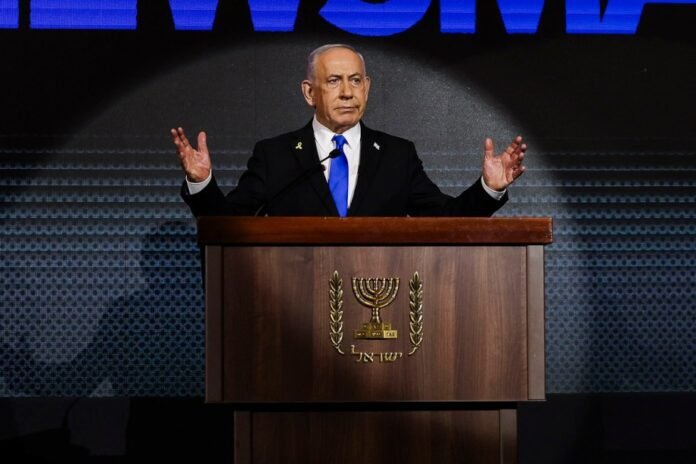
Israeli Prime Minister Benjamin Netanyahu “is doing everything” to prevent the establishment of an official commission of inquiry into the events of Oct. 7, 2023, former military intelligence officer Barak Seri said, Anadolu reports.
In a Saturday post on the US social media company X, Seri said Netanyahu was “warned and alerted” ahead of the attacks, but that “he ignored it all.”
“This is why Netanyahu is personally blocking the establishment of an inquiry commission,” he said.
Earlier Saturday, Israeli newspaper Yedioth Ahronoth reported that Netanyahu received warnings about a possible Hamas attack ahead of Oct. 7, 2023, but did not convene a meeting to discuss them.
READ: Hamas slams Netanyahu’s UN speech: He should be in prison to face trial for crimes
Citing unnamed security officials, the outlet said Netanyahu did not share the warnings with the Shin Bet, Mossad or the Military Intelligence Directorate, known as Aman.
Meanwhile, US magazine The Atlantic reported that former Egyptian intelligence chief Abbas Kamel secretly visited Israel 11 days before the Oct. 7 events to alert Tel Aviv about a possible Hamas attack.
There has been no official Egyptian comment on the claim.
Following the Oct. 7 events, Israel launched a brutal offensive on the Gaza Strip, killing nearly 74,000 people, injured around 175,000 others and turned the entire enclave into ruins.
Despite a ceasefire that took effect in October 2025, Israel has continued its daily attacks on Gaza, killing more than 1,400 Palestinians and injuring nearly 5,000 others, according to Gaza’s Health Ministry.
READ: Netanyahu failed to relay UAE warning of possible Hamas attack to security chiefs: NYT
Zelenskyy Warns ‘AI, Not Only People’ Could Soon Decide on the Battlefield
Ukraine’s rapid adoption of drones and artificial intelligence is reshaping combat even as manpower shortages and traditional attritional warfare continue to constrain Kyiv
Russia’s war in Ukraine is accelerating technological change on the battlefield while forcing European governments to confront how drone warfare and covert operations could create security risks far beyond Ukraine’s borders.
Ukrainian President Volodymyr Zelenskyy brought the technological dimension to the UN General Assembly on Wednesday, warning that artificial intelligence could soon move from assisting military operations to making battlefield decisions itself.
As early as next year, there is already a real possibility that AI, not only people, will begin to decide what happens on the battlefield. We need peace before we reach that point.
“As early as next year, there is already a real possibility that AI, not only people, will begin to decide what happens on the battlefield. We need peace before we reach that point,” Zelenskyy told world leaders in New York.
His speech also offered a stark accounting of the human cost Russia has incurred. Zelenskyy said Russian forces lost nearly 249,000 soldiers killed or seriously wounded between January and August. The figures are Ukrainian claims and cannot be independently verified.
Zelenskyy has also acknowledged that the battlefield picture remains more complicated than Russian losses alone suggest, saying this week that Russian President Vladimir Putin “is not winning” but also “is not losing,” because the Kremlin has not yet been forced to regard its human losses as strategically prohibitive.
That tension between technological progress and the traditional realities of attritional warfare is central to how Don Bowser, an international anti-corruption, governance and security expert with more than three decades of experience focusing on the post-Soviet space, particularly Ukraine, assesses the conflict.
Bowser cautioned against treating artificial intelligence as if it had already transformed the war by itself.
“Everything is AI. So how much does it directly affect what is going on in the war? Not much. The networking of the drones and unmanned systems, that was long predicted,” Bowser told The Media Line. “What does it do right now on the battlefield in Ukraine? It allows an operator to operate several drones at the same time.”
Ukraine’s technological evolution also predates the current AI boom. Bowser pointed to the role of civil society, NATO assistance, and earlier work on Ukraine’s Delta battlefield management system.
“If it hadn’t been for NATO in 2016, Ukraine wouldn’t have gotten its Delta battle management system, which probably is one of the factors in saving Kyiv during the siege of Kyiv,” he said.
“So, this innovation is driven, not because of the state, but in spite of the state,” Bowser added.
Ukraine has nevertheless become one of the world’s most active testing grounds for drone warfare, autonomous systems and digitally integrated battlefield management. It has also increasingly used long-range drones to strike energy and military infrastructure deep inside Russia.
Those attacks have placed substantial pressure on Russia’s refining industry. Reuters reported Sept. 15 that three of Russia’s six largest diesel-producing refineries had significantly reduced or completely halted output after drone strikes. The six plants together account for roughly half of Russia’s diesel production, and falling output has contributed to fuel shortages and Russian restrictions on fuel exports.
Another major Ukrainian drone operation on Sept. 20 reached the Moscow region and damaged the Moscow oil refinery. The refinery subsequently halted crude processing after fires broke out in its two primary distillation units, according to industry sources cited by Reuters.
Bowser cautioned, however, against interpreting the economic damage as evidence that Russia is approaching collapse.
“Is this impacting on the Russian economy? Yes. Is it impacting on the Russian economy enough to make Russia collapse? No,” he said.
Nor have Ukraine’s growing technological capabilities solved one of Kyiv’s most persistent battlefield problems: manpower.
Bowser said drones and other new systems have given Ukraine important capabilities but cannot compensate fully for shortages of personnel.
Technology isn’t going to win the war. Robots are not going to win the war either.
“Technology isn’t going to win the war. Robots are not going to win the war either,” he said.
Russia, meanwhile, has continued to adapt while maintaining a sustained aerial campaign against Ukrainian cities and infrastructure. Russian attacks on Sept. 12 killed 10 civilians and injured dozens, according to Ukrainian authorities.
Reuters has also documented Russia’s expanded use of modified RM48U training missiles. The repurposed missiles are less sophisticated than some of Russia’s other ballistic weapons but allow Moscow to maintain pressure on Ukrainian air defenses while conserving more advanced systems.
The technological contest is increasingly influencing NATO’s security planning as well.
Countries along the alliance’s eastern flank have repeatedly raised alerts over aerial incursions and Russian attacks close to their borders. NATO says Russian airspace violations, cyberattacks and acts of sabotage have increased in frequency, while Poland has repeatedly activated aircraft and air-defense systems during major Russian attacks on western Ukraine.
Polish Prime Minister Donald Tusk warned on Sept. 18 that intelligence assessments indicated Russia could carry out drone or missile operations against NATO countries and present them as accidental, complicating the alliance’s response.
Bowser said some of the public discussion of hybrid warfare risks overlooking Russia’s ability to recruit people abroad for intelligence and sabotage operations.
“So this hysteria about hybrid war doesn’t address the real issue, which is Russia’s intelligence capability to be able to recruit people abroad, mostly Ukrainians, and the resources they have,” he said.
Concerns about such operations are no longer confined to countries bordering Russia or Ukraine.
Spanish newspaper El Mundo reported this week that US intelligence had warned several European governments about a possible Russian operation involving Gerbera drones launched from merchant vessels in the Mediterranean against targets in Italy, France or Spain.
The reported warning has not been publicly corroborated. Italian Defense Minister Guido Crosetto said Thursday that the alleged alert had “not been confirmed,” while Italian government sources told ANSA that no warning had reached Rome through intelligence, diplomatic or military channels.
Daniele Garofalo, a security consultant and intelligence analyst, said the reported scenario should be assessed by separating what Russia could technically do from evidence that it has decided to do it.
“If the report were confirmed, the fundamental distinction would be between capability, intent, and operational preparation,” Garofalo said.
“The technical capability to build an operation of this kind is credible. Russia’s intent to maintain pressure on European countries through hybrid tools is consistent with behavior already observed and with the deterioration of the European security environment. Much weaker, however, based on publicly available information, is the evidence of specific operational preparations for an attack against Italy, France, or Spain,” he added.
The scenario nevertheless illustrates how relatively inexpensive drones could create problems well beyond their immediate destructive power.
The Gerbera, a Russian drone frequently used as a decoy, can also carry a small explosive payload. Its limited payload would make it poorly suited to destroying a large military installation on its own, but a successful strike could still close an airport, damage exposed equipment, or disrupt critical infrastructure.
For Garofalo, the more consequential element of the reported scenario is the proposed launch platform.
The genuinely interesting aspect of El Mundo’s reporting, therefore, is not the drone. It is the ship.
“The genuinely interesting aspect of El Mundo’s reporting, therefore, is not the drone. It is the ship,” he said.
“With a stated range of approximately 600 km, a Gerbera is not normally a system with which Russia could directly reach much of Western Europe from Russian territory. Transporting the system through the Mediterranean, however, would completely change the operational geometry,” he added.
Launching drones from a merchant vessel could also complicate early detection and attribution. A civilian ship under a third-country flag, with opaque ownership and a multinational crew, could leave governments uncertain about responsibility during the crucial first hours after an incident.
The problem would not necessarily be preventing final attribution, but delaying it
“The problem would not necessarily be preventing final attribution, but delaying it,” Garofalo said. “Twenty-four or 48 hours of uncertainty can have considerable political value during a NATO crisis.”
For NATO countries, the problem would therefore extend beyond the ability to shoot down individual drones. Modern counter-drone and air-defense systems can protect high-value targets, but governments face a much more difficult problem in providing continuous coverage for large numbers of airports, ports, military bases, refineries and other critical infrastructure.
“The capability to counter the threat therefore exists. The problem is the density of coverage,” Garofalo said.
“No country can reasonably deploy C-UAS systems, sensors, electronic warfare capabilities, and interceptors permanently around every airport, port, base, refinery, energy node, and critical infrastructure site,” he added.
The political consequences of any such incident would also depend heavily on the target, damage, and ability to establish responsibility. An intercepted drone that caused no damage would pose a different challenge for NATO than a coordinated attack causing casualties at a military installation.
Garofalo said the most immediate concern is therefore not necessarily a confirmed Russian attack plan against Southern Europe but the possibility of lower-level activity intended to test NATO defenses while preserving ambiguity.
“In the short term, over the next 30–90 days, the most relevant scenario to monitor is not necessarily a direct Russian attack against Italy, France, or Spain, for which there is currently no public evidence of specific operational preparations,” he said.
“A more plausible intermediate phase would be characterized by reconnaissance, probing, and difficult-to-attribute activities designed to gather information on NATO countries’ detection and response capabilities while simultaneously maintaining political pressure without unequivocally crossing the threshold of an armed attack,” he added.
Tesla’s big electric truck faces an even bigger infrastructure challenge
Tesla CEO Elon Musk has insisted investors think of his electric automaker as a robotics and autonomous vehicle company now. He’s targeted a $20 trillion valuation—nearly four times the value of market leader Nvidia—on that premise. But his Tesla team was in Sparks, Nevada, on Thursday to focus on, well, an electric vehicle: the long-awaited Tesla Semi.
The Semi concept first rolled onto a Tesla event stage in late 2017. Nearly a decade later, Tesla officially launched high-volume production at a livestreamed but invite-only event at the company’s factory. It targeted a niche audience: the cost-conscious people who manage large trucking fleets. A handful of them, all men, trooped across the stage to be thanked for their orders to a pulsing techno beat.
“It’s going to be, really, a driver’s truck. It’s like a sports car in truck form.” Musk said in a pre-taped video played during the evening event. (Musk, for years the ringmaster at Tesla’s circus-like events, skipped his second vehicle debut in a row; he was attending a White House China State Dinner featuring President Xi Jinping.)
The long-range version of the Semi will travel an estimated 500 miles per charge, Lars Moravy, Tesla’s vice president of Vehicle Engineering, confirmed at the event—around the average number of miles traveled by US long-haul truckers each day. The standard version will get an estimated 325 miles per charge. Competitor EVs advertise ranges of 155 to 430 miles.
Electric dreams
The Tesla Semi has its work cut out for it.
While electrics account for nearly 30 percent of heavy-duty truck sales in China, according to state media, they’ve had a slow start in the US, as manufacturers struggle to make the vehicles competitive with their traditional diesel-burning counterparts. Electric semis can cost two to three times more upfront. Right now, they’re not easy to charge because they require a countrywide network of specialized megawatt chargers that can fill large batteries in hours. Tesla’s website shows two such public chargers operating in the LA area. However, Dan Priestley, who leads Tesla’s Semi program, says the company plans to open 30 by the end of the year.
Plus, the Trump administration and the GOP—the same group Musk spent millions to get into the White House—cut billions in federal support for electric vehicles last year. The administration is also working to lower fuel economy standards for truck engines, which would have required manufacturers to hit aggressive climate goals. Heavy trucks alone account for some 7 percent of US greenhouse gas emissions.
And yet, it’s not a bad time to be an EV-maker. US diesel prices hit record highs this month as the Iran War continues to disrupt oil production and shipping in the Middle East; prices are up nearly double from this time last year. The truck “is going to make a ton of sense economically because the cost of electricity is much less than the cost of diesel, especially in these crazy times,” Musk said in his pre-taped address, nodding to the conflict launched by the administration he once worked for.
This week, an alliance of shippers including Microsoft and PepsiCo placed a record-setting order for 2,500 Tesla Semis, to be delivered starting this year and through the next 18 months. If those trucks reach customers, they would nearly double the number of heavy-duty electric trucks on US roads today.
The group selected Tesla trucks over competitors’ after “assessing price, performance, production capability, and service support,” Meena Bibra, a spokesperson for the nonprofit Smart Freight Centre, which was involved in the deal, told WIRED. If the carriers are accustomed to another truckmaker’s vehicles, or if other electric trucks better meet their needs, they may also choose to purchase electric trucks from Kenworth, Ride, and Volvo.
Pooling demand among many carriers allowed the electric automakers to bring down the prices of the new trucks, the group said.
Full Self-Driving (Supervised), Tesla’s driver assistance feature, will not yet be available on the Semi, though Musk said in his address that it would debut in “the very near future.” The feature’s predecessor technology, Enhanced Autopilot, was promised during the initial 2017 rollout.
EU Parliament chief urges compromise in Germany-US drug pricing dispute
The president of the European Parliament, Roberta Metsola, says Germany should seek a deal with the Trump administration to resolve their trade dispute over drug pricing.
“If you don’t talk directly and reach a deal — the art of the deal — then the consequences might be more difficult to swallow. So my advice to anyone would be: Just try to find it,” she said in an exclusive interview with POLITICO on the sidelines of the United Nations General Assembly in New York.
The Office of the U.S. Trade Representative is currently investigating Germany’s drug pricing policies, accusing it of “persistent underpayment” for pharmaceutical products.
In a hearing this week in Washington, a clear majority of witnesses supported this claim. The investigation could ultimately provide the legal justification for Trump to impose new tariffs on German exports.
Metsola advocated for a compromise between Washington and Berlin to avoid “an impossible race on drugs.” Europe could “still lead in pharmaceuticals,” she said. But the bloc has to become “much more agile, not only in pricing but also in terms of clinical trials and bringing new products on the market.”
The center-right European People’s Party politician, a member of the EU Parliament since 2013, serves in a role akin to that of the Speaker of the House in the U.S.
A deal is a deal
While Metsola backed negotiations over confrontation with the Trump White House, she also sent a clear warning to the U.S. government, suggesting any tariff increase on German goods would potentially violate the 15% tariff ceiling agreed in the deal that President Donald Trump struck with European Commission President Ursula von der Leyen at his golf resort in Turnberry, Scotland, last year.
Metsola pointed to a suspension clause the European Parliament had forced into the trade deal, warning that “there are legal consequences” if the Trump administration targets individual EU countries. “The agreement we voted on already foresaw that,” she said.
She repeated this warning regarding U.S. tariffs on steel and aluminum derivatives. Under the Turnberry agreement, the U.S. must bring its high steel and aluminum derivative tariffs into line with a 15% tariff ceiling agreed to in Turnberry by the end of the year. Non-compliance by the U.S. side “would be a trigger alert” for the suspension clause, Metsola said.
Digital sovereignty
In a speech on the sidelines of the assembly on Tuesday, the Maltese politician called for “guardrails” for artificial intelligence, a hot-button issue in Washington at the moment after leaders of top American AI firms called for a slowdown in development of some of the most cutting-edge technologies.
Asked if regulating AI risked Europe losing the competition against the U.S. and China, Metsola said: “I remain convinced that the race is not between the EU and the U.S. It is between democratic AI and autocratic AI. The EU and America have to be together in this race.”
At the same time, Metsola rejected doubts about the bloc’s digital sovereignty. “We depend on U.S. tech. But U.S. tech depends on the EU market. This is what I think we don’t have in the conversation when tech leaders come to Europe and say: ‘We want to have a common market.’”
European lawmakers from across the political spectrum are currently pushing to extend the EU’s cornerstone AI Act to cover liability for U.S. tech giants whose cutting-edge models threaten global safety. Metsola seemed to support this initiative. “We should listen to the leaders of those AI models that themselves are saying to be careful and they themselves are calling for guardrails.” She pointed to the EU’s Digital Services Act as a potential “platform” for a future liability mechanism.
Triangular trade
While China’s President Xi meets with Trump in Washington this week, EU Trade Commissioner Maroš Šefčovič is about to head to China. By mid-October, the bloc wants to reach an agreement with Beijing for better market access for European companies, Chinese government action on trade imbalances and overcapacity and greater certainty on critical raw materials.
“We cannot afford to become a continent that is just a consumer continent,” Metsola insisted regarding EU-China relations. The EU needs an “honest,” “strong” and “self-confident” conversation with Beijing, she said.
Metsola said the bloc had taken a similarly strong and self-confident stance in the crisis around Trump’s threats to annex Greenland at the beginning of 2026, and also when von der Leyen last week invited Canada to become an associate member.
But despite strong ties with Canadian Prime Minister Mark Carney and his country, crucial elements of bilateral agreements are still in limbo. Metsola called on the 10 remaining EU countries that have not ratified the decade-old CETA free-trade deal between the European Union and Canada to finally do so.
The leaders of the EU and Canada are expected to hold a summit in Montreal in October, where both sides are aiming to seal a Digital Trade Agreement. Metsola dismissed concerns over the absence of dedicated AI provisions. “The idea of having separate chapters on AI would be akin to having chapters on the internet in the past,” she said, arguing that the technology will permeate every aspect of economic activity.
Recently, Metsola’s center-right EPP has repeatedly relied on support from right-wing groups to pass legislation, drawing sharp criticism from Socialists and Greens. Metsola declined to give a direct answer when asked whether she wanted the EPP to rule out future alliances with hard-right parties such as Germany’s AfD and France’s Rassemblement National.
“I am a proper centrist,” she said. “I have always believed that majorities should be built from the center outwards. That gives you a stronger mandate when negotiating with the Council.” There would be votes in the future “that will depend on different majorities,” she added. “I’m the president, I represent all the members. I just want predictability and stability.”
At the beginning of 2027, Metsola is expected to run for a third consecutive term as president of the European Parliament, but she did not confirm this to POLITICO. Asked if she had any ambitions to eventually run for president of the European Commission, Metsola said: “It is the honor of a lifetime and the responsibility of a lifetime to run this parliament. It’s not easy. So I focus on that.”