Russia-Ukraine war is accelerating the dangerous race toward fully autonomous drones
A battlefield dominated by fully autonomous drones capable of selecting and engaging targets without human intervention sounds like a dystopian sci-fi plot. And while that scenario has not yet arrived, the conflict between Russia and Ukraine has moved modern warfare a notch down that road.
In recent years, both nations have deployed semi-autonomous drones in combat and are rapidly racing toward fully autonomous unmanned aerial vehicles.
Given these developments and the pace of Russian and Ukrainian drone production, a battlefield with hundreds to thousands of fully autonomous drones operating is plausible within the next few years. Yet, the technology underpinning autonomous warfare risks outpacing the Russian and Ukrainian frameworks for maintaining some degree of human control over weapons.
As an expert on weapons technology, I worry that the battlefield incentives to deploy more autonomous drones will completely push aside human targeting decisions related to using proportional force, avoiding strikes on non-combatants and limiting collateral damage.
The creeping drone war
Both Ukraine and Russia have increasingly prioritized the use and production of drones since the war began in February 2022. Unable to produce large numbers of one-way attack drones at first, Russia turned to Tehran for technological assistance – and has steadily developed its own capacity. Ukraine had a nascent drone industry and has grown it using private defense firms and technological innovation.
As the war has progressed, both sides have added autonomous features to existing drones, as well as developed new drones with autonomous capabilities. Specifically, both Russia and Ukraine have deployed drones with autonomous functions using AI on the battlefield to recognize targets, navigate and self-guide to targets.
In November 2025, a Ukrainian first-person-view drone used an AI-assisted guidance system to strike a probable Russian tank after the drone’s communications link with its operator was disrupted. A human operator selected the target, but the drone itself guided the final stages of the attack.
Reliable estimates of the numbers of these drones on the battlefield are unavailable. However, reports on their usage suggest they represent only a small percentage of the millions of drones both sides have deployed to date.
At the advanced end of the spectrum, Russia reportedly fielded at least one model of a fully autonomous unmanned aerial vehicle in early 2025. Ukrainian analysis of recovered Russian V2U drones revealed a small Nvidia computer designed to run AI-enabled decision-making software. Variants recovered in late 2025 no longer contained the external communications systems suggestive of operator control.
Autonomous targeting
The V2U’s technical systems are configured to enable autonomous selection and engagement of targets without operator intervention following launch.
Human operators have generally selected intended targets or target areas for moral reasons, highlighting the significance of the V2U’s ability to carry out these missions autonomously.
The onboard AI utilizes computer vision, allowing the drone to analyze images from its onboard sensors. It can autonomously recognize objects, track them, navigate and select potential targets.
In July, Russia employed a different AI-enabled drone in combat that demonstrated a less comprehensive form of autonomous targeting. The strike, on a gas station in Zaporizhzhia, killed three Ukrainian civilians. Human operators selected the gas station as the target area, while onboard software independently picked the final aim point.
Russia is also integrating versions of a similar technology into its Geran series unmanned aerial vehicles, which are based on Iran’s delta-wing Shaheed-136 attack drone. Some Gerans include a seeker guidance package that allows the onboard computer to guide the drone in the final flight phase, after a human operator initially selects the target.
Ukraine, for its part, has focused on modular AI-driven packages, including chips with embedded software and sometimes cameras, that it can install widely across drone and other platforms. It has fielded drones that use onboard AI to identify targets and guide them in their final flight phase.
One such module tracks targets and guides the drone the final 500 meters to them. The company that makes the computer advertises more advanced modules, which it claims will provide additional and even full autonomy.
Ukraine claims to have used more advanced autonomous drones on the battlefield as well. Former Defense Minister Mykhailo Fedorov said in July that Ukraine used a drone that autonomously chooses targets with no radio connection to a human pilot in strikes in Russian-occupied Crimea at an unspecified date. He added that Ukraine has not mass-produced this drone.
Ukraine also reportedly employed what have been dubbed fully autonomous quadcopter drones two years ago against Russian forces near Bakhmut, Ukraine, killing Russian soldiers. However, reports that the drones were preprogrammed raise questions about whether the drones independently selected the targets.
Smoke rises from Russian oil producer Gazprom Neft’s Moscow oil refinery on Sept. 20, 2026, after a drone attack.AFP via Getty Images
Battlefield advantages, ethical concerns
Russian and Ukrainian drones with autonomous capabilities already have had battlefield impact, even though Kyiv and Moscow have not yet deployed the most advanced systems in large numbers.
The benefits of deployment are clear. Drones with autonomous functions reduce their dependence on communications links and can continue despite jamming and other forms of electronic warfare. These capabilities help enable strikes deep into each other’s territory.
Autonomous navigation and guidance in the final portion of flight can also improve drones’ ability to engage moving targets. Deployment of fully autonomous drones at scale could reduce the personnel required to operate large numbers.
But autonomous drones come with serious ethical concerns.
A major risk is that the development and employment of this technology leapfrogs the ability of Russia and Ukraine to maintain some type of human control over autonomous weapons. Ukrainian Ministry of Defense rules require keeping humans in the loop for “combat” decisions, meaning that humans verify targets in the “final stages of interception.”
In contrast, Russia’s arms control positions provide insights into its views on human control. Russian officials highlight “human control,” with a focus on the ability to alter the system, deactivate it or provide limitations, such as on the types of targets that it can engage. But Moscow does not stress that a human has to be in the loop for verifying targets before they strike them.
As worrying as that sounds now, the next step in AI drone warfare is even more concerning: Swarming drones that can hunt in packs of a few to thousands and autonomously alter their behavior based on communicating with one another present a frightening challenge to maintaining human control.
Trump is backing a diesel export ban. How much would that do?
Diesel prices have hit a record high nearly every day this month, with a national average on Tuesday at $6.52 a gallon, according to AAA. That is driving a growing call to combat this climb by banning the export of the fuel, a move President Donald Trump endorsed today.
Although relatively few Americans fill their cars with diesel, it’s a backbone of the U.S. economy. It powers the trucks, ships and trains that move goods across the country, and it is used throughout the agricultural sector. That means everyone is feeling the effect of fuel prices that have climbed almost 80 percent since the United States and Israel launched a war against Iran earlier this year. They have risen almost $1 per gallon in September alone.
“If our govt can embargo chips to China it can embargo diesel to help American farmers & truckers,” wrote Senator Chuck Grassley, a Democrat from Iowa, on X. Representative Ashley Hinson, a Republican from Iowa, posted Monday on X. Senator majority leader John Thune, of South Dakota, has expressed interest as well. “If that would take pressure off of prices,” he said, “I’m open to exploring it.”
An online dashboard that has been tracking the impact of rising diesel prices since the war started shows that the ongoing increase has cost American households nearly $400 each — or more than $51 billion overall. Jeff Colgan, a Brown University political scientist who helped build the tracker, explained that banning exports would boost the supply and therefore lower the price.
“It could make a huge difference,” he said, though others disagree. Patrick De Haan, head of petroleum analysis for GasBuddy, wrote on X, “U.S. diesel prices are determined not by a U.S. supply and demand balance, but a global one. Keeping distillates and diesel home does not change the world price.”
The idea isn’t new. In 1975, after OPEC stopped shipping oil to the U.S., Congress passed the Energy Policy and Conservation Act, which included what ended up being an effective ban on crude oil exports. It continued until President Barack Obama lifted it four-decades later. Since then, oil companies have made billions exporting their products and oppose reviving any limits on where they can sell them.
Read Next
The American Fuel & Petrochemical Manufacturers association has said that such a ban would make the problem worse. “Export bans do not create more fuel for Americans,” the organization wrote in a press release. “They reduce U.S. fuel production, put upward pressure on prices, weaken energy security and hand market share to foreign competitors.”
Some Republicans, including within the administration, also expressed concern about a ban. Republican Senator John Cornyn of Texas, which is the country’s biggest oil-producing state, told The Hill that a ban would be a “gimmick.” Interior Secretary Doug Burgumtold CNBC that “it could actually hurt Americans.
Democrats have, in the past, called for export bans on oil products, including earlier this year and in 2021 when President Joe Biden was in office. So far they have been largely quiet on the diesel debate. “Trump is all smoke and mirrors,” said Senator Peter Welch, of Vermont, when Grist asked about the export ban. “If he’s serious about lowering prices of oil, gas, and home heating oil, he needs to end his illegal war with Iran.”
Before the president offered his thoughts on a ban, a White House official told Grist that the administration was not considering an export ban. It’s unclear if President Trump’s statements change that and how he might advance the issue — or whether Congress can build bipartisan will for legislation. But, regardless, Tyson Slocum, the energy program director at Public Citizen, a non-profit consumer advocacy organization, would like to see a more nuanced discussion of the way forward.
“The debate is so absurdly simplistic. People are like either total unfettered, unregulated exports or zero exports,” he said. There are many options in-between, he added, including how much diesel gets shipped overseas rather than cutting off that supply entirely.
“It could be very significant,” he said of even partial measures. “You would absolutely see a significant short-term drop in diesel prices.”
In July 1971, Henry Kissinger, then American national security adviser, had arrived in Pakistan on an official trip but suddenly developed a convenient case of “Delhi belly.”
The top envoy was supposedly too ill to continue his itinerary. Instead, under cover, Kissinger slipped onto a secret aircraft and flew to Beijing. There, behind the curtain of the Cold War, he met Premier Zhou Enlai and laid the foundations for Sino-US rapprochement.
The deception was audacious. The objective was even more so: to turn two ideological adversaries of the Cold War into strategic partners against a common rival, the Soviet Union. The secret mission eventually produced President Richard Nixon’s historic week-long visit to China that came to be known as the “week that changed the world.”
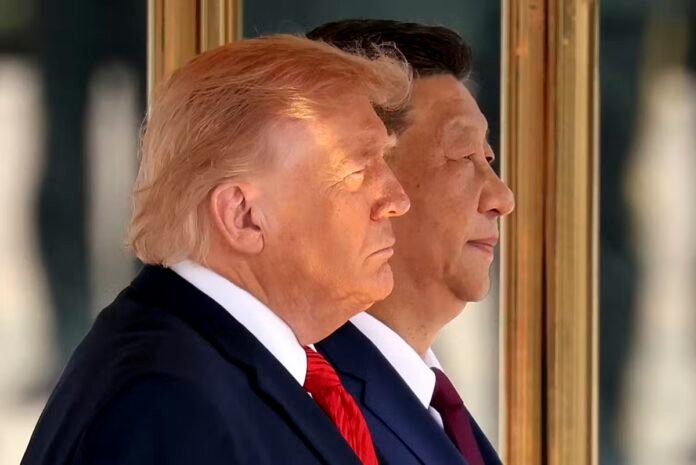
Fifty-five years later, history has reversed its choreography but not its stakes. After their May 2026 meeting in Beijing, where they had agreed on ensuring “constructive strategic stability“, Donald Trump and Xi Jinping will meet at White House on September 24, not behind any curtains of the Cold War but beneath the full glare of world media, with no secret channels or common enemy to justify their encounter.
Yet, the question hanging over their summits remains disquietingly similar to the one that had haunted Kissinger on his covert flight to Beijing: can these two rivals build a durable peace without ever pretending to like one another?
Weaponized interdependence
For most of the Trump era, the world has come to see US-China relations through a single, blunt vocabulary: tariffs. But that vocabulary is now dangerously inadequate. Their relationship has since mutated into a contest over mushrooming new chokepoints.
But the most revealing weapon is one most Americans had barely heard of until recently: rare earths. China’s dominance over refining and supply is so complete that even a limited stock of rare earths mined in California is sent to China for processing.
China’s dominance in processing can be weaponized, holding US industrial applications from aerospace and semiconductors to high-temperature coatings hostage to Beijing’s strategic calculus.
China’s recent export restrictions have exposed vulnerabilities in US industrial supply chains and demonstrated how something buried deep inside a supply chain can suddenly acquire geopolitical significance. This mutual weaponization of their asymmetric economic interdependence represents the new geoeconomics of their great-power politics.
Washington also possesses formidable leverage: tariffs, advanced semiconductors, investment restrictions, financial power, sanctions and access to cutting-edge technology, including cutting-edge AI chips. Beijing possesses a different arsenal: manufacturing scale, supply chains, rare earths, critical minerals, processing capacity and access to one of the world’s largest markets.
Political scientists Robert Keohane and Joseph Nye once described this as “complex interdependence”, i.e., the recognition that mutual dependence generates both constraint and leverage.
But what is unfolding between Beijing and Washington is the darker, harder version of that insight. US-China interdependence has become increasingly securitized.
Rival philosophies
Trump’s instinct is transactional and immediate — leverage converted swiftly into visible, measurable concession – the kind that can be announced, photographed, and claimed as victory before the news cycle turns.
Xi’s instinct runs on an entirely different clock. His tradition favors incrementalism, sequencing and calculated ambiguity — a patient accumulation of strategic space, careful never to concede anything that might later bind one’s hands.
Washington wants greater predictability in Chinese rare-earth supplies and restraint on practices considered economically or strategically damaging. Beijing wants relief from technology restrictions, tariffs and a durable framework of engagement.
Their Board of Trade created last May aims to cut tariffs on non-sensitive commodity exports up to $30 billion per annum — a modest institutional scaffolding for an otherwise volatile relationship.
But beneath these economic negotiations lurks a deeper security dilemma. Taiwan remains their most dangerous fault line. In their May meeting in Beijing, Xi warned Trump that mishandling Taiwan could push bilateral relations into “a very dangerous place.”
AI is another layer of intensifying complexity. The two sides are racing to dominate AI, yet neither can manage it alone. Measures intended to increase security by one — export controls, technology restrictions, military deployments, supply-chain diversification — can be interpreted as preparation for containment by the other.
It’s unclear whether the US-China Dialogue mechanism, agreed in advance of the Trump-Xi summit to flag rogue AI developments, will actually be established and used in the heat of the competitive moment.
None of this needs to trigger war, but these escalating tensions on so many fronts make them vulnerable to other exogenous forces. This is where the Trump-Xi summit is larger than just US-China relations. The wider world is no idle spectator, and its incremental assertion should also shape the summit’s agenda and outcomes.
The world out there
Wars in Ukraine and Iran have revealed the hard limitations of great powers. At the same time, India, ASEAN, Europe, Japan, South Korea, Australia, the Gulf states and much of the Global South have gradually enhanced their bargaining power.
They may depend on China for manufacturing, on America for technology and finance, on the Gulf for energy and on one another for markets and connectivity, yet most of them do not wish to choose between Washington and Beijing.
India’s emphasis on strategic autonomy and multi-alignment fits this pattern. So is ASEAN’s seasoned resistance to making binary great power choices. European governments want resilience without rupture, i.e., economic security without severing ties to Beijing. Gulf states are quietly demonstrating how partnership with Washington need not preclude a parallel courtship of China.
The most consequential question hovering over the summit is not which of the two will have greater leverage. It is whether their rivalry leaves enough oxygen — enough strategic space — for everyone else. A US-China condominium would alarm much of the world.
A full-blown confrontation would be equally unacceptable. A carefully managed rivalry could permit other powers to retain agency while these two giants fine-tune their equilibrium: not friendship, not trust, not even reconciliation — just managed coexistence.
What coexistence requires
The summit should therefore be judged not by its optics but by whether Trump and Xi can construct some modest but durable guardrails.
The first would be economic predictability. Businesses cannot reorganize global supply chains every time Washington or Beijing reaches for a new trade war weapon. The second would be strategic communication. Hotlines and military-to-military contacts are not guarantors of trust, but they are proven mechanisms for preventing accidents from becoming crises.
The third would be selective cooperation. Climate, public health, financial stability and AI safety all require urgent collaboration that can happen before settling their geopolitical differences. The fourth would be bounded competition. Great powers have always competed. The problem is when competition becomes uncontrolled and results in conflict.
Finally, both sides will have to accept something psychologically harder: the other is not disappearing anytime soon. America will remain a formidable technological, financial and military power. China will remain a formidable industrial, commercial and geopolitical power. That is the reality from which a sustainable relationship must begin.
In 1971, Kissinger’s secret flight to Beijing helped demonstrate that yesterday’s adversary can become tomorrow’s partner. In 2026, Trump and Xi face the opposite challenge: demonstrating that an adversary need not become an enemy.
Nixon and Mao sought a strategic opening because the Cold War demanded it. Trump and Xi need a strategic ceiling — a limit beyond which rivalry can slip into catastrophe.
This week’s Trump-Xi summit will not determine whether the US or China dominates the 21st century. But it could yield something more consequential: whether these two can compete peacefully without making the rest of the world pay the price for their competition.
Swaran Singh is a former professor of diplomacy and disarmament at the School of International Studies, Jawaharlal Nehru University, New Delhi.
TV Star Hit with Heartbreaking Family Tragedy Days After Emergency Bypass Surgery
‘Pawn Stars’ star Rick Harrison is facing another painful family loss just days after recovering from emergency heart surgery.
Tracy Harrison, Rick’s ex-wife and the mother of his son Jake, died on Sept. 16 at age 61 after battling brain cancer, according to reports. A representative for the Harrison family said Tracy had been receiving hospice care before her death.
Rick and Tracy were married for 25 years, from 1986 until 2011, meaning they were still together when “Pawn Stars” premiered on the History Channel in 2009.
Although Tracy largely stayed away from the cameras, she was part of the Harrison family during the show’s early years. She and Rick shared son Jake, who has also appeared on “Pawn Stars.”
Rick released a statement following her death, remembering Tracy as a devoted mother and saying his focus is now on supporting the family.
“She was a great mom to the boys,” Harrison said, adding that he was doing everything he could to support Jake and Corey during the difficult time.
The loss comes less than two weeks after Rick, 61, experienced a frightening medical emergency of his own.
On Sept. 4, Harrison went to the hospital expecting to undergo what his representatives described as a relatively routine stent procedure.
Instead, doctors discovered a more serious heart problem and determined that he needed emergency bypass surgery.
A family spokesperson said afterward that Harrison was resting comfortably and expected to make a full recovery.
Just three days later, on Sept. 7, Harrison was discharged from the hospital and returned home.
“By all accounts, he’s now doing great,” his representative said at the time.
His wife, Agripina “Angie” Polushkin, and other family members remained by his side throughout the health scare. Rick and Angie married earlier this year, first in Las Vegas and later during a destination celebration in Cancun.
Tracy’s death adds to several difficult losses the Harrison family has endured in recent years.
Rick’s son Adam Harrison died in January 2024 at age 39 from an accidental drug overdose involving fentanyl and methamphetamine. Rick’s father and longtime “Pawn Stars” castmate Richard “Old Man” Harrison died in 2018.
Despite his recent surgery, Harrison has reportedly been recovering at home as his family now mourns Tracy’s death.
“Pawn Stars” first premiered in 2009 and turned Rick, his father Richard, son Corey Harrison and family friend Austin “Chumlee” Russell into some of reality television’s most recognizable personalities.
The families of victims killed in one of the deadliest mass shootings in Canada’s history have already sued OpenAI over its failure to warn law enforcement after discovering in advance that the shooter was using ChatGPT to plan the violence.
Now, British Columbia is suing, explaining for the first time how costly and extreme the disaster response has been. OpenAI and Sam Altman owe the tiny remote mining community shattered by the tragedy much more than an apology, the Canadian province argued. They must make meaningful changes to end ChatGPT-assisted violence and then pay whatever it costs to help Tumbler Ridge to rebuild, recover, and heal.
In a complaint filed Monday, British Columbia explained that Tumbler Ridge Secondary School had to be demolished after an 18-year-old transgender shooter, Jesse Van Rootselaar, committed suicide there in February after killing five kids and an education assistant. In total, eight lives were lost, as prior to the school shooting, Van Rootselaar shot their mother and half-brother.
Previously, the secondary school sat “in the heart of the town, both geographically and culturally,” the lawsuit said. But after the shooting, it became an unavoidable “symbol of the trauma.”
About 160 students, teachers, and staff “were trapped in classrooms and closets” at the school for hours, and they were too traumatized to ever go back. To provide “at least some small relief to those who have suffered the most intensely,” demolition began in August, and the community hopes to have a replacement school built at a new location by the end of this year, if all goes to plan.
British Columbia argued that OpenAI and Altman should pay for the school, as well as cover a wide range of other emergency costs that never would have been incurred if not for “this tragedy and its foreseeable consequences.” They also asked the court to provide injunctive relief, including requiring OpenAI to update ChatGPT to automatically terminate violent conversations.
B.C. wants to see the ChatGPT logs
Most urgently, British Columbia and the local school district’s Board of Education have asked the court for an immediate order that would force OpenAI to share Van Rootselaar’s chat logs with the public for the first time.
So far, OpenAI has only shared the logs with the Royal Canadian Mounted Police (RCMP). Asked for comment on whether there’s any plan to release the chat logs to the public—as a Florida law enforcement agency did following a prior ChatGPT-linked shooting at Florida State University—RCMP declined to comment. Instead, they pointed Ars to a July statement, where the RCMP would only confirm that police are reviewing information from online accounts. In a seeming acknowledgment that the public wants answers, the statement also offered a reminder that “it is important to understand that the absence of publicly disclosed details does not mean investigators do not have that information.”
OpenAI declined to comment directly on the lawsuit or requested remedies. The company has said that it was protecting Van Rootselaar’s privacy when the decision was made to override human review teams recommending that the violent chat logs be shared with police. Today, a spokesperson told Ars that “what happened in Tumbler Ridge was an unspeakable tragedy, and our thoughts remain with the victims, their families, and the entire community. OpenAI remains committed to working collaboratively with government and law enforcement officials, and continuing to advance our ongoing safety work.”
British Columbia maintains that OpenAI has not made ChatGPT any safer following several mass shootings that established “recurring” patterns of violent ChatGPT use. Further, the firm’s rationale for ignoring the threat seemed untrustworthy. British Columbia suspects that OpenAi actually wanted to avoid drawing a hard line that would require OpenAI to report more violent users to police and expose the public to more of the real-world threats that chatbots could pose. The province accused OpenAI of hiding the chat logs to protect its potentially $1 trillion IPO.
To British Columbia, it seems like OpenAI is doing little to combat the most violent threats. Their complaint noted that OpenAI claimed it made an “attempt” to block violent chats in December 2025, but that change did not stop Van Rootselaar’s harmful use during that time or any time in the months after. At a press conference covered by The Wall Street Journal, B.C.’s attorney general, Niki Sharma, said that “we should be asking them why” they won’t release the chat logs.
“In any other circumstance where a person aids, encourages or conspires to commit a criminal offense or is criminally negligent, they can be investigated, prosecuted, and judged,” Sharma said. “There is no AI exemption to those criminal law principles.”
“We all know the victims”
The shooting on February 10, 2026, left everyone in Tumbler Ridge reeling. The population is only 2,700. A local official summed up the extent of the crisis by saying, “We all know the victims.”
Tumbler Ridge Secondary School closed the day of the shooting and never reopened. For the kids recovering and seeking normalcy, that has been a problem, since there is no other school in the town. Instead, they’ve been attending a temporary school on a makeshift campus “assembled first from fourteen Ministry of Forestry trailers,” then eventually converted into “larger modular classrooms.”
Throwing together a functioning school on the fly wasn’t cheap or easy, the school district said in the complaint. They had to “furnish it, recruit and train replacement educators for local staff who could not return, and reorganize instruction around the absence of murdered students and colleagues.”
As for the old school, it cost money to demolish it, and none of these emergency resources are considered “recurring public services that governments fund through taxation and spread across all taxpayers,” the complaint said.
In addition to the school, they’re also building a wellness center, as demand for counseling has not gone down since the tragedy. Acute and ongoing health care, victim services, and trauma-informed mental health care are all considered necessary services the community will need for years to come. As the complaint emphasized, OpenAI should have deliberately considered how small the community was when weighing the threat the shooter posed:
Unlike other larger communities, in Tumbler Ridge there were no redundancies of personnel or facilities to carry the community following the tragedy. There was no other school building to house students for education or counseling following this trauma. There were few available adults to step in for teachers and administrators who were directly impacted by the assault. Students, parents and all those impacted needed immediate support and counseling, and there simply were not enough people in this small town to match the need.
There were also “no substitute teachers, no standby clinicians, and no extra police officers,” the complaint alleged, and what frontline workers were available “were themselves traumatized.” To help out, British Columbia transported in temporary workers, who needed temporary housing, to keep up with demand for emergency services.
In the three months following the shooting, “Child & Youth Mental Health alone delivered well over 900 counseling sessions to more than 100 unique children and families, and Northern Health treated more than 130 unique adults,” the lawsuit reported. More recently, British Columbia has started shifting from offering an emergency response to supporting long-term recovery, including establishing a long-term grief-and-bereavement working group. Those solutions will require substantial investments.
On top of that, British Columbia and the school district have also paid for an “extraordinary policing response.” That’s still necessary, they argued, since the community worries that potential copycat shooters pose a real threat. The complaint alleged that RCMP has already investigated copycat threats.
“Demand for scheduled mental-health services remains high and spikes around anniversary dates and other triggering events; these services are expected to be needed for years to come,” the lawsuit said.
ChatGPT “reinforced” violent ideation
OpenAI first detected the violent chats in June 2025. At that time, human reviewers “examined the flagged conversations” and “concluded that the shooter presented a credible and specific risk of gun violence to real people,” whistleblowers told the WSJ. Disagreeing, however, OpenAI leadership intervened to block reports to law enforcement, overruling their own safety teams and claiming that “the matter did not satisfy a ‘higher threshold’ for ‘credible and imminent’ threat reporting.”
Ultimately, instead of reporting the user to RCMP or warning the community, OpenAI simply deactivated the account, which did nothing to prevent Van Rootselaar from making a second account.
At that time, OpenAI was publicly claiming that any violent conversations would be reviewed by humans and reported to law enforcement to deter real-world tragedies. ChatGPT had been linked to the FSU shooting, as well as to a CyberTruck bombing in Las Vegas, and British Columbia alleged that the Tumbler Ridge shooter should’ve been flagged as threatening as the users in those cases.
After the whistleblowers outed OpenAI for failing to warn authorities, OpenAI claimed that it “was reluctant to make such referrals because they would require it to disclose how its product contributes to the threat environment.” But that didn’t ring true to British Columbia and the Tumbler Ridge community. They think it seemed like OpenAI was hoping that empty promises to do better would protect “its valuation, and its anticipated public offering.” In Tumbler Ridge, the youngest victims who actually needed protecting were 12 and 13, they noted.
The complaint suggested that OpenAI’s defense will likely be to blame Van Rootselaar for their violent inputs, while downplaying ChatGPT’s outputs.
But even without the logs, British Columbia alleged that the defect with ChatGPT is not its users, but its design. Allegedly, OpenAI turned off functionality that would have terminated the Tumbler Ridge chats, then introduced a more sycophantic model that it already knew had assisted users bent on causing real-world violence. Since ChatGPT’s release, the model spec has always instructed the chatbot to assume “good faith” and “not to probe intent” when users initiated violent chats, and British Columbia wants the court to order those two instructions specifically to be changed.
Still, the community wants to see the chat logs, and so does British Columbia, who’s funding their recovery.
The province alleged that the ChatGPT logs will show that OpenAI’s product dangerously “facilitated the mental instability of the shooter” by encouraging, elaborating, and reinforcing violent ideation “instead of interrupting it or directing the user to real-world help.”
In a loss, OpenAI could face extensive damages, including an order to cover the costs of emergency responses. They could also face punitive damages if the failure to warn police is deemed willful.
OpenAI “repeatedly represented to users and the public that it detected users who present a risk of harm to others, routed such conversations to trained reviewers authorized to act, and referred imminent threats of serious physical harm to law enforcement,” the complaint said. “Having held itself out as voluntarily undertaking and performing exactly the protective function” that a law imposing a duty to warn requires, “OpenAI cannot disclaim the duty it publicly assumed,” the lawsuit said.
Altman’s apology is not enough
In April 2026, Altman publicly acknowledged that OpenAI failed the Tumbler Ridge community.
“I am deeply sorry that we did not alert law enforcement to the account that was banned in June,” Altman said.
According to British Columbia, the account was never banned, and that apology is “an admission” that “OpenAI did not notify law enforcement after its safety team identified the risk of violence.”
To ensure the most violent chats are always routed to police, the province asked the court to order OpenAI to conduct regular independent audits.
The company’s conduct “was despicable,” the lawsuit said.
“Had OpenAI implemented a meaningful user ban,” the shooter would not have had continued access to ChatGPT, which allegedly “increased the shooter’s lethality.” And had OpenAI reported the user to law enforcement, any weapons the shooter used could have been removed from the house, as the shooter was already on the local law authorities’ radar, the lawsuit alleged.
Major US TV networks suspend Trump coverage in protest
Major US television networks have suspended their shared coverage of President Donald Trump’s White House events in protest against restrictions imposed on several news organisations. ABC, CBS, CNN, Fox and NBC said on Monday that the decision followed the White House preventing CNN from carrying out its assigned duties in the presidential media pool. CNN, MS NOW and Politico had been denied access to the White House grounds and had their passes confiscated after Trump criticised their reporting.
The networks said the public had a vital interest in receiving accurate, independent information about government and that administrations should not restrict news organisations because of their reporting.
Other media organisations, including the Associated Press, AFP, The Washington Post and The New York Times, also withheld photographs from presidential events. The dispute meant there was no live television pool coverage of Trump’s White House helipad opening or his visit to the United Nations General Assembly.
The affected organisations have also launched legal action, describing the restrictions as an attack on press freedom and the First Amendment. The White House has defended its position, while Vice President JD Vance accused the outlets of political bias.
How a Small Kansas City Became a Critical Hub for Trump’s Deportation Regime Against Its Will
A former maximum-security prison in Leavenworth, Kansas, is now a critical hub in the Trump administration’s immigration detention machine, transforming in just a few months from a facility shuttered for its inhospitable conditions to a privately run jail holding hundreds of immigrants.
This is the story of how — and why — it happened.
The deal had been in motion for more than a year before the Leavenworth City Commission conceded to the controversial project, one that would allow the private-prison operator CoreCivic to reopen its notorious prison and fill it with immigrants. They did so after a protracted battle with the company, one that made them cogs in a vast deportation machine.
“I don’t want them to be in jail,” Leavenworth Mayor Nancy Bauder said of the more than 500 immigrants held at the facility as of August, the last publicly available count. “I think it’s horrendous. My moral objection to this is very strong.”
“They just bought their permit.”
But as the Trump administration and CoreCivic carried out an aggressive campaign to expand the federal detention network, city officials said they concluded they couldn’t afford to fight it. They tried to sue to stop the project, but instead spent more than a quarter-million dollars fighting it in court, draining city funds, before CoreCivic offered a $1.5 million impact payment to reimburse the city’s legal costs and pledged $400,000 a year to the local government.
The Leavenworth facility, for years marred by an ugly history of overcrowding and understaffing, is now the Midwest hub for the mass detention and deportation of undocumented immigrants. Under this hub-and-spoke model, which has gone little noticed by the public even now, ICE moves detainees and staff between smaller facilities — the “spokes,” which include facilities such as regional jails — and a larger facility as a center of operations — the so-called “hub.” Using this model, ICE is able to obscure the scale of its operations and quickly move immigrants through the system, from arrest to detention to fast-tracked deportation flights out of the country.
“Leavenworth’s capacity is going to be that hub in the Midwest, to draw down from Minnesota, Chicago, Indiana, to house all that detention,” Sharma-Crawford said. Two other immigration attorneys who represent clients in the region corroborated the operational pattern through their own clients’ transfers and named additional “spoke” facilities feeding the pipeline.
Using a hub-and-spoke model, ICE is able to obscure the scale of its operations and quickly move immigrants through the system, from arrest to detention to fast-tracked deportation flights.
The Midwest Regional Reception Center, as it’s now known, in Leavenworth is a critical site for the Trump administration, whose promises of 100,000 beds for immigrant detention stalled out at around 66,000 in July and had run into multiple obstacles across the Midwest. In Illinois, a 2021 state law ended immigration detention statewide. Minnesota remained a possible location for a hub, but the process moved slowly; CoreCivic’s shuttered Prairie Correctional Facility in Appleton had long sat idle before its recent sale, and ICE needed to get a Midwest hub up and running immediately. Proposed sites were contested one after another: A potential warehouse for up to 10,000 detainees in south Kansas City was killed by community opposition, and facilities were either blocked or contested in Shakopee, Minnesota; Romulus, Michigan; Hudson, Colorado; and McCook, Nebraska. The Midwest’s largest operational ICE detention center, GEO Group’s North Lake Processing Center in Baldwin, Michigan, is geographically isolated, hours from any major airport, and has been mired in controversy over a hunger strike, a death in custody, and hundreds of unlawful detention rulings.
Leavenworth, a town with a corrections history stretching back over a century, seemed to offer the path of least resistance.
“Aggressive and Unlawful”
The City of Leavenworth fought the facility in court for months. CoreCivic countersued, and the Department of Justice intervened on CoreCivic’s side, accusing Leavenworth of “aggressive and unlawful” interference.
In the meantime, the fight threatened to bankrupt the city. Records obtained through the Kansas Open Records Act show the city paid roughly $820,000 in legal fees to Spencer Fane LLP over 12 months, about 6 percent of its general fund. The bill was a drain, but not a death blow. The city’s foremost concern was the takings clause, which allows the government to seize private property for public use, City Manager Scott Peterson said. A state judge had directed CoreCivic to follow the permit process, and if Leavenworth denied the permit, CoreCivic could argue bad faith, claim the city had effectively seized its property, and sue for damages, Peterson said, leaving Leavenworth to choose between greenlighting a facility it opposed or gambling on a lawsuit it might not survive. The alternative, Bauder, the mayor, said, was the federal government acquiring the building, which would eliminate local oversight entirely.
Both the city and county rejected the facility early on, local officials said. Residents protested its reopening and offered impassioned testimony against it at public hearings.
CoreCivic structured the $1.5 million impact payment in part to reimburse the city’s legal costs from the company’s lawsuit. When asked about the arrangement, CoreCivic instead reiterated its promised $1 million one-time impact fee, $250,000 a year to the city, and $150,000 a year to the police department.
Mayor Pro Tem Rebecca Hollister, who cast the sole dissenting vote on the 4-to-1 decision, explained her objection was procedural and understood it had no bearing on the outcome: “It was an inevitability.”
The Hub
On January 14, two months before the vote, CoreCivic detention officer Brittany Williams reached out to city leadership to voice her support of the facility, an unusual move for a rank-and-file corrections officer with no role in the municipal permitting fight. In the email to Assistant City Manager Penny Holler, Williams said the company transferred her to Oklahoma to help open Diamondback, a sister CoreCivic facility. She wrote that she was currently assigned to TransCor America, a private transportation company that contracts with ICE to move detainees around the country, in her case from ICE’s Kansas City, Missouri, field office “to where they are needed to go.” The email, which was entered into the public record before the February 2 hearing on the special use permit, or SUP, to allow the facility to house immigrants, inadvertently revealed ICE’s hub-and-spoke detention model was already in motion in the region, shuffling detainees and staff between facilities and states.
The Leavenworth facility was in a strategically advantageous position to become a new hub for ICE, and Sharma-Crawford, the immigration attorney, said ICE had been eyeing the location since it closed as a federal prison. It sits just 10 miles from Kansas City International Airport, where ICE’s Enforcement and Removal Operations field office is a six-minute drive away. It also allows ICE to hold detainees at Leavenworth then move them through KCI to staging areas for deportation flights in Louisiana or Texas.
“They want it short, quick,” Sharma-Crawford said. It allows ICE to claim “‘I gave them due process,’” he said, “and they’re out the door.”
“They’re doing this in smaller areas because no one’s paying attention.”
On March 25, the 8th U.S. Circuit Court of Appeals issued a bond decision holding that anyone who entered the United States without authorization is ineligible for bond, a ruling that covers Missouri, Nebraska, the Dakotas, Iowa, Arkansas, and Minnesota, the states Sharma-Crawford said he expects to feed into Leavenworth. Mandatory detention across those seven states meant the government needed greater capacity from the region’s jails. Genevra Alberti, former chair of the local AILA chapter, whose attorneys represent clients throughout the area, named additional “spokes” in the system: Chase County in Kansas, and Greene, Ste. Genevieve, Phelps, and Ozark counties in Missouri. Enough local jails plus a CoreCivic facility, she said, can hold and process as many people as a mega-detention center.
“It makes sense that they’re doing this in smaller areas, because no one’s paying attention,” Alberti said. “There’s definitely a method to this. They know if they do this in the massive cities, there’s going to be more light shed on what they’re doing.”
In Leavenworth County, the CoreCivic-run ICE detention center is one of five major correctional facilities, which provide a total of roughly 6,000 beds. Up the road, FCI Leavenworth, a federal Bureau of Prisons facility, held ICE detainees in what Alberti called a “black hole” for a full year before the SUP was approved. Last May, the ACLU wrote to the warden documenting limited time outside and no exercise for detainees. Peterson, the city manager, confirmed the federal prison doesn’t answer to the city, and there have been no community relations meetings for more than a year.
The SUP the city approved authorizes “jail or prison” use at the Leavenworth site without restricting it to ICE detention. The concentration of prisons meant the workforce, the infrastructure, and the institutional muscle were already there. Reopening one more facility for ICE required little more than a single municipal approval.
The Immigration Courts
Once their clients are fed into one of the deportation regime’s hubs, immigration attorneys say it’s become an increasingly byzantine process to find them, plan their defenses, and get them out of detention.
Working with clients imprisoned at Leavenworth is chaotic and difficult from the moment they arrive, the attorneys said. To schedule a televideo call the lawyers must email their state bar cards and licenses, and they are subject to automatic, one-hour cutoffs. CoreCivic has repeatedly demanded attorneys file formal representation paperwork before they’ve even met the detainee or agreed to take on the case, Alberti said.
Valerie Sprout, a Kansas City immigration attorney with 15 years of experience, said she wasn’t even able to locate the facility in ICE’s call-scheduling portal.
“We didn’t know how to contact that client,” Sprout said. “We were on our listserv, frantically sharing information, because you have people there that you have no access to.”
Ryan Gustin, a spokesperson for CoreCivic, rejected these characterizations, saying video visitation calls run in 30- and 60-minute sessions, calls are not automatically cut off, and staff accommodate requests for more time. He said the forms identifying a detainee’s lawyer are standard and a pre-representational visit can occur without one, adding that legal representatives may visit their clients seven days a week, from 8 a.m. to 8 p.m.
Some of the details of the internal dysfunction detainees face only come to light after they’re released. According to Alberti, a former client took over running the laundry for roughly a week because no one was washing detainees’ clothes. She was promised token pay, either a dollar an hour or a dollar a day, but was never paid.
The obstacles extend into the courtroom. Detainees are increasingly given remote, on-camera hearings, never physically appearing before a judge. The Kansas City Immigration Court, part of the Justice Department’s Executive Office for Immigration Review, holds jurisdiction over Leavenworth’s detainee docket. Just six judges, working across three courtrooms and a small pro bono room, carry more than 1,000 cases.
“So far, I haven’t seen any of them in person,” Alberti said of the judges, which she said makes it more difficult to tell how they’re weighing cases.
Sprout, who is also a board member of Asylum Clinic Kansas City, has witnessed the shift to teleconferenced hearings firsthand.
“All detained cases are over video. No detained cases are in-person, which I feel is just an incredible violation of due process, especially in asylum cases, because the threshold issue in every asylum case is to determine whether the respondent is credible,” she said.
Former prosecutors and military lawyers preside over the hearings. Allan F. John-Baptiste, a former Bureau of Prisons lawyer, was appointed during the first Trump administration. Jared Grimmer, a former Air Force judge advocate general, accepted a temporary appointment in October 2025. Katherine Estes ran military personnel law at the Pentagon. Scott Ison is a local-level Missouri prosecutor. After the Trump administration fired or pushed out more than 100 judges last year, none of the newly appointed Kansas City judges have a background in immigration law, according to the official bios provided in a DOJ press release announcing their appointments.
Created in the wake of 9/11 and historically invoked only sparingly, the EOIR-43 automatic stay allows the government to override an immigration judge’s bond order without review or appeal. Records obtained by Documented through a records request show the Department of Homeland Security used it 877 times over a three-month period in mid-2025. Faced with these stays, Alberti has filed two federal habeas corpus petitions for clients at CoreCivic Leavenworth. The first was for a young woman with a pending petition for legal status as a victim of crime and no criminal history who entered the country as a baby; she was released after roughly two weeks. As of this spring, the second remained in detention.
Another recent petition put the conditions themselves before a federal judge. Katsiaryna Bartko, a Belarusian asylum-seeker detained at Leavenworth, filed a pro se petition in August over her medical care. In an order appointing her counsel, U.S. District Judge Daniel Crabtree found she brought “a viable deprivation-of-medical-care” claim and noted it was undisputed that her recent test results showed worsening thyroid levels. Bartko, who depends on hormone medication after surgery for thyroid cancer, had not seen a specialist since her transfer, according to court filings. CoreCivic and ICE dispute she was denied appropriate medical care. After a fourth hospitalization and 106 days in ICE in custody, she was released on recognizance on September 16.
One of Alberti’s clients, who was detained at Leavenworth but has now been released, told her that guards and ICE officers sometimes asked her to act as an interpreter for other detainees without pay. No one on staff spoke Spanish, the client told Alberti, and when officers needed to communicate, they relied on a translation app rather than a live interpreter.
Gustin, the CoreCivic spokesperson, said in a statement to The Intercept that “any claim that a detainee is required to translate for staff communication is false” and that the facility uses a contracted translation service with a live translator reached through devices, computers, and phones.
About six weeks after the facility began accepting detainees in May, Sharma-Crawford reported at the first community oversight committee meeting that detainees did not have access to their own charging documents. Without them, he said, the lawyers weren’t able to formulate a defense for their clients.
When asked about that allegation by The Intercept, Gustin said that concern involved a single detainee whose documents were provided upon request. He also said detainees keep their charging documents with them from the time they arrive and any suggestion to the contrary was “false.”
But for those who’ve been made party to the system, the situation has begun to feel intractable.
“We cannot stop the federal government from incarcerating these people,” Bauder, the mayor, had said. “We can’t stop them, but we can try to make it better for them here.”
The community’s only check on CoreCivic was the CoreCivic Community Relations Advisory Board, required as a condition of the special use permit. But while the board streamed their meetings publicly, it existed in a purely advisory capacity, Peterson, the city manager, said. Enforcement power lay with the city, not the board, and to act on any issues it flagged, the city of Leavenworth would have to sue.
On the city’s working relationship with CoreCivic in the first weeks, Peterson said, “For now, things are great,” before adding, “How long is this sustainable? How long does it go?”
Foreclosing on the Future
With the hub-and-spoke model, the Trump administration planned for mega-detention centers with 7,500 to 10,000 beds as the hubs, but the 1,033-bed Leavenworth facility became a hub at a fraction of the size, inviting far less scrutiny than a mega-center would. Its reopening spurred community mobilization, but not the same national level of fanfare or resistance — as was the case with “Alligator Alcatraz,” the now-shuttered detention center in the Florida Everglades — which has worked in the Trump administration’s favor.
“DHS has taken a two-pronged approach to this,” Peterson said. “They are both contracting with private organizations like CoreCivic and GEO Group to manage their detention population, but then they are also just directly acquiring properties to manage themselves.”
The administration’s mass deportation agenda has remained paramount despite its growing unpopularity with the American public. The Leavenworth location had been a federal priority from the start, identified in ACLU Freedom of Information Act disclosures alongside other proposed reopenings. It was named in ICE’s emergency justification as one of three publicly identified among nine no-bid detention contracts. It was selected for its central location within ICE’s Chicago area of operations. With warehouse acquisitions stalled, Leavenworth, the Midwest regional hub, may represent the Trump administration’s new default model when ambitious, public-facing expansions become too politically or financially costly to defend.
In July, CoreCivic’s sold two of its largest California facilities, Otay Mesa and California City, to DHS for $1.5 billion. The company will continue operating both and plans to sell off more jails. Under this hybrid arrangement, federal ownership can put facilities beyond the reach of many state and local regulations, limiting outside scrutiny even as courts test its limits.
In August, CoreCivic sold Leavenworth’s Midwest Regional Reception Center to the U.S. government for $238 million.
Last month, the pattern played out again. On August 4, CoreCivic announced the sale of the shuttered Prairie Correctional Facility in Appleton, Minnesota. The following day, in a second press release, it announced the $238 million sale of Leavenworth’s Midwest Regional Reception Center, recasting both as a single $734 million deal. Under the arrangement, the company expects to keep operating both facilities through their existing ICE contracts.
At Leavenworth, the contract expires in September 2027. City officials learned of the sale the morning the news broke and were notified by CoreCivic rather than the federal government, raising questions as to whether its permit and oversight conditions would survive federal ownership. Even as these sales closed, CoreCivic said it had opened preliminary discussions with ICE about selling still other facilities.
Rep. Gwen Moore, a Wisconsin Democrat who toured the facility on September 9 to meet with two detained constituents, said it was under active construction to add capacity, telling reporters “everywhere we went, they were building.” A DHS spokesperson confirmed the agency acquired Leavenworth and the Appleton facility to create additional detention space.
Alberti sees these actions as the administration waging a “war of attrition” on immigrants, their families, and their advocates.
Leavenworth fought this outcome through every channel available to a local government — in the courts, at the commission, through public protests, and in open hearings packed with residents. Nevertheless, CoreCivic and DHS jammed the approval through. Once the facility was operational, the federal government purchased the building outright, severing the meager leverage the city extracted as the price of its consent. In May, DHS quietly disbanded its own internal detention oversight office after a funding lapse, leaving no federal watchdog to fill the void. Rebranded as an expansion of ICE’s immigration capacity, this series of federal acquisitions represents the quiet desecration of the public trust. More troubling still is the notion that across America, other Leavenworths may still be unaccounted for and effectively shielded from the public’s knowledge or scrutiny. Without the tools to meaningfully oppose the expansion of Trump’s anti-immigrant regime, communities are left without recourse, making them nodes of a vast, and violent, machine.
Lula’s UN address points to two starkly different visions of Brazilian nationalism ahead of crucial election
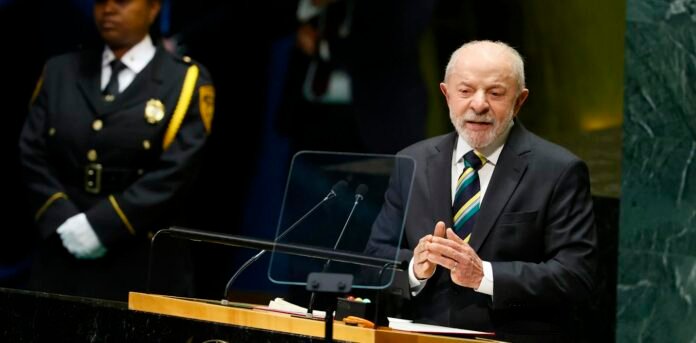
When Luiz Inácio Lula da Silva addressed the United Nations General Assembly on Sept. 22, 2026, the Brazilian president posed a question to both an international and domestic audience: Who is to decide Brazil’s future?
It is an unusually pressing question this year. Voters in Latin America’s largest nation head to the polls on Oct. 4, marking the culmination of a campaign defined by a greater degree of U.S. interference than any election in recent memory. Although President Donald Trump has established a surprising personal rapport with the left-wing elder statesman, the U.S. administration doesn’t hide its preference for Flávio Bolsonaro. He is the son of the disgraced former President Jair Bolsonaro, who is currently serving a lengthy sentence after being convicted of attempting to overturn the results of the 2022 election.
Lula has responded to U.S. pressure – which has included tariffs, sanction threats and revoked visas – by making sovereignty a central theme of his campaign, arguing that Brazil’s political destiny must be set by Brazilians rather than what he sees as a capricious foreign power.
Lula’s language has been uncompromising and often colorful. At a campaign rally outside the capital, Brasília, on Sept. 16, Lula declared Brazil would not tolerate politicians who “by day display the national flag and at night get on all fours for the United States.”
He has denounced members of the Bolsonaro family as traitors conspiring against the national interest in pursuit of personal gain. Such rhetoric has contributed to Lula’s small but steady lead in most polls.
The underlying argument predates the current confrontation with Washington — and it’s also older than Lula himself, who would be sworn in at the age of 81 should he prevail in the national vote. Nationalism today might be “the master concept of the radical right,” as one scholar of extremism has put it, but it has never belonged exclusively to reactionaries in Brazil.
Dueling notions of the nation
As I document in my new book, “Claiming the Nation,” Brazilian political movements both left and right throughout the 20th century competed to claim the nationalist mantle. In so doing, they argued about who was best positioned to ensure the nation lived up to its extraordinary natural potential while ascribing very different meanings to concepts like sovereignty and the national interest.
One of these political traditions – which can broadly be grouped as progressive nationalist – understood national sovereignty as the capacity to determine Brazil’s economic and political development on its own terms. For its proponents, a country could not be fully independent while its resources and institutions remained excessively dependent on decisions made elsewhere.
Supporters of Flávio Bolsonaro march with an effigy of U.S. President Donald Trump holding a doll depicting Brazilian President Luiz Inácio Lula da Silva as a prisoner.AP Photo/Andre Penner
A more conservative opposing strain of nationalism emerged after World War II in response to Brazil’s first era of mass democratic politics and presented Brazil’s failures less as a consequence of foreign dependence than of its own populist political class. This tradition viewed progressive nationalism as using promises of reform and demagogic tirades against scapegoats abroad to distract from their own corruption and irresponsibility.
These two nationalist traditions offered starkly different diagnoses of Brazil’s problems and divergent political prescriptions.
While Lula’s current appeals to sovereignty belong to the progressive tradition, they should not be mistaken for anti-Americanism. Brazil’s progressive nationalists have historically sought greater room for maneuver in the international system precisely because they understood national autonomy to depend on the ability to engage the world without becoming subordinate to any single power.
In that vein, Brazil has cultivated relations across ideological divides while seeking a larger voice in shaping the international order. Its efforts to assert that role, whether by pursuing a permanent seat on the U.N. Security Council or offering to mediate seemingly intractable geopolitical disputes, have often been dismissed as naive or misguided. As one commentator put it: “To behave as though Brazil could wield global power comparable to China’s, or even India’s, is pure folly.”
Yet such dismissals overlook the foreign-policy ambitions of a large and complex nation that has historically aspired to an important global role. Sovereignty, in this formulation, is less a demand for withdrawal than a claim to political agency.
The Bolsonaro reaction
Flávio Bolsonaro, by contrast, criticizes Brazilian democratic institutions – particularly the Supreme Court and the electoral system – as obstacles to restoring the country’s political order.
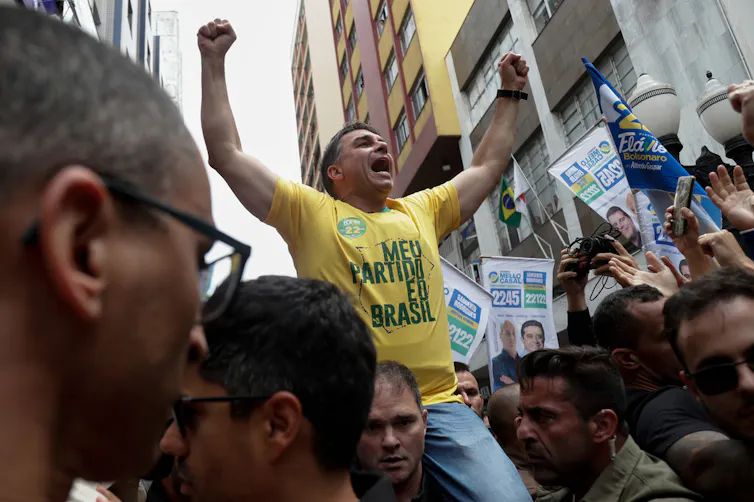
Flávio Bolsonaro rides on a man’s shoulders during his campaign rally at the site where his father, former President Jair Bolsonaro, was injured by a stabbing attack in 2018.AP Photo/Bruna Prado
From this perspective, a closer relationship with the U.S. is perfectly compatible with national renewal. If sovereignty for Lula means defending Brazil’s freedom to chart its own course in the world, for Bolsonaristas it means reclaiming Brazil from the domestic forces he and his supporters blame for its decline.
Flávio Bolsonaro’s main target is the judiciary that prosecuted and ultimately imprisoned his father. His promise to free Jair Bolsonaro is presented not as a rejection of the rule of law but as part of a broader pledge to reform institutions that, in his telling, have exceeded their proper authority.
The irony is that, notwithstanding his nationalist posturing, a Flávio Bolsonaro electoral victory would strengthen the transnational far-right current that many critics see Trump as embodying, extending the reach of a political project deeply hostile to popular sovereignty abroad.
Brasília by way of New York
In his U.N. speech, Lula insisted that powerful countries cannot dictate the political choices of weaker ones. That message comes weeks after a leaked confidential report from Brazil’s national intelligence service described the U.S. pressure campaign as having reached a “critical” level.
Shared with the Justice Ministry and the Superior Electoral Court, Brazil’s supreme body on elections, the report indicates that, for the first time in decades, foreign influence has become serious enough to warrant the attention of the institutions charged with protecting Brazil’s political and electoral system.
The U.N. was an ideal stage for Lula because it allows Brazil to reassert the principles of its independent foreign policy without signaling a retreat from international engagement.
That sovereignty argument has paid political dividends at home. But the campaign has increasingly been pulled back toward another elemental fault line in Brazilian politics: corruption. The crisis surrounding Banco Master, a failed financial institution whose owner is at the center of a sprawling investigation into fraud, money laundering and political influence, has pushed the issue to the forefront of the campaign.
A Bolsonaro supporter wears a costume with Brazilian and U.S. flag motifs at a Brazilian Independence Day event on Sept. 7, 2026.AP Photo/Andre Penner
Ironically, while Lula is not directly implicated in the scandal and Flávio Bolsonaro very much is, the incumbent seems to be the one paying a political price for one of the largest financial scandals in Brazilian history. The more the campaign turns from sovereignty to corruption, the more vulnerable Lula becomes.
Nor is Lula enjoying the traditional polling bump that incumbents have historically received late in the campaign. Despite relatively robust job growth and low inflation over Lula’s third term, the cost of living has been a central campaign issue dogging the president. The economy might be slowing down at exactly the wrong time for Lula’s electoral chances.
Security is another top-of-mind issue that favors the challenger, who has promised an approach modeled after El Salvador’s President Nayib Bukele.
The pre-election lines in the sand
For generations, Brazilian politicians have argued over whether the country’s frustrations are best explained by forces beyond its borders or by failures within them. Washington has hardly been a neutral observer.
What is unique about this election, however, is that the U.S. is taking sides so openly and in real time through hostile policy measures designed to put a thumb on the scale of the country’s political debate. Sovereignty, once invoked to debate development, economic dependence and Brazil’s place in the international order, has become an immediate question of de facto political authority.
Flávio Bolsonaro does not reject national sovereignty. Instead, he locates threats to that sovereignty primarily inside Brazil, in institutions and political actors he regards as having thwarted his family’s political agenda.
Lula very pointedly locates the threat differently, emphasizing the ability to resist a foreign power’s undue exertions of leverage. They represent competing answers to the older question of what is needed for Brazil to remain master of its own destiny.
On Oct. 4, Brazilians will determine which understanding of the national interest will guide their nation in an increasingly uncertain global order. The choice is whether Brazil’s sovereignty means charting its own course or accepting one charted, at least in part, somewhere else.
When Presidents Donald Trump and Xi Jinping last sat down in May 2026, talk was centered on three Ts: trade, technology and Taiwan.
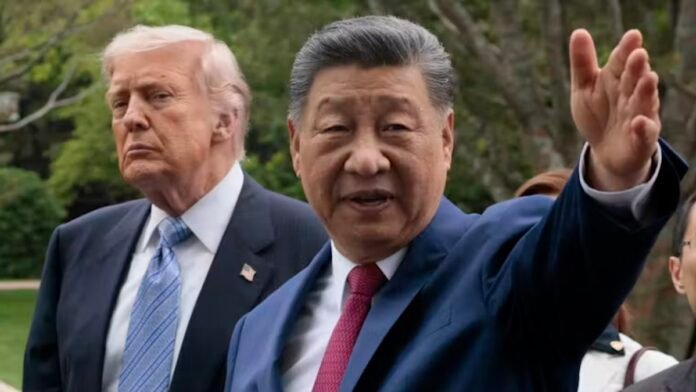
The latest summit, due to begin in the United States on Sept. 24, looks set to focus on the same set of issues again. The main difference will be that the technology element has been given added urgency by the sudden and rapid shift in developments in artificial intelligence.
What’s less clear is whether the two sides will be able to come to any sort of transformative agreement on that, or any other issue.
Tweaks to trade?
The most urgent issue, but also the simplest to solve, will be on trade.
Nearly a year ago at Busan in South Korea, Trump and Xi hammered out an agreement whereby the US agreed to lift some export controls on high-end technology and to reduce the then three-figure tariffs on Chinese goods. For its part, China agreed not to restrict the flow of critical minerals and rare earths to US users.
That pact is now up for renewal. Both sides are likely to want a continuation of the current arrangement, and while there may be some tweaking on the side, the new deal will probably be similar to the old one.
Each side has proposed in previous meetings that there should be a new instrument, a Board of Trade, that will assess non-sensitive US-China business interests.
However, details about the institution remains vague. Some announcements are likely during the summit, but business leaders will want to know how comprehensive and lasting the arrangements for the board will be.
There is still less information on a proposed Board of Investment, which remains on the drawing board. The Chinese side has proposed bringing major Chinese CEOs to the summit to match the likes of Nvidia’s Jensen Huang and Tesla’s Elon Musk – both of whom accompanied Trump on the Beijing trip.
But the choice of business leaders is likely to turn on which aspects of trade China thinks are likely to develop most effectively in the short term.
The always thorny issue of Taiwan
Taiwan is a much harder issue to solve, but it’s unlikely that much that is discussed on Xi’s visit will determine its outcome.
Trump has been less willing than his predecessor to commit the US to defending the island should Beijing invade, instead reasserting Washington’s long-held position of strategic ambiguity.
And although the US is currently distracted from East Asia by the Iran conflict, China still prefers to find methods short of war to bring the island under Beijing’s control.
Taiwanese soldiers set up anti-tank obstacles to simulate stopping Chinese forces during the Han-Kuang military exercise on Aug. 6, 2026. Daniel Ceng/Anadolu via Getty Images via The Conversation
The island’s January 2028 presidential election is likely to be a more crucial moment for Taiwan’s future, particularly if the opposition — and more China-friendly — Kuomintang party wins the presidency, or indeed if an isolationist candidate becomes US president later that year.
If the next US president opted to change course by taking a less active involvement in overseas issues — as has been floated by early contenders on both the left and right — that would change things all the more.
For now, Beijing will continue to build the People’s Liberation Army’s naval capacity to have the option of military action against the island. But its preference will be to take advantage of changes within Taiwan’s internal politics while combining economic incentives and coercion, squeezing Taipei’s international footprint and hoping for a slackening of US interest in the western Pacific.
Other international issues are likely to gain less attention. China is expected to make clear its unhappiness about the war on Iran, and the U.S. may remind China that it has passed new legislation allowing sanctions on countries that buy Russian oil – of which, China is the largest purchaser. However, neither issue is likely to lead to any major change in practice.
Turning to tech
It’s really in the area of tech, and AI in particular, where both sides will be trying to make diplomacy catch up with reality. The May summit surprised many because the question of mutual agreement on regulation of AI came up in a way that had not been on the agenda for the first year of the Trump administration.
Between the May and September summits, fears about AI in the US have created an increasingly unfriendly atmosphere toward unregulated AI.
In China, public sentiment about AI is less openly hostile and some of its major benefits in areas such as healthcare have softened people’s attitudes. Yet there are still plenty of concerns expressed in private about whether China’s troubled economy will definitively benefit from the AI boom.
Although many argue it has created new opportunities for consumers, others point to the relatively few jobs that have been created for a workforce that finds itself buffeted by wide-scale job elimination.
Both the US and China have reasons to talk about AI regulation. The alarming prospect of rogue AI companies causing intense social disruptions through their business choices is clearly one such reason, and in the US, voters’ more immediate concerns about data centers are another.
There are also China-specific reasons that Beijing may seek restraint. One of the most common concerns about AI is that it may well run out of control. And “out of control” is a kryptonite phrase for the leadership of the Chinese Communist Party.
That’s particularly true of Xi who, as a youth, spent years in rural exile after his father fell to a purge just before the Cultural Revolution – an upheaval during which China’s politics turned to anarchy. It was a formative experience for Xi, which has no doubt influenced his tendencies as a leader toward exercising as much control as possible.
AI that undermines the unchallengeable leadership of the Communist Party would be an unwelcome guest in China’s cyberspace, and regulation that solves that problem would not be rejected out of hand.
However, this recognition of mutual concern about AI – albeit for very different reasons – is still not likely to see much progress in the short term. The competition between the US and China on AI is real, and neither governments nor private sector actors in either country are willing to make concessions that could advantage the other side.
Levels of trust between Washington and Beijing remain very low on the issue. Talks about talks seem the most likely public outcome, though what happens behind the scenes may be pursued more discreetly.
It’s good to talk
The Trump-Xi summit is less important in terms of any major change in policy on either side, and more because it marks part of a commitment to maintain some form of dialogue between the leaders of the world’s two most powerful countries. The leaders may well meet twice more in the near future, at the G20 and APEC summits.
To meet four times in just over half a year is a good sign; refusal to meet would be much more worrying.
But the underlying difficulties of the three Ts, where the leaders seem to have fundamentally incompatible agendas, remain the thread beneath the ostensibly polite and occasionally amiable conversations.
Amnesty urges UEFA to suspend Israel, calls Nations League participation ‘unconscionable’
Human rights organization Amnesty International on Tuesday called on UEFA and FIFA to suspend Israel’s football association, saying its Nations League participation is “unconscionable” because of the association’s support for settlement-based clubs, Anadolu reports.
“It’s unconscionable that the Israel men’s football team will participate in the UEFA Nations League this autumn despite clear evidence that Israel’s football association continues to support illegal settlements,” Steve Cockburn, Amnesty International’s regional director for Europe, said in a statement.
“UEFA and FIFA should have suspended the Israel Football Association (IFA) over its refusal to exclude clubs based in illegal settlements in the Occupied Palestinian Territories,” Cockburn said.
He said the continued participation of settlement-based clubs in Israeli leagues “violates FIFA statutes and international law.”
He added that UEFA and FIFA funding to the IFA “risks contributing to the sustainability of Israel’s illegal occupation, settlements and violations of international law.”
Israel is set to play in League B’s, Group B3 alongside Austria, the Republic of Ireland and Kosovo.
The league phase begins Thursday, with Austria hosting Israel, according to UEFA.
READ: Football legends criticise FIFA leadership, demand greater voice for players and fans
Israel will also play the Republic of Ireland on Sept. 27 and Oct. 4, and Kosovo on Oct. 1 and Nov. 14, before hosting Austria on Nov. 17.
Amnesty said opposition to Israel’s participation has grown in Ireland, where football associations, players, activists, trade unions and politicians have called for sanctions, a boycott or suspension.
The Football Association of Ireland has also asked UEFA to consider suspending Israel, according to the rights group.
“Sport should never be used as a public relations spectacle for states committing atrocities,” Cockburn said.
“As the Israel team travels to Europe, Palestinian families are being displaced and dispossessed, their land stolen, their olive trees uprooted and their histories erased by settlers with the support of the Israeli military,” he said.
“The beautiful game should bring people together, not rubber-stamp apartheid,” Cockburn added.
Amnesty said it wrote to FIFA and UEFA in October 2025 to call for the IFA to be suspended unless clubs based in Israeli settlements were excluded from Israeli competitions.
FIFA announced in March 2026 that it would take no action against the IFA over the participation of settlement-based clubs, according to Amnesty.
The Palestinian Football Association subsequently appealed the decision to the Court of Arbitration for Sport.
READ: Palestine Football Association says FIFA failed to enforce rules against Israel