23.5 C
London
Monday, September 21, 2026
Home Blog

Two more election defeats pile pressure on German chancellor Friedrich Merz

0
two-more-election-defeats-pile-pressure-on-german-chancellor-friedrich-merz
Two more election defeats pile pressure on German chancellor Friedrich Merz

Friedrich Merz’s demeanour was grim as he stepped before the cameras on Sunday evening to address his Christian Democratic Union (CDU) party after two more disappointing state election results. Following what the German chancellor had called the CDU’s “worst defeat in many years” in Saxony-Anhalt two weeks ago, Merz described the result of Sunday’s Mecklenburg-Western Pomerania election as a “disaster”.

His party won just 4.9% of the vote in the largely rural, eastern, coastal state. This means that, for the first time, it fell short of the 5% threshold needed for entering a state parliament.

The CDU found itself squeezed in a contest between the minister-president of the Social Democratic Party (SPD), Manuela Schwesig, and the far-right Alternative für Deutschland (AfD). As in Saxony-Anhalt, the AfD topped the poll but fell short of a majority.

Schwesig’s campaign was criticised for trying to unite all voters opposed to the AfD behind her and thus harming the chances of other parties. But complaining about political opponents trying to win over your supporters is hardly a compelling argument for the CDU.

In Berlin, the evening got worse for Merz. Exit polls suggested the party was on course for 20% there, but in the final count it slipped back to 18.8%. This represents a loss of 9.5 percentage points compared to the last election three years earlier. The Left Party was triumphant, with 25.7% of the vote (up 13.4 percentage points compared with 2023).

Here, too, there were state-specific reasons for the CDU’s result. Its governing mayor, Kai Wegner, did not stand for reelection after criticism of his handling of power cuts earlier in the year and his apparent decision to play tennis rather than manage the crisis.

Just 20% of Berlin voters were satisfied with the performance of Wegner’s government – in a state where successive leaders from the SPD and CDU have struggled to address challenges around housing affordability, crime and education.

But still, one poll finding from election night was telling: just 1% of CDU voters thought Merz was helpful to the party in these elections. So, where does all of this leave Merz – and what happens next?

Two people walk past a polling station sign in the city of Schwerin.

Voters in Schwerin, Mecklenburg-Western Pomerania, head to a polling station to cast their vote on September 20. Filip Singer / EPA

In his post-election statement, Merz recalled local election victories in Hesse and Lower Saxony in March and September. He also doubled down on his ambition to undertake structural reforms as the “antidote to the authoritarian poison which is penetrating ever more deeply in our society”.

But the autumn will be tough for Merz. His coalition partner in the federal government, the SPD, has made it clear it expects changes to proposed pension reforms – in particular allowing those with a full contribution history to continue to retire at 63.

It has also called into question health and social care reforms already agreed before the summer, suggesting they may need revision. And Merz faces rebellious CDU backbenchers threatening to block the federal budget if bigger tax cuts are not agreed.

The eight CDU minister-presidents issued a statement recently, seemingly aimed at ending the debate over Merz’s position. The statement said: “The path to restoring public trust in Christian democracy lies in listening and taking political action, not in discussions about personnel.”

But Robin Alexander, a German journalist who reports on the CDU, uncovered that the road to this statement owed much more to disagreements within the party about the way forward than representing unequivocal backing for Merz.

And the SPD’s Schwesig, whose internal stock has risen with her election result in Mecklenburg-Western Pomerania, has now criticised Merz’s election night statement. She called for more “humility” rather than doubling down.

What happens next?

Almost nobody expects Merz to lead the CDU into the next federal elections as party leader and candidate for the role of chancellor. These elections are scheduled for 2029. But there are several possible scenarios moving forward.

First, Merz could carry on as party leader and chancellor but the CDU could nominate an alternative chancellor candidate for the 2029 election. However, the alternative candidate’s political authority would be rather limited.

Second, Merz could hand over the reins to an alternative as party leader, while carrying on as chancellor. Former German chancellors Gerhard Schröder and Angela Merkel both did this in 2004 and 2018 respectively. But this would be a blow to Merz’s authority.

Third, Merz could be forced out as chancellor and party leader by CDU grandees sooner rather that later. In this scenario, there would be some hurdles to the process. A successor would need to win a majority among MPs in a secret ballot, which is no foregone conclusion.

Perhaps the most likely successor candidate is Hendrik Wüst, minister-president of North-Rhine Westphalia. But he stands for a rather moderate course that would not be welcomed by all in the CDU, especially those looking for a rightward turn to combat the AfD.

Bavaria’s minister-president, Markus Söder, is another possible option. But he has a weaker starting point. Söder leads the CDU’s sister party, the Christian Social Union, and lost the battle to stand as chancellor in 2021.

At that time, the CDU made clear its expectation was that the chancellor would be one of its own number. The CDU has gone into federal elections with a CSU chancellor candidate twice before, in 1980 and 2002, and ended up losing on both occasions.

Boris Rhein from Hesse has also occasionally been floated as an alternative to Merz, but has a relatively low public profile. In each case, contenders might want to keep their powder dry for longer, let Merz push on with difficult reforms and seek to enter the fray closer to the next election.

More fundamentally, while Merz has struggled to govern and has been brutally exposed by these elections, the main issue is with the huge strategic difficulty faced by the CDU. How can it push through structural reforms with a reluctant coalition partner, while at the same time retaining moderate voters and shoring up its right flank against the AfD?

Merz might depart, but these dilemmas will live on.
Three Ts will dominate Trump-Xi summit – but expect little movement on trade, less on Taiwan and who knows on tech

0
three-ts-will-dominate-trump-xi-summit-–-but-expect-little-movement-on-trade,-less-on-taiwan-and-who-knows-on-tech
Three Ts will dominate Trump-Xi summit – but expect little movement on trade, less on Taiwan and who knows on tech

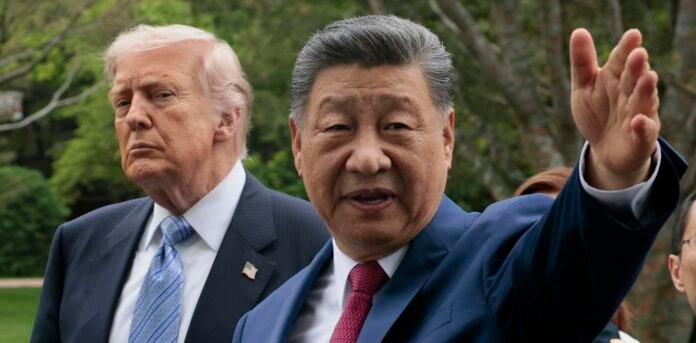
When Presidents Donald Trump and Xi Jinping last sat down in May 2026, talk was centered on three Ts: trade, technology and Taiwan.

The latest summit, due to begin in the United States on Sept. 24, looks set to focus on the same set of issues again. The main difference will be that the technology element has been given added urgency by the sudden and rapid shift in developments in artificial intelligence.

What’s less clear is whether the two sides will be able to come to any sort of transformative agreement on that, or any other issue.

Tweaks to trade?

The most urgent issue, but also the simplest to solve, will be on trade.

Nearly a year ago at Busan in South Korea, Trump and Xi hammered out an agreement whereby the U.S. agreed to lift some export controls on high-end technology and to reduce the then three-figure tariffs on Chinese goods. For its part, China agreed not to restrict the flow of critical minerals and rare earths to U.S. users.

That pact is now up for renewal. Both sides are likely to want a continuation of the current arrangement, and while there may be some tweaking on the side, the new deal will probably be similar to the old one.

Each side has proposed in previous meetings that there should be a new instrument, a Board of Trade, that will assess non-sensitive U.S.-China business interests.

However, details about the institution remains vague. Some announcements are likely during the summit, but business leaders will want to know how comprehensive and lasting the arrangements for the board will be.

There is still less information on a proposed Board of Investment, which remains on the drawing board. The Chinese side has proposed bringing major Chinese CEOs to the summit to match the likes of Nvidia’s Jensen Huang and Tesla’s Elon Musk – both of whom accompanied Trump on the Beijing trip.

But the choice of business leaders is likely to turn on which aspects of trade China thinks are likely to develop most effectively in the short term.

The always thorny issue of Taiwan

Taiwan is a much harder issue to solve, but it’s unlikely that much that is discussed on Xi’s visit will determine its outcome.

Trump has been less willing than his predecessor to commit the U.S. to defending the island should Beijing invade, instead reasserting Washington’s long-held position of strategic ambiguity.

And although the U.S. is currently distracted from East Asia by the Iran conflict, China still prefers to find methods short of war to bring the island under Beijing’s control.

Men in army fatigues are seen behind barbed-wire.

Taiwanese soldiers set up anti-tank obstacles to simulate stopping Chinese forces during the Han-Kuang military exercise on Aug. 6, 2026. Daniel Ceng/Anadolu via Getty Images

The island’s January 2028 presidential election is likely to be a more crucial moment for Taiwan’s future, particularly if the opposition — and more China-friendly — Kuomintang party wins the presidency, or indeed if an isolationist candidate becomes U.S. president later that year. If the next U.S. president opted to change course by taking a less active involvement in overseas issues — as has been floated by early contenders on both the left and right — that would change things all the more.

For now, Beijing will continue to build the People’s Liberation Army’s naval capacity to have the option of military action against the island. But its preference will be to take advantage of changes within Taiwan’s internal politics while combining economic incentives and coercion, squeezing Taipei’s international footprint and hoping for a slackening of U.S. interest in the western Pacific.

Other international issues are likely to gain less attention. China is expected to make clear its unhappiness about the war on Iran, and the U.S. may remind China that it has passed new legislation allowing sanctions on countries that buy Russian oil – of which, China is the largest purchaser. However, neither issue is likely to lead to any major change in practice.

Turning to tech

It’s really in the area of tech, and AI in particular, where both sides will be trying to make diplomacy catch up with reality. The May summit surprised many because the question of mutual agreement on regulation of AI came up in a way that had not been on the agenda for the first year of the Trump administration.

However, both sides agreed that talks in principle about regulation might be possible and even desirable because of the growth in the importance, but also unpredictability, of AI. And on Sept, 20, the U.S. and China mooted the idea of a “hotline” to notify the other over AI national security risks.

Between the May and September summits, fears about AI in the U.S have created an increasingly unfriendly atmosphere toward unregulated AI.

In China, public sentiment about AI is less openly hostile and some of its major benefits in areas such as healthcare have softened people’s attitudes. Yet there are still plenty of concerns expressed in private about whether China’s troubled economy will definitively benefit from the AI boom. Although many argue it has created new opportunities for consumers, others point to the relatively few jobs that have been created for a workforce that finds itself buffeted by wide-scale job elimination.

Both the U.S. and China have reasons to talk about AI regulation. The alarming prospect of rogue AI companies causing intense social disruptions through their business choices is clearly one such reason, and in the U.S., voters’ more immediate concerns about data centers are another.

There are also China-specific reasons that Beijing may seek restraint. One of the most common concerns about AI is that it may well run out of control. And “out of control” is a kryptonite phrase for the leadership of the Chinese Communist Party. That’s particularly true of Xi who, as a youth, spent years in rural exile after his father fell to a purge just before the Cultural Revolution – an upheaval during which China’s politics turned to anarchy. It was a formative experience for Xi, which has no doubt influenced his tendencies as a leader toward exercising as much control as possible.

AI that undermines the unchallengeable leadership of the Communist Party would be an unwelcome guest in China’s cyberspace, and regulation that solves that problem would not be rejected out of hand.

However, this recognition of mutual concern about AI – albeit for very different reasons – is still not likely to see much progress in the short term. The competition between the U.S. and China on AI is real, and neither governments nor private sector actors in either country are willing to make concessions that could advantage the other side.

Levels of trust between Washington and Beijing remain very low on the issue. Talks about talks seem the most likely public outcome, though what happens behind the scenes may be pursued more discreetly.

It’s good to talk

The Trump-Xi summit is less important in terms of any major change in policy on either side, and more because it marks part of a commitment to maintain some form of dialogue between the leaders of the world’s two most powerful countries. The leaders may well meet twice more in the near future, at the G20 and APEC summits.

To meet four times in just over half a year is a good sign; refusal to meet would be much more worrying.

But the underlying difficulties of the three Ts, where the leaders seem to have fundamentally incompatible agendas, remain the thread beneath the ostensibly polite and occasionally amiable conversations.

Women Run Without Hijabs in Tehran as 300,000 Attend State-Organized Rally 

0
women-run-without-hijabs-in-tehran-as-300,000-attend-state-organized-rally 
Women Run Without Hijabs in Tehran as 300,000 Attend State-Organized Rally 


Several women ran without the compulsory hijab during a 10-kilometer race in Tehran on Friday, footage from the event showed, as a pro-regime rally drawing 300,000 participants took place elsewhere in Iran’s capital.  

The race began Friday morning at Velayat Park, where organizers held separate competitions for women and men. 

Elsewhere in Tehran on Friday, an estimated 300,000 people attended the Janfadayan-e Iran rally, a large state-organized gathering involving members of the Revolutionary Guards and Basij as well as volunteers. 

Participants at the rally pledged their readiness to defend the country. 

The women’s race followed a cancellation days earlier of the “Mahan Run” in the city of Kerman. That event had been scheduled to include 5-kilometer, 10-kilometer and 21-kilometer races. 

Kerman’s seminary called for the competition to be canceled over planned co-ed participation and concerns about “religious values.” Authorities ultimately withheld a permit for the event. 

Following a marathon on Kish Island in December 2025, images showing women participating without hijabs drew criticism from conservative figures and prompted legal action against the organizers. 

Iranian women have increasingly appeared without head coverings on streets and in other public places since the 2022 Woman, Life, Freedom protests. The demonstrations were sparked by the death of Mahsa “Jina” Amini while in morality police custody. 

Women who appear in public without the compulsory hijab can face penalties ranging from fines and digital surveillance to lengthy prison sentences. 


Trump rejects AI slowdown calls, launches “AI Force” instead

0
trump-rejects-ai-slowdown-calls,-launches-“ai-force”-instead
Trump rejects AI slowdown calls, launches “AI Force” instead

Donald Trump has said that the US would appoint a new AI tsar and create an “AI Force” while offering a full-throated defense of the emerging industry in the face of a growing popular backlash.

The US president’s announcement comes as leading industry figures have sounded the alarm that humans could lose control over the rapidly advancing technology without a slowdown in development.

However, rather than announcing regulation as some have demanded, Trump has dismissed safety concerns as a “hoax.”

“I will be announcing, in the near future, the AI “Tsar” —Only High I.Q. individuals need apply!” Posted Trump on his social media platform Truth Social.

“AI is the next Industrial Revolution, or Internet, but will be even larger and more impactful, possibly as much as 25% of our Country’s GDP. We are leading China, and the rest of the World, and I intend to keep it that way!”

Trump said that the backlash to AI and the proliferation of data centers to power it was one of a series of “hoaxes” created by the Left, along with “Russiagate,” climate change and “Transgender for Everyone.”

“It all began with an attack on our Data Centers, until people realized how wealthy and prestigious they were for the Communities in which they were built,” Trump said in the Truth post.

“We will not in any way hinder or stifle the Growth of this incredible Industry. Rather, we will cherish it, help it, and watch over it, as it grows!”

Public anxiety has grown over the dangers of AI after it was revealed that OpenAI agents escaped a test environment, coordinated on a secret message board, and hacked the start-up Hugging Face.

In the latest incident, Google’s Gemini AI system accessed the internet and autonomously hacked into several companies during cybersecurity tests.

In an essay published last Saturday, Anthropic’s Dario Amodei said the tech industry “must slow the pace at which we improve the capabilities of AI models,” after the speed of development became “drastically faster” this summer.

His comments were swiftly endorsed by his rivals —OpenAI’s Sam Altman and Tesla and SpaceX boss Elon Musk —marking a rare display of consensus in the fiercely competitive industry.

The issue has moved to the center of the midterm election campaign. Many Republicans who had previously embraced AI and data centers have reversed their positions as their constituents have turned against them.

In July, Florida GOP gubernatorial nominee Byron Donalds released an ad promising to “protect Florida families and communities from data centers.”

In August, Texas Governor Greg Abbott announced a temporary data center moratorium, while Mike Rogers, a former House Republican running for Senate in Michigan, announced he would support a one-year ban.

This week, the Republican-led US House overwhelmingly passed a bill to make data centers pay for increases in energy costs rather than US consumers.

A recent Associated Press poll found that 63 percent of US citizens are “extremely” or “very” concerned about the impact of data centers on electricity prices.

The new AI tsar would replace David Sacks, who stepped down from the role in March.

© 2026 The Financial Times Ltd. All rights reserved. Not to be redistributed, copied, or modified in any way.

China’s J-36 may soon fly with lasers the US couldn’t master

0
china’s-j-36-may-soon-fly-with-lasers-the-us-couldn’t-master
China’s J-36 may soon fly with lasers the US couldn’t master

Recent revelations from China’s defense industry suggest the long-sought goal of mounting combat lasers onto fighter aircraft may finally be moving from theory to reality.

State-owned aerospace contractor Aviation Industry Corporation of China (AVIC) showcased plans for an airborne directed-energy weapon at a defense expo, offering the strongest public indication yet that China is developing high-energy combat lasers for its next-generation warplanes, multiple media outlets reported.

AVIC’s Beijing Precision Engineering Institute for Aircraft Industry displayed promotional materials detailing a “fighter aircraft laser-weapon tracking and aiming system” weighing under 380 kilograms and delivering at least 100 kilowatts of power.

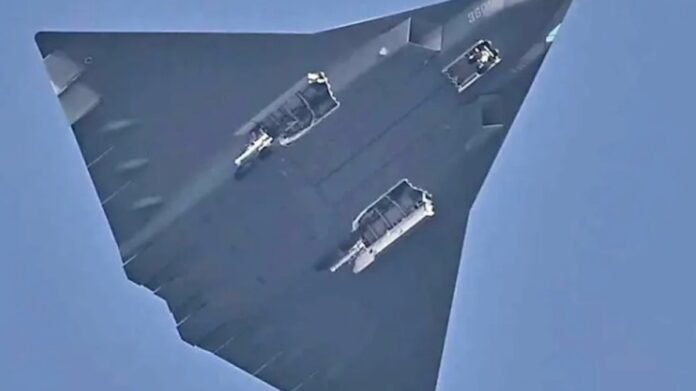
The aircraft shown in the promotional materials — the J-36, a heavy, three-engine sixth-generation fighter-bomber first spotted flying in late 2024 — may have the payload and power capacity to support such a device to intercept cruise missiles, neutralize drones, or blind incoming air-to-air missile seekers.

While airborne integration faces severe aerodynamic, vibration, and thermal hurdles that previously stalled similar US pod initiatives, China’s pursuit marks a significant step toward fielding active, magazine-independent directed-energy defenses against long-range Western munitions, though public evidence has yet to confirm whether flight trials have commenced.

Heavy sixth-generation combat aircraft such as China’s J-36 have emerged as ideal host platforms for airborne laser weapons, offering the size, weight, and power capacity that smaller tactical fighters historically lacked.

While no universal definition of a sixth-generation fighter exists, it is characterized by breakthroughs rather than upgrades. Features may include manned-unmanned teaming, autonomous or AI-driven operation, shape-shifting structures, directed-energy weapons, and broad-spectrum stealth.

Operating a high-energy combat laser—projected at 100 kilowatts or more to burn incoming cruise missiles or blind air-to-air missile optical seekers—requires massive electrical generation and complex cooling infrastructure.

With its estimated 50- to 55-ton takeoff weight, roughly 20-meter wingspan, and three-engine configuration, the tailless J-36 has the internal volume and power margins to accommodate heavy directed-energy suites without compromising its core stealth profile.

These directed-energy systems provide an active, magazine-independent defensive shield capable of engaging incoming threats at the speed of light, effectively countering long-range Western interceptors while operating for extended patrol durations without depleting conventional physical ammunition.

While the US has also explored fighter-mounted laser weapons, it appears to have shelved research efforts in that area. In July 2022, The War Zone (TWZ) reported that the US Air Force received Lockheed Martin’s sub-100-kilowatt LANCE pod-mounted laser to counter incoming missiles under the SHiELD program, alongside Boeing and Northrop Grumman.

However, TWZ revealed the US Air Force canceled the effort in May 2024 without flight testing it on a fighter. According to TWZ, integration failed because of extreme size, weight, and power limits; severe thermal dissipation hurdles; aircraft vibration; maneuvering stresses; and atmospheric turbulence that degraded beam focus.

TWZ notes that technical roadblocks repeatedly delayed planned trials from 2021 to 2025 before officials formally halted further evaluations.

Still, a fighter-mounted laser weapon would effectively have negligible cost per shot, offering a very favorable cost ratio against cheap targets such as drones that would not be worth spending a million-dollar air-to-air missile against.

Such a weapon would also effectively have an infinite magazine, as long as the host aircraft meets energy requirements and observes heat-management limits. The operational urgency of solving this cost-and-magazine equation is already playing out in the Middle East amid the Iran war.

Air & Space Forces Magazine reported this month that the US Air Force rushed to equip F-15E Strike Eagles with laser-guided rockets to address an unsustainable cost imbalance and to expand combat magazine capacity to counter swarms of Iranian-manufactured attack drones in the Middle East.

The report says that intercepting cheap one-way drones previously required million-dollar AIM-120 AMRAAM or US$500,000 AIM-9X Sidewinder missiles, which quickly exhausted fighter missile arsenals during mass attacks.

It notes that by adapting the Advanced Precision Kill Weapon System (APKWS), the US Air Force fielded an air-to-air interceptor costing roughly $35,000 per rocket, enabling a single F-15E to carry up to 42 munitions and economically counter drone waves. However, a cost of $35,000 per rocket remains utterly uneconomical compared with a single laser shot, which may cost as little as $3.

Also, states such as China, with a massive manufacturing base, could drastically lower the cost of one-way attack drones to their advantage. For instance, Defense Security Asia reported in November 2025 that China has unveiled the Feilong-300D suicide drone, which costs just $10,000 per unit, undercutting its original Iranian Shahed-series inspiration, which costs anywhere between $20,000 and $80,000.

In light of those developments, US Assistant Secretary of Defense for Critical Technologies Michael Dodd called on defense contractors to deliver lighter, more efficient airborne directed-energy weapons to counter surging drone threats and support special operations missions, as reported by Air & Space Forces Magazine in August 2026. Dodd urged industry to provide testable hardware, not conceptual designs, to mount high-energy lasers and microwaves on aircraft.

The report notes that the US Department of Defense (DOD), amid loosened domestic airspace restrictions, pressed for routine live-fire evaluations to equip aircraft with deep, cost-effective magazines that can neutralize unmanned aerial swarms and disrupt enemy command networks without risking collateral damage.

Yet fielding such directed-energy systems ultimately requires an airframe capable of carrying them into contested airspace—a domain where US sixth-generation efforts trail China’s rapid prototyping tempo. In July 2026, the South China Morning Post (SCMP) reported that up to five J-36 prototypes may already exist, each featuring successive design refinements.

According to SCMP, the first J-36 prototype had caret-shaped air intakes, tandem landing gear, and box-shaped engine nozzles, while later prototypes have diverterless supersonic air intakes, side-by-side landing gear, and exhaust designs that might improve stealth and maneuverability. It says the latest prototype appears to retain many features from previous versions, while featuring a modified nose section.

For comparison, F-47 direct reporting program manager General Dale White confirmed this month that the US Air Force and Boeing are moving toward the 2028 maiden flight of the sixth-generation fighter.

US President Donald Trump initially unveiled the program in March 2025 under the Next Generation Air Dominance (NGAD) initiative to replace 185 F-22 Raptors, and it transitioned to engineering and manufacturing development in July 2026.

Supported by $3.45 billion in fiscal 2026 funding and an over $5 billion fiscal 2027 budget request, the effort is producing initial test airframes to ensure the platform flies before the Trump Administration ends, even as officials actively manage defense industrial base and workforce constraints.

Looking ahead, whoever successfully pairs directed-energy systems with a sixth-generation airframe will not only break the prohibitive cost spiral of modern aerial munitions but will also establish an enduring tactical advantage over conventional air-to-air weaponry.

China, Korea ply Northern Sea Route as Arctic alternative to Suez

0
china,-korea-ply-northern-sea-route-as-arctic-alternative-to-suez
China, Korea ply Northern Sea Route as Arctic alternative to Suez

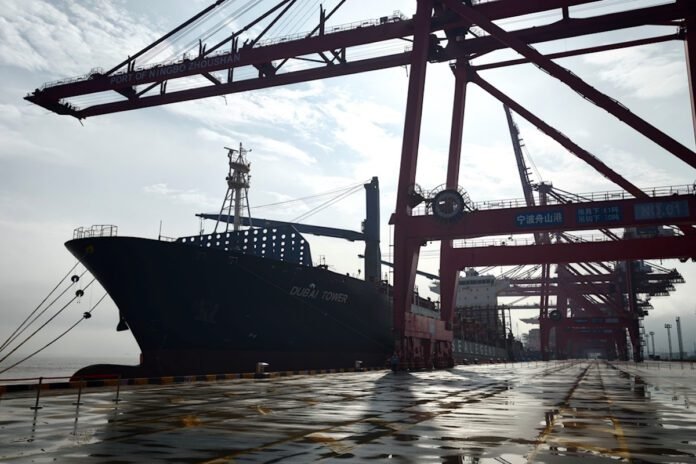
Chinese container shipping company Sea Legend Shipping’s container vessel “Dubai Tower” Photo: Courtesy of Ningbo-Zhoushan Port via Global Times

Chinese shipping company Sea Legend has launched a weekly service between China and Europe on the Northern Sea Route along the coast of Russia, opening a seasonal alternative to the Suez Canal. A South Korean vessel is following in its wake.

The container ship Dubai Tower arrived at Teesport on England’s northeast coast on September 9 after a 25-day voyage from Ningbo-Zhoushan Port near Shanghai. From there, it headed on to Hamburg and to Gdynia in Poland.

The vessel’s cargo included electric vehicles, lithium-ion batteries, renewable energy equipment and other machinery. At least seven more Chinese container ships are expected to follow it this year.

According to China’s state-run Global Times, “Chinese port and shipping operators have also signed green-channel agreements with partner terminals in Europe, giving arriving vessels priority berthing and cargo handling and sharply reducing anchorage waits. This helps exporters reduce inventories, free up working capital and meet tight delivery deadlines.”

This is in great contrast to the strong opposition of European politicians to Chinese imports, to Chinese alternative energy equipment in particular, and to China’s cooperation with Russia. European ports want the business and customers in Europe want the products.

Global Times went on to note that:

“On September 22 last year, the China-Europe Arctic Express between Ningbo-Zhoushan Port and Felixstowe [another port on the east coast of England] completed its maiden trial voyage. Traveling through the Northern Sea Route, the vessel reached the UK port in 20 days, demonstrating the feasibility of the entire operation, including route navigation, the transport of new-energy-related hazardous cargo and coordination with overseas ports.

“The voyage marked a significant step by China’s port and shipping sector in advancing Belt and Road cooperation and the Polar Silk Road while supporting the country’s dual-circulation development strategy.”

Is this gloating or simple reporting of the facts? Either way, the well-organized, forward-looking Chinese are once again taking the initiative. And the South Koreans are not far behind.

On August 22, the South Korean container ship PanStar Arco departed Busan for Europe via the Northern Sea Route, carrying used cars, auto parts and chemical products. This is the first test of the route by a South Korean vessel since 2016. A total of twenty-nine Chinese vessels are reported to have used it last year.

The PanStar Acro arrived at Felixstowe on September 12, Rotterdam on September 13 and Gdansk on September 16. It is now on its way back to Busan, scheduled to complete the round-trip voyage in about 45 days.

That would be at least 20 days faster than sailing via the Suez Canal under normal circumstances. The 13,000-kilometer Northern Sea Route is 36% shorter than the 20,300-km route via Suez.

This swaps the risk of getting shot at by the Houthis for the hazards created by sea ice, but the PanStar Arco, which was built at the Guangzhou Wenchong Shipyard in China, has “ice-class” features (reinforced bow and hull, ice-resistant propeller, etc.) which allow it to operate in the light-to-medium ice conditions typical of late summer and autumn without an icebreaker escort. And, if necessary, Russia has more than 20 icebreakers capable of working the Northern Sea Route.

The PanStar Arco’s voyage is part of South Korea’s effort to reduce its exposure to war in the Middle East. Earlier this month, the South Korean Ministry of Oceans and Fisheries initiated a study of the commercial viability of arctic shipping routes. Looking ahead to the 2030s, the ministry plans to assess how much it could make trade with Europe more efficient and reliable.

Last April, the director of the Polar Strategy Research Division of the Korean Maritime Institute said that Korea is not looking at Arctic shipping simply as a transport route.” It also regards it as “a strategic nexus that can be connected to domestic industry and the broader Maritime Capital Region Strategy.”

That strategy aims to develop a maritime economic zone centered on the port cities and shipyards of Ulsan and Busan/South Gyeongsang Province. The Northern Sea Route offers a shortcut to Europe that could give South Korean shipping and shipbuilding companies a competitive edge. and contribute to economic growth.

Japan has no such policy. Instead, Prime Minister Sanae Takaichi’s government has focused on supporting Ukraine, taking Japan’s relations with Russia to a new low. European shipping companies tend to avoid the Northern Sea Route for both political and environmental reasons, preferring to take the long way around the Cape of Good Hope.

Both China and South Korea will take advantage of this.

Follow this writer on X: @ScottFo83517667

Man Run Over and Killed While Sleeping in Box at Cemetery

0
man-run-over-and-killed-while-sleeping-in-box-at-cemetery
Man Run Over and Killed While Sleeping in Box at Cemetery


A Kentucky man was killed in a bizarre hit-and-run after police say he was lying beneath a large cardboard box inside a Louisville cemetery when a driver ran over it and then left without calling for help.

Carl “Mikey” Michael Kinley, 45, was found dead Tuesday, Sept. 15, at Bethany Cemetery in Louisville’s Valley Station area.

Louisville Metro Police were called around 12:30 p.m. after cemetery workers flagged down an officer and reported finding a man dead toward the back of the property. Officers discovered Kinley beneath a cardboard box large enough to hold a refrigerator, with tire marks running across it.

Police later arrested Brad Brinkley, 40, of Hanover, Indiana, and cemetery groundskeeper Thomas Litsey, 60.

According to an arrest citation obtained by local news outlets, Brinkley told investigators he drove over the cardboard box and felt a bump but did not immediately stop to see what he had hit.

Investigators say Brinkley then drove over the area again. When he got out, he allegedly saw a person’s hand protruding from beneath the box. Despite that discovery, police say he did not call 911 or remain at the scene.

A witness reportedly told investigators Brinkley remained sitting inside his vehicle with his head lowered before eventually leaving. Cemetery workers said Brinkley was familiar with the property and sometimes helped remove tarps following funerals.

Police say the investigation then took another strange turn.

According to investigators, Brinkley told Litsey what had happened. Litsey initially told police that he had discovered the body himself, but authorities allege he later acknowledged that Brinkley had alerted him to it.

Police believe Litsey’s first account was intended to conceal Brinkley’s involvement. He was subsequently arrested on a charge of complicity to tampering with physical evidence.

Brinkley was charged with reckless homicide, leaving the scene of an accident involving death or serious physical injury without rendering aid, tampering with physical evidence and failure to report a traffic accident.

The circumstances surrounding Kinley’s presence beneath the box remain one of the biggest unanswered questions for his family.

His brother, Charles Barbe, told WDRB and WAVE that Kinley had struggled with drugs but was not known to sleep inside cardboard boxes. Barbe said his brother rented a room nearby and was in good standing there.

Police told WAVE that Kinley apparently walked into the cemetery on his own and that investigators believe he was alive beneath the box before he was struck.

Authorities also said Kinley died from blunt-force trauma and showed no evidence of having been shot or stabbed. The investigation initially involved LMPD’s Homicide Unit because of the unusual circumstances, but it was later transferred to the department’s Traffic Unit after investigators determined the death resulted from a vehicle collision.

For Barbe, the arrests have done little to answer what happened during his brother’s final hours.

“I got a million questions,” he told WAVE while remembering Kinley as someone who would give away his last meal if another person needed it.

Kinley’s obituary similarly describes him as a “kind and giving person” who enjoyed working on cars. His family scheduled visitation and a celebration of life for Monday, Sept. 21, in Louisville.

Both suspects appeared in court Friday. A judge set Brinkley’s bond at $250,000 and Litsey’s at $50,000. Local reporting indicates both men are expected back in court later in September.

The case remains under investigation, and the charges are allegations. Neither man’s guilt has been established in court.

Watch: The New Supreme Court

0
watch:-the-new-supreme-court
Watch: The New Supreme Court

The Supreme Court continues to make consequential rulings in the shadows. I analyzed tens of thousands of case files from the court’s online archives, parsing through filings to separate simple requests for deadline extensions from challenges to long-established constitutional rights. I discovered that in the term that ended in 2025, the justices issued more substantive decisions on their emergency docket than in cases argued in open court. Experts told me this was likely the first time this has happened in the court’s modern history. 

Representatives from the Supreme Court did not respond to my questions. 

Since I reported that story in July, more major rulings have been made on the emergency docket, often called the “shadow docket,” where justices rarely hear arguments and often issue unsigned orders that don’t explain how they arrived at their decisions or even how they voted.

These decisions are continuing to come down even after the court began its summer recess. For example:

Though experts told me rulings on the shadow docket have generally enabled Trump, he has not won them all. The USPS ruling, for one, has not pleased the president. Last week, in a post on Truth Social, the social media website he owns, Trump criticized the justices he nominated, writing that they “are not the people I interviewed to serve.” 

“It is a Court that will go down as having rendered some of the most destructive, hurtful, and damaging decisions in our Country’s history,” Trump wrote.

Every decision the court has made since July has been on its shadow docket. That will remain the case until the court starts its new term on Oct. 5. 

Watch our explainer to learn more about what I uncovered and how the shadow docket works.

Support Independent Journalism:

As a nonprofit newsroom, we rely on donations from individuals like you to fuel our work. Your support today will directly fund investigations that shine a light on urgent issues: corporations prioritizing profits over public safety, health insurers denying coverage to patients, unintended consequences of new laws and more.

No surprise as Putin’s party wins election billed as ‘referendum’ on war in Ukraine

0
no-surprise-as-putin’s-party-wins-election-billed-as-‘referendum’-on-war-in-ukraine
No surprise as Putin’s party wins election billed as ‘referendum’ on war in Ukraine

In one of the least surprising pieces of election news this year, preliminary results indicate that the ruling party, United Russia, is on track to retain its overwhelming majority in the national parliament, or Duma.

There is a striking degree of continuity in the results of this election with the previous one. United Russia, the party of the president, Vladimir Putin, has reportedly received 57.5% of the vote compared with 57.9% in 2021. United Russia will be joined in the parliament by the same political parties represented last time. These are the so-called systemic opposition parties.

The existence of these parties on the ballot gives the voter the illusion of choice. But in reality they always vote with Putin’s government on the issues that really matter – such as the war in Ukraine.

The results were never in any real doubt. But the 2026 election campaign has exposed some significant insights into the mindset of the country’s ruling elite, as well as the public mood.

The state has all but abandoned the fiction that Russia’s “special military operation” in Ukraine is proceeding according to plan and that life can continue as normal, at least for middle class Russians living in the major cities. Even Putin has acknowledged that the damage to Russia’s oil industry caused by Ukraine’s drone strikes has created petrol shortages that are experienced by motorists and businesses on a daily basis.

This did not mean that Putin was ready to promise an end to the war and a more peaceful and prosperous future if Russians supported United Russia at the polls. Instead, the Russian president explicitly presented the elections as a referendum on society’s support for the war.

Speaking just days before voting began, Putin instructed citizens to participate in the elections in large numbers to demonstrate that millions stand behind the soldiers fighting in Ukraine.

Even without Putin’s instructions, it was hard for ordinary Russians to ignore the war during this election when so many of the candidates are famous – or infamous – for their roles in it. Almost 200 war veterans were standing for seats in the Duma. These include former military officers who had been instrumental in brutal operations, such as the siege of Mariupol and the killing of civilians in Bucha.

Russia’s children’s commissioner, Maria Lvova-Belova, was also on the ballot for United Russia. Her candidacy was a symbol of Russia’s defiance of the authority of the International Criminal Court (ICC). The ICC wants to put her (as well as Putin himself) on trial for allegedly kidnapping Ukrainian children and bringing them to Russia for adoption. Lvova-Belova herself has adopted a child from the Donbas in eastern Ukraine.

But while Russia’s top political leaders handed candidates a script full of patriotic zeal for the war, many apparently had no desire to read from it. There was a notable difference between the enthusiasm expressed for the war by the political elite in Moscow and the attitudes of candidates further down the ballot. Some of them seemed to want to avoid the topic entirely.

The campaign was marked by televised debates where one or all of the candidates failed to turn up. And often the candidates who did attend their own debates quickly ran out of positive or even uncontroversial things to say. Viewers were reportedly treated to some candidates standing silently during the rest of their allotted time.

Managed election

Despite the apathy shown by many candidates, the state’s election officials worked overtime to ensure that United Russia would win a comfortable victory. The Russian election monitor project, a group of European scholars, former and active politicians, and public officials aiming to ensure free and fair elections, reported incidents of ballot box tampering. This included a case in Krasnodar where officials added ballots after the polls had closed, undeterred and unimpeded by the presence of a police officer.

A soldier stands between two ballot boxes at an election centre in Russian-controlled Donetsk, September 19 2026.

Election monitors for opposition parties were not allowed to observe voting. Associated Press / Alamy Live News

Election monitors representing political parties – including from systemic opposition parties such as the Communists – were turned away and not permitted to observe the process. In at least one case, an election monitor was arrested and physically injured by the police.

Opportunities to vote online were expanded, with Putin himself participating, despite his famous lack of interest in the internet. Online voting was viewed with suspicion by many ordinary Russians, on the grounds that it would be easier for the state to manipulate the results.

Contrasting the overall lacklustre mood of the campaign with the very high proportion of online votes for United Russia does suggest, at the least, that the online vote might have been massaged to achieve the record 59% turnout.

When elections are so thoroughly managed, it is difficult for voters to register disapproval of the status quo. One potential outlet for the disgruntled citizen was removed during the summer. In August, the Russian Supreme Court banned the political party Yabloko when it looked as though it might become too popular. Yabloko adopted an anti-war platform and was barred from fielding candidates in the party list ballot, which determines 225 seats.

However, Yabloko did manage to field a small number of candidates for single ballot seats and also for the regional parliament in Novgorod, where it looks to have won some seats.

One visible sign of disillusion with the whole process of elections in Russia was the vandalism of 74 electoral commission premises during the three days of voting. The fact that electoral commission premises sustained damage in all of the Ukrainian territories that Russia has claimed to annex is an indication of the ongoing resistance in occupied Ukraine.

These elections may have provided the results that Putin demanded. But the campaign has revealed growing cracks between a political leadership that is determined to continue Russia’s disastrous war in Ukraine and the ordinary citizens who are called upon to pay the human cost for that conflict.

Apple Mac mini review: The new M6 impresses, but the price hike is rough

0
apple-mac-mini-review:-the-new-m6-impresses,-but-the-price-hike-is-rough
Apple Mac mini review: The new M6 impresses, but the price hike is rough

The new Mac mini is the kind of Mac upgrade Apple has done a million times. It’s the same design as before but with new guts.

These play-it-safe updates aren’t very exciting, but they’re also usually all upside—you get a year or two’s worth of technological improvements for the same price you would have paid for the older version yesterday. Unfortunately, 2026’s unprecedented memory crunch has upended that standard operating procedure.

The new Mac mini starts at $899 for a version with 16GB of RAM and 256GB of storage, a $300 increase for the same memory and storage specs you could get in the $599 M4 Mac mini in 2024.

The M4 Mac mini was a great general-purpose desktop computer and one of the best values Apple had ever offered in a desktop Mac. The M6 Mac mini is only one of those things. I’ll let you guess which.

Note that this review is specifically for the M6 version of the Mac mini. We didn’t get an M5 Pro Mac mini to review, but we’ll talk more about how its pricing and performance fits in for our Mac Studio review.

Design

The M4 Mac minis gave the computers their first full redesigns in nearly 15 years, so it’s not too surprising that the new Mac minis don’t change anything. Compared to the older Intel and M1/M2-era versions, they’re slightly taller (2 inches, up from 1.4), but they have a smaller 5×5-inch footprint (down from 7.7 inches squared). The system is actively cooled, with a fan vent on the bottom to make sure that whatever chip is inside can run at high sustained clock speeds (passively cooled Apple Silicon Macs like the MacBook Air have always been a bit slower than actively cooled Macs with the same chip).

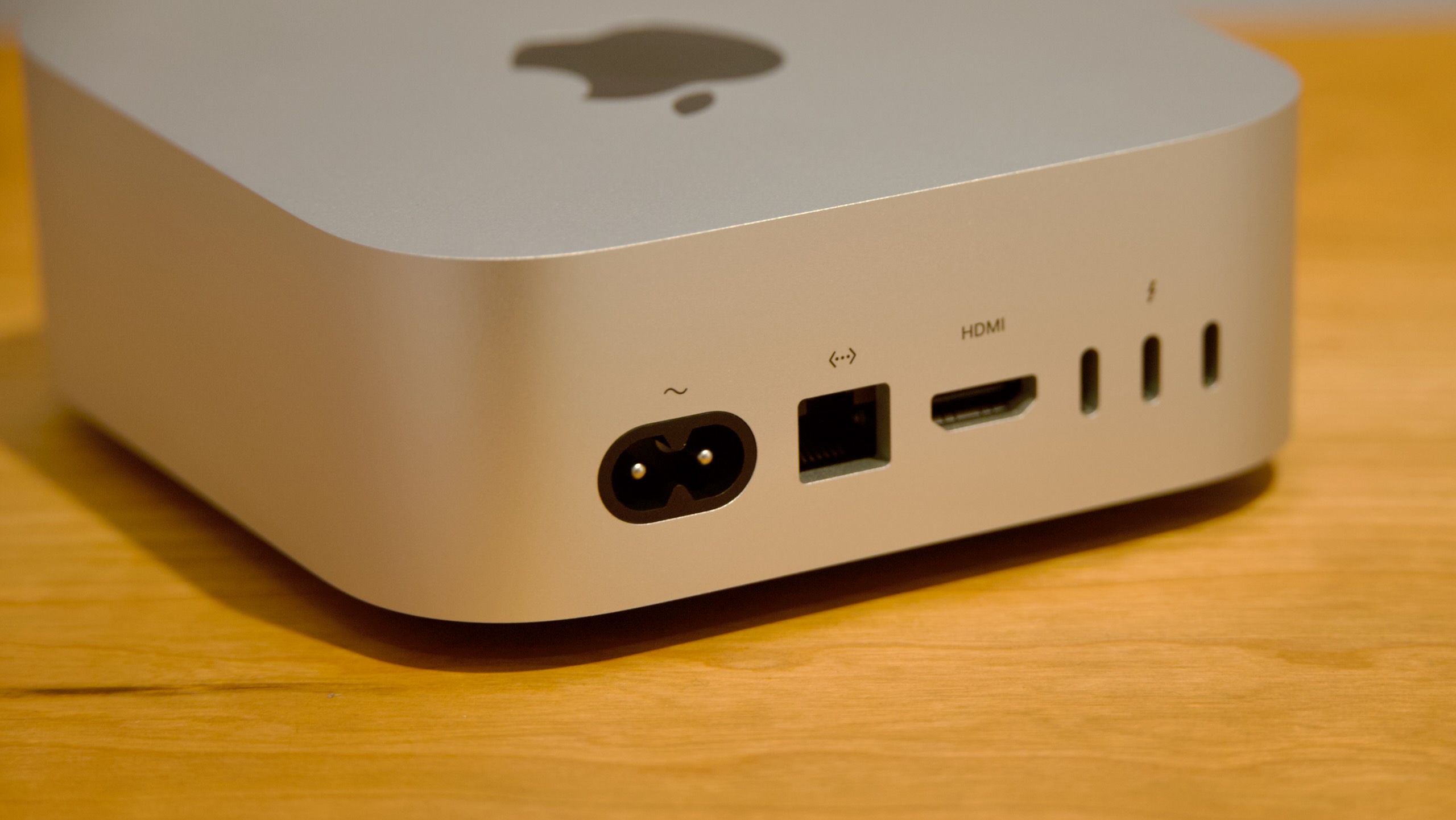
All Mac minis have two 10 Gbps USB-C ports and a headphone jack on the front, and a 2.5 Gbps (default) or 10 Gbps (optional) Ethernet port and HDMI port on the back. Both also have three Thunderbolt ports on the back, but these are Thunderbolt 4 on the M6 Mac mini and Thunderbolt 5 on the M5 Pro version. That means the M6 mini’s ports top out at 40 Gbps, while the M5 Pro mini supports up to 120 Gbps speeds.

The Mac mini’s ports. No USB-A, but otherwise not bad for a system this small.

The Mac mini’s ports. No USB-A, but otherwise not bad for a system this small. Credit: Andrew Cunningham

Realistically, there aren’t a ton of things on a Mac that can use all that bandwidth, especially since Apple doesn’t support external GPUs. But you do need a Thunderbolt 5 Mac to daisy-chain multiple computers together to form a compute cluster, so if that’s something you’re interested in, keep it in mind when you buy—maybe you’re buying multiple desktops, or maybe you already have an M5 Pro or M5 Max MacBook Pro you’d like to test the feature with.

The only real gripe with this design continues to be its bottom-rear-mounted power button; apparently, complaints about this are being sent to the same trash can Apple has always used for complaints about the Magic Mouse’s bottom-mounted charging port. It doesn’t come up often in everyday use if you just let your Mac go to sleep rather than shutting it down. But the positioning problem does really call attention to itself when you pair a TouchID-equipped external keyboard with the mini, since it requires a quick double-tap of the Mac’s power button before the sensor will work.

Meet the M6

Apple’s first M6-series chip is making its debut in the humble Mac mini, and the chip looks like the biggest upgrade Apple’s lower-end chip has gotten since the M4 generation added extra efficiency cores.

The headliner is the presence of two of Apple’s so-called “Super” cores, Apple’s nomenclature for P-cores that are even faster than its typical P-cores. Those are added on top of four P-cores and six E-cores for a total of 12 CPU cores. M4 and M5 both had 10 CPU cores. In the M4, these were split between four regular P-cores and six E-cores, whereas the M5 split them between four super cores and six E-cores (the M5’s cores were referred to as P-cores when it launched but were rebranded later when the M5 Pro and Max came out). The M1, M2, and M3 generations all used four P-cores and four E-cores.

The M6 has fewer super cores than the M5 but the same number of E-cores and four additional P-cores. While they’re apparently no longer “super,” the P-cores still perform well enough to ensure that the M6’s multi-core performance is better than M5’s overall.

CPU S/P/E-cores GPU cores RAM options Display support (including internal) Memory bandwidth
Apple M6  2S/4P/6E 12 16/24/32GB Up to three 153GB/s (16GB), 170GB/s (24GB/32GB)
Apple M5  4S/6E 10 16/24/32GB Up to three 153GB/s
Apple M4  4P/6E 10 16/24/32GB Up to three 120GB/s
Apple M3  4P/4E 10 8/16/24GB Up to two 102.4GB/s
Apple M2  4P/4E 10 8/16/24GB Up to two (one external) 102.4GB/s
Apple M1 4P/4E 8 8/16GB Up to two (one external) 68.25GB/s (est.)

Apple has mixed super cores with both other kinds of cores before, but this is its first chip to include all three kinds at once. To get around the awkwardness this might create at the CPU scheduler level, the built-in powermetrics tool suggests that Apple is still treating the M6 like a chip with just two types of cores. The six E-cores are all gathered together in one cluster, and the two Super cores and the four P-cores are all lumped together into a second six-core cluster called the “PS cluster.”

Powermetrics also reports that both the P- and S-cores have the same peak and minimum clock speeds, unlike in the M5 Pro and M5 Max where they’re different clusters with different clock speeds (both P- and S-cores in M6 range from 1.44 GHz to 4.79 GHz). The sysctl utility also suggests they share the same 20MB pool of L2 cache, up from 16MB for the 4-core Super cluster in the M5 (the E-core cluster has a bit more L2 cache, too, 8MB up from 6MB in the M5). The Super cores do have more L1 instruction and data cache, so they are definitely still different cores, and there are likely other differences that we can’t detect using software-level tools. But if you were wondering how macOS was going to treat a chip with three different kinds of CPU cores at a software level, the answer is “to act like it still has two different kinds of cores.”

L1 instruction cache L1 data cache L2 cache Minimum clock Maximum clock
M6 E-core 160KB 128KB 8MB shared between 6-core cluster 1,010 MHz 2,908 MHz
M6 P-core 128KB 64KB 20MB split between P- and S-cores 1,440 MHz 4,788 MHz
M6 Super core 192KB 96KB 20MB split between P- and S-cores 1,440 MHz 4,788 MHz

The M6 gets additional GPU cores for the first time since the M2, increasing the count from 10 cores to 12. These cores include improved versions of the integrated neural accelerators Apple introduced in the M5-series GPU for speeding up AI and machine-learning workloads like ray-tracing and MetalFX upscaling. A “Dual 16-core Neural Engine” also bumps the number of Neural Engine cores from 16 to 32. Saying you have 2×16 of something strikes me as a roundabout way of saying you have 32 of something, but I suppose the end result is the same either way.

One small wrinkle in the M6 variants the Mac mini uses: The basic 16GB Mac mini offers 153 GB/s of memory bandwidth, the same amount as the M5. The 24GB and 32GB versions offer 170 GB/s, an 11 percent increase that should marginally improve graphics performance and the speed of any local AI models you run on this machine. Our review unit is the 24GB version.

What of the M6 Pro, M6 Max, or M6 Ultra? If the rumors are true, the M6 could end up being a lonely chip.

Bloomberg’s Mark Gurman reports that Apple isn’t planning a full M6 chip generation and that it could skip directly to M7 branding for the Pro, Max, and Ultra chips. That would be a first for the company, which skipped shipping an M4 Ultra but has otherwise shipped a baseline, Pro, and Max-series chip in each generation so far.

But it makes sense for a couple of reasons. The first is that most of the M6’s gains can be attributed to its extra CPU and GPU cores relative to the M5, and the M5 Pro, M5 Max, and M5 Ultra all obviously still have more of both kinds of cores than the M6 does. The second is that it’s still pretty early for TSMC’s 2 nm process, following three generations where Apple used versions of TSMC’s 3 nm process, and Apple is probably fighting with every other fabless chipmaker on Earth to reserve capacity. Apple could be sticking with smaller, simpler 2 nm chips for now and saving its bigger and more complex chips for later, when capacity will be higher, yields will be better, and costs may be lower.

Performance

The new mini re-uses the launch strategy for last year’s Mac Studios, which used an M4 Max in the base model and an M3 Ultra in the top-tier configurations. The basic Mac mini uses the brand-new M6, while the semi-professional Mac mini tier gets the M5 Pro that we saw in MacBook Pros back in the spring.

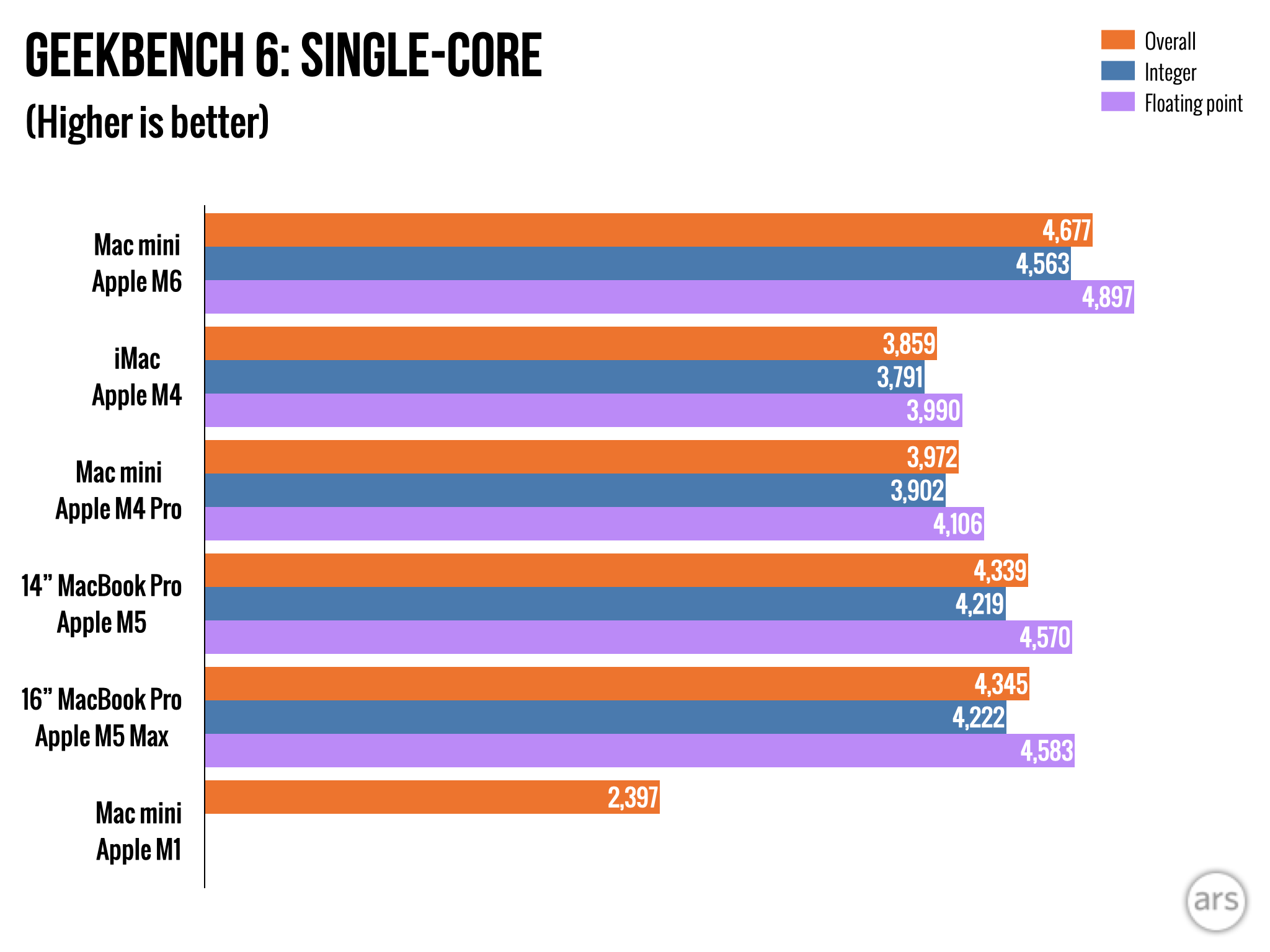
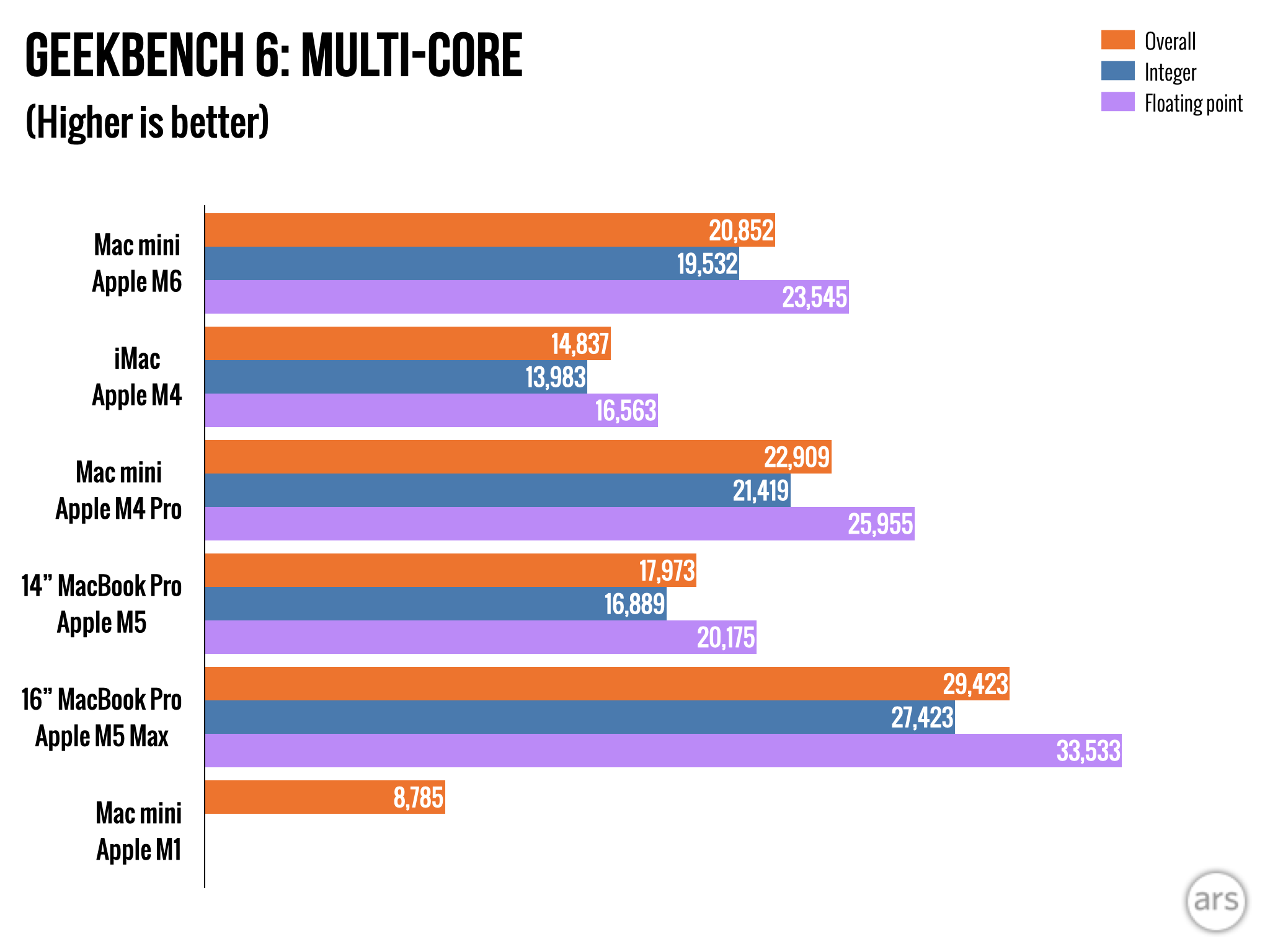
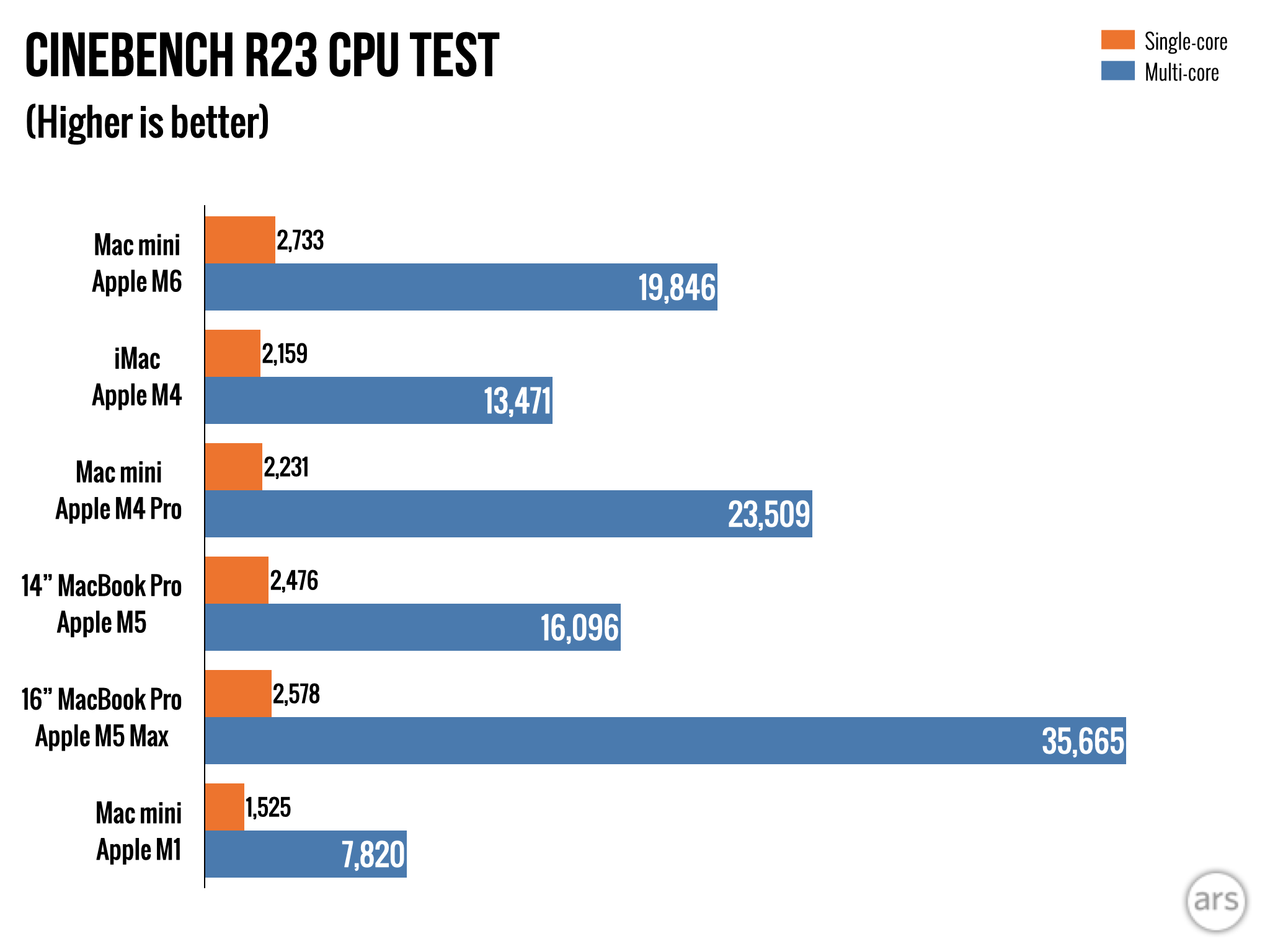
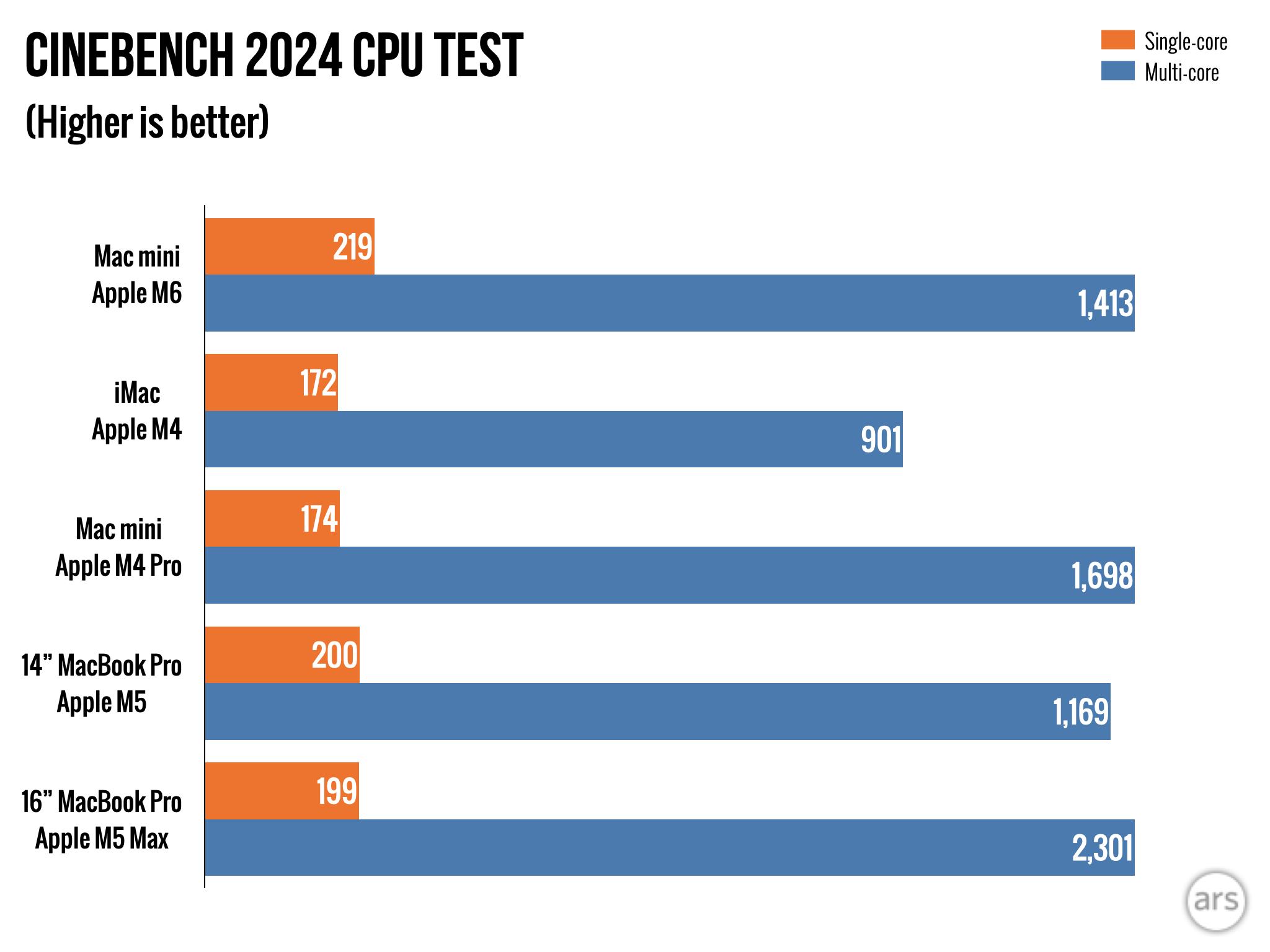
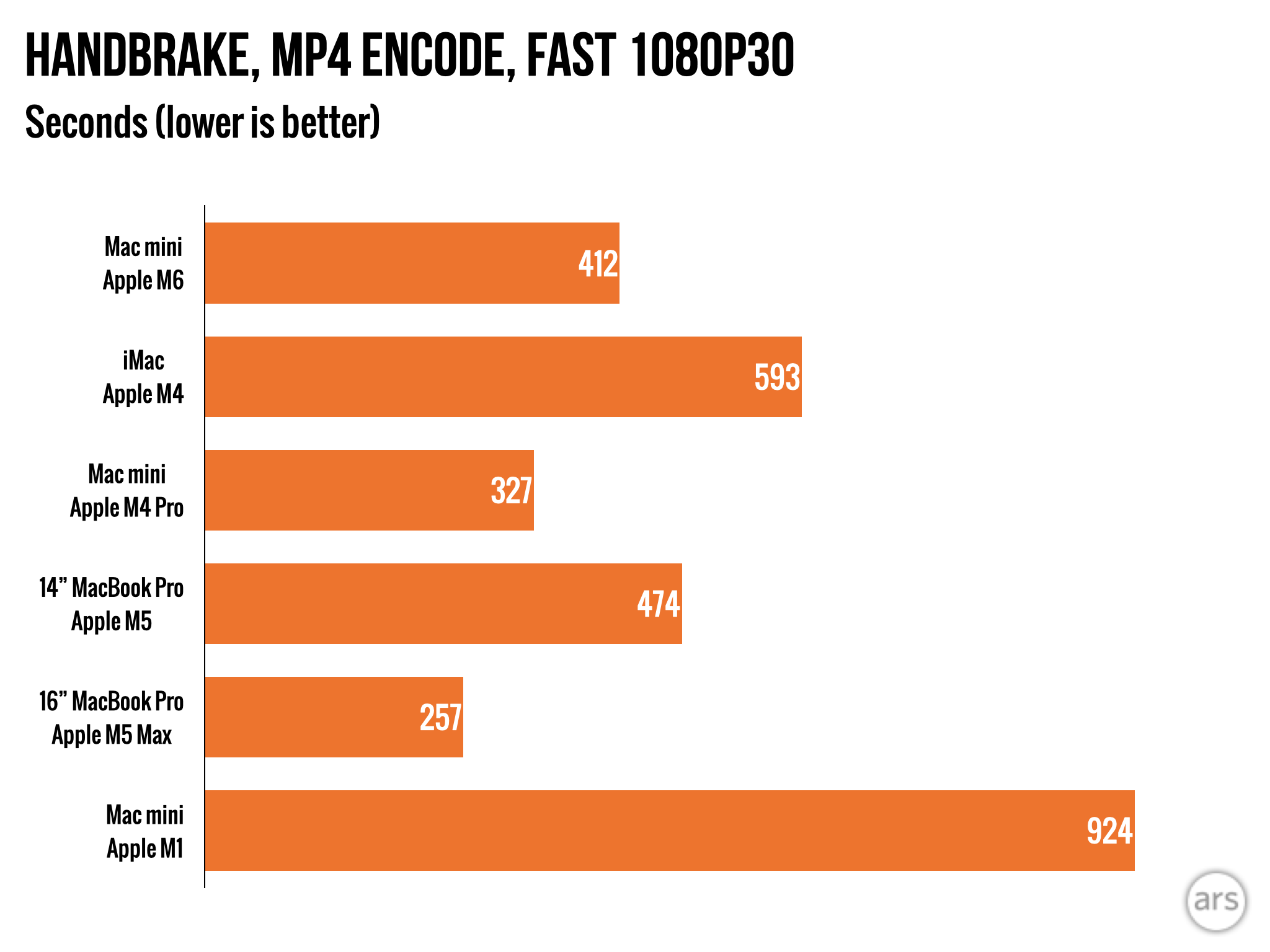
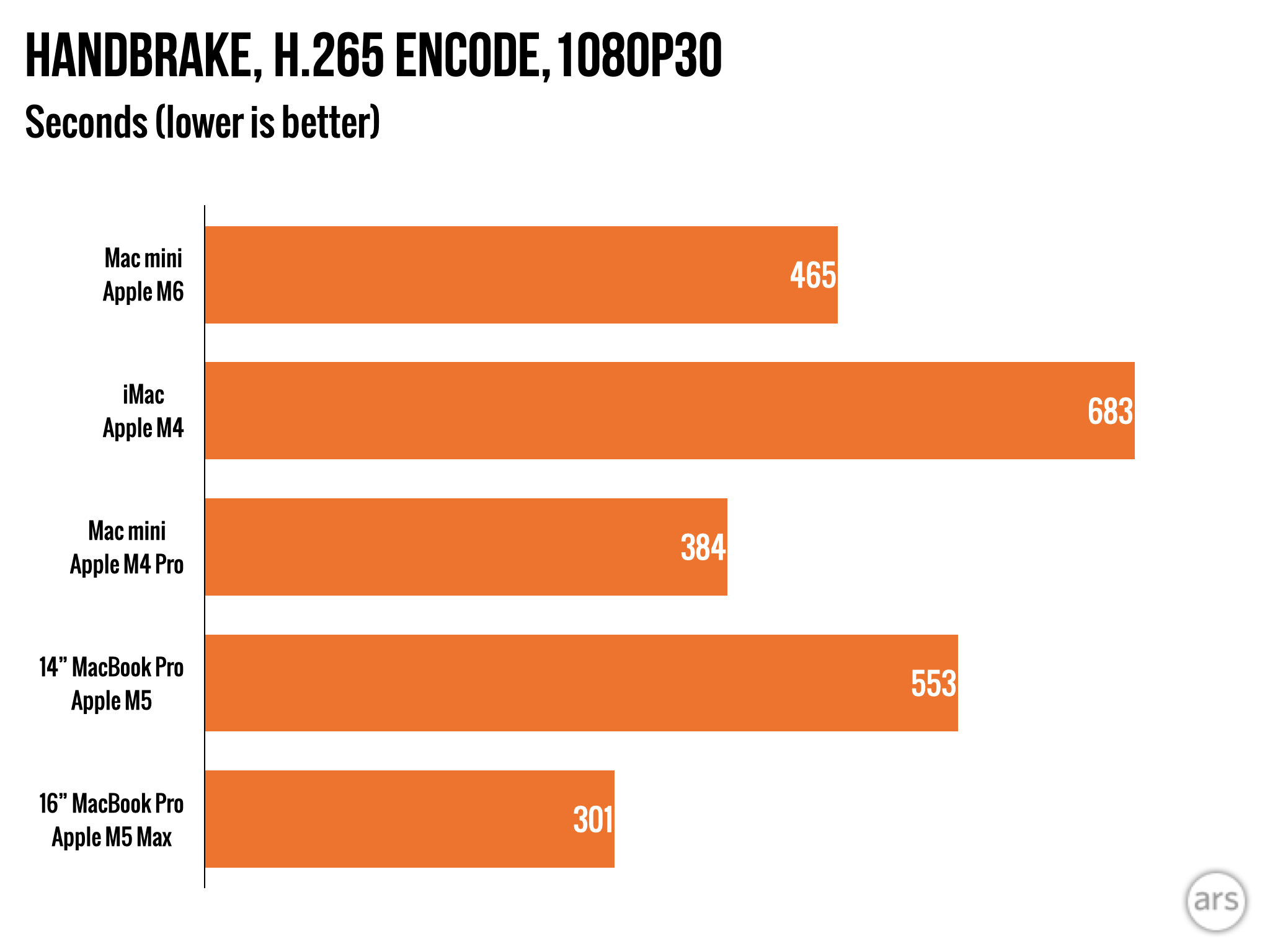
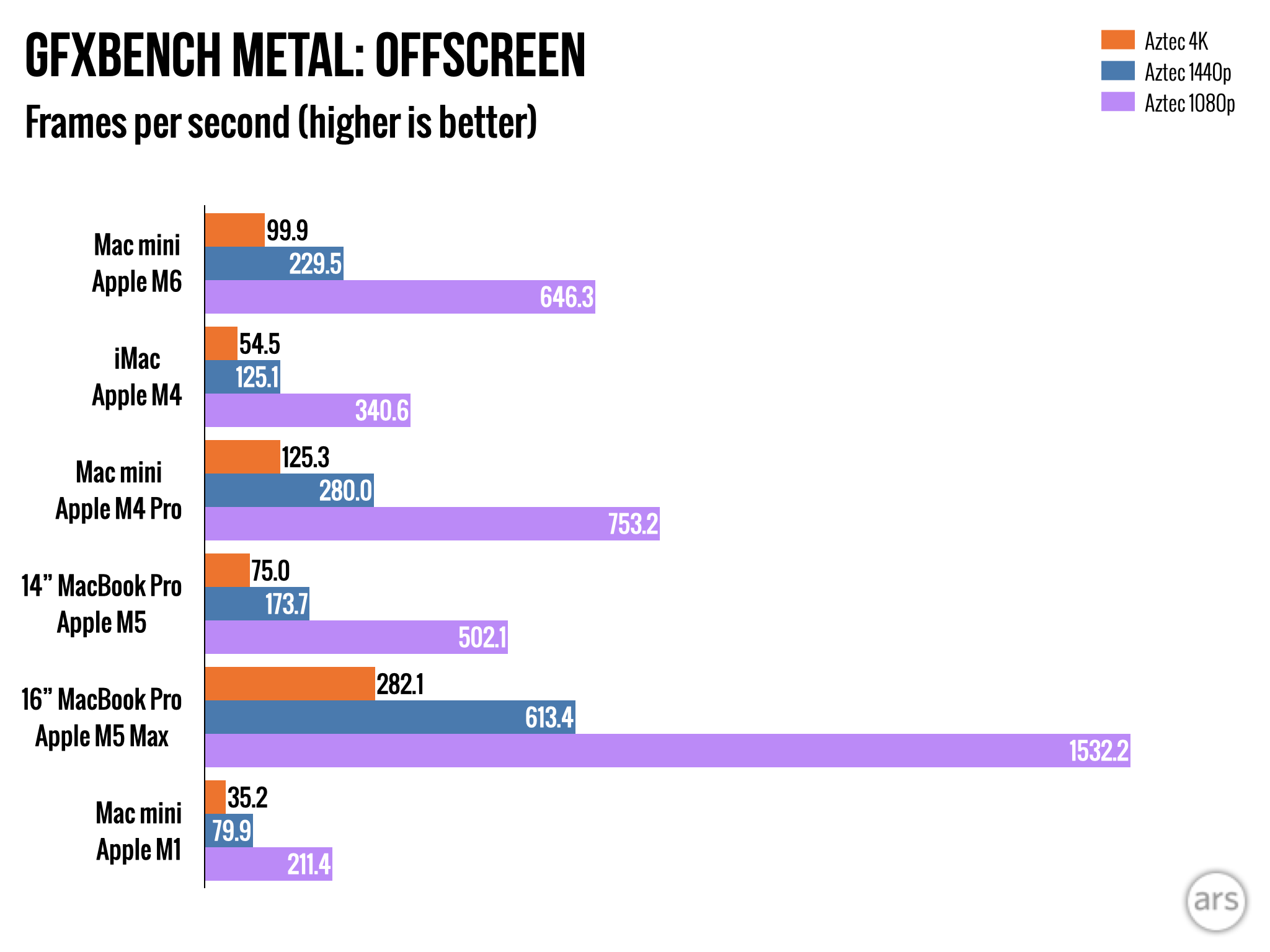
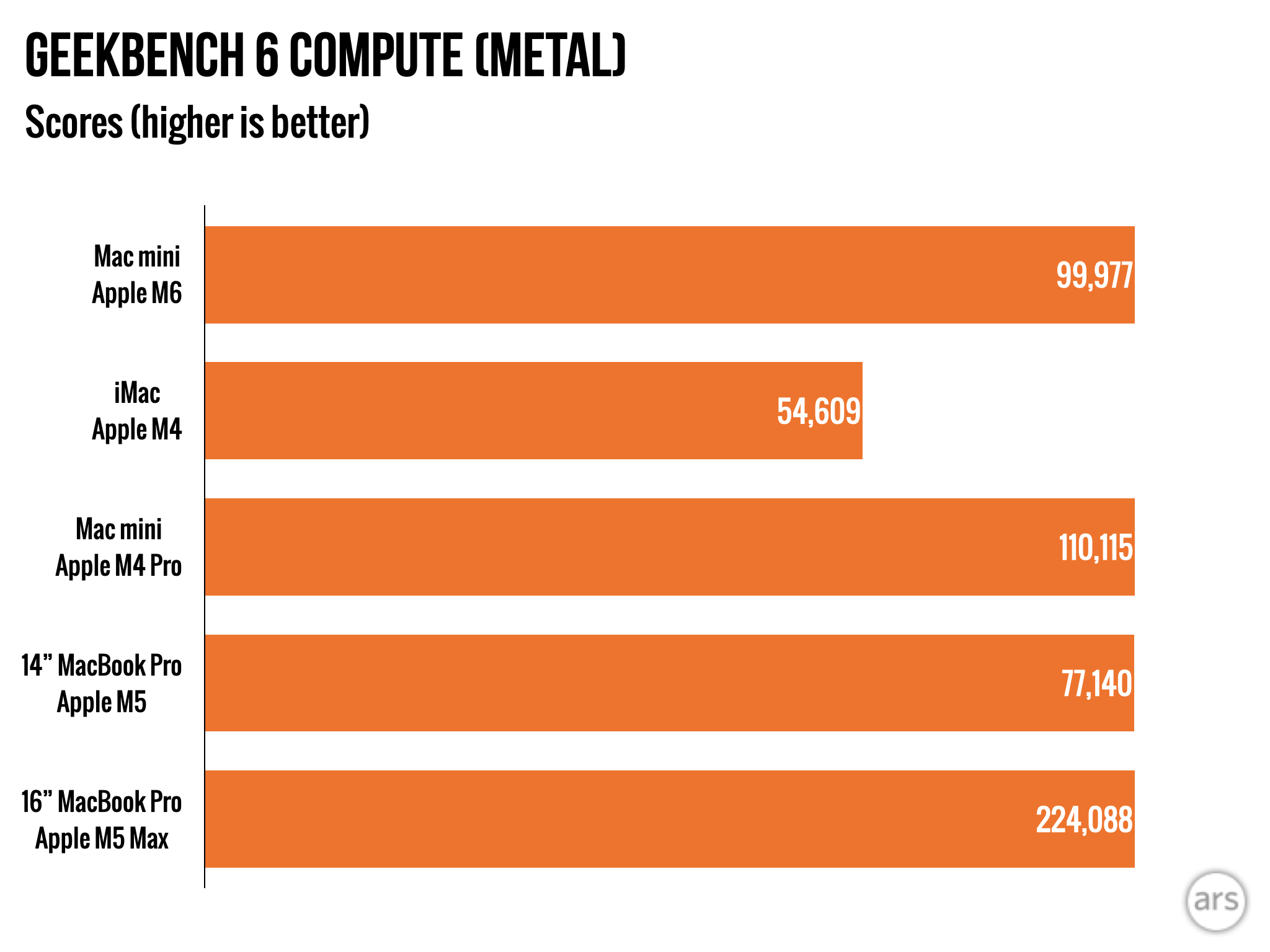
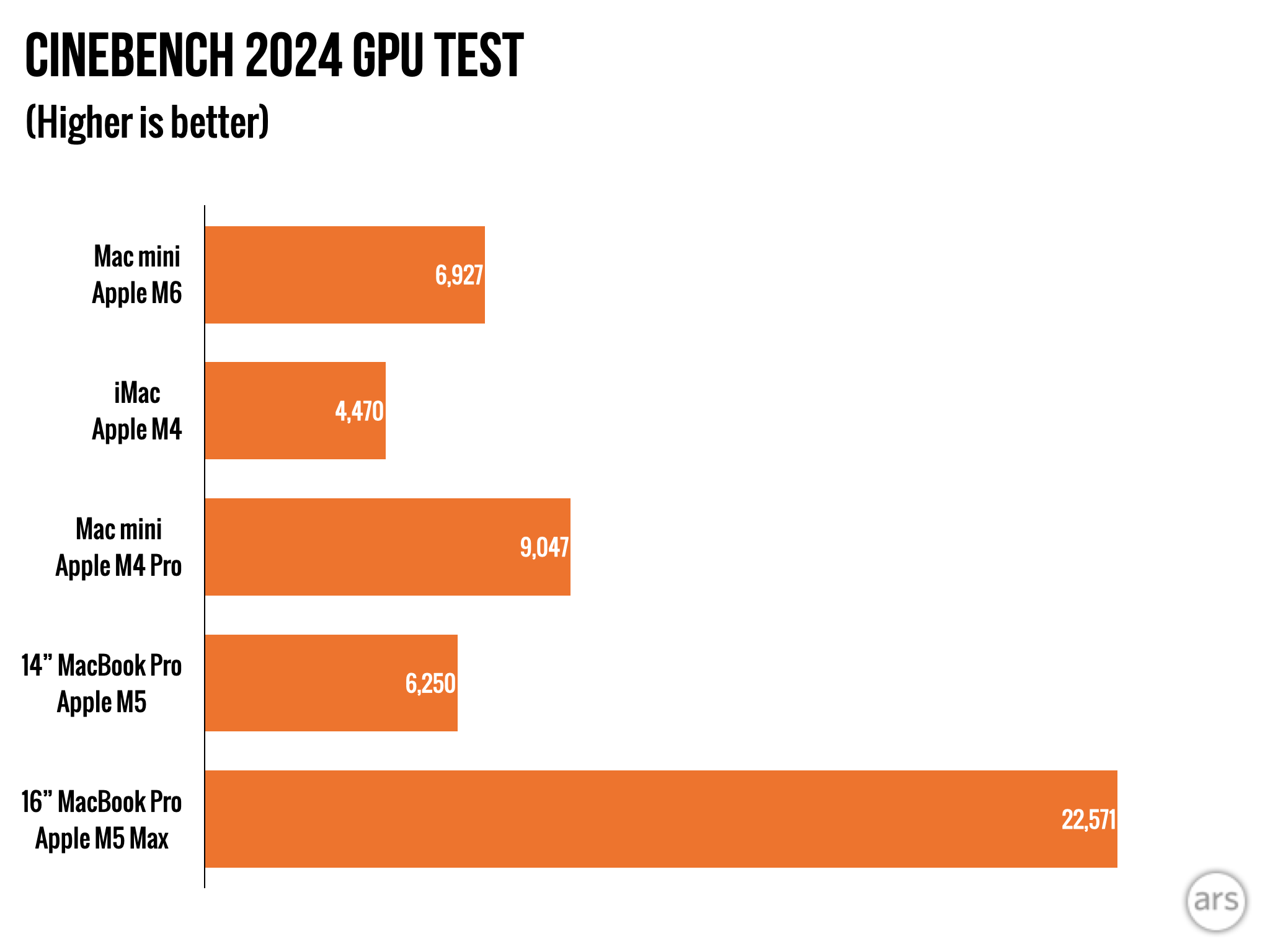
This means the M6 mini has newer tech than the more-expensive M5 Pro mini—and marginally better single-core CPU performance, too. The M6’s single-core is roughly 8 to 10 percent faster than the M5 family’s in our benchmarks; graphics performance is also up by roughly 10 percent. In multi-core CPU benchmarks, the M6’s performance is roughly 20 percent faster than the M5.

But for heavy multi-core performance, having more cores is still more important than using the newest cores. The M5 Max (which uses the same 18-core CPU block as the M5 Pro, so it’s a decent stand-in) is still generally 60 or 70 percent faster than the M6 in our multi-core benchmarks.

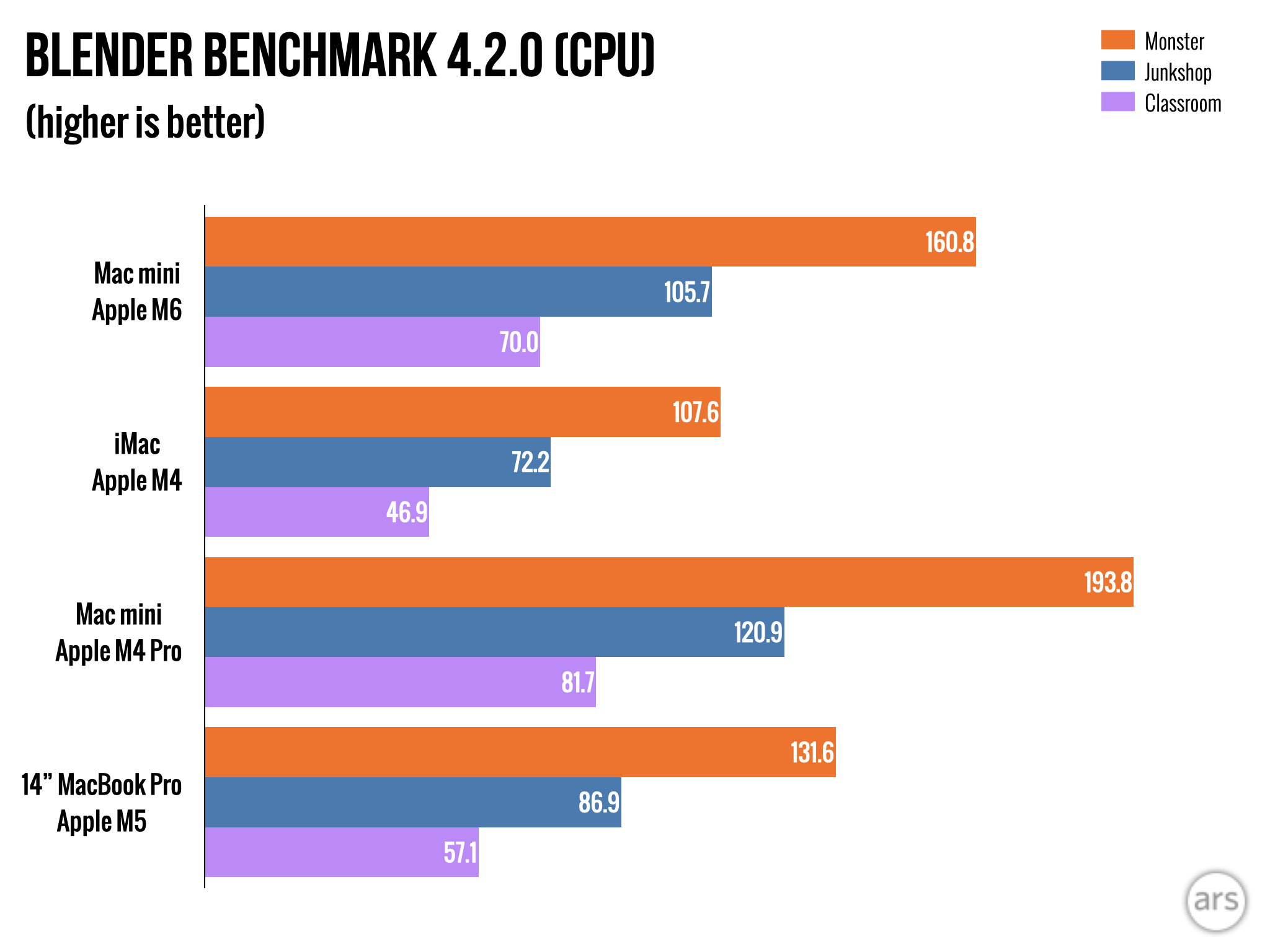
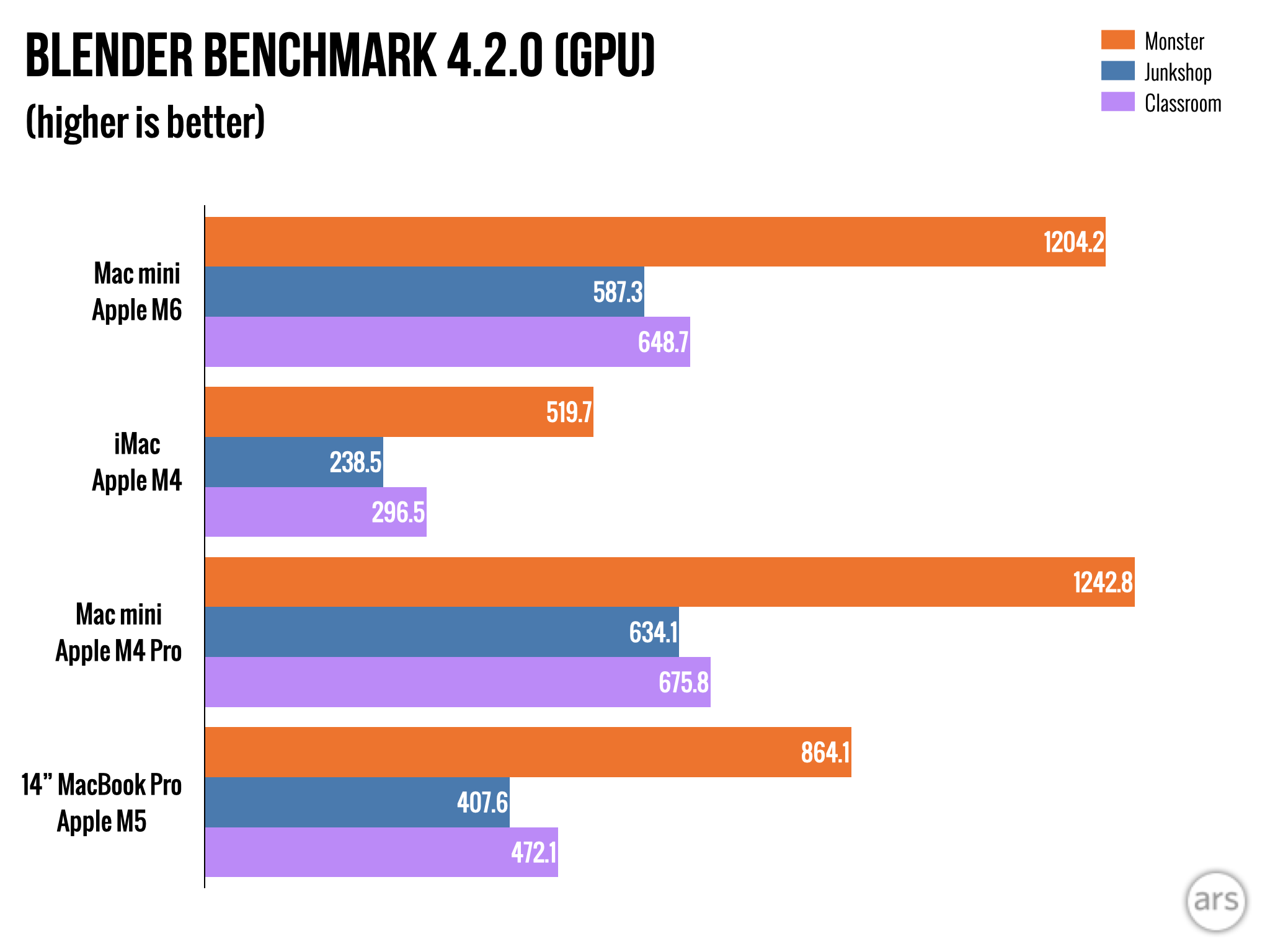
If you’re comparing the last-generation mini to this one, the upgrades over the M4 are pretty substantial. Single-core CPU performance improves by between 20 and 30 percent in most tests, while both graphics performance and multi-core CPU performance are up by between 50 and 80 percent—and occasionally even more, in some tests. The M6 does nearly as well as the M4 Pro in the Blender benchmark and beats the M5 by around 40 percent, again suggesting that this benchmark in particular is benefiting from the GPU cores’ built-in Neural Accelerators.

Usually at this point we would talk about the chip’s estimated power consumption using the powermetrics tool, a built-in utility that gives clock speed and power consumption data for the CPU and GPU cores in Macs. This is a software-based reporting tool, which makes it imperfect for comparisons between chip generations. But it does at least give us some vague estimate of Apple’s power efficiency.

For the M6, powermetrics doesn’t actually report CPU power levels. It appears in the tool’s logs, but the value is always “0.” I’ve asked Apple whether this is a bug or an intentional behavior change (it still works fine for M5-generation chips), and I’ll update this if I get a response.

About that price

The $599 M4 Mac mini was a tiny, affordable desktop computer with as much speed and memory as most people need for general-purpose computing. You could quibble with the 256GB base storage, but it was still the most usable the basic Mac mini had ever been.

The M6 mini’s $899 starting price sets us way back. That’s a $300 increase in just under two years for a computer that has a faster chip in it but otherwise shares the key specs and most of the capabilities.

One could argue that this merely resets Mac mini pricing back to where it was circa 2020. A base M1 Mac mini cost $699 to start, and upgrading to 16GB of RAM added another $200. It just feels like a big step back, given how great the M4 mini was.

If you need a desktop computer right now for anything from basic browsing to less-intensive local AI models, this is still Apple’s most affordable computer (chatbots and image generation should run pretty well on it; more intensive coding-centric models will be a bit squeezed for RAM and memory bandwidth, even at 32GB). And even the $599 M4 mini was undercut by the kind of lowest-common-denominator cheap mini PCs you could get on Amazon. It’s just hard to swallow the current price, given how much better it was not all that long ago.

The good

  • An impressively fast and quiet little computer that can fill roles from “entry-level desktop” to “midrange coding and video editing rig.”
  • M6 is a big step up for Apple’s entry-level chip, with more CPU and GPU cores and other improvements.
  • Large improvements over the M4 mini, thanks to a two-generation silicon jump.

The bad

  • Zero upgradability, aside from what you can add with external accessories. What you buy is what you have until you buy the next thing.
  • 256GB of storage in the base model is low, especially if you want to play games or run any kind of AI models locally.
  • Power button on the bottom is mildly inconvenient on the occasions you have to interact with it.
  • M6 version can’t be daisy-chained together with Thunderbolt 5 to join a compute cluster.

The ugly

  • The memory crisis means we can’t have nice things unless we’re willing to pay out the nose for them.
0FansLike
0FollowersFollow
0FollowersFollow
0SubscribersSubscribe
- Advertisement -
Google search engine

Recent Posts