Highlights from Von der Leyen’s State of the Union: Pushes Security Pact, AI Caution and Closer Canada Ties
European Commission President Ursula von der Leyen called on Wednesday for EU states to form a new partnership with Canada and tackle climate change, competition from China and other major challenges in “an openly hostile world”.
Von der Leyen covered a large range of topics in a 73-minute annual “state of the union” address to the European Parliament in Strasbourg, leading off with the opening line from Charles Dickens’ Tales of Two Cities, which she said was also described the world today. “It was the best of times, it was the worst of times”.
CANADA
Von der Leyen said the EU was opening the door to Canada becoming the first “associate member” of the 27-nation bloc, a status that is not set out in EU treaties.
Canada and the EU stood together in defence of Ukraine, and believed in democracy and that power does not belong to “the strongest, the richest or the loudest”.
The EU’s relationship with Canada should rise to the highest level possible, with cooperation on economic security, intelligent manufacturing, tech, defence industries, the Arctic, energy, critical minerals, batteries, quantum and cyber security.
CHINA
Von der Leyen described the EU goods trade deficit with of €1 billion per day as “unsustainable” and said a tipping point had been reached.
She said dialogue with Beijing must produce results and that it was in both sides’ interest to find a solution.
“Let me be clear: we will use all the tools at our disposal to rebalance our relationship. Words are good. But deeds are better,” she said. She added the EU would establish a European Corporation on critical raw materials to help obtain and stockpile supplies.
CLIMATE
In response to a summer of heatwaves and wildfires, the EU will launch a “climate insurance alliance” aimed at increasing insurance cover for extreme weather events, von der Leyen said.
“Today, only around 25% of catastrophe losses in Europe are covered by private insurance. This means that, far too often, national budgets become the insurer of last resort. We need to take action to close this gap,” she said.
The European Commission will also present a European Heatwave Plan with early warning systems and health preparedness, along with a water initiative to address leakage, improve risk management and address the insurance gap. For wildfires, von der Leyen also proposed a future European firefighting fleet.
AI
Von der Leyen backed calls by leading U.S. artificial intelligence labs for a slowdown in the development of the technology.
“As the frontier models become more capable, these risks have come more sharply into focus. Models being developed will allow hacking on a level we never thought possible. And they will soon be in the hands of adversaries who see the world very differently from us,” von der Leyen told EU lawmakers.
“CEOs of the most advanced companies tell us that it is time to slow down on the self-recursive models. To pace the frontier. If the people developing the technology are clear, then we should be too,” she said.
Von der Leyen also said the EU should step up work on establishing guardrails with like-minded partners such as Britain and Canada.
SOCIAL MEDIA
The European Commission will propose on Thursday a ban on social media access for children under the age of 13 and “mini accounts’ supervised by parents, with limited features and time restrictions until a child turns 15.
UKRAINE/SECURITY
Von der Leyen pledged that the EU would gives its “strongest-ever support” to Ukraine over the forthcoming winter, which she forecast would be the toughest of the war triggered by Russia’s invasion.
She said the EU would provide humanitarian aid and reinforce supplies of power and heating and would strengthen Ukraine’s air defences.
The European Commission chief also proposed a European Security Council that could bring together the EU and partners such as Britain, Canada and Norway and establish an ’emergency security protocol’ to allow EU members to trigger discussions to respond to crises.
MIGRATION
The European Commission will propose an emergency response system to react to sudden massive inflows of migrants.
“Europe needs the means to protect its borders at all times. Especially in scenarios when mass movements are engineered and weaponised. This is why we will propose a new European Emergency Response Framework,” she said.
The framework would only a be triggered under strictly defined criteria and offer time-limited flexibility to affected countries.
Iran threat to cut Hormuz undersea cables puts Gulf on edge
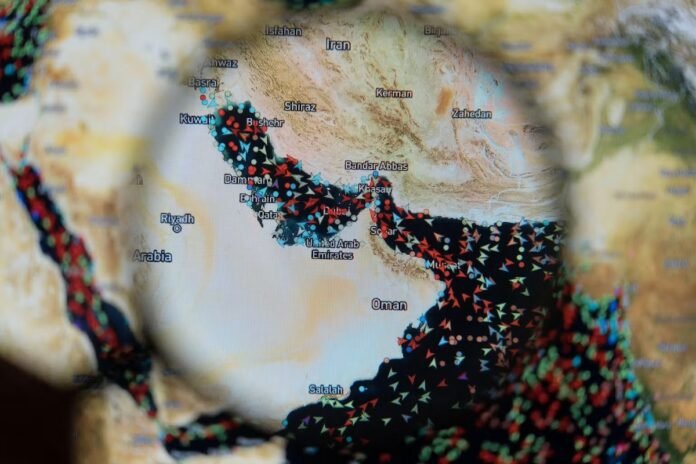
The conflict between Iran and the US appears to have reached a stalemate. The US Navy continues to prevent Iranian vessels and others from transiting to or from Iranian ports. Iran, meanwhile, threatens shipping moving in or out of the Persian Gulf region via the Strait of Hormuz.
Iran has also recently said it will establish a new “restricted zone” stretching into the Gulf from the Strait of Hormuz – although details remain sketchy. Less frequently discussed is the network of undersea cables across the Persian Gulf, which connect the region with the outside world.
On August 16, the Wall Street Journal reported that the Iranian government was considering attacks on that network. In the Gulf’s relatively shallow waters, threats to this critical undersea infrastructure (CUI) pose a credible risk to the Gulf States and the wider world.
These cables form a largely unseen foundation of the global economy, carrying more than 95% of international data traffic. Their role extends far beyond everyday internet and call usage. They support financial transactions, government communications and the increasingly data-intensive operations of the global technology sector.
Major technology companies such as Google, Amazon, Meta and Microsoft are investing heavily in subsea connectivity as they expand data-centre networks and seek to meet the growing demands of AI.
For the Gulf States, where hundreds of billions of dollars are being invested in AI as part of efforts to diversify economies away from fossil fuels, disruption to this infrastructure could therefore have consequences far beyond communications. Cutting these CUI cables threatens a key element of their broader economic ambitions.
To demonstrate the scale of this risk, the key cable networks include the Fibre in Gulf submarine cable system, which connects Bahrain, Iraq, Kuwait Oman, Qatar, Saudi Arabia and UAE. There is also the Falcon Network, which connects Bahrain, Egypt, India, Iraq, Kuwait, Maldives, Oman, Qatar, Saudi Arabia, Sri Lanka, Sudan and Yemen.
The Asia-Africa-Europe1 (AEE1) network, with landing sites in Oman, Qatar, Saudi Arabia and UAE, linking southeast Asia to Europe via Egypt. And the Gulf Bridge International, which links Bahrain, Iran, Iraq, Kuwait, Oman, Qatar, Saudi Arabia, UAE, and has onward connectivity to India and Europe.
Key undersea internet calbes are vulnerale to disruption in the Persian Gulf and Strait of Hormuz. TeleGeography, CC BY-NC-SA
With that web of connections funnelled through the Strait of Hormuz, an international waterway that has long been of strategic importance for oil and gas has taken on a new significance as a choke point for global undersea infrastructure.
What makes the Strait of Hormuz and the rest of the Gulf region particularly vulnerable to an attack on the CUI is the shallow water. With an average depth of 50 meters and a maximum depth of less than 100 meters, those who might wish to attack the CUI network do not need the sort of high-end capabilities of Russia’s Gugi agency. Gugi, which is the Russian acronym for the Main Directorate of Deep Sea Research, is responsible for underwater sabotage and espionage.
Remotely operated vehicles (ROV) with working depths of thousands of metres are commonplace in the oil and gas industry. There are growing numbers of autonomous underwater vehicles (AUV) with similar operating parameters in that field. Both can be repurposed and used for offensive operations.
Iran has already debuted its own mine clearance ROV, and there may be other capabilities which it has not chosen to publicize. The shallowness of the Persian Gulf puts most of it well within the depths military divers are able to operate. We could also see the sort of blunt threat posed by a ship “accidentally” dragging its anchor to cut cables in the manner we have witnessed in the Baltic.
So it’s entirely feasible that Iran could conduct attacks against the CUI network. And the threat has already affected planned extensions or new elements of this undersea infrastructure. Several projects have been put on hold after their owners or contractors declared they can’t safely operate in the Gulf.
This neatly illustrates the impact of conflict on the ability to maintain and extend the cables carrying so much of the world’s trade and communication. In the context of the Middle East, that will have a direct impact on the ambitions of Gulf States to become AI-enabled economies.
Iran clearly appreciates the strategic and operational significance of the regional CUI network and will have put significant effort into mapping it. It is also reasonable to assume that it will have a trained force of divers able to operate at depths that would enable them to reach the cables across the Persian Gulf seabed.
We know that they have an ROV designed for mine clearance operations – and it’s highly likely operate other assets in support of a well-developed offshore oil industry.
How far would Iran go?
The most important question is what would the Iranians be prepared to do?
An attack on the cable network could create a very significant impact on trade and communications across the Middle East, with global ramifications. Such an attack would need to be targeted and limited if Iran wished to avoid global condemnation. But it’s a risk they may be willing to take given their current isolation.
That “maybe-they-would” doubt leads us to consider a new form of deterrence – of one nation’s ability to affect either CUI of another, or of broader networks.
It’s something of an extension of Nixon’s madman theory of nuclear deterrence. A nation that is desperate enough could be willing to take extreme action in the CUI domain – with what might appear to a rational observer to be disproportionate regional and potentially global consequences – in order to deter more traditional military strikes against it.
To a certain extent, this should come as no surprise. The CUI network is the cyber age equivalent of the roads, bridges and rail systems which have long been targets for military planners seeking to disrupt an opponent’s ability and willingness to fight.
Iran’s capacity and desire to conduct this sort of operation may be uncertain – but that very ambiguity may prove enough to have a significant impact on the region.
Aoun, King Abdullah To Join Macron for Paris Talks on Post-UNIFIL Security
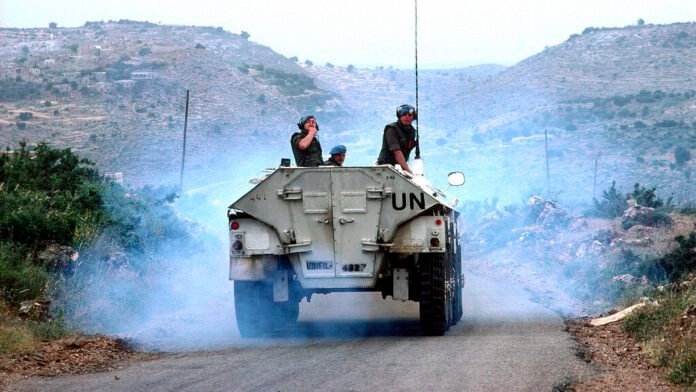
Lebanese President Joseph Aoun and Jordan’s King Abdullah II are set to join French President Emmanuel Macron in Paris Thursday for talks aimed at strengthening the Lebanese Armed Forces and shaping an international security presence in southern Lebanon after the United Nations peacekeeping mission ends.
The meeting will bring together senior military officials from Lebanon, Jordan, France, the UK and other countries, with US participation also expected. The talks are being held under the Aqaba Process, a security initiative launched by King Abdullah in 2015.
The Abu Dhabi-based English-language newspaper The National reported Wednesday that France and Italy are leading work on a possible multinational successor to the United Nations Interim Force in Lebanon (UNIFIL), with about 10 European Union countries prepared to contribute training and advisory support. Details of the proposed mission, including its mandate and structure, remain under discussion.
Aoun, who arrived in Paris Wednesday, said the future of UNIFIL would be among the issues he would discuss with Macron, along with Israeli military operations in Lebanon and negotiations between Lebanon and Israel.
“The main thing is that there is no vacuum,” Aoun said in an interview with Agence France-Presse before leaving Beirut. He said any new international force should be temporary and remain until the Lebanese military can deploy fully.
UNIFIL was established in 1978 and expanded following the 2006 Israel-Hezbollah war. Its mandate is scheduled to end Dec. 31 after the United States and Israel pushed for the mission’s termination. The force currently has more than 7,500 peacekeepers in Lebanon.
France and Italy said in June that they would work toward an international coalition to support Lebanon following UNIFIL’s departure. Paris has also sought increased international assistance for the Lebanese military as Beirut attempts to extend state authority across the country and disarm Hezbollah.
Aoun said Wednesday that Lebanon remains committed to disarming Hezbollah without provoking an internal armed confrontation and wants an eventual security agreement with Israel.
It’s OK to tell ICE their actions will haunt them, judge rules in speech fight
It’s not illegal to send an email telling Immigration and Customs Enforcement (ICE) officials that their actions will haunt them, a federal judge ruled Tuesday, granting a preliminary injunction that blocks ICE from threatening to prosecute a critic for protected speech.
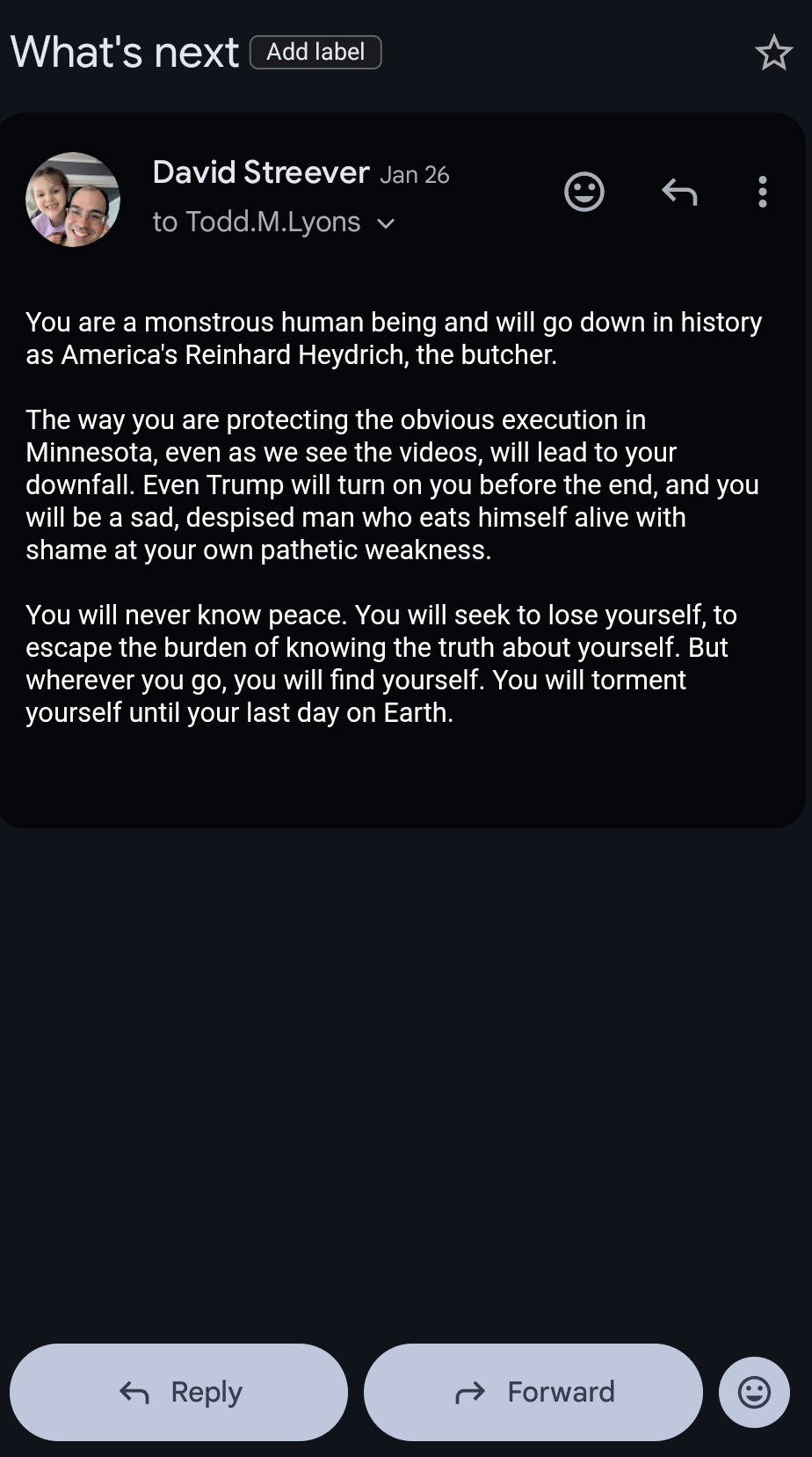
Back in January, David Streever sent a scathing three-paragraph email to then-acting director of ICE, Todd Lyons. Outraged by the killings of two Minnesota protestors against ICE, Renee Good and Alex Pretti, Streever told Lyons that he was a “monstrous human being” who will eat himself “alive with shame” for defending officers who shot people who posed no threat and had no weapons. Comparing Lyons to an infamous high-ranking Nazi cop, Streever predicted that “even Trump” would one day turn on Lyons for defending the “obvious” slayings of Americans.
David Streever’s email to ICE.
Credit: via FIRE
David Streever’s email to ICE. Credit: via FIRE
“You are a monstrous human being and will go down in history as America’s Reinhard Heydrich, the butcher,” Streever wrote. “You will never know peace. You will seek to lose yourself, to escape the burden of knowing the truth about yourself. But wherever you go, you will find yourself. You will torment yourself until your last day on Earth.”
ICE did nothing when the email was received, but five months later, the agency served a warning notice at Streever’s home that claimed his note may have constituted a criminal threat of violence.
Those warnings are normally issued to people threatening to assault, kidnap, or murder officials, not morally condemn their actions. But ICE held Streever’s email to the same bar, warning that if he did not “discontinue” speaking critically of ICE leadership, he risked state and federal prosecution.
Because Streever wasn’t there at the time of their visit, agents took the extra step of tracking him down at a hotel. That “greatly alarmed” him, his lawyers at the Foundation for Individual Rights and Expression (FIRE) said in a press release. And he’s been self-censoring ever since, fearful of government retaliation.
“I’m deeply relieved”
At least for now, ICE apparently has conceded that Streever’s email was protected speech, US District Judge Rudolph Contreras wrote in his opinion.
Notably, ICE confirmed that the agency supposedly dropped the investigation within a month of sending the warning, but it never told Streever that his case was closed. Rather, an official Department of Homeland Security (DHS) account made a “somewhat contradictory statement” in an X post that Streever reasonably understood as confirming that the probe was still underway, Contreras said.
Moving forward, ICE still has to prove that the case was actually closed. Either way, though, the agency’s warning—which Contreras said “practically shouts” that Streever could be prosecuted for future political speech—remained in effect. That allowed the government to continue censoring Streever in likely violation of his First Amendment rights, Contreras wrote.
To avoid irreparable harm to Streever, Contreras ordered ICE to temporarily stop enforcing the warning notice, making good on the threats, or issuing similar threats while the case proceeds. Otherwise, Contreras found that Streever “faces a distinct possibility of prosecution for future speech,” especially since a DHS spokesperson has warned that “ANYONE who assaults or threatens our law enforcement officers will face the consequences.”
“I’m deeply relieved that the court affirmed what I knew all along: that I am permitted to speak my conscience in the United States of America, including when I criticize government officials,” Streever said. “While I wish this ordeal hadn’t happened, hopefully this incident will serve as a reminder that the First Amendment protects us all.”
ICE doesn’t contest email is protected speech
Ars could not immediately reach ICE for comment or to confirm if it plans to appeal the injunction.
During litigation, ICE wouldn’t explain who made the determination that Streever was potentially illegally threatening violence. Instead, ICE noted that the email came amid a reported “946 percent increase in threats against ICE officials” between 2024 and 2025. Ultimately, it was decided that “the email had potential threatening undertones to ICE personnel, potentially presenting a safety concern,” ICE claimed.
As the case moves forward, ICE will likely continue to argue that it needs to police critical emails like Streever’s “to protect the ability of law enforcement to investigate and deter criminal threats or crimes that follow less-than-criminal threats.”
However, Contreras emphasized that ICE’s lawyers “wisely do not contest that Mr. Streever’s January email constitutes protected expression or that similar speech would be protected.”
As Contreras explained:
Streever’s email addressed salient political decisions to a government official, an arena where the First Amendment’s speech protections reach their “zenith.” More importantly, the email does not contain a physical threat. The email registered displeasure with Acting Director Lyons’s official conduct, forecasted that the Acting Director will lose favor with the President, and warned that the moral weight of the Acting Director’s actions will haunt him in the future. Although Mr. Streever’s email was not kind, and may not have been particularly productive, it was a far cry from a “[t]rue threat[ ] of violence” sufficient for the email to shed its First Amendment protections.
As it stands, the agency must defend against both First Amendment coercion and retaliation claims.
ICE critic likely to win
Contreras found that Streever is likely “to succeed in proving that Defendants either tried to coerce him into abandoning his First Amendment rights or retaliated against him for his exercise of those rights.” Until that’s decided, the injunction ensures no further censorship can occur stemming from the ICE threat, the judge said, no matter how cutting Striver’s criticism may be.
“Streever’s injury is the loss of his freedom to engage in political speech now because the threat of such an investigation or prosecution looms over him like the sword of Damocles, and he is forced to self-censor under that threat,” Contreras wrote. Later on, he stressed that “Streever has a right to express his political views through non-threatening speech, however degrading the speech might be.”
For Streever, the injunction means he’s free to once again “engage in speech through off-the-cuff emails and comments on social media” that ICE may have previously tried to use against him, Contreras wrote. However, ICE could still potentially target him in a future investigation, as the injunction doesn’t cover all possible future probes into his protected speech. That’s likely troubling since Contreras noted that ICE had fought to substantially narrow the injunction in a way that might have allowed the agency to continue pursuing Streever by simply assigning another agent.
FIRE senior attorney Adam Steinbaugh told Ars there’s no indication yet that the government will appeal the injunction, which takes effect after 14 days. He celebrated his client’s win, saying that Contreras’ “decision is a strong protection for the First Amendment” and confirming that “we are confident the court’s careful analysis will hold up on appeal or after summary judgment.”
“Ominous letters warning people their speech might land them in prison are meant to coerce people into silence, and that’s not how the First Amendment works,” Steinbaugh said in a press release.
Streever has been clear that his hope is that his ICE fight will put an end to intimidation tactics that he believes are intended to silence protestors.
“I cherish our right to speak openly about issues of public concern,” Streever said in July as his free speech fight intensified and he felt forced to explain to his daughter that ICE might try to forcibly detain him. “I hope others will not be discouraged from peacefully expressing their views, even when those views are critical of the government.”
Any such undertaking would always have been fraught with potential traps. For the city’s first democratic socialist mayor, changes to criminal policy would have made Mamdani a prime target for conservative backlash. It’s a well-worn playbook: He would be blamed for any level of crime in the city. The mayor and his allies, even among them advocates hoping he’d go further to curb police abuse, understood the threat well.
Still, Mamdani had little trouble during his bombshell campaign convincing leftists that his sweeping vision for a socialist-governed metropolis included criminal policy reforms that would satiate them.
He promised to eliminate some of the most notorious of the New York Police Department’s institutions — a widely criticized gang database and infamous Strategic Response Group, which responds to protests and whose officers have histories of higher complaint rates. Mamdani outlined an ambitious vision to divert police away from responding to mental health crises, proposing an Office of Community Safety.
New data on how much the New York City is spending to pay for police misconduct, however, has heightened concerns among advocates that paltry rate of changes to policing under Mamdani could lead to even higher payouts in coming years. The first six months of the Mamdani administration saw $53 million in police misconduct settlements, according to an analysis of NYPD data by the public defense group Legal Aid Society.
If the figures continue to grow at that rate under Mamdani, it will make 2026 the fourth year in a row that police misconduct settlements top $100 million.
“We’re going to see these numbers continue to balloon absent a new course from the administration.”
The payouts under Mamdani so far cover conduct that took place under his predecessor Eric Adams’s administration, but criminal policy experts worry that, without major changes to policing, the new mayor will put the city on the hook for similar payouts in the future. That’s especially true if he maintains an approach to policing that they say is not all that different from the policies he campaigned against.
“What is concerning is that if we don’t see the kind of shift in tactics away from the kind of NYPD activity that has been driving these misconduct complaints and settlements, we’re going to see these numbers continue to balloon absent a new course from the administration,” said Michael Sisitzky, assistant policy director at the New York Civil Liberties Union.
More Broken Windows
The settlements represent the kinds of abuses of aggressive enforcement of “quality of life” policing and the deployment of specialized units like the Strategic Response Group that characterized the Adams administration, Sisitzky added.
“Those have yet to really be reined in under the Mamdani administration,” he said. “So, while he can’t be held directly responsible for all of the numbers reflected in this first tranche of data in terms of settlements payouts, we’re going to continue to see large volumes of complaints being filed, of settlements being reached, unless we see a change in tactics and a shift away from the kind of policing policies that drove these settlements in the first place.”
Even as Mamdani made campaign promises on policing, he went out of his way not to bash the NYPD or offer too much specificity about addressing the department’s biggest issues. During the election, that didn’t worry too many of his supporters. There was too much at stake for purity tests. Let him win first, many criminal justice advocates thought — and then they’d see what he could do.
The steps Mamdani has taken on criminal policy seem tailored to avoiding political pitfalls.
While, as mayor, Mamdani takes his biggest swings at the city’s billionaire class, the steps he has taken on criminal policy seem tailored to avoiding political pitfalls.
Along the way, he has notched small victories. He made progress on police body cameras and cutting down on low-level cycling offenses. Pushing to close the jails on Rikers Island, he has opened alternatives to jails and shut down a vacant one. Though he ended his pause on sweeps of encampments for the unhoused, he ordered that they be led by homeless service workers. And he installed the first permanent chair of the NYPD’s oversight body in six years.
Nine months into Mamdani’s first year in office, however, the NYPD itself has changed little.
Mamdani’s office declined to comment but provided background information on what it said were his criminal policy accomplishments, including a budget increase for a police oversight board.
“Deference to Tisch”
One of the things reform advocates were mostly able to set aside during Mamdani’s campaign was his pledge to keep on Adams’s police commissioner, Jessica Tisch.
The daughter of a prominent New York family of billionaires, Tisch was first appointed by Adams. With crime rates falling and her tenure at the NYPD winning plaudits from the likes of Donald Trump to the American Enterprise Institute, Mamdani pledged during his campaign to keep her on.
Widely viewed as a political play, the move alarmed many reformers, who voiced criticisms but held out hope that Mamdani’s proposals would at least start a long project of changing policing from the bottom up, despite Tisch’s perch at the top.
“There’s been a lot of backtracking on promises without any kind of affirmative vision for what policing could look like.”
With Tisch helming Mamdani’s NYPD, however, reformers’ fears have been borne out. The department has continued to pursue what Tisch describes as “quality of life” crimes — just the kinds of crime Mamdani campaigned on diverting police away from — and what reform advocates like Sisitzky say is a continuation of the failed “broken windows” policing fads of 1980s and ’90s. The strategy’s inherent focus on the most visible issues like panhandling, public urination, and sleeping on the subway effectively criminalizes poverty while letting violent crime and its root causes go largely untouched.
“The main critique is: There’s been a lot of backtracking on promises without any kind of affirmative vision for what policing could look like in his administration,” said Amanda Jack, director of policy for criminal law reform at the Legal Aid Society. “It has all been deference to Tisch.”
The NYPD’s focus on those “quality of life” offenses also looks little different from its approach under Adams. Data from the NYPD’s first quarter under Mamdani “was a continuation of broken windows policing, and, in some cases, an expansion,” Sisitzky said.
During his four years in office, Adams oversaw a surge in enforcement of low-level offenses. Mamdani’s first quarter in office saw more criminal summonses in that category than the first quarter of 2025 under Adams, temporarily driven by increased enforcement against people being in a park unauthorized or biking on the sidewalk. Toward the end of Mamdani’s first quarter, he announced that the NYPD would stop issuing criminal summonses for minor traffic offenses for cyclists.
Arrests for other offenses like subway fare evasion are on a similar track: During the first quarter of the year, Mamdani’s NYPD arrested 3,188 people for not paying the subway fare, down from 3,696 such arrests during the same period of Adams’s last year in office. Many of the subway arrests, Sisitzky said, focused on people without housing.
“This is an administration that promised, at least during the campaign, that they were going to be taking a fairer, more equitable, more justice-oriented approach to policing,” Sisitzky said. “And we haven’t seen that translate into a meaningful shift away from the ‘broken windows’ approach that has long subjected New Yorkers to racially biased policing.”
Deportation Pipeline
While making New York a sanctuary for immigrants is a centerpiece of Mamdani’s agenda, continuing the kinds of enforcement practices that disproportionately bring immigrants into contact with police make them more vulnerable to Trump’s mass deportation machine, said Yasmine Farhang, executive director of the Immigrant Defense Project.
“Increased NYPD policing necessarily increases the risk of ICE policing for non-citizens,” Farhang told The Intercept. When an immigrant has an encounter with a police officer for any reason, “their risk of getting later funneled into detentions, deportations, increases regardless of the outcome.”
Even if no one is charged with a crime, if they are fingerprinted by police, those fingerprints are sent through a state criminal system shared with the FBI, which is shared with U.S. Immigration and Customs Enforcement. “That pipeline of fingerprint sharing from the point of NYPD to ICE happens right now just by default.”
Mamdani supports policies that protect immigrants, and his former colleagues in Albany are pushing state-level sanctuary laws, but those efforts mean little if they aren’t paired with changes that reduce encounters with police.
“The risk is increased,” Farhang said, “of ICE identifying and targeting someone, whether or not a local agency is actively colluding with them or not.”
Gangs and Goons
Among the biggest disappointments for criminal justice advocates who support Mamdani are his abandonment of promises to deal with some of the city’s most heavy-handed policing.
During the campaign, Mamdani said he would get rid of the NYPD gang database and its Strategic Response Group, as well as standing against the sweeps of homeless encampments. Instead of following through, Mamdani implemented gang database reforms, left the Strategic Response Group in place, and walked back his pledge to end the encampment sweeps.
When asked Monday about his administration footing the bill for a new lawsuit over the Strategic Response Group’s conduct, Mamdani said the allegations were “incredibly troubling.” He restated his commitment to “decoupling” the response to terrorism, which is in SRG’s remit, from the response to the First Amendment-protected protesting.
Without substantive shifts on how police operate, criminal justice advocates said, the city will continue to pay out big settlements.
“There’s just a cycle of impunity that is ever-present in the NYPD,” said Divad Durant, a member of the Justice Committee, an organization that fights police violence in New York City. “And the lack of discipline is what keeps this cycle going.”
Political Miscalculation?
Critics of Mamdani’s approach to policing aren’t necessarily trying to position themselves against him, said Jeremy Saunders, co-executive director of VOCAL-NY, which works on issues like mass incarceration and homelessness. They just want him to do what he campaigned on.
“We have heard from numerous people inside of City Hall an acknowledgment that, ‘Yes, we understand this frustration,’” he said. “And that’s really all they can explain.”
Saunders said it was possible that Mamdani calculated that Tisch’s relationship to the Trump administration would help create a “buffer” from the president’s wrath.
“Also,” Saunders added, “there’s this very real concern about crime going up or any backlash that could happen to the mayor around seeming like he’s allowing crime.”
The response from advocates at groups like VOCAL-NY, Saunders said, is that the very political trap he’s trying to avoid is set up by the mistakes that Mamdani is repeating: criminalizing poverty and homelessness.
“There is nothing he can do that will stop the New York Post and high-ranking people inside the NYPD from undermining the mayor’s agenda.”
“The mayor has to accept — and he knows — that the NYPD has the New York Post on speed dial,” Saunders said. “There is nothing he can do that will stop the New York Post and high-ranking people inside the NYPD from undermining the mayor’s agenda.”
Saunders pointed to Mamdani’s decision to stand behind a rent freeze despite pushback from the landlord class.
“We would urge the mayor and his inner circle to take that same approach,” he said. “Listen, for us to actually solve a problem, we have to invest in and politically support real solutions to ending these problems, even if that will lead to some blowback.”
“The best thing for him to do,” Saunders said, “is exactly what he campaigned on: Show New Yorkers, ‘I’m going to make this city work. I’m going to make it livable for all of us, and I’m going to prove it. I’m going to show you.’”
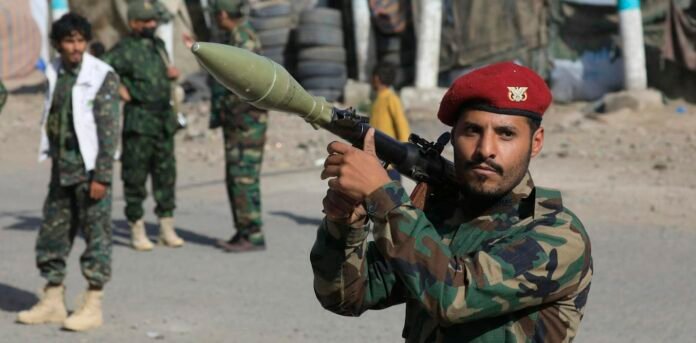
The dormant conflict in Yemen has erupted once more, with the Houthi rebel group seizing control of the Red Sea port city of Mocha and a number of islands from Yemeni government forces in recent weeks. This has given the Houthis a foothold close to the Bab al-Mandab Strait, a key trade gateway linking Asia and Europe.
The advance of the Houthis has alarmed Yemen’s northern neighbour, Saudi Arabia, for three main reasons. First, the Houthis’ drive down the coast constitutes a military setback for the Saudis and the pro-government forces they have long supported militarily and financially in Yemen.
Second, the Saudis have become more reliant than ever on access to Bab al-Mandab to export their oil since the effective closure of the Strait of Hormuz following the outbreak of war between the US, Israel and Iran in February 2026. Control of Yemen’s western coast would allow the Houthis to further restrict Saudi Arabia’s energy exports.
And third, the Houthis are closely allied with Iran. This means Tehran now has the possible means to control two of the most important maritime chokepoints for the transit of global oil supplies. The Bab al-Mandab Strait was carrying roughly 7% of global oil supplies by June.
The renewed hostilities bring to an end a ceasefire in the Yemeni conflict that had been in place since 2022. The Houthis, in origin a movement that emerged in the 1990s to protect the interests of Yemen’s substantial Zaydi Shia Muslim population, had previously engaged in armed conflict with the longtime Yemeni president, Ali Abdullah Saleh.
In the aftermath of Saleh’s forced resignation in 2012, which followed popular mobilisation against his autocratic rule, the country entered a period of instability. During this period, the Houthis moved from their stronghold in the north of the country to take control of the capital, Sana’a, in 2014.
Unwilling to see its southern neighbour come under the control of forces allied to Iran, Saudi Arabia launched an all-out war in March 2015. The objective was to restore the internationally recognised government of Abd-Rabbu Mansour Hadi, Saleh’s one-time deputy who had succeeded him in office, to power.
The fighting persisted for several years, but an effective stalemate was reached early on. While attempts to negotiate a lasting agreement to end the war failed, all sides agreed on a ceasefire in April 2022. The ceasefire lapsed in October of that year but both sides largely refrained from major escalatory actions and the level of conflict remained low.
Hopes for a more substantial deal between the warring parties were briefly raised in March 2023. That month saw China broker a rapprochement between Iran and Saudi Arabia, restoring diplomatic relations between the two countries after their 2016 suspension.
But in a clear assertion of its independence from Iran, Houthi leadership expressly rejected the notion that normalisation of relations between the two regional powers should lead to a deal between the Houthis and Saudi Arabia.
The prospects of a long-term deal to end the conflict were dealt a further blow by the Houthi response to Israel’s military campaign in the Gaza Strip, which followed the deadly Hamas-led attack on southern Israel on in October 2023.
Shortly after that war began, Houthi fighters fired several missiles and drones at an Israeli ship in the Red Sea. The US Navy also shot down Houthi-launched missiles and drones heading towards Israeli territory, in what was the first US action in defence of Israel since the start of the conflict in Gaza.
There was further escalation in January 2024, when the Houthis staged a large-scale attack on several US Navy vessels in the Red Sea. This was followed by US and UK airstrikes against Houthi targets. In May 2025, the US and the Houthis agreed a ceasefire which was mediated by Oman.
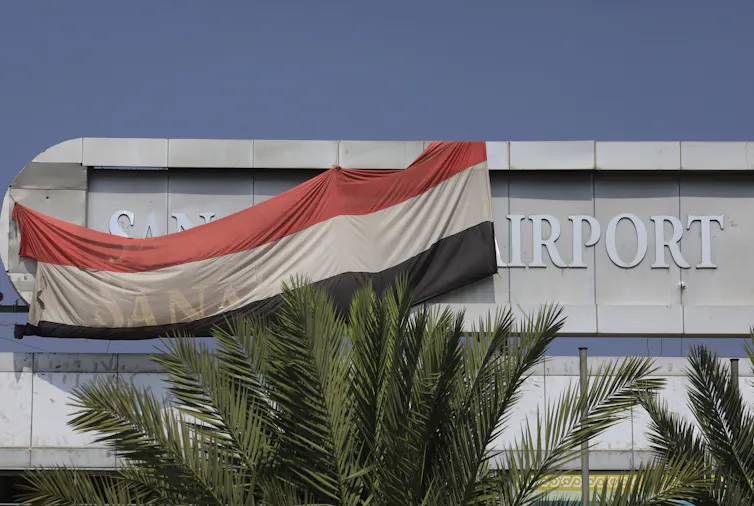
The relative peace that followed came undone in July 2026. On July 13, the Saudis attacked Sana’a International Airport in order to prevent a plane carrying the Houthi delegation to the funeral of Iran’s slain supreme leader, Ali Khamenei, from landing. The Yemeni government and Saudi Arabia claimed the flight represented a violation of Yemen’s sovereignty.
The Houthis launched missile attacks on airports in the south of Saudi Arabia in response, while also declaring the imposition of a strict maritime embargo against Saudi vessels. On Telegram, Houthi official Yahya Saree announced an end to what he called the “de-escalation phase” of the conflict.
A Yemeni national flag hangs on the main building of Sana’a International Airport in August 2026.Yahya Arhab / EPA
The recent rapid advance of the Houthis along Yemen’s western coast has focused attention on the group’s potential to disrupt global oil supplies even further. However, the offensive also has major implications for Yemen itself.
It constitutes a major setback for the Saudi-backed forces in Yemen, which are far more diverse than is commonly assumed. These forces include those under the control of Tareq Saleh, nephew of the fallen autocrat, as well as southern groups with aspirations for autonomy and other tribal and local forces.
The advance also represents a challenge for the Houthis themselves. They now control a swathe of new territory, and with it a larger population. There are questions regarding the capacity of the Houthis to withstand the inevitable attempts to dislodge it from its new position.
Earlier in the conflict, in 2015, the Houthis won control of areas in the south such as Aden, Abyan and Lahj. But they were soon pushed back by government forces and resistance fighters, and forced to relinquish their control of these areas.
Recent reports suggest that the Saudi crown prince, Mohammed bin Salman, has requested that the US launch airstrikes against the Houthis. The invitation was apparently declined, but is unlikely to be the final word in the seemingly endless conflict between Riyadh and its antagonists in its southern neighbour.
What happens when neutrinos swap identities inside a supernova?
Our basic understanding of core-collapse supernovae hasn’t changed in decades. Large stars burn through all the fuel at their cores and start creating heavier elements in reactions that consume energy. The lack of energy from these reactions allows gravity to pull the interior of the star in on itself, collapsing it into a neutron star or black hole. The energy released by this process then blows the remainder of the star apart.
And, generally, that’s right. But there’s an entire busload of devils in the details. The statistics of supernovae that we’ve observed indicate that the model may be seriously incomplete. And on the theoretical side, there are still plenty of uncertainties, including over some of the basics, such as whether all core collapses actually result in a supernova.
A paper being released by Physical Review D provides what might be a potential explanation for the discrepancy: flavor-changing neutrinos. Neutrinos play a key role in our current models of supernovae, and right now, those models don’t take into account one of neutrinos’ most striking features: their ability to change identity.
Slowdown, climbdown or meltdown, Asia sits on AI’s fault line
TOKYO – After two years of near-vertical capital spending, euphoric earnings calls, and GPU shortages that became their own economic indicator, the mood toward AI has dramatically shifted. Hyperscalers, model makers and investors are now asking the same uncomfortable question: did the future arrive too fast?
The recent wave of slowdown warnings isn’t just caution — it’s the first real test of whether the artificial intelligence trade is a revolution, a slow-motion bubble or something in between. Every boom eventually reaches a moment when optimism stops compounding and starts questioning itself. Many now believe AI has hit that inflection point, the place where booms either harden into durable growth or crack under the weight of their own expectations.
“There are plenty of signs that we are now in the late stages of a bubble in AI,” says John Higgins, economist at Capital Economics, who argues. He argues the epicenter of any bust would likely be the US stock market, where most of key indicators sit at or near levels that have historically preceded market peaks.
Adding to the unease, Higgins doubts markets will get the kind of shock-absorbing rally in US Treasuries that followed the dot-com crash of the early 2000s. With the US national debt recently topping US$40 trillion and President Donald Trump weighing on the Federal Reserve’s independence, confidence in Treasuries and the dollar is harder to come by.
Meanwhile, “AI fatigue,” as Wolfe Research puts it, appears to be spreading. “If this does lead to a slowdown and a rethink of AI spending, that will have ramifications for the economy and some important sectors of the stock market, because essentially we’ve been running hot based on AI spending,” says Steve Sosnick, analyst at Interactive Brokers.
Old-economy variables could compound the problem. Ruchir Sharma, chairman at Rockefeller International, warns that if the 10-year Treasury yield “decisively breaches” 5% — the top of its range since the dot-com era — it would signal the start of a tighter-money environment in which AI megaprojects become harder to fund.
Debt-servicing costs are also far higher today, he notes, meaning rising public borrowing costs will squeeze other borrowers sooner and hit the “bubbly” AI market harder.
Investor Michael Burry, of “The Big Short” fame, has been warning since May that AI stocks are overpriced, calling the boom “just an asset bubble, plain and simple” and drawing direct comparisons to the dot-com era. More recently, he’s accused corporate leaders of “hype and puffery” designed to mask “real, uncontrollable slowing growth.”
Nobel laureate Paul Krugman takes a different view, describing the AI craze not as a conventional asset bubble but as “a kind of fad, almost a social delusion.”
Not everyone, however, is convinced a pullback is coming. “The key question is whether this is the first sign that the extraordinary AI investment cycle might eventually moderate,” analysts at Deutsche Bank write. “For now, that seems unlikely. The competitive race between companies and countries remains intense, and it’s difficult to imagine firms voluntarily stepping back while rivals continue to push ahead.”
There’s also reason to think the broader economy is more insulated than the stock market suggests. Morgan Stanley chief US economist Michael Gapen estimates AI-related spending has added just 0.4 percentage points to annual GDP since 2025 — modest compared to how reliant economies like South Korea or Taiwan are on the sector.
Bank of America disagrees that a real slowdown is likely, arguing the economic stakes are “too large for any sustained meaningful deceleration,” and that current AI network utilization rates still point to healthy demand.
Some see an upside to a slower pace. Salesforce President Patrick Stokes argues a slowdown could actually help builders “who have a lot of catching up to do” to perfect their AI models. Mohamed El-Erian, chief economic adviser at Allianz, similarly believes a slowdown in AI investment “need not trigger an equivalent slowdown in broader tech-related economic activity.”
Goldman Sachs economist Joseph Briggs adds that the conversation is too narrowly focused on hardware capex. “What I think is less appreciated is how much is being invested in softer forms of investment at the company level” and the data infrastructure and strategy needed to actually deploy AI effectively.
One of the more consequential fault lines is geopolitical: which nation — the US or China — ultimately gets AI right. That question gained urgency after Anthropic CEO Dario Amodei published a lengthy essay over the weekend urging the industry to slow development of the most advanced AI models.
“The people building AI earnestly believe that it could kill us all by the end of the decade. This is not a marketing stunt,” Amodei wrote. “Many executives and senior researchers will couch their phrasing in the press to sound sensible — but I hear the same people express fear privately. No other human activity poses this level of danger.”
Trump sees it differently. “We’re leading China in AI. We’re the most sophisticated country in the world, and frankly, I want to keep it that way, because whoever wins AI wins,” he said Sunday, adding that concerns about guardrails are being pushed by “very negative forces” raising issues “that won’t happen.” Vice President JD Vance has gone further, calling government efforts to regulate AI a “Trojan horse” for stifling innovation.
Democrats are pushing back. Former President Barack Obama and former Vice President Kamala Harris this week became the latest prominent Democrats to call for stronger government action.
“We need government — and specifically our leaders in Washington — to get proactive in coming up with concrete proposals, laws and regulations that deal with serious safety concerns, anticipate AI’s impact on jobs and our kids, and make sure that AI’s benefits are widely spread,” Obama said.
Obama added: “We can’t stuff AI back in a box. But we can collectively determine how it’s developed and used, rather than letting AI and its fallout happen to us.”
China, meanwhile, has dismissed American calls to slow down as “fearmongering” lifted from a “Cold War playbook” — and the US political infighting may be giving Beijing room to expand its own ambitions. The US still leads in model capability, research output, and citations, but China is closing the gap faster than expected, despite American export restrictions on advanced chips.
Chinese models from DeepSeek to Moonshot have narrowed the distance considerably, catching Silicon Valley off guard. Stanford’s Institute for Human-Centered Artificial Intelligence notes China is rapidly eroding whatever lead the US once had. Samm Sacks, a senior fellow at Johns Hopkins’ School of Advanced International Studies (SAIS), says “the gap between US and Chinese models is narrow and fragile.”
Within the GOP itself, the divide is notable. House Speaker Mike Johnson is aligned with Trump’s position, but Senate Majority Leader John Thune — long an advocate for reining in AI developers as former chair of the Commerce Committee — is more cautious, putting him at odds with Trump’s dismissal of AI risk as a “hoax.”
For now, Thune is playing it carefully: “There are going to continue to be a lot of conversations about potential paths forward, but getting anything done in the near term is going to be challenging given the other stuff we’re dealing with.”
If the industry does coordinate a real slowdown — slower model releases paired with new guardrails — the market impact could be immediate. As Neil Wilson, a strategist at Saxo Bank, puts it, analysts would be left “scrabbling around to assess likely impact on earnings and valuations.”
Xi Jinping’s China, meanwhile, is pressing ahead with its open‑source approach to AI. And Trump’s laissez‑faire stance may be overlooking the strategic advantages China gains from its deployment‑first strategy.
“China is competing on a different axis, with focus on AI deployment,” argues Reva Goujon of Rhodium Group. “In recognition of its own constraints, due in large part to US export controls, China has focused on deploying and diffusing cheap, near‑frontier open‑weight models to deliver both cost‑efficient AI capabilities and tech sovereignty.”
Goujon adds that when “paired with its footholds in wireless networking and device manufacturing, and a playbook to globalize standards that play to those strengths, China is positioned as the default infrastructure supplier for physical AI and connected industries — especially across aspiring manufacturing hubs in the Global South.”
Trump’s America, meanwhile, is actively alienating the Global South, if not repelling it in real time.
If the AI music really is stopping, East Asian economies are in for a shock. Frenzied demand for AI chips, advanced memory modules and other tech goods is propelling growth in China, Taiwan and South Korea while giving Japan a meaningful tailwind. Semiconductor giants — Samsung and SK Hynix in Korea, TSMC in Taiwan — are minting record profits that underpin their broader markets and economies.
But the AI boom is masking deeper weaknesses: real‑estate crises, record‑low birth rates, slowing domestic demand, US tariff headwinds and fallout from the Iran conflict. As Moody’s economist Stefan Angrick puts it, Asia‑Pacific economies are running at two speeds: “the AI boom is boosting exports and production, while higher inflation and tighter policy drag on growth.”
If today’s AI turbulence is the start of the reckoning many fear, the economic reality would likely hit Asia fastest and hardest.
Brussels Proposes New Platform to Speed Up Recognition of Workers’ Documents Across EU
In a proposal put forward on Tuesday, the European Commission has set out plans for a digital European platform that citizens can use to get their working documents recognised across the bloc.
The aim of the platform, which will be known as the “European Social Security Pass”, is to overcome delays that cross-border workers face when they need to receive working documents or get them recognised in member states other than their home countries. Those delays often result in basic rights being violated.
With the new package, workers will be able to more easily claim their social security and health insurance benefits, as well as have their professional qualifications recognised in other EU countries without unnecessary red tape.
The proposals also aim to protect mobile workers and to address challenges faced by companies when recruiting talent from abroad within the EU.
“The single market must also become a genuine skills market with more opportunities for workers and businesses,” European Commission President Ursula von der Leyen said in a press statement.
Commission data from 2024 showed that around 14 million Europeans lived in EU countries other than those they were born in; 10 million of them were of working age. A recent Eurobarometer survey, meanwhile, found that 18% of Europeans want to move abroad.
European Commission Vice-President for Social Rights Roxana Mînzatu told Euronews that a new EU platform will save “talented” people from “wasting their skills” when they move across EU borders.
The Commission estimates that the platform could deliver as much as €6 billion in benefits by 2040.
“Over 12 years, digitisation could save up to €64 million for businesses, €69 million for healthcare providers, and €72 million for labour inspectors through faster cross-border verification. Digital signatures could avoid up to €277 million in fraud over the same period,” the Commission said in a statement.
Savannah Guthrie fought back emotion Tuesday as she made another heartbreaking plea for help finding her missing mother, Nancy Guthrie, more than seven months after the 84-year-old vanished from her Arizona home.
The “Today” host opened up about her family’s ongoing nightmare during the Sept. 15 broadcast after actress Allison Janney unexpectedly mentioned Nancy while celebrating her big win at the 2026 Emmy Awards.
Janney, who won her eighth Emmy for Outstanding Supporting Actress in a Drama Series for “The Diplomat,” was speaking to reporters when she was asked about the compassion she has shown Savannah since Nancy was abducted from her Tucson-area home on Feb. 1.
“I honestly can say I think about her every day and think about the loss and what Savannah and her family are going through,” Janney said.
The actress added that she believes millions of Americans are still thinking about the Guthrie family.
“I don’t think I’m alone,” she said. “I think all of America was thinking about her.”
The touching comments were played on “Today,” where guest co-host Willie Geist called Janney’s words a “beautiful expression of sympathy.”
Savannah, 54, said she was deeply moved that Janney would use what should have been a moment celebrating her own career to remember Nancy.
“I was so touched to see her do that,” Savannah said. “It was her moment of her triumph and for her to sit and just take a moment and think about our family.”
Savannah then used the unexpected moment to once again plead for help.
“I never let a moment pass, if I get one, to talk about my mom and how much we miss her and love her,” she said.
Savannah said she, her sister, her brother and their extended family remain devastated by Nancy’s disappearance.
“We’re in such pain. We need help,” she said.
Then came her most emotional admission.
“We just want our mom home, give her a proper goodbye. That’s all.”
Al Roker also spoke about the case, telling Savannah that Janney’s concern reflects how many Americans feel about the family’s ordeal.
“Allison Janney speaks for almost everybody out there in America,” Roker said.
Nancy disappeared from her home in Arizona on Feb. 1, setting off a massive investigation that has now stretched beyond seven months.
Savannah stepped away from “Today” for several months following her mother’s disappearance so she could remain with her family in Arizona as authorities searched for answers.
She eventually returned to the morning show in April, admitting at the time that coming back to such an upbeat environment was difficult while her family was living through unimaginable grief.
“It’s hard to imagine doing it because it’s such a place of joy and lightness and I can’t come back and try to be something that I’m not,” Savannah said at the time.
But she said she also could not stay away because her “Today” colleagues had become like family.
Despite the passage of time, Savannah and her relatives have continued publicly pushing for information that could finally reveal what happened to Nancy.
The FBI is asking anyone with information about Nancy Guthrie’s disappearance to call 1-800-CALL-FBI. Tips can also be provided to the Pima County Sheriff’s Office at 520-351-4900.