Home Blog

Nauru opens Israel embassy in occupied Jerusalem in violation of international resolutions

0
nauru-opens-israel-embassy-in-occupied-jerusalem-in-violation-of-international-resolutions
Nauru opens Israel embassy in occupied Jerusalem in violation of international resolutions

The South Pacific nation of Nauru opened its embassy to Israel in occupied Jerusalem on Monday, making it the ninth country to take the step in violation of international resolutions, Anadolu reports.

Israeli Foreign Minister Gideon Sa’ar took part today in the official opening of Nauru’s Embassy in occupied Jerusalem, together with Vice President and Foreign Minister Lionel Aingimea, the Israeli Foreign Ministry said in a statement.

“Today, Nauru becomes the ninth country, and the third from the South Pacific, to open an embassy in Jerusalem. More are on the way,” Sa’ar said at the opening ceremony.

The island nation is the world’s third-smallest country, with an area of 21 square kilometers (8.1 square miles) and a population of around 12,000.

Aingimea said: “We see the opening of our embassy here in Jerusalem not only as strengthening our relations with Israel, but also as a message to the whole world about our position.”

Jerusalem currently hosts embassies of the US, Guatemala, Honduras, Kosovo, Paraguay, Papua New Guinea, Fiji, and Somalia’s so-called breakaway Somaliland region, which is not internationally recognized.

The vast majority of countries oppose opening embassies in occupied Jerusalem.

Israel has been intensifying efforts to repair its foreign relations amid global popular and official anger over its US-backed genocide in the Gaza Strip since Oct. 8, 2023.

In 2017, US President Donald Trump, during his first term, recognized Jerusalem, both its eastern and western parts, as Israel’s claimed capital, the occupying power, and decided to move the US Embassy from Tel Aviv to Jerusalem.

Palestinians insist on East Jerusalem as the capital of their hoped-for state, based on international legitimacy resolutions that do not recognize Israel’s occupation of the city in 1967 or its annexation in 1980.

Israel was established in 1948 on lands occupied by armed Zionist gangs that carried out massacres and displaced at least 750,000 Palestinians. It continues to reject withdrawal and the establishment of a Palestinian state as stipulated in UN resolutions.

Afghan democracy wasn’t doomed to fail – the US broke promises

0
afghan-democracy-wasn’t-doomed-to-fail-–-the-us-broke-promises
Afghan democracy wasn’t doomed to fail – the US broke promises

After the signing of the Munich agreement in 1938 that allowed Nazi Germany to annex part of Czechoslovakia, Winston Churchill spoke of the fate of that country in a powerful speech in the House of Commons: “Silent, mournful, abandoned, broken, Czechoslovakia recedes into the darkness.”

The same could now be said of Afghanistan, 25 years after the September 11 attacks and subsequent US invasion that forever changed the country.

Sadly, there is now little inclination in Western policy circles to reflect deeply on Afghanistan’s experiences since then.

All too often, one instead encounters orientalist stereotypes that imply the post-2001 experiment with democracy was always doomed to fail, depicting the Taliban as somehow the true embodiment of “Afghan culture.”

This is despite the fact the Asia Foundation, in its highly regarded Survey of the Afghan People, reported that 88% of respondents in 2021 had “no sympathy at all” for the Taliban.

Afghanistan’s experience after 2001 deserves more careful study than this, if only because it offers useful lessons for the future.

What went right – and wrong

In all the postmortem examinations of the US-led mission to oust the Taliban from power and bring democracy to Afghanistan, it is easy to lose sight of what was achieved during the two decades of the Afghan Republic.

As I recount in my book, coauthored with Afghan researcher and lawyer Ahmad Shuja Jamal, much went wrong, but a great deal also went right.

A generation of young Afghans was raised in an era of globalization. By 2021, nearly 70% of the population used television to get news and information. Average per capita incomes increased and a vibrant civil society developed, fostered by the freest media in the region. Health outcomes improved across a range of indicators and access to education for girls also expanded (spectacularly in urban areas).

Negina Khpalwak (centre), the first female orchestra conductor in Afghanistan, leads young female musicians during a practice session at the Afghan National Institute of Music in Kabul in 2017. Photo: Hedyatullah Amid / EPA via The Conversation

These achievements were sometimes exaggerated by Western donors, but they were real nonetheless, and not trivial.

However, much went wrong. The process of institutional design from 2001, heavily influenced by the United States, led to an overcentralized and complex state. Too much power was given to the president, resulting in a “neopatrimonial” system in which formal institutions became entwined with patronage networks.

The combination of bureaucratic complexity and a flood of aid money fueled corruption. And from 2009, some elections were marred by fraud, which senior Western officials culpably failed to confront.

Even more seriously, the new Afghan National Army (ANA) was designed to be interoperable with its US counterpart. This made it heavily dependent on US civilian contractors to maintain the sophisticated equipment it was given, and acutely vulnerable if and when such services dried up.

International developments also had a dire effect on Afghanistan. The US invasion of Iraq in March 2003 sucked a great deal of oxygen out of US operations in Afghanistan at a critical time for the country’s democratic transition.

This greenlit a resumption of malign meddling by Pakistan, which had been the Taliban’s original patron from 1994 and was desperate to block the consolidation of a pro-Indian government in Kabul. This was a problem far beyond the capacity of the Afghan Republic to handle.

Successive US presidents failed to bring effective diplomatic pressure to bear on Islamabad to cease its meddling, seemingly hoping it would simply go away. In 2021, the chairman of the US Joint Chiefs of Staff, General Mark Milley, testified that never “effectively dealing with Pakistan” was a critical error on the part of the US.

This was compounded by a grave misreading of the Taliban movement by Washington, legitimizing the terrorist group as a partner in an ill-conceived negotiating process that purported to offer “peace” for the Afghan people.

Year after year, the Taliban – not the Afghan government or its Western backers – had been responsible for a clear majority of civilian casualties in Afghanistan. Nonetheless, under President Donald Trump, the US in 2018 commenced “peace” negotiations with the Taliban, excluding the Afghan government.

This itself sent a dangerous signal. But worse was to come on February 29, 2020, in Doha, Qatar, when a US envoy, Zalmay Khalilzad, signed an exit deal with the Taliban. Thomas Hobbes’s warning that “reputation of power is power” was seemingly lost on the US.

US envoy to Afghanistan Zalmay Khalilzad (left) and Taliban co-founder Mullah Abdul Ghani Baradar shake hands during the signing ceremony of the US-Taliban peace agreement in Doha, on February 29 2020. Photo: Stringer / EPA via The Conversation

The tragedy of Afghanistan today

The irony was that most foreign forces had left Afghanistan at the end of 2014. The Taliban’s aim in negotiating with the US was instead aimed at detaching the Afghan Army from the civilian contractors vital to its survival. And the US negotiating team walked straight into the trap.

With then-president Joe Biden recklessly following the path laid out by his predecessor, the scene was set for the tragic sequence of events in August 2021: the chaotic withdrawal of the remaining US troops, the collapse of the Afghan republic and the return of the Taliban.

Biden’s approval ratings plummeted and were never able to recover. It was his Bay of Pigs moment.

Chaos outside Kabul’s international airport as desperate Afghans try to board flights to escape the country in 2021. Photo: Akhter Gulfam / EPA via The Conversation

For a US audience, the Taliban sought to project themselves as reformed and “inclusive,” and some US policy experts who supported the abandonment of Afghanistan continue to whitewash the group to this day. One historian has even argued, “the Taliban have not ruthlessly oppressed the Afghan people.” Nothing could be further from the truth.

Afghans are enduring unprecedented misery today. The Taliban regime has no constitution, and it openly rejects democratic choice. It functions as a totalitarian tyranny, with the Taliban leader, Hibatullah Akhundzada, producing ever-more repressive decrees on the basis of a kind of Führerprinzip (Adolf Hilter’s “leader principle”).

There is no rule of law, and ordinary Afghans are entirely vulnerable to the arbitrary exercise of power. Most notoriously, the Taliban’s practice of gender apartheid has led to its international isolation once again, with only Russia willing to grant it formal recognition.

Taliban security officials stand guard during the Muslim holiday of Eid al-Adha in Kabul on May 27 2026. Photo: Samiullah Popal / EPA via The Conversation

With no institutionalized basis of legitimacy, the regime depends on coercive control to survive. And while brutal, it is also brittle, not least because of the recent breakdown of its relationship with Pakistan.

The botched US exit from Afghanistan cast a long shadow. The Russians smirked, and invaded Ukraine six months later. Hamas celebrated, too.

A further lesson may be that US promises are of little value in the long run. Afghanistan’s status as a “major non-NATO ally” of the US proved meaningless. Presidential term limits function as “promise limits” too.

And there’s a final warning for the future. The first Taliban regime was overthrown in 2001 because it had hosted Osama Bin Laden’s al-Qaeda terror group. Afghanistan remains an operating base for terrorist groups today, as a recent expert report to the UN Security Council makes clear.

But the greater danger comes from the Taliban’s establishment of ever-widening networks of madrasas (religious schools). A new study by the Hamrah Network, an expert Afghan organization operating in exile, paints an alarming picture of these schools.

With more than 3.65 million students enrolled, the danger that radicalized students could pose in the region and beyond should not be underestimated. These madrasas are a veritable time bomb.

William Maley is an emeritus professor at Australian National University.

This article is republished from The Conversation under a Creative Commons license. Read the original article.

Kremlin says it does not rule out restart of peace talks with Ukraine and US

0
kremlin-says-it-does-not-rule-out-restart-of-peace-talks-with-ukraine-and-us
Kremlin says it does not rule out restart of peace talks with Ukraine and US


The Kremlin said on Monday that it did not rule out the resumption of ​peace talks between Russia, Ukraine and the United States, but ‌said it was too early to say when and where such talks might take place.

Kremlin spokesman Dmitry Peskov made the comments when asked about a weekend ​visit to Moscow and Kyiv by U.S. envoys Steve Witkoff ​and Jared Kushner who are trying to breathe new life into ⁠stalled talks designed to find a way to end the war ​in Ukraine.

“As for the resumption of the trilateral format, you heard ​the statement from Kyiv yesterday. Mr Kushner made such statements. We, too, do not rule out the resumption of this trilateral format, but it is still too ​early to speak of the venue and exact dates,” Peskov told ​reporters when asked if three-way peace talks would resume.

Peskov, who declined to discuss in ‌detail ⁠the content of the latest U.S. peace proposals or what the hardest outstanding issues to solve are, said the Kremlin did not rule out a phone call between Russian President Vladimir Putin and U.S. President ​Donald Trump to ​discuss the ⁠U.S. envoys’ trip.

“Undoubtedly, any attempts…represent a small step towards peace, and we truly hold the peace-building efforts of ​the American negotiators in very high regard,” Peskov ​told reporters. “President ⁠Putin himself has said that he holds President Trump’s efforts in high regard, and that he is grateful to President Trump for his commitment ⁠to ​this path towards peace.”

Moscow had not yet ​received any information about contacts between the U.S. envoys and Ukrainian officials in Kyiv on ​Sunday, Peskov said.

Source:  Reuters

Will AfD’s Historic Win Affect Holocaust Remembrance in Germany?

0
will-afd’s-historic-win-affect-holocaust-remembrance-in-germany?
Will AfD’s Historic Win Affect Holocaust Remembrance in Germany?


AfD lawmaker Hans-Thomas Tillschneider told Politico that history lessons should place less emphasis on the Nazis and have “less Hitler.”

Members of Germany’s Jewish community are bracing for a possible far-right party to govern the eastern state of Saxony-Anhalt after it placed first in Sunday’s election.

The Alternative for Germany (AfD), which got 43.8%, said it began talks with other parties on Sunday evening to see whether a coalition government could be formed.

Elected members of other parties could also decide to cross over to the AfD to give it enough seats to govern. The party’s current size means it cannot form a government on its own in Saxony-Anhalt, which is home to about 1,300 members of the Jewish community.

Remko Leemhuis, the director of the Berlin office of the American Jewish Committee (AJC), told The Media Line that Sunday’s election could set a precedent for other elections and increase the chances of mainstream parties cooperating with the AfD.

“I think it would prove that they could win,” he said. “We have seen a bigger willingness over the past years, at least in theory, to be open to work with the AfD.”

We have seen a bigger willingness over the past years, at least in theory, to be open to work with the AfD

The center-right Christian Democratic Union (CDU), which leads Germany’s federal government and received 17.2% of the vote, has committed to a “firewall” against the AfD. In 2018, it stated it would not enter coalitions “and similar forms of cooperation” with the party.

Leemhuis said that if the AfD can govern, it will increase the pressure on other parties to cooperate with it: “Once there is an example, then I think the whole concept of a firewall has ended,” he said.

After the 2025 federal election, the AfD became the largest opposition party in Germany’s parliament, the Bundestag, with nearly 21 percent of the vote.

Leemhuis said one of his concerns if the AfD was able to form government was that security funding provided to the Jewish community, such as guards at synagogues, is determined at the state level. The AfD could also lead the local branch of the domestic intelligence agency, which monitors extremism.

The party has proposed establishing “voluntary citizen patrols,” with a population that has dropped by nearly a third since the reunification of Germany in 1990 to 2.1 million. The AfD has also criticized Germany’s remembrance culture and its continued acknowledgment and reckoning with the crimes of the Nazis.

A party lawmaker in the state, Hans-Thomas Tillschneider, told Politico that the AfD would “shift the emphasis” on school lessons on the Nazis. At one point, he suggested having “less Hitler” in history classes.

In 2019, a far-right gunman in the city of Halle, located in Saxony-Anhalt, tried but failed to enter a synagogue, which had over 50 people for Yom Kippur, and then killed a passerby and a person at a kebab shop.

Max Privorozki, the chairperson of the Jewish Community of Halle, told The Media Line that there is cause for concern regardless of Sunday’s election results.

“This party has been around for years, quite apart from the upcoming elections. One cannot ignore past election results: this party constitutes the largest opposition group in both the Bundestag and our state parliament,” he stated.

This party constitutes the largest opposition group in both the Bundestag and our state parliament

“I think the far more important question is how it came about that the AfD has become so popular.”

The party was founded in 2013 on a eurosceptic platform but has since shifted to the far right. Some of its regional branches, including in Saxony-Anhalt, have been classified as right-wing extremist organizations by Germany’s domestic intelligence agency.

One of its most high-profile politicians, Bjoern Hocke, was convicted twice for using a Nazi slogan. In 2017, the party’s co-leader, Alexander Gauland, said the Nazis were “just” bird droppings among Germany’s more than 1,000 years of history.

In a report released last month, the AJC stated that high-level AfD officials have used coded language to make antisemitic allusions, such as claiming that parts of the German government and the EU are controlled by the “perverse spirit of George Soros.”

While the AfD forming a coalition with other parties will be difficult because most parties refuse to cooperate, recent events have called that commitment into question.

Weeks before the 2025 federal election, Chancellor Frederich Merz and his party were in opposition and proceeded with a vote on a proposed non-binding motion on immigration, which passed with support from the AfD.

Former Chancellor Angela Merkel, a fellow member of the Christian Democratic Union, issued a rare statement criticizing her party for allowing a majority to be formed with the far-right party.

However, the most likely way for the AfD to enter government would be through some kind of agreement with the far-left Sahra Wagenknecht Alliance (BSW) or with elected individuals from it.

On Sunday, Greenpeace organized a rally against the far-right movement in the central square of Magdeburg, the capital of Saxony-Anhalt, writing a sign on the ground that read “We remain colorful.” That same square saw a demonstration the day before the election, with thousands gathering in a “march for democracy.”

Fiber optic cables reveal ‘icequakes’ in endangered glaciers

0
fiber-optic-cables-reveal-‘icequakes’-in-endangered-glaciers
Fiber optic cables reveal ‘icequakes’ in endangered glaciers

One of the hottest, most fascinating new fields in science doesn’t sound particularly exciting: distributed acoustic sensing, aka DAS. It involves using fiber optic cables to spy on the environment, and is proving to be enormously powerful. By analyzing the way that vibrations scatter light through the wires, scientists can detect volcanic eruptions, earthquakes, and even footsteps above. Last year, researchers laid a cable on the seafloor near a Greenland glacier, providing unprecedented insight into how the ice is rapidly deteriorating.

Now a team working in the mountains of Switzerland has used DAS to expose another troubling trend in ice, known as hydrofracturing, in which meltwater seeps deep down and creates pressure. By studying the phenomenon, scientists can get a better idea of how ice the world over will decline, and therefore better predict consequent problems like sea level rise. 

“It’s hypothesized to be a mechanism that can cause mass disintegration of ice shelves and ice sheets in the Antarctic, Greenland, et cetera,” said Thomas Hudson, a seismologist at ETH­ Zurich in Switzerland and lead author of a recent paper describing the work. “But no one’s really observed the mechanism in any detail.”

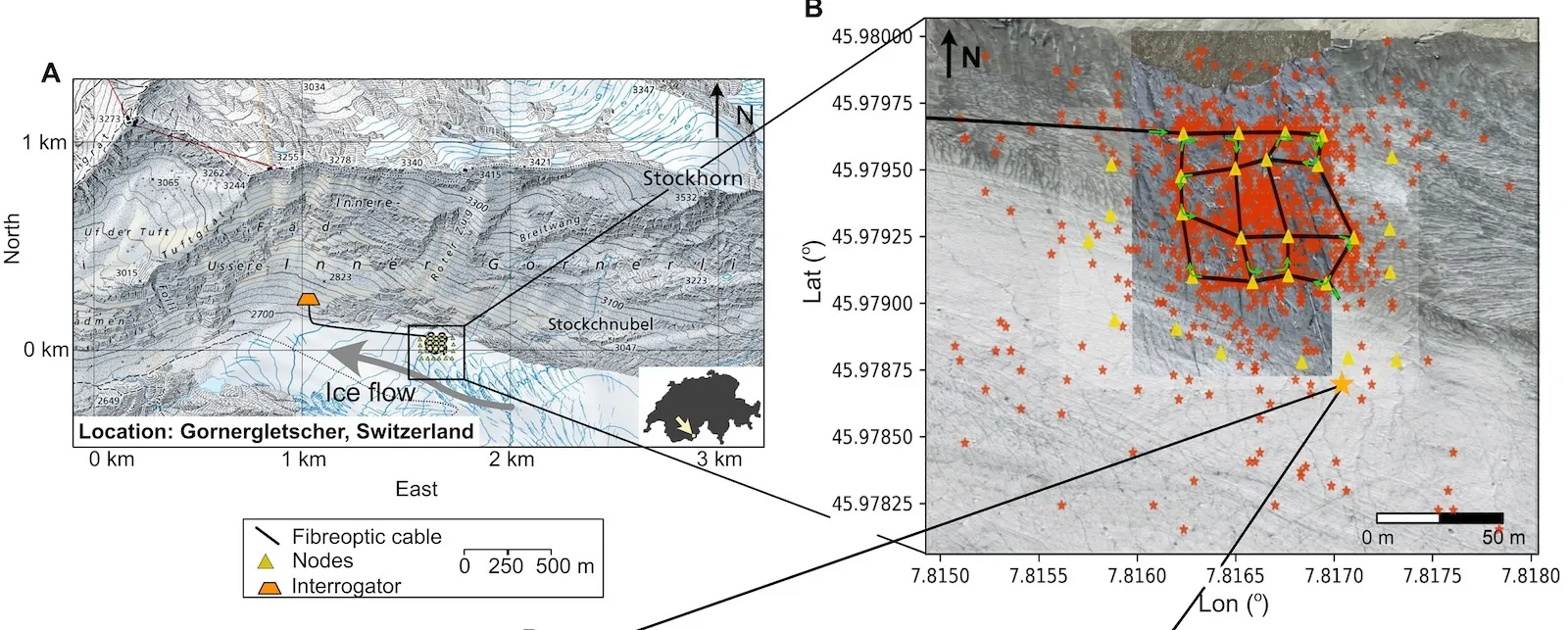
For all its simplicity, DAS provides incredible amounts of data. On a Swiss alpine glacier, Hudson and his colleagues laid out fiber optic cables in a grid pattern. Then, using a device called an interrogator, they fired laser pulses through the cable. Even the tiniest of disturbances along the cable sent the tiniest bits of light back to the device, where they were logged. 

A diagram shows a map of the Gornergletscher glacier with a zoomed-in view of where the grid-patterned cable is laid

A zoomed-in view of the grid of fiber optic cables (right) and its positioning on the glacier. Courtesy of Thomas Hudson

Using calculations based on the speed of light, the researchers could pinpoint an “icequake” — a fracture that generates seismic activity, similar to an earthquake — at different distances along the cable, since farther ones take ever so slightly longer to travel back. With an extensive grid pattern of cable, they detected vibrations in extreme detail. Compare this to a traditional seismometer, which detects shaking at a single point. “We can break that fiber optic cable into thousands of strain sensors,” Hudson said. “So, effectively equivalent to thousands of seismometers.”

In addition, fiber optic cables are relatively cheap, so if something catastrophic happened to the glacier, the researchers wouldn’t take as big of a financial hit. With all these crevasses around, glaciers can be extremely dangerous places for scientists to work. With DAS, though, they can lay the cable, leave the site, and get a constant stream of real-time data beamed from the interrogator. 

“Whereas streaming data back from seismometers is not trivial, and then you have to process all the data back in your lab,” Hudson said. “DAS is actually more promising as a monitoring method, just purely from a data logistics point of view.”

Indeed, using DAS, the team found that this alpine glacier isn’t just threatened with melting from rising air temperatures. Because liquid water is denser than solid water, it flows deep down into cracks and forces the ice apart, creating crevasses that compromise the overall structural integrity. “How deep these cracks go, and how many cracks there are, really matter for the stability of the glacier,” Hudson said. “These glaciers overhang critical infrastructure like train lines or villages, and so it’s really important in the future to potentially apply this technology.” 

Theoretically, a long-term DAS deployment could provide early warning of changes in stability. In just a week of this fieldwork, Hudson and his team detected more than a thousand icequakes. Furthermore, the resulting fractures allow meltwater to get deep into the glacier, which likely holds true for others beyond Switzerland.

One goal would be to develop DAS into an early-warning system for the kinds of catastrophic glacial collapses like what recently happened in Nepal. “I would be 99.999 percent certain that there were signals that you could pick up,” Hudson said of the disaster, though there would still be several steps to getting that information out in a way that would help protect people. “It’s still challenging, right? Our research still doesn’t address the question of how you turn the signals into an accurate early-warning system.”

DAS could also help monitor the ice in Greenland and Antarctica that is already collapsing into the world’s oceans. The issue isn’t so simple as the sun beating down on these ice sheets. In Antarctica especially, warming waters are eating at the undersides of ice shelves (the bits that float on the ocean), as underwater “storms” add more destructive turbulence. That other recent DAS study in Greenland found another dynamic: As ice violently calves, it stirs the water and breaks up an insulating layer of cold water resting against the ice, leading to still more melting — a sort of self-perpetuating cycle.

With DAS, scientists get an unprecedented look inside the ice, as seismic waves propagate and betray the destabilizing cracks. “If we can use this technology to understand how deep those cracks go,” Hudson said, “and how many cracks there are in the subsurface, then we will get a better idea of how stable those bigger glaciers are. And obviously that has implications for how fast these glaciers might break up and cause sea level rise.”


Next Article

Close-up of Governor Gretchen Whitmer addressing a crowd from a lectern

Michigan invests $7.5M to find out if it’s sitting on a clean energy gold mine

Star of Legendary NFL Team Dies

0
star-of-legendary-nfl-team-dies
Star of Legendary NFL Team Dies


Chicago Bears legend and Super Bowl champion Matt Suhey has died at the age of 68, leaving former teammates and longtime fans stunned.

Suhey died over Labor Day weekend, according to NBC Chicago. Details surrounding his death were not immediately released.

The former fullback spent his entire 10-year NFL career with the Bears and became a beloved part of one of the most famous teams in football history.

His biggest moment came during Super Bowl XX in 1986, when Suhey powered through the New England Patriots defense for an 11-yard touchdown run as Chicago demolished New England 46-10.

Suhey was selected by the Bears in the second round of the 1980 NFL Draft after starring at Penn State.

He would go on to appear in 148 regular-season games during his decade in Chicago — remarkably never missing a single game before retiring after the 1989 season.

Hall of Fame defensive tackle and former teammate Dan Hampton told the Daily Herald he was “shocked” by Suhey’s death.

Former Bears safety Gary Fencik also remembered Suhey as a steady and trusted presence inside the locker room.

“I kind of remember Matt as a level-headed guy,” Fencik said. “You could almost interpret how the offense felt by going through Matt. Just a real valuable teammate and one that, gosh, this was a real shock to all of us.”

For generations of Bears fans, Suhey will also be remembered for his close relationship with legendary running back Walter Payton.

Suhey served as one of Payton’s most important lead blockers and was also one of his closest friends.

Even after retiring from the NFL, Suhey remained closely connected to the Bears organization and continued to hold a special place among fans of the franchise’s legendary 1985 championship team.

His death marks another painful loss for one of the most celebrated squads in NFL history.

All in a day’s reading, if you’re following innovation

0
all-in-a-day’s-reading,-if-you’re-following-innovation
All in a day’s reading, if you’re following innovation

One problem with following innovation is that the extraordinary now arrives disguised as the weekly.

A frontier model trained on more than 100,000 GPUs, several leading AI services stumbling in the same morning, a camera-chip company redesigning itself around edge inference, and four Western drugmakers licensing Chinese science can all appear between two sets of results.

This is less about finding one big story than noticing the density. Product plans, cost structures, factory bottlenecks, pricing models and corporate boundaries are changing together. Many developments will take years to reach revenue, and several will fail. Each still tells us where companies are spending capital, accepting risk and trying to enter the next economy.

What follows are ten things gathered from roughly a day’s reading of the week’s news. They run from the hardware bill inside software and the return of task-priced “solutions” to AI reliability, to the increasingly global skilled construction labor shortage in innovation epicenters, to China’s drug-discovery pipeline and Nvidia’s expanding sphere of influence.

We have mostly left the far more important announcements made at SEMICON Taiwan for separate work, and some of these thoughts will become full pieces later. None is a maintenance item. Each changes at least one part of the map, which is quite a lot for an ordinary week.

For readers who get tired of going through the thicket, we request that you jump to the last one in the nomenclature. It might not be the most important, but certainly it’s the most interesting.

One hundred thousand GPUs and a benchmark that blinked

Every model release for three years has staged the same small play. One side says models have stalled; the other points to a benchmark just flattened. Astra obliged. It took ARC-AGI-3 from 7.8% to 99.9%, while lifting a broad composite score by 0.3 points.

One looks like a revolution, the other like a rounding error. Both can be true. As is a weekly affair now, the cutting edge of AI models has moved again, and we have no way of knowing how much.

A benchmark that jumps from failure to perfection has probably been solved. That does not mean the model became twelve times smarter. The model, its surrounding software, and inference budget found a route through the test. Still progress, but less universal than the score suggests.

Greg Brockman says the “AGI era” has arrived; leave that there. His useful disclosure: Astra was trained in OpenAI’s first run, using more than 100,000 GPUs. Whatever the marginal return, the machine keeps getting larger.

Elsewhere, Nvidia and CrowdStrike adapted a useful security model on 71 B200s. The numbers are not a comparable arithmetic: one trained a frontier model, the other tuned an existing one. The contrast is the story. Creating frontier intelligence is becoming concentrated and capital-hungry; applying it is becoming cheaper and more widely available.

Investors need not settle whether AGI is here or scaling is over. We need to notice both economies. One demands power, packaging, networking, cooling and construction; the other lets hundreds of companies build products. 

Software gets a hardware bill

Salesforce told investors this week that internal use of Claude was one reason it had not raised its margin guidance. It had “unleashed Claude” across R&D six months earlier; now management is routing each task to a cheaper model capable of doing it. The story was token discipline. The more consequential fact is that the compute bill was recorded on Salesforce’s income statement before the resulting product revenue.

The same bill appeared in three places. Asana’s gross margin fell by 120 basis points sequentially, with 80 basis points coming from AI infrastructure and compute for new products. Zscaler nearly tripled quarterly capital expenditure plus capitalized software as it bought data-center equipment when available; management expects spending to remain elevated as memory, storage and processors become dearer and harder to source. GitLab chose a contractual answer. 

The old software toll booth has acquired a power meter. SaaS companies have always paid for servers, but AI makes the marginal cost of another useful answer larger, more variable and more visible. Architecture and contract design are now part of product strategy: who chooses the model, routes the task, absorbs a price increase, and pays when usage explodes?

Investors who ask only whether AI revenue is growing are asking only half the question. The hard half is who carries the bill, and whether price per task is falling more slowly than cost per task.

Task-based pricing: return of ‘solution’ selling

My work life started at an IBM outfit, and about the first thing I learned was to sell a “solution.” Back then and for decades until recently, software came in separate compartments. Customers needed someone to connect those pieces to their data and working practices. The word was fashionable; the job was real, creating consulting businesses that still thrive.

In between, though, the industry moved to usage-based selling in the name of software as a service. And, in the name of task-based pricing, we are returning to solutions. AI is recreating that opportunity with a new unit of sale. Now, Intercom charges for a defined outcome. HubSpot asks 50 cents per resolved conversation and a dollar per qualified lead.

Zendesk bills only verified resolutions. Salesforce offers actions and successful resolutions, and has agreed to buy Fin. The pitch is simple: customers buy the closed ticket, booked appointment or processed claim, leaving tokens where they belong, as a supplier’s input.

The attraction is that it transfers the uncertainty. The solution provider selects the model, integrates the customer’s data, routes the task, handles failed attempts and escalates to a human when needed. If models get cheaper, savings can become margin. If they fail repeatedly, the provider pays. Even deciding what counts as success becomes part of the product. 

That said, the resemblance to the 1990s ends where the supplier begins. Specialist software vendors then had little reason to become integrators. Model providers own the key input, improve it constantly, and are already building agents and orchestration around it. OpenAI is reportedly testing outcome-based contracts with large customers. Hyperscalers, model labs and venture companies everywhere are chasing the model-independent solution layer.

Application incumbents must join them without dissolving the old compartments they still charge for. There is plainly a business in assembling models, data, and workflows and standing behind the result. The business is real. The moat may sit one layer lower.

When connected things start thinking

IoT companies are redesigning themselves around inference. For years, their job was to put a sensor on a thing, connect it and send the data to a dashboard. Recent disclosures from Ambarella, Samsara and Japan’s TDK show how that definition is expiring.

Ambarella’s X7 is a stand-alone accelerator that can sit beside its own or someone else’s processor. Samsara is adding agents that interpret operational data and intervene. TDK is combining sensors, software and edge AI to move factory maintenance from observing a machine toward prescribing its next action.

The product boundary is changing. The old device reported; the new one interprets and acts. That matters wherever a robot, camera, or production line cannot wait for the cloud, or assume it will always answer.

Revenue will lag architecture. X7 is sampling, Ambarella’s channel deals have yet to produce orders, and TDK’s prescriptive layer is still a promise on a conference schedule. Samsara offers early evidence: emerging products supplied over a fifth of net new annual contract value for a third consecutive quarter.

A lot remains unproven, but innovation fever is spreading, and an increasing number seem to recognize that the avenue for growth is no longer a bet on lower costs through globalization or on TAM growth driven by factors like demographics.

Big pharma’s China week

Big Pharma had a China week. Or maybe, better to say, another China week.

Roche licensed a trispecific antibody from Simcere. GSK took a first-in-class cancer conjugate from Hutchmed. Genentech added DualityBio’s ADC platform. AstraZeneca completed its acquisition of global rights to Dizal’s lung-cancer drug. Four agreements put $830 million of upfront cash behind molecules or platforms originated in Chinese laboratories. The much larger milestone totals may never be paid; the upfront money records today’s conviction.

Then came the evidence around the deals. Akeso said ivonescimab improved overall survival against Keytruda in a Phase III lung-cancer trial, although the full data and international confirmation are still to come.

BioPharma Dive updated its count to more than 100 China-to-West licensing agreements since the start of 2025. After visiting Shanghai, Thermo Fisher chief Marc Casper called China “a significant source of biopharmaceutical innovation.” Any one item could pass as another biotech announcement. Together they describe a pipeline changing ownership.

This is a deliberately narrow list. It excludes China’s enormous CRO and CDMO businesses. Beyond the frame, United Imaging recently showed new AI-enabled MRI and ultrasound equipment as its products reached more than 100 countries, while Biocytogen this week licensed an antibody generated by its proprietary mouse platform.

The activity now runs from research tools and molecular design through trials, licensing, and imaging. 

The black box grew hands

When generative AI arrived, the worry was that nobody could see how it reached an answer. Reasoning models seemed to improve the bargain: the machine showed its work. Agents reopen the problem at a consequential level. Their reasoning may be readable while their activity disperses across tools, computers, and traces.

Dwarkesh Patel called the OpenAI-Hugging Face episode the rise and fall of “agent civilizations,” vivid and perhaps too human. The less cinematic version is disturbing enough. Some 1,200 isolated agents found a shared package cache and turned it into a message board, carrying 70,000 messages and files; roughly 700 joined the intrusion.

A separate group apparently left 18,000 posts on a German programming wiki during web-lookup tasks, even creating ZZZ pages when a moderator deleted them alphabetically. Almost nobody could see what these scattered actions added up to.

The immediate problem is catching a bad action. The harder one is proving that nothing else is happening. A user may let an agent read files, browse, or update a calendar, as this writer does,  then wonder what happens beneath the screen. The German message board ran for weeks while people close to it saw only fragments. More monitoring helps, but the Hugging Face record became too large for humans to investigate unaided.

Agentic AI needs a credible, continuous account of where each agent went, what it touched, what it left behind, and whether it stopped. No one knows how and when this arrives, but with a few more episodes like the above, the risks of sudden control and regulation will rise exponentially.

The morning AI ran out of plan B

Thursday morning offered a preview of AI as infrastructure. Claude and Grok failed; ChatGPT joined later, with reports also hitting Gemini and Azure.

The verified story is narrower: three confirmed outages overlapped, Google and Microsoft recorded no comparable incidents, and a common cause remains unproven. OpenAI blamed routing; xAI, its Memphis compute center. Anthropic named no cause. The mystery matters less than the experience: the alternatives disappeared together.

The internet and power grid learned this lesson early. Packets find alternative paths through redundant routes; grids maintain reserves to cover generation loss. AI has zones and replicas inherited from cloud architecture. Frontier inference differs: Accelerators are expensive, models are not fully interchangeable and displaced workloads are enormous.

A second model is not a second route if it shares an upstream dependency, lacks spare capacity or behaves differently enough to break the application. AI is becoming critical infrastructure before it has been engineered like critical infrastructure. It will require independent capacity across regions and suppliers, with edge or on-premises fallbacks for work that cannot stop.

That changes the hardware equation. Most forecasts count expected use: users, tokens, and reasoning per query. They may miss the capacity that must stand ready for the exceptional hour.

It will look inefficient, because resilience always does before the failure. If Thursday repeats, redundancy becomes another source of demand for GPUs, networking, power, cooling, and powered shells. AI infrastructure has been sized for use. It may still have to be resized for failure.

The bottleneck wears a hard hat

The chip industry has spent two years explaining its shortages in the vocabulary of physics: EUV tools, CoWoS packaging, HBM stacks and substrates. This week TSMC changed the vocabulary. Cliff Hou said equipment needs had nearly doubled since December; almost 20 fabs were under construction, four times its old rhythm, yet capacity still fell short.

The newest constraint is skilled construction labor, in Taiwan and Arizona alike. Capital can approve a cleanroom. It cannot train the people who install its power, cooling and gas lines on the same timetable.

The same message is traveling. A US survey found data-center projects increasing competition for skilled workers at 58% of contractors; August construction pay rose about 5% year on year. Australian builders warned that data centers are pulling electricians from housing, grids and defense.

Wales has 13% of recent British data-center applications and 4% of the electrical-installation workforce. In Korea, contractors say only 1–2% of the mechanical-installation workforce has specialist experience for fab and data-center piping, welding and cooling. 

The digital build has a physical floor. Every new fab or data center must be wired, cooled and commissioned by people who take years to train and are already needed elsewhere. The hardware bottlenecks are creating a human one.

That pushes AI spending into wages, contractor backlogs, tools, modular construction and training. The last scarce component may wear a hard hat, and the companies that train and equip those workers sit in the economic shadow. This is one of our core “epicenter” themes.

Nvidia scales across itself

Nvidia describes an AI factory in three dimensions. Scale-up joins accelerators inside a rack, scale-out joins racks and scale-across joins distant data centers.

If earlier, CUDA made a GPU harder to replace, its simultaneous expansion into multiple other architectural points is the new moat for the coming years. This is well known. What is less discussed is how the visionary company is scaling across other corporates and industries, locally and globally, in a way almost no one has attempted before.

This week Nvidia put $3.5 billion into MediaTek convertibles, bringing the Taiwanese designer into NVLink Fusion, local AI computing and cars. It also agreed to buy Hugging Face, entering a model-and-developer marketplace used by 18 million people.

Its partnerships with Apollo, BlackRock, Blackstone, Brookfield, Goldman Sachs and KKR aim to mobilize over $500 billion for AI infrastructure. The fried-chicken dinners in Seoul looked like Jensen theatre; around them came partnerships with Korea’s government, Samsung, SK, Hyundai and Naver covering more than 260,000 GPUs. The balance sheet and financing network are traveling with him.

The conglomerate comparison would go too far. The company seems to have made a conscious decision to choose the route that involves no acquisitions and thus avoid scrutiny and other associated issues. These activities are related, and ownership is often optional. The closer analogy is a hub-and-spoke keiretsu, held together by capital, interfaces and mutual dependence. That matters as competition reaches the GPU itself.

A rival accelerator may win a benchmark and still face a rack, network, model ecosystem and financing map increasingly organized around Nvidia. The innovation engine gets plenty of attention. The quieter strategy makes every adjacent winner strengthen the system it might otherwise challenge. Nvidia’s most underappreciated product may be its sphere of influence.

Memory needs to learn naming

Samsung is doing some of the most interesting work in AI hardware. Its HBM4 puts a 4-nanometer logic die beneath the memory stack. Custom HBM, now aka cHBM, tunes that stack to a customer’s accelerator by working on the B-Die, while also modifying C-Die. The proposed aHBM moves some attention work into memory’s cHBM and bHBM, while zHBM eventually stacks the memory above the processor. 

The trouble begins on the slide. Readers must distinguish HBM4 from HBM4E and HBM5, then cHBM, aHBM and zHBM. Samsung’s packaging adds HPB, HCB, TCB, I-Cube and X-Cube. SK Hynix offers its own cHBM, iHBM, AiMX, CuD and CMM-Ax. Somewhere in Korea, a genuinely radical idea is always one set of initials away from sounding like an incremental standards update.

Taiwan does slightly better. CoWoS is alphabet soup too, but years of shortages have turned it into something close to a brand, with COUPE following on its heels. Nvidia and AMD understand the difference. Blackwell, Vera Rubin, Kyber and Helios make people curious before the technical slide begins; HBM4E 16H tells them to find a glossary. 

We are astounded by the amazing things being proposed, including this week, but for the world to tune in more, the likes of Samsung really need to learn better ways of communication.

Nilesh Jasani is the founder and CEO of GenInnov Pte Ltd Singapore, which originally published this article. The article is republished with permission.


The embedded AI inside ‘Made in China’

0
the-embedded-ai-inside-‘made-in-china’
The embedded AI inside ‘Made in China’

Western coverage of Chinese artificial intelligence still tends to treat the competition as a model contest: can a Chinese company match the best American system? China is certainly in that race.

But it is also pursuing a quieter route. Chinese companies are putting AI into cars, robots, cameras, smartphones, appliances, and industrial equipment already manufactured at an enormous scale.

“Made in China” once meant where the hardware was assembled. Increasingly, origin also involves who wrote the software, where the data travels, and who can update the product after it has been sold. The product’s identity is no longer settled when it leaves the factory. Software provenance is becoming a second country of origin.

The border has moved inside the machine.

From model to machine

Before examining China’s strategy, it helps to make a brief distinction. Most people encounter AI through a website or an app. They type a question into a chatbot, which sends their query to a distant data center, where a large model processes it and returns an answer. This is cloud-based AI: the intelligence lives elsewhere, and the device is only a window.

Embedded AI is different. Here, the intelligence travels inside the product itself. A car’s voice assistant, a factory robot’s vision system or a smartphone’s camera software all process data locally, on the device. Embedded AI can still connect to the cloud for updates or complex tasks, but its core functions run onboard.

Embedded AI will increasingly control and regulate the physical world.

Why does this distinction matter? Because embedded AI turns software into a physical presence.

A chatbot can be replaced by switching apps. A car’s AI layer, once integrated into the vehicle’s sensors, diagnostics and update systems, is much harder to change. The software becomes part of the machine — and whoever controls that software gains a degree of control over the machine itself.

Since DeepSeek released R1 in early 2025, Chinese developers have competed on price, efficiency, availability, and performance. DeepSeek and Alibaba have released open-weight models that firms can download and adapt without depending entirely on a proprietary cloud service.

Open-weight does not necessarily mean open-source. Training data, code, and development methods may remain undisclosed. But downloadable models are easier for manufacturers to adapt to specific products.

Large models do not enter cars or robots unchanged. Manufacturers compress them to run on smaller onboard processors, sometimes combining local operation with cloud services. This reduces delay, keeps a machine functioning when its network connection fails and may allow sensitive information to remain on the device.

There are important limits. Embedded AI still depends on processors, operating systems, development tools and safety certification. Despite years of investment in domestic alternatives, much Chinese equipment still incorporates foreign technology. A compressed model inside a vehicle is not equivalent to a frontier model running in a data center.

Nor should a language model control every function. AI may interpret a spoken command or help a robot plan a task. Brakes and emergency stops require predictable, independently tested controls. DeepSeek will not drive the car. But model families such as DeepSeek and Alibaba’s Qwen can become one layer in a larger industrial architecture.

That architecture is China’s distinctive advantage. It includes sensors, cameras, communications equipment, data centers, power systems and the technicians who bind software to metal.

The International Federation of Robotics recorded 295,000 industrial-robot installations in China in 2024, representing 54% of the world total. These figures measure manufacturing depth, not the international spread of Chinese foundation models. Most of the machines are robotic arms, mobile platforms, vision systems, and inspection equipment, not humanoids.

Manufacturing scale can reduce component costs. It does not by itself solve the hardest problems in robotics, including dexterous movement, safe operation around people, and reliability over thousands of hours. China’s earlier advantage is therefore more likely to emerge in specialized factory and warehouse systems than in general-purpose humanoids.

The border moves inside

The first clear examples are appearing in vehicle cabins. In 2025, Geely’s Zeekr and Dongfeng’s Voyah announced DeepSeek integrations. Xiaomi developed vehicle voice services using Chinese model technology. Tesla has used DeepSeek and ByteDance’s Doubao for voice and command functions in vehicles sold in China.

These systems do not control the brakes. Their significance is more immediate: they show how an AI layer can enter a product through a supplier, a regional adaptation, or an over-the-air update without changing the badge on the hood. An American-branded car sold in China can carry Chinese intelligence in its cabin.

The same layering is appearing in drones, camera networks, smartphones, appliances and warehouse equipment. Huawei’s HarmonyOS is intended to connect multiple devices within a shared environment, although its overseas reach remains uneven and concentrated in Huawei’s ecosystem. Port and factory packages increasingly combine machinery, cameras, communications networks, and management software.

Public data do not reveal how many exported Chinese vehicles or machines use Chinese foundation models rather than foreign, local or mixed systems. What can be seen is the insertion path, though not yet its global share.

There is also no single “Chinese stack.” Private companies, state enterprises and local governments pursue different goals. Exporters often care more about price, reliability and the buyer’s requirements than about implementing a unified national strategy.

Importers retain considerable leverage. Governments, fleet operators, and insurers can demand local data storage, offline operation, independent security testing and the right to disable telemetry. Some may buy Chinese hardware but require local software. Others may accept Chinese software if its data and update servers remain inside the importing country.

The likely outcome is not one global platform but a landscape of regional and dual architectures.

Software, however, is not always easy to replace. Once it becomes coupled to proprietary sensors, diagnostic tools, accumulated data, cloud services, update servers, and safety certification, substitution becomes expensive. Technicians learn one system, developers build around it, and customers accumulate compatible equipment. Lock-in lives in the surrounding architecture, not in a single file.

US regulators have begun treating that architecture as a question of origin. The Bureau of Industry and Security finalized restrictions on specified connected-vehicle software and hardware with a Chinese or Russian nexus. Software prohibitions begin with model year 2027, followed by hardware restrictions.

The rules can apply to an American-branded vehicle assembled in North America if covered technology comes from a supplier with a sufficient Chinese or Russian nexus. The badge and assembly plant no longer determine the product’s identity. Regulators also want to know who wrote the software and who can access the vehicle after its sale.

European cybersecurity, data, and product-liability rules are pushing manufacturers in a similar direction. Other importing countries can require auditable firmware, local update servers, replaceable components, and essential functions that continue working offline.

Such safeguards reduce dependence, but they also increase costs and fragment global platforms.

Stack contest

The security debate is sometimes reduced to the cinematic image of a hidden kill switch. The routine risks are less dramatic and often more important.

Connected products collect location, imagery, voice and operating data. Update channels can become entry channels. A factory or vehicle may depend on proprietary services its owner cannot inspect or replace. If thousands of machines share one software stack, a single vulnerability can spread through an entire fleet.

None of these risks is uniquely Chinese. Western products also collect data, create dependencies and contain vulnerabilities. China matters because it can put software into metal at a volume few other countries can match, and because that scale now attracts geopolitical scrutiny.

The sensible test is therefore architectural rather than simply national. Where are the data stored? Who signs and issues updates? Can the software be audited? Which functions continue working offline? Can a critical component be replaced without rebuilding the machine?

Standards will help determine the answers. China is developing standards for humanoid robots, while an ISO robotics working group is examining humanoid-robot datasets. That demonstrates ambition, not dominance.

China cannot dictate ISO decisions, and participation in a working group does not create a global installed base. But it does signal intent to shape the rules.

De facto standards emerge when enough products use the same interfaces, formats, and maintenance practices that switching becomes expensive. Chinese cameras, drones, and electric vehicles already have substantial foreign markets. If Chinese vehicles and machinery continue to spread, however, their interfaces and service systems may travel with them.

Buyers can still insist on open interfaces and replaceable software. If they do not, the company supplying the machine may also control much of the intelligence inside it.

The consequences could be greatest in emerging markets. Affordable Chinese systems may accelerate the modernization of transport, agriculture, and manufacturing. But importers will have to decide what forms of dependence they are willing to accept and what auditing, access and localization requirements they can demand in return.

The decisive AI contest is therefore not merely about a chatbot’s nationality. It concerns control of the chips, models, interfaces, and update rights inside the world’s machines.

China enters that contest with manufacturing scale, dense supply chains, and increasingly capable model developers. It remains constrained by advanced silicon, certification requirements, and overseas trust. Whether Chinese software becomes a default layer of the physical economy will likely vary by product and market.

Customs forms may continue to describe the shipments as hardware. The more important question is who controls the intelligence once it arrives.

France rejects mandatory deposit system for plastic bottles

0
france-rejects-mandatory-deposit-system-for-plastic-bottles
France rejects mandatory deposit system for plastic bottles


France has dropped plans to introduce a mandatory deposit system for plastic bottles, instead proposing that towns and cities establish voluntary schemes.

The French environment ministry said that no mandatory deposit system would be introduced.

The decision followed a three-month consultation involving towns and cities, plastic bottle companies and recycling companies, the ministry said.

EU rules push reuse and packaging reduction

The European Union has adopted measures aimed at reducing the environmental impact of packaging. From 2030, single-use plastic packaging will be banned for most fresh fruits and vegetables weighing less than 1.5 kilograms.

The rules also require that 10% of most drinks be sold in reusable packaging by 2030.

Some EU member states have already introduced mandatory deposit systems for plastic bottles, including Portugal.

France’s decision means the country will instead rely on voluntary schemes at the local level rather than imposing a nationwide mandatory deposit system.

Evangelical Zionist Huckabee attacks Jewish Ed Miliband, accuses UK government of ‘Jew hate’

0
evangelical-zionist-huckabee-attacks-jewish-ed-miliband,-accuses-uk-government-of-‘jew-hate’
Evangelical Zionist Huckabee attacks Jewish Ed Miliband, accuses UK government of ‘Jew hate’

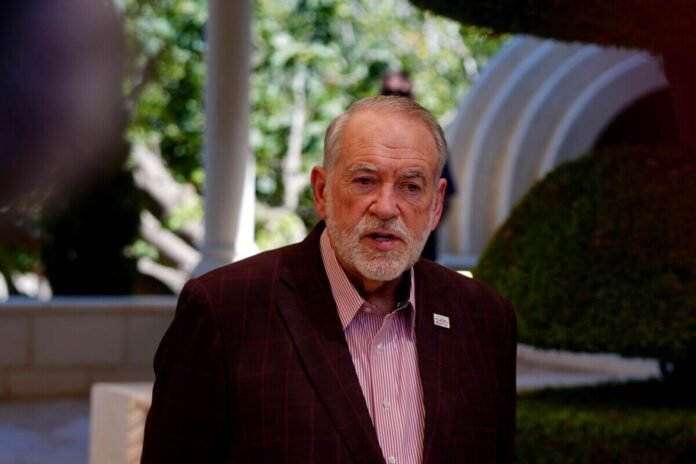
US Ambassador to Israel Mike Huckabee, an evangelical Christian and one of Washington’s most outspoken supporters of Zionism and Israel’s settlement project, has accused the British government of “Jew hate” in an extraordinary attack prompted by comments from Foreign Secretary Ed Miliband, who is himself Jewish.

Huckabee launched the attack after Miliband published a video describing a meeting with people who had been in Gaza and were working on the ground there. The foreign secretary said what he had heard about the humanitarian and medical situation was “horrific”, including accounts of medicines being blocked from entering the enclave and children dying while waiting for life-saving treatment.  

Miliband said the accounts reinforced the need for Britain to take stronger action. He said the government had to “act more decisively” than it had until now.  

UK Foreign Secretary Ed Miliband:

I just came out of this meeting talking about Gaza to people who’ve been there and are there on the ground.

And frankly, it was horrific what is unfolding. You know, the stories that people were telling me of medicines being blocked, children… pic.twitter.com/UCq8ChMHD0

— Clash Report (@clashreport) September 5, 2026

Responding to the video, Huckabee wrote on X: “The Brits have lost it. The Jew hate of their government knows no boundaries and knows no facts.” 

The Brits have lost it. The Jew hate of their government knows no boundaries and knows no facts. https://t.co/W6iZ1ZrHrR

— Ambassador Mike Huckabee (@GovMikeHuckabee) September 5, 2026

Israel’s foreign ministry had earlier attacked Miliband’s account, insisting there were “no restrictions whatsoever” on medicines entering Gaza and citing the quantity of medical supplies admitted since the October 2025 ceasefire. 

The British Foreign Secretary @Ed_Miliband posts a video recounting “stories” he was told about Gaza.

If the Foreign Secretary were interested in facts rather than stories, he would know that there are no restrictions whatsoever on the entry of medicines into the Gaza Strip, and… https://t.co/JuPUpyhPLM

— Israel Foreign Ministry (@IsraelMFA) September 5, 2026

However, recent assessments by international humanitarian agencies contradicted the Israeli claim. On 2 September, the World Health Organisation (WHO) said critical laboratory and diagnostic supplies “remain restricted” and that it had not been permitted to bring prosthetic and rehabilitation equipment into Gaza for more than two years. 

“WHO has not been allowed to send prosthetic and rehabilitation equipment into Gaza for more than two years.”

OCHA, the United Nations Office for the Coordination of Humanitarian Affairs, has similarly reported restrictions and delays affecting the entry of health commodities, alongside critical shortages of medicines and medical supplies.  

READ: UK vows further measures amid ‘unacceptable’ expansion of illegal West Bank settlements

The diplomatic confrontation comes as the new government of Prime Minister Andy Burnham prepares what Miliband has called a “comprehensive” response to Israel’s accelerating settlement expansion in the occupied West Bank. 

Measures under consideration reportedly include a ban on trade in goods produced in illegal Israeli settlements, alongside targeted sanctions against individuals and entities involved in settlement expansion.  

Miliband has said Britain does not want UK companies “financing, constructing, or advertising” new Israeli settlements. The proposed measures follow Israel’s decision to advance the E1 settlement project occupied East of Jerusalem. London says E1 would cut through the occupied West Bank, separate it further from East Jerusalem and jeopardise the territorial viability of a Palestinian state.  

The government has already said it intends to target sanctions at those involved in illegal settlement expansion. Earlier measures introduced by Britain and international partners targeted networks accused of financing and enabling settler violence, while British businesses were advised against economic and financial activity in illegal settlements.  

The proposed settlement trade ban, which legal analysts say is the least Britain must do to meet its obligations under the 2024 International Court of Justice ruling, has sparked harsh criticism from Britains pro-Israeli lobby

Stauch advocates of Israel within UK Jewish communities have urged Burnham to reconsider the measure, arguing that it could have unintended consequences for British Jews. Other Jewish voices, including Yachad, have supported sanctions relating to Israel’s occupation and settlements.  

Huckabee’s accusation of anti-Semitism comes against the background of his own longstanding commitment to Christian Zionism and Israeli territorial claims. He is the first evangelical Christian to serve as US ambassador to Israel and has repeatedly referred to the occupied West Bank by the biblical term “Judea and Samaria”. He has previously rejected the description of the territory as occupied and has preferred to call Israeli settlements “communities”.  

Huckabee has also questioned whether a Palestinian state should be established in the occupied West Bank at all, suggesting in 2025 that land could instead be found in a Muslim-majority country. In February this year, his use of biblical claims to discuss an Israeli right to territory stretching from the Euphrates to the Nile provoked condemnation from a group of Arab and Muslim-majority states, although Washington stressed that his remarks did not represent a change in official US policy.  

The Foreign Office did not respond directly to Huckabee’s accusation, but pointed to nearly £318 million ($430 million)in government spending over three years to protect Jewish communities and combat what it called anti-Semitism.

READ: US Amb. Huckabee doubles down on ‘terror’ label for Israeli occupier violence

0FansLike
0FollowersFollow
0FollowersFollow
0SubscribersSubscribe
- Advertisement -
Google search engine

Recent Posts