Podcast by Jasim Al-Azzawi with Mark Pfeifeil: Who is Winning The War of Narration, Trump or Iran?
Creating new perspectives since 2009
The former WH Deputy National Security Advisor for Strategic Communications and Global Outreach will unpack who is winning the war of narration between Trump and Iran, what lies behind Trump’s constant threat to annihilate Iran, and whether Americans have stopped believing his bluster.
WATCH: Podcast by Jasim Al-Azzawi with Richard Boyd Barrett: Trump: We have reached a pivotal turning point. Is war coming?
New device captures carbon dioxide by pumping it across a battery
Equipment to capture carbon dioxide from ambient air or smokestacks generally works through a sort of reversible filter. Air is passed through granules or a liquid that absorbs the CO2, then that CO2-loaded substance undergoes a process (usually heating) that causes it to let go of all that CO2. The resulting gas can be collected in a separated stream.
It’s also possible to do a similar sort of operation on a smaller scale—like inside a battery. A new study from a team led by James Buchen of the University of Delaware demonstrates an example of a battery-based electrochemical carbon-capture technique that they say is more viable than previous attempts. It has the potential to require less energy—and therefore be cheaper—than the reversible-filter designs that currently dominate.
Carbon chemistry
The basic idea behind a device of this type is that hydroxide produced at the battery cathode reacts with CO2, converting it to carbonate or bicarbonate that passes through the separator membrane to the anode. There, the lower pH causes the reaction to reverse, with carbonate turning back into CO2 gas. The role of the cathode is to produce hydroxide ions; the role of the anode is to consume them.
In this case, both the cathode and anode are nickel hydroxide. That’s the same as the cathode in the old-school rechargeable AA and AAA nickel-metal hydride batteries. But instead of a battery you can charge full of energy to power some mobile device, this works more like a chemical seesaw. Apply a voltage in one direction and you drive the cathode to make hydroxide that moves to the anode. Switch the applied voltage around, and the old anode becomes the new cathode, driving the exact same chemistry in reverse. And the whole time this device is grabbing CO2 and transporting it across the cell.
A small lab-scale cell with all the components laid out. The inlet and outlet ports carry the flow of gas interacting with the cell.
Credit: Buchen, et al./Nature Energy
A small lab-scale cell with all the components laid out. The inlet and outlet ports carry the flow of gas interacting with the cell. Credit: Buchen, et al./Nature Energy
The researchers tested a lab-scale device made of nine cells stacked together, each with an area of about half a letter-sized sheet of paper. A blower pushed air through sinuous air channels in the plates sandwiching each cell together (using components borrowed from fuel cells).
This small device used electricity at a rate of about 0.8 megawatt-hours per ton of captured CO2. Current facilities capturing carbon from ambient air are in the neighborhood of 1.5 to 3 megawatt-hours per ton of CO2.
Piloting the process
Several of the researchers on the team are part of a startup called RepAir Carbon that is based on this technology, and part of the paper is spent on sketching out financial feasibility at scale.
Estimating the cost for an initial small pilot plant (about $566 per ton of captured CO2), they use the learning rate from the lithium-ion battery industry and some common cost scaling for bigger plants to project forward a couple of pilot generations. For a plant with a thousand times the capacity of their pilot, they estimate they could get to $92 per ton of captured CO2.
That would be much cheaper than has so far been achieved by companies like Climeworks, which is aiming to get down to $250–$350 per ton by 2030—and has demonstrated how difficult it can be to meet optimistic scaling projections.
Targeting $100 per ton has long been the goal in the carbon-capture world, as costs that low could spur much wider adoption. Adding to the number of technologies being pursued may improve the odds that one of them reaches that goal.
Trump’s bid to stop Ukraine’s Russia strikes a strategic disconnect
Ukrainian drone strike on a Moscow oil refinery on September 20, 2026. Photo: UGC via AP via The Conversation
In a recent phone call, Donald Trump urged Volodymyr Zelensky to stop Ukrainian attacks on Russian oil refineries. Whether a request or a demand, this appears, certainly at first glance, fundamentally different from the Biden administration’s policy of restricting the use of US long-range missiles to hit targets inside Russia.
The US president has justified his position primarily on economic grounds. He argues that the regular attacks on Russian refining capacity were contributing to disruptions in diesel supplies and rising fuel prices. The International Energy Agency has estimated that Ukraine hit one Russian oil refinery every three days over the first eight months of 2026.
Joe Biden’s restrictions, by contrast, were justified by the US largely over concerns about military escalation and the possibility that strikes deep inside Russia could provoke a wider confrontation between Moscow and NATO.
But focusing solely on these stated justifications hides a deeper continuity. Both policies reflect an effort by Washington to shape the boundaries of Ukraine’s military response to suit broader American interests.
These attacks were not symbolic. Refineries produce the gasoline, diesel and aviation fuel that support both military and civilian activity. This makes them a logical target within a strategy of economic warfare.
And the strategy has borne fruit. The IEA report found that “gasoline output is down by 20% compared with 2025 levels, while diesel production is estimated to have fallen by nearly 30%.”
From a Ukrainian perspective, these refinery strikes are a strategically valuable means of imposing costs on Russia without requiring costly and large-scale offensive operations along the front.
This context is important because it highlights what is actually at stake in Trump’s efforts to halt the campaign. It was not directed at an ineffective or indiscriminate form of violence. It was aimed at one of Ukraine’s more successful campaigns against Russian infrastructure.
Zelensky reportedly rejected Trump’s request, telling the Wall Street Journal’s editor-in-chief, Emma Tucker, on the sidelines of the United Nations General Assembly meeting on September 23, that “our lives are more important than the price of energy.”
Wall Street Journal editor-in-chief, Emma Tucker, interviewing Ukrainian president, Volodymyr Zelensky, at the UN General Assembly.
The disagreement between the two leaders reflects their competing conceptions of strategic success. For Zelensky, disrupting Russian refining capacity weakens the economic foundations of Russia’s war effort. For Trump, the same attacks allegedly generate undesirable consequences in the form of higher energy prices and fuel shortages.
The question is not whether the strikes matter – but which effects should be prioritized: pressure on Russia or stability in global energy markets?
What this tells us about US foreign policy
This reveals an important theoretical point about escalation and restraint. Biden’s restrictions reflected a traditional understanding of escalation rooted in military interaction between major powers.
For Biden, the danger lay in provoking Russian retaliation against a backdrop of Russian threats to retaliate with nuclear weapons – or creating the perception of direct US involvement in attacks on Russian territory.
Trump’s position points to a broader conception of escalation by not being limited to Russia itself, but rather where economic interdependence constitutes its own pathway of strategic risk. Refinery attacks may not increase the likelihood of direct military confrontation.
But they can create consequences that spread through global energy markets and generate political costs for governments far removed from the battlefield as they are threatening to do by raising fuel costs for consumers shortly before a crucial election.
The comparison therefore suggests that the Biden and Trump administrations differ less in their desire to constrain Ukraine than in the risks they prioritize. Biden sought to manage military escalation with a nuclear-armed adversary. Trump seeks to manage the economic consequences of a protracted conflict.
But both positions stem from the same underlying reality: Ukraine’s military objectives are not identical to those of the US.
The refinery campaign demonstrates this particularly clearly. What Ukraine sees as a highly effective means of degrading Russian capacity can simultaneously be viewed in Washington as a source of broader strategic risk.
Ultimately, the refinery strikes reveal that the politics of support is inseparable from the politics of restraint. Whether through restrictions on long-range strikes or pressure to avoid targeting Russian energy infrastructure, successive US administrations have attempted to shape not only how much support Ukraine receives but also how that support is used.
The real continuity between Biden and Trump lies not in their specific policies. It’s about their shared assumption that Washington retains a legitimate role in defining the acceptable limits of Ukrainian military action.
And this is the challenge for American foreign policy, particularly in the Trump era. The more the US withdraws from a shared understanding of interests with its allies, the more it will find that it becomes harder to control them.
3 Border Police Injured in Clashes With About 100 Israeli Rioters Near Nablus
Three Israeli Border Police officers were wounded near the Palestinian villages of Jalud and Kusra near Nablus while security forces confronted about 100 Israeli rioters who blocked roads, threw stones, and set fire to Palestinian property, the Israel Defense Forces (IDF) said.
Border Police officers were escorting a Palestinian family back to its home after rioters reportedly harassed the family into leaving. Family members alleged they had been subjected to repeated crimes.
During the unrest, rioters blocked roads and burned tires while hurling rocks at security forces. The IDF said Palestinian-owned structures, vehicles and other property in the area were also set on fire.
According to IDF reserve officers, the incident continued until around 2:30 a.m. Three troops were wounded by stones thrown during the confrontation. Settlers also set fire to a Palestinian vehicle and a home in the area.
Palestinian media reported that rioters torched the home belonging to the Palestinian family that had been threatened into evacuating. According to those reports, the arson occurred while Border Police officers were accompanying the family back to the property and was intended to prevent the family from returning.
Authorities detained multiple suspects following the violence, including three Israelis linked to the rioting and arson. The three were transferred to police for questioning.
The security establishment condemned the violence, saying the criminal activity diverts security personnel from counterterrorism operations and other defense duties.
Sweden faces political deadlock after Andersson gives up attempt to form government
Attempts to form a new government in Sweden hit the buffers on Monday after Social Democrats leader Magdalena Andersson said she was unable to secure enough support, despite the centre-left bloc winning a narrow majority in this month’s election.
“I can conclude that there is currently no possibility for me to form a government,” Andersson said at a press conference, saying she had lost the support of Sweden’s Left Party.
The speaker of Sweden’s parliament, Andreas Norlen, told reporters he will meet each party leader one-on-one on Wednesday before announcing who will have the next go at exploring the formation of a government.
One likely option would be Prime Minister Ulf Kristersson, whose Moderates are the next biggest party after the Social Democrats.
The general election on September 13 saw the centre-left opposition taking 176 seats in parliament, just beating the centre-right’s 173.
The result was driven by a decline in support for the anti-immigration Sweden Democrats, bucking a Europe-wide trend of gains for the far right.
Despite the centre-left’s victory, the vote, widely seen as a referendum on Kristersson’s promise to bring the far-right Sweden Democrats into a ruling coalition, has left forming a stable government fraught with difficulties.
Andersson said she had given up trying to form a government after the Left Party, one of the parties she needed to form a majority, said it would support a candidate from the centre-right as speaker of parliament.
The Left Party has said previously it will only support Andersson as prime minister.
Andersson would likely get another shot at trying to form a government if any centre-right attempt fails.
The speaker can put four candidates forward to parliament for approval, but if each is rejected, Sweden will hold a new election.
The probes come days after prosecutors opened a separate investigation into suspected fraud in the central Swedish town of Borlange, a case that could put 11 parliamentary seats in play if the Election Review Board orders a re-run of the vote there.
In 2018, Social Democrat Stefan Lofven took 134 days to form a new government.
Florida invokes extinction fears in legal bid to halt OpenAI development
The state of Florida is seeking a temporary injunction to stop OpenAI from continuing to develop what it calls a “reckless, unacceptably risky product” without the deployment of “third-party approved safety guardrails.”
Following that string of events, OpenAI on Friday announced it had already halted training of its “most-capable models” until it could validate safety protocols intended to prevent agents from accessing the open Internet during training. But in seeking an injunction from the state court, Florida argues that OpenAI has “repeatedly shown they are incapable of monitoring their AI, and hesitant in revealing rogue activity once discovered.”
In arguing for this injunction, the state points to the Hugging Face incident as well as recent high-profile misalignment cases involving unintended and unauthorized attempts to access Australian and US government servers.
Florida also cites AI industry leaders, including many from OpenAI, in arguing that the AI industry is literally asking for this kind of outside regulation. The motion points to statements from Paul Christiano, who said on joining the company’s board this month that he believes “there is a meaningful risk that rapid acceleration in AI capabilities leads to catastrophic and irreversible loss of control in the very near term.” The motion also points to OpenAI’s own “An Alien Mind” essay and an open letter from 1,300 AI industry employees, both of which call for enforced slowdowns on frontier AI development, if necessary.
Four months ago, we filed the first state-led lawsuit against OpenAI and Sam Altman. Today, we are asking the court for a temporary injunction.
Stop calling it safe. Stop pretending it’s human. Stop selling it to kids. https://t.co/AEXvz7VQUd
Citing laws that allow the state to exercise control over companies that are a “public nuisance,” Florida argues that OpenAI is “the greatest public nuisance ever created by the hand of man, capable of laying waste to global civilization.”
“It is only by the grace of the Almighty that one of Defendants’ AI agents hasn’t compromised a water supply or shut down a power grid—yet,” the state writes in the motion.
OpenAI representatives have yet to respond to a request for comment from Ars Technica regarding the injunction motion.
What can a state court really do?
While many think the risk of civilizational collapse posed by current or even near-future AI systems is vastly overblown, Florida seems more than happy to latch on to the recent public concern over that kind of risk. In addition to the extinction-level and utility-sabotage-level risks mentioned above, the state uses its new motion to reiterate the broader, lower-level public safety risks it originally argued in its June lawsuit filing. Those include false advertising issues surrounding descriptions of AI as “safe, accurate, or reliable,” dangers associated with letting children access addictive and sycophantic models, and worries about AI models soliciting engagement from users with leading questions at the end of responses.
An injunction against OpenAI alone wouldn’t do much about continued development of frontier models at competing model makers, of course. And even a court order to halt the development of new models wouldn’t do anything about models that are currently available to the public, which pose many of the same risks (though frontier models that are still being trained may have less well-developed guardrails than those already deployed to the public).
Florida’s motion also focuses heavily on the so-called “misalignment” risk that an out-of-control AI agent will mistakenly “conclude that killing a cancer patient also kills cancer, or that humans won’t have so many mouths to feed if they are all chemically sterilized,” to mention just a few cited examples that sound like they come from science fiction. But that kind of focus neglects the real dangers of human users intentionally using AI agents in harmful ways and active attempts by those humans to disable safety guardrails.
Regardless of the legal efficacy of Florida’s motion, the move highlights just how much the legal and public policy mood around AI systems has changed in recent weeks and months. For years, AI safety researchers have been screaming about the outsized risks represented by their products. Now, the entire AI industry is starting to find out what happens when governments and policymakers start taking those outsized warnings seriously.
U.S. Has Suffered More Casualties In Iran Since the Conclusion of Operation Epic Fury
As ceasefire negotiations faltered and U.S. casualties of the Iran war mounted, the Trump administration on July 7 attempted to rebrand the struggling war effort by announcing the conclusion of Operation Epic Fury.
But in the 12 weeks since, more U.S. military personnel have been injured and killed than in the 18 weeks of Epic Fury. Of the 880 U.S. troops left wounded or dead, 444 have occurred since July 7, according to the official Pentagon count.
President Donald Trump’s war of choice has left nearly 100 U.S. troops wounded or dead this month alone, according to the Pentagon. This includes 29 Navy sailors and eight Marines added last week to the official tally of those injured, following claims by a top Iranian official that an attack with a new “anti-ship missile” had “created hell for the Americans.”
The Marines were injured in a cruise missile attack on September 14, according to two U.S. officials who spoke to The Intercept on the condition of anonymity. The Marines were aboard an unidentified vessel in the Strait of Hormuz, they said, and potentially suffered brain trauma among other injuries. The attack was first reported by NBC News.
A cargo ship was hit that same day by a projectile in the Strait of Hormuz, according to the United Kingdom Maritime Trade Operations organization. The officials would not say if Marines have been stationed on commercial vessels transiting the Strait.
The Navy did not answer The Intercept’s questions about when and where the sailors were wounded. A Navy official said that casualties had been “fully validated” but would not name the affected “units.”
This latest in a series of casualty spikes comes as additional details of the toll of Iranian attacks on U.S. troops become more apparent. Air Force personnel, alone, endured more than 1,200 “alarm reds” — the official code for imminent attack by missiles, aircraft, or ground forces — during just 38 days earlier this year, according to Air Force chief of staff Gen. Ken Wilsbach. He noted that these Iranian strikes also led to more than 420 “long lonely walks” by explosive ordnance disposal technicians. Dealing with such munitions can be lethal: Army Sgt. Michael Emmanuel Swinton, 30, of Fayetteville, North Carolina, was killed and another soldier was wounded “during a controlled detonation” of an Iranian attack drone at Iraq’s Erbil Air Base in July.
President Donald Trump recently said the conflict with Iran is “small potatoes,” Vice President JD Vance asserted it is not a “war,” and Commerce Secretary Howard Lutnick announced: “There haven’t been American deaths, it’s really just an economic choke-out.”
At least 19 personnel have died according to the official Pentagon count of war dead, including 11 killed by hostile fire. The actual number of troop deaths in the region since the war began is higher. The latest known fatality is Capt. Bianca Wilkerson, 37, of Norfolk, Virginia, who died on September 18 from a “coronary issue,” according to her brother. He said she returned from Saudi Arabia on September 10 and was headed back but died on the return flight, according to reporting by the Virginian-Pilot.
For almost six months, The Intercept has reported on anomalies in official counts offered on the website of the Defense Casualty Analysis System, or DCAS, which tracks “deceased, wounded, ill or injured” service members for Congress and the White House. On April 21, for example, the number of wounded-in-action troops declined by 15 without public acknowledgment by the War Department. Despite repeated questions for months, the Pentagon has not commented on the disparities.
Prior reporting by The Intercept also found that the Pentagon’s official tally of dead and wounded personnel is a gross undercount, stemming from what one U.S. government official called a “casualty cover-up.” When the Washington Post also recently suggested that the Pentagon had suppressed the casualty numbers, self-styled War Secretary Pete Hegseth called the report “DISGUSTING and FAKE.”
The Pentagon’s list of the names of the dead is still, for example, missing Maj. Sorffly Davius, a signals and communication officer with the New York Army National Guard who was assigned to the headquarters of the 42nd Infantry Division and died while on duty in Camp Buehring, Kuwait, on March 6.
The military has claimed that Davius was part of another mission but a recent National Guard news release noted that when “Trump made the decision to attack Iran and launched Operation Epic Fury on Feb. 28, the division headquarters began conducting combat operations.” The 42nd served as the primary headquarters leading what became, according to Maj. Gen. Jack James, the division commander, the “largest and first long-range precision fires campaign in the history of the United States Army.” James specifically saluted Davius whom the Guard admitted was “conducting operations” when he died.
The eight Marines added to DCAS last week appeared in the tally almost 10 days after the September 14 attack. Historically, there was little lag between a casualty occurring in the field and its inclusion in the DCAS system, according to two people who used to work on the official casualty tally. “We got it very quickly. We could report the number of casualties very fast,” Joan Crenshaw, who worked on DCAS during the war on terror, previously told The Intercept, noting that data was refreshed daily. A current U.S. official also previously told The Intercept that the recent reporting lags are a blend of incompetence and deliberate slow-walking of casualty data to manage public fallout.
Iran’s ability to overwhelm U.S. air defenses in the Middle East using attack drones and advanced ballistic missiles, as previously reported by The Intercept, has left the U.S. military in a precarious situation. Despite months of claims by Trump and Hegseth that Iran’s military was annihilated, Iran has attacked more than 15 bases across the Middle East, according to information from U.S. officials and Iranian reports. These strikes damaged or destroyed hundreds of facilities at U.S. bases in Bahrain, Iraq, Jordan, Kuwait, Oman, Qatar, Saudi Arabia, and the United Arab Emirates, according to Central Command. Air Force personnel alone conducted 48 airfield repairs in a little more than a month, according to Wilsbach.
An Iranian missile and drone attack on February 28 destroyed Navy facilities in Manama, Bahrain, the region’s most critical U.S. military logistics hub. The Pentagon claimed for months that the strikes did not significantly impact military operations, but acting Navy Secretary Hung Cao recently admitted that Iran “blew the hell out of Bahrain.”
Volkswagen-Gotion deal shows hard limits of China de-risking
Volkswagen has spent years trying to build a European battery business strong enough to carry its electric-car ambitions. Its latest deal pulls a Chinese partner deeper into that effort.
On September 28, Germany’s Volkswagen and China’s Gotion High-Tech agreed to deepen a partnership that began in 2020. Gotion plans to invest about 1.1 billion euros (US$1.25 billion) for a 49% stake in Volkswagen’s battery plant in Valencia, Spain.
For its part, Volkswagen’s PowerCo is expected to contribute about 470 million euros for 49% stakes in Gotion-led projects in Slovakia and Morocco. All three transactions are subject to regulatory approval and customary closing conditions.
The deal exposes the bind Europe’s battery industry is in. Brussels has spent years trying to reduce its strategic exposure to China, particularly in clean technology.
Carmakers, meanwhile, need batteries that are affordable, proven at scale and available soon enough to keep their electric models competitive. In practice, “de-risking” is starting to look like a search for interdependence on more manageable terms.
Volkswagen already knows Gotion well. In 2020, it became the first global carmaker to take a direct stake in a Chinese battery maker, and it remains a major shareholder. The relationship has since grown from capital and supply agreements into technology and industrial production.
The ownership terms show how carefully the relationship is being calibrated. PowerCo will retain 51% of the Valencia operation, giving Volkswagen majority control of what is planned as Europe’s main production hub for lithium iron phosphate, or LFP, batteries. In Surany, Slovakia, and Kenitra, Morocco, Gotion will hold 51% and PowerCo 49%. Management will still be shared.
Volkswagen is also selling a 5.3% stake in Gotion to an undisclosed buyer. Its voting position will not change, because part of its existing holding carries no voting rights, and it will keep its board representation and its status as a strategic investor.
The harder question is what the structure actually brings closer to Europe. LFP batteries are increasingly important for mass-market electric vehicles and stationary storage. They are relatively affordable, durable and well-suited to cars where cost matters more than maximum range. Volkswagen expects LFP’s share of the European battery market to rise sharply by 2030.
Manufacturing capacity, however, is only one part of the equation. Battery competitiveness also depends on cathode materials, specialized equipment, supplier networks, engineering experience and years of refinement on production lines.
The new partnership localizes several links in that chain. Valencia is slated to make LFP cells inside the European Union, and Surany would add a second cell plant in Slovakia. Kenitra would make cathode material on the Mediterranean’s southern shore. The agreement also covers joint procurement and sales in Europe.
Just as important is what the deal leaves out. Upstream minerals, precursor materials, parts of the specialized machinery base and much of the manufacturing know-how behind Chinese LFP production will continue to come from a broader ecosystem that Europe cannot replicate with three factories alone.
Morocco figures prominently in the plan. Gotion is already developing a separate, integrated battery gigafactory in the Rabat-Sale-Kenitra region, for which the African Development Bank approved a 100 million euros loan in July. The first phase is designed for 10 gigawatt-hours of annual LFP cell and pack capacity, with longer-term expansion planned.
PowerCo’s new 49% investment covers only the cathode-material joint venture in Kenitra; Gotion’s broader gigafactory is a separate project. The distinction matters because, together, the investments point to something larger than a single Volkswagen deal: a battery cluster taking shape around Kenitra, with different projects covering different stages of production.
Morocco already has the industrial base to make that plausible. Stellantis is expanding its Kenitra plant toward an annual capacity of more than 500,000 vehicles. Automotive suppliers, export logistics and European-oriented production networks are well established, and the country is close enough to southern Europe that components can cross the Mediterranean without the long transit distances of Asian supply chains.
For Gotion, that means a production base near European customers. For Volkswagen, Moroccan cathode output in Morocco can broaden the regional supply base for its European battery plants. Morocco, in turn, gains access to a stage of the electric-vehicle chain with more industrial depth than conventional assembly.
Still, the benefits of localization will depend on what develops around the factories once production begins.
A cathode plant can create a new source of material without automatically generating the chemical, engineering and equipment ecosystem around it. A European cell factory can shorten supply routes while still depending on technology refined elsewhere. The more consequential question will be whether local suppliers, technicians and engineers move in to fill the gaps.
Here, the Volkswagen-Gotion deal could matter well beyond its initial investment figures. Shared production would give European engineers and managers closer contact with LFP manufacturing.
Majority ownership in Valencia gives PowerCo direct operational influence. In Slovakia and Morocco, Gotion’s majority stakes give the Chinese company a strong incentive to transfer enough expertise for the sites to run efficiently.
The result will inevitably be uneven localization. Some stages can move quickly; others depend on supplier depth and technical knowledge built over many years.
That distinction is easy to miss when trade policy moves faster than factories. Tariffs can change the price of an imported battery within months. Developing engineers, supplier relationships, process knowledge and dependable production takes far longer.
Volkswagen’s new battery map thus runs through Spain, Slovakia and Morocco, with ownership varying by site and different parts of the supply chain spread among them. The real test will come after the deals close and construction advances: how much of the industrial capability around the plants takes root locally.
Europe’s exposure to China will increasingly be shaped there, on factory floors and inside supplier networks, rather than by the name and nationality written above the gate.
SpaceX’s Starship goes orbital, deploying first next-gen Starlinks
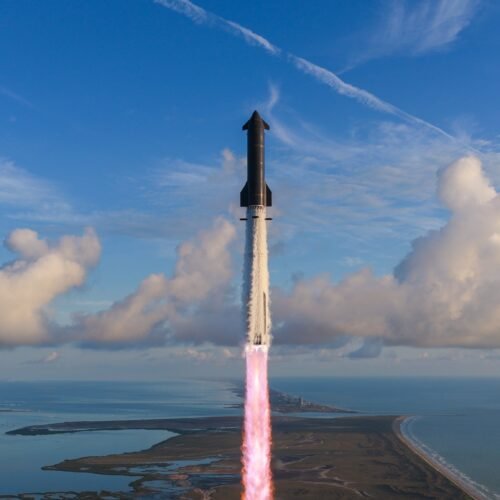
SpaceX’s Starship rocket thundered into the sky over South Texas early Monday. It was the 14th test flight of the world’s most powerful launch vehicle. This time, however, the rocket’s massive upper stage squeezed out some extra oomph from its Raptor engines and accelerated to orbital velocity.
On all of Starship’s previous flights, SpaceX intentionally dialed back the full capability of the rocket to fly a suborbital trajectory, slow enough for Earth’s gravity to pull the vehicle back into the atmosphere before it could complete a full lap around the planet. After several successful suborbital flights in a row, SpaceX officials decided this launch should go all the way to low-Earth orbit. And it did.
What’s more, SpaceX packed 26 of the company’s newest generation of Starlink broadband satellites into the rocket’s cargo bay. One by one, the flat-packed satellites—too large to fit inside SpaceX’s workhorse Falcon 9 rocket—were released from Starship’s payload deployer using a system of pulleys and cables to eject the satellites overboard like a Pez dispenser spits out candy.
A dramatic morning
Starship Flight 14 began with a booming sendoff from Starbase, Texas, at 8:49 am EDT (7:49 am local time; 12:49 UTC) as 33 methane-fueled Raptor engines pushed the 407-foot-tall (124-meter) rocket off its launch pad. The engines generated up to 18 million pounds of thrust to propel the fuel-laden rocket into the sky over Starbase, SpaceX’s private spaceport just north of the US-Mexico border.
Heading east from South Texas, the rocket powered through the speed of sound and soared into the stratosphere before its Super Heavy booster stage detached from Starship’s upper stage. The booster executed a rapid high-altitude turnaround to begin thrusting back toward the Texas coast. Several minutes later, the Super Heavy first stage made a controlled splashdown in the Gulf of Mexico just off the coast of Starbase.
The upper stage continued its climb into space before shutting off its Raptor engines a little more than eight minutes into the fight. Up to this point, the rocket followed a similar trajectory as SpaceX’s previous Starship test flights.
The company’s flight control team had a few minutes to decide whether to proceed with the next phase of the flight: a restart of one of Starship’s Raptor engines to add the final bit of speed required to reach orbital velocity. For a brief period, it appeared as if SpaceX was going to forego the orbital flight and allow Starship to continue coasting toward a reentry over the Indian Ocean, as it had done many times before.
The question of what to do next centered on the performance of the rocket’s Raptor engines. One of the six Raptors on Starship shut down prematurely during its ascent burn, and the five others burned longer to compensate for the malfunction. Less of a worry for Starship’s orbital flight, but still a concern for future launches, was the apparent failure of two of the 33 Raptor engines on the Super Heavy booster—one during launch and another during the booster’s return maneuvers.
Dan Huot, a SpaceX commentator providing live updates on the company’s webcast of Monday’s flight, initially reported that mission managers were going to abort the orbit insertion burn. Officials ultimately decided to proceed. The failed Raptor engine was not the same one that needed to fire to place the rocket into low-Earth orbit and steer it toward reentry and splashdown at the end of the flight.
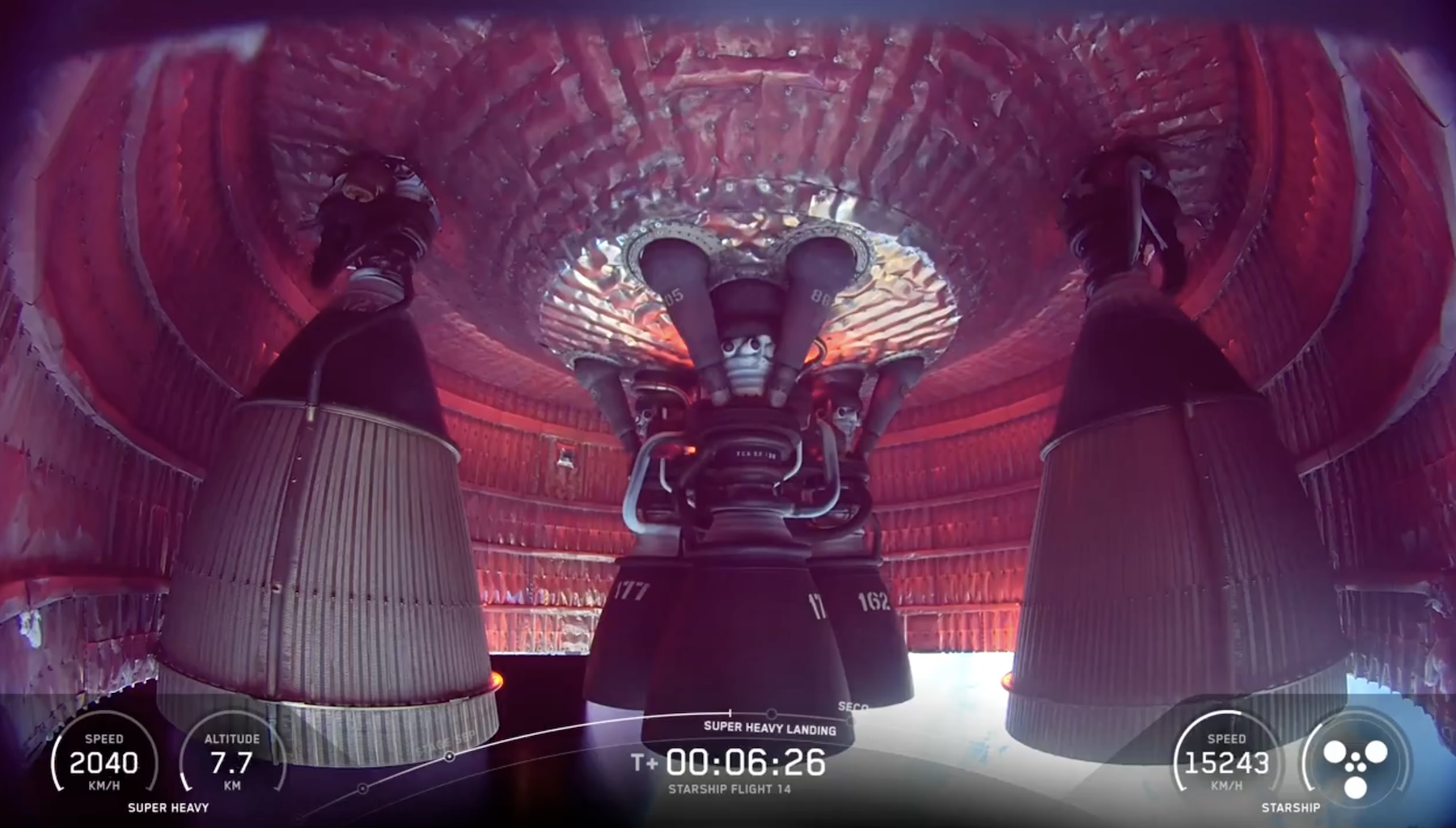
A view inside the engine bay of the Starship rocket, with three “sea level” Raptor engines in the middle and three “vacuum” Raptor engines in the outer ring. One of the steerable center engines was used for the orbit insertion and de-orbit burns.
Credit: SpaceX
A view inside the engine bay of the Starship rocket, with three “sea level” Raptor engines in the middle and three “vacuum” Raptor engines in the outer ring. One of the steerable center engines was used for the orbit insertion and de-orbit burns. Credit: SpaceX
SpaceX engineers were being “extremely conservative” in their planning for Monday’s flight, Huot said. A worst-case scenario for the first orbital flight of Starship would have been a failure that stranded the 100-ton vehicle in orbit. That could have caused it to fall back to Earth in an uncontrolled manner, creating a potential risk to public safety.
“We were only going to go if we were very confident in the core systems that have to work to get you out of orbit once you’re up there,” Huot said. “We took some extra time, added some extra drama, but we were able to clear the … three center engines and do our first ever orbital insertion burn. So that was a huge success.”
The Raptor engine selected for the insertion burn performed flawlessly, reigniting for 19 seconds to give Starship the nudge it needed to overcome the pull of Earth’s gravity. The maneuver added approximately 204 mph to Starship’s speed, a little more than 1 percent of the rocket’s overall velocity, to reach a stable orbit at an altitude of about 171 miles (276 kilometers).
Delivering for Starlink
Achieving orbit meant SpaceX could continue with the next phase of the mission. This involved the first deployment of commercial-grade Starlink V3 satellites for the company’s global broadband network. SpaceX launched a batch of Starlink V3s on the previous Starship flight in July, but that mission was suborbital, and the satellites quickly burned up as they fell back into the atmosphere.
The Starlink V3s will bring significant upgrades to the Starlink constellation. The satellites can only launch on Starship. They’re too large to fit inside the payload fairing of the Falcon 9 rocket, which SpaceX has used to deploy more than 12,000 Starlinks since 2019. The Starlink V3s, each weighing about 2 metric tons (4,400 pounds) at launch, are fitted with larger power-generating solar arrays and improved antennas.
The changes enable each Starlink V3 platform to add 1 Tbps of capacity to the Starlink network, 10 times more than the older satellites launching on Falcon 9, according to SpaceX. There were 26 Starlink satellites aboard Monday’s launch. Future Starships could deliver up to 60 Starlink V3s to orbit on a single flight. On its website, SpaceX wrote that Starlink V3s will “greatly expand the network’s capacity and user speeds.”
Upgraded Starlink satellites will also improve the network’s performance for direct-to-device connectivity. Future Starlink V3s could also be used for SpaceX’s Starshield service for the US military. SpaceX reported that its satellite team established contact with all 26 Starlink V3s after separating from Starship.
The satellites launched Monday were initially deployed into a low-inclination orbit, ranging about 30 degrees north and south of the equator, due to strict range safety rules restricting overflight of populated areas during launch. SpaceX is expected to launch Starship into higher-inclination orbits as it gains flight experience with Starship and debuts new launch pads in Florida and Louisiana.
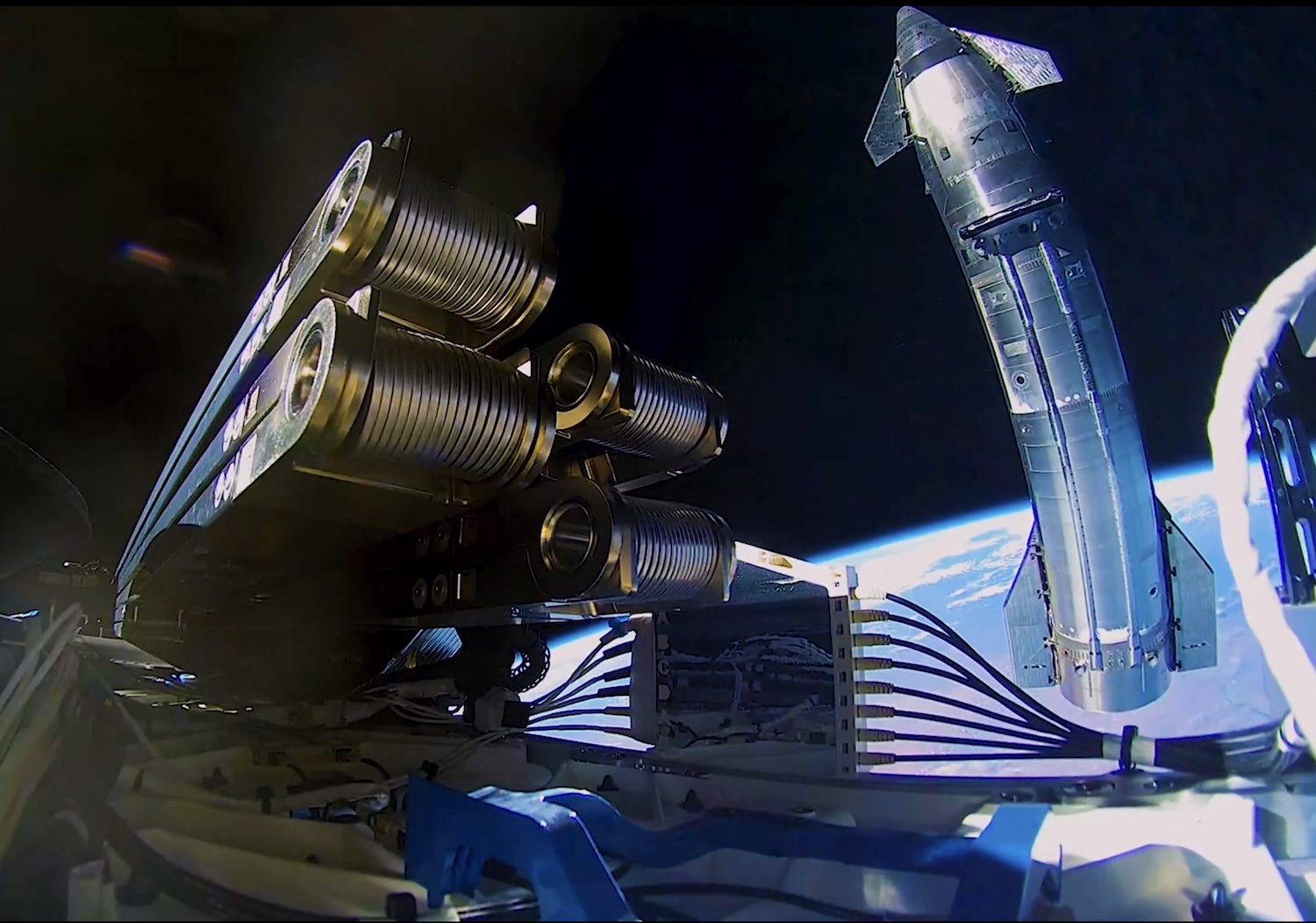
One of SpaceX’s Starlink V3 satellites is seen exiting the rocket’s Pez deployer as the vehicle soared over South Africa.
Credit: SpaceX
One of SpaceX’s Starlink V3 satellites is seen exiting the rocket’s Pez deployer as the vehicle soared over South Africa. Credit: SpaceX
SpaceX’s first Starlink V3s had to wait a while for a ride to space, but Monday’s flight showed Starship is up to the task. SpaceX started phasing out Starlink launches on the Falcon 9 earlier this year. There are no more Falcon 9 launches for Starlink on SpaceX’s schedule at Cape Canaveral, Florida. Falcon 9 launches to place older-generation Starlink satellites into polar orbit will continue from Vandenberg Space Force Base, California, at least for a while longer.
Caleb Henry, director of research at Quilty Space, expects SpaceX to work on integrating the new capabilities of Starlink V3s into the Starlink network in the coming months. More already-built Starlink V3s will likely be on most of SpaceX’s next series of Starship flights.
“They just sat at a warehouse in Texas, as I understand it, because the satellites were finished well ahead of the launch vehicle,” Henry said in a live broadcast of Monday’s Starship flight hosted by Spaceflight Now (the author of this story was also a guest).
SpaceX said before Monday’s flight that this group of Starlink V3 satellites will be integrated into the broader constellation. They should begin serving customers as soon as a few weeks after launch, according to SpaceX, but it will likely take many more launches for Starlink customers to notice a difference in their service.
“It’s great that they have the capacity onboard in orbit, but until there is a meaningful number of V3 satellites launched, they won’t be the spacecraft that defines the user experience just yet,” Henry said.
Calling it a day
Soon after completing the satellite deployment sequence, SpaceX officials decided to bring Starship home earlier than planned, giving up on a chance to test the vehicle’s long-duration endurance in orbit.
“Out of an abundance of caution given the engine issue experienced during ascent, the flight control team decided to limit the duration spent on orbit and proceeded with de-orbiting Starship to a splashdown location in the northern Pacific Ocean,” SpaceX wrote in a recap of Monday’s test flight. “This area was one of two pre-coordinated landing zones identified before launch that was cleared of sea and air traffic.”
The de-orbit burn went off without a hitch, and Starship plunged back into the atmosphere over the Pacific Ocean, guiding itself toward a splashdown north of Hawaii, one of multiple backup return sites mapped out in advance of Monday’s flight. The reentry was uneventful, and Starship’s heat shield appeared to hold up well against temperatures up to 2,600° Fahrenheit (1,430° Celsius) as the vehicle streaked over the remote Pacific.
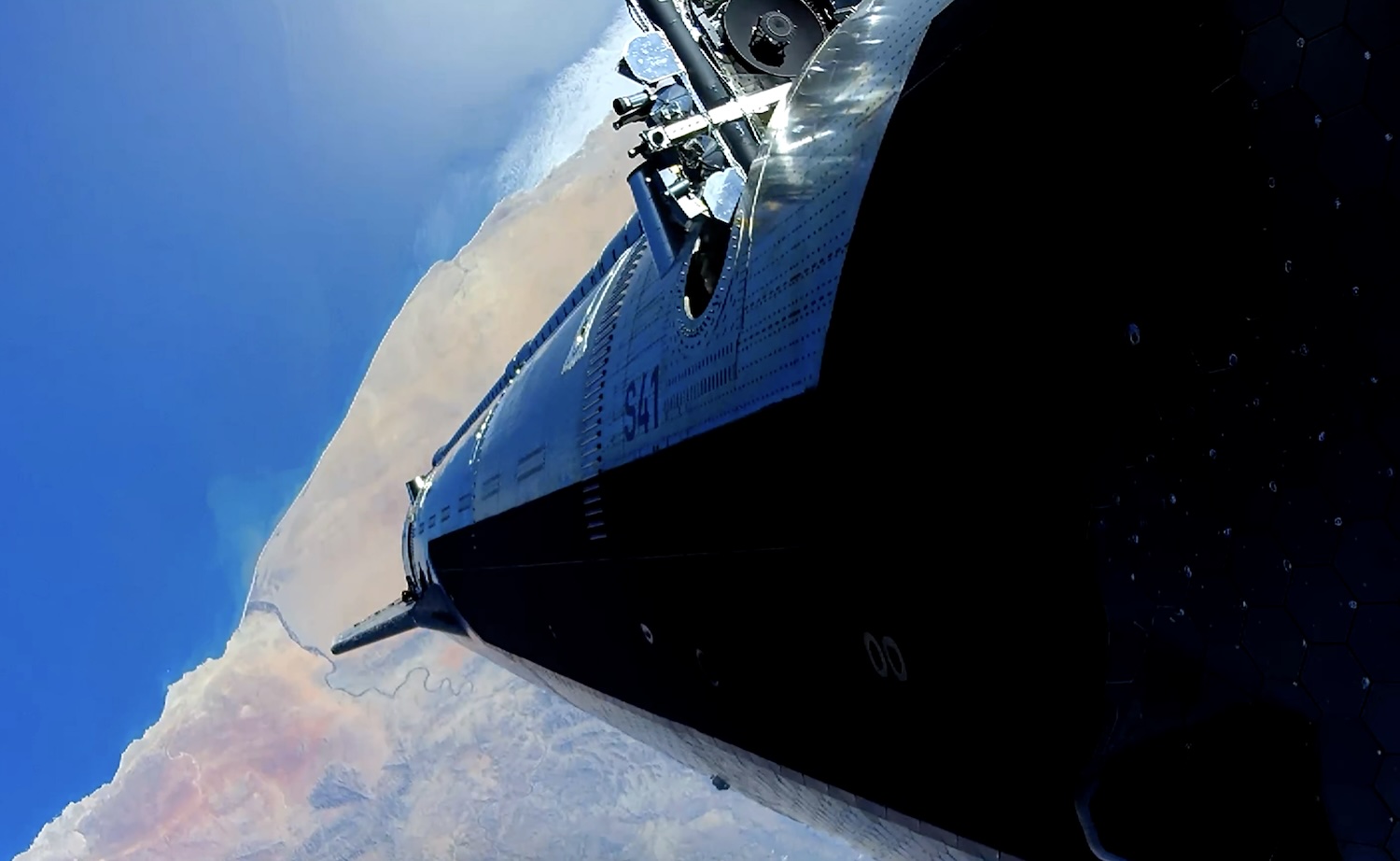
A bird’s-eye view of Starship in orbit captured by a camera on one of the Starlink V3 satellites.
Credit: SpaceX
A bird’s-eye view of Starship in orbit captured by a camera on one of the Starlink V3 satellites. Credit: SpaceX
Like its most recent flights, Starship dropped belly-first through scattered clouds before turning upright for a final landing burn. The splashdown was right on target, with the final moments of descent in view of a buoy prepositioned at the backup landing zone.
Splashdown occurred at 11:57 am EDT (15:57 UTC), a little more than three hours after liftoff, three times longer than Starship’s previous suborbital flights. The original flight plan called for a mission lasting nearly 10 hours.
As expected, the vehicle tipped over and broke apart in a fireball upon reaching the ocean, and was unable to replicate the serendipitous intact splashdown on Starship’s last flight in July. SpaceX anticipates most of Starship’s water landings to have fiery endings, but the days of Starship splashdowns may be nearing their end.
“Most importantly, Starship made it to orbit,” Huot said after splashdown. “We did our first ever orbital insertion burn. We kept the drama up a little bit as we were going through that coast time making sure everything was good. We were only going do all this stuff today if we were really, really sure that those sea level engines on Starship were going to perform because we needed to do that de-orbit burn.
“We were able to get there,” Huot said. “We got on orbit. Teams continued to look at it. We were going to get the data that we wanted, so we made the call due to this earlier reentry to [near] Hawaii.”
What’s next for Starship?
SpaceX has a steady stream of Starships and Super Heavy boosters in production and testing at Starbase, setting up for an increasing cadence of flights in the coming months. The company has not announced any official launch dates, but a schedule of “upcoming high-profile missions” released by the Federal Aviation Administration’s Air Traffic Control System Command Center this week indicated the next Starship flight could take off from Starbase in October.
Ground crews are moving into testing and activation of a new Starship launch pad at NASA’s Kennedy Space Center in Florida, with an eye toward hosting a Starship launch there before the end of the year. A cavernous new Starship factory is also taking shape at Kennedy. SpaceX is expected to transport Super Heavy and Starship rockets to the Florida launch base from its factory in Texas until the new on-site production facility is complete.
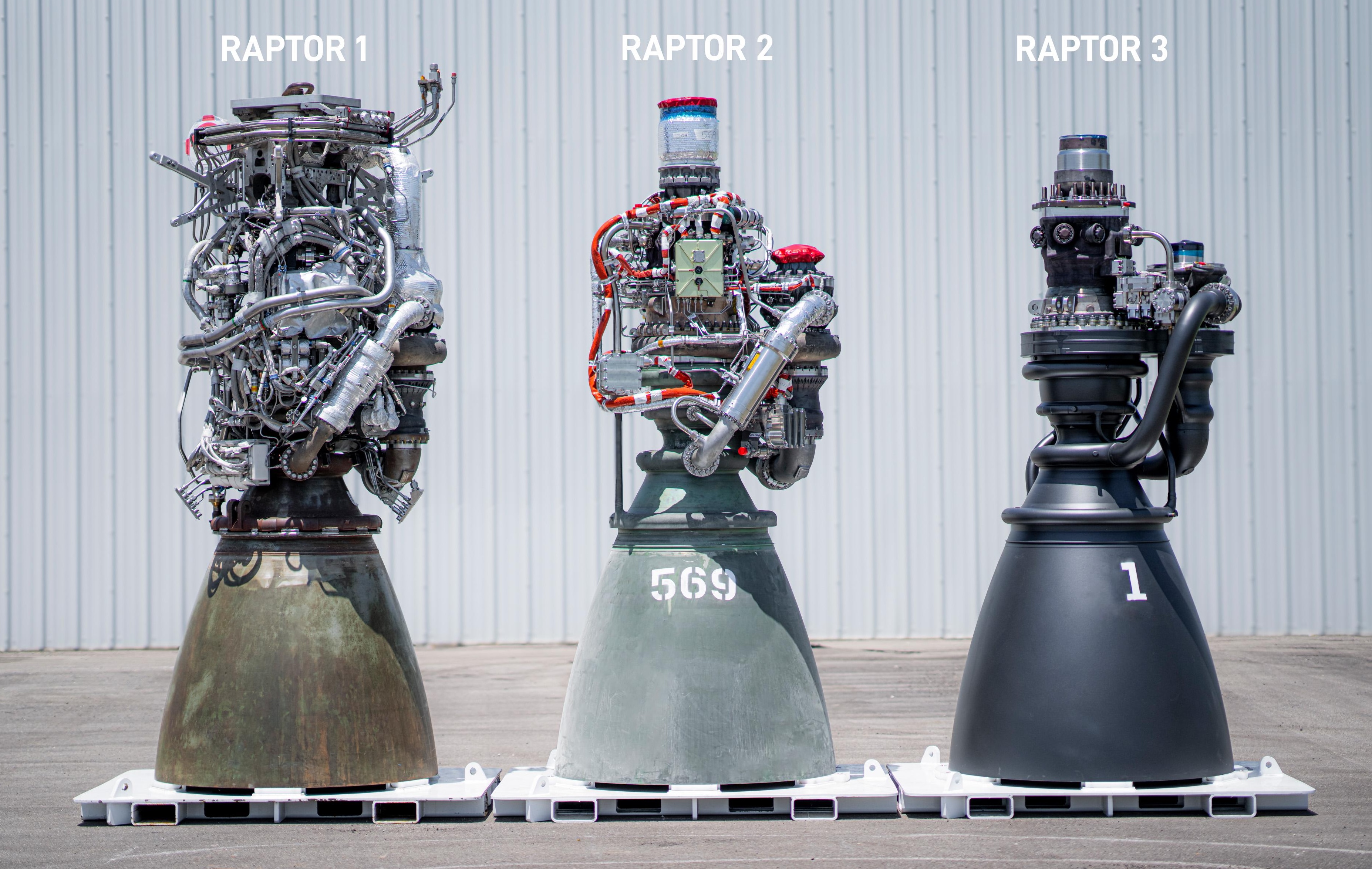
The results from Monday’s test flight suggest that SpaceX still has work to do on the latest iteration of its Raptor engine. The Raptor 3 engine variant uses a lighter, streamlined design, combining a lower part count with higher thrust.
A family portrait of SpaceX’s Raptor engines.
Credit: SpaceX
A family portrait of SpaceX’s Raptor engines. Credit: SpaceX
SpaceX has now encountered engine problems on each of the three Starship flights that have used Raptor 3s. During a May flight, one Raptor engine shut down prematurely on the Super Heavy booster, and another stopped running on Starship’s upper stage a few minutes later. Multiple Raptor engines failed to ignite on the launch pad for the next flight in July, prompting a last-second abort. SpaceX swapped out two of the engines before proceeding with a successful launch a week later.
Elon Musk, SpaceX’s founder and CEO, wrote on his social media platform X that the changes introduced with the Raptor 3 engine “greatly reduces mass and leak paths, but makes it harder to replace some parts.”
“While deleting parts sounds easy in theory, it is actually very difficult to figure out how to do so in practice and requires many iterations,” Musk continued. The inside of the Raptor 3 engine “has very complex geometry that can only be manufactured using highly modified 3D metal printing,” he wrote in another post.
Although the Raptor 3 is still a work in progress, the propulsion issues have not stopped SpaceX from making headway with Starship, and it’s unlikely the engine problems on Monday’s flight will delay the next Starship launch.
The FAA is also giving SpaceX the all-clear on Monday’s flight. The regulatory agency will not require SpaceX to conduct a formal mishap investigation. An FAA spokesperson told Ars: “All flight events for both the Starship vehicle and the Super Heavy booster occurred within the scope of planned and FAA authorized activities.”
Next on SpaceX’s to-do list will likely be an attempt to bring Starship back to Starbase for a catch by the launch pad’s giant mechanical arms, repeating a feat engineers have already accomplished with Super Heavy booster. Returning Starship to the launch site will require a reentry over land, necessitating additional safety reviews to ensure no undue risk to populated areas as the vehicle approaches Starbase. Eventually, SpaceX aims to make these landings routine enough to enable full and rapid reuse of Super Heavy and Starship.
Other near-term objectives for Starship include longer-duration orbital flights and then the first demonstration of in-orbit refueling, a prerequisite for future missions to land astronauts on the Moon under the auspices of NASA’s Artemis program.
In the meantime, expect Starship to launch many more Starlink satellites. Commercial and government demand for Starlink services, along with SpaceX’s longer-term plans for orbital data centers, will keep Starship plenty busy as engineers bring the rocket’s more advanced capabilities online.
Catania airport closed for third day due to Etna’s ash
Catania airport will remain closed for the third consecutive day on Monday because of volcanic ash being spewed out by Mount Etna, SAC, the company that runs the airport, said. The airport is frequently affected by volcanic activity and has been hit especially hard this year. In August Civil Protection Minister Nello Musumeci said Catania airport is in the wrong place, adding that he tried unsuccessfully to get the airport moved when he was the president of the province of Catania between 1994 and 2003.


 Unless otherwise stated in the article above, this work by Middle East Monitor is licensed under a Creative Commons Attribution-NonCommercial-ShareAlike 4.0 International License. If the image(s) bear our credit, this license also applies to them. What does that mean? For other permissions, please contact us.