20.8 C
London
Friday, September 4, 2026
Home Blog

Netanyahu Declares Fall of Iranian Regime Is ‘’Within Reach’ 

0
netanyahu-declares-fall-of-iranian-regime-is-‘’within-reach’ 
Netanyahu Declares Fall of Iranian Regime Is ‘’Within Reach’ 


Israeli Prime Minister Benjamin Netanyahu said in Tel Aviv that removing Iran’s government has become a central Israeli objective and is within reach. 

Netanyahu made the comments during a toast ahead of Rosh Hashanah, which begins next week, at the Kirya. Defense Minister Israel Katz, Chief of Staff Lt. Gen. Eyal Zamir, and members of the IDF General Staff Forum attended. 

“This regime is currently crumbling. It is weaker than ever. Overthrowing the regime is the central mission still before us, but it is near. It is not impossible, and it is within reach,” Netanyahu said. 

Netanyahu said Iran has refrained from attacking Israel because its leaders understand Israel’s military capabilities and willingness to use them. 

“It is no coincidence that they are not attacking us. They are attacking everyone except us. They know our strength, the force of our blows and our determination,” he said. 

Netanyahu also expressed confidence that Israel could eliminate the threat posed by Iran and bring down its government. 

“I am convinced of our ability to remove the threat once and for all and overthrow the Iranian regime that is fighting for its life. I say to our enemies – don’t mess with us. We have the power, the determination, and the internal unity to overcome you.” 

His remarks come as renewed fighting between the US and Iran continues and negotiations aimed at ending the conflict have reached an impasse. 

Earlier Thursday, Katz warned that any Iranian attack on Israel would prompt strikes against all of the regime’s infrastructure, “including energy infrastructure.” Iran had threatened retaliation over Israel Defense Forces operations at Lebanon’s Ali Taher Ridge, a strategic underground facility. 

Before the US renewed strikes in response to Iran targeting vessels in the Strait of Hormuz and attacking US bases in the region, US President Donald Trump declared an “economic D-Day” aimed at using financial pressure to bring down the Iranian government. Trump described it on Truth Social as “the most crushing economic operation ever taken against any country!” 

The US has imposed sanctions, frozen assets and adopted additional financial measures intended to restrict Tehran’s access to international trade and foreign currency. 

Iran is also confronting an economic crisis, with the Iranian rial falling to more than 2 million per US dollar as sharply rising inflation drives up food prices and other essential costs. 

When the American aircraft carrier loses its aura

0
when-the-american-aircraft-carrier-loses-its-aura
When the American aircraft carrier loses its aura

Most people around the world have probably come to know the American aircraft carrier in much the same way: through US Navy publicity films, Hollywood blockbusters, television news and political debates.

For decades, these images taught us what an American carrier was supposed to look like — and, perhaps more importantly, what we were supposed to feel, and to fear, when one appeared. This time, the cameras kept rolling after the heroic image should probably have ended.

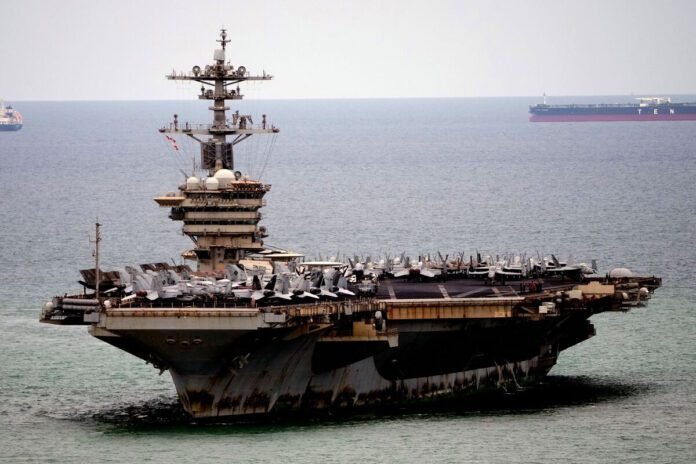
The USS Abraham Lincoln arrived in Thailand on September 2 after more than eight months on deployment, much of it literally at sea. The carrier had spent much of that time supporting US combat operations against Iran.

Its roughly 5,000 crew members finally had the opportunity to go ashore. Many headed for nearby Pattaya, the Thai beach town notorious for its red lights. By then, however, another picture of the carrier had already been circulating.

Families of sailors had reported food shortages, broken toilets, moldy showers and water contamination during the prolonged deployment. Photographs of the enormous hull showed streaks of rust.

Then came Thailand: thousands of sailors finally leaving the ship for shopping, food, drink and the nightlife of Pattaya, a city whose international reputation as an R&R destination was itself partly created by American servicemen during the Vietnam War.

From major newspapers and television networks to the endless feeds of social media, the world was suddenly seeing the American supercarrier almost with the naked eye. Captain America had somehow disappeared from the picture. The brighter the old image had been made to shine, the more glaring the rust now appeared.

I am not a paparazzo. Unlike some international reporters, I have no particular desire to follow American sailors into Pattaya’s go-go bars to investigate what happened next. To remain euphemistically polite, readers interested in the details of what awaited them there may consult the BBC.

The sailors themselves deserve no ridicule. After so long at sea, they deserved their rest. What interests me is what had already happened to the image.

Try to imagine Captain America, shield still in hand, emerging somewhat unsteadily from a Pattaya go-go bar. Americans themselves might have no difficulty accepting that even heroes are ordinary human beings who need to eat, drink, sleep, use a functioning toilet and occasionally have a night off.

But this is not the visual memory that decades of Hollywood, military publicity and political theater taught much of the rest of the world. Captain America was supposed to arrive with his uniform immaculate, his muscles tightened and his shield held at the proper angle.

The aircraft carrier belonged to much the same visual world. As an art historian who works with visual culture, I am interested in how remarkably consistent its images have been. Fighter jets roar from the flight deck. Sailors stand in formation.

The enormous ship cuts through a perfect blue ocean while escort vessels arrange themselves around it in geometrical order. The carrier is almost always given the distance it needs. And that distance turns machinery into monument.

A submarine becomes more dangerous by disappearing. A missile can wait unseen in a silo. An aircraft carrier announces itself. It is enormous, expensive and deliberately visible. It turns abstract military power into a physical object that can be photographed, filmed and sent across the world.

For much of the postwar era, American military superiority, political theater, television and Hollywood reinforced one another so successfully that the supercarrier became one of the most immediately recognizable images of national power on earth. It became a kind of Mount Rushmore at sea.

And Mount Rushmore is not supposed to stumble out of a go-go bar.
Monuments work best from the proper distance. Look too closely, and the image becomes less simple.

This is particularly important for an aircraft carrier because it carries more than aircraft. Its appearance carries an expectation about how the person looking at it should respond. Awe is part of the machinery. So is fear.

Shortly before the USS Abraham Lincoln reached Thailand, a US Navy P-8A Poseidon flew through the Taiwan Strait. The Seventh Fleet said the transit demonstrated America’s commitment to a “free and open Indo-Pacific” and repeated that the US military “flies, sails, and operates anywhere international law allows.”

Operations like this are announced publicly because presence must be visible if it is to become a political signal. I understand that signal perfectly well. I simply find it increasingly difficult to feel its intended effect.

This is not because the aircraft carrier has suddenly become militarily irrelevant. The Lincoln itself has just demonstrated the opposite. It sustained months of operations at extraordinary distance, supported combat operations against Iran and kept thousands of people and dozens of aircraft functioning through an exceptionally long deployment. As a machine of war and military organization, it remains formidable.

But being formidable and looking almighty are not quite the same thing.
Even the language surrounding the ship reveals something about the grandeur attached to it. In Chinese, an aircraft carrier is hangkong mujian (航空母舰) — something like the “Mothership of Navy and Air Force,” a union of naval and air power in a single name.

The English “aircraft carrier” sounds logistically uncool and almost comically mundane by comparison, especially when the words themselves are so strangely unpompous: a carrier carries things, while craft can be something made by hand.

Read too literally, the mightiest warship in the world begins to sound like a mule carrying a load of little wooden birds made by a folk craftsman. Chinese has somehow given the American warship an additional layer of grandeur in translation. Yet even linguistic assistance cannot protect an image forever.

This is what makes the Lincoln episode interesting to me. Rust by itself means almost nothing. Ships rust. Broken toilets do not change the balance of naval power. Food shortages do not make fighter jets stop flying. Sailors needing a shower and a night ashore is hardly evidence of imperial decline. Nor does a visit to Pattaya make the carrier’s aircraft any less lethal.

But images accumulate. The rust matters because the ship was supposed to gleam. The toilet stories matter because the floating city was supposed to look almighty. The shortages matter because abundance is part of the visual language of power.

The exhausted sailors matter because military spectacle normally turns thousands of ordinary human beings into disciplined figures arranged across a flight deck. And Pattaya matters because, after all those other images, the camera finally followed those human beings all the way out of the monument.

The sublime and the ridiculous suddenly found themselves uncomfortably close.
The United States can still decide where an aircraft carrier sails, what aircraft it carries and, when necessary, what targets those aircraft attack.

What it cannot control quite so completely is what happens to the image once it enters everybody else’s screens. The object can still arrive exactly where Washington intends but the feeling does not necessarily arrive with it.

Awe requires distance. Get close enough to almost any monument, particularly military ones, and eventually you find rust, bad plumbing and tired people who would rather be somewhere else.

Pattaya alone did not destroy the aura of the American aircraft carrier. That would give a Thai resort town far too much geopolitical responsibility. The erosion has been slower and much less dramatic.

But after the rust, the shortages, the overflowing toilets, the moldy showers and the exhausted human bodies, the sight of thousands of sailors finally heading into the neon lights felt like the last straw.

Hu Chao is a Singaporean art historian and curator based in Guangzhou, China. His research focuses on the intersection of material culture, technology, and geopolitics in Asia.

Israeli army kills 3 Palestinians, wounds others in Gaza Strip despite ceasefire

0
israeli-army-kills-3-palestinians,-wounds-others-in-gaza-strip-despite-ceasefire
Israeli army kills 3 Palestinians, wounds others in Gaza Strip despite ceasefire

The Israeli army killed three Palestinians and wounded others in separate attacks on Gaza Strip on Thursday despite an ongoing ceasefire, a medical source told Anadolu, Anadolu reports.

One Palestinian was killed and two others were injured in a drone strike targeting a group of civilians in central Gaza City, according to a medical source.

A medical source at Al-Shifa Hospital told Anadolu that the body of the deceased victim arrived at the facility heavily disfigured.

The strike on Al-Thawra Street also injured two other Palestinians, according to preliminary medical reports.

An Anadolu correspondent on the ground confirmed that the Israeli drone targeted a gathering of civilians in the area.

In an earlier attack, a medical source said Israeli army gunfire killed one Palestinian and wounded others in Beit Lahia.

A second Palestinian was later killed when Israeli forces opened fire on tents housing displaced Palestinians and homes in the area, the source added.

In a statement, the Israeli army acknowledged killing a Palestinian in northern Gaza, claiming that its forces had spotted an “armed individual who crossed the Yellow Line and approached the forces in a way that posed an immediate threat.”

It was not immediately clear whether the Palestinian killed in the army’s account was one of the two people whose deaths were reported by the medical source in Beit Lahia.

In Khan Younis, southern Gaza, a medical source at Nasser Hospital said a Palestinian was wounded by Israeli army gunfire inside a camp for displaced people in the Hamad residential area, north of the city.

In a statement, the UN human rights office said that at least 24 Palestinians, including four children and a woman, were killed in Israeli attacks over a five-day period, emphasizing that Gaza remains unsafe although it has been nearly a year since the announcement of a ceasefire.

“There is no safe place, nor safe person, in Gaza,” the office noted.

“Twenty-four Palestinians were killed in Israeli attacks over five days between Aug. 28 and Sept. 1, including four children and a woman, 21 of whom were killed in airstrikes,” the statement said.

According to preliminary information cited in the report, Israeli forces carried out a raid on Sept. 1 in the Al-Katiba area, west of Gaza City. The raid resulted in the deaths of a 3-year-old girl, a 13-year-old boy, and a 31-year-old man.

The fourth victim of the raid was a 49-year-old woman, who was killed while Israeli forces were detaining her 51-year-old husband, Muin Al-Arbeed.

The UN office noted that Al-Arbeed holds the rank of colonel in the internal security service of the de facto authority in Gaza.

The UN office stressed that Israel’s claims of targeting individuals it deems “lawful targets” do not absolve it of its obligations under international humanitarian law and international human rights law, including the duty to respect the right to life for Palestinians.

It emphasized that such claims “do not justify the daily life of horror experienced by Palestinians in Gaza,” calling for an end to the bloodshed and demanding justice and accountability for all unlawful killings in the enclave.

Israel launched its military campaign in Gaza on Oct. 8, 2023. The offensive continued for two years, causing widespread destruction, while Israeli violations have persisted despite a ceasefire that took effect on Oct. 10, 2025.

Since the ceasefire took effect, Israeli violations have killed 1,334 Palestinians and wounded 4,429 others, while rescue teams have recovered hundreds of bodies from beneath the rubble, according to Gaza’s Health Ministry.

Israel’s military campaign in Gaza has killed about 73,470 Palestinians and wounded 174,540 others since October 2023, the ministry said Thursday.​​​​​​​

Supreme Court urged to let states regulate sports bets on prediction markets

0
supreme-court-urged-to-let-states-regulate-sports-bets-on-prediction-markets
Supreme Court urged to let states regulate sports bets on prediction markets

New Jersey yesterday asked the Supreme Court to rule on whether states can regulate sports betting on prediction markets such as Kalshi.

“Companies like Kalshi claim to offer legal sports betting in all 50 states, but they refuse to follow the gambling laws of any state,” New Jersey Attorney General Jennifer Davenport said in a press release announcing the lawsuit.

In April, the US Court of Appeals for the 3rd Circuit ruled that New Jersey cannot regulate sports bets on prediction markets. The court determined that sports-related event contracts meet the legal definition of “swaps,” giving the US Commodity Futures Trading Commission (CFTC) exclusive jurisdiction.

New Jersey’s petition to the Supreme Court said, “The issue is one of tremendous practical and legal consequence: Kalshi seeks to federalize the multi-billion-dollar sports betting industry at the expense of every state sports gaming law. And the decision [by the 3rd Circuit] is badly mistaken.”

New Jersey’s petition to the Supreme Court came about a week after the 9th Circuit appeals court ruled that Nevada can stop Kalshi from allowing sports bets. Unlike the 3rd Circuit, the 9th Circuit judges determined that sports betting labeled as swaps is just gambling with a different name.

The split between circuits “has tremendous importance, as it will determine whether a multi-billion-dollar gaming industry can suddenly operate free from state sports-gaming laws,” New Jersey’s petition said.

Circuit split raised odds of Supreme Court taking case

The circuit split dramatically raised the odds that the Supreme Court will step in and determine who’s right, although Kalshi reportedly said it won’t allow bets on the case. Davenport’s office said New Jersey’s petition asks the Supreme Court “to hear a question that divided courts nationwide: whether prediction markets can offer sports wagers without following state sports-gambling laws.”

“Litigation regarding these questions has erupted across at least 20 states, with dozens of active suits pending and the gambling laws of several states currently enjoined by the federal courts,” Davenport’s office said. “This is the first certiorari petition filed with the US Supreme Court regarding the legality of this business model—of offering sports wagers self-certified by Kalshi with the Commodity Futures Trading Commission (CFTC) without following state laws.”

New Jersey regulates gambling and prohibits betting on college sports entirely but hasn’t been able to enforce its laws against Kalshi. New Jersey’s petition asked the Supreme Court to determine “whether the 2010 Dodd-Frank Wall Street Reform and Consumer Protection Act preempted States from regulating sports bets that occur within their jurisdictions if those bets are offered on markets registered with the Commodity Futures Trading Commission.”

New Jersey’s petition said that “if Kalshi is right that it can offer sports bets on federal exchanges irrespective of state law, companies can disregard all state sports-gambling statutes with ease, so long as they register with the CFTC.” New Jersey said the 3rd Circuit decision is “profoundly wrong.”

Defining sports bets as swaps

The more specific legal question is whether the US law’s definition of a swap includes sports bets. The Dodd-Frank Act amended the Commodity Exchange Act to give the CFTC exclusive jurisdiction over swaps and defined “swap” as “any agreement, contract, or transaction… that provides for any purchase, sale, payment, or delivery… that is dependent on the occurrence, nonoccurrence, or the extent of the occurrence of an event or contingency associated with a potential financial, economic, or commercial consequence.”

Judges have come to different conclusions about whether athletic contests are events with potential financial, economic, or commercial consequences. Third Circuit judges ruled that “the outcome of a sports event certainly can be associated with a potential financial, economic, or commercial consequence,” with “numerous affected stakeholders, including sponsors, advertisers, television networks, franchises, and local and national communities.”

The Trump administration has backed Kalshi in the company’s fights against states, and the CFTC has filed lawsuits itself against states to block them from regulating prediction markets. Donald Trump Jr. is an advisor to Kalshi and Polymarket, and his venture capital firm has invested in Polymarket.

While Trump has had plenty of success at the current Supreme Court, the court’s conservative majority isn’t necessarily a guarantee that states will lose this battle. After all, the three 9th Circuit judges who unanimously ruled against Kalshi were all appointed by Trump.

“Placing sports bets, even when called by another name, is still gambling,” 9th Circuit Judge Ryan Nelson wrote. Judge Kenneth Lee said the outcome of a typical sports game is not an “event” with financial, economic, or commercial consequences as conceived in US law governing swap contracts.

“Few people would describe, say, the New York Mets’ latest loss of a game as an ‘event.’… perhaps in an uber-technical sense a Mets’ loss could have marginal economic impact as some fans guzzle more beer to drown away their sorrows. But it seems somewhat fanciful to say that the outcome of a single game in a 162-game season is likely ‘associated’ with a ‘financial, economic, or commercial consequence’ that one would expect in a swap contract,” Lee wrote.

NJ: Congress did not federalize gambling regulation

New Jersey’s petition to the Supreme Court cited the 9th Circuit’s discussion of swaps and said that prohibiting state regulation of sports bets on prediction markets would conflict with other US laws on the balance of power between the federal government and states.

“Kalshi argues that in granting the CFTC ‘exclusive jurisdiction’ over ‘swaps’ on CFTC-registered markets, Congress in 2010 actually preempted sports-wagering laws applied to these bets,” New Jersey said. “But as the Ninth Circuit has since explained, these sports bets are not ‘swaps’ as the statutory text and structure uses that term. And it strains credulity to hold that Congress in resolving the 2008 financial crisis took steps to federalize regulation of sports gambling that was otherwise explicitly addressed across other federal statutes spanning decades.”

New Jersey argued that if Kalshi is right, it would mean casinos are violating US law. “Dodd-Frank also prohibits companies from offering swaps off of CFTC-registered markets. So if Kalshi is correct that Dodd-Frank federalized regulation of sports wagering, then state-licensed sportsbooks that everyone has understood to be legal since [Murphy v. NCAA]—including at brick-and-mortar casinos—have apparently been violating Dodd-Frank all along,” New Jersey said.

New Jersey also said the CFTC’s exclusive jurisdiction over swaps doesn’t preempt state laws. The state argues that even if sports bets are considered swaps, the CFTC authority is exclusive only relative to other federal agencies. The CFTC authority doesn’t preempt states’ police powers over gambling, which “Congress repeatedly recognized and embraced across decades of reticulated federal gaming laws,” New Jersey said.

Netherlands moves gold reserves to UK amid rising geopolitical uncertainty

0
netherlands-moves-gold-reserves-to-uk-amid-rising-geopolitical-uncertainty
Netherlands moves gold reserves to UK amid rising geopolitical uncertainty


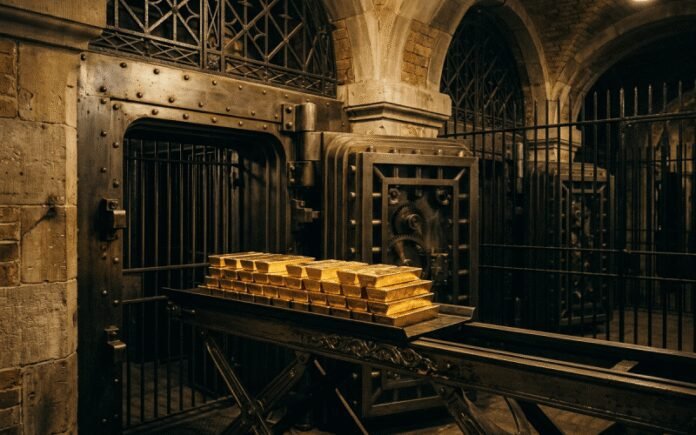
The Dutch central bank (DNB) said on Wednesday it had moved 86 tonnes of its gold stock out of the United States and Canada to London, citing “increasing geopolitical unrest.”

The DNB said gold reserves held in London could be traded more easily than those held in New York and Ottawa.

“This makes it the quickest for DNB to deploy in a crisis situation,” said the bank in a statement.

“With this step, we have improved the deployability of the gold reserves. We assume that we will never need to deploy the gold, but it is nevertheless necessary to strengthen our resilience and preparedness,” said DNB President Olaf Sleijpen.

The total Dutch gold stock amounted to 612.4 tonnes and was valued at €72.2 billion at the end of 2025, the DNB said.

Before the deployment, the Dutch bank held 31.3% of its gold in New York and 19.7% in Ottawa.

After the move, both countries account for 18.5 percent of the Dutch gold reserve.

The share of gold held in London increased from 18.1 percent to 32.1 percent. The bank still holds 30.8% of its gold in the Netherlands.

The transfer was carried out partially by buying and selling and partly by physically transferring gold, said the bank.

The bank moved more than 27 tonnes of physical gold from the United States and Canada to Zeist.

The same quantity of gold was moved from Zeist to London, preventing the melting down of gold bars.

“By combining buying and selling and physical transport, the risks associated with physically moving a large quantity of gold have been spread,” said the DNB.

Confused about which VPN is right, US senator asks the NSA for guidance

0
confused-about-which-vpn-is-right,-us-senator-asks-the-nsa-for-guidance
Confused about which VPN is right, US senator asks the NSA for guidance

A prominent US senator is asking the National Security Agency to provide guidance to the general public on best practices for using virtual private networks to secure their communications from spying by foreign adversaries.

VPNs funnel all of a user’s Internet traffic through an encrypted connection to a remote server. The design provides strong assurances that no one between the user and the server can read the encrypted contents. VPNs also allow users to hide their IP addresses from the destination servers they communicate with. While US agencies have previously recommended use of VPNs, none have given recommendations on which ones provide adequate protection.

It’s all in the nuances

There are a host of limitations that can undo many of the protections users may think their VPN provides them. For instance, the encrypted tunnel often terminates once a single server decrypts the traffic and sends it on to its final destination. That means the decrypted traffic or the sending and destination IP addresses may be available for snooping by rogue employees or attackers who hack the server. VPNs also don’t encrypt certain types of metadata, such as time stamps, allowing nation-states to build profiles that can be useful in intelligence gathering.

With so many nuances, the existing recommendations to use a VPN don’t provide enough information for people to make informed decisions. Sen. Ron Wyden (D-Ore.) is asking the NSA to provide specific recommendations.

“Americans facing advanced foreign threats—including government personnel, defense contractors, journalists, and human rights defenders—deserve clear, honest advice about how best to protect their communications from surveillance by foreign adversaries,” Wyden wrote in a letter sent Wednesday to Gen. Joshua Rudd, the director of the NSA. “To that end, I request that you update NSA’s existing public guidance on VPN configurations to address this issue.”

Specific questions touch on some fairly technical details, including the general architecture of a VPN service. They include the adequacy of single-hop VPNs, which, as noted earlier, use a single server to decrypt traffic sent by the user and send it to its destination. It also asks about multi-hop architectures, in which the traffic is funneled through two or more servers, allowing the first to see only the IP address of the sender and the terminating server to see only the destination address. The letter also inquires about the use of random delays and cryptographic padding to thwart attacks that detect timing patterns or the size of messages. Wyden further asks about the adequacy of specific services such as Apple Private Relay, Nym, and Tor.

The questions are:

1. Are standard, single-hop commercial VPNs sufficient to protect Americans’ sensitive digital footprints from foreign adversaries monitoring internet backbones?

2. Does the NSA recommend multi-hop tools such as Apple Private Relay, Tor, or Nym over standard VPNs for Americans facing heightened surveillance threats?

3. What technical features, such as random delays, padding, and cover traffic, are needed to defend against sophisticated surveillance, and how does the NSA assess multi-hop systems like Apple Private Relay compared with Tor and Nym?

Nym is an open source VPN client written in Rust, a memory-safe programming language that’s resistant to attacks exploiting buffer overflows or other types of memory-corruption bugs. Nym can route traffic through a decentralized “mixnet,” which provides random time delays and the reordering of messages. The VPN can also provide a multi-hop architecture.

Apple Private Relay provides multi-hop browsing using two servers, one operated by Apple and the other by a third-party content provider. Tor is a privacy service that encrypts traffic and sends it through three servers before decrypting it and sending it to its final destination.

Each of the services comes with pros and cons. The hops provided by Nym and Tor, for example, are operated by volunteers, some of whom may be nation-state spies trying to use their vantage point to gather intelligence. Apple Private Relay relies on content delivery networks like Cloudflare and Akamai that not everyone trusts. Its protection is also limited to the Safari browser running on Apple devices.

A memo issued by the Congressional Research Service provides an overview of the options but provides no criteria for determining which ones are best. That leaves many people unable to make informed choices about what’s best for their threat model.

“There’s no trustworthy standardization” for assessing various VPN services, Micah Sherr, a Georgetown University professor specializing in network security, said in an interview. “The VPN ads you get in YouTube commercials can be incredibly misleading. It’s extremely difficult for ordinary users to determine whether they need a VPN, what a VPN actually buys them, and which one to use.”

Wyden requested that the NSA provide answers no later than October 14.

Inside the ‘shadow fleet’ industry that keeps rogue states afloat

0
inside-the-‘shadow-fleet’-industry-that-keeps-rogue-states afloat
Inside the ‘shadow fleet’ industry that keeps rogue states afloat

Photo: Johan Nilsson / TT News Agency / EPA

It’s the middle of the night in April 2023 in the East China Sea.

A North Korea-linked oil tanker sailing under another country’s flag suddenly goes dark. It stops transmitting its location via the Automatic Identification System (AIS) machine that all large commercial ships have on board. It simply vanishes from the map.

Ten days later, the ship reappears on global tracking screens. Its signal places it off the coast of southern China.

Except it’s not. It’s actually in a bay many hundreds of kilometers away, preparing to deliver oil to North Korea in violation of UN sanctions.

Justin Hastings, a professor of international relations at the University of Sydney, has been tracking North Korea’s shadow fleets as part of his research.

He describes to The Conversation Weekly podcast the tactics that North Korea uses to disguise the identities of its shadow ships – and why it has got away with it for so long.

The first reason is that the oceans are a lot bigger than you think. It’s a lot harder to find ships that don’t want to be found in the ocean.

The second reason is that there is this presumption under international law that if a ship is on the high seas, you won’t really interfere with it unless you have very specific legal reasons.

Hastings compares the world’s oceans to the “Wild West” and says other countries such as Russia and Iran have now borrowed from North Korea’s playbook.

For countries that are engaging in sort of large-scale campaigns to evade sanctions, like Russia, that also have lots of money and lots of ships, boarding the ships … is one way to at least slow them down.

But obviously there’s a lot of ships and every interdiction is really expensive and potentially dangerous.

Watch the podcast here: https://stories.theconversation.com/tracking-north-korean-dark-ship/


This episode of The Conversation Weekly was written Justin Bergman and produced by Isabella Podwinski. Mixing by Lloyd Barrett and theme music by Neeta Sarl. Newsclips in this episode from BBC News and The Wall Street Journal.

Justin Bergman is international affairs editor, The Conversation.

This article is republished from The Conversation under a Creative Commons license. Read the original article.

Iraq’s Shadow Trade Gives Iran a Lifeline

0
iraq’s-shadow-trade-gives-iran-a-lifeline
Iraq’s Shadow Trade Gives Iran a Lifeline


Dollar flows, commercial ties, and cross-border networks offer Tehran economic channels as US pressure intensifies

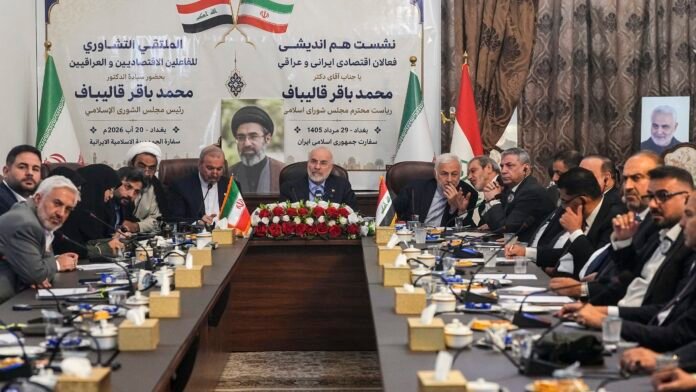
[MANAMA] Iraq remains one of Iran’s most important regional economic and financial links as Washington expands pressure on Tehran and entities accused of supporting it. Iraq’s close political and commercial ties with Iran, along with the influence of Iran-backed armed groups in parts of the economy, give Tehran access to trade routes, currency markets, and commercial networks that are difficult for US authorities to monitor.

The issue has gained urgency as Iraqi Prime Minister Ali al-Zaidi has pledged to bring the weapons of Iran-backed armed groups under state control by a Sept. 30 deadline. Iraqi officials and analysts have said progress has been slow, while Washington has continued pressing Baghdad to strengthen oversight of dollar transactions and the banking system.

Iraq and Iran share a roughly 1,600-kilometer border, with multiple formal crossings as well as longstanding informal trade routes. US authorities have documented the use of Iraqi banks and currency-exchange mechanisms to move dollars to Iran and Iran-aligned armed groups.

In December 2023, the US Treasury said Al-Huda Bank had used access to US dollars to support the Islamic Revolutionary Guard Corps-Qods Force and Iran-aligned Iraqi armed groups, including Kata’ib Hizballah and Asa’ib Ahl al-Haq. Treasury also accused the bank’s owner of using front companies and forged documents to circumvent restrictions on currency purchases and international transfers.

US restrictions on dollar transactions have narrowed the formal channels available to some Iraqi banks since 2023. The measures have reduced access to dollars for institutions targeted by the restrictions, though they have not eliminated incentives for illicit currency trading.

The Central Bank of Iraq has set the official exchange rate at 1,300 Iraqi dinars per dollar. The parallel-market rate has remained higher, reflecting continued demand for hard currency outside formal channels.

Ali Hamza, a former Iraqi banker, told The Media Line that the volume of money smuggled from Iraq to Iran is difficult to establish. “Daily shipments of dollars go to Iran through several border crossings, most notably the Shalamcheh border crossing between Basra and Iran, which is clearly controlled by Shia militias,” he said.

There is still a network of smuggled funds whose amounts are unknown

Hamza said the funds being moved had declined following US restrictions on Iraqi banks but had not stopped. “There is still a network of smuggled funds whose amounts are unknown,” he said.

He said one method involved accounts opened at Iraqi, Lebanese, and other banks in the names of Iranian nationals or figures whose beneficial ownership was difficult to trace. “These accounts are used by the Iranian Revolutionary Guard, or even some agencies of the Iranian regime, and it is impossible to trace who benefits from these accounts,” he said.

Iraqi markets carry a wide range of Iranian products, including agricultural goods, dairy products, iron and steel, household goods, ceramics, and other consumer and industrial items. Iranian customs data put Iran’s non-oil trade with Iraq at more than $7 billion in the first seven months of 2024, while Iraqi official statistics recorded about $3.1 billion in non-oil imports from Iran for all of 2024. The differing figures reflect the use of separate national reporting systems and trade classifications.

Sanjabi Shirazi, secretary general of the Iran-Iraq Joint Chamber of Commerce, told Iraqi and Iranian media outlets that “despite the decrease in the value of exports between Iraq and Iran, trade in non-energy goods is growing and active.”

Iraq exported goods worth approximately $2.2 billion annually to Iran, according to Trade Map.

“Trade between the two countries cannot be stopped for several reasons, most notably that the current government is loyal to Iran, and there are militias working for Iran as well,” Abdulrahman al-Sheikh, an Iraqi economist, told The Media Line. “Furthermore, some families living near the border between the two countries have shared ancestry and work together for each other’s benefit.”

Iran will obtain all the goods it lacks through the Iraqi market

Al-Sheikh said Iraqi exports to Iran could increase and that Iraq could be used to obtain goods restricted by US sanctions. “Iran will obtain all the goods it lacks through the Iraqi market, especially since transporting them is easy through several border crossings between the two countries, most notably the Shalamcheh crossing in Basra,” he said.

The economist also said Iran pays for some goods in Iraqi dinars and that the Iranian toman is used in some southern Iraqi provinces with Shia-majority populations. He argued that these arrangements reduce Iran’s need for dollars in bilateral trade while increasing the economic burden on Iraq.

He said Iranian goods retain a strong market in Iraq because of their price and established distribution networks. Al-Sheikh alleged that Iran-backed armed groups use their political and economic influence to favor Iranian goods.

A source familiar with the matter at the Iraqi Ministry of Industry and Minerals said repackaging operations had increased in industrial areas of Karbala and Najaf. The source, who requested anonymity because he was not authorized to speak publicly for the ministry, said some facilities might be repackaging Iranian goods for export under Iraqi labels.

Ali al-Badri, an Iraqi businessman, told The Media Line that Iranian goods could increasingly be sold with “Made in Iraq” labels to facilitate exports to other countries. He said armed groups with economic interests in manufacturing could exploit factories to repackage and relabel goods, harming Iraqi producers.

Al-Badri also said access to several industrial areas in Iraqi governorates had been restricted, though he could not identify the authority imposing those restrictions. He said he believed Iran-backed armed groups were responsible.

Iraq has also faced allegations that its oil-export system has been used to help disguise Iranian oil or fuel-oil sales and circumvent US sanctions. A source familiar with oil export operations at the Iraqi Ministry of Oil told The Media Line that “the mixing of Iraqi oil exported by the government with Iranian oil exported by other parties outside Iraq” made it difficult to determine the full volume of Iraqi oil shipped abroad.

The Ministry of Oil did not respond to a request for comment.

That allegation is consistent with a May 2026 US Treasury action against Deputy Oil Minister Ali Maarij al-Bahadly. Treasury accused al-Bahadly of facilitating the diversion of Iraqi oil products and the blending of Iranian and Iraqi oil to disguise its origin before export. The deputy minister’s designation, along with sanctions against Iran-aligned armed-group figures, pointed to the continuing risk that official and informal networks could be used to evade sanctions.

Iranian business activity is also visible in Iraq, including in Baghdad and Erbil, the capital of the Kurdistan Region. In August 2025, the Erbil Chamber of Commerce and Industry said 395 Iranian companies were operating across the Kurdistan Region, including 200 in Erbil. No comparable, current official figure was available for Baghdad.

These companies operate in many Iraqi sectors, including construction, trade, import-export, food, and energy. Contracting remains especially important because of Iraq’s extensive construction and housing needs.

Iraqi militias backed by Iran are jeopardizing Iraq’s economy for the benefit of Iran

“Iraqi militias backed by Iran are jeopardizing Iraq’s economy for the benefit of Iran,” Hatem al-Sulaimani, an Iraqi economist, told The Media Line.

Al-Sulaimani said illicit currency transfers, alleged trade fraud, and preferential treatment for Iranian goods could expose Iraq to further financial restrictions and increase pressure on the dinar. “All of this poses a threat to the Iraqi economy and could subject Iraq to sanctions, in addition to the risk of a dollar shortage,” he said.

He called on Baghdad to strengthen oversight of armed groups’ economic activities and protect Iraq’s recovering economy. He said the two countries’ stated goal of expanding annual trade to $20 billion, together with increased activity at border crossings, could complicate enforcement as US sanctions on Iran tighten.

Man Left Swollen and Bloodied After He Attacks Cop in Hospital

0
man-left-swollen-and-bloodied-after-he-attacks-cop-in-hospital
Man Left Swollen and Bloodied After He Attacks Cop in Hospital


A Florida man who allegedly told a police officer, “I want to fight you,” ended up with a badly swollen and bloodied face after the challenge turned into a violent hospital brawl, authorities say.

Ronald Jeffrey Johnson, 51, was later seen being physically supported by jail staff for his bruising mugshot after the Aug. 29 confrontation at Broward Health Medical Center in Fort Lauderdale.

According to an arrest report, Johnson was already causing trouble inside the hospital’s emergency department when a uniformed Fort Lauderdale Police officer working an off-duty detail was called over.

The officer said Johnson was yelling at hospital workers across the registration desk and alarming other patients in the waiting room.

“I observed the defendant yelling at medical staff from the opposite side of the registration desk, causing a breach of peace in the waiting room and creating fear in the surrounding patients,” the officer wrote in the report.

But once Johnson spotted the officer, authorities say his attention quickly shifted.

“I want to fight you,” Johnson allegedly shouted before aggressively charging toward the cop.

The situation then exploded into a physical struggle.

The officer said Johnson grabbed him and attempted to fight while resisting efforts to bring him under control.

“A physical altercation between me and the defendant ensued, where he initially grabbed me in an attempt to fight me, and resisted me from controlling him,” the officer wrote.

Police said the officer was eventually able to overpower the 5-foot-8, 240-pound suspect and stop his alleged “intentional, aggressive and physical behavior.”

Johnson was detained and treated for his injuries without having to travel far — he was already inside the hospital.

After being medically cleared, he was transported to the Broward Sheriff’s Office Main Jail, where his battered appearance was captured in a dramatic booking photo showing his face severely swollen and bloodied.

Johnson was charged with aggravated battery on an officer, resisting an officer with violence, assault on an officer and disorderly conduct.

Authorities also discovered Johnson was wanted in Georgia for failing to appear in court in a case involving terroristic threats.

The police officer was also hurt during the confrontation, suffering a cut to his left hand that required multiple stitches.

Johnson remained in custody on bond following the incident.

Xbox imposes harsh new time limits for Game Pass game streaming

0
xbox-imposes-harsh-new-time-limits-for-game-pass-game-streaming
Xbox imposes harsh new time limits for Game Pass game streaming

In 2020, Microsoft announced that Game Pass Ultimate subscriptions would include unlimited access to its new Xbox Cloud Gaming service (then still known as Project xCloud). Now, that kind of streaming buffet service is coming to an end, as Microsoft announced strict new limits on how much streaming is included in its various Game Pass subscriptions.

Starting in November, Game Pass subscriptions will include the following monthly limits on game streaming time:

  • Game Pass Ultimate ($23/month): 15 hours
  • Game Pass Premium ($15/month): 10 hours
  • Game Pass Essential ($10/month): 5 hours

Subscribers who use up their monthly streaming allotment will be able to buy additional time, Microsoft said, without sharing specific pricing or availability for that streaming time. Access to downloadable versions of games included in a Game Pass subscription remains unaffected.

Players who don’t subscribe to Game Pass will also be able to purchase timed access to streaming versions of “eligible games they own on supported devices,” Microsoft said. In June, Microsoft also began testing a free “stream with ads” option for players to access their cloud libraries at no additional cost.

Sony currently offers streamable versions of select PlayStation games—without time limits—only to subscribers of its top-tier, $20 per month PlayStation Plus Premium plan. Nvidia’s GeForce Now streaming PC games service currently limits the length of a user’s individual play sessions, ranging from one-hour sessions on the free ad-supported tier to eight-hour sessions on the $20 per month Ultimate tier. GeForce Now users can start as many sessions as they want in a day, however, and can purchase single-day passes for limited-time streaming access to over 2,000 streamable titles.

Who pays?

While Microsoft acknowledges that its new streaming limits will result in a “higher cost” for some customers, the company says the change will only impact “4% of Game Pass subscribers.” That ratio suggests that about 1.2 million of the estimated 30 million Xbox Game Pass subscribers are currently using streaming often enough to require additional payments under the new structure.

What’s unclear is just how many Game Pass subscribers currently make use of game streaming at all. In 2022, Microsoft was quick to trumpet when its streaming service had reached its first 10 million and 20 million user milestones—numbers that surely included many who tried the service and never came back. Last year, Microsoft shared that Xbox Cloud Gaming usage was up 45 percent from the year before and said that it had streamed 500 million hours of games in the 2025 fiscal year alone.

Taken together, those numbers suggest a relatively small minority of Game Pass subscribers are responsible for the vast majority of streaming play time on Microsoft’s service. Microsoft also hints at this in today’s announcement, writing that “we’re introducing this model because the cost of providing cloud gaming grows as more people use it and play for longer. Moving to monthly limits allows us to keep offering the service while continuing to invest in its reliability and performance.”

A scene from a circa 2018 promotional video showing off “Project xCloud” as a key to the future of Microsoft’s gaming business.

A scene from a circa 2018 promotional video showing off “Project xCloud” as a key to the future of Microsoft’s gaming business. Credit: Microsoft

Unlike linear video streaming services—which have to worry primarily about increased bandwidth costs as usage increases—Microsoft also has to devote significant computing resources to running cloud-based games on remote servers. Those costs have undoubtedly increased of late as the price of RAM and storage continues to skyrocket this year.

Today’s announcement comes over five years after Xbox rolled out a cloud-focused, streaming-centric vision of its future, where a critical mass of gamers would supposedly flock to access Xbox games via web browser, smart TV, streaming stick, or dedicated “streaming devices” rather than buying expensive hardware to run games locally. Since that announcement, Google has killed off its ambitious Stadia game streaming project, and Amazon has stopped selling new games and streaming old purchases via its Luna platform.

In a 2023 “Finding of Fact” document filed during Microsoft’s trial with the FTC, Microsoft said cloud gaming “makes up only a tiny fraction of the billions of hours of gameplay each year and has never achieved consumer demand beyond its current niche.”

In June, cloud gaming barely factored into the “hard truths” new Xbox CEO Asha Sharma addressed in announcing a “hard reset” of Microsoft’s entire gaming business.

0FansLike
0FollowersFollow
0FollowersFollow
0SubscribersSubscribe
- Advertisement -
Google search engine

Recent Posts