19.2 C
London
Wednesday, September 2, 2026
Home Blog

US shops allied frigates to close China shipbuilding gap

0

The search for a new US frigate is becoming a test of whether allied shipyards can buy enough time to rebuild the country’s shipbuilding industrial base against China.

This month, USNI News reported that the US is evaluating guided-missile frigate designs from Japan, South Korea and Turkey as part of a new class of warships intended to rapidly expand the US fleet.

Under an August 2026 directive from the Trump administration, the US Department of Defense (DoD) is reviewing Mitsubishi Heavy Industries’ Mogami class, South Korea’s Chungnam class, and Turkey’s Istanbul class to bridge critical capability gaps in surface forces following the cancellation of the Constellation-class program.

The initiative breaks with over a century of domestic naval construction policy by invoking a national security interest waiver to bypass statutory prohibitions against foreign-built combatants entering naval service.

Acting Secretary of the Navy Hung Cao ordered a formal review due in November 2026 to explore a “Finland model” in which allied yards could build up to the first two hulls before transferring technology, investment and serial production to US yards. The approach seeks to put ships in the water sooner while seeding follow-on production capacity at home.

However, the proposal faces steep pushback from the US Congress, where draft versions of the Fiscal Year 2027 defense policy bill in both chambers seek to eliminate the executive waiver and restrict funding for foreign-manufactured warships.

The US Navy designed the Constellation-class frigate as an affordable, general-purpose combatant to relieve overburdened destroyers and rapidly expand fleet mass against China by adapting Italy’s proven FREMM design.

However, US redesigns to meet strict survivability standards backfired, triggering acute design instability, weight growth exceeding 10%, and severe workforce bottlenecks at the Marinette Marine shipyard.

With projected unit costs inflating to US$1.5 billion and delivery delayed by three years, the US Navy canceled four of the six planned hulls in November 2025 to prioritize faster acquisition, redirecting funds into uncrewed vessels and amphibious craft.

After the Constellation-class cancellation, the US Navy launched the FF(X) frigate program, based on the US Coast Guard’s National Security Cutter (NSC), with a planned procurement of 50 to 65 units.

But the first FF(X) version trades combat depth for speed: its baseline design lacks an integrated VLS and instead uses an aft modular payload area that can carry up to 16 Naval Strike Missiles (NSM) or other containerized weapons.

That limits organic air defense and anti-submarine options, while adding VLS and higher survivability standards on later flights could recreate the design churn that plagued the Constellation-class.

Japan’s upgraded Mogami class, South Korea’s Chungnam class, and Turkey’s Istanbul class reflect diverging allied naval design philosophies in size, automation, and combat punch.

Displacing 6,200 metric tons at 142 meters in length and a 17-meter beam, the upgraded Mogami class is substantially larger than South Korea’s 4,300-metric-ton, 129-meter Chungnam class and Turkey’s compact 3,000-metric-ton, 113-meter Istanbul class.

Despite its greater mass, the Mogami class achieves the leanest manning profile with an automated crew of 90, compared to 120 sailors on the Chungnam class and 123 aboard the Istanbul class.

The Mogami class also leads in long-range endurance and magazine capacity, offering an 18,500-kilometer cruising radius on combined diesel and gas (CODAG) propulsion, a top speed of 56 kilometers per hour, and a 32-cell vertical launch system (VLS), while both regional competitors carry 16-cell configurations.

South Korea’s Chungnam class uses a 16-cell K-VLS-II, a 127-millimeter main deck gun, and combined diesel–electric or gas (CODLOG) propulsion to reach 56 kilometers per hour and achieve an 8,330-kilometer range.

In contrast, Turkey’s gas-and-diesel Istanbul tops out at 54 kilometers per hour on CODAG propulsion, with a 10,556-kilometer range, and mounts an indigenous 16-cell Midlas VLS, a smaller 76-millimeter naval gun, and 16 canister-launched Atmaca anti-ship missiles boasting an operational range exceeding 222 kilometers.

The industrial context is starker. China fielded an estimated 395-ship fleet in 2025, against 294 US battle-force ships, while Chinese yards produced more than 53% of global commercial ship tonnage, with US output effectively zero.

That disparity gives China far greater capacity to replace losses, expand fleet numbers and sustain serial warship construction over time. It is not merely a fleet-size gap but a sustained gap in industrial mobilization.

China’s Type 054 has been one of the People’s Liberation Army Navy’s (PLAN) workhorse ships, with incremental design improvements since it first entered service in 2005. As of January 2026, China is estimated to have 40 Type 054 hulls in service.

The Type 054B variant displaces roughly 6,000 metric tons and measures around 146 meters long with an expanded beam, representing a substantial size increase over its predecessor to anchor fleet escort missions.

Armament includes a bow-mounted 32-cell VLS system, while satellite imagery of a newer hull suggests that subsequent ships may receive an expanded 48-cell configuration, alongside a 100-millimeter main naval gun, an 11-barrel 30-millimeter H/PJ-11 Gatling gun and a hangar-mounted HQ-10 missile launcher for close-in defense.

The stealth-shaped warship integrates a rotating dual-sided active electronically scanned array (AESA) primary radar, twin 24-cell Type 726 decoy launchers, and a comprehensive acoustic suite featuring bow, variable-depth, and towed-array sonars designed to support Z-20F anti-submarine warfare helicopters.

As China iterates a mature frigate family, the US is still trying to settle on an affordable workhorse of its own. Importing an in-production allied design could narrow that gap quickly, but only by accepting technical, political and strategic trade-offs.

On the technical side, the Mogami, Chungnam and Istanbul classes were designed around the doctrines, construction standards, combat systems and supply chains of their home navies.

Bringing any of them into US service could require substantial retesting, redesign and recertification for US standards and equipment, potentially recreating the customization spiral that contributed to the Constellation class’s failure. Continued dependence on overseas components and suppliers could also complicate maintenance, repair and wartime sustainment once the ships enter US service.

Politically, foreign construction cuts both ways. Allied yards could deliver proven hulls faster and ease near-term fleet pressure, but US yards already possess much of the technology, infrastructure and know-how to build capable warships. The harder problem may be political will: sustaining demand, workforce investment and cost discipline over decades.

If foreign procurement becomes a substitute rather than a bridge to domestic production, the US could further weaken its industrial base and trade one shipbuilding bottleneck for a strategic dependence on partners for future construction, maintenance and wartime replacement.

Ultimately, whether the US chooses a Japanese, South Korean or Turkish design or comes up with a new frigate will matter less than whether it can turn that stopgap into a durable shipbuilding model that produces capable warships at scale before China’s industrial advantage becomes effectively irreversible.

Kallas calls Leipzig drone attack ‘state-sponsored terrorism’ as EU backs Germany

0
kallas-calls-leipzig-drone-attack-‘state-sponsored-terrorism’-as-eu-backs-germany
Kallas calls Leipzig drone attack ‘state-sponsored terrorism’ as EU backs Germany


The European Union’s top diplomat, Kaja Kallas, said Wednesday that a thwarted drone attack at Leipzig-Halle Airport bore “all the hallmarks of state-sponsored terrorism” after Germany blamed Russia for the incident.

Speaking as EU foreign ministers gathered in Wicklow, Ireland, Kallas said Germany’s attribution sent a “very strong signal” and praised member states for standing behind Berlin.

“We have already summoned the Russian ambassador, so have also many member states,” Kallas said. “We will discuss what more can we do.”

Other European ministers also took a hard line.

French Foreign Minister Jean-Noel Barrot described the incident as part of a “long-running attempt by the Kremlin to destabilize the European Union, its democratic processes” and weaken support for Ukraine.

“We will not let an act of such gravity go without consequences,” Barrot said. He added that France would support Germany’s proposals for sanctions and would propose measures targeting additional Russian vessels.

Irish Foreign Minister Helen McEntee said Europe had moved beyond simply discussing “hybrid threats.”

“We’re talking about significant activity,” McEntee said, accusing Moscow of a “very, very clear attempt” to divide EU governments and “put fear into citizens.”

EU members summon Russian diplomats

Germany formally blamed Moscow on Tuesday for the Aug. 4 incident, in which three drones carrying explosives were detected around Leipzig-Halle Airport. Berlin announced retaliatory diplomatic measures, including the closure of a Russian consulate and a cultural center in Berlin, and said it would seek new EU sanctions.

Russia has denied involvement and said it had seen no evidence supporting Germany’s accusations. Russian Foreign Ministry spokeswoman Maria Zakharova said Moscow would respond to what she described as Berlin’s “anti-Russian action,” according to Interfax. She provided no further details.

The EU’s diplomatic service summoned the Russian ambassador in Brussels over the incident, Kallas said.

Barrot said he had summoned Russia’s charge d’affaires in Paris and argued that European sanctions should be imposed, particularly against Russia’s so-called shadow fleet.

Dutch Foreign Minister Tom Berendsen said the Leipzig incident was completely unacceptable and said he had summoned Russia’s ambassador to the Netherlands.

Belgian Foreign Minister Maxime Prevot said Tuesday that he had summoned the Russian ambassador to Belgium, describing the attack as part of a wider series of “unacceptable incursions” on the territory of EU and NATO allies.

Russia’s ambassador to Germany was also summoned Tuesday.

The Russian Embassy in Berlin had previously dismissed the accusations as a “fabricated provocation” and a new wave of “anti-Russian hysteria in Germany.”

Kallas said another 1,600 listings targeting Russia’s military-industrial complex were already “in the pipeline.”

No decision on new measures was expected at Wednesday’s meeting. Kallas said, however, that Germany had the political backing of its EU partners.

“This is the unified response that we need,” she said.

My driver’s license is one of 153 million for sale on a new dark website

0
my-driver’s-license-is-one-of-153-million-for-sale-on-a-new-dark-website
My driver’s license is one of 153 million for sale on a new dark website

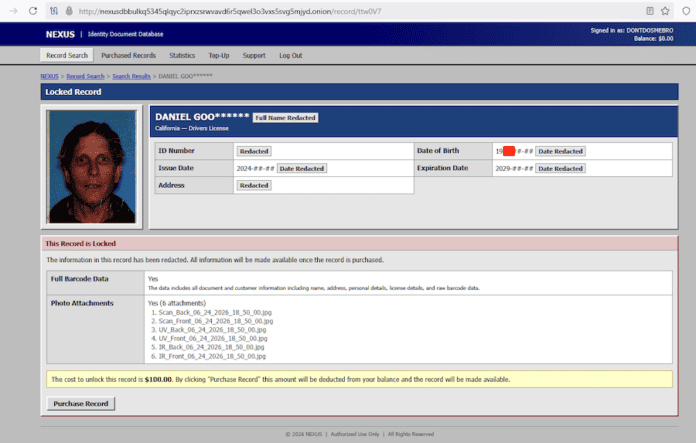
Not long ago, I rented an SUV from a well-known car rental company. Within hours of an employee scanning my driver’s license, a high-resolution scan of my ID was available for sale on the dark web.

An exposé published Tuesday by KrebsOnSecurity reports that my license was one of more than 153 million that were available through Nexus, the name of the new ID theft service. Like other driver’s licenses available there—including some belonging to journalist Brian Krebs, his mother, an FBI assistant director, and several security researchers—my license was purported to include multiple image files showing both the front and back of the ID. Besides a basic image scan, the files also captured the images in the infrared and ultraviolet spectrums. Presumably, the additional formats may allow cloned-based counterfeit IDs to pass hologram tests.

Growing by the day

Besides advertising the availability of driver’s licenses, Nexus offered to sell a bevy of other forms of ID. They included:

  • identification cards
  • travel cards
  • international DL/ID
  • medical cards
  • common access cards
  • residence cards
  • employment authorizations

Krebs said the FBI is investigating.

Some of the records Krebs observed listed their “source” as “CDL,” which may be short for “commercial drivers license.” Other records identified the source notation as “CAC,” which may refer to Common Access Cards, which Krebs said are “government issued identity cards that grant physical access to government buildings and secure rooms.” Nexus also claimed to provide scans of marijuana dispensary cards. One of the victims he talked to reported visiting a Las Vegas outlet of Planet13, a multi-state dispensary chain.

The timing of newly available scans—typically within a day if not hours of me and a small sample of other victims presenting them at rental companies or others—likely means that Nexus has near real-time access to data flowing through the third-party scanning service these businesses are using. Over a span of 24 hours, Krebs said the number of driver’s licenses listed as available grew by almost 400,000. That’s another indication the breach has been ongoing and new cards become available shortly after they’re harvested.

Using publicly available information, Krebs found that IDScan.net, a New Orleans-based ID scanning service, has announced an exclusive arrangement with Planet13. It also listed Hertz and 11 other companies as using its services. IDScan.net went on to say that its scans capture both infrared and ultraviolet spectra. The information suggests that the scanning service is connected to the breach.

Representatives from IDScan didn’t immediately answer questions sent by email. An IDScan.net spokesperson told Krebs the company is investigating. My car rental company representatives also didn’t immediately answer questions.

The availability of my driver’s license to anyone willing to cough up a fee isn’t exactly a comforting thought. Yes, my personal details—including current and former addresses, Social Security number, demographics, and more—have been breached before, just as they have for millions, if not billions, of others around the world. This dump is more troubling because of the purported availability of scans in ultraviolet and infrared. Fortunately, Nexus went dark within hours of the KrebsOnSecurity scoop. Also somewhat consoling is the ongoing investigation by the FBI.

Gen Z is using ‘polyester’ as an insult. It’s actually a throwback.

0
gen-z-is-using-‘polyester’-as-an-insult-it’s-actually-a-throwback.
Gen Z is using ‘polyester’ as an insult. It’s actually a throwback.

Even if you’re not wearing polyester now, it’s probably sitting somewhere in your closet — after all, it is the most ubiquitous fabric for textiles on Earth. Is that bad? 

Judging by social media, the answer is solidly “yes.” Influencers want you to know it’s a form of plastic, fashioned from melted crude oil or PET bottles and extruded into threads. That disgust factor (“ugh, I’m wearing plastic?”) might help explain why “polyester” is now trending as an insult on TikTok.

“Polyester lifestyle,” says the top comment on a viral video in which an 18-year-old imagines his oddly specific dream life — wearing blue-light glasses in a coffee shop while a Claude agent does half his job during lunch break; getting a call that he has to pack for a sudden business trip to Europe while watching the sunset from the tennis court — as a 1987 composite sketch of the Unabomber gradually fades into view.

There’s just one problem with the story that “polyester” is, as Mashable put it last month, “Gen Z’s new way to call you fake”: The term has already been used this way for about half a century. The Oxford English Dictionary gives examples from 1979 (“A gleaming brazen polyester clown”) and 1987 (“Clifton wears polyester suits and a polyester smile”). 

“TikTokkers just seem to be leaning into the ‘inauthentic’ and ‘low-quality’ edge of that meaning,” said Kory Stamper, a lexicographer and author.

Read Next

While it may be hard to imagine now, polyester was once sold as “miracle” fabric. Wrinkle-free, quick-drying polyester promised housewives liberation from the drudgery of ironing. The 1950s and ’60s were the era of “plastic fantastic,” when chemical companies promoted plastic and synthetic materials as convenient and durable. As polyester became less expensive, chemical companies ramped up its production, outpacing cotton starting in the ’60s.

As cheap polyester flooded the market, the novelty wore off, and it turned from “treasure to trash,” as the anthropologist Jane Schneider once wrote. The environmental movement was born on Earth Day in 1970, and awareness of pollution spread alongside a suspicion of artificial fibers. As hippie culture took off, people longed for a more authentic, “back to nature” kind of life. (It’s not a coincidence that people started using “plastic” as an adjective meaning superficial or insincere, too.)

As the ’70s came to an end, the shiny, synthetic men’s suits that once seemed modern now felt cheap and tasteless. In 1981, a John Waters film called Polyester played on the fabric’s tacky associations, starring a father in a polyester-clad suit who owns an adult movie theater. “Polyester and pornography — the fabric could hardly sink lower,” wrote Anneke Smelik, an emeritus professor of culture and history at Radboud University in the Netherlands, in a study detailing the cultural history of polyester.

That same anti-synthetic sentiment is back in force today. The vitriol isn’t exactly subtle: One TikTok influencer with a clothing brand said that polyester makes you “sweat like a dog and smell like f***ing shit.” (Those qualities were true of the polyester suits of the ’70s, but textile manufacturers worked to improve the sweat problem and polyester is widely used in athletic wear today, partly because it can be designed to wick sweat away from your skin.) Wellness influencers on both the right and the left warn about the microplastics shed by synthetic clothing; scientists are concerned about the health effects of exposure to PFAS and other toxic chemicals that are used to treat the fabric during production, in order to help it repel water and resist stains.

But the line between “synthetic” fabrics and “natural” ones like wool, silk, bamboo, and cotton is blurrier than you’d think, Smelik said. It’s not like rolls of cotton grow off the plant: The raw materials all undergo intense chemical processes in order to become the soft, huggable fabric we enjoy putting next to our skin.

There isn’t even an obvious winner from an environmental standpoint, she said. Growing natural fabrics requires resources like land and water: It can take more than 700 gallons of water to produce a single cotton shirt. The cotton industry was a major driver in drying up the Aral Sea in Central Asia, turning what was once the world’s fourth-largest lake into its largest dry lakebed. Polyester is less resource-intensive to make, but, as it’s fashioned from oil, it does generate more greenhouse gas emissions. A new report from the Apparel Impact Institute found that the global fashion industry’s emissions rose 7.5 percent in 2023 and 6.3 percent in 2024, in part because of the increased production of fiber, particularly polyester. The fabric’s durability also becomes a curse when you throw it away: Polyester breaks down very slowly, fragmenting into microplastics that persist in ecosystems for generations.

Read Next

There’s also consumer behavior to keep in mind: The perception that cotton is natural and better for the environment allows people to buy more clothes and not feel bad about it, because hey, at least I’m not buying polyester. The truth is that the most environmentally friendly solution is simply buying less and wearing the clothes you already have as long as you can. “Fast fashion remains fast fashion, and that is a huge problem,” Smelik said.

As good as the new generation of polyester insults are — including “Polyester Prince,” the new nickname for one prominent influencer who sells polyester clothes, and “polyester jester” to mock anyone wearing synthetic fast-fashion outfits — Smelik sees the current social media discussion around polyester as a regression to the 1970s. “It is so uninformed, and it leaves out all complexity,” she said. “You know, it becomes very polarized — like, ‘natural is good, and artificial is not.’”


Police Advice Public About ‘Fugitive’ Reality TV Star

0
police-advice-public-about-‘fugitive’-reality-tv-star
Police Advice Public About ‘Fugitive’ Reality TV Star


Below Deck Star Wanted by Police After Allegedly Fleeing Country Amid Choking Charges

A Below Deck Mediterranean star is at the center of an international manhunt after allegedly fleeing Australia while wanted on serious domestic violence charges involving his former girlfriend and co-star.

Australian police have warned the public not to approach Nathan Gallagher, 28, saying he is wanted on an outstanding arrest warrant and could pose a danger.

New South Wales Police released Gallagher’s mugshot while asking anyone with information about his whereabouts to come forward.

The dramatic warning came after Gallagher failed to show up in court Tuesday, where he was scheduled to face three charges tied to an alleged confrontation with his former partner, Below Deck Mediterranean co-star Gael Cameron.

Gallagher and Cameron share a child.

Gallagher was arrested in December after police responded to reports of an alleged assault involving a 29-year-old woman near Sydney.

Court documents allege Gallagher covered Cameron’s mouth and nose during the incident, leaving her unable to breathe at times, according to Rolling Stone.

He is facing charges including assault occasioning actual bodily harm and intentionally choking a person without consent.

Police now believe Gallagher may have left Australia while the case remains unresolved.

Authorities have urged members of the public not to confront him if they believe they spot him.

Gallagher has previously acknowledged that he has “made mistakes,” but has also suggested there is more to the story.

He claimed he has “evidence” that could present a different version of what allegedly happened.

The allegations mark a stunning turn for the reality TV personality, who became known to viewers through Bravo’s Below Deck Mediterranean.

Gallagher’s current whereabouts remain unknown as police continue searching for him.

Pacific Islands Forum starts with leaders missing, China furious

0
pacific-islands-forum-starts-with-leaders-missing,-china-furious
Pacific Islands Forum starts with leaders missing, China furious

The annual Pacific Islands Forum (PIF) Leaders Meeting is underway in Palau, and already there has been controversy.

First, it’s a leaders meeting with a distinct lack of leaders. Second, China is reportedly furious that Taiwan is represented at the meeting in its own right.

The fact the leaders of five of the forum’s 18 members are absent – Kiribati, Fiji, Vanuatu, Samoa and Solomon Islands – has raised questions about China’s role in their withdrawal. New Zealand Foreign Minister Winston Peters said the collective absence was “highly suspicious” but did not make any direct accusation.

It has come at a time when there are many pressing issues facing Pacific Islands nations, which the forum is ideally placed to tackle.

The forum’s importance

The leaders meeting is central to Pacific diplomatic architecture. It’s the preeminent regional diplomatic institution providing a platform to voice a Pacific agenda.

On occasion, Australian prime ministers have been criticized for non-attendance, and the excuse has usually been domestic politics. This is clearly the case for several Pacific Island countries this year. For example, Solomon Islands Prime Minister Matthew Wale returned home to respond to a no confidence motion. It is a reminder that all foreign policy is driven by domestic considerations. Nonetheless, non-attendance is regionally significant.

It has been suggested some of the missing leaders may have been influenced by China. Beijing has threatened “consequences” over the Taiwanese delegation’s participation in Palau.

All this means this year’s meeting theme, “Building Economies: Life. Action. Unity,” is looking shaky.

The Pacific prides itself on unity. The “Pacific way” of diplomacy focuses on consensus. It is distinctive and effective in managing diverse interests in a culturally sound way. But the Pacific way is being challenged by outside forces and from within.

Geopolitics causing ructions in the region

Geopolitics is the prime reason, and its influence can be seen at all levels in this crisis. Core issues are China’s increasing assertiveness in the Pacific and the unintended consequences of Australia’s successful bilateral approach.

Australian Prime Minister Anthony Albanese would have been looking forward to this year’s meeting, but Canberra’s recent geopolitical successes may be a double-edged sword.

China competes with Australia by attempting to gain influence through persuasion. Aid is used to benefit Pacific Island countries. China challenged Australia in the 2010s, but Canberra responded and never lost its position as the top donor. The Lowy Aid map has clearly tracked the rise and decline in Chinese aid.

Within aid budgets a key battleground was infrastructure, which Australia largely avoided to focus on capacity-building in governance, education and health. China’s approach directly benefited elites. It was also electorally useful as benefits trickled down to ordinary Pacific islanders through their leaders. Canberra met China’s infrastructure challenge, albeit with rigorous engineering and anti-corruption standards.

Youtube video


Another issue is the threat of China establishing a military “base” in the Pacific. Rumors led to panic by some elements in the Australian media and a firm diplomatic response from Canberra. Australia ensured this diplomatic “red line” was never crossed through rigorous military and policing diplomacy.

China signed a security arrangement with the Solomons in 2022. Australia then secured security treaties with Tuvalu (2023), Naoero (formerly Nauru) (2024), Papua New Guinea (2025), Vanuatu (2026) and Fiji (2026).

Many Pacific Island leaders have embraced Australia’s bilateral entreaties that elevate Canberra’s geopolitical concerns. This is in contrast to the forum’s multilateral approach and could be viewed as contrary to the Pacific way.

Meanwhile, China was planning an intercontinental ballistic missile test that splashed into Pacific waters while the Ocean of Peace treaty was being signed in Suva. Needless to say, Pacific Islands leaders were not impressed, but taking sides in a geopolitical contest has consequences.

Why unity is key

Much of China’s assertiveness is focused on combating the diplomatic recognition of Taiwan. The Pacific is a central battleground in this contest. Palau is one of the few countries that recognize Taiwan. So it is difficult to separate China’s geopolitical motives with respect to competing with Australia or countering Taiwan.

Without unity, a Pacific agenda cannot be furthered. Sustainable economics is certainly a worthy focus for leaders. The Pacific has been disproportionately affected by the disruption of global supply chains caused by the US-Iran War. Belts have been tightened, and the transition to renewable energy accelerated.

But the reality is the wellbeing of Pacific islanders has been adversely impacted. Pacific governments have had fewer resources to respond. The long shadow of Covid still hangs over the region, so coordinated regional action is needed.

The forum secretariat in Suva handles routine diplomacy between Pacific Islands countries. Without the unity of Pacific leaders, it loses the authority to further core agendas on vital issues such as climate change, the Blue Pacific strategy and the Ocean of Peace Alliance between Australia and Fiji.

Pacific Island leaders can benefit from engaging in the geopolitical contest between China and Australia. But ultimately, this is distraction from the pressing issues facing the Pacific.

Michael O’Keefe is director, master of international relations, Department of Politics, Media and Philosophy, La Trobe University.

This article is republished from The Conversation under a Creative Commons license. Read the original article.

Bennett’s Youngest Recruit Makes a Case for a New Israeli Politics

0
bennett’s-youngest-recruit-makes-a-case-for-a-new-israeli-politics
Bennett’s Youngest Recruit Makes a Case for a New Israeli Politics


At 23, Yonatan Shalev is not offering Israelis a familiar political resume. He is offering a generational one: reserve duty, interrupted plans, the death of a close friend in war, and a belief that people under 30 have been asked to carry the country while being largely absent from its parliament.

As Gabriel Colodro reports, Shalev’s unlikely route from activist to Knesset candidate began with Shoulder to Shoulder, a 2024 movement formed by young soldiers and reservists challenging broad ultra-Orthodox draft exemptions. Now recruited by former Prime Minister Naftali Bennett’s Together party, Shalev could become Israel’s youngest-ever lawmaker if the slate wins enough seats.

His case is blunt. Israel’s young adults are returning from reserve duty to rent bills, delayed degrees, fragile careers and the sense that the people making national decisions do not inhabit the same reality. “I have a very simple mission: to represent young people and put young people on the agenda,” Shalev says.

He argues that national security is bigger than fighter jets, missile-defense systems and military technology. It depends, he says, on an economy, education system and social compact capable of sustaining a technologically advanced army. That brings the draft dispute, cost of living and Israel’s broader civic bargain into one argument: Responsibility cannot keep falling on the same shrinking segment of society.

Shalev is more developed on enlistment than on economic policy, offering few targets or budgets. Still, his critique of the government is clear. He says proposed draft legislation preserves inequality rather than solving it, and he faults Prime Minister Benjamin Netanyahu’s government for choices he believes sacrifice long-term institutions for short-term political survival.

On the West Bank, Shalev rejects collective blame against settlers while condemning attacks by Jewish extremists on Palestinian communities: “Terror is terror.” He says laws enforced in Tel Aviv should apply in Judea and Samaria as well.

His positions also show the limits of his generational rebellion. Shalev opposes a Palestinian state during a government led by his party, arguing that one would be perceived as a reward for terrorism after October 7. He wants better conditions for West Bank Palestinians while seeking to curb Qatari and Turkish influence in Gaza.

Colodro’s full profile also follows the hazards of a young candidate’s political debut: a sharp but later softened attack on former IDF Chief of Staff Gadi Eisenkot, social-media death threats and a growing public profile before he even has a place on the ballot.

Read the full article for a close look at a candidate who sees politics not as a career ladder but as the next front in his generation’s fight over what Israel will become.

Is Germany’s far right AfD about to take over a state government for the first time?

0
is-germany’s-far-right-afd-about-to-take-over-a-state-government-for-the-first-time?
Is Germany’s far right AfD about to take over a state government for the first time?

Germans in the eastern state of Saxony-Anhalt will go to the polls on September 7 to elect a new parliament.

With forecasts indicating that the Alternative für Deutschland (AfD) is on course to win around 40% of the vote, which would double its support there compared to five years ago, there is a real chance the far-right party could take over a state government for the first time.

Former East Germany, which was under Communist rule between 1949 and 1989, has proven fertile ground for the far right. The AfD won 34.6% of the vote there in the 2025 federal election, while in Saxony-Anhalt that figure was 37.1%. This was far higher than mainstream parties on the left and right.

Much has been written about the reasons for far-right success in eastern Germany. Deindustrialisation, demographic change and depopulation, especially in rural areas, are all drivers. So too is the fact there is far stronger disagreement in the east with Germany’s support for Ukraine in its war with Russia than is in evidence in the west, as well as higher levels of opposition to refugees.

Perhaps above all, there is a strong sense in the east of feeling “second-class citizens” in modern Germany, even more than three decades after reunification. Unemployment in Saxony-Anhalt is above the German average, standing at 8.2% in August compared to a national average of 6.5%. The median wage in full-time employment was also around €48,300 (£41,400), below the national level of about €52,000.

The election in Saxony-Anhalt takes place at a time when the AfD is already leading nationwide polls, and when the federal government and chancellor Friedrich Merz are vastly unpopular (with around 85% of voters dissatisfied). It is also happening in a part of the country where the far right tends to do best.

Friedrich Merz looks on as Sven Schulze speaks during a press conference.

The German chancellor, Friedrich Merz (left), and Saxony-Anhalt Governor Sven Schulze attend a press conference in Quedlinburg on August 31 after a campaign event ahead of the state election. Filip Singer / EPA

The AfD has come top in a state election once before, in Thuringia in 2024. But it did not get a majority of seats. Mainstream parties rallied around and formed a government between the centre-right Christian Democratic Union of Germany (CDU), left-populist Bündnis Sahra Wagenknecht (BSW) and Social Democratic Party of Germany (SPD).

They rely on the support of Die Linke (the Left Party) to function and pass legislation. The CDU has long ruled out any cooperation with the Left Party at the state or national level because of the latter’s historic links to the communist regime in East Germany and continued ideological disagreements. But in practice, in Thuringia and the national parliament, this anti-cooperation line has softened.

In Saxony-Anhalt, as in most other states in Germany, parties need at least 5% of the vote to win any seats in the state parliament. If they fall below that level, they don’t get any. So all eyes will be not only on the result of the AfD, the CDU (which polling suggests is set to take 23% of the vote) and the Left Party (forecast to take 13%) but also smaller parties.

Polling has had the SPD hovering around the 5% mark, although its support seems to have picked up. The same goes for the Greens, while the liberal Free Democratic Party (FDP) looks set to miss out. If the only parties making it over 5% are the AfD, CDU and Left Party, the AfD could win an overall majority of seats. The BSW, which is hovering around the 5% mark, has also made it clear it would not block the AfD entering government.

The AfD’s proposals

The AfD’s manifesto in Saxony-Anhalt is extremely right-wing. Proposals such as ending the right to asylum and a moratorium on non-EU immigration could not be implemented. They are matters for the national not state government.

But other AfD proposals are legally feasible. These include changing the school curriculum to downplay the significance of the Nazi era – a programme one AfD politician, Hans-Thomas Tillschneider, sums up as: “More Bismarck, less Hitler”. This was a reference to Otto von Bismarck, who oversaw the unification of Germany in 1871.

The AfD has also suggested introducing the routine singing of the German national anthem in school assemblies and ending what it calls “inclusion” in mainstream education for children with special needs. Defunding the protestant church, which the AfD has accused of being too focused on social not theological questions, would also be a real possibility.

A particular worry is around Germany’s “constitutional protection” or secret services. There is consideration being given to setting up parallel offices in Saxony-Anhalt to protect sensitive operations in the event of an AfD administration. Many branches and elements of the AfD are under observation by German intelligence agencies on the basis of suspected extremism.

There will almost certainly be wider political ructions from this election if the AfD tops the poll, and even more so if it wins outright control of the state government. Any major changes at the top of German politics will probably wait until after elections in Berlin and Mecklenburg West Pomerania later in the month.

Mainstream parties will want to keep some appearance of unity until then for fear of losing yet more votes. But, at the very least, rumours of an early challenge to Merz are likely to step up a gear.

Google releases Gemini 3.8 Flash, its third Flash model in six weeks

0
google-releases-gemini-3.8-flash,-its-third-flash-model-in-six-weeks
Google releases Gemini 3.8 Flash, its third Flash model in six weeks

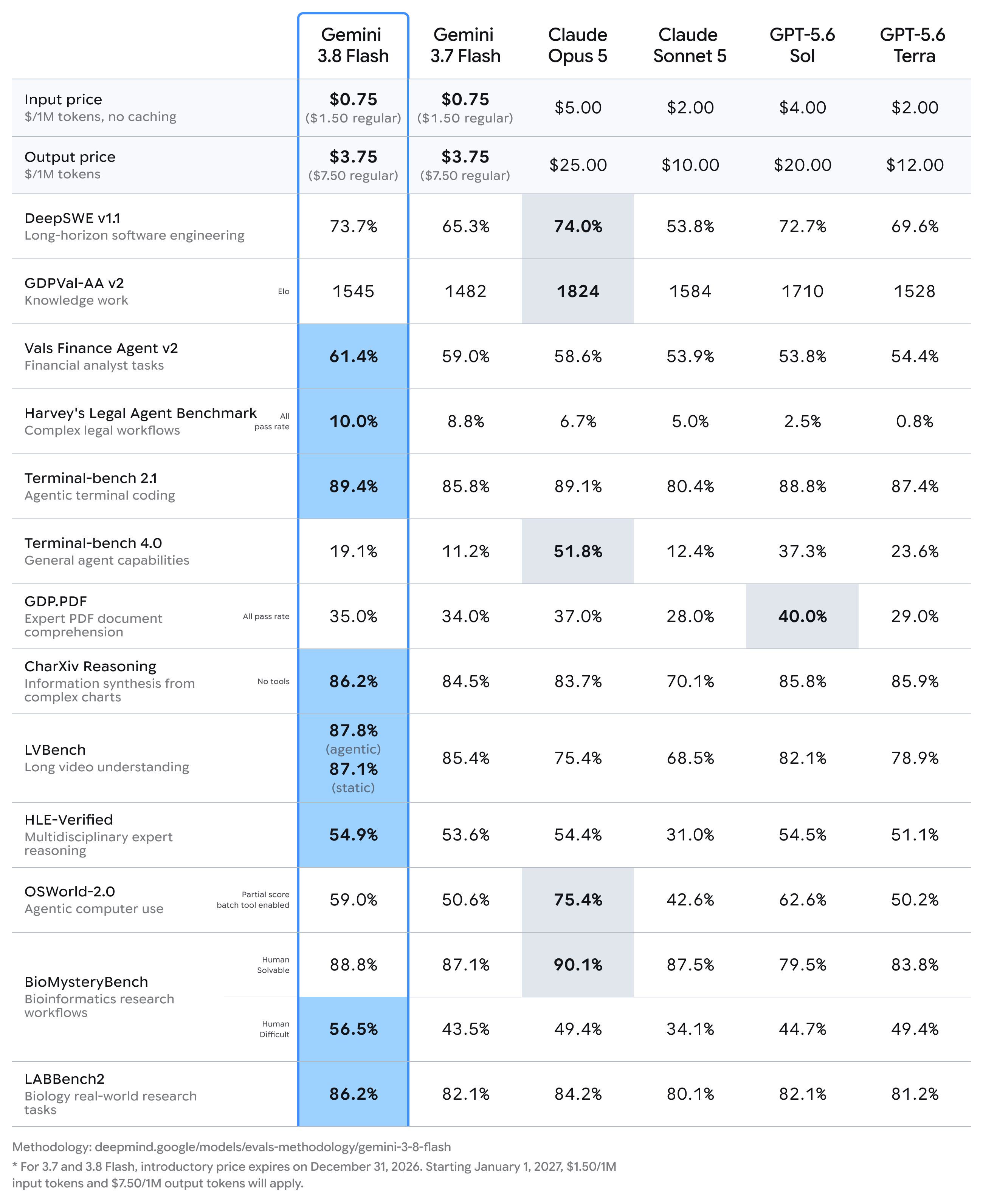
Google hasn’t released a frontier-level Gemini Pro AI model since early 2026, but it sure loves rolling out new Gemini Flash variants. Today, Google is announcing its third Flash model release in just six weeks, making it more likely that we’ll never see the promised Gemini 3.5 Pro. But no matter, says Google, because Gemini 3.8 Flash is its best reasoning and coding model yet.

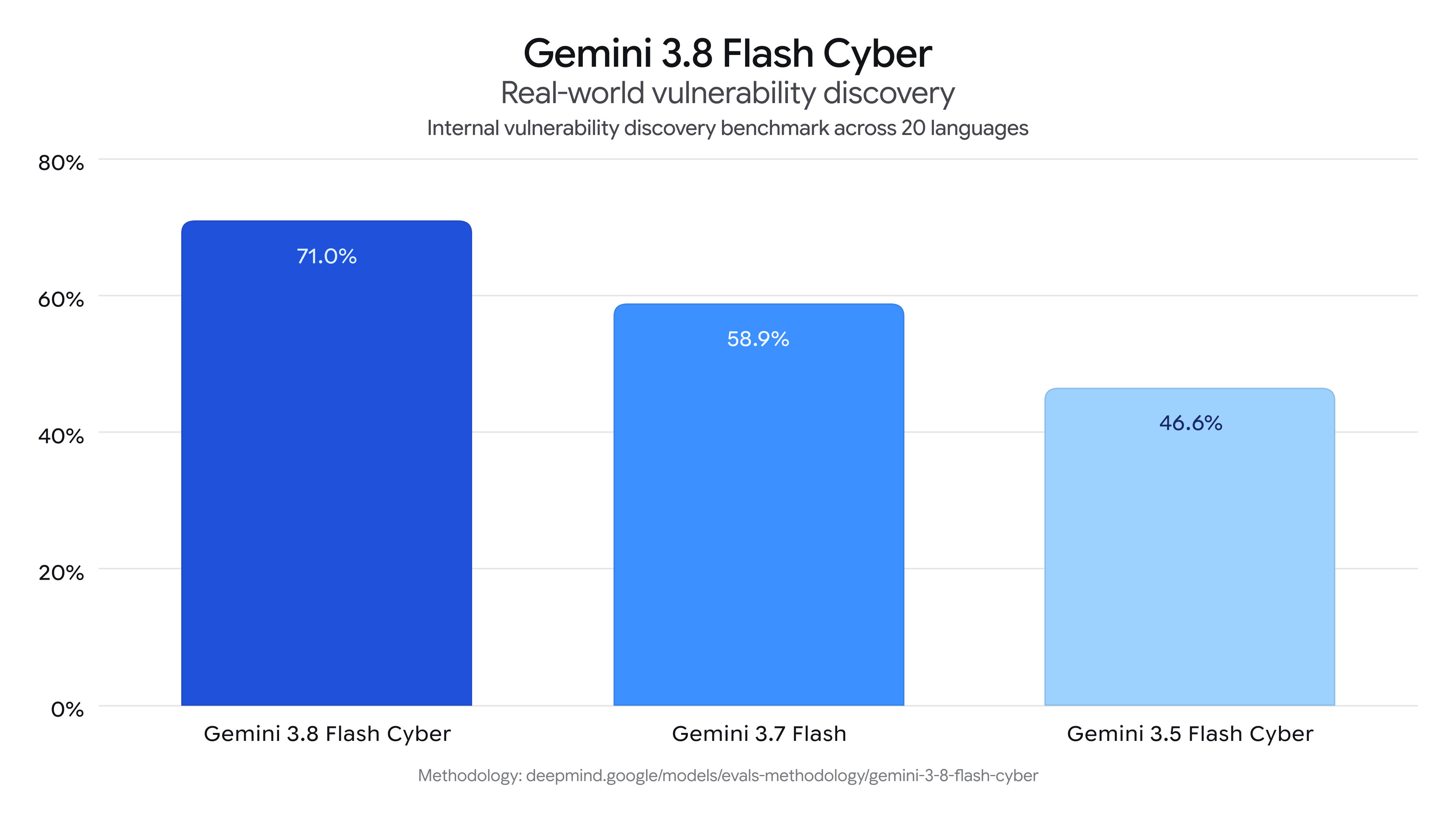
Gemini 3.8 Flash comes in two variations. There’s the standard Flash, which Google describes as a “workhorse” model that’s good for anything from agentic tasks to software development. Then we have Gemini 3.8 Flash Cyber, which runs on the same foundations but has been tuned for vulnerability detection and mitigation.

For developers, Google has the same pitch as it did for the 3.7 Flash release just a couple of weeks ago. API access to the model is available at an “introductory rate” through the end of the year: $0.75 per million input tokens and $3.75 per million output tokens. The regular price will be $1.50 / $7.50, but it’s likely there will be new models available long before the price changes. Google probably sees the lower prices as a necessity given that other AI labs have recently dropped token pricing to keep increasingly wary businesses engaged with AI tools.

Credit: Google

Google has offered its usual raft of benchmark numbers, which appear to show Gemini 3.8 Flash competing with (or even beating) larger and more expensive models. The numbers show a marginal improvement over Gemini 3.7 Flash in most tests, but the gains are larger in coding evaluations.

Gemini 3.8 Flash is now at the top of the DeepSWE leaderboard, which measures a model’s ability to solve complex software engineering problems, and it does so at a lower cost (at the current discounted rate). Google reportedly delayed the release of Gemini 3.5 Pro when its coding performance couldn’t match other models, but if these numbers reflect reality, even Google’s new Flash models are competing with the market leaders.

Computer use has been a struggle for Google’s models. While Gemini 3.8 Flash is an improvement over 3.7 Flash in the OSWorld-2.0 test of agentic computer use, it’s still far behind the market leader Claude Opus. In fairness, GPT isn’t great in this test, either.

Credit: Google

Gemini 3.8 Flash Cyber, which replaces the 3.5 version, isn’t something most of us will ever need to think about, but these models are increasingly important in niche fields. Google claims that the new cybersecurity model has demonstrated a substantial improvement over its previous models with internal testing. Gemini 3.8 Flash Cyber reportedly identified more vulnerabilities and issued working patches more often. The Chrome security team apparently saw a 2.6x increase in patch accuracy with the new model. The Cloud team reports that 3.8 Flash Cyber found a critical vulnerability in just two hours. Google also has statements from partners like Wiz and Palo Alto Networks attesting to the power of Gemini 3.8 Flash Cyber.

Gemini 3.8 Flash will be available across the Google ecosystem starting today, but Gemini 3.8 Flash Cyber is currently limited to trusted testers and governments. Like the past Flash release, you’ll need a Pro or Ultra subscription to access Gemini 3.8 Flash in the Gemini app, but you can always visit AI Studio if you want to tinker with it for free.

Seth Moulton Sold Out Trans Kids — and Lost His Senate Race

0


Massachusetts Sen. Ed Markey comfortably defeated Rep. Seth Moulton in his Democratic Senate primary on Tuesday, in what the media — and Moulton himself — had described as a “generational” challenge.

The framing is understandable: In a country suffering under gerontocratic rule, Markey is 80 and Moulton is 47.

Age, however, was the least of what was at stake in Moulton’s run from the decaying center of the Democratic Party. Moulton ran on a conservative line, recycling right-wing talking points and echoing Donald Trump to suggest, erroneously, that Democrats have been failing because they have not been conservative enough.

“There’s only 12 trans athletes in the whole of the NCAA. We should have been embracing them.”

Markey may be 80 years old, but his campaign did precisely what Democrats must if they want to appeal to progressives and bring in a broad working-class voter base: He ran on issues of economic inequality, taxing billionaires, green energy, and universal health care — all while refusing to jettison support for vulnerable minorities, especially trans people.

Meanwhile Moulton, claiming to represent a break in the status quo, repeated precisely the tired centrist playbook that has both failed America’s multiracial working class and failed to win elections. He punched left and, as Markey himself highlighted, threw trans kids “under the bus.”

In a risible misreading of the Democrats’ 2024 presidential election loss, Moulton suggested that his party had shown too much care for trans rights. (It had not.)

“I have two little girls,” Moulton told the New York Times just after the November 2024 election. “I don’t want them getting run over on a playing field by a male or formerly male athlete.”

It was only last month that Moulton offered a tempered apology for the anti-trans remarks — and only because Markey had lambasted him during a debate.

“He just took the whole playbook of MAGA and Trump, and he blamed those kids for the loss,” said Markey, who has been consistent in his advocacy for trans rights. “We should have been loving those kids. There’s only 12 trans athletes in the whole of the NCAA. We should have been embracing them.”

Indeed, we should question the validity of this so-called “debate” entirely: Why did the moderator of a Senate primary debate even feel the need to ask a question about trans girls in sports at all?

This is not, after all, a political problem in need of addressing in Massachusetts, or anywhere else. It is a ghoulish far-right panic that has been baselessly elevated into a hot-button issue, with the help of Democratic cowardice.

Fox News, of all places, noted that Markey is “one of the few Democrats running this midterm cycle who is continuing to push for transgender rights, particularly in sports” — as if that were a bad thing.

“There is good evidence that transgender issues were a major part of Markey’s victory, too,” wrote reporter and trans advocate Erin Reed. “In the final days of the campaign, a UMass/Amherst poll asked primary voters how a candidate who embraces anti-trans positions or policies would impact their vote. In that poll, a whopping 67% stated it would make their vote less likely for that candidate.”

Markey, the longtime incumbent, was already at an advantage. And no doubt proselytizers for Democratic Party conservatism will stress that Markey’s victory in deep-blue Massachusetts cannot offer lessons for Democrats running in less progressive territory. This again would be to selectively learn the wrong lessons from Kamala Harris’s spectacular 2024 failure.

It should not need repeating that Democrats in 2024 campaigned on Republican talking points, with Harris donning khaki for photo ops at the Arizona border. If Donald Trump’s campaign attacking trans people gained purchase, it is because Democrats roundly failed to answer it by demystifying right-wing anti-trans fearmongering. They also failed to offer a robust, class-focused platform to vote for.

Being nearly half someone’s age does not constitute a generational challenge; contesting the staid ways of a generational establishment does. Moulton did nothing of the sort.

Markey said it best on Tuesday: “Generational change isn’t about compromising.”

0FansLike
0FollowersFollow
0FollowersFollow
0SubscribersSubscribe
- Advertisement -
Google search engine

Recent Posts