17.1 C
London
Wednesday, September 2, 2026
Home Blog

Best propaganda money can buy can’t sell Americans on Iran war

0
best-propaganda-money-can-buy-can’t-sell-americans-on-iran-war
Best propaganda money can buy can’t sell Americans on Iran war

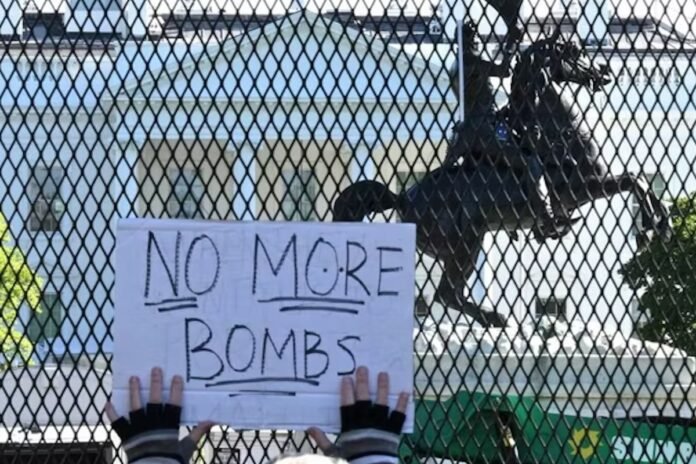
A demonstrator holds a placard in front of the White House in Washington, DC, the United States, on April 7, 2026. Photo: Li Rui / Xinhua

A new University of Massachusetts-Amherst opinion poll, conducted August 21-26, finds profound American disillusionment with President Donald Trump, with his Iran war, and with its economic fallout in their lives.

Apparently, the Ellison family’s attempt to drum up support for Donald Trump and his Iran war by buying up CBS News and gutting it as a respected news organization was a costly failure.

Likewise, Rupert Murdoch’s NewsCorp and his various pro-Trump organs, from Fox Cable News to The Wall Street Journal, have not pulled the wool over the public’s eyes in the ways that Murdoch hoped.

Israeli Prime Minister Benjamin Netanyahu boasted of the effort he expended convincing the American people to go to war with Iran, saying he had a thousand hours on US television , but while he may have prevailed on the gullible and avaricious Trump to fall on that country like a ravenous wolf, he did not succeed in altering the views of the American public on the desirability of such a war.

The only significant impact of Netanyahu on most Americans has been to convince them that the Israeli government is a combination of genocidal maniacs and welfare queens that Americans should cut off economically and perhaps even militarily.

The UMass poll asked a weighted sample of respondents how well Trump has handled his Iran war. The response of 55% of those asked this question was “not well at all.” Ouch. Another 13% replied “not too well.”

So 68%, over two-thirds, think he has done a piss-poor job on his Iran war, which was his war of choice. Two-thirds is the percentage needed in the Senate to impeach and remove a president, so if our representatives actually mirrored public opinion, Trump would be toast.

That question had to do with Trump’s handling of the war. Asked whether they approved of the war on Iran, a majority, 54%, said they strongly or somewhat disapproved, and another 20% were noncommittal, which I would interpret as not actively supporting the war even if they didn’t particularly oppose it.

Those statistics yield a picture of a war that nearly three-fourths of Americans either oppose or about which they just don’t care. It isn’t what the commander of a war would want to hear from his own public.

A majority think the war was a mistake and question whether it has made the US safer or forestalled an Iranian bomb. Another way of putting it is that only about a quarter of respondents think the US should have gone to war with Iran, and that the US is winning.

The UMass report on the opinion poll noted that Raymond La Raja, professor of political science at UMass Amherst and co-director of the poll, said, “Americans are overwhelmingly negative about Trump on the Iran situation.”

He continued: “Only one in four Americans thinks he is handling Iran well. The real divide is increasingly between Trump’s hardcore MAGA base and almost everyone else. Among Republicans who identify very strongly with MAGA, 87% approve of Trump’s handling of Iran.

But that falls to 58% among Republicans who are ‘somewhat MAGA’ and just 30% among Republicans who say they are ‘not MAGA at all.’ The more loosely attached Republicans are to the MAGA identity, the more skeptical they are of the war.”

Conducting a war in the Middle East, as even the cowboys in the G. W. Bush administration recognized, requires at least some allies. But Americans don’t think Trump plays well with other children.

Asked how he has handled working with allies in global affairs, 52% say “not well at all” and 12% say “not too well,” showing that nearly two-thirds view his foreign policy performance negatively.

Based on this sounding, we can further project that Americans are even more angry about the main fallout of the failed war on Iran, which is high inflation. Fully 80% of respondents said that the Iran War has increased the cost of gasoline and groceries. Asked about how Trump has dealt with inflation, 57% responded, “not well at all.”

A further 18% said “not too well.” That is 75%, fully three-fourths, who disapprove of his handling of inflation. Trump and the Republicans are always campaigning on being the party of business and therefore the party that knows how to handle the economy.

But only a tiny minority, 7%, think Trump is handling the economy very well, and I presume they are wealthy investors in Trump’s casino stock market. The tech-heavy Nasdaq is up 14-16% so far this year.

Juan Cole teaches Middle Eastern and South Asian history at the University of Michigan. His newest book, “Muhammad: Prophet of Peace Amid the Clash of Empires” was published in 2020. He is also the author of “The New Arabs: How the Millennial Generation Is Changing the Middle East” (2015) and “Napoleon’s Egypt: Invading the Middle East” (2008). He has appeared widely on television, radio and on op-ed pages as a commentator on Middle East affairs, and has a regular column at Salon.com. He has written, edited or translated 14 books and has authored 60 journal articles.

Common Dreams

Think twice before installing this device promising free movies

0
think-twice-before-installing-this-device-promising-free-movies
Think twice before installing this device promising free movies

As online services get better at blocking malicious traffic, the attackers and scammers behind them have been forced to find new ways to reach their targets. The alternative of choice is now what are known as residential proxy networks. These systems funnel millions of home Internet connections into a unified network, and the proxy operators allow attackers to route their malicious traffic through these connections for a fee. The online services see only IP addresses with good reputations and geolocations that don’t stand out.

More often than not, the home users have no idea that their connections are being used to facilitate crime and occasionally even nation-state attacks. Users who do know often don’t care much. In exchange for leasing out part of their unlimited bandwidth to others, many get free movie and TV show streaming. Several less tech-savvy people I know who own such digital media players have told me, after I explain how the media players piggyback off their connections, that the bonanza of content is worth it. They find the tangible benefits outweigh the abstract harm they pose.

Infecting already compromised devices

Research published Monday brings the threat into much clearer view. Security firm Plume cataloged a vast ecosystem of malware that preys squarely on users of SuperBox, just one of many media players offering pirated content. These malicious apps can be surreptitiously installed by remote attackers even when the devices are positioned behind a router. While Monday’s deep-dive analysis focused exclusively on SuperBox, Plume warned that dozens of similar streaming devices pose precisely the same threat.

“Our researchers found that these residential proxy networks are not simply monetization tools,” Plume researchers wrote. “They are actively being used as a target for additional malware delivery, enabling cybercriminals to infect already-compromised devices with entirely new malware families while remaining largely invisible to the device owner.”

The Android-based SuperBox is configured with almost all the OS-based security protections turned off. Apps that come pre-installed, or those that are available through the SuperBox app store, then run as root, meaning they have unfettered administrative system rights on the device. Paying proxynet customers can also gain root by issuing a handful of Linux commands. With that, either the app or the paying customer can install their own apps and surveil and join the local network the device is connected to, where they have the same system rights as any other connected device.

The SuperBox neuters default Android defenses, including signature verification, the “unknown sources” restriction, the permission-review dialog, and Play Protect scanning. As a result, the box’s ADB (Android Debug Bridge) is exposed to the Internet. Worse, the su binary—the code that provides the command-line interface allowing users with low-level system rights to temporarily gain administrator-level access—is set to grant root without any authentication. The combination of the ADB being exposed to the Internet and the lack of authentication for root access means that both apps and users of the proxy service can execute virtually any command they want on the device.

More often than not, users position their SuperBox behind their home router, where they may think their device is safe from Internet-connected remote attackers. In fact, that sense of security is completely false. The binary that provides proxy functions inside many SuperBox apps opens an outgoing connection to a proxy server and keeps it open as a communication channel indefinitely. Routers are unable to block the communications because the connections they rely on are outbound and encrypted between the SuperBox and the proxy server. Even users who are savvy enough to monitor traffic on their network never see anything that looks like an inbound connection to the ADB port.

“The open ADB port plays the central role,” Plume researcher Gergely Eberhardt wrote in an email. “Combined with root access, a single pm install command can silently install any APK. This bypasses every one of Android’s default protections at once: signature verification, the “unknown sources” restriction, the permission-review dialog, and Play Protect scanning.”

Intruders at gates

The open ADB, along with the default presence of apps that have built-in proxy functionality, creates a dangerous mix that makes SuperBox a potent threat.

“This combination results in further infections involving additional residential proxies or IoT botnets, and the attackers are often the very customers of the primary proxy network,” Plume wrote. “The device owners get multiple bots they never asked for and are not aware of, all competing for the same hardware, and an IP address whose reputation now reflects whatever those bots utilize it for.”

Some of the proxy networking services that make use of SuperBox take measures to prevent their customers from accessing the local networks of SuperBox users. The recently disrupted Popanet, for instance, blocks local IP address ranges from outside the local network. Even then, Popanet users can access local IPs by specifying the special wildcard address 0.0.0.0, which Android then routes to the SuperBox IP 127.0.0.1. From that vantage point, proxy users can access the rest of the local network.

Monday’s post also reported that even the Popanet network was facilitating live exploit attempts. Plume wrote:

The internal-network protection issue that we described in the previous part isn’t just a theoretical concern. To confirm whether anyone is actually exploiting it, we ran a controlled experiment. We joined the Popanet network as a residential exit node and instructed the host that any connection coming through the tunnel targeting either port 5555 or 5858 (these are the most common ADB ports) would be redirected to our local honeypot. From the operator’s perspective, our node looked like any other regular residential endpoint serving customer traffic; from the inside, every attempt aimed to reach an ADB port through our node was captured.

We let the node run for over three weeks; over that period, the honeypot recorded 1,352 distinct attempts at reaching the ADB through the gap we identified earlier. All the attacks could be split into two families of loopback addresses targeting the local machine. The first is 0.0.0.0, supplied either as a raw address or embedded in a hostname via a wildcard DNS service such as nip.io. The second is 127.0.0.1, which the proxy blocked via isLoopbackAddress() as we explained earlier.

An email sent to info@mysuperboxtv.com seeking comment didn’t receive a response before this story’s publication.

Intruding traffic attempted to install multiple malicious apps that made SuperBoxes a node in yet another proxy network or join botnets for use in DDoS attacks. The three primary apps were CECbot, a variant of Mirai, and Maskify.

It’s hard to walk away from Monday’s report with anything other than the strong conviction that SuperBox—and virtually all of its peers—pose a tangible and imminent threat to the networks they’re connected to. Even savvy people who think they can be cordoned off from the Internet are at risk. If you’re using one, you should disconnect it and throw it away. If you find a family member using one, you should intervene. With the Popanet proxy service alone running through 2 million devices, according to Google, chances are good that a home network near you is, too.

Bangladesh should think twice before joining Mecca pact

0
bangladesh-should-think-twice-before-joining-mecca-pact
Bangladesh should think twice before joining Mecca pact

Last week, Bangladesh’s Foreign Minister Khalilur Rahman told parliament that the country would view an invitation to join the Mecca Joint Defense Agreement “positively.”

Then he also went on to add that an expanded pact could essentially become a self-defense mechanism for the world’s Muslim-majority states, and described Bangladesh’s possible membership as “an internal matter of our family, the Muslim family,” on which outsiders had no basis to raise issues or concerns.

So, the invitation may or may not come from Riyadh, but the “Muslim family” argument has already come from Dhaka – and that is where the trouble starts.

Nobody asked Bangladesh to define a military alliance in terms of religious kinship. The question was whether joining a collective-defense arrangement with Saudi Arabia, Turkey and Pakistan would serve Bangladesh’s interests.

Turning that into a matter of the Muslim family does something rather convenient: it makes scrutiny sound like an insult to faith, when it is actually the most basic responsibility of foreign policy.

If Bangladesh is going to assume obligations under a military pact, its government should be able to explain why, since religion in itself cannot be an explanation.

Bangladesh is a People’s Republic, not an Islamic Republic. While its Constitution recognizes Islam as the state religion, secularism also remains one of its fundamental principles of state policy.

More importantly, the Constitution’s principles governing international relations speak in the language of sovereignty, equality, non-interference and peaceful settlement of disputes.

That does not require Bangladesh to keep Muslim-majority countries at arm’s length. Quite the opposite: there is nothing wrong with deep relations with Saudi Arabia, Turkey, Pakistan or any other Muslim country. But friendship between states is one thing; turning a religious identity into the basis for military commitments is quite another.

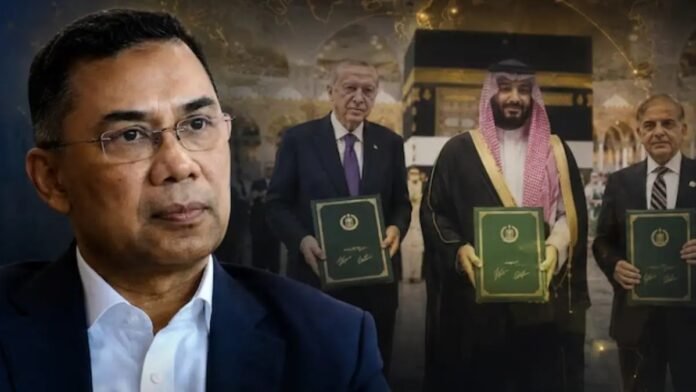
Among the three countries that signed the Mecca Joint Defense Agreement on August 7, Pakistan is a self-declared Islamic Republic, Saudi Arabia is an absolute monarchy whose political identity is inseparable from its custodianship of Islam’s two holiest sites and Turkey remains constitutionally secular, though the AK Party that has governed it for two decades emerged from the country’s Islamist political tradition.

These countries have their own reasons for wanting closer security ties, but Bangladesh must decide whether those reasons are also its own. Saying that the matter belongs to the “Muslim family” neatly avoids that question rather than answering it.

The agreement itself is not a ceremonial declaration of brotherhood. Its central provision says that an armed attack against one member will be regarded as an attack against all. That is an Article 5-style collective-defense commitment, even if nobody should pretend that the Mecca pact has NATO’s institutions or military machinery.

Pakistan Foreign Minister Ishaq Dar has called the agreement “purely defensive”, while Turkish Foreign Minister Hakan Fidan has compared its central provision with NATO’s Article 5.

There is no contradiction in calling a collective-defense arrangement defensive while acknowledging that it can create obligations that pull members into a war that starts elsewhere. That is precisely why the details matter before, rather than after, a country signs.

And the pact’s details remain thin. The three countries have spoken about political and military coordination, joint exercises and defense-industry cooperation and plans for mechanisms to coordinate their senior officials and armed forces.

But there is still no publicly disclosed integrated military command comparable to NATO’s, and the precise obligations of a future member in a crisis are not nearly as clear as they would need to be before Bangladesh voluntarily takes them on.

There is another problem. Saudi Arabia, Turkey and Pakistan do not have identical security maps. Saudi Arabia’s immediate concerns include the Houthi threat in Yemen and the wider confrontation involving Iran.

Turkey’s security calculations are shaped by Syria, Kurdish militancy, the Black Sea and its own regional ambitions, alongside its longstanding territorial disputes with Greece. Pakistan’s security concerns are concentrated on Afghanistan and, much more consequentially, India.

These countries may have found useful common ground, but their strategic problems are hardly interchangeable. Whether they can turn that political convergence into a coherent collective-defense system remains to be seen.

Bangladesh, meanwhile, has an entirely different neighborhood. Its immediate security concerns involve India, Myanmar, the Bay of Bengal, maritime security, the Rohingya refugee crisis and the protection of its trade and energy routes.

None of those problems suddenly becomes easier because Dhaka acquires a mutual-defense commitment with Riyadh, Ankara and Islamabad. Also, Bangladesh does not need a promise to fight somebody else’s war to maintain friendly relations with any of the three.

Other prospective members are treating the invitation with caution rather than solidarity. Pakistan has said the agreement is open to other regional countries, while Turkey has discussed expansion.

Egypt is examining the legal and constitutional implications of joining. Other major Gulf states have yet to sign on. Their restraint is not necessarily rejection, but it shows that countries far closer to the region’s actual security flashpoints are weighing membership as a strategic choice, not a family obligation.

For Bangladesh, the biggest complication is not thousands of kilometers away in the Gulf. Rather, it is across its western border. Pakistan is one of the three pillars of the pact, and Pakistan’s defining strategic rivalry is with India.

Bangladesh does not need to take India’s feelings as a commandment. But pretending that New Delhi’s interpretation of such a move is irrelevant would be dangerously naive.

Bangladesh-India relations are already strained over Dhaka’s extradition request for toppled ex-leader Sheikh Hasina, allegations of forced push-ins along the border and the unresolved renewal of the Ganges Water Sharing Treaty.

Putting a formal defense pact with Pakistan into that already perilous mix would change the political meaning India attaches to Bangladesh’s subsequent choices, whether Dhaka likes it or not.

This is not an argument for making Indian displeasure the compass of Bangladeshi foreign policy. Bangladesh’s water, trade and border-security interests are deeply entangled with India in a way they simply are not with Saudi Arabia, Turkey or Pakistan.

Riyadh can provide investment and employment opportunities. Ankara can provide defense technology and political support. Islamabad can offer historical and diplomatic links that Dhaka may want to strengthen.

None of that changes the fact that India is Bangladesh’s neighbor, its largest immediate security counterpart and the country with which many of Bangladesh’s most consequential bilateral disputes must eventually be managed.

History also suggests caution. In 1955, Turkey, Pakistan and Iraq joined the Baghdad Pact, a Western-backed collective-security arrangement meant to contain Soviet influence. Iraq’s withdrawal after the 1958 revolution ended the original pact; its successor, CENTO, lasted until 1979, but never developed anything resembling NATO’s integrated military structure.

Meanwhile, Bangladesh has spent decades trying, with varying degrees of success, not to become an appendage of somebody else’s strategic rivalry. Joining the Mecca pact would make that harder.

It would place Bangladesh closer to a security arrangement built around three countries whose relations with India, Iran and the wider Middle East carry consequences that have little to do with Bangladesh’s own security needs.

Iran’s relevance to Bangladesh is economic, not strategic. Bilateral trade stood at roughly $15.89 million in FY2023-24 against nearly $2 billion with Saudi Arabia. Tehran is not Riyadh’s equal in Dhaka’s calculus. That is exactly why Bangladesh has no interest in inheriting someone else’s security antagonisms.

It can maintain working relations with countries on opposite sides of regional rivalries without formally attaching itself to one side. If the Mecca pact comes to be read as a hedge against Iran, Dhaka gains little by joining the contest.

None of this, however, requires Bangladesh to turn its back on the pact’s founders. It can expand defense training, military exchanges, trade, investment, labor agreements and defense-industrial cooperation with all three.

It can welcome Saudi support, buy Turkish defense equipment, work with Pakistan on various grounds and maintain warm political ties without signing a collective-defense clause that could one day oblige Bangladesh to take sides in a conflict that has nothing to do with its own territory or people.

The question Dhaka should therefore answer is embarrassingly simple: what specific security threat does joining the Mecca pact address for Bangladesh that its existing bilateral relationships cannot already address?

If the answer is a credible threat in the Bay of Bengal, along the Myanmar border or somewhere else directly affecting Bangladesh, the government should name it. If the answer is that Bangladesh belongs to the “Muslim family”, that is not a security assessment but an identity argument dressed up as foreign policy.

Jannatul Naym Pieal is a Dhaka-based journalist, writer and researcher with over a decade of experience in professional journalism. He is also the author of 10 published books and a researcher focusing on Bangladesh’s media industry and its intersections with broader social and academic fields.

Private group wants to launch “cheapest possible” mission to Alpha Centauri

0
private-group-wants-to-launch-“cheapest-possible”-mission-to-alpha-centauri
Private group wants to launch “cheapest possible” mission to Alpha Centauri

There are, by various estimates, several trillion planets within what is known as the Local Group of galaxies—our closest galaxy neighbors, including our own Milky Way. Many of these planets are within the habitable zone of their stars. So if life finds a way, where are the alien civilizations?

This is the crux of what is known as the Fermi paradox, which posits that if life is fairly common in the Universe, humans should have collected credible evidence for the existence of extraterrestrial civilizations by now. People who think about this paradox believe there may be some “filter” that limits or entirely prevents an advanced civilization from sending out probes or even life-bearing spacecraft to nearby stars.

Philip Johnston is someone who thinks a lot about the Fermi paradox. A mathematician and physicist from the United Kingdom, Johnston has gained some notoriety lately in the space community as one of the biggest proponents of orbital data centers. He co-founded Starcloud in 2024 to develop such data centers, and the company is presently valued at $2.3 billion.

Johnston is in the midst of scaling up Starcloud, working through technical issues, and raising hundreds of millions of dollars. So he’s pretty busy. But Johnston also wants to send a mission to the nearest star to our Sun and investigate the Fermi paradox.

Meet the Fermi Explorer

On Tuesday, Johnston and a handful of other entrepreneurs announced the “Fermi Explorer” mission. In concept, it is simple. They seek to raise $15 million to build a small spacecraft, carrying a 1 kg payload, and launch it to Alpha Centauri such that it reaches that system in fewer than 80,000 years. Why? In conversations about the Fermi paradox, Johnston realized such a mission would knock two “filters” off the list: Species won’t want to send spacecraft beyond their home star, or species will find that interstellar transit is too difficult.

The goal was not to run to NASA to try to get it to fund a $1 billion mission or seek to develop a new propulsion technology like the Breakthrough Starshot mission proposed a decade ago. Rather, the Fermi Explorer team wants to use existing technology to do something cheap and fast and launch by 2029.

“So we were like, ‘Fuck it, let’s send a spacecraft for the cheapest amount possible, a bog-standard minimum viable mission to Alpha Centauri,’” he told Ars.

The main stumbling block involves getting the probe—essentially a large tank of Xenon gas and some solar panels for solar-electric propulsion, and a few small scientific payloads—moving fast enough. Solar-electric propulsion is super efficient, but once a spacecraft is beyond Jupiter, the solar energy flux is low enough that it might as well be zero for a spacecraft the size of the Fermi Explorer. Johnston and a small team spoke with many people, including trajectory experts at NASA’s Jet Propulsion Laboratory, to find a solution.

Introducing the Fermi Explorer mission.

Nothing worked until Johnston linked up with Alex Wissner-Gross, a physicist who founded Physical Superintelligence, an AI technology company. They fed the mission parameters into the AI, and it returned an 81-page technical feasibility assessment that offered a novel mission profile. It involves hanging around our Sun for more than a decade before charging out to Alpha Centauri.

Essentially, after launching into low-Earth orbit on a rideshare mission, the spacecraft would fly retrograde arcs to decrease its distance from the Sun at perihelion from 1 astronomical unit (Earth-Sun distance) to 0.42 astronomical units. At these close approaches to the Sun, taking advantage of the higher solar flux as well as the Oberth effect, the spacecraft would operate its propulsion system to increase its velocity with “perihelion pump” maneuvers.

It would achieve an escape trajectory after about 12 years, at a velocity of about 25 km/s, or about 55,000 miles per hour. At this speed, the Fermi Explorer could reach Alpha Centauri within about 77,000 years, flying on a ballistic coast.

Striking off two of the Fermi filters

The team would only have contact with the spacecraft for about 18 months, Johnston said. With retroreflectors on the vehicle, he expected ground-based telescopes to be able to track it until it reached Jupiter. After that, if all the maneuvering goes as planned, it will be gone—long gone. Only to turn up in the Alpha Centauri system a very long time from now.

If this all seems a little whimsical, well, maybe it is. But Johnston said the point is to get humanity thinking about our place in the Universe. If the Fermi Explorer mission can knock down a couple of the filters that might explain the Fermi paradox, that only leaves a few options for why our galaxy appears not to be littered with alien civilizations. One is that civilizations are exceptionally rare. If it is the case, then humans maybe should take our responsibility as stewards of the galaxy a little more seriously.

Another option is that superintelligence does not last long. Perhaps, then, governments on Earth ought not to be building swarms of killer drones? Maybe we should be careful about LLM agents running amok? “We could really be facing the great filter,” Johnston said. So let us go forward with eyes wide open.

Putin says Russia is winning on battlefield, will not negotiate with ‘terrorists’

0
putin-says-russia-is-winning-on-battlefield,-will-not-negotiate-with-‘terrorists’
Putin says Russia is winning on battlefield, will not negotiate with ‘terrorists’


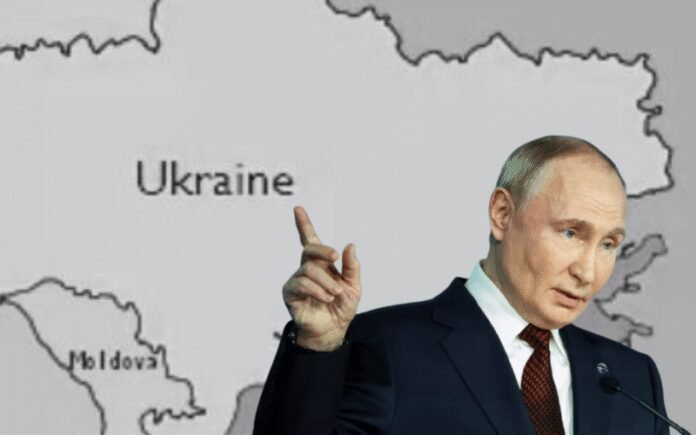
President ​Vladimir Putin said that Russia was winning the war in Ukraine and portrayed the Ukrainian leadership as “terrorists” with ‌whom Moscow could not negotiate.

Putin, in his most detailed comments on the war for many weeks, acknowledged that Ukrainian attacks inside Russia had inflicted real damage and said that drones posed a particular challenge.

But he said that Russia was advancing on the battlefield and told reporters: “I have no doubt the enemy will crumble.”

He declined to say when ​that would happen.

Rumours that Russia would be forced to order a new military mobilisation were “utter nonsense,” he said.

PUTIN SAYS RUSSIAN ADVANCES ​ARE ACCELERATING

Four and a half years into the war, Russia controls about a fifth of Ukraine. U.S.-mediated peace talks ⁠broke off in February after the United States and Israel went to war with Iran.

Opinion polls suggest growing war fatigue in Russia ​and influential voices are warning about the strain on its economy.

But Putin struck a confident, hawkish tone as he rattled through a detailed version ​of developments on the front line, saying Russian advances were accelerating.

Russian troops had captured 270 square km (104 sq miles) of the Donetsk region in eastern Ukraine in August and two large groups of Ukrainian troops – one comprising 4,500 to 4,800 men, the other up to 2,000 – were surrounded, he said. Reuters could not independently verify those assertions.

Russia continues to advance towards the ​cities of Sloviansk and Kramatorsk, Putin said, adding that Moscow’s forces were preparing to launch massive strikes against energy infrastructure in Ukraine.

Putin said that ​Ukrainian President Volodymyr Zelenskiy’s warning to airlines that Ukrainian drones would effectively shut down Russian airspace sounded like “state terrorism” and that Moscow would find a way to respond ‌if it ⁠happened.

Speaking at a news conference after a summit in Kyrgyzstan, Putin said it was not possible to negotiate with “terrorists”.

He also said, however, that Moscow was open to talks aimed at ending, rather than freezing, the war, and restated its willingness to talk to U.S. President Donald Trump’s envoys.

“If someone makes, or can make, a tangible contribution to this process, we are all in favour,” Putin said.

“The only thing we would want to avoid is ​the process spinning its wheels pointlessly. ​However, if someone is capable ⁠of bringing something positive to these negotiations – which, as we understand it, are currently somewhat frozen – then, generally speaking, we are not opposed.”

Putin specifically acknowledged that Ukrainian drone strikes had caused damage to Russian oil refineries, ​although without referring to widespread fuel shortages that have resulted from those attacks.

But he said that ​the level of protection ⁠had improved, and “we only have 10% of our refineries left to repair”.

Putin responded scathingly to an accusation by the German government on Tuesday that Russia was to blame for an attempted drone attack at Leipzig airport last month.

He said the government of Chancellor Friedrich Merz was pointing the finger ⁠at Moscow ​to distract from domestic problems and falling approval ratings.

Putin accused Germany of planting ​evidence in order to frame Russia for the drone attack, but he did not say what he was basing that accusation on.

Iran strikes back at US positions: Iranian media

0
iran-strikes-back-at-us-positions:-iranian-media
Iran strikes back at US positions: Iranian media

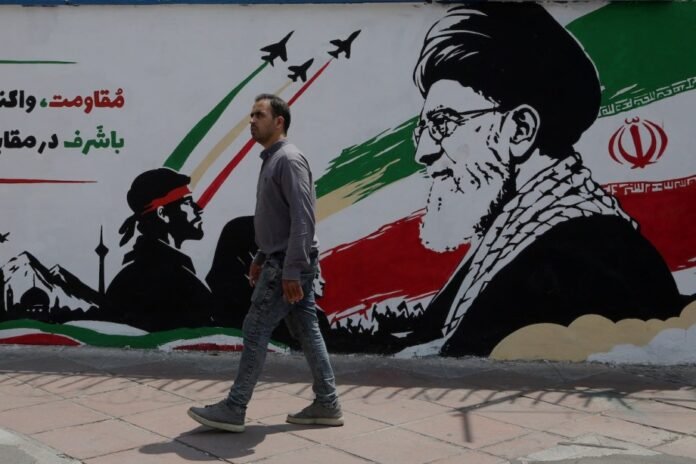
Iran launched missile and drone attacks against US positions on Tuesday, Iran’s semi-official Fars news agency said.

“Field observations indicate Iranian missiles and drones firing at enemy positions,” the agency said.

The report came after the US Central Command (CENTCOM) announced that American forces began striking IRGC targets in Iran.

Tensions between Tehran and Washington have remained high since the war began with strikes on Iran in late February.

A framework deal was signed in June through Pakistani and Qatari mediation.

The US began a two-week bombing campaign in July and reimposed a naval blockade after differences over navigation in the strait.

READ: US forces begin strikes on Iran’s Revolutionary Guard targets: CENTCOM

As-Suwayda’s Schoolchildren Become Pawns in Political Struggle Over Exams 

0
as-suwayda’s-schoolchildren-become-pawns-in-political-struggle-over-exams 
As-Suwayda’s Schoolchildren Become Pawns in Political Struggle Over Exams 


Muhannad Sharrouf, a political activist from As-Suwayda, told TML: “They are not merely depriving them of an exam; they are threatening their future and pushing another generation toward further loss, chaos and collapse.”

[DAMASCUS] Before her exams, Sally—a pseudonym used at her request—left Syria’s southern As-Suwayda province and moved to a government-controlled area in the province’s countryside, where she stayed with a relative.  

It was not a family visit. She left because she feared that if she remained in As-Suwayda, she might not be allowed to reach her examination center.  

“I left before the exams because we knew there was a strong possibility that we would be prevented from reaching the examination centers,” Sally told The Media Line.  

I left before the exams because we knew there was a strong possibility that we would be prevented from reaching the examination centers

Her decision illustrates a crisis that has turned what should be a routine educational process into another arena of the political struggle between Damascus and local forces in As-Suwayda. 

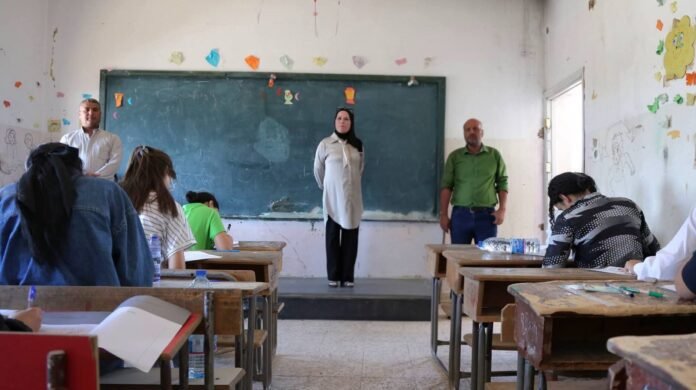
Thousands of students have been unable to sit for official exams amid a dispute over where the tests should be held and who should supervise them. The Syrian government insists that the exams be administered by the Ministry of Education at officially designated centers, while local forces have demanded centers closer to where students live and objected to sending them into government-controlled territory.  

For the students, the dispute could cost them an academic year.  

Syrian student. (Courtesy: Syrian Ministry of Education)

The father of one student told The Media Line that his son had spent weeks preparing but was unable to reach his examination center.  

The father, who asked that his name be withheld for security reasons, accused members of the National Guard a local armed formation aligned with Druze spiritual leader Sheik Hikmat al-Hijri —of preventing students from leaving.  

He said the restrictions reflected the local forces’ broader refusal to deal with the government in Damascus or recognize its institutions.  

Families in As-Suwayda, however, are themselves divided.  

Some have refused to send their children to centers in government-controlled areas, citing security concerns and the tense political situation. Others insist their children should be allowed to take the official exams regardless of the dispute between Damascus and the province’s local authorities.  

More than 13,000 students in As-Suwayda were registered for basic education and secondary school certificate examinations during the first examination session. Around 2,000 were able to take their exams, leaving approximately 11,000 unable to.  

Authorities then organized a special examination session intended to give those students another chance.  

But when the special session began on August 29, only around 150 students reached the designated centers in northern rural As-Suwayda.  

Those who made it are continuing their exams under a schedule running through September 10. Thousands of others remain outside examination halls.  

The problem is not simply transportation.  

Syrian school. (Courtesy: Syrian Ministry of Education)

Efforts to reach an agreement allowing the exams to be held inside As-Suwayda city under the Ministry of Education’s supervision failed. The government instead established centers in northern parts of the province under its control.  

Local groups rejected those locations and demanded that the exams be conducted closer to students’ homes, citing security risks and the distance students from some villages would have to travel.  

The disagreement quickly became part of a much larger question: Who has the authority to administer public institutions in As-Suwayda?  

For Damascus, official exams must remain under the authority of state institutions. For local forces that reject greater government control over the province, sending students to government-run centers carries political and security implications.  

The National Guard has denied preventing students from reaching the examination centers. It described what happened as a “popular movement” led by families unwilling to send their children into government-controlled areas and accused Damascus of politicizing education by placing examination centers far from students’ homes.  

But an earlier statement by the Shahba Operations Room, which is affiliated with the National Guard, complicates that denial.  

Before the exams began, the operations room announced that roads would be closed to vehicles transporting students to the centers designated by the Education Ministry. It warned drivers against transporting students and threatened to impound vehicles that violated the order.  

That announcement suggests that opposition to the government’s examination arrangements went beyond individual decisions by concerned families and included measures that could physically obstruct students who wanted to attend.  

The Syrian Ministry of Education, meanwhile, said the special session was organized specifically to protect the rights of As-Suwayda students who had missed the previous round of exams.  

In a press statement, the ministry said it prepared examination centers in northern rural As-Suwayda and provided staff, proctors, and the materials required to conduct the tests.  

The ministry expressed regret that not all students were able to reach the centers and said the examinations would continue as scheduled rather than be canceled.  

According to the government, armed groups prevented large numbers of students from reaching the centers. Authorities delayed the start of the examinations by several hours on the first day to give more students time to arrive.  

Yet critics of Damascus also question why the government did not establish examination centers closer to the thousands of affected students, given As-Suwayda’s exceptional security and political circumstances.  

The result is a situation in which both sides accuse the other of politicizing education.  

Damascus argues that local armed groups are obstructing official exams because they reject state institutions. Local forces accuse the government of using the examination arrangements to assert political and administrative authority over the province.  

The students are caught between them.  

The dispute reflects a much broader struggle over As-Suwayda’s relationship with Syria’s central government.  

Relations between Damascus and local forces have remained tense since deadly fighting in the province in July 2025. As-Suwayda city and other parts of the province remain under the control of local armed groups, while Syrian authorities are seeking to extend state institutions across the country.  

Against that backdrop, disputes over security, administration and public services increasingly carry political significance.  

Education has now become part of that struggle.  

Muhannad Sharrouf, a political activist from As-Suwayda, warned that preventing young people from completing their education could have consequences long after the current political confrontation ends.  

“Depriving an entire generation of education does not end at the school gates,” Sharrouf told The Media Line. “Its effects extend to unemployment, poverty, marginalization, and declining prospects for stability, and society as a whole pays the price.”  

He linked the current crisis to the damage already inflicted on Syrian education by years of war.  

Children who were 10 or younger when the conflict began are now adults in their mid-20s, he said, after growing up through years in which war disrupted education, training, and opportunities to build stable futures.  


Anyone who prevents As-Suwayda’s students from reaching their examination centers and taking their exams is committing a grave wrong

“Anyone who prevents As-Suwayda’s students from reaching their examination centers and taking their exams is committing a grave wrong against the students, their families, their community and their country,” Sharrouf said.  

“They are not merely depriving them of an exam; they are threatening their future and pushing another generation toward further loss, chaos and collapse.”  

The current dispute shows how unresolved questions of authority in As-Suwayda can affect even services that would normally be expected to remain outside political confrontation.  

There are legitimate security questions surrounding the movement of students across areas controlled by rival forces, and some families have independently decided that sending their children to government-controlled areas is too dangerous.  

But other students want to take the exams, and the earlier threat by a National Guard-affiliated operations room to stop vehicles transporting them raises a different question: whether political opposition to Damascus should determine whether a student can reach an examination hall.  

Sally avoided that dilemma by leaving before the exams began.  

Thousands of her fellow students did not.  

For them, an exam that should have tested what they learned in school has instead become a test of something entirely different: whether Damascus and As-Suwayda’s local forces can keep their political struggle from determining the future of a generation.  


CBS News Spins El-Sayed’s 9/11 Tweets Into a Manufactured Anti-Muslim Scandal

0
cbs-news-spins-el-sayed’s-9/11-tweets-into-a-manufactured-anti-muslim-scandal
CBS News Spins El-Sayed’s 9/11 Tweets Into a Manufactured Anti-Muslim Scandal


Eoin Higgins is the author of “Owned: How Tech Billionaires on the Right Bought the Loudest Voice on the Left.”

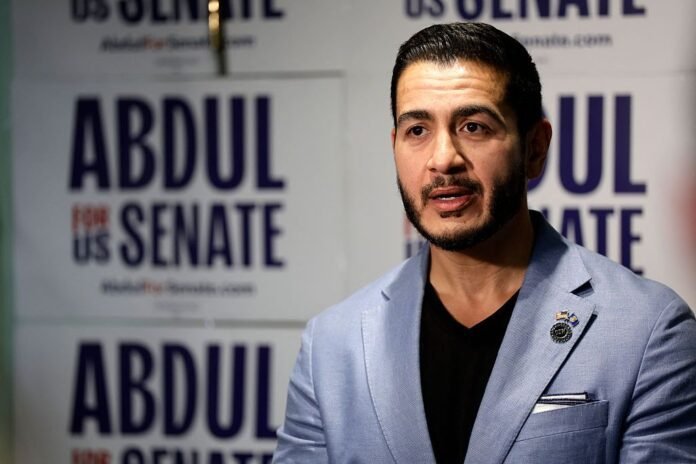
It always felt inevitable that Bari Weiss’s tenure at CBS News would see the network devolve into rank Islamophobia — but even for most of us, who took a dim view of her takeover of the news behemoth, tying Michigan Democratic Senate nominee Abdul El-Sayed to the 9/11 attacks was an unexpected new low. To make matters worse, many centrist Democrats and their allies cleared the way for just this kind of attack. 

On Monday, CBS reporter Zak Hudak published an article headlined with the critique that El-Sayed’s “deleted tweets on Sept. 11 attacks invite scrutiny of past remarks.” Weiss, whose time in charge of CBS has been rife with controversy, was reportedly deeply involved with the story’s promotion and framing, going so far as to praise it in a newsroom meeting and champion it “to the entire network,” according to media-industry newsletter Status. She “even personally directed the headline to be tweaked to specifically mention” the 9/11 angle. 

The story immediately came under harsh criticism, even from people whose politics when it comes to Muslims are virtually indistinguishable from Weiss’s. Atlantic writer Jonathan Chait, for example, called the tweets a “non-story.”

CBS declined to mention that two of those three deleted posts were asking Americans to take the death toll of the Covid-19 pandemic as seriously as the attacks. It’s worth noting — CBS did not — that invoking 9/11 to put the Covid death toll in perspective wasn’t unusual at the time; then-Gov. Andrew Cuomo directly compared the pandemic, which ravaged New York City, to the attacks the same month that El-Sayed did.

Another post at issue was a rather anodyne comment about the consequences of the decadelong war on terror and a call to action: “We could save lives rather than take them.”

El-Sayed’s campaign previously told Politico that all posts older than July 2023 were deleted “to prevent any old posts from being taken out of context.”

Weiss’s guidance led to CBS News’s racist framing that there’s just something different — even untrustworthy — about El-Sayed, and that the upcoming 25th anniversary of 9/11 is the right time to ask what that is.

In doing so, she’s embracing a long-standing bipartisan tradition of Muslim dehumanization — a playbook still being deployed on both sides of the aisle. The current anti-Muslim environment reflects the growth and regression in the country since the 9/11 moment: growth in the number of Muslims in political and public life, and the regressive backlash to multicultural liberalism that’s defined the Trump era. 

This kind of bigotry was rampant during the early 2000s, particularly in 2002 and 2003, when the George W. Bush administration weaponized Americans’ anger and shock over the attacks to gin up support for its war of choice on Iraq.

Weiss’s guidance led to CBS News’s racist framing that there’s just something different — even untrustworthy — about El-Sayed, and that the upcoming 25th anniversary of 9/11 is the right time to ask what that is.

More recently, in the wake of mass protest and opposition, mainly from the left, to Israel’s genocide of Palestinians in Gaza, institutional power on both sides of the partisan divide has cracked down on dissent. In the immediate aftermath of the October 7 attacks, expressing sympathy for Palestine was enough to engender severe career consequences

Since 2023, the landscape of public opinion has shifted significantly. A supermajority of Democratic voters are opposed to Israel’s war on Gaza and support sanctions on Israel. Increasingly, primary voters are punishing incumbents who have been diehard supporters of Israel. The callback to the anti-Muslim rhetoric of the post-9/11 era has also fallen flat with the base, who are more concerned with affordability and opposing Trump than they are with ensuring U.S. dominance over the region.

Rather than adapt to this new political reality, some of the Democratic Party’s most enthusiastic cheerleaders are fighting back by playing dirty. Neera Tanden, president of the powerful Democrat-aligned think tank Center for American Progress, has turned attacking El-Sayed and the Twitch streamer Hasan Piker — who was raised Muslim — into her main focus. 

The callback to the anti-Muslim rhetoric of the post-9/11 era has fallen flat with the base, who are more concerned with affordability and opposing Trump.

Tanden’s venomous online behavior has gained traction with anti-Muslim voices on the Democratic side, including activists Fred Guttenberg and Shannon Watts, who made their names protesting against gun violence against children — unless they live in Gaza.

But Tanden, with her reach and influence in the party, which has included stints in both the Biden and Obama administrations, is far more influential, and she wields that influence to her advantage against progressives and Muslims in her own big tent. 

She’s reposted commentary from white supremacist streamer Nick Fuentes and arch-right provocateur Laura Loomer, in the latter case boosting a comment accusing Piker of using “Ninja Taqiyya,” a white nationalist meme referring to a secret Muslim plot to infiltrate Western society with their Islamic faith. Tanden later deleted it, claiming it was a “mistake,” but didn’t disavow the content.

A number of Democratic politicians eager to revive the party’s Islamophobic war on terror days have joined these attacks. Piker, a public figure aligned with progressives but just outside the mainstream enough to threaten the establishment, is a perfect foil for centrist Democrats fighting against a lefty uprising

Democratic senators and representatives have in turn targeted Piker as a way to swipe at the party’s ascendant left in more and more deranged and defamatory ways, and have repeatedly called on El-Sayed to disavow the streamer, who campaigned for him in the primary. 

Piker’s recent comments that Israel’s actions are making Jews around the world less safe — echoing remarks previously made by Ezra Klein and others — were were cynically used as another example of the streamer’s “antisemitism” by right-wing Democrats, with Democratic Rep. Josh Gottheimer telling CNN, “There’s no way I’m ever coming out for El-Sayed.” 

Rep. Brad Sherman, a California Democrat, claimed Piker endorsed Hamas fighters raping children. And Sen. John Fetterman, the nominal — at the time of this writing — Democrat from Pennsylvania has mumbled at various moments about Piker’s opposition to Israel as part of a dealbreaker for him staying in the party.

This mainstreaming of liberal Islamophobia at the party and think tank level has emboldened media figures to indulge in the same bigotry.

At CNN, it’s anchors Dana Bash and Jake Tapper who are most enthusiastic about smearing critics of Israel and engaging in open hate toward Muslims. As Intercept contributor Adam Johnson has pointed out, CNN’s “State of the Union,” the network’s flagship Sunday news show hosted by Tapper and Bash, “hasn’t had on a Palestinian or Palestinian-American guest in over 7 years, and the last time they did it was Rashida Tlaib and Jake Tapper asked her if she believed in Israel’s ‘right to exist’ three different times.”

When you find yourself in common cause with the likes of virulent anti-Muslim bigots like Laura Loomer, it’s time to take a long look in the mirror, and consider the fact that you’re doing the Republicans’ work for them.

Over at The Atlantic, writers like Chait are often so hostile toward El-Sayed and Piker that they’re earning the kinds of rebukes mostly left to private conversations. Chait’s latest smear of El-Sayed was so dishonest it prompted former Atlantic associate editor Siddhartha Mahanta to publicly question the writer, asking if he had requested comment for the claims he was making about the candidate. Chait snapped back that as an opinion writer, he wasn’t subject to those kinds of ethical requirements — a familiar retort.

But tying El-Sayed to 9/11 is an escalation. Weiss’s choice to push Islamophobia in mainstream discourse past the point of plausible deniability, regardless of how one feels about that plausibility, will have an impact. When you find yourself in common cause with the likes of virulent anti-Muslim bigots like Loomer, it’s time to take a long look in the mirror, and consider the fact that you’re doing the Republicans’ work for them. A closing argument for the GOP in Michigan, and nationally, that focuses on the otherness of Muslims is ideal ground for the right, and highly preferable to talking about the domestic issues El-Sayed has built his campaign around. 

It would be helpful if Democrats presented a united front against racist attacks on members of their own party. Unfortunately, it appears that for some on the party’s right wing, welcoming Muslims into the tent is a nonstarter.

FTC alleges Amazon illegally made $20 billion by rigging billions of ad auctions

0
ftc-alleges-amazon-illegally-made-$20-billion-by-rigging-billions-of-ad-auctions
FTC alleges Amazon illegally made $20 billion by rigging billions of ad auctions

The Federal Trade Commission and 22 states sued Amazon yesterday, alleging that it has conducted a secret scheme to overcharge advertisers for seven years.

“Since 2019, Amazon.com, Inc. has secretly and systematically overcharged its approximately 1.2 million advertising customers by manipulating the ‘auctions’ that it uses to set the price of ads on its platform,” the lawsuit said. “Amazon represents, and advertisers believe, that competitive auctions set the prices for advertising on its leading e-commerce website. But, in reality, Amazon overrides and replaces the actual auction results with higher prices set by Amazon to increase its profits.”

The FTC said it obtained internal documents and messages that reveal how Amazon secretly inflated auction prices for Sponsored Products, Sponsored Brands, and Sponsored Display advertisements that appear alongside results seen by consumers when they search for a product. The FTC investigation began in 2024.

“Based on numerous internal documents describing its ‘hidden’ ‘surcharges,’ Amazon’s scheme has likely illegally extracted over $20 billion from its unwitting advertising customers,” according to the lawsuit filed in US District Court for the Western District of Washington.

The FTC lawsuit was joined by a bipartisan group of 22 state attorneys general from Alaska, Arizona, California, Colorado, Florida, Idaho, Illinois, Indiana, Iowa, Kentucky, Louisiana, Maryland, Nebraska, New Jersey, New York, North Carolina, Oklahoma, Pennsylvania, Rhode Island, South Carolina, Vermont, and Washington.

The lawsuit said Amazon has conducted “billions of rigged auctions,” imposing “hidden surcharges on advertisers almost every time a shopper clicks on an advertisement on the Amazon website. Amazon’s deception continues to this day” and deprives customers “of the benefits of competition and fair and transparent dealing,” the FTC said.

Amazon says “FTC cherry-picked” details

The FTC and states are seeking a permanent injunction to change Amazon’s practices along with civil penalties, restitution, disgorgement, and other monetary relief. Amazon reported $200.6 billion in net sales in Q2 2026 and a net income of $62.6 billion.

Amazon yesterday issued a response that said the FTC lawsuit is “misguided.” Amazon did not dispute key claims about the mechanics of its ad auctions, but said its system did not harm consumers or advertisers.

“After reviewing approximately 1.5 million pages spanning six years, the FTC leans on a handful of simplified communications to allege a companywide effort to deceive. That is patently false,” Amazon said. It also said “the FTC cherry-picked a small number of materials, such as a few online educational videos and training content that contained older or simplified examples about how our auctions are run.”

An FTC press release said that Amazon tells potential ad buyers that it “runs ‘second price’ auctions where the winner of the auction would only pay ‘one cent more than the next highest bidder’ for each successful bid for an advertising keyword.” This “generalized second-price, or GSP auction” is an industry standard for digital ad placements, the FTC said.

Amazon has run GSP auctions since 2012, but in 2019, it started adding an undisclosed surcharge that it internally calls a “soft reserve price,” causing advertisers to pay more than the price determined by the auction, the FTC said.

The FTC quoted an Amazon senior scientist as explaining that Amazon raises prices by using “an invented auction participant representing how much Amazon thinks that particular ad slot is worth.” An Amazon senior VP in charge of ads said internally that in Amazon’s auctions, “the second price isn’t set by an actual bidder, but rather by” Amazon itself with a “proxy 2nd price that we calculate,” the lawsuit said.

“We don’t tell them about the surcharge”

Amazon kept the use of soft reserve prices secret, even from its own sales and marketing employees in charge of interacting with advertisers, and designed the system to be undetectable by advertisers, the FTC said. Amazon did not mention reserve pricing on its website until October 30, 2025, “almost a year after learning of the FTC’s investigation,” the lawsuit said.

The lawsuit quoted an Amazon employee as writing in a 2024 message, “We don’t tell them about the surcharge, we let them assume [it is] GSP-based.” The employee who wrote this “had helped conduct a large-scale pricing experiment that concluded that Amazon could increase surcharges without fear of detection by advertisers,” the lawsuit alleged.

Amazon’s response acknowledged that it uses reserve prices, saying it implemented the system because “relevant ads [were] increasingly winning at prices below market value.” A soft reserve price is “a real-time minimum value that seeks to better reflect what each placement is actually worth” and “represent[s] what we estimate to be the true market value of the ad placement,” Amazon said.

Amazon also sets a “hard reserve” price. Amazon said this is the minimum a bid must surpass to enter an auction and helps cover the company’s costs.

“Our auction looks at a combination of which ad is most relevant to the customer and the price an advertiser is willing to pay,” Amazon said. “Here’s how it works: Advertisers bid a maximum price for a placement. When the winning advertiser’s bid exceeds both the hard and soft reserve, they pay the soft reserve, which is less than they were willing to pay. When the winning advertiser’s bid exceeds the hard reserve but doesn’t meet the soft reserve, we still grant the placement to that advertiser and they pay their bid. In no scenario does an advertiser pay more than their bid.”

FTC: Amazon still “fails to clearly” disclose system

On an Amazon Ads auctions webpage last updated in April 2026, Amazon notes that reserve pricing may affect the cost of ads and “help allocate ad space by setting a bid threshold.” The FTC said that while Amazon’s website was updated to disclose reserve pricing, it still “fails to clearly and conspicuously disclose the nature, scope, and extent of Amazon’s secret reserve pricing systems that have been in place since 2018.”

Much of Amazon’s public defense relies on an assertion that its ad prices haven’t risen significantly. Amazon said that “from 2019 through 2024, the average cost-per-click to advertisers remained flat when adjusted for inflation.” Since advertisers didn’t have to pay more, there were no price increases to be passed on to consumers, Amazon argued.

Amazon also said 92 percent of Sponsored Products ads are not given to the highest bidder because the company selects winners based on a combination of price and relevancy to the keyword search. Amazon claimed that between 2021 and 2025, advertisers saved over $8 billion “as a result of Amazon incorporating ad relevancy into our auction versus selecting ads on bid alone.”

The FTC says customers paid more than they would have if Amazon operated the auction in the way it claimed it did. “These inflated advertising charges allow Amazon to extract additional revenue from sellers on its platform, on top of the account fees, referral fees, and fulfillment and storage fees that increasingly both cut into Amazon sellers’ profit margins and lead to price increases borne by Amazon shoppers,” the lawsuit said.

Homeland Security Opens Child Exploitation Probe Into Banned Texas Volleyball Coach

0
homeland-security-opens-child-exploitation-probe-into-banned-texas-volleyball-coach
Homeland Security Opens Child Exploitation Probe Into Banned Texas Volleyball Coach

A Texas volleyball coach who was the subject of an investigation last month by ProPublica and The Washington Post is now facing a federal child exploitation probe, according to an agent for Homeland Security Investigations, the main investigative arm of the Department of Homeland Security.

The ProPublica and Post story detailed how Ryan Richardson continued to coach teenage girls for years at his gym in Pharr, Texas, amid allegations of misconduct, even after he was suspended in early 2025 and subsequently ruled “permanently ineligible” this February by the U.S. Center for SafeSport, an oversight group. On its public disciplinary list, SafeSport said it found that Richardson had an intimate relationship with a minor, committed sexual misconduct involving a minor, and engaged in physical misconduct and bullying. 

Juan J. Flores Jr., a supervisor in a Homeland Security Investigations unit that focuses on child exploitation in the Rio Grande Valley, told ProPublica and The Post that he had launched the probe into Richardson in response to the story, which included allegations from a parent and former players that he had a sexual relationship with a 16-year-old player beginning in 2022 and that he groomed and emotionally and physically abused others. 

“My plan is to turn over every rock, have every conversation. I know he’s still coaching,” Flores said. 

Richardson did not respond to multiple requests for comment on ProPublica and The Post’s reporting or to an email seeking a comment for this story. When he was first suspended in 2024 by Lone Star Region Volleyball, the organization overseeing volleyball in Texas, Richardson told the local news website MyRGV that complaints about him were an effort to “retaliate and defame someone’s character,” and said he “would never do anything to risk the physical or mental wellbeing of these strong young ladies.” 

A spokesperson for the Department of Homeland Security said HSI was “a global leader in the fight against child exploitation” but said it was “unable to confirm or deny any ongoing investigations.”

ProPublica and The Post published excerpts of Snapchat messages between Richardson and a former player, including from August 2022, when the girl was 16. In those messages, Richardson and the girl said “I love you” to each other and planned when they would next meet up. In a message in May 2023, when the girl was 17, Richardson wrote, “I don’t like that we are only sex right now so I really would love to get past this high school Shit when you are on your own pretty much.” The Snapchat messages were part of an investigation conducted by SafeSport.

The mother of the former player, Maggie Gutierrez, said that in the summer of 2022, she discovered Richardson alone with her 16-year-old daughter in the darkened back room of his gym, which at the time contained a twin mattress. Richardson turned his back to her and appeared to be tying up the string of his pants, Gutierrez said. At the time, Richardson and Gutierrez’s daughter denied anything inappropriate had happened. (ProPublica and The Post, which do not name alleged victims of sexual abuse without their consent, are referring to Gutierrez by her maiden name to avoid identifying her daughter, who declined to be interviewed.) 

Gutierrez went to the police in both Pharr and McAllen in early 2024, she told ProPublica and The Post, after her daughter’s college volleyball coach told her that he believed Richardson and her daughter, then 18, were dating. 

She said police declined to pursue the case because her daughter was a legal adult and did not want to speak to police officers.

Police in both jurisdictions denied records requests from ProPublica and The Post by citing an exemption under state privacy statutes, but the news organizations obtained excerpts from the police report in McAllen. In the text, an officer described meeting with Gutierrez at the McAllen police station.

The officer wrote that due to Gutierrez’s daughter “being 18 years of age, which as per Texas law is considered an adult and an age which gives her the right to consent, case would not be further investigated and closed.” 

Gutierrez then reported her concerns to Lone Star, the regional arm of USA Volleyball, which governs the sport. Officials referred the matter to SafeSport, which opened an investigation. 

Gutierrez spoke to the Homeland Security investigator last week, she told ProPublica and The Post. 

Flores said his inquiry would also involve looking into the actions of both police departments that declined to pursue a case against Richardson.

Police in Pharr and McAllen did not respond to requests for comment.

Read More

0FansLike
0FollowersFollow
0FollowersFollow
0SubscribersSubscribe
- Advertisement -
Google search engine

Recent Posts