
15.5 C
London
Friday, August 21, 2026
Home Blog

Russia’s Khabarovsk sub tests Cold War deterrence in a new age

0
russia’s-khabarovsk-sub-tests-cold-war-deterrence-in-a-new-age
Russia’s Khabarovsk sub tests Cold War deterrence in a new age

Russia’s Khabarovsk submarine may represent the cutting edge of undersea nuclear warfare, but its arrival also raises a more fundamental question: whether increasingly exotic weapons can preserve deterrence in an era when adversaries are learning to impose strategic costs without ever crossing the nuclear threshold.

This month, multiple media outlets reported that Russia has begun initial factory sea trials of its Project 09851 nuclear-powered submarine Khabarovsk, the country’s first purpose-built standard carrier for the Poseidon strategic nuclear drone system.

The submarine departed the northern shipbuilding hub of Severodvinsk to begin maritime trials, marking its first voyage since construction began in 2014, with official plans to transfer the vessel to the Pacific Fleet upon completion of testing.

Designed primarily as a second-strike retaliation platform, the Khabarovsk is equipped with six 2P39 launchers to deploy 2M39 Poseidon autonomous underwater drones—megaton-class nuclear weapons engineered to destroy coastal military facilities, critical ports, and carrier strike groups following an initial strategic exchange.

Operating at depths of approximately one kilometer and at submerged speeds of up to 200 kilometers per hour, the nuclear-powered torpedoes have an estimated 10,000-kilometer range and complex routing capabilities designed to circumvent conventional anti-torpedo defenses.

The deployment to sea represents a key milestone in Russia’s transition toward fully operationalizing its next-generation deep-sea nuclear deterrence capabilities.

In July 2022, Russia commissioned the Belgorod special mission submarine – capable of carrying four Poseidon drones and serving as the mothership for the Losharik spy submarine, which is designed to sever, tap, or inspect critical undersea cables.

The Khabarovsk appears to be more specialized as a Poseidon launch vehicle than the Belgorod, with up to four additional units planned, along with 30 Poseidon drones.

This development indicates that Russia is intensifying its focus on heavy, high-yield strategic systems as arms control norms weaken. With the expiry of the New Strategic Arms Reduction Treaty (New START) in February 2026, the Khabarovsk and Poseidon are now distinct strategic assets without effective arms control mechanisms.

They are among Russia’s “superweapons,” designed either to defeat current and emerging US missile defense systems or to serve as bargaining chips to secure US concessions in any future strategic arms negotiations.

Other such superweapons include the Sarmat super-heavy intercontinental ballistic missile (ICBM); the Avangard and Zircon hypersonic weapons; the Burevestnik nuclear-powered cruise missile; and the Kinzhal aero-ballistic missile. While Russia has used the Zircon and Kinzhal in combat against Ukraine, these weapons have not broken the stalemate in the Russia-Ukraine war.

Khabarovsk’s potential assignment within Russia’s Pacific Fleet would expand its undersea nuclear posture toward the US West Coast, Hawaii, and Japan.

However, the Khabarovsk may be entering service just as traditional notions of sea-based nuclear deterrence are being challenged. While nuclear ballistic missile submarines (SSBNs) have long been regarded as the ultimate guarantors of second-strike capability, developments in the Russia-Ukraine war increasingly question that assumption.

Ukraine’s strikes on Russian submarines in the Black Sea may call into question the survivability of Russia’s sea-based nuclear arsenal.

In December 2025, Ukraine destroyed a Russian Kilo-class submarine at its homeport in Novorossiysk, with a Sea Baby unmanned underwater vehicle (UUV) slipping past base defenses.

Previously, in September 2023, Ukraine severely damaged the Russian Kilo-class submarine Rostov-on-Don with Storm Shadow/SCALP cruise missiles while it was in drydock at Sevastopol; after repairs, Ukraine struck and sank the submarine in August 2024.

Those incidents may have prompted Russia to take countermeasures to protect its submarine fleet. For instance, The War Zone (TWZ) reported this month that Russia has begun installing anti-drone cages on the conning towers of its Kilo-class submarines assigned to the Black Sea Fleet and is keeping them submerged at port.

TWZ also reports that Russia has installed anti-drone netting over docked nuclear ballistic missile submarines (SSBNs) at the Rybachiy Naval Base in Kamchatka and deployed floating booms around submarine piers to block UUV attacks.

As those attacks show, SSBNs and special mission submarines such as the Khabarovsk and Belgorod may not be as invulnerable as previously thought.

Also, SSBNs may be “brittle” in the sense that if the submarine loses contact with higher command, is prevented from launching its nuclear payload, or is destroyed, it could result in the loss of a significant part of its operator’s nuclear arsenal.

That brittleness is not confined to SSBNs: concentrating multiple Poseidon weapons aboard a small number of Khabarovsk- and Belgorod-class submarines creates a comparable problem of force concentration.

Losing one Khabarovsk-class or Belgorod-class submarine and its entire Poseidon payload could seriously damage Russia’s nuclear posture in the Pacific, forcing it to rely more on conventional nuclear delivery systems, such as intercontinental ballistic missiles (ICBM), which may be vulnerable to US missile defenses, including the Ground-Based Midcourse Defense (GMD) or the planned Golden Dome space-based system.

While attacking a major nuclear power’s strategic assets was previously seen as a red line inviting nuclear retaliation, Ukraine’s audacious June 2025 Operation Spiderweb, which struck dozens of Russian aircraft – including several irreplaceable Tu-95 strategic bombers – may have served to call out Russia’s nuclear bluff and set a perception-breaking precedent. Instead of nuclear retaliation, Russia retaliated with a barrage of 400 drones and 40 missiles against Kyiv.

In the broader picture, nuclear-armed states may face significant difficulty deterring an adversary that employs sustained conventional and hybrid attacks – as long as the former decides not to use nuclear weapons.

Even limited use of nuclear weapons carries significant escalation risks, while leaders contemplating their use face severe domestic and international backlash – and if they proceed despite that backlash, risk infamy.

This credibility problem may deepen as new technologies expand the space for conflict below the nuclear threshold. As Alex Kolbin pointed out in a January 2026 article for the Bulletin of the Atomic Scientists, AI could soon become a strategic weapon, upending the dominant role held by nuclear weapons.

Kolbin notes that AI allows adversaries to maintain ongoing pressure through cyberattacks, information control, autonomous systems, and precision strikes, which do not trigger the same level of existential fear as nuclear retaliation.

He argues that in such an environment, nuclear weapons appear to be blunt – catastrophic, but unusable, inspiring fear but not restraint. He points out that future conflicts may be fought with tools that are cheaper, easier, and more politically acceptable to use, but cautions that such a conflict could escalate to the use of nuclear weapons.  

As such, the Khabarovsk and Poseidon may ultimately prove less a revolution in nuclear deterrence than technologically sophisticated expressions of Cold War thinking, reinforcing Russia’s capacity for catastrophic retaliation even as future adversaries increasingly seek to compete, coerce and inflict strategic damage below the threshold at which such weapons can credibly be used.
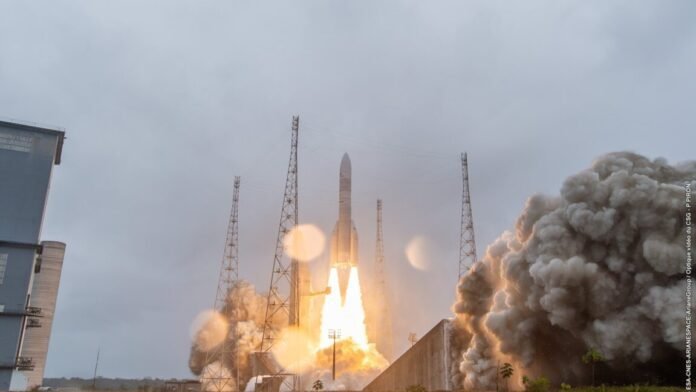

Europe cancels planned upgrades for Ariane 6 rocket

0
europe-cancels-planned-upgrades-for-ariane-6-rocket
Europe cancels planned upgrades for Ariane 6 rocket

In the two years since it made a largely successful debut, Europe’s Ariane 6 rocket has launched eight missions, all of which reached orbit safely.

The large, expendable rocket has a capacity of more than 20 metric tons to low-Earth orbit. And to the credit of European rocket scientists and planners, the Ariane 6 has had a substantially smoother rollout than comparable vehicles in the United States—Blue Origin’s New Glenn and United Launch Alliance’s Vulcan rockets—both of which have had significant growing pains.

However, even though the Ariane 6 rocket has had a successful debut, its future is clouded by high costs.

Block 3 put on ice

On Thursday, European Spaceflight reported that “Block 3” upgrades for the Ariane 6 rocket have been shelved by the European Space Agency. A key element of the “Block 3” evolution of Ariane 6 was the lightweight ICARUS upper stage, which would have used carbon-composite structures.

The cancellation of this upgrade has implications for some of the European Space Agency’s science missions, including a probe to Saturn’s icy moon Enceladus.

Perhaps the bigger question is what the cancellation of future versions of the Ariane 6 rocket tells us about the program’s future. In some ways, the vehicle has been a tremendous success. It has provided the continent reliable access to orbit for its most important satellites when the war in Ukraine pushed Europe to end its use of Russian rockets and ended Europe’s need to launch on SpaceX rockets owned by Elon Musk.

However, the fact that the European ministers who provide funding for Ariane 6 balked at these upgrades may indicate growing impatience with the rocket’s cost.

Arianespace hasn’t publicly disclosed the cost of an Ariane 6 launch, but it is likely somewhere in the range of 80 million to 100 million euros. The rocket has a number of European customers but also a major US corporation, Amazon, which contracted for 18 launches to get its Amazon Leo constellation into space. Three Amazon flights have occurred so far, all this year.

Major subsidies

That may sound like a commercial success, but Europe is likely losing money on each of those private missions.

Europe invested about 3.6 billion euros in the development of the Ariane 6 rocket and its launch site in French Guiana, but that’s not the end of it. The European Space Agency’s director general, Josef Aschbacher, has publicly confirmed that, based on nine flights a year, the European governments involved with the space agency will still need to subsidize each launch with between 32 million and 38 million euros per flight.

If we amortize the development costs with the ongoing subsidy, European taxpayers have put more than 100 million euros into each launch before the customer pays the rocket’s operator, Arianespace, anything.

Europe’s current goal is to fly the Ariane 6 rocket nine or 10 times a year, but given the growing global demand for launch and lack of capacity, there is some discussion about increasing the number of Ariane 6 rockets available.

Will ministers increase cadence?

In June, Aschbacher said Europe is on track to have the capability to launch Ariane 6 a total of 10 times next year, meeting the target set for Arianespace. However, he added that the agency is looking at various scenarios to increase that capacity to 12, 15, or even 20 launches a year.

Because the Ariane 6 rocket is expendable, Europe must increase production of all of the vehicle’s elements, from its solid-rocket motors to first-stage engines, in addition to upper stages and payload fairings.

Aschbacher said he hopes to have “clarity” from European ministers by the end of this year as to plans, if any, for scaling up production of the Ariane 6 rocket. The question for ministers may not be easy, however, because they will have to make investments in factories and other logistics to increase rocket production. And would it be worth doing that to meet growing commercial demand, if the only way to attract that demand is to heavily subsidize the price of its launch vehicle?

Ministers may decide that these funds would be better invested in the next generation of Ariane rocket that would incorporate at least partial reuse, and better compete with a growing number of reusable vehicles in the United States and China.

The decision by ministers later this year on whether to scale up capacity should reveal a lot about how they’re thinking about the long-term future of Ariane 6.

US debt crosses $40 trillion threshold

0
us-debt-crosses-$40-trillion-threshold
US debt crosses $40 trillion threshold


The United States has crossed a historic fiscal milestone, with total federal debt surpassing $40 trillion for the first time, according to new Treasury data. The figure reflects a decade of rapid borrowing driven by pandemic spending, rising costs for social programmes, and interest payments that now outpace several major government departments.

The Treasury reported total public debt outstanding at $40.047 trillion, including $32.3 trillion held by investors and $7.8 trillion in internal government accounts. The debt load has more than doubled since early 2017, when Donald Trump began his first term. Roughly one‑third of the increase came from emergency COVID‑19 spending under both Trump and Joe Biden, while long‑standing tax cuts and structural budget pressures account for much of the rest.

Fiscal watchdogs warn that the U.S. is edging closer to a potential debt crisis unless lawmakers confront widening deficits. Maya MacGuineas of the Committee for a Responsible Federal Budget said the burden is increasingly felt across the economy, fuelling inflation, crowding out other priorities, and limiting the government’s ability to respond to future shocks.

Investor appetite for U.S. debt also appears to be shifting. Foreign demand has weakened, and yields on long‑term Treasury bonds have climbed to their highest levels in nearly two decades. In response, Treasury Secretary Scott Bessent announced a doubling of buyback operations for 10‑ to 30‑year bonds to help ease market pressure.

Trump, asked about bond market volatility, dismissed concerns and repeated his call for lower interest rates, arguing that a strong U.S. economy should support cheaper borrowing.

The fiscal strain is increasingly visible in monthly data. The government posted a $432 billion deficit in July, one of the largest on record, driven by rising Social Security and Medicare costs and falling customs revenues. Interest payments have now overtaken Medicare spending, becoming the second‑largest item in the federal budget after Social Security.

Both Trump and Biden oversaw major increases in public debt:

  • Trump: +$11.6 trillion across two terms, including pandemic‑era borrowing and new legislative spending.
  • Biden: +$8.4 trillion during his four‑year term, driven by COVID‑19 recovery measures, infrastructure investment and clean‑energy subsidies.

With an ageing population, rising healthcare obligations, and tax revenues unable to keep pace, analysts warn that the U.S. faces a long‑term structural challenge that will require politically difficult choices on taxes, spending, or both.

Former Indian Major General Warns of Turkey-Pakistan-Saudi Pact, Urges Stronger Ties With Iran 

0
former-indian-major-general-warns-of-turkey-pakistan-saudi-pact,-urges-stronger-ties-with-iran 
Former Indian Major General Warns of Turkey-Pakistan-Saudi Pact, Urges Stronger Ties With Iran 


Retired Indian Maj. Gen. Gagan Deep Bakshi warned that the new defense pact involving Turkey, Pakistan and Saudi Arabia poses a concern for India, while arguing that New Delhi should strengthen ties with Iran despite pressure from Israel and the United States. 

Bakishi warned that a developing “Sunni NATO” could endanger India, arguing that New Delhi should deepen its ties with Iran regardless of pressure from Israel or the United States. 

“A Sunni NATO comprising Turkey, Saudi Arabia, and Pakistan has been established in the Middle East, in Mecca, and that is a serious cause for concern,” Bakishi said in an interview with New Delhi-based media. 

Bakishi said Shiite Iran provides India with an important strategic counterweight to Pakistan, which he described as a major security concern alongside China. 

“We very much need Shi’ite Iran to be on our side because Pakistan is our primary security headache,” he said. 

He contrasted Israel’s concerns about Iran with India’s view of nuclear-armed Pakistan, which he described as a “fundamentalist, jihadist Islamic state” possessing 180 nuclear warheads. Bakishi said Israel had not demonstrated comparable concern about Pakistan’s arsenal as it had about Iran’s nuclear program. 

Bakishi also pointed to growing military cooperation between Turkey and Pakistan, claiming Ankara supplied Pakistan with nearly 1,000 unmanned aerial vehicles and assisted in operating them during Operation Sindoor. Turkey also sent a warship to Karachi during the confrontation, he said. 

“This was already a ‘Sunni NATO,’ with or without an agreement. Turkey and Pakistan are already in an undeclared practical alliance,” Bakishi said. 

While describing Israel as a friend, Bakishi said India should not subordinate its national interests to either Jerusalem or Washington. 

“We are not the 51st state of the United States, and for that matter, we are also not an appendage or client state of Israel,” he said. “We are friends, certainly. But vassals? No, sir.” 

Bakishi particularly rejected any expectation that India would abandon ties with Iran because of the Israel-Iran war: “You cannot tell us: Throw Iran away because you are at war with it,” he said. 

He explained that Iran provides India with land routes to Central Asia and Afghanistan that New Delhi considers vital: “We cannot close these land routes because Israel is at war with Iran,” he said. 


Masked ‘Chucky’ Maniac Terrorizes Philadelphia (Video)

0
masked-‘chucky’-maniac-terrorizes-philadelphia-(video)
Masked ‘Chucky’ Maniac Terrorizes Philadelphia (Video)


A terrifying masked stranger allegedly spent nearly 30 minutes chasing and threatening people through Philadelphia — but one woman decided she wasn’t going to keep running.

Police say the young man, who was wearing a creepy Chucky-style mask, targeted at least six people during a bizarre spree last week.

One of those victims, Jameka Wilson, said she initially tried to get away before making a split-second decision to turn around and confront him.

“I figured it was smart to turn around and face him,” Wilson told CBS News. “I was like, ‘OK, well, let’s fight.’ I put my hands up. I covered my face.”

Then she fought back.

Wilson said she kicked the masked man squarely in the chest, causing him to stumble backward.

That apparently caught him off guard.

Instead of continuing after her, Wilson said the man turned and ran away.

Police described the suspect as being between 16 and 25 years old.

Another woman, Luanda Marinho, said she encountered the same bizarre stranger while meeting up with a friend.

According to Marinho, the masked man repeatedly challenged them to a race.

“He starts asking, ‘Do you guys want to race me? I bet I am faster than you. Want to race me?’” she recalled.

The women ignored him, but Marinho said the encounter immediately felt strange.

“Very weird,” she said.

But another alleged encounter was far more frightening.

Police said a woman was out for an early-morning jog when the masked suspect allegedly approached her and asked a chilling question.

“Are you ready to die?”

Philadelphia Police Capt. Jason Smith said the suspect allegedly repeated the threat before chasing the woman.

“He chases her, gets in front of her. ‘Are you ready to die?’ He makes that statement twice,” Smith said.

The frightened jogger ran away and injured herself while trying to escape, according to police.

Authorities have not said that the masked man physically attacked any of the victims.

Still, police made it clear they are not treating the strange series of encounters as some harmless prank.

“Some people may find this situation to be funny. Rest assured, we do not,” Smith said. “We’re taking this very seriously. We are going to find this individual.”

If caught, the suspect could potentially face charges including terroristic threats, harassment and intimidation.

For now, Philadelphia police are still trying to identify the man behind the mask — while Wilson’s decision to turn around and fight may have given him one surprise he wasn’t expecting.

US distributor of China’s most popular humanoid robots pivots after US ban

0
us-distributor-of-china’s-most-popular-humanoid-robots-pivots-after-us-ban
US distributor of China’s most popular humanoid robots pivots after US ban

A leading US distributor of China’s most popular humanoid robots and robot dogs now plans to produce its own robots at a facility on Long Island, New York. The business pivot comes amid the US government’s growing crackdown on foreign-made robots.

The company RoboStore had previously become the main North American distributor for humanoid robots and quadruped robots from Unitree Robotics, a Chinese robotics company that produces some of the most affordable and popular humanoid robot models. Universities such as Harvard and MIT, along with tech companies like Amazon and Nvidia, purchased such robots made in China through RoboStore for their own research and development purposes.

“We’ve sold over 1,500 robots and deployed them and worked with customers like Cisco, OpenAI, Nvidia, and over 150 universities,” Teddy Haggerty, founder and CEO of RoboStore, told Ars.

But on August 10, RoboStore announced a major shift in its business strategy with plans to fully open a 66,000-square-foot facility for manufacturing commercial robots by the first fiscal quarter of 2027. It also launched a new company called Robo Inc. to oversee the new robotics manufacturing and systems integration business.

Making the pivot

Haggerty and his team had already started thinking about the possibility of starting up their own robotics manufacturing business about a year ago. While supporting customers’ deployment and integration requests, they had gained insights into how customers were thinking about using robots for specific applications.

They also believed they could help more companies integrate industry-specific robots in ways that made sense for their businesses, rather than simply trying one of the many humanoid robots being pitched as a general-purpose solution for everything.

“Companies like Standard Bots and Universal Robots have a robotic arm for specific use cases,” Haggerty told Ars. “And I will tell anyone that that product is better suited for most businesses, for what they want to achieve, than a humanoid robot.”

The team accelerated plans to open a robotics manufacturing facility as the US government moved toward restricting or banning foreign-made robots. US lawmakers introduced legislation such as the American Security Robotics Act in the Senate in March, followed by the GUARD Act in the House of Representatives in June.

The biggest development so far came in July, when the US Federal Communications Commission banned the imports of new models of foreign-made robots, including popular robot vacuum cleaners and Unitree’s humanoid robots and robot dogs. The move was justified along national security lines because of potential cybersecurity vulnerabilities, but also clearly geared toward encouraging companies to produce more robots in the United States.

By that time, RoboStore had already shut down its distribution business while still promising to continue supporting customers needing parts, repairs, and upgrades for their existing robot models. The team’s focus shifted to developing robots and building out manufacturing capacity.

Working toward commercial robots

Under the Robo Inc. banner, the team is developing and testing several different robotic products. Those include a humanoid torso on top of a chassis with wheels that is designed for the healthcare industry and concierge services. Such a robot would come equipped with cameras and sensors to help take a patient’s standard vital signs, such as temperature and blood oxygen level.

Other initial products include a specialized quadruped for security applications and a humanoid robot platform for educators and researchers. “Universities are looking for a US-compliant product,” Haggerty said. “So we’ve taken everything we’ve learned from being easily the largest distribution channel for education for robotics.”

The team’s engineers have already used 3D printing to help build robot prototypes that are being tested by certain customers. They expect to be able to produce commercial versions of such robots from their new dedicated facility by early 2027.

Commercialization and manufacturing scaling challenges lie ahead. But before then, Robo Inc. is also looking to do its first big round of raising funding after having spent years as a bootstrapped business without outside investor money.

“We’ve reached out to all these customers, and we have an incredible interest now as we’re going through the process of raising money,” Haggerty said. “It definitely helps, 100 percent.”

The Mossad Suffers a Crushing Defeat Entirely of Its Own Making

0
the-mossad-suffers-a-crushing-defeat-entirely-of-its-own-making
The Mossad Suffers a Crushing Defeat Entirely of Its Own Making


Earlier this month, Roman Gofman, the new director of the Mossad, Israel’s shadowy national intelligence agency, dismissed the heads of its intelligence directorate and Iran division, known only by their heavily anonymized names “K” and “Y,” respectively. The Mossad prides itself on secrecy, and while terminations following the appointment of a new Mossad director aren’t unprecedented, such public oustings, which were reported by Israel’s mainstream news organizations, are almost unheard of.

The last known dismissals for incompetence came in 1997, when a botched attempt to assassinate Khaled Mashal, then chair of Hamas’s political bureau, resulted in the detention of several Mossad agents inside Jordan and a public relations disaster. Prime Minister Benjamin Netanyahu’s government found itself forced to supply the antidote for the poison its Mossad agents had administered, bringing down both the agency’s director and the director of operations. 

Israel is now dealing with the aftermath of the largest mistake in its history, one of its own doing: its failed war on Iran. Sold to the United States as an easy war that would quickly bring down the Islamic Republic and its alleged nuclear weapons program, almost nothing Israel desired came to pass.

The promise of assassinating Ali Khamenei was that it would bring about governmental chaos and spur a spontaneous national uprising. Instead, it only led to the selection of his younger son as the new supreme leader, a leadership that may prove to be even more antagonistic to the United States and Israel than the previous one.

Israel also promised that any potential closure of the Strait of Hormuz would be militarily ineffective. Now, Iran’s ability to hold the world economy hostage — despite relentless claims by the U.S. that the waterway is “open” — is its most valuable weapon. 

The Mossad’s particular role in this war involved weakening the Islamic Republic’s security structure in hopes of then funneling guns to Kurdish armed groups who would invade the country from Iraq, and then fuel mass demonstrations to topple the state. All of these lofty ambitions completely detonated on impact with reality, with Iran’s security structure remaining intact despite assassinations and airstrikes, Kurdish factions instead suffering constant Iranian military attacks, and no major protests occurring in any Iranian city, despite the massive anti-government protests in January that swept through the country.

For those who witnessed the Mossad’s public campaigns to encourage protests and defections — which it deployed in the open through Farsi-language social media accounts on X and Telegram bearing their name and seal — signs of the inevitable failure of this campaign were becoming evident. While images from June 2025’s Twelve-Day War of Mossad agents operating inside Iran and sabotaging Iranian military operations shocked many inside the country — that sabotage hampering Iran’s initial military response — its ability to change fundamental facts on the ground, and to move an entire country’s population against the sitting government, sputtered.

The Mossad chose to shift its image as that war began, capitalizing on its perception as an all-powerful and omniscient force to offer its supposedly unlimited power to help the Iranian populace. This shift manifested through cryptic social media posts, sarcastic quote-tweets of Iranian officials, and offering gifts to those who answered questions by direct message. The Mossad offered remote medical services through WhatsApp, and former radio host Menashe Amir, who notably hosted an Israeli radio show in Farsi aimed at anti-Islamic Republic Iranians, made videos on the Mossad’s behalf encouraging Iranians to listen to what the intelligence agency had to say.

The effort produced little. Iranian officials openly mocked the campaign online from the start, and it became increasingly desperate as mass protests failed to materialize. AI-generated videos of Iranian prisons having their walls blown open, and of happy Iranians following their defections to Israel, did next to nothing. The Mossad has continued to post AI-generated videos using Grok to encourage collaboration following the ceasefire.

While accusations were levied (and arrests made) of supposed Mossad agents inside the Iranian protests in January, their infiltration, alleged or otherwise, did not end up toppling or even shattering the Islamic Republic. Instead, more than 7,000 protesters were killed that month, in addition to hundreds of police officers.

After the plan to arm Kurdish groups, in collaboration with the CIA, apparently fell apart — either by Trump’s veto or, as Trump claimed, because the Kurds simply kept the weapons themselves — the Mossad apparently came up with a quick Plan B. The new bright idea: Overthrow the government via an airstrike campaign against Iranian police stations and checkpoints manned by the Basij, the Islamic Revolutionary Guard Corps’ paramilitary militia component. Despite extensive strikes in broad daylight, with some Iranians tipping off locations to opposition media outlets to help facilitate this campaign, the mass uprising, once again, did not arrive.

The war did not continue long enough for a comprehensive Plan C to come to fruition on the ground, with the Israeli military beginning to strike railways and manufacturing infrastructure, and Trump taking the lead on calling for the destruction of Iran’s energy infrastructure and bridges. Both are unified in their hope to strangle the country economically in hopes of pushing Iranian society into oblivion, but this outcome is only truly possible through American military means.

But even the U.S. has seen itself overextended, unable to resupply its missile interceptors for its own bases in the Middle East, and potentially unable to protect Israel as effectively as it had in the past should open conflict break out over its skies again.

News of the dismissal of the Mossad officials was met with disbelief in the Israeli media and by veterans of the intelligence service, who accused Gofman of suppressing the agency’s ability to function. By firing two deputies, security analysts accused him of foisting the agency’s failure onto underlings to shield the decisions made at the top levels of government from scrutiny.

While overthrowing the Iranian government has remained a popular idea among Israeli officials and other elected politicians, Netanyahu chief among them, other politicians have acknowledged its difficulty. Gadi Eisenkot, the former Israel Defense Forces chief of the general staff, has spoken of the unlikelihood of being able to overthrow the entire Iranian system, instead stating that operations should have continued “in the shadows.”

Reporting from Israel Hayom in May revealed that many in the Mossad were opposed to the idea of focusing resources on overthrowing the Iranian government, seeing it as a massive gamble. The Mossad’s former chief of influence operations, known as O., told the newspaper that he felt he had to sell the operation to many in the agency, despite the fact that “no one actually knows how to overthrow a regime or what the chances are that it will succeed.”

In March, just days before he would be killed in an Israeli assassination strike, Ali Larijani, then-secretary of the Iranian Supreme National Security Council, told the Iranian news outlet ISNA that Netanyahu “seemed to believe that these attacks had set a movement in motion inside Iran and that, by portraying the system as being in disarray, he could incite the public.” But Larijani pointed out that in less than a day, the regime had appointed “replacements for the commanders who had been killed, addressed the public, changed the atmosphere, and, by issuing specific orders, authorized the launch of missiles.”

Netanyahu, having pushed for the military overthrow of the Iranian government across multiple American administrations, finally got the war he wanted. But neither raw force, nor covert operations executed on his orders, were enough to carry out his will.

While Finance Minister Bezalel Smotrich has remarked upon how the current situation is very much working for Israel — one in which southern Iran is constantly bombarded with no end, and America is doing all of the fighting and dying — Netanyahu has continued his rhetoric about the need to create the conditions for the fall of the Islamic Republic. But in a moment of rare humility, he admitted this may “not happen in a single day.”

Recent reporting from Ynet found Netanyahu’s government instructed both the Israeli military and the Mossad to prepare for a much larger campaign against the Iranian state, with eyes on a potential return to open war in autumn. As has been the case over and over again, in Yemen, Lebanon, Gaza, and now Iran, Israel hopes that what was not solved with bombs can still be won — this time with even more bombs.

Flood of discounted auction homes deepens China’s property slump

0
flood-of-discounted-auction-homes-deepens-china’s-property-slump
Flood of discounted auction homes deepens China’s property slump

China’s residential property prices kept falling this year as a surge in court-ordered auction homes flooded the market with steep discounts, deepening buyer wariness and stalling any signs of recovery in the world’s second-largest economy.

Data from China Index Academy, a real estate research institute, showed the number of properties listed for court-ordered auction across 355 Chinese cities reached 539,000 in the first seven months of the year, up 23.7% from a year earlier.

The flood of discounted properties has depressed auction prices, which fell 9% year-on-year over the same period, as courts and asset managers rushed to offload homes seized from defaulting borrowers.

Media reports said only about one-third of the listed auction homes have found buyers, selling at prices roughly 30% below comparable properties in the secondary market overall. The discount was far steeper in second- and third-tier cities, where a small portion of auctioned homes changed hands at 50% to 60% below secondary-market levels while most others saw no bidders.

The steep discounts have cast a psychological shadow over the wider market, reinforcing a belief among prospective buyers that prices have farther to fall before hitting bottom.

With so much inventory to choose from, buyers are now cherry-picking properties they believe could be resold easily, rather than settling for a discount alone. Demand has concentrated on well-located units in top-tier cities with strong transport links and good schools, leaving remote, aging or rural properties largely untouched.

“Transactions of court-auctioned homes rose 42.7% year-on-year in the first seven months of 2026, which looks impressive,” says Jiang Xiaorong, a Shaanxi-based columnist. “But this looks more like sellers using price cuts to clear a growing backlog, not buyers suddenly turning bullish on housing again.”

“For ordinary secondary-home owners, the real pain usually is not that statistics show prices down a few percentage points,” Jiang says. “It’s that they want to sell but simply cannot, especially for families trying to upgrade to better homes.”

She gives the example of one such upgrading family in need of a 3 million yuan (US$420,000) down payment for a new apartment, but their old home, valued at 2.5 million yuan, has sat unsold for three months despite two price cuts to 2.2 million yuan, leaving them unable to raise enough money before the transaction deadline.

She adds that some families turn to consumer loans or dip into savings meant for elderly care and education, while others just keep cutting prices to force sale. For these families, she says liquidity matters more than paper value, and court-auction data shows an asset is only worth what it can quickly fetch in cash.

“As of April 2026, 8 million people nationwide were officially listed as loan defaulters after they missed mortgage payments,” says a columnist who writes under the pen name Property Observer. “About 60% of these mortgage defaulters are under the age of 35.”  

“In one case, a person bought an apartment for 3.48 million yuan with a 2.8 million yuan mortgage,” he says. “A few years later, the property’s value fell to 1.2 million yuan, but the buyer has to keep paying the mortgage. If he stops paying, his home will be auctioned while he will bear a huge debt.”

The columnist says about 45% of families who stopped paying their mortgages had lost their jobs, as industries once seen as safe bets, including catering, real estate and private tutoring, cut staff in recent years. He says giving up a home is rarely a choice – it’s a last resort.

A two-speed secondary market

Home prices in the secondary market in China’s first-tier cities fell 3.7% year-on-year in July, according to the National Bureau of Statistics (NBS). Guangzhou posted the steepest drop among the four top-tier cities at 4.7%, followed by Beijing at 4.5% and Shenzhen at 3.6%, while Shanghai fared best with a 2% decline.

Second-tier cities fared worse, with home prices in the second-hand market down 5.1% year-on-year, while third-tier cities posted the steepest declines at 5.8%.

Chinese commentators say the gap illustrates why liquidity, not price alone, defines China’s secondary housing market. They say top-tier cities are cooling more slowly, as buyers still see enough scarcity and demand to step in, while smaller cities are facing years of oversupply, leaving sellers with far less room to negotiate.

“The secondary market has a shortage of good-quality listings, so some newer homes in good school districts or prime locations can still hold their value,” said Yan Yuejin, deputy director of the Shanghai-based E-house Real Estate Research Institute. “But, overall, sellers in most cities are still cutting prices just to keep transactions moving, and further price adjustments are needed to draw buyers back in.”

Clearance rates in the auction home market, the share of listed properties that actually sell, also show how demand differs sharply across city tiers.

Nationwide, 245,000 residential properties were listed for court auction in the first seven months of 2026, and 89,000 of them found buyers – a clearance rate of 36.2%.

Clearance rates were far higher in top-tier and strong second-tier cities. Ningbo led at 80.8%, followed by Shanghai at 78.5%, Shenzhen at 71.3%, Hangzhou at 70.4% and Guangzhou at 55.6%.

Smaller cities fared far worse. In Luoyang, for example, only 12.87% of auctioned homes found buyers, meaning not even 13 out of every 100 listed properties actually sold.

Auctioned homes nationwide sold for about 73% of their appraised value on average in 2026, a discount of roughly 27%. If a home fails to sell at its first auction, the starting price for the next round can be cut by up to 20%.

A columnist who writes under the pen name Yang Po describes the situation as especially brutal in Shijiazhuang, a second-tier city near Beijing where many homeowners have lost their jobs, their homes and a lifetime of savings during the property downturn in recent years. 

She cites the case of a local man surnamed Zhang, who bought a small three-bedroom apartment in 2019 for 1.1 million yuan, with a 350,000 yuan down payment, a 750,000 yuan mortgage and monthly payments of 4,200 yuan. Zhang lost his job in the winter of 2024 and became a food deliverer but could not make ends meet. His home was then listed for court auction, with the starting price set at 660,000 yuan, about 70% of its appraised value. There were no bidders. In the second round, it was sold for 560,000 yuan, meaning that Zhang still owed the bank about 190,000 yuan.
 
She says the low sale price dragged down valuations in the surrounding neighborhood, adding to the anxiety of other secondary-home owners nearby.

Property developers have also pulled back, slowing new projects as the downturn drags on. NBS said nationwide real estate development investment fell 19.2% year-on-year to 4.3 trillion yuan in the first seven months of the year.

Read: China’s housing market free-falls as buyers wait for floor prices

Follow Jeff Pao on X at @jeffpao3

UK, Italy, France, Germany urge Israel to halt plans on occupied West Bank settlement expansion

0
uk,-italy,-france,-germany-urge-israel-to-halt-plans-on-occupied-west-bank-settlement-expansion
UK, Italy, France, Germany urge Israel to halt plans on occupied West Bank settlement expansion

The UK, Italy, France and Germany on Thursday condemned Israel’s decision to publish construction tenders for the E1 settlement project in the occupied West Bank, warning they threaten the chance of a two-state solution, Anadolu reports.

The four governments said the expansion was “unacceptable” and warned that the E1 development would “undermine the prospect of the two-state solution by driving a wedge through the West Bank and harming the territorial contiguity of the Palestinian Territories.”

The governments said the international community had long opposed settlement expansion and repeatedly raised its concerns with Israel — privately and publicly.

“International Law is clear that Israeli settlements in the West Bank are illegal,” they said, adding that the position had been reaffirmed by the UN Security Council.

The four countries also expressed concern about the wider situation in the West Bank, citing “unprecedented levels of violence by settlers against civilians” alongside serious restrictions on the Palestinian economy.

They urged Israel to withdraw the plans immediately and to end its expansion of settlements in the West Bank.

“Not only will they take us further from peace, but they further undermine Israel’s international standing,” they said.

The governments also urged businesses not to bid for construction tenders connected with the project, warning companies to consider the potential “legal and reputational consequences,” including the risk of involvement as “serious breaches of international law.”

The statement reiterated the commitment of the four countries to a “comprehensive, just and lasting peace based on the two-state solution.”

SpaceX’s orbital data centers would create a new category of e-waste

0
spacex’s-orbital-data-centers-would-create-a-new-category-of-e-waste
SpaceX’s orbital data centers would create a new category of e-waste

Elon Musk’s talk about maintaining a million-strong AI data center satellite megaconstellation may not exactly be practical or economical, but it might be unique. It’s about the closest we’ve come to confronting a scheme that would export a considerable amount of valuable materials into space. Humans aren’t doing a great job of material sustainability, but normally we’re talking about stuff escaping a recycling pipeline rather than escaping Earth’s gravitational pull.

The commercial space sector likes talking about the allure of mining asteroids for precious metals to bring back to Earth. Under what circumstances are we going to be willing to do that in reverse? Starlink alone has doubled the mass of objects in low-Earth orbit, and this orbital data center constellation would dwarf that—and dispose of at least some satellites by pushing them away from Earth.

Given the roughly five-year expected lifetime for data center GPUs, about 200,000 of the 1 million proposed SpaceX AI1 satellites would be decommissioned each year. Based on their May 29 FCC filing, about 40,000 would definitely deorbit and burn up in the atmosphere. (Those materials would largely be dispersed throughout the atmosphere, turning a resource into a diffuse contaminant that slowly settles over the globe. One related issue: the aluminum would cause an unknown amount of ozone depletion over a period of decades.) Some or all of the remaining 160,000 satellites would be moved outward into a distant “disposal” orbit, instead. Either way, they’re lost from a “material life cycle” point of view.

Without full, detailed specifications for these satellites, there’s no way to properly tally the amount of material we’re talking about. Focusing on just the GPUs themselves—ignoring solar panels, cooling systems, and the rest of the server and networking devices—can at least provide a starting point.

Musk has described these satellites as using a modified Nvidia Vera Rubin NVL72 rack, which contains 72 GPUs. Though it references a slightly older card, a May study on the material footprint of LLMs provided a full chemical analysis of an A100, covering 32 elements. The massive air-cooled heatsink on that card accounted for 88 percent of its mass, which we’ll simply have to exclude, since the satellite will obviously require another type of cooling that has not been defined.

But using the extremely conservative assumption that each AI1 satellite was simply composed of 72 naked A100 GPUs taped together, we can estimate the material exported to space (or vaporized so thoroughly that it might as well have been) each year.

That includes 1,000 tons of copper, 170 kilograms of gold, almost 2 tons of silver, over 20 tons each of bismuth and titanium, over 2 tons of palladium, and 76 kilograms of thallium.

Some of these elements are, unsurprisingly, rounding errors compared to the amount we mine each year. But that’s around 1 percent of global annual palladium and thallium—a remarkable amount to eject into space.

Earth’s neighborhood inconvenience store

Another way to think about this is to calculate the size of asteroid you would have to mine to recover the amounts of these elements being lost. As a 2023 study notes, there are only a few elements that can be found at a higher concentration in asteroids compared to ores on Earth, like the platinum group metals.

Using average chemistry and densities for a couple different types of asteroids—common CM-group carbonaceous chondrites and rarer iron-rich M-type asteroids—some of the elements lost could be found in modestly sized bodies. The platinum, for example, equates to the contents of an asteroid 16 to 43 meters in diameter. The 180 kilograms of cobalt could be recovered from an asteroid about 3 to 6 meters across.

But it would take a 140–190-meter asteroid to collect that much copper, something in the 225–300-meter range for an equivalent amount of silver and barium, and something like a 530-meter asteroid for an equivalent amount of tin.

Again, this would have to be repeated annually to balance the losses from the satellite constellation.

Most of these elements are too low in value to be proposed targets for asteroid mining, but it has been suggested that spacecraft materials like aluminum and titanium might someday be mined in space for use in space. SpaceX suggested a variant of this in an SEC filing: “We intend to establish lunar‑based manufacturing capabilities, including factories to produce large‑scale AI compute satellites[…] We expect to use raw materials from the Moon to construct most of the mass of the satellites and ship chips and other lower mass elements from Earth.”

It’s technically possible to mine aluminum and titanium on the Moon. It doesn’t necessarily follow that it’s cheaper to manufacture satellites on the Moon just because it would reduce the weight launched from Earth’s surface. (Of course, you’d first have to launch an entire moonbase and mining operation and satellite factory up there…)

There are a number of questions about all this that one would not have to answer if one were building servers on Earth, deploying them in data centers inside humble buildings, and responsibly processing e-waste for recycling in a few years when they die of email-summary-related causes. (Or even better, pushing some equipment to the secondary market if it has useful life left.) In addition to the cost of putting something in orbit, there is a cost to not getting it back.

Will there someday be an environmental review for space projects that includes an evaluation of the mass of materials it proposes to remove from the Earth system? The legal framework for extracting minerals from space has been much discussed—but congested orbits full of junk (or junk reentering the atmosphere) may not be the only space disposal concern on the horizon if projects of this size are ever seriously pursued.

0FansLike
0FollowersFollow
0FollowersFollow
0SubscribersSubscribe
- Advertisement -
Google search engine

Recent Posts