Indonesia’s commodity exchange bid won’t work without global trust
Indonesia’s ambition to evolve into a global price-setter for commodities was formally unveiled by President Prabowo Subianto on August 4, 2026, during his State of the Nation Address before the joint session of the People’s Consultative Assembly (MPR), the House of Representatives (DPR), and the Regional Representative Council (DPD).
Delivered amid the presentation of the 2027 State Budget Bill and the accompanying Financial Note, the speech signaled the establishment of a “Mineral and Strategic Commodity Exchange,” targeting an operational launch by January 1, 2027, under the supervision of the Financial Services Authority (OJK).
The government positions this move as the logical successor to the single-door strategic commodity export policy that sparked intense debate among market participants just months ago. The idea stems from a commodity paradox that has long plagued Indonesia.
While the archipelago stands as one of the world’s largest producers of palm oil, nickel, tin, coal, coffee, and rubber, the pricing of these assets has historically been determined in markets far beyond Indonesia’s borders.
Prabowo, a former soldier with a penchant for free-market intervention, seeks to upend this status quo through what he calls an “Indonesia Reference Price.” The goal is to shift Indonesia from a nation that sells commodities at prices dictated by others to one that hosts its own vibrant, price-discovery hubs.
From a political-economic perspective, the rationale is compelling. Nations possessing strategic resources have every reason to capture a larger share of the rents generated along the value chain.
A transparent exchange could improve price discovery, close loopholes for under-invoicing, connect producers and buyers more efficiently, and bolster the bargaining power of Indonesian exporters.
However, Prabowo must not overlook a fundamental truth: possessing commodities is not the same as having the power to set their prices. Likewise, launching an exchange does not automatically make Indonesia a “price maker.”
The core question is not whether Indonesia needs a strategic commodity exchange; the clear answer is yes. The more difficult question is whether Indonesia can convince the global market to trust the prices generated and commanded by that exchange.
Price-maker ambition
To be sure, the narrative driving the Prabowo administration is built on a solid economic foundation. Indonesia is a major player in global commodity markets.
In nickel, for instance, Indonesia has cemented its position as the world’s dominant producer. In 2025, the nation’s nickel mine production was estimated at approximately 2.6 million tons, far outstripping any other competitor.
It maintains a similar top-tier status in palm oil, a leading role in global coal exports and a prominent position in tin production. This scale provides Indonesia with significant market power. Yet, market power is not synonymous with pricing power. A nation may control supply but remain a price taker if price discovery continues to occur in markets that are more liquid, transparent, trusted and integrated into global trade.
Nickel is the quintessential example. While Indonesia commands a lion’s share of global production, international nickel prices remain tethered to the London Metal Exchange (LME). The LME is more than a mere transaction platform; it is an ecosystem featuring extensive warehousing networks, “good delivery” standards, physical delivery mechanisms, robust clearing and risk management systems, and a diverse pool of international participants.
This combination allows futures and physical market prices to self-correct through arbitrage. The challenge, therefore, is not “why doesn’t Indonesia have an exchange?” but “why should global market participants abandon a trusted benchmark to switch to Indonesia?”
Malaysia offers a more relevant lesson. Bursa Malaysia Derivatives successfully established its Crude Palm Oil (CPO) futures as a primary global price-discovery center. Even the CME Group offers dollar-denominated CPO contracts that settle against the Bursa Malaysia FCPO contract.
In essence, the global market integrated the Malaysian benchmark into its own infrastructure. Indonesia produces more palm oil than Malaysia, but production alone is insufficient. Malaysia succeeded by fusing exchange standards, contract norms, delivery mechanisms, liquidity, international participation, financial infrastructure and institutional reputation.
Ecosystem of trust
An international commodity exchange is fundamentally a machine for generating trust. It requires clear quality standards, credible warehousing and delivery points, well-capitalized clearinghouses, robust margin and default management systems, dispute-resolution mechanisms, market-manipulation surveillance, transparent positions, cybersecurity and verifiable transaction data.
Perhaps most daunting of all is liquidity. Without massive transaction volume, bid-ask spreads widen. Without competitive spreads, traders depart. Without traders, there is no price discovery. Without price discovery, the exchange fails to become a benchmark. Without a benchmark, it remains nothing more than a domestic market wearing an international label.
Consequently, the January 1, 2027, target should be viewed as a goal for establishing a market, not as a deadline for becoming a global price center. An exchange can be administratively launched in months, but a global benchmark requires years of track record.
Indonesia also doesn’t need to build an “Indonesian LME” for every commodity at once. A more rational approach is to start with commodities that offer the strongest combination of production dominance, trading volume, product standardization, and global market appetite.
Palm oil is the most logical candidate. Nickel holds greater strategic significance but is significantly more complex. Tin is worth considering given Indonesia’s strong global production position, though the challenge lies in shifting away from LME reliance.
Coal offers massive volume but faces long-term global demand pressure from the energy transition. Indonesia should focus on establishing one or two truly credible benchmarks rather than chasing breadth for the sake of scale.
Another paradox the government must come to terms with: the more Indonesia wants the world to trust its exchange prices, the more open that exchange must be to the world. Foreign participants must be able to enter, hedge, deploy capital, settle transactions and exit positions without unreasonable friction.
Prices must emerge from competition, not administrative decree. This is the new exchange’s ultimate tipping point. It should not be designed as a tool to force the world to accept Indonesian pricing, but as a market that compels the world to choose it voluntarily.
If international buyers deem Indonesian prices too high, they will seek alternatives. If Indonesian sellers find the prices inadequate, they will trade elsewhere. Arbitrage will always prevail. Global markets do not bow to nationalism.
Therefore, the success of Prabowo’s project will not be measured by the construction of a building, the number of commodities listed or the launch ceremony on January 1, 2027.
The yardstick will be higher and clearer: trade volume, open interest, the depth of foreign participation, the competitiveness of spreads, the volume of physical settlements and—most crucially—how many international contracts begin to use the “Indonesia Reference Price.”
Indonesia already possesses advantages others cannot replicate: resources, production scale, a massive domestic market, geographic positioning and an expanding industrial base. What it lacks is the global institutional trust required to convert production dominance into global pricing power.
This project is worthy of support, but it should not be shielded from criticism simply because it bears the banner of “economic sovereignty.” The government must distinguish between sovereignty over resources and the power to set prices.
The former can be acquired through state policy and ownership; the latter can only be earned through a deep, liquid, transparent and trusted market.
Ronny P. Sasmita is a senior analyst at the Indonesia Strategic and Economic Action Institution, a Jakarta-based think tank. He holds a PhD from the University of Tokyo.
Israel signs $3.5 billion air defence deal with Greece
Israel and Greece signed a €3 billion ($3.5 billion) defence deal on Monday under which Israel will build a multi-layered air defence system for Greece as Athens pushes ahead with a broader military modernisation programme.
Israel’s defence ministry said it was Israel’s largest-ever defence export deal with Greece and one of the biggest in the country’s history. The agreement confirmed an earlier Reuters report.
Amir Baram, director general of Israel’s defence ministry, said the so-called Achilles Shield deal reflected “Israel’s technological edge and the proven track record of our defence systems in the field.”
Under the deal, Israel will supply Greece with the David’s Sling and SPYDER systems produced by Rafael Advanced Defense Systems and the BARAK MX system made by Israel Aerospace Industries, as well as MMR multi-mission radars for air surveillance, manufactured by IAI unit ELTA Systems.
David’s Sling was used by Israel to intercept Iranian missiles during the war with Iran this year. Greece becomes the second customer for the system after Finland.
Greece spends nearly 3.5% of its gross domestic product on defence, a higher proportion than many NATO allies due to its long-standing dispute with neighbouring Turkey.
Athens plans to spend about €28 billion by 2036 to build the Achilles Shield multi-layer anti-ballistic, anti-aircraft and anti-drone system, and to buy up to 40 F-35 fighter jets from the U.S. and frigates from France and Italy.
Under Monday’s deal, Greece will also receive a new national command-and-control system, developed by Rafael, to integrate the country’s air-defence capabilities.
A supplementary €26 million agreement will see Israel supply Greece with Rafael’s Drone Dome systems to protect strategic sites against drones and reinforce existing defences.
Israel will also expand defence-industrial cooperation with Greece, including transfers of technology and expertise to local industry.
Esmaeil Baqaei, the spokesperson for Iran’s Foreign Ministry, recently warned of the increasing environmental damage caused by the U.S. war, drawing attention to oil contamination in the Persian Gulf that has begun washing up on Iranian shores. “This incident is only one visible example of the extensive pollution — both overt and concealed — that has degraded the waters of the Persian Gulf and the Sea of Oman,” he wrote on X. “Who bears responsibility for compensating these damages? Is it the nations that consume the inexpensive energy exported from our region, the shipping insurers, or the aggressors and their partners who have transformed the Persian Gulf and the Sea of Oman into a theater for military operations and the testing of highly destructive weaponry?”
Alongside death and destruction that has killed or wounded tens of thousands of Iranians, the U.S.–Israeli war has caused massive environmental devastation. By March, attacks had already resulted in more than 300 incidents of potential environmental harm, documented across 12 countries in the region, according to a report by the Conflict and Environment Observatory. These toxic exposures threaten not only today’s war victims, but also future generations who will grapple with the knock-on effects.
The ongoing satellite blackout has hindered the work of those tracking the environmental devastation.
Major commercial satellite companies have restricted or delayed the publication of their Middle East data at the behest of the U.S. government. Likely intended to obscure the true extent of damage inflicted on U.S. military facilities across the region, the ongoing satellite blackout has also hindered the work of those tracking the environmental devastation that has accompanied the conflict since it began in February. Even with the limited data, the Conflict and Environment Observatory has concluded that “[a]ll parties to the conflict” have appeared to target “environmentally risky facilities,” including oil infrastructure and water desalination plants.
According to research by the Climate and Community Institute, U.S. and Israeli attacks on Iran in the first 14 days of the war emitted roughly 5 million metric cubic tons of greenhouse gases. Put another way: In two weeks, coalition strikes produced roughly the same amount of carbon emissions as the country of Iceland does over the course of a year. And as the war dragged on, missile facilities, weapons depots, oil infrastructure, nuclear facilities, dual-use and civilian infrastructure including power stations and desalination plants were also increasingly struck.
The environmental threats these targets pose is enormous. Damaged desalination plants jeopardize the civilian water supply and flood nearby land and marine environments with harmful chemicals like sulfuric acid. Bombed infrastructure fills urban streets with asbestos-contaminated rubble and dust, heightening the risk of respiratory illness and cancer among exposed populations. Damaged weapons facilities pollute surrounding areas with explosives, highly toxic liquid propellants, and heavy metals. And the targeting of nuclear facilities risks radiation exposure or worse, an uncontrolled nuclear disaster, like a meltdown.
Fossil fuel infrastructure has also remained a key military objective for all belligerents. Israeli strikes on more than two dozen Iranian oil depots in early March engulfed the capital city of Tehran in a cloud of toxic smoke that rained black carbon and sulfuric acid on the city’s 9 million residents. Attacks on oil tankers and other commercial vessels have leached oil and spilled fuel into myriad waterways from the Egyptian port of Damietta, where Iran struck two liquefied natural gas vessels, to the coast of Sri Lanka, where the U.S. sank an Iranian frigate. And such environmental damage is likely to increase as the conflict continues to sporadically flare up.
The U.S. has a long history of starting wars that leave deep environmental scars. And for decades, U.S. troops have paid for it with exposures to toxic substances, including defoliants like Agent Orange, an herbicide the U.S. sprayed across Southeast Asia in the 1960s and 1970s; smoke from oil depot fires that dotted the landscape in and around Iraq during the 1991 Gulf War; and the military base burn pits of the post-9/11 forever wars. The PACT Act of 2022 extended healthcare access to millions of veterans who served from the last half of the 20th century to today and now suffer from a wide range of conditions related to such wartime exposures, including cancer, chronic obstructive pulmonary disease, and reproductive issues likely caused or exacerbated by their military service.
Health problems among U.S. veterans often mirror those of local communities in war zones as they are exposed to the same toxic substances. Just as American troops returned home from Iraq with higher rates of diseases like urinary and blood cancers, doctors in the Iraqi city of Fallujah, for example, reported higher birth abnormalities and miscarriages among the local population.
Fallujah offers a glimpse of the environmental fallout that the people of neighboring Iran may face in the years to come. More than half of Fallujah was leveled in a U.S. Marine-led siege of the city in 2004. Hospitals, water systems and electrical grids were destroyed. A similar wave of destruction accompanied the ISIS takeover of the city in 2014. Fallujah was then besieged and heavily bombed in 2016 during the U.S.–Iraqi military operation that retook the city. Iraqis in Fallujah fled en masse in both 2004 and 2014. Those who returned were greeted by demolished homes, bomb craters, chemical spills, and houses with ash covered walls littered with bullet holes.
Since 2004, Fallujah has seen a 12-fold increase in childhood cancer rates and similar spikes in early onset cancer and respiratory diseases, according to a study co-authored by local physicians. Elevated rates of miscarriages and lethal birth defects that followed the initial U.S. invasion have never diminished. Reports on these poor health outcomes by doctors at Fallujah Women and Children’s Hospital led to the creation of a multidisciplinary study steered by researchers from Purdue University in the U.S. and Britain’s Newcastle University which tracked the intergenerational health effects of heavy metal exposure.
Depleted uranium munitions — which shatter and ignite on impact, allowing them to penetrate heavy armor plating — have been used by the U.S. in combat since the Gulf War. Spent rounds then release particles of radioactive uranium and other heavy metals, like titanium, into the surrounding earth, water, and air. Heavily bombarded areas in Fallujah were left with a greater percentage of heavy metals in their soil as a result.
Those who returned to the city after the battles, rebuilt their homes, reseeded contaminated farmlands, and drank and bathed in local waters now carry higher levels of radiation and heavy metals in their bodies. Indeed, uranium was found in the bones of one-third of study participants, all of whom were children during the 2004 siege — at levels roughly 300 times higher than their generational peers in America.
While highly toxic on its own, uranium levels are also often a marker for exposure to heavy metals including lead, arsenic, and mercury, which have been known to harm virtually every organ in the human body. Today, elevated rates of miscarriages and lethal congenital anomalies plague families in Fallujah.
“War itself is always about combustion,” explained Kali Rubaii, a cultural anthropologist and Purdue University assistant professor who led the study on Fallujah. “The combustion of generally toxic materials redistributes these toxicants into people’s air, water and food. Every time someone breathes in everything in the air, they are inheriting the pollutants of war.”
Post-war surges in birth defects, respiratory diseases, and cancers in Fallujah have now been directly linked with exposure to the weapons of war. As the pollutants of war are largely universal, the study’s implications lie far beyond Fallujah. Recommendations for those returning to bombarded areas are included in the study’s appendix in both Ukrainian and Arabic. When I spoke to Rubaii in March — two days after Tehran was drenched in black rain — she hoped the study’s finding, and its recommendations for returnees, could be of help to those living near the Persian Gulf.
The U.S–Israeli war on Iran has only exacerbated ongoing environmental crises in the Middle East, including a five-year-long drought, brought on by years of insufficient rainfall linked to human-induced climate change, that poses a severe threat to Tehran’s water supply. The Persian Gulf’s fragile coral reefs and mangrove forests have also, for years, suffered under rising water temperatures, intensive vessel activity, and growing industrial pollution.
“The most effective way to limit heavy metal toxicity from war is by not bombing cities.”
The Persian Gulf’s ecosystems still bear the scars of oil spills from the U.S. battles with Iraq during the 1991 Gulf War. Now, according to a recent study from the University of South Florida’s College of Marine Science, oil spills in the Gulf have increased dramatically since the beginning of the war to cover roughly four times the area in March 2026 as they did one year earlier. Though it is still too soon to calculate the full extent of the environmental harm imposed by the ongoing conflict, the toxic airborne pollutants, land contaminated with heavy metals, and oil-soaked waterways will pose a threat to life for decades to come.
As Rubaii’s study concludes, “the most effective way to limit heavy metal toxicity from war is by not bombing cities.” While we live in an age where threats to civilian infrastructure are espoused and ordered by prime ministers and presidents alike, the illegality of these attacks — and their grave ecological consequences — cannot be ignored. The targeting of a country’s energy infrastructure, waterways, bridges, and homes makes it more likely that the attacked nation will respond with attacks on similar targets, placing civilians at risk in the present and, due to environmental contamination, for following generations.
People can’t be healthy if they live on sick lands.
The International Committee of the Red Cross — which works to uphold the laws of war — has repeatedly affirmed that the environment itself is a civilian object and must be protected. Under the 1998 Rome Statute, which established the International Criminal Court, to inflict disproportionate widespread and severe environmental damage is a war crime.
The Iran war has already sparked a global fuel crisis, threatened future harvests, and placed tens of millions of people at risk of hunger, imperiling this generation and the next. It has also subjected civilians to toxic smoke, black carbon rain, and other public health hazards. People can’t be healthy if they live on sick lands. Even after the final bomb of the Iran war has dropped, the ecological devastation and health hazards will haunt U.S. service members and local residents alike. Fallujah has shown that even long after the guns fall silent, war victims continue to suffer with the fallout of conflicts that have, quite literally, seeped into their bones.
The Trump Administration’s Plan for Protecting Consumers? Politely Ask Companies to Behave.
Reporting Highlights
Weakened Watchdog: After failing to dismantle the CFPB, Russell Vought and his allies have reshaped the bureau into an industry-friendly, less aggressive regulator.
Face Value: The CFPB’s ask-nicely approach faced its first test when a buzzy startup failed its customers, but the CFPB took the company’s word that it fixed its problems.
The New Abnormal: Current and former CFPB staffers say the bureau’s light-touch approach and reliance on political aides breaks from precedent and leaves consumers vulnerable.
These highlights were written by the reporters and editors who worked on this story.
In mid-July testimony before Congress, Russell Vought boasted that, as the acting head of the Consumer Financial Protection Bureau, he’d refashioned the agency’s approach to pursuing banks and other financial companies accused of exploiting Americans — the role Congress had created for the agency after the 2008 economic crash.
Vought had spent the first 18 months of the new Trump administration trying to dismantle the bureau, much as he and other appointees had done with the U.S. Agency for International Development. At CFPB, he’d ordered mass layoffs, tried to choke off the bureau’s funding and ended the lease on its headquarters, attempting to make good on his vow to put civil servants “in trauma.” But federal courts blocked Vought’s efforts to close the CFPB, with a judge at one point saying the administration had acted with “complete disregard” for Congress.
So Vought, who is one of President Donald Trump’s top advisers, switched tactics: If there had to be a watchdog, theirs would be more of a golden retriever, friendlier to industry and less aggressive. Vought had accused the bureau of “thuggery” in the past, and said the “new” CFPB would focus on deregulation, embrace “humility” and adopt a “collaborative approach” to its dealings with companies that harm consumers.
As evidence of the success of this new approach, Vought singled out one company by name in his testimony, a buzzy startup called Bilt. The company, which offers credit cards used to make rent and mortgage payments, had fumbled a critical transition, leading to confusion and financial stress for its customers. In the past, the CFPB might’ve deployed examiners to ensure that every consumer harmed got relief, investigated Bilt’s technology platforms for potential flaws, questioned its third-party contractors or issued subpoenas — with the goal of finding the root causes of whatever went wrong and preventing it from happening again.
The Trump-era CFPB took a different tack. “We reached out to the company,” Vought told Congress, “and before it got to the adversarial part of the process, they were able to fix their issues.” The CFPB even posted a feel-good statement on its website, touting its new approach and telling consumers that information provided by Bilt “appears to show” the firm was “back on track.”
Yet two weeks after Vought’s testimony, Bilt failed customers again. This time, Bilt cardholders received mistaken debt collection notices and saw their credit scores go down as a result, sparking more embarrassing news stories and angry complaints. It was Bilt’s second fiasco in six months, and as its customers scrambled to understand what had gone wrong, the CFPB was nowhere to be found.
The Bilt controversy offered an early test of CFPB’s new approach, and the results suggest that an ask-nicely strategy to consumer protection isn’t likely to protect consumers. What’s more, current and former CFPB officials say the bureau could’ve caught the issues that caused the second of Bilt’s two screw-ups had the previous playbook still been in use.
ProPublica sent the CFPB a detailed set of questions about its handling of the Bilt complaints and what actions it took to protect consumers and prevent future problems. The bureau did not respond to any questions or requests for comment.
The whole episode drives at a bigger question, according to consumer advocates and current and former CFPB employees: If the Trump administration can’t eliminate the CFPB, what will become of it in the hands of Trump officials, such as Vought, who have long believed the agency is unnecessary? (Vought termed out as acting director in early August but remains a senior adviser. The administration’s nominee for full-time director, Brian Johnson, is an executive at Capital One bank and a former CFPB appointee. At his confirmation hearing, Johnson said he could not think of a single decision that he disagreed with made by Vought at the CFPB.)
“What we saw Vought do with Bilt is innovative — and I don’t mean that as a compliment,” said Mike Pierce, a former CFPB official who runs the consumer advocacy group Protect Borrowers, which has criticized Vought’s tenure at the bureau.
A Rocky Transition
Bilt’s business rests on a simple premise: Consumers should build credit and earn rewards for what’s typically their single biggest expense — their rent or mortgage payment. “Prior to Bilt, that payment didn’t build anyone’s credit history, which is crazy,” Bilt co-founder Ankur Jain said in March. Jain added that it was “silly that you can earn rewards buying a round of drinks at a bar, but not paying your rent every month.”
Founded in 2021, Bilt is one of the hottest startups in the personal finance industry. Bilt says it has 7 million customers and has raised nearly $1 billion in venture capital investments, at a $10.75 billion valuation. Investors include private equity giant Blackstone, the Ontario Teachers’ Pension Plan and a venture capital fund chaired by former American Express CEO Kenneth Chenault.
Forbes estimates Jain’s wealth at $3.4 billion. People magazine published exclusive photos of Jain’s 2024 wedding to Erika Hammond, a former WWE wrestler and cast member on the upcoming season of “The Real Housewives of New York City.” The event took place near the Great Pyramid of Giza; one photo shows the couple kissing at sunset with the Sphinx and pyramids in the background.
Earlier this year, Bilt suffered a serious crisis. The startup had signed a seven-year partnership with Wells Fargo to offer Bilt-branded credit cards that could be used to pay rent. Under its deal with Bilt, Wells Fargo agreed to absorb processing fees associated with rent transactions and make payments to Bilt because it saw the partnership as a way to attract new customers who might one day seek a mortgage from Wells Fargo, according to The Wall Street Journal.
But revenue fell short of Wells Fargo’s projections, and the bank was losing so much money — as much as $10 million a month, the Journal reported — that it ended its partnership with Bilt four years early. (A Bilt spokesperson said at the time that the Journal’s reporting was “an inaccurate representation” of the Wells Fargo partnership.)
Bilt co-founder Ankur Jain attended the Bilt Rewards x Wells Fargo launch party in March 2022.Jared Siskin/Patrick McMullan via Getty Images
In February, Bilt relaunched its credit cards with new financial partners. But the rollout of “Bilt 2.0,” as the company called it, was a debacle.
Customers said their rent payments were paid late, double-charged or not paid at all. Credit limits had been lowered from one card to the next. Their cards were inexplicably frozen. “This unexpected double charge has caused significant inconvenience and financial distress,” one Bilt customer wrote to the CFPB in February after Bilt paid her rent twice in the same month. (A Bilt spokesperson said, “As soon as we were made aware of this issue, we resolved it and made the member whole.”)
Bilt’s customer support department struggled to keep up as tens of thousands of messages poured in. Customers fumed that they were unable to bypass chatbots and reach a human being for help. They also bombarded the CFPB’s website with complaints, which included accounts of how Bilt’s AI support system gave information that was “completely wrong” and “demonstrably … false.” (In a statement at the time, Bilt said its new card had “attracted unexpectedly high demand, and some of our members experienced gaps in service that are simply unacceptable to us.” The company told ProPublica it resolved all problems related to the new cards “months ago.”)
In March, the consumer group Protect Borrowers sent a letter to the CFPB, demanding that the bureau’s supervision or enforcement divisions take “immediate action.” Sen. Elizabeth Warren, D-Mass., wrote to Bilt, pointing out a 1,300% increase in complaints about the company submitted to the CFPB in February and seeking answers about the Bilt 2.0 transition. Warren also said that Bilt’s practice of immediately debiting rent payments may have run afoul of the 2009 Credit Card Accountability Responsibility and Disclosure Act’s disclosure requirements for credit cards. A Bilt spokesperson said Warren’s assertions were “incorrect.”
It’s common for lawmakers and advocacy groups to fire off outraged letters about a company’s alleged wrongdoing.
The strange part is what the CFPB, then led by Vought, chose to do about it.
“Air Cover for the Company”
The law that established the CFPB, the Dodd-Frank Act of 2010, envisioned two tracks for the bureau’s work.
On the supervision track, CFPB employees would periodically visit banks and other financial institutions to monitor their business practices and ensure compliance with the law. Supervision would be confidential, giving companies the ability to adjust their operations without public scrutiny. Contrary to Vought’s accusations, current and former CFPB staffers say the traditional supervision process has long been collaborative and nonpublic. Congress designed it that way when it wrote the law.
Supervision could examine the past or look in real time. In one notable instance, when two federal student loan servicers exited the industry in 2021, the bureau’s supervision division chose to proactively monitor the transition of more than 9 million borrowers’ accounts to new servicers. Bureau staffers caught problems mid-transfer, from inaccurate due dates to botched repayment schedules, and directed the companies to fix them. It later published a recap of what the CFPB did as well as a set of tips so that the rest of the industry could avoid the same mistakes.
On the enforcement track, CFPB lawyers would file lawsuits against or pursue consent decrees — binding settlements that courts can enforce — with companies that allegedly broke the law. By their nature, lawsuits and settlements are public, but the enforcement division didn’t speak publicly about its actions apart from its filings.
The Trump-era CFPB took neither of these tracks in response to Bilt’s first incident. A senior political appointee and Vought aide, Victoria Dorfman, took the lead in contacting Bilt and asking for information about the consumer complaints, according to a person familiar with the interactions who requested anonymity to share confidential communications. Dorfman was joined by Elie Greenbaum, another Vought adviser, and Deborah Morris, the deputy enforcement director. Having political appointees lead this process, instead of nonpartisan career executives and subject-matter experts, was “abnormal” for the CFPB “but is becoming normal” under the Trump administration, a current CFPB staffer told ProPublica.
Dorfman, Greenbaum and Morris met with Bilt’s executives, who explained how they were fixing the problems and supplied data to the bureau about the company’s customer communications and efforts to resolve problems. When Bilt assured the bureau it had fixed the issues, CFPB officials appear to have taken those assurances at face value, issuing a celebratory press release on the bureau’s website.
But it was what the press release said, or didn’t, that alarmed some current and former CFPB officials. Nowhere does it mention whether the bureau dispatched examiners to help locate the root of Bilt’s problems, as it would have done in the past, or whether it conducted its own audit of Bilt data to ensure every harmed consumer got relief.
Indeed, the CFPB’s statement stressed that the bureau did not open an investigation. Nor did it craft a consent decree or enforceable pledge to ensure compliance. Documentation provided by Bilt, the bureau said, “appears to show” that the company had fixed its problems and that its systems were “back on track.”
Austin Hinkle, a former supervision lawyer and section chief at the CFPB, said it’s easy for a company to identify a population of customers who were harmed, issue an apology and get them relief, as Bilt did.
Understanding what caused the issue is more complicated — and arguably just as important. In a situation like Bilt’s, Hinkle said, CFPB examiners would normally conduct a root-cause analysis, asking, for instance, which system led to the late or double-charged rent payments and why had it failed. Financial technology companies often rely on third-party processors and banks, Hinkle said, so the bureau’s investigators would also scrutinize what outside firms Bilt uses and what the communications have been with those firms.
There’s none of that depth in the CFPB’s statement, Hinkle said. “The press release just looks like they’re providing air cover for the company without directing real fixes or systematic changes.”
The lighter touch appears, so far, to be a hallmark of the Vought-era bureau. It has brought just one enforcement action since Trump took office, which ended with a consent decree and a civil penalty of $1, while dismissing or resolving dozens of cases brought during previous administrations. A CFPB supervisor warned her subordinates that they would face “most unpleasant” consequences if they were too aggressive in their work, Reuters reported. Recently, the bureau announced it would no longer include narratives in consumer complaints that appear in the CFPB’s public database.
Meanwhile, a current CFPB staffer told ProPublica that the number of policy attorneys, who help direct supervision work and identify violations of law, had shrunk from typically between 40 and 50 lawyers down to five. The staffer said that examiners were no longer allowed to access the primary source level data and could only “check the checker now,” meaning they must rely on a company’s own findings. They also faced pressure to finish examinations as fast as possible, given only three weeks to complete their work when they used to have eight weeks.
The staffer added that, as far as they knew, the first time that front-line staffers on the supervision and enforcement tracks heard of CFPB’s handling of the Bilt case was either the public statement or when Vought mentioned Bilt in his Capitol Hill testimony.
Pierce, the Protect Borrowers director, said he viewed CFPB’s treatment of Bilt as an indication that the bureau had embraced a mindset similar to what Ronald Reagan’s presidency was known for: a wholesale deregulatory approach meant to strip away regulations and oversight of companies large and small.
“It’s taking the government’s supervision and enforcement tools and figuring out how you can use them the way the Reaganites used them,” Pierce said.
“Sent Me Into a Panic”
Roughly two weeks after Vought’s testimony, Bilt customer Jordan Carey, a 30-year-old who works in the hospitality industry, received an alert from Credit Karma, the credit-monitoring service. His credit score had dropped 50 points in a single day. The news “sent me into a panic,” Carey said. He had stellar credit and paid off his Bilt credit card the day charges were posted. “I was thinking there is no way this is real,” he said.
Carey dug deeper and saw that the hit to his score had happened after a debt collector, Tate and Kirlin, reported a supposed long-overdue payment. And when he looked at the collections notice, he saw it listed Bilt as the cause of the error.
When he alerted Bilt’s customer service to the problem, he said, “they were not aware of the issue [and] I’m pretty sure I was one of the very first people to report it.” A Bilt customer service agent initially laid the blame with Wells Fargo and told Carey to contact the bank for help. But when he posted on Reddit about his experience, he got a different response from Bilt about the source of the problem, blaming a different banking partner. He also heard from almost a dozen other people who said they had the same issue.
Nearly 1,900 of Bilt’s customers received mistaken notices from a debt collector that said they owed hundreds or even thousands of dollars in unpaid credit card balances. On Reddit, people wrote about receiving one or multiple false collections notices, including, in one case, as the cardholder was closing on a new house.
Hinkle, the former CFPB section chief, said the more recent Bilt problem was the kind of situation the CFPB’s previous oversight model could’ve prevented or identified more quickly, instead of customers discovering the problem and self-reporting it. “The fact that there’s a seemingly related problem popping up now suggests to me that the normal supervisory process didn’t work here,” he said.
The CFPB has not made a public statement since Bilt’s second breakdown.
Bilt, for its part, said the issue had to do with an earlier iteration of its credit cards that had stopped accepting customers. The company said it alerted the collection agency in question as well as the credit bureaus to the mistake. It also awarded customers an extra 2,500 points for their trouble, worth between $25 and $50. “We held the agency accountable, made things right for every customer involved, ensured each was notified directly and provided direct customer support along with courtesy Bilt Points,” a spokesman said.
Carey said his credit score had been restored within a few days but was unimpressed by the free points; 10,000, or about $100 to $200, would have felt more appropriate. “This is a multibillion-dollar company,” he said. “They can afford it.”
The catastrophic flood that killed hundreds of people in Nepal on Aug. 26, 2026, and left many more missing likely began with falling ice and rock crashing into the river below, but that wasn’t the end of the disaster. Days later, a new lake pooled behind the debris and then burst, sending more water streaming through the valley.
The destruction represents two of the ways rising temperatures, thawing permafrost and melting ice are increasing the risk of destructive floods in the Himalayas and other high mountain regions around the world.
I am a geologist and part of an ad hoc international group of 50-plus scientists who meet quickly after mountain disasters to analyze satellite images and field data to get information out to the public. This is what we’ve learned so far about the disaster and the region’s rising risks from climate change.
The flood disaster in Nepal
Evidence from satellites and seismic data we have reviewed suggest that an enormous mass of bedrock and glacier ice broke off a slope north of Langtang Lirung and slammed into the valley about 4,000 feet (1,200 meters) below – that’s a distance roughly three times the height of the Eiffel Tower. The landslide shook the earth hard enough to register as a magnitude 5.2 event on seismometers, the U.S. Geological Survey confirmed.
The result was a slurry of melting ice, rock and water that quickly flowed into the river.
We have a rough idea of how much ice fell, and it likely wouldn’t have been enough to trigger the magnitude of the flood that followed. One theory is that the rock and ice briefly dammed the valley, allowing water to back up in the river.
When that blockage broke, a wall of water rushed downstream – reaching towns, taking hundreds of lives and destroying infrastructure. Hundreds more people were stranded by the flood.
Second threat: The lake that formed, then burst
The disaster wasn’t finished when the first wall of water passed. Within a day, authorities warned that a new “barrier lake” estimated to hold a few million cubic meters of water had developed behind avalanche and flood debris where two rivers meet in Tibet, a region of China, before crossing into Nepal.
On Aug. 28, the barrier lake broke its bank and the river rose again. Helicopter search operations were briefly suspended while rescuers and residents on the lower banks scrambled to high ground. The immediate danger eased only when the barrier drained gradually rather than collapsing all at once.
This is the crux of why these events are so dangerous: A temporary, debris-choked dam can form in minutes, hold for hours or days, and fail with little warning. An avalanche-dammed lake often appears and disappears too quickly for conventional monitoring to catch.
Risks are rising
We’re seeing disasters like this happen frequently.
In 2021, a similar rock and ice avalanche in India’s Uttarakhand state sent about 950 million cubic feet (27 million cubic meters) of rock and ice – roughly 80% rock, 20% ice – cascading down from Ronti Peak. It destroyed one hydropower plant, badly damaged another and killed or left missing about 200 people, many of them dam workers.
In 2025, roughly 335 million cubic feet (9.5 million cubic meters) of rock and ice fell from the Birch Glacier in the Swiss Alps, burying most of the village of Blatten; only advance monitoring and the evacuation of more than 300 residents kept the death toll to one.
In 2023, thawing permafrost led to a rock collapse into South Lhonak Lake in Sikkim, India, generating a wave that burst through the moraine holding back the glacial lake. The outburst flood sent more than 13 billion gallons (50 million cubic meters) of water rushing down the mountain, damaging several dams, more than 25,000 buildings and more than 30 bridges.
Climate change is one major contributor to rising disaster risk.
Populations are growing, too, and these valleys are increasingly being used to generate hydropower. As countries build more infrastructure in these places, the hazard risk rises because more people and development sit in the flood’s path.
The valley where the latest disaster occurred held multiple hydropower plants – Nepal’s electricity authority said the flood knocked about a dozen major generation and transmission facilities offline. Bridges and a major border crossing, the Gyirong Port gateway between Nepal and China, were also destroyed. It became a catastrophe because of where the water, rock and mud landed.
Thawing permafrost, geology raise flood risk
Together with the neighboring Hindu Kush mountains, the rugged Himalayas that stretch across Asia contain one of the world’s largest volumes of ice. They’re sometimes called the “third pole” for that reason.
As temperatures have risen, their ice loss rates roughly doubled since 2000, according to studies from the Nepal-based International Center for Integrated Mountain Development, or ICIMOD.
And it isn’t only the glaciers that are melting. High mountain slopes are also held together by permafrost – ground that stays frozen year-round – with ice filling the cracks and joints in the rock like a natural cement. As that frozen ground warms and ice inside thaws, the cement weakens, and slopes that stood for thousands of years can lose their grip.
Meltwater from snow and ice seeps into cracks in the rock. Where it refreezes, it can pry those cracks wider. Where it stays liquid, it acts as a lubricant along the surfaces where rock and ice meet.
On a steep cliff, these water-filled fractures can sometimes be the difference between a face that holds and one that gives way all at once – sending millions of tons of rock and ice into the valley below in seconds.
Residents run through a mud-covered street, where the debris shows the flood reached well into the second flood of homes, on Aug. 26, 2026. Hundreds of people are missing on the Nepal-Tibet border after the flood swept away homes and cut off villages.Prabin Ranabhat/AFP via Getty Images
Not every thaw ends in disaster. But rising temperatures steadily load the dice: more slopes lose their frozen glue, more meltwater works its way into the cracks, and the odds of a catastrophic collapse rise year after year.
In the 2021 disaster in Uttarakhand, thawing likely contributed to the collapse of a large slab of rock and ice on the face of Ronti Peak.
Early indications in Nepal point to a similar story: a large mass of rock and ice detaching from a mountainside and falling, triggering the August 2026 flood. Comparing satellite images of the site from before and after, first posted by my colleague Dan Shugar, we have also noticed that a lot of snow had disappeared in the days preceding the flood. That snowmelt had to go somewhere – and it may have supplied the water that lubricated the rockfall.
How to lower the risk
From a risk standpoint, some areas of these mountains are extremely dangerous today.
To help protect people, early warning systems are crucial. When a flood starts, people living farther down the valley might have several minutes to get to safety before the water arrives – and minutes are enough to save lives.
Nepal has warning systems in place, and they have been credited with preventing casualties in the past. But the warning systems rely heavily on river-level gauges, which work far better for monsoon floods than for a wall of water moving tens of meters per second – and the flood itself likely destroyed the very gauges the warning systems depend on.
Building redundancy into the system would help, such as adding seismic sensors that detect a large mass movement the instant it happens, sirens and loudspeakers in valley-bottom settlements, radio and satellite-based cell broadcasts that don’t rely on a single tower that a flood can sweep away, and automatic alerts triggered when an avalanche and sudden water and sediment level in the river jumps.
Knowing the risks can also improve permit decisions for hydropower dams, roads and buildings in high-hazard corridors – and it can push monitoring beyond the familiar checklist of large glacial lakes to hanging glaciers, steep ice-and-rock slopes, permafrost, and the short-lived debris dams that can be just as deadly.
Regional cooperation is also important. When rivers cross borders or a transboundary glacial lake has potential to fail, the disaster doesn’t stop at the border. The water that devastated Nepal began on the Tibetan side, and the barrier lake that threatened a second surge sat right on the frontier.
El Niño is now stronger than at any point in the last 1,000 years, study finds
Every few years, El Niño or its cool counterpart, La Niña, shifts rainfall across the tropics, dries out Australia, floods parts of Peru, and rearranges the weather on most of the planet. The two are the warm and cold swings of a single system, the El Niño–Southern Oscillation, or ENSO, and that system is the largest source of year-to-year climate variation on Earth. Its swings sit atop the steadily rising temperatures driven by global warming.
But we didn’t know whether global warming is making it stronger. It’s possible that the added energy in the atmosphere and oceans was causing its swings to be more dramatic.
“We’ve been seeing some very strong El Niño events in the late 20th and early 21st century, and what we didn’t know was how unusual those are,” said Julie Cole, an environmental scientist at the University of Michigan. Because models disagree with one another and the instrumental data are too short to separate a trend, Cole’s team reconstructed a thousand-year-long ocean surface temperature record by analyzing fossilized Galápagos corals.
It turns out that El Niño in the eastern Pacific has never been as violent as it is now. “The events don’t look anything like what we see in the pre-industrial era,” Cole said. “That was exciting. And a little surprising, actually.”
Limestone thermometer
The Galápagos sit in the bullseye of the eastern Pacific ENSO pattern, where the biggest events have their strongest impact. It is also one of very few options to look for fossilized corals in the region. “The Galápagos are located at 90 degrees west, and you have to go all the way to 160 degrees west to find another island in that near-equatorial zone,” Cole said.
Corals there grow one to two centimeters a year, laying down a calcium carbonate skeleton with a chemistry that depends on the water it formed in. In these skeletons, Cole and her colleagues looked at the strontium-to-calcium ratio and at different isotopes of oxygen because both track temperature. “As temperatures get warmer, we get less strontium in the coral,” Cole said. Sampling the extracted cores of fossilized corals millimeter by millimeter yields more than a dozen measurements per year—a monthly temperature log for the life of the coral colony.
Living colonies cover recent decades and can be checked against instrument data. The deeper history comes from dead coral heads, which can be dated using uranium-thorium methods to within a few years, even as far as 500 years back. “We were also able to find corals that are dead and washed up on the beach,” Cole said. “They may be 100 years old, 200 years old, or 900 years old, or even older.”
The result of sampling corals was a patchy but long temperature log—28 time-separated series from five islands, covering scattered years back to around 1100 CE. Set against that baseline, the last four decades look rather strange.
Modernized ENSO
Temperature variability since 1984 runs 36.5 percent higher than it was during the preindustrial stretch from 1000 to 1850 CE and is still 16.2 percent higher than during the period from 1851 to 1982. All three intervals are statistically distinct, and the trend only goes up. Those figures, Cole explained, mean that events that once ran a degree or two above normal in the Galápagos now run three or four.
The corals also record a shift in skewness—whether the swings were lopsided in the warm or cold direction. “The skewness turned positive,” Cole said, “and the positive skewness indicates that it’s the warmer events that got stronger.”
The extra variability in our times is due to El Niño specifically. What’s more, nothing comparable shows up elsewhere in the record. Neither the Little Ice Age nor the Medieval warm period left such a distinct fingerprint on ENSO variability.
However, Cole and her colleagues did not yet have evidence clearly indicating that human activity was to blame. That came when scientists fed coral records into multiple climate models.
Beating the models at their own noise
ENSO fluctuates on its own; quiet decades are followed by wild ones, with no external push required. To understand whether the recent decades were really special or we just happened to catch the cycle in a more energetic period, the team had to find some point of reference for their findings. This proved tricky.
“We don’t have a direct source of observational data to compare our records to in the eastern Pacific,” Cole said. “If we had another long record, we wouldn’t be publishing this in Science.”
As a workaround, Cole and her colleagues used simulations in several climate models running through the conditions of the last millennium but incorporating only natural factors like volcanoes or solar variability—changes in greenhouse gas concentrations were left out. This allowed them to ask how often a climate untouched by any human impact produces a swing this large on its own.
“We tried to see if there was some evidence for this in climate models, and we found none,” Cole said. The actual increase retrieved from coral records sits outside the models’ internal variability at a confidence level approaching 99 percent. The team interpreted this as evidence that what’s currently happening with ENSO would not be happening without us.
The picture in the central Pacific, though, is murkier. Line Islands corals show a similar mean increase but far wider scatter, which the researchers partly attribute to these records’ reliance on oxygen isotopes alone. Heavy El Niño rainfalls there can account for half or more of the signal by changing the oxygen levels in water.
But an ambiguous central Pacific coral record is also what climate models predict. A forced, human-caused increase should appear first in the east. “The faster emergence in the eastern Pacific is exactly consistent with the models,” Cole said.
Crystal ball
Global warming is already expected to intensify ENSO’s hydrological consequences, creating wetter wet phases and drier dry ones, regardless of ENSO-driven temperature swings. Even if El Niño’s temperature swings stayed exactly the same magnitude, its floods and droughts would still get worse in a warmer world because the hotter atmosphere holds more water vapor.
But if ENSO temperature swings are strengthening too, the effects compound. What these compound effects are going to look like, however, is something corals can’t say. “We don’t predict the future. We kind of have a crystal ball to look into the past—it’s a little murky, but that’s our corals,” Cole said.
The future, though, has already started happening since Cole’s study concluded. Two more strong El Niño events have arrived since the end of the team’s coral temperature logs, with another developing now that Cole (and most other experts) expects to break records. “It suggests that what we see is not a fluke,” she said, “but rather a new type of situation for El Niño, a new style of El Niño.”
While the nature of the change remains uncertain, Cole and her colleagues have little doubt about its root cause. “We are attributing that to warming, and we know what causes the warming, and it’s our use of fossil fuels,” Cole said. “One more warning sign here of what we’re facing in a warmer world.”
The US-Israeli war against Iran passed its six-month mark this week, and on August 24, the bill for two decades of hosting American power came due. The US Treasury opened a global sanctions campaign against everyone still trading with Tehran.
It runs through Emirati and Qatari banks, ports and free zones. It named no entities, set no deadline and published no guidance, and it was designed without the capitals it runs through. Four days later, it named one of them.
On August 28, FinCEN proposed cutting the five Emirati branches of Egypt’s Banque Misr off from American correspondent banking, citing roughly US$1.8 billion moved for 103 suspected Iranian front companies since January 2024.
The same day, Treasury’s OFAC designated the Dubai branch manager of Bank Melli along with a Hong Kong trading company. The first institution named under the new campaign sits in the UAE, which had already cut Iran off, apparently unasked, nine days earlier.
Treasury’s objective remains clear: Iran lacks nuclear inspectors on its territory, and its uranium stockpile enriched to 60% is unaccounted for. A campaign targeting this is justified and needs no apology. What requires explanation is how it is being done.
A compliance officer in Dubai is working from a rule that reached him as an enforcement action first and as a proposal open for comment second. He is applying it against a neighbor that treats such enforcement as an act of war, and the retaliation lands on his country’s ports rather than on Washington.
Iran never needed to strike American forces in the Gulf directly. Instead, Arab governments provided bases and intelligence but were barred from revealing them. When the war opened on February 28, and Operation Epic Fury followed the next day, those governments became Iran’s targets.
Iran hit energy facilities and airports in the Emirates and Saudi Arabia, drone-struck American support sites in Jordan and Kuwait, and in August fired ballistic missiles toward Emirati waters. Each of those countries was hosting, in one form or another, a campaign planned in Washington and Jerusalem.
The Strait of Hormuz itself became a checkpoint. Tehran set up an authority for the Gulf Straits, began charging transit tolls and now claims through the Islamic Revolutionary Guard Corps that the whole waterway, including Omani waters, will remain under Iranian military control until the US returns to the memorandum signed under Pakistani mediation in June.
War-risk insurance ran at about a quarter of 1% of hull value before the war. It moved into the 1% to 3% range within a week of the opening strikes and reached 7.5% to 10% by late July, which, on an unchanged ship carrying unchanged cargo, comes to millions of dollars per transit. Crossings are down roughly 90%, and some 6,000 seafarers remain stranded aboard ships in the Gulf.
Abu Dhabi, for one, has begun paying the price. On August 19, the UAE suspended all trade and financial dealings with Iran indefinitely, five days before the US Treasury announcement and without being asked.
The Emirates had supplied more than 30% of Iranian imports, amounting to some $21 billion a year. That outweighs the first tranche of American designations, and it came without consultation or published rules.
One cost has gone unpriced. For five months Iran had every commercial reason to keep Hormuz open because two million barrels of its own crude went out through it every day. The blockade has taken those exports to nearly nothing. A country with no cargo of its own loses very little by shutting a waterway that carries everyone else’s.
Last weekend, Iran’s new security chief said no oil would leave the Gulf if the economic war continues. He was describing where his country already is. The pressure came first and the guarantee for keeping the Strait open never did, which is how Washington talked itself out of the one thing that had kept Tehran cautious. The campaign was right; the order was not.
An Arab NATO alone cannot fix this by itself, and an American withdrawal under the disguise of regional ownership might make matters worse. Tehran’s idea — a Gulf order excluding outside military forces — essentially removes the police and gives the arsonist the fire safety rules.
Some believe that a paid strait is better than a contested one and think Washington should allow Iran to charge fees. However, the concern remains: fees could turn a temporary closure into a permanent right, encouraging other chokepoint nations to adopt similar strategies.
The Gulf needs something enforceable at Hormuz. UN Resolution 2817, adopted on March 11 with 135 co-sponsors, condemned Iran’s attacks but authorized nothing. Russia and China vetoed the follow-up text that would have allowed defensive escort on April 7.
If the UN Security Council stays closed, the coalition of more than 40 states already committed to protecting shipping can be given a standing escort mandate outside it, in the language of Resolution 2817, if not under its authority.
Meanwhile, the US Treasury should publish designations and the guidance explaining them on the same day, rather than letting a Section 311 finding be the first notice a bank receives.
America is still the insurer of last resort against an Iranian breakout, and no one in the region is looking for another one. (Beijing offers consultation but not protection.) The arrangement only works if Washington stops treating allied territory as ground it happens to use and allied banks as tools it happens to need.
An unnamed alliance with the US is cheap in peacetime. In war, the cost falls on those who never agreed to it. This is a poor way to manage a strait that still influences energy prices for everyone else.
Eric Alter is a non-resident senior fellow at the Atlantic Council’s Middle East programs and a former UN civil servant.
Mecca defense agreement launches process for ‘new regional security, cooperation architecture’: Turkish foreign minister
The Mecca defense agreement has launched a process to establish a “new security and cooperation architecture” in the region, Turkish Foreign Minister Hakan Fidan said Monday, Anadolu reports.
Speaking in Istanbul following the first meeting under the trilateral agreement between Turkiye, Pakistan and Saudi Arabia, Fidan said: “With this agreement, the process of testing a new security and cooperation architecture in our region has begun.”
Regional countries urgently need to act together for security, stability, prosperity and lasting peace, he added.
Fidan attended the meeting at Istanbul’s Ciragan Palace alongside Turkish National Defense Minister Yasar Guler and Chief of General Staff Gen. Selcuk Bayraktaroglu.
Pakistan’s delegation included Foreign Minister Mohammad Ishaq Dar, Defense Minister Khawaja Muhammad Asif and army chief Field Marshal Asim Munir.
Saudi Arabia was represented by Foreign Minister Faisal bin Farhan, Defense Minister Khalid bin Salman and Chief of General Staff Gen. Fayyadh bin Hamed Al-Ruwaili.
‘Alliance established with aim of expanding’
Fidan said the agreement allows other countries to join the alliance, but discussions would be needed with both prospective members and existing members on the conditions, procedures and standards for accession.
He said work is underway on a roadmap for the accession process.
“The alliance was established with the aim of expanding. But at the outset, its foundations need to be laid very well, and its institutionalization also needs to be carried out very well,” Fidan said, adding that Saudi Arabia and Pakistan also share this sensitivity on the issue.
Fidan said the three countries agree on the need to build a strong and institutionalized structure capable of addressing challenges and bringing stability, peace and prosperity to the region, while also expanding the alliance over time.
READ: Mecca defense pact has sent ‘message of unity, peace throughout region’: Pakistan premier
A potential new ally should join a well-established and effectively functioning structure, he said.
“We are now working together to complete the difficult part, which is the establishment phase,” Fidan added.
Fidan added that greater stability would create an environment conducive to more investment and development.
‘International system must fight against Netanyahu threat’
Asked about Israel viewing Turkiye as a “strategic threat,” Fidan said Israeli Prime Minister Benjamin Netanyahu and his supporters have increasingly used rhetoric targeting Turkiye, President Recep Tayyip Erdogan and other Turkish officials as Israel heads into election period.
“We have been following this from the beginning,” he said.
Fidan described Netanyahu as having become a “common enemy of humanity, the international community and security,” calling him a “criminal” and a “perpetrator of genocide” who should not be taken seriously.
He said Netanyahu, his “mentality” and those acting alongside him pose a threat not only to Turkiye but to global security.
“It would be a major mistake to think of this as only Turkiye’s problem,” Fidan said.
He called on the international community to stop Netanyahu, arguing that his policies are harming the region, Israel, the Jewish people and the wider world.
Fidan said Netanyahu’s remarks indicate that he does not want the establishment of a Palestinian state or an end to ongoing occupations in countries across the region.
“He wants the genocidal and occupying approach, which endangers regional and international security, to continue,” Fidan said.
“This is a major threat not only to us, but to the entire region and the international community. The international system must fight against this threat, this Netanyahu threat,” he added.
READ: Report: Turkey, Saudi Arabia and Pakistan to hold first meeting under Joint Defence Agreement
Greece is preparing to spend roughly $3.6 billion on Israeli air-defense technology, a major military upgrade arriving just as Turkey, Saudi Arabia and Pakistan begin putting their new mutual-defense pact into practice.
In What’s Behind the $3.6 Billion Israel-Greece Defense Deal,The Media Line’s Giorgia Valente looks at what Athens is buying and the significance of the timing. Greece’s planned “Achilles’ Shield” will combine the Spyder, Barak MX and David’s Sling systems with radar and command infrastructure to defend against aircraft, ballistic missiles and drones.
Turkey is difficult to separate from the story. Panayotis Tsakonas, a professor of international relations at the National and Kapodistrian University of Athens, told The Media Line that Turkey has been Greece’s main security concern for more than five decades. But he stressed that Athens’ military doctrine is built around deterrence, not preparing for war.
Meanwhile, Turkey, Saudi Arabia, and Pakistan are beginning work under the Mecca Joint Defence Agreement, which says an attack on one country will be treated as an attack on all three.
That does not mean Israel, Greece, and Cyprus are forming an opposing alliance. Dr. Gallia Lindenstrauss of Israel’s Institute for National Security Studies told The Media Line that their partnership has been growing for years and, unlike the Mecca pact, includes no promise to defend one another.
India is also increasingly connected to Israel, Greece, and Cyprus through defense and strategic cooperation.
Valente’s report explores a region where old partnerships are deepening while new ones emerge—and where a $3.6 billion weapons deal is only part of the story.
NASA’s next “great observatory” begins mission to widen our view of the Universe
NASA’s $4.3 billion Nancy Grace Roman Space Telescope, equipped with a 300-megapixel camera sighted through a refurbished spy mirror, launched Sunday from Kennedy Space Center in Florida on a mission to reveal the mysterious forces driving the Universe.
The new mission will extend the vision of NASA’s other famous observatories, providing a field of view 100 times wider than the Hubble Space Telescope and complementing the groundbreaking work of the James Webb Space Telescope. Roman is just the second NASA-led astrophysics mission to launch this century, following the launch of Webb in 2021.
Unlike Webb, which suffered many years of delays before reaching space, Roman arrived at the launch pad nine months before NASA’s commitment to send it skyward by May 2027.
“Roman is exactly the kind of success story we want to see across NASA,” said NASA Administrator Jared Isaacman. “Delivered ahead of schedule and on budget, this mission reflects more than a decade of dedication from the NASA workforce and our industry partners. Now, Roman will give us a new atlas of the Universe, push the boundaries of discovery, and demonstrate what is possible when America’s space program pairs bold ambition with disciplined execution.”
A SpaceX Falcon Heavy rocket gave Roman a thundering lift to space. SpaceX’s heavy-lifter, powered by 27 kerosene-fueled main engines, took off at 7:25 am EDT (11:25 UTC) Sunday from Launch Complex 39A at NASA’s Kennedy Space Center in Florida. Darting into the sky just after dawn, the Falcon Heavy flew downrange over the Atlantic Ocean, released its two reusable side boosters to return to Cape Canaveral, then deployed Roman on a course to take it four times farther from Earth than the Moon.
Fully fueled, Roman tipped the scales at some 20,000 pounds (9 metric tons) and filled the Falcon Heavy’s payload fairing. The rocket sent the observatory toward an observation post around the Sun-Earth L2 Lagrange point, a gravitational balance point nearly a million miles (1.5 million kilometers) from Earth.
“This is a bigspacecraft,” said Denton Gibson, NASA’s launch director for the Roman mission. “We needed all 5 million pounds of thrust on that Falcon Heavy, which performed flawlessly.”
It will take about three months for Roman to reach its operational orbit around the L2 point. Ground teams will activate and calibrate the observatory during the transit, and scientists aim to have the first science images ready for publication by the end of the year.
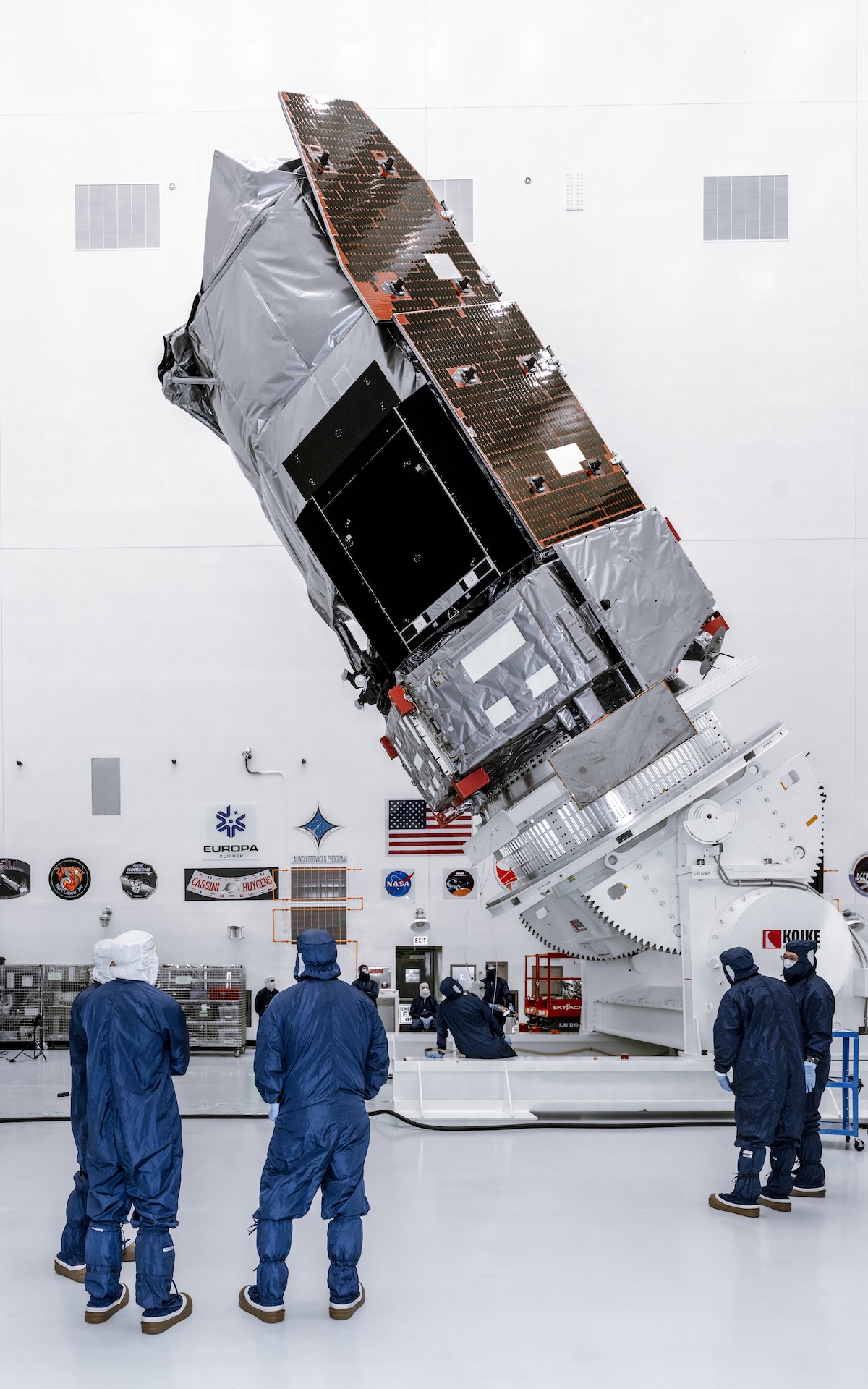
A view of the Roman Space Telescope undergoing launch preparations at NASA’s Kennedy Space Center in Florida.
Credit: NASA/Sydney Rohde (Rocz)
A view of the Roman Space Telescope undergoing launch preparations at NASA’s Kennedy Space Center in Florida. Credit: NASA/Sydney Rohde (Rocz)
Mirror, mirror on the wall
NASA named the mission after Nancy Grace Roman, the agency’s first chief astronomer and a pioneering advocate of space-based telescopes. During her tenure at NASA, Roman fostered support in the science community and funding from Congress for what became Hubble. Roman retired from her position in NASA’s leadership in 1979 and died in 2018. NASA announced in 2020 that the next great observatory, up until then known as the Wide Field Infrared Survey Telescope (WFIRST), would be named in honor of Roman.
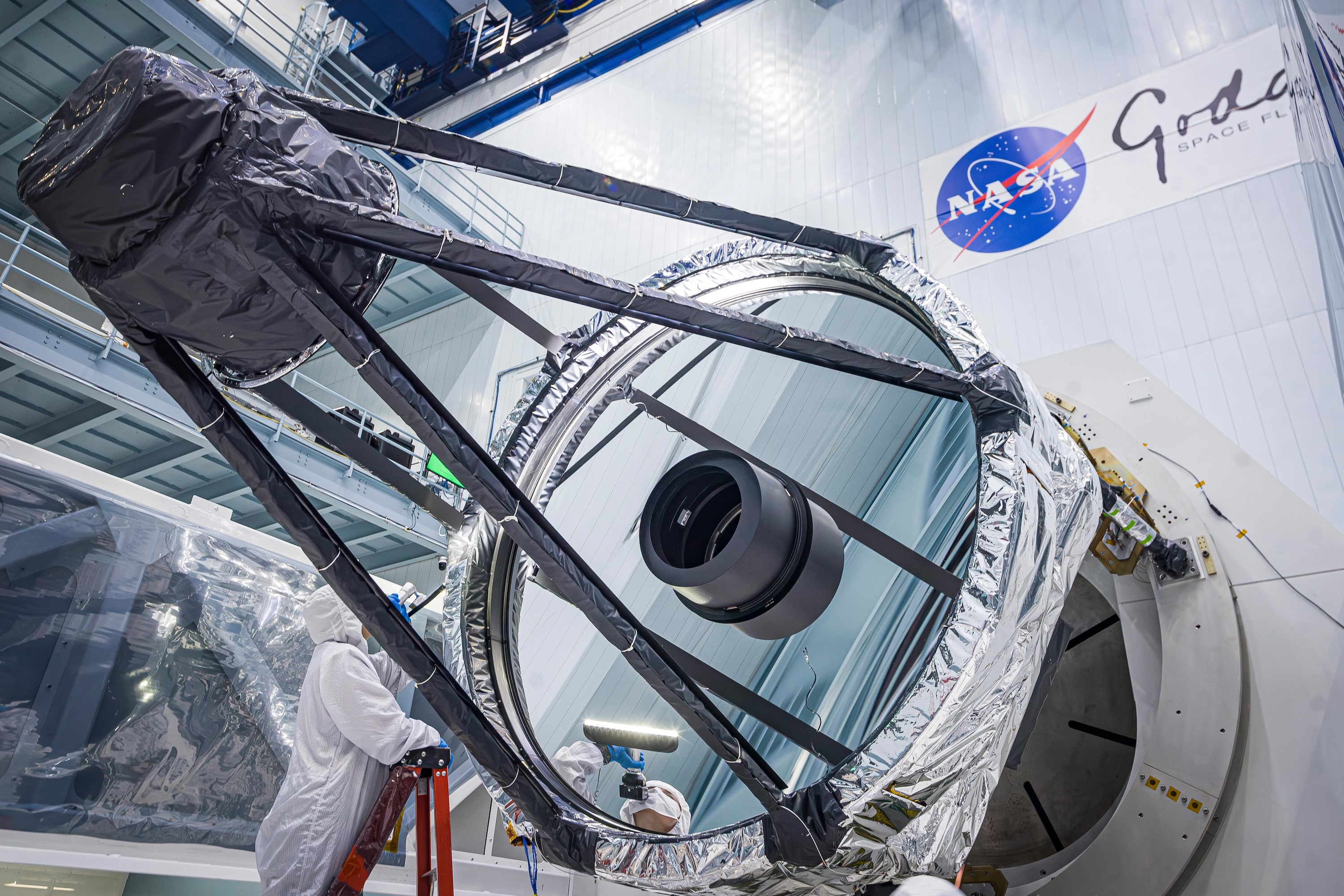
Engineers spent the better part of a decade assembling the observatory around a 7.9-foot-diameter (2.4-meter) telescope donated to NASA by the National Reconnaissance Office, the US government’s spy satellite agency. The telescope’s primary mirror is the same size as that of Hubble.
NASA took possession of two NRO spy telescopes in 2012, and scientists soon earmarked one of them for the mission that became Roman. The agency hasn’t identified a use for the second telescope. The NRO declared the telescopes surplus after the cancellation of one of its surveillance satellite programs.
The sudden availability of an off-the-shelf telescope led to a redesign of WFIRST. The observatory—still on the drawing board at the time—essentially doubled in size to accommodate the telescope, improving its vision while adding to its cost. Ground teams also had to reconfigure the mirror to change its “optical prescription” and accommodate colder operating temperatures.
“It certainly wasn’t just plug and play,” said Julie McEnery, senior project scientist for the Roman telescope at NASA’s Goddard Space Flight Center.
Roman passed its NASA confirmation review in 2020, and since then, the mission’s development proceeded on budget and faster than expected.
The 7.9-foot-diameter polished primary mirror for the Nancy Grace Roman Space Telescope was originally built for a US government spy satellite.
Credit: NASA/Chris Gunn
The 7.9-foot-diameter polished primary mirror for the Nancy Grace Roman Space Telescope was originally built for a US government spy satellite. Credit: NASA/Chris Gunn
Nicky Fox, head of NASA’s Science Mission Directorate, calls Roman the Swiss Army Knife of telescopes. It will survey 12 percent of the sky, and while that may not sound like a lot, it is far more than the 0.1 percent observed by Hubble over its 36 years in orbit.
“Roman’s large field of view and fast survey speeds will reveal untold cosmic objects while shining a light on dark energy and dark matter,” Fox said. “During its mission, Roman will discover tens of thousands of new planets, billions of galaxies, thousands of supernovae and tens of billions of stars. And it will do all of that at a speed about 1,000 times that of Hubble… So to put it into context, what Roman can do in a month would take Hubble a century.”
Who is the fairest one of all?
Cosmologists are eager to learn more about dark energy, an unseen force that, according to the Standard Model of the Universe, makes up about 70 percent of the cosmos and is responsible for accelerating the Universe’s expansion. Dark matter makes up a little more than a quarter of the Universe. The rest of the cosmos is made of regular atoms and molecules that we can see and touch.
But the Standard Model might be wrong. Roman’s untold discoveries “may confirm the current hints that our Standard Model of the Universe is incorrect, and set us on the path to figuring out what’s right,” McEnery said.
“One month of Roman observations could survey our own Milky Way, resulting in the detection of up to half the stars in our own galaxy,” McEnery said. “This would, itself, represent a catalog of astronomical objects much larger than any in existence today.
“Our main survey will take over a year, and it will be really huge,” she said. “We would need over half a million 4K TVs to fully display the single Roman image from our largest survey. To understand the scale, these TVs would cover 45 Manhattan city blocks, or fully cover El Capitan in Yosemite National Park.”
Roman’s Wide Field Instrument gives the observatory its broad vision. This near-infrared camera can take a picture of a pocket of the sky larger than the full Moon, allowing Roman to map megastructures like clusters of galaxies and large-scale filaments of matter and dark matter that make up the cosmic web.
“To put it into perspective, it is as if Hubble and James Webb kind of peered through a keyhole at the Universe, while Nancy Grace Roman will kick the door down,” Fox said. “But Roman isn’t just doing Hubble and Webb science faster. It’s doing fundamentally different science that could not be done by either observatory. Together, these three flagship telescopes will combine their observations to give us a more complete picture of our cosmos, and our place in it.”
Roman’s Coronagraph Instrument, designed for direct imaging of exoplanets, is one of the most sophisticated astronomy instruments ever sent into space.
Credit: NASA/JPL-Caltech
Roman’s Coronagraph Instrument, designed for direct imaging of exoplanets, is one of the most sophisticated astronomy instruments ever sent into space. Credit: NASA/JPL-Caltech
A second instrument on Roman, called a coronagraph, will allow astronomers to directly image planets orbiting faraway stars in our own galaxy. The coronagraph works by blocking the bright light from stars, using masks and large-format self-flexing mirrors to detect planets 100 million times fainter than their hosts. NASA says the coronagraph on Roman, with internal mirrors capable of adjusting their prescription on the fly, is 100 to 1,000 times more sensitive than previous coronagraphs on Webb and Hubble.
This part of Roman’s toolkit will allow astronomers to study the sizes, atmospheres, and structures of more kinds of exoplanets than possible today. The coronagraph’s innovations will inform the design of future instruments that could expand the reach of direct imaging to include rocky planets in the habitable zones of their stars.
“Roman will photograph worlds, dusty disks, and nearby stars in visible light to help see the giant worlds that are older, colder, and in closer orbits than the hot young Jupiters that we’ve previously imaged with other telescopes,” Fox said.
Roman will also detect exoplanets using the tried-and-true transit method, but scientists expect the new telescope will find a lot more than past space missions have, thanks to its wider vision.
Heigh-ho, it’s off to work we go
All of this means data, and lots of it.
“In just one day of observing our Universe, Roman will downlink 1.4 terabytes of data,” Fox said. “That is an entire gaming system hard drive in one day. That is a staggering amount of data.”
Roman will transmit this amount of information down to Earth nearly every day for its planned five-year mission. NASA and its partners will connect with Roman through a collection of ground stations around the world separate from the agency’s oversubscribed Deep Space Network. NASA and the Space Telescope Science Institute, which oversees Roman’s operations, will release the observatory’s data to a public archive accessible to scientists around the world.
Many astronomers are accustomed to downloading data from Hubble and Webb onto personal computers. In most cases, that won’t be possible with Roman. NASA’s new observatory will generate 20 petabytes (20,000 terabytes) of data over its five-year prime mission. By comparison, Hubble has delivered a little more than 400 terabytes of data since its launch in 1990.
Scientists developed a cloud-based platform for astronomers to explore, access, and analyze Roman’s data, with options for astronomers to use preconfigured built-in software or bring their own software for data reduction.
NASA’s Nancy Grace Roman Space Telescope’s three main observing programs, highlighted in this infographic, can enable astronomers to view the Universe as never before, revealing billions of cosmic objects strewn across enormous swaths of space-time.
Credit: NASA/Goddard Space Flight Center
NASA’s Nancy Grace Roman Space Telescope’s three main observing programs, highlighted in this infographic, can enable astronomers to view the Universe as never before, revealing billions of cosmic objects strewn across enormous swaths of space-time. Credit: NASA/Goddard Space Flight Center
“No single person is going to be able to look at all of the stars and all the galaxies and all the unusual things that we’re going to see with Roman,” said Jeremy Perkins, integration and test scientist for the Roman telescope at NASA Goddard. “One way I like to think about this is that our data set at the end of Roman’s life is going to be bigger than your favorite music streaming platforms. And I can’t go online and listen to every single song to find new songs and new music. I have to use algorithms and other ways to introduce new music to myself, and we’re going to do the same with Roman.”
“So much of what physics is trying to understand about the nature of the Universe today needs large number statistics in order to understand,” said Jackie Townsend, NASA’s project manager for the Roman mission.
In one survey, Roman will cover an area equivalent to 3,455 full moons in about three weeks, then go back and observe a smaller portion of that area repeatedly over five-and-a-half days—jobs that Hubble and Webb can’t do.
“We will do fundamentally different science,” Townsend said. “In some subset of our observations, we’re going to be making 3D movies of what is going on in the Milky Way galaxy and in distant galaxies. That is just something that’s never happened before.”
Roman will animate and reveal the sky with the same sharpness as Hubble’s most memorable observations, such as its famous Ultra Deep Field image.
“Now, we’re taking that depth of field and that power and applying it globally to a decent fraction of the night sky,” Townsend told Ars in an interview. “Just like we pointed Hubble at what looked to be a dark patch, and we discovered billions and billions of galaxies out there, I think Roman is going to have the same gee-whiz moments, [showing] we just didn’t understand how the Universe worked until we had this dataset that was so big and so huge.”