24.5 C
London
Saturday, August 15, 2026
Home Blog

IDF Kills Radwan Force Commander After Hezbollah Drone Wounds 3 Soldiers 

0
idf-kills-radwan-force-commander-after-hezbollah-drone-wounds-3-soldiers 
IDF Kills Radwan Force Commander After Hezbollah Drone Wounds 3 Soldiers 


The Israel Defense Forces (IDF) struck Hezbollah targets across southern Lebanon overnight and into Saturday, killing a Radwan Force battalion commander and several other terrorists after what the military described as Hezbollah action against Israeli troops operating in the Ali Taher Ridge security zone. 

A Hezbollah explosive drone seriously wounded three Israeli soldiers on the Ali Taher Ridge on Saturday morning, according to Israeli reports.  

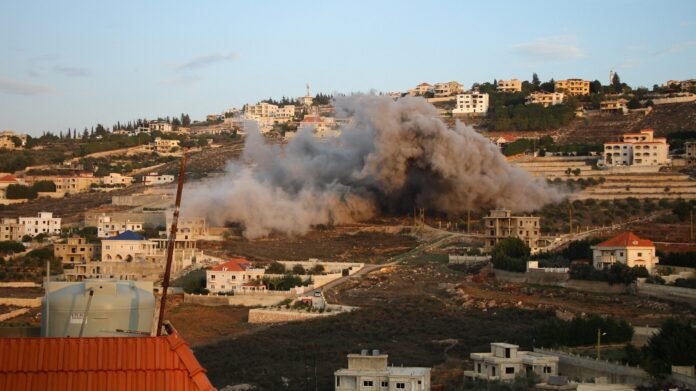
The IDF said it targeted Hezbollah infrastructure in the Nabatieh and Ansar areas following action against soldiers stationed in the Ali Taher Ridge area. Lebanese reports initially said seven people were killed and two wounded in strikes in Ansar, with additional strikes reported around Ali Taher Ridge and al-Nabatieh al-Fawqa. 

Lebanon’s Health Ministry later said seven people were killed in Ansar, claiming three children and two women were among the dead. 

The IDF subsequently said a central Hezbollah command center in the Kafr Ansar area was among the targets. Ali Samir al-Haj Hassan, a battalion commander in Hezbollah’s Radwan Force, was killed along with several other terrorists, the military said. 

Hassan’s family was inside the command center and was reportedly harmed, but the IDF said they had not been targeted. 

“It should be emphasized that they were not the target of the strike,” the IDF said. “The terrorist used his family as human shields and hid with them inside the military command center.” 

Another Israeli strike was reported in Deir ez-Zahrani in the Nabatieh region. Lebanese authorities later put the death toll there at four, with 17 people wounded. Lebanese reports said the combined toll from the strikes during the day reached 11 dead and 19 wounded. 

Lebanese Prime Minister Nawaf Salam called the Israeli strikes a “dangerous” escalation that threatened efforts to establish stability. He said responsibility for addressing military structures on Lebanese territory belonged solely to the Lebanese state, army and legitimate institutions. 

Hezbollah accused Lebanese authorities of making concessions to Israel and demanded an end to direct negotiations. The terrorist organization also threatened retaliation, saying Israel’s “aggression, violations and attempts to impose a fait accompli” would be met with “an appropriate response.” 


Air India to test all pilots for banned substances

0
air-india-to-test-all-pilots-for-banned-substances
Air India to test all pilots for banned substances


Air India is to test all of its pilots for banned substances, starting immediately.

It comes after an incident last week in which its Phuket to Delhi flight suddenly lost altitude, with a preliminary report saying the senior pilot had to retake their substance test. Reports say they had tested positive for marijuana.

Pilots at the airline’s budget arm, Air India Express, will also be subject to the tests from Thursday.

Existing rules require at least 10% of pilots to be tested at random.

Seventeen passengers and crew were injured when the Airbus lost about 91 metres (300 feet) in height shortly after departure on 4 August.

It is being investigated by Indian authorities working alongside Airbus and France’s air safety agency.

Both pilots of the flight have been removed from duties until the investigation is complete.

In a memo seen by the BBC, Air India said it was “important to go further” in its testing.

“This initiative, which goes beyond regulatory requirements, reflects our determination to uphold the highest standards of safety and professionalism, and to provide reassurance to our passengers, stakeholders and the community at large,” it said.

The airline has already been under scrutiny after a June 2025 flight from Ahmedabad to London crashed shortly after take-off, killing 241 people on board and 19 on the ground. Only one passenger survived.

The tests – for substances as well as medications prohibited under aviation regulations – are being carried out alongside training sessions at Air India’s academy, as well as other locations including briefing centres and offices.

Last week, former Ethiopian Airlines boss Tewolde Gebremariam became Air India’s new chief executive.

Via BBC

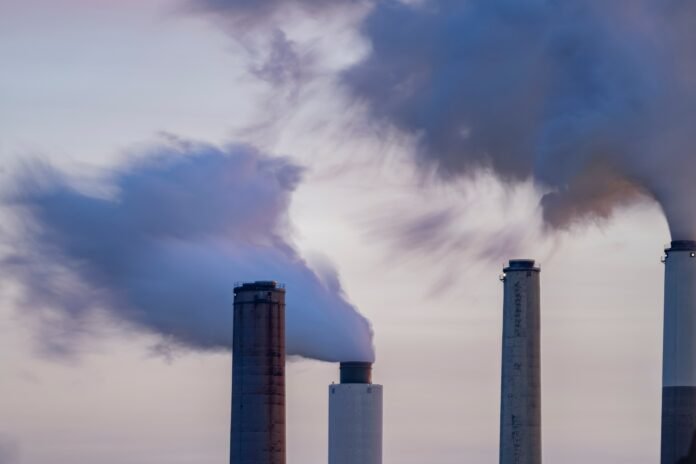
AI could help fossil fuel companies create more emissions

0
ai-could-help-fossil-fuel-companies-create-more-emissions
AI could help fossil fuel companies create more emissions

This story was originally published by Wired and is reproduced here as part of the Climate Desk collaboration.

The emissions from powering data centers rightly get a lot of attention. But new research from former Microsoft sustainability workers cautions that the way artificial intelligence enhances productivity in the oil and gas industry could be much more damaging to the planet.

Published last week in the journal npj Climate Action, the research finds that AI use could significantly increase global energy emissions simply by enabling the fossil fuel industry to produce more oil and gas. At the low end, the research finds that the additional yearly emissions could be equal to Mexico’s; at the high end, AI boosting the fossil fuel industry could add as much greenhouse gas emissions as Russia, the world’s fourth-largest emitter.

That increase in emissions, the paper finds, outweighs the benefits AI provides to developing solar, wind, and other clean technologies. It also significantly outpaces projections of emissions from the global data center buildout.

The relationship between technology companies and fossil fuels is “a self-reinforcing effect between supply and demand,” says Will Alpine, one of the authors of the research. “One of the key insights of our paper is that you cannot treat them independently. They are two sides of the same coin.”

Alpine and his wife and coauthor, Holly, are former Microsoft sustainability workers with years of experience between them at the company. They quit their jobs at the start of 2024 because of the company’s continued work with the oil and gas industry and began publicly campaigning to draw attention to the relationship between AI and fossil fuels.

Oil and gas companies have been using various types of AI for decades to help find and develop underground resources more efficiently. That increases global dependence on fossil fuels and makes it harder for the world to reach its climate targets, the Alpines argue.

While tech companies measure their own emissions and that of their supply chain, they don’t tend to measure just how much their tools help to increase fossil fuel production. The Alpines refer to AI-supported greenhouse gas pollution as “enabled emissions.”

“Sustainability measures [within tech companies] are very much focused on operational emissions” rather than enabled emissions, Holly says. The new paper argues that while accounting for that pollution is important, it ignores emissions that do much more damage to the climate.

To get an idea of how AI can affect fossil fuel companies’ emissions, the Alpines used a complex economic model that allows researchers to introduce various factors to test out how they might play out over the broader economy. Using reports from oil and gas companies about demonstrated gains from AI tools, the Alpines modeled AI as a productivity enhancer across various sectors of the fossil fuel industry, from extraction to refining to electricity generation. They also estimated how that in turn can increase global emissions.

Read Next

The modeling found that AI as a productivity enhancer for the fossil fuel industry could help increase global energy-related emissions between 1.2 to 4.8 percent. That’s significantly higher than multiple projections around emissions from data center energy use.

“The scale of this was staggering,” says Will.

Fossil fuel companies are increasingly providing power for data centers. Chevron and Microsoft recently confirmed that the oil giant would be building a large behind-the-meter gas plant in Texas to power data centers for the tech company.

In a call with analysts in June, Jeff Gustavson, the president of Chevron’s New Energies division, hinted that the deal would benefit Chevron’s AI capacities as well. Chevron, according to Gustavson, will “use some of that compute” generated by the power from the power plant serving Microsoft “to actually power AI inside of our company.” (“Chevron and Microsoft have worked together for years to accelerate digital transformation, leveraging the capabilities of a trusted cloud to generate insights, scale innovation, and unlock value across the organization,” Chevron spokesperson Paula Beasley told WIRED in an email, in response to several questions about the specific relationship between the oil giant and the tech company.)

“It’s perfectly illustrative of the relationship between AI and fossil fuels,” Will says of the Chevron deal with Microsoft.

“There are many AI boosters who blithely claim that AI will solve the climate problem so we should go ahead and develop it as quickly as possible,” Jon Koomey, an energy researcher, tells WIRED in an email. “Such hand-waving arguments ignore the effects that AI will have on ALL industries, not just renewable energy and efficiency.”

Koomey, who was not involved in the new analysis, says that the conclusions the researchers draw seem solid.

“Machine learning can make data center cooling 30-40 percent more efficient, but [could] also make fossil fuel extraction much cheaper and faster,” he says. “How that nets out nobody yet knows for sure, but this new research is a credible attempt to answer that question using a macroeconomic model.”

NFL Reporter Suffers Terrifying Health Emergency Live on Air

0
nfl-reporter-suffers-terrifying-health-emergency-live-on-air
NFL Reporter Suffers Terrifying Health Emergency Live on Air


NFL reporter Michael Holley sparked a frightening scene Friday when he suddenly fainted during a live NBC Sports broadcast, forcing the show to abruptly cut to commercial.

Holley, 56, a longtime Boston sports journalist and former ESPN contributor, was appearing remotely on Pro Football Talk with host Mike Florio when the scary moment unfolded.

As the two discussed the latest NFL headlines, Holley suddenly became wide-eyed and began slipping down in his chair before disappearing from view.

A stunned Florio immediately realized something was wrong.

“What happened to Michael Holley?” Florio asked members of the production crew. “Did he just pass out?”

The host quickly sent the program to commercial as staff scrambled to determine whether Holley needed emergency help.

“We want to see what’s going on with Michael Holley,” Florio told viewers before the broadcast cut away.

Fortunately, the frightening incident did not turn out to be as serious as it initially appeared.

Florio later told Awful Announcing that Holley had been broadcasting from a studio inside his home that had become extremely warm.

According to Florio, Holley had also not eaten or had anything to drink before going on the air.

“It’s very warm in there,” Florio explained. “He hadn’t had anything to eat or drink before the show. He became overheated during the show and passed out.”

Florio said he initially missed the warning signs because he was looking directly into the camera instead of watching Holley on a monitor.

“I didn’t notice until he slumped in his seat,” he said.

The show immediately went to break so producers could make sure Holley received assistance if necessary.

Thankfully, Holley regained consciousness quickly.

“Fortunately, he recovered quickly and is fine,” Florio said.

The incident was especially alarming because Holley, who was wearing a warmup jacket, appeared to fade without saying a word before collapsing out of his chair.

Television studios can become surprisingly hot under production lights, which is why many professional sets are kept unusually cold during broadcasts.

Holley’s collapse also brought back memories of another frightening live-TV moment involving NFL legend Bruce Smith.

Smith fainted during a TNT broadcast in 2000 while standing on the set. It was later revealed that the Hall of Famer had been suffering from the flu and dehydration at the time.

In Holley’s case, the terrifying on-air scare had a much happier ending, with Florio assuring worried viewers that the veteran sports journalist was doing well after the incident.

Ukraine strikes major Russian rocket factory with cruise missiles

0
ukraine-strikes-major-russian-rocket-factory-with-cruise-missiles
Ukraine strikes major Russian rocket factory with cruise missiles

Ukrainian President Volodymyr Zelenskyy confirmed on Saturday that his country struck the Progress Rocket Space Center deep within Russia using ground-launched cruise missiles.

“In Russia’s Samara region, one of the key enterprises within Roscosmos—the Progress Center, which was involved, among other things, in electronics production–was hit,” Zelenskyy said on the social media site X. “Flamingo missiles were used. A good achievement.”

The largest city in the Samara Oblast, about 900 km from the Ukrainian border, Samara is home to Russia’s most important manufacturer of rockets. The Progress center assembles the workhorse vehicle for Russia, the Soyuz-2 vehicle, as well as the newer Soyuz-5 rocket. The facility also builds military satellites.

Russia uses the Soyuz-2 rocket, which has a lift capacity of about 8 metric tons to low-Earth orbit, for a variety of civil and military purposes. Notably, it is the principal rocket used for Russia’s human spacecraft launches to the International Space Station.

Already a shortage of Soyuz rockets

It was not immediately clear which facilities at the sprawling Progress facility were damaged. There were some open-source reports that a missile struck a building that houses a clean room for avionics—perhaps a reference to the electronics production Zelenskyy referred to.

Ukraine used the FP-5 “Flamingo” missiles for the attack, which have a range of several thousand kilometers. The “FP” stands for Fire Point, the Ukraine-based defense group that developed the missile. The missile has previously been used to target energy infrastructure, military production facilities, and other strategic targets. It seems unlikely that Ukraine sought to target Russia’s civilian space infrastructure, but the civil and military space efforts in Russia are closely aligned.

Any lasting damage to Soyuz rocket production would be crippling for Russia’s space programs. Of the more than 120 Russian rocket launches since 2020, more than 85 percent have involved the Soyuz-2 family of rockets. This has become the country’s key launch vehicle with the Proton booster aging out, and the newer Angara rockets being so slow to reach a decent launch cadence.

Even before the attacks, Russian space officials said demand for Soyuz rockets were exceeding the production capacity, Russian Space Web reports. This demand was as much as 30 to 50 percent higher than capacity for the period from 2027 to 2030.

3 Palestinians injured in Israeli drone strike in central Gaza despite ceasefire

0
3-palestinians-injured-in-israeli-drone-strike-in-central-gaza-despite-ceasefire
3 Palestinians injured in Israeli drone strike in central Gaza despite ceasefire

Three Palestinians were injured on Saturday in an Israeli drone strike targeting a motorcycle in Deir al-Balah in the central Gaza Strip, Anadolu reports.

The attack was the latest Israeli violation of a ceasefire agreement in effect since Oct. 10, 2025.

A medical source at Al-Aqsa Martyrs Hospital in central Gaza said that three injured people were brought to the facility, one of them in serious condition, after an Israeli drone struck a motorcycle on Salah al-Din Street, east of Deir al-Balah.

Early Saturday, the Israeli army carried out large-scale demolitions in areas under its control in Rafah in southern Gaza and east of Gaza City in the north.

Witnesses told Anadolu that they heard powerful explosions caused by Israeli forces blowing up buildings and other structures.

Israeli artillery also fired several shells toward areas east of the Zeitoun neighbourhood in southeastern Gaza City.

Israeli ceasefire violations have killed 1,262 Palestinians and injured 4,168 others since the agreement took effect.

With US support, Israel has waged a war on Gaza since Oct. 8, 2023, killing more than 73,000 Palestinians and injuring over 174,000, most of them women and children, according to Palestinian sources.

The war has also caused widespread destruction, damaging around 90% of the enclave’s infrastructure.

Oil steadies after US threatens indefinite blockade of Iran

0
oil-steadies-after-us-threatens-indefinite-blockade-of-iran
Oil steadies after US threatens indefinite blockade of Iran


Oil prices inched up on Friday after the United States threatened an indefinite naval blockade of Iran, reviving ​concerns about supply of crude after the previous session’s fall on a weaker outlook ‌for demand and a large build in U.S. stocks.

Brent futures rose 1 cent, or 0.1%, to $87.08 a barrel by 0247 GMT, while U.S. West Texas Intermediate (WTI) crude futures rose 6 cents to $81.31 a barrel.

The benchmarks were on track ​for weekly rises of about 4% after the prior session’s fall of more than 2%, ​paring gains following Brent’s six-session rally and a five-session rise for WTI.

“Despite the ⁠bearish crude stock data, the broader geopolitical backdrop is preventing a sharper price decline,” Susan Bell, senior ​vice president for oil commodity markets at Rystad Energy said in a note.

On Thursday, the United States ​warned that it could maintain a naval blockade of Iran indefinitely and ramp up economic pressure on Tehran as ceasefire talks have stalled.

“Watch this space for more announcements coming next week because we are going to apply measures like have ​never been seen in the history of economic isolation of a country,” Treasury Secretary Scott Bessent ​told Newsmax’s “Rob Schmitt Tonight” programme in an interview.

The latest U.S. threats come as Iran curbs traffic through the Strait ‌of Hormuz, ⁠which carried 20% of the world’s oil before the conflict, driving up fuel prices and putting pressure on President Donald Trump to end a war that is unpopular at home.

The strait is “under the management and control of the Islamic Republic”, however, the recently appointed head of Iran’s Basj paramilitary unit, ​Hossein Taeb, has said, according to ​the semi-official Fars ⁠news.

The prospect of a longer war constraining supply was offset this week by forecasts from OPEC and the International Energy Agency lowering outlooks for demand growth, while ​data showed the largest weekly gain in U.S. crude stocks for more than ​3-1/2-years.

KCM chief ⁠market analyst Tim Waterer said the two forces were acting as counterweights.

“The result is a market that remains supported but struggles to break meaningfully higher while these opposing pressures remain in place.”

Two vessels from the ⁠state-owned Abu ​Dhabi National Oil Company were attacked transiting the Strait of Hormuz ​on Thursday, said UAE state news agency WAM, an incident the United Arab Emirates government condemned as an Iranian attack.

Source:  Reuters

So much solar: Digging into the list of every US power plant that went online this year

0
so-much-solar:-digging-into-the-list-of-every-us-power-plant-that-went-online-this-year
So much solar: Digging into the list of every US power plant that went online this year

It’s been a wild first half of the year in the US power sector, with announcements of gigantic natural gas power plants and some long-awaited renewable energy projects coming online.

At times of rapid change, forecasting is difficult. So I feel a measure of comfort focusing on something concrete like the list of 368 utility-scale plants that began operation from January to June, according to data from the US Energy Information Administration. The group is dominated by utility-scale solar.

This is a top-heavy list, led by SunZia Wind South and SunZia Wind North in New Mexico, which went online this spring and are the largest wind farms in the country, with a combined generating capacity of 3,650 megawatts. SunZia has been in the works for about a decade and arrives at a time when US onshore wind power development has dwindled for a host of reasons related to regulations and public opinion.

In other words, the SunZia is not indicative of an onshore wind-energy boom. It is more like an echo from a past boom.

Next is Trumbull Energy Center in Ohio, a 900-megawatt combined-cycle natural gas plant that is part of an expansion of natural gas power in the PJM Interconnection grid region, which covers parts of the Mid-Atlantic, Midwest and South.

The fourth-largest new power plant—if we’re counting SunZia as two—is Vineyard Wind, the offshore wind project near Massachusetts, which, much like SunZia, has been in development for a long time and whose completion doesn’t reveal much about future trends.

It isn’t until the fifth-largest new plant that we see one that is connected to the broader trend in the data: Green River Energy Center in Utah, with 800 megawatts that includes 400 megawatts of solar and 400 megawatts of batteries.

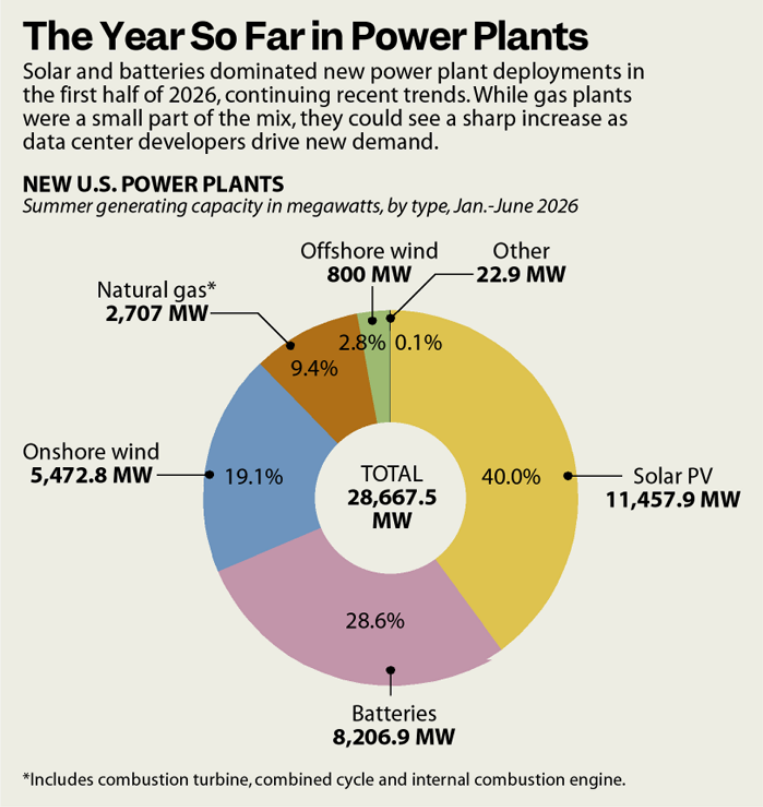
Indeed, the story of power plant completions in the first half of 2026 was mainly about utility-scale solar and batteries.

Utility-scale solar led in the number of projects coming online, with 207, followed by batteries, with 95.

Next were natural gas combustion turbines, with 22, and natural gas internal combustion engines, with 21.

Onshore wind had nine projects.

Combined-cycle natural gas, despite having massive amounts of announced capacity in development, had just 3 projects that went online. The high tide of new gas plants won’t arrive for another few years.

If we look at projects in terms of generating capacity, utility-scale solar led with 11,458 megawatts, followed by batteries, 8,207 megawatts, and then onshore wind, mostly because of the SunZia projects, with 5,473 megawatts.

The three largest types of natural gas plants added a total of 2,707 megawatts of new capacity.

Small-scale solar, including rooftop solar, is not part of this database.

A perpetual caveat: Power plant technologies have important differences to keep in mind when comparing generating capacity. The most obvious one is that solar doesn’t produce power at night. Another is that many gas plants only run a few days or weeks per year, when they’re needed to handle peak demand.

What do these numbers tell us? I asked Eric Gimon, a senior fellow at Energy Innovation, a San Francisco-based think tank.

Gimon explained that the bulk of new projects are small and mid-size utility-scale solar. They are not attention-grabbing. But they’re almost everywhere. Many of the solar projects are paired with batteries.

“These kinds of smaller-size projects are just easier to build, and the site possibilities are much more diverse and easy to find,” he said.

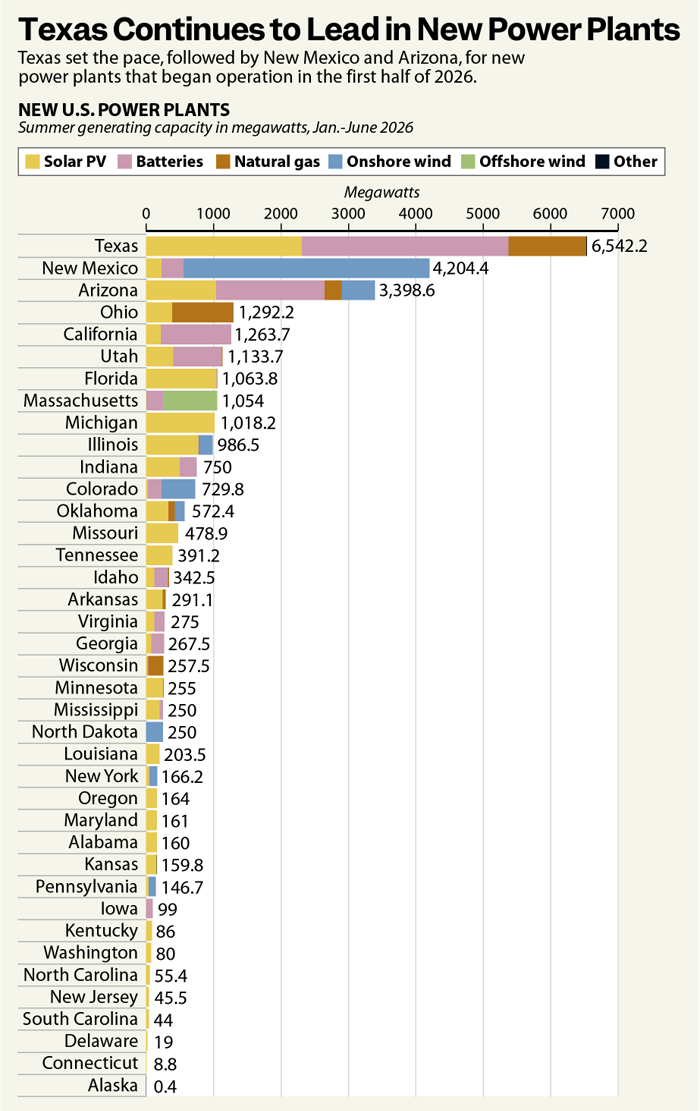
Now, let’s look at the new power plants in terms of where they were built. Three states account for about half of the country’s new generating capacity: Texas, New Mexico and Arizona.

Texas was the leader, with a power mix that leaned more heavily on batteries and gas than other states. The leading category in Texas was batteries, with 3,067 megawatts, followed by utility-scale solar, with 2,311 megawatts, and then natural gas combustion turbines or natural gas internal combustion engines, with 1,154 megawatts.

Texas’ policies have prioritized gas and battery plant construction to help bolster the power grid’s reliability at times of high demand.

Also, Texas illustrates how challenging the market is for new onshore wind. The state is the national leader in onshore wind, but brought no new projects online in the first half of the year.

One of Gimon’s takeaways is that we’re firmly in the era of utility-scale solar, with batteries playing a supporting role.

“The real underlying workhorse is solar plus battery,” he said.

Some other observations from this data:

  • Illinois ranked first in the number of new utility-scale solar projects, with 36, ahead of California, with 22, and Texas, with 16. Illinois’ projects tended to be on the small side, which is why it could lead in the number of projects but barely cracked the top 10 in overall generating capacity coming online. This is policy-driven and shows that state laws encouraging small and medium-size solar are leading to completed projects.
  • The “other” category of power technologies almost always has something interesting, with some tiny plant that isn’t indicative of anything, but is probably a good story. One that caught my eye is the 4 megawatts of hydropower that went online in Dakota County, Minnesota, which is in the Minneapolis-St. Paul metro area. The project at the Byllesby Dam is a replacement of hydropower turbines that have operated on the Cannon River since 1910, and got local media coverage when the county government announced the project a few years ago.
  • A 2.8-megawatt biomass power plant went online just a few miles from my house in Ohio, operated by the Columbus city government. It’s fueled by methane captured from waste at a sewage-treatment plant. I was unaware of this project and now want to take a closer look.

Looking ahead, the Energy Information Administration’s list of planned power plants shows that the utility-scale solar boom is likely to continue, and the final years of this decade are shaping up to bring a boom in natural gas power plants.

But it’s tough to pin down the size of the solar and gas booms because of uncertainty about many factors, including how much electricity demand will grow and what share of the growth will be driven by AI data centers.

So take some comfort in what we know for sure, which is the stuff that’s actually built, and realize that just about everything else comes with a question mark.

This article originally appeared on Inside Climate News, a nonprofit, non-partisan news organization that covers climate, energy and the environment. Sign up for their newsletter here.

Thousands stranded at Japan’s Narita airport after record rain kills four

0
thousands-stranded-at-japan’s-narita-airport-after-record-rain-kills-four
Thousands stranded at Japan’s Narita airport after record rain kills four


Record ‌rainfall left thousands of travellers stranded at Tokyo’s Narita airport on Friday as flooding in the surrounding area disrupted transport, knocked out power to homes and claimed at least four lives.

More than ​360 millimetres of rain fell in 24 hours in parts of Chiba prefecture, ​which adjoins the capital Tokyo, inundating roads and railways during one of ⁠Japan’s busiest holiday weeks.

Authorities said four deaths have been confirmed so far, including one ​person trapped in a submerged vehicle, while another person is missing. Soldiers have been dispatched to the ​area to help with relief efforts.

“This case was an extremely unusual situation,” Chiba Governor Toshihito Kumagai told reporters on Friday morning. “I have responded to many disasters in the past, but I have never experienced ​a case like this.”

More than 22,000 households remained without power on Friday at ​11:00 a.m. (0200 GMT), according to utility provider Tokyo Electric Power. In Chiba city, one of the worst ‌hit ⁠areas, hundreds of people spent the night under foil blankets at government buildings serving as temporary evacuation centres.

The transport disruption left around 7,000 people stranded at Narita, an airport spokesperson said, adding that all flights are scheduled to operate normally on Friday. Japan Airlines ​said some flights may ​experience delays but ⁠no cancellations are currently expected.

Some major highways in Chiba were shut, forcing drivers onto alternative routes and causing heavy traffic, according to highway ​operator NEXCO East.

Several rail services also remained suspended on Friday morning, ​though some ⁠trains connecting Narita to Tokyo had resumed operations, easing congestion at the international transport hub.

Overnight, hundreds of passengers queued to collect blankets, water bottles and snacks from airport staff ⁠before bedding ​down across the terminal building, footage on public broadcaster ​NHK showed.

“We are never going to forget this trip,” one American traveller stranded with his family at the ​airport told NHK.

Source:  Reuters

Beloved Former Child Star Dies Suddenly

0
beloved-former-child-star-dies-suddenly
Beloved Former Child Star Dies Suddenly


The cast of Nickelodeon’s beloved ’90s sketch comedy show “All That” is mourning one of their own after the sudden death of former star Christy Knowings.

Knowings died this week in California at just 46 years old, her father, Charles Dunn, confirmed to ABC News on Friday.

The actress and comedian became a familiar face to a generation of Nickelodeon viewers after joining “All That” in 1997. She remained on the hit series for three seasons through 2000, sharing the screen with future stars including Kenan Thompson, Kel Mitchell, Amanda Bynes, Lori Beth Denberg, Josh Server and Nick Cannon.

News of her death quickly prompted emotional tributes from her former castmates.

Thompson, who later became one of the longest-running stars of “Saturday Night Live,” said the loss hit him especially hard.

“Man this one hit hard!!! Rest well Christy!!! Never could have imagined this day!!” Thompson wrote on Instagram alongside a photo of Knowings.

He remembered her as “a real one” and “one of the funniest people out here,” while sending his love to her grieving family.

“Gonna miss you buddy!!!” he added.

Mitchell also shared an emotional tribute, calling Knowings “truly one of a kind.”

Alongside clips highlighting some of her funniest “All That” moments, Mitchell remembered his former co-star as naturally hilarious, talented and completely fearless when it came to comedy.

“She had a gift for creating characters that were big, memorable, and completely her own,” he wrote.

Mitchell said he would always treasure the laughs and memories they shared as members of the “All That” family.

“Christy, thank you for sharing your incredible gift with all of us,” he continued. “Your talent, your characters, and the joy you brought to so many will never be forgotten.”

Knowings’ manager, Al Hill, also remembered her as a woman whose creativity extended far beyond acting.

“Christy was a multi talented lady,” Hill told ABC News. “Whether it was singing, acting, dancing, she was always creating. Always professional and dedicated to her work.”

Knowings previously spoke fondly about her Nickelodeon years, revealing in a 2019 interview with Bustle that one of her favorite memories involved creating the outrageous character Gloria Bankhead during Season 6.

Knowings described the character as an over-the-top version of Martha Stewart and said she became so immersed in the role that she stayed in character throughout the day.

“Everybody loved it!” she recalled.

Knowings also believed the diverse cast of “All That” played a major role in the show’s popularity and lasting cultural impact.

A Bronx native who described herself as Native American and Afro-Latina, Knowings said she and her castmates were able to bring their own backgrounds and cultural touches into the comedy.

“We would bring cultural nuances and it was celebrated,” she said.

For Knowings, the show represented something bigger than laughs.

“‘All That’ showcased the unity that we all wanted, needed and still need in a very humorous way,” she said.

Now, more than two decades after her time on the Nickelodeon staple, the stars who grew up performing alongside Knowings are remembering the woman whose larger-than-life characters helped define an unforgettable era of kids’ television.

0FansLike
0FollowersFollow
0FollowersFollow
0SubscribersSubscribe
- Advertisement -
Google search engine

Recent Posts