Hong Kong’s first regulated stablecoin faces its market test
Hong Kong’s stablecoin experiment has entered its first controlled market test.
On August 12, Anchorpoint began phase-one Beta Access for HKDAP, initially involving institutional distributors and professional investors. HashKey and OSL are among the first issuer-authorised distributors. HashKey has completed an initial client mint-and-redemption transaction with fiat on-ramps and off-ramps, while OSL provides distribution, liquidity, exchange, trading and settlement support.
It is more than a demonstration token, yet far from a broad retail currency. Anchorpoint has disclosed no circulation, distinct-user or sustained transaction-volume data. Wider retail access could begin by the end of 2026, subject to market conditions.
The launch takes Hong Kong beyond legislation and regulatory signaling. The commercial question remains: can a Hong Kong dollar token attract durable demand outside crypto trading?
Thirty-six applications, two initial licences
Hong Kong’s Stablecoins Ordinance took effect on August 1, 2025. It requires a licence to issue specified stablecoins in Hong Kong in the course of business, or to issue a Hong Kong dollar-referenced stablecoin outside Hong Kong in the course of business.
Issuers must maintain segregated reserve assets whose value at least equals the stablecoins in circulation. Valid redemption requests must be honoured at par as soon as practicable. The often-cited one-business-day standard comes from the Hong Kong Monetary Authority’s supervisory guideline rather than the ordinance itself. A non-bank licensee must maintain at least HK$25 million in paid-up capital or equivalent approved resources, and licensees may not pay interest on their stablecoins.
The HKMA also expects every holder to be identified, unless an issuer can demonstrate effective alternative safeguards. HKDAP’s Ethereum-based Beta makes that restriction concrete: Transfers are limited at smart-contract level to addresses verified through at least one issuer-authorised distributor. Transfers to unverified addresses are automatically rejected.
The HKMA received 36 applications and granted the first two licences, to Anchorpoint and HSBC, on April 10, 2026. Mainland regulators had meanwhile hardened their position on private stablecoins and offshore issuance. Ant Group and JD.com suspended planned Hong Kong initiatives following intervention by mainland regulators, according to reports. The HKMA has not disclosed the full applicant list, individual outcomes or the number of withdrawals.
Anchorpoint is a joint venture of Standard Chartered Bank (Hong Kong), HKT and Animoca Brands. HSBC plans to connect its coin to PayMe and its Hong Kong app for transfers, merchant payments and tokenised investments, but had not launched by mid-August.
The initial market is therefore bank-backed and institution-heavy. Hong Kong has licensed a supervised settlement instrument, not permissionless private money.
Different rules, different objectives
Across major markets, the common direction is full or near-full reserves, segregation, redemption rights and strict financial-crime controls. The policy objectives differ.
Europe has the most complete cross-border framework. Under MiCA, a token referencing one official currency is an e-money token whose issuer must generally be a credit institution or electronic-money institution. Holders can redeem at par without a fee, and issuers and crypto-asset service providers may not grant interest.
MiCA also requires an issuer to stop issuing when a non-EU currency token’s use as a means of exchange within a single currency area exceeds both one million transactions and €200 million a day on a quarterly-average basis. It is a monetary-sovereignty defence, not a general restriction on trading or redemption.
The United States is building a federal-state framework through the GENIUS Act, but its issuer regime had not taken effect by August 13. Distribution is further ahead: Visa lets participating institutions settle obligations in USDC seven days a week; PayPal and Venmo support PYUSD; Shopify merchants can accept USDC; and Stripe accepts stablecoin payments into fiat, although Connect USDC payouts remain a limited private preview.
Circle’s structure also shows where US policy is heading. Outside the European Economic Area, USDC was still issued under state authorities by Circle Internet Financial, LLC. Circle received final OCC approval in July for a national trust bank that will begin with custody, while a separately chartered New York trust is intended to assume non-EEA issuance. That migration had not been publicly confirmed by August 13.
Japan contains risk through regulated issuer types. JPYC, the first domestic yen stablecoin under the post-2023 regime, is live, but JPYC EX limits direct issuance to ¥1 million per transaction and redemption to ¥1 million a day. Singapore has moved in the reverse sequence: Its dedicated stablecoin label is not yet in force, but XSGD already works behind familiar wallets and QR payments as a clearing and settlement asset. Consumers need not hold the token directly.
Switzerland has no dedicated stablecoin statute in force. Its strength lies in regulated custody, tokenized securities and institutional settlement. In April 2026, six regulated banks joined Swiss Stablecoin AG in an industry-led live test of a franc-denominated coin. The pattern is institutional rather than retail.
The economics HKDAP must prove
Regulation can make a token safe enough to hold. It cannot make holding it economical.
HKDAP pays no interest. At the August 11 tender, the average accepted yield on 91-day Hong Kong Exchange Fund Bills was 2.69%. At that rate, moving HK$100 million into non-interest-bearing HKDAP for 90 days would forgo about HK$663,000, or HK$7,370 a day.
That is an illustrative gross benchmark, not a universal upper bound. The actual cost depends on a company’s marginal use of liquidity: It may be lower for idle deposits, but higher where HKDAP displaces money-market assets, collateral or debt repayment.
The issuer-level prohibition does not determine where incentives ultimately appear. PayPal pays rewards on eligible PYUSD balances even though Paxos, the issuer, pays nothing. Whether Hong Kong distributors offer rebates, fee waivers or funded settlement lines may matter more for adoption than the formal ban. Anchorpoint and its distributors have not addressed the question.
Companies should therefore treat HKDAP as working settlement inventory, not a treasury asset. Faster settlement, reduced prefunding, cheaper reconciliation or more efficient collateral must recover the negative carry.
Photo: Jeffrey Sze
For ordinary domestic transfers, around-the-clock availability alone provides little advantage. Hong Kong’s Faster Payment System already moves Hong Kong dollars and renminbi between banks and wallets in near real time, 24 hours a day. Project Ensemble is testing tokenized bank deposits as settlement assets, while a future e-HKD would represent central-bank money. The HKMA has made no decision on issuance.
HKDAP’s potential edge is portability: a common Hong Kong dollar cash leg moving across approved wallets, exchanges and smart contracts beyond any single bank ledger. It could support atomic settlement of tokenized bonds, funds or other assets. But its present portability extends across a shared, multi-distributor whitelist, not to unidentified users on an open network.
The economic gain is conditional. If HKDAP reduces by one full day the period for which HK$100 million is immobilised as settlement inventory, the released gross carry is about HK$7,370. Atomic settlement may also reduce principal risk and reconciliation, but a 24-hour cash token cannot deliver end-to-end settlement if the asset leg, compliance process or redemption bank remains closed.
Liquidity is the second test. OSL offers liquidity and fiat ramps; HashKey has completed an initial client mint-and-redemption transaction. Yet the legal redemption claim remains against Anchorpoint. The market still lacks a comprehensive fee schedule and evidence on committed market-making, spreads, depth, cut-offs, weekend exits and actual redemption times.
Access to mainland China remains tightly restricted
Hong Kong’s license provides no automatic route into mainland China. In February 2026, Chinese authorities reiterated that virtual-currency business remained illegal on the mainland, prohibited unauthorized offshore issuance of renminbi-linked stablecoins and barred overseas institutions from unlawfully serving mainland entities.
The same policy package also opened a narrower asset channel. The China Securities Regulatory Commission established a pre-issuance filing regime for offshore asset-backed security tokens whose repayment is supported by cash flows from onshore assets or related rights. It is not blanket approval for offshore real world asset issuance, and other approvals and reviews may still be required. The rules neither designate nor privilege Hong Kong, although its regulated tokenized-securities infrastructure makes it a plausible venue.
HKDAP could eventually serve as the cash leg for qualifying mainland-linked assets tokenized in Hong Kong. That is a legally conceivable settlement use case, not yet an established market. Its development will depend on actual filings, transaction structures and the willingness of regulated institutions to use a Hong Kong dollar token.
The credible near-term markets are therefore settlement for tokenized funds, bonds and other real-world assets; round-the-clock transfers among banks and licensed platforms; and payment corridors accepted by regulators on both sides.
Progress should be measured through circulating value, repeat corporate users, transaction turnover, redemption performance, secondary-market spreads and the value of tokenized assets settled in HKDAP. Those figures will distinguish useful financial activity from crypto speculation.
Hong Kong has built a credible gate. HKDAP must now prove that its settlement utility is worth the yield its holders surrender.
Jeffrey Szeis chairman of Habsburg Asia, general partner of Archduke United LPF,and Director of the Austria and Central Europe to Asia AI & Innovation Exchange. He specializes in high-value art transactions and real world asset tokenization operations and secured a cryptocurrency exchange licence in Switzerland in 2017.
‘Syria is Gaza on steroids’: Israeli minister says war with Damascus is ‘absolute certainty’
“Syria is Gaza on steroids, and that is the next war, with absolute certainty”, said Amichai Chikli Israeli Diaspora Affairs Minister. “There is no avoiding it.”
Israeli Diaspora Affairs Minister Amichai Chikli on Syria:
Syria is Gaza on steroids, and that is the next war, with absolute certainty.
There is no avoiding it. pic.twitter.com/KbH0KndkWG
— Clash Report (@clashreport) August 13, 2026
Chikli’s remarks come as Israel is already waging military campaigns across multiple fronts in the region, including Palestine, Lebanon, Syria and Iran, while carrying out attacks elsewhere in the Middle East. Israeli leaders have themselves described the conflict as a war on seven fronts
The remarks are not the first time Chikli has openly threatened war against Damascus. In June, he said Israel would wage war on Syria “sooner or later”, claiming that Syria and Turkiye posed a greater challenge to Israel than Iran. “We will wage war on Syria, sooner or later, because it and Turkiye are far more worrying than Iran,” Chikli said at the time.
Chikli’s latest threat comes as Israeli forces already occupy Syrian territory and carry out repeated incursions into the country. Following the fall of Bashar Al-Assad’s government in December 2024, Israel declared the 1974 Disengagement Agreement void, moved into the UN-monitored buffer zone adjoining the occupied Syrian Golan Heights and established military positions deeper inside southern Syria.
Israeli operations have continued despite the new Syrian leadership repeatedly signalling that it does not seek war with Israel. Syrian President Ahmed Al-Sharaa has called for Israeli forces to return to the positions they held before Assad’s fall, while Israel has demanded a demilitarised zone extending through much of southern Syria.
READ: Katz says Israel to remain in ‘security zones’ in Lebanon, Syria, & Gaza
Only days before Chikli’s comments, Israeli troops again entered Quneitra province, erected checkpoints and searched civilians and vehicles. Israeli forces have conducted repeated raids, searches, arrests and artillery attacks across southern Syria in recent months. On Friday, Syrian state media reported that Israeli forces opened fire towards civilian homes in the Daraa countryside, forcing some residents to flee.
The declaration that another war is an “absolute certainty” comes as Israel’s aggression has expanded across multiple fronts. Israel continues to control territory illegally in Palestine, has seized a swathe of southern Lebanon following its latest war with Hezbollah and occupies additional Syrian land beyond the Golan Heights. Israel also launched a major war against Iran alongside the US earlier this year.
In Lebanon, Israeli Defence Minister Israel Katz said this week that Israeli troops would remain in what Israel calls a “security zone” until Hezbollah is disarmed, ordering the army to prepare for an “extended presence”. Washington responded that a permanent Israeli military presence in southern Lebanon would contradict commitments made under the US-backed agreement with Beirut.
Israel’s increasingly aggressive regional posture is widely seen as a contributing factor in the reordering of security relations across the Middle East. Last week, Saudi Arabia, Turkiye and Pakistan signed the landmark Mecca Joint Defence Agreement, under which an armed attack against one of the three countries will be regarded as an attack against all.
The pact brings together three of the Muslim world’s most consequential military powers: NATO member Turkiye, nuclear-armed Pakistan and Saudi Arabia, the region’s largest Arab economy. Turkish Foreign Minister Hakan Fidan has compared its collective-defence provision to NATO’s Article 5, under which an attack against one member is treated as an attack against all.
READ: Israeli army opens fire on civilian areas in Daraa, southern Syria: State TV
Ukraine’s monthly civilian casualties highest since 2022
Civilian casualties in Ukraine have climbed to their highest monthly level since the early weeks of Russia’s full-scale invasion, according to the United Nations.
July recorded the highest overall number of civilian casualties since March 2022, while the number of people killed was the highest since May 2022.
The UN said the true toll was likely higher, with some reports still being verified.
Since Russia launched its full-scale invasion on February 24, 2022, the UN has verified at least 16,874 civilian deaths and 51,273 injuries in Ukraine.
Long-range missiles and drones remained the biggest cause of civilian casualties in July, accounting for 38% of the total. Short-range drones operating close to the frontline accounted for another 27% of casualties.
“Civilians are facing intensified risks from the increased use of missiles and drones in urban centers, glide bombs in cities closer to the frontline, and short-range drones,” said head of the mission Danielle Bell.
Russia launched at least 429 missiles during the month, more than twice the number fired in June, according to the UN.
The deadliest attack came on July 2, when Russian forces launched 74 missiles and almost 500 long-range drones, mostly against Kyiv. At least 30 civilians were killed and 104 injured.
OpenAI and Anthropic in price war as Chinese AI rivals gain ground
Leading US AI labs such as OpenAI and Anthropic are releasing cheaper models as they fight to retain cost-conscious customers who are switching to cut-price alternatives from Chinese rivals.
The price war comes as rising AI bills push companies to curb usage and seek cheaper models, helping Chinese developers including Moonshot and DeepSeek make inroads with users from Silicon Valley to Europe.
OpenAI recently said that it was slashing prices for GPT-5.6 Luna, its “fastest and most affordable model”, by 80 percent. Anthropic has launched Claude Opus 5, touting the system’s “frontier intelligence… at half the price” of Fable 5, the company’s most capable model.
The moves have helped decrease prices that customers are paying for models from leading US labs by almost a quarter since mid-July, according to Silicon Data’s token price index. Tokens are the units of data processed by language models and are used to calculate many customers’ bills.
The cuts mark a shift for US AI groups that make proprietary “closed” models that have, until now, competed heavily on performance. Increasingly capable “open” Chinese models—which can be freely downloaded and tweaked by developers—have contributed to pressure on prices.
The moves also come as OpenAI and Anthropic plot initial public offerings at trillion-dollar valuations while investors seek evidence that the industry’s vast spending on AI can generate returns.
Corporate AI users face cost pressures as Anthropic and OpenAI shift some enterprise customers away from flat subscriptions and toward usage-based billing, under which companies pay according to the computational resources they consume.
Some businesses have responded to a rise in bills by imposing caps on AI usage or testing cheaper alternatives. Companies such as DoorDash and Airbnb have said they have started to use Chinese-made models in an effort to rein in bills.
That shift has coincided with a flurry of releases from Chinese labs that have narrowed the performance gap with leading US models, raising concerns in the US tech industry that American developers could lose customers even as they spend heavily to maintain their technological edge.
AI labs offer a range of models with different capabilities and prices, with costs varying further according to the version of a model and the “effort” settings used. Customers are typically charged for input tokens, used to measure data fed into a model, and output tokens, which measure what it generates in response.
The latest price cuts from US labs apply to mid-tier products and make them more competitive with Chinese offerings. OpenAI, for example, cut the price of GPT-5.6 Luna from $1 to $0.20 per million input tokens and from $6 to $1.20 per million output tokens.
Anthropic launched Opus 5 at $5 per million input tokens and $25 per million output tokens—half the price of its Fable 5 model. This week, the company called off a planned rise in prices for its Sonnet 5 model, which had been due to take effect from September.
Headline token prices do not provide a straightforward comparison between AI models, however. More capable models can sometimes complete a task using fewer tokens or with fewer attempts, meaning a model that appears more expensive based on the headline price of tokens can ultimately cost less.
Additionally, most can operate at different “effort” settings, which vary the computing power used to answer a question and can affect both performance and the ultimate cost of completing a task.
Artificial Analysis, which benchmarks models across areas including math, science, coding, and reasoning, found Anthropic’s Opus 5 at “medium” effort delivered similar performance and cost per task to Moonshot’s Kimi K3 at “max” effort. OpenAI’s GPT-5.6 Luna at “max” effort performed similarly to DeepSeek’s V4 Flash at “max,” but cost just under twice as much per task.
Anthropic and OpenAI declined to comment.
A person close to Anthropic said Opus 5’s pricing below its flagship Fable 5 was how the startup’s “family of models is built, so there’s no connection to competitors.”
Mantas Lukauskas, AI tech lead at Hostinger, a website hosting provider that has used large language models since 2020, noted that prices for the very best models were “flat to rising.”
He added that the recent pricing changes are the “first real test” of whether groups such as Anthropic and OpenAI can protect the cost of their most advanced offerings: “The US labs have cut the middle and are defending the top.”
How Imperial Japan turned to the sardine to help build a war machine
Empires have risen and fallen in their pursuit of precious resources such as oil, gold, tea or spices. But in the first half of the 20th century, an increasingly assertive Imperial Japan relied on a fishier form of wealth to build its military and industrial base: the sardine.
In Japan, sardines are among a group of fish fondly known as “the people’s fish.” Along with Japanese anchovy and round herring, they are collectively known as “iwashi” and have long been a common ingredient in the Japanese diet, whether consumed raw or used in a variety of dishes.
But this small fish, named in records from early 20th century Imperial Japan as “ma-iwashi,” was more than just food. Beginning with the Meiji Restoration in 1868, Japan embarked on its modernization project and aggressive empire-making to become an imperial power. Despite being a latecomer to imperialism, through military annexation and invasion Japan took control of large swaths of Asia.
As a scholar studying the history of the Japanese empire, I have profiled the key role of sardines in the making of Japanese imperialism. With a high fat content, a significant portion of the sardine catch was processed into fish oil, serving as a primary raw material for the empire’s war-oriented chemical industry.
From fish oil to dynamite
Prior to the demand for sardines for chemical manufacturing, sardine oil had long been a byproduct of processing the fish into fertilizer. Through the trading company Suzuki Shoten, the smelly oil was originally exported to Europe, where it was turned into a solid, odorless fat through a process called hydrogenation.
The technique was introduced to Japan in the early 1910s. Hydrogenated oil, after chemical processing, would become nitroglycerin – the main ingredient of dynamite.
Using fish oil to produce military weapons was not unique to Japan. In fact, it was a trend in imperial warfare during the early 20th century, as seen in Nazi Germany’s wartime operations as well.
Japan’s employment of sardines for this application meant it had to seek such a natural resource beyond its archipelago. For Imperial Japan, the relationship between sardines and its empire-making was twofold: Expanding territory facilitated its larger yield of the fish, which in turn allowed for more oil for the empire’s war apparatus. And placing waters around the Korean peninsula under control was key.
Korea’s ascension
Japan annexed Korea in 1910. But the year 1923 has been recognized as a watershed for sardine fishing in the region. That year, massive schools of sardines were reported off the coast of northern Korea. This was possibly due to ocean current changes following the Great Kanto Earthquake, newfound knowledge of sardines’ value among fishermen, or changes in the sea surface temperature.
With the sardine migratory route along the eastern coast of the Korean peninsula allowing for a nearly year-round fishing season, the colony’s importance within the empire grew as its rich sardine resources became key to Japan’s military ambitions.
Aggressively extracting oil from its iwashi resources, Imperial Japan became the world’s largest harvester of the fish. Its catch in 1931, including yields from colonies such as Korea and Taiwan, which was under Japanese control from 1895 to 1945, accounted for roughly 44% of the global total, according to Japan’s Fisheries Bureau.
As the data showed, the harvest from colonial Korea and the entire Japanese empire were, respectively, nearly three times and 10 times that of the United States, which was second behind Japan that year.
Underscoring the importance of sardine oil as an industrial raw material, a 1939 article in the Dong-A Ilbo newspaper extolled the fish as the “Darling of the Century” as it celebrated a record-breaking catch in North Hamgyong Province of present-day North Korea.
Dynamite used in both military operations and the full-scale war later were likely sourced from the empire’s sardines.
By then, colonial Korea’s Hungnam region had become the hub that produced such fish-sourced weapons. It centered on the Hungnam Complex, a massive chemical industrial facility that had been established as part of the Chosen Nitrogenous Fertilizer Corporation. Initially built as a chemical fertilizer plant, the complex grew into an expansive establishment encompassing glycerin and explosives factories by 1935.
As a self-sufficient production facility, turning locally caught fish into dynamite using chemicals produced within the same manufacturing center, the Hungnam Complex shortened the supply line for delivering dynamite to Manchuria. Previously it had to be shipped from Japan.
With Korea’s ascension from sardine-fishing hub to chemical industrial powerhouse, sardines were no longer the “people’s fish.” Instead, they became the “militarized fish.”
But the weaponization of the fish did not last long into World War II. Studies suggest Imperial Japan’s sardine catch declined drastically and even ceased during the early 1940s, constraining the empire’s military power relying on fisheries resources.
Japan’s defeat in the war ended its imperial ambitions shaped by sardines. But the industrial use of sardines continues today. According to Japanese government statistics cited in a Toyomi Fish Museum article, as recently as 2020 more than 70% of sardines were used for nonedible purposes, such as oil, fertilizer and fish feed.
The story of sardines feeding Japan’s war machine illustrates the convergence of technology, environment and imperialism. Even a tiny fish could be reconfigured as a foundational raw material that fueled a modern empire’s machinery.
Vietnam and Australia: steady delivery, familiar limits
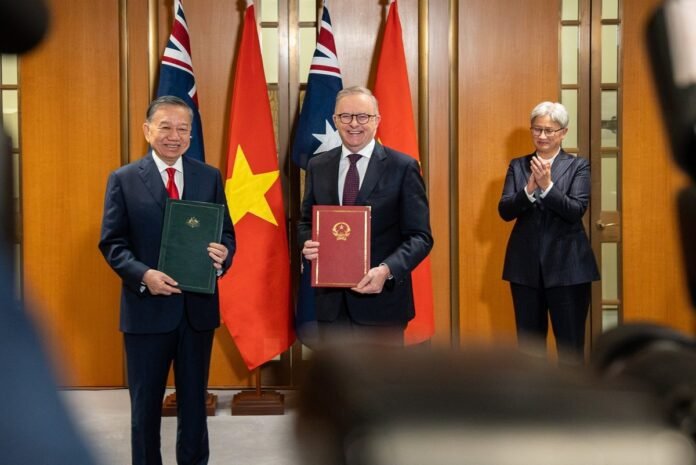
Australia and Vietnam have agreed to closer cooperation across defense, security, trade and innovation. Photo: X
To Lam’s visit to Canberra on August 11 was the first state visit to Australia by a Vietnamese head of state since the 1975 reunification and the first meeting between the two leaders. Since taking the presidency in April, To Lam has visited China, India, Sri Lanka, Thailand, Singapore and the Philippines, and the Australia trip precedes a stop in New Zealand to meet Christopher Luxon.
Australia and Vietnam elevated relations to a comprehensive strategic partnership in March 2024, Hanoi’s highest partnership tier. The CSP designation was once reserved for a handful of major powers, but they have expanded rapidly the last few years. Both governments have spent two years building institutional mechanisms on top of the framework, including an inaugural trade ministers’ dialogue and ministerial security dialogue in 2024, and the announcement of a new energy and minerals ministerial-level dialogue. The joint statement issued on 11 August, read against the 2024 elevation statement, reflects steady, incremental progress on commitments already made.
The 2024 statement’s headline commitments are being delivered. The ministerial security dialogue was inaugurated in 2024. The peacekeeping partnership agreement was signed in July 2025. A defense cooperation plan for 2025–2027 is in place. The ministerial energy and minerals dialogue, committed in 2024 and still not convened as of the August 2025 foreign ministers’ meeting, was finally held alongside this visit. These are concrete follow-throughs, and they distinguish the CSP from partnerships where elevation produces communiques but little institutional change.
Defence cooperation has continued to build incrementally on that base. An updated Joint Vision Statement on Further Defense Cooperation was signed. Vietnam’s participation in Exercise Kakadu for a second consecutive cycle, in 2024 and 2026, and its observation of Exercise Talisman Sabre in 2025 extend a pattern of gradually expanding operational engagement. A maritime law enforcement agreement and a cooperation and mutual assistance agreement are in negotiation. These are meaningful for a country whose defense policy rules out military alliances.
On economics, the visit produced no new quantified commitment. The only significant figure in the statement is Export Finance Australia’s A$1.3 billion in finance to support infrastructure development and exports to Vietnam since 2017, a cumulative reporting figure rather than new money. Vietnam is a key focus of Australia’s blended finance portfolio, receiving A$83 million, over a third of Australia’s total financing.
The Aus4Skills program was extended for nine years to 2035. An amended investment registration certificate was issued for RMIT University’s Hanoi campus. These commitments share a common feature: all are publicly financed or government-facilitated. No private sector investment target was set, nor was any bilateral trade target agreed.
A new element is the Joint Statement on Economic Resilience Cooperation, which frames supply chain resilience across critical minerals, semiconductors, clean energy, grid infrastructure and agricultural essentials. Whether economic resilience cooperation acquires operational substance or remains a framing document will depend on whether specific projects follow. Currently, Australian figures put two-way trade in goods and services at A$30.0 billion in 2025, while the total stock of two-way investment sat at A$2.0 billion.
Several structural factors constrain investment beyond the partnership’s political settings. Vietnam caps aggregate foreign ownership in commercial banks at 30 per cent of charter capital. Foreign individuals and organizations do not hold land use rights under Vietnamese law, and are limited to leasing arrangements capped at 50 years under the 2024 Land Law. On the Australian side, institutional investors have limited exposure to frontier markets such as Vietnam. These are not problems a joint statement can solve, but they explain why the CSP’s economic section remains dominated by public finance rather than private capital.
On technology, the TechConnect forum launched in Sydney on 10 August and a Joint Statement on Science, Technology and Innovation Connectivity was signed, alongside a health cooperation MOU. Vietnam has pursued parallel technology cooperation with Japan, South Korea and Singapore in recent months, including joint semiconductor research projects with Japan and semiconductor and data center agreements with South Korea. What Australia can offer centers on research training, critical minerals supply chains and governance frameworks rather than in commercial technology.
The relationship carries significant people-to-people depth. Australia is home to around 350,000 people of Vietnamese heritage, and Vietnam is Australia’s fourth-largest international student market, with approximately 35,000 students currently enrolled and over 160,000 alumni. Vietnam’s Deputy Minister of Foreign Affairs Nguyen Manh Cuong’s briefing described this people-to-people dimension as social capital that cannot be created overnight by any agreement.
Yet, while both governments treat the diaspora as a bilateral asset, the community is not monolithic. A substantial portion is descended from refugees who arrived after 1975, and organized Vietnamese-Australian groups have routinely protested visits by Vietnamese leaders to Canberra, reflecting a historical distrust of the Communist Party leadership that annual Black April commemorations and the continued use of the heritage flag keep visible.
While the older generations are aging and the newer ones are less engaged with the political legacy, the absence of a substantive gesture from the party-state toward the community’s historical grievances has made reconciliation and efforts to tap into the diaspora’s full potential considerably more difficult.
The overall trajectory of bilateral relations is consistent. The CSP’s 2024 commitments have been acted on, which is itself a credible outcome. The new instruments agreed during this visit are largely continuations of existing programs, frameworks not yet operational, or reporting of cumulative public expenditure. The relationship continues to deepen where governments act directly, through defense exercises, public finance and publicly funded capability programs. It remains thin where progress depends on private actors whom neither government controls, and where political will to shift existing settings has not been forthcoming.
Drone Strikes and Intelligence Chief’s Killing Expose Libya’s Fragile Balance
The unclaimed attacks have not been linked, but they come as rival power centers compete for influence and the US seeks to reunify Libya’s divided institutions
Drone attacks on energy facilities in western Libya and the assassination of a senior intelligence official in the east have renewed fears of instability as Libyan factions maneuver ahead of possible political negotiations.
No evidence has emerged connecting the two sets of events, and no group has claimed responsibility for either. Their timing has nonetheless raised questions about whether Libya faces another brief outbreak of violence or a broader contest for influence.
Maj. Gen. Fawzi al-Mansouri, head of military intelligence for Khalifa Haftar’s eastern-based forces, was killed in Benghazi on Monday night, August 10, when an explosive device detonated at his vehicle in the Hawari district, according to security officials and the eastern General Command.
Al-Mansouri was buried the following day at a funeral attended by senior military figures, including Saddam Haftar, one of Khalifa Haftar’s sons. A security committee has opened an investigation, but authorities have not publicly identified a suspect or motive.
The assassination eliminated one of the most senior officials in an eastern security establishment that has portrayed Benghazi and much of eastern Libya as having left behind the instability of earlier years.
Hundreds of kilometers to the west, attacks were hitting some of the country’s most important energy facilities.
Drone strikes began targeting facilities in Zawiya on August 9. The following night, a drone hit a gasoline-storage tank at the Zawiya oil complex, west of Tripoli, causing a major fire and the tank’s collapse. The tank held approximately 4.5 million liters of gasoline when it was struck, according to Libya’s National Oil Corporation.
Another drone landed near a second tank without causing reported casualties or damage. Further attacks continued into August 11.
The National Oil Corporation said firefighters had contained the blazes and that the refinery itself was not damaged, although production was briefly disrupted. It warned that more attacks could force it to suspend operations.
The complex includes Libya’s largest operating refinery, which can process approximately 120,000 barrels per day. It is connected to the Sharara oil field and plays a central role in the country’s energy production and fuel-distribution network.
Prime Minister Abdul Hamid Dbeibah, who heads the internationally recognized Government of National Unity in Tripoli, condemned the strikes as organized crime and promised to hold those responsible accountable.
Another drone struck the South Zawiya electricity substation on August 12, setting it ablaze and causing widespread outages. Libya’s state-run General Electricity Company said more than 700 megawatts of the nearby power plant’s 1,300-megawatt capacity remained unavailable.
US energy company GE suspended work at the power station and withdrew its technical teams because of the security situation.
The attackers and their objectives remain unknown. Zawiya is divided among armed groups with shifting alliances, and tensions have grown between Dbeibah’s government and forces associated with Mohamed Bahroun, a powerful commander in the city.
Libya has been divided between rival centers of authority for more than a decade. Dbeibah’s government operates from Tripoli, while authorities backed by Haftar’s forces control the east. A 2020 ceasefire ended the last major nationwide war but failed to produce unified political, military, or security institutions.
The latest violence comes as Libyan leaders and foreign governments seek arrangements that could narrow the east-west divide.
Misbah Omar, a Libya-based analyst at the Institute for Integrated Transitions and a member of the Mediterranean Platform, said the attacks could be part of a larger contest, although no wider pattern has yet been established.
What we are witnessing may represent an initial phase in the restructuring of Libya’s political and security landscape
“If this assessment is correct, what we are witnessing may represent an initial phase in the restructuring of Libya’s political and security landscape—one aimed at allowing the main actors to consolidate or redefine their respective spheres of influence before moving toward a clearer political process,” Omar told The Media Line.
Zawiya is particularly important in any contest over western Libya. The city sits west of Tripoli at the junction of armed influence, energy infrastructure, migration routes, and economic networks.
The attacks raise the possibility that armed factions or their opponents are shifting their focus from direct clashes to the resources and supply systems that sustain military power.
“Such actions would represent a significant shift in the nature of the confrontation,” Omar said. “Rather than focusing exclusively on the armed formations themselves, pressure could increasingly be directed toward the economic and logistical networks that sustain their influence and operational capacity.”
Potential targets could include infrastructure, revenue sources, supply routes, and other assets that help armed groups maintain their position, he added.
Ibrahim Mousa Said Grada, a former Libyan ambassador to Sweden and former UN adviser, also described Zawiya as central to the struggle over political power and economic resources.
“This happened in Zawiya, a city that deserves to be described as afflicted and targeted because it has become a meeting point for the contradictions of politics, conflicts of interest, and disputes over the division of power and resources in Libya,” Grada told The Media Line.
This happened in Zawiya, a city that… has become a meeting point for the contradictions of politics, conflicts of interest, and disputes over the division of power and resources in Libya
The violence coincides with renewed US efforts to encourage cooperation between Libya’s rival authorities.
Massad Boulos, senior adviser to President Donald Trump for Arab and African affairs, has promoted an initiative focused on institutional reunification and economic cooperation. He has met Haftar, Dbeibah, and other political and military figures across Libya.
Published accounts describe the initiative as an effort to reach agreements between Haftar’s eastern authorities and Dbeibah’s Tripoli-based government, with energy investment and economic development offered as incentives.
The plan remains controversial, and many of its details have not been made public. Critics warn that a power-sharing agreement could preserve the authority of Libya’s current leaders and armed factions rather than build representative national institutions.
Omar said the US approach seemed to favor a series of limited agreements rather than a comprehensive settlement.
“If this trajectory continues, the initiative could enter a more practical phase during the final quarter of this year and the beginning of next year, operating along two parallel tracks: economic and political, supported by corresponding security arrangements on the ground,” he said.
Grada was less optimistic about its immediate prospects.
“The Boulos initiative ‘appears’ to have been placed in a freezer during this scorching summer, so that it does not die or become buried altogether,” he said.
The recent attacks do not show that Libya’s factions have agreed on a new division of power. They could instead represent attempts by competing groups to improve their positions before negotiations, whose timing and structure remain unclear.
Al-Mansouri’s assassination creates another problem for the east. Grada said the loss of its military intelligence chief came at a sensitive time for Libya’s divided security services.
“At the same time, the absence of the head of military intelligence for the eastern Libyan forces coincides with the continuing dispute over the leadership of the General Intelligence Service, or external security apparatus,” Grada said. “This means an intelligence vacuum and state of confusion at a particularly dark and sensitive moment domestically and during a highly unstable and critical international environment.”
Foreign involvement adds to the uncertainty. Russia, Turkey, the US, European powers, and regional governments retain varying degrees of political, economic, and security influence in Libya.
“There is an increasing possibility that Libya could be transformed into an arena for proxy warfare between intelligence services and their military and media arms, as international and regional conflicts and rivalries expand and deepen,” Grada said.
The latest violence does not necessarily mean that Libya is heading back to nationwide war. Omar said a series of limited moves intended to change the balance of power was more likely than an immediate, large-scale confrontation.
These developments should not necessarily be interpreted as evidence of an imminent comprehensive military confrontation
“However, these developments should not necessarily be interpreted as evidence of an imminent comprehensive military confrontation,” he said. “A more plausible scenario may be a series of calibrated and limited moves designed to alter the balance of power gradually, while leaving room for negotiations and political accommodation.”
The next political agreement may depend as much on events outside formal negotiations as on what happens at the table. Control of territory, energy assets, and security institutions will help determine what Libya’s competing factions are willing—and able—to accept.
The Zawiya strikes and al-Mansouri’s assassination do not prove that anyone is carrying out a coordinated plan to redraw Libya’s balance of power. They do show how quickly an attack on an oil tank, power station, or security chief can unsettle a country whose rival authorities have never fully resolved the conflict between them.
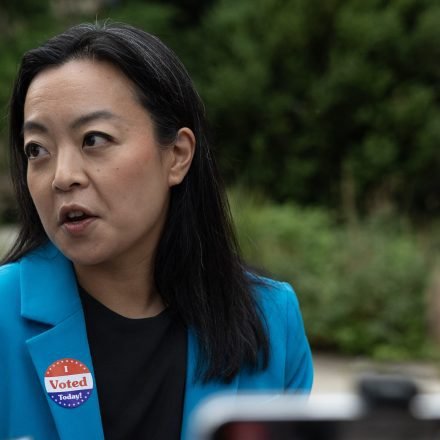
The stunning momentum of the insurgent left hit a roadblock this week when democratic socialist Francesca Hong narrowly lost her primary race for Wisconsin governor to Milwaukee County Executive David Crowley, a moderate who garnered significant support from establishment Democrats.
“The collective power of that Democratic establishment in a state, where there is a Democratic governor and there is a real Democratic Party establishment machine, all of that power was required to eke out a 0.4 percent victory in the party’s own primary against a previously unknown candidate running as a Democratic socialist,” The Lever’s David Sirota tells The Intercept Briefing.
This week on the podcast, host Jessica Washington speaks with Sirota, founder and editor-in-chief of The Lever, about the primaries and how the left is building power within the Democratic Party.
There were bright spots for progressives on Tuesday night. In Minnesota, progressive Lt. Gov. Peggy Flanagan defeated AIPAC-backed Rep. Angie Craig, D-Minn., in the Senate primary race. Craig had previously voted for the Laken Riley Act, which requires the federal government to detain people for certain crimes, including shoplifting and burglary. Flanagan, by contrast, told supporters on election night: “We need to rip ICE apart and stop them from terrorizing our communities.”
“What you’re seeing now is, and I don’t want to call it a Democratic Tea Party, but it is certainly organizing and pressuring to take back power in an adversarial way from a set of forces to the left of the Democratic establishment,” says Sirota. “That is what’s new, and that is what’s driving the political dynamic now.”
Washington and Sirota also discuss the intensifying democracy crisis unfolding in the United States. According to Sirota, it “stands on two pillars: concentrated executive power and the supremacy of money.”
Sirota explores this theme and more, in the new season of his show, Master Plan: The Kingmakers. The podcast is all about how a once-fringe legal theory moved into the mainstream and transformed the power of the American presidency.
For more, listen to the full conversation of The Intercept Briefing on Apple Podcasts, Spotify, YouTube, or wherever you listen.
Transcript
Jessica Washington: Welcome to The Intercept Briefing, I’m Jessica Washington, politics reporter at The Intercept.
On Tuesday night, democratic socialist Francesca Hong narrowly lost her primary race for Wisconsin Governor to Milwaukee County Executive David Crowley.
Hong lost by less than a percentage point. But her defeat was a blow to the anti-data center movement, which she had championed throughout her campaign, even as her detractors tried to make the race about her opinions on Thanksgiving and other major holidays.
But the night was not a total loss for progressives. In Minnesota, Lt. Governor Peggy Flanagan defeated AIPAC-backed Congresswoman Angie Craig for Senate.
Peggy Flanagan: And now let’s talk about Donald Trump’s out of control ICE force [crowd boos]. We need to rip ICE apart and stop them from terrorizing our communities.
JW: Last year, Craig voted in favor of the Laken Riley Act, which requires the federal government to detain people for a host of crimes, including nonviolent ones like shoplifting, and it allows states to sue over immigration enforcement, giving power to state attorneys general to shape immigration enforcement policy regardless of which party holds the White House. That vote appears to have cost her in a state that largely rose up in defiance of the Trump administration’s brutal immigration crackdown, after federal immigration agents shot and killed two U.S. citizens.
For more of our reporting on the primaries and the anti-data center movement, visit TheIntercept.com.
This week on The Intercept Briefing, I speak to David Sirota, founder and editor-in-chief of The Lever, about the primaries and how the left is building power within the Democratic Party.
David also talks about the parallels between how the left and the right have consolidated power, and we get into the second season of his amazing series Master Plan, resuming this week.
This new season is called The Kingmakers and is all about how a once-fringe legal theory moved into the mainstream and transformed the power of the American presidency.
It traces the people and institutions behind that campaign — from Richard Nixon’s downfall and Dick Cheney’s post-9/11 power grab to pivotal Supreme Court decisions and Project 2025.
David, welcome back to The Intercept Briefing.
David Sirota: Thank you. Thanks for having me.
JW: So Tuesday night, Francesca Hong narrowly lost her primary race for Wisconsin governor to the more moderate candidate, David Crowley. But it wasn’t a total loss for the left. In Minnesota, Lieutenant Governor Peggy Flanagan defeated AIPAC-backed Angie Craig. Hong’s race was plagued by, honestly, the dumbest issues, like whether she supports Thanksgiving or how she views her “proximity to whiteness.”
David, what did you make of Tuesday night’s results? Does this, as The New York Times called it, show the “limits of the left,” or is something else at play here?
DS: I think this is a good test of the power dynamic in American politics right now, specifically inside the Democratic Party. I’m going to state a few empirical facts about what happened. People can use these facts to try to confirm their priors. But here are the facts that we know. Fact one is that the entire establishment of the Democratic Party came together towards the end of this race, really consolidated to try to shut down Francesca Hong’s campaign and defeat her.
“All of the power of the old Democratic machine was required to eke out the narrowest of victories against the longest of long-shot candidates.”
The collective power of that Democratic establishment in a state, where there is a Democratic governor and there is a real Democratic Party establishment machine, all of that power was required to eke out a 0.4 percent victory in the party’s own primary against a previously unknown candidate running as a Democratic socialist who was wildly under-resourced, did not air any television advertisements through her own campaign. So the point being that all of the power of the old Democratic machine was required to eke out the narrowest of victories against the longest of long-shot candidates.
A candidate who, by the way, had been effectively abandoned by other national left-of-center icons and politicians, democratic socialists. Bernie Sanders did not endorse Francesca Hong. AOC did not endorse Francesca Hong. The candidates who have been winning as democratic socialists did not come to Wisconsin to campaign with Francesca Hong. We can discuss why that is and the mistakes or stumbles that Hong made as a candidate. But the point is that the machine with all of the power and advantages it had against a candidate with no advantages at all, that ran to say the least, an imperfect campaign, still needed all of its power to barely win a race in Wisconsin.
So to me, what that says is that the Democratic establishment that has gotten very used to being able to easily control primary outcomes is now having to marshal all of its collective power and have everything break right for it in order to eke out these primary wins. That, I think, is a fundamental difference of the political topography of the Democratic Party.
JW: I’m thinking about the fact that we didn’t see Bernie Sanders supporting her. Obviously, AOC had come out and said that it was because she wanted to focus on Congress. So we can have that conversation.
But we also didn’t see that support for Cori Bush either. And she lost.
Do you think that progressives are making a smart play here by trying to decide who’s more electable in a general election? Or, is that just more of the same silly stuff we’ve seen from the Democratic Party in terms of electability and making those decisions before voters do?
DS: Yeah, I’ve said this before and I’ll say it again. My take on so-called electability is that nobody really knows who is electable or not electable. I’m old enough to remember when the same media machine and Democratic Party apparatus insisted with certainty that Barack Obama could never possibly win a general election. I remember when that same machine laughed at the idea that Donald Trump could be elected president.
I tend to believe that this whole discussion about electability is silly, but also a Jedi mind trick that the establishment of the Democratic Party uses to try to manipulate voters into not voting for candidates and not seeing elections as forums for voting for good policies.
They’re trying to turn primaries into — and they’ve been successful at it in the past — trying to turn primaries into this idea that, “Don’t vote for the candidate who may be offering you policies that you actually support. Vote for our view of who is actually ‘electable’ in a general election. Forget the fact that we told you that Barack Obama wasn’t electable or Donald Trump wasn’t electable. Forget all that.” So my basic take is that the whole electability discussion is this moving target and a real sort of engine of manipulation.
I think that in every race, candidates are looked at for their viability, for how well they are running, and their basic competence as a candidate. It’s not wrong for folks and political organizations and activists on the left or really any political faction to try to evaluate the competence of candidates that they are going to spend resources on or organize for or endorse. That’s part of the political process in America, and that’s not a perfect process. But sometimes you can make mistakes. That happens all the time.
Did Francesca Hong not get endorsements because she was evaluated to be a less competent candidate? Same thing for Cori Bush. Were those candidates seen as not competent? Competent meaning as candidates, not as people, as candidates running a campaign. Were they seen as not competent versus was Abdul El-Sayed seen as a highly competent candidate?
My guess is that those calculations were at play here. I’ve worked on a lot of campaigns in my life at this point. A candidate’s competency is this intangible that’s really important.
So my guess is though all of those questions were on the table in the way that these decisions were made to endorse certain candidates and not go all in for other candidates.
JW: That makes a lot of sense. We’re also talking about having to run these candidates against the right, against the massive money machine that the right has.
So I want to talk a little bit more about Republicans and their power. Recently on your podcast, Lever Time, you spoke to Reed Galen, co-founder of the anti-Trump political action committee, The Lincoln Project. Galen talked about leaving the Republican Party and his warning that Democrats are making the same mistakes Republicans made, mapping the transition of the GOP to the Tea Party movement takeover.
Can you talk about that conversation and what Galen sees as the kind of dangerous mistakes the Democratic Party is making, and what’s your view?
DS: Yeah, I agree with his story of history, which is that to understand the current Republican Party, you have to really rewind history and look at what created it. You can go all the way back to Barry Goldwater and tell the story from there.
But in modern times, what you can see is that in 2008, Barack Obama won the presidency. A lot of the center-left foment gets driven into the Democratic Party and into Obama as a personality, and a lot of the center-right and hard-right unhappiness with our political system was driven first into the Tea Party, which ultimately became MAGA, which ultimately became the Trump presidency.
The Tea Party was operating outside of the Republican Party, although in conjunction with it, to transform that party. Ultimately, Donald Trump’s presidency, first the MAGA movement and then Trump’s presidency, becomes the culmination of all of that foment outside of the party.
Obviously the party has been transformed. It is a much different party than it was even 10, 15 years ago. I think a similar dynamic is happening right now vis-a-vis the Democratic Party and the American left. Obviously on totally different issues. They don’t share ideologies, they don’t share policy agendas.
But politically speaking, just the raw politics of it, I think this is delayed, I think it’s been belated. Whereas in 2008, there was a moment in the middle of the financial crisis where center-left discontent could have been channeled into something like a center-left Tea Party. I reported on this for a long time.
There was Occupy Wall Street and the like. But certainly it wasn’t as big a movement as the Tea Party on the right because a lot of that energy was, again, channeled into Obama and the Obama presidency. We’re now here 18 years later, many of the grievances of that moment back in 2008 in the middle of the financial crisis, really the supercharging of oligarchy, they’re still here.
But the difference is here — in the here and now — if you look at polls of people on the left, center-left, before in 2008 they were fairly confident in Democratic leaders to channel their grievances. Today, they have lost faith in the Democratic leadership. They are angry at the Democratic Party for what they perceive to be capitulations and unnecessary compromises with corporate power and with Trump and MAGA.
“What you’re seeing now is … certainly organizing and pressuring to take back power in an adversarial way from a set of forces to the left of the Democratic establishment.”
What you’re seeing now is, and I don’t want to call it a Democratic Tea Party, but it is certainly organizing and pressuring to take back power in an adversarial way from a set of forces to the left of the Democratic establishment. That is something I think we have not really experienced in our lifetimes. That is what’s new, and that is what’s driving the political dynamic now.
Whether it’s in any of these races happening across the country or in Congress itself, which I expect the next session of Congress, if Democrats take it back, to be a lot of push and pull inside the Democratic caucus, which of course will overlay the 2028 presidential campaign.
I very much expect candidates in the Democratic primary to be competing for that positioning. You might want to call it the Bernie Sanders lane, but it’s really the lane to say, “I am the outsider that is going to take back the White House for a particular faction,” or representing a particular faction of the Democratic Party. A faction that is most certainly not the corporate old-school establishment that has been running the party into the ground for the last 30 years.
I see the whole push and pull right now as something very healthy. I don’t think it is healthy for democracy, for an establishment of one of the major parties in this country to have clung onto power for so long, offering so little change through so many electoral defeats and through the rise of Donald Trump and authoritarianism.
For that establishment to still be able to hold on to power without much change at all really is the democracy crisis in practice. So the effort to change that party through democratic means, is entirely long overdue, is entirely necessary. People listening to this may agree or disagree with specific different parts of the policy platform being pushed by those outside the establishment, but the process itself is the democracy working.
“The democracy crisis is a set of elite power brokers being able to cling on to a political party’s power regardless of what is happening in the worldand in a way that sells out voters.”
A lot of liberals think about the democracy crisis. The democracy crisis is a set of elite power brokers being able to cling on to a political party’s power regardless of what is happening in the worldand in a way that sells out voters. That’s what’s been going on in the Democratic Party for a long time, and the effort to significantly change it and revitalize the party through democratic means is a healthy expression of democracy.
[Break]
JW: We have multiple crises of democracy happening. We obviously have Trump, but we also have the establishment [Democrats] and the fact that they’ve allowed Republicans to gain control of the government from the House to the Senate to presidency, and I would argue, also the Supreme Court.
Last week, the president’s personal attorney, Todd Blanche, was confirmed as attorney general with, to me, what seems like a clear mandate to target the president’s enemies. Then on Tuesday, it was reported that the DOJ issued a sweeping memo giving broad authority to the president to conceal his communications with so-called private advisers in what seems like just a clear effort to undercut Democrats’ ability to investigate the president if they retake Congress. That doesn’t even touch on the fact that we’re over 100 days into war with Iran without congressional approval.
I want to talk about how we got here, and you explore that in the new season of your show, Master Plan: Kingmakers, which is out this week, by the way. It tracks how a once fringe legal theory has transformed the American presidency into a pseudo-monarchy with term limits.
I listened to the first episode and loved it, by the way. It also feels incredibly relevant right now. David, how did we get here?
“We’ve turned elections into auctions. We’ve equated money with free speech, we’ve equated corporations with people, giving them human rights.”
DS: To my mind, it is the second part of a two-part story to understand the real democracy crisis. The democracy crisis I think, stands on two pillars: concentrated executive power and the supremacy of money.
They’re obviously interrelated. Season one of Master Plan traces the secret 50-year plot to effectively legalize corruption, deregulate the campaign finance system and make bribery essentially a permissible act in the United States. We all understand, implicitly, that we’re now living in that reality when we’ve turned elections into auctions. We’ve equated money with free speech, we’ve equated corporations with people, giving them human rights.
So we are living through that project of the American right to effectively legalize corruption, to turn the democracy from a “one person, one vote” democracy into a “one dollar, one vote” oligarchy. I think we all see the evidence of that. That came about through, among other things, the infamous Powell Memo.
That’s the sort of origin story where a lot of it started, which was a call to arms for corporations in the early 1970s when corporations and oligarchs felt under attack from the New Deal policies of the mid-20th century. The Powell Memo was a call to essentially make monetary investments in buying democracy.
The democracy was functioning too well. It was becoming too responsive to what people actually wanted, and the idea was we have to legalize corruption to be able to rig the system so that we can buy outcomes, we the oligarchy. So that was season one of Master Plan.
The other pillar of the democracy crisis is then to concentrate as much power in the executive branch in the hands of really one person so that the small-D democratic institutions of government have much less power, so that power is less diffuse. It’s all in the hands of one person, because if that’s your guy — you the oligarchy — then you’ve essentially ended democracy. This story starts in Watergate. Watergate was the moment that was seen as a so-called imperial presidency, a presidency that had gotten out of control and stepped over the boundaries and thresholds that had been established for the executive branch.
Congress passes a series of laws that are designed to take power away from the executive branch. So the story really starts there at a kind of small-D democratic moment of triumph, but it also hatches a backlash, and that’s what the new season of Master Plan is about, The Kingmakers.
It hatches a backlash among conservatives starting in the Ford administration with Dick Cheney, who was chief of staff to make legal arguments and start creating legal doctrines that are designed to grab back the power that was taken in the post-Watergate era, put it back in the White House, and then significantly expand it.
“The original Project 2025 was The Heritage Foundation’s Mandate for Leadership, a policy bible whose through line was how to use executive authority.”
That’s what happens soon after Ronald Reagan gets elected president. We all have heard of Project 2025. Back in the late 1970s into 1980, the original Project 2025 was The Heritage Foundation’s Mandate for Leadership, a policy bible whose through line was how to use executive authority to do what the conservative movement wanted regardless of what Congress or any other institution wanted, and how to grab as much of that power as possible under a new legal rubric called the unitary executive theory.
I’m guessing some people have heard that. This is cooked up inside of the Reagan Justice Department in its battles with a Democratic Congress. A legal doctrine that is then tested in the courts in strategic ways to try to get it enshrined into the law.
From the Reagan era into obviously the Bush era, the Bush’s war on terror, Dick Cheney, the guy who had been spearheading parts of this when he was in the Ford administration and when he was in Congress, the Bush administration sees a huge consolidation of power under the veneer of the so-called war on terror.
“All of these powers, from the unitary executive theories that were forged in the Reagan administration to the drone war national security powers that were fortified by Obama after the Bush era, all of this is now resting in the Trump White House.”
Then in probably our most controversial episode of this season, we go into how the Obama administration ended up consolidating power in truly unprecedented ways. The Obama administration didn’t champion the unitary executive theory, but it did make a set of precedential legal arguments about the executive branch’s alleged power to execute and target for assassination American citizens without charging them even with a crime.
I’m talking about the drone war here. Some may say that the drone war was necessary, others may say it wasn’t, but the legal architecture and the outlining of the powers asserted by the executive branch were unprecedented and were effectively validated during the Obama presidency. Powers that are now, fast-forward to today, all of these powers, from the unitary executive theories that were forged in the Reagan administration to the drone war national security powers that were fortified by Obama after the Bush era, all of this is now resting in the Trump White House.
So the point of this is that what we’re living through today didn’t just happen because Donald Trump showed up to the White House. Donald Trump, when he got to the White House, had a series of levers, if you will, an entire control panel of executive powers, unprecedented executive powers, that were created for him.
So when we see him use those powers, it’s not to say we shouldn’t be terrified by it or outraged by it, but it is to say, let’s understand where those powers came from, because they didn’t just happen. They weren’t just seized randomly, and they weren’t just created by Donald Trump himself.
JW: As you just mentioned, efforts to bring the unitary executive theory to reality have been decades in the making. We saw President George W. Bush’s administration push in that direction, and now it’s reached just a whole other level under Trump. First, just to make it clear, can you briefly explain just how powerful is the American presidency under Trump, and what is the unitary executive theory?
DS: The unitary executive theory is this idea that the president singularly is the controller, the master, the decider of every single thing that the executive branch does. The executive branch, that’s one term for it. Another term for the executive branch is the federal government, right?
At one level they are one and the same, but I bring that up so that people can understand how radical the unitary executive theory actually is. When I use the federal government, maybe you’re thinking of the military. Maybe you’re thinking of the Agriculture Department, the scientists working on food safety in the Agriculture Department.
We’re talking about everything, the sort of basic functions, the on-the-ground functions of the government. Technically all of those agencies are operating in what we understand in terms of separation of powers. We understand them to be the executive branch. There’s Congress that makes the laws. There’s the president that executes the laws. There’s the courts that adjudicate battles between Congress and the president, adjudicate what the law is actually saying, et cetera, et cetera.
The unitary executive theory is saying that the president as the head of the executive branch has complete and total power to effectively do whatever the president wants inside of the executive branch.
So the unitary executive theory undergirds something like DOGE, the rampage that we all experienced right when Donald Trump came into his second term. He said, for instance, I’m shutting off all previously approved congressional grants across the entire United States. I’m asserting my executive authority to do that.
Now, Congress had passed laws saying that the money must be spent, but Trump and his administration were essentially arguing the president makes the decision on whether to execute those laws. So I give that example as a way for people to understand how radical an idea this is.
By the way, this came up recently with independent federal agencies. There are a set of agencies that Congress had set up and that presidents had signed laws, signed them into law in the past, saying that, the FTC or the Securities and Exchange Commission that these agencies are quasi-independent because the commissioners have set terms.
It’s much harder to fire them. Donald Trump went into court saying, I’m the unitary executive. These independent agencies structurally are unconstitutional. I should be allowed to hire and fire whoever I want at any time for any reason. And the Supreme Court largely agreed with him.
So this is about an unprecedented consolidation of power in the hands of one person to say that at any level of the federal government, any granular level, there’s some EPA scientist who is issuing a report about climate change that the president doesn’t like, the theory would hold that the president has a right, regardless of what Congress has passed, regardless of what the courts have adjudicated, the president has the right to reach into the EPA, target that one person, and fire them himself.
So you can see the dangers of this, because here’s the thing: Part of the way modern civilization has modernized from the old era of medieval royal courts, is that we have professionalized a lot of the functions of government. Like line scientists doing food safety reviews or environmental reviews or making all sorts of technical technical determinations, et cetera, et cetera. We had previously said this is going to be insulated at some level from the political whims of just one all-powerful king, whichever party it is. There’s a civil service, there’s a sort of a professionalized bureaucracy, if you will, and the unitary executive theory is trying to dismantle all of that.
Now, I want to add one thing very quickly here. I do think there’s an argument that, when a bureaucracy, a professionalized government bureaucracy, is so insulated from what voters are voting for, there can be an undemocratic disconnect there. If voters are voting for certain kinds of change and a kind of permanent bureaucratic government, because of job protections and the like over many years, is not responding to what people want, I do think there is a nugget of an argument there that there has to be ways that elections happen and policy changes then flow from those election changes.
But I think the unitary executive theory is a radical overcorrection for that kind of alleged problem. The solution to that theoretical problem is not to turn the president into an all-powerful king who can wake up at any day or any moment, ignore all of the laws on the books, and do whatever he wants.
JW: It sounds like there’s a lot that’s going to be happening in your podcast, and I’m, for one, really looking forward to listening to the rest of the new season of Master Plan: The Kingmakers. David, where can people listen to it?
DS: They can find it on our website at levernews.com. You can also go on your podcast app and just type in Master Plan. And you can go to our YouTube page. We have video versions of the episodes. That’s youtube.com/@levernews. The URL, the easiest way to find it, masterplanpodcast.com.
JW: David, thank you so much for joining us on The Intercept Briefing.
DS: Thank you. Thanks so much for having me.
JW: We want to hear from you. Tell us what you’re following or want to see more coverage of. Email us at podcasts@theintercept.com or leave us a voicemail at 530-POD-CAST, that’s 530-763-2278
That does it for this episode.
This episode was produced by Laura Flynn. Ben Muessig is our editor-in-chief. Maia Hibbett is our Managing Editor.
Fei Liu is our product and design manager. Nara Shin is our copy editor. William Stanton mixed our show. Legal review by David Bralow.
Slip Stream provided our theme music.
This show and our reporting at The Intercept do not exist without you. Your donation, no matter the amount, makes a real difference. Keep our investigations free and fearless at theintercept.com/join.
And if you haven’t already, please subscribe to The Intercept Briefing wherever you listen to podcasts. Do leave us a rating or a review, it helps other listeners to find us.
How Trump’s Unprecedented Effort to Prosecute Noncitizen Voters Fell Apart
Reporting Highlights
Inflated Claims: HSI deployed its tech platform to find noncitizens on voter rolls, despite warnings from agency insiders that it would lead to an “ungodly” number of false positives.
Privacy Concerns: DOJ leaders ignored internal concerns that transferring voter lists to HSI for criminal investigation might not be legal.
Scant Results: Despite intense White House pressure, the effort has produced only a few dozen noncitizen voter prosecutions nationwide — and even fewer convictions.
These highlights were written by the reporters and editors who worked on this story.
It was late March when Joe Teirab, the second-in-command at Minnesota’s U.S. attorney’s office, received an urgent email from Washington.
The federal government was scrambling to find criminal cases to back up President Donald Trump’s claims that illegal voting by noncitizens was tipping the scales in American elections. Agents from Homeland Security Investigations, a massive federal law enforcement agency, had been dispatched to work leads across the country, including hundreds in Minnesota.
Teirab was already under pressure. In an earlier missive, Nick Davis, a high-ranking Justice Department appointee helping to lead the election fraud crusade, had reminded him the cases were so high priority that Teirab and his staff couldn’t decline to move forward on them without express approval from agency higher-ups. On March 24, Davis demanded a status report — within hours.
Teirab, a former Marine and a Harvard Law graduate who’d run unsuccessfully for Congress as a Republican, responded with a blunt reality check.
“Bottom line up front,” he replied in an email reviewed by ProPublica. After subpoenaing records on about 130 people, only one had been referred for prosecution, his staff had told him. Agents had deluged local election offices with calls and demands for voting histories, demonstrating “a complete lack of understanding” of illegal voting investigations.
“The HSI task force has been disjointed and disorganized,” Teirab wrote. The entire process, he said, had been “dysfunctional.”
Since Trump regained the White House, his administration has launched a series of unprecedented initiatives to find and prosecute voting by noncitizens, which he’s long claimed, without evidence, is rampant.
He’s stepped up this push in recent weeks, saying in a nationally televised speech that the American election system was “so vulnerable that no one can possibly defend it.” To support that assertion, the Department of Homeland Security, HSI’s parent agency, released documents asserting it had found more than 250,000 noncitizens on voter rolls in just four states, all led by Democrats. The documents included no explanation of how that number was calculated.
It’s well known the administration has tasked HSI — a force established to combat drug cartels, terrorism and other cross-border criminal enterprises — with leading the campaign to find election fraud cases in the United States.
But an investigation by ProPublica reveals for the first time how the Trump administration came to harness HSI’s personnel, technology and sweeping legal authority in service of its election agenda — and how meager the results have been, despite the prodigious resources sunk into the effort.
According to interviews and internal emails reviewed by ProPublica, career staffers at the Justice Department warned that transferring voter rolls to HSI to enable it to search for noncitizen voters could violate federal privacy laws. Similarly, longtime HSI insiders cautioned that using the agency’s databases and tools to search these lists would yield mismatches and wildly inflated results.
The administration plowed forward anyway.
HSI’s involvement in the hunt for election fraud traces at least to summer 2025, when agency supervisors embraced a proposal from a midlevel agent who’d publicly echoed Trump’s claims about elections. He argued the agency’s powerful databases and tools could find noncitizens even on the voter lists that states make publicly available, from which the most confidential information has been redacted. Under Trump, the Justice Department had collected many public voter rolls as part of a controversial effort to compel states to turn over the unredacted versions.
Those searches went forward, ProPublica’s reporting shows, helping to generate tens of thousands of leads regarding illegal voting across the country. But when HSI agents were sent to investigate them, the results were similar to what Teirab reported from Minnesota.
Between January 2025 and May 2026, a ProPublica analysis of Justice Department data shows, fewer than 150 alleged noncitizen voters were referred for prosecution. Even fewer — 41 — were charged with voting illegally or other election-related crimes. (More than 150 million people voted in the most recent presidential election.)
In response to questions from ProPublica, administration officials insisted the effort spearheaded by HSI was producing meaningful results.
“President Trump is committed to ensuring that Americans have full confidence in the administration of elections, and that includes totally accurate and up-to-date voter rolls free of errors and unlawfully registered non-citizen voters,” Abigail Jackson, a White House spokesperson, said in response to ProPublica’s request for comment. “Noncitizens voting is a crime. Anyone breaking the law will be held accountable.”
A DHS spokesperson didn’t answer questions about why so few prosecutions have resulted from HSI’s work. The agency wouldn’t specify what tools or techniques HSI had used, but confirmed it had cross-referenced “publicly available data” from state voter rolls with information on “known illegal aliens” in its systems. “It’s not rocket science,” the spokesperson wrote of this initiative in a response to ProPublica’s questions. “It’s an easy step to secure our elections.”
Teirab and the U.S. attorney’s office in Minnesota declined to comment.
There’s an array of reasons why Trump’s campaign to document claims of widespread voter fraud hasn’t succeeded. Most obviously, it’s exceedingly rare, as countlessstudies and state audits have found. Noncitizens often get on voter rolls by accident or when government officials make errors. Last month, New Jersey disclosed that a mistake involving its Motor Vehicle Commission caused 6,600 noncitizens to be registered (fewer than 400 voted).
The administration’s critics say its hunt for noncitizen voters aligns with Trump’s attempts to seek more federal control over elections while stoking doubt and fear about the voting process. Since taking back the Oval Office, Trump has tried to impose new restrictions on voter registration, mail-in ballots and voting machines, though judges have shut down most of these efforts.
Former officials at DHS and the Justice Department called the move to involve HSI a further escalation and questioned the propriety of aiming the agency’s muscle and technology at individual cases of illegal voting.
“It’s one thing if you’re going after Pablo Escobar,” said Steve Bunnell, a former DHS general counsel and senior intelligence adviser who handled voting fraud prosecutions during more than a decade at the Justice Department. “It’s another thing if you’re going after some cleaning lady who’s been working in the United States for 20 years and taking care of her 80-year-old mother and taking her little kids to church.”
Matt Rota for ProPublica
“The Swiss Army Knife of Federal Law Enforcement”
Trump’s enlistment of HSI in his election fight is no accident. Cobbled together in the aftermath of 9/11, the agency has 7,100 armed, highly trained agents and another 800 criminal analysts, as well as access to troves of confidential data about hundreds of millions of Americans.
Though part of Immigration and Customs Enforcement, the agency has historically stayed out of immigration cases. During the first Trump administration, leaders of 19 HSI regional offices — virtually its entire top field hierarchy — signed a letter calling for HSI to become a standalone agency, arguing that ICE’s deportation work dissuaded people from cooperating with its investigations. But when Trump returned to the White House, it swiftly became clear that the agency would play a central role in investigations related to the president’s twin obsessions, illegal immigration and noncitizen voting.
Trump picked his field general for repurposing HSI even before taking the oath of office. In December 2024, he named Anthony Salisbury, a 50-year-old career agent who’d run the agency’s Miami office, as a deputy homeland security adviser, reporting to White House policy chief Stephen Miller. He was also given a dual appointment as head of HSI.
Salisbury was colorful: A mixed martial arts enthusiast, he once appeared at the agency’s headquarters with his face bruised and eye blackened from a recent bout. He’d sometimes entertain colleagues by pulling out a bridge that covers his missing front teeth.
To agency veterans, however, he was forever linked to a 2011 operation he’d overseen in Mexico in which one agent was killed and another wounded in a highway ambush by a drug cartel. An agency review submitted to Trump in April 2020 concluded that errors by HSI supervisors, including Salisbury, contributed to the outcome; it urged the administration to consider disciplinary action. None was taken against Salisbury, however.
Salisbury did not respond to requests for comment from ProPublica. A White House official called him “a critical member of the Trump administration” who was “cleared” in every review of the Mexico incident and was subsequently “promoted six times under multiple administrations.”
“It’s one thing if you’re going after Pablo Escobar. It’s another thing if you’re going after some cleaning lady who’s been working in the United States for 20 years and taking care of her 80-year-old mother and taking her little kids to church.”
Steve Bunnell, a former DHS general counsel and senior intelligence adviser
Once elevated to his new posts, Salisbury took charge of carrying out the second Trump administration’s agenda for HSI, personally issuing staffing directives, reassignments and promotions, current and former agency officials told ProPublica. (A number of them spoke on condition of anonymity out of fear of retribution.)
Starting in early 2025, Salisbury oversaw the unprecedented reassignment of more than 6,000 agents to immigration enforcement, diverting most of the agency from its normal duties. He then also pointed HSI at noncitizen voting, presiding over multiple meetings with officials at DOJ and Homeland Security focused on election fraud, according to emails reviewed by ProPublica and agency supervisors who worked with him.
“Stephen Miller has an HSI deputy for a reason,” said Eric Balliet, a high-level HSI manager who retired in 2024 after 23 years with the agency. (Like many HSI veterans, Balliet has remained in close contact with former colleagues.) “Salisbury is going to salute and execute, and he is going to make sure that from the HSI side, they fall in line, and there’s going to be no resistance or pushback. HSI has been turned into the Swiss Army knife of federal law enforcement.”
In early July 2025, Frank Quiñones, an HSI special agent who’d worked under Salisbury in Florida, approached leaders at the HSI Innovation Lab with an idea for using the agency’s technology to find noncitizen voters on state voter rolls, sources at the agency told ProPublica. Quiñones had been transferred to Washington to oversee a unit that had previously handled cases involving the theft of government benefits but that had been enlisted into voting investigations.
The lab, housed in an unmarked office in a D.C. suburb, had access to the government’s most sensitive databases, from suspicious activity reports to arrest records. Staffed by a combination of HSI experts and outside consultants, it developed software tools to comb the data for information that could help agents pursue criminal suspects.
Quiñones was a true believer in Trump’s claims about election fraud: In multiple Facebookpostsandreposts, ProPublica found, he promoted claims that the 2020 presidential vote had been stolen. At a meeting with the Innovation Lab’s overseers, according to sources who worked in the lab, he pitched using the lab’s technology to identify illegal voters — even though the agency lacked voter rolls that included identifiers such as partial Social Security numbers. (Quiñones did not respond to ProPublica requests for comment.)
For proof of concept, Quiñones proposed using a February 2021 public voter list he’d obtained for New Jersey and running it through HSI’s databases. The lab staff viewed his idea as “a little insane,” one recalled — both unreliable and improper. Since the public rolls don’t include voters’ unique identifiers, people at the lab also knew linking them to HSI’s data would produce mismatches — what the staffer called an “ungodly” number of false positives. The lab team also worried about violating longstanding safeguards limiting use of private citizen data. They “didn’t want to touch this,” the staffer added. Quiñones defended his idea, repeatedly declaring: “The president wants this!”
Tom Hodge, an HSI data analyst at the meeting, proposed running the voter information through the Athena Toolbox, an analytical platform developed by the Sandia National Laboratories that had access to all of HSI’s databases. (Hodge did not respond to ProPublica requests for comment. Sandia referred ProPublica’s questions to the facilities’ parent agencies, including the Department of Energy, which did not respond to our requests.)
Hodge and the Sandia team spent the next six weeks on the project, reporting they’d found large numbers of noncitizens on Quiñones’ 2021 New Jersey list. According to one former HSI official, they said they’d found “5,000 high-confidence illegal voters” in just a single New Jersey county. (Officials at the New Jersey secretary of state’s office, which oversees the state’s voter rolls, declined to comment on the claim. Beth Thompson, head of a group for local New Jersey election officials, called the number impossibly high, even accounting for the mistake disclosed by the state.)
The apparent breakthrough couldn’t have come at a better time.
The Trump administration’s other efforts to identify noncitizens on state voter rolls were running into a variety of roadblocks.
The administration had hoped to persuade states to check their voters’ citizenship status using a system called the Systematic Alien Verification for Entitlements, or SAVE, but many didn’t. Most states also refused the Justice Department’s demands to turn over their unredacted voter rolls, including partial Social Security numbers, which thwarted the agency’s plan to run them through SAVE. Courts have stymied the DOJ’s attempts to sue for the records, citing the Constitution, which gives primary control over elections to the states.
In an Aug. 21 email to a half dozen administration officials, Quiñones touted the solution he’d brought to the HSI Innovation Lab: using HSI’s platform to search voter rolls. The results, Quiñones noted, could fuel both criminal and immigration investigations.
By the end of the month, those in top election-related roles at DHS and the Justice Department were actively promoting what they dubbed the “HSI Tool” as a preferred alternative to SAVE, according to people familiar with the matter. Among them was Heather Honey, the prominent election denier appointed as a senior counselor at DHS, who is helping lead the government’s efforts to identify noncitizens on voter rolls. (Honey did not respond to ProPublica’s requests for comment. In an email responding to questions to her, DHS said Honey’s “expertise in election administration” was “invaluable to the Department’s efforts to protect critical infrastructure.”)
The White House, too, got behind the idea. In a November email, J. Brian Sikma, special assistant to the president, excitedly noted that the New Jersey trial cross-checking voter rolls with DHS data appeared to have identified a “very significant number” of “potential non-citizens.” (Sikma didn’t respond to a request for comment.)
The DOJ, Sikma reported, had already obtained public voter rolls for many other states. He included a list of them, adding: “It is of paramount importance that these also be reviewed expeditiously.”
Matt Rota for ProPublica
Running “Roughshod” Over Privacy
As the push to use HSI’s tech to search voter information gained momentum, a new problem emerged.
Career attorneys at the Justice Department, including specialists on privacy law, raised concerns that transferring voter rolls wholesale from the agency to DHS might not be legal, according to internal emails reviewed by ProPublica and interviews with several former officials.
The voter rolls the DOJ had collected contained sensitive information on millions of Americans. Even the public versions, which political parties and candidates routinely obtain to target ads and messages, included voters’ addresses, birth dates and party affiliations. For the 16 states that have agreed to share their unredacted voter lists, the DOJ had citizens’ partial Social Security numbers or driver’s license information, too.
Federal laws, particularly the Privacy Act, dictate what data government agencies can collect, what it can be used for, how it can be shared, and how it must be protected. Agencies have to disclose their plans in advance, gathering public comment. A person’s information can’t be released or shared without their consent, subject to limited exceptions.
From the outset, the Trump administration’s effort to combine data across federal agencies has repeatedly drawn criticism from courts and whistleblowers for failing to adhere to restrictions meant to keep data private and secure. In June, for example, a judge prohibited the government from using SAVE for mass searches, ruling the administration had violated federal privacy laws by giving DHS access to Social Security data to enhance the tool. The administration has appealed that ruling.
In July 2025, as word got around that the DOJ might hand over voter data to DHS, a half dozen career attorneys who had been reassigned into the voting section voiced their unease to supervisors, according to two former DOJ lawyers. Their concerns were disregarded, prompting most to resign.
Instead, the DOJ’s office of legal counsel pushed forward with plans to share the public voter rolls, claiming a Privacy Act exception allowed HSI to receive such data without public notice as long as it was for law enforcement purposes. DHS just needed to submit a letter officially requesting the data for those purposes, an attorney in the legal counsel’s office explained, according to internal emails.
But this exception was meant to be used to get information on individual criminal suspects, not to gain mass access to data on people suspected of no wrongdoing, according to Nikhel Sus, chief counsel for Citizens for Responsibility and Ethics in Washington, which has sued the Trump administration on behalf of voter and pro-privacy groups, filing the case that eventually limited SAVE’s use.
“[Anthony] Salisbury is going to salute and execute, and he is going to make sure that from the HSI side, they fall in line, and there’s going to be no resistance or pushback. HSI has been turned into the Swiss Army knife of federal law enforcement.”
Eric Balliet, a former high-level HSI manager
Peter Winn, a 29-year Justice Department veteran who had served as the agency’s acting privacy chief for nearly a decade, drafted a letter to set out the data-sharing agreement between the DOJ and DHS, according to internal documents reviewed by ProPublica.
In a Feb. 12 email to two top DOJ officials, he said he’d rewritten an initial draft memo to “make the information sharing arrangement far easier to defend, if and when it is challenged in court.”
Rather than simply handing over the voter rolls, Winn proposed having DHS request “pertinent and relevant” information about specific people from the DOJ, then having technical staff at Justice and Homeland Security “coordinate” to fulfill the requests.
“Having slept on it,” Winn wrote, “I ended up deciding that our initial idea of sending a huge amount of raw unprocessed voter registration data to DHS, involved taking far too much unnecessary legal risk, given that 99% of the data would implicate the privacy and civil liberties of United States Citizens, and would risk adding to the false narrative in the establishment press of DOJ and DHS being unconcerned with the privacy and civil liberties of Americans.”
Winn attached his proposed letter, to be signed by Todd Lyons, then the acting director of ICE.
Winn’s suggested restrictions were quickly abandoned, however. A second draft of the letter, dated March 4, contained altered language providing that the voter information would be “transferred” to HSI, with one exception: Voters’ party affiliation would be redacted, if possible, it said.
The final letter, signed by Lyons and sent to the DOJ just two days later, abandoned even that limitation. Just three paragraphs long, it permitted HSI to use the voter rolls to pursue any “appropriate investigation of potential violations of federal election law.”
In response to questions from ProPublica, Winn said “I can’t really comment on internal drafts of correspondence.”
A Justice Department spokesperson defended the government’s actions, saying “no one should oppose intergovernmental data sharing and coordination that enable swift investigations and prosecution of illegal alien voting.” DHS echoed the DOJ’s view, calling such information sharing “essential to protecting America’s election process by keeping noncitizens off voter rolls” and “an easy step to secure our elections.”
Sus said that by pooling voters’ sensitive personal identifiers, along with their party and voting histories, the administration has “run roughshod” over privacy laws and is creating a “1984-style database” that could be used to surveil political participation.
Balliet, the former HSI agent, expressed similar concerns, saying that handing over voter rolls to run through DHS’ systems amounted to “a mass data-collection effort by the government against its own citizens in a non-criminal setting.” On a practical level, he added, the data sharing increased the risk of breaches that can open law-abiding citizens up to identity theft.
“As a citizen, I want the government to take seriously the protection of my private data,” he said. “If it falls into the wrong hands, it’s not the government that suffers. It’s me.”
Matt Rota for ProPublica
Collapsing Claims
By January 2026, scores of HSI agents were fanning out across the country to investigate thousands of leads about illegal voting.
About 25,000 of them involved people SAVE had identified as potential noncitizens on state voter rolls. Another 15,000 were given to HSI’s cross-border financial crimes unit, which was told to prioritize them over money laundering and fraud cases, a former high-level HSI official said. Quiñones’ unit led a separate effort to find additional cases by reviewing whether people who’d recently become citizens had voted before they were naturalized, then lied about it in naturalization interviews.
Still more leads came from running public voter rolls through the HSI lab’s databases, though it’s not clear how many. Agency sources told ProPublica that the rolls of New Jersey and Pennsylvania were searched using the Athena Toolbox. When DHS announced it had found more than 250,000 noncitizens on the registered voter lists of four Democrat-led states, it said that included “as many as” 35,152 in New Jersey and 14,576 in Pennsylvania. Both states have asked DHS to provide the source of the numbers.
Once federal investigators started digging into these cases, however, they often fell apart.
Through May, prosecutors had charged fewer than four dozen people with crimes related to noncitizen voting, ProPublica’s analysis of DOJ data and federal court filings shows, getting convictions or guilty pleas in 14 cases.
The largest cluster of cases was brought in the Southern District of Florida, headed by Jason Reding Quiñones (no relation to the HSI agent), a staunch Trump ally who has led investigations of the president’s political opponents. Voters have been sentenced in eight of the office’s cases; seven others are pending.
Prosecutors have initiated a total of seven noncitizen voting cases as of May in the four states where DHS claimed to have found more than a quarter million noncitizens on the rolls. Collectively, these states have more than 40 million registered voters.
Overall, the paltry numbers reflect the realities HSI investigators confronted on the ground as they tried to convert leads into cases, a ProPublica review of records obtained by voting-advocacy groups Campaign Legal Center and Democracy Forward shows.
Emails between agents and local election officials in Texas and Ohio indicate much of the federal information on purported noncitizens was inaccurate, the consequence of flawed data matching. When agents demanded voting histories and registration forms, they often discovered people weren’t registered in the counties where HSI thought they were. When voters register, they must attest that they are U.S. citizens; agents found some, however, who’d been put on voter rolls in error after disclosing they weren’t citizens. Many had never voted.
“Our initial idea of sending a huge amount of raw unprocessed voter registration data to DHS, involved taking far too much unnecessary legal risk, given that 99% of the data would implicate the privacy and civil liberties of United States Citizens.”
Peter Winn, a Justice Department veteran, in an email urging limits on data sharing that were not adopted
Most HSI agents, steeped in pursuing complex international crimes, had no experience in pursuing voting fraud. In his email to Nick Davis at the Justice Department, Teirab, the top deputy in Minnesota’s U.S. attorney’s office, described the chaos that ensued when the state and at least six counties got subpoenas for voters’ records. The demands “presented a host of issues,” Teirab wrote to Davis. (Davis did not respond to a request for comment.)
“An unknown number of agents are constantly arriving in Minnesota without any knowledge of the investigation, the issues already discussed and decided, and the processes they need to follow,” Teirab complained. “Instead of getting up to speed and learning, they have demanded many calls and subpoenas, most of which demonstrate a complete lack of understanding of the investigation.”
In Stearns County in central Minnesota, HSI agents subpoenaed voting histories on 13 people, county officials told ProPublica. Only six turned out to live there.
Minnesota Secretary of State Steve Simon, a Democrat, said the effort revealed federal investigators’ ignorance about “the nuance of elections administration.” The rate of purposeful election crime is “microscopic,” he said. “The very human errors that can happen are not some sort of plot or scheme to dirty up the voting rolls, but are just everyday human beings making mistakes, not intending at all to violate any law.”
As of May, only one illegal voting case has been referred for prosecution in Minnesota. The state has more than 3.8 million registered voters.
Even Republican-led states like Ohio, which has shared its unredacted voter rolls with the DOJ and run them through the SAVE system, have struggled to meet Trump administration demands to deliver cases.
In October, the Ohio secretary of state referred more than 1,000 voters identified as possible noncitizens to the federal government, claiming 167 had voted at least once since 2018. At least nine HSI agents in Cincinnati and Cleveland began to investigate, emails obtained by Campaign Legal Center and shared with ProPublica show.
The agents bombarded local election officials with requests for voting histories and other records, some dating back decades. “Sorry again for piecemealing these to you,” one agent wrote to an official in Butler County, outside Cincinnati, after making five separate requests over two weeks. Mohamed Al-Hamdani, a Democratic member of Montgomery County’s Board of Elections, which received similar inquiries, said they amounted to “witch hunts” that ate up staff time.
In February, Davis sent an email pressing Ohio’s two U.S. attorneys’ offices for an “election integrity” update, asking: “How close are we to complaints/indictments, how many subjects, what issues you’ve run into, how many referrals have been closed and why, how helpful HSI has been.”
As of May, just two voting cases had been referred for prosecution in Ohio and no one had been charged, federal data shows. The state has nearly 8 million voters.
Now, however, U.S. attorneys’ offices are taking a different approach, pursuing prosecutions that could result in prison terms or deportation.
In May 2025, federal prosecutors in Florida filed illegal voting charges against a mother and daughter, both Ukrainian citizens, who’d registered after becoming permanent U.S. residents, then voted in the 2024 presidential election. They’ve pleaded not guilty, with the mother saying in an interview with investigators that she thought having a green card meant she could vote. They and their attorneys didn’t respond to requests for comment from ProPublica. The prosecutor handling the case for the Southern District of Florida also didn’t respond to questions. The mother and daughter are scheduled to go to trial in September.
Matt Rota for ProPublica
“Far-Reaching Consequences”
Experts on both elections and national security warn there may be profound longer-term costs to unleashing the federal government’s investigative and prosecutorial might to try to prove the president’s claims about noncitizen voting.
Current and former HSI agents say critical investigations — including task forces aimed at drug rings, human trafficking and money laundering — have languished as the agency has pivoted to take on noncitizen voting and immigration enforcement.
In February 2026, according to court files and emails reviewed by ProPublica, an HSI agent in Ohio who’d been leading a multistate child sex abuse investigation was abruptly assigned to pursue dozens of leads on suspected noncitizen voters, work that took months. It wasn’t until May that he made an arrest in the other case. Prosecutors have filed child exploitation and pornography charges against the man, 38, in connection with acts involving at least five 14-year-old girls.
Cases like this “don’t just stop,” said Balliet, the 23-year HSI veteran. “When you pull people off them for an extended period of time, those criminal networks will adapt, and people get killed and kidnapped.”
Federal data hints at a broader slowdown in what had been HSI’s most urgent work. According to an annual government report, the number of wiretaps obtained by DHS — often to investigate drug trafficking — plummeted to 23 in 2025, from 133 the previous year. In the report, DHS attributed the decline to several factors, including “changes in administration enforcement and prosecutorial priorities.”
“It’s never been a better time to be involved in transnational organized crime,” said John Tobon, a high-ranking HSI official who retired in early 2025.
“The very human errors that can happen are not some sort of plot or scheme to dirty up the voting rolls, but are just everyday human beings making mistakes, not intending at all to violate any law.”
Minnesota Secretary of State Steve Simon
In its statement, DHS denied HSI has neglected its core mission, saying the agency has increased its efforts to combat criminal cartels, gangs and drug traffickers in response to multiple Trump executive orders.
Though HSI’s voting-related investigations have yielded only a small number of prosecutions, voter advocacy groups worry the Trump administration will use them to justify more extreme interventions.
“Those concerns are playing out in real time, with far-reaching consequences,” said Dax Goldstein, a director at the States United Democracy Center, a nonprofit group that works to build confidence in elections. “When federal agencies are misused and weaponized, people lose trust in government itself.”
Rocket Report: Rocket Lab shows off its flexibility; Blue Origin’s two-pad plan
Welcome to Edition 9.06 of the Rocket Report! Rocket Lab made a lot of news this week with its quarterly update, and it is clear the company is making impressive progress as it becomes much more than a launch company. But at the end of the day, a lot of the company’s success is predicated on the Neutron vehicle, and I’m not thrilled with Rocket Lab’s ambiguity around its readiness. As a user on X noted, the company’s language on Stage 2 being ready to ship to the launch site has not changed much in 12 months.
As always, we welcome reader submissions, and if you don’t want to miss an issue, please subscribe using the box below (the form will not appear on AMP-enabled versions of the site). Each report will include information on small-, medium-, and heavy-lift rockets as well as a quick look ahead at the next three launches on the calendar.
Rocket Lab decides to get flexible. Rocket Lab plans to start launching its Electron vehicle even more frequently and flexibly, thanks to a new portable spaceport system called GHOST, Space.com reports. GHOST—short for “Global Hypersonic & Orbital Spaceport Technology”—turns the company’s “Electron and HASTE rockets into a launch-anywhere, launch-anytime capability for multi-launch flight campaigns and critical national security missions,” the company said this week.
Onward to Alaska … Rocket Lab currently flies from two different launch sites—one on the North Island of company founder and chief executive Peter Beck’s native New Zealand and one at Wallops Island in Virginia. But the company recently announced plans to fly out of Alaska’s Pacific Spaceport Complex as well, and GHOST will expand its launch footprint even further. The company was inspired to develop the portable spaceport system, he added, to meet the needs of a HASTE (a suborbital hypersonic test bed) customer, who expressed a desire for Rocket Lab to be “a little bit more mobile than we are.”
ArianeGroup decides not to halt MaiaSpace. ArianeGroup has decided against dissolving MaiaSpace after the company posted a 37.5 million euro loss for 2025, pushing its shareholders’ equity below zero, European Spaceflight reports. Shareholders’ equity fell from a positive 35.82 million euros at the end of 2024 to negative 823,375 euros. Shareholders’ equity is what remains after the company has paid all its liabilities. A negative figure means MaiaSpace owes more than it owns.
Yes, most rocket startups lose a lot of money … Under French corporate law, when shareholders’ equity falls below half of the company’s share capital, the shareholder, in this case ArianeGroup, is required to decide whether the company should be dissolved or allowed to continue operating. At a meeting on June 25, 2026, ArianeGroup officially rejected the option of dissolving MaiaSpace, allowing the company to continue preparations for the inaugural flight of Maia. ArianeGroup’s pockets are not bottomless, so this bears watching.
The Ars Technica Rocket Report
The easiest way to keep up with Eric Berger’s and Stephen Clark’s reporting on all things space is to sign up for our newsletter. We’ll collect their stories and deliver them straight to your inbox.
Firefly increases Alpha rocket production. Firefly Aerospace says it is seeing strong interest in its launch vehicles and is ramping up production, Space News reports. Firefly executives said in an August 11 earnings call that production of its Alpha launch vehicle is at an “all-time high” as development continues on its larger Eclipse vehicle. “I can’t stress enough that the demand for launch capacity is amplified right now. We’ve never seen launch capacity so constrained,” Jason Kim, chief executive of Firefly, said during the call.
Production hasn’t translated into increased cadence … “A majority of our manifest for 2027 has already been sold out,” Kim said, but declined to say how many missions were on its manifest for the year. “We’re not going to talk about guidance for 2027,” he said when asked about the company’s projected launch cadence for next year. Alpha has launched only seven times, dating back to September 2021.
Virgin Galactic isn’t flying, but it is naming. As Virgin Galactic nears christening the first of its next-generation spaceship designed to launch customers on suborbital flights, it still is missing a key component—a name, Ars reports. Virgin Galactic completed structural assembly of “Delta-1,” its first new spaceship, earlier this year and towed it from its assembly hangar to a test and launch hangar in Arizona. Like SpaceShipTwo, Delta spaceships are designed to fly with up to six people.
We like the name Horizon … Virgin Galactic plans to debut the Delta spaceship’s livery, including its name, as its next milestone before delivering the first vehicle to Spaceport America in New Mexico, where flight tests will begin. “Our first ship is now expected to enter commercial service in February 2027,” said Michael Colglazier, Virgin Galactic CEO, in a statement released on Wednesday. We advise the public to take that date with a grain of salt, but you can indeed vote to name the ship now. There are four options: Horizon, Explorer, Ascend, Apeiron.
Tank issue delayed RFA One launch. The majority owner of Rocket Factory Augsburg is still confident the company will conduct its first orbital launch attempt this year despite a setback in testing during July, Space News reports. In an August 6 earnings call, Marco Fuchs, chief executive of OHB, the German aerospace company that owns 65 percent of RFA, said engineers needed to “examine the tanks” of the rocket. “There was a problem with the tank, and this was uncertain, so the team decided to take a look into this,” he said.
RFA had been working toward an August debut launch … The company returned the rocket to the hangar and opened up the tank. He said he expected the rocket to be back on the pad soon but didn’t offer a more precise schedule. “The first test flight is still planned for later this year,” he said. “We’re hopeful that these last remaining challenges will be fulfilled in the next foreseeable days and weeks.” We’ll be watching with interest.
Chinese rocket breaks apart in flight. One of China’s most-used rockets, the Long March 7A, exploded a little more than a minute after lifting off on Monday evening, local time, Ars reports. The medium-lift rocket’s payload was classified, but it was believed to be a military communications satellite. The rocket’s liftoff from Wenchang Space Launch Site appeared to be nominal, but publicly captured videos showed that the rocket’s first stage exploded about 1 minute and 20 seconds into flight.
The front fell off … The Long March 7A rocket was developed by the China Aerospace Science and Technology Corporation and is operated by the state’s space agency. As of Monday night in China, state officials have not commented on the cause of the explosion. Later videos appeared to show the top of the rocket breaking off in flight. Based on the timing of the explosion, it occurred during the flight of the first stage of the vehicle, likely around the time of maximum dynamic pressure as the rocket accelerated through the lower atmosphere.
Neutron launch slips to 2027. Rocket Lab warned that the chances of launching its Neutron rocket for the first time before the end of the year are “narrowing” despite progress on the vehicle’s development, Space News reports. “As with any complex development program, we’ve had to tweak a few things along the way, but we’re moving now into final checkout and assembly of all of our flight hardware before integrating them at the pad,” Peter Beck, chief executive of Rocket Lab, said on the call.
Let’s be real … Ongoing work on the vehicle’s two stages, engines, and other systems, he said, “lines up with our target delivery of Neutron to the pad in Q4 2026.” Even if the stages reach the pad during the fourth quarter of this year, they still must be integrated and undergo additional testing. It is often during this final integration that problems are discovered. For this reason we can confidently say Neutron will not launch this year. Next year is plausible, but not guaranteed.
Rocketdyne returns as a standalone space company. Rocketdyne is returning as an independent company as AE Industrial Partners completes its purchase of L3Harris Technologies’ space propulsion, power, and electronics units, Space News reports. The revived Rocketdyne won’t resemble the full Aerojet Rocketdyne inherited by L3Harris three years ago. That company combined solid rocket motors, launch engines, and spacecraft systems under one roof.
RL-10 remains key asset … Missile propulsion, solid rocket motors, and hypersonic technologies remain with L3Harris’ Missile Solutions business, which the company plans to take public. The RS-25 engine used on NASA’s Space Launch System core stage was also excluded from the sale and remains wholly owned by L3Harris. Rocketdyne will concentrate on launch-vehicle engines, spacecraft propulsion, space electronics, and nuclear power systems. Its best-known product is the RL-10 upper-stage engine, which is used by United Launch Alliance’s Atlas 5 and Vulcan rockets. (submitted by Tfargo04)
Blue Origin narrows in on BE-4 failure. Blue Origin has provided its first substantive update on the cause of the catastrophic loss of the New Glenn rocket and most of its launch pad infrastructure at Cape Canaveral, Florida, in May. The space company’s chief executive, Dave Limp, confirmed widespread speculation that the problem started in one of the rocket’s seven BE-4 engines that power the vehicle’s first stage, Ars reports.
Root cause not identified yet … “The anomaly originated at the main oxygen valve on one of the BE-4 engines, which was later confirmed by hardware recovery and inspections,” Limp said. He added that the company’s path forward is “clear” as Blue Origin works toward returning the New Glenn rocket to flight before the end of this year. This is a positive update, and the transparency is appreciated. However, it also seems clear from Limp’s statement that the company has not yet identified the root cause of the issue.
SpaceX set to acquire large swath of Louisiana marshland. SpaceX and the state of Louisiana are close to finalizing a deal for the launch company to acquire about 130,000 acres along the northern coast of the Gulf of Mexico, Ars reports. The deal would give SpaceX control of an 18-mile stretch of marshland southwest of Lafayette. The site, known as Pecan Island, became available as part of a legal settlement that resolves dozens of lawsuits that blame ExxonMobil for pollution and coastal land loss, the newspaper reports.
There has been no confirmation from SpaceX or Louisiana officials … But earlier this year the Louisiana Legislature passed a package of incentives for aerospace companies, including liability protections and property tax breaks. If SpaceX is to fulfill its ambitions to launch thousands of Starship rockets a year to build a massive constellation of orbital data centers, among other purposes, it needs more launch sites. And there are limited expanses of undeveloped coastal locations along the Gulf of Mexico and southern Atlantic Ocean in the United States.
Blue Origin announces two-pad plan. In May, the explosion of New Glenn’s rocket took out Launch Complex 36A at Cape Canaveral Space Force Station in Florida. In the weeks after the anomaly, Blue Origin outlined plans to restore that pad for New Glenn operations as soon as possible. On Thursday, the company revealed that it will also move to quickly develop a larger launch pad at the nearby Launch Complex 36B.
New launch tower will resemble Starship tower … This newer pad will serve as the operational home for New Glenn 9×4 (that is nine first stage engines, four upper stage engines), while LC-36A remains the operational home for the smaller New Glenn 7×2 vehicle that blew up earlier this year. Additional infrastructure planned includes a new Vertical Integration Facility for the 9×4 vehicle and a Payload Processing Facility. Built in partnership with the US government, this facility will support both variants of New Glenn.
Next three launches
August 15: Falcon 9 | USSF-366 | Vandenberg Space Force Base, California | 21:52 UTC
August 16: Falcon 9 | Globalstar 2-R | Cape Canaveral Space Force Station, Fla. | 01:12 UTC
August 16: Long March 12 | Unknown payload | Wenchang Space Launch Site, China | 04:10 UTC