Britain moves to curb rogue businesses and expand police powers under new high street strategy
Britain’s new Prime Minister Andy Burnham is set to unveil plans on Tuesday to tighten controls on vape shops, betting outlets and other rogue businesses as part of a broader effort to revive town centres after decades of decline, his office said Monday.
The proposals would give local communities a greater role in deciding what businesses can open on their high streets and would expand the powers of police and local authorities to tackle premises linked to organised crime.
Under the plan, the government would revoke a rule that currently limits councils’ ability to refuse new betting shops, even when there are strong local objections.
New vape shops and adult gaming centres would be required to obtain planning permission before opening.
The package would also extend the time available for police and local authorities to investigate properties suspected of being connected to organised crime. The maximum duration of orders allowing authorities to close such premises would increase from six months to 12 months.
Burnham’s initiative follows a series of other measures aimed at easing pressure on households and supporting local businesses, including cuts to taxes on domestic electricity bills, caps on bus fares, and lower business rates for pubs, clubs and live music venues.
The government has presented the measures as part of a wider strategy to strengthen local economies and restore confidence in Britain’s town centres.
Canada’s wildfire season is taking a heavy toll on First Nations
This story is published through the Indigenous News Alliance.
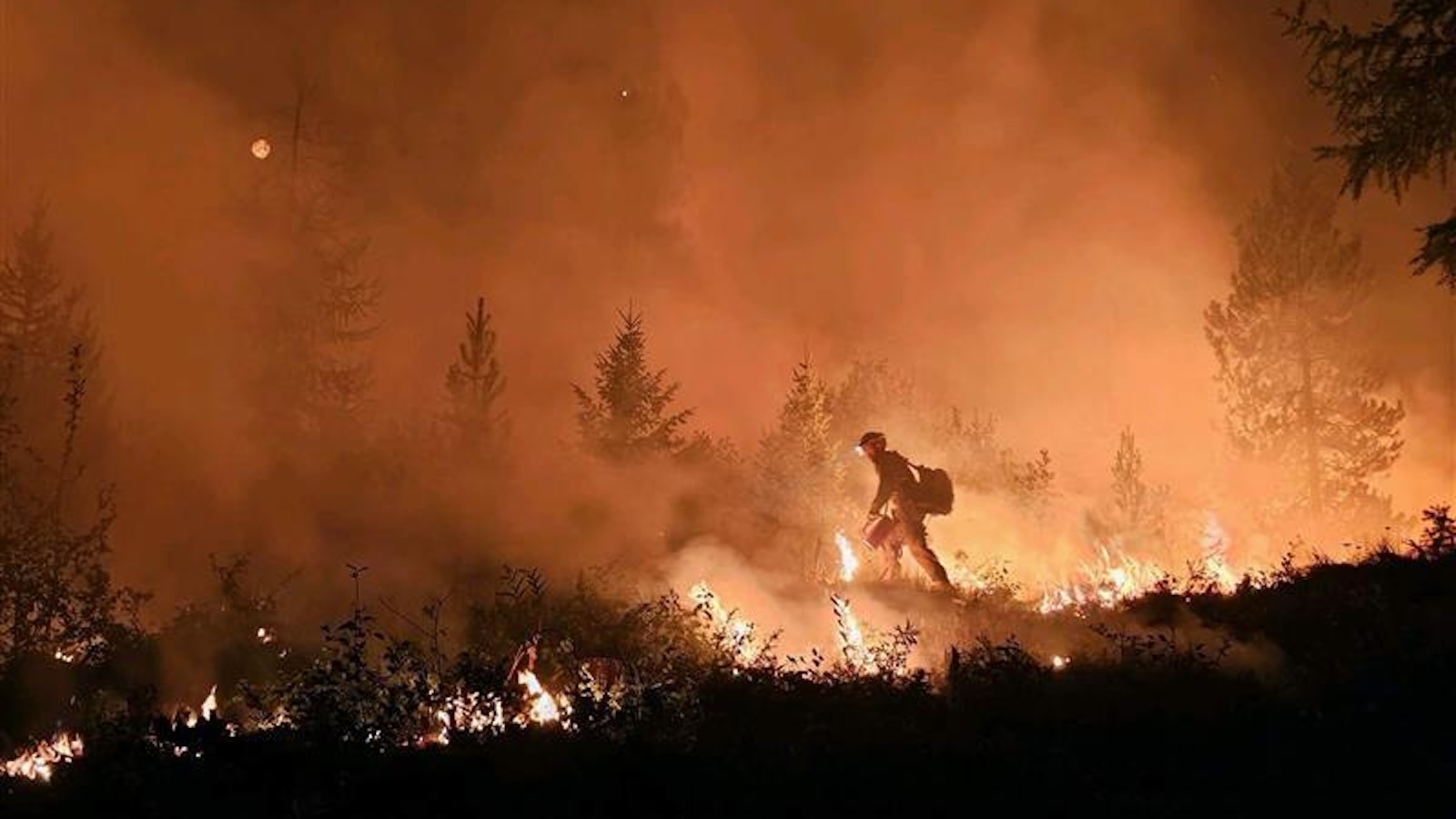
When the chief of the Okanagan Indian Band looked down on his community from a helicopter last week, much of what he had known all his life was gone.
Homes had burned. Photographs, memorabilia, and Salish baskets had disappeared with them. More than 30 band members had lost their homes, naspəpʕásəs Dan Wilson said, along with around 200 homes and other structures belonging to non-band members.
“Our loss is measured in the family histories that have been lost — especially the Elders who have lost their homes,” he said.
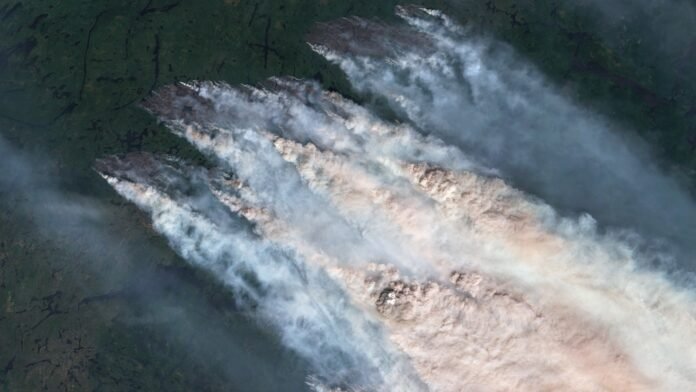
The destruction left by the Bradley Creek wildfire at nk̓maplqs (the head of Okanagan Lake) comes amid a wildfire season that has repeatedly forced Indigenous peoples across Canada from their homes. As of Tuesday, 601 wildfires were burning across the country, including 113 classified as out of control and another 371 that remained out of control but were being monitored rather than actively suppressed.
Those numbers have translated into a summer of evacuations, displacement, and, in some communities, devastating losses for First Nations. Wildfires have affected at least 81 First Nations and forced 9,131 people from their communities since April 1; 2,524 people remained evacuated as of Tuesday. As fires have threatened communities from British Columbia to Ontario, Indigenous leaders have raised concerns about inadequate firefighting equipment, delays in emergency assistance, and the information used to make evacuation decisions.
In Ontario, a fast-moving fire devastated Namaygoosisagagun First Nation in July as residents fled by boat. At least 12 First Nations in the province have been fully or partially evacuated because of wildfires this summer, according to Chiefs of Ontario. The organization is demanding an independent public inquiry into what Ontario Regional Chief Abram Benedict called a “catastrophic and systemic failure” in the response.
And last week, leaders of Kiashke Zaaging Anishinaabek were still fighting an Ontario government decision to withdraw wildfire implementation and evacuation orders while massive fires remained out of control nearby.
For the Okanagan Indian Band, the immediate danger has eased. The wildfire, which started July 31 on reserve lands near Vernon, British Columbia, had burned about 6,550 acres as of Monday. It was classified as being held over the weekend, meaning it was expected to remain within its existing boundaries under prevailing and forecast conditions. Some evacuation orders have since been rescinded or downgraded.
Although the community faces a long recovery, it “is getting stronger every day,” Wilson said last week. “We’re holding up. We’re very resilient. We have a long history — we’ve been here for 10,000 years.”
Read Next
Wilson praised the band’s firefighters, who were first on the scene and worked alongside provincial wildfire crews. “They went above and beyond. I can’t say enough,” he said.
Wilson said the band’s fire department, which consists of around 30 trained firefighters, was equipped only with a fire truck designed to tackle structural fires. “If we had a proper wildland firefighting truck that’s able to access rough terrain … I’m told that if we had that equipment, our first responders would’ve been able to put that fire out immediately,” he said.
He said that concern was relayed to Mandy Gull-Masty, the federal minister of Indigenous Services.
Wilson noted that the one bright spot from the helicopter tour was seeing the Komasket powwow arbour grounds — as well as the nearby daycare and Nk̓maplqs Iʔ Snm̓am̓ay̓aʔtn Iʔ K̓l Sqilxʷtət Cultural Immersion School — unscathed by the fire.
The disaster comes five years after the Whiterock Lake wildfire destroyed 10 homes belonging to Okanagan Indian Band members and displaced the community for weeks.
For communities facing this summer’s fires, the challenges have extended beyond escaping the flames. The devastation of Namaygoosisagagun, also known as Collins First Nation, has raised questions about whether the remote community will receive federal recovery and rebuilding assistance. Although its residents are recognized as First Nations people under the Indian Act, Namaygoosisagagun is not recognized as a First Nation. A lawyer representing the community wrote to Gull-Masty that denying it the emergency and rebuilding assistance available to recognized First Nations could threaten its ability to rebuild.
Ontario Regional Chief Abram Benedict also criticized bureaucratic obstacles First Nations encountered while trying to access emergency assistance. On July 30, Chiefs of Ontario called for an independent public inquiry into the province’s response, saying at least 12 First Nations had been fully or partially evacuated during the wildfire season.
“There has been a catastrophic and systemic failure at nearly every level and at nearly every step of this process,” Benedict said in a statement. “We need to know how and why this happened. But most importantly, we need to learn from it so it never happens again.”
Read Next
Communication has emerged as another concern. When an out-of-control wildfire threatened Xeni Gwet’in First Nation in British Columbia in April, authorities did not provide emergency alerts in Tŝilhqot’in — the only language spoken by many Elders in the community — leaving the Nation’s own forestry crew to alert them directly.
Sara Wilson, a communications researcher at Simon Fraser University, has described such shortcomings as part of a broader “crisis communication gap,” pointing to language barriers, underfunding, and the exclusion of Indigenous communities from decision-making during emergencies.
Those concerns extend beyond how emergency information is communicated to questions about who decides when a First Nation is safe. That question remained at the center of a dispute last week at Kiashke Zaaging Anishinaabek, also known as Gull Bay First Nation, in northwestern Ontario. The Nation’s leaders objected to the government decision to withdraw wildfire implementation and evacuation orders around the community. “Our members are still at risk and our infrastructure is at risk,” Chief Wilfred King told CBC Thunder Bay.
Several large fires remained near the community, and King said one of the community’s greatest concerns was that one of them could block its only road out, leaving residents trying to flee across Lake Nipigon. “The only escape would be jumping on boats and crossing Lake Nipigon, and that’s not an alternative,” he said.
King said the community was also concerned about delays in receiving information about changing fire conditions. Before residents return, he said, the Nation also must ensure its water treatment and sewage systems are functioning safely.
Ontario’s Ministry of Natural Resources told CBC that changes to evacuation orders would be made only when fires no longer posed a risk, based on advice from fire behavior experts. But King said the provincial order should have remained in place until the community was confident it was safe. He told CBC that Indigenous Services Canada supported the Nation’s decision to maintain its own evacuation order.
At Okanagan Indian Band, support came from other First Nations and Indigenous leaders. Penticton Indian Band and Westbank First Nation opened their communities to evacuees, while leaders from across the syilx Okanagan Nation Alliance reached out.
At an emotional community meeting in Vernon, drummers Bruce Manuel and his sister Trish Manuel, sent by Upper Nicola Band Chief Dan Manuel, performed a closing drum song. Wilson said the response was “really bolstering our spirits here.”
“We say our prayers,” he said. “We have a strong faith in kʷuləncútn, the Creator.”
This story was originally published by IndigiNews and updated with additional information by Grist.
Japanese electric vehicle (EV) makers have fallen so far behind BYD and other Chinese competitors, and been so brightly outshone by Tesla, that it is easy to forget that the Nissan Leaf was the world’s first mass-market EV.
People might also fail to notice that the Japanese auto industry has launched more than 20 new and upgraded EV models in the past year, and that EVs are full of Japanese components.
The new models include the third generation Nissan Leaf, three other Nissan brand models, and a modified Leaf built for Mitsubishi Motors; five Toyota and three Lexus brand models; three Subaru models, with one more on the way; two built by Mazda’s joint venture with Changan in China; two minicar EVs from Suzuki in Japan and an electric SUV from Maruti Suzuki in India.
This marks a step beyond the hybrid vehicles that have so far dominated the new energy vehicle sales of Japanese automakers. Not only Toyota but the entire industry is shifting toward EVs, and with the war in the Middle East threatening oil supplies, this seems likely to continue.
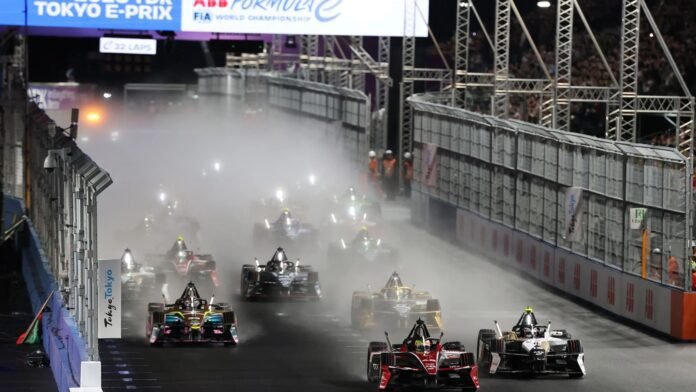
Meanwhile, putting a spotlight on Japan’s renewed interest in EVs, rounds 14 and 15 of the 2025/26 ABB FIA Formula E World Championship were held in Tokyo on July 25 and 26 (after Shanghai and before the finale in London). It was the third time for Formula E to be held in Tokyo.
Formula E is the world’s premier all-electric vehicle racing event. The FIA (Fédération Internationale de l’Automobile) is the governing body that overseas both Formula E and Formula 1, its predecessor and motorsport rival. ABB, the Swedish-Swiss engineering company, is the official title sponsor and a technical partner of Formula E.
The Tokyo rounds, also called the 2026 TDK Tokyo E-Prix, were sponsored by Japanese electronic component maker TDK and supported by the Tokyo Metropolitan Government. Tokyo Governor Yuriko Koike sees the event as a way to accelerate the adoption of zero emission vehicles and contribute to the city’s climate action plan, which targets net zero CO2 emissions by 2050.
The Tokyo races were held on a track constructed on the roads running around the Tokyo Big Sight convention center (not really on “public roads” as Koike had said). They were also held at night, when it was cooler, with an exceptional view of the city lights, giving the governor a chance to promote tourism as well as sustainability.
Looking down at the track, we saw a wall covered with the letters TDK, the sponsorship reflecting the fact that electric vehicles are full of TDK products.
TDK was founded in 1935 in order to commercialize synthetic ferrite, a magnetic ceramic material invented in 1930 by Japanese scientists Yogoro Kato and Takeshi Takei at the Tokyo Institute of Technology. Ferrite is made by sintering iron oxide (Fe2O3) with metal oxides such as nickel, zinc or manganese.
TDK, which stands for Tokyo Denki Kagaku (Tokyo Electric Chemical), used ferrite to build businesses in magnetic recording tape, hard disc drive (HDD) read/write heads, and other applications in consumer and industrial electronics, including EVs.
TDK also has a large automotive business in China, supplying EV makers with capacitors, inductors, transformers, and sensors made in factories located in China. It has a long-standing relationship with Chinese battery maker CATL. Including smart phone batteries and other components used in consumer electrics and information equipment, about 55% of TDK’s total sales are made in China, 32% in the rest of Asia (including Japan), 7% in Europe and only 6% in the US.
The primary suppliers of passive (non-semiconductor) electronic components to the auto industry are
TDK, Murata, Taiyo Yuden, Kyocera and other Japanese companies;
South Korea’s Samsung Electro-Mechanics; and
Yageo along with other Taiwanese companies.
Image: TDK
TDK ranks third, after Murata and Samsung Electro-Mechanics. The US company Vishay ranks eighth, according to market research organizations.
Chinese passive component makers, including Fenghua High-Tech and Faratronic, have also benefited from the advance of the Chinese EV industry and have started moving into overseas markets.
The Saturday race (Round 14) of the Tokyo Formula E double-header was won by English driver Dan Ticktum in a vehicle based on a Porsche powertrain. Ticktum took the lead in a sensational final lap, which is worth watching on video:
A Mahindra vehicle driven by Nyck de Vries of the Netherlands won the Sunday race (Round 15).
Two Japanese automakers, Nissan and Yamaha Motor, the latter through its partnership with Lola and ABT, have cars in Formula E. The Lola Yamaha ABT partnership combines chassis design and powertrain integration developed by Lola Cars of the UK with Yamaha’s electric motor, inverter and gearbox. Japanese power supply and energy management company Takasago provides bench-testing of high-voltage components.
Nissan’s drivers, Oliver Rowland and Norman Nato, are British and French. Lola Yamaha ABT’s drivers, Lucas di Grassi and Zane Maloney, are from Brazil and Barbados. Other drivers are from Europe and New Zealand. There are no American or Chinese drivers.
Four teams have American financial backing, but there are no American powertrains in the 2025/2026 Formula E. China’s Envision uses a Jaguar powertrain. Other powertrains come from Stellantis/DS/Citroen and Mahindra. Tesla does not have a motorsports program.
If it seems odd that Chinese automakers are not major participants in Formula E, it may be that they think their highly successful EV business does not need the brand enhancement provided by motorsport.
Matthew Marsh, Porsche Carrera Cup Asia Champion and founder of Sinpapore-based motorsport consultancy EDJ, explained for Asia Times the differences between Formula E and Formula 1 from the perspective of a professional driver:
Formula E cars are heavy as a consequence of being battery powered. The whole thing about EVs is the energy density of a battery is less than that of gasoline so you need more weight. Anyway, the Formula E cars are heavy which makes them less agile than other single seater race cars.
Then they have very little in the way of grip provided by aerodynamic downforce. Because that downforce would also create drag which squares with velocity. And again the last thing a battery powered vehicle needs is drag. If Formula E cars generated the downforce F1 cars can, the battery would run out in about 15 minutes.
The tires used in Formula E are much closer to road car rubber than racing. Because the sport is predicated on sustainability, slapping on new tires all the time would be antithetical. Instead, each driver has 1.5 sets to use for each event. Three fronts and three rears. And these tires need to work in the cold as well as in the heat. In the wet as well as in the dry. In other words, durability trumps grip.
Additionally, a key component of Formula E is that the car generates its own energy during the race through recovery under braking as all EVs do. I think it generates about half the energy that it’s going to use during the race. The point being the driver can’t just drive flat out. He has to develop a technique for going fast efficiently.
One other point is the very even nature of the competition. The cars are all provided by the league. I mean the chassis, bodywork and suspension. Also the battery. The drive trains come from the manufacturers (Nissan, Porsche, Stellantis, etc). These being motors, inverters, gearboxes. And associated software. In short, there’s not much differentiation so it’s highly competitive.
Formula 1 has been hybrid since 2014. But the percentage of electrical power was originally about 20%. This year it has moved to 50%. And essentially there’s not enough. So deployment and harvesting of that electrical power is now critical.
Apparently F1 teams are now more interested in listening to feedback from drivers in Formula E than they were in the past. I don’t think this is a massive thing thing for Formula One. But you can imagine the Formula E people are happy to tell the story.
Next season, Formula E will introduce its Gen 4 technology, which includes 71% greater peak power, faster acceleration than Formula 1 (zero to 100 km/h in1.8 seconds), top speeds exceeding 205 mph (in theory), enhanced regenerative braking capable of recovering nearly 50% of the energy used during a race, and other innovations. Japan’s Bridgestone will supply the tires.
Formula E is a laboratory where the auto industry pushes the boundaries of speed, energy efficiency, weight reduction and safety under extreme conditions. The technologies refined in the pursuit of motorsport filter down into commercial EVs, making for quieter cities with cleaner air, and contributing to the pursuit of sustainability in spite of the roadblocks thrown up by politicians.
Next season – the 21-race 2026/2027 Formula E – is scheduled to start in Jeddah on December 18 and finish in Tokyo on July 25. Races will also be held in two cities in the US, Miami and Austin; two cities in China, Sanya on Hainan island and Shanghai; and in Mexico City, Sao Paulo, Berlin, Monaco, London, Madrid, and Zandvoort in the Netherlands.
The final races of this year’s Formula E – the 2026 Hankook London E-Prix, sponsored by the South Korean tire maker – will be held in London on August 15 and 26.
Matthew Marsh, founder of Sinpapore-based motorsport consultancy EDJ, contributed to this article.
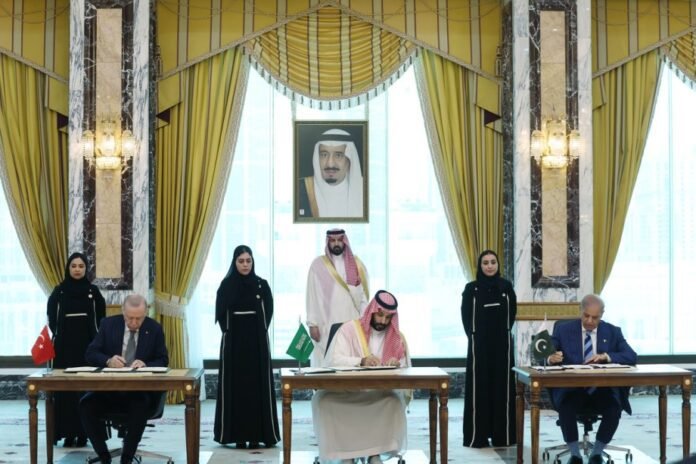
Saudi Arabia says Mecca Agreement with Turkiye, Pakistan ‘long-term’ deal to boost cooperation
Turkish President Recep Tayyip Erdogan (L), Saudi Crown Prince Mohammed bin Salman (C), and Pakistani Prime Minister Shehbaz Sharif (R) sign a trilateral defense agreement in Mecca, Saudi Arabia, on August 7, 2026. [TUR Presidency/ Murat Cetinmuhurdar – Anadolu Agency]
The Mecca agreement between Turkiye, Saudi Arabia and Pakistan is a “long-term” defense partnership that will boost cooperation, Saudi King Salman bin Abdulaziz Al Saud said Tuesday, Anadolu reports.
The deal will bolster efforts to address regional challenges and maintain security and stability, Salman told a Cabinet meeting in Jeddah, Saudi Press Agency (SPA) reported.
The trilateral summit that led to the deal “reaffirmed the deep-rooted historical ties among the three countries and their shared commitment to strengthening the bonds of brotherhood” while pursuing “common strategic interests.”
Türkiye, Saudi Arabia and Pakistan signed the defense agreement Friday at a trilateral summit in Mecca, pledging to strengthen collective security, deepen defense cooperation and promote peace and stability in the region and beyond.
A strange thing is happening in the used EV market. Supply is up thanks to an ever-increasing stream of ex-lease cars reaching the market, and yet prices have been going up as well. As a result of America’s latest war in the Middle East, used EVs have appreciated by just over 5 percent since February. Despite the stronger pricing, used EV sales have been strong this year—up 25 percent year on year by May, although a weaker June has brought overall sales up just over 20 percent year on year, according to the analysts at Cox Automotive.
Used EVs also hang around on dealer lots a lot less than new ones—the same analysts at Cox found just 38 days’ supply of used EVs in June, but 81 days for new EVs. And much of the demand is at the cheaper end of the spectrum, say the analysts at Recurrent. In previous installments of our used EV buyers’ guide, we’ve already looked at the most affordable used EVs, ending last time at $25,000—EVs that may now qualify for a $1,750 rebate if you’re in California. Today we’re looking at used EVs that cost between $25,000 and $30,000, and according to Autotrader’s search, there are more than 9,000 used EVs for sale in that price range.
Broadly, you can split the results into three buckets: Cars where you’ll find plenty to choose from; ones where there might be a couple of hundred for sale nationwide; and then the oddities where there might just be a handful to pick from.
Lots of choice
We are now several years down the road from the debut of several mass-market EVs from mainstream brands, and it’s not surprising that there’s the greatest choice among models that have been strong sellers. Chevrolet is well-represented, with about 750 Blazer EVs and another 550 Equinox EVs available in our price band. The smaller Equinox EV starts new at not that much more, so used ones should be low mileage and well-specced. Neither will have Apple CarPlay or Android Auto, which is a sticking point for a lot of you out there.
There’s a decent selection of Ford Mustang Mach-Es in this price range, too, with almost 700 to choose from around the country. At this price, you’ll find Mach-Es as recent as model year 2025, but I would be quite tempted by one of the 50 Mach-E GTs I found for sale. These will only be MY23 cars, and they are less efficient than other Mach-E variants, but they also ride much better thanks to magnetorheological dampers.
Although Hyundai’s ICCU reliability has commenters running from Korean EVs, the automaker recently extended the ICCU warranty to 15 years/180,000 miles, so we still feel comfortable recommending its E-GMP-based EVs, like the Ioniq 5 and Ioniq 6. There are more than 1,000 Ioniq 5s to pick from, the newest being MY25 cars. Kia’s EV6 shares the same platform, but you’ll only find half as many on used lots. Some prefer the styling of the Kia to the angular Ioniq 5.
Given Tesla’s enormous market share for EVs, it’s no surprise that you’ll find thousands of them for sale, used, in our price range.
You’ll have to look a bit harder
There are about the same number of used Nissan Ariyas as Volkswagen ID.4s—roughly 400 of each for sale used. The Nissan is an underappreciated option in my opinion, with a better interior than the VW. There are also a couple hundred Honda Prologues, which is essentially the Chevy Blazer EV but with Apple CarPlay. The closely related Toyota bZ4x and Subaru Solterra also show up in roughly the same volumes; these will be the older models with CCS1 charge ports and the less-efficient first-generation powertrains. And if you want something a little smaller, there are low-mileage Kia Niro EVs on offer too.
Sedan lovers should consider the Hyundai Ioniq 6 and Polestar 2. The former is wonderfully efficient and looks a lot better in person than two-dimensionally on a screen. The latter is now from an OEM that has exited the US market, which may well put some people off, but the cars can be serviced at Volvo dealers, so don’t be scared. At this price, we found a mix of older single-motor FWD cars, single-motor RWD cars (Polestar switched for MY24), plus twin-motor AWD versions. Or stick with Volvo itself. There are about three times as many C40 coupes available as the XC40 Recharge, but quite a lot of people prefer the looks of the fastback, so this is no bad thing.
Audi’s Q4 e-tron crossover is basically a more premium VW ID.4 and does little to stand out from the alternatives here. The same can’t be said for the BMW i4, which now starts appearing in my searches as we passed the $25,000 floor. For this money, we’re looking at the i4 eDrive35, which is the less-powerful RWD version. But it’s also the most efficient, and in my opinion, the single-motor i4s are much sweeter to drive than the AWD ones (although I’ve only driven the eDrive40, not the eDrive35).
How brave/mad do you feel today?
An Ioniq 5, Mach-E GT, or i4 would be my picks of the bunch so far, but here are some other alternatives we found. Some I mostly include as a warning—probably safer to avoid the few Vinfast VF8s and Jaguar I-Paces out there, as well as the handful of Jeep Wagoneer Ses that have depreciated to this price range. While I’d say the I-Pace was a fun-to-drive EV, our managing editor Eric Bangeman had no end of trouble with his and now drives a Mach-E instead. As for the Vinfast and Jeep, both are among the worst EVs I’ve driven to date. I wasn’t much of a fan of the Lexus RZ 450e, either (although it’s by no means as bad as the Jeep or Vinfast), a few of which you’ll find for less than $30,000.
Less common options that still come with a fancy badge include the Mercedes GLB crossover and the original Audi e-Tron if you want something German, or the Cadillac Lyriq and Acura ZDX if you want an EV made in America. The Acura and Caddy will be harder to find, with the latter being mostly high-mileage ex-livery cars.
You’ll also find some very nearly new Nissan Leafs and some Chevy Bolt EUVs; the Leafs include the current model that starts at under $30,000 (if you ignore the destination charge), and Chevy will sell you a new Bolt with an LFP battery pack from less than $30,000 new, so if that’s the model you’re looking for, you might be able to find either one brand new. For a small city car, the Mini Cooper SE is a hoot to drive, but limited in range.
And then there are the real rarities. I was surprised to find only three Genesis GV60s in this price range; it’s smaller than the related EV6 or Ioniq 5, but with a higher spec and better interior, and its smaller size means it works great in the city. A Ford F-150 Lightning Pro might be a possibility at under $30,000 if you’re patient and if you need a pickup and don’t mind a work spec. And similar patience may turn up a Kia EV9 if you need something voluminous for the school run. I have to say, I’d be very tempted by the BrightDrop delivery vans, several of which are now within our price range—start here if you want to build yourself an electric camper wagon.
For the really brave, you might even slip into one of the really fancy EV sedans. We found eight Mercedes-Benz EQSs, making it almost common compared to the single Lucid Air Grand Touring that showed up. Either of those is a lot of car for $30,000, but that goes double for the lone Audi e-Tron GT and the only Porsche Taycan (a 4S) that also appeared. They drive quite differently from each other despite sharing a platform; the Audi has a more usable interior with fewer touchscreens, and the Porsche has the better badge and keener handling. I mean, yes, plenty could go wrong with a $30,000 electric Porsche that has servicing bills belonging to a car that cost four times as much new. But I imagine it could be rather fun finding out.
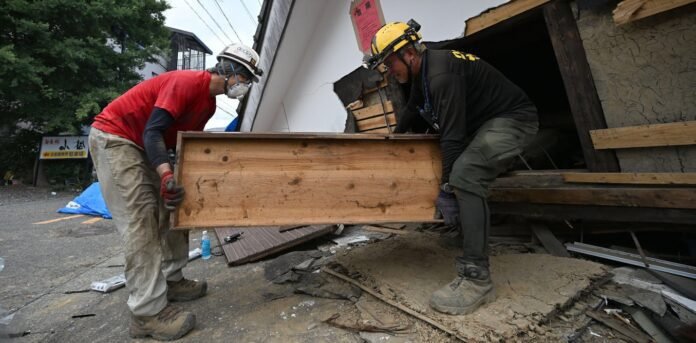
Extreme heat affects almost every aspect of an emergency response. For the close to 7,000 people in 130 evacuation shelters and in temporary accommodation across the Kumamoto region, on the southernmost of Japan’s four main islands, hot and humid conditions increase the risk of dehydration, heat exhaustion and heatstroke.
Older adults, infants and people with chronic illnesses are particularly susceptible. It is suspected that one older woman has already died of heatstroke while sheltering in her car.
Heat also makes it harder for people to sleep, especially when air conditioning is unavailable or electricity supplies have been interrupted. Poor sleep can worsen stress, impair decision-making and slow recovery following traumatic events. Emergency responders are similarly affected.
Rescue work, debris removal and infrastructure repairs are physically demanding activities. High temperatures reduce physical performance, increase fatigue and require more frequent rest breaks, potentially slowing recovery operations.
Temperatures in Kumamoto during and after the earthquake
Temperatures peaked in the high 30s a few days after the earthquake, but throughout July both maximum and minimum temperatures were well above the long-term average.Glenn McGregor
The effects extend beyond health. Damaged water infrastructure increases demand for drinking water precisely when supplies may be constrained. Electricity demand for cooling rises at the same time as power outages. Some medicines require refrigeration. Businesses face longer interruptions. Schools and community facilities may remain closed for longer. This creates a complex web of interacting risks.
Water supplies have been disrupted in some areas and electricity outages have limited access to cooling equipment, leaving evacuation centres very hot. These conditions create a second emergency that receives far less attention than the earthquake itself but can have profound consequences for public health and recovery. This is an example of what hazard scientists call a compound event.
Emergency workers are still battling to cope with the recovery.
The second emergency
Often natural hazards are thought of as isolated events, but they frequently interact with one another, so that their combined impacts are greater than the sum of each individually. Sometimes the interaction is between different weather extremes, such as heatwaves followed by drought or wildfire. In other cases, climate hazards combine with other geophysical hazards such as earthquakes.
The conditions in 2026 are very different to those when Kumamoto last experienced large earthquakes, in April 2016.
Comparison of temperatures: 2016 and 2026 earthquakes
Temperatures in 2016 (left) vs 2026 (right). Days in 2016 were warm, about 25°C, but in 2026 temperatures rarely fell that low, even at night.Glenn McGregor; data: Japan Meteorological Agency data
The 2016 Kumamoto earthquake caused widespread destruction. However, the April temperatures were relatively mild. The recent earthquake occurred during one of the hottest parts of the Japanese summer. Although rescue priorities remain the same, the environmental conditions are fundamentally different.
As the climate changes, the impact of any disaster will increasingly depend not only on the primary event but also on the climatic conditions in which it unfolds. The Kumamoto earthquake shows how extreme heat can become a powerful disaster risk multiplier. A similar lesson emerged after the catastrophic western Japan floods of 2018, when a record-breaking heatwave, subsequently shown by research to have been virtually impossible without human-induced climate change, compounded the disaster, increasing health risks and hampering recovery efforts.
Together, these events demonstrate how heatwaves following other disasters can amplify the consequences.
Planning ahead
The Kumamoto earthquake shows that disaster resilience is no longer just about building stronger infrastructure or improving earthquake-resistant design. It also means preparing communities for multiple interacting hazards.
As climate change increases the frequency and intensity of extreme heat, those planning for emergencies will have to factor this in.
The question is no longer simply how societies respond to earthquakes or heatwaves separately, but how they prepare for all of these circumstances.
As the world experiences more heatwaves, extreme temperatures will pose new challenges for disaster recovery during the hottest parts of the year.
Barron Trump Told to Cut Ties with ‘Friend’ Andrew Tate
Barron Trump is being dragged into a growing political firestorm over his reported relationship with controversial influencer Andrew Tate — and now critics are even turning their fury on his mother, First Lady Melania Trump.
The 20-year-old president’s son has not been accused of any wrongdoing. But his alleged communications with Tate have attracted fresh scrutiny after Democratic Rep. Yassamin Ansari called for Congress to investigate reported connections between the Tate brothers and members of the Trump family.
Now, a communications expert is warning Barron to carefully consider whether maintaining any relationship with Tate is worth the potential damage, while podcaster Jennifer Welch has launched an explosive attack on Melania over the controversy.
The drama erupted after Ansari urged House Oversight Committee Chairman James Comer to open an investigation into Andrew and Tristan Tate’s reported ties to people connected to President Donald Trump.
In her July 23 letter, Ansari reportedly asked lawmakers to examine Barron’s knowledge of the brothers’ legal troubles and whether he had any involvement in matters surrounding their cases.
She also cited reports alleging “direct, extensive communications” between Barron and Andrew Tate.
There is no allegation that Barron committed a crime or participated in any of the conduct at the center of the Tate cases.
Andrew and Tristan Tate are currently fighting extradition from the United States to Britain, where they face a combined 59 charges. The allegations include rape, assault, human trafficking and other sexual offenses. Both brothers deny wrongdoing.
As the controversy surrounding Barron grows, New York communications consultant Sam Gauchier said she does not believe the president’s son should make a dramatic public spectacle of ending any friendship.
“I don’t think Barron needs to put out a statement announcing the end of a friendship,” Gauchier told the Irish Star.
She argued that doing so could actually bring even more attention to Barron’s alleged relationship with Tate and feed the influencer’s ability to generate publicity through controversy.
But Gauchier said Barron could face a different problem if he continues publicly associating with Tate.
“If he continues speaking with Andrew, defending him, or appearing connected to his world, his silence will start to look like loyalty,” she said.
Gauchier said Barron should consider not only whether he personally believes Tate, but whether he is comfortable being publicly associated with what Tate represents.
The controversy became even more personal when podcaster Jennifer Welch turned her attention to Melania.
Appearing on The Don Lemon Show, Welch delivered a blistering attack on the first lady over Barron’s reported friendship with Tate.
“Melania Trump is this country’s worst mother,” Welch declared. “The biggest deadbeat mother in the United States of America is Melania Trump!”
Welch claimed Barron’s reported relationship with the Tate brothers represented “completely failed parenting.” Video and reports of Welch’s remarks circulated widely online following the appearance.
She then compared the situation to how she would react if her own children expressed admiration for Tate, saying she would ground them and take away their phones.
Welch saved her harshest criticism for Melania, questioning why she would allow her son to remain friendly with the controversial brothers.
Her comments were an attack on Melania’s parenting rather than evidence that the first lady approved of or facilitated Barron’s reported communications with Tate.
Meanwhile, the Tate brothers’ relationship with Trump-world figures has become increasingly political.
Tate attorney Joseph McBride previously claimed Andrew Tate played a role in motivating young men who helped Trump politically and warned Republicans could alienate those voters if they publicly abandoned him.
“Andrew Tate was a material participant in ensuring President Trump’s victory,” McBride told Vanity Fair.
McBride argued that some young voters could turn against Republicans in future elections if they believed the party had abandoned Tate.
The political debate comes as the Tate brothers remain locked in a far more serious legal battle.
They were arrested in Miami in July after British authorities sought their extradition, and U.S. prosecutors have argued they should remain in federal custody because they pose a flight risk. Their lawyers are fighting for their release while the extradition case moves forward.
For Barron, who has largely stayed out of the political spotlight despite being the president’s youngest son, the controversy now threatens to pull him deeper into the public eye — whether he wants the attention or not.
Tracking extreme heat by the hour makes climate change seem even worse
Global warming is leading to more extremely hot weather. There is perhaps no more obvious consequence of climate change. But changing how we analyze this problem can still help scientists think about it in a different way that may yield surprises.
Generally, studies on heat extremes work with some combination of daily minimum, maximum, and mean temperatures. Sometimes they focus on multi-day heatwaves using those metrics, since the discomfort and health impacts increase for longer events. There are different thresholds you can use to define extreme heat in these analyses, either based on past statistics or on the human body’s physiological limits.
A new study led by Weilin Liao and Xuanzong Zhang at Sun Yat-sen University tried breaking down heat extremes to the hourly level instead, which reveals some interesting nuances.
Hourly reports
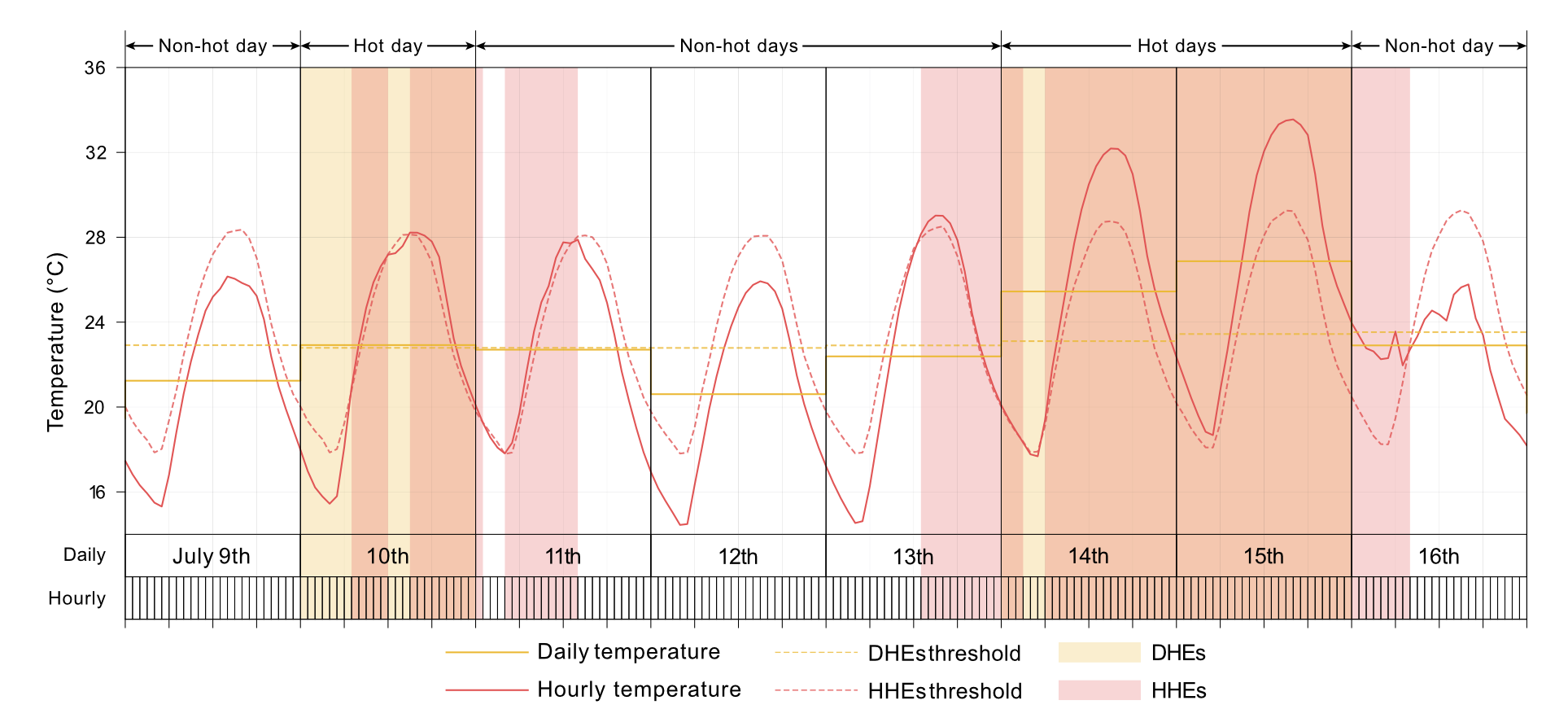
The researchers calculated each hour of the day separately, comparing 8 am temperatures only to other 8 am temperatures. They defined extreme heat as anything above the 90th percentile of recorded temperatures at that time of day between 1981 and 2010. To put this in context, the global average over the last four decades has been that people experience about 270 hours of “hourly heat extremes” each summer. But that average obscures a very obvious trend: that number has been increasing by 62 hours each decade.
An example to illustrate how hourly heat extremes (HHEs) differ from daily heat extremes (DHEs). The dashed thresholds set the definition of what’s extreme.
An example to illustrate how hourly heat extremes (HHEs) differ from daily heat extremes (DHEs). The dashed thresholds set the definition of what’s extreme. Credit: Liao, et al./Nature Climate Change
To project this into the future, the researchers used climate model results from two scenarios of future greenhouse gas emissions—one with medium emissions leading to 3°C (about 5.5°F) warming by 2100, and one with high emissions and 5°C (9°F) warming.
Comparing the past couple of decades to 2070–2099, the total number of hourly heat extremes triples in the medium scenario and increases by 4.5 times in the high scenario. For every half a degree C (almost 1°F) of global average temperature increase, the study shows an increase of about 200 hot hours per summer.
The trend is worst in the tropics, even though overall warming is stronger at higher latitudes. The researchers say this is because temperature variability increases in the tropics, making extremes more frequent.
Hot nights
The number of hot hours also increases more at night than it does during the day. This is where the hourly analysis can start to seem more relatable than metrics of temperature change or counts of days. Days that fail to qualify as “hot days” still see an increase of several hot hours—mostly at night. This wouldn’t show up if you just counted the number of hot days. And these shorter hot periods often precede or follow hot days, extending the stress a heatwave puts on your body.
Obviously, those hot days also see an increase in hot hours. Right now, the average hot day contains about 16 hot hours, but that increases to 19 hours in the medium scenario and 21 hours in the high scenario. So the miserable part of the day gets longer, reducing the hours that grant some relief.
The researchers also looked at differences in these trends for countries at different income levels and compared the lifetime total exposure to hot hours for people born in 1981 and 2023. Low-income countries see the strongest increase in hot hours. But even at the global average, those born in 2023 would experience about 1.4 to 1.8 times as many hot hours, depending on the greenhouse gas emissions scenario.
While the overall trend in hot weather is well known, the hourly details matter. They highlight that the number of hot hours is increasing even faster than the number of hot days, for example. But the details also help us better represent what this means for human health.
The researchers write, “As heat risks continue to intensify, hourly-scale assessments will become essential for anticipating health impacts, informing equitable adaptation strategies and designing responsive early warning systems that reflect the new reality of round-the-clock heat exposure.”
Talking to the dead: the high price of engaging Myanmar’s junta
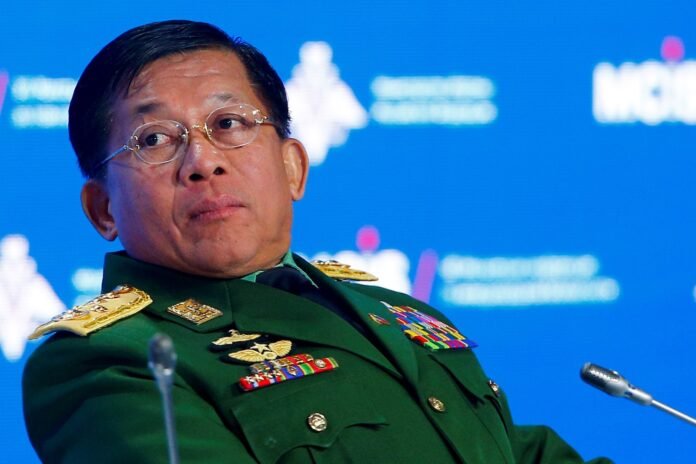
Neighbors are busy rehabilitating the diplomatic standing of Myanmar’s junta-chief-turned-president Min Aung Hlaing just as his regime openly shreds the regional bloc’s peace plan.
Min Aung Hlaing may have traded his general’s uniform for civilian clothes and a practiced smile on his recent diplomatic tours, but Myanmar’s military leadership remains entirely unchanged. Its latest message to the Association of Southeast Asian Nations (ASEAN) has stripped away whatever civilian disguise remained.
By dismissing the need for a future ASEAN special envoy, rejecting renewed pressure for the release of detained civilian leader Aung San Suu Kyi and warning against external “interference,” the military-backed government is signaling that it believes it can dictate the terms of its regional relationships. This defiance comes after five years of ignoring ASEAN’s Five-Point Consensus Min Aung Hlaing himself agreed to.
ASEAN had just reiterated that its envoy should meet all parties, including Suu Kyi, and again called for her unconditional release. Naypyitaw’s answer was essentially: we no longer need your mediation, and we will handle Myanmar’s crisis on our own terms. Only days earlier, Min Aung Hlaing was smiling for cameras in Bangkok.
The Thai-Myanmar joint statement went further, pledging Thai support for Myanmar’s “full and equal participation” in ASEAN mechanisms, while Naypyitaw thanked Bangkok for “facilitating the normalization” of its relations with the bloc.
These governments may call their approach pragmatism or “calibrated re-engagement.” But from Naypyitaw, the lesson looks completely different: Min Aung Hlaing can brush aside ASEAN’s demands and continue a brutal civil war at home while still receiving handshakes, honors and diplomatic standing from neighboring capitals.
While regional diplomats arranged those handshakes, Myanmar’s air force was doing much of the talking at home.
According to the independent conflict monitor ACLED, state repression and aerial bombings intensified after the military command was reshuffled in March, just before a pro-military parliament installed Min Aung Hlaing as civilian president in April after sham elections in December and January.
The political makeover did not reduce the violence. In the first half of 2026, the military perpetrated more than a dozen mass killings that left over 450 civilians dead, according to ACLED’s data.
For people living under those aircraft, regional normalization is measured not in communiqués and business forums, but in bodies, burned homes and displacement.
Bilateral escape route
This defiance did not emerge in a diplomatic vacuum. It has been encouraged by creeping normalization.
Min Aung Hlaing’s diplomatic offensive is doing more than restoring his personal standing; it is giving Naypyitaw an escape route around ASEAN. If China, India, and individual ASEAN members deal with his government bilaterally, he has far less incentive to meet ASEAN’s collective conditions.
He can gain diplomatic standing, investment and security cooperation from individual capitals, while rejecting the political obligations demanded by the bloc. Every bilateral red carpet makes ASEAN’s collective leverage a little cheaper to ignore.
The Five-Point Consensus, however ineffective, remains ASEAN’s agreed regional framework for the Myanmar crisis. If the consequential dealings with Naypyitaw increasingly take place outside of those collective conditions, ASEAN centrality becomes purely ceremonial.
The generals’ treatment of Suu Kyi shows exactly how this hostage diplomacy works. On August 3, before Min Aung Hlaing’s visit to Thailand, authorities allowed an International Committee of the Red Cross representative to meet her. ASEAN welcomed the meeting.
But within days, Naypyitaw slammed the door, rejecting the bloc’s demand for her unconditional release.
Illusion of effective control
There is, of course, a transactional case for engagement. Thailand needs cooperation on energy, labor, trade and cross-border crime. China wants relative stability around the China-Myanmar Economic Corridor. India wants border security and critical minerals. None can simply pretend Naypyitaw does not exist.
Crucially, however, Min Aung Hlaing cannot guarantee the very things his neighbors want. Myanmar’s borderlands remain fragmented; Chinese infrastructure routes cross contested territory; strategic rare-earth deposits lie in Kachin areas outside regime control. A presidential handshake in Bangkok cannot manufacture effective authority on the ground.
That is why ASEAN’s exclusion of Myanmar’s political leadership from top-level meetings still matters. The Five-Point Consensus has failed to stop the war, but failure is not an argument for surrendering the little leverage ASEAN still possesses over Myanmar.
Engagement only matters when it produces something measurable, not when the meeting itself is framed as the achievement. The bloc should demand measurable steps now: an end to attacks on civilians, the release of political prisoners, genuine humanitarian access and serious and sincere initiatives for dialogue with the opposition and ethnic armed organizations that control large parts of the country.
Now, nearly two decades later, Min Aung Hlaing has replaced his uniform with a suit and added “President” to his title. Yet the old habit statesman Lee identified remains: take what outsiders offer, concede as little as possible and wait for the pressure to fade.
The lesson to learn for ASEAN is that talking does not require surrendering leverage. For five years, ASEAN has rightly kept Myanmar’s political leadership out of its highest-level meetings.
That exclusion has carried a message that communiqués could not: Myanmar remains an ASEAN member, but membership does not automatically entitle Min Aung Hlaing to a seat at the leaders’ table. That seat is one of the few bargaining chips ASEAN has left.
The critical issue now is whether bilateral rehabilitation will allow Min Aung Hlaing to bypass ASEAN’s collective conditions and secure the leadership seat he still clearly craves. If ASEAN restores political-level participation without securing meaningful concessions, the bloc will have paid in legitimacy for the privilege of talking to the dead.
Nyein Chan Aye is a Washington-based Burmese journalist who previously worked for the BBC and Voice of America and writes on Myanmar, China, the US and regional affairs.
Ukraine, Saudi Arabia Deepen Defense Cooperation With Counter-Drone Deal
Ukraine and Saudi Arabia signed a defense cooperation agreement centered on counter-drone technology, combining Kyiv’s battlefield experience against Iranian-designed drones with plans for joint production, technology development and investment.
The agreement provides for Ukraine to share operational knowledge acquired from years of confronting aerial attacks, including methods used to detect and destroy low-cost attack drones such as the Shahed.
Ukraine and Saudi Arabia are set to establish joint production lines and develop drone interceptors, while creating opportunities for technological investment, according to the framework. Kyiv is seeking broader cooperation on air defenses and missile assistance from partners in the Middle East.
Ukrainian President Volodymyr Zelenskyy and Saudi Crown Prince Mohammed bin Salman discussed the agreement and its next stages during high-level talks, along with global food security.
“There are domains in which Ukraine and Saudi Arabia can strengthen each other’s ability to protect lives and people,” Zelenskyy wrote on X following their conversation.
Zelenskyy said the leaders addressed measures expected to be taken in the near future as part of what he called the “Drone Deal” between the two countries.
The Ukrainian president later said officials from his government were already working in the region on expanding cooperation.
Speaking in his nightly video address, Zelenskyy said the Ukrainian team was in the region “and there are already areas in which our relations are developing well. I am counting on reciprocity in our mutual support.”
The talks also covered coordination between Ukraine and Saudi Arabia on food security, which Zelenskyy described as a “global need.”



![Turkish President Recep Tayyip Erdogan (L), Saudi Crown Prince Mohammed bin Salman (C), and Pakistani Prime Minister Shehbaz Sharif (R) sign a trilateral defense agreement in Mecca, Saudi Arabia, on August 7, 2026. [TUR Presidency/ Murat Cetinmuhurdar - Anadolu Agency]](https://i0.wp.com/www.middleeastmonitor.com/wp-content/uploads/2026/08/AA-20260807-42161786-42161781-TURKIYE_SAUDI_ARABIA_AND_PAKISTAN_SIGN_TRILATERAL_DEFENSE_PACT-1-1.jpg?fit=920%2C613&ssl=1)