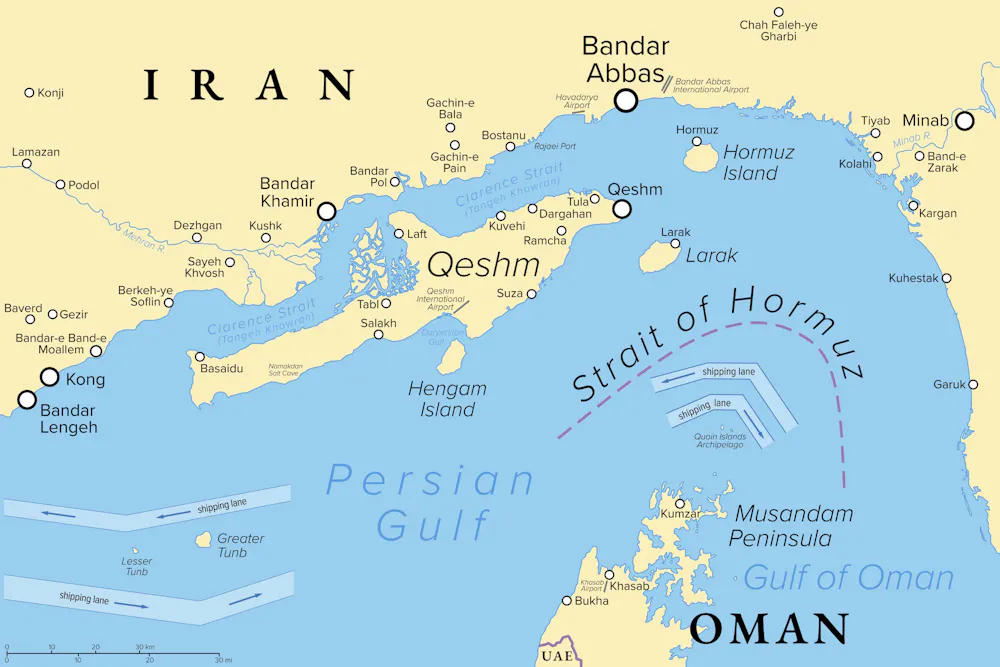
Oil slicks moving along Iran’s southern coast have reached the Hara mangrove forests of Qeshm Island. Iranian authorities say the extent of the contamination is still being assessed and the source of the oil pollution has not yet been established. But several oil spills have been detected in the region since the war between the US and Iran began.
The Hara forests lie in the Khuran Strait, which separates Qeshm Island from mainland Iran. This waterway is close to the Strait of Hormuz – one of the most strategically important marine corridors on Earth. The Strait of Hormuz is normally discussed through the vocabulary of geopolitics: barrels of oil, shipping lanes, energy prices and global trade.
But beneath that geopolitical map lies another map that receives far less attention. The Strait of Hormuz and its surrounding waters are home to mangroves, coral reefs, seagrass beds, fisheries and coastal communities. They also provide the seawater upon which some of the world’s most water-stressed societies depend.
The Strait of Hormuz is not only an energy chokepoint. It is an ecological chokepoint. And prolonged conflict exposes both at the same time.
An oil slick on open water is a serious pollution event. But oil entering a mangrove ecosystem creates a different problem. Mangroves occupy the boundary between land and sea, with dense root systems that slow water movement and trap sediments.
The same characteristics that make these ecosystems extraordinarily productive also make them effective traps for pollutants.
While oil can be removed from the water surface, oil that penetrates shorelines and fine sediments can be much more difficult to address. Contamination can affect roots and seedlings and expose organisms living in or feeding on these sediments to pollution. Fish and birds can be affected through ecological pathways extending beyond the visibly contaminated trees.
Qeshm should also not be viewed in isolation. Earlier in the war, another oil slick near Kharg Island in the northern Persian Gulf was tracked. Satellite imagery indicated that currents were carrying contamination through the Khuran Strait towards the mangroves.
Researchers using satellite observations have also reported a marked increase in the frequency and extent of oil pollution in the Gulf since the beginning of the war. This is where the environmental significance of prolonged conflict becomes much larger than any individual spill.
What needs to happen now
The first priority in Qeshm must be containment. Preventing additional oil from entering the mangroves is far more effective than attempting to remove it once it has penetrated a complex inter-tidal environment.
However, containment alone is insufficient. Authorities need to establish the source and chemical characteristics of the contamination, map its spatial extent, combine field observations with satellite monitoring and sample water and sediments.
They will also need to establish baseline conditions in affected and unaffected areas and monitor mangrove condition, aquatic organisms and other ecological indicators over time.
Such efforts may themselves be constrained by the war. Conflict can make scientists, environmental agencies and emergency-response teams less able to reach the places where intervention is most urgently needed.
The response must also avoid causing additional damage. Following the 1989 Exxon Valdez oil spill off the coast of Alaska, high-pressure hot-water washing removed stranded oil but also caused substantial additional damage to shoreline organisms and habitats.
In mangroves, where roots and sediments are particularly sensitive to physical disturbance, similarly aggressive interventions can do more harm than good. Most importantly, monitoring of the Hara mangrove forests cannot stop when the coastline looks clean.
There is a temptation during war to treat environmental damage as secondary: something to assess after questions of military strategy, diplomacy, energy supply and economic loss have been addressed. That hierarchy is difficult to defend.
Environmental systems are infrastructure. Mangroves protect coastlines and sustain marine ecosystems. Fisheries support livelihoods and food security. Soils support agriculture. Aquifers store water and coastal waters feed desalination plants.
Healthy ecosystems provide forms of resilience that become more – not less – important during periods of political and economic instability. Destroying or degrading them thus creates liabilities that can persist long after military operations have ended.
And unlike a bridge, pipeline or building, an ecosystem cannot necessarily be reconstructed. A mature mangrove forest is the product of biological processes that unfold over time. Lost ecological functions may take years to recover, and some changes may prove difficult to reverse.
This is why what is happening at Qeshm deserves attention well beyond Iran. The question is not whether this particular oil contamination represents an ecological catastrophe. We do not yet have the evidence to make that judgment. The more important question is what the event is telling us.
It is telling us that in a region where enormous volumes of hydrocarbons, dense maritime traffic, critical water infrastructure and fragile coastal ecosystems occupy the same narrow geography, environmental risk cannot be separated from geopolitical risk.
If the Iran conflict continues, the probability of further accidents, infrastructure damage, pollution and interrupted environmental management will increase. Some consequences, such as burning vessels, blackened coastlines or dead vegetation, will be immediately visible.
But others will accumulate quietly – in sediments, soils, groundwater, food webs and stressed ecosystems. It is these consequences that may ultimately prove harder to repair. While all wars eventually end, their environmental consequences do not necessarily follow the same timetable.
Iraq Sets Sept. 30 Deadline for US Withdrawal, Disarmament of Armed Groups
Iraqi Prime Minister Ali al-Zaidi said the US-led military coalition must complete its withdrawal from Iraq by Sept. 30, while his government is pressing non-state armed groups to surrender their weapons to state authorities by the same deadline.
Al-Zaidi reaffirmed the withdrawal timetable Wednesday after meeting with Adm. Brad Cooper, commander of US Central Command, saying he had confirmed Sept. 30 as the “fixed and final date for ending the military mission of the Global Coalition to Defeat Daesh (Islamic State) in Iraq and completing the departure of its forces.”
A US official said Washington expects to complete the withdrawal of its remaining forces by the deadline. The official did not disclose how many US troops remain in Iraq or where they would be redeployed.
“The United States, Iraq, and coalition partners have achieved tremendous success in defeating Daesh, and now the Iraqi security forces, including the Peshmerga and other Iraqi Kurdistan Region security forces, will lead the fight against terrorists in Iraq,” the official said.
US troops withdrew from bases across most of Iraq last year but remained in the semi-autonomous northern Kurdish region. Two Iraqi Kurdish officials, speaking on condition of anonymity because they were not authorized to comment publicly, said US personnel and military equipment began leaving Irbil about three weeks ago.
Washington and Baghdad agreed in 2024 to wind down US-led operations against the Islamic State (ISIS). About 2,500 US troops had remained in Iraq to train Iraqi forces and conduct counter-ISIS operations after coalition military operations ended in 2021.
The US military presence in Iraq exceeded 170,000 troops at the height of counterinsurgency operations in 2007. The final combat troops left in December 2011, but U.S. forces returned at the Iraqi government’s invitation in 2014 after Daesh seized large areas of Iraq and Syria.
Al-Zaidi has also set Sept. 30 as the deadline for armed groups outside state control to disarm, arguing that the departure of foreign forces will remove their justification for retaining weapons.
Some factions have entered discussions or taken steps toward integration, but powerful Iran-backed militias have resisted disarmament and said they have no intention of surrendering their weapons. The government has framed Oct. 1 as the beginning of a new phase in which Iraqi security forces assume exclusive responsibility for national defense.
Ted Danson Reveals Dark Truth About His Life After ‘Cheers’
Ted Danson may have been one of television’s biggest stars when Cheers ended, but behind the scenes, his personal life was falling apart.
The 78-year-old actor, who became a household name playing womanizing bartender Sam Malone on the hit NBC sitcom, has admitted that by the time Cheers wrapped its 11-season run in 1993, he felt so lost that he barely recognized his own life.
Danson said the turmoil surrounding his marriage, divorce and highly publicized romance with Whoopi Goldberg left him emotionally overwhelmed at what should have been one of the biggest moments of his career.
“People say, ‘What was it like? What did you do when she was over?’” Danson recalled of the end of Cheers. “I said, ‘I had f—d up my life so much that I didn’t even realize Cheers was over.’”
For Danson, the end of the beloved sitcom came during an especially chaotic period.
His relationship with Goldberg reportedly contributed to the collapse of his second marriage to producer Casey Coates. The pair divorced in 1993, with the costly split reportedly setting Danson back around $30 million.
Looking back, Danson said he knew something had to change.
“I wanted to stop being a liar,” he said. “I wanted to be emotionally mature. I wanted to change.”
His relationship with Goldberg also led to one of the most controversial moments of his career.
In October 1993, Danson appeared in blackface during a Friars Club roast honoring Goldberg, sparking widespread outrage.
Decades later, the actor said he still feels the need to apologize for the stunt.
“I need to and want to apologize for the rest of my life because somebody today can go on the internet” and see it, he said.
After Cheers, Danson began rebuilding both his personal life and his career.
He said he took what he described as a “postgrad grown-up class” with an “amazing” mentor and began confronting the behavior that had left him feeling as though his life was built on dishonesty.
At the same time, Danson decided he needed to take more risks professionally instead of forever being known as Sam Malone.
“If I don’t leave now, I may not know if I could do anything else,” he recalled thinking. “And I want to see if I can do any other stuff.”
That gamble paid off.
Danson went on to star in a string of successful television shows, including Becker, Curb Your Enthusiasm, CSI: Crime Scene Investigation and The Good Place.
He currently stars in Netflix’s A Man on the Inside and has been married to actress Mary Steenburgen for more than 30 years.
By 2024, Danson had reportedly appeared as a regular on 12 television series, giving him one of the most unusually long and consistent careers in Hollywood.
And after surviving decades of personal and professional ups and downs, Danson said even a recent health scare has changed the way he looks at life.
He said he is now “fine,” but added that the experience may have ultimately been a wake-up call.
“I think it was the best thing that could have happened to me,” Danson said, “and I’m doing some things differently.”
Anthropic could be worth $2 trillion when it goes public
Anthropic investors expect the AI startup to float at a valuation of $2 trillion or more in October, a dizzying figure that would eclipse SpaceX and make the AI lab’s debut the largest-ever initial public offering.
Half a dozen of the company’s backers told the FT that Anthropic’s rapidly rising revenue would enable it to more than double its current valuation in a planned autumn float.
A listing at that level could unlock billions of dollars in gains for the five-year-old company’s early investors but would also test public markets that are growing more nervous about the AI boom.
Anthropic’s backers say booming demand for the lab’s advanced AI models and tools justifies their lofty expectations. Investors expect the Claude maker’s annualized revenue to be between $100 billion and $120 billion by the end of 2026—using the startup’s preferred measure, which infers full-year sales from recent performance—up by more than 10 times over the course of 2026.
“If Anthropic is growing 800 percent a year, you’d think at the incredibly low end they would trade at 30 times [revenue],” said one investor in the group. “That would make them a $3 trillion company.”
Anthropic lacks a publicly listed US peer that would provide a benchmark for its valuation. But companies that are seen as AI beneficiaries, such as data intelligence group Palantir and cloud company Nebius, have traded this year at roughly 55 times revenue.
Several investors said senior Anthropic executives had yet to fix the valuation target for the IPO, even in private conversations. But investors have built their own financial models.
Their bullish projections come despite mounting challenges, including rising competition from Chinese rivals, pressure for AI regulation, and a simmering feud with the US government.
Those concerns, particularly the Commerce Department’s temporary ban on Anthropic’s best models, contributed to overall revenue growth slowing in the month of June, according to two investors with knowledge of the matter. Even so, they said the company had rebounded and continued to grow at an extraordinary rate even by Silicon Valley standards.
Anthropic declined to comment.
The startup led by Dario Amodei filed paperwork with the Securities and Exchange Commission in June, putting the company in a quiet period that limits public announcements about its financial performance.
Anthropic has gained ground on rivals OpenAI and Google this year, releasing models that have outperformed competitors while focusing on sales to business customers. The group announced in May that its annualized revenue had surpassed $47 billion.
Venture capitalists, sovereign wealth funds, and other institutional investors have poured just under $100 billion into the company in 2026. Anthropic’s valuation leapfrogged OpenAI’s for the first time in May, reaching $965 billion, including the new investment.
But the group also faces considerable uncertainty. It has repeatedly clashed with the Trump administration and remains in active litigation against the US Department of Defense, which labeled Anthropic a supply-chain risk earlier this year.
Anthropic has since been forced to briefly pull its leading models, Fable 5 and Mythos 5, after being hit with export controls by the Commerce Department in June. The episode spooked some customers who rely on Anthropic models.
Customers are also increasingly sensitive to the price of accessing the best models. Faced with spiraling costs, they have, in some cases, reversed directives for employees to maximize their AI use and opted for less powerful, cheaper models.
Anthropic’s market-leading model costs more than two and a half times as much to use as OpenAI’s flagship, while Chinese open-weight alternatives, which have also improved dramatically this year, are a fraction of the cost, according to Artificial Analysis, which analyzes AI models.
Anthropic increased its market share among US businesses last month, according to data from payments group Ramp. But analysts at the company found that businesses were “hitting their limit on AI spend” and turning to cheaper alternatives.
“It’s easy to come up with challenges,” said an Anthropic investor who has also backed AI groups including OpenAI and SpaceX, which went public at a $1.77 trillion valuation in June. “But the company continues to be in first position in performance, positioning, and what people want exposure to.”
Additional reporting by Zijing Wu and Ivan Levingston.
Trump says press secretary Leavitt to leave job at month’s end
White House press secretary Karoline Leavitt will leave her role at the end of the month, U.S. President Donald Trump said on Wednesday, leaving the president without one of his most trusted advisers ahead of November’s midterm elections.
Leavitt will be an outside communications adviser and party operative shaping the future contours of Trump’s “Make America Great Again” movement, she and Trump said in statements.
In a social media post, Leavitt, 28, said she aimed to spend more time with her young children. She gave birth to a daughter, her second child, in May and recently returned from maternity leave.
“Karoline has been a real leader in the White House, and has done a phenomenal job fighting for Justice, Liberty, and Freedom, since 2018, including our Historic Re-Election Campaign of 2024,” Trump said in a social media post, calling Leavitt “one of the best White House Press Secretaries in the History of the Office.”
Leavitt called her role at the White House “the honor and adventure of a lifetime.”
YOUNGEST WHITE HOUSE PRESS SECRETARY
Leavitt joined Trump’s 2024 campaign and served as transition spokeswoman before Trump selected her to be White House press secretary. She was the youngest person to be appointed to the role.
“Few could or will ever compare to Karoline,” said Harrison Fields, Trump’s former principal deputy press secretary. “She’s someone who not only spoke Trump fluently, she knew how to feed the media beast in a cunning, audacious, and successful way that, most importantly, played to her audience: the president.”
In her year and a half on the job, Leavitt and White House communications director Steven Cheung transformed the administration’s posture toward the media — in ways that some of Trump’s allies cheered and free press advocates criticized.
The Trump administration began handpicking which journalists receive access to the president, jettisoning the long-running system set up by the independent White House Correspondents Association. The “press pool” was traditionally a rotation chosen by the industry group to ensure media outlets had uniform access to the president and could relay his activities to the public and to other journalists who could not attend smaller gatherings.
As part of that process, the Trump administration press office created a special “new media” seat in the briefing room that gave podcasts, newsletters and fledgling digital outlets a more prominent role in covering the presidency. Some press advocates hailed the move as a recognition of the changing media landscape. Others criticized it as a lever the administration could use to reward outlets whose coverage it saw as favorable.
Leavitt leaves the White House as administration officials face reports from the Washington Post this week that Trump used a plane carrying cabinet officials, staff and journalists as a decoy when departing a NATO summit in Turkey in July.
The Secret Service clandestinely moved the president from one jet to another in the back of a catering truck, the newspaper reported, as Trump faced a potential Iranian assassination threat.
Journalists and staffers on the original jet were unaware of Trump’s movements, a significant departure from precedent.
UK media proposals raise fears over suppression of independent Palestine reporting
A new campaign is urging the British public to oppose government proposals that could give selected news organisations greater prominence on social media, warning that the measures risk pushing independent media further down users’ feeds.
NewsCord founder Nima Akram has launched the Say No to Media Censorship campaign in response to the government’s Green Paper on the future of British media.
“The government wants platforms to push state-approved news and bury the rest,” the campaign warns. It is encouraging members of the public to send formal responses to the Department for Culture, Media and Sport (DCMS) before its consultation closes on 31 August.
The campaign page allows users send a response to the consultation. NewsCord says the submissions are formal responses that DCMS must record.
The government published its Green Paper, Watch this space: a new strategic direction for UK media, in June. It proposes requiring social media companies and video-sharing platforms to make news from public service media, including the BBC, ITV, Channel 4 and other providers regarded as trustworthy, more prominent and easier to find.
Under the proposals, selected news providers could appear more prominently when users search for news or in content presented to them on social media platforms. The government argues that the changes could help combat misinformation and ensure what it considers reliable journalism continues to reach audiences as more people get their news online.
The consultation does not propose banning independent publishers. However, critics are concerned about who decides which organisations qualify as “trustworthy” and what happens to outlets that fall outside that category.
Read: Over 600 media figures urge BBC to air shelved Gaza medics documentary
The government has suggested that the definition of a “recognised news publisher” in the Online Safety Act could provide a starting point for deciding which organisations benefit from greater prominence, although no final criteria have been agreed.
The Independent Media Association (IMA) has warned that the proposal could disadvantage independent, regulated publishers. “We are disappointed that the green paper does not adequately address the needs of independent, regulated non-broadcast media” the IMA said.
“Our principal concern is the paper’s suggestion that the Online Safety Act’s definition of a recognised news publisher could serve as the starting point for determining which publishers benefit from prominence. That definition was designed for a different purpose and was never intended to distinguish genuinely trustworthy public-interest journalism from other news publishers. It requires publishers to have a standards code and complaints process, but not that those standards be independently enforced”.
The proposal comes as independent and alternative media have played a prominent role in challenging official British and Israeli narratives on Palestine, particularly since Israel launched its assault on Gaza in October 2023.
Independent outlets have regularly reported on Palestinian casualties, Israeli war crimes, Britain’s arms relationship with Israel, lobbying and the treatment of pro-Palestine activists, often giving greater prominence to issues and Palestinian voices that critics say receive less attention in mainstream coverage.
At the same time, major British news organisations, including the BBC, have faced sustained accusations of pro-Israel bias in their reporting on Gaza.
A 2024 report examined by MEMO found major disparities in British media coverage of Israel’s assault, including what researchers described as the dehumanisation of Palestinians, greater questioning of Palestinian casualty figures and a tendency to accept Israeli claims with less scrutiny.
The BBC has faced its own controversies over Palestine coverage. In March, a British court heard allegations that the broadcaster had imposed “legal and editorial restrictions” on journalists covering Israel’s war on Gaza and had misled audiences through some of its reporting. The BBC contested the claims.
The broadcaster also faced criticism after declining to air Gaza: Medics Under Fire. More than 600 media figures signed a letter in 2025 urging the BBC to broadcast the documentary, which examines attacks on Palestinian healthcare workers and hospitals.
BBC Arab journalists have also previously complained of an atmosphere in which criticism of Israel was subjected to heightened scrutiny. MEMO reported in 2024 that journalists at the corporation had raised concerns about investigations and disciplinary action over alleged anti-Semitism, with one source describing an “atmosphere of fear” surrounding criticism of Israel.
Critics of the Green Paper fear that giving major broadcasters greater prominence could have consequences on the coverage of Palestine. They see the proposal as another potential means of suppressing information and analysis that challenges the dominant political and media narrative on Israel.
Rivian’s 2027 changes include its No. 1 most-requested feature
It’s time for Rivian’s changeover from model year 2026 to 2027, and the electric vehicle startup has decided to take a page from its recently released R2 SUV and apply it to the company’s larger, more expensive R1 line. The changes aren’t massive—the R1 got a refresh back in 2024 that saw the R1S SUV and R1T pickup each get some comprehensive re-engineering with new powertrain options, a new electronic architecture, and new batteries.
But among them is the No. 1 most-requested feature by Rivian R1S customers, the automaker told Ars: captain’s chairs for the second row. The six-seat interior is an alternative to a middle bench, and the Rivian captain’s chair looks thoughtfully designed, with a hidden cupholder that I’m not sure I’ve seen on any other SUV before. The chairs are also spaced so it’s easy to get to the third row, or use that volume between them for skis or snowboards or surfboards.
Rivian has also changed the trims, bringing them into line with the offer structure on the recently released R2. Instead of choosing from Dual, Tri, or R1s, Rivian is now calling them Premium and Performance; Quad stays Quad. But the base price for each stays the same: The R1T still starts at $79,990 and the R1S at $83,990.
But the technical specs haven’t changed. Premium R1s still have the same 329 mile (530 km) range, with a larger battery as an option that increases range to 410 miles (660 km) for the R1S and 420 miles (675 miles) for the R1T. Power is still 533 hp (397 kW), upgradable to 655 hp (488 kW). And you still have a choice of the same two interiors (now named Black Mountain and Ocean Coast), although only the black one can be specified with the middle bench seat. Captain’s chairs add $1,500 on top of the required $2,500 Sound+Vision package, or $4,500 if you want the Ocean Coast interior (which also includes the Sound+Vision package).
Rivian
Rivian
The integrated cupholder hides when not in use.
Rivian
The integrated cupholder hides when not in use. Rivian
Yes, the seats fold flat.
Rivian
Yes, the seats fold flat. Rivian
The integrated cupholder hides when not in use. Rivian
Yes, the seats fold flat. Rivian
The Performance R1s feature Rivian’s tri-motor powertrain, still with 850 hp (634 kW) and a range of 371 miles (597 km). And the R1 Quads keep their name together with the same powertrain specs. There are still three interior trim options with the new names: Black Mountain, Ocean Coast, and Slate Sky. Here, the bench seat is only available with the black interior, with black captain’s chairs adding $1,500. The other two interiors are only available in the six-seat configuration; Ocean Coast will cost $4,000, and Sky Slate will cost $4,500.
Additionally, there’s a new Esker silver paint that replaces the old LA Silver Rivian previously offered, and a new 20-inch all-season tire and wheel for the R1T that better balances on- and off-road performance.
That one sentence names a problem that plays out after every major fire.
When a wildfire reaches historic masonry buildings – stone, brick and block structures that have stood for centuries – the first photographs tell a simple story: Everything is black and looks ruined. But masonry conducts heat so poorly that the damage is often only centimeters deep.
Fire damaged the Church of São Domingos in Lisbon in 1959. The outer surface shows black soot and white calcination, but where the plaster has spalled or cracked, the undamaged brick is visible beneath.Tiago Miguel Ferreira
Timber roofs, wood floors and interior framing in historic buildings are extremely vulnerable to fire and can let fire jump building to building, but the load-bearing masonry shell often survives. Preserving even a part of the original structure can dramatically reduce reconstruction costs and retain the historic fabric that gives these places their identity.
But to save these buildings, people have to act quickly.
A masonry wall that has lost its timber roof or floors is now unbraced. Wind alone might bring it down. The stone itself can also start to deteriorate. When limestone is heated to about 1,380 degrees Fahrenheit (750 degrees Celsius), the calcium carbonate, which makes up most of the rock, decomposes, leaving solid calcium oxide and carbon dioxide gas. If rain reaches that surface before it is covered, the calcium oxide can react with the water and expand by as much as 20%, enough to crack the stone from within.
Masonry conducts heat poorly. In a thick wall exposed to a wildfire, the exposed surface heats up while the cooler interior remains relatively unchanged.
These thermal gradients generate stresses that may crack or spall – chip or flake off – the outer surface, but the heat often does not penetrate deeply enough to compromise the structural core. Research on fire-exposed sandstone structures found a sharp boundary between the heated, red-colored surface and the unaltered stone behind it, with the damaged crust only about an inch (2 to 3 centimeters) deep.
The Nevera de Castro, a historic stone snow well used to store snow and pack it into ice for villages in the Serra d’Espadà, Castellón, photographed before the fire. The masonry dome and castle ruins on the ridge behind it are now surrounded by charred landscape.Jrpuig/Wikimedia Commons, CC BY-SA
The 650-year-old wall did exactly what a thick, noncombustible wall should do.
Clay brick is especially resilient because it was already fired at 1,650 to 1,800 F (900 to 1,000 C) when it was made. A 2025 study tested structural clay units reheated to 1,800 F and found no statistically significant loss of compressive strength – its ability to hold weight.
The weak link is the mortar between the bricks, not the bricks themselves. Industry fire-rating tables show that a solid brick wall only about 150 millimeters thick can withstand four hours of standard fire exposure. Many historic masonry walls are two to four times that thick.
Evaluating a burned building starts with color. When concrete or stone turns pink or red, it signals that the stone has been exposed to temperatures above roughly 570 F (300 C) and iron in the material is effectively rusting in the heat. That is the threshold where it begin to lose significant strength. Gray or white means the stone got even hotter, water is cooking out and the material is turning to ash.
But color is only a surface clue.
The colors of fire damage are visible on the Church of São Domingos in Lisbon, 67 years after a fire. The vault shows the pink-red tones that signal temperatures above 570 F (300 C). The columns are blackened by soot. Where the outer surface has spalled or chipped away, the undamaged masonry is visible beneath.Tiago Miguel Ferreira
The critical question is how deep the damage goes. Fire damage in a thick wall is almost always one-sided. When researchers tested concrete masonry walls with fire on one face, those walls retained roughly 46% of their compressive strength, enough that they can be stabilized and repaired. When the same walls had fire on both faces, their compressive strength dropped to 14% to 27% of the original.
Engineers can estimate the depth of the damage using methods such as petrographic analysis – cutting thin sections from the wall and examining the microcracking under a microscope.
After the Notre Dame Cathedral fire in Paris in 2019, researchers drilled cores through the limestone vaults and mapped exactly where the heat stopped. The fire was catastrophic, but the heat stopped short of the full depth, even in vaults – the arched stone ceilings of the cathedral – only about 5 to 6 inches (12 to 15 centimeters) thick.
Unlike the prolonged heat associated with many structure fires, a wildfire front can pass a building within minutes. Even when flames are intense, the relatively short duration of exposure gives heat little time to penetrate thick masonry walls, assuming interior materials don’t catch fire and continue burning from within.
The outer surface may crack or spall as it expands under rapid heating, while the interior remains comparatively cool, preserving the mechanical properties of the masonry.
The clock is ticking for recovery
The clock is already ticking by the time an assessment can be conducted to determine whether a building can be saved.
The first step to saving it is shoring it up – propping up weakened arches, bracing freestanding walls and weatherproofing exposed surfaces to avoid more damage.
The governing principle in the International Council on Monuments and Sites guidelines for structural restoration of architectural heritage is minimum intervention – do only what is needed to guarantee the safety and durability with the least harm to the historical or cultural value of the property.
Fire-damaged mortar joints are repointed. Spalled or calcined stone faces are cut back to reach sound material and then patched or replaced with stones from the same quarry, where possible.
After a fire damaged parts of the Mosque-Cathedral of Cordoba, Spain, in 2025, workers reinforced the walls, cleaned soot and added a temporary cover to protect it while planning for reconstruction.Joaquin Corchero/Europa Press via Getty Images
After the 1997 fire at Turin, Italy’s Cappella della Sindone, the Chapel of the Holy Shroud, restorers replaced 1,400 marble elements and consolidated 4,050 more. They reopened the original quarry at Frabosa to get stone that would match the 17th-century building materials.
These are not fast processes. The chapel took 21 years to restore. But the window that determines whether restoration will even be possible is measured in weeks and relies on shoring up the masonry and weatherproofing it.
When demolition is (and is not) the answer
Not every fire-damaged building can be saved.
When flames penetrate the interior of a building and attack its walls from both faces, the fire causes far greater damage to the masonry. Some types of masonry block can disintegrate days after a fire if minerals in the blocks get wet and expand.
But demolition should be a careful decision based on proper assessments. And right now, no country has a postfire assessment protocol for historic buildings comparable to what exists for assessments after earthquakes.
Wildfires determine what burns. People determine what is lost. Until those protocols are developed, the default will often be to treat a standing wall as debris rather than a valuable building block for the future.
Pentatgon funded a $533 million artillery plant that made nothing
This article was originally published by ProPublica, a Pulitzer-prizewinning investigative newsroom.
A robot was on fire. Again.
It was the summer of 2024, and the cutting-edge robots inside General Dynamics’ sweltering artillery factory near Dallas were catching fire with startling regularity, according to four former workers there. This wasn’t ideal, as the plant was supposed to be churning out urgently needed artillery shells for Ukraine.
The robots, giant metal arms with clamps for hands, would end up drenched in oil, which would then — no surprise — combust as they moved steel blocks heated to 1,800 degrees into and out of a machine that periodically erupted columns of fire. One blaze that summer melted a robot’s cables, putting it out of commission for a week.
Only weeks earlier, defense officials and executives had touted the factory’s innovative new machinery, imported from Turkey, at a gala opening ceremony. But employees were already used to spectacular mishaps, fiery and otherwise. “After the second, third, fourth time, it just became almost normal,” one former worker said. “It got to the point where I was not surprised by anything that happened there.”
Instead of producing shells in an efficient and streamlined fashion, the pricey machines kept failing in bizarre ways. The robot arms would swing out of control, smashing into carefully calibrated equipment, and sometimes they would unexpectedly drop hunks of steel five feet down to the floor.
The factory’s signature device, meant to precisely stretch the steel for the artillery shells, instead often cracked it beyond repair. Then there were the giant press machines, which required regular pounding with a sledgehammer to function properly but still botched the shaping of nearly every shell.
“We really didn’t have any standardized practice,” said Quantel White, a former employee. “It was just a bunch of guys taking turns going at the machine with a sledgehammer every night.” To workers, even the factory buildings themselves came to feel doomed, with acrid smoke hanging in 100-degree heat over foundations seemingly sinking into the earth.
The situation never improved. The US Army, which funded the factory, ordered work halted on two of its three production lines in August 2025. By then, General Dynamics had blown eight deadlines. Work on the third production line continued, but the facility never produced a single usable shell, according to a report issued by the Department of Defense’s inspector general in July.
The fiasco has cost American taxpayers $533 million, according to the Army. But the Army has not held General Dynamics or a key Turkish subcontractor — which provided the factory’s much-hyped but little-proven equipment — publicly accountable for the failures. Nor has it made General Dynamics pay a penny back.
Just the opposite: General Dynamics, one of the world’s largest defense companies, has been showered with new contracts, continuing its track record as one of the greatest beneficiaries of Pentagon spending. The company is still in charge of the factory. It recently announced that it will fix things there by bringing in another much-hyped but little-proven technology.
“It’s an absolute disaster,” said one former official in an Army office supervising the project. “The Army should’ve gone after recovering money from General Dynamics,” added the official, who, like others interviewed for this story, spoke on the condition of anonymity.
Publicly, the Army has been tight-lipped about what, exactly, went wrong at the factory, located in a sprawling suburb called Mesquite. The inspector general report described the failure but offered few specifics. It didn’t name the companies involved, much less any of the individuals responsible.
The report’s recommendations were tepid: The Army should determine whether the contract was “appropriately issued,” how “the money was spent” and whether it can recoup any of it. It should also “identify and implement a solution” for producing more artillery. Army officials deflected blame, telling the inspector general that they didn’t do anything wrong.
In a detailed statement to ProPublica, the Army said it will recover funding for the project by getting unspecified discounts from General Dynamics on production orders. “The Army is exercising rigorous oversight to ensure every dollar invested delivers capability to the warfighter,” the statement read. “Where vendors fail to meet contract specifications, as seen at the Mesquite facility, we are evaluating contract performance, seeking recoupment of funds and pivoting resources.”
As for General Dynamics, it has given no public explanation whatsoever. The company has said that it “met or exceeded requirements,” according to the inspector general report. General Dynamics declined an interview request from ProPublica. Company spokesperson Jeff Davis said ProPublica’s reporting “fundamentally mischaracterizes the circumstances and falsely impugns our record of employee safety and truthfulness with our customer.” He continued: “An article based on this foundation would be a materially false and misleading hit piece.” Davis did not respond to ProPublica’s request that he specify the alleged errors.
ProPublica reconstructed how the project went awry through interviews with 36 current and former employees of General Dynamics, the Army, the Pentagon and the White House. ProPublica also reviewed internal company documents as well as photographs and videos taken inside the factory.
Those involved described a project that was rushed and ill considered from the start. Congress paved the way, removing government contracting guardrails — meant to ensure taxpayer money isn’t wasted — so that Ukraine-related defense projects could be funded quickly. The Army took advantage, handing General Dynamics lucrative no-bid awards without knowing whether the machines it planned to use could perform the desired work. The Army’s due diligence was inadequate, four former Army and General Dynamics officials told ProPublica.
Compared with the multibillion-dollar budgets of other DOD projects, the financial cost of the Texas debacle is small. But the lack of consequences for the companies involved, in the view of defense-spending critics, is symptomatic of a larger problem: a deep-rooted culture at the Pentagon and in Congress in which expensive failures lead only to more spending. Such critics fear that extreme cases like this one could become more common if the Trump administration succeeds in boosting the defense budget from $1 trillion to $1.5 trillion. The administration is also seeking tens of billions of dollars for its war against Iran and pressuring defense companies to quickly ramp up weapons production.
“Too often the contractors have no accountability for their mistakes,” defense budget researcher William Hartung said. The Texas failure, he said, “is a foreshadow of what’s to come if the Trump administration gets the budget it asked for.”
The pitch
Russia’s invasion of Ukraine in February 2022 felt like an emergency to the Biden administration. For General Dynamics, it was an opportunity. And Firat Gezen was ready with a pitch.
In six years running General Dynamics’ Ordnance and Tactical Systems business, Gezen had earned a reputation as a deft strategist and salesman. At 50, he wasn’t an engineer, and he had no experience running factories. He had spent decades working on the financial side of the weapons business. With a ready smile and a delivery as smooth as his perfectly bald head, he knew how to woo corporate leaders and Pentagon arms buyers alike.
Gezen was also shrewd. In 2020, after the Army sought to diversify its artillery supplier base by contracting with a small Pennsylvania company, Gezen swooped in and bought that company. That allowed General Dynamics to maintain its stranglehold over the production of metal bodies for the standard American artillery shell, referred to by its caliber: 155 mm. “Firat throws his arm around you and talks to you nicely,” one former Army official said. “But he’s got, like, five things that he’s the sole provider of, and it’s exclusive. He’s got you locked up forever.”
Firat Gezen, former president of General Dynamics Ordnance and Tactical Systems. Photo: UA Army
That put General Dynamics in an ideal position. Russia and Ukraine were firing thousands of shells back and forth each day. The United States was a key supplier to Ukraine, but decades of disinvestment had left the US artillery industry emaciated. In March 2022, Congress passed the first in a series of bills allocating billions of dollars for Ukraine-related causes, including boosting artillery production. The next month, President Joe Biden pledged to send shells to Ukraine, and he wanted to move fast. But first someone had to make them.
The 155 mm shell has been a military workhorse for a century, owing to its simple, lethal power. Packed with TNT, the 33-inch cylinder can travel 10 miles when shot out of the barrel of a howitzer and send fragments flying hundreds of feet upon impact. But decades of asymmetric warfare in the Middle East, in which the United States relied largely on drones and bombs, had led some to believe the days of artillery battles were waning. By 2022, General Dynamics was the only producer of 155 mm metal shell bodies in the country, mainly in a century-old facility in Scranton, Pennsylvania.
Given that, the company was an obvious candidate to meet the sudden new demand. General Dynamics could simply replicate Scranton’s traditional manufacturing method, which dated back to the time of the Korean War. But in meetings with Pentagon officials in the fall of 2022, Gezen proposed an alternative: What if the Army funded a state-of-the-art production line that used a promising new technique?
Central to this proposal was a virtual unknown in the world of American defense: Repkon. The company had been operating in its home country of Turkey for decades, providing “turnkey production facilities in the metal forming industry.” (Coincidentally, Gezen himself was born to Turkish parents in the United States.)
But Repkon had never received a Pentagon contract, and certainly not for its signature metalworking process called “flow-forming.” Whereas the Scranton method mainly involves molding ultrahot steel in giant forging presses, Repkon added a step in which a fast-spinning machine squeezes and rolls out the metal like clay on a potter’s wheel.
The advantage, Gezen told defense officials, is that the same equipment could produce shells of various calibers. Most important, Repkon had a production line already available, meaning General Dynamics could start making shells faster than if it had to procure traditional equipment piece by piece.
Warning signs abounded. Army officials learned that the production line that Repkon wanted to sell had been designed to produce an older, simpler model of 155 mm shells, which was made with different steel.
It wasn’t clear that the Turkish equipment could even work with the steel used to make the newer 155 mm model, as the equipment had never actually produced it, according to four former General Dynamics and Army officials. Repkon said other countries were using the machines to produce the older model. But the Army and General Dynamics could not inspect those active production lines, Repkon told them, citing customer privacy.
The Army could have balked at all of this and insisted on learning more about the capacity of the Repkon machines to perform the desired work. But learning more would’ve taken time, and time seemed in short supply. “There was incredible pressure to go fast,” a former Army official said. Everybody moved forward.
In November 2022, the Army raced to give General Dynamics the first in a series of contract awards for the project that would ultimately be worth nearly $600 million if carried to completion. The next month, Congress granted the DOD extraordinary powers to award money for Ukraine-related causes without the usual contracting safeguards, dropping competitive bidding requirements and restrictions on so-called undefinitized contracting actions. UCAs allow a company to begin work even before finalizing the terms of its contract with the government. One defense executive compared them to “building the airplane as you’re flying it.”
The Army made the most of its expanded powers, awarding General Dynamics a number of UCAs without considering alternate proposals in a competitive bidding process. (The Army told ProPublica it selected the company because of its unique artillery production experience.)
In fact, the Army was so enamored with the proposal that it decided to order even more than Gezen had pitched. Instead of contracting for one Repkon production line, the Army signed up to buy three – without knowing whether any of them would work.
Gezen had never overseen a project this ambitious. Until then, he had mainly presided over smaller expansions of existing factories that used traditional methods.But he was optimistic it would work.“He’s extremely aggressive, willing to take risks,” one former colleague said.
Some of the Army’s scrutiny of the proposal occurred only after it began awarding contracts for it. The service and General Dynamics sent staffers to Turkey to inspect Repkon’s machinery, but they never inspected a full production line in action and there weren’t enough experts who could spot potential defects in the equipment, four former General Dynamics and Army officials said.
Crucially, before greenlighting the deal, the Army did not require General Dynamics to demonstrate that it could use the Repkon equipment to complete the entire production process and make shells that met the Army’s specifications. (The Army told ProPublica that “formal testing could not occur prior to full machinery installation.”)
If the typical contracting safeguards had been in place, perhaps everything that followed could have been prevented. If the Pentagon had been forced to open the project to competitive bidding, it would have had to consider other proposals in a painstaking review process. If restrictions on UCAs had been in effect, the Pentagon would have had to slow down and finalize the terms of the deal before allowing it to proceed, which might have surfaced its fatal flaws.
But one man’s due diligence is another man’s red tape. Soon, Repkon’s flow-forming machines were sailing across the Atlantic, heading eventually for Mesquite.
‘This is actually Hell’
On May 29, 2024, the mood in Mesquite was triumphant. After two short years of planning, the factory was opening, and defense officials and executives gathered there to celebrate.
“Our nation’s defense relies not only on our soldiers and other servicemembers in uniform but on production facilities like this one,” then-Army Secretary Christine Wormuth told seated dignitaries. She stood at a podium branded with the General Dynamics logo, with two howitzers posed behind her. She thanked the company’s CEO, Phebe Novakovic, and Gezen by name. “It’s a pleasure to highlight the fantastic work you all have done,” she said.
But everything was not as fantastic as it appeared. Artillery shells displayed around the plant that day had been shipped in from elsewhere, three former workers told ProPublica. A worker picked one up and was startled to discover it was fake — seemingly made of plastic. General Dynamics had already failed to perform a scheduled first article test, meant to demonstrate the facility could produce shells that met the Army’s specifications. The facility was supposed to start cranking out shells soon, but machines were barely functioning.
Soon problems seemed to explode out of every corner, according to interviews with 12 former factory workers. For one thing, the flaming robot arms also kept smashing into things. They slammed into computer numerical control machines, breaking their windows and bending their doors. They knocked over shells. They bashed into safety fences. Workers talked about the arms going “rogue” and began calling one of them “Johnny 5” after a sentient military robot from a 1980s movie.
Soon problems seemed to explode out of every corner, according to interviews with 12 former factory workers. For one thing, the flaming robot arms also kept smashing into things. They slammed into computer numerical control machines, breaking their windows and bending their doors. They knocked over shells. They bashed into safety fences. Workers talked about the arms going ‘rogue’ and began calling one of them ‘Johnny 5‘ after a sentient military robot from a 1980s movie.
Even simple equipment failed with slapstick regularity, six workers said. Conveyor belts broke down. Automated carts got lost. Safety gates meant to shut down machines when workers approached did not shut down machines when workers approached. A pipe exploded, spraying water up to the ceiling. Parts on Repkon machines deformed, leading a worker to discover that they were made with Chinese steel, possibly in violation of federal regulations. (The Army said it has no evidence of such violations.)
Smoke hung in the air; it rolled off the press machines when robots sprayed them with lubricant. Workers could feel the smoke in their lungs. When they blew their noses after shifts, their mucus was black. A worker complained to the Occupational Safety and Health Administration about a “respirable hazard” at the factory, according to an OSHA record and spokesperson. The agency opened an investigation in October 2024, and an inspector visited the facility.
The smoke-spewing press machines were scheduled to be operating on the day of the visit, but for some reason they weren’t running during the inspection, according to four former workers. OSHA issued no penalties, the agency told ProPublica. Staffers started to think it wasn’t just Repkon’s faulty equipment to blame for problems at the factory — it was General Dynamics management, too.
The plant could reach Sahara Desert temperatures when the furnaces or presses were on. “This is actually hell,”one worker thought to himself. It was hotter still inside cabinets containing drives that controlled critical machines, where it was regularly 140 degrees Fahrenheit, two former workers told ProPublica. An outside inspector warned in an email reviewed by ProPublica that, at that temperature, “you would not only have drives failing but also human lives failing.”
Every day seemed to bring more of the same: another machine broken, another frantic effort to repair it, another batch of misshapen shells tossed into the discard pile. As 2024 became 2025, little seemed to get better.
With so few shells passing inspection stations along the production line, many workers had nothing to do. A cat-and-mouse game ensued. Bored staffers spent endless hours gazing at their phones, leading supervisors to restrict phone use. So workers began bringing crossword books. Managers nixed those. Some workers were seen sleeping, so supervisors took away chairs.
“We sat around twiddling our thumbs, trying to find work, trying to figure out what was going on,” said Natashia Passmore, a former production technician in the plant. “It was a waste of government money, and it was a waste of our time.”
The dumpster fire
Tension rose between the Americans hired by General Dynamics and Turkish workers sent over by Repkon. The Repkon team was there to install the equipment, but it seemed equally flummoxed by the problems. General Dynamics workers found them evasive. They would give curt responses to questions in English but then be seen holding long, animated conversations in Turkish outside during frequent smoking breaks. A carelessly discarded cigarette butt sparked a real-life dumpster fire, three former workers said.
Repkon was especially secretive about the flow-forming machines, refusing to answer most questions about their operations. General Dynamics workers could tell when Repkon was testing one of them, because they would find metal shards scattered on the floor around it later. The shards looked like alligator teeth. “Oh, the tooth fairy was here,” one worker would think to himself.
Paranoia set in. Repkon refused to share passwords needed to control important equipment, according to five former General Dynamics employees. Sometimes workers would be startled by the sight of a machine moving by itself and realize it was being controlled by someone in Turkey. Spooked, General Dynamics workers tore out hardware to cut off remote access to the machines, two former workers said.
Rumors swirled among the Americans that the Turks were purposefully sabotaging machinery — or perhaps even engaged in some convoluted form of espionage. “It was astonishing how little progress we would make, month after month, year after year,” one former General Dynamics worker said. “People started speculating, ‘I wonder if they’re spying on us.’” General Dynamics assigned someone to shadow the Repkon workers in the factory, two former staffers said. (The Army said it has no evidence of sabotage or spying.)
Even the buildings themselves — a trio of vast, anonymous boxes tucked into the crook of two freeways — were plagued with problems. Walls cracked, and daylight became visible around window frames. Doors began dragging on concrete floors. When it rained, water would flood in — “like a tsunami,” one former worker said. The foundations appeared to be shifting or sinking, six former employees said. It was as if the whole dysfunctional factory — its fires and smoke, its idle workers and haywire machines — was being slowly sucked down into the earth.
Faced with the kaleidoscopic array of problems, the response from General Dynamics managers always seemed to be to plow forward. “Every single time they opened their mouths, it was: ‘We need to get into production,’” one former worker said. “Production is the only thing that mattered.”
“Nobody wins”
As the situation at the factory deteriorated, General Dynamics and the Army told a very different story to the public.
In April 2024, General Dynamics CEO Novakovic told investors: “In the US, we are rapidly increasing ammunition production with the opening of our Texas facility.” General Dynamics failed to conduct a scheduled first article test in Mesquite that same month.
That July, two months after the opening ceremony, Novakovic told investors that “the first line is running and producing as we anticipated.” In fact, the first line was not producing any usable shells, six former plant workers told ProPublica.
In September Doug Bush, then the Army’s acquisition czar and a key figure overseeing the project, said “there have been no major delays” to the Army’s goal of producing 100,000 artillery shells each month — a goal for which the Mesquite factory was critical. “Any delays you’ve had have been measured in, I would call them weeks, not months, certainly not years,” Bush told reporters. He downplayed the problems, describing them as merely a matter of adjusting a machine “so that it puts out shells just so, versus a little bit off.”
The next day, a laborer in Mesquite photographed the work of a machine meant to begin giving the shells perfectly smooth noses; it had instead mangled the metal into something that resembled the swirl of soft-serve ice cream.
A machine at the factory sometimes mangled artillery shells, meant to be perfectly smooth, into swirls that looked like soft serve ice cream. Photo: obtained by ProPublica
Also in September, Secretary Wormuth touted the Army’s artillery ramp-up at a conference, saying, “part of what’s enabling that are things like the brand-new plant that we opened up in Mesquite.” One month later, an Army contracting officer sent General Dynamics a letter of concern about its performance at the facility. The company missed the Army’s deadline for completing the first production line one month after that. (Wormuth declined to comment.)
Despite it all, Gezen remained optimistic through the fall of 2024. The issues in Mesquite were mere delays, he thought, and there were plans in place to fix them, according to a person familiar with his thinking. “If Firat’s guilty of something, it’s not wanting to see the truth in the matter,” a former colleague said. He “has a tendency to not want to listen to bad news.”
General Dynamics announced Gezen’s retirement in January 2025. Some industry insiders believe he was pushed out in part over Mesquite. (Gezen denied that but declined to sit for an on-the-record interview.)
The split screen of blown deadlines and rosy public comments continued into the second administration of President Donald Trump. In April 2025, General Dynamics missed the completion date for the second production line. That same month, Novakovic told investors, once again: “We are rapidly increasing munitions capacity and production with the opening of our projectile facility in Texas.” The company missed another first article test two months later.
As the failures mounted, a sinking feeling took hold in Army offices. The service assembled a team to assess the situation in the factory, which produced a report that gave little confidence the problems could be fixed. Finally, in June 2025, the Army told General Dynamics it was considering terminating the contract awards for the plant, a defense trade publication reported at the time. Two months later, the service ordered work halted on two of the factory’s three production lines.
But the Army did not unilaterally terminate the contract awards. “A termination for default would’ve taken years through the legal system, because General Dynamics wasn’t going to accept that,” a former Army official told ProPublica. “Nobody wins except the lawyers.”
This would not be the last act of generosity from the Trump administration to General Dynamics. In December 2025, according to the inspector general’s report, the government paid the company $26.3 million in “progress payments” for the second and third production lines in Mesquite, although neither line had ever produced a usable shell.
A novel solution
Two months ago, General Dynamics made an announcement that conjured a sense of déjà vu. To fix the problems at the factory, the company would team up with yet another unheard-of partner promising technological innovation. The solution this time? Artificial intelligence.
A news release from General Dynamics and the new company, Deterrence, was filled with techno-business jargon. “AI-enabled capabilities” and “intelligence and connectivity” would be added at Mesquite and other General Dynamics factories, the companies wrote. “AI transforms production facilities into strategic assets,” Deterrence’s CEO said in the release. “We’re building autonomous manufacturing systems that learn, adapt, and scale in real time.”
These pronouncements have baffled former Mesquite workers. “What are they talking about? There’s nothing to learn or adapt or scale,” one said. “It’s all broken.”
General Dynamics is doing this even as it replaces most of the Repkon equipment with traditional machines like those used in Scranton. How AI will wrest miracles from decades-old technology is unclear. But General Dynamics told investors it expects to be in production next year, and the Army told the inspector general that’ll amount to 20,000 shells a month.
Compared with Repkon, Deterrence is perhaps an even less conventional choice. Deterrence was established just three years ago and has never received a DOD contract. Its website gives no indication it has ever helped to manufacture anything. Its three founders have no prior defense experience. One of them worked at Tesla; the other two created a startup that enabled people to lock and unlock buildings with smartphones. Deterrence did not respond to a request for comment.
General Dynamics also pledged to put $200 million into the project. That’s a small sum for a company that generated more than $50 billion in revenue last year and gave CEO Novakovic a compensation package worth more than $25 million. (Meanwhile, the company furloughed or laid off most of the Mesquite workers.)
The Army says it won’t spend any more money on the project, but it has hardly blackballed General Dynamics. Since the Army shut down work on two production lines in Mesquite one year ago, General Dynamics Ordnance and Tactical Systems has received contract awards totaling $2.5 billion, the Army told ProPublica. (The service said this was for “distinct production lines and critical national defense requirements” unrelated to Mesquite.)
Repkon’s American offshoot is now at work setting up a TNT factory after receiving a no-bid contract from the Army worth $435 million. TNT is the primary explosive fill in 155 mm shells. Repkon Turkey’s CEO co-founded the American company, which was originally named Repkon USA. In March, it changed its name to Paligen Technologies. Some interpreted this as an effort to create distance from the Mesquite disaster. Paligen told ProPublica that it and Repkon are “different and wholly separate companies.” Repkon Turkey did not respond to requests for comment.
The one thing that key decision-makers appear to agree on is that they are absolutely not to blame. Gezen, the former General Dynamics executive, told ProPublica that the company and the Army did nothing wrong. In a brief conversation at his apartment door in a ritzy section of Washington, D.C., in May, Gezen maintained his sunny optimism. The Repkon equipment was a good option, and it may still be a good option, he said, holding an iced coffee in one hand and restraining a large dog with his other. In any case, he added, “it was the fastest option available.”
Bush, the Army’s former acquisition chief who had assured reporters there were “no major delays” to increasing artillery production, also declined to be interviewed. In a terse conversation in May, peering out from his half-closed front door in Northern Virginia, he told ProPublica: “All of this was done through appropriate procedures.”
Others who were involved, speaking on the condition of anonymity, engaged in mutual finger-pointing: The White House demanded too much too fast, Repkon and General Dynamics overpromised, the Army didn’t perform due diligence and Congress underwrote the whole thing.
The United States still is not close to producing the promised 100,000 shells per month, a former Army official told ProPublica in June,although otherinvestments to increase 155 mm production have turned out better. Ukraine still needs those shells, the official said, but attention has once again shifted. In the Middle East, it’s other munitions that the Trump administration has rapidly burned through during its war with Iran. Trump officials are now calling for ramping up production in those areas — and fast.
“Conventional ammo is back on the back burner,” the official said. “Everything now is about interceptors, missiles.”
Detention of Former Syrian General in Lebanon Opens Question of Extraditing Assad-Era Officials to Damascus
Adel Issa’s detention under a Syrian warrant puts judicial cooperation between Beirut and Damascus to the test, as a Syrian source says Damascus has sought the handover of more than 200 former officers believed to be in Lebanon
[DAMASCUS] The detention by Lebanese authorities of former Syrian Maj. Gen. Adel Issa, who is sought by the Syrian judiciary, has opened a broader debate over the fate of former security and military officials who fled to Lebanon after the fall of Bashar Assad’s government, and whether Beirut is moving toward a new phase of cooperation with the Syrian authorities that could include their arrest and extradition.
A well-informed Syrian source told The Media Line that Syrian authorities had asked Lebanese security agencies several months ago to hand over more than 200 senior security and military officers who fled to Lebanon following the collapse of the Assad government in late 2024.
The reported request has taken on added significance following Issa’s detention. Issa, the former commander of the Syrian army’s 17th Division, is now in Lebanese judicial custody under an arrest warrant issued in absentia by the Syrian judiciary.
It remains unclear whether Issa was among the names Damascus had asked Beirut to hand over. Neither the Lebanese nor Syrian authorities have publicly released a formal list of wanted individuals or disclosed the number of extradition requests currently being handled.
Issa, 67, went to the Syrian Embassy in Beirut on Friday to complete an administrative procedure before it emerged that he was wanted by the Syrian judiciary.
After the Lebanese judiciary was notified, security forces detained him and placed him in Lebanese judicial custody. The Lebanese judiciary said Issa is accused in Syria of murder and crimes against humanity, allegedly committed during his military service.
Lebanon’s public prosecutor at the Court of Cassation, Ahmad Rami al-Hajj, asked his Syrian counterpart to provide Issa’s extradition file and documents related to the accusations against him before reviewing the request and deciding whether he can be handed over to Damascus.
Issa’s detention therefore does not mean that a decision to extradite him has already been made, as the Lebanese judiciary is still awaiting the Syrian file before ruling on the matter.
In response, Issa’s family issued a statement calling on human rights organizations to intervene for his release. The family said he had retired around six years before the fall of the former Syrian government and had been living a regular life in the coastal city of Tartus.
The family added that he had previously testified before a Syrian court in a financial case without facing prosecution and said he left Syria after his home was raided by an unidentified armed group.
According to the family’s account, Issa went to the Syrian Embassy in Beirut to arrange a legal power of attorney. His driver lost contact with him after he entered the building, and it later emerged that he had been taken into Lebanese custody.
Issa is from the Duraykish area of Tartus province and held several senior military positions during the Syrian conflict, most notably commanding the 17th Division in Raqqa, in addition to military responsibilities in Deir ez-Zor and at the Tabqa military air base.
His name has been linked to allegations of violations committed during his military service, but Syrian authorities have not yet made public the details of the judicial file or the evidence supporting the accusations against him.
If the Lebanese proceedings ultimately result in his extradition, his case could become an important test of how Beirut handles other Syrian requests involving former Assad-era officials.
A Lebanese judge directly familiar with the case told The Media Line, speaking on condition of anonymity due to the matter’s sensitivity and because judges are currently not authorized to speak to the media about it, that receiving an extradition request from Damascus does not automatically oblige Lebanon to surrender the wanted person.
The judge explained that the process begins with a formal extradition request submitted by the Syrian Justice Ministry or Public Prosecution to the Lebanese authorities. The request must include the identity of the wanted individual, the crimes attributed to him, the reasons for seeking his extradition, and the relevant arrest warrants and judicial documents.
Once the file is formally received, the Lebanese public prosecutor at the Court of Cassation reviews whether the legal conditions have been met, the judge said. This includes confirming that the alleged crimes occurred on Syrian territory, that the wanted person is a Syrian national, and that the alleged acts harmed Syrian citizens, the Syrian state, or Syrian national security.
The judge said the public prosecutor may question the wanted individual and issue an arrest warrant before referring the file to Lebanon’s justice minister together with a report setting out the prosecutor’s legal assessment of the extradition request.
The final extradition decision, however, is not made by the judiciary alone.
According to the judge, the handover ultimately requires a decree issued by the Lebanese state on the recommendation of the justice minister and signed by the president, prime minister, and justice minister.
The judge said several legal grounds could prevent extradition. These include cases in which the alleged act is not punishable under Lebanese law, where the prescribed penalty does not meet the required legal threshold, or where the person has already received a final judgment in Lebanon for the same offenses.
Extradition may also be refused if the request is found to be politically motivated or if the penalties the person could face after extradition raise concerns under Lebanon’s legal system, he said.
The judge noted that the possibility of the death penalty in Syria may become a point of legal debate in Lebanon. However, in Issa’s case, he said that, in his assessment, extradition remains likely if the Syrian file meets the required conditions, particularly in light of the current climate in relations between Beirut and Damascus.
Lebanese legal expert Amine Bashir told The Media Line that Issa’s case is currently governed by Lebanese criminal procedure and that, at this stage, the Lebanese judiciary is not deciding whether Issa actually committed the crimes attributed to him.
Rather, Bashir said, it is examining the identity of the wanted person, the nature of the alleged crimes, the legality of the procedures, and whether the extradition request is consistent with Lebanese law and Lebanon’s obligations regarding human rights and public freedoms.
“If the Lebanese judiciary determines that there are no legal obstacles, and that the arrest warrant does not conflict with human rights standards and public freedoms, the wanted person can then be handed over to the Syrian authorities to continue his trial,” Bashir said.
But the reported Syrian request involving more than 200 Syrian officers raises a more complicated legal question.
Criminal responsibility is personal, so there cannot be a collective request to extradite 200 officers or more
“Criminal responsibility is personal, so there cannot be a collective request to extradite 200 officers or more,” Bashir said. “Each officer must have an independent file, and the Lebanese judiciary must know what crimes are attributed to him. The arrest warrant and evidence related to each individual case must be presented separately.”
The Lebanese judge who spoke to The Media Line made a similar point, saying that the presence of more than 200 names within one broader political or security file does not allow the authorities to issue a blanket decision handing them all over.
Each individual, the judge said, requires a separate warrant, file, and body of evidence, and must go through the same legal stages as Issa’s case.
Thus, even if Syrian authorities have asked for the extradition of more than 200 former officers, handling those names through the Lebanese judiciary would require a case-by-case review, beginning with the nature of the accusations and ending with the final extradition decision.
Bashir said the issue becomes more complicated when the focus shifts from Issa, who is already in judicial custody, to other former Syrian officers believed to be in Lebanon.
“In Adel Issa’s case, the process is primarily legal,” he said. “But when we talk about the other Syrian officers in Lebanon, we inevitably enter the political dimension.”
When we talk about the other Syrian officers in Lebanon, we inevitably enter the political dimension
Bashir said the failure to detain some officers who have reportedly been present in Lebanon may, in his view, be linked either to the absence of a political decision to pursue them or to difficulties faced by state institutions in reaching their locations.
He also linked cooperation with Syria’s new authorities to political changes inside Lebanon, arguing that a decline in Hezbollah’s influence within state institutions gives the Lebanese government greater room to expand security and judicial cooperation with Damascus.
Bashir’s political analysis remains speculative, as there has been no official Lebanese statement linking the handling of former Syrian officers’ cases to the positions of domestic political forces.
Issa’s detention comes as Beirut and Damascus seek to expand security and judicial cooperation.
On Aug. 5, just days before Issa’s detention, a delegation from Syria’s Interior Ministry visited Beirut, headed by Assistant Interior Minister for Security Affairs Brig. Gen. Mulham al-Shantout, and met Lebanese Interior and Municipalities Minister Ahmad al-Hajjar.
The Syrian Interior Ministry said the meeting addressed issues of common concern and ways to strengthen security cooperation between the two countries.
Issa’s case and the Syrian request described by the source raise questions about the next phase, including whether Damascus has already provided Beirut with separate judicial files for the individuals it wants extradited, how many of those individuals Lebanese authorities have been able to locate, and whether proceedings have begun in cases other than Issa’s.
If the request involving more than 200 officers moves from the level of a broad security demand to individual judicial extradition files, Lebanese institutions could face a lengthy and legally and politically complex process, as each case would have to be reviewed separately before any handover decision is made.
If Issa’s case progresses from detention to the first extradition of a prominent Assad-era official to Syria’s new authorities, it could set a precedent for how Lebanon handles a much broader file: hundreds of former officers and officials whom Damascus says are in Lebanon and whom it wants returned to face the Syrian judiciary.