25.4 C
London
Saturday, August 8, 2026
Home Blog

Junts joins European Democratic Party, expanding EDP presence in Spain

0
junts-joins-european-democratic-party,-expanding-edp-presence-in-spain
Junts joins European Democratic Party, expanding EDP presence in Spain


The European Democratic Party said it has welcomed Junts per Catalunya into its political alliance, a move that strengthens the party’s presence in Spain and deepens cooperation on a federalist vision for the European Union.

The European Democratic Party, also known as EDP/PDE, said the accession reflects a shared commitment to a more democratic and federal Europe that respects national, cultural and linguistic diversity.

In a statement announcing the decision, Junts per Catalunya described the EDP as a European federalist and centrist party committed to civil and social rights. The Catalan party said membership would enhance its international profile and increase its ability to influence debates on the future direction of the European Union.

Junts said it shares with the EDP the view that a stronger Europe and the nations and territories that compose it are “not incompatible projects, but allies.” The party added that identities, languages and the democratic right to determine one’s future deserve full recognition within the EU framework.

The European Democratic Party said the move aligns with its own belief that European integration, federalism and respect for territorial diversity are mutually reinforcing. It said a stronger Europe is one that protects the linguistic, cultural and national identities of its constituent territories.

The EDP added that the accession reinforces a shared commitment to the rule of law and democratic dialogue.

Trump is blocking billions of dollars of grants that would fix the grid

0
trump-is-blocking-billions-of-dollars-of-grants-that-would-fix-the grid
Trump is blocking billions of dollars of grants that would fix the grid

This story was originally published by Canary Media and is reproduced here as part of the Climate Desk collaboration.

In Wisconsin, utility Alliant Energy has called off a project meant to reduce power outages in disadvantaged and tribal communities, after the Trump administration terminated a federal grant that would have supported it.

In California, the Sacramento Municipal Utility District, which has deployed and upgraded hundreds of thousands of advanced smart meters, has not received any reimbursement from the U.S. Department of Energy, or DOE, for the work since October, when the Trump administration declared it was killing grants that it described as fueling ​“the Left’s climate agenda.”

And in the upper Midwest, a consortium of regional grid operators, utilities, and state agencies is still waiting for $464 million in DOE funds meant to help build high-voltage transmission lines to reduce grid congestion — although the agency in charge of the project says the funding will soon be restored.

Across the country, hundreds of such projects to improve grid reliability and make electricity more affordable face a highly uncertain future — the result of Trump administration actions that have slowed the outflow of billions of dollars of DOE funds to a trickle.

Read Next

Some of those projects in ​“blue states” were targeted as political retribution, as recent reporting from The New York Times has made clear. A handful of grant awardees in this category have won favorable court rulings, and more are seeking legal redress.

But many others are suffering from the DOE’s broader failure to carry out work that Congress has tasked it to do, according to groups that have been monitoring the agency since the start of last year. In red and blue states alike, the DOE is forcing thousands of grantees to undergo a laborious review process, so even projects that have not been officially terminated are stuck, unable to determine when or if they’ll start getting the money they’re owed.

According to an April report from the DOE Alumni Network, a group of former agency employees, the DOE has announced the termination of 356 awards totaling $12.5 billion since January 2025, and has threatened to terminate 303 additional awards worth $12.2 billion.

But the DOE has also stalled projects for ​“a large number of awardees who have never appeared on any list,” the report found. ​“This means the agency is not moving forward to resolve disputes, finalize conditional awards, or respond to continuation applications, leaving projects in administrative limbo and functionally freezing promised funds.”

“DOE both overtly canceled a set of projects, then had this pattern of behavior where for 15 months they stopped actively managing projects,” said one former DOE official. ​“Projects can’t proceed to the next stages and get their next tranche of funding.”

The former official, who asked not to be named, described a pattern of stalling, stonewalling, and ​“ghosting” utilities, state governments, energy companies, and nonprofit groups awarded grants under the Biden administration.

Read Next

Many of those projects have been caught up in a process the DOE announced in May 2025 to review all financial assistance ​“on a case-by-case basis to identity [sic] waste of taxpayer dollars, protect America’s national security and advance President Trump’s commitment to unleash affordable, reliable and secure energy for the American people.”

Then, in October, the DOE announced the ​“termination of 321 financial awards supporting 223 projects” — all of them tied to states that voted for Kamala Harris in the 2024 election. The DOE’s termination announcement came right after Russ Vought, director of the White House Office of Management and Budget, declared in a social media post that the administration would cancel ​“nearly $8 billion in Green New Scam funding.”

Canary Media reached out to a subset of DOE grantees that had won funding from the Grid Resilience and Innovation Partnerships (GRIP) program created by the 2021 bipartisan infrastructure law. The DOE issued a total of more than 100 GRIP grants — in October 2023August 2024, and October 2024 — for projects to enlarge the grid, harden it against extreme weather, build microgrids to protect vulnerable communities, and deploy technologies to integrate solar, wind, EVs, and batteries.

Some of the GRIP projects involve expanding clean energy and serving disadvantaged communities, two bugbears of the Trump administration. But many more are straightforward grid improvement projects that need federal dollars to reduce the costs borne by utilities and regional or state agencies.

The largest of these is in California. In 2024, the DOE awarded a $630.6 million grant aimed at upgrading more than 100 miles of high-voltage power lines in the state with advanced power cables capable of carrying more electricity along existing transmission corridors, a project estimated to be capable of delivering about $200 million in savings from improved energy efficiency. That project was terminated in October, and the DOE has disbursed no money for it, according to federal records.

Read Next

This uncertainty appears to apply to the majority of GRIP projects, according to Emlyn Bottomley, founder of the consultancy High Road Analytics, which focuses on workforce development, and a former Department of Labor deputy policy director in the Biden administration.

According to his tracking of federal spending, of the roughly $11.4 billion in DOE funds obligated to grid infrastructure and resilience — a category that includes GRIP program funds — $9.1 billion remains ​“at risk,” with funding stalled or timelines for completion shortened. That’s compared with $400 million in grants that have been canceled outright and $1.3 billion not yet disbursed but showing no signs of being stalled.

“It’s a shame these projects are being held up or canceled, especially since the case for them is fairly bipartisan — spanning national security, economic competitiveness, and cost and affordability,” Bottomley said.

All of the GRIP projects required partners to provide matching funds at an amount at least equal to the money DOE is providing, the former DOE official added. ​“You’re talking about folks putting hundreds of millions of dollars on the line. People have skin in the game for these awards.”

The costs of losing federal funding

Many of the GRIP grantees contacted by Canary Media declined to comment, citing ongoing discussions with DOE. Others reported that they are no longer pursuing the projects as described in their grant applications, at least not with the help of DOE money.

The latter is the case for Alliant Energy’s Smart Power Automation in Rural Communities (SPARC) project, which won a $50 million grant in late 2024 to add grid visibility and control devices to 140 grid circuits in disadvantaged and tribal communities served by subsidiary Wisconsin Power & Light — a utility in a blue state.

Those devices could allow the utility to quickly find and isolate faults on its grid, cutting power outages in targeted communities by up to 50 percent. They could also support grid-management software to help integrate more renewable and distributed energy, and potentially expand wireless communications access to these remote areas.

Alliant ​“voluntarily withdrew” from the grant award process in April, six months after its grant was terminated by the DOE, Alliant spokesperson Melissa McCarville told Canary Media. The agency has disbursed no funds to the project, according to federal records.

Read Next

Alliant is ​“actively pursuing many of the goals that were outlined in the SPARC project,” McCarville wrote in a May email, but as part of a 10-year strategic plan with no set timeline. ​“While the grant did provide valuable funding, it also required a significant investment, and we want to ensure our contributions are properly prioritized,” she wrote.

Still, at least one grant-funded project in a blue state is proceeding despite the absence of DOE funds. 

That’s the case for the Sacramento Municipal Utility District, which serves the state’s capitol and environs. In 2023, SMUD won a $50 million grant to support a project to deploy 200,000 smart meters and grid devices and underlying software controls to ​“improve grid reliability, resilience, visibility and efficiency,” utility spokesperson Gamaliel Ortiz told Canary Media in an email. 

SMUD has carried out much of that work, which includes close to $100 million in utility spending, and has received almost $33 million in reimbursements from DOE, according to federal records. However, SMUD ​“has not received reimbursement for any costs incurred after the grant was cancelled on October 10, 2025,” Ortiz wrote. ​“We remain committed to this critical work and stay flexible as we evaluate how the loss of grant funding may impact the project timeline.”

In other blue states, some grants have been canceled and others are still under negotiation. In Oregon, utility Portland General Electric has recently learned that the DOE may reinstate a previously terminated $50 million grant to support next-generation ​“grid edge computing” devices, utility spokesperson John Farmer told Canary Media in an August email. That project had received only $1.2 million in DOE funding, according to federal records.

Read Next

The purpose of the project was to integrate batteries, EVs, and community solar into its grid to ​“improve resilience, enable the integration of distributed energy resources, and maximize customer investments in home energy solutions.”

“PGE is evaluating the benefits and risks of reinstating the grant,” Farmer told Canary Media. The utility ​“recognizes that there are inherent risks of additional and changing demands by the DOE as the administration’s priorities change.”

At the same time, PGE remains in discussion with the DOE on a $250 million grant to build a high-voltage transmission line with the Confederated Tribes of Warm Springs, Farmer wrote. ​“Without this funding, we would lose the opportunity to offset those costs with external dollars, which could limit how efficiently we can advance needed grid improvements.”

Red state projects are also being held up because the grantee is located in a blue state. Such is the case of the aforementioned $464 million DOE grant for the Joint Targeted Interconnection Queue project to build new transmission lines between the Midcontinent Independent System Operator and Southwest Power Pool, two grid operators spanning nearly a dozen Midwestern states.

The $464 million GRIP grant was meant to bolster $1.3 billion in matching funds from utilities in the region to enable nearly 30 gigawatts of new generation to be built in Iowa, Kansas, Minnesota, Missouri, Nebraska, North Dakota, and South Dakota. All but one of those states voted for Donald Trump in the 2024 election — but the Minnesota Department of Commerce, the entity awarded the grant, is in a blue state.

Read Next

In May, the Minnesota Department of Commerce announced that the DOE ​“will honor its $464 million grant,” which will ​“unlock more than $1 billion in additional private investment and provide communities across the region with economic and infrastructure benefits.”

A DOE spokesperson told Canary Media in a July email that the DOE has conducted its review of GRIP projects based on a ​“number of criteria,” including whether it has ​“achieved the milestones set forth in the terms of the award,” whether it ​“remains technically and economically feasible,” and whether it ​“continues to effectuate the purpose of the program or the Department’s priorities.”

The spokesperson added that ​“none of the termination decisions were based on political considerations.” That statement is belied by court testimony reported by The New York Times last month, in which a DOE lawyer stated that none of the October grant terminations were ​“based on any programmatic, statutory, cost-reduction or performance-based factor,” and that all but one of them ​“had a recipient location and/​or at least one place of performance in a state that awarded its electoral votes to Kamala Harris in the 2024 election and has two Democratic-caucusing senators.”

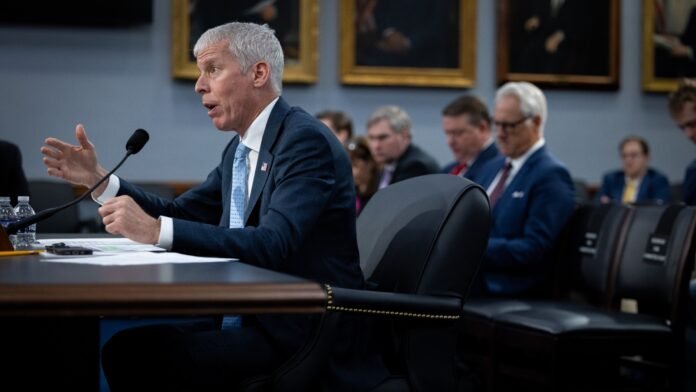
During a series of congressional hearings in April, Energy Secretary Chris Wright stated that the DOE’s review of more than 20,000 grants was almost complete, and that more than 80 percent of grantees had received notice that their awards could proceed as is or with modifications.

But an Alumni Network analysis of DOE data shared with Congress showed that the DOE’s review both failed to restore the vast majority of projects caught up in the ​“blue state” termination action in October and failed to address the hundreds of projects that have never been officially terminated but remain unable to secure funds.

The revelation of the DOE’s explicit targeting of blue states for grant termination spurred 39 Senate Democrats to sign a letter to Wright and Vought demanding the immediate restoration of funding for DOE projects terminated in October.

“Once an administration begins punishing Americans for how they vote,” the senators wrote, ​“the threat extends far beyond these projects: no state, community, business, or worker can trust that the federal government will apply the law fairly.” 

Makkah pact more strategic hedge than mutual defense revolution

0
makkah-pact-more-strategic-hedge-than-mutual-defense-revolution
Makkah pact more strategic hedge than mutual defense revolution

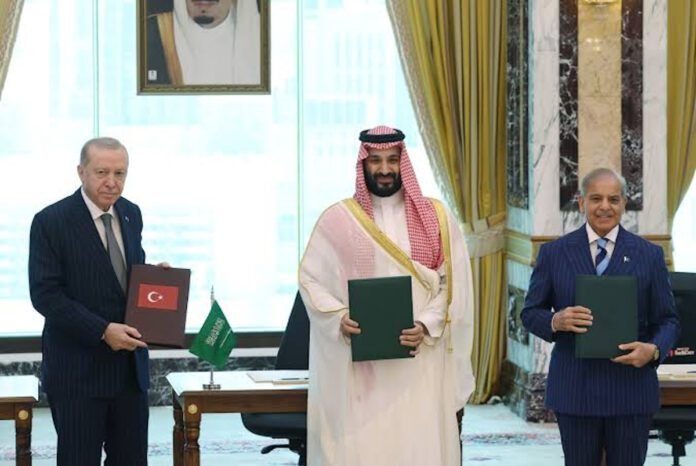
On August 7, 2026, at Al-Safa Palace in Makkah, Saudi Crown Prince Mohammed bin Salman, Turkish President Recep Tayyip Erdogan and Pakistani Prime Minister Shehbaz Sharif signed the Makkah Joint Defense Agreement — a trilateral pact declaring that an armed attack against any one of the three states will be treated as an attack against all.

The symbolism was carefully chosen: a Friday signing in Islam’s holiest city, framed as an act of religious and civilizational solidarity as much as a conventional alliance treaty. However, beneath the symbolism lies a more sober strategic calculation, one born of a region that has spent the better part of a year absorbing shocks it did not fully anticipate.

The agreement cannot be read apart from the war that has convulsed the Gulf since February 28, 2026, when the United States and Israel launched strikes against Iran that killed Supreme Leader Ali Khamenei and triggered a prolonged regional conflict. Iran’s retaliation extended well beyond Israel, reaching Saudi Arabia, Kuwait, Bahrain, Qatar, the UAE, Oman and Jordan.

In addition, Tehran’s effective closure of the Strait of Hormuz cut crude and LNG shipments through the waterway by roughly nine-tenths, a disruption serious enough that Gulf officials do not expect full flows to resume before 2027. Riyadh, in particular, absorbed direct fire while watching its economic diversification plans fall into jeopardy.

This sustained exposure, arriving despite decades of American security guarantees and billions of dollars in American arms purchases, appears to have done more to catalyze the Makkah pact than any single event.

It followed and built upon a bilateral Pakistan-Saudi defense understanding signed in Riyadh in September 2025, itself a response to earlier shocks, including an Israeli strike on Doha that alarmed Gulf capitals.

The trilateral agreement can therefore be understood less as a sudden rupture than as the latest and most formal step in a gradual process of Gulf states hedging against the possibility that Washington’s protection may prove selective, slow or simply nonexistent.

The logic of the pact rests on genuine complementarity. Turkey brings NATO’s second-largest standing army and a defense-industrial base that has made it a significant drone and missile producer. Saudi Arabia brings financial depth, custodianship of Mecca and Medina, and one of the best-equipped air forces in the region.

Pakistan brings the only nuclear arsenal in the Muslim world, along with a large army long involved in training and advising Gulf militaries. Analysts have described the pact’s purpose as building deterrence and balancing Iranian and Israeli influence, rather than seeking direct confrontation with either.

Yet complementary assets are not the same as an integrated command. As several defense analysts have noted, the three militaries operate largely incompatible equipment: American systems predominate in Saudi service, a mix of Chinese and domestic platforms in Pakistan’s, and NATO-standard as well as indigenous systems in Turkey’s.

There are, as yet, no shared data links, no status-of-forces arrangements, no pre-positioned stocks and no joint headquarters. NATO took roughly a decade, and a far more existential threat, to build that infrastructure among states that at least shared contiguous territory.

The Makkah Agreement’s signatories are starting, for now, from a communiqué rather than a command structure. Whether the pact evolves toward integrated air and missile defense over the Arabian Peninsula, or remains chiefly a political signal, will depend on choices not yet made public.

Reactions elsewhere have been watchful rather than hostile. Iran’s initial public response emphasized Muslim unity rather than confrontation, consistent with Saudi officials’ insistence that the pact is defensive and threatens no one. Israel has offered no formal comment, though some Israeli commentary has begun to describe Turkey’s regional weight, alongside Iran’s, as a factor to watch.

India has said it is studying the pact’s implications, a natural response given its own defense ties with Israel and its long-standing, complex relationship with Pakistan. Washington, for its part, appears to view the pact as one more indicator that Gulf and South Asian partners are diversifying their security options rather than as a repudiation of the US relationship outright.

The US and Gulf officials alike have described the agreement as an institutionalization of long-standing cooperation rather than a response to any single actor.

Several questions remain genuinely open. The pact’s text, so far as has been made public, leaves unspecified what obligations “collective defense” actually entails — whether troop commitments, basing rights or purely diplomatic and economic solidarity.

The three states also do not share identical threat perceptions: Pakistan’s primary security preoccupation remains India, Saudi Arabia’s is Iran and the Houthis, and Turkey’s spans Syria, the Kurdish question and its own complicated ties with Israel.

Whether the agreement can accommodate such divergent priorities without becoming diplomatically hollow, and whether it will eventually be opened to other Muslim-majority states such as Egypt or Qatar, are questions that will only be answered as the pact is tested.

For now, the Makkah Joint Defense Agreement is thus best understood as a hedge rather than a revolution: a formal acknowledgment that three states with complementary strengths and a shared sense of vulnerability have decided that pooling their deterrence, however loosely defined, is safer than relying on any single external guarantor in a region that has recently proven capable of upending assumptions very quickly.

The views expressed in this article are the author’s own and do not reflect the positions of any institution.

The world’s biggest solar telescope caught vortexes on the Sun’s surface

0
the-world’s-biggest-solar-telescope-caught-vortexes-on-the-sun’s-surface
The world’s biggest solar telescope caught vortexes on the Sun’s surface

Wherever two fluids slide past each other at different speeds, the boundary between them buckles, then curls, then rolls up into vortexes. It’s called the Kelvin-Helmholtz instability, and the physics behind it was worked out in the late 1860s. We know this instability explains why wind causes ripples on the surface of water and clouds shear into a row of curves.

For decades scientists argued the same thing must be happening with plasma on the surface of the Sun, and yet nobody had been able to confirm it. Now, a team led by David Kuridze and Friedrich Wöger of the National Solar Observatory reports that Kelvin-Helmholtz instabilities are not just visible on the Sun, but they’re ubiquitous. Their new study proposes that this may change the way we think about how heat, mass, and magnetic energy move through the Sun’s atmosphere.

Telescope’s test drive

The reason plasma whirlpools on the Sun stayed hidden for so long is rather trivial: They are very small. Their scale sits below what telescopes with mirrors smaller than 2 meters can resolve. For most of the history of solar physics, that has ruled out every telescope on Earth. This changed when the US National Science Foundation opened the Daniel K. Inouye Solar Telescope, a 4-meter instrument in Hawaii and the largest solar telescope in the world. The telescope entered its operational phase back in November 2021.

During a three-minute window on April 14, 2025, Kuridze’s team pointed it at an active region near the center of the solar disk and recorded images at a wavelength of 416 nanometers using a diagnostic camera setup built jointly by the National Solar Observatory and the Max Planck Institute for Solar System Research. They were not looking for vortexes, though. “The main goal was to achieve diffraction-limited performance with the telescope,” Kuridze said.

Every telescope has a diffraction limit, the finest detail its optics can physically deliver. It’s set by two things: the size of the mirror and the wavelength being observed. The bigger the mirror and the shorter the wavelength, the finer the detail we can observe. The mirror at the Inouye telescope was fixed at 4 meters, so the team pushed on the wavelength. “416 nanometers is towards the smaller portion of the visible spectrum,” Kuridze says. “We selected it because we wanted to achieve a higher diffraction limit and higher resolution.”

What they got in the end, though, was something more than just a cool test drive. The camera read out 740 frames per second with exposures of 100 microseconds. Two thousand of those frames were combined into a final image using a technique called multi-frame blind deconvolution, which numerically models and removes the blurring left over by Earth’s atmosphere after the telescope’s optics have done their work. The result was a movie of the solar surface with a new frame every two seconds and a spatial resolution of about 19 kilometers—right at the theoretical limit of what a 4-meter mirror can do at that wavelength.

“As a byproduct we got these amazing observations, which allowed us to see something which has never been seen before,” Kuridze said.

Vortex structures

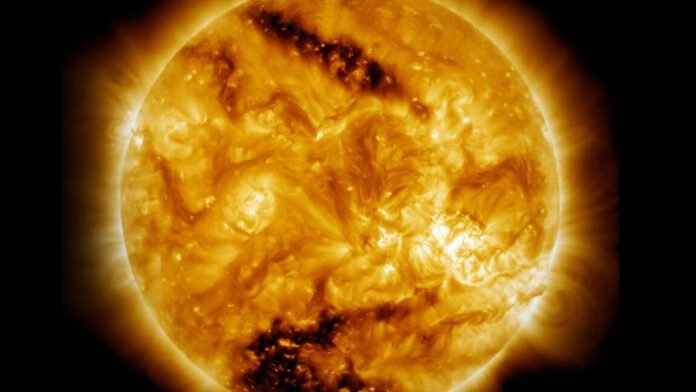
At 416 nanometers, the solar surface is dominated by granules, the convection cells that carry heat from the interior. They’re interlaced with concentrated bundles of intense magnetic fields. In lower-resolution images, the interface between a bundle of these magnetic fields and the surrounding granulation looks smooth and slightly blurry.

In the DKIST data, it looks nothing like that.

The interfaces are composed almost entirely of vortex-like structures and fine dark striations. The team identified 47 of these vortex-bearing interfaces in the telescope’s field of view and measured the spacing between adjacent curls. It turns out they’re usually between 60 and 100 kilometers apart, with individual vortexes measuring from 25 to 170 kilometers in diameter. The smallest ones scientists could spot sat right at the 19-kilometer resolution limit, which means we don’t know how far down in size they go. Tracking how fast they grow, the team established they could double their size in under a minute. The vortexes also propagated along the interfaces at speeds between 0.67 and 3 kilometers per second.

For the observer hovering above one of these boundaries, Kuridze says, the view would depend on the time of arrival. The instability runs through two phases. “The first is the linear phase, when things are more relaxed, very well organized, regular and beautiful,” he said. “If you see them from close range, you will see something like cloud-type things, which are rolling.”

But when the peaceful phase is over, it’s chaos. “At some point everything turns into a non-linear regime and then things get messy,” Kuridze said. “You are basically getting turbulence—very chaotic turbulence.”

Why do the curls form at the interfaces and not elsewhere? That’s due to the direction the magnetic field is pointing. Magnetic field lines act a bit like elastic threads running through the plasma, and they resist being bent. When those threads lie along the direction of the flow, they pull a rippling boundary back, which flattens and suppresses the instability before it can grow. When they run across the flow, they do nothing to stop it.

In the strong magnetic regions DKIST observed, the field points almost straight up out of the surface, while the granular flows sliding past it move sideways. The threads are strung the wrong way to hold the boundary together, so the curls grow with nothing to limit them.

Double-checking

Because Kuridze, Wöger, and their colleagues saw something nobody has seen before, they made sure the observation wasn’t just an artifact of image processing. “Everything looked like it should be Kelvin-Helmholtz, but of course this is not enough,” Kuridze said. “You need theoretical proof to make sure that it is really Kelvin-Helmholtz.”

To get that theoretical proof, researchers ran computer simulations modeling a patch of photosphere roughly 6 megameters on a side at a grid spacing of 3.2 kilometers, seeded with a magnetic field map of the actual observed region. Then, they synthesized images that the DKIST should have registered while looking at this simulated patch.

The team computed 500 spectral points across the observed wavelength band, applying the transmission profile of the real interference filter and blurring the result to match the real telescope’s resolution. The synthetic images accurately reproduced the vortexes’ appearance and dynamics, including growth rate, distribution, and propagation speeds, which led the team to conclude their observations are most likely real.

And so are the consequences.

Unexpected stir

A strong magnetic field normally holds plasma still. That’s essentially what a sunspot is: a patch where the field is strong enough to choke off convection, leaving the surface dark and cool.

Finding an instability that spins up vortexes along the edge of every magnetic element means finding a stirring mechanism where none was expected to exist. That means magnetized and unmagnetized gas can blend into each other; cool material from the edges of the convection cells can leak into the magnetic regions, altering how heat moves just beneath the visible surface. Our existing models of solar convection do not account for this.

Then there is the corona, the Sun’s million-degree outer atmosphere. It is heated partly by field lines being shuffled at their anchor points until they braid into tangles that eventually snap and release energy. The problem is, we have never observed the mechanism responsible for this shuffling. “You have these twisting motions everywhere at the surface of the magnetic element, and this twisting motion is nothing else than braiding of the magnetic fields,” Kuridze says.

So far, though, all of this rests on a three-minute observation window—a snapshot rather than a survey—and simulations that were also somewhat limited.

Imperfect images

“One thing we just don’t know is how small these Kelvin-Helmholtz patterns get on the Sun,” Kuridze said. What we can resolve is very close to the resolution limit, so it’s possible we’re missing ones below that. One way around this is to let the simulations run finer than the telescope can see. The team tried to do that but with little luck so far.

“When you do this at higher resolution in the simulations, some extra physics needs to be involved, and we are not sure exactly how things work in computational simulations when you need to reach those resolutions,” he said. “This is a completely new area, and we need to do more investigation.”

Another limitation comes from the kind of data the team got from the DKIST, which mostly provided high-resolution visual images. These worked as a decent proxy for the location and strength of the magnetic fields, but they were still just a proxy. Everything the team knows about how fast the plasma is actually moving comes from the simulations rather than from the telescope, and the magnetic field driving the whole thing has never been measured directly at this scale.

The team thinks most lingering uncertainties can be resolved by extending the observations beyond the current three-minute window. “If you want to quantify how the magnetic field is evolving in time, what sort of dissipation you have, how much energy is released, how much energy budget there is for eruptions and flares—you need much longer observations, and you need magnetic maps,” Kuridze said. “This is the next challenge and the next milestone.”

Nature, 2026. DOI: 10.1038/s41586-026-10871-3

Radio Host Accused of Misusing GoFundMe Cash

0
radio-host-accused-of-misusing-gofundme-cash
Radio Host Accused of Misusing GoFundMe Cash


A longtime Bay Area radio personality is facing explosive allegations over what happened to more than $137,000 raised to help him through serious health problems — and the controversy is now colliding with his daughter’s already headline-grabbing criminal case involving former Bachelor star Clayton Echard.

Radio Hall of Famer Ronn Owens, 80, received the GoFundMe donations in 2024 after retiring while battling Parkinson’s disease, cancer and heart problems.

The fundraiser was presented as a way to help the veteran broadcaster navigate mounting health and financial challenges.

But newly revealed financial records are now raising questions about where some of that money actually went.

According to court documents obtained by RadarOnline, Owens and his wife later filed for bankruptcy, opening their finances to scrutiny.

The records reportedly show the couple spent $61,654.75 on mortgage payments and another $44,375 in capital contributions to their LLCs over an 18-month period.

By comparison, healthcare and pharmacy expenses across eight reviewed bank accounts totaled $17,209 during that same period, according to the report.

Other spending allegedly included credit card payments, retail and online purchases and transfers to adult family members.

But one payment in particular is drawing attention.

Court records allegedly show nearly $20,000 went to Owens’ daughter, Laura Owens — the Arizona woman now facing felony charges tied to her highly publicized pregnancy claims involving Echard.

The United States Trustee for the District of Arizona reportedly said Owens and his wife had twice stated under oath that they made no gifts exceeding $600 per person during the two years before their bankruptcy petition.

However, financial records allegedly disclosed “$19,608 in gifts to daughter Laura Owens.”

The trustee also noted that recovering money from Laura could be complicated because she had recently filed her own Chapter 7 bankruptcy case, which was later dismissed.

The allegations add yet another bizarre twist to a family already caught up in a sensational legal battle.

Laura Owens was indicted in Maricopa County last year on 14 felony counts involving alleged fraud, perjury and evidence tampering.

Authorities have accused her of making a false pregnancy claim involving Echard, who starred on Season 26 of The Bachelor.

According to Maricopa County Attorney Rachel Mitchell, Echard and Owens began dating in 2021, but he ended the relationship after their third date.

Owens allegedly later told Echard she was pregnant with his child.

Investigators claim she then falsified documents in an attempt to support the pregnancy allegation.

“In 2021, the victim began dating Laura Owens, but after the third date, he decided not to continue the relationship,” Mitchell previously said.

“Owens then claimed to be pregnant by him. MCAO investigators found evidence that Owens falsified documents to bolster this claim.”

Owens has disputed allegations surrounding her case, which remains pending.

Her trial assignment date is currently scheduled for Oct. 28, 2026, while a settlement conference is set for Aug. 28.

Meanwhile, Echard has taken his side of the extraordinary saga to the podcast world.

iHeartRadio released Love Trapped, a series focused on Echard’s allegations and the legal battle that followed.

Promotional material for the podcast describes Echard as a man who initially appeared to be the villain before becoming trapped in what it calls a fabricated pregnancy scandal involving allegedly forged documents, thousands of text messages and extensive court filings.

The situation also comes with an unusual radio-industry connection.

iHeartRadio is a major competitor of Cumulus Media, which owns the station where Ronn Owens worked.

Owens spent decades as one of the Bay Area’s most recognizable radio voices before retiring following years of health struggles.

He has publicly discussed living with Parkinson’s disease for more than two decades as well as battling cancer and serious heart problems.

Now, however, the veteran broadcaster’s finances are under a new spotlight — just as his daughter prepares for another major chapter in her own closely watched legal fight.

RadarOnline said it contacted Cumulus Media and Echard for comment.

Iraq’s premier says country rejects use of territory to threaten neighbours

0
iraq’s-premier-says-country-rejects-use-of-territory-to-threaten-neighbours
Iraq’s premier says country rejects use of territory to threaten neighbours

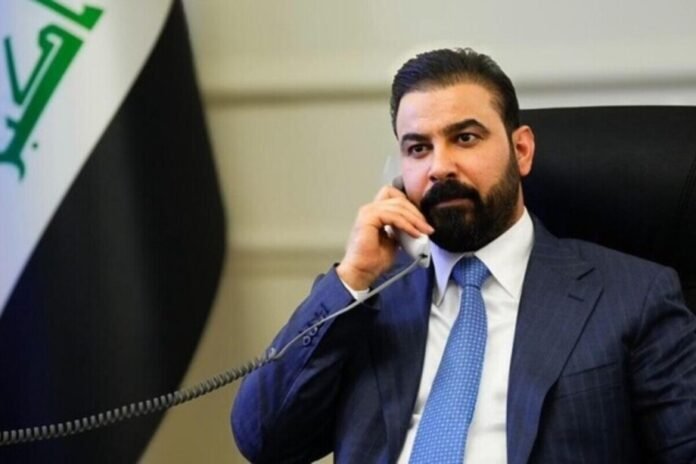
Iraqi Prime Minister Ali al-Zaidi said Saturday that his country seeks balanced relations with neighbouring states and will not allow its territory to be used to threaten their security, during a phone call with French President Emmanuel Macron, Anadolu reports.

The two leaders discussed strengthening bilateral relations and cooperation, regional developments and the scheduled end of the international coalition’s mission in Iraq, according to a statement from the Iraqi prime minister’s media office.

The statement said they also discussed economic and investment cooperation in Iraq, opportunities for French companies, and joint efforts to reduce tensions and promote regional security and stability.

Al-Zaidi highlighted the importance of relations between Baghdad and Paris and invited Macron to visit Iraq, calling for joint efforts to build a “sustainable economic and investment partnership” that serves the interests of both countries.

He said his government would continue working to strengthen stability and “transform Iraq into an influential economic and political power in the region,” citing the country’s resources and strategic position connecting international trade routes.

Al-Zaidi said Iraq remained committed to building balanced relations with neighbouring countries and “not allowing Iraqi territory to be used to threaten their security.”

He also reaffirmed Iraq’s commitment to protecting its security, sovereignty and national interests while relying on dialogue to address regional and international issues.

READ: US Federal Reserve sends $500M cash shipment to Iraq: Report

Withdrawal of coalition forces

On security issues, al-Zaidi reiterated that 30 September would be the “final date for the withdrawal of coalition forces from Iraq.”

He said ending the coalition’s mission would give Iraq greater room to focus on reconstruction and development, promote economic growth and improve the welfare of its people.

Macron, for his part, praised steps taken by the Iraqi government and reaffirmed France’s support for Iraq’s efforts to combat corruption and implement economic reforms, according to the statement.

The French president also said Paris would continue supporting Iraq in combating terrorism and strengthening the capabilities of the Iraqi armed forces.

On 27 September, 2024, Washington and Baghdad announced in a joint statement that they had agreed on a two-phase plan to end the coalition’s mission in Iraq.

The first phase was scheduled to be completed by September 2025 and included ending the coalition’s military mission, withdrawing forces and handing over bases before transitioning to a bilateral security partnership.

The second phase runs through September 2026, during which the coalition’s military mission in Syria continues from an air base in Erbil, Iraq.

The US leads the coalition, which includes countries such as France and Spain. It was formed in 2014 to fight the ISIS (Daesh) terrorist group, which at the time controlled large areas of Iraq and Syria.

On 10 December, 2017, then-Iraqi Prime Minister Haider al-Abadi declared “victory” over ISIS after three years of fighting.

The group, however, continues to operate in northern, western and eastern provinces through sporadic attacks, while the Iraqi government conducts security and military operations to eliminate its remnants.

READ: Saudi Arabia calls on Iraq to prevent its territory from being used for attacks

ByteDance trains massive AI model in bid to rival Anthropic

0
bytedance-trains-massive-ai-model-in-bid-to-rival-anthropic
ByteDance trains massive AI model in bid to rival Anthropic

ByteDance is training an AI model that could approach the size of Anthropic’s most cutting-edge Mythos system, as Chinese companies continue to narrow the gap with the top US labs.

The Chinese tech giant is at an early stage of training a model with as many as 10 trillion parameters—three times larger than Moonshot’s Kimi K3, the biggest Chinese model released to date, according to three people with knowledge of the matter.

The ByteDance model is being pre-trained—a stage that typically takes three to six months—before it is fine-tuned and released if all goes well, one of the people said. The exact model size would only be determined at a later stage.

Anthropic doesn’t disclose the size of its models, but industry estimates say its most advanced Mythos 5 has about 8 trillion parameters and Fable 5 about 5 trillion. While parameter count sets the fundamental capacity or memory limits for the models to store information, actual capability also depends on other factors, such as data quality and training methods.

ByteDance’s efforts to train one of the world’s largest AI models show Chinese labs’ ambition to not only catch up but outperform their US peers in the most advanced level of AI.

In the past weeks alone, Chinese models from Moonshot and Alibaba show strong performance on benchmarks, lagging behind only Anthropic’s Fable 5 in certain areas. Mythos 5, Anthropic’s most advanced model, is only available to approved organizations after a temporary ban in June due to security concerns.

Industry insiders say multiple Chinese labs are in the process of training models of the size of Fable 5, while ByteDance is currently the most ambitious in pushing for the largest.

ByteDance, the parent of viral video platform TikTok, has kept a low profile in its AI development as its models are mostly closed, unlike many of its Chinese peers. Its latest SeeDance model ranks among the most advanced globally in video generation, while its flagship consumer-facing model Doubao is the most popular in China with 324 million monthly active users.

Over the past three years, ByteDance has invested in AI more aggressively than any of the other Chinese tech giants, building out its network of data centers and hiring researchers. It has doubled down on its cloud unit, Volcano Engine, which sells AI solutions to enterprises. ByteDance also has ambitions to develop custom AI chips.

Seed, its model development team led by former Google DeepMind scientist Wu Yonghui, has about 2,000 members in China and overseas. The team includes core researchers, infrastructure engineers, a data labeling team, and translators.

Its model development has also implemented a more independent approach that does not involve “distilling” existing models from other labs, according to one of the people. This approach has been in place for more than a year, which some believe has led to its slower development versus rivals.

Model distillation is the process of compressing a large, complex AI model into a smaller, faster one by training the smaller model to copy the knowledge and outputs of the larger teacher.

ByteDance’s management, led by founder Zhang Yiming, believes only independent development can result in a model that outperforms rivals.

Zhang reiterated his stance in an internal meeting two weeks ago, where he told the Seed team to target “world-leading model capabilities” in the long run without getting too worried about falling behind in the near term, according to the person.

Chinese media Latepost and The Information first reported Zhang’s comments from the recent internal meeting.

ByteDance did not respond to a request for comment.

© 2026 The Financial Times Ltd. All rights reserved. Not to be redistributed, copied, or modified in any way.

The political black hole over the Strait of Hormuz

0
the-political-black-hole-over-the-strait-of-hormuz
The political black hole over the Strait of Hormuz

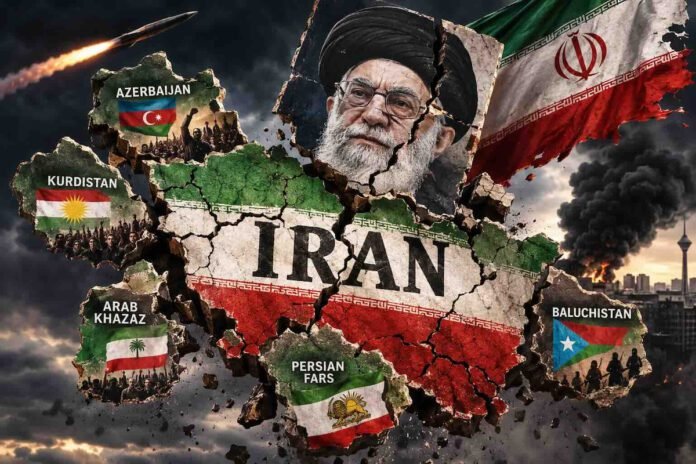
The absence of Iran’s supreme leader, doubts about his condition and internal power divisions are turning the country into a failing state — spreading chaos as far as China. What will Beijing do?

Iranian regime media have claimed the emerging Iran-Oman deal would let Iran maintain control of the Strait of Hormuz. Still, many in the US believe any agreement granting Iran control over the strait would harm US and global commercial interests.

International recognition of that control would give Iran a strategic tool — a way to use the strait as leverage during future political disputes.

The US may want to block that recognition, which would be a significant setback for US interests globally, before the midterm elections and amid complex discussions with China on multiple fronts.

But behind Iran’s apparent political victory may lie a deeper transformation within the regime — one that could signal a disintegration of internal power and impending chaos in the country.

On August 5, China’s official news agency, Xinhua, reported that Iranian President Masoud Pezeshkian said communication with Iran’s supreme leader, Mojtaba Khamenei, has been difficult recently. Is Beijing signaling that it, too, is struggling to reach Tehran? And why would Pezeshkian say this?

In the past week, Gulf states — which are now under attack from Tehran and supply most of China’s oil — asked Beijing to intervene with Iran and reopen the strait, without result. China may be signaling that it has no one to talk to in Iran, and therefore cannot help the Gulf states.

According to Iranian media, Pezeshkian “was taken to a secret Tehran location and allowed only minutes in a dark, tinted-window car with a man presented as Supreme Leader Mojtaba Khamenei.”

It is not clear whether the younger Khamenei is in control of his own life, let alone his country. These reports — coming from Iran’s elected president — clearly indicate that national leadership is bitterly split, with the most radical elements of the Revolutionary Guards seizing ultimate power by using Mojtaba as a figurehead.

But this isolates both Mojtaba and the Revolutionary Guards, setting in motion new, disruptive dynamics within the country.

Moreover, to preempt US decapitation strikes, Iran’s command structures have been devolved to local levels, and it seems unlikely they will be recentralized anytime soon. Israel is rumored to have contacts with senior officials in Tehran who could stage a coup.

Those rumors may have fueled a campaign of pervasive mutual suspicion, under which anyone, for any reason, can be accused of being a traitor.

These elements make it impossible to sustain a clear, efficient decision-making process. Any compromise could be vetoed by radical factions refusing to accept what they call a “traitor’s surrender,” while the supreme leader remains a ghost, handled by other ghosts.

The country still retains manufacturing capacity for missiles and drones, along with apparently ample stockpiles.

This paints the picture of a country in deep disarticulation and disarray, on the verge of failing. But even a failed state can survive and remain dangerous. Myanmar has endured years of internal conflict without a clear winner, with its military junta still in ultimate control.

A failing Iran could expand a vast zone of instability stretching from Central Asia to the Mediterranean coast. The US has so far avoided being drawn into the Iranian quagmire.

But Iran’s disarticulation — even as it remains in de facto, if not de jure, control of Hormuz — may pose a different kind of threat to the region and the global oil supply.

Talking to Mojtaba Khamenei and guaranteeing his security, and that of other top Iranian leaders, in exchange for a step back on Hormuz could help stabilize the situation.

On the bright side, Iran’s failure is, for the first time, bringing together regional states once divided over how to cope with Iran and its threats. They are now converging on ideas to limit Tehran’s harmful influence, building new medium- and long-term pressure on the regime.

The region will likely hasten efforts to bypass Hormuz, and the strait will ultimately only constrain Iranian trade and further isolate the religious leadership.

In this situation, Beijing may welcome America’s setback, but its inability to intervene and mediate leaves China out of the region’s political dynamics, which are increasingly dominated by the US and Israel. Finding common ground with Washington and Israel could prove difficult for China, in part because Beijing may not see a clear upside in the collaboration.

However, the expansion of a political black hole along its borders may soon create new risks for China. The Iranian meltdown is occurring as Russia also struggles to hold its position in Ukraine. China could soon find itself surrounded by zones of instability — a situation Beijing may want to prevent.

This article was first published on Appia Institute and is republished with permission. Read the original here.

Thousands of Jewish Canadians Seek Shelter in US, Israel as Hate Crimes Rise 

0
thousands-of-jewish-canadians-seek-shelter-in-us,-israel-as-hate-crimes-rise 
Thousands of Jewish Canadians Seek Shelter in US, Israel as Hate Crimes Rise 


For a growing number of Jewish Canadians, the question is no longer how to respond to rising antisemitism at home, but where to build a future. 

Organizations helping families relocate say interest has accelerated in recent months. One group, Tulsa Tomorrow, reports receiving inquiries from roughly 900 Canadian families, representing nearly 2,000 people, who are exploring a move to the United States or considering aliyah to Israel. 

The backdrop is a sharp increase in anti-Jewish incidents. Police data shows that Jewish Canadians, who make up about 1% of the country’s population, have been targeted in more hate crimes than all other religious groups combined. Synagogues, Jewish schools, community centers and Jewish-owned businesses have faced firebombings, shootings and harassment. 

The growing exodus has begun attracting attention in Washington. Some advocates and US think tanks have urged the administration to consider asylum or refugee pathways for Jewish Canadians fleeing hostility.  

Organizations working with prospective migrants say interest continues to grow as families evaluate opportunities in the United States, including community support and financial assistance. 

The “Lech L’Tulsa” initiative, operated by Tulsa Tomorrow together with the Jewish Federation of Tulsa, offers up to $4,000 in relocation reimbursements, discounted immigration services, free consultations with immigration lawyers, and personalized visits that introduce families to professional networks and the local Jewish community. 

German anti-terror police investigate explosive drone found at Leipzig airport

0
german-anti-terror-police-investigate-explosive-drone-found-at-leipzig-airport
German anti-terror police investigate explosive drone found at Leipzig airport


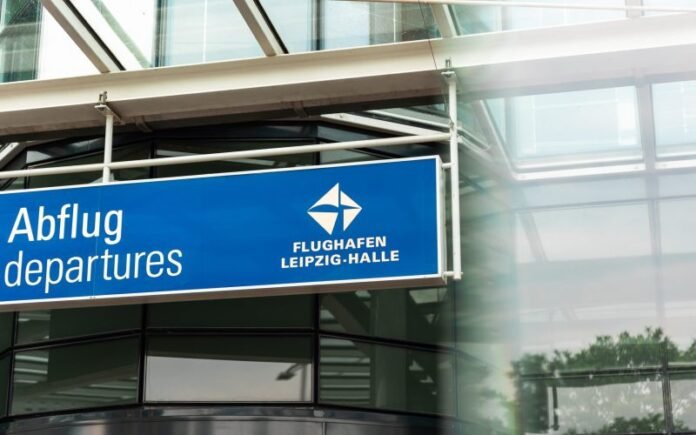
German counterterrorism authorities are leading an investigation into an explosive-laden drone that was found overnight at Leipzig airport, an important base for the NATO alliance.

An airport worker discovered the drone carrying an explosive device in a restricted cargo area late Tuesday, according to Dresden Public Prosecutor’s office and Saxony state police. A police bomb disposal robot examined the drone before officers disarmed the device by removing its detonator.

Airport officials temporarily suspended flights and diverted several aircraft. One of the diverted planes, a DHL cargo aircraft, struck another flying object while climbing away from the airport. After landing at Hanover airport, officials found signs of an impact on the aircraft’s nose.

Officials told WELT — which, like POLITICO, is part of the Axel Springer group — that the device’s detonator failed to function, preventing an explosion. They also said the drone was found just meters from a Ukrainian Antonov transport aircraft. According to the report, it contained Semtex, the explosive used in the bomb that brought down Pan Am Flight 103 over Lockerbie, Scotland in 1988, killing all 259 people on board and 11 on the ground.

Leipzig airport hosts the base of operations of NATO’s Strategic Airlift International Solution (SALIS), which gives participating countries access to Antonov cargo planes to transport military equipment. The airport is DHL’s largest European air hub and serves as an aircraft maintenance base for some Ukrainian Antonov aircraft.

According to WELT, security authorities have internally classified the incident as an attempted attack. No suspects had been detained as of Wednesday evening.

Germany’s Interior Minister Alexander Dobrindt interrupted his summer vacation in Italy to meet officials in Leipzig.

Saxony’s Interior Minister Armin Schuster described the incident in a statement as “very serious security incident.”

Ukraine’s ambassador to Germany, Oleksii Makeiev, assumed Moscow could be behind the incident. “I hope that all the authorities in Germany will now establish the facts as well. But who else could it have been besides Russia?” he posited on WELT TV.

Via Politico

0FansLike
0FollowersFollow
0FollowersFollow
0SubscribersSubscribe
- Advertisement -
Google search engine

Recent Posts