20.7 C
London
Thursday, August 20, 2026
Home Blog

mRNA cancer vaccine succeeded in Phase 3 melanoma trial, Moderna and Merck say

0
mrna-cancer-vaccine-succeeded-in-phase-3-melanoma-trial,-moderna-and-merck-say
mRNA cancer vaccine succeeded in Phase 3 melanoma trial, Moderna and Merck say

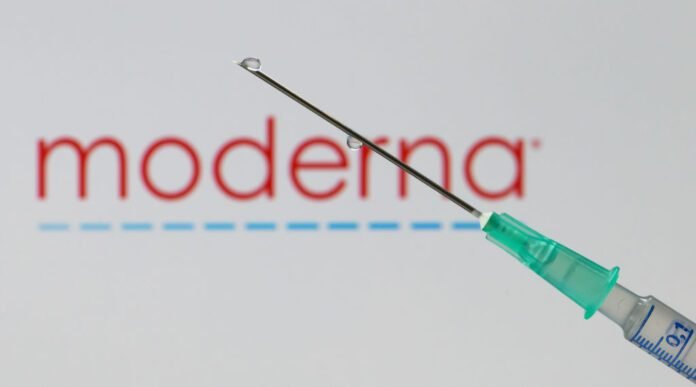
Pharmaceutical partners Moderna and Merck announced on Wednesday that their novel mRNA-based vaccine—individually tailored to target a patient’s unique cancer mutations—was effective in a late-stage clinical trial of patients with melanoma, one of the deadliest forms of skin cancer.

The announcement was scant on details, but if the success holds, it stands to realize the high aspirations for both mRNA vaccines and individualized cancer-targeting medicines in cancer therapy, providing a first success for both treatment types.

The Phase 3 trial included 1,137 patients who had stage IIB–IV melanoma that had been surgically removed prior to their treatment in the trial. Patients were randomized 2-1 to receive either a combination treatment of the tailored mRNA vaccine (intismeran or mRNA-4157) with Merck’s established monoclonal antibody cancer treatment Keytruda, or they received treatment with Keytruda alone. Both patient groups were treated for about a year. The trial was placebo-controlled and double-blind, meaning neither the doctors nor the patients knew which treatment patients were randomly assigned to receive.

Based on a planned interim analysis, Moderna and Merck report that the combination therapy with the mRNA vaccine extended “recurrence-free survival” (RFS), which is the amount of time a patient has without the cancer returning. The combination therapy also extended “distant metastasis-free survival” (DMFS), which is the amount of time a patient has without the cancer returning and occurring in a different part of the body than where it began.

The companies say the extensions of RFS and DMFS reported were statistically significant and clinically meaningful, but they did not elaborate. They said the data will be presented at an upcoming international medical conference. They did note, however, that data from a five-year Phase 2 trial, which was presented at a cancer researcher conference in June, showed a 49 percent reduction in the risk of recurrence or death and a 59 percent reduction in the risk of distant metastasis or death.

The mRNA vaccine intismeran works using a synthetic mRNA that holds the unique genetic coding for up to 34 mutations in a patient’s own cancer cells. The production process involves comparing the genetic sequences of a patient’s cancer cells to those of healthy cells and picking out any cancer-specific mutations that could help the immune system differentiate cancer cells from healthy ones.

Promising design

Using the same platform Moderna used for its mRNA COVID-19 vaccine, intismeran delivers to healthy cells the mRNA code for those mutations. Healthy cells translate that mRNA code into protein fragments representing the cancer mutations, and then those fragments are presented to immune cells as antigens, a foreign substance to attack. As such, Moderna and Merck call their mRNA cancer vaccine a type of “neoantigen therapy.”

The term avoids both “mRNA” and “vaccine,” which draw hostility from Trump’s anti-vaccine Health Secretary Robert F. Kennedy Jr. In addition to his concerted efforts to undermine lifesaving vaccines, Kennedy has canceled hundreds of millions of dollars in federal grants for the development of mRNA vaccine technology.

In the companies’ announcement, Georgina Long, who led the trial, said the results were “a landmark moment” with the “potential to establish a new treatment paradigm.” Dean Li, president of Merck Research Laboratories, said the findings “reinforce the promise of a more personalized approach to cancer treatment.” Moderna CEO Stéphane Bancel, meanwhile, highlighted mRNA technology’s role, saying this is “a pivotal moment for the field of cancer research.”

“For many years, the idea of creating an mRNA treatment designed specifically for an individual patient’s cancer was aspirational. We are now helping turn that vision into a reality,” Bancel said.

Despite the lack of details, outside experts are similarly hopeful and encouraged by the announcement. “This is the first positive Phase III trial of an individualized neoantigen therapy and an mRNA-based cancer treatment,” University of Oxford cancer expert Lennard Lee said in a statement. “That makes this an important moment for a field that scientists have been working towards for many years. Within six years of the pandemic, we have mRNA vaccines to treat cancer,” he said, also calling it “very encouraging” and “significant.”

Lee, however, highlighted that we don’t yet know the magnitude of the benefit, the detailed subgroup analyses, quality-of-life data, or mature overall-survival results. “Those details will allow the scientific and clinical community to understand precisely how large the benefit is, which patients benefit most, and ultimately where this treatment might sit within routine melanoma care,” he said.

The global revival of mahjong, a centuries‑old Chinese tradition

0
the-global-revival-of-mahjong,-a-centuries‑old-chinese tradition
The global revival of mahjong, a centuries‑old Chinese tradition

Mahjong is having a global moment. From designer tile sets and “mahjong parties” to growing numbers of clubs and classes, the centuries-old Chinese tile game is becoming trendy once again.

But its resurgence raises questions about cultural exchange, commercialization, and what happens when a tradition rooted in Chinese history becomes a “lifestyle trend.”

Mahjong emerged in eastern coastal China in the mid-19th century, toward the end of the Qing Dynasty. Although its exact origins are debated, historians agree the game developed from earlier Chinese tile-based games.

In the early 20th century, mahjong spread across China and internationally, including to the United States, France and the United Kingdom.

Annelise Heinz, historian of modern America, explains how American businesses marketed the game as an exotic Chinese novelty, often using Orientalist imagery in related advertisements and media.

American companies such as Abercrombie & Fitch helped commercialize mahjong. But Heinz argues their success depended on Chinese manufacturing, commercial networks and cultural expertise. Chinese merchants and community members imported and sold mahjong sets, and taught many white Americans how to play – yet their contributions are often overlooked.

Young Chinese boys engraving mahjong tiles, circa 1924. Photo: Library of Congress

How it works

Mahjong traditionally involves four players drawing and discarding from 144 tiles to create winning combinations. Strategy, probability, memory and your ability to read your opponents all play a role. The social experience is equally important.

Today, there are more than 40 iterations of mahjong played globally, with different versions having different rules and varying numbers of players and tiles. Chinese variants such as the Cantonese and Hong Kong styles differ from other versions such as Japanese riichi mahjong.

One of the most distinctive adaptations is American Mah Jongg. Developed in the 1920s, this version has its own rules, and a number of joker tiles that don’t exist in the original version. The spelling “Mah Jongg” reflects the commercial branding adopted during the American mahjong boom. This game was eventually standardized by the National Mah Jongg League.

A trademark advertisement page from 1924 shows the Parker Brothers claiming ownership of ‘Mah Jongg’, the American version of the game. Photo: MoPA, CC BY-NC-ND

In the US, the current revival is centered largely on American Mah Jongg, while in Australia newer clubs such as Lucky Tiles are introducing players to the Hong Kong style.

Cultural and historical significance

In China, the history of mahjong has reflected broader shifts in society. During the late Qing and republican periods (1912–49) the game moved from male-dominated gambling spaces such as teahouses and brothels into bourgeois homes and parlors. It became increasingly associated with women’s social lives, reflecting changing gender roles and attitudes towards leisure.

But mahjong has not always been viewed positively in China. Critics at different points in history have associated it with gambling or excessive leisure, with increased anxieties as the game became popular with women.

Yet such criticisms have not diminished the game’s cultural significance. In many Chinese households, mahjong is woven into Lunar New Year celebrations and everyday socializing.

Outside China, mahjong helps the Chinese diaspora maintain their cultural identity. Playing together also creates a shared space for community and connection, including across generations.

Why is mahjong booming now?

Google data show rising search interest in “mahjong” and related terms, with media coverage also reflecting the game’s soaring popularity.

This resurgence reflects a number of overlapping trends. Many people are seeking offline activities that provide genuine social connection, particularly following the pandemic.

Social media and pop culture have also changed how the game is viewed, with many sources crediting the current revival to the popular 2018 film Crazy Rich Asians.

Boutique brands and influencers have turned mahjong into a lifestyle trend, promoting fashionable game nights, in what might be viewed as an extension of the “Chinamaxxing” trend.

Appreciation or appropriation?

Mahjong’s commercial growth has prompted debate about cultural appropriation. This tension is not new.

During the 1920s American mahjong craze, the game became fashionable among affluent white American women, who embraced what Heinz describes an Orientalist “feminine exoticism”. This involved using Chinese-inspired dress and language to perform an imagined version of Chinese culture.

Ironically, this enthusiasm coincided with escalating anti-Asian prejudice and immigration restrictions in the US.

Philosopher James Young argues cultural borrowing is a normal feature of human societies, and is not automatically unethical. The more important question is how cultural practices are adopted. Are their origins acknowledged? And does the “borrowing” cause harm to the communities they come from?

In her essay “Eating the Other,” the late American cultural critic Bell Hooks cautions against treating culture as an aesthetic object detached from its history. This tension came into focus in a 2021 controversy, when Dallas-based company The Mahjong Line marketed sets with the traditional Chinese tiles replaced with English words and Western symbols.

There is also the question of who benefits financially from the mahjong comeback.

Another Dallas-based company Oh My Mahjong, founded in 2022 by Megan Trottier, reported more than US$30 million revenue in 2025. Meanwhile, luxury houses such as Hermès are selling mahjong sets for tens of thousands of dollars, showing how the culturally significant game has been turned into a lucrative commodity.

The challenge moving forward will be ensuring mahjong’s growing popularity remains connected to the Chinese communities and histories that shaped it. Those communities should also have a meaningful say in its future.

Aaron Teo is a lecturer in curriculum and pedagogy, University of Southern Queensland.

This article is republished from The Conversation under a Creative Commons license. Read the original article.

Oil gains on Middle East supply concerns amid impasse in US-Iran war

0
oil-gains-on-middle-east-supply-concerns-amid-impasse-in-us-iran-war
Oil gains on Middle East supply concerns amid impasse in US-Iran war


Oil prices climbed on Thursday on concerns the impasse in ‌the U.S.-Israeli war against Iran will continue to disrupt supply from the key Middle Eastern producing region and tighten global supplies.

Brent crude futures for October delivery rose 26 cents, or 0.28%, to $91.87 a barrel by 0439 GMT, while ​U.S. West Texas Intermediate crude futures for September added 17 cents to $86 a barrel. ​The more-active October WTI contract gained 12 cents, or 0.13%, to $89.91.

Both Brent and WTI benchmarks gained ⁠for a fifth straight session on Thursday, having settled on Wednesday at their highest since July 24. ​The September WTI contract expires later on Thursday.

“Oil prices remained elevated as the market is supported by ​sporadic attacks in the Middle East but lacks fresh momentum without a major escalation,” said Hiroyuki Kikukawa, chief strategist of Nissan Securities Investment, a unit of Nissan Securities.

“The market is likely to maintain a gradual upward trend ​given uncertainty over peace talks and tensions involving the United Arab Emirates, Oman and Iran,” ​he added.

The UAE’s decision to suspend all financial and economic transactions with Iran until further notice has refocused the spotlight ‌on ⁠fraught ties between the major Gulf Arab oil producer and Iran.

On Tuesday, U.S. President Donald Trump said no talks were taking place with Iran and that the Strait of Hormuz was open. Iran, however, said the waterway remained shut.

Shipping traffic through the Strait of Hormuz on Wednesday was unchanged from ​the day before as discussions ​to end the ⁠war between the United States and Iran remained deadlocked, according to the latest shipping data.

Prior to the war that began on Feb. 28, shipments ​equal to about one-fifth of global consumption moved through the waterway, with ​current flows ⁠far below pre-war levels.

The war has also impacted the supply of refined fuels and drawn down inventories with less crude available to refiners.

U.S. stockpiles of distillate fuel, including diesel and heating oil, fell last ⁠week for ​a third week, the Energy Information Administration said on ​Wednesday.

However, crude inventories rose by 4.4 million barrels in the week ended on August 14, compared with estimates for a 600,000-barrel draw.

Source:  Reuters

Israeli opposition leader calls Syria attack ‘provocative and dangerous’, warns Israel will ‘pay the price’

0
israeli-opposition-leader-calls-syria-attack-‘provocative-and-dangerous’,-warns-israel-will-‘pay-the-price’
Israeli opposition leader calls Syria attack ‘provocative and dangerous’, warns Israel will ‘pay the price’

Yair Golan, leader of Israel’s Democrats party, on Wednesday described the Israeli attack in Syria as a “provocative and dangerous step”.

He said the attack would deepen tensions with Israel’s allies, particularly the United States.

In a statement posted on X, Golan said: “Military force is once again being used for political considerations.”

He added that Israel was “paying the price in security”.

Moreover, Golan said the attack “brings Israel closer to a confrontation with Turkey and deepens the rift with its allies, particularly the United States”.

He also accused Prime Minister Benjamin Netanyahu of being “an extremist and unreliable figure”, saying that he could not be relied upon or trusted to build a stable regional strategy with.

READ: Israeli military patrol approaches Syrian town southwest of Damascus: Local media

Golan added: “In this way, Netanyahu erodes trust in Israel, alienates us from partners and allies.”

The Israeli opposition leader said Israel “needs leadership that knows how to wield power to achieve security, not to generate yet another war for political survival.”

Meanwhile, Syria said in two identical letters sent to the United Nations and the UN Security Council that continued Israeli attacks, including air strikes, incursions and abductions, were “hindering efforts to achieve stability and threatening the region with further tensions”.

In the letters, Syria reaffirmed its “firm position calling for an immediate halt to Israeli attacks, for Israel to be compelled to implement the 1974 Disengagement of Forces Agreement, and for its full withdrawal from the areas it entered after 8 December 2024 and from the occupied Syrian Golan Heights”.

READ: Israeli army chief visits troops in southern Syria amid continued violations

President Trump Declares ‘Economic D-Day’ Against Iran, Threatens Countries Providing Tehran a Lifeline 

0
president-trump-declares-‘economic-d-day’-against-iran,-threatens-countries-providing-tehran-a-lifeline 
President Trump Declares ‘Economic D-Day’ Against Iran, Threatens Countries Providing Tehran a Lifeline 


President Donald Trump declared an “Economic D-Day” against Iran, announcing what he described as an unprecedented campaign of economic warfare and threatening severe consequences for countries that continue providing Tehran with financial or commercial lifelines. 

He argued that Iran had failed to take advantage of opportunities to reach an agreement with the United States and would now face sweeping efforts to further isolate its economy. 

“No one has given the Islamic Republic of Iran a greater opportunity to make a Deal than me. TRAGICALLY, for them, they have failed to take it,” President Trump wrote in a social media post. 

“Therefore, today, I am announcing the MOST CRUSHING ECONOMIC OPERATION EVER TAKEN AGAINST ANY COUNTRY!” he added. “This will be Economic Warfare and Isolation on an unprecedented scale.” 

He pointed to Iran’s weakened military and economy, saying “their navy is gone, their air force is destroyed, their military factories are now rubble, their currency is worthless, and their country is hanging by a thread.” 

The president also put other countries on notice that maintaining economic links with Tehran could bring consequences of their own. 

“ANY country that allows its financial institutions, businesses, airports, or government entities to provide any type of lifeline to Iran will itself face TREMENDOUS Economic Consequences,” Trump said. 

He specifically demanded an end to oil smuggling, swap lines, cash transfers, exchange houses, ship registries, and front companies. 

President Trump called on US allies to join Washington in isolating Tehran, declaring, “This will be an ECONOMIC D-DAY, and we need all of our Allies to stand with the United States of America to isolate, and defeat, the Iran threat.” 

“IRAN WILL NEVER HAVE A NUCLEAR WEAPON,” he added. 

Iranian Foreign Minister Abbas Araqchi dismissed Trump’s announcement as “a distraction from America’s own crisis: unprecedented debt and rising prices.” 

“Doubling down on a failed policy will only lead to another defeat,” Araqchi said. “US economic terrorism threatens the global economy and sovereignty around the world.” 

The floodgates are open after another Chinese company lands a reusable rocket

0
the-floodgates-are-open-after-another-chinese-company-lands-a-reusable-rocket
The floodgates are open after another Chinese company lands a reusable rocket

It has been a little more than a month since China recovered an orbital-class rocket booster for the first time. A second launch operator accomplished a similar feat Tuesday in another sign of China’s growing launch capability.

It took 10 years for a second US launch company, Blue Origin, to propulsively land an orbital-class booster after SpaceX did it with the Falcon 9 rocket in 2015. SpaceX has since added a second reusable rocket to its fleet with Starship and its Super Heavy booster. Perhaps a third American company will join SpaceX and Blue Origin’s club in 2027. Rocket Lab, Stoke Space, Relativity Space, and Firefly Aerospace—working in partnership with Northrop Grumman—are working on reusable rockets that could make their first flights in the next couple of years.

A similar number of launch companies are working on reusable rockets in China. Some of them operate under the auspices of the sprawling state-owned China Aerospace Science and Technology Corporation (CASC). Others are more commercial in nature, driven by capital investment from private industry.

After years of development, these Chinese launch companies made their first attempts to land their new rocket boosters last December. A company named LandSpace was first when it launched the first test flight of its new Zhuque-3 rocket. The rocket successfully reached orbit but missed its landing. Later that month, CASC’s Shanghai Academy of Spaceflight Technology launched a new rocket named the Long March 12A with similar results.

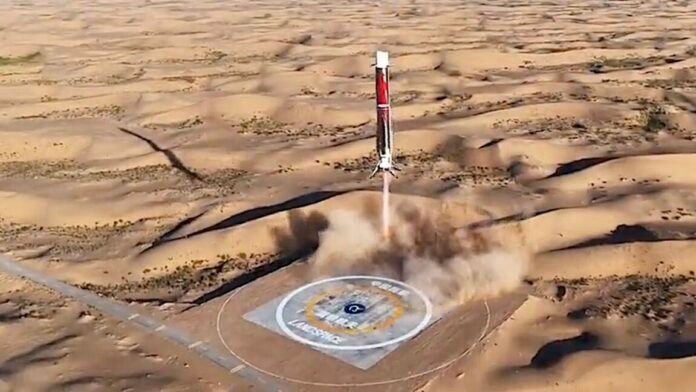
Then, a third rocket, the Long March 10B from another CASC division, became the first to achieve a successful booster recovery July 10. The Long March 10B’s first stage was caught by a net recovery mechanism on an offshore platform in the South China Sea. Now, 40 days later, LandSpace’s Zhuque-3 has flown again, this time on a flight punctuated by a picture-perfect landing of its first-stage booster in northwestern China.

Landing from space

The Zhuque-3, or ZQ-3, rocket lifted off from a commercial launch zone at China’s Jiuquan Satellite Launch Center at 7:35 pm EDT (23:35 UTC) Tuesday, about an hour after sunrise Wednesday at the spaceport in the Gobi Desert. Nine methane-fueled engines powered the 216-foot-tall (66-meter) rocket on a course southeast from Jiuquan, then the rocket’s upper stage took over the task of placing a single satellite into orbit.

The rocket’s first stage, made of stainless steel, soared to the edge of space, then maneuvered toward a prepared landing zone some 240 miles (390 kilometers) downrange, settling to a propulsive touchdown on four extendable landing legs. LandSpace, founded in 2015, declared the mission a total success.

MISSION SUCCESS | ZhuQue-3 Y2 Reusable Launch Vehicle Achieved Full Success in Orbital Insertion and First-Stage Recovery

“This mission marks China’s first-ever successful recovery attempt of the first stage of an orbital-class launch vehicle using landing legs, and China’s first successful booster recovery on land,” LandSpace said in a statement. “It is a pivotal flight test for Zhuque-3 as it transitions from the technological demonstration and verification phase toward the engineering application phase of reusability.”

LandSpace’s engineers made several changes to the rocket after the crash landing of the first Zhuque-3 booster in December. The updates included using just a single engine for the final phase of landing and modifications to the rocket’s heat shield for protection from reentry conditions.

“This mission lays a solid foundation for subsequent stages, including post-recovery inspection and maintenance, reuse flights, and commercial applications,” LandSpace said.

“The first stage underwent high-altitude gliding, followed by ignition for deceleration upon re-entry, aerodynamic glide control, and finally, a landing burn to slow down,” Dai Zheng, head of the Zhuque-3 project at LandSpace, told Chinese state television. “That final braking maneuver was executed beautifully, achieving a soft landing and realizing our original design goal of a ‘one-shot reverse-parking’ maneuver while moving at high speed.

“Our team will immediately begin inspecting the recovered first-stage booster,” Dai said. “We will collect status data and perform maintenance and overhauls. Once that work is complete, we will put the booster back into service for another flight as soon as possible.”

The Zhuque-3’s basic design can place a payload of more than 17,600 pounds (8 metric tons) into low-Earth orbit after accounting for the fuel reserves required for booster recovery. LandSpace eventually plans to debut an upgraded Zhuque-3 carrying more propellant and using more powerful engines, raising its payload capacity to more than 40,000 pounds (18.3 metric tons) in reusable mode or a few tons more with an expendable booster.

The Zhuque-3 builds on LandSpace’s earlier work on a smaller rocket named the Zhuque-2, which became the world’s first methane-fueled launcher to reach orbit in 2023.

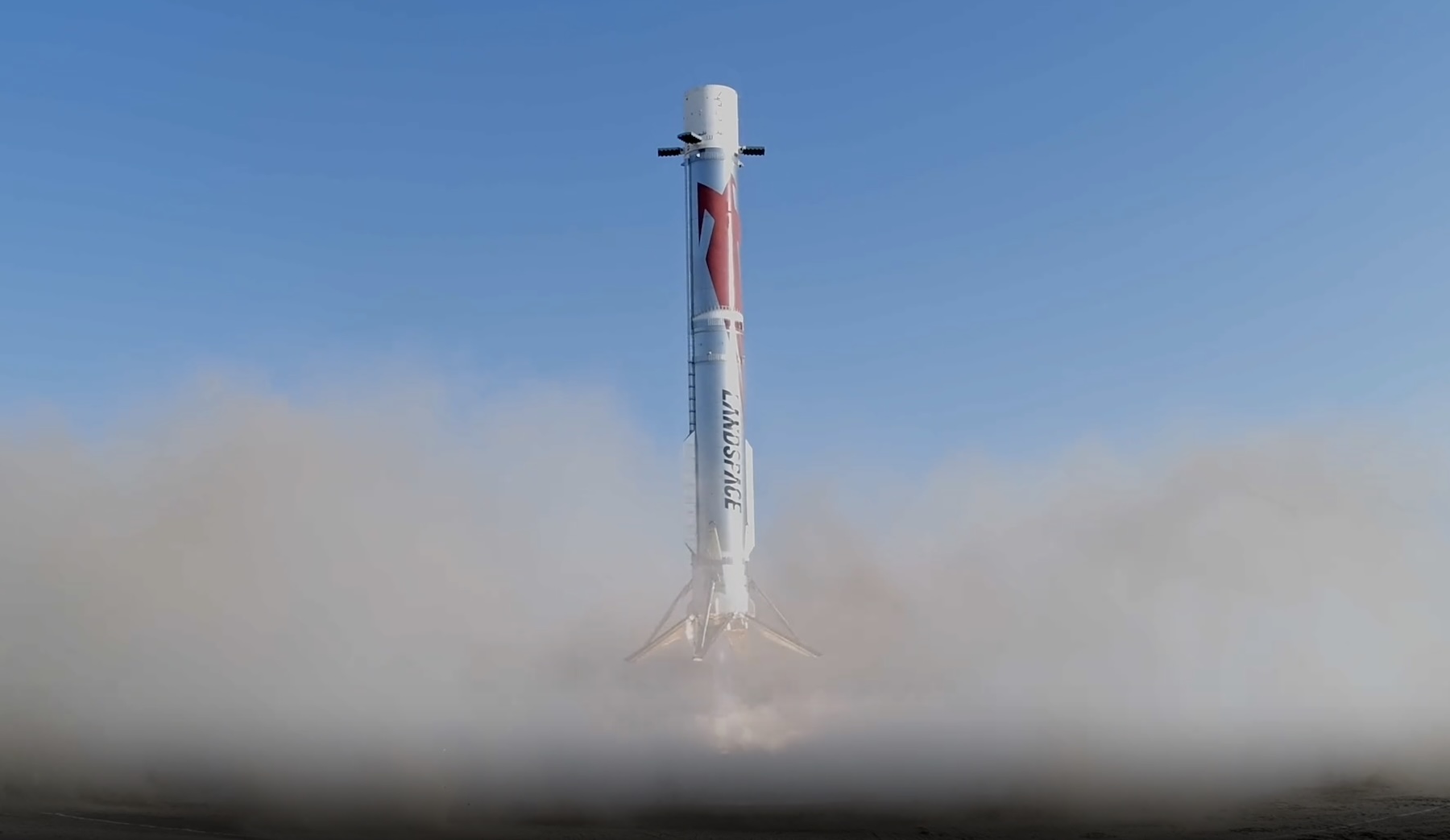
The Zhuque-3 booster bears a striking resemblance to SpaceX’s Falcon 9, with grid fins and landing legs. The Falcon 9 uses kerosene fuel, while the Zhuque-3 uses methane.

The Zhuque-3 booster bears a striking resemblance to SpaceX’s Falcon 9, with grid fins and landing legs. The Falcon 9 uses kerosene fuel, while the Zhuque-3 uses methane.

Second mover

China’s rocket companies still have some work to do to demonstrate booster turnaround and reuse. The Long March 10B booster recovered last month is supposed to fly again before the end of the year, according to CASC. LandSpace did not immediately say when it might reuse the Zhuque-3 booster, but the company previously said it plans to fly each booster at least 20 times.

With the benefits of reuse, LandSpace says its medium-lift rocket will be optimized for deploying Chinese satellite mega-constellations, such as those for broadband connectivity. Chinese officials project the country’s two largest constellations, Guowang and Qianfan, will require 700 to 800 rocket launches over the next seven to 10 years.

Several more Chinese rockets with reusable boosters could fly in the next few months. Next in line might be the second flight and landing attempt of the Long March 12A. Others include the Long March 12B backed by the Chinese government, the Pallas-1 from Galactic Energy, the Hyperbola-3 from iSpace, and Space Pioneer’s Tianlong-3, which failed on its first test launch earlier this year. It would not be surprising if one or more of these Chinese rockets launch and land before one of the next crop of American rockets does so.

The US rocket industry has long been dominant in the two most important metrics: number of orbital launches and payload mass to orbit. This is almost entirely thanks to the growth of SpaceX and its pioneering reusable Falcon 9 rocket. For the past few years, Falcon 9s have flown an average of three times per week, usually on fully loaded missions to deliver more capacity to SpaceX’s Starlink Internet network.

But SpaceX is looking to wind down the Falcon 9 rocket soon and could stop offering the workhorse launch vehicle to commercial customers after 2028. The replacement is Starship, a massive rocket with at least five times the payload capacity of the Falcon 9. It is designed for full reuse to support a more rapid launch cadence than the Falcon 9, which has likely already had its busiest year.

Starship remains experimental, with many milestones to go before it can fully replace the Falcon 9. Starship also has a history of delays, so further schedule slips may cause SpaceX to reconsider the retirement of its workhorse. China is working on a Starship-like rocket called the Long March 9, but it won’t fly until sometime after 2030.

The payload envelope for Blue Origin’s New Glenn rocket falls in between Falcon 9 and Starship. New Glenn appeared poised for a breakout year after the first reflight of a recovered first-stage booster, but the rocket is now grounded after an explosion on the launch pad in Florida in May.

The other major US launch provider, United Launch Alliance, has no near-term plans for a reusable architecture. Nobody else is close, either.

This all leaves companies like Rocket Lab, Stoke, Relativity, and others with a potential opening in the market for their medium- to heavy-class rockets once Falcon 9 is off the stage.

China, meanwhile, has a bench that is arguably just as deep as the US launch industry. None of China’s space companies—even the colossal state-owned CASC—can come close to matching SpaceX’s rapid-fire launch schedule. Collectively, they only launch about half as often as SpaceX.

But that is with a fleet of entirely expendable rockets. China’s foray into the realm of reusable rockets could change that.

Kim Jong-un balks at grasping fleeting opportunity

0
kim-jong-un-balks-at-grasping-fleeting-opportunity
Kim Jong-un balks at grasping fleeting opportunity

North Korean paramount leader Kim Jong-un has demonstrated he can make bold policy decisions.

In 2013 he sought to frighten his senior officials into obedience by ordering the execution of his uncle and senior mentor Jang Song-thaek. In 2017 he kept his nerve and continued to develop a nuclear missile capability despite US threats of a preventive attack. In 2018 he broke out of international isolation by meeting with the leaders of the US, China and the Republic of Korea (ROK). Starting in 2022 he aligned his country with Russia. In 2024 he abandoned his legendary grandfather’s commitment to reunification with South Korea.

Nevertheless, Kim may be passing up what looks like a historically unique window of opportunity. 

On August 16, US President Donald Trump announced in a social media post that he is ordering the US Department of Defense to “substantially reduce” joint US-South Korea military exercises.

The standard rationale for these exercises is they are needed to maintain the two allies’ readiness to defeat a possible North Korean invasion. Trump, however, repeated his criticism that US-ROK military exercises are “costly” and “hostile” toward North Korea. The latter word echoes a perennial Democratic People’s Republic of Korea (DPRK) talking point.

Trump’s social media post also said that during his presidency, North Korea “has been unthreatening and respectful.” A few reminders are necessary here.

While Trump was president, the DPRK demonstrated a credible intercontinental ballistic missile capability; conducted what Pyongyang said was a hydrogen bomb test; threatened to “reduce the US mainland into ashes and darkness”; tested ballistic, cruise and hypersonic missiles; sent thousands of soldiers to fight for Russia against Ukraine; and provided Russia with missiles that have killed Ukrainians.

Trump’s willingness to overlook these dark data points is part of his approach toward Pyongyang.

Trump followed his Aug. 17 post about curtailing US-ROK military exercises with another post the next day that displayed a photo of Kim talking on a telephone with the caption, “Hey Donald, we cool … Right?”

These were only the latest of many signals, going back to before he returned to the White House, that Trump wants to restart summitry with Kim, which crashed after three meetings between the two men in 2018-2019.

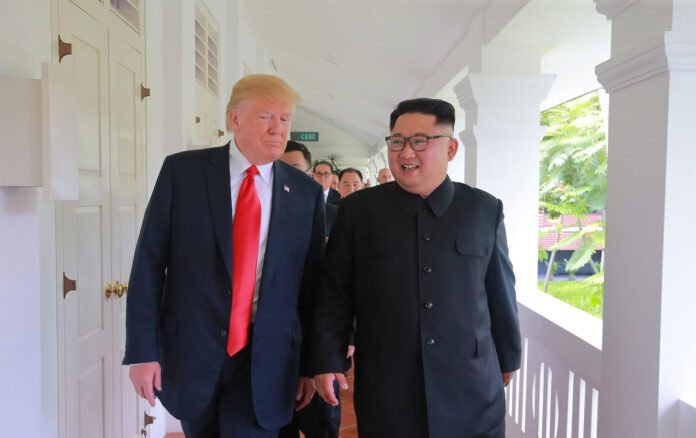
In June, Trump reportedly told South Korean President Lee Jae-myung that it was “time to pay attention” to the DPRK. That same month Trump also posted on social media a photo of himself and Kim walking together in Singapore, considered a successful summit.

Trump’s attitude toward the Korean Peninsula is extremely unusual and not likely to recur in its totality in any future US presidency.

It’s not only that he has repeatedly expressed disapproval of the alliance’s military exercises as “provocative” to North Korea. He also consistently touts his friendly personal relationship with Kim; he wants to withdraw US troops from South Korea; and ,at his first summit with Kim, he agreed to the goal of “complete denuclearization of the Korean Peninsula,” by which Pyongyang means the withdrawal of the US nuclear umbrella from South Korea.

Trump is also relatively unsentimental toward South Korea. His August 16 post mentioned his annoyance that South Korea did not send warships to support the US effort to reopen the Strait of Hormuz. Trump expanded on that angle in comments to journalists on Aug. 17. Lee, he said, refused a request to “give us a hand with Iran … guarding the Strait,” leading Trump to ask rhetorically “Why are we involved in helping you? … We can’t go around and protect all of these countries, especially when they’re not there to help us.”

The resentment toward South Korea as an alleged defense free-rider undermines what might otherwise be an obstacle to reaching an agreement that reduces US pressure on Pyongyang.

It’s safe to assume the unpopularity of the Iran war and his sinking public approval polls only make Trump more desirous to gain a foreign policy win, especially one he thinks might qualify him for a Nobel Prize.

Trump has a little more than two more years in office. His successor, whether from the Republican or Democratic Party, will not be anywhere near as favorably disposed toward accommodating important Pyongyang objectives. Kim should be jumping at the chance to meet with Trump again. But thus far he is not.

There is no official acknowledgment, let alone acceptance, from Pyongyang of Trump’s overtures. On August 19, Kim’s politically powerful sister Kim Yo-jong said she knows of no current communication between her brother and Trump.

Kim might benefit in several ways from renewed talks with Trump.

One possible prize would be the lifting of US economic sanctions. This is not as big a deal now thatRussia and China are no longer enforcing international economic sanctions and the DPRK economy is performing modestly well, having grown by at least 3 percent for each of the last three years. But it would be a welcome relief for the regime. The US effectively embargoes commerce and financial transactions with North Korea. The most damaging aspect is deterring foreign banks from doing business with the DPRK because of the risk they would be shut out of the US financial system. The president has the legal authority to reduce or remove most US economic sanctions against North Korea.

Like Trump, Pyongyang wants US troops to leave South Korea. This is a decades-old, official demand. It is baked into Pyongyang’s frequent complaints about the US having a “hostile policy” toward the North.

The DPRK government cites the presence of US forces as a reason for tensions on the Peninsula and a justification for the DPRK’s nuclear weapons and missile programs.

While Kim has sometimes downplayed the urgency of this demand, there is no question it would support North Korea’s grand strategy.

US military capabilities substantially augment South Korea’s conventional combat strength, which North Korea sees as a threat. Removing them from the Peninsula would immediately improve the DPRK’s sense of security. This step would eliminate the “tripwire” guarantee of US intervention in a new Korean War. It would largely de-fang US-ROK-Japan security cooperation. It would represent an ideological and political triumph for the Kim regime.

Most importantly, it would be a major and perhaps decisive step toward dissolving the US-ROK alliance, opening the possibility of Pyongyang exercising greater leverage over the South.

Furthermore, Kim could use talks with the US as an opening for talks with Japan.Tokyo no longer demands resolution of the abduction issue as a precondition for talks with Pyongyang. The Japan-DPRK Pyongyang Declaration of 2002 noted that both sides agreed to Japan “providing economic co-operation after the normalization by the Japanese side to the DPRK side” to compensate for Japan causing “tremendous damage and suffering to the people of Korea through its colonial rule in the past.” This could unlock billions of dollars of Japanese economic assistance, which would go a long way in North Korea’s relatively small economy.

So why the hesitancy to restart diplomacy with the US? It is possible that Kim is still traumatized by the outcome of the Hanoi Summit. The US side surprised Kim by refusing to lift economic sanctions in exchange for a closure of most of the facilities at the Yongbyon nuclear complex, after which Trump ended the summit early. Kim felt a loss of face because he left the meeting empty-handed, suggesting he failed.

But things have changed. Since Pyongyang has made abundantly clear that its nuclear weapons program is no longer on the table, and the US is still interested in talking, Kim could reframe the talks around a different objective.

Outsiders, and particularly Americans, have often accused Kim of acting irrationality. In this case he might be letting his emotions get in the way of grasping an opportunity.

Another possible consideration for Kim is how a meeting with Trump would affect Kim’s relations with Russia and China.These partnerships may now be more valuable to the DPRK than a potentially improved relationship with Washington.

China is still the DPRK’s largest trade partner by far, with pledges to deepen bilateral economic cooperation even further. The DPRK gets cash, food, energy and advanced military technology from Russia, plus combat experience from participating in Russia’s war against Ukraine. During the World War II victory celebration in Beijing in 2025, China honored Kim by having him walk down a red carpet shoulder-to-shoulder with Xi and Putin, an amazing overachievement by the leader of a small and fundamentally weak country. 

Theoretically, there might be a risk that Moscow and/or Beijing would hold back potential benefits to punish Pyongyang for reconciliation with the US government, a tradeoff Kim might view as unfavorable.

North Korea has learned over the years, however, that improving relations with one outside major power motivates others to court Pyongyang’s favor harder, offering more rather than fewer benefits. Outreach to the US would signal to Russia and China, both of which seek to maintain their influence over Pyongyang, that the DPRK has other options, and that the Russians and Chinese must do more to stay in the competition.

An example: Xi kept his distance from the DPRK government for the first seven and a half years of Kim’s rule, but invited Kim to visit China in March 2018 only after the announcement that Kim would meet Trump for their first summit in Singapore. Kim and Xi met a total of three times in 2018. It is fair to assume the prospect of better DPRK-US relations prodded Xi to get closer to Pyongyang out of fear of being left out. 

China may even welcome Kim-Trump summitry as an indirect way of limiting Russian influence over the DPRK.

So Kim may not be such a smart cookie after all. For supporters of the US-ROK alliance, Kim’s delay in responding to Trump’s overtures is not necessarily a problem.

As the Hanoi Summit underscored, no deal is better than a bad deal.

Denny Roy is a senior fellow, East-West Center, Honolulu.
FCC abolishes gigabit speed goal, suggesting it is unfair to slower technologies

0
fcc-abolishes-gigabit-speed-goal,-suggesting-it-is-unfair-to-slower-technologies
FCC abolishes gigabit speed goal, suggesting it is unfair to slower technologies

The Federal Communications Commission last week eliminated the gigabit speed goal established during the Biden administration and declared that current levels of broadband deployment in the US are acceptable. Though fiber networks have routinely offered such speeds for years, the FCC said the gigabit speed goal is not “technologically neutral,” suggesting that it isn’t fair to other, slower technologies.

In 2024, the FCC raised its broadband benchmark to 100Mbps downstream and 20Mbps upstream, setting the new standard by which to judge whether deployment is reasonable and timely. The FCC at the time also set a long-term speed goal of 1Gbps download speeds paired with 500Mbps upload speeds, saying it would use the goal “as a guidepost for evaluating our efforts to encourage deployment.”

Republican Brendan Carr, who is now the FCC chairman, never liked that long-term goal. He proposed abolishing it last year, and the change was finalized on August 14 in the FCC’s latest broadband deployment report. The reports are mandated by Section 706 of the Telecommunications Act.

“As part of our return to following the plain language of Section 706, we adopt our proposal from the Notice [of Inquiry] to abolish without replacement the long-term goal of 1,000/500 Mbps established in the 2024 Report,” the order said. “A long-term goal is not mentioned in Section 706 and could appear to violate our obligation to conduct our analysis in a technologically neutral manner. At present, it is impossible to predict long-term technological developments and the evolution of consumer preferences.”

The FCC said that comments submitted by cable industry group NCTA and wireless industry group CTIA “support our reasoning for abolishing the long-term goal.”

Gigabit goal “prejudicial” to satellite and wireless

The Carr FCC said last year that the gigabit goal “may be unreasonably prejudicial to technologies such as satellite and fixed wireless that presently do not support such speeds.” But in last week’s report, it said it is not eliminating the goal merely to help providers of slower technology.

“We disagree with commenters arguing that our concern about technological neutrality merely serves to accommodate technologies that may currently offer slower speeds,” the FCC said. “At present, we do not know the nature of future consumer preferences and, considering that the goal is not required by the statute and does not serve any positive purpose (as discussed herein), we believe it prudent to abolish it.”

Democratic FCC Commissioner Anna Gomez was not convinced.

“Lowering standards to ensure certain technologies can meet a benchmark is the opposite of technological neutrality,” Gomez said. “Technological neutrality requires that we evaluate all technologies against the same standard and support the ones that perform best. We need not lower the standards or get rid of them entirely to allow certain technologies to flourish despite their shortfalls.”

The change does not affect grant programs that require ISPs to deploy certain speeds in exchange for government funding. Most of the network deployments paid for by the FCC’s Rural Digital Opportunity Fund are required to have gigabit speeds.

“If this is the standard that funding awardees are held to, other providers should be working towards providing service at the same speeds,” Gomez said.

FCC finds deployment is good enough

Section 706 requires the FCC to determine whether broadband is being deployed “on a reasonable and timely basis” to all Americans. If the answer is no, the US law says the FCC must “take immediate action to accelerate deployment of such capability by removing barriers to infrastructure investment and by promoting competition in the telecommunications market.”

Democratic-led commissions have generally found that the industry isn’t doing enough to make broadband universally available, while Republican-led commissions have found the opposite. The Carr FCC maintained that tradition in the latest report.

“Today, we conclude our annual inquiry by finding that deployment of advanced telecommunications capability to all Americans meets the statutory standard of being reasonable and timely,” the FCC report said.

The FCC said that as of mid-2025, “approximately 94 percent of Americans had access to fixed wireline service at our speed benchmark of 100/20 Mbps,” and that the percentage was 97 percent when including fixed wireless service. Including satellite service would bump it to 99.7 percent, the FCC said.

Many Americans had only one choice for modern wireline service. In addition to the 5.7 percent of US households without any 100/20 Mbps providers, 40.6 percent of households had just one wired broadband provider offering those speeds. When including fixed wireless service, 3 percent of households had zero options and 20 percent had just one option.

No price analysis

In addition to availability, the Biden-era FCC’s 2024 report considered the price of broadband. The Trump-era FCC called that a mistake, saying that “the 2024 Report strayed from the statute’s plain language, which requires consideration of ‘availability’—not adoption, affordability, or equitable access.”

While the Carr FCC chose not to measure affordability itself, it concluded that “evidence shows broadband prices are going down.” The FCC report cited evidence from third parties including a price analysis and comments written by broadband industry lobby groups, but didn’t cite advocacy group research suggesting that prices have risen.

“Today’s Section 706 Report shows that President Trump’s policies and the Commission’s Build America agenda are delivering real results for the American people,” Carr said. “More Americans than ever have access to affordable, next-gen services. The digital divide is rapidly closing. And a range of data sets show that speeds are up, prices are down, and competition is intensifying.”

Gomez objected to the decision to drop affordability from the analysis. “The report at hand covers only infrastructure deployment and consequently does not address other important pieces of the puzzle, affordability and usability, which tie directly into the purpose of broadband deployment: ensuring that everyone is connected. Omitting affordability and usability from the analysis was a policy decision with which I disagree,” Gomez said.

She also called the 99.7 percent deployment figure misleading, because satellite “is limited by physical obstructions to the line of sight, capacity constraints in areas with high demand, and network congestion that can result in slower speeds.” As Gomez noted, Starlink satellite broadband suffers from congestion that varies by region, and Starlink has imposed “demand surcharges” of up to $1,500 in areas with many users.

Grandmother Left Paralyzed After Hospital ‘Accidentally’ Gave Her Lethal Injections

0
grandmother-left-paralyzed-after-hospital-‘accidentally’-gave-her-lethal-injections
Grandmother Left Paralyzed After Hospital ‘Accidentally’ Gave Her Lethal Injections


A Tennessee grandmother went to the hospital for what was supposed to be a routine knee replacement — but her family says a horrifying medication mix-up left her paralyzed from the chest down.

Glenda Dorton, 72, checked into Ascension Saint Thomas Hospital Midtown in Nashville on Friday for knee surgery.

Her family claims that while doctors were treating her pain, Dorton was mistakenly given potassium chloride instead of medication intended for an epidural, according to WSMV4.

Potassium chloride can be extremely dangerous when administered incorrectly. The drug was also previously used as part of Tennessee’s lethal-injection protocol, although the state has since changed the drugs used in executions.

Now, Dorton remains in the intensive care unit and is unable to move below her chest, according to her daughter-in-law, Kristina Dorton.

Her devastated family is waiting to learn whether the paralysis can be reversed.

The frightening case may not have been the only one connected to what happened inside the hospital.

Ascension Saint Thomas officials acknowledged that at least three other patients were affected by an undisclosed “event” at the facility.

The hospital has not publicly confirmed the family’s allegation that Dorton received potassium chloride by mistake, and officials have declined to release details about the other patients, citing privacy concerns.

Hospital president and CEO Dr. Shubhada Jagasia apologized for the harm suffered by patients.

“On behalf of our leadership and care teams, I am deeply sorry for the harm caused to our patients,” Jagasia said in a statement.

She added that hospital leaders have met with the affected families and are providing support, spiritual care and access to continued medical treatment.

For Dorton and her loved ones, however, the nightmare is far from over as doctors work to determine the full extent of the damage and whether she will ever regain movement.

The hospital is continuing to investigate exactly what happened.

Bread and pasta prices face fresh pressure from war and extreme heat

0
bread-and-pasta-prices-face-fresh-pressure-from-war-and-extreme-heat
Bread and pasta prices face fresh pressure from war and extreme heat


Global food prices are expected to increase by 11.8% this year and by 4.8% in 2027, with the most severe impact expected to be on crops — grains, fruit and vegetables — and dairy, according to Oxford Economics.

This comes as Europe’s extreme heat and drought have damaged crops, while farmers are also facing high energy and fertiliser prices, compounded by the wars in the Middle East and Ukraine.

Following Europe’s heatwave, Coceral, the Brussels-based European cereals and oilseeds trade association, issued an extraordinary update in July, cutting its forecast for the combined EU-27 and UK grain harvest from 295.5 million tonnes to 286.6 million tonnes. That compares with 310 million tonnes harvested in 2025.

Germany’s grain harvest is expected to fall by 7% this year after severe drought and heatwaves, according to AFP, citing a warning from the German Farmers’ Association on Tuesday. It forecast production of 41.9 million tonnes.

While the heatwave caused substantial damage, farmers also face higher costs because of disruption to oil and other raw-material supplies following the blockade of the Strait of Hormuz due to the Iran war.

Oxford Economics says that the most significant impact on food prices globally stems from the “US-Iran war and its impact on inputs for food production, mainly oil (diesel), natural gas and fertiliser,” Senior Economist Tomas Dvorak told Euronews Business.

Oxford Economics said global diesel prices surged 36% year on year in July, driven partly by disruption to the Strait of Hormuz, while fertiliser prices are forecast to rise by 22% this year.

At the same time, the war in Ukraine is also having a significant impact on global food prices.

Cereals form 25% of the global food price index, and the two countries “together account for just under 30% of total global wheat exports and above 10% of corn,” Dvorak said.

Attacks on Russian and Ukrainian ports, loading terminals and ships, as well as disruption to Black Sea and Sea of Azov grain exports, could affect 86 million tonnes of annual grain-export capacity — 52 million tonnes from Russia and 34 million tonnes from Ukraine — equivalent to almost 17% of global cereal exports, according to the report.

According to the UN Food and Agriculture Organisation, global food commodity prices were 1% higher in July than a year earlier, with cereal prices up 6.9% and vegetable-oil prices up approximately 17.3%.

Oxford Economics’ global food price index tracks commodity prices, so an increase does not automatically translate into an equivalent rise in supermarket prices.

The forecast increase in 2026 is still lower than the 14.2% rise recorded in 2022.

Which food prices could be most affected?

“The most severe impact will be in crops — grains, fruit and vegetables — and dairy,” Dvorak told Euronews Business, adding that these are the most severely affected by droughts and heat.

“This will also feed into prices of processed products — bread, cheese, wine or oil,” he continued. Products such as meat, on the other hand, are expected to be less affected.

As a fertiliser-intensive crop, wheat is under the greatest pressure, with prices expected to jump by 36% year on year to $6.92 a bushel — equivalent to about 27 kilograms of wheat — in the third quarter of 2026, according to the researchers.

Wheat is used in processed foods ranging from bread and pasta to breakfast cereals and biscuits.

“For fresh food, mainly fruit and vegetables, the impact will be relatively swift and likely visible in consumer prices in two to three months. For processed food, the lags tend to be longer, given the time for harvest and processing. There, we expect the peak impact on consumer prices in around six to nine months’ time,” Dvorak said.

That means fresh-food prices could begin reflecting the disruption between October and November 2026, while the greatest effect on processed-food prices could be felt between February and May 2027.

Jed Cartledge, an agricultural commodities economist at Oxford Economics, said the food price shock could prove more severe than forecast as the full impact of Black Sea attacks is still emerging and a strong El Niño threatens crops beyond Europe.

However, he added that higher wheat prices could make more expensive alternative export routes commercially viable, helping to offset some of the disruption.

Read more via Euronews

0FansLike
0FollowersFollow
0FollowersFollow
0SubscribersSubscribe
- Advertisement -
Google search engine

Recent Posts