24.6 C
London
Friday, August 7, 2026
Home Blog

House Democrats Demand Answers From Trump’s VA on Vets Struggling to Access Mental Healthcare

0

What Happened: More than 60 House Democrats are pressing Department of Veterans Affairs Secretary Doug Collins for answers about how the agency’s mental healthcare has been increasingly strained under President Donald Trump’s second administration. The lawmakers sent the secretary a letter last week asking questions about the state of VA care, citing a ProPublica investigation from this spring that revealed the agency’s mental health workforce has been plummeting and veterans have been left in the lurch.

What They Said: The letter was spearheaded by Rep. Judy Chu, who is a psychologist and represents a district in Southern California. “Caring for our nation’s Veterans is a fundamental responsibility,” the letter says. “That includes ensuring access to high-quality mental health care.”

The lawmakers demanded that the VA disclose details about its shortage of mental health providers and the impact on veterans. It also pushed the agency to lay out how long veterans have to wait for care.

As ProPublica has detailed, while the VA has long had a shortfall of mental health providers, the situation has gotten far worse under the current Trump administration. Hundreds of mental health staffers have left the VA and not been replaced.

Background: ProPublica’s investigation recounted the troubling experiences of both mental health providers and of veterans seeking care.

With so many staffers leaving and not being replaced, the remaining providers have often been stretched remarkably thin.

A psychologist who worked for a VA in Arizona recounted how some of her one-on-one sessions were replaced with online group sessions that included as many as 35 veterans. The therapist said their remaining individual sessions were sometimes limited to as little as 16 minutes.

“It was always bad,” said the psychologist. “And now it’s at a breaking point.”

In VA exit surveys that ProPublica obtained, mental health staffers who quit often wrote that they were no longer able to provide high-quality care.

Series Timeline

June 26, 2025

June 11, 2025

“Mental Health is understaffed, burned out,” wrote one New York-based staffer who was leaving. “There is not enough mental health care for the Veterans who need the services.”

Veterans, meanwhile, have started to fall through the cracks.

Jason Beaman, a Navy and Army vet, was shuffled among therapists who later left until he finally had enough. “I just quit. I don’t want to mess with the therapist anymore,” Beaman told us this spring.

Why It Matters: After Trump returned to office last year, his administration promised to deliver veterans “the highest quality care.”

The VA is the country’s largest healthcare system, serving 9 million veterans. Those men and women face many mental health issues at a higher rate than the general population. They die by suicide at roughly twice the rate.

VA mental health staff have developed deep expertise in addressing the particular needs of vets. Indeed, studies have shown that vets get better care at the VA than through private providers.

“VA psychologists are best in class,” said Russell Lemle, former chief psychologist for the San Francisco VA Health Care System and now a senior policy analyst at the Veterans Healthcare Policy Institute. “When you lose them, the veterans are the ones who pay the price.”

ProPublica reported that in January, the department had around 500 fewer psychologists and psychiatrists than it had at the same time last year. Recent VA data shows those head counts continue to decline.

Response: In response to questions from ProPublica, VA spokesperson Quinn Slaven defended the agency. “The Trump Administration is solely focused on measuring VA’s success by how well it serves Veterans,” Slaven wrote in an email. “This commonsense approach has led to dramatic improvements for Veterans, families, caregivers, and survivors across the country.”

Slaven said that the VA completed a record number of mental healthcare appointments in the past fiscal year while also lowering veterans’ wait times.

The VA previously declined our request for an interview. Instead, spokesperson Peter Kasperowicz accused ProPublica of attempting to mislead the public by “cherry picking issues that are limited to a handful of sites and in many cases were worse under the Biden Administration.”

After ProPublica shared the findings of its investigation and the names of veterans who would appear in it, the agency reached out to several to inquire about their care and offer help.

The congressional letter gives the VA until Aug. 14 to respond.

Read the Investigation

Japan’s missile leap marks shift from defense to counterstrike

0
japan’s-missile-leap-marks-shift-from-defense-to-counterstrike
Japan’s missile leap marks shift from defense to counterstrike

Japan’s successful Tomahawk and Upgraded Type-12 tests mark a decisive shift beyond interception-only defense toward a more assertive counterstrike posture.

Last month, multiple media outlets reported that Japan’s Defense Ministry significantly expanded its long-range strike capabilities by conducting two milestone tests of standoff missile systems aimed at strengthening deterrence in the Indo-Pacific.

In late July, the Japan Maritime Self-Defense Force, supported by the US Navy, launched a Tomahawk land-attack cruise missile from the Kongo-class Aegis destroyer JS Chokai in the Pacific, making Japan the third foreign country to launch the weapon from a surface warship.

At Gifu Air Base, the Japan Air Self-Defense Force (JASDF) also began flight testing an F-2 fighter equipped with the air-launched Upgraded Type-12 Surface-to-Ship Missile. The test supports Japan’s broader effort to field low-observable, networked standoff weapons, including systems designed to strike targets at ranges of up to 1,600 kilometers.

Japan is procuring 400 US Tomahawk missiles as an interim capability while developing indigenous standoff missiles for deployment by fiscal year 2027, seeking to deter China without formally abandoning its exclusively defense-oriented posture.

Japan’s defense-only posture is a well-worn myth and known to China. With Japan developing a first-strike capability and now “thinking about nuclear weapons,” as announced by Defense Minister Shinjiro Koizumi, China is now likely to adjust its nuclear doctrine accordingly.

Combined with Prime Minister Sanae Takaichi’s remarks that Taiwan poses a threat to Japanese sovereignty, the danger of Japan-China strategic instability and possible future nuclear confrontation is rising.

At the same time, Japan’s rapidly expanding missile reach is running ahead of the targeting networks, stockpiles, alliance arrangements and legal doctrine needed to employ those weapons credibly.

In a March 2026 International Institute for Strategic Studies (IISS) report, Rupert Schulenburg places new standoff weapons within a broader strike architecture, arguing that ship-launched Tomahawks would give Japan a naval capability for deep precision strikes.

He adds that the Upgraded Type-12 missile, with a reported range of at least 900 kilometers, will substantially expand the Japan Self-Defense Forces’ (JSDF) maritime-strike reach compared to existing systems like the ground force’s 200-kilometer Type-12 and the air force’s 180-kilometer ASM-2.

Operationally, Japan still lacks an independent kill chain capable of finding and tracking targets, launching strikes and assessing damage, according to a December 2025 International Crisis Group (ICG) report. It remains dependent on US capabilities across those functions.

That dependence also leaves Japan’s counterstrike force vulnerable to alliance friction and Chinese disruption, Kaitlyn Early and Carl Rehberg argue in a 2026 Helms School of Government conference paper.

They argue that Japanese missiles become credible only when the US synchronizes intelligence, surveillance, and reconnaissance (ISR), planning and targeting within a unified denial posture; otherwise, they appear fragmented and exert less influence on China.

Mixed US signaling, force-posture gaps and incomplete integration further weaken that credibility, particularly in a Taiwan contingency where compressed timelines would leave little room for delayed intelligence, political hesitation or disrupted command networks.

The logistics picture is equally problematic. Masashi Murano and William Chou argue in a June 2026 Hudson Institute report that Japan’s munitions industry lacks scale, relies on fragile supply chains and remains dependent on foreign components and allocation decisions.

Tomahawk deliveries are particularly exposed: US production increases will take years, while active wars and global demand intensify competition for scarce munitions. Murano and Chou cite lead times of up to 47 months for the missile.

Japan has also prioritized expensive platforms — including F-35 fighters, upgraded F-15s and Aegis-equipped vessels — over sufficient stocks of missiles and interceptors, leaving its inventories and industrial capacity ill-prepared for sustained, high-intensity combat.

The doctrinal problem is how to strengthen deterrence without destabilizing the alliance arrangements that have long governed Japan’s use of force.

Satoru Mori and Shinichi Kitaoka argue in a 2022 RAND report that China’s growing missile capacity and saturation tactics make relying solely on ballistic missile interception inadequate for Japan’s defense.

They propose adding a limited counterstrike capability — conducted as a proportional, retaliatory measure after being attacked first — targeting fixed coastal military infrastructure such as air bases, naval ports, logistics hubs, radar sites and command headquarters.

In the same report, Jeffrey Hornung analyzes the operational implications for the alliance, noting that the allies are “woefully behind the curve” on bilateral planning.

He stresses that integrating long-range fires will require deep synchronization across joint targeting, command-and-control structures, C4ISR hardware dependencies, and active/passive force protection for Japanese launch sites.

Those coordination problems persist. In an April 2026 Center for Strategic and International Studies (CSIS) report, Kristi Govella and Nicholas Szechenyi argue that US-Japan alignment is being strained by divergent priorities and incomplete mechanisms for employing Japan’s new capabilities.

The US emphasizes allied burden sharing while dividing its attention among the Indo-Pacific, Western Hemisphere and Middle East; Japan remains focused on China, North Korea and preserving the regional order.

New command structures still lack clarity over delegated authority, frontline decision-making and coordination with US Indo-Pacific Command. The allies have also yet to settle arrangements for intelligence sharing, targeting, real-time decisions and the operational division of labor surrounding Japanese strikes.

Legal limits on Japanese force employment, doubts about extended deterrence, intelligence-sharing weaknesses and unresolved alliance roles could therefore leave the new missiles operationally disconnected despite otherwise smooth cooperation at lower levels.

The domestic debate has meanwhile shifted from whether Japan should possess long-range missiles to when their use would remain defensive rather than become pre-emptive, Charlotte Boring and Wrenn Yennie Lindgren wrote in Japanese Studies in December 2025.

According to Boring and Lindgren, the government maintains that strikes on enemy territory can remain constitutional when they are limited to the minimum force necessary for self-defense and conducted within Japan’s established legal conditions for responding to an armed attack.

However, Boring and Lindgren say opposition parties and Komeito dispute where that threshold lies: must an attack first strike Japan or an ally, or could an adversary’s launch preparations justify action?

They warn that ambiguous criteria could enable first strikes, hollow out the limits of Japan’s exclusively defense-oriented policy and entangle the country in US-led operations.

Japan’s next test will be whether it can convert missile acquisitions into rules, stockpiles and alliance mechanisms robust enough to function under crisis pressure without eroding the defensive legitimacy on which the policy’s political sustainability depends.

Remembering the pre-Google web, when search was an experiment

0
remembering-the-pre-google-web,-when-search-was-an-experiment
Remembering the pre-Google web, when search was an experiment

In the mid-’90s, the web was exploding, but finding anything of actual value on it felt like an elaborate negotiation with whatever proto-search engine happened to be standing closest to the door. Unlike now, when Google is widely seen as both portal and gatekeeper, sites like AltaVista, Lycos, Excite, HotBot, and Ask Jeeves promised to tame the chaos, each with its own suite of quirks, charms, and flaws.

The real story of pre-Google search is not that early engines were inferior. It’s that they reflected a different Internet entirely, one where directories mattered, crawling was still an art, ranking was fragile, and the idea of “search” had not yet hardened into a single dominant interface.

A different kind of web

The first thing to remember about the pre-Google Internet is that there was no built-in assumption that you could search for everything. Many users found pages through Yahoo-style directories, bookmarks, newsgroups, email signatures, and links from site to site because the web was still small enough that human organization could compete with machine indexing. It was an era of Wild West-style discoverability. Search engines existed, but they were only one part of a larger ecosystem that blended curation and accident.

Before those engines became the main public interface to the web, resources like Usenet were showing people how to organize and discover information online. Conceived in 1979, it gave users topic-based newsgroups and a culture of distributed discussion that made online information feel social and communal before the first major web engines arrived. Usenet helped establish the habit of navigating vast, messy digital spaces through categories and communities rather than a single search box.

Nicole M. Radziwill worked as a systems administrator, programmer, and project manager, among other things, in the ‘90s. She remembers Usenet as a portal to unearthing interesting content online. “It was the way to find out about websites that might interest you,” she said. “I got on Usenet in 1990 as a student in Durham, North Carolina… it was delightful, especially the alt.* and misc.* groups. People would put links in at the bottom of their posts, and awareness grew organically. And if you wanted safer or more reliable recommendations, you could limit yourself to moderated groups.”

It was an era when the term “discovery” carried actual weight, when you could authentically be one of the first people viewing a piece of content, regardless of its quality or how long it may have existed—an era of equal parts wonder and frustration.

“Then a couple of years later, webrings popped up,” Radziwill said. “You’d get a block of code and put it on the bottom of your site’s HTML page, and it would embed a link to the next website related to this one. Someone else would manage the list of what could come next, so it was a great way to increase your exposure. The people putting together the lists for the webrings were generally pretty upstanding, so we didn’t even think about sabotage.”

Webrings are another pre-Google artifact that recalls an era when microcommunities sprang up, not unlike those in the BBS era, from groups of people sharing niche interests, sometimes even local to one another in the real world. Before monolithic aggregators like Reddit, webrings were one of a handful of ways to find sites focused on the topics you were interested in.

That mattered because the web had not yet become a pure retrieval machine. It still had a culture of exploration, and many services were designed to help users browse topical categories rather than fire a query into a universal index. In that world, a webring or directory was not a compromise. It was often the main event.

Directories before algorithms

Yahoo is the best-known example of this early logic. It began as a human-edited guide to the web, organized into nested subject categories and maintained by people rather than fully automated ranking systems. For a young web, that approach was surprisingly effective: Human editors could identify quality sites, filter obvious junk, and impose a sense of order on a medium that was still expanding rapidly.

“I was a sysadmin for an ‘ecommerce shop’ in 1995 and 1996,” Radziwill told me, “and when we would turn up websites for new clients, the highlight of our process was submitting the site to Yahoo. Yahoo was like the Yellow Pages, but only for websites. There was a form you would fill out, and you had to justify to the real people at Yahoo that this business you were submitting was legit and important enough to be in Yahoo’s main directory.”

That kind of human curation is almost unimaginable now.

“I remember one time submitting the website for a regional branch of the American Cancer Society and getting rejected because it ‘wasn’t significant enough,’” Radziwill said. “They recommended we contact the main ACS and have them link the site from their page… that they didn’t have yet.”

It was a time when getting accepted into a directory like Yahoo by their human moderators was a massive badge of honor. But the model had obvious limits. Human curation couldn’t scale forever, and it became more expensive and less timely as the web ballooned and content outpaced curation. The moment the number of pages outstripped the number of people who could reasonably classify them, the future belonged to crawlers and ranking systems.

The rise of crawlers

Search engines of the era confronted the scale problem with software. Many of the first big commercial systems, like AltaVista, Lycos, Excite, and HotBot, used crawlers and indexes to automatically map a growing web rather than relying on editors to hand-classify every site. While these engines didn’t all work the same way, they shared a core ambition: to gather up as much of the web as possible and let the algorithm sort through the mess.

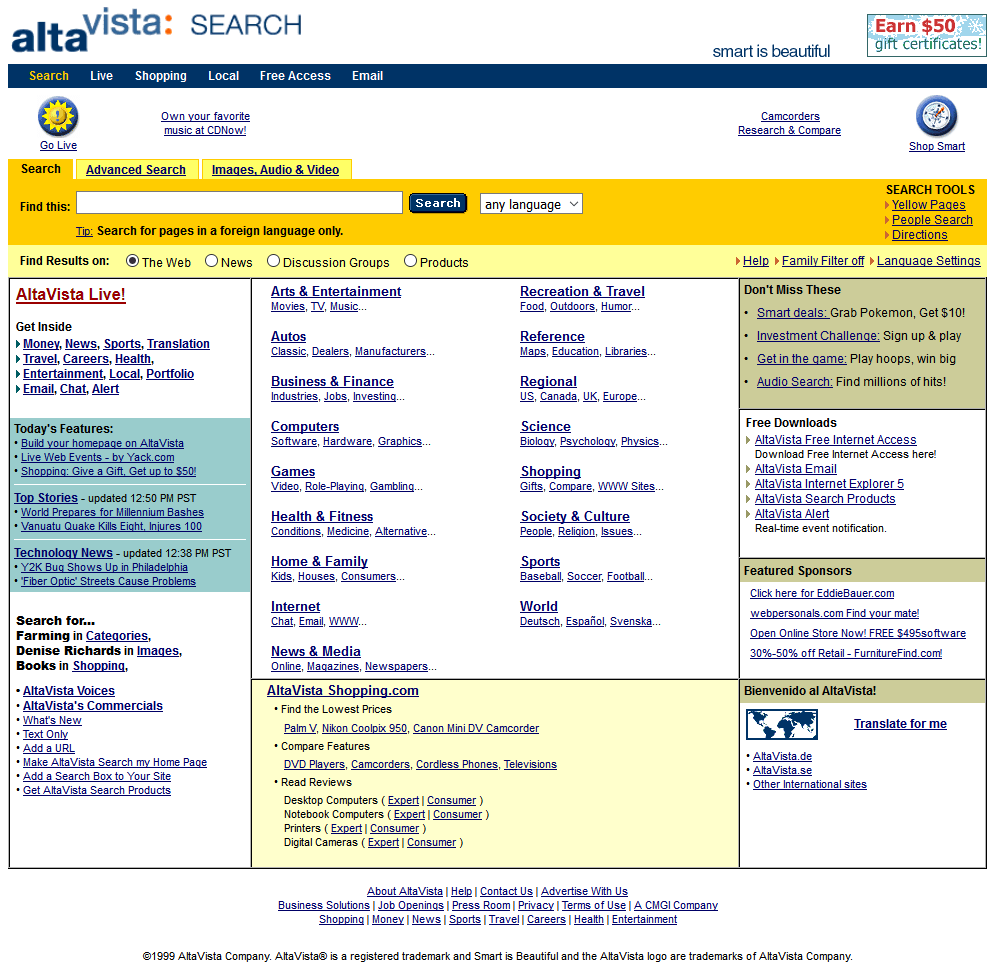
It may sound obvious now, but it was a leap at the time. AltaVista in particular represented a major step forward, combining a fast crawler with scalable indexing software, and was already handling millions of HTTP requests per day shortly after launch. It made search feel less like browsing a catalog and more like querying a giant machine.

AltaVista’s moment

AltaVista became one of the defining search engines of the 1990s because it was fast, broad, and unusually capable for the time. Later versions supported natural language-style searches and gave users the sense that the web could finally be approached as an indexable whole, even if the results were still rough around the edges. In a decade when many people were still learning what the web even was and grappling with its vastness, it felt close to miraculous. But it was still a very limited tool compared to the hyper-sophistication of an evolved engine like modern Google.

Mark Friend, director of the IT support firm Classroom365 Limited, worked as a systems operator in the late ‘90s. He remembers that in the pre-Google era, searching the web was both a technical skill and an art form.

A dense page of hyperlinks and text with a search bar near the top

Altavista in 1999.

Altavista in 1999. Credit: Web Design Museum

“Most people have completely forgotten how chaotic it really was,” Friend said. “Back then, if you typed a question into AltaVista, the odds were stacked against you if you were looking for anything specific. You’d receive 40,000 results that would leave you just as confused as shouting into a crowded room.”

Compared with Google’s once-user-friendly UI and more relevant results, combing through an AltaVista results page required patience and genuine skill that was honed over time. But AltaVista did accomplish one important thing: It set the expectation that search should be immediate. That expectation proved decisive. Once users experienced a search engine that could quickly sweep a huge index, they stopped accepting sluggish, partial systems as sufficient. AltaVista didn’t win the search war, but it clarified the rules of engagement.

Lycos, Excite, and the portal era

Lycos and Excite occupied an important middle ground. They were search brands, but they were also portals, meaning they strove to be destinations as much as tools. Search lived alongside breakouts for news, email, sports, weather, finance, and other content, all designed to keep users on the site rather than springing off to results pages.

The classic Excite logo tops a web page of blue links

Excite in 1997.

Excite in 1997. Credit: Web Design Museum

These companies demonstrated how unsettled the category was. Some engines emphasized breadth, some emphasized speed, and some blended editorial channels with automated results in ways that feel alien today. The “search engine” label covered a wide range of products, from directory services and crawlers to portals with search bolted on as a tertiary feature.

HotBot, Inktomi, and technical credibility

HotBot earned a reputation as one of the more technically serious search engines of the era. It arrived during a period when users were beginning to notice that search quality depended on both the size of the index and the sophistication of the ranking system behind it—the scalable backend was provided by Inktomi. A fast crawl was not enough; people wanted results that were relevant, current, and not obviously gamed.

A mostly green old-fashioned website with left-hand navigation

Hotbot in 1999.

Hotbot in 1999. Credit: Web Design Museum

That tension exposed a weakness in the early generations of machine-based search. If a system leaned too heavily on on-page textual signals, people could just overstuff their content with word bloat to artificially boost ranking. If an engine relied mostly on easily manipulated on-page signals, marketing could overpower quality. The early web quickly became a laboratory for manipulation, even before anyone used the term “search engine optimization” (SEO) in the modern sense.

Ask Jeeves and the question interface

Ask Jeeves stood out because it tried to make search feel conversational, an idea that feels especially prescient in the age of the AI chatbot—though Ask Jeeves obviously did not offer anything close to the conversational interface based on today’s large language models. Mark Friend said Ask Jeeves felt genuinely futuristic because instead of asking users to think in keywords, it invited them to query in natural language, giving the impression of a web managed by a knowledgeable assistant.

A search box next to an illustration of a butler

Ask Jeeves in 1999.

Ask Jeeves in 1999. Credit: Web Design Museum

The problem was that natural language is hard. Users didn’t always ask clean questions, and the underlying systems were not yet good enough to infer intent reliably at scale. Ask Jeeves was memorable because, without the underpinning of deep learning and LLMs, it purported to understand the user experience better than the technology of the time could support.

Search before SEO

The pre-Google web was also a pre-industrial SEO environment. Site owners tried to improve visibility, but the modern system of search optimization had not yet become the massive, professionalized discipline it later became, with full departments of “experts” chasing ephemeral signaling from Google and attempting to predict its next mysterious pivot. Early engines were still relatively easy to influence with obvious signals like keyword repetition, metadata, and submission tactics.

“People didn’t talk about ranking back then,” Friend recalled. “They submitted their URL and waited patiently to see if it would show up in a search. Everyone took the Meta keyword tag seriously and the practice of utilizing ‘white text on a white background’ to hide hidden keywords was a legitimate tactic that webmasters would use to include keywords in their website for search engine crawlers. There was no fear of penalties, and you built a website, crossed your fingers, and hoped for the best.”

By the late ’90s, engines were identifying the white-on-white approach as spamdexing and taking action. In any case, that meant ranking was both simpler and more fragile than it is today. The early search web was an experimental stage where the rules had not hardened, and the feedback loop between publishers and engines was still manageable and easier to test and interpret. Once search became the main gateway to the web, that open-ended environment collapsed into a more adversarial one.

“The hard truth that most people do not want to face is that scraping and ranking turned the Internet into a manufacturing facility of content,” Friend said. “Websites went from being written for people to being written primarily for search engine crawlers.”

PageRank changes everything

Google’s crucial contribution was not that it discovered search; it was that it changed the logic of ranking. Among other things, PageRank treated links as signals of authority, which made relevance partly a question of how the web itself pointed to a page. It marked a major shift because it made results seem more trustworthy and made simple manipulation harder, though obviously not impossible.

Just as importantly, Google paired that ranking approach with a stripped-down interface and a results page that got out of the way. The clean design mattered because it reinforced the sense that search should be a utility, not a portal amusement park. In practice, Google made the search box feel like the front door to the whole web, with the same intrinsic, vital importance that a front door serves in a home.

Why the old web mattered

In retrospect, the pre-Google era was slower, messier, and in many ways less efficient. But it also had more competing ideas about how information should be found, categorized, and judged, alongside a lawless atmosphere that suggested unlimited potential. Some systems trusted people. Some trusted crawlers. Some trusted directories, and some trusted questions phrased in plain English.

“The Internet contained an inherent level of clutter and chaos,” Friend remembered. “But at the same time, it was a much more humanized place before. It’s why many of us feel nostalgic for that time. The Internet had an artisanal feel to it. It was made by real people using text editors such as Notepad and Dreamweaver. You might start at one destination and find yourself at a fan site of an obscure band, and then end up at a forum discussing vintage synthesizers, and ultimately end up on a NASA page.”

That diversity is worth remembering because it shows that search was never necessarily destined to look the way it does now. The pre-Google engines weren’t just failed precursors. They were serious attempts to address a problem that the web had made urgent but not yet solvable in one obvious way. Google won by combining technical rank, usability, and scale at exactly the moment the rest of the Internet was ready to abandon the old order.

Dash for Ceuta adds heat to Europe’s migration debate

0
dash-for-ceuta-adds-heat-to-europe’s-migration-debate
Dash for Ceuta adds heat to Europe’s migration debate

At a time when the debate over migration is drawing a great deal of heat, Spain has stood out in Europe for its liberal stance. Six months ago, the government of Pedro Sánchez opened up a pathway to legal residency for hundreds of thousands of undocumented migrants. So, when tens of thousands of migrants crossed from Morocco into the tiny Spanish enclave of Ceuta on July 30, the uproar was not confined to Spain.

This came days after Spain’s supreme court had ruled that migrants stopped at sea while trying to reach Ceuta or Melilla, another Spanish enclave on the coast of Africa, could not simply be returned from whence they came. While many commentators blamed this ruling for the sudden dash for Ceuta, more than 95% of the migrants who entered on July 30 have since returned to Morocco via the land border.

Nonetheless, the events of July 30 stirred up a hornets’ nest in Spain, where the Sanchez government, which has a minority of seats in the Spanish parliament, is under severe pressure from conservative and far-right parties. Spain’s far-right Vox party, led by Santiago Abascal, has been running hot on the subject ever since.

As Deniz Torcu, an expert in globalisation at Spain’s IE university, notes, the footage of migrants surging past, or swimming around, barriers into Ceuta immediately changed the tone of the migration debate in Spain – and elsewhere in Europe. “The optics are a gift for Europe’s far right, and they know precisely what to do with it. They can lose every argument about the real numbers and still come out ahead, because their aim is to make the story of a welcoming Spain look foolish.”


Read more: How the Ceuta border crossing incident immediately played into the hands of Spain’s far right


Spain has held Melilla and Ceuta since the 15th and 16th centuries respectively, despite being pushed out of the rest of north Africa over the years. Francisco Franco launched the Spanish civil war from Ceuta in 1936, having flown there from the Canary Islands where he was Spain’s military commander.

The two enclaves remain an open sore in relations between Spain and Morocco, explains Parvati Nair, a professor of Hispanic, cultural and migration studies at Queen Mary University of London. And the events of July 30 will not have made things any easier – Ceuta’s authorities have already accused its neighbour of deliberately loosening border controls on its side, something Morocco denies.

Nair charts the controversial history of Ceuta and Melilla as colonial hangovers which now play a key – and contested – role in the enforcement of Europe’s southern border.


Read more: Ceuta and Melilla: how the colonial legacies of these cities have shaped migration in the region


This role, and the ability of the European Union generally to control its borders, are now the subject of intense debate for the EU’s 27 member states. An emergency video conference was held on August 4, prompted by a letter signed by 22 members including Italy, Germany, Poland, Hungary, the Czech Republic and Denmark, which made a number of claims about shortcomings in EU border controls.

One was that domestic policies of countries such as Spain acted as “pull factors” for irregular migrants. Another was that the movement of such migrants through EU countries is being facilitated by the Schengen agreement, which provides for free movement of people through member countries. Karla Zeravcic and Marco Mauer, researchers at the European University Institute, point to problems with these assumptions as they relate to EU law.


Read more: Ceuta migrant crossings: are calls for stronger border controls from 22 member states in line with EU law?


West Bank violence, Gaza famine

The UN has reported that in the 300 days since the ceasefire in Gaza came into force last October, at least 300 children have been killed. It’s a shocking statistic which gives urgency to the latest roadmap to peace unveiled by the US president, Donald Trump, at the end of July.

But that deal now looks to be dead in the water after Israel’s prime minister, Benjamin Netanyahu, said his country would not withdraw its troops from the Palestinian enclave until Hamas is completely disarmed. Hamas has already said it will not disarm until Israel withdraws its military. So it’s stalemate – once again.

This was not unexpected, writes Julie Norman, whose book Gaza: The Dream and the Nightmare – co-authored with American political scientist Maia Carter Hallward – charts the enclave’s history and chronicles the devastation of the past three years of war. Norman has just returned from a month of fieldwork in the West Bank, where settler violence and land seizures are spiralling.

road signs with Arabic writing painted over

Arabic script blacked out on road signs in the West Bank. Julie M Norman

She believes that events in Gaza and the West Bank are “inextricably linked” – and that the likelihood of any peace deal in Gaza is far outweighed by the very real prospect of out-and-out conflict in the other, much larger Palestinian territory.


Read more: How Israeli conduct in the West Bank could derail Donald Trump’s latest peace plan for Gaza


Stolen childhood

In March 2023, the International Criminal Court issued an arrest warrant for Vladimir Putin and the Russian president’s commissioner for children’s rights, for the crime of unlawful deportation of children from occupied areas of Ukraine into the Russian Federation.

Now, a disturbing report prepared for the Organization for Security and Co-operation in Europe has revealed the forcible indoctrination and militarisation of these children, and also children in Russian-occupied parts of Ukraine.

The report’s authors, Stefan Wolff, Elīna Šteinerte and Hervé Ascensio, found detailed and distressing evidence of children being force-fed propaganda and given military-style training in schools which were deliberately preparing them to fight against their own country. This, they stress, is a crime under the Geneva Convention.


Read more: We investigated Russia’s military indoctrination of Ukrainian children in occupied territories – what we found was more shocking than we could have imagined


Donald Trump’s midas touch

It was revealed at the end of June that Donald Trump made US$2.2 billion (£1.63 billion) in the first year of his second presidential term. Much of this reportedly came through his investments in cryptocurrency, including the $TRUMP meme coin he launched days before his inauguration, which has since lost much of its value.

The revelations prompted much discussion about the rights and wrongs of a president doing business while in office. Historian Benjamin Quail, of Queen’s University Belfast, gives us a rundown of the financial fortunes of previous inhabitants of the White House, and finds that while it’s not unusual for a president to make a fortune after leaving office, Trump’s amassing of such a fortune as president is without precedent.


Read more: Donald Trump has made US$2.2 billion in his second term. How does that stack up against other US presidents?


Metsola’s re-election drive puts Socialists under pressure

0
metsola’s-re-election-drive-puts-socialists-under-pressure
Metsola’s re-election drive puts Socialists under pressure


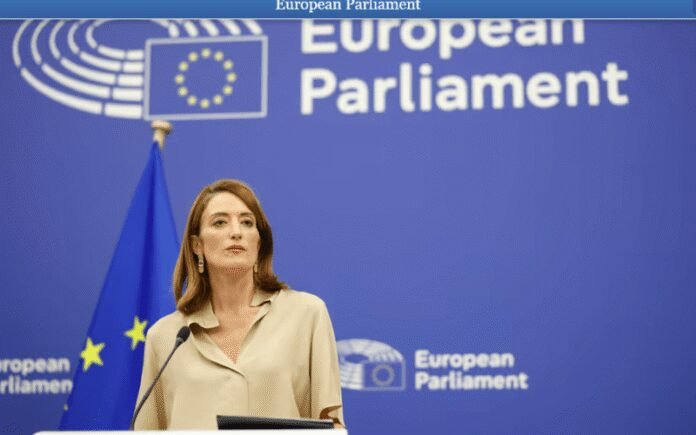
Momentum is building behind a third term for conservative European Parliament President Roberta Metsola, a prospect set to disrupt an informal agreement among centrist political forces and to put the Socialists and Democrats (S&D) on the back foot.

The Maltese politician from the European People’s Party (EPP), who is currently serving her second term as president, is clearly the frontrunner, despite not having announced whether she will seek another mandate.

This scenario is concerning for the centre-left S&D group, which should be entitled to the presidency in the second half of the legislature but lacks the political clout to push through its own candidate.

“We should not accept Metsola, and we will not do it. But it seems to me quite obvious it will be her again,” a Socialist MEP told Euronews, speaking on condition of anonymity and summarising the mood among fellow lawmakers.

While negotiations over the presidency will only get into full swing after the summer break, discussions within the groups have already begun, and the Socialists appear boxed into an uneven contest, unable to put forward a credible challenger.

An ambiguous deal

The European Parliament’s president is elected every two and a half years by MEPs through a secret ballot. But the decision is usually settled beforehand through backroom deals among the political groups.

The main European political families – conservatives, socialists and the liberal Renew Europe – usually settle on a candidate beforehand to avoid a showdown in the chamber. This is part of a broader agreement on the EU’s top jobs, which include the presidents of the Commission and the Council, as well as the high representative for foreign affairs.

The latest deal, struck in June 2024, saw conservative Ursula von der Leyen confirmed as Commission president, socialist António Costa appointed president of the European Council, and liberal Kaja Kallas as high representative for foreign affairs.

In Parliament, the deal usually splits the legislature into two halves, as has been the case over the past four terms, with EPP and S&D members alternating as president.

Several MEPs have confirmed the agreement to Euronews, but its wording regarding Parliament’s presidency deliberately leaves some room for ambiguity.

“It says that the groups aim for a balanced distribution of the Parliament’s top positions,” which include vice-presidents and committee chairs, an MEP from another group told Euronews.

This leaves room for manoeuvre for Metsola’s EPP, which is by far the largest political force in Parliament and could find allies to its left or right to impose its preferred candidate.

The Socialists’ dilemma

The election’s rules play in the EPP’s favour.

In the secret ballot, the European Parliament’s president could be elected by an absolute majority of votes cast in any of the first three rounds. If no candidate secures that majority, the election goes to a final run-off between the two candidates who received the most votes in the previous round.

If the EPP insists on another mandate for Metsola – as many MEPs expect – there is therefore little chance of stopping it.

With this prospect more and more likely, the S&D would face a lose-lose dilemma: challenge Metsola from a position of weakness or accept her re-election and grin and bear it.

The heads of Socialist parties’ delegations discussed their strategy in one of the last meetings before the summer break.

According to people in the room, some pushed to strike a backroom deal with the EPP, backing Metsola in exchange for concessions. These concessions include additional committee chairs or a stronger commitment to draft legislation exclusively with the centrist majority established at the beginning of the mandate.

Others were more inclined to pick a candidate and mount a challenge in the ballot, with German MEP Katarina Barley’s name floated in the discussions. Despite having virtually no chance of success, this move would force the EPP to breach the informal deal explicitly.

Centre-right conservatives have the upper hand in the vote. However, they prefer to maintain the appearance of unity and present Metsola as the product of a deal among pro-European forces, rather than get the president elected with the votes of far-right parties.

“Socialists should have moved earlier to call the EPP’s bluff by tabling a candidate before the summer,” another MEP from a different political group told Euronews. “Now, if the EPP has the first move and it picks Metsola, they are cornered.”

A president for all seasons

Metsola remains silent, ready to step into the ring.

Her cabinet does not want to speculate on the possibility at this stage, stressing that any candidate must first be nominated by their political group.

She was re-elected with a broad cross-party majority in July 2024 and could become the first person in history to serve three terms as president.

“She knows how to keep colleagues on her side,” a senior lawmaker not belonging to the EPP told Euronews, citing Metsola’s ability to cultivate relationships beyond the conservative camp.

“I do not see any better choice. She has also built a public image that is very appreciated,” another MEP said, referring to Metsola’s profile on the international stage.

The current president has sought to project a strong international profile, particularly on Ukraine and Iran. She was the first European leader to travel to Kyiv in April 2022, less than two months after Russia’s full-scale invasion; the whirlwind visit caught everyone by surprise, including officials in Brussels.

It was mostly a symbolic gesture, but one that paved the way for subsequent visits by Commission President Ursula von der Leyen, French President Emmanuel Macron, former German Chancellor Olaf Scholz, former Italian Prime Minister Mario Draghi, and other European leaders.

Metsola has also been at the forefront of the European Parliament’s hard line towards Iranian leadership, supporting dissidents’ protests, calling for regime change and banning all Iranian diplomats from the Parliament.

She also pushed for Iran’s Islamic Revolutionary Guard Corps to be placed on the EU terrorist list, which happened a few weeks after her call.

At that time, her activism sparked speculation among MEPs about possible future ambitions for the European Commission’s presidency. But with the way cleared for her to remain at the helm of the Parliament, moving to another Brussels institution’s building is unlikely to happen anytime soon.

Via Euronews

Tree Branch Impales Dad’s Face and Brain in Freak Backyard Accident

0
tree-branch-impales-dad’s-face-and-brain-in-freak-backyard-accident
Tree Branch Impales Dad’s Face and Brain in Freak Backyard Accident


A South Jersey father is lucky to be alive after a horrifying backyard accident left him impaled through the face by a tree branch that pierced his brain.

Troy Hathaway, 45, was trimming branches outside his Glassboro, New Jersey, home when the ladder beneath him suddenly collapsed, sending him plunging roughly eight feet to the ground.

At first, Hathaway believed he had simply injured his jaw.

“Initially, I really thought I broke my jaw,” he recalled.

But the reality was far more terrifying.

A jagged piece of tree had entered through his cheek and nose, passed near his eye and traveled upward into his brain. X-rays later revealed the full extent of the gruesome injury.

Despite the branch protruding from his face, Hathaway remained conscious and surprisingly alert.

“I hadn’t lost consciousness, I wasn’t nauseous, I felt fine other than being a little bit sore and my ego being a bit bruised,” he said.

He was rushed to the trauma center at Jefferson Health, where stunned doctors quickly assembled a team of specialists for the delicate emergency surgery.

“This was a pretty huge piece of tree that was stuck through his face and into his brain,” neurosurgeon Dr. Chris Farrell said. “We needed to move quickly on this, but we wanted to move smart.”

Doctors initially feared they might have to open Hathaway’s skull to remove the branch. Instead, surgeons used a less invasive approach through his nasal passages, a technique sometimes used to remove brain tumors.

Incredibly, the branch had somehow missed critical blood vessels and vital brain tissue.

The surgical team was able to carefully pull it back out through Hathaway’s cheek without causing severe bleeding or permanent damage.

“Overall, a tricky thing, but it couldn’t have gone better,” Farrell said.

The operation lasted approximately four hours, but Hathaway emerged with only a few stitches and bruises. He suffered no vision problems, breathing difficulties or apparent neurological damage.

“It’s mind-boggling to think of that,” Hathaway said. “It’s emotional because it’s tough to sit there and think how close it could have been.”

Now back home with his wife and daughter, Hathaway is taking antibiotics as doctors continue monitoring him for infection.

So far, there are no warning signs, and physicians expect him to make a full recovery.

“I was so lucky to be with such an amazing surgical team,” Hathaway said. “The doctors, the whole team, are absolutely beyond words.”

SoftBank’s ‘crazy guy’ canary-in-coalmine role in AI

0
softbank’s-‘crazy-guy’-canary-in-coalmine-role-in-ai
SoftBank’s ‘crazy guy’ canary-in-coalmine role in AI

For Masayoshi Son, the AI boom has been both a blessing and a curse for a conglomerate that had lost its way.

In June, AI returned SoftBank Group to the top. For the first time in 22 years, Son’s conglomerate overtook, for a time, Toyota Motor in market capitalization to become Japan’s most valuable public company. It did so riding a euphoric surge in artificial intelligence shares.

That’s the blessing. Before January, when the AI trade became the financial zeitgeist, SoftBank was still nursing wounds from its WeWork disaster, and the nearly $100 billion Vision Fund that Son launched in 2017 had limped into 2026.

AI flipped the script. Son’s much-maligned 2016 acquisition of British chipmaker Arm suddenly looked like a contrarian masterstroke, turning SoftBank from tech laggard to AI hero. So did its big bets on OpenAI and Nvidia.

Yet SoftBank’s latest earnings were loaded with warning signs. On Thursday, the world’s most important venture fund reported an 18% drop in fiscal first-quarter profit, to $2.2 billion for April-June, down from $2.6 billion a year earlier.

Investors spun it as a win anyway: quarterly sales rose nearly 11%, to 2 trillion yen ($12.7 billion). CFO Yoshimitsu Goto told reporters Arm, its chip-design unit, is thriving, and boosters pointed to a lucrative Intel stake.

That’s the problem, though. Vision Fund’s success – and SoftBank Group’s by extension – has always hinged on the zigs and zags of giant bets: Intel, TikTok parent ByteDance, Japanese payments app PayPay, Taiwan Semiconductor Manufacturing Co. It’s a portfolio, not a strategy, and portfolios can turn.

SoftBank has poured an additional $20 billion into OpenAI and plans more such bets this fiscal year. As Macquarie analyst Paul Golding puts it, Softbank Group “continues to scale in the key enablement vectors of the AI revolution, investing in leading automation companies, software platforms, data centers and semis firms, delivering quality exposure to the theme and benefiting from secular tailwinds for its equity holdings and the resilience of its balance sheet.”

Still, as much as any systemically important company on earth, the conglomerate Son founded in 1981 is a bellwether for whether the world can actually monetize AI – or whether it goes the way of the dot-coms a quarter-century ago.

SoftBank has much left to prove. The $14 billion WeWork write-down raised questions about Son’s judgment. His $60 billion-plus commitment to Sam Altman’s OpenAI revived them. The balance sheet doesn’t help the case: Debt hit $113 billion as of March 31, up from $77 billion a year earlier. In April, SoftBank paid a record 8.5% coupon on a 10-year dollar tranche as part of a $3.6 billion raise – a rate more typical of junk-rated borrowers than a company leading a nation’s stock market.

For Son, the year 2000 looms large here. That’s when he handed an obscure English teacher in Hangzhou $20 million. When Jack Ma took Alibaba public in New York 14 years later, that stake was worth $60 billion, and the “Warren Buffett of Japan” narrative was born. The nine-year-old Vision Fund was an attempt to recapture that magic. With his AI bets, Son is betting he’s done it again – which is why he’s betting investors will look past the debt.

In June, Son told CNBC that AI is “probably 50x bigger than dot-com.” Behind that optimism sits his long-held belief that the “singularity” – the moment AI outsmarts humanity – is near. For years, he’s called himself the “crazy guy who bet on the future.” In 2026, that future seems to have finally arrived.

Only time will tell if he’s right – or if history remembers him as a cautionary tale, the man who turned SoftBank into an AI meme stock. What Son really needs is a page from Buffett’s playbook for stabilizing Berkshire Hathaway’s balance sheet – including some unexpected bets on Japan, of all places.

For Son, Vision Fund was always a way to escape Japan’s rigid, aging, slow-growth economy. It’s no coincidence that the year he effectively discovered Alibaba’s Ma coincided with the Bank of Japan‘s slashing of rates to zero and pioneering quantitative easing. His venture ambitions were an attempt to find growth abroad that no longer existed at home.

Japan’s deflation, dismal demographics and play-it-safe corporate culture pushed Son to deploy billions across China, India, South Korea, Indonesia, Bangladesh, Brazil, Kenya, Israel and beyond – riding a herd of tech “unicorns” toward riches SoftBank could no longer find domestically.

Buffett has been going the other way since 2020. That year, the Oracle of Omaha shocked even Tokyo’s biggest bulls with a $7 billion bet on five centuries-old Japanese trading houses. While financial media gushed over Jack Ma’s Ant Group and the FAANGs, Buffett was getting deliberately old-school, old-economy.

Few are second-guessing that move now. Buffett’s retro-Japan bets are paying off handsomely: shares of “sogo shosha” trading conglomerates have rallied as energy, metals and crop prices surged amid geopolitical tension and supply-chain chaos. Management at Buffett-backed Itochu, Marubeni, Mitsubishi, Mitsui and Sumitomo have boosted forecasts – or look set to shortly.

Turns out Buffett’s “Moneyball” experiment was a hit. He was, in effect, doing for stock-picking what Oakland A’s manager Billy Beane did for baseball in 2002 – using unconventional, data-driven analysis to build a winner on a budget, as Michael Lewis chronicled in his 2003 book and as the 2011 Brad Pitt film dramatized. As Tokyo investment veterans noted at the time, Buffett was running the same play: rebuilding Berkshire’s steady, unglamorous returns through predictable, low-risk Japan. Mission accomplished.

But Berkshire’s success rests heavily on the steady income from General Re. Boring as it is, that reinsurance shock absorber is what lets Buffett take his big swings elsewhere. Son knows it. In recent years he flirted with buying a $10 billion stake in reinsurance giant Swiss Re – a distinctly Buffettesque move. The deal fizzled, but a stabilizer like that is exactly what would lend credibility to Son’s singularity dreams.

If Japanese Prime Minister Sanae Takaichi were wise, she’d find a way to bridge Buffett’s success harnessing Japan Inc. with Son’s quest to discover the next tech unicorns.

One of the few economic-reform wins her Liberal Democratic Party can claim over the past 12 years is nudging CEOs toward internationalized management and higher returns on equity. It’s a work in progress, but Japan Inc. is slowly adding more outside directors. As Takaichi’s LDP looks to reboot structural reform, a smart place to start would be impressing the Buffetts and Sons of the world – and catching the eye of the millennials now calling the shots on Wall Street.

The best way to do that is to accelerate a startup boom that generates economic energy and wealth from the ground up: regulatory and tax tweaks that make a nation of 123 million more entrepreneurial, competitive, and productive. The immediate to-do list is straightforward – cut the red tape that makes starting a business a slog, and build a tax code that rewards innovation and risk-taking.

Japan badly needs to catch up with China, South Korea, Indonesia and other economies that are simply better at producing tech unicorns. Look no farther than Son’s own venture empire, scattering billions across the globe while doling out only scraps at home. SoftBank’s spending pattern is itself an indictment of Japan’s startup climate.

Buffett is reminding the world that Japan Inc.’s biggest names are more than exhibits in a corporate wax museum – they can be genuine profit centers for those willing to look closely and wait patiently. At the other end of the spectrum, Son is betting on “new economy” disruption on a scale arguably never seen before.

Son may be right about the future. But in 2026, SoftBank is reminding the world it still has plenty to prove before it can validate investors’ lofty hopes for its role in an AI future being written on the fly.

Israel orders uprooting of trees on 316 dunums in West Bank for settlement expansion

0
israel-orders-uprooting-of-trees-on-316-dunums-in-west-bank-for-settlement-expansion
Israel orders uprooting of trees on 316 dunums in West Bank for settlement expansion

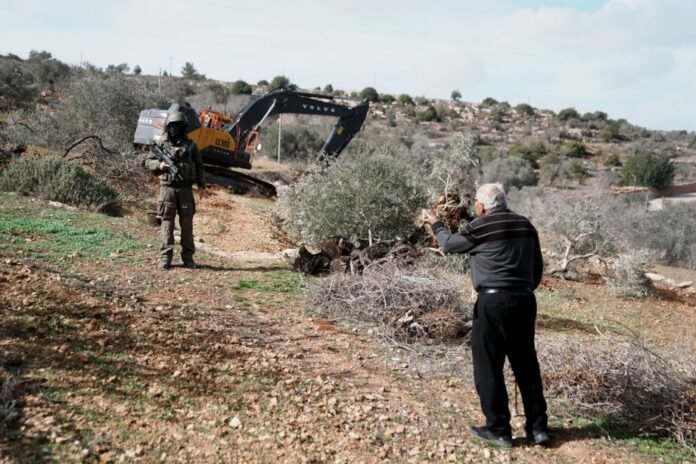
The Israeli military has issued eight orders to uproot trees and remove vegetation from 316 dunums of land across the occupied West Bank for settlement-related purposes, the Colonisation and Wall Resistance Commission (CWRC) said on Thursday.

A dunum is equivalent to 1,000 square metres.

In a statement issued on Thursday evening, the Palestinian government body said the orders require the removal of wild vegetation and olive trees from land identified in attached maps.

The eight orders cover a total of 316.636 dunums. Six of them target about 311 dunums in the northern governorate of Jenin, while the remaining two apply to the Nablus governorate and occupied East Jerusalem.

The commission said the vegetation clearance does not target isolated farmland but areas alongside main roads, expanding Israeli control on both sides of the roads and causing direct damage to olive trees and neighbouring agricultural land.

It warned that the Israeli authorities are using the orders to facilitate the establishment of settlements, saying the measures are intended to prepare the land for settlement infrastructure while restricting landowners’ access to and use of their property.

According to the commission, Israel has issued 59 orders since the beginning of 2026 to remove tree cover from 2,480 dunums of Palestinian-owned land. It added that around 60,000 dunums of Palestinian land have been seized during the 1,000 days of the Gaza war, which began on 8th October 2023.

Palestinians warn that such measures are paving the way for Israel to formally annex the occupied West Bank, which they say would undermine the possibility of establishing a Palestinian state as envisaged in relevant United Nations resolutions.

Parasitic zombie-ant fungus thrives in mosses, too

0
parasitic-zombie-ant-fungus-thrives-in-mosses,-too
Parasitic zombie-ant fungus thrives in mosses, too

The parasitic fungi in the Cordyceps genus are a favorite subject of nature documentaries. They’ve also infiltrated popular culture via the zombie-apocalypse video game The Last of Us (2013) and its TV adaptation, in which a parasitic fungus mutates to infect humans. Scientists are keen to study Cordyceps to learn more about the origins and intricate mechanisms underlying these pathogen-based diseases.

The latest finding: DNA analysis revealed the same fungus in both parasitized insects and surrounding mosses, according to a paper published in the journal IMA Fungus. (Yes, really.) This suggests a second life stage during which the fungus lives inside the moss, possibly an evolutionary adaptation to survive when insect hosts may be scarce. It could also explain why the host species seems to prefer biting into mosses during their final death throes.

As we’ve previously reported, there are more than 400 different species of Cordyceps fungi, each targeting a particular insect species, like ants, dragonflies, cockroaches, aphids, or beetles. The spores attach to the target insect, such as a carpenter ant, and germinate, spreading through the host’s body via long tendrils called mycelia. Cordyceps essentially turns its host into a zombie slave, compelling the ant to climb to the top of the nearest plant and clamp its tiny jaws in a death grip around a leaf or twig.

The fungus then slowly devours the ant, sprouting through its head in one final indignity. The bulbous growths on the ends of the mycelia burst, releasing even more spores into the air to infect even more unsuspecting ants. It’s not a great way to go: The entire process can take four to 14 days. Prior research showed that the zombification might be due to the release of a special chemical that causes the muscles in the infected ants’ mandibles to contract forcefully for that death-grip bite.

A 2017 study found that the fungal cells formed an elaborate, interconnected 3D network, enabling them to communicate and exchange nutrients. They essentially cut the brain off from the rest of the ant’s body so the networked cells can control its behavior. And in 2019, scientists found that the fungus doesn’t actually directly attach to an infected ant’s brain. Rather, it breaks apart the membrane that covers jaw-muscle fibers, causing contractions strong enough to damage or destroy the muscle filaments that slide past each other when the muscles contract.

A hidden stage

There is growing evidence that these kinds of fungal pathogens can expand their host range to adapt to a scarcity of hosts or environmental stress. For example, one species colonizes plant roots and can also parasitically infect cyst nematode eggs. Most relevant to this latest paper is recent research on insect-parasitizing fungi that have evolved to exploit both plants and arthropods.

This includes a 2020 Chinese study in which the “Himalayan gold” (O. sinensis) fungal species (which targets ghost moth larvae) was found lurking in plants in alpine regions. There have also been reports of ant-infecting Ophiocordyceps species showing a seeming preference for specific plants, like understory palm trees and moss carpets, as death sites for their unfortunate hosts.

For this latest study, the authors collected samples from “ant graveyards”—sites littered with the corpses of Ophiocordyceps-infected ants—at the Adolpho Ducke Forest Reserve in Brazil’s Central Amazon region. There were four sample categories: fungi emerging from infected insects, mosses located where the ants were bitten, mosses adjacent to biting sites, and a control group of mosses at least 10 meters away from biting sites with no evidence of infected insect bodies. All samples were photographed and cleaned of debris, placed in tubes, and stored in a freezer for DNA extraction and analysis.

The authors identified 19 Ophiocordyceps-infected insects, all but three of which were infected with the “zombie-ant” fungi in the first group—mostly ants, but also a weevil, a plant hopper, and a firefly larva. The majority (11 of 19) of the infected insects were found attached to mosses; one had bitten into liverwort as well as moss, and a handful of specimens were embedded in carpets made of several different kinds of mosses and liverworts. The team also identified Ophiocordyceps in the actual mosses, suggesting that the ants’ preference for those mosses when choosing the site for their “death grip” might be another form of manipulation by the parasitic fungus.

“We have always thought of this fungus (Ophiocordyceps) as a parasite exclusive to insects, especially the ones it manipulates,” said co-author Tales Alves Jr. of Instituto Nacional de Pesquisas de Amazonia in Brazil. “What our data suggest is that the story is much larger: The same fungus appears to be ubiquitous in the surrounding moss communities. Our results illustrate a far closer link between the lifecycles of the plants and fungi involved in the behavioral manipulation of Amazonian ants.”

IMA Fungus, 2026. DOI: 10.3897/imafungus.17.196998 (About DOIs).

Casualties Reported After Explosive Device Detonates Inside Bus in Druze-Majority Area Near Damascus 

0
casualties-reported-after-explosive-device-detonates-inside-bus-in-druze-majority-area-near-damascus 
Casualties Reported After Explosive Device Detonates Inside Bus in Druze-Majority Area Near Damascus 


[DAMASCUS] A number of people were killed and wounded Thursday evening after an explosive device planted inside a bus detonated in the city of Jaramana, in the Damascus countryside, according to Syrian state media. No final casualty toll has been released, and officials have not provided details about the motive or those responsible. 

A security source told The Media Line that the explosion was caused by an explosive device placed inside the bus but did not specify the number of dead or injured. A second source told The Media Line that the blast caused deaths and injuries, while ambulances and security forces were dispatched to the scene. 

The Media Line’s correspondent in Damascus reported hearing a powerful explosion in the vicinity of Jaramana. Shortly afterward, videos and preliminary reports circulated on social media indicating that the blast had occurred near the entrance to the Al-Rawda neighborhood. 

Circulating images showed damage to the bus and the surrounding area, while local reports said passengers and people nearby had been injured. The Media Line could not independently verify the footage or the casualty figures being circulated. 

As of the time of publication, Syrian authorities had not issued a detailed statement explaining the type of explosive device used or how it was brought onto the bus. They also had not announced any arrests or released preliminary findings from the security investigation. 

Jaramana is located approximately four kilometers southeast of central Damascus and is one of the most densely populated cities in the Damascus countryside. It is home to Syrians from a range of religious and social backgrounds, as well as large numbers of displaced people who settled there during the years of war. The city has a significant Druze population. 

The incident is expected to raise renewed concerns about security around the Syrian capital, particularly over the ability of armed cells or individuals to plant explosive devices on public transportation and reach densely populated areas. 

Authorities are continuing to investigate the circumstances surrounding the blast. A formal statement is expected to clarify the final casualty toll, identify the intended target, and determine whether the attack was directed at a specific group or indiscriminately targeted civilians. 


0FansLike
0FollowersFollow
0FollowersFollow
0SubscribersSubscribe
- Advertisement -
Google search engine

Recent Posts