US polysilicon tariffs to move solar makers to domestic materials
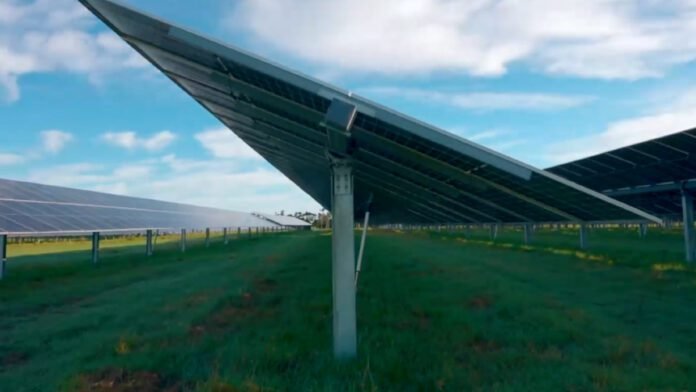
The United States is moving to impose a 15% tariff and a series of price floors on polysilicon and its derivative products, a step designed to push solar panel manufacturers toward domestic raw materials.
The proposal follows a national security investigation the US launched in July 2025 under Section 232 of the Trade Expansion Act of 1962, covering imports of polysilicon and its derivative products. Beijing has voiced opposition to the plan.
Since 2012, the US has relied on anti-dumping investigations, tariffs and tax incentives to steer Chinese solar panel makers away from China and eventually onto American soil.
The new tariffs add a final piece to that strategy, aimed at forcing these companies to use local raw materials and build a complete solar supply chain inside the US.
Some Chinese commentators have described the policy shift as a ‘pig-butchering scam,’ arguing that the Biden administration used tax credits to lure Chinese solar makers into building US factories, only for the Trump administration to slash those credits and effectively seize their investment.
The unveiling of the new tariffs coincided with China’s move to tighten its exit-entry regulations, a shift some commentators mistakenly read as a sign of national closure or a broad block on citizens leaving the country.
In fact, Beijing appears more focused on controlling its highly skilled engineers, including those with know-how in N-type solar cell technology, and preventing them from quietly joining American rivals.
Citing unnamed sources, Reuters reported on Thursday that US President Donald Trump will include minimum import prices on polysilicon, wafers, cells, modules and solar panels, along with a 15% tariff on the polysilicon derivatives.
The Chinese embassy in Washington said the US must stop the Section 232 tariff measures as soon as possible and resolve the concerns of all parties through equal dialogue.
“China firmly opposes the US overstretching the concept of national security and abusing state power to unjustifiably suppress Chinese companies,” an embassy spokesperson said. “Protectionism will not enhance US competitiveness.”
“What the US has done seriously impedes normal economic and trade exchanges between Chinese and American companies and serves the interests of no party, including American businesses and consumers,” the spokesperson said. “China will continue to firmly safeguard the lawful and legitimate rights and interests of Chinese companies.”
The Global Times, a unit of the People’s Daily, also criticized the tariff plan, citing Chinese industry experts.
Huo Jianguo, vice chairperson of the China Society for World Trade Organization Studies in Beijing, told the newspaper that the Trump administration has overstretched the concept of national security. He said Washington should avoid rash protectionist moves that serve no one’s interests, disrupt global supply chains and fail to boost US competitiveness.
Lu Jinbiao, an industry expert with the China Photovoltaic Industry Association’s expert committee, said the plan would do little to boost US polysilicon output but would raise costs for American solar manufacturers. He said the impact on Chinese producers would be limited, since their main export markets are India, Vietnam and other Southeast Asian countries.
However, many Chinese commentators acknowledge that shifts in US policy over the past decade have started shaking China’s dominant position in the global solar panel sector.
“Since last year, Chinese solar panel makers including Trina Solar, JinkoSolar and Boviet Solar have been unwinding newly built US plants. But some were put up for sale within a week of starting production,” says a Shaanxi-based columnist writing under the pen name Clear Mind. “The production lines and equipment are still there, but there’s no profit on the books, so Chinese firms end up exiting at low prices.”
“The root cause lies in tax credits,” he writes. “According to previous US policies, solar manufacturing built on American soil could enjoy tax credits covering cells, modules and other key segments, and a large module plant could save hundreds of millions of dollars a year, enough to offset high local production costs.”
He says a new federal law took effect in early July, sharply speeding up the tax credit phase-down and tightening eligibility for foreign-invested firms. He says the legislation forced most leading Chinese firms to sell out entirely or keep only a minority stake, with little chance of recovering their upfront investment.
He advises Chinese manufacturers to look closely at the long-term impact of foreign policy and government support, while keeping their production lines and market plans flexible enough to adapt if that support changes.
The US policy change refers to the One Big Beautiful Bill Act, signed into law on July 4, 2025. Under the law, solar panel makers had to have formally begun building their factories in the US before that date, July 4, 2026, to lock in the federal tax credit. Afterward they have a four-year grace period to complete the construction.
The law sets rising domestic-content thresholds for solar components. Modules sold in the US must be 50% domestically sourced in 2026, rising to 60% in 2027, 70% in 2028 and 80% in 2029. Inverters face a similar schedule, starting at 50% in 2026 and increasing five percentage points a year to reach 65% by 2029.
The law also bars tax credits for any US taxpaying entity, such as a solar plant project company or an equipment manufacturer, that qualifies as a prohibited foreign entity (PFE). A US project company falls onto that restricted list if a government, citizen, or permanent establishment of China, Russia, Iran or North Korea, or a US-sanctioned company, holds 25% or more of its equity, directly or indirectly.
Some Chinese commentators have described the policy shift as a “pig-butchering scam,” arguing that the Biden administration used tax credits to lure Chinese solar makers into building US factories, only for the Trump administration to slash those credits and effectively seize their investment.
The term describes an online scam in which victims are persuaded by a scammer (often posing as a lover) to buy investment products. The scammer disappears once the transaction is complete.
A 14-year hunt-down
China’s dominance of the global solar panel supply chain took root after the country joined the World Trade Organization (WTO) in 2001. Local governments set up scores of solar panel makers in the years that followed, and those firms gradually ate into the global market. By 2012, China already accounted for roughly 50% to 60% of global solar cell and module production. This sequence followed:
In 2012 the Obama administration imposed anti-dumping tariffs on Chinese solar products, but a major loophole let Chinese firms easily bypass them.
In 2018 Trump imposed tariffs that forced Chinese solar makers to relocate entire factories to Southeast Asia.
In 2022 the Biden administration launched the Inflation Reduction Act (IRA), subsidizing Chinese firms to build factories in the United States.
By 2025 China controlled roughly 95% to 98% of global wafer production, 85% to 92% of cell output and 80% to 85% of panel assembly. Trump dismissed the IRA as a waste of public money, imposed heavy duties on Southeast Asian-made panels and set the July 4, 2026 deadline for construction to qualify for tax credits.
“The US Commerce Department has been hunting down Chinese solar panel makers with a series of effective measures for 14 years,” says a Guangdong-based writer using the pen name Tanshuo Renjian. “Its tariffs on solar cells from Vietnam, Thailand, Malaysia and Cambodia pushed some manufacturers to move their production to Ethiopia.”
He says Ethiopia’s solar exports to the US surged from near zero to about US$300 million in the second half of last year, but then the US extended its anti-dumping probes to the African country. He says Chinese firms will find new ways to survive.
These developments may help to explain why China wants to stem the exodus of skilled workers by launching a new set of exit and entry rules effective from September 15.
Under the rules, those deemed to endanger national industrial or technological security will be barred from leaving the country, while those who have committed crimes overseas will be barred from leaving for six months to three years from the date they return to China.
Some pundits say a Chinese solar panel technician found to be working for a US firm may be barred from leaving China again after a short stay in the country, and that he would lose his US job and green card.
Anthropic will design its own hardware to power Claude
Anthropic is hiring a “custom silicon team” to design chips on which to run its models, the company has revealed.
Yesterday, Business Insider noticed a job listing for a senior engineer with experience shipping semiconductor designs. (You can see listings for a silicon engineer and a technical program manager, silicon on Anthropic’s job board right now.) A spokesperson for Anthropic then confirmed the plans to both Business Insider and TechCrunch.
The spokesperson clarified that Anthropic will still take a “multi-chip approach,” with plans to use hardware from other companies alongside its own designs as it continues to scale up.
This is confirmation of a rumor that has been circulating for a little bit; The Information previously reported that Anthropic was considering working with Samsung as a hardware manufacturing partner.
Anthropic is not alone in walking this path. Its competitor, OpenAI, recently announced a new custom chip called Jalapeño designed for large language model inference in data centers. OpenAI partnered with Broadcom to develop the chip. Google has been running its models on its own hardware for a while; Meta has also designed and deployed its own chips, and Mistral is reportedly looking into doing the same.
There are a few reasons AI providers are doing this. First, much of the industry is heavily reliant on Nvidia for the hardware the companies’ models run on, and Nvidia’s continued leverage there is a potential strategic vulnerability, especially as AI companies operate in an environment where compute infrastructure is highly competitive as demand continues to outstrip current capacity.
Second, designing chips for specific models and vice versa could lead to better performance. So, for example, if OpenAI can reap the rewards of that vertical integration, you can bet Anthropic and other frontier model providers will want that advantage as well.
To that point, Anthropic says its teams will co-design new hardware and models side by side. It has co-designed certain hardware with partners before, but the plan is now to bring more silicon expertise inside Anthropic itself.
Anthropic may also hope this could help its frontier models get some extra competitive edge as software developers and other users begin exploring running cheaper, smaller, or open-weight models on their own hardware or on edge devices.
However, since Anthropic is still in the process of hiring key team members, it will be some time before either the company or its users see any benefits.
Bruce Willis Supported by Two Assistants During Rare Church Outing
Bruce Willis made a rare public appearance this week as the beloved Hollywood star continues his heartbreaking battle with dementia.
The 71-year-old Die Hard actor was spotted outside a church at Forest Lawn in Glendale, California, on August 5, where he waited for a ride alongside two assistants.
Willis appeared calm and relaxed during the quiet outing, wearing a loose white shirt and a blue baseball cap as his companions remained close by his side.
The emotional sighting came as his wife, Emma Heming Willis, revealed she continues to struggle with feelings of guilt while caring for her husband and raising their two young daughters.
Emma, who turned 50 in June, admitted she initially did not feel comfortable celebrating the milestone birthday because of the devastating changes facing her family.
“I was unsure if I really wanted to do anything,” she told Hoda Kotb during an appearance on the Making Space podcast.
However, one of Emma’s friends encouraged her not to let such an important moment pass without marking the occasion.
“You don’t want to miss out on your 50,” Emma recalled her friend telling her. “You have to celebrate in some form or fashion.”
Emma said she eventually realized that Bruce would have wanted her to enjoy herself instead of feeling guilty for experiencing moments of happiness.
“I always wrestle with guilt,” she admitted. “I think guilt is something that I am always carrying, but I’ve learned that it is really not helpful.”
The model and dementia advocate said she often asks herself what her husband would want her to do.
“He would want me to have a big, fun bash,” she explained. “He would want me to celebrate my life with my friends and family.”
Emma ultimately decided to hold a small gathering with her mother, close friends and relatives.
Her birthday wish list was simple.
“I want to eat tacos, and I want to have a margarita. And I wanna be with my friends,” she said.
Emma added that she was thankful she decided to celebrate, describing the evening as a “really lovely, intimate night.”
Bruce and Emma married in 2009 and share daughters Mabel, 14, and Evelyn, 12.
The actor was first diagnosed with aphasia in 2022, prompting his family to announce his retirement from acting. In February 2023, they revealed that his condition had progressed and that he had been diagnosed with frontotemporal dementia.
Since then, Emma has dedicated much of her time to raising awareness about the degenerative condition while also navigating life as a caregiver.
Although Bruce now reportedly lives in a separate residence with around-the-clock support, Emma has stressed that she and the girls remain closely involved in his daily life and continue spending time with him.
Bruce also shares three adult daughters — Rumer, Scout and Tallulah — with his former wife, Demi Moore. The blended family has remained united around the actor throughout his health battle.
The church visit was one of only a handful of times Willis has been seen publicly in recent months.
In April, the action star was photographed smiling broadly while being driven around Los Angeles shortly after celebrating his 71st birthday in March.
His latest appearance offered fans another rare glimpse of the Hollywood icon as his family continues to protect his privacy and surround him with support.
Iranian parliament reviews bill to restrict Strait of Hormuz transit
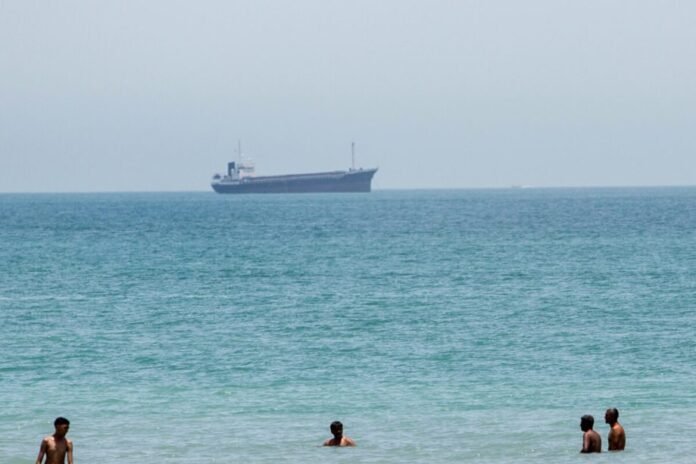
Iran’s parliament is reviewing a draft bill that would significantly tighten state control over navigation in the Strait of Hormuz and the Persian Gulf, including by banning vessels linked to the United States, Israel and other countries Tehran designates as hostile, the semi-official Tasnim News Agency reported Thursday, Anadolu reports.
Tasnim cited Abbas Salimi, a member of parliament’s presiding board, as saying the preliminary text of the Strategic Action for the Security and Sustainable Development of the Strait of Hormuz and the Persian Gulf is being reviewed by parliament’s National Security and Foreign Policy Committee.
Under the draft, vessels belonging to the United States, Israel and other countries Iran considers hostile would be barred from transiting the Strait of Hormuz.
The proposal would also prohibit the passage of military and civilian cargo linked to Israel, as well as vessels or cargo deemed to have supported operations against what Iran calls the “Axis of Resistance.”
Countries and individuals deemed responsible for causing damage to Iran would be denied permission to transit the Strait of Hormuz and the Persian Gulf until compensation is paid, according to the draft.
The bill also proposes heavy penalties for violations, including fines of up to 20% of a vessel’s cargo value.
Under the proposal, the government would be required to work with the armed forces to oversee navigation, monitor vessel movements and ensure security and environmental protection in the Persian Gulf.
Salimi said the bill remains under expert review and that parliament has invited specialists to submit recommendations before the text is finalised, according to Tasnim.
The draft comes amid heightened tensions over navigation through the Strait of Hormuz following months of regional confrontation involving Iran, the United States and Israel. During that period, Iranian officials repeatedly warned that they could restrict maritime traffic through the strategic waterway if Tehran’s security interests were threatened.
The proposal also comes as Tehran and Muscat continue negotiations on a new framework for managing navigation through the strait. The process followed an Iran-US memorandum of understanding reached in June to end the conflict, under which Iran and Oman were tasked with negotiating new arrangements for maritime traffic through the strategic waterway.
Earlier Thursday, Tasnim cited an informed Iranian Foreign Ministry source as saying the proposed framework would initially retain the existing northern and southern shipping lanes before phasing them out in favor of a centrally managed corridor.
Under the plan, inbound vessel traffic would be managed by Iran, while outbound traffic would be jointly managed by Iran and Oman after the transition, according to the report. Ships transiting the strait would pay fees for maritime services—including insurance, bunkering and environmental protection—rather than cargo-based transit tolls.
The source also rejected reports that Tehran and Muscat were divided over proposed charges of 7% or 3% of a vessel’s cargo value, saying the fees would instead depend on the scope of maritime services provided.
Suno hopes to go legit with watermarks for AI-generated music
The Internet is awash in AI content, and it’s not always easy to tell it apart from genuine human creations. While images and videos are perhaps the most obvious type of AI slop, streaming music services like Spotify are also being inundated with AI-generated tunes. Suno is one of the most prolific sources of this AI music, but the company now says it’s looking to clean up its act with watermarks and policy changes.
In a blog post announcing the plans, Suno CEO and co-founder Mikey Shulman says this is a necessary change to meet “emerging industry standards” for the labeling of AI content. Soon, the company will add watermarks to all audio outputs from its models, giving platforms the option to mark content as AI or block it entirely. Shulman doesn’t say if Suno will rely on an in-house solution or a ready-made solution like Google’s SynthID.
Google recently began licensing SynthID to other companies. Google says the tech has been used to label 60,000 years’ worth of audio generated by its Gemini models, plus more than 100 billion images and videos.
Whatever technology Suno uses, the idea is that every track it generates will have an invisible code embedded in the waveform. A detector trained on that signature will be able to identify it, allowing Suno’s partners to combat “fraud and misuse.” Shulman notes the watermarking tech Suno intends to use is “durable and resistant to tampering” without affecting quality.
However, no system is perfect. If someone does manage to break Suno’s watermarks, all the tracks produced to that point could be stripped of their AI labels. And this doesn’t solve the problem of proliferating AI music. There are other platforms that don’t have plans for watermarking, and open models could allow people to generate unlabeled AI music on their own hardware. That’s a problem with all efforts to watermark AI content.
Going legit
While much of the visual media generated by AI has flown under the legal radar, the music industry is famously litigious. Suno is being sued by Universal and Sony for copyright infringement in the US, and a German court recently found the company was violating the country’s music licensing laws. Both cases could lead to hefty fines.
Suno is also in hot water after a hack in late 2025 that showed it scraped content from YouTube, Deezer, and others to train its models. Suno did not disclose the hack, which may have included the private information of millions of users. It’s being sued in Massachusetts over that.
None of that is a good look, so it’s no surprise Suno is looking for ways to change the conversation. The company is essentially positioning itself as a tool for musicians and personal projects, not as a way to generate unlimited slop for Spotify. Shulman stresses in the blog that Suno supports the artistic process, noting that AI technology “can’t replace the human experiences, emotions, and imperfections that make music meaningful.”
That, he claims, is why Suno already has rules designed to guard against misuse. For example, Suno doesn’t allow users to include specific artists or songs in their prompts, and it partners with companies like Musixmatch to ensure people don’t upload copyrighted content to use as a base for their generative compositions. Suno has also strengthened prohibitions against this kind of misuse in an update to its usage policy.
More changes are coming, too. Last year, Suno agreed to limit downloads in a settlement with Warner Music Group. Suno is still working out the specifics, but Shulman says most users won’t be affected. However, limits on downloads, along with watermarking tracks, will apparently help to limit “large-scale abuse.”
Whether these changes will save Suno from its legal woes remains to be seen.
Kyrgyzstan’s Dordoi Bazaar, a world made from shipping containers
When I left Ainura’s container-shop at the Dordoi Bazaar in Bishkek, the capital of Kyrgyzstan, I found the market eerily quiet. I had not noticed the passing of time while she was generously sharing her life story with me.
As I walked toward the mini-bus stop at the square in front of the bazaar, the echo of her words mixed with the end-of-day soundscape at Dordoi: the heavy slam of container-shops’ metal doors and the resonant clang of heavy padlocks clicking into place.
A moment later only the sound of stray plastic wrappings, stirred up by the last vendors and customers heading home, hinted at the day’s bustling activity.
Soon, the cleaners would sweep them down the pathways between the containers and children would try to snatch the recyclables.
Answering my question about why she thinks Dordoi is a good place to work, Ainura explained: “Here in Kyrgyzstan, we can’t rely on the state. Dordoi feeds the country. It feeds our families; and it allowed me to start a new life after I had left my husband.”
Ainura is one of thousands of people – many of them women – who found a new livelihood at Dordoi after life took an unexpected turn. Estimates of people working there range from 30,000 to 150,000, depending on whether auxiliary jobs, such as food hawkers, drivers, packers and carriers are included.
In 2025, these diverse economic activities generated roughly US$7.9 million in tax revenue: a substantial contribution to the city’s public finances.
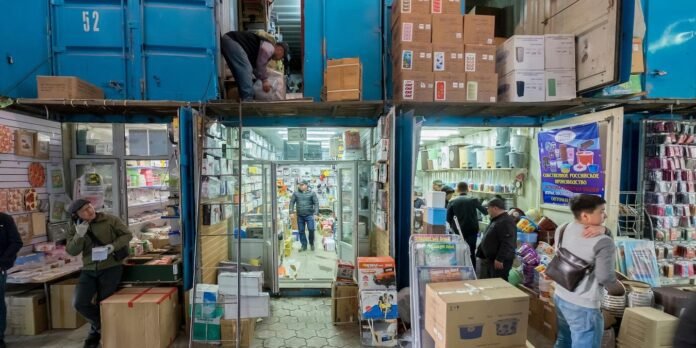
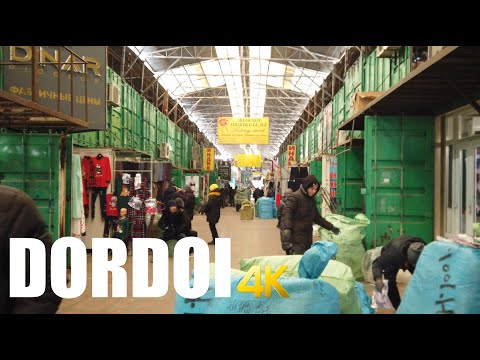
Spanning more than 100 hectares and built from up to 60,000 double and triple-stacked shipping containers, Dordoi stands as one of Kyrgyzstan’s most important economic engines since the country gained independence in 1991.
Dordoi’s main entrance in winter 2021. Photo: Claudia Eggart
More than a trading centre, Dordoi is a city within a city. Beyond shops and storage spaces, it also has currency exchanges, medical centres, a fire station, hotels, a gym, beauty salons and a mosque.
Its liveliness is equally reflected in the languages spoken along its aisles. While Russian and Kyrgyz remain the languages of commerce, Dungan, Uyghur, Uzbek, Tajik and Chinese can also be heard, revealing the extensive trading networks that converge here from across Central Asia and beyond. Traders sell almost anything that can be bought, packed and shipped – from sewing needles and refrigerators to cars and spare parts.
Yet clothing remains Dordoi’s lifeblood. Textiles, knitwear and ready-made garments dominate the trade, arriving chiefly from China and Turkey alongside an increasing volume of locally produced apparel.
A couple photographs clothing inside a fashionable Dordoi store for online sale. Photo: Claudia Eggart
At the heart of the market, the central passageway serves as both a shopping boulevard and the bazaar’s main artery. Cart pushers weave through the crowded aisles, shouting “Jol, jol, jol, jooool, daroga!” (“Make way!” in both Kyrgyz and Russian) as they maneuver heavily laden carts through the throngs of daily visitors.
Threading their way through the crowds, they deliver goods to packing stations near the long-distance bus terminal, where workers compress merchandise into tightly packed bales and sacks. Every centimeter matters in the effort to minimize shipping costs.
By midday, the pace begins to slow. The air fills with the scent of roasting meat and fresh dough as food stalls offer a culinary map of Central Asia, from Dungan laghman and Uzbek plov to Uyghur samsa.
Carriers at Dordoi have a hard job, but the money is good. Photo: Claudia Eggart
Tea vendors, coffee sellers and fruit merchants weave through the crowds, while – to my own delight – a growing number of barista coffee shops have become an increasingly visible part of the market landscape.
I began studying market biographies in 2018, at first with a focus on the emotions involved in losing a career after the collapse of the Soviet Union, but also the trauma that is often associated with the post-Soviet period. In 2019, I extended my research to include the Dordoi Bazaar in Kyrgyzstan.
Ever since, I have returned to Dordoi for extended fieldwork in 2021-22, 2024 and 2026. For my dissertation I conducted a comparative study of Dordoi and the remarkably similar container-built 7th Km Market in Odesa, Ukraine.
I am now turning that research into a book – Lived Geopolitics – which traces the history of both markets from their rise after the collapse of the Soviet Union to the consequences of Russia’s full-scale invasion of Ukraine in 2022.
From a bird’s eye view, both the Dordoi Bazaar and the 7th Kilometer in Odesa appear as vast expanses of corrugated metal.
At ground level however every container opens onto its own distinct social world. That tension between scale and intimacy is what keeps drawing me back. These markets offer a unique vantage point from which to explore how personal histories, aspirations and moral commitments intersect with abstract forces of markets, logistics and global economic and political power.
Two traders playing chess during a lull in business at Dordoi. Photo: Claudia Eggart
My research examines how people make lives, livelihoods and futures within these intersecting forces and the ways traders create pockets of stability despite recurring crises and upheaval.
The Soviet collapse
Bishkek’s Dordoi Bazaar is neither an anomaly nor a continuation of the ancient bazaars often associated with Arab cities. Its origins lie in the collapse of the Soviet Union in 1991, when countless similar markets appeared across the former socialist world. As factories closed and rapid market reforms pushed millions into economic uncertainty, large numbers of newly unemployed workers were left to seek livelihoods in the booming retail sector.
Among the most visible responses to the faltering state economy was the proliferation of “shuttle trading”: small-scale cross-border commerce in which individuals – predominantly women – transported goods, often in bulk and manually, between sites of purchase and resale. Despite the small-scale, manual character, shuttle traders supplied an estimated 75% of consumer goods to post-Soviet countries by 1996.
Mannequins lined up along a container in the eastern part of the 100-hectare Dordoi Bazaar. Photo: Claudia Eggart
Olena, one of the women I spoke to in Bishkek and a former pharmacist with family roots in Ukraine, recalled how she first entered this new world of trade in the early 1990s.
At first, she ventured to Poland, a dangerous and exhausting one-week trip in buses and trains, to buy goods at the Jarmark Europa, Warsaw’s wholesale hub, where traders from all across former Soviet countries filled their bags for retail back home.
In Poland, Olena had heard of an opportunity to buy stock from a garment factory in Indonesia. “It seemed like a once in a lifetime opportunity, so I gathered a group of eight people and we flew to Jakarta,” she said. At the airport, she remembered, border officials had never heard of a country called Kyrgyzstan. The passports were as unfamiliar as the newly independent state itself. Only after repeated trips did local authorities begin to develop a formalized visa-free entry agreement.
Like Olena, millions of ad hoc entrepreneurs traveled to unfamiliar destinations across Turkey, China, the United Arab Emirates and beyond. They bought goods where they were cheap and abundant, then carried them back to resell at home. These vast informal networks became a powerful engine of what scholars have called “globalization from below,” integrating formerly planned economies into global markets through the everyday mobility and resourcefulness of ordinary people.
Two women in container. Photo: Claudia Eggart
Nowadays, at wholesale hubs like the 7th Km Market or at the Dordoi Bazaar, goods arrive via cargo companies. Supply chains have become more complex, with prices and accessibility being ever more volatile in times of pandemics and wars. Dordoi’s extensive reach also makes trade networks highly sensitive to shifts in tariffs, exchange rates and economic conditions in its main commercial partner countries, which include but are not confined to Russia, Kazakhstan and China.
Against this backdrop of volatility, a central question has guided my research: How have local entrepreneurs managed to keep their businesses running and, with them, the market itself, despite recurring crises and long standing predictions of the markets’ decline?
‘Made in Kyrgyzstan’
One such moment of crisis came with Kyrgyzstan’s accession to the Eurasian Economic Union (EAEU) in 2015. The Russian-led bloc, comprising Russia, Kazakhstan, Belarus, Armenia and Kyrgyzstan, was designed to create a common market allowing for the free movement of goods, people and information. For Kyrgyzstan, membership meant aligning external import tariffs with EAEU rules.
This shift disrupted existing low tariff arrangements with China – the source of roughly three quarters of goods sold at Dordoi. Within a year, Damira Doolotaliyeva, the market’s trade union leader, reported a turnover drop of at least 80%. Some media outlets went so far as to warn that the collapse of Dordoi would amount to a humanitarian catastrophe.
It was during this period of uncertainty that Ainura, then in her early 30s, rented her first container. She still recalls the anxiety among Dordoi’s traders at the time. “But what choice did I have?” she asks. “I had left my husband, sold my parents’ house in southern Kyrgyzstan and moved to Bishkek with my two small children and my mother.”
The first years were difficult for her. “There were no customers,” she recalls. “Every day I prayed that I would sell just a few pieces. I had debts to repay, and I knew that a single wrong decision, a delayed delivery, or an unpaid order could push me into bankruptcy.”
After around three years, she began to breathe more easily. By 2018, Ainura had built a stable client base among wholesale traders from Russia and Kazakhstan, who valued her selection of imported underwear from Turkey. As her business grew, she invested in a small garment workshop, bringing her mother and other female relatives into the enterprise, following a pattern common across the rapidly expanding “Made in Kyrgyzstan” garment sector.
The sector flourished on the back of low tariffs on imported raw materials and an abundant supply of skilled, low-cost labour. Long associated with cheap, low-quality goods it increasingly emerged as a key pillar of the national economy after Kyrgyzstan joined the EAEU.
Just as Ainura’s business was gaining momentum, the pandemic struck. Yet contrary to expectations that trade would collapse under lockdown conditions, many samoposhiv (translates to self-sewn) producers fared unexpectedly well and even reported record sales during the pandemic. Once mobility restrictions were introduced, orders came in large volumes through WhatsApp or Telegram, thus reflecting a broader global turn toward digital platforms and e-commerce.
During my fieldwork in 2022, one woman even remarked, half jokingly, “Oh if only there was still a pandemic!” Many argued that locally produced garments now compete in style and quality with global brands such as Zara or Max Mara.
For Ainura, it meant her Telegram channel grew from 30 to 3,000 followers within days, and orders followed just as fast. She invested her entire savings in raw materials and worked at full capacity to meet the surge in demand.
Ainura’s story also speaks to the skill and willingness to take risks that characterize many of the women entrepreneurs I have met over the years.
She drew my attention to something else as well: The financial independence that Dordoi made possible was, for many, a means of leaving abusive relationships and rebuilding their lives.
Two women chat outside their market stalls. Photo: Claudia Eggart
While she asked me to keep the intimate details of her own experience private, she encouraged me to write about a different dimension of the bazaar: that, despite its hardships, it can be an empowering space where women earn the resources needed to support themselves and their children.
A whole world in miniature
Since emerging amid the socio-economic and political upheaval of the early 1990s, Dordoi has prospered by occupying the space between major economic spheres – most notably China, Russia and Turkey.
This position has created an opportunity structure in which traders profit from differences in availability, regulations and prices across borders. These geopolitical distinctions are mapped onto the market itself through sections known as Europe and China. Yet these labels signify less about geography than about value. Evropa (Europe) is home to traders selling higher-end goods, often, though not exclusively, textiles labelled “Made in Turkey.” The contrast reflects a broader hierarchy of value.
Evropa evokes quality and higher prices, while Kitai (China) refers to the world of shirpotreb: inexpensive, mass-produced consumer goods distributed at scale by Chinese wholesalers and Kyrgyz retailers.
But these categories are far from fixed. Zoja, one of the most memorable market characters whose age is impossible to guess, told me:
The bazaar is a miniature version of the world we live in, and Kitai has long surpassed Evropa.
As we walk down the bazaar’s central pathway she weaves nonchalantly left and right signaling toward different market sections and their role in the wider web of market relations. I am struggling to keep pace as she moves through the bazaar’s aisles with the ease of someone who is both entirely at home and slightly above the place, greeting vendors here and there while barely slowing her stride. Her hair is immaculately blow dried, her nails freshly done. A trace of expensive perfume envelopes me as we walk to her container.
Zoja’s container is unlike most others. It sits in a secluded corner of Dordoi, where entrances are hidden behind heavy curtains that block the view from passing eyes. The effect is stunning as it creates a surprising sense of intimacy amid the bazaar’s constant bustle.
Located in the very center, this row is widely understood as the place “where real money is made” – an observation uttered in a wistful tone when speaking with those whose business is in more remote areas, and reluctantly confirmed by those who are lucky enough to sit in the thick of it.
Like its owner, the container is meticulously curated. Everything appears carefully chosen, elegant and expensive.
Zoja’s container deluxe. Photo: Claudia Eggart
As I settle onto a comfortable chaise longue, I remark on the unusually refined interior. Zoja smiles faintly and asks whether markets like Dordoi exist in Germany. Surely, she muses, shops in Europe must be even more luxurious than hers? Then, rather unexpectedly, she says with an almost tender undertone: “But you know, I wouldn’t like to give up my dvatsattonnyk.” Dvatsattonnyk, translates to “20-tonner”, but it actually refers to the 20ft measure of the standard shipping container, not its weight.
I asked Zoja if she knew how she became successful? Did she have an instinct for future trends? But the question itself immediately marked me as an outsider. “Only someone new to this business would call it luck or intuition,” Zoja pushed back. “I have worked hard, thought big and planned long term. Thanks to this, my family has good cars, nice houses and we can live well in Kyrgyzstan. But it is not easy to get there.”
Since gaining independence in 1991, Kyrgyzstan has experienced repeated political upheavals, including popular uprisings, changes of government and periods of ethnic violence. These episodes, combined with recurring economic crises, have created an environment of persistent uncertainty for businesses and households alike.
Against this background, Zoja came to the conclusion that “only a container of my own could secure a stable income.”
Dordoi’s containers are a funny thing. More than trading spaces, they function as assets in their own right.
Depending on location, they are traded for well over US$150,000, generating income not only through trade but through subletting as well. By 2023, prime containers fetched as much as US$250,000, and monthly rents reached US$3,000. By April 2026, prices had fallen to between US$80,000 and $150,000. Traders link this drop to the wider effects of Russia’s invasion of Ukraine. When demand from Russia slows, Dordoi feels it quickly. This shows how volatile the business really is.
Just like in other urban environments, inequalities at Dordoi are stark. While entrepreneurs like Zoja spend sums comparable to the price of a detached house in a desirable district of Bishkek, many struggle to afford rents in the market’s less profitable corners. But these inequalities have produced their own adaptations. Location is everything. Sometimes a container is shared among several entrepreneurs, while other containers are move repeatedly in search of better-connected rows and higher footfall.
A store in the Junghai Market, a Chinese dominated part of Dordoi where household appliances and electronics are sold. Photo: Claudia Eggart
One trader told me her family sold their home during the pandemic to buy a container and rebuild their business. Others spent years working abroad, often in Russia, saving enough to secure a place in Dordoi’s dense commercial network. Despite all insecurities, Dordoi, as Ainura put it, “gives us hope, hope that we can build something here.”
Government modernization drive
That prevailing sense of hope has recently been unsettled. In April 2026, President Sadyr Japarov summoned Askar Salymbekov to deliver a public reprimand: The market’s iconic “container empire” had failed to modernisz.
Salymbekov, 71, is the man who had bought the land and put the first containers on it to build what has turned into the largest retail hub in Central Asia. Questioning whether the long-serving owner had grown “old and stingy,” Japarov argued that the bazaar should have long ago been redeveloped into a sleek complex like the ones he had seen in “Dubai or Istanbul.”
While his claim that years spent laboring in cramped container shops can take a toll on traders’ health is not unfounded, challenging Salymbekov strikes at a delicate nerve. As the founder of one of Kyrgyzstan’s most vibrant economic engines, he is considered something akin to a national hero. Besides, in a society where deference to elders is the norm, such remarks carry immense weight, if not risk.
Japarov’s ultimatum arrived against the backdrop of a booming economy. Kyrgyzstan recorded a staggering real GDP growth rate of 11.1% in 2025.
Regardless, the current government sees this moment as a pivotal opportunity to shed the image of a poor, landlocked, mountainous nation and reposition itself as a central node in China’s Belt and Road Initiative.
As several gigantic warehouse complexes are planned through co-funding from the Silk Road Fund, Japarov’s vision of transforming Dordoi into a semi-digitalized, futuristic retail hub begins to look less like mere ostentation and more like an ambitious but not impossible strategy.
Long live Dordoi!
At Dordoi today, future and past collide. While the market clings to archaic traditions, like burning juniper to ward off bad spirits, it is simultaneously being reshaped by digital platforms.
A new generation of baiery (Russian for buyers) no longer rents physical containers; instead, they act as intermediaries, sourcing goods from Dordoi to sell them via Instagram, or Russian-led online marketplaces like Ozon or Wildberries.
Saturday at Dordoi’s central street. Photo: Claudia Eggart
Aiza, one such baier, explains the appeal of this model: “Before, costumers from Russia and Kazakhstan came to us, but since the pandemic they prefer to buy online.”
Yet, even this digital evolution remains tethered to the physical bazaar; without walking the floors to find and select goods, e-commerce cannot function. So Dordoi, for the time being, maintains its unique position as “the region’s largest showroom,” – a metaphor many state with pride.
This hybrid reality challenges the view of bazaars as mere relics of a transitional era. Critics often dismiss their informality, particularly regarding taxation and intellectual property, as a failure to modernize.
But Dordoi traders also remind me that the distinction between the informal and formal economy is rather ambiguous and hardly unique to Central Asia. “Do multinational businesses in Germany pay as much taxes as they should?” as some asked.
The issue is not whether informal markets fit a western ideal of order. It is what their survival strategies tell us about making a living amid capitalist crises and geopolitical ruptures.
In this sense, Ainura’s story, like many others I encountered during years of research at Dordoi, are not exceptional. They point to the broader principle of endurance through adaptation.
Traders continually recalibrate to shifting regulations, fluctuating trade routes, changing consumer demand and periodic economic shocks. In doing so, they provide what a formal economy often cannot – services, work, credit and practical forms of support that extend far beyond the acts of buying and selling.
But Dordoi matters for something more interesting than its survival economies. Its significance lies in its capacity to coordinate economic life across a vast network of traders, suppliers, transporters and customers while at the same time, every container offers a glimpse into the ways in which ordinary people produce a sense of conviviality and stability in a world increasingly hostile to both.
I was on my way out when Ainura called after me. I turned back and she said: “We really like to work here…. We love Dordoi.”
Houthi Missile, Drone Attack Kills 45 Yemeni Government Troops, Injures Dozens More
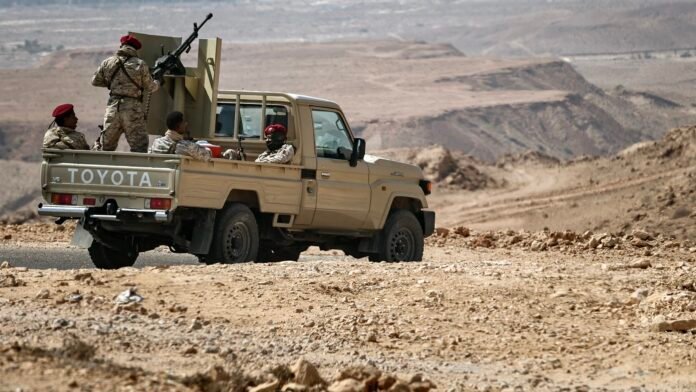
Yemen’s internationally recognized government vowed to retaliate after Houthi forces launched missile and drone attacks Thursday on military positions in Marib and Hadhramaut, killing at least 45 government troops and wounding about 80, according to Yemeni officials and Al Arabiya.
The country’s Defense Ministry described the assault as a “treacherous attack” targeting armed forces camps and units with ballistic missiles and drones: “[We] will respond to the Houthis’ aggression at the appropriate place and time,” the ministry said in a statement.
Yemeni military sources told Al Arabiya English that at least 45 government soldiers were killed in the strikes, which hit camps belonging to Saudi-backed government forces, primarily Emergency Forces units.
The same sources said around 80 wounded personnel were receiving treatment at hospitals in Marib and Seiyun. Witnesses reported that the Houthis fired eight missiles from the Al-Mahzamat mountains in Al-Jawf province during the attack.
Multiple army camps and units, including emergency-force positions, were struck, resulting in casualties and material damage, according to The leadership of the First Emergency Division. The attack followed what it described as recent security and military successes by government forces in securing areas and international roads and pursuing smuggling gangs, bandits, and criminal cells.
In a separate statement, the Houthi Armed Forces claimed responsibility for what it called a “large-scale and precise military operation” targeting Saudi troop concentrations in Al-Ruwaik, Al-Abr, and Al-Thaniyah, as well as camps belonging to what it referred to as the First and Third Emergency Divisions. The Houthis said the operation involved ballistic missiles and drones.
The Houthi statement also warned against further Saudi military action and said the group would continue what it called a “siege for siege” policy until what it describes as the siege on Yemen is lifted.
Sweden’s top court clears way for transfer of seized ship to Ukraine
Sweden’s top court said on Thursday it has upheld a ruling that a cargo vessel seized in the Baltic Sea this year can be handed over to Ukraine, where it is suspected of illegally transporting grain from Russian-occupied territory.
The supreme court dismissed an appeal from the owners of the Caffa vessel, which was seized in March off southern Sweden on suspicion of sailing under a false flag and of violating maritime and ship safety laws due to a lack of seaworthiness.
Ukraine has sought the ship as part of a probe into suspected war crimes involving the appropriation and removal of property from Russian-occupied territory.
Lower Swedish courts said those alleged actions could constitute a war crime under Swedish law, meaning Sweden could transfer the vessel and related evidence to Ukraine.
“The Supreme Court does not grant leave to appeal. The Court of Appeal’s decision is therefore final,” the supreme court said in a ruling dated August 4.
Most of the 11 crew members on Caffa, which is owned by Caffa Shipping Limited, were Russian, police said at the time of the seizure.
X wants to keep suing advertisers, asks 5th Circuit to overrule district judge
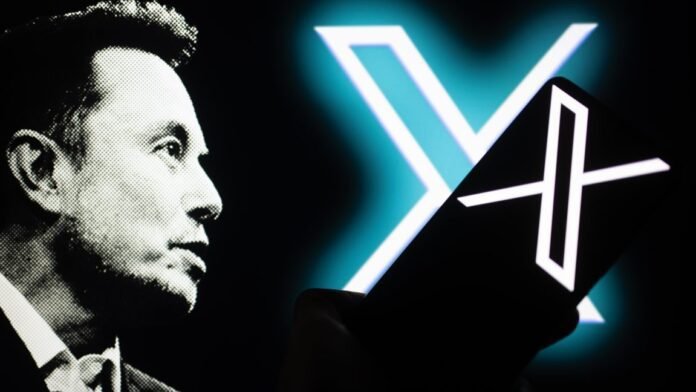
Elon Musk’s X is trying to revive a lawsuit against advertisers it’s accusing of illegally boycotting the social media platform, despite previously reaching a settlement to end litigation against an ad-industry trade group.
“This case involves an unusually brazen group boycott,” X said in a filing yesterday. “That misconduct has drawn the attention of regulators and Congress. There is no valid reason that this effort by the direct victim to recover its massive economic losses from that boycott should not move forward.”
X’s lawsuit was thrown out in March when US District Judge Jane Boyle in the Northern District of Texas ruled that advertisers did not commit any antitrust violation. Last week, Musk reached a settlement with the World Federation of Advertisers, the first defendant named in the lawsuit.
But Musk’s lawsuit had other defendants: Mars, Incorporated; CVS Health; Nestle; Abbott Laboratories; Colgate-Palmolive; Lego; Pinterest; Tyson Foods; Shell; and Ørsted A/S. While X agreed to dismiss the World Federation of Advertisers from the case, it urged the US Court of Appeals for the 5th Circuit to revive the suit with respect to the other defendants.
The boycott “injured X and competition in that market, allowing other social-media platforms to charge rates above truly competitive pricing,” the company said. “Especially in light of the power defendants wield within the market, their agreement to boycott X cannot be characterized as anything other than an unreasonable restraint on trade.”
Judge: Losing to competitors is not antitrust injury
Boyle’s decision dismissing Musk’s lawsuit said the “only harm X has asserted is that its customers collectively chose X’s competitors over X.” Boyle, a George W. Bush appointee, cited a precedent that a loss from competition itself does not constitute an antitrust injury. “Therefore, although a group boycott is alleged, there is no antitrust violation here,” she wrote.
Asking the 5th Circuit to reverse Boyle, X argued that advertisers colluded to boycott X, “eliminat[ing] the independent decision-making that would otherwise force each firm to weigh the competitive benefits of continuing to advertise on the platform, suppressing competitive rivalries and insulating the boycott from market forces. The group boycott targeting X thus distorts competition in multiple markets in clear contravention of the antitrust laws.”
X’s claims relate to the Global Alliance for Responsible Media (GARM), an initiative by the World Federation of Advertisers to define violent and obscene content and help advertisers create brand-safety guidelines. The ad industry shut down Garm after Musk filed the lawsuit in 2024, though law professors described X’s legal case as a weak one.
X’s filing yesterday said that GARM “exercised collective power through its rules for membership. As a condition of joining GARM, members agree[d] to adopt GARM solutions to improve business operations.’ For GARM’s advertiser and advertising agency members, that meant agreeing to enforce the implementation of the Brand Safety Standards by the social-media platforms from which they purchased advertising.”
X’s big ad revenue drop
X, then called Twitter, suffered a large drop in advertising revenue after Musk bought the company in October 2022 and made major changes to content moderation. Advertisers stayed away, worried that ads would appear next to antisemitic posts, misinformation, and other objectionable content.
Specific numbers on X ad revenue were hard to come by the past few years because Musk took the company private when he bought Twitter. But X Corp. is now a subsidiary of SpaceX, which recently went public and must report earnings.
SpaceX’s earnings report this week said the company made $367 million in advertising revenue in Q2 2026, down from $426 million in Q2 2025. For the first six months of 2026, ad revenue was $710 million, down from $870 million in the first six months of 2025.
Twitter reported much higher ad revenue before being bought by Musk. “X’s current quarterly ad revenue has dropped even more drastically compared to the last quarter before Musk bought the popular social-media platform,” MediaPost reported. “In the second quarter of 2022, Twitter reported $1.08 billion in ad revenue, roughly $713 million more than Q2 2026.”
China’s bamboo growth model vs. India’s eucalyptus growth model
Nature offers unexpectedly good lessons in strategy. As a child, I was fond of bamboo shoots, though none grew in our farmland. My mother, noticing my enthusiasm, suggested that I plant some myself. A neighbor gave me a stalk about three feet tall, which I planted, watered and fussed over. Nothing happened. A year passed […]