Iranian parliament reviews bill to restrict Strait of Hormuz transit
Iran’s parliament is reviewing a draft bill that would significantly tighten state control over navigation in the Strait of Hormuz and the Persian Gulf, including by banning vessels linked to the United States, Israel and other countries Tehran designates as hostile, the semi-official Tasnim News Agency reported Thursday, Anadolu reports.
Tasnim cited Abbas Salimi, a member of parliament’s presiding board, as saying the preliminary text of the Strategic Action for the Security and Sustainable Development of the Strait of Hormuz and the Persian Gulf is being reviewed by parliament’s National Security and Foreign Policy Committee.
Under the draft, vessels belonging to the United States, Israel and other countries Iran considers hostile would be barred from transiting the Strait of Hormuz.
The proposal would also prohibit the passage of military and civilian cargo linked to Israel, as well as vessels or cargo deemed to have supported operations against what Iran calls the “Axis of Resistance.”
Countries and individuals deemed responsible for causing damage to Iran would be denied permission to transit the Strait of Hormuz and the Persian Gulf until compensation is paid, according to the draft.
The bill also proposes heavy penalties for violations, including fines of up to 20% of a vessel’s cargo value.
Under the proposal, the government would be required to work with the armed forces to oversee navigation, monitor vessel movements and ensure security and environmental protection in the Persian Gulf.
Salimi said the bill remains under expert review and that parliament has invited specialists to submit recommendations before the text is finalised, according to Tasnim.
The draft comes amid heightened tensions over navigation through the Strait of Hormuz following months of regional confrontation involving Iran, the United States and Israel. During that period, Iranian officials repeatedly warned that they could restrict maritime traffic through the strategic waterway if Tehran’s security interests were threatened.
The proposal also comes as Tehran and Muscat continue negotiations on a new framework for managing navigation through the strait. The process followed an Iran-US memorandum of understanding reached in June to end the conflict, under which Iran and Oman were tasked with negotiating new arrangements for maritime traffic through the strategic waterway.
Earlier Thursday, Tasnim cited an informed Iranian Foreign Ministry source as saying the proposed framework would initially retain the existing northern and southern shipping lanes before phasing them out in favor of a centrally managed corridor.
Under the plan, inbound vessel traffic would be managed by Iran, while outbound traffic would be jointly managed by Iran and Oman after the transition, according to the report. Ships transiting the strait would pay fees for maritime services—including insurance, bunkering and environmental protection—rather than cargo-based transit tolls.
The source also rejected reports that Tehran and Muscat were divided over proposed charges of 7% or 3% of a vessel’s cargo value, saying the fees would instead depend on the scope of maritime services provided.
Suno hopes to go legit with watermarks for AI-generated music
The Internet is awash in AI content, and it’s not always easy to tell it apart from genuine human creations. While images and videos are perhaps the most obvious type of AI slop, streaming music services like Spotify are also being inundated with AI-generated tunes. Suno is one of the most prolific sources of this AI music, but the company now says it’s looking to clean up its act with watermarks and policy changes.
In a blog post announcing the plans, Suno CEO and co-founder Mikey Shulman says this is a necessary change to meet “emerging industry standards” for the labeling of AI content. Soon, the company will add watermarks to all audio outputs from its models, giving platforms the option to mark content as AI or block it entirely. Shulman doesn’t say if Suno will rely on an in-house solution or a ready-made solution like Google’s SynthID.
Google recently began licensing SynthID to other companies. Google says the tech has been used to label 60,000 years’ worth of audio generated by its Gemini models, plus more than 100 billion images and videos.
Whatever technology Suno uses, the idea is that every track it generates will have an invisible code embedded in the waveform. A detector trained on that signature will be able to identify it, allowing Suno’s partners to combat “fraud and misuse.” Shulman notes the watermarking tech Suno intends to use is “durable and resistant to tampering” without affecting quality.
However, no system is perfect. If someone does manage to break Suno’s watermarks, all the tracks produced to that point could be stripped of their AI labels. And this doesn’t solve the problem of proliferating AI music. There are other platforms that don’t have plans for watermarking, and open models could allow people to generate unlabeled AI music on their own hardware. That’s a problem with all efforts to watermark AI content.
Going legit
While much of the visual media generated by AI has flown under the legal radar, the music industry is famously litigious. Suno is being sued by Universal and Sony for copyright infringement in the US, and a German court recently found the company was violating the country’s music licensing laws. Both cases could lead to hefty fines.
Suno is also in hot water after a hack in late 2025 that showed it scraped content from YouTube, Deezer, and others to train its models. Suno did not disclose the hack, which may have included the private information of millions of users. It’s being sued in Massachusetts over that.
None of that is a good look, so it’s no surprise Suno is looking for ways to change the conversation. The company is essentially positioning itself as a tool for musicians and personal projects, not as a way to generate unlimited slop for Spotify. Shulman stresses in the blog that Suno supports the artistic process, noting that AI technology “can’t replace the human experiences, emotions, and imperfections that make music meaningful.”
That, he claims, is why Suno already has rules designed to guard against misuse. For example, Suno doesn’t allow users to include specific artists or songs in their prompts, and it partners with companies like Musixmatch to ensure people don’t upload copyrighted content to use as a base for their generative compositions. Suno has also strengthened prohibitions against this kind of misuse in an update to its usage policy.
More changes are coming, too. Last year, Suno agreed to limit downloads in a settlement with Warner Music Group. Suno is still working out the specifics, but Shulman says most users won’t be affected. However, limits on downloads, along with watermarking tracks, will apparently help to limit “large-scale abuse.”
Whether these changes will save Suno from its legal woes remains to be seen.
Kyrgyzstan’s Dordoi Bazaar, a world made from shipping containers
When I left Ainura’s container-shop at the Dordoi Bazaar in Bishkek, the capital of Kyrgyzstan, I found the market eerily quiet. I had not noticed the passing of time while she was generously sharing her life story with me.
As I walked toward the mini-bus stop at the square in front of the bazaar, the echo of her words mixed with the end-of-day soundscape at Dordoi: the heavy slam of container-shops’ metal doors and the resonant clang of heavy padlocks clicking into place.
A moment later only the sound of stray plastic wrappings, stirred up by the last vendors and customers heading home, hinted at the day’s bustling activity.
Soon, the cleaners would sweep them down the pathways between the containers and children would try to snatch the recyclables.
Answering my question about why she thinks Dordoi is a good place to work, Ainura explained: “Here in Kyrgyzstan, we can’t rely on the state. Dordoi feeds the country. It feeds our families; and it allowed me to start a new life after I had left my husband.”
Ainura is one of thousands of people – many of them women – who found a new livelihood at Dordoi after life took an unexpected turn. Estimates of people working there range from 30,000 to 150,000, depending on whether auxiliary jobs, such as food hawkers, drivers, packers and carriers are included.
In 2025, these diverse economic activities generated roughly US$7.9 million in tax revenue: a substantial contribution to the city’s public finances.
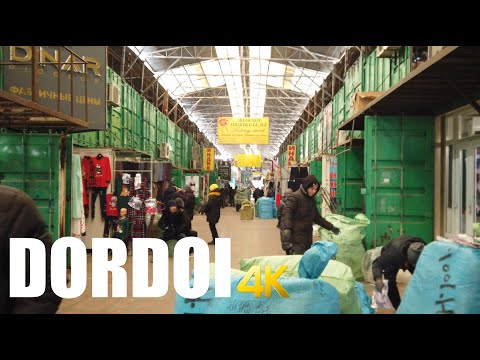
Spanning more than 100 hectares and built from up to 60,000 double and triple-stacked shipping containers, Dordoi stands as one of Kyrgyzstan’s most important economic engines since the country gained independence in 1991.
Dordoi’s main entrance in winter 2021. Photo: Claudia Eggart
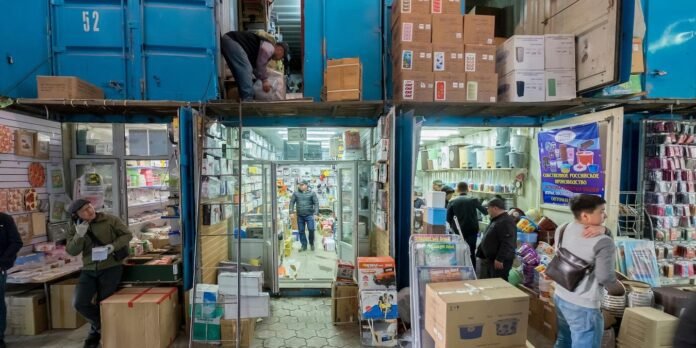
More than a trading centre, Dordoi is a city within a city. Beyond shops and storage spaces, it also has currency exchanges, medical centres, a fire station, hotels, a gym, beauty salons and a mosque.
Its liveliness is equally reflected in the languages spoken along its aisles. While Russian and Kyrgyz remain the languages of commerce, Dungan, Uyghur, Uzbek, Tajik and Chinese can also be heard, revealing the extensive trading networks that converge here from across Central Asia and beyond. Traders sell almost anything that can be bought, packed and shipped – from sewing needles and refrigerators to cars and spare parts.
Yet clothing remains Dordoi’s lifeblood. Textiles, knitwear and ready-made garments dominate the trade, arriving chiefly from China and Turkey alongside an increasing volume of locally produced apparel.
A couple photographs clothing inside a fashionable Dordoi store for online sale. Photo: Claudia Eggart
At the heart of the market, the central passageway serves as both a shopping boulevard and the bazaar’s main artery. Cart pushers weave through the crowded aisles, shouting “Jol, jol, jol, jooool, daroga!” (“Make way!” in both Kyrgyz and Russian) as they maneuver heavily laden carts through the throngs of daily visitors.
Threading their way through the crowds, they deliver goods to packing stations near the long-distance bus terminal, where workers compress merchandise into tightly packed bales and sacks. Every centimeter matters in the effort to minimize shipping costs.
By midday, the pace begins to slow. The air fills with the scent of roasting meat and fresh dough as food stalls offer a culinary map of Central Asia, from Dungan laghman and Uzbek plov to Uyghur samsa.
Carriers at Dordoi have a hard job, but the money is good. Photo: Claudia Eggart
Tea vendors, coffee sellers and fruit merchants weave through the crowds, while – to my own delight – a growing number of barista coffee shops have become an increasingly visible part of the market landscape.
I began studying market biographies in 2018, at first with a focus on the emotions involved in losing a career after the collapse of the Soviet Union, but also the trauma that is often associated with the post-Soviet period. In 2019, I extended my research to include the Dordoi Bazaar in Kyrgyzstan.
Ever since, I have returned to Dordoi for extended fieldwork in 2021-22, 2024 and 2026. For my dissertation I conducted a comparative study of Dordoi and the remarkably similar container-built 7th Km Market in Odesa, Ukraine.
I am now turning that research into a book – Lived Geopolitics – which traces the history of both markets from their rise after the collapse of the Soviet Union to the consequences of Russia’s full-scale invasion of Ukraine in 2022.
From a bird’s eye view, both the Dordoi Bazaar and the 7th Kilometer in Odesa appear as vast expanses of corrugated metal.
At ground level however every container opens onto its own distinct social world. That tension between scale and intimacy is what keeps drawing me back. These markets offer a unique vantage point from which to explore how personal histories, aspirations and moral commitments intersect with abstract forces of markets, logistics and global economic and political power.
Two traders playing chess during a lull in business at Dordoi. Photo: Claudia Eggart
My research examines how people make lives, livelihoods and futures within these intersecting forces and the ways traders create pockets of stability despite recurring crises and upheaval.
The Soviet collapse
Bishkek’s Dordoi Bazaar is neither an anomaly nor a continuation of the ancient bazaars often associated with Arab cities. Its origins lie in the collapse of the Soviet Union in 1991, when countless similar markets appeared across the former socialist world. As factories closed and rapid market reforms pushed millions into economic uncertainty, large numbers of newly unemployed workers were left to seek livelihoods in the booming retail sector.
Among the most visible responses to the faltering state economy was the proliferation of “shuttle trading”: small-scale cross-border commerce in which individuals – predominantly women – transported goods, often in bulk and manually, between sites of purchase and resale. Despite the small-scale, manual character, shuttle traders supplied an estimated 75% of consumer goods to post-Soviet countries by 1996.
Mannequins lined up along a container in the eastern part of the 100-hectare Dordoi Bazaar. Photo: Claudia Eggart
Olena, one of the women I spoke to in Bishkek and a former pharmacist with family roots in Ukraine, recalled how she first entered this new world of trade in the early 1990s.
At first, she ventured to Poland, a dangerous and exhausting one-week trip in buses and trains, to buy goods at the Jarmark Europa, Warsaw’s wholesale hub, where traders from all across former Soviet countries filled their bags for retail back home.
In Poland, Olena had heard of an opportunity to buy stock from a garment factory in Indonesia. “It seemed like a once in a lifetime opportunity, so I gathered a group of eight people and we flew to Jakarta,” she said. At the airport, she remembered, border officials had never heard of a country called Kyrgyzstan. The passports were as unfamiliar as the newly independent state itself. Only after repeated trips did local authorities begin to develop a formalized visa-free entry agreement.
Like Olena, millions of ad hoc entrepreneurs traveled to unfamiliar destinations across Turkey, China, the United Arab Emirates and beyond. They bought goods where they were cheap and abundant, then carried them back to resell at home. These vast informal networks became a powerful engine of what scholars have called “globalization from below,” integrating formerly planned economies into global markets through the everyday mobility and resourcefulness of ordinary people.
Two women in container. Photo: Claudia Eggart
Nowadays, at wholesale hubs like the 7th Km Market or at the Dordoi Bazaar, goods arrive via cargo companies. Supply chains have become more complex, with prices and accessibility being ever more volatile in times of pandemics and wars. Dordoi’s extensive reach also makes trade networks highly sensitive to shifts in tariffs, exchange rates and economic conditions in its main commercial partner countries, which include but are not confined to Russia, Kazakhstan and China.
Against this backdrop of volatility, a central question has guided my research: How have local entrepreneurs managed to keep their businesses running and, with them, the market itself, despite recurring crises and long standing predictions of the markets’ decline?
‘Made in Kyrgyzstan’
One such moment of crisis came with Kyrgyzstan’s accession to the Eurasian Economic Union (EAEU) in 2015. The Russian-led bloc, comprising Russia, Kazakhstan, Belarus, Armenia and Kyrgyzstan, was designed to create a common market allowing for the free movement of goods, people and information. For Kyrgyzstan, membership meant aligning external import tariffs with EAEU rules.
This shift disrupted existing low tariff arrangements with China – the source of roughly three quarters of goods sold at Dordoi. Within a year, Damira Doolotaliyeva, the market’s trade union leader, reported a turnover drop of at least 80%. Some media outlets went so far as to warn that the collapse of Dordoi would amount to a humanitarian catastrophe.
It was during this period of uncertainty that Ainura, then in her early 30s, rented her first container. She still recalls the anxiety among Dordoi’s traders at the time. “But what choice did I have?” she asks. “I had left my husband, sold my parents’ house in southern Kyrgyzstan and moved to Bishkek with my two small children and my mother.”
The first years were difficult for her. “There were no customers,” she recalls. “Every day I prayed that I would sell just a few pieces. I had debts to repay, and I knew that a single wrong decision, a delayed delivery, or an unpaid order could push me into bankruptcy.”
After around three years, she began to breathe more easily. By 2018, Ainura had built a stable client base among wholesale traders from Russia and Kazakhstan, who valued her selection of imported underwear from Turkey. As her business grew, she invested in a small garment workshop, bringing her mother and other female relatives into the enterprise, following a pattern common across the rapidly expanding “Made in Kyrgyzstan” garment sector.
The sector flourished on the back of low tariffs on imported raw materials and an abundant supply of skilled, low-cost labour. Long associated with cheap, low-quality goods it increasingly emerged as a key pillar of the national economy after Kyrgyzstan joined the EAEU.
Just as Ainura’s business was gaining momentum, the pandemic struck. Yet contrary to expectations that trade would collapse under lockdown conditions, many samoposhiv (translates to self-sewn) producers fared unexpectedly well and even reported record sales during the pandemic. Once mobility restrictions were introduced, orders came in large volumes through WhatsApp or Telegram, thus reflecting a broader global turn toward digital platforms and e-commerce.
During my fieldwork in 2022, one woman even remarked, half jokingly, “Oh if only there was still a pandemic!” Many argued that locally produced garments now compete in style and quality with global brands such as Zara or Max Mara.
For Ainura, it meant her Telegram channel grew from 30 to 3,000 followers within days, and orders followed just as fast. She invested her entire savings in raw materials and worked at full capacity to meet the surge in demand.
Ainura’s story also speaks to the skill and willingness to take risks that characterize many of the women entrepreneurs I have met over the years.
She drew my attention to something else as well: The financial independence that Dordoi made possible was, for many, a means of leaving abusive relationships and rebuilding their lives.
Two women chat outside their market stalls. Photo: Claudia Eggart
While she asked me to keep the intimate details of her own experience private, she encouraged me to write about a different dimension of the bazaar: that, despite its hardships, it can be an empowering space where women earn the resources needed to support themselves and their children.
A whole world in miniature
Since emerging amid the socio-economic and political upheaval of the early 1990s, Dordoi has prospered by occupying the space between major economic spheres – most notably China, Russia and Turkey.
This position has created an opportunity structure in which traders profit from differences in availability, regulations and prices across borders. These geopolitical distinctions are mapped onto the market itself through sections known as Europe and China. Yet these labels signify less about geography than about value. Evropa (Europe) is home to traders selling higher-end goods, often, though not exclusively, textiles labelled “Made in Turkey.” The contrast reflects a broader hierarchy of value.
Evropa evokes quality and higher prices, while Kitai (China) refers to the world of shirpotreb: inexpensive, mass-produced consumer goods distributed at scale by Chinese wholesalers and Kyrgyz retailers.
But these categories are far from fixed. Zoja, one of the most memorable market characters whose age is impossible to guess, told me:
The bazaar is a miniature version of the world we live in, and Kitai has long surpassed Evropa.
As we walk down the bazaar’s central pathway she weaves nonchalantly left and right signaling toward different market sections and their role in the wider web of market relations. I am struggling to keep pace as she moves through the bazaar’s aisles with the ease of someone who is both entirely at home and slightly above the place, greeting vendors here and there while barely slowing her stride. Her hair is immaculately blow dried, her nails freshly done. A trace of expensive perfume envelopes me as we walk to her container.
Zoja’s container is unlike most others. It sits in a secluded corner of Dordoi, where entrances are hidden behind heavy curtains that block the view from passing eyes. The effect is stunning as it creates a surprising sense of intimacy amid the bazaar’s constant bustle.
Located in the very center, this row is widely understood as the place “where real money is made” – an observation uttered in a wistful tone when speaking with those whose business is in more remote areas, and reluctantly confirmed by those who are lucky enough to sit in the thick of it.
Like its owner, the container is meticulously curated. Everything appears carefully chosen, elegant and expensive.
Zoja’s container deluxe. Photo: Claudia Eggart
As I settle onto a comfortable chaise longue, I remark on the unusually refined interior. Zoja smiles faintly and asks whether markets like Dordoi exist in Germany. Surely, she muses, shops in Europe must be even more luxurious than hers? Then, rather unexpectedly, she says with an almost tender undertone: “But you know, I wouldn’t like to give up my dvatsattonnyk.” Dvatsattonnyk, translates to “20-tonner”, but it actually refers to the 20ft measure of the standard shipping container, not its weight.
I asked Zoja if she knew how she became successful? Did she have an instinct for future trends? But the question itself immediately marked me as an outsider. “Only someone new to this business would call it luck or intuition,” Zoja pushed back. “I have worked hard, thought big and planned long term. Thanks to this, my family has good cars, nice houses and we can live well in Kyrgyzstan. But it is not easy to get there.”
Since gaining independence in 1991, Kyrgyzstan has experienced repeated political upheavals, including popular uprisings, changes of government and periods of ethnic violence. These episodes, combined with recurring economic crises, have created an environment of persistent uncertainty for businesses and households alike.
Against this background, Zoja came to the conclusion that “only a container of my own could secure a stable income.”
Dordoi’s containers are a funny thing. More than trading spaces, they function as assets in their own right.
Depending on location, they are traded for well over US$150,000, generating income not only through trade but through subletting as well. By 2023, prime containers fetched as much as US$250,000, and monthly rents reached US$3,000. By April 2026, prices had fallen to between US$80,000 and $150,000. Traders link this drop to the wider effects of Russia’s invasion of Ukraine. When demand from Russia slows, Dordoi feels it quickly. This shows how volatile the business really is.
Just like in other urban environments, inequalities at Dordoi are stark. While entrepreneurs like Zoja spend sums comparable to the price of a detached house in a desirable district of Bishkek, many struggle to afford rents in the market’s less profitable corners. But these inequalities have produced their own adaptations. Location is everything. Sometimes a container is shared among several entrepreneurs, while other containers are move repeatedly in search of better-connected rows and higher footfall.
A store in the Junghai Market, a Chinese dominated part of Dordoi where household appliances and electronics are sold. Photo: Claudia Eggart
One trader told me her family sold their home during the pandemic to buy a container and rebuild their business. Others spent years working abroad, often in Russia, saving enough to secure a place in Dordoi’s dense commercial network. Despite all insecurities, Dordoi, as Ainura put it, “gives us hope, hope that we can build something here.”
Government modernization drive
That prevailing sense of hope has recently been unsettled. In April 2026, President Sadyr Japarov summoned Askar Salymbekov to deliver a public reprimand: The market’s iconic “container empire” had failed to modernisz.
Salymbekov, 71, is the man who had bought the land and put the first containers on it to build what has turned into the largest retail hub in Central Asia. Questioning whether the long-serving owner had grown “old and stingy,” Japarov argued that the bazaar should have long ago been redeveloped into a sleek complex like the ones he had seen in “Dubai or Istanbul.”
While his claim that years spent laboring in cramped container shops can take a toll on traders’ health is not unfounded, challenging Salymbekov strikes at a delicate nerve. As the founder of one of Kyrgyzstan’s most vibrant economic engines, he is considered something akin to a national hero. Besides, in a society where deference to elders is the norm, such remarks carry immense weight, if not risk.
Japarov’s ultimatum arrived against the backdrop of a booming economy. Kyrgyzstan recorded a staggering real GDP growth rate of 11.1% in 2025.
Regardless, the current government sees this moment as a pivotal opportunity to shed the image of a poor, landlocked, mountainous nation and reposition itself as a central node in China’s Belt and Road Initiative.
As several gigantic warehouse complexes are planned through co-funding from the Silk Road Fund, Japarov’s vision of transforming Dordoi into a semi-digitalized, futuristic retail hub begins to look less like mere ostentation and more like an ambitious but not impossible strategy.
Long live Dordoi!
At Dordoi today, future and past collide. While the market clings to archaic traditions, like burning juniper to ward off bad spirits, it is simultaneously being reshaped by digital platforms.
A new generation of baiery (Russian for buyers) no longer rents physical containers; instead, they act as intermediaries, sourcing goods from Dordoi to sell them via Instagram, or Russian-led online marketplaces like Ozon or Wildberries.
Saturday at Dordoi’s central street. Photo: Claudia Eggart
Aiza, one such baier, explains the appeal of this model: “Before, costumers from Russia and Kazakhstan came to us, but since the pandemic they prefer to buy online.”
Yet, even this digital evolution remains tethered to the physical bazaar; without walking the floors to find and select goods, e-commerce cannot function. So Dordoi, for the time being, maintains its unique position as “the region’s largest showroom,” – a metaphor many state with pride.
This hybrid reality challenges the view of bazaars as mere relics of a transitional era. Critics often dismiss their informality, particularly regarding taxation and intellectual property, as a failure to modernize.
But Dordoi traders also remind me that the distinction between the informal and formal economy is rather ambiguous and hardly unique to Central Asia. “Do multinational businesses in Germany pay as much taxes as they should?” as some asked.
The issue is not whether informal markets fit a western ideal of order. It is what their survival strategies tell us about making a living amid capitalist crises and geopolitical ruptures.
In this sense, Ainura’s story, like many others I encountered during years of research at Dordoi, are not exceptional. They point to the broader principle of endurance through adaptation.
Traders continually recalibrate to shifting regulations, fluctuating trade routes, changing consumer demand and periodic economic shocks. In doing so, they provide what a formal economy often cannot – services, work, credit and practical forms of support that extend far beyond the acts of buying and selling.
But Dordoi matters for something more interesting than its survival economies. Its significance lies in its capacity to coordinate economic life across a vast network of traders, suppliers, transporters and customers while at the same time, every container offers a glimpse into the ways in which ordinary people produce a sense of conviviality and stability in a world increasingly hostile to both.
I was on my way out when Ainura called after me. I turned back and she said: “We really like to work here…. We love Dordoi.”
Houthi Missile, Drone Attack Kills 45 Yemeni Government Troops, Injures Dozens More
Yemen’s internationally recognized government vowed to retaliate after Houthi forces launched missile and drone attacks Thursday on military positions in Marib and Hadhramaut, killing at least 45 government troops and wounding about 80, according to Yemeni officials and Al Arabiya.
The country’s Defense Ministry described the assault as a “treacherous attack” targeting armed forces camps and units with ballistic missiles and drones: “[We] will respond to the Houthis’ aggression at the appropriate place and time,” the ministry said in a statement.
Yemeni military sources told Al Arabiya English that at least 45 government soldiers were killed in the strikes, which hit camps belonging to Saudi-backed government forces, primarily Emergency Forces units.
The same sources said around 80 wounded personnel were receiving treatment at hospitals in Marib and Seiyun. Witnesses reported that the Houthis fired eight missiles from the Al-Mahzamat mountains in Al-Jawf province during the attack.
Multiple army camps and units, including emergency-force positions, were struck, resulting in casualties and material damage, according to The leadership of the First Emergency Division. The attack followed what it described as recent security and military successes by government forces in securing areas and international roads and pursuing smuggling gangs, bandits, and criminal cells.
In a separate statement, the Houthi Armed Forces claimed responsibility for what it called a “large-scale and precise military operation” targeting Saudi troop concentrations in Al-Ruwaik, Al-Abr, and Al-Thaniyah, as well as camps belonging to what it referred to as the First and Third Emergency Divisions. The Houthis said the operation involved ballistic missiles and drones.
The Houthi statement also warned against further Saudi military action and said the group would continue what it called a “siege for siege” policy until what it describes as the siege on Yemen is lifted.
Sweden’s top court clears way for transfer of seized ship to Ukraine
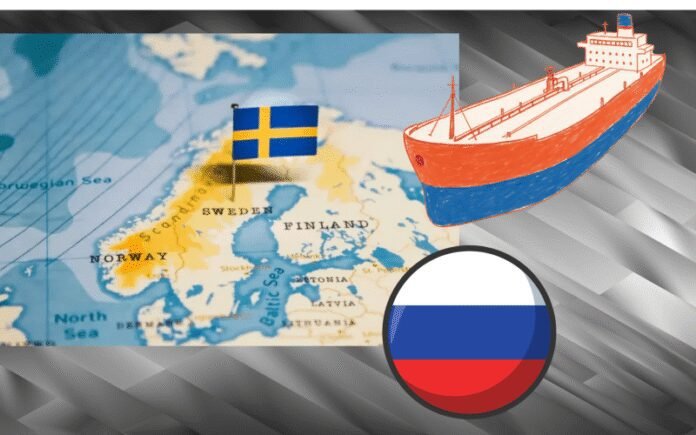
Sweden’s top court said on Thursday it has upheld a ruling that a cargo vessel seized in the Baltic Sea this year can be handed over to Ukraine, where it is suspected of illegally transporting grain from Russian-occupied territory.
The supreme court dismissed an appeal from the owners of the Caffa vessel, which was seized in March off southern Sweden on suspicion of sailing under a false flag and of violating maritime and ship safety laws due to a lack of seaworthiness.
Ukraine has sought the ship as part of a probe into suspected war crimes involving the appropriation and removal of property from Russian-occupied territory.
Lower Swedish courts said those alleged actions could constitute a war crime under Swedish law, meaning Sweden could transfer the vessel and related evidence to Ukraine.
“The Supreme Court does not grant leave to appeal. The Court of Appeal’s decision is therefore final,” the supreme court said in a ruling dated August 4.
Most of the 11 crew members on Caffa, which is owned by Caffa Shipping Limited, were Russian, police said at the time of the seizure.
X wants to keep suing advertisers, asks 5th Circuit to overrule district judge
Elon Musk’s X is trying to revive a lawsuit against advertisers it’s accusing of illegally boycotting the social media platform, despite previously reaching a settlement to end litigation against an ad-industry trade group.
“This case involves an unusually brazen group boycott,” X said in a filing yesterday. “That misconduct has drawn the attention of regulators and Congress. There is no valid reason that this effort by the direct victim to recover its massive economic losses from that boycott should not move forward.”
X’s lawsuit was thrown out in March when US District Judge Jane Boyle in the Northern District of Texas ruled that advertisers did not commit any antitrust violation. Last week, Musk reached a settlement with the World Federation of Advertisers, the first defendant named in the lawsuit.
But Musk’s lawsuit had other defendants: Mars, Incorporated; CVS Health; Nestle; Abbott Laboratories; Colgate-Palmolive; Lego; Pinterest; Tyson Foods; Shell; and Ørsted A/S. While X agreed to dismiss the World Federation of Advertisers from the case, it urged the US Court of Appeals for the 5th Circuit to revive the suit with respect to the other defendants.
The boycott “injured X and competition in that market, allowing other social-media platforms to charge rates above truly competitive pricing,” the company said. “Especially in light of the power defendants wield within the market, their agreement to boycott X cannot be characterized as anything other than an unreasonable restraint on trade.”
Judge: Losing to competitors is not antitrust injury
Boyle’s decision dismissing Musk’s lawsuit said the “only harm X has asserted is that its customers collectively chose X’s competitors over X.” Boyle, a George W. Bush appointee, cited a precedent that a loss from competition itself does not constitute an antitrust injury. “Therefore, although a group boycott is alleged, there is no antitrust violation here,” she wrote.
Asking the 5th Circuit to reverse Boyle, X argued that advertisers colluded to boycott X, “eliminat[ing] the independent decision-making that would otherwise force each firm to weigh the competitive benefits of continuing to advertise on the platform, suppressing competitive rivalries and insulating the boycott from market forces. The group boycott targeting X thus distorts competition in multiple markets in clear contravention of the antitrust laws.”
X’s claims relate to the Global Alliance for Responsible Media (GARM), an initiative by the World Federation of Advertisers to define violent and obscene content and help advertisers create brand-safety guidelines. The ad industry shut down Garm after Musk filed the lawsuit in 2024, though law professors described X’s legal case as a weak one.
X’s filing yesterday said that GARM “exercised collective power through its rules for membership. As a condition of joining GARM, members agree[d] to adopt GARM solutions to improve business operations.’ For GARM’s advertiser and advertising agency members, that meant agreeing to enforce the implementation of the Brand Safety Standards by the social-media platforms from which they purchased advertising.”
X’s big ad revenue drop
X, then called Twitter, suffered a large drop in advertising revenue after Musk bought the company in October 2022 and made major changes to content moderation. Advertisers stayed away, worried that ads would appear next to antisemitic posts, misinformation, and other objectionable content.
Specific numbers on X ad revenue were hard to come by the past few years because Musk took the company private when he bought Twitter. But X Corp. is now a subsidiary of SpaceX, which recently went public and must report earnings.
SpaceX’s earnings report this week said the company made $367 million in advertising revenue in Q2 2026, down from $426 million in Q2 2025. For the first six months of 2026, ad revenue was $710 million, down from $870 million in the first six months of 2025.
Twitter reported much higher ad revenue before being bought by Musk. “X’s current quarterly ad revenue has dropped even more drastically compared to the last quarter before Musk bought the popular social-media platform,” MediaPost reported. “In the second quarter of 2022, Twitter reported $1.08 billion in ad revenue, roughly $713 million more than Q2 2026.”
China’s bamboo growth model vs. India’s eucalyptus growth model
Nature offers unexpectedly good lessons in strategy. As a child, I was fond of bamboo shoots, though none grew in our farmland. My mother, noticing my enthusiasm, suggested that I plant some myself. A neighbor gave me a stalk about three feet tall, which I planted, watered and fussed over. Nothing happened. A year passed […]
Abdul El-Sayed Beats the Democratic Establishment and AIPAC in Michigan
Despite record amounts of outside spending and attacks from the Democratic establishment, Abdul El-Sayed prevailed in a bitter primary race for the U.S. Senate seat in Michigan.
Voters in the key swing state chose El-Sayed over the establishment’s choice of Rep. Haley Stevens, whose campaign received about $60 million in support from pro-corporate and pro-Israel super PACs, making the race the most expensive Democratic primary ever. El-Sayed won by a margin of around 1 percentage point, according to The Associated Press, which called the race in his favor Wednesday morning.
The victory of El-Sayed, a former public health official endorsed by Sen. Bernie Sanders and Rep. Alexandria Ocasio-Cortez, is the latest sign of the growing influence of the Democratic left. And it’s the most staggering illustration yet of the party establishment’s waning grip on power and the unpopularity of the pro-Israel lobby giant, the American Israel Public Affairs Committee, amid shifting American sentiment on Israel and Palestine.
Through its super PAC, the United Democracy Project, AIPAC broke its own single-race spending record by funding $30 million in attack ads against El-Sayed. Ads that dominated airwaves, flooded streaming services, and stuffed mailboxes in the final month of the race misrepresented El-Sayed’s previous comments about Michelle Obama and Michigan Gov. Gretchen Whitmer to allege misogyny, and attempted to paint El-Sayed as a terrorist sympathizer.
El-Sayed’s platform, boosted by an army of 12,000 door-knocking volunteers, centered on policies such as Medicare for All policy, addressing cost of living issues in the state, and removing corporate spending from politics. But it was the two candidates’ stances on Israel and Palestine that came to define the race. El-Sayed condemned Israel’s genocide of Palestinians in Gaza and committed to ending U.S. military aid to Israel. His criticism of Israel also extended to its joint U.S. war on Iran, which he decried as military glut that could be spent instead on healthcare and education in his state.
Stevens opposed any conditioning of military aid to Israel. She has consistently voted in favor of weapons transfers since first assuming office in 2019, including last month when she sided with Republicans against an amendment in a Pentagon budget bill that would have cut military spending for Israel. When AIPAC began pouring money into the Stevens campaign, El-Sayed effectively turned those millions of dollars into a key campaign issue, pointing to Stevens as an illustration of the danger of lobby spending and corporate money in politics.
It’s not the first race in Michigan shaped by AIPAC money. Former Rep. Andy Levin — who was considered the most progressive Jewish member of the House because of his support for Palestinian statehood — lost his seat after redistricting forced a showdown with Stevens in 2022. In that race, Levin was also dramatically outspent by outside money, with AIPAC buying $4 million in ads to attack him and boost Stevens.
El-Sayed’s success, however, shows a major shift in politics since the start of Israel’s most recent war on Gaza. Cutting off military support to Israel has become a mainstream position among Democrats. And AIPAC has since become a politically toxic entity — “a four letter word in Democratic politics,” Levin told The Intercept.
“The kind of truth-telling about Israel and Palestine is tied into the truth-telling about the economy, and people wanting real solutions.”
“Most people still don’t vote on Israel and Palestine, they vote on their pocketbooks,” said Levin, who endorsed El-Sayed. “But if you’re not willing to say that Israel perpetrated a genocide in Gaza, Democratic primary voters are like, ‘OK, you’re bought and paid.’ The kind of truth-telling about Israel and Palestine is tied into the truth-telling about the economy, and people wanting real solutions.”
Leftists have claimed victories against establishment picks throughout this year’s midterm primaries, running on similar platforms addressing affordability and support for Palestine. But those wins have so far been in House races, mostly in metropolitan areas where leftist progressive politics have gained a foothold in recent years, such as New York, Pennsylvania, Colorado, New Jersey, and California. In House races in Michigan, leftists also found success with wins for Donavan McKinney, a state representative who defeated the AIPAC-backed incumbent Democratic Rep. Shri Thanedar, and Will Lawrence, a progressive climate activist who beat a pair of moderate Democratic opponents.
Both McKinney and Lawrence, a co-founder of the youth-led Sunrise Movement, had an endorsement from Sanders and a mutual endorsement from El-Sayed. And both ran on a similar platform of lowering the cost of living and opposing war — including Israel’s genocide in Gaza — and for Lawrence, opposing AI data centers. While McKinney is expected to win the general election in a solid blue district, Lawrence now faces a Republican incumbent, Rep. Tom Barrett, in a purple district that had previously been held by Democratic Sen. Elissa Slotkin.
El-Sayed’s win is the first leftist victory in a Senate race this election cycle.
Unlike other leftist wins so far in the midterms outside of Michigan, El-Sayed faces a difficult challenge in the general election from a formidable Trump-endorsed opponent. Polls have shown El-Sayed neck-and-neck with Republican Mike Rogers, a former congressman and FBI agent who ran unopposed in Tuesday’s primary. In 2024, Rogers ran for Senate and lost to Slotkin by less than 20,000 votes. In Michigan, where voters swung for Trump by about 1 percentage point over Kamala Harris in 2024, the November election is expected to be the most significant midterm test for the left. An El-Sayed win in November is essential to the Democratic effort to regain control of the Senate.
Electability has been among the largest criticisms from Stevens and her supporters against El-Sayed. Conventional establishment thinking maintains that progressive policy is not popular among most Americans. To beat Republicans, the centrists say, Democrats need to run a more moderate candidate who can appeal to more conservative voters. Late last month, the Stevens campaign circulated a quote from Rogers, who called El-Sayed “radical” and claimed “I don’t think he likes America.” Stevens suggested Rogers would prefer to face El-Sayed because of his leftist platform.
Last week, Rep. Hillary Scholten, D-Mich., a Stevens surrogate, said El-Sayed was so polarizing that she could not back him against Rogers in the general election. “I will not stand beside someone who has allowed distinctly anti-American sentiment to enter our public dialogue,” she said, a reference to his campaign events in April where political streamer and commentator Hasan Piker stumped with El-Sayed at university campuses. Despite efforts by the Stevens campaign, AIPAC, and corporate media outlets to play up Piker’s comments faulting U.S. foreign policy for 9/11, there’s little evidence that criticism has resonated with voters.
The National Republican Senatorial Committee released its first attack ad against the “radical” El-Sayed on Wednesday, referring to him by his full name and referring to Piker’s 9/11 comments, a preview of the continued anti-Muslim and anti-Arab tactics that are expected to ratchet up in the general.
The progressive left has long argued that its platform will perform better in front of a broader electorate hungry for political and economic change. Michiganders have paved the way for El-Sayed to try and prove just that. His fate in the general election might reverberate into the 2028 campaign cycle, as the Democratic Party looks to decide what type of candidate to nominate for president.
Soon after NBC News made its call, state Sen. Mallory McMorrow — who dropped out of the U.S. Senate race in July — offered her endorsement to El-Sayed. On Wednesday, Stevens — along with Democratic minority leader Sen. Chuck Schumer and Democratic Senatorial Campaign Committee Chair Kirsten Gillibrand — endorsed El-Sayed. Stevens said she had spoken with El-Sayed and was “proud to offer my support as he takes on Mike Rogers in the general election.”
“We’re gonna build a movement that reaches out to everybody — I know not everybody’s gonna agree with me on everything, that’s not how this works. But I know they agree with me on the need to beat Mike Rogers and the need to hold Donald Trump accountable, and the need to provide people healthcare, and the need to address the affordability crisis,” El-Sayed said at the Wednesday press conference, flanked by McMorrow and Michigan Democratic Party Chair Curtis Hertel Jr. “I’m looking forward to unifying together,”
El-Sayed argues the same anti-corporate messaging that has appealed to his progressive base translates to all voters, transcending partisan political framing. A week before Tuesday’s primary, El-Sayed told The Intercept’s Akela Lacy, “Most people don’t walk around asking, ‘Where do I sit on the left–right spectrum?’ Most people are walking around asking, ‘What the hell’s going to happen if I get sick? What’s going to happen if I lose my home or I lose my job?’ … I think those are the things that unite most Michiganders … I’m looking to build a movement that pushes back on the bipartisan consensus that we ought to build a politics that is paid for by corporations.”
Levin said that voters want a candidate who is “authentic,” “brave,” and “speaks truth to power.” He pointed to Michigan’s historic embrace of progressive Democratic politics, such as the nominations of Jesse Jackson’s presidential candidacy in 1988 and Sanders’s in 2016.
It was in Michigan where Democrats in 2024 started the Uncommitted Movement as a protest against the Biden administration’s support of Israel during its genocidal war in Gaza. El-Sayed voted “uncommitted” in that primary. Stevens and her surrogates have attacked his “uncommitted” vote to try and show El-Sayed’s lack of loyalty to the party, despite his immediate endorsement of Harris one day after Biden dropped out of the running.
“People act like it means we all must run to the mushy middle. But that’s not what a swing is at all.”
Levin describes Michigan as the “ultimate swing state,” but cautioned that many political pundits misunderstand what that says about the state’s electorate.
“People act like it means we all must run to the mushy middle. But that’s not what a swing is at all. If a swing just sat in the middle, you would never get on it. It’d be boring. That’s not what it’s about,” Levin said. “We have to realize that ‘swing’ means that people go back and forth. And people in both parties right now — this is national — they are so sick of politics. They are so sick of the money in politics. They are so sick of the rich people and the corporations and the special interests [that] basically do whatever they want in American politics.”
Update: August 5, 2026, 1:22 p.m.ET This article was updated to include news of Donavan McKinney’s victory, a National Republican Senatorial Committee attack ad, Haley Stevens’s endorsement of Abdul El-Sayed, and remarks from El-Sayed’s victory speech.
Explosive drone found hovering near Ukrainian cargo aircraft at German airport
German police disarmed a drone carrying explosives after it was discovered near Ukrainian cargo aircraft parked at Leipzig airport—and authorities are looking into the possibility of a second drone after an approaching aircraft collided with something midair.
The drone was first spotted by an airport employee hovering close to the ground between two parked An-124 cargo aircraft owned by Ukraine’s Antonov Airlines shortly before midnight on August 4, according to The Guardian. It had apparently been modified to help avoid detection by the airport’s drone defense sensors, said Alexander Dobrindt, federal minister of the interior for Germany, during a press conference.
Dobrindt described the drone as carrying a fist-sized package of a substance believed to be the plastic explosive Semtex. Only a failed detonator prevented the drone from exploding near the Ukrainian cargo aircraft, he said.
German police used a bomb disposal robot to help disarm the drone and later carried out a controlled explosion, according to BBC News.
Contrary to some media reports, the German Interior Ministry has denied that the apparently targeted Ukrainian cargo aircraft were carrying weapons or other munitions for delivery to Ukraine, according to Deutsche Welle. Instead, government officials described the aircraft as having been empty at the time of the drone incident.
The incident forced Leipzig/Halle airport—one of Europe’s largest air cargo hubs—to close to all air traffic for several hours. That forced 19 flights to divert away from the airport, including a Boeing 757 operated by the shipping company DHL that was forced to abort its landing approach, according to the flight tracking service Flightradar24.
As the DHL-operated aircraft started climbing again, it collided with another flying object midair and diverted to land at Hanover airport with minor damage, German police reported in a statement. German authorities are looking into the possibility that the object was a second drone.
The possible culprit and motive
German officials have not officially named a suspect behind the attempted attack, but have opened a counterterrorism investigation. Dobrindt acknowledged that “we are dealing with a contest here that possibly involves foreign powers,” and described the incident as a “hybrid threat scenario.”
The incident has already spurred Roderich Kiesewetter, a lawmaker and member of the German parliament’s intelligence committee, to more directly describe Russia as being responsible for the “attempted act of terrorism.”
As a major hub for air cargo, Leipzig/Halle airport frequently oversees the transit of shipments for NATO and the German military. It is also the current home base for Ukraine’s Antonov Airlines, which operates a charter cargo service fleet that includes the world’s largest operational cargo aircraft, the Antonov An-124 Ruslan.
The incident also evoked a potentially telling reaction from Alexander Sosnowski, a pro-Kremlin propagandist who regularly appears as a guest on Russian state television. In a short video posted on Telegram, Sosnowski clearly assumed the attempted attack was a Russian operation targeting the Ukrainian aircraft and expressed disappointment that it had failed, according to The Bild, a German tabloid newspaper.
Repeated drone incursions and missing defenses
These latest incidents follow dozens of drone sightings over other European airports, along with military bases, ports, energy and industrial facilities, since 2024. In May, Munich airport in Germany closed twice within 24 hours following possible drone sightings.
Drone incursions have become especially more frequent in Northern and Eastern Europe, given their closer proximity to Russia and the ongoing war in Ukraine. Those incursions have forced fighter jets to scramble repeatedly in response, along with leading to a building fire and injuries in Romania following a Russian drone crash.
But the long-promised European Drone Defence Initiative that was supposed to create the equivalent of a “drone wall” to provide counter-drone surveillance and defenses has yet to materialize in any meaningful way, said Ulrike Franke, a senior policy fellow at the European Council on Foreign Relations, in an article for World Politics Review. Instead, individual European countries such as Poland have been building their own national counter-drone systems.
Germany has already provided about $118 billion to support Ukraine since Russia launched a full-scale invasion of Ukraine in 2022, according to Deutsche Welle. Beyond supplying weapons and humanitarian aid, Germany has also trained more than 24,000 Ukrainian soldiers and is hosting more than 1 million Ukrainian refugees.
Some of Germany’s latest cooperative ventures with Ukraine have involved joint production of new military drones. Ars recently covered a $100 million deal—reportedly funded by Germany—that is equipping the Ukrainian military with drones capable of performing AI target tracking.
Disney and TikTok strike content-sharing deal with short-form videos to be added to Disney+
TikTok videos are coming to Disney+, meaning that Spider-Man and Moana are about to become TikTok stars. Officially.
The tech giant and the entertainment behemoth have inked what they are calling a “first-of-its-kind” content sharing deal, which will allow Disney themed TikTok videos to live on both of their platforms.
Creators will gain access to Disney assets, while a “thoughtfully curated” selection of videos from creators who opt-in will live on both TikTok and in Verts on Disney+ (the company’s vertical video products).
The financial terms of the deal have not been disclosed.
“The best storytellers are fans first,” said Asad Ayaz, chief marketing and brand officer for Disney. “That has always been true at Disney, and today, fans are celebrating our stories in entirely new ways.”
“This collaboration creates a new bridge between the stories we tell and the creativity they inspire, giving creators a bigger stage to share what they’ve made, and audiences more to discover on Disney+ every day,” he added in a statement.
The companies also say that they “will enable best-in-class creators to unlock special rewards and provide them with increased visibility, access to exclusive events and career development pathways.”
The partnership will launch in the US first, with plans to eventually bring it to other markets.
The deal confirms not only the prominence of short-form video content and the continued popularity of TikTok, which has surpassed 200 million users in the US according to Pew Research Center, but also the acknowledged power of creator fandom when it comes to reaching audiences.
It is also reminiscent of last year’s announcement that Disney was investing $1 billion in OpenAI, aiming to bring characters such as Mickey Mouse and Luke Skywalker to the AI company’s Sora video generation tool.
The three-year deal sanctioning the use of Disney’s IP to a third party was ultimately scrapped after OpenAI decided to shut down Sora after backlash over racist and violent content produced using the tool. This failure to launch was met with applause by many in Hollywood, considering Sora was perceived as a threat to the creative industry, as well as to legal use of intellectual property.