Home Blog

Will Israel build a stealth fighter jet?

0
will-israel-build-a-stealth-fighter-jet?
Will Israel build a stealth fighter jet?

A senior Israeli official, likely Prime Minister Benjamin Netanyahu, recently briefed the ​Israeli press​ delegation that traveled to Washington​ with him for his White House visit regarding plans ​for Israel to build a domestic stealth fighter plane and an accompanying unmanned combat aerial vehicle (UCAV).

The primary motivation​, the prime minister has said in the recent past, is to ensure that Israel can support its own aircraft without depending on the good will of outside suppliers. This concern has been heightened by recent military export suspensions from the UK and disruptions from France, and it builds upon past supply delays from the United States under various administrations.

Netanyahu says the project timeline is ten years.

However, Israel faces significant constraints based on historical precedents and current resource limitations.

While past domestic projects like the Nesher and Kfir saw success, the Lavi project was cancelled in 1987 because soaring costs threatened other critical military programs.

​The Nesher was Israel’s first domestic aircraft, based on the French Mirage 5. It used a French Snecma jet engine, but also included Israeli and US components.

The Nesher was an effective platform in Israeli services until it was replaced by the Kfir. It also was updated and sold to Argentina and was used with some success against British ships in the Falklands War.

A retired Nesher.

​The Kfir was a Nesher follow-on, this time with more US avionics and with a US General Electric J-79 powerplant, the same engine that powered the US Phantom F-4. The Kfir was exported to Colombia, Ecuador, Sri Lanka and the United States. Ecuador retired its Kfir fighters in 2012 after 30 years of service. Sri Lanka has seven remaining Kfir aircraft still in service. These were updated and modernized in Israel this year.

Israel will continue maintaining Colombia’s Kfir fighter jets for 19 months, despite the breakdown of diplomatic and military relations. Photo: Airman Magazine / CC BY-NC 2.0

​The Lavi never entered operational service. The Lavi project, which was an all-weather fourth-generation-plus platform, incurred heavy cost overruns tying up over half of US foreign assistance funds in the early and mid 1980s.

Internally there was opposition to the Lavi in Israel’s army because Lavi was shortchanging important projects including the Merkava tank and air defense systems. At the same time, US companies worried that the Lavi was a low-cost alternative to the F-16 and F-18. US aerospace companies lobbied the Pentagon and Reagan administration to halt funding support for the Lavi. In the end the Israeli cabinet killed Lavi in a dramatic 12 to 11 vote (with one abstention) in 1987.

The Lavi first production model.

Later it was claimed Israel sold Lavi technology to China, where the technology was allegedly used in China’s J-10 program.

​It is important to note that, despite a growing opposition in and outside Israel over the Lavi program, the US never stopped providing parts and equipment for Lavi.

There is still fallout over the Lavi cancellation, which some in Israel regard as a major missed opportunity and damaging to Israel’s aerospace industries. There also is legitimate alarm that Israel’s friends and allies could cut off military supplies at any time, endangering the Jewish state.

There is plenty of precedent for that worry. The Obama administration and Biden administration cut off important military supplies to Israel including Hellfire missiles, bombs, JDAM kits, tank ammunition, helicopters and other defense hardware.

Similarly the UK recently stopped some 30 vital exports to Israel including parts for the F-16.

The French meanwhile have deliberately interfered with supply chains of military hardware going to Israel and have blocked Israel’s access to important industrial defense exhibitions including Eurosatory and the Paris Air Show. Recently, Israel was alarmed by hostile statements from some in the Trump administration, especially Vice President J.D. Vance.

Any domestic stealth fighter or UCAV would require a propulsion system from Europe or the United States​, with the US most likely a supplier. A new Israeli fighter would also compete directly with US defense companies like Lockheed​, Boeing and General Dynamics, potentially requiring a US joint venture​ or some deal with the US limiting exports to mitigate opposition.​

The immense cost could strain the Israeli economy and impact other vital programs, such as air defense systems and smart weapons manufacturing. Furthermore, major defense firms like IAI, Elbit and Rafael are already heavily burdened with existing orders and current security demands.

The UCAV alternative

A UCAV platform may be a more realistic option, as Israel is already networking advanced drones with the F-35 (Adir). A UCAV offers significant advantages, including the ability to pull extreme G-loads beyond human endurance and enhanced stealth capabilities by eliminating the cockpit canopy.

The MQ-28 Ghost Bat first flew on 27 February 2021 with a second prototype flying in November that year. Credit: Boeing Australia

While Israel possesses strong ​combat experience, artificial intelligence​ know-how, and systems integration, a UCAV project would still require a US power plant. Additionally, the US is already developing its own Loyal Wingman” Collaborative Combat Aircraft program, slated for initial operation around 2030.

Boeing Loyal Wingman

​The US Loyal Wingman (F-47) is designed to enhance the combat lethality of the F-35 and de-risk the F-35 against deep high value targets such as air defenses and command and control stations. It also is aimed to later support the emerging NGAD (Next Generation Air Dominance) sixth generation fighter that supposedly will replace the powerful F-22.

F​uture of an Israeli stealth and UCAV project

Ultimately, Israel lacks the resources, manufacturing depth, and financing to simultaneously develop a domestic stealth fighter and a new UCAV from scratch. A more viable alternative may involve converting existing platforms into UCAVs. Israel faces critical strategic decisions ahead regarding the future of its local military aerospace manufacturing​, and its leaders will have to see what is affordable and realistic for its military needs and its defense industrial base.

Odds are Israel will not build a stealth fighter from the ground up, and may rethink a UCAV to suit its requirements and cost impact.

Stephen Bryen is a former US deputy under secretary of defense. This article along with many others can also be seen on his newsletter, Weapons and Strategy.

Egyptian foreign minister, Board of Peace envoy discuss next phase of Gaza ceasefire

0
egyptian-foreign-minister,-board-of-peace-envoy-discuss-next-phase-of-gaza-ceasefire
Egyptian foreign minister, Board of Peace envoy discuss next phase of Gaza ceasefire

Egyptian Foreign Minister Badr Abdelatty and the Board of Peace envoy Nikolay Mladenov on Sunday discussed the latest developments in the Gaza Strip and arrangements for the next phase of the ceasefire plan, Anadolu reports.

During a phone call, the two officials reviewed negotiations aimed at completing the implementation of commitments under US President Donald Trump’s Gaza plan, according to an Egyptian Foreign Ministry statement.

Abdelatty stressed “the importance of fulfilling all commitments under the plan’s first phase, including ensuring the full, safe and sustainable delivery of humanitarian assistance and an Israeli withdrawal from Gaza, followed by early recovery and reconstruction.”

The two sides also discussed arrangements for the coming phase.

READ: Israeli attacks kill 18 Palestinians across Gaza despite ceasefire

The Egyptian minister stressed that the National Committee for the Administration of Gaza should begin performing its duties from inside the enclave “to manage the transitional period efficiently and preserve the unity of the Palestinian territories.”

He also urged all parties to fulfill their obligations under the plan and refrain from taking steps that could undermine its implementation.

Such efforts would help achieve security and stability and pave the way for restoring stability across the region, the minister added.

On Friday, the Peace Board and US President Donald Trump announced an agreement to implement the next phase of the Gaza ceasefire, with the board saying Hamas had accepted a detailed roadmap. Israel has not officially commented on the proposal.

READ: Hamas says Israel escalating Gaza attacks to derail ceasefire understandings

What President Trump’s Gaza Deal Actually Says About Hamas’ Weapons 

0
what-president-trump’s-gaza-deal-actually-says-about-hamas’-weapons 
What President Trump’s Gaza Deal Actually Says About Hamas’ Weapons 


The body that would take custody of the weapons was formed in January and has been working from Cairo. Israel has not permitted most of its members into the territory they are meant to govern.

[CAIRO] Late Saturday, Mohammad Dahlan, the former Fatah security chief who now heads the Democratic Reform Current from exile in the United Arab Emirates, said in a post on his official Facebook page that US special envoy Jared Kushner had told him he had reached an agreement with Israel to halt its attacks on Gaza the following morning.  

“Mr. Jared Kushner confirmed to us that he had agreed with the Israeli side to halt the attacks on Gaza beginning tomorrow morning,” Dahlan wrote.  

Less than two hours later, Dahlan edited the post, removing both the claim that Kushner had reached an agreement with Israel and the deadline. “Mr. Jared Kushner has informed us that he is working with the Israeli side to stop the attacks on Gaza,” the revised version read. “We continue our intensive contacts with the US side to ensure the agreement is implemented fully and faithfully.”  

The revised post said the agreement’s success now depended on Israel fully committing to ending its daily attacks. A Board of Peace official separately walked back a claim that the disarmament had already begun.  

There is a clear Israeli rejection of the matter of storing the weapons. This is the most important problem facing the agreement.

“There is a clear Israeli rejection of the matter of storing the weapons,” Mohamed Ibrahim, an Egyptian security analyst involved in the 2011 Gilad Shalit prisoner exchange, told The Media Line. “This is the most important problem facing the agreement, and we will make a great effort to solve this problem, which could obstruct implementation.”  

Israel will keep attacking Gaza despite Hamas’ agreement to hand over its weapons, Energy Minister Eli Cohen said Sunday. In an interview with Army Radio, Cohen, a member of the security cabinet, denied that Israel had agreed to end its assault and backed a full military takeover of the Strip, which Israel already holds about 70% of. Cohen, who as foreign minister opened talks with Rwanda and Congo on accepting displaced Palestinians from Gaza, has said Israel is moving toward full control “until we reach 100%.”  

Two people were killed in Deir al-Balah before the hour the halt was meant to take effect. Medics counted nine dead in Gaza on Sunday morning. By afternoon the figure was 13. By evening Palestinian medical sources put it at least at 15.  

An Israeli helicopter struck an apartment in the Al-Masha’ala area of Deir al-Balah, killing Kamal Abu Muailaq, head of Hamas’ administrative body in the city, and his wife; the Israeli military said its strikes there targeted two commanders of Hamas’ Nukhba force.  

In Gaza City, a strike on an apartment in the al-Sousi tower killed Abdullah Adnan Abu al-Tayef, his wife Abeer and their son Azzam. Three members of the al-Hams family, one of them a child, were killed in al-Qarara, northwest of Khan Yunis.  

It was the second straight day of airstrikes since President Donald Trump announced what he called a historic agreement for the “complete disarmament” of Hamas.  

Dahlan said contacts with Washington were continuing and that the ball is now in the Israeli court.  

Hamas and the other Palestinian factions accepted the roadmap on Thursday at El-Alamein, on Egypt’s Mediterranean coast. It names one body that may hold Hamas’ weapons, and it is not Israel.  

Only the National Committee for the Administration of Gaza may “hold, store or control weapons in Gaza,” the document says. No weapons may be transferred or surrendered to Israel or to any non-Palestinian party. Palestinian factions would take part in identifying and storing them. An International Verification Committee would monitor the process, backed by an International Stabilization Force. Point two requires Israel to cease its military operations “fully and without delay.” 

President Trump says “complete disarmament.” Hamas officials do not use the word, and neither does Cairo.  

Hamas would lose independent control of its arsenal. But nothing in the document sends those weapons to Israel or out of Gaza—the two things Israeli officials have called essential.  Hamas has since submitted amendments to the weapons article and to the clause covering Gaza’s government employees. It has asked for changes to the definition of the military infrastructure to be dismantled, seeking language it says cannot later be reinterpreted. It is waiting for an Israeli response.  

Ghazi Hamad, a member of the Hamas negotiating team, said the movement was making concessions “for the sake of our people in the Gaza Strip, to save them from killing and displacement.” The weapons go into storage only after Israel completes what it owes under the Sharm El Sheikh protocol: halting attacks, pulling back, letting in aid and commercial goods.  

Hamad, a member of Hamas’ political bureau, told Lebanon’s LBC TV in October 2023 that the group would repeat the Oct. 7 attack “again and again” until Israel was annihilated, and that Israel “is a country that has no place on our land.”  

Hamas “is demonstrating considerable flexibility and making substantial concessions in an effort to save the Palestinian people in Gaza,” Mohammad Seyam, a Palestinian researcher from Gaza based in Doha and a professor of security and conflicts, told The Media Lineand “at the same time, deprive Israel of its pretexts.”  

The 15-point roadmap sorts Gaza’s arsenal into categories and sends each one down a different route.  

Police weapons go first. When the committee enters Gaza and takes up its duties, every police weapon passes to its authority. Serving officers and new recruits face vetting. Hamas’ police force numbers about 10,000 officers, mostly unarmed and dressed in navy uniforms, and whether any of them join the new force is one of the plan’s unresolved questions: Hamas wants them included, and Israel rejects any officer with a Hamas affiliation. 

The same commission is mandated to rebuild Gaza’s civil registration and identity systems and to coordinate with the Palestinian Authority, Israel and international partners on a unified population registry. Israel has controlled that registry since Oslo; births, marriages, deaths and address changes all require Israeli approval.  

Heavy weapons follow—a gradual, sequential process covering heavy arms, production facilities, depots and tunnels. The text says decommission and store. It does not say where, who guards the sites, how inspectors get in, or whether anything is destroyed.  

Personal weapons are the rifles and pistols held by individuals, families and clans rather than by the factions. Under the roadmap, they come under Palestinian law, with the committee alone registering and licensing them, revoking licenses and enforcing the rules. Civilians would be allowed to sell privately owned weapons, and the roadmap asks factions, clans and other parts of Palestinian society to cooperate.  

No published estimate exists of how many such weapons are in Gaza. The large clans have been heavily armed for decades. Hamas tried and failed to disarm the Doghmush family of Sabra in Gaza City repeatedly after the movement’s founding in the 1980s, in clashes that continued through last October. Armed groups outside Hamas now field roughly 3,000 fighters across the Strip, according to Sky News’ Data and Forensics Unit.  

Militias outside Hamas are covered too. Their weapons are placed in committee storage, and their members are barred from the new police and security services. Israel has armed and supported anti-Hamas groups inside Gaza.  

Dahlan called on all Palestinian factions to abide by the agreement, “end all armed activity and refrain from any actions that could give Israel a pretext to undermine it.”  

The stabilization force would not police Palestinians. It deploys between Israeli troops and committee-run areas, watches the ceasefire, trains Palestinian police, guards aid convoys. Internal security stays with the committee. The verification committee decides when the process moves from one stage to the next. The roadmap does not name its members, does not say what happens if they disagree, and does not say what follows if anyone blocks an inspection.  

Establishing a stabilization force “without clear command structures, UN oversight, and the privileges and immunities established through the United Nations” is “particularly worrisome,” said Susan Akram, a clinical professor at Boston University School of Law, who added that it remains unclear whether the mission is peacekeeping or peace enforcement.  

The roadmap makes each stage conditional on the last, and Israel controls the first one.  

On Thursday, Netanyahu’s office said the proposal did not meet Israel’s demand for the complete demilitarization of Gaza. On Sunday, Doron Spielman, spokesperson for the Prime Minister’s Office, said Israel had raised serious security concerns with Washington.   

National Security Minister Itamar Ben-Gvir called the roadmap unacceptable and said Israel should keep killing Hamas leaders. Ben-Gvir, convicted in 2007 of incitement to racism and support for a terrorist organization, has said the only path to victory is “the full conquest of the Gaza Strip, a complete halt to the so-called ‘humanitarian aid,’ and the encouragement of emigration.” Netanyahu himself has not commented publicly.  

Israel’s position is that the weapons leave Gaza, said Nimrod Goren, president and founder of Mitvim, the Israeli Institute for Regional Foreign Policies, and that Israel signs off on the decommissioning before it moves.  

“It’s essentially an Israeli stamp of approval—that it was done according to the expectations,” Goren told The Media Line. “Only then Israel will move to withdrawal.”  

When Israeli and Egyptian officers met in Cairo in early July, Egypt said it was willing to take Hamas’ weapons if they are handed over.  

“If Israel does not accept the agreement formally, the ground will be prepared for further tension, and we could return to a state of war,” Ibrahim said. Egypt will step up coordination with the mediators and the United States “in order to pressure Israel into accepting the agreement in full.”  

If Israel does not accept the agreement formally, the ground will be prepared for further tension, and we could return to a state of war

“The Egyptian state trusts the American administration completely,” he said. Without bilateral coordination between Cairo and Washington, he added, Trump’s original 20-point plan “could not have been reached.”  

Egyptian Foreign Minister Badr Abdelatty spoke with Nickolay Mladenov, the Board of Peace’s high representative for Gaza, and with US envoy Steve Witkoff the same day.  

“There should be simultaneous steps—a gradual Israeli withdrawal against a gradual resolution of the weapons problem, the inventory and storage of the weapons,” Ibrahim told The Media Line. “If the two parties commit to the principle of simultaneity, the agreement will succeed. The opposite is also true.”  

Mladenov, the architect of the phased approach, wrote on X that implementation and verification mechanisms must be “real and effective,” and that the Israeli withdrawal must proceed in parallel with the dismantling of weapons.  

What Israel has given Washington is narrow approval for the stabilization force to enter, some flexibility for a partial entry, and a decision not to attack the agreement publicly, Goren said.  

“All of these smaller operational things, or symbolic or statement-related things, are not really impacting the way the Israeli presence in Gaza looks like,” he said. “And then he will avoid anything that can bring political backlash during a campaign season.”  

Israelis vote Oct. 27. The disarmament sequence runs six to eight months.  

The 14-day clock may not have started. The roadmap does not give Hamas two weeks to empty its depots. It gives the parties 14 days to write the implementation timetable, and only after all sides approve the document. The verification committee can extend even that.  

“There’s no real debate on the practicalities,” Goren said. “This whole discussion about this process is so detached from the debate in Israel.”  

The body that would take custody of the weapons was formed in January and has been working from Cairo. Israel has not permitted most of its members into the territory they are meant to govern. The committee said this weekend it was fully ready to take on governance and reconstruction once the transition begins.  

Abdelatty raised it with Mladenov by phone on Sunday, stressing the importance of the committee beginning its work from inside Gaza to manage the transitional phase and preserve the unity of the Palestinian territories, according to a statement from the Egyptian foreign ministry.  

Hamas announced in July that it was dissolving its emergency government.  

Neither Hamas nor the Palestinian Authority has faced voters since 2006. The committee’s members were approved by the Palestinian factions, not elected, and hold little decision-making power inside the Board of Peace structure.  

The committee “may not enjoy widespread popularity among the people of Gaza because it was established through arrangements involving those parties who,” they claim, “committed genocide against them,” Seyam said. “Nevertheless, the people of Gaza continue to hold on to it because it represents the only remaining thread of hope for saving them from Israeli brutality and returning them to a path toward normal life.”  

Israel’s security cabinet gave initial approval on July 26 for a stabilization force of roughly 200 troops, with a headquarters near Rafah, and reserved the right to decide which countries may take part. Ben-Gvir voted against, telling ministers Hamas had not disarmed, and Israel was therefore not obligated to proceed. No deployment date has been set.  

Since the ceasefire took effect in October 2025, Israeli forces have killed 1,222 Palestinians and wounded 4,053, according to Gaza’s health ministry.  

“Without a different Israeli leadership, you could not really make any progress—either with or without the Board of Peace,” Goren said.  

“Even if Hamas were to raise the white flag and all its leaders, together with the population of Gaza, were to surrender, this would still not satisfy Israel,” Seyam said. “It would continue to demand more.”  



King Charles Dragged Into Bizarre ‘Doctor Who’ Crisis

0
king-charles-dragged-into-bizarre-‘doctor-who’-crisis
King Charles Dragged Into Bizarre ‘Doctor Who’ Crisis


King Charles may have accidentally stepped straight into the BBC’s growing Doctor Who crisis.

The 77-year-old monarch and Queen Camilla, 79, stunned spectators when they emerged from the show’s famous blue TARDIS during the opening ceremony of the Commonwealth Games in Glasgow.

The playful royal entrance was supposed to celebrate one of Britain’s most beloved television franchises. Instead, it has now become an awkward symbol of the turmoil reportedly unfolding behind the scenes.

The BBC had reportedly hoped to use the renewed attention surrounding Doctor Who to build excitement for the show’s future, including a possible announcement about the next actor to play the Doctor, a new Christmas special and another season expected next year.

But those plans appear to have hit major trouble.

No replacement has officially been announced for Ncuti Gatwa, the planned Christmas special has reportedly been shelved, and Disney has not renewed its international distribution partnership with the BBC.

Now, questions are swirling over the show’s funding, production schedule and long-term future.

“The royal appearance was supposed to be a celebratory moment for one of the BBC’s biggest franchises,” a source said.

“Instead, it has become an awkward reminder that the broadcaster still has major questions to answer about where Doctor Who goes next.”

The insider added that nobody expected the King’s surprise cameo to arrive at the same time as such serious uncertainty surrounding the long-running sci-fi series.

“The BBC is genuinely facing a crisis over one of its biggest franchises,” the source claimed.

Charles and Camilla’s TARDIS entrance was designed to be one of the biggest surprises of the Commonwealth Games opening ceremony.

The royal couple stepped out of the iconic police box in front of delighted spectators, paying tribute to a show that has become one of Britain’s most recognizable cultural exports.

Doctor Who first aired in 1963 and has remained a global television institution through numerous actors, storylines and regenerations of its time-traveling hero.

Gatwa took over as the Fifteenth Doctor in 2023 and was praised by many fans for bringing a fresh burst of energy to the role.

However, speculation about the show’s future has grown amid reports that production plans have stalled and the BBC has yet to confirm who will take over next.

The uncertainty has also been fueled by the apparent collapse of the show’s streaming agreement with Disney.

Disney’s partnership with the BBC helped finance recent seasons while giving Doctor Who a larger international platform.

Without a renewed deal, serious questions remain about how future episodes will be funded, where they will be released and whether upcoming seasons will have the same expensive production values.

Adding another twist, many longtime BBC viewers may not have even seen the King and Queen’s TARDIS stunt live.

Broadcast rights for the Commonwealth Games are now held by TNT Sports, ending the BBC’s decades-long position as the event’s main live television broadcaster.

Charles has frequently used his royal role to promote British arts, television and cultural institutions.

Since becoming King following the death of Queen Elizabeth II in September 2022, he has continued balancing formal royal duties with appearances supporting the country’s creative industries.

Camilla has also become a regular presence at cultural events, particularly those involving literacy, libraries and the performing arts.

Their Doctor Who appearance was meant to be a lighthearted salute to one of Britain’s greatest television success stories.

Instead, the image of the King stepping out of the TARDIS may now be remembered as the moment the royal family was unexpectedly pulled into the BBC’s biggest sci-fi headache.

Israel Denies It Agreed To Stop Targeting Hamas Leaders 

0
israel-denies-it-agreed to stop-targeting-hamas-leaders 
Israel Denies It Agreed To Stop Targeting Hamas Leaders 


Israeli officials on Sunday pushed back against reports that Jerusalem had agreed to stop targeting Hamas leaders as part of a proposed Gaza disarmament arrangement, saying no such commitment has been approved and that operations against terrorists will continue. 

The reports suggested Israel would withdraw from the Gaza Strip, suspend military operations and end targeted strikes on Hamas leaders in return for the terrorist group’s disarmament. An Israeli official disputed that account, saying the cabinet has not discussed the proposal. 

In an interview with Army Radio, Cohen said, “there has not been a cabinet discussion [on the Gaza plan] in the past 72 hours.” 

He also dismissed suggestions that Israel’s policy of targeting Hamas operatives had changed. 

“Any armed actor who operates, threatens, that is involved with terrorism, we will eliminate him,” Cohen said. 

The comments followed claims by Palestinian politician Mohammad Dahlan that senior White House adviser Jared Kushner had informed him Israel had agreed to halt its military strikes in Gaza beginning Sunday as part of efforts to advance the initiative. 

The competing accounts came a day after reports that Hamas had accepted a proposal calling for the group to disarm in exchange for an Israeli withdrawal from Gaza and an end to Israeli military activity there. 

Separately, the Gaza Peace Council released a document outlining what it described as a roadmap for implementing President Donald Trump’s Gaza plan. The framework calls for implementation procedures and a timetable to be finalized within 14 days, followed by the entry of a National Committee for the Management of Gaza, described as a technocratic government, and the subsequent deployment of an International Stabilization Force. 

Prime Minister Benjamin Netanyahu has not publicly addressed the proposal. However, statements attributed to a “senior Israeli official” indicated that Israel considers the current framework inadequate and is not prepared to end its military presence. 


This Texas coal mine will soon be home to a 1.2GW solar farm

0
this-texas-coal-mine-will-soon-be-home-to-a 1.2gw solar farm
This Texas coal mine will soon be home to a 1.2GW solar farm

This story was originally published by Canary Media and is reproduced here as part of the Climate Desk collaboration.

Construction is underway on a $1.7 billion solar and battery storage project in Texas that will turn existing coal mining land into a hub of clean energy generation.

Panamint Capital announced last week that it broke ground on the 1.2-gigawatt Big Rooter Power solar farm in Bremond, about halfway between Dallas and Houston. The project will use some of the land and assets from the adjacent Twin Oaks coal-fired power plant and Calvert surface coal mine, both of which will continue operating.

Panamint’s clean energy project will be among the largest in the nation — and, the developer claims, the biggest solar array ever built at a brownfield site in North America.

“We believe deploying new capacity at existing energy sites is the clearest way to benefit communities, ratepayers, and the environment alike,” said Apolka Totth, CEO of Panamint, a Nevada-based investment firm.

The giant installation will further boost Texas’ thriving solar sector, which this year is expected to generate more electricity than coal in the Lone Star State. The renewable resource is helping meet the state’s energy demand from data centers, manufacturing facilities, and rising air-conditioning use amid more frequent and extreme hot weather.

The Calvert mine is a 19-million-ton surface lignite mine adjacent to the Twin Oaks coal plant. Panamint Capital

Panamint, which is backed by the private equity firm KKR, launched in 2019 with the goals of squeezing more life out of existing fossil-fuel infrastructure while building lower-emission facilities on the same sites. In 2023, Panamint acquired the 310-MW Twin Oaks coal plant and Calvert mine ​“with the express intention of leveraging the site’s existing characteristics to massively and rapidly expand generating capability at the lowest possible cost,” Totth said by email. 

Work has started on the first phase of the solar farm, a 491-MW section that is set to go online in August 2028. Construction will begin in December on the remaining 658 MW, which could start producing power in August 2029.

The 10,000-acre Big Rooter site will also include 1.6 gigawatt-hours of battery storage and 20 miles of new extra-high-voltage transmission lines. The investment firm says it also has the infrastructure and natural gas access needed to build at least 800 MW of gas-fired generation, either for the grid or customers like data center developers.

“Big Rooter is a landmark project that reflects the scale of investment being made in America’s energy future,” George Hershman, CEO of Solv Energy, said in a news release. The contractor is building the site’s solar array, substation, and transmission infrastructure.

Turning coal mines into clean energy 

Big Rooter’s pairing with active coal operations makes it unique within the nation’s small but growing coal-to-solar subsector, which has mainly focused on putting panels on former mine lands and retired industrial sites.

The largest of these projects is the 186-MW Tilden Solar Project in southern Illinois, followed by the 111-MW Martin County Solar Project in eastern Kentucky, which both went online last year atop abandoned coal mines.

In Louisiana, the 240-MW Dolet Hills Solar Project is now being built on a former coal mine property. And the developer BrightNight is advancing the Starfire installation on remediated mine land in Kentucky.

In 2023, when BrightNight announced the Appalachian project, electric truck startup Rivian signed on as the anchor customer, with a 100-MW power purchase agreement. Starfire was initially envisioned as a roughly 800-MW project, but is now on track for 410 MW, with construction slated for late 2027 and planned operations in 2030.

Toyota“>

The 111-MW Martin County Solar Project in eastern Kentucky will supply power for Toyota’s automaking operations in the state. Toyota

“Earlier descriptions of a larger project reflected a broader long-term vision for the site, but as development has progressed, BrightNight has focused on the configuration that best aligns with current interconnection, permitting, site, and customer considerations,” a BrightNight spokesperson said by email. ​“We remain very enthusiastic about Starfire and its importance as a major redevelopment project on former coal mining land in Eastern Kentucky.”

Repurposing old mining sites for solar power has an obvious appeal. As opposition breaks out in rural areas over using prime farmland for solar — concerns stoked by Trump administration officials, including U.S. Agriculture Secretary Brooke Rollins — brownfield projects allow developers to sidestep those conversations and put sullied land to use. Doing so has typically proved more complicated and expensive than placing solar panels on flat or uncontaminated fields.

The 2021 bipartisan infrastructure law and 2022’s Inflation Reduction Act provided incentives to make it easier to finance clean energy installations on mine lands, while a $500 million Department of Energy program allocated funding for projects on current or former mines.

But last year, the Trump administration and Congress added more hurdles by phasing out tax credits for solar and wind energy, effectively ending the tax bonus for brownfield developments. And the administration scrapped at least one DOE mine-land award, for Mineral Basin Solar Power, as part of its sweeping cancellation of $7.6 billion in clean energy grants in the 16 states that voted for Democrat Kamala Harris in the 2024 presidential election.

The Nature Conservancy, a global nonprofit.

“In many parts of the country, wind and solar are the cheapest forms of energy and are succeeding on economics alone,” she added. ​“And if building on mine lands, brownfields, and landfills has fewer community conflicts, they may be seen as very enticing.” 

The nonprofit and its partners plan to develop 25 solar and battery storage projects on former mine lands that The Nature Conservancy manages in the Cumberland Forest, which spans parts of Kentucky, Tennessee, and Virginia. The first project, the 10-MW Wildcats Solar in Virginia, is expected to break ground this fall and could start delivering power to the grid next year.

Wilkinson noted that despite the federal pullback, states have continued to show support for what her group calls ​“mining the sun” projects. For example, Ohio and Colorado passed laws to incentivize renewable energy development on former industrial sites. And a handful of federal programs continue providing financial support for cleaning up coal mining areas — a crucial step for enabling future solar development.

“Communities still want to see these lands become economic engines again,” Wilkinson said.

Texas project adds solar — and more coal

Panamint, for its part, said it was able to secure clean energy incentives for Big Rooter Power before Trump signed the One Big Beautiful Bill Act on July 4, 2025, repealing large swaths of the Inflation Reduction Act.

“We ordered long-lead time equipment such as transformers and circuit breakers well before last summer’s OBBBA, so we were largely insulated from those impacts,” Totth said.

She noted that Panamint is partnering with U.S. firms First Solar and Nextpower (formerly Nextracker) to procure domestically made solar modules and racks. Big Rooter is also located in an ​“energy community” — the Department of Energy’s term for brownfield sites and areas affected by coal plant and mine closures. For those reasons, the company says it will receive a federal investment tax credit worth 50% of total project costs.

Read Next

Yet as Panamint begins installing millions of solar panels in Texas, it has no plans to wind down production at the neighboring Twin Oaks coal plant.

“Twin Oaks is an economically competitive unit that provides low-cost reliability to Texas ratepayers, and we see no reason for an early retirement,” Totth said. She added that the company is also investigating both expanding the Calvert mine area and building a terminal facility to rail in coal for continued operations.

As Totth sees it, the new solar array will produce enough carbon-free power to ​“negate” the coal plant’s emissions profile on an annual basis.

It’s an example of the all-of-the-above approach to energy in Texas. Despite the massive amounts of solar, storage, and wind the state has built, it continues to cling to fossil fuels. 


Iran says talks with Oman on Strait of Hormuz ‘nearing completion’

0
iran-says-talks-with-oman-on-strait-of-hormuz-‘nearing-completion’
Iran says talks with Oman on Strait of Hormuz ‘nearing completion’

Iranian Foreign Minister Abbas Araghchi said Sunday negotiations between Iran and Oman over the management of the Strait of Hormuz are “nearing completion.”

Araghchi briefed the Cabinet on the latest status of negotiations between Tehran and Muscat, noting progress in the discussions, Iran’s state-run IRNA news agency reported.

He said the negotiations are “nearing completion and in their final stages,” without providing further details.

Separately, Foreign Ministry spokesman Esmaeil Baqaei said the talks were bilateral and “do not concern any other party,” according to the semi-official Fars news agency.

“The issue of Iran and Oman holding talks to reach a mechanism that safeguards our interests is not new and has been under discussion for a long time,” he said.

Baqaei said under Article 5 of the memorandum of understanding with the US to end the war, the future management of the Strait of Hormuz was to be carried out by Iran, in consultation with Oman and through dialogue with regional countries.

READ: Iran denies seeking halt to US attacks, agreement to reopen Strait of Hormuz

Baqaei said the northern route of the waterway was “completely safe” during the first 22 or 23 days of the memorandum’s implementation and that vessels used it during that period.

The US then launched a military attack against Iran before the expiry of the 30-day period intended to restore maritime traffic to pre-war conditions, he added.

Baqaei said the southern route had contributed to regional insecurity and harmed Iran’s national interests, saying Tehran would not accept it.

“The agreed route will be neither the current northern route nor the southern route, but a new route on which the two sides will reach an understanding,” he said.

He stressed that an understanding between Iran and Oman on a new route “does not mean that the Strait of Hormuz will be opened or remain closed.”

“The Islamic Republic of Iran acts according to the country’s interests and considerations and will not change its decisions under the influence of threats or intimidation by others,” Baqaei added.

​​​​​​​There was no immediate comment from Oman on the Iranian statements.

READ: Trump postpones Iran escalation following Gulf diplomatic pressure: Reports

Uganda Unveils Monument to Yoni Netanyahu at Entebbe

0
uganda-unveils-monument-to-yoni-netanyahu-at-entebbe
Uganda Unveils Monument to Yoni Netanyahu at Entebbe


Uganda unveiled a monument honoring Yonatan “Yoni” Netanyahu at the old Entebbe airport terminal, commemorating the commander of the Israeli force killed during the 1976 hostage rescue mission while highlighting what Ugandan officials described as a renewed partnership between Uganda and Israel. 

The memorial was inaugurated during a ceremony led by Ugandan Armed Forces Commander Muhoozi Kainerugaba at the historic terminal where the operation took place, according to The Kampala Post, a local outlet close to the Ugandan government and military. 

Kainerugaba said the monument reflected “the ongoing security partnership, mutual trust and diplomatic reconciliation between Uganda and Israel.” 

“Monuments are much more than stone and bronze. They preserve memory, teach history and inspire future generations,” he said. 

Referring to those who lost their lives during the operation, Kainerugaba added: “Their memory remains an important part of this solemn history.” 

Yonatan Netanyahu, the older brother of Prime Minister Benjamin Netanyahu, commanded the Israeli force that carried out the July 4, 1976, raid at Entebbe Airport. He was killed during the mission, which freed more than 100 hostages held aboard an Air France aircraft hijacked by Palestinian and German militants and flown to Uganda. 

Israeli commandos flew more than 2,500 miles to reach Entebbe before storming the terminal, killing the hijackers and evacuating the hostages in less than an hour. 

During the ceremony, Kainerugaba also paid tribute to Ugandan soldiers who died in the fighting. He described the events of 1976 as occurring during “one of the darkest periods” in Uganda’s history under dictator Idi Amin and said today’s Uganda is a constitutional democracy committed to peaceful relations and cooperation with the international community. 

Representing the Israeli delegation, Barack Orland thanked Kainerugaba for his support of Israel and for backing the decision to erect the memorial at the site of the rescue operation. 

Orland said the monument was intended not only to commemorate the events of 1976 but also to reflect the future relationship between the two countries. 

“It symbolized two countries standing together for future generations,” he said. 


5 Lebanese soldiers injured in Israeli attack in south, military says

0
5-lebanese-soldiers-injured-in-israeli-attack-in-south,-military-says
5 Lebanese soldiers injured in Israeli attack in south, military says

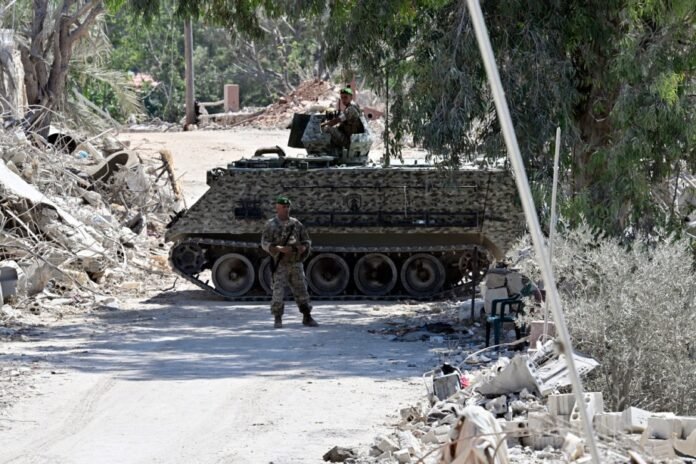
A view of heavy destruction at homes, places of worship, roads, and infrastructure, after Israeli troops withdrew from the town of Zawtar al-Gharbiya, following the US State Department's announcement on July 20 regarding the launch of a pilot project under the Lebanon-US-Israel framework agreement on July 27, 2026 in Zawtar al-Gharbiya, Lebanon. [Houssam Shbaro - Anadolu Agency]

A view of heavy destruction at homes, places of worship, roads, and infrastructure, after Israeli troops withdrew from the town of Zawtar al-Gharbiya, following the US State Department’s announcement on July 20 regarding the launch of a pilot project under the Lebanon-US-Israel framework agreement on July 27, 2026 in Zawtar al-Gharbiya, Lebanon. [Houssam Shbaro – Anadolu Agency]

Five Lebanese soldiers were wounded Sunday in an Israeli attack in southern Lebanon, the army said, Anadolu reports.

A military statement said the soldiers sustained minor injuries in the town of Kafra in Bint Jbeil while escorting civilians in an army vehicle.

The army did not provide further details on the circumstances or the type of strike and there was no comment from the Israeli army yet.

Separately, Lebanon’s National News Agency said Israeli forces detonated explosives in the town of Kounine in Nabatieh, with the blasts heard across several areas in southern Lebanon.

The agency also reported explosions shortly after midnight in the vicinity of the town of Haddatha, also in the Bint Jbeil district.

READ: Israeli violations in Lebanon may amount to ‘war crimes’: UN rights chief

It added that Israeli drones were seen flying over Beirut and the capital’s southern suburbs.

The latest developments come despite a US-brokered framework agreement signed by Lebanon and Israel on June 26.

The agreement calls for a phased Israeli withdrawal from all occupied Lebanese territory in exchange for the deployment of the Lebanese army, along with the disarmament of armed groups, in an apparent reference to Hezbollah.

Israel has continued its assaults in Lebanon since March 2, killing at least 4,333 people and wounding 12,236 others, according to the Lebanese Health Ministry.​​​​​​​ During the current offensive, Israeli forces have advanced more than 10 kilometers (6.2 miles) into Lebanese territory.

READ: Explosive hazards still pose risks in southern Lebanon despite reduced violence: UNIFIL

Child Pop Star Sues Airline Over Chicken Skewer Injury

0


A former child pop star who now works as a yoga instructor in Los Angeles is suing Singapore Airlines after she says a splintered chicken skewer served during a business-class flight became lodged in her throat and damaged her vocal cords.

Briohny Smyth, 44, claims she was flying to Los Angeles on July 28, 2024, when she unknowingly swallowed a jagged wooden splinter that broke off from a chicken satay skewer served with her in-flight meal, according to a federal lawsuit filed July 24 in Los Angeles.

Smyth, who had a platinum album in Thailand when she was just 13 years old, says the shard caused immediate pain, violent coughing and frightening choking sensations after it became stuck in her throat.

According to the complaint, Smyth suffered “substantial pain and emotional distress” while trying to expel the object during the flight. She eventually coughed up a jagged wooden shard that measured about 1.5 inches long.

The lawsuit says Smyth was seated in business class and was eating the meal as intended when the alleged incident happened.

After the flight, Smyth claims she continued to suffer from throat discomfort, vocal fatigue, raspiness, tightness and pain when speaking or singing for extended periods. She later saw an otolaryngologist, who allegedly found scarring and trauma to her vocal cords consistent with an injury from a sharp foreign object.

The lawsuit describes Smyth as a professional singer, performer, wellness educator and public speaker whose career depends heavily on her voice.

Because of the alleged injury, Smyth says she has suffered bodily harm, loss of earning capacity, professional setbacks and anxiety connected to eating and flying.

Smyth is seeking damages for past and future medical expenses, past and future lost earnings and earning capacity, emotional distress tied to bodily injury, legal costs and pre- and post-judgment interest.

The lawsuit comes amid a string of unusual in-flight food-related legal claims.

Last year, a New York City doctor with a severe shellfish allergy sued Singapore Airlines after allegedly being served a meal containing shrimp. That flight, traveling from Frankfurt to New York’s JFK Airport, was reportedly diverted to Paris so Dr. Doreen Benary could be taken to a hospital.

In another case, a New Jersey woman sued JetBlue after claiming she broke an incisor on an ice cream sandwich she described in court papers as “dangerously cold” and “frozen solid.” Karla Quinonez said she needed an emergency tooth extraction after landing, followed by an implant and continuing treatment.

Last November, a North Carolina mother sued Qatar Airways for $5 million after her 3-year-old daughter, who has a severe dairy allergy, was allegedly given a chocolate bar by a flight attendant despite repeated warnings that the child could not have milk. The lawsuit says the toddler went into anaphylaxis, her vital signs declined and she later spent two days in intensive care.

Smyth, meanwhile, is still known in wellness circles. A yoga video she appeared in back in 2011 went viral and has racked up nearly 16 million views on YouTube.

Singapore Airlines did not respond to a request for comment, according to The Independent.

0FansLike
0FollowersFollow
0FollowersFollow
0SubscribersSubscribe
- Advertisement -
Google search engine

Recent Posts