17.5 C
London
Wednesday, July 29, 2026
Home Blog

Remember the two-state solution? Trump doesn’t

0
remember-the-two-state-solution?-trump-doesn’t
Remember the two-state solution? Trump doesn’t

Israel’s right-wing government is intensifying its half-century-long campaign to take over the West Bank fully by unleashing bands of settler militias to harass Palestinian residents, destroy their homes and livelihoods and restrict their movement throughout the occupied territory.

The aim is to quickly erase conditions necessary for creating a viable Palestinian state alongside Israel, a proposed solution for ending a century of Israeli-Palestinian conflict. Opposition to the so-called two-state solution has been central to the political career of Prime Minister Benjamin Netanyahu, who heads the Likud Party that leads Israel’s present ultra-nationalist government. His 19 years in office, spread over seven scattered terms, is the longest in Israeli history.

Outside observers contend that attention paid to the concurrent wars in the Gaza Strip, Iran and Lebanon have sucked away almost all international attention and concern from Netanyahu’s West Bank ambitions.

“While much of the world’s attention is fixated on Israel’s ongoing conflict in the Gaza Strip and its unprecedented direct confrontation with Iran, another front has been quietly boiling over,” wrote the Armed Conflict Location & Event Data, a conflict monitor organization affiliated with the University of Texas. “Violence is surging in the West Bank.”

Israel’s allies and sympathizers in the United States and Europe stand by idly, even as they all verbally promote the so-called two-state solution of providing Palestinian sovereignty in the West Bank and Gaza Strip to coexist alongside Israel. Netanyahu’s current multi-layered offensive make the possibility a prayer rather than policy.

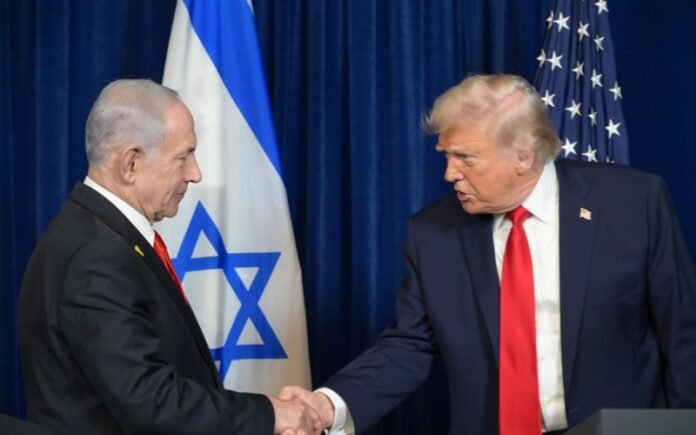
Netanyahu visited Washington Tuesday for talks with US President Donald Trump. The meeting is meant to close gaps in strategy between the US and Israel over the war in Iran. The West Bank was not on the Washington agenda.

Instead, the talks were “first and foremost about Iran,” according to a White House official. Trump wants to call it off as soon as possible, while Netanyahu prefers a clear military victory over Iran and Lebanon, where Hezbollah, a militia fighting the Israelis on behalf of Iran, is based.

Netanyahu didn’t bring up the West Bank, either.

Iran seems disinterested. Expert observers point out that the West Bank does not fall within Iran’s list of top regional interests. It is not a member of Tehran’s designated Axis of Resistance against Israel, which includes Hezbollah in Lebanon, the Houthis in Yemen and Hamas, the Islamic militia whose October 7, 2023, invasion of Israel ignited the interlocking Middle Eastern wars.

Iran has issued only cursory verbal support for the Palestinians. On July 15, its Foreign Ministry “denounced Israel’s escalating attacks against the Palestinian people in Gaza and the West Bank, demanding international action to stop the killings and hold Israeli leaders accountable.”

A Western intelligence analyst observed that, “Iran operates within a strict strategic hierarchy. The Lebanese arena, for instance, is viewed as far more important than the Palestinians. Hamas is somewhat down the list of concerns and, anyway, was so battered by Israel that it is beyond use or help.”

Such indifference makes the West Bank a geopolitical orphan. On the ground, Netanyahu has taken advantage of it. “While the world is focused on the war in Iran, Israel is working at full speed to create a new reality on the ground,” said Abed Aboul Shhadeh, a commentator for The New Arab, a Qatar news outlet based in London.

Stepped-up assaults on Palestinian towns, villages, individuals and their farmland come in all shapes, sizes and curation. Many attacks are spearheaded by militantly anti-Arab Israeli settlers. Their activities are protected by army units available to control armed mayhem and especially to defend the marauding settlers if necessary.

Old and new settlements

The joint activities include the expansion of old settlements and creation of new ones. Initiated by Likud Prime Minister Menachem Begin in 1977, this grew into a pet project of Netanyahu, Likud’s longest serving Prime Minister.

About 500,000 Israelis live in the West Bank, up from 140,000, the population when Netanyahu first took power in 1996. Since late 2023, over half of the West Bank’s 360 settler “outposts,” consisting of little more than shacks, have sprung up across the West Bank. There are 147 officially-recognized fully constructed settlements. About 3.4 million Palestinians live in the West Bank.

Assaults on Palestinian towns, villages, refugee camps, individual homes

In recent months, the Israeli army has demolished scores of homes in Palestinian towns and villages on the ground that they harbor terrorists. Some 30,000 refugees from past wars have been driven out by force from three United Nations refugee camps in Jenin and in and near the town of Tulkarem. Military officials have forbidden former inhabitants to return.

Demolitions of homes and evictions from property are increasing across the territory, Israeli and Palestinian human rights researchers say. Israeli armed forces demolished 740 houses in the first six months of 2026, affecting 1,923 residents, including 431 women and 546 children, the researchers say.

Recent demolition of four houses in the town of Nahallin, which lies near Bethlehem, typifies the actions. Before dawn on July 20, soldiers entered the town, which sits near Bethlehem, and began to level the houses with bulldozers. One of them belonged to the town mayor. Residents threw stones and three Palestinians were arrested during the melee.

A week later, police delivered orders for residents another 14 houses to evacuate. No reasons were provided, though often houses are torn down because they were constructed without Israeli permission. Permission is almost are never provided for Palestinian construction.

Israel plans to drain Nahallin’s population in order to empty the area, take it over and unite three settlements that are blocked by Nahallin’s presence, Israeli officials say. The expulsion plan is called the “Gush Etzion Continguity Project” named after a nearby, larger nearby settlement bloc.

Violence, intimidation and harassment

Settler vigilantes intimidate Palestinians by vandalizing property, stealing or kill livestock or cutting off Palestinian farmers and herders from their fields and pastures.

Amnesty International, the human rights research group, says at least 50 distinct Palestinian shepherd communities have been cut off from their lands and forced to flee. A prime target of a current campaign is the West Bank hamlet of Khan al-Ahmar. Israeli authorities want to remove Khan al-Ahmar’s community of shepherd families from the path of apartment blocks planned to be built between Jerusalem and Ma’aleh Adumim, a large West Bank settlement.

This spring, the government ordered the evacuation “as soon as possible,” though no eviction action has begun. The Office of the United Nations High Commissioner for Human Rights objected and demanded Israel “cease its measures to forcibly displace the Khan Al Ahmar community … and stop its settlement expansion plans there.”

In the meantime, settlers have set up a camp near the village. Their members have stoned shepherds, scattered their sheep and cut water pipes that supply water to the village.

Marauding settlers also carry out numerous acts of hatassment of civilians across the West Bank. In the weeks following Hamas’ 2023 attack from Gaza, the governmemnt distributed thousands of weapons to newly established civilian security squads in the West Bank.

The move unleashed waves of vigilante violence,. “Israeli settler violence is at an all-time high,” write the International Crisis Group, a conflict monitoring organization. “The aggressive acts, often perpetrated by gangs of armed young men, range from verbal intimidation and harassment to theft of livestock to assaults on Palestinians, in which the settlers uproot farmers’ olive trees and deny them access to land and water.”

Agricultural vandalism has altered swaths of West Bank landscape. Thousands of ancient olive trees have been cut down or uprooted systematically. Olive trees take decades to mature and bear the fruit that provides primary income for tens of thousands of Palestinians.

During the summer dry season, settlers set fire to wheat fields as well as olive groves. Settler gangs spray herbicides on crops to poison them and the soil. Herds of sheep have been poisoned. A video of a settler trying to beat an old sheep dog to death went viral, upsetting animal rights advocates who otherwise care or know little about West Bank cruelty.

Equally sinister is the dumping of poisons, animal carcasses or fuel into Palestinian wells, cisterns and springs and blocking wells with cement. Settlers erect fencing to keep shepherds from accessing communal pastureland. Thousands of acres of such land have been expropriated in the name of military necessity.

This violent reality has forced Palestinians to fear working their land. Some  have been driven away by bullying armed settlers. In other cases, the military has sealed Palestinian land off from farmers.

The Neranyahu government condones these activities for a purpose: to force rural communities to abandon the lnd and gather into urban areas that are easier for the authorities to police, said B’Tselem, Israel’s leading human rights organization. “The regime fragments Palestinian space, dispossesses Palestinians of their land and relegates them to living in small, over-populated enclaves.”

In case anyone thought Netanyahu might pause his West Bank offensive in advance of his meeting with Trump, Israelis officials demonstrated it was to be business as usual in coming days: Officials announced that soldiers would soon force the evacuation of a refugee camp in a yet unnamed West Bank town, as they had done in Jenin and Tulkrem.
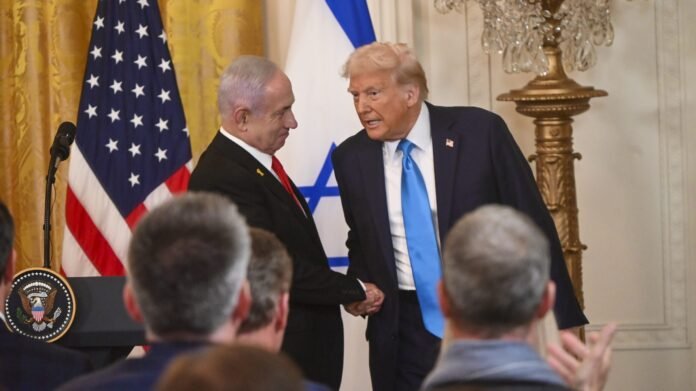

Netanyahu Says Talks With President Trump Were ‘One of the Best Conversations’

0
netanyahu-says-talks-with-president-trump-were-‘one-of-the-best-conversations’
Netanyahu Says Talks With President Trump Were ‘One of the Best Conversations’


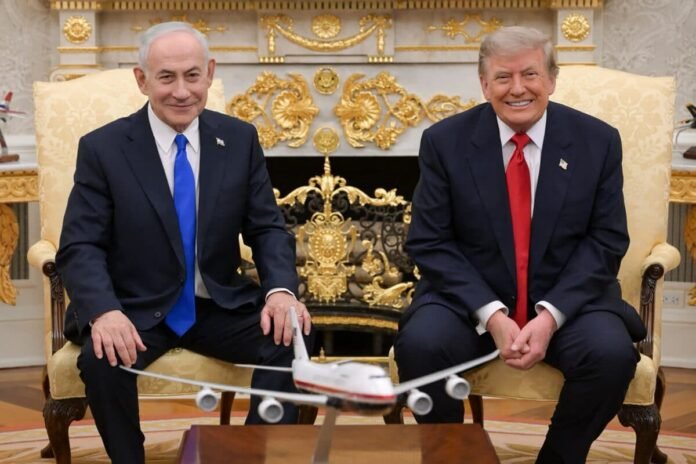
President Donald Trump and Prime Minister Benjamin Netanyahu concluded a 90-minute White House meeting Tuesday with a shared message that the United States and Israel remain aligned on preventing Iran from acquiring a nuclear weapon, while President Donald Trump weighs whether to pursue further diplomacy or authorize additional military action.

Speaking after the talks, Netanyahu described the meeting in unusually favorable terms.

“I have just concluded an excellent meeting with President Trump,” Netanyahu said. “It was a conversation marked by full partnership, mutual support, and a shared understanding of our common goal: ensuring that Iran never obtains a nuclear weapon. It was one of the best conversations I have ever had with a president of the United States.”

Iran was the central focus of the discussions, Israeli officials said. During the meeting, Netanyahu presented Israel’s assessment that Tehran has restored parts of its nuclear infrastructure and other strategic capabilities, arguing that additional military strikes may still be necessary.

“We are at a critical juncture,” a senior Israeli official said. “President Trump will make a decision soon about the path forward. We are not pressuring him, but neither are we burying our heads in the sand. Netanyahu presented him with Israel’s perspective.”

Israeli officials described the discussions as “very good” and “highly positive,” adding that the leaders also reviewed broader developments across the Middle East and reaffirmed the US-Israel alliance. The meeting differed from previous Trump-Netanyahu summits in that all discussions were held in an expanded format. The leaders did not hold a private one-on-one session, and no joint press conference followed the meeting.

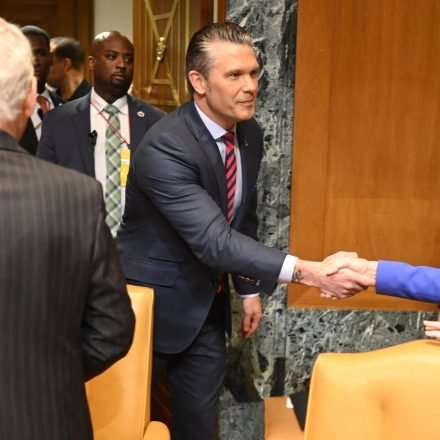
The US delegation included Vice President JD Vance, Secretary of State Marco Rubio, Defense Secretary Pete Hegseth, CIA Director John Ratcliffe and Special Envoy Steve Witkoff. Netanyahu was joined by National Security Adviser Shmuel Ben Ezra, Israeli Ambassador to the United States Yechiel Leiter, Chief of Staff Ido Norden, Military Secretary Guy Markizano, senior adviser Caroline Glick and diplomatic adviser Ophir Falk.

A White House spokeswoman described the meeting as “positive and productive.” An Israeli official in Washington also said Trump did not ask Israel to withdraw from its security zones in Gaza, Lebanon or Syria during the talks.

GO Ventures Invests in AI Cybersecurity Company Jericho Security

0
go-ventures-invests-in-ai-cybersecurity-company-jericho-security
GO Ventures Invests in AI Cybersecurity Company Jericho Security


GO Ventures, the corporate venture capital arm of GO plc, has invested in Jericho Security, a New York-based cybersecurity company developing artificial intelligence tools to help organisations defend against increasingly sophisticated social engineering attacks.

The investment comes as businesses face a rapidly changing threat landscape, with attackers using generative AI to create more convincing phishing campaigns, synthetic voices and deepfake content.

The investment comes as European organisations increasingly confront the rapid adoption of artificial intelligence by both defenders and attackers. Global information security spending is forecast to exceed €170 billion annually, with European companies increasing investment as new regulations and sophisticated social engineering threats reshape security priorities.

“Cybersecurity is becoming a defining challenge for organisations as artificial intelligence changes both the scale and sophistication of attacks,” said Nikhil Patil, chief executive of GO plc. “This investment reflects our strategy of supporting innovative technology companies that can deliver long-term strategic value, while reinforcing our commitment to cybersecurity as a critical area of growth.”

Founded in 2023, Jericho Security uses generative AI to simulate real-world phishing, voice, SMS, video and other social engineering attacks. Its platform enables organisations to test employee resilience against evolving threats and deliver adaptive security awareness training.

The company’s approach focuses on what remains one of the most difficult areas of cybersecurity: the human element. As attackers increasingly use AI to personalise and automate campaigns, organisations are seeking new ways to prepare employees for threats that traditional security controls may not detect.

The company recently raised a US$15 million Series A funding round led by Era Fund, with participation from leading technology investors including Lux Capital, Plug and Play Ventures, Gaingels, Dash Fund and Distique Ventures. The funding will support continued product development and international expansion.

“GO Ventures brings more than capital to this partnership. GO’s deep cybersecurity expertise and established presence across the European market make them an ideal partner as we expand Jericho’s platform into new territories,” said Sage Wohns, CEO of Jericho Security.

“Their team understands both the technical challenges organisations face today and how the region’s cybersecurity landscape is evolving, which will be invaluable as we grow our footprint in Europe.”

Jericho demonstrates the success of its advanced solutions with its growing customer base including the US Air Force, NFL and many more.

GO Ventures invests in early-stage technology companies with the potential to create long-term strategic value, focusing on sectors including artificial intelligence, cybersecurity, fintech, digital infrastructure and enterprise software.

Audi has a new flagship designed with the US in mind: The 2027 Q9

0
audi-has-a-new-flagship-designed-with-the-us-in-mind:-the-2027-q9
Audi has a new flagship designed with the US in mind: The 2027 Q9

MUNICH—It has taken Audi a little longer than its rivals, but with the debut of the 2027 Q9 this evening, the company has joined them in offering a range-topping full-size SUV. No, not the Q7, although a third-generation version of that vehicle broke cover in June. The car was designed first and foremost for Europe, with a third row of seats that’s fine for small children or occasional use. But in America, there’s a segment one size larger, pioneered by the Cadillac Escalade, and it’s here we find the new Audi. With no concrete plans to replace the A8 sedan yet, the Q9 SUV becomes the brand’s new flagship.

At 209 inches (5,309 mm) long, 79.2 inches (2,012 mm) wide, and 71.4 inches (1,814 mm) tall, it’s definitely not diminutive, although parked next to the aforementioned Caddy, you’ll find the American SUV exceeds this one by a few inches here and there. The 123.5-inch wheelbase (3,137 mm) is 5.6 inches (142 mm) longer than the Q7’s, much of which translates to more room for the third row.

An Audi Q9 in a studio

The silhouette is like a station wagon, but scaled up by 1.3x.

Audi Q9 from the rear 3/4s

OLED rear lights are an option.

The Q9 looked big in the studio, but it was less imposing than a Mercedes-Benz GLS or BMW X7. The body panels feature more curves and more subtle creases than the Audis of a few years ago. And there are definite station wagon vibes, but that’s mostly because its big wheels make it look smaller and closer rather than bigger and farther away (aka, the Father Dougal principle.)

Like the Q7 (and the new A5 and Q5), the Q9 uses Volkswagen Group’s new Premium Platform Combustion, or PPC, architecture. At launch, it will come with one of Audi’s 2.9 L V6 engines under the hood, but there’s also the SQ9, which uses the twin-turbo V8 found in some RS6 and RS7 models. You’ll know the SQ9 by its wider wheel arches, bigger alloy wheels, and the different illuminated grille. Audi says that unlike the regular Q9, the SQ9’s all-wheel drive power delivery is rear-biased for daily driving.

As we have previously covered, Audi will finally bring its active-matrix LED headlights to the US with the Q9’s arrival in the last quarter of the year. The advanced headlights can selectively dim portions of their beam to avoid dazzling oncoming drivers or subjecting the Q9 driver to undue glare while projecting driving aids like lane markers onto the road ahead. The Q9 (and the Q7) also get new turn signals that project indicators onto the roadway to make them more visible for other road users like cyclists and pedestrians.

Audi SQ9 in studio

The SQ9 has quad exhausts.

The Audi Q9 interior

There are two wireless charging pads up front and a plethora of USB-C ports.

In May, we looked at the Q9 interior. At the time, you had to imagine the olive-colored interior I waxed lyrical about; Audi only shared images of the carbon-accented SQ9 for that embargo. But in the images here, you can see a warmer option than the SQ9’s First Order-inspired color palette, which uses open-grain wood instead of carbon. There’s a massive panoramic roof with electrochromic dimming, and the interior can be configured as a six-seater with two captains’ chairs in the middle row or a three-seat bench. Cargo room is 19.3 cubic feet (547 L) with the third row in use, up to 50 cubic feet (1,416 L) with the third row flat, or 87.7 cubic feet (2,483 L) with all the seats flat. Towing capacity is 7,700 lbs (3,492 lbs) for both Q9 and SQ9.

The Q9 will start at $87,700, with the SQ9 starting at $118,000.

Bank Indonesia drama shows why rupiah is plunging

0
bank-indonesia-drama-shows-why-rupiah-is-plunging
Bank Indonesia drama shows why rupiah is plunging

TOKYO — Investors hoping President Prabowo Subianto might learn from Indonesia’s past economic mistakes should get used to disappointment.

Since taking office in October 2024, Prabowo has worked to drag Southeast Asia’s biggest economy back into its past. Which past is debatable. What isn’t debatable: the general-turned-politician is overseeing Indonesia’s worst financial turmoil since the 1997-98 Asian crisis. The rupiah is down more than 8% year to date.

Things are about to get worse. Tensions are re-escalating in the Persian Gulf. The Federal Reserve is signaling more rate hikes. And US tariffs are landing at the worst possible moment. Each of those pressures got heavier Monday with the abrupt departure of Bank Indonesia (BI) Governor Perry Warjiyo.

Warjiyo was the last major link between the Prabowo era and the policies of predecessor Joko Widodo. From 2014 to 2024, Widodo moved Indonesia farther beyond the kleptocratic system Suharto built over his 32-year reign, which ended in mass protests and his ouster in 1998 during the Asian financial crisis.

Widodo didn’t revolutionize Indonesia, but he built on the reform groundwork laid during Susilo Bambang Yudhoyono’s 2004-2014 presidency, launching infrastructure projects meant to lift productivity and draw foreign investment. And showcasing Jakarta’s new status as an investment-grade credit.

Widodo also made unprecedented progress cutting extreme poverty in Indonesia’s 280 million-strong population, and steered the country through Covid-19 more smoothly than many peers — the US included. He did it with BI governor Warjiyo, his handpicked pick since 2018.

Enter Prabowo, once Suharto’s son-in-law. He’s pledged to lift annual growth to 8% by 2029 — a pace Indonesia hasn’t seen since the eve of the 1997 crisis — and opened with a heavy fiscal stimulus push.

That spending spree widened Indonesia’s twin budget and current-account deficits and put Prabowo on a collision course with globally respected Finance Minister Sri Mulyani Indrawati, who’d acted as a check on his impulses. He sacked her in September 2025, rattling global markets.

Prabowo doubled down by naming his nephew, Thomas Djiwandono, deputy BI governor. That track record is why few investors believed Warjiyo left for “personal” reasons.

“The leadership change adds uncertainty over the future direction of monetary policy, leaving the rupiah vulnerable to further weakness and heightened volatility,” says Oxford Economics’ Adam Ahmad Samdin. “We maintain our call for another Bank Indonesia rate hike in the third quarter. But delayed policy action, or a premature pivot, could ultimately necessitate a more aggressive tightening cycle down the line to restore confidence in the local currency.”

Once lost, central bank credibility is brutally hard to rebuild. BNY Investments strategist Aninda Mitra says Warjiyo’s exit “raises questions about the sufficiency of the broader macro stabilization efforts.”

Markets are hoping interim BI chief Destry Damayanti, a senior deputy governor, can restore calm. But Mitra warns that until the monetary uncertainty clears — or fiscal announcements surprise to the upside — rupiah risk premia will stay elevated, leaving any transitional leadership “more stark tradeoffs between managing growth and rupiah stability.”

ANZ Bank’s Asia research head, Khoon Goh, says markets will now fixate on Warjiyo’s permanent successor. “This could take a few months, and in the interim, whilst you can argue there is some continuity with the deputy governor taking over, we’re also entering a potentially choppy period as well.” The timing stings, Goh adds, because recent stabilization — helped by S&P affirming Indonesia’s rating outlook — had just started calming nerves. “So,” Goh says, “this latest development has once again introduced uncertainty for investors.”

Camelia Suryanata, head of research at Kiwoom Sekuritas, tells the Jakarta Post that rebuilding investor confidence won’t be easy “especially now that monetary policies are under executive control.”

Layer on top of that home-grown mess a set of external shocks. Trump’s war in Iran has sent oil prices and risk premia higher, hitting the rupiah hard. US President Trump’s latest tariff barrage — fresh US levies of 10-12.5% on Indonesia, India, the Philippines and others — could not have landed at a worse time. The immediate priority, says Moody’s Analytics economist Xiaohan Chen, is an “all-hands-on-deck approach to preserve rupiah stability.”

The longer-term picture is murkier. Whether Prabowo intends to revive elements of the old Suharto system remains unclear. But the speed with which he sidelined Widodo’s allies — the same allies who helped elect him — has only deepened investor unease. Early optimism that Prabowo would stay the reform course has faded, replaced by concern over Indonesia’s fiscal trajectory, rising economic nationalism, possible democratic backsliding, and eroding central bank autonomy — all of which is driving capital out of rupiah assets.

Against that backdrop, BI is left treating symptoms, not causes. Monetary tightening can slow the rupiah’s slide, but it can’t offset the policy uncertainty pushing investors toward the exits.

A resurgent dollar isn’t helping. All of Asia is exposed as the Federal Reserve pivots toward hikes, but Indonesia’s self-inflicted wounds make it stand out — no small feat in a region where governments often work against their own interests. Export-led, dollar-dependent Asian economies would sit on the front lines of any US credit-market contagion — and dollar strength is exactly why the ghosts of 1997-98 are stirring again.

One side effect of the US- and Israeli-led Iran war: the dollar’s wrecking-ball tendencies are back. Despite US national debt nearing $39 trillion, elevated inflation, and Trump’s tariffs, the dollar keeps rising against the odds — a clear and present danger for Asia in 2026.

Extreme dollar strength has a bad track record in this region. The Asian financial crisis had its roots in the Fed’s 1994-95 tightening cycle, when the Fed doubled short-term rates in 12 months. The resulting dollar surge broke Asia’s currency pegs — Thailand devalued first, in July 1997, then Indonesia, then South Korea. The 2013 “taper tantrum” was another such episode, prompting Morgan Stanley’s original “fragile five” list: Brazil, India, Indonesia, South Africa and Turkey.

Now a stubbornly strong dollar is complicating Asia’s plans anew, pulling in capital that’s needed elsewhere to finance deficits, stabilize bond yields and support equities. Trump isn’t exactly happy about all this. He’s spent years trying to weaken the dollar, including by working to strip the Fed of its policy independence — even as Asia’s top currencies slide against it.

AI-related jitters compound the vulnerability. Moody’s Analytics notes that the Middle East conflict has sent shockwaves through Asian equity markets, hitting South Korea hardest, after a red-hot AI rally had already pushed valuations in Korea and Taiwan to stretched levels. The result, Moody’s argues: markets “where AI optimism had recently raised valuations to stretched levels” are absorbing the heaviest macro and financial fallout, and while the initial shock may fade, “market volatility looks set to stay elevated.”

Investors fleeing Indonesia — driving Jakarta equities to multiyear lows — cite Prabowo’s fiscal maneuvers, export controls, and pressure on BI as reasons to sell. The deeper problem may be a lack of self-awareness inside Prabowo’s economic team. Its policy mix has grown so erratic that index giant MSCI is weighing a downgrade of Indonesia to frontier-market status, a threat that has shadowed the rupiah for months.

Prabowo’s allies note that efforts to rein in central bank independence aren’t unique to Jakarta — Washington included. Trump nominated adviser Stephen Miran to the Fed board and installed loyalist Kevin Warsh as Fed chair to replace Jerome Powell.

But Indonesia’s push to weaken its own financial guardrails explains not just why the rupiah is sliding but why its declines could become even more dramatic in the back half of 2026.

-0-

College lab class ends with 32 people on antibiotics for deadly germ exposure

0
college-lab-class-ends-with-32-people-on-antibiotics-for-deadly-germ-exposure
College lab class ends with 32 people on antibiotics for deadly germ exposure

A bizarre series of events in a college microbiology lab class left 33 people—including students, professors, and lab workers—believing they were exposed to a deadly germ. Of those, 32 began taking an antibiotic regimen as a precaution to prevent a life-threatening infection. Two also underwent lumbar punctures—aka spinal taps—after developing mild symptoms.

But none of them had actually been exposed to a dangerous pathogen, a fortunate twist in the strange incident, which otherwise stands to be a cautionary tale for the ages. The incident was published in a recent issue of Morbidity and Mortality Weekly Report.

It began with a simple laboratory exercise. The microbiology lab students were supposed to be given mystery bacteria by their instructors and then identify the microbe based on a series of biochemical tests and morphological characterization.

Unbeknownst to the students, the mystery bacteria was supposed to be Plesiomonas shigelloides, a common, non-scary bacterium. It infects a variety of animals, including fish, and has been known to cause diarrhea in humans. But it can be found throughout the environment and in the gastrointestinal tracts of healthy people, too.

To the lab instructors’ great surprise, no one in the microbiology class identified their mystery germ as P. shigelloides. Instead, every single person in the class identified it as Neisseria meningitidis, a dangerous pathogen that can cause meningitis (swelling of the brain and spinal cord) and bloodstream infections, both potentially deadly.

N. meningitidis can spread by aerosols, and in laboratories, it requires specialized handling measures to prevent exposures. That includes respiratory protection and a biosafety cabinet, which is an enclosed, ventilated workspace that prevents the bacteria from spreading in the air. But the students did not have those things; they just had gloves and lab coats.

When the instructors checked the lab class’s work, they couldn’t find fault with their conclusion. They had all identified the mystery bacterium as a gram-negative, oxidase- and catalase-positive diplococcus with carbohydrate fermentation patterns all consistent with N. meningitidis.

An incident response ensued. University officials found that the stockroom freezer where the P. shigelloides was stored also, for some inexplicable reason, held a vial labeled N. meningitidis.

University officials determined that 33 people linked to the lab class had been exposed. They called in state public health officials, who quickly helped with risk assessments and sample testing, made public health recommendations, and helped with the investigation.

Incident response

The health officials recommended that all the exposed people start taking post-exposure prophylactic antibiotics for 10 days. Of the 33 exposed, all but one person started on antibiotics. Health officials noted that 15 of the 33 (45 percent) had gotten at least one meningococcal vaccination previously. Still, two people developed headaches and sought emergency care; they were given spinal taps to rule out N. meningitidis infection.

Several days later, the state’s public health laboratory obtained two samples from the ill-fated lab experiment. They used mass spectrometry and whole-genome sequencing to conclusively identify the mystery bacterium: N. sicca, a nonpathogenic relative of N. meningitidis.

The state lab repeated the carbohydrate fermentation tests that the lab students had used to identify the germ as N. meningitidis. The state lab reproduced their results. They concluded that this odd N. sicca isolate was an “atypical carbohydrate fermenter” that threw off the identification, leading not only to the exposure scare but also to the original misidentification on the vial in the stockroom freezer.

While everyone was safe in the end, the class did experience quite a scare and underwent unnecessary interventions. State and federal health officials conducted a subsequent investigation to figure out how a thought-to-be-dangerous pathogen was stored in the same freezer as harmless bacteria for lab classes and how the two got mixed up.

“The investigation found inadequate inventory controls for identifying, labeling, storing, and segregating biological materials according to handling practices and containment conditions,” officials reported. “Additional practice gaps included limited stockroom employee supervision, inadequate availability and use of personal protective equipment, and insufficient documentation of sample inventory, disposition, and chain of custody.”

The officials reported that the findings prompted the university to overhaul their procures and protocols.

Iran Has Figured Out How to Overwhelm U.S. Air Defenses

0
iran-has-figured-out-how-to-overwhelm-us.-air-defenses
Iran Has Figured Out How to Overwhelm U.S. Air Defenses


As munitions streaked through the night sky, a plaintive cry like a whale song echoed in the darkness. U.S. troops grabbed their gear and headed for shelter as the warning sirens rang out, a leaked video shows.

The military personnel, clad in a mix of combat fatigues and gym attire, piled into a bunker, huddling in the darkness. “Guys, off the walls if we can,” a woman, likely a medic, advised, warning about the danger of traumatic brain injuries.

The footage, reportedly from Jordan’s Muwaffaq Salti Air Base, where three U.S. troops were killed during Iranian ballistic missile and drone attacks on July 17 and 18, offers a glimpse of the dangers faced by U.S. forces across the Middle East.

The attacks are continued demonstrations of Iran’s ability to target U.S. bases across the Middle East and kill U.S. troops, despite months of claims by President Donald Trump and self-styled War Secretary Pete Hegseth that Iran’s military was annihilated. As this fiction has collapsed, U.S. Central Command has refused to discuss the number and scale of the strikes. “I have nothing for you on that,” Maj. Emma Thompson, the command’s media operations chief, told The Intercept.

Iran has attacked at least nine U.S. outposts across the Middle East since July 9, according to a U.S. official who spoke to The Intercept on the condition of anonymity because they were not authorized to speak with the press. Several of these bases suffered “significant” damage in the attacks, the source said.

Iran’s military managed to overwhelm U.S. air defense systems using a mix of attack drones and advanced ballistic missiles, according to the official. Numerous factors make the missiles difficult to defeat, the source said: They travel at hypersonic speeds, have complex navigational capabilities including methods to circumvent jamming, and some can be guided or steered.

Stocks of advanced air-defense missiles, like Patriot and THAAD interceptors, are so depleted that U.S. forces are not shooting down all Iranian missiles and drones aimed at U.S. and allied targets across the Middle East, the official said, referencing a Friday report by NBC News that revealed the tactic. The official told The Intercept that the U.S. allows missiles through its defenses only in cases where a strike is judged not to imperil U.S. lives.

The U.S. and its allies burned through more than 11,000 munitions, including large amounts of defensive missiles, in the first 16 days of the war alone, according to a March analysis by the Royal United Services Institute. The report predicted then that U.S. forces were about a month away from running out of THAAD interceptors. An April report by the Center for Strategic and International Studies noted that “diminished munitions stockpiles have created a near-term risk.” A follow-up report the next month warned that it would “take three or more years from today to return to prewar inventory levels” of Patriot and THAAD missiles.

Brig. Gen. Hossein Mohebbi, an Islamic Revolutionary Guard Corps spokesperson, said that “Patriot systems have been weakened to such an extent that Iranian missiles and drones are reaching their targets without being intercepted.” He said that during a flurry of attacks from July 8 to July 22, Iran struck numerous air defense and radar installations, including six “Patriot air-defense radars.”

CENTCOM did not reply to a request for comment on the claims by the U.S. official or Mohebbi.

The official confirmed that Iran also recently attacked Tower 22, a U.S. military outpost on the northern Jordanian border with Syria. Satellite images as well as photos and videos circulating online indicate the base suffered extensive damage. (In 2024, a drone attack on Tower 22 by an Iran-backed militia killed three U.S. troops.) 

Iran says it also attacked U.S. military facilities at Jordan’s Prince Hassan Air Base, King Faisal Air Base, and Al-Azraq Air Base; Kuwait’s Al-Adiri base, Ahmed Al-Jaber Air Base, Camp Doha, Ali Al Salem Air Base, and Camp Arifjan; Naval Support Activity Sheikh Isa in Bahrain; and Al Udeid Air Base in Qatar.

Thompson refused to confirm Iranian attacks on various U.S. bases across the Middle East. “We don’t comment on battle damage assessments,” she said.

Iran has fired between 8,000 and 9,000 drones and missiles at targets across the Middle East since the U.S.–Israeli war began in February, according to the official. Iran’s Islamic Revolution Guard Corps recently warned residents of countries that host American forces to keep at least 1,650 feet away from any buildings housing U.S. personnel. The group is also fielding crowdsourced information on “new locations of the American occupying forces” from people in these countries.

The IRGC specifically mentioned “covert and secret” facilities in a statement posted on their website. CIA sites in Iraq, Saudi Arabia, and elsewhere in the region were reportedly struck, possibly with Russian assistance, according to Reuters. A former Pentagon consultant with ties to the defense industry told The Intercept that Russia has certainly provided “targeting support” to Iran during the conflict but did not comment directly on attacks on CIA facilities.

Despite Trump’s insistence that Russia and China are “not participating” in the Iran war, Hegseth recently said both are “enabling some of the things Iran is doing.” In March, CIA Director John Ratcliffe told senators that the “Iranians are requesting intelligence assistance from Russia, from China and from other adversaries of the United States,” but said he would only talk about what they might have provided in a classified setting.

The lethal strike on Muwaffaq Salti Air Base in Jordan killed Pvt. Isabella Gonzales, 19, of Carrollton, Texas; Lt. Tyler James Feehan, 25, of Ewa Beach, Hawaii; and Sgt. Angel S. Rampersad, 28, of Ozone Park, New York. All three soldiers were from air defense units. They were “not actively engaged in anti-aircraft activity” during the attacks, according to a different “defense official” who spoke on background because they were not authorized to disclose the information.

An Iranian drone attack on Erbil Air Base, Iraq, on July 18 led to the death of Army Sgt. Michael Emmanuel Swinton, 30, of Fayetteville, North Carolina, and left another soldier injured during what CENTCOM called a “controlled detonation” of the downed aircraft.

In April, Hegseth told the Senate Armed Services Committee that “CENTCOM had every possible measure they could to ensure that our troops are protected.” The U.S. official would not address possible failures of force protection measures that led to the most recent deaths, due to operational security. But the official said that Hegseth’s claims “obviously were not true.” They noted that it was no secret that earlier casualties were caused by a lack of sufficient overhead protection, referencing a March 1 drone attack on the U.S. base at Port Shuaiba, Kuwait, that killed six troops.

Hundreds of U.S. personnel have been killed or wounded in the war. Months of reporting by The Intercept found the Pentagon’s official casualty tally is a gross undercount, which another U.S. government official called a “casualty cover-up.”

Israel, Saudi Arabia, Jordan, Iraq, and Qatar said they intercepted attack drones on Monday, two days after the United States abruptly suspended a two-week campaign of airstrikes against Iran amid concern over the dwindling stocks of air defense missiles and a reported dearth of Iranian targets. Trump insisted on Tuesday that there had been some “very good talks” with Iran but failed to offer evidence when confronted with Iranian denials.

Saudi Arabia said on Monday that the drone attacks it suffered were “carried out by Iran-backed militias operating in Iraq.” On Tuesday, Jordanian authorities said they downed a drone in the east of the country, near its border with Iraq and Saudi Arabia.

Trump says Israel ‘would not survive’ without US

0
trump-says-israel-‘would-not-survive’-without-us
Trump says Israel ‘would not survive’ without US


US President Donald Trump sought to shape expectations ahead of his first meeting in months with Israeli Prime Minister Benjamin Netanyahu by stressing Israel’s reliance on American support and dismissing concerns over a possible US sale of F-35 fighter jets to Turkey.

Speaking before Netanyahu’s visit to Washington, Trump acknowledged “a little difference” between their military priorities, amid growing signs that US and Israeli approaches in the Middle East are diverging.

He said many countries benefited from US backing, adding that Israel “wouldn’t survive without us”.

The meeting, the eighth between the two leaders since Trump returned to office, comes after Trump announced a ceasefire with Iran in April, before Israel had achieved all its stated war aims.

Netanyahu said Iran would be a central topic, though all issues would be discussed. He is reportedly seeking broader US action against Tehran beyond the Strait of Hormuz, while Washington has paused strikes to allow diplomacy a chance. Israel’s original objectives included eliminating Iran’s nuclear and missile capabilities and weakening its government.

via FT

Iran says final Hormuz proposal to Oman requires control of key shipping lanes

0
iran-says-final-hormuz-proposal-to-oman-requires-control-of-key-shipping-lanes
Iran says final Hormuz proposal to Oman requires control of key shipping lanes

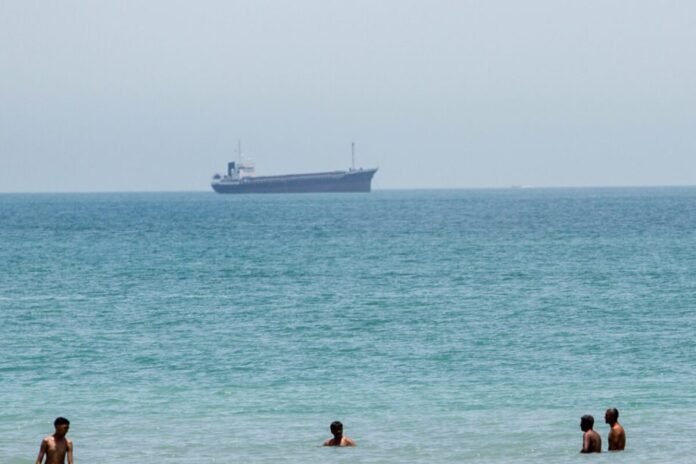
Iran’s deputy foreign minister said Tuesday that Tehran’s final proposal to Oman on reopening the Strait of Hormuz requires one shipping lane to remain entirely under Iranian control and part of a second lane to be also controlled by Iran, Anadolu reports.

Speaking on Iranian state television, Kazem Gharibabadi said Oman had proposed a temporary shipping route that would replace the current northern and southern routes through the strait.

He said the Omani proposal envisioned a route with 50% under Iran’s control and 50% under Oman’s control, but Tehran rejected the formula.

“Our proposal is that one shipping lane through the strait must be entirely under Iran’s control, with part of the other lane also under Iranian control. This is our definitive position, and Iran will accept no other formula,” Gharibabadi said.

He added that if Oman does not accept Iran’s proposal, the Strait of Hormuz will remain closed, saying Tehran is also prepared for the possibility of renewed conflict.

READ: Gulf foreign ministers discuss regional security, Strait of Hormuz navigation

Syria Closes the Chapter on the ‘Assad Pound.’ Can the New Currency Regain Syrians’ Trust?

0
syria-closes-the-chapter-on-the-‘assad-pound.’-can-the-new-currency-regain-syrians’-trust?
Syria Closes the Chapter on the ‘Assad Pound.’ Can the New Currency Regain Syrians’ Trust?


Bahjat Daqdouq, a Damascus resident, told The Media Line: “We want to see real strength in the new currency, rather than the process being limited to replacing banknotes”

[DAMASCUS] As the deadline for exchanging banknotes issued during the rule of former President Bashar Assad approaches, the Central Bank of Syria says around 80% of the old currency has been exchanged since the beginning of the year.

The transition introduces a new Syrian pound, with two zeros removed from the old currency’s face value: 100 old pounds are exchanged for one new pound. The process goes beyond replacing old notes with newly issued Syrian pounds, raising broader questions about national identity, confidence in the Syrian pound, and the country’s economic future.

Currency is more than a means of daily exchange. The images and symbols printed on banknotes often reflect the identity of the state and the political era in which they were issued. Syrians therefore regard the withdrawal of notes bearing Assad’s image as a symbolic break with a chapter that has ended.

Syrian researcher Mohammad Jamal Tahan told The Media Line that placing leaders’ images on currency has historically been a way to display authority and reinforce a leader’s presence in everyday life. He said the old currency had become associated with a president whom many Syrians hold responsible for the deaths of hundreds of thousands of people during the conflict. Replacing notes bearing Assad’s portrait therefore carries symbolic importance during the country’s political transition, he explained.

Throughout its history, the Syrian currency has reflected the political changes the country has experienced. The names, images, and symbols appearing on banknotes changed as governments shifted and concepts of national identity evolved.

But a redenomination and redesign do not, by themselves, make a currency stronger. The Syrian pound’s value will continue to depend on economic stability, domestic production, and confidence in financial institutions.

Central Bank of Syria Governor Safwat Raslan told The Media Line that the deadline for exchanging the old banknotes is July 30, and that they will cease to be legal tender beginning July 31. After that date, they will no longer be legally valid for commercial transactions or the settlement of financial obligations.

Raslan said approximately 80% of the old Syrian currency had been exchanged since the process began at the start of the year, leaving about one-fifth outside official exchange channels.

He said the formal withdrawal period would begin on July 31 and remain open for five years. Applications will be handled exclusively at the Central Bank’s headquarters in Damascus, the only authorized location for receiving withdrawal requests.

Under the announced procedures, each application must include at least 100 banknotes, regardless of denomination. Requests involving fewer than 100 notes will not be accepted.

The Central Bank of Syria headquarters in central Damascus on July 28, where the exchange and withdrawal of old banknotes are being administered. (Hiba Allah Taraf/The Media Line)

Following inspection and approval, the corresponding value will be transferred in newly issued Syrian pounds to a bank account designated by the applicant.

Raslan said the withdrawal process would not be subject to commissions, fees, taxes, or other charges. He urged Syrians to rely only on official channels for information and to avoid rumors and unofficial sources.

The decision means that old notes will no longer be usable in markets beginning July 31. Their holders will, however, retain the right to recover their value from the Central Bank during the following five years, subject to the stated conditions.

Limiting the process to Damascus and requiring a minimum of 100 banknotes could create difficulties for people with small amounts of cash and residents of distant provinces.

In Damascus markets, reactions have been mixed. Some people see the new Syrian pound as the beginning of a new era, while others say changing the currency will have little effect unless it is accompanied by higher incomes and greater price and exchange-rate stability.

Bahjat Daqdouq, a Damascus resident, told The Media Line that replacing the currency had become unavoidable because of the weakness of the old pound and the political symbols printed on it.

“We want to see real strength in the new currency, rather than the process being limited to replacing banknotes,” he said. “So far, the exchange rate has not changed. One US dollar is still worth around 13,000 [old] Syrian pounds, which is an extremely high figure.”

So far, the exchange rate has not changed. One US dollar is still worth around 13,000 [old] Syrian pounds, which is an extremely high figure.

The new notes are issued in denominations ranging from 10 to 500 pounds, reducing the number of bills needed for many everyday purchases without, by itself, changing purchasing power. Abu Hassan al-Kuwa, who owns a grocery store in Damascus, told The Media Line that the new currency had made payments easier. “In the past, shoppers had to carry large quantities of banknotes to buy their basic needs,” he said. “Today, they can replace them with a much smaller bundle. That has had a positive psychological effect on both buyers and sellers.”

Economists say replacing banknotes could help regulate the money supply, combat counterfeiting, and bring some cash circulating outside the banking sector back into official channels.

Abdel Azim al-Maghribel, an economist, told The Media Line that the pound’s value is determined not by its design or the symbols printed on it, but by confidence in the economy and the state’s ability to control spending, stimulate production, and attract investment.

“The new currency can be part of an economic reform process, but it cannot substitute for reform,” he said. “Stabilizing the pound requires a clear monetary policy, fiscal discipline, increased production and exports, and the reconstruction of the banking sector.”

The new currency can be part of an economic reform process, but it cannot substitute for reform

Experiences in Iraq, Turkey, and West Germany show that replacing a currency can help close a political chapter or reorganize a monetary system. In each case, however, success was linked to wider reforms involving inflation control, exchange-rate management, and the rebuilding of economic institutions.

In Syria, the outcome will be judged by the stability of prices and the exchange rate, the amount of money entering the banking system, public acceptance of the new notes, and whether Syrians regain enough confidence in the pound to use it as a store of value rather than merely a means of daily payment.

As the symbols of the previous era disappear from Syria’s banknotes, the more important question is what follows. The new currency may help the country present a different image of the state, but restoring the pound’s value will depend on the economy’s ability to achieve stability and growth.

Currency can be printed. Trust cannot.

0FansLike
0FollowersFollow
0FollowersFollow
0SubscribersSubscribe
- Advertisement -
Google search engine

Recent Posts