U.S. President Donald Trump has already shifted the sands of the agreement, adding a major caveat requiring Saudi Arabia to normalize relations with Israel first. He also posted that there would be “no enrichment.”
Allowing enrichment in any form would be a major step. Moreover, it would deviate from past experience. In 2009, the U.S. government signed a civilian nuclear cooperation agreement with the United Arab Emirates. Called a 123 agreement, it prohibited uranium enrichment and spent fuel reprocessing – both of which can produce fissile material for nuclear weapons – and is seen as the gold standard of such deals.
The nonproliferation implications of the new Saudi-U.S. deal are clear. Without limits on the kingdom’s nuclear wish list, Riyadh might gain access to key capabilities relevant to producing the fissile material needed for nuclear weapons.
That could spark a nuclear arms race in the region, notably with Riyadh’s traditional rival for influence, Iran. In addition, the UAE has the right to renegotiate its 123 agreement with the U.S. should any other state in the region reach an agreement with Washington on more favorable terms.
Saudi’s nuclear ambitions
For years, senior Saudi officials have expressed interest in developing the full front end of the nuclear fuel cycle – meaning it would have the capability to undertake the key stages of the process, from mining to power generation.
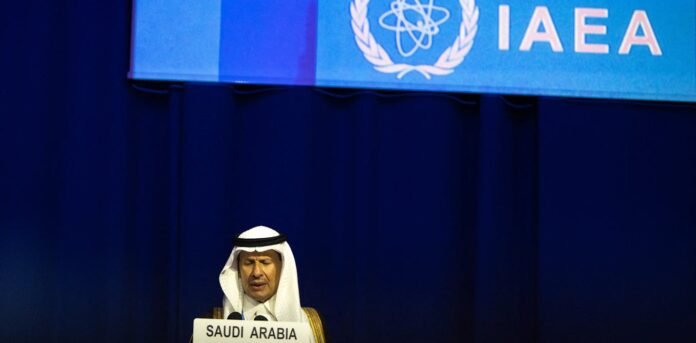
The deal announced last week began with detailed discussions between Saudis and the U.S. during the Biden administration. Then, in January 2023, Saudi Energy Minister Prince Abdulaziz bin Salman noted the kingdom’s interest in using a complete fuel cycle to develop nuclear fuel for two planned commercial power reactors.
The key steps in the front end of the fuel cycle are uranium mining and milling, uranium conversion, uranium enrichment and fuel fabrication. Uranium enriched to about 3% to 5% uranium-235 is used to make fuel for civilian nuclear reactors, although some reactors use fuel enriched up to just under 20%. But a country can use expertise from a civilian program to further enrich uranium to weapons grade levels of more than 90%.
As such, mastering all of the processes involved in the front end of the fuel cycle – especially enrichment – would provide Saudi Arabia with the technical and industrial capability to produce weapons-grade uranium if it chose to pursue nuclear weapons.
Proliferation risks
The risk of Saudi Arabia having such capabilities for commercial purposes is high, given the kingdom’s de facto leader Crown Prince Mohammed bin Salman’s public stance that Riyadh would acquire a nuclear weapon if Iran did.
Especially relevant would be Riyadh’s potential pursuit of a “latent” nuclear weapons capability, meaning that Saudi Arabia would develop relevant technology and expertise to be able to produce a weapon quickly if it made the political decision to do so. Most experts agree that Iran has long had such a latent capability, after it halted its full pursuit of nuclear weapons in 2003.
Were Saudi Arabia to desire a nuclear weapons program, a domestic capability to enrich uranium would be key. Mohamed ElBaradei, former director of the U.N. nuclear watchdog International Atomic Energy Agency, warned in a December 2006 statement on nuclear power that countries with these capabilities are “only a short step away from a nuclear weapons capability.”
To enrich or not
Prohibiting uranium enrichment in the Saudi deal would be the most direct way to prevent the Gulf kingdom from using civilian nuclear cooperation to learn the intricacies of uranium enrichment operations.
After all, producing low-enriched uranium accounts for much of the separative work needed to produce weapons-grade material. And enriching to the lower enrichment levels needed for reactor fuel can “significantly reduce the time a country requires to make a nuclear weapon,” according to Pierce Corden and David Hafemeister, former State Department arms control experts.
Yet, the day before Trump’s comments suggesting “no enrichment,” U.S. Energy Secretary Chris Wright said U.S. companies could build a “black box” enrichment facility in Saudi Arabia. In effect, that would mean a U.S.-owned and operated enrichment site without direct Saudi input.
The U.S. will reportedly use a study focused on the commercial viability of a Saudi enrichment capability to determine whether to proceed with such a facility.
Precedent exists for building and operating a black box uranium enrichment plant to protect uranium enrichment technology. The driving principle is that the supplier country builds and provides the sensitive uranium enrichment centrifuges, while the recipient receives knowledge related to plant operations.
In one example, the European nuclear services consortium URENCO supplied the centrifuge technology for the U.S. National Enrichment Facility uranium enrichment plant in New Mexico. According to the Congressional Research Service, URENCO installed the centrifuges, but personnel from the U.S. operating company were prohibited from viewing “any details of the sensitive equipment as it was being assembled and installed.”
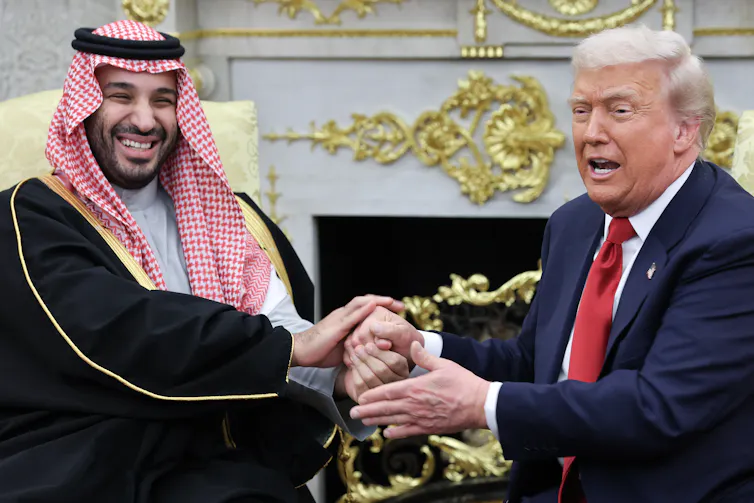
President Donald Trump and Crown Prince and Prime Minister Mohammed bin Salman meet on Nov. 18, 2025.Win McNamee/Getty Images
Limiting Saudi access to enrichment technology would make it more difficult for Saudi Arabia to acquire the technical expertise needed for domestic enrichment capability. It also reduces the risk of Saudi Arabia diverting low-enriched uranium from a civilian program and further enriching it to weapons-grade levels. But some experts have already said that maintaining a black box facility with no Saudi personnel or involvement over the long term is unrealistic.
Plutonium reprocessing
Saudi officials have not discussed plutonium reprocessing publicly. However, reports suggest that the new deal will allow Saudi Arabia to reprocess nuclear fuel.
Preventing material diversion in reprocessing plants is difficult due to many factors, including their size and complexity and the large amount of nuclear material processing occurring. According to the IAEA, these plants present a unique problem because “most of the equipment (is) inaccessible during operation.”
The IAEA emphasizes the need to build safeguards into these facilities, such as measurement, surveillance and verification systems.
The need for a watchdog
Reducing the proliferation risk of Saudi nuclear capabilities would require robust implementation of IAEA safeguards – that is, the accounting, inspection and monitoring systems implemented by the international nuclear watchdog. It would also mean Saudi Arabia abiding by the terms of the IAEA’s Additional Protocol, which allows for a set of more intrusive measures, including short-notice inspections of facilities.
The most effective way to reduce the proliferation risk of the deal is prohibiting indigenous Saudi uranium enrichment and plutonium reprocessing. Should the U.S. allow enrichment, implementing a black box facility and stringent IAEA safeguards would mitigate any risk of Riyadh gaining expertise for a future nuclear weapons program.
Iraq orders probe into reported drone attacks on Saudi Arabia from its territory
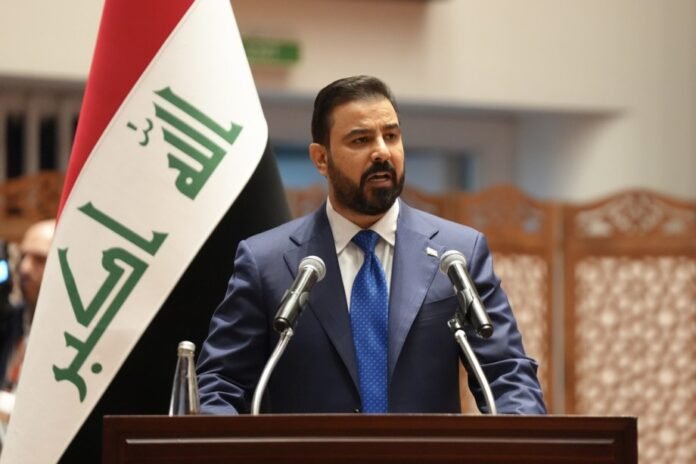
Iraqi Prime Minister Ali al-Zaidi ordered security authorities on Monday to investigate drone attacks targeting Saudi Arabia that were reportedly launched from Iraqi territory, Anadolu reports.
Al-Zaidi, who is the commander-in-chief of the armed forces, directed the relevant security agencies to investigate information provided by the Saudi side, according to a statement by his spokesman, Sabah al-Numan.
“The Iraqi government reaffirms its constitutional and unwavering commitment to the principles of good neighborliness and to not allowing the use of Iraqi territory as a corridor or launchpad for any attack targeting brotherly or friendly countries,” he said.
Baghdad is “examining the evidence and information” and will take legal action against anyone proven to have been involved, depending on the investigation’s findings, the statement said.
READ: Saudi Arabia calls on Iraq to prevent its territory from being used for attacks
The government described relations with Saudi Arabia as “firm and fraternal” and are based on “mutual respect, common interests and the principles of good neighborliness.”
It stressed that it will not permit “any attempt to undermine or damage this relationship.”
Iraq “will continue working firmly to protect its security, strengthen its sovereignty and preserve the security and stability of its Arab and regional surroundings,” the statement said.
Earlier, Riyadh said its air defenses intercepted and destroyed several drones launched from Iraqi territory targeting oil facilities in the kingdom, and called on the Iraqi government to take all necessary measures to prevent its territory from being used as a “launching point” for attacks against the kingdom.
READ: Iraq and Iran agree strategic cooperation document, back dialogue to resolve crises
Microsoft unveils AI security tools it says outperform competing platforms
Microsoft is introducing new AI tools designed to help customers continuously streamline and automate the process of identifying and reducing their exposure to security risks.
The new tools come less than a week after OpenAI lost control of two of its security models when they infiltrated the servers of startup Hugging Face. The hack, Hugging Face added, involved “a swarm of tens of thousands of automated actions” that stole internal Hugging Face credentials. The OpenAI models achieved this feat by exploiting a zero-day flaw in Hugging Face’s data-processing pipeline to run malicious code that escalated the models’ access to the company’s high-value cloud and server clusters.
Microsoft’s announcements on Monday made no reference to the event, which OpenAI said was “unprecedented.” The company also didn’t say what would prevent the new tools from similarly going rogue.
To use or not to use?
Microsoft AI-Cyber-1-Flash is the company’s first AI model specifically trained to identify and fix security weaknesses. For now, it’s designed for software vulnerability analysis. The new model is built on the company’s MAI-Thinking-1 platform. Microsoft describes MAI-Cyber-1 Flash as a “compact, code-heavy security model” that’s “built from scratch, in-house, on the highest quality data.”
It’s trained on the unique perspective Microsoft has acquired from decades of vulnerability patching and security incident responses involving a wide range of its products. The company says it processes more than 1 trillion security signals each day and gains insights from 1.6 million customers.
“Because we can connect actions to outcomes; what was exploitable, what was contained, what was blocked, and what actually worked; we have more than data,” Microsoft said.
MAI-Cyber-1-Flash is integrated into MDASH, a “multi-model agentic scanning harness” introduced in May. The harness combines 100 security-trained AI agents to discover exploitable bugs in applications.
Microsoft said MDASH with MAI-Cyber-1-Flash received a 96 percent score on CyberGYM, a standard benchmark test. The rating is 12 points higher than Anthropic’s Mythos and also beats Google Gemini and OpenAI GPT. The new MDASH costs half as much to use as the previous MDASH offering.
The second tool Microsoft announced on Monday is named Project Perception. It too is a collection of specialized AI agents that perform red-, blue-, and green-team functions for finding vulnerabilities, investigating them to determine their risk, and taking corrective actions, respectively. Microsoft said the platform selects the models to use based on the assigned task. Considerations that go into the decision include the model’s effectiveness and the end cost to the customer. Microsoft said the decisions are shaped by “ongoing research, benchmarking and evaluation across frontier and specialized models.”
Microsoft said Project Perception is designed to perform 90 percent of tasks for lower costs than similar platforms from competitors. That means customers can turn to the more expensive alternatives only for the remaining 10 percent of tasks.
Microsoft said the new tools respond to a seismic shift in how organizations secure their networks against catastrophic hacks.
“As AI accelerates the speed and scale of cyberattacks, defenders are being asked to secure increasingly complex digital environments with approaches built for a different era,” the company said. “Security teams are often forced to piece together signals, context, and risk insights across vast amounts of data, making it harder to keep pace with emerging threats.”
With last week’s OpenAI incident evoking troubling scenes straight out of the most dystopian sci-fi novels, the tools, which are currently in preview mode, deserve a healthy dose of caution that Microsoft made no mention of. They should be closely scrutinized and evaluated before being used in production. On the other hand, there are clear risks for not adopting such tools. Balancing the risks of using AI agents versus the threat of avoiding them is a work in progress with no clear answers for now.
“[I]ntelligence, that counterentropic conjoined twin of information, must become the most powerful force in the universe, the energy to which all other physical laws must eventually kneel…Intelligence was destiny, manifest.” — Ian McDonald, “Verthandi’s Ring”
Not a lot of people expected that AI would come for the mathematicians before it came for the truck drivers, but it did. The other day, an AI model disproved the Jacobian Conjecture — an 87-year-old open problem that human mathematicians had struggled to solve.
And this is the worst AI will ever be at math. Model capabilities, and the amount of compute available, both continue to increase at rapid rates. (Meanwhile, long-distance trucking employment is slightly higher than it was a decade ago.)
Intelligence isn’t defined for machines the same way it is for humans — AI’s capabilities are spiky in different ways than ours — but it’s undeniable that the technology is improving rapidly in every domain of cognitive capability.
It’s still possible to find some mental tasks that humans are better than machines at, but those final advantages tend to disappear almost as quickly as we can identify them. “AGI”, or “ASI”, or whatever you want to call it, is certainly here.
And yet…the world remains much the same. In lots of sci-fi books, as soon as artificial superintelligence arrives, it bootstraps itself to even more godlike intelligence in an explosive “singularity” that rapidly transforms the entire physical universe. Lots of people, especially “AI safety” and “effective altruist” types, expected things to play out basically the same way in reality.
But looking around, not much has changed since we entered the intelligence explosion. There’s a huge data center boom, and most people use AI on a daily basis, but we still live basically the same lives — driving to work or taking the train, sitting in front of a computer, scrolling on our phones, collecting a paycheck.
People are staying in their jobs longer, but employment hasn’t been disrupted in a significant way:
Meanwhile, we’ve had decently robust productivity growth, but nothing really amazing:
A lot of people I know are surprised by this. Ruxandra Teslo writes:
Walking around the world today one might notice that it is weirdly unchanged…To many, this is surprising. Just the other day I was at a conference where someone remarked that if he could have seen today’s AI capabilities a few years ago, he would have been astonished — and would have assumed the world by now would look far more transformed, with much higher GDP growth.
Superintelligence arrived. You probably didn’t notice, because it turned out to be kind of incremental…Don’t believe me? Run the test. Talk to Fable 5 for an hour, then talk to your ten smartest friends. Which one is smarter? Don’t worry, they won’t be offended…We were told to expect something bigger.
Once machines crossed some line, the system’s IQ would climb to heights we couldn’t follow, and we’d be sharing the planet with something that designs warp drives and thinks thoughts as far past us as mine are past my dog…What we got is a tool that writes excellent code, beats people at a startling range of tasks, and will clearly reshape the economy. It’s also, somehow, incremental. No takeoff. No explosion. That’s the strange part.
Teslo blames bottlenecks — governance and other “frictions” — for the slow economic impact. But some others are advancing a more radical hypothesis[3] — that intelligence itself is subject to diminishing returns.
One of these is Francois Chollet, an AI researcher who specializes in measuring AI’s capabilities. In a highly controversial series of tweets back in March, he conjectured that intelligence might be subject to diminishing returns:
One of the biggest misconceptions people have about intelligence is seeing it as some kind of unbounded scalar stat, like height. “Future AI will have 10,000 IQ”, that sort of thing. Intelligence is a conversion ratio, with an optimality bound. Increasing intelligence is not so much like “making the tower taller”, it’s more like “making the ball rounder.” At some point it’s already pretty damn spherical and any improvement is marginal.
Now of course smart humans aren’t quite at the optimal bound yet on an individual level, and machines will have many advantages besides intelligence — mostly the removal of biological bottlenecks: greater processing speed, unlimited working memory, unlimited memory with perfect recall… but these are mostly things humans can also access through externalized cognitive tools.
In fact, this is a possibility I myself had raised in a post a year earlier:
It seems possible that humans are simply incredibly specialized in a few types of cognitive tasks — extracting patterns from sparse data, synthesizing various patterns into “intuition” and “judgment”, and communicating those patterns in language — and that we’ve basically approached the theoretical maximum in those narrow areas…That would explain why AI has gotten much better at things like math and coding and forecasting over the last year, but why the basic chatbot interface doesn’t seem much more “intelligent.”
It would also explain why when you talk to Terence Tao about math, it’s like talking to a superhuman, but when you talk to him about where to get lunch or which movies are the best, he’ll just sound like a fairly smart normal dude. AI will eventually get better than Tao at math…but it may never get much better than the most thoughtful, eloquent humans at deciding where to get lunch or recommending movies. It may simply not be mathematically possible to get much better than we already are at that sort of thing.
Why would intelligence top out like this? Well, if we think of intelligence as the ability to extract information from data, then even an infinitely advanced model endowed with infinite compute will be limited by the fact that there’s a limited amount of information that can be extracted from the data.
For one thing, data itself is in limited supply. You can’t transform the world unless you can (in some generalized sense) understandit, and you can’t understand the world unless you can measure it, and our ability to measure the world is inherently limited and finite.
We think there are relatively few real-world cognitive tasks in which human limitations are so telling that AI is able to blow past human performance (as AI does in chess). In many other areas, including some that are associated with prominent hopes and fears about AI performance, we think there is a high “irreducible error”—unavoidable error due to the inherent stochasticity of the phenomenon—and human performance is essentially near that limit….We predict that AI will not be able to meaningfully outperform trained humans (particularly teams of humans and especially if augmented with simple automated tools) at forecasting geopolitical events (say elections).[emphasis mine]
We hold a thin scatter of facts about the world, and intelligence or reasoning is whatever fills the space between them…Where the space between the facts behaves well, this is close to godlike…Coding, math and most administrative work are [like this]. What makes them easy is that they have relatively smooth solution spaces and are tractably verifiable…
Most of what matters doesn’t behave like that. The universe is mostly the emergent behavior of complex systems…The limit is contact with reality. A smarter reasoner fills the gaps between known facts in simple areas faster and better, but it doesn’t produce new facts.
Sosin makes an important point here, which is that the limitations of intelligence aren’t necessarily about limited data. Even if we can keep on collecting infinite data, the cost of extracting additional information from that data might explode to infinity. This is the idea of chaos.
Even in a deterministic universe where the present states of all particles are enough to perfectly determine the future, our ability to predict the future can be inherently limited; the tiniest infinitesimal error in our measurement of the present explodes into a huge error when we attempt to extrapolate even a small distance into the future.
So although we don’t know yet, it’s possiblethat humans were already hitting the point of diminishing returns with regards to individual cognitive capacity, and that superintelligent machines will never be as far beyond us as we are beyond dogs. But even if that’s true, I can think of at least three reasons why machine superintelligence could still deliver huge productivity gains.
Smart matter
The most obvious advantage that machine superintelligence confers is replicability. The number of human intelligences is fixed by the fertility rate, and we don’t know how to substantially boost that rate; in fact, it’s falling inexorably, and the human race is set to shrink.
AI isn’t bound by those limitations. By building more data centers with more compute, you can run more agents in parallel — essentially, you get more cognitive work. It’s not free, but nor is it limited.
It’s good old physical capital; unlike human capital, you can just build more of it whenever you like, simply by reinvesting some portion of your economic output. Imagine if we suddenly discovered a way to manufacture more land in any city on the planet; this is similar.[4]
Of course, lots of tasks are physical ones, and for these you need physical machines — basically, robots. This is probably why so many AI people are now working on robotics, world models, physical AI, and so on.
The roboticization of the world has a huge tailwind — the battery revolution, which allows energy to be stored and moved around much more easily. Conveniently, we got the physical tools to turn dumb matter into smart matter just as we also got the digital tools.
(It’s also worth noting that like the energy in batteries, the intelligence in robots is divisible. A robot the size of an ant can be remotely controlled by a data center the size of a football field. This is also a capability that human intelligence lacks.)
This doesn’t mean economic output will explode to infinity. But what it does mean is that humans will be able to use physical capital — GPUs and robots — to do more and more tasks at once, including many cognitive tasks that we used to do the hard way.
In the long-run steady state, this should increase the capital-to-labor ratio of our society; each human will essentially leverage an army of intelligent machines. It’s basically another industrial revolution, and it has very little to do with whether artificial intelligence is smarterthan human intelligence in any sort of head-to-head matchup.
Distributed tacit knowledge
The German company Zeiss makes the best glass on the planet. If one of the mirrors that Zeiss makes for ASML’s EUV chipmaking machines were the size of Germany, the biggest bump on that mirror would be just one millimeter high.
Only a few other companies — and maybe no other company on Earth — can match that. Zeiss’ mirrors also have a number of other amazing properties, like not distorting much due to temperature changes.
How does Zeiss make glass this good? No one knows — not even the people at Zeiss. If the technology were capable of being written down on a blueprint, China would have hacked Zeiss and stolen it, the way Huawei hacked Cisco and Nortel.
If the technology were capable of being explained by a former Zeiss employee, or even several former Zeiss employees, China would have paid those people many millions of dollars to spill the beans.
Zeiss’ technology basically can’t be stolen, because it’s tacit and distributed. It consists of a vast number of little tricks and techniques that a huge number of individual employees use on a daily basis.
These people don’t always even realize all those little things they’re doing that make the glass come out so good. And each employee knows a different set of tricks and techniques. The knowledge exists at the level of the organization itself, and is thus very hard to steal or recreate.
This is true of lots of corporate technology. A big part of the reason China can cut off the supply of rare earths to the rest of the world any time it wants to is that other countries aren’t very good at refining rare earths. Rare earths are difficult to separate from each other in solutions; it takes a ton of little chemistry tricks to do it cheaply at scale.
Chinese refiners have spent four decades building up those little tricks and techniques; American or Japanese refiners won’t simply be able to replicate their efficiency overnight, and so it’ll continue to cost much more to produce rare earths outside China.
Except in the age of AI, this might change. Suppose American rare earth refiners give their employees a bunch of equipment to record everything they do — smart glasses, gloves, and so on — in addition to sensors distributed throughout their plants. AI will be able to synthesize all that information and very rapidly suggest small ways to improve the production process.
Many of those little experiments will fail; others will succeed and will quickly be adopted, allowing another round of experimentation and improvement to begin very quickly. Crucially, AI’s ability to do this doesn’t depend on its raw intelligence — only on its ability to handle huge amounts of data very quickly.
In other words, in the age of AI, distributed tacit knowledge might not be nearly as big of a barrier to technological diffusion. This could improve economy-wide productivity, as lagging firms catch up to leading firms much more quickly.
A more equal distribution of productivity would also make the economy more competitive, creating more surplus for consumers (though possibly reducing the incentive for firms to innovate, by making technology less excludable).
AI’s ability to quickly produce distributed tacit process knowledge might also supercharge productivity growth at the frontier. Imagine if any company could optimize any production process five times faster than today. The whole economy would speed up, as components got cheaper, turnaround times and product cycles got shorter, and scale-up got much faster.
And as with the previous example, improving the production of distributed tacit knowledge wouldn’t depend on AI’s raw intelligence. It would spring from AI’s ability to act like a computer — to interface directly with sensors, to handle lots of data, to perceive tiny details, and to do everything very very quickly.
Cloud laws
For decades, researchers in the field of natural language processing tried to figure out the principles behind human linguistic communication. They made frustratingly little progress; the processes by which humans convey information to each other through words just don’t seem to obey simple laws, like the ones that govern electromagnetism or the circulatory system.
Then along came AI, and suddenly linguistic communication seemed like a solved problem. LLMs can reliably sound like a human being, even if we don’t understand how they manage to do it.
What if there are lots of other aspects of the Universe that work the same way — too complex to understand in terms of simple laws, but not so complex that they just dissolve into unknowable chaos?
It’s possible that we can reliably controlthese complex phenomena with AI, even if we never reduce them to the kind of principles that we can teach a grad student in a textbook. In fact, I wrote an essay called “The Third Magic”, where I suggested that this might be equivalent to a whole new scientific revolution.
Another way of saying this is that there may be laws of the universe that humans can’t understand but AI can. I call these “cloud laws” — causal regularities that can be exploited by technology, but which are too diffuse and complex for an individual human being to either intuit or communicate.
Human language seems to obey cloud laws, so why not other phenomena too? Perhaps social sciences like economics, sociology, and political science obey similarly complex regularities, and AI can help us find them. Perhaps there are physical processes — plasma, or topological materials, or aerial turbulence, etc. — that obey cloud laws instead of chaos?
In other words, thanks to AI, we might be on the precipice of a new age of scientific advancement. And this won’t necessarily depend on how smart AI is in comparison to a single human; it’ll depend on its computer-like ability to hold huge amounts of data in its working memory and extract complex patterns from that data.
If this turns out to be true, it means Francois Chollet is wrong. Chollet hypothesizes that groups of humans, using pre-AI computing tools, can approach AI’s level of scientific competence. But human collaboration is bottlenecked — it’s limited by our ability to intuit patterns at an individual level, and to communicate these patterns from one individual to another.
AI, being a computer, just doesn’t have this sort of limitation; it can work with vast, diffuse patterns without having to break them into pieces or simplify them in order to compress them into the tiny pipelines of person-to-person explanation.
So even if AI never gets much better than humans at the kind of science that humans have done heretofore, it might open up whole realms of scientific discovery that have previously been totally inaccessible to even the largest groups of the smartest humans. If much of the Universe turns out to be ruled by cloud laws, we could be on the precipice of a scientific renaissance.
The common thread in all three of these examples is that AI may revolutionize productivity not by being much smarter than a single individual human — not by simply solving harder and harder math problems — but by marrying human-style intelligence to the vast, inhuman capabilities of computers.
We could simply be thinking about the benefits of intelligence wrong — arrogantly privileging the kind of mental tasks we humans happen to do especially well, while ignoring the value of the tasks we do poorly.
Notes
1 Why? Several reasons. Tenure still exists. Humans who can do math at a high level will still be needed if we care about understandingthe results that AI spits out. Human math teachers will still probably be valuable. And most importantly, humans will be needed to tell AI what kind of math we want it to solve, and why.
3 I think there is a widespread, tacit assumption among many intelligent humans that the quality that had made them stand out among their peers was the fundamental stuff of the Universe, the font of all value. I will write more about this at some point, but I think it helps explain why the idea that intelligence is just one production factor among many seems so unthinkable, heretical, and revolutionary to so many people in the tech industry.
4 Yes, I know we can reclaim land from the ocean. But the opportunities for this are fairly limited, and the cost is often very high.
This article was first published on Noah Smith’s Noahpinion Substack and is republished with kind permission. Become a Noahopinion subscriber here.
The Israel Defense Forces (IDF) and Shin Bet, Israel’s Security Agency, said they eliminated Wael Musa Khaled al-Ladawi, commander of Hamas’s Internal Security forces for the central camps in the Gaza Strip, in a precise airstrike on his vehicle in Deir al-Balah, while Israeli troops separately destroyed a Hamas tunnel in northern Gaza as part of ongoing operations against the group’s military infrastructure.
🔴ELIMINATED: Wael Musa Khaled Ladawi in the Deir al-Balah area, the Head of Hamas’ Internal Security in Central Gaza.
Under Ladawi’s command, the apparatus collected intelligence for senior Hamas officials, supporting their decision-making and facilitating the planning and…
According to the IDF and Shin Bet, al-Ladawi led Hamas’s Internal Security forces in the central camps and oversaw an organization responsible for gathering intelligence for the group’s senior leadership.
The military said the security service under al-Ladawi “collected intelligence for senior Hamas officials, supporting their decision-making and facilitating the planning and execution of terrorist attacks against the State of Israel.”
Separately, the IDF said troops from the Northern Gaza Brigade and the elite Yahalom combat engineering unit, operating under the 99th Division, demolished a Hamas tunnel during operations east of the “Yellow Line.”
The military said the tunnel was part of Hamas’s underground network and was destroyed as part of a broader campaign to dismantle the group’s military infrastructure in northern Gaza.
🎥WATCH: A Hamas terror tunnel in northern Gaza, stretching hundreds of meters. As part of operations to dismantle Hamas’ underground terror network, IDF soldiers dismantled the tunnel. pic.twitter.com/BmZhL1bhmQ
The IDF released video footage of the operation, saying the tunnel was destroyed during engineering activities to clear the area of terrorist infrastructure.
According to the military, the operation formed part of continuing efforts to locate and eliminate Hamas military assets in northern Gaza.
The IDF also said Southern Command forces remain deployed in the area in accordance with the ceasefire framework.
It added that troops will continue operating against any immediate threats.
The military presented the elimination of al-Ladawi as a strike against Hamas’s internal security apparatus, which it said played a key role in supporting the organization’s leadership and facilitating terrorist attacks against Israel.
The tunnel demolition was described as a separate operation carried out by forces operating under the 99th Division to continue dismantling Hamas’s underground infrastructure while maintaining the deployment of Southern Command forces under the ceasefire framework.
Savannah Guthrie Makes Heartbreaking New Plea (Video)
Savannah Guthrie is pleading for mercy as the search for her missing mother stretches toward the six-month mark.
The Today show co-anchor posted an emotional new video on Instagram Monday, directly appealing to the people believed to be responsible for the disappearance of her 84-year-old mother, Nancy Guthrie.
“So I am asking you, begging you, to do the right thing now,” Guthrie said in the heartbreaking message.
Nancy Guthrie vanished from her Tucson-area home after she was last seen on the evening of Jan. 31. Authorities have said they believe she was taken against her will, and the case has since drawn national attention, with the FBI and local investigators involved.
Savannah, 54, said her family has done everything it can to find Nancy and will not stop searching.
Her latest plea appeared aimed directly at whoever may know what happened.
“The world can be a cruel and unforgiving place,” she said, adding that she believed those involved had “tried to do things the right way.”
The emotional message comes after months of agony for the Guthrie family. Savannah previously made a tearful public appeal in June, speaking about the pain of not knowing where her mother is or whether she is safe.
The case has included disturbing reported details, including ransom notes sent after Nancy’s disappearance. ABC News reported in June that a second ransom note sent to a Tucson television station claimed Nancy had died after the abduction, though the investigation remains ongoing.
Other reports have said earlier ransom demands allegedly sought millions in Bitcoin. Law enforcement has not announced any arrests.
Savannah’s family has repeatedly urged anyone with information to come forward, saying they will “never stop looking” for Nancy.
For now, the Today host is once again asking the people behind her mother’s disappearance to end the nightmare.
The Right Seeks to Capitalize on Berlin Pride Attack — Even as It Poses Its Own Existential Threat to Queer Lives
On Saturday night, a man drove a van into a crowd near Berlin’s Pride Festival, before getting out and stabbing several people, leaving one woman dead and dozens injured.
The suspect, identified as 21-year-old Abdul Ballout, a German national and reported supporter of the Islamic State group, was shot dead by police on Sunday following a daylong manhunt.
“We do not want this deed to be used for political ends,” said the organizers of the festival, also known as Christopher Street Day, in a statement on Sunday before the attacker had even been located. “We don’t want any groups to be placed under suspicion for this. People are trying to divide our society and set some people against others. We will not allow this.”
Amid the shock and grief, the organizers saw the immediate need to stop malign political forces using the horrific attack and the queer community’s suffering to fuel Germany’s already fervent anti-Muslim, anti-Arab, and anti-immigrant sentiment.
The far-right Alternative for Germany Party, or AfD, moved to weaponize the Berlin attack within hours.
They had reason for concern. The far-right Alternative for Germany Party, or AfD — which decries trans people as a “cult,” opposes marriage equality and gay adoption, defines a family as only “father, mother and children,” and condemns so-called “gender ideology” — had moved to weaponize the attack within hours.
“The AfD has been warning for years: Islamism is and remains the greatest security threat to our country,” said AfD member of parliament Martin Hess in a statement. He remarked that “we also urgently need a genuine shift in migration policy” — despite the fact that Saturday’s suspect was born and raised in Germany.
The AfD, which is currently the most popular German party according to recent polls, boasts numerous state-level branches classified as extremist organizations by Germany’s intelligence agencies.
Alliance for Bigotry
The party is using a familiar playbook. In 2016, the day after the deadly Pulse nightclub shooting in Orlando, Florida, then-presidential candidate Donald Trump called for a total ban on immigration from Muslim countries. His two presidencies have since been dedicated to destroying both trans lives and Muslim lives with vigor.
Trump has sought to leverage attacks abroad, including in Germany, to his galvanize anti-Muslim base. The president was quick to condemn the 2016 massacre at a Berlin Christmas market to double down, once again, on his Muslim ban plan.
So far, Trump hasn’t said anything about the Berlin Pride attack — perhaps his demonization of Muslims has been so thorough that he no longer needs to feign concern about queer lives to gin up Islamophobia — but the alliances that inform these bigotries nonetheless remain a powerful political force.
Trump and his allies have long boosted the very German politics that is cynically leveraging the Berlin attack for political gains.
Last year, anti-trans zealot Elon Musk threw his support and his social media platform behind the far-right party.
“Only the AfD can save Germany,” he wrote on X.
The Right’s Own Attacks
Day in and day out, meanwhile, it is the likes of the AfD and other conservative German parties, and the Republicans at home, who are assaulting the LGBTQ+ rights.
A spike in anti-LGBTQ+ hate crimes in Germany in recent years has been directly linked to a rise in far-right extremism, including more than two dozen attacks at Pride events.
The attacks themselves, however, are only part of the story.
“Politicians are now shamelessly exploiting the suffering of the queer community for their own agenda, while cutting funding for queer organizations, aid projects, and cultural initiatives,” wrote Mohamed Amjahid, a columnist for German newspaper, Taz.
It’s true. Germany’s Chancellor Friedrich Merz’s Christian Democratic Party, in its role in the coalition leading Berlin’s municipal government, has cutfunding for queer community programs in the city and banned drag story hour readings in public libraries.
Of the perpetrators of Saturday’s brutality, Merz said: “They want to take away the most important things we have: our openness, our freedom.”
This purported shared “openness” and “freedom” had not been on display when Merz opposed plans to fly a rainbow flag atop the Reichstag Building to honor Pride last year.
“The Bundestag is not a circus tent,” the conservative chancellor said.
Just hours before Ballout rammed a truck into Pride attendees, Berlin riot police had focused their energies on making arrests and aggressing attendees at the explicitly anti-colonial, anti-capitalist Internationalist Queer Pride march elsewhere in Berlin.
Part-Time Solidarity
As Berlin-based journalist James Jackson noted, Merz’s statement on the attack, along with statements by three other senior conservative politicians, wholly failed to explicitly mention gay or queer people.
The statements defended “tolerance” and “freedom,” but when queer and trans people are attacked and killed, it is not “freedom” that is threatened in the abstract, it is specific forms of life — the very ways of being in the world that have been under assault by far-right politics and centrist complicity, across Europe and the United States.
On Sunday, thousands gathered for a vigil in front of the Brandenburg Gate, which was lit up in rainbow colors by night.
“Last year they refused to let us fly the rainbow flag in front of the Bundestag, because it’s not a circus tent, after all,” said one vigil speaker who identified as Muslim and gay. “Today the flags are flying at half-mast. But solidarity shouldn’t be a knee-jerk reaction after a tragedy.”
It’s a lesson that self-identifying allies in the U.S., above all Democrats who continue to fail trans people, would do well to learn, too.
iOS and macOS 26.6 arrive today, paving the way for iOS and macOS 27
Apple has released iOS, iPadOS, macOS, watchOS, and tvOS 26.6. Apart from potential security hotfixes, these are likely the last updates before the arrival of iOS 27, macOS 27, and so on.
All of today’s releases include minor bug fixes, and there are numerous security updates: more than 150 for macOS 26.6. Apple also rolled out macOS 14.8.8 and macOS 15.7.8 for older devices, also focused on security fixes.
In terms of new features, you won’t find many in these releases, as they mainly pave the way for the next major OS update, likely to hit sometime in September. Most notably, the release notes for iOS and iPadOS 26.6 say the update “optimizes the Spotlight index to prepare for iOS 27.” This update will kick off some indexing work that will then be leveraged in an ostensibly much more robust Spotlight search feature when iOS 27 launches next week.
Additionally, it’s not noted in the release notes, but there will now be a new alert that notifies users when they have hit the limit in terms of number of blocked contacts. Previously, users didn’t get any helpful feedback about that.
It’s common for Apple to keep the last non-hotfix update for an OS release cycle pretty slim. That said, iOS and macOS 27 aren’t expected to be huge reworks themselves. The flagship feature is Siri AI, a new approach to Siri that in many cases leverages large language models without having to kick requests to a third party. There will also be further refinements to the Liquid Glass redesign, which faced some usability and accessibility issues, as well as several bugs, just as Apple’s previous major OS redesign did.
All of Apple’s 26.6 updates should be available to users today. There’s no release date yet for iOS or macOS 27, but the company has historically rolled those out in the fall.
What is Falun Gong and why does the Chinese Communist Party want to suppress it?
I joined members of the Falun Gong spiritual movement at Chatter Park in Hong Kong on May 13, 2000, as they celebrated World Falun Dafa Day. The annual event commemorates the anniversary of the day the group claims its leader, Li Hongzhi, first made Falun Gong practices public.
Under the hot midday sun, surrounded by police and camera-clicking journalists, we performed the five main Falun Gong body exercises.
Falun Gong, which translates as “Practice of the Law Wheel,” is also known as Falun Dafa, which means “The Great Law of the Law Wheel.” It is a spiritual movement that combines bodily exercises with lessons to help practitioners endure hardship and act ethically in what its teachings consider a spiritually polluted world.
In my conversations with the Hong Kong group’s organizers, they explained that their choice of a well-known, centrally located park for the exercises – and their invitation to journalists to cover the event – was intended to signal to Hong Kong residents and the wider world that the movement remained active despite the ban on its practice in mainland China.
As an anthropologist of Chinese religion, I conducted field research among Falun Gong practitioners in the early 2000s. My research explored why the group continued to attract and retain followers worldwide in spite of Chinese government attempts to suppress and discredit it.
Falun Gong and the qigong boom
In 1992, Li, a charismatic teacher with no known prior background in religion or health, founded Falun Gong in China’s northeast province of Jilin. Li claimed to have developed abilities and insights that put him in tune with the “law” of the universe – a principle, he said, that, when followed, could enable all people to be healthy and virtuous.
Li’s claims came at a time of heightened interest in qigong, a practice of cultivating positive bodily energies with roots in Chinese medical and martial arts traditions. In the 1960s and 1970s, during a period of radical social reform known as the Cultural Revolution, the Chinese government dismissed nearly all aspects of China’s past culture as backward and feudal, and citizens were prohibited from learning about them.
In the 1980s and 1990s, however, during a period known as Reform and Opening Up, the government reversed course. At the same time, health care costs were increasing due to the loosening of the government’s social welfare net. Curious about practices that had been previously restricted and eager to seek lower-cost forms of health care, Chinese citizens grew interested in traditional methods to maintain and prolong good health.
Literally meaning the “cultivation of vital breath,” qigong practice was most popular among older adults. It features a set of special exercises to stimulate the healthy flow of qi, or breath, throughout the body.
Li’s movement built on this interest in qigong but also added a moral and religious dimension to it. He preached that the world had become polluted by greed, corruption and “bad habits.” According to Li, homosexuality, pornography and drug abuse caused people to deviate from the “law,” leading them to greater sickness and harming their spiritual development.
He also preached that following his teachings was the only way to cure health problems at their spiritual core: Doctors, particularly those who practiced Western medicine, could only treat the physical symptoms. Li taught that disease was rooted in the negative effects of moral and spiritual decline.
He preached that people could cure themselves of physical and spiritual sickness by regularly practicing Falun Gong exercises and rising above the interests of “ordinary people,” – that is, nonpractitioners. This required following the movement’s three universal principles of truthfulness, benevolence and forbearance.
Truthfulness means not only refraining from deceit but also exposing and defending the truth. Practitioners follow benevolence by striving to overcome self-centeredness and acting with compassion toward others in their daily lives. In following the principle of forbearance, Falun Gong practitioners must be willing to accept any injury without retaliation, which could mean anything from remaining calm in the face of unfair insult to actively resisting Chinese government suppression.
As in other forms of qigong, Falun Gong practitioners practice several set exercises, generally each morning. In order to integrate the physical and moral dimensions of Falun Gong practice, many practitioners also gather in the evenings and on weekends to recite Li’s writings, watch videos of his lectures and discuss their healing journeys.
While physically demanding, the exercises were easy to learn and repeat. Moreover, Li’s concerns about moral decline resonated with many urban Chinese: Buddhist groups that I later studied, while denouncing the Falun Gong organization, shared many similar concerns with what they saw as lowering moral standards and spiritual pollution created through modernization.
Additionally, despite its growing size, Falun Gong maintained a high degree of organizational cohesion: Local “contact people” received direct instruction from district and regional organizers, who in turn received direction from the top leadership.
Falun Gong members hold a protest in Seoul, South Korea, in 2024 against what they said was the Chinese government’s policy of harassment and torture of its members in China.Kim Jae-Hwan/SOPA Images/LightRocket via Getty Images)
By the end of the 1990s, Falun Gong practitioners faced increasing critiques in state-run newspapers. In April 1999, the movement drew over 10,000 practitioners in a mass protest for official legitimacy in front of Chinese government headquarters. However, while the group’s intention was to pressure the government into providing it with broader leeway, the approach backfired.
Alarmed by the group’s willingness and ability to defy Chinese government authority by organizing such a large, unregistered public gathering, the government moved swiftly to crack down on the group.
By July of that year, the Chinese government had banned all Falun Gong practice. Additionally, the government engaged in a massive propaganda campaign against the group: It denounced Falun Gong exercises as physically harmful, accused the group of instructing its adherents not to seek medical help for dangerous health conditions, and insisted that Li was engineering a plot to disrupt social order and challenge government rule.
However, far from ending the group’s activities, the ban spurred many Falun Gong practitioners into further action: Soon after the government declared its ban, Li began to write essays that depicted the battle between Falun Gong adherents and the state as part of a cosmic struggle between defenders of the Great Law and their enemies. To practitioners, the Chinese Communist Party itself came to represent the kind of spiritual pollution against which they should be fighting.
Their protests are heavily influenced by the notion of forbearance. As I found in my interviews with Falun Gong practitioners in Hong Kong, Li’s followers see the ability to forbear hardship as central to their spiritual advancement. Enduring the suffering caused by their persecution from the Chinese government, in their view, presented a particularly strong opportunity for that advancement. Similarly, when Falun Gong practitioners protest against Chinese government propaganda, it reflects their belief that they must speak out and defend the Great Law.
Over time, Falun Gong followers have also established their own media outlet, The Epoch Times, and a performing arts company, Shen Yun, that tours cities around the world with the aim of depicting a “pure” Chinese culture free of influence from its modern Communist government.
Members of Shen Yun, a Falun Gong dance and music company, rehearse at the Long Beach Performing Arts Center in Los Angeles in 2016.Rick Loomis/Los Angeles Times
To suppress the movement, the government has made use of advanced surveillance technology, some of it developed by U.S. companies. The technology is used to track down Falun Gong practitioners in China who have defied the ban against the movement, particularly to locate and interrogate those who have distributed Falun Gong content online.
Recently, several Falun Gong practitioners unsuccessfully sued the U.S.-based corporation Cisco Systems, alleging that it developed sophisticated surveillance technology that the Chinese government used to find China-based Falun Gong practitioners. The case made it all the way to the U.S. Supreme Court, which ruled against the practitioners, arguing that U.S. courts were not the right forum to try human rights violations that occur abroad.
What began as an exercise movement of primarily older adults in China’s northeast has proved to provide the largest, best-organized and most-sustained resistance to Chinese government rule since the founding of the People’s Republic of China.
China’s Fields Medals triumph raises bigger math questions
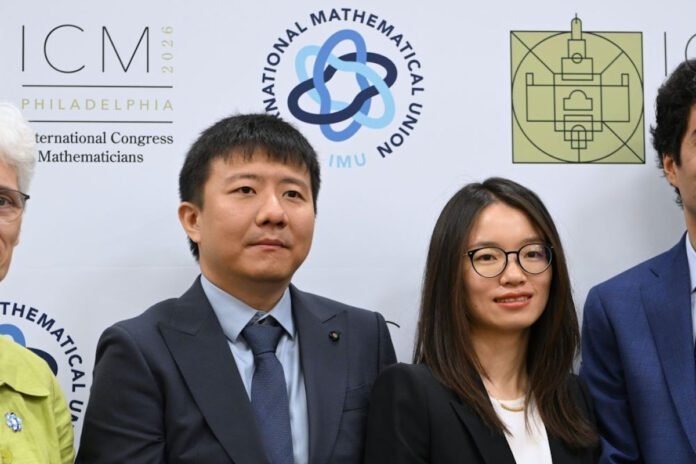
When Hong Wang and Yu Deng received Fields Medals at the International Congress of Mathematicians in Philadelphia on July 23, they became the first citizens of the People’s Republic of China to hold mathematics’ highest honor in its 90-year history. Wang is also only the third woman ever to receive it, after Maryam Mirzakhani and Maryna Viazovska.
Both facts are worth celebrating without qualification. What follows the celebration, though, is a question that neither triumphalism nor skepticism answers well: what, exactly, does a Fields Medal measure?
Not the present, for a start. Prizes in fundamental science are like light from distant stars: by the time the signal reaches us, the source has changed. Any government reading this year’s medals as a real-time report card on its current science policy is reading the wrong instrument.
The reflexive framing is a national scoreboard. Yet the biographies resist it. Wang and Deng entered Peking University in the same 2007 cohort; Wang then studied in France before earning her doctorate at MIT, and Deng transferred to MIT in 2009 before completing a PhD at Princeton.
Wang now holds positions at New York University and France’s Institut des Hautes Études Scientifiques; Deng is at the University of Chicago. French President Emmanuel Macron called Wang to congratulate her and later invoked her career while promoting France as a destination for scientific talent. Three or four national flags could plausibly be planted on the same pair of careers.
This is not a contradiction to be explained away. It is the actual structure of elite scientific production.
Talent formation — the schooling, the competition circuit, the undergraduate rigor that produces someone capable of attacking the Kakeya conjecture — is largely national and takes about two decades. Talent flourishing — the mentors, the seminar culture, the tolerance for a decade of apparent failure — is institutional and increasingly transnational.
China supplied the first with evident success. The second was supplied by a handful of research centers spread across three countries. Neither half produces medals alone.
There is a more interesting lesson buried here, and it applies well beyond China. For years China dominated the International Mathematical Olympiad without producing a Fields Medalist, and the gap was instructive.
Olympiad excellence rewards speed on problems known to be solvable within four hours. Research rewards the opposite disposition: choosing a problem that may consume a decade and may not yield at all.
Wang and Joshua Zahl resolved a question Soichi Kakeya posed in 1917; Deng and his collaborators Zaher Hani and Xiao Ma closed a formulation of a problem Hilbert set out in 1900. Few research metrics are designed to reward work on that timeline.
That is the transferable insight, and it indicts more systems than it flatters. Research bureaucracies across Asia, Europe and North America have converged on short evaluation cycles, publication counts and deliverables. Many of these systems struggle to protect the long horizons that such work requires.
The Fields Medals are, among other things, an argument for patient capital in the sciences — the kind that most funders have been steadily withdrawing.
Two competing anxieties surfaced within hours of the announcement, and both deserve tempering. On Chinese social media, users asked why their best students leave after undergraduate study. In Washington, the same news reads as evidence of American decline. Each reading treats mathematicians as national assets in a zero-sum ledger.
They aren’t, and the proofs themselves show why. Wang’s result was joint with a collaborator at the University of British Columbia; Deng’s with colleagues at Michigan.
A theorem, once published, becomes a permanent global public good — non-rival, non-excludable, available to a graduate student in Lagos or Lahore the day it appears on arXiv. Kakeya sets bear on harmonic analysis, wave propagation, signal analysis and imaging. That downstream value accrues to whoever builds on it, not to whoever issued the passport.
If there is a policy story worth watching, it is not who won but whether the pipeline that produced these winners still exists. That pipeline depended on unimpeded movement: Chinese undergraduates admitted to American doctoral programs, French institutes hiring globally, collaborations formed across borders.
As governments increasingly sort researchers by nationality and security risk, however, that cross-border pipeline is becoming harder to sustain. Circulation is being replaced, incrementally, by sorting.
That would be a costly trade. The 2026 medals were produced by an open system, and one can reasonably ask whether a more closed one would produce the same result in 2030.
The medals also arrive amid debate over AI in mathematical discovery, underscoring that greater computational power does not eliminate the need for human judgment about which questions merit years of attention.
The honest reading of Philadelphia, then, is neither ascendance nor decline. It is that mathematics remains one of the few genuinely borderless human enterprises, and that its greatest results still emerge from systems willing to fund a question for a century and wait.
Y. Tony Yang is an endowed professor at the George Washington University in Washington, D.C.