Russia’s war in Ukraine has generated one of the largest labour supply shocks in recent history. From an estimated pre-war population of 41 million people, close to 6 million have now left Ukraine. This outward migration alone has reduced the country’s worker population by roughly 3 million people.
It has been compounded by the mobilisation of more than 700,000 Ukrainian citizens into the army. At least 55,000 Ukrainian soldiers had been killed in combat by July 2026 (this is likely to be an underestimate as many soldiers are missing in action), with 400,000 more wounded. Most of these people are working-age men.
By conservative estimates, Ukraine’s civilian casualties amount to almost 70,000 people, with the rate increasing over the past few months because of Russia’s extensive use of ballistic missiles. Millions of Ukrainian citizens in the east and south of the country also remain under Russian occupation.
In total, there has been a contraction of about 25% of the initial labour force in areas still under Ukrainian government control. This is a labour supply shock of extraordinary scale.
The shock to labour demand has been similarly severe. A massive, multidimensional reallocation has taken place as a result of the war, with most economic activity shifting to the western part of Ukraine, which is less exposed to air attacks.
In a wartime economy experiencing such massive displacement and reallocation, can workers and firms still find each other? To answer this question, we analysed data from Work.ua, a Ukrainian online platform where companies post jobs and job seekers upload their resumes.
We estimated the efficiency of matching between workers and firms – in other words, given a certain number of vacancies and job seekers, how often supply and demand actually meet.
Imagine there are ten companies, each with one open position and ten unemployed people. If matching efficiency is maximal, up to ten hires can be generated; if it is minimal, there will be none. The more frictions there are in the market, the more this efficiency decreases.
We traced how matching efficiency has evolved before and after the 2022 full-scale invasion, across Ukraine’s regions and economic sectors.
Labour market resilience
Three facts emerge from the data. First, matching efficiency has declined by about 15% since 2022. It has become more difficult for firms in Ukraine to find workers to hire and for job seekers to find employers willing to hire them.
This decline is significant, but not catastrophic. It is, for example, less than was estimated during the 2008 financial crisis in the US.
Second, the situation is varied. In the regions most exposed to the war, such as Sumy and Kharkiv oblasts in north-eastern Ukraine, the reduction in matching efficiency reaches about 20%.
But in the western regions of Ukraine, the picture is significantly better. In Lviv and Ivano-Frankivsk oblasts, the number of resumes and vacancies both increased compared with before the full-scale invasion – despite the overall decrease in Ukraine’s population and labour force. Matching efficiency in these areas decreased by just 5-7%.
We found similar variation across sectors. Many blue-collar occupations involving manual labour or skilled trades, from cleaning services to drivers, have experienced relatively modest declines. Non-essential personal services, like travel agencies, have suffered the most.
Finally, direct exposure to conflict – measured using data on air-raid alarms independent of proximity to the frontline – makes it significantly harder to match labour supply and demand. These daily disruptions, which generate fear, uncertainty, damage to infrastructure and blackouts, can severely hamper the labour market.
Overcoming wartime disruption
We also identified mechanisms that may have helped Ukraine compensate for its wartime labour market frictions. Many women have taken on traditionally male job roles, from mining to truck driving. Older people and those with disabilities are also playing a greater role in the labour force.
Many firms have adopted remote working and more flexible schedules. This has been especially important for displaced people and refugees, allowing many to stay connected to their employers in Ukraine and continue to provide services, despite the physical distance.
Ukrainian firms have also benefited from greater contractual flexibility. The minimum wage did not increase between the start of the full-scale invasion and 2026, while inflation eroded its real value. This means firms have been able to hire less-productive workers without experiencing profit losses.
Worker shortages are affecting many sectors of Ukraine’s economy – most notably in professions such as construction, transport and engineering. A continuation of the war will require more mobilisation in the labour market of people so far inactive, as well as a bigger contribution from those who left the country.
When the war finally ends, mobilising workers at all levels will be the next hurdle. Veterans will need to be reintegrated into the workforce, while refugee return, immigration and worker retention will all have to be encouraged.
Continuing to nudge higher participation among groups underrepresented in the labour market will also be important. But this all represents a sizeable challenge.
NEW YORK – America’s trade deficit just widened to US$88.6 billion, its largest since March 2025 — and the political reflex in Washington is almost certain to be more, not fewer, tariffs and trade restrictions.
The irony is that the number doesn’t mean what US President Donald Trump will likely claim. July’s spike reflects a surge in AI‑related tech and semiconductor imports, not a collapse in American competitiveness.
A booming domestic appetite for chips and computing hardware is pulling in more foreign goods than exports can offset. That’s not a losing trade war — it’s an economy investing aggressively in the next technology cycle.
But nuance rarely survives contact with tariff politics. Washington is poised to treat the widening gap as proof that tougher measures are needed, setting up yet another round of retaliatory duties and non‑tariff barriers just as businesses were adjusting to the last one.
He immediately pivoted to Section 122 of the 1974 Trade Act. When that authority expired in late July, he pivoted again — this time to Section 301, slapping 10%–12.5% tariffs on more than 60 countries.
That’s three legal-system workarounds in under a year. As Deutsche Bank strategist Jim Reid notes, tariffs are becoming a permanent fixture of US economic policy — and the striking part is how little the underlying economics change each time.
The data tell the story. The trade gap jumped 24.4% in July. Imports rose 2.8% to $399.3 billion, goods shipments climbed 3.7% to $320.6 billion, and capital‑goods imports hit a record $140.3 billion, driven by computers, components and semiconductors feeding the AI buildout.
Now the rising political fallout from Trump’s poor trade track record even has Canada in harm’s way. “Americans have zero interest in picking a fight with Canada,” says Eurasia Group’s Ian Bremmer — which hasn’t stopped the administration from aiming at it anyway.
Raymond James analyst Edward Mills expects this to open “the next chapter” in Trump’s effort to rebuild the tariff regime the Supreme Court ruling dismantled, noting that despite midterm anxieties and inflation fatigue, “the US has not yet reached peak tariff.”
The consequences are already apparent: rising inflation pressure, 30‑year Treasury yields at 20‑year highs, and a Federal Reserve now weighing a rate hike as soon as this month. Higher borrowing costs threaten growth and confidence — undercutting the very economic legacy tariffs were meant to protect.
The deeper problem isn’t any single tariff; it’s the worldview behind them. Trump entered office thinking like it’s 1985, and that mindset keeps misfiring in a global economy that no longer operates on those gears.
Beijing, meanwhile, has little reason to complain. Xi Jinping’s Communist Party is likely pleased to see Washington roiling markets, straining alliances and eroding the soft power the US spent decades building. Watching Trump’s inner circle disrupt institutions and mishandle sensitive data only deepens mistrust at home and abroad.
Trump has blinked so many times on his big trade war that it’s become easy to dismiss. Though he imposed 30%‑range tariffs on China, that’s a fraction of the 100%‑plus levies he threatened. For all the bluster, many on Wall Street are betting he will ultimately back down.
Fears of tanking the stock market, pushback from the oligarch‑adjacent figures orbiting Trump 2.0, or advisers warning that threatening a massive trade war is one thing. Detonating the global economy, and Wall Street with it, is another.
Trump’s not alone in using tariffs. Biden quadrupled tariffs on Chinese EVs to 100% in 2024 and raised duties on batteries, solar cells, cranes, medical equipment, aluminum, and steel — borrowing the same playbook despite promising a more competitive American economy.
Japan has spent 14 years trying to revive Reagan‑era trickle‑down economics through Abenomics, with little to show in real wage growth. South Korea has flirted with similar strategies, with similarly thin results.
If the 1985 model still worked, Russia’s economy would be thriving. It isn’t.
Xi, by contrast, is playing a different game — pouring money into renewable energy, automation and high‑value industries to position China for 2030 and beyond. Trump’s approach, by contrast, is trying to drag America back to an industrial model globalization retired decades ago.
The mental template is the 1985 Plaza Accord, negotiated at Trump’s former Plaza Hotel, where Washington pressured Japan and Europe into currency moves that suited US interests. Trump wants that leverage again, aimed at China.
But China in 2026 isn’t Japan in 1985. The US and Chinese economies are too intertwined to separate cleanly, and Beijing has ample leverage to dump Treasuries, tax US exports, devalue the yuan, cancel Boeing orders, choke off soybean purchases, or restrict imports from pharmaceuticals to beef.
Even a “successful” currency squeeze wouldn’t fix what actually ails the US economy: crumbling infrastructure, unstable health care, an opioid crisis, or a workforce unprepared for automation and AI — forces likely to eliminate more American jobs than China ever will. It wouldn’t lift productivity, narrow inequality or push corporations to raise wages or innovate faster.
Instead, the fixation on tariffs distracts from the challenges that matter — from the shift to solar and wind to automation timelines Treasury officials still dismiss as “50 or 100 more years” away.
Even the administration’s flagship “wins” reflect outdated logic. In 2017, the Trump 1.0 White House offered Taiwan’s Foxconn roughly $3 billion to build a Wisconsin plant projected to create 13,000 jobs — about $15,000 in public subsidy per job, per year, for a company whose profits depend on mainland Chinese labor.
It was a small but telling example of 1985‑style industrial thinking applied to a 2026 economy that no longer runs on those terms — and a reminder of how tangled the US–China relationship really is. It’s highly unclear whether Trump 2.0 has learned from any of its former mistakes.
America’s edge has always come from looking forward. Pulling policy back to 1985 risks losing exactly that. And as Trump focuses on tripping up rivals rather than strengthening the US economy, China has every incentive to maintain its trade surplus as long as possible, argues economist Michael Pettis of the Carnegie Endowment.
Writing in Foreign Affairs, Pettis notes that protectionism is usually a symptom of long‑standing imbalances, not their cause — and removing it doesn’t make the eventual adjustment less painful. Today’s global imbalances are unusually large, and the coming correction is likely to be difficult.
China, too, looks vulnerable: its debt burden is among the world’s highest, much of it tied to investments with diminishing or negative returns — excess housing, underused infrastructure and manufacturing capacity that far outstrips demand.
Given those pressures — a massive property crisis, near‑record youth unemployment, weak local‑government finances, and soft consumer demand — Xi has every incentive to keep China’s export engine running hot and heavy.
And to thank his lucky stars that he’s facing off against an American leader whose 40-year-old toolkit is failing in real time.
US military turns off ad trackers on devices amid Middle East targeting reports
U.S. military officials say they have disabled advertising trackers on a range of phones and computers, according to letters, released on Friday by U.S. Senator Ron Wyden and statements given to Reuters, a development that follows reports that commercially available location data had been used to target American forces in the Middle East.
The Air Force told Wyden it disabled the advertising identifiers on computers and mobile phones two months ago. U.S. Special Operations Command said in a separate letter that it had “recently” disabled them on its Windows devices. The Army told Reuters that advertising IDs tied to mobile devices had been disabled since earlier this year.
Wyden, an Oregon Democrat, has pressed the Pentagon on the issue for months.
The disclosures highlight a growing national security concern: that location data collected by the advertising industry and sold by data brokers — companies that collate and resell personal data — can be used to track and target military personnel deployed to war zones.
The Air Force and Special Operations Command declined further comment. Similar letters from the Army and Navy to Wyden said they disabled advertising IDs on military devices but gave no indication of when the restrictions were imposed. The Army said in a statement that advertising IDs had been blocked on Windows computers “since before 2021” but that Android and Apple mobile devices had only had it disabled by default “since at least February 2026.”
Messages seeking comment from the Navy went unreturned.
The effort to reduce the location data generated by smartphones comes as military officials weigh increasingly strict restrictions on phone use overall. In July, Reuters reported that some deployed personnel in the Middle East could be ordered to surrender their phones amid concerns that mobile videos they were posting to the internet were helping Iran target American bases in the region.
Wyden and U.S. Representative Pat Harrigan, a North Carolina Republican, sent a letter to the Pentagon on Friday asking for an investigation into whether the military had properly countered the dangers of the location data trade. The letter included the updates from the various service branches on their efforts to disable advertising IDs on military devices.
Wyden said in a statement that it was clear that the military’s efforts “have not been effective at neutralizing this threat.” Harrigan said that U.S. enemies “should not be able to pull out a credit card and buy information that helps them track American troops.”
The Pentagon said in an email it would respond to the lawmakers directly.
Mobile advertising IDs, often abbreviated MAID, are unique identifiers tied to specific devices that can be used to track a person’s activity across mobile apps and pinpoint their physical location.
Zach Edwards, co-founder of privacy ad tech company Decryptads, said that efforts to disable MAID on military-operated devices were “definitely a positive thing.”
The restrictions “will essentially ensure their location isn’t being included in bulk data sales being done by numerous vendors,” although he cautioned that personnel might still be tracked through apps in other more complicated ways, for example by triangulating technical device details with network data or location information.
The Mecca Pact: Threat to Iran or an Opportunity to Reshape Regional Security?
The signing of the Mecca Joint Defence Agreement by Saudi Arabia, Türkiye, and Pakistan on 7 August 2026 has introduced a new element into an already changing regional security environment. The agreement stipulates that an armed attack against one signatory will be considered an attack against all three, creating a collective-defence commitment broadly comparable in principle to Article 5 of the NATO Treaty. Given Iran’s longstanding rivalry with Saudi Arabia and the involvement of three major regional powers, the agreement has naturally generated speculation about whether it represents the emergence of a new anti-Iran coalition. Yet this interpretation remains premature. The more consequential question for Tehran is whether the agreement will become part of a broader regional security architecture that develops without Iran.
The pact emerged amid a profound transformation in the security environment of West Asia. Recent conflicts, uncertainty over external security guarantees, and growing regional interest in developing indigenous mechanisms of deterrence have encouraged states to diversify their security partnerships.
Saudi Arabia, Türkiye, and Pakistan are responding to this environment by seeking closer political, military, and defence-industrial coordination.. The agreement therefore reflects not only bilateral or trilateral relations but also a wider search for new forms of regional security cooperation.
Its significance has increased considerably since its signing. On 31 August, the three countries held the first meeting of the Strategic Political and Defence Committee in Istanbul, bringing together their foreign and defence ministers and chiefs of staff. The meeting addressed the development of defence capabilities, military interoperability, counterterrorism, and cooperation in defence industries, including joint production and research and development. More importantly, the three governments agreed to establish a permanent secretariat in Saudi Arabia, initially headed by a Pakistani secretary-general for three years, and to develop a roadmap for future cooperation.
This development marks a transition from a political agreement toward an institutionalized framework. It does not yet make the Mecca Pact a fully operational military alliance, but it makes the agreement considerably more relevant to Iran than it appeared immediately after its signing.
Permanent coordination mechanisms, military interoperability, and defence-industrial cooperation can gradually transform political commitments into durable strategic capabilities.
Nevertheless, there is insufficient evidence to characterize the pact as explicitly anti-Iranian. Neither the agreement nor the subsequent institutional steps have identified Iran as a common enemy. On the contrary, the three countries have emphasized de-escalation, restraint, peaceful conflict resolution, respect for sovereignty, and regional ownership of security.
Turkish officials have also stressed that the arrangement is based on cooperative regional security rather than confrontation with a particular state.
For Iran, however, the absence of an explicit anti-Iranian clause does not mean the agreement is strategically irrelevant. The key issue is its potential role in reshaping the regional balance of power. Iran has traditionally been one of the major military and geopolitical actors in the Gulf and wider West Asia. Any institutional arrangement involving Saudi Arabia and Türkiye—and supported by Pakistan’s military capabilities— is likely to affect Tehran’s strategic calculations, even if its declared purpose is defensive.
The Mecca Pact should also be understood alongside earlier attempts to reshape the regional order, particularly the Abraham Accords. The two initiatives represent different approaches to regional alignment.
The Abraham Accords sought to integrate Israel more deeply into a network of political, economic, and security relationships with Arab states, potentially creating a regional structure in which Israel became increasingly connected to the security calculations of its Arab partners. The Mecca Pact, by contrast, brings together three major Muslim powers around a collective-defence framework while explicitly emphasizing regional ownership. Together, these arrangements show that the region is experimenting with different security frameworks, some centered on Israel and others on cooperation among Muslim powers.
This comparison is particularly important for Iran. Tehran’s strategic concern should not be reduced to the possibility of facing a new military coalition. A deeper concern is the possibility that regional security institutions will increasingly be constructed around Iran rather than with Iran. If the Mecca framework expands, develops stronger operational mechanisms, or becomes connected with other regional security arrangements, Iran could find itself confronting a more institutionalized network of security cooperation in which it has limited influence.
At the same time, the pact should not be viewed solely as a threat. Its emphasis on regional ownership and cooperative security could potentially create space for a broader regional dialogue. Iran’s geographical position, military capabilities, energy resources, and political influence mean that a durable regional security architecture is difficult to construct while permanently excluding Tehran. The question is therefore not whether Iran can simply ignore the new arrangement, but whether it can influence its evolution.
For Tehran, this may require moving beyond passive observation toward more active diplomatic engagement.. Iran could strengthen its diplomatic relations with Saudi Arabia and Türkiye, deepen security dialogue with states such as Oman and Qatar, and promote the principle that regional security mechanisms should be inclusive rather than organized through competing blocs. Engagement with the members of the Mecca framework would not necessarily require Iran to endorse the agreement; rather, it could provide Tehran with an opportunity to understand, shape, and potentially constrain its future development.
The Mecca Pact is neither an immediate strategic threat to Iran nor an insignificant diplomatic arrangement. Its importance lies in the direction it is beginning to take. The creation of permanent institutions and deeper military coordination suggests that it may acquire greater strategic weight.
For Tehran, the central question is whether it remains outside while other actors shape the emerging regional order. Treating the pact solely as a hostile coalition could reinforce Iran’s exclusion; engaging diplomatically with its members may offer Tehran a chance to influence the architecture taking shape around it.
The views expressed in this article belong to the author and do not necessarily reflect the editorial policy of Middle East Monitor.
US House Passes Bill To Cut Funding to Universities Boycotting Israel
Proposed legislation that would cut off certain federal funding to higher education institutions that participate in economic or academic boycotts of Israel passed the US House of Representatives on Thursday.
The Protect Economic and Academic Freedom Act passed 237-169 and now requires Senate approval to become law. The House Education Committee approved the legislation in June.
This measure would amend the Higher Education Act of 1965, making eligibility for certain public funds conditional on universities refraining from “participating in a nonexpressive commercial boycott of Israel.”
Colleges and universities receiving the funds would also be required to “certify that students are not unreasonably obstructed from participating in academic programs in Israel.”
Education Committee Chairwoman Virginia Foxx, a Republican, said the legislation was intended to counter the Boycott, Divestment and Sanctions (BDS) movement and academic boycotts targeting Israel.
Foxx said, “The bipartisan legislation makes clear that tangible campaigns of antisemitism in the form of boycotts have no place in any aspect of civil society.”
She said the measure “takes a strong stand against the BDS movement on college campuses across the nation.”
“This legislation has true teeth and completely severs any possible taxpayer support of these concrete campaigns of antisemitism in the form of BDS and academic boycotts of Israel,” Foxx added.
Thursday’s vote largely divided lawmakers along party lines. Two Republicans voted against the legislation, while 33 Democrats supported it.
US Rep. Jerrold Nadler, a New York Democrat, opposed the measure despite saying he was against the global BDS movement.
In a statement released before the vote, Nadler said he would vote against the legislation because of concerns about protecting Americans’ right to free expression.
“It is the only way to ensure speech I do agree with is equally protected,” Nadler said.
Although the legislation targets financial or economic boycotts, it doesn’t prohibit demonstrations or sanction speech.
Nearly impossible? How Fairphone built the ethical, repairable Fairphone Gen 6+.
Smartphone longevity didn’t used to matter. In the past, before you could wear out or break a phone, there was always some shiny new thing to buy. Today, we expect our smartphones to go the distance, but they’ve also become less repairable and, in many cases, more fragile. Fairphone, a Dutch smartphone maker that has just entered the US market, thinks about phones differently.
The new $650 Fairphone Gen 6+ is designed both for longevity and easy repairability. There are trade-offs to this approach if you’re used to the standard glass and aluminum sandwiches filled with glue, gaskets, and teeny-tiny screws. But the drawbacks could be worth it for the right buyer. Fairphone CTO Chandler Hatton told Ars that Fairphone’s goal is to provide a compelling mobile experience while also enabling the user to “fully own” their device. At the end of the day, this is what a lot of people say they want in a smartphone.
Take it apart, put it back together
These days, Google, Samsung, and Apple support phones with software updates for the better part of a decade, but will the hardware last that long? And what happens when it needs a repair? You may be out of luck or out a lot of money, but Fairphone prioritizes the self-repair experience.
“We’re doing something that was long thought to be nearly impossible,” said Hatton. “Which is delivering high-performing modular smartphones that can last for a very long time.”
The Fairphone Gen 6+ has a 6.31-inch OLED screen, which is, of course, fully replaceable.
Credit: Ryan Whitwam
The Fairphone Gen 6+ has a 6.31-inch OLED screen, which is, of course, fully replaceable. Credit: Ryan Whitwam
Fairphone designs devices to be sustainable, focusing on avoiding conflict minerals, using recycled materials, and paying workers a living wage. Fairphone says it doesn’t want to sell you a bunch of phones, just one that you can keep using even if something breaks.
“Our goal is that every single person that purchases a Fairphone uses it for at least five years, and we track that as a KPI [Key Performance Indicator],” said Hatton.
The standard way to design a modern smartphone is to cram as much as you can into an aluminum and glass sandwich, with the expectation that it will be assembled once in a factory and never opened by the buyer. Devices rely on glue and awkwardly placed screws to accomplish this, making the internals a little like metal spaghetti.
The Gen 6+ is designed so that anyone can replace parts, reducing e-waste and potentially saving consumers a lot of money. If you’ve had, say, a Samsung Galaxy phone for a couple of years and need to replace the screen or USB port, the cost might be higher than just buying a new phone.
“There is an incentive in terms of planned obsolescence to replace your device,” said Hatton. “On the one hand, it’s a good way to keep selling devices, but that’s simply not the proposition that we have.”
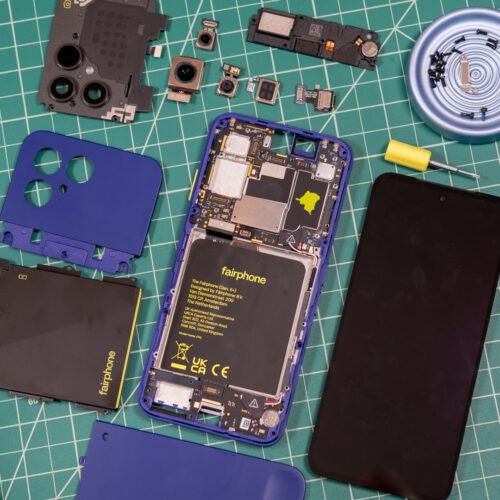
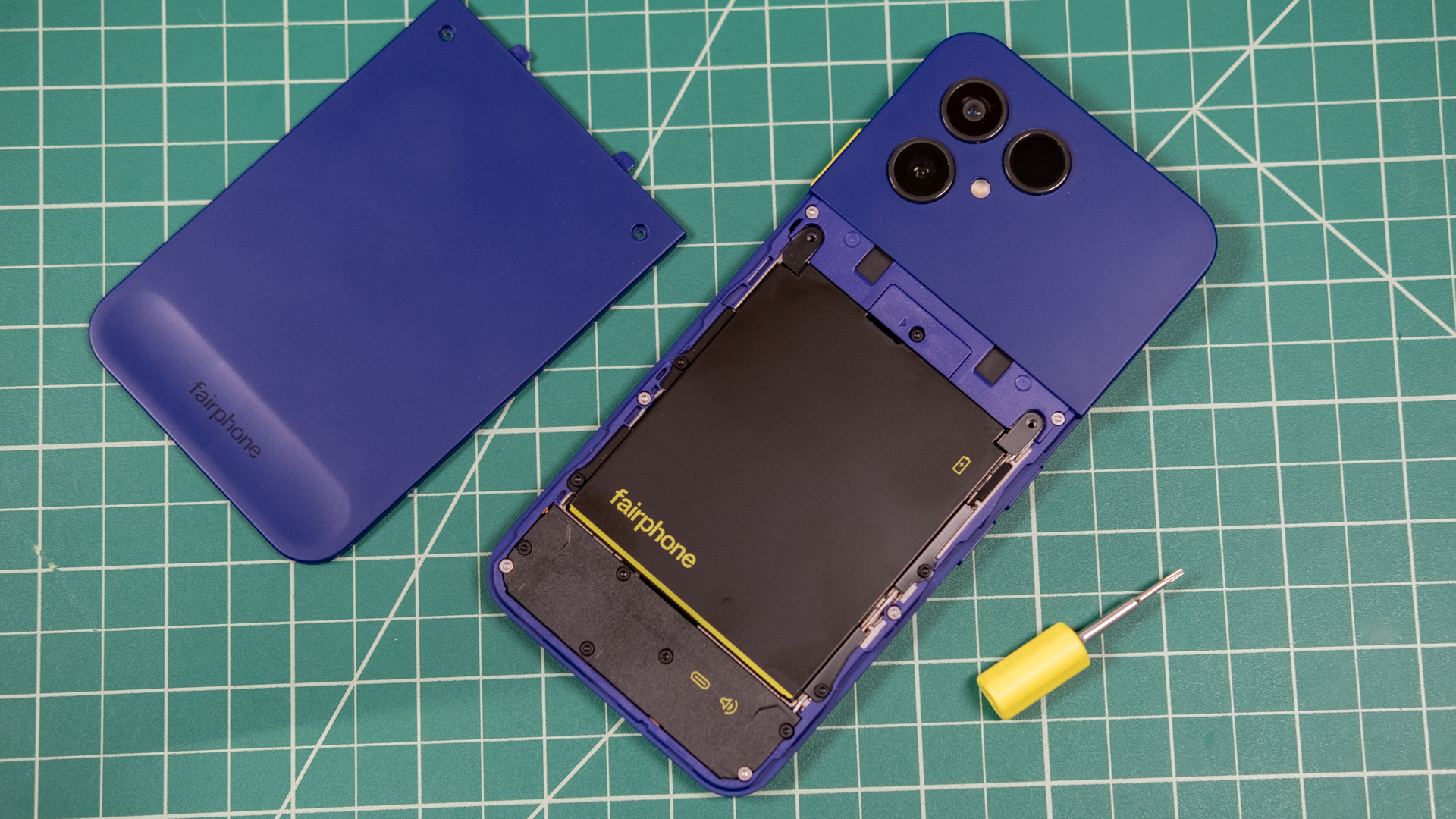
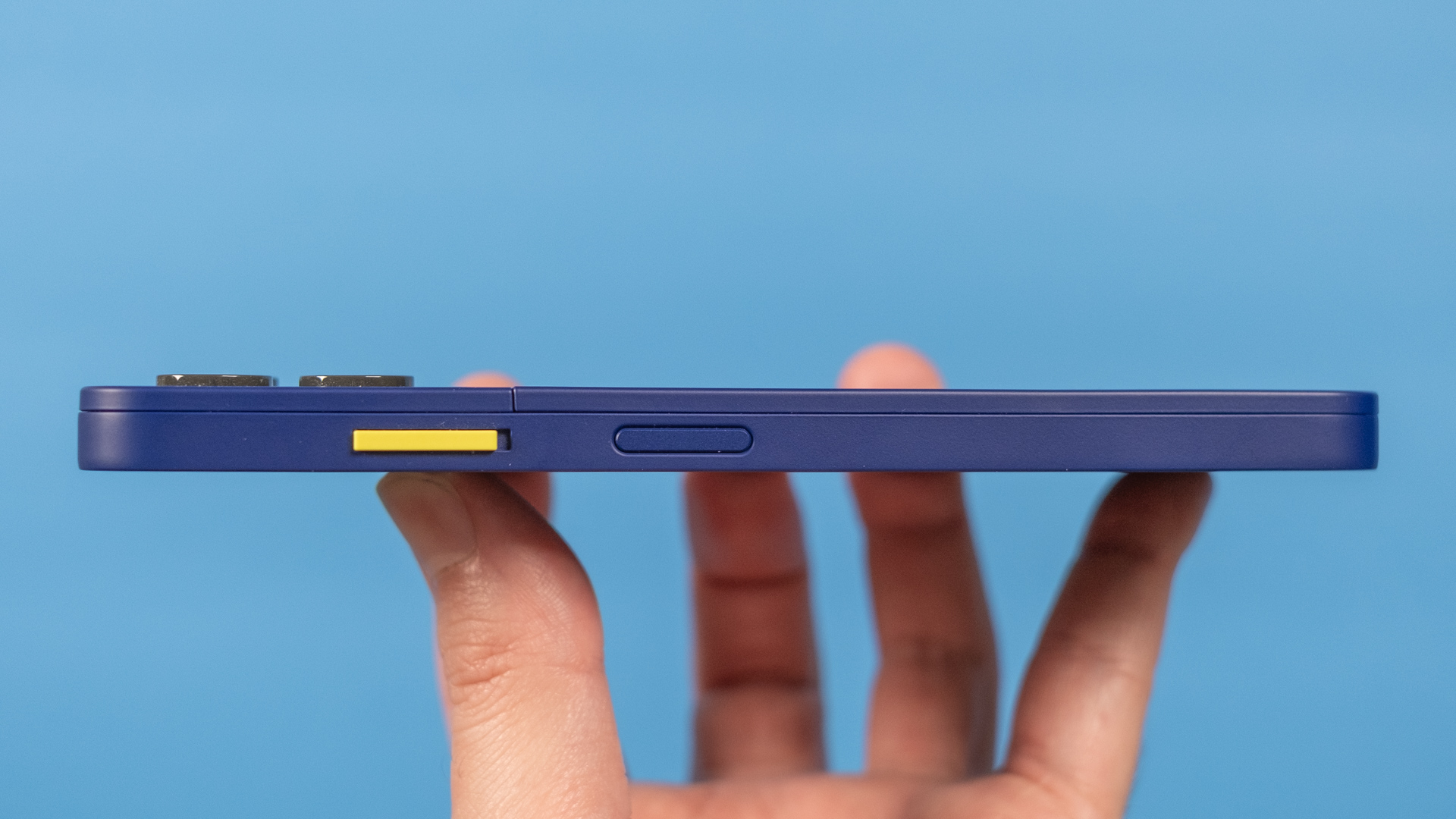
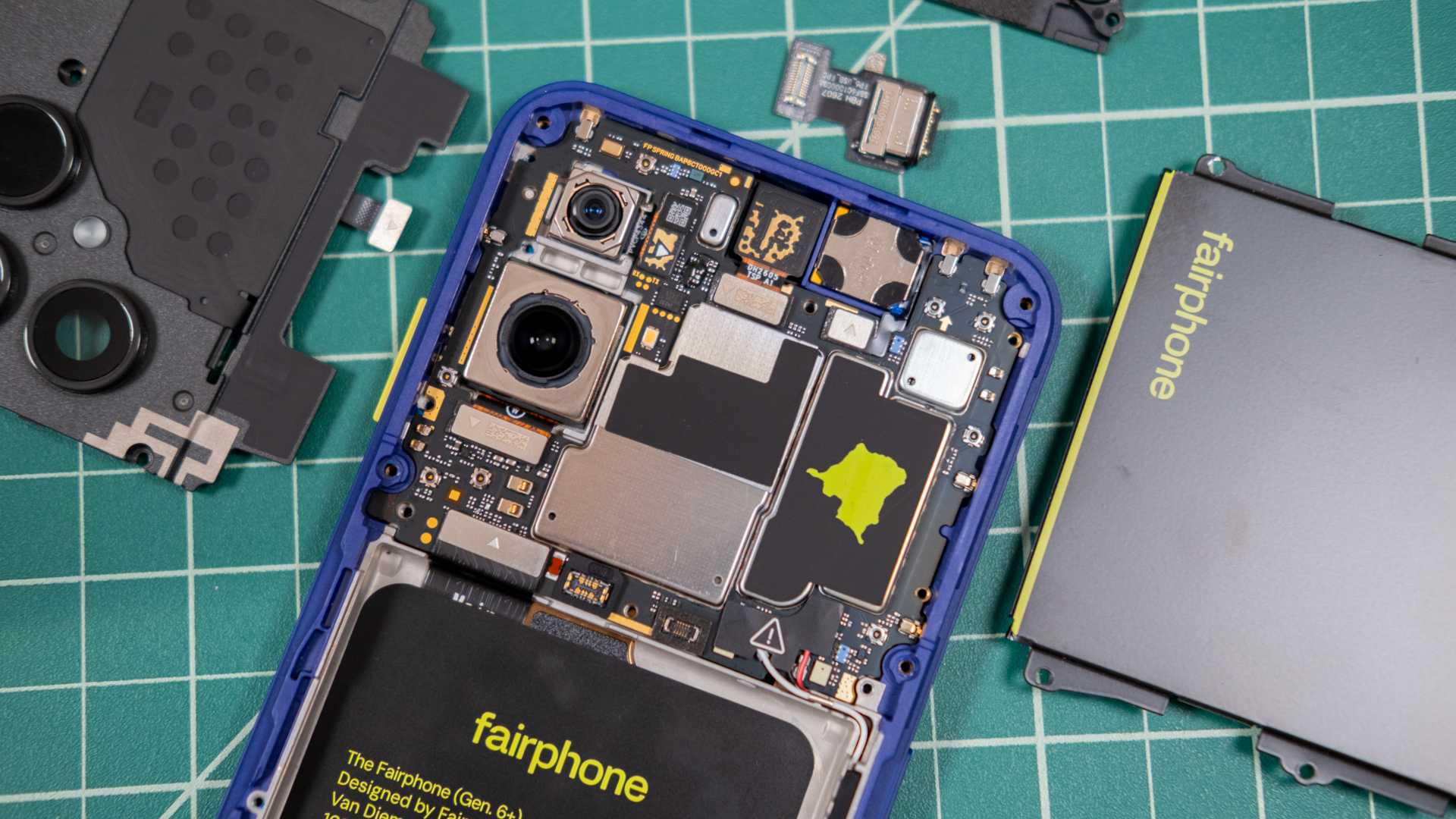
That means designing the phone differently—it’s not just a matter of skipping the glue. Inside, the Fairphone Gen 6+ is clean and orderly. It starts with a pair of T5 Torx screws exposed on the back of the phone. After removing those, the back cover slides off. With the same driver, you can extract the battery, camera modules, USB-C port, display, and more. In all, the phone supports user replacement of 12 different parts with just that one (included) screwdriver. One drawback is that the modular approach makes the phone a millimeter or two thicker than most glued-together phones.
The phone comes with a tiny screwdriver, but any T5 torx will work.
Credit: Ryan Whitwam
The phone comes with a tiny screwdriver, but any T5 torx will work. Credit: Ryan Whitwam
The battery stares you in the face once the back panel is opened. You’ll have to remove a few more screws to get it out, but quick swapping isn’t the goal here—this is about longevity.
“We know that after about three years, it will be wise to replace your battery with a new one,” said Hatton. “Batteries aren’t meant to last forever, but your phone on the whole can last a lot longer than a battery.”
While the Fairphone is designed to be disassembled, what about the long haul? The Fairphone 6+ is mostly plastic rather than metal like a Pixel or iPhone. The phone still manages to feel solid, though, thanks to its internal metal frame, and the company has worked to ensure the device doesn’t become progressively less sturdy as you tinker with it.
“When we’re in our product development cycle, we introduce tests that are specifically dedicated to disassembly and reassembly,” said Hatton. “So we’re looking in part at the robustness.”
Robots work the assembly line, but humans are less predictable. Hatton pointed to tests that examine, for example, what happens when someone over-tightens screws while servicing their device. Does it warp the casing? Damage any nearby components?
Hatton said it takes her 15 minutes to fully disassemble a Fairphone Gen 6+, but she did have a hand in designing it. That said, it shouldn’t take a novice much longer. After a couple of minutes perusing Fairphone’s documentation, I was able to take the phone apart and remove all of the user-serviceable components in about 20 minutes. Everything went back together without issue and still works perfectly, with no new gaps or wobble.
The process is pretty intuitive, with most of the parts held in with flat board-to-board cable connectors. Just pop them off with a spudger or your fingernail, and the component lifts right out. There are a good number of screws to remove to get all the way down to the metal frame and screen, but again, they all use the same T5 Torx bit.
Glass backs are common on smartphones because they’re good for radio performance, and they add significant rigidity to the design. But they’re also easy to crack and difficult to remove (they’re almost always glued in place). Naturally, the only glass on the Fairphone 6+ is covering the 6.31-inch 1116 x 2484 OLED display, which is fully replaceable. This is probably the most challenging component to swap, but even this isn’t too bad. The screen is held in place by a handful of screws and has a generously long ribbon cable attachment, making a swap much less frustrating than your typical smartphone.
The OLED is about what you would expect for this price range—the resolution is more than sufficient, and the colors are great. The brightness is good enough to be legible outdoors, but at a mere 1,300 nits peak brightness, it’s harder to see than the displays you get on phones like the Pixel or Galaxy S26 that are a few hundred more expensive. Good luck replacing those displays on your own if you get a crack, though.
What specs make the cut?
Smartphones have become more powerful over the years, but their designs have also been streamlined. Headphone jacks and microSD card slots are now rare, and even the SIM card slot is quickly fading away. OEMs often cite the space constraints when dropping these features.
“There’s a reason that most phone manufacturers prefer slightly larger footprints—because you can fit more stuff in there,” Hatton said. “So yes, it is legitimate if phone manufacturers are saying, ‘Hey, we dropped this feature to save space inside the device.’”
The Fairphone retains some of these elements, but not because there’s a surplus of space, Hatton said. The Fairphone 6+ still has a microSD slot and physical SIM card because people want them. These features don’t come free, though. In addition to the space constraints, adding more components adds to the price and complicates supply chains. That’s another reason some OEMs have removed features.
Being modular means the Fairphone is a little thicker than most smartphones.
Credit: Ryan Whitwam
Being modular means the Fairphone is a little thicker than most smartphones. Credit: Ryan Whitwam
The Fairphone Gen 6+ plays to picky smartphone and DIY enthusiasts, but there’s still no headphone jack. Hatton notes that the team hears from a small but vocal cadre about headphone jacks every time it starts planning a new device, but it hasn’t made sense to include one in recent phones.
“In terms of how to actually get [a headphone jack] into the device, it is quite difficult,” Hatton said. “It’s a relatively large hardware component, but it’s not just the component itself. It’s also where it needs to be. You know, you’re not going to put the headphone jack in the middle of the back of the phone. You also need to make sure it attaches to the right things on the inside, and because we’re Fairphone, you need to make sure it’s repairable. So when we look at that total picture, we assess the needs of our customers to fulfill some other wishes at the expense of the headphone jack.”
Looking at spec sheets side-by-side, the Fairphone also lacks something that many of today’s phones have: IP6X water resistance. An upshot of making non-repairable phones that are chock-full of glue is that they’re relatively easy to seal against water intrusion. With an IP6X rating, a phone can be fully submerged in water for up to 30 minutes, at least in theory.
The Fairphone Gen 6+ is only rated as IP55, which will protect it from splashes. That could be enough, though. “Our phones are designed for what people need on a day-to-day basis,” said Hatton. “How often is it that people would like to take their hardware underwater? I think the answer there is less often than some manufacturers would have you think.”
While it might be comforting to think you could drop your phone in a pool, that’s still risky. OEMs don’t warranty the water-resistance of their phones, and if you’ve made any repairs, it’s possible the sealing of that difficult-to-open device was compromised. Hatton notes that it wouldn’t be impossible to make a repairable phone that’s also IP6X, but you’d have to design around that in numerous ways.
“There are a number of things that you need to weigh against a higher IP rating,” Hatton said. “You can achieve it in a very small form factor with higher costs, or you can achieve it with a larger form factor—you could increase the Z dimension and perhaps also the other dimensions, and that way you could create all sorts of gaskets and other things. But we assess the whole landscape and say, ‘Hey, the customer doesn’t want a phone that’s a brick.’ They also don’t want a phone that’s incredibly expensive. So within those boundaries, what IP rating meets their needs?”
It’s a trade-off, but it’s one that many people would probably make in the name of repairability if given the choice.
Planning for the future
The Fairphone Gen 6+ is similar to the Gen 6 that launched in Europe last year, but there are a few notable changes. The new phone has a slightly upgraded Snapdragon chip, and it has more memory than the last Fairphone at a time when AI has driven up costs considerably.
“We decided to increase the RAM to 12 gigabytes,” said Hatton. “This is something that I think is a little bit unique, given the current circumstances in the consumer electronics industry. But the reason that we did is that it really underscores the value proposition of longevity that we’d like our customers to enjoy when they purchase the Gen 6+.”
Fairphone boosted RAM to 12GB for this release.
Credit: Ryan Whitwam
Fairphone boosted RAM to 12GB for this release. Credit: Ryan Whitwam
Google, meanwhile, is catching some well-deserved flak for regressing from 16GB to 12GB of RAM in its latest Pixel phones, which start at $900. Samsung is also sticking with 12GB of RAM in its $2,000 foldables. And all those phones devote a lot of memory to AI services that not everyone cares about. The Fairphone has the Gemini app installed like all Google-certified Android devices, but the company has yet to create any on-device AI services of its own. That’s on Fairphone’s radar, but the team is taking a measured approach.
“We have not immediately jumped onto the bandwagon of creating AI features without really understanding what the use scenario is and what the customer really wants,” said Hatton. “We see that people are quite interested in understanding how their data is used and having control over their data and privacy. That means that as we continue to use more AI in all sorts of different settings, we’ll continue to work on AI features for our devices that focus on these aspects that are important.”
Fairphone has been offering devices with generous support windows for years. The Fairphone 3, which launched in 2019, just reached end-of-life a few weeks ago. The Gen 6+ will be supported through 2033 with software updates and replacement parts.
Hatton says that multiple factors go into determining the length of support. The availability of hardware in the supply chain is part of it, but it becomes impossible to update devices once vendors like Qualcomm stop supporting the underlying firmware. Seven or eight years is the functional limit for any smartphone due to vendor support, so it’s impressive to see Fairphone in the same range as the likes of Google and Samsung. It really can’t do more than it’s already doing here.
Is the Fairphone the right phone?
At $650, the Fairphone feels like a good deal in 2026. Maybe a year or two ago, the device wouldn’t have seemed as competitive, but with price increases and RAM regressions becoming standard, Fairphone comes out looking much stronger with the Gen 6+. It has a solid mid-range Snapdragon chip, ample storage (with a microSD card slot), and 12GB of RAM, which is still flagship territory.
There’s also something to be said for knowing that your phone is repairable if something goes wrong, and when the time comes to replace the battery, you can do it yourself in a few minutes. Fairphone is committed to keeping all these parts in stock for the duration of the phone’s support window, which runs through 2033.
The Fairphone may not be everyone’s style, but I like the utilitarian vibe. My design complaints are fairly limited and minor: the volume buttons are too low, and the power button (with fingerprint sensor) is too hard to find by feel.
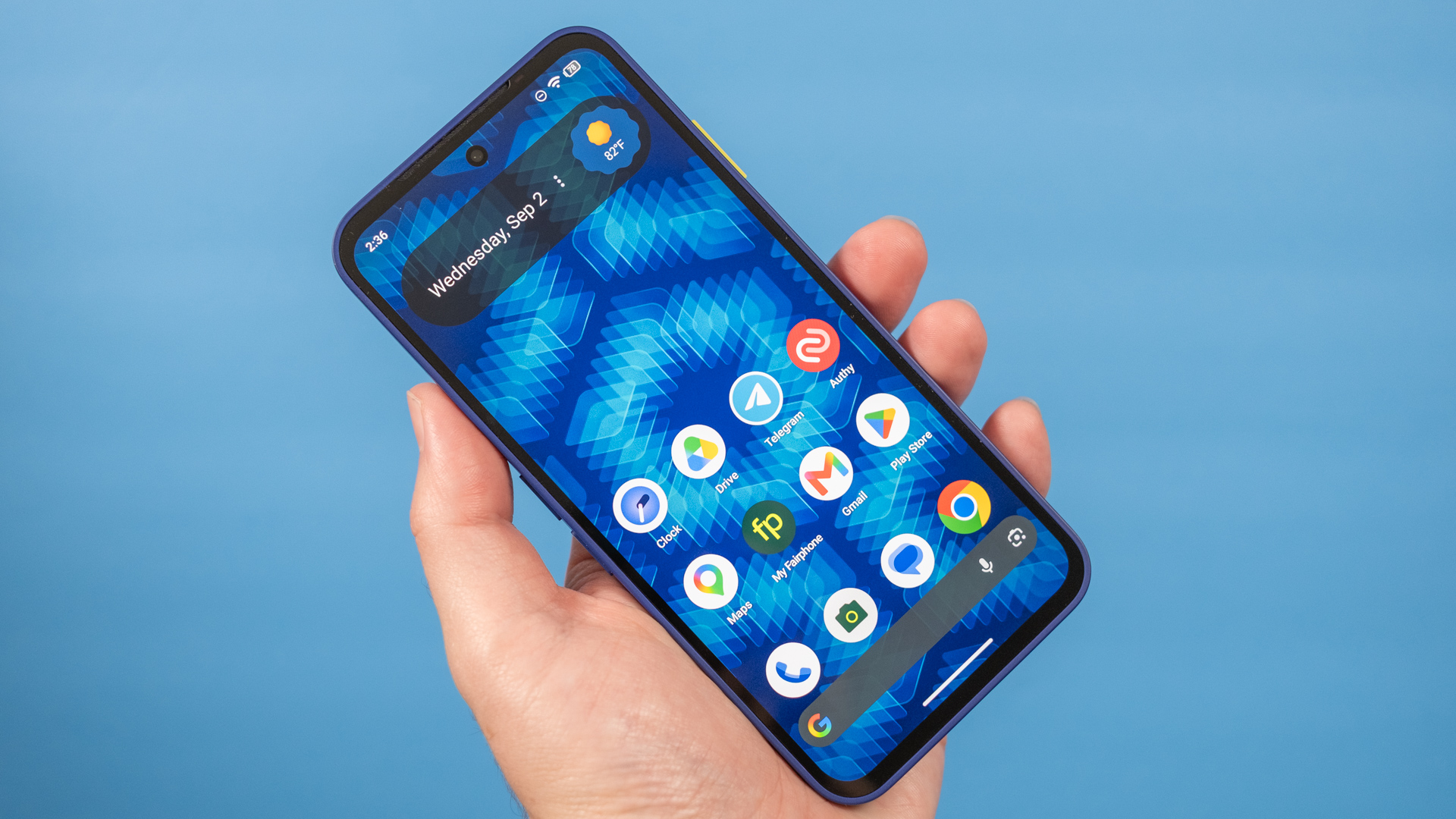
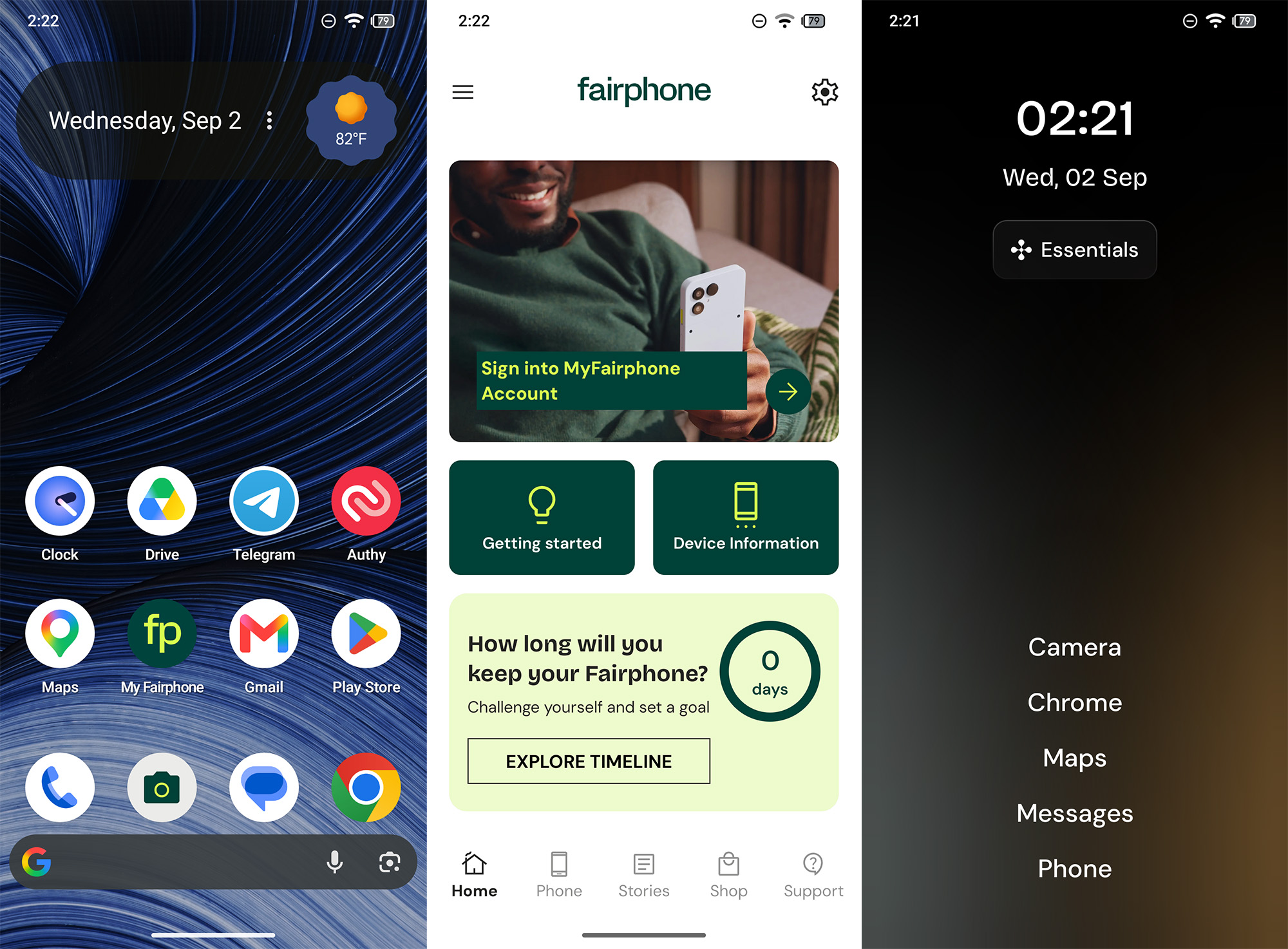
Fairphone’s version of Android is light on bloat.
Credit: Ryan Whitwam
Fairphone’s version of Android is light on bloat. Credit: Ryan Whitwam
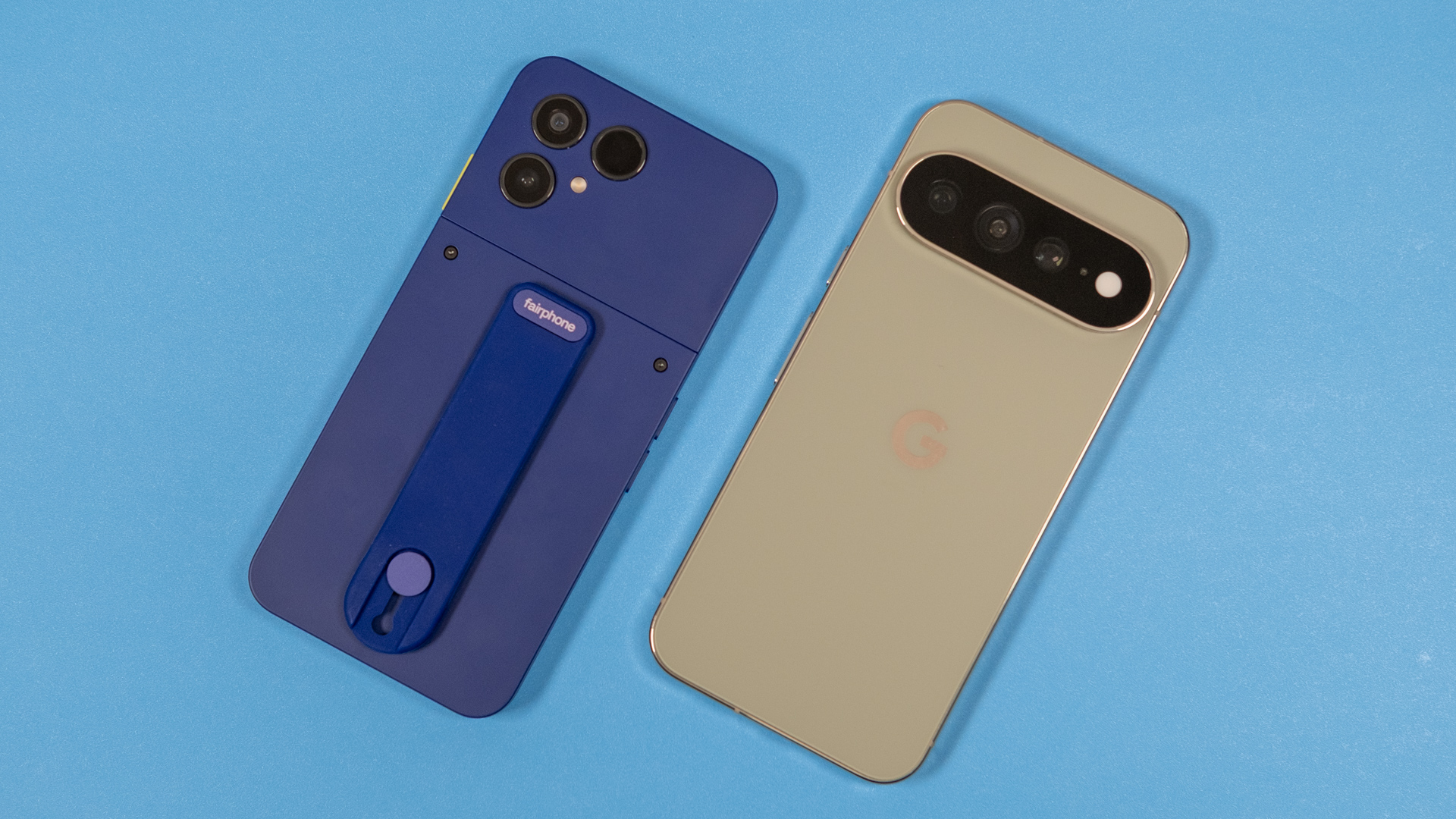
The modular design allows for a little fun in the form of accessory back panels. You can swap them just by removing the two external screws. There’s a finger loop back (below), a card holder, and a lanyard that works with any of the backs. Hatton notes that the accessories also invite users to open up the phone to see how easy it is, something Fairphone recommends people get familiar with even if they don’t have any accessories to swap—it’s like knowing where the spare tire is in your trunk.
The Fairphone Gen 6+ runs a minimally customized build of Android 16, so it’s a bit behind the latest and greatest. Thankfully, Google doesn’t limit as many features to the latest builds of Android anymore. It has almost no bundled software outside of the standard Google apps, which is nice to see, but if you’re hoping for a phone that’s crawling with snazzy software features, this is not it.
Medium outdoor light
Ryan Whitwam
Medium outdoor light Ryan Whitwam
Outdoors overcast
Outdoors overcast
Ultrawide
Ultrawide
Outdoors overcast
Ultrawide
Ultrawide
Bright outdoor light
Night mode
Ryan Whitwam
One of Fairphone’s few software customizations is called Moments, which you can toggle with the brightly colored side switch. Moments can help limit distractions by hiding most of your apps behind a minimalist UI. It’s just a full-screen app overlay rather than a completely custom home experience, though. If you don’t fancy the digital well-being approach to mobile tech, you can remap that switch. Using it as a flashlight toggle is nifty, for example.
The camera may be the biggest compromise if you switch from a Google or Samsung phone. The hardware is typical for the mid-range, with a 50 MP Sony 700C joined by a 13 MP OmniVision OV13B10. That third lens on the back is actually a window for a time-of-flight sensor that helps with focus. With ample light, both rear sensors produce good images, and the primary even does fine in some more challenging conditions.
Capture speeds are long, though, making it hard to get clear images of moving subjects. Colors look a bit flat, too, and autofocus speed seems on the slow side. There’s a 32 MP selfie camera, which looks a touch dimmer than most devices in this price range.
The Fairphone Gen 6+ (left) might not be as sleek as the Pixel 11 Pro XL (right), but you don’t need a hairdryer to open it up.
Credit: Ryan Whitwam
The Fairphone Gen 6+ (left) might not be as sleek as the Pixel 11 Pro XL (right), but you don’t need a hairdryer to open it up. Credit: Ryan Whitwam
With support increasing for making electronics more repairable, other companies may need to start moving in Fairphone’s direction. In Europe, regulators are preparing to require removable batteries, and more US states are enacting right-to-repair laws. The Fairphone CTO stresses that other OEMs have what they need to make phones more repairable.
“We’re producing our phones on the same production lines as our competitors, and often with many of the same components,” said Hatton. “It’s actually quite a small industry when you’re in it, and there is very little room for one of our competitors to say it’s impossible when on the next production line over it is happening.”
The Fairphone Gen 6+ is available directly from Fairphone, as well as on Amazon. It’s unlocked and works on both AT&T and T-Mobile.
Flock Donations to Local Politicians’ Groups Skyrocket as Protests Against AI Cameras Mount
As fed-up activists target Flock, the AI-powered surveillance camera company is battling back with a massive increase in donations to associations for mayors and other local officials.
Since the beginning of 2025, Flock has given 700 percent more to the partisan groups representing mayors, attorneys general, and governors than in the previous three years. The giving has gone to Democratic and Republican groups alike.
Donating to those groups is a time-worn strategy for companies under scrutiny. The gifts can sometimes reap face time with elected officials. Two major Flock competitors in the license-plate reader industry, Axon and Motorola Solutions, have also donated widely.
One group that received money from Flock, the Democratic Mayors of America, defended its decision to accept $30,000. A spokesperson said reports of Flock misuse are “deeply unsettling,” while arguing that the donations gave Flock no influence over local mayors.
Since the beginning of 2025, Flock donated a quarter-million dollars to a bipartisan slate of groups.
Critics of money in politics have long raised concerns that such donations create, at a minimum, the appearance of a conflict of interest. A surveillance skeptic said the groups could face blowback.
“There’s a reputational risk for them accepting donations from Flock at this time,” said Torin Monahan, a professor of communication at the University of North Carolina at Chapel Hill.
Flock did not respond to a request for comment.
Over the past year, Flock has faced intense pushback from activists on the left and right over perceived civil liberties abuses. Flock was forced to admit that immigration officials had access to its data, despite earlier denials in the middle of the Trump administration’s immigration crackdown last year. Dozens of police officers have also been accused of abusing Flock’s database to track people, often former romantic partners.
Flock was founded in 2017, but it was only five years after that that it began doling out money to what are known as 527 groups, according to records compiled by the nonprofit news outlet ProPublica. The so-called 527 groups can raise unlimited funds directly from corporations and spend that money on key political races.
Flock’s giving began at a relatively meager rate: From 2022 to 2024, the company gave $20,000 to the Democratic Mayors Association and $10,000 to its Republican counterpart, the Community Leaders of America.
Its spending has skyrocketed since then. Since the beginning of 2025, the company donated a total of $240,000 to a longer list of groups that includes the Democratic and Republican Governors Associations and the Democratic and Republican Attorneys General Associations.
Flock’s pattern of donating to 527 groups was identified by a widely cited critic of the company, Jason Hunyar, who asked on his blog what the company was receiving in exchange for those donations.
Influence Investments
The donations came as Flock was hiring an army of lobbyists. It has spent more than $2 million on state and federal lobbying since the start of 2025, according to a recent report from the transparency group OpenSecrets.
The rise of that multi-pronged influence campaign coincided with intense pushback to the company’s practices. Several members of Congress have proposed either outright bans or stricter regulations on Flock and other license-plate readers.
Much of the activism against Flock thus far has come at the local level. Scores of cities and other local governments have rejected or canceled Flock contracts or deactivated the company’s cameras since the start of 2026, according to the advocacy group DeFlock.
The suspicion crosses party lines. In Knox County, Tennessee, Republican Mayor Glenn Jacobs — the former professional wrestler Kane — recently led a campaign to cancel the company’s contract there. In Arizona, Democratic Attorney General Kris Mayes announced that she was launching a review of Flock and other camera networks.
Flock is not the only license-plate reader company that has routed money to political groups. Motorola Solutions, which counts cameras as one product among many in its portfolio, has donated more than $986,000 since the start of 2023, according to public records.
Axon, which also hawks Tasers and body-worn cameras, has donated $225,000 to Democratic and Republican attorney general groups over the same period. (Motorola Solutions and Axon did not respond to requests for comment.)
Making Connections
Corporate donations to 527 groups long been controversial. Companies can use the groups to build connections with the same elected officials making decisions about whether to purchase their products and services.
More than a decade ago, the New York Times documented how corporations facing lawsuits used donations to the Republican and Democratic attorney general groups to cozy up to decision-makers.
On its website, the Democratic Mayors Association touts a program that connects mayors “with leaders from the private sector, organized labor, advocacy groups, and partner organizations to build relationships, share ideas, and take on the most pressing challenges facing America’s cities.”
That group defended its decision to accept donations from Flock.
“No donation made to the Democratic Mayors Association guarantees any form of influence over the mayors, no matter who the donor is,” said a spokesperson. “The reporting we’ve seen about police departments across the country misusing Flock cameras and the data is deeply unsettling, which is why mayors across the country have taken action to implement strict guardrails or ban them altogether. Ultimately, Democratic mayors have presided over a historic drop in crime and have proven they know how to keep their communities safe. Each mayor makes their own decisions about what is best for their cities, and we trust their judgement.”
The Democratic Governors Association also defended its donations from Flock and other corporations.
“The DGA does not take policy positions as an organization,” said a spokesperson for the group. “Every dollar sent to the DGA helps us elect more Democratic governors who make their own policy decisions about how to make life better in their states and stand up to Donald Trump.”
Other groups that have received money from one or more of three leading companies in the license-plate reader world — Axon, Flock, and Motorola Solutions — did not respond to requests for comment.
US pressure puts Takaichi’s economic agenda in the crosshairs
Subscribe nowwith a one-month trial for only $1, then enjoy the first year at an exclusive rate of just $99.
Bessent gives orders to Japan’s Katayama and Ueda Scott Foster reports that US pressure on Japan to strengthen the yen and raise rates is colliding with Sanae Takaichi’s fiscal and industrial agenda, threatening investment plans in defense, AI and strategic technologies as inflation and debt-service costs rise.
Germany’s Russia confrontation comes home in Saxony-Anhalt Diego Faßnacht reports that Saxony-Anhalt’s election could become a historic test of Germany’s political order, as the AfD nears power while Berlin reframes pro-Russia positions as a domestic security risk after the Leipzig drone incident.
Bishkek summit shows Russia is far from isolated in Asia James Davis reports that the SCO summit in Bishkek demonstrated Russia’s continuing role in greater Asia, with China, India and Turkey engaging Moscow despite Western pressure. At the same time, the Ukraine war and Germany-Russia confrontation are entering a more dangerous phase.
Four major AI models suffer rare overlapping downtime
Cloud-based AI models operated by OpenAI, Anthropic, xAI, and Google suffered a rare and overlapping set of significant service interruptions over a period of hours Thursday morning.
Anthropic first reported a “partial outage” related to “elevated errors on requests to Claude Mythos 5.1, Claude Fable 5.1, and Claude Opus 5” at 9:23 am (all times Eastern). The company reported that it had “identified the cause” of the error roughly 15 minutes later, before reporting that “a fix has been deployed” and the issue was resolved by 12:16 pm. A separate incident report indicated “elevated errors on requests to Claude Sonnet 5” for a brief period just after noon.
OpenAI, meanwhile, reported “elevated errors across ChatGPT and Codex” were resulting in “degraded performance” as of 10:43 am Thursday morning. A mitigation put in place a little more than half an hour later led to the issue being marked as “resolved” by 12:55 pm.
As of this writing, xAI’s Grok currently displays a user-facing error message that the model “is experiencing issues” and that the company is “working on restoring service as quickly as possible.” User-submitted reports from DownDetector regarding Grok shot up from less than 10 just before 9 am to 1,365 by 9:45 am and have fallen to 273 as of this writing.
While Google has not publicly acknowledged any issues with its Gemini model, reports of problems on DownDetector similarly spiked from just 23 around 10:30 am to 412 just after 11 am. Data collected by API checker StatusGator also shows what it terms a “likely outage” for the Gemini API between 10:45 and 11:15 a.m. before the status returned to normal.
Other major Internet services, including Amazon Web Services, Microsoft Azure, and Cloudflare, have not reported any major issues as of press time Thursday, though issue reports on DownDetector did spike somewhat for all three this morning.
While the affected frontier models go down occasionally, having all four experience interruptions in the same short period is practically unheard of. Claude reports 99.4 percent uptime for its services over the last 90 days and last reported a similar three-hour “partial outage” on August 24. OpenAI reports 99.63 percent uptime for ChatGPT and 100 percent uptime for ChatGPT Codex in the same period. ChatGPT’s so-called “Work Mode” reported an hours-long period of “elevated latency” on August 31.
Finland probes possible territorial violation after drone discovery
Finland’s Border Guard said Friday it is investigating whether a surveillance drone found on the country’s southern coast had violated Finnish territory.
The investigation will seek to establish where, when and how the aircraft entered Finland and how it may have crossed the country’s border, the Border Guard said.
A preliminary examination indicated that the aircraft was a Geoscan 701-type drone. Authorities said the model is used by both state and civilian actors.
The Border Guard said it could not confirm at this stage where the drone came from, who operated it or what its purpose was.
Authorities continue investigation
The investigation is continuing in cooperation with other authorities, the Border Guard said.
Finland’s Defense Ministry said Wednesday that the drone was designed for surveying and mapping and did not pose a danger to the public.