22.4 C
London
Wednesday, July 22, 2026
Home Blog

Xi’s national team rides again to save swooning tech stocks

0
xi’s-national-team-rides-again-to-save-swooning-tech-stocks
Xi’s national team rides again to save swooning tech stocks

TOKYO — Chinese stocks just had a remarkable week, with stellar news from startup Moonshot AI delivering a DeepSeek-like jolt to a fragile market. Its new AI model reminded investors how fast China Inc. is closing the technology gap with Silicon Valley.

But as China’s “new economy” grabs the headlines, its “old economy” troubles are grabbing the wrong kind of global attention at a rough moment for Xi Jinping’s Communist Party.

A giant property crisis, near-record youth unemployment, dismal local government finances and weak consumer demand are weighing on markets — and Beijing’s “national team” is back in action.

Xi’s inner circle has reactivated its usual cast of regulators, state-backed investors, insurers and asset managers to circle the wagons after a chaotic tech-share selloff. On Sunday alone, funds tied to Beijing announced purchases of nearly US$8.9 billion in stocks.

National-team deployments have a track record of stabilizing Shanghai shares. The most famous came in summer 2015, when shares fell by a third in a few weeks.

That crisis triggered a whole-of-government response: waves of state funding into markets, trading suspensions across thousands of companies, a freeze on IPOs, and rules letting mainlanders pledge homes as collateral for margin loans. Beijing even rolled out marketing campaigns framing stock-buying as a patriotic act.

The team has been called back repeatedly since: during the 2018 margin-call crisis tied to share-pledge financing, in 2021-22 amid Covid, in 2023 when certain ETFs ran into trouble, in 2025 amid fallout from US President Trump’s tariffs, and now, as tech stocks wobble again.

This round follows investor unease over lofty chip valuations, not helped by wild swings in South Korean and Taiwanese markets. So far, the effort to put a floor under stocks is working.

The national team’s reported buying of China’s largest chip-heavy fund, the ChinaAMC STAR 50 ETF, calmed nerves after a 17% plunge last week — the most intense selloff, driven by funds unwinding leveraged positions, since 2015.

By Tuesday, concerted buying sent the STAR 50 index up 11%, its biggest single-day rally in roughly two years. The broader Shanghai Shenzhen CSI 300 Index is now up 1.7% year to date.

“The national team’s buying of the STAR 50 ETF provided exactly that signal, prompting funds to wade back in after interpreting the move as an official vote of confidence,” Zhuang Jiapeng, fund manager at Shenzhen JM Capital, tells Bloomberg. It also reassured AI investors who, Zhuang says, “had been searching for any sign that policymakers were still willing to back the trade.”

Such interventions treat symptoms, not causes. “China’s national team is offering market protection, not macro repair,” says Geoffrey Yu, strategist at BNY Mellon. “State-backed equity purchases can stabilize benchmarks and reduce downside pressure, but they don’t solve weak domestic demand or the property drag. Beijing can protect prices, but confidence still requires a stronger growth impulse.”

The underlying economic strains aren’t something 27% year-on-year export growth in June can fix — even as that trade performance puts Beijing on track for a second straight year of surpluses topping $1 trillion.

Gavekal Dragonomics notes China’s ratio of annual exports to total manufacturing sales rose to 24% in the first four months of 2026 — the highest since 2001, when China joined the World Trade Organization.

In 2019, the ratio was 18.3%. This year’s level “would be considered high for a small export-focused country,” Gavekal economists write. “For the world’s second largest economy, it’s remarkable.”

The trouble is domestic headwinds may be too strong for exports to offset. Xu Tianchen, an economist at the Economist Intelligence Unit, expects “continued export strength, mostly driven by AI” with help from a more expansionary policy mix. “But,” he says, “domestic demand remains a drag. Retail sales remain pretty flat and fixed asset investment was negative last month.”

Economist Carlos Casanova at Union Bancaire Privée says the 5.3% gain in industrial production is “increasingly concentrated in high tech and semiconductor-related goods. In other words, the gap between exports and industrial output widened, suggesting that the current export-at-all-costs strategy is delivering limited spillovers to the broader economy and raising doubts about its durability.”

Domestic demand remains “subdued,” Casanova adds, while fixed asset investment fell 5.7% year-to-date in June, led by an 8.5% contraction in private investment. Real estate investment fell 18.0% year-to-date; residential property sales fell 13.7%.

Exports, in other words, are no longer the cure-all they once were — not while domestic trends batter both household and business confidence.

The AI supercycle is reinforcing the strong side of China’s K-shaped economy by lifting production. But Citigroup Chief China Economist Xiangrong Yu notes “the benefits of this boom, however, aren’t spreading evenly across the broader economy. Consumer confidence remains subdued, having stayed negative for more than four years.”

Households, Yu adds, “continue to save heavily, maintain large excess deposits, and show limited willingness to take on additional borrowing. Meanwhile, fading policy support and earlier stimulus effects contributed to a contraction in retail sales in May, the first decline since Covid.” Property markets, Yu says, “tell a similar story.”

Conditions have improved in some Tier-1 cities benefiting from AI-related activity, Yu explains, but the broader national market remains weak. “More generally, AI is creating pockets of strength rather than generating a broad recovery in domestic demand.”

Investment trends show the same split: AI-related investment stays robust on hyperscaler, data-center and digital-infrastructure spending, while “investment in many traditional sectors faces mounting headwinds from delayed fiscal deployment, uncertainty linked to geopolitical developments, anti-involution pressures, and squeezed profit margins.” China’s reflation story, Yu notes, reflects the same uneven pattern.

The deeper problem is that Xi keeps deferring the reforms needed to stabilize China’s investment climate. The property crisis is now in its fifth year, producing the longest deflationary streak since the 1997 Asian crisis. Weak household demand and near-record youth unemployment are crushing confidence — which helps explain why China’s 1.4 billion people still save more than they spend.

Defeating deflation for good means getting Chinese households to deploy the more than $22 trillion in savings they’re sitting on. This stockpile is more than four times Japan’s annual gross domestic product, whose lost decades show the cost of complacency. The two problems are linked: roughly 70% of household wealth is tied to property.

If China’s economy became more transparent and stable, and offered real alternatives to owning property, citizens might feel less urgency to send their money abroad. Team Xi is mistaken if it thinks the answer is limiting options to move money overseas. What’s needed is the harder work of building trust — enough to make Chinese households want to invest at home.

Beijing’s renewed efforts to support China’s volatile stock markets are another stop-gap step. Encouraging pensions and mutual funds to invest more in domestic stocks and prodding mainland households to buy more shares are fine for the current quarter – not for the longer term. Such steps are only necessary, though, because Team Xi has been too slow to address the economy’s cracks.

One big debate in financial circles is whether Beijing might resort to weakening the yuan to boost growth. The pros are obvious. A weaker exchange rate would further boost exports, a key reason why China may reach 4.5%-5% growth this year.

Yet the cons are stopping Team Xi from going the weaker yuan route. For one thing, it might make it harder for highly indebted property developers to make payments on offshore bonds. That would increase default risks in Asia’s biggest economy. Seeing #ChinaEvergrande trending again is not what Xi’s party wants in 2025.

For another: the monetary easing required to depress the yuan could squander years of deleveraging efforts. In recent years, Beijing has made important strides in reducing China’s financial excesses and improving the quality of gross domestic product.

As a result, Xi and Premier Li Qiang have been reluctant to let the People’s Bank of China ease more assertively, even as deflation deepens.

Xi’s government has proved more skilled at talking the talk than walking the walk on earning the trust of global investors. Too often, Xi’s reform team put the proverbial cart before the horse.

Team Xi has tended to over-promise and under-deliver on financial reforms. And to think that pulling in more foreign capital is a reform all its own. It’s been slower to strengthen China’s financial system ahead of those waves of overseas capital.

For example, China’s inclusion in the WTO did less to recalibrate its growth engines these last 25 years than to remake the global economic system to its advantage. The 2016 inclusion of the yuan in the International Monetary Fund’s special-drawing-rights basket didn’t stop Beijing from imposing capital control or accelerate capital liberalization nearly as much as hoped.

In 2019, A-share stocks being added to the MSCI index didn’t suddenly make China’s financial system sounder, the government more transparent, companies more shareholder-friendly or the ginormous shadow-banking world any less of a menace.

Strengthening China Inc. — and generating a genuine stock rally with national-team support — requires significant heavy lifting to curb the dominance of state-owned enterprises, increase economic space for the private sector and eliminate the risk of dueling bubbles in debt, credit, assets and pollution.

The key now is for vibrant debt capital markets to help catalyze growth of all sectors, but particularly those in the high-tech space — the realm Premier Li has been elevating over the last year.

It’s also important that Beijing end the regulatory volatility of recent years, particularly concerning internet companies. More international capital markets would accelerate China’s move upmarket.

This week’s bounce in Shanghai shares may suggest investors are giving Team Xi the benefit of the doubt. It’s high time, though, that Beijing stepped up efforts to raise its financial game so that stocks soar for the right reasons, not state help.

Follow William Pesek on X at @WilliamPesek
Anthropic’s $1.5B copyright settlement approved; only 350 authors opted out

0
anthropic’s-$1.5b-copyright-settlement-approved;-only-350-authors-opted-out
Anthropic’s $1.5B copyright settlement approved; only 350 authors opted out

On Monday, a judge approved a $1.5 billion settlement between Anthropic and authors, ending the largest copyright class-action ever certified and granting the largest copyright settlement ever reached.

Back in May, some authors fought to block the settlement, which was proposed after the court ruled that Anthropic training AI on books was fair use; however, its piracy of works was likely not.

Authors opposing the settlement argued that lawyers’ fees were too high and authors’ payouts were too low. Hoping to avoid accepting the estimated $3,000-per-work payout and file separate lawsuits to seek higher damages, a handful of authors tried to opt out past the deadline.

In her order, US District Judge Araceli Martínez-Olguín overruled objections to the settlement as lacking merit. She emphasized that about 95 percent of the class received notifications and approximately 91 percent of authors and publishers impacted have already filed claims. Only 350 class members opted out, while another 54 sought to object or filed late opt-out requests, Martínez-Olguín said.

The high rate of participation suggested that most authors received timely notice of the distribution plan, agreed it was “fair,” and supported the settlement, Martínez-Olguín wrote. She also noted that the $3,000-per-work payouts were “four times the minimum statutory damages.”

Lawyers fees, plaintiffs awards cut

Although Martínez-Olguín approved the total settlement amount, she reduced both lawyers’ fees and the requested awards for the three authors who represented the class in the litigation.

Lawyers originally asked for 20 percent of the settlement in fees, requesting $300 million. Ahead of Martínez-Olguín’s ruling, that percentage was reduced to 12.5, with the total fees requested amounting to approximately $187 million.

The judge ruled that 12.5 percent was too high, however, cutting fees down to less than 7 percent of the settlement fund, which is about $101 million.

Some of those fees include future work that lawyers will do to distribute funds, and some authors argued that lawyers’ projections for time spent were alarmingly inflated. Acknowledging these concerns, Martínez-Olguín wrote in a footnote that the court decided to take “an additional step to protect the interests of the Class.” Once payouts have been finalized, lawyers will be required to file a post-distribution accounting, and if their fees are less, then the court “may reduce” them, Martínez-Olguín said.

Although the settlement likely relieves the three authors who spent years defending their works and 506,194 works from potential class members, the lead plaintiffs are likely disappointed by a decision to reduce their requested service awards from $50,000 to $15,000.

But Martínez-Olguín said that the higher amount was “unreasonable,” despite authors spending substantial time and resources on both litigation and the settlement negotiation. Without a sign that authors may face retaliation for filing the lawsuit, the judge ruled that lower awards were due.

In a statement to Reuters, lead plaintiffs said that the settlement “brings us one step closer to real accountability for Anthropic and puts all AI companies on notice they can’t shortcut the law or override creators’ rights.”

It’s unlikely, but still possible, that authors may receive more than $3,000 per work.

“If any funds remain in the Settlement Fund after all Valid Claims are paid, the Parties anticipate a redistribution of the remaining funds to Settlement Class Members unless it is economically infeasible to do so,” Martínez-Olguín said.

Authors’ lawyers celebrated the judge’s approval, writing in a press release that “rightsholders came together to call foul” on Anthropic’s piracy and describing support for the settlement among them as “overwhelming.”

Anthropic also seems happy to be done arguing about the settlement. In a statement provided to Ars, Anthropic’s deputy general counsel, Aparna Sridhar, said that Anthropic is glad the case’s landmark ruling established that its AI training was fair use and is happy that most rightsholders have already filed claims.

“We are pleased that more than 91 percent of authors and publishers covered by the settlement have claimed their share of the payment, and we’re looking forward to bringing this matter to a close,” Sridhar said.

Anthropic blocked last-minute opt-outs

For every opt-out granted, Anthropic risks facing separate litigation on what Martínez-Olguín said remains a complex case for courts to assess. It makes sense then that Anthropic was motivated to block delayed requests to opt out.

Some authors who opposed the settlement argued that they did not receive timely notices, the opt-out period was too short, and the settlement awards to authors were unacceptable, because the Copyright Act allowed for potentially higher statutory damages.

Martínez-Olguín confirmed that 350 class members successfully opted out of the settlement, but dozens of objections were denied, as were at least nine authors’ direct requests to opt out after the March 30 deadline.

Ultimately, Martínez-Olguín overruled most of the objections and denied most of the late opt-out requests.

The court only accepted two late opt-out requests from authors who showed “excusable neglect” in failing to meet the deadline, Martínez-Olguín said.

The two were co-authors who did not receive settlement notices. One author filed an opt-out request a few days late, which was granted, while the other request was granted after a much longer delay, due to the author suffering a stroke. That author also garnered the court’s sympathy by noting that she “lives in Mexico, speaks Spanish, was not able to understand the class notice, and asserts no Spanish translation was provided.”

One of the last authors to try to escape the settlement at the last minute was Donald Passman, an entertainment lawyer and author who sent his request at the end of June. That was three months after the deadline, which Martínez-Olguín said was “inexcusably late” since records showed the notices were delivered to his current address, where at least one notice was “received,” albeit more than a month after the opt-out deadline.

In a court filing, Passman argued that evidence showed he received late notice of the settlement. He allegedly couldn’t even rely on his publisher, Simon & Schuster, to forward notices and “had no information about the existence of any opt-out deadline” until he received a letter past the deadline that only invited him to claim his payout and did not mention opt-outs.

Passman did not immediately respond to Ars’ request to comment on the settlement approval. But he’s likely disappointed, since he argued that his book, All You Need to Know About the Music Business, is a key industry text and “the estimated per-work settlement payment of approximately $3,351.39 does not adequately compensate me for the potential value of my individual copyright claims.”

Anthropic fought Passman’s attempt to opt out, arguing that he took months to file his opt-out request after learning about the settlement. According to Anthropic, it allegedly strained credulity that Passman “somehow did not hear about the largest copyright settlement ever in a case that generated mountains of headlines.”

“Allowing Mr. Passman to opt out after such a long and unjustified delay would invite others to try the same, undermining finality and risking undue delay in the distribution of Settlement funds,” Anthropic argued. “In a Class of hundreds of thousands, only a tiny fraction—approximately 400—have sought to opt out.”

Martínez-Olguín agreed with Anthropic and said that granting Passman’s request risked opening the floodgates for other authors to back out of the settlement.

In her order, Martínez-Olguín reminded authors that the settlement provided non-monetary benefits they seemed to be ignoring. For one, authors can avoid costly, lengthy, complex litigation that could result in a loss with “zero recovery,” she said, citing precedent showing that “prompt closure” provides value to class members. For another, the settlement requires Anthropic to destroy all their works and allows for future litigation, should Anthropic misuse their works after the dust settles.

Woman’s First Cruise Leaves Her with ‘Catastrophic’ Injury

0
woman’s-first-cruise-leaves-her-with-‘catastrophic’-injury
Woman’s First Cruise Leaves Her with ‘Catastrophic’ Injury


A Louisiana woman’s dream cruise vacation turned into a medical nightmare after a shore excursion in Honduras ended with a devastating injury, emergency treatment aboard a Carnival ship, and a $50,000 air evacuation back to the United States.

Kristen Lindsey was reportedly on the third day of her first cruise when she took part in a rope swing excursion during a stop in Honduras. But what was supposed to be a thrilling vacation memory quickly went horribly wrong.

According to her boyfriend, Blake, a retrieval line that should not have been connected to the swing suddenly tightened just before Lindsey dropped, causing what he described as a “catastrophic saddle injury.”

At first, Lindsey apparently did not realize how serious the injury was. She reportedly thought she had only suffered a minor scratch and returned to the Carnival cruise ship.

But within hours, her condition became frightening.

The pain worsened, the swelling intensified, and the injury reportedly grew to the size of a baseball. What had seemed like an uncomfortable mishap had become a serious medical emergency far from home.

Lindsey’s mother, Tara, said her daughter spent more than 12 hours in the ship’s medical bay as her family and boyfriend scrambled to figure out what to do next.

Blake said he called 911 from the ship before Lindsey was rushed to the vessel’s medical center, where she was treated for several hours. Before leaving the ship, the couple reportedly had to pay about $4,000 out of pocket for her onboard medical care.

As Lindsey’s condition continued to deteriorate, the couple was presented with a brutal set of options.

They could keep her in the ship’s medical facility for the rest of the cruise, get treatment at a hospital in Mexico, try to make their own way back to the United States, or arrange an emergency medical evacuation.

The couple chose the air evacuation, believing it was the safest way to get Lindsey the urgent care she needed.

“We chose the air evacuation because we believed it was the best way to get Kirsten the care she needed,” Blake told NewsNation.

The decision came with a staggering price tag.

According to Blake, the emergency flight cost $50,000, including $20,000 to leave Costa Maya and another $30,000 to return to the United States.

After hours of delays, Lindsey was taken by ambulance to the airport and placed on a private medical jet bound for Fort Lauderdale, Florida. From there, she was rushed to HCA Florida Aventura Hospital, where she underwent her first surgery.

The ordeal did not end there.

After returning home to Louisiana, Lindsey continued receiving treatment at CHRISTUS Highland Medical Center. She is now undergoing a second surgery as she continues recovering from the injuries suffered during the excursion.

What began as a long-awaited vacation has left the couple facing a mountain of unexpected expenses, including medical bills, travel costs, lost income, and the complicated process of getting Lindsey safely back home.

Her family has since launched a GoFundMe campaign to help cover costs as she continues what is expected to be a long recovery.

Airbus, Kawasaki team up to send Eurodrone sub-hunting

0
airbus,-kawasaki-team-up-to-send-eurodrone-sub-hunting
Airbus, Kawasaki team up to send Eurodrone sub-hunting

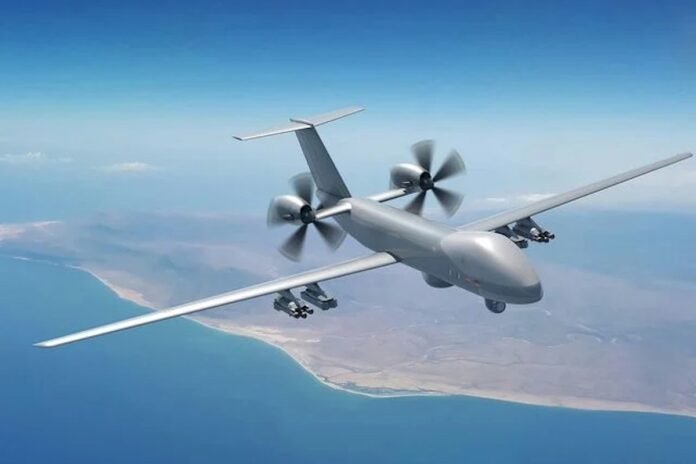
Conceptual image of the Eurodrone. Image: Airbus

Japan’s Kawasaki Heavy Industries (KHI) has signed a memorandum of understanding (MOU) with Airbus Defence and Space (Airbus D&S) to collaborate on long-endurance unmanned aerial vehicles (UAVs). The agreement covers operations combining the Eurodrone with KHI’s P-1 maritime patrol aircraft, with particular attention to anti-submarine warfare.

KHI is Japan’s second-largest defense contractor. Airbus D&S is the military aircraft and space systems division of Airbus. Airbus has worked with KHI and other Japanese companies for decades, but this agreement takes the relationship to a new level of military cooperation.

Currently under development, the Eurodrone is a large, twin-engine, remotely piloted aircraft with a 30-meter wingspan. A medium-altitude, long-endurance UAV, it can cruise at altitudes up to 12,200 meters (40,000 feet) for up to 40 hours and has a maximum payload capacity of 2.3 tons, excluding fuel.

The Eurodrone will be an armed intelligence, surveillance, target acquisition and reconnaissance (ISTAR) platform able to carry air-to-surface missiles and precision-guided bombs underwing. It will also have command, control and communications, and airborne early warning capabilities. Unlike purely military drones, it will be certified to fly in civilian airspace and use standard air traffic management systems.

The Eurodrone program is supported by Germany, France, Italy and Spain, with Airbus D&S as prime contractor and Leonardo and Dassault Aviation as industrial subcontractors. The European Union co-funds the program. Japan has been an observer since 2023, as has India.

The Eurodrone program operates independently of the International Traffic in Arms Regulations (ITAR), the US export-control regime governing trade in defense products, services and data.

The collaboration will therefore help Europe and Japan reduce their dependence on the US military-industrial complex, building on the existing EU-Japan Security and Defense Partnership.

The Eurodrone is a good fit for both KHI and Japan, which is playing catch-up in drone technology and has a very large jurisdictional sea zone — including its territorial waters (such as the Seto Inland Sea) and its exclusive economic zone (EEZ).

Japan’s EEZ is almost 12 times larger than its national territory. It extends nearly to Taiwan in the southwest, to Okinotori Island, 1,740 km south of Tokyo, and to Minamitorishima (Marcus Island), 1,850 km southeast of Tokyo (see map).

Airbus and KHI are considering development of a specialized anti-submarine variant of the Eurodrone that would carry sonobuoys and torpedoes. It would work in tandem with KHI’s P-1 maritime patrol aircraft, which is designed for prolonged surveillance over the ocean. The P-1 has an operational radius of about 2,500 km and is powered by four turbofan jet engines produced by IHI Corp. (formerly Ishikawajima-Harima Heavy Industries).

A Japanese version of the Eurodrone could include Japanese sensors and other components and involve Japanese participation in manufacturing and maintenance, making it easier for Japan to operate the aircraft independently.

“Furthermore, insights gained from developing Japan’s specific variant are expected to provide substantial operational and logistical advantages for future European naval versions of Eurodrone,” Airbus said.

The Eurodrone isn’t scheduled to make its first flight until 2029, but its capabilities would already exceed those of competing medium-altitude, long-endurance UAVs if it were flying today.

Eurodrone data:

  • Wingspan: 30 meters; length: 17 meters; height: 6 meters
  • Maximum takeoff weight: 13-ton class
  • Mission payload: 2.3 tons (excluding fuel)
  • Maximum speed: 270 knots (500 km/h)
  • Flight time: up to 40 hours

Features:

  • Twin turboprop engines
  • Automatic takeoff and landing
  • Traffic collision avoidance system
  • Air traffic management communications
  • Narrow/wide-band redundant data link architecture
  • Detect-and-avoid system
  • Weather radar
  • Lightning protection
  • Ice detection and protection

Mission payload:

  • Electro-optical/infrared camera
  • Multi-mode surveillance radar
  • Line-of-sight/beyond-line-of-sight datalink
  • Automatic identification system for warship detection

Source: Airbus media assets

Airbus and KHI have jointly produced helicopters for emergency medical services, transport, law enforcement and other purposes for nearly 50 years. KHI, along with All Nippon Airways and Kansai International Airport, joined the Airbus Hydrogen Hub at Airports project in 2024.

Airbus also works with Toshiba on the development of superconducting technologies for hydrogen-powered aircraft. Airbus D&S has design, manufacturing and data supply arrangements with Japanese satellite companies Astroscale, Synspective and Sky Perfect JSAT.

Airbus has also been taking market share from Boeing in Japan, while KHI, Mitsubishi Heavy Industries (MHI) and other Japanese suppliers of aircraft components have been doing more work for Airbus and less for US aerospace giant Boeing.

Follow this writer on X: @ScottFo83517667

Naked mole-rat queens use a chemical signal to suppress fertility in rivals

0
naked-mole-rat-queens-use-a-chemical-signal-to-suppress-fertility-in-rivals
Naked mole-rat queens use a chemical signal to suppress fertility in rivals

Naked mole rats are weird. They spend their lives almost entirely underground, are largely insensitive to some kinds of pain, can persist without oxygen for a long time, rarely develop cancer, and can live past 30 years, which is decades longer than similarly sized rodents. They are also eusocial, like ants, bees, or termites—in a colony that can hold more than a hundred animals, only one female, the queen, breeds.

We didn’t know how exactly naked mole-rat queens stop other females from breeding. For a long time, our leading hypothesis was bullying and violence, but that may be a bit impractical, given their kingdoms are vast networks of tunnels that can stretch for up to three kilometers. But now a team of Lewin Lab scientists at Max Delbrück Center for Molecular Medicine in Berlin discovered it’s actually just one part of a sophisticated olfactory signaling program.

Running on smell

“It’s very clear that mole rats actually have quite big noses and smell a lot,” says Gary Lewin, a neurobiologist at the Max Delbrück Center for Molecular Medicine and senior author of the study. Naked mole rats have around 1200 olfactory receptor genes, more than mice (which have roughly 1,000 of them) and way more than the few hundred in humans. They’re also blind. “They have to be able to navigate and move around without vision, so smell is one of those things that’s enhanced,” Lewin said.

To find out how heavily mole rats rely on smell, the team collected odor bouquets from individual animals. Scientists held an absorbent plastic tube near a mole rat for about half an hour to pick up the volatile molecules coming off its body. Then, they analyzed these scents in a mass spectrometer, which separated the components of the scent into around 100 distinct chemical compounds.

Based on analyzing samples taken from hundreds of different mole rats, the team learned members of each colony carried a distinguishable chemical signature. When mole rats from different colonies were placed together, they sniffed each other for about 40 seconds to decide if they were dealing with their nestmate or a stranger. When they sniffed a stranger, they attacked, often with lethal intent. “Naked mole rats are like humans in the sense that they’re very xenophobic,” Lewin said.

So, the team tested if depriving mole-rats of smell would purge the xenophobia out of them. It did. When scientists temporarily disabled mole-rats’ olfactory sensory neurons with chemicals, the aggression towards strangers disappeared. “They basically were cool with each other, and there was no fighting,” Lewin said.

Besides chemical friend-or-foe signals, researchers found something else in the odor bouquets. There was one compound, an ester called isopropyl myristate, that scientists found in the samples taken from queens and nowhere else. “Breeding females had this particular molecule that non-breeding animals did not have,” Lewin said.

The royal scent

Scientists found breeding queens secreted isopropyl myristate from their genitals and smeared it through the tunnels as they roamed their underground kingdoms. Tracking a queen’s output of the compound over her reproductive cycle showed that it rises and falls with her fertility, peaking when she’s in heat or pregnant. “It’s actually a very good marker of whether the queen is capable of breeding, ” Lewin said. On top of that, it has another useful feature.

Isopropyl myristate, while volatile, is rather stable once deposited on a surface. Researchers could still detect it in mole-rat cages roughly 24 hours after it’d been applied. Because a colony’s burrow system can run up to three kilometers, a queen has a lot of ground to cover if she wants every subordinate exposed to her scent. “It sticks around for a while, so she has less work to spread the odor around the underground colony,” Lewin said.

Pinpointing the queen’s molecule was one thing, though. Showing what it does was another.

Lowborns and upstarts

Naked mole-rat colonies are organized in a hierarchy loosely correlated with body size, starting with bottom-ranked workers and foragers, up through soldiers, to the highest-ranked animals and the breeding male called the pasha. Scientists sort naked mole rats into ranks using a dominance test: When two animals meet in a tunnel, whichever one yields is the lower-ranked of the pair. When Lewin’s team tested how mole rats react to isopropyl myristate, the reaction seemed to be dependent on rank.

When placed in a T-maze with the queen’s molecule placed on one side, higher-ranked females, the ones with a realistic shot at becoming the queen one day, avoided it. “We’ve got an idea, although we didn’t prove it, that in a normal environment, higher-ranked animals try to avoid the queen, because the queen might be aggressive towards them,” Lewin said.

Direct evidence on the mole-rat brain response to isopropyl myristate came from functional ultrasound imaging, a technique that tracks blood flow non-invasively in an anesthetized animal. “If you just puff isopropyl myristate on the nose of the animal, a large part of the olfactory cortex lights up,” Lewin said. The team interpreted this as a proof the compound is registering as a distinct signal, not just background smell. What’s more, the exposure to the queen’s scent triggered hormonal shifts in females.

Non-breeding mole-rat females are known to run high on prolactin, a hormone that also suppresses fertility during lactation in nursing mammals. Lewin’s team found that prolactin levels drop when a queen is removed from a colony and climb back up once isopropyl myristate is reintroduced. Progesterone, a hormone associated with active breeding, moved in the opposite direction: low in non-breeders, and rising once the queen was gone. “These hormones seem to be directly controlled by the presence of the molecule [isopropyl myristate],” Lewin said.

The queen’s odor bouquet, however, contained many other scents. To be sure they’ve got the right one and that others are not involved in reproductive suppression, the researchers tested what happens when the queen herself is gone, but her royal molecule stays. It turned out the scent alone kept the subjects in check just as well as the real queen did.

Game of thrones

The team started by taking mating pairs out of a colony away from any queen. Under such conditions, mole rats usually start breeding within four or five weeks. When the team sprinkled their cages with isopropyl myristate daily, though, the animals did not breed—the compound reliably prevented pregnancy. Once the contraceptive effect was confirmed at the individual level, Lewin’s team extended this experiment to the whole colony scale.

Removing a queen from an established colony normally sets off the mole-rat version of Game of Thrones. The strongest females fight against each other, often to the death, until a single winner emerges as the new queen. When the researchers removed the queen and dosed the colony with isopropyl myristate every day for three months, there were no attempts at coup d’etat. “Everything was peaceful,” Lewin says. “We had no fights. We had no females emerging as reproductive queens. The molecule was acting as a super contraceptive keeping them all sexually repressed.”

To Lewin, these results show that naked mole-rat biology is more closely tied to insect eusociality than scientists expected. Queens in honeybee colonies and other eusocial insects use pheromones to keep worker daughters from developing ovaries. “It’s a relatively simple mechanism that explains a relatively complex behavioral trait,” Lewin says.

What we are still not sure about is whether in this shape or another it appeared somewhere else in the mammalian evolutionary tree. Because secreting isopropyl myristate is not something exclusive to naked mole rats. Humans do that too.

“Isopropyl myristate has been detected in the breast secretions of lactating human mothers, though its function there is unknown,” Lewin says. “This molecule or similar molecules may have effects on reproduction in species other than naked mole rats, maybe even including humans. We just don’t know that”.

Nature, 2026. DOI: 10.1038/s41586-026-10772-5

Spain seeks to extend smoking ban to terraces, include vapes

0
spain-seeks-to-extend-smoking-ban-to-terraces,-include-vapes
Spain seeks to extend smoking ban to terraces, include vapes


Spain will ban smoking on outdoor bar ​and restaurant terraces while extending smoke-free areas and regulating vaping products in ‌the same way as conventional cigarettes, Health Minister Monica Garcia said on Tuesday.

European countries such as Britain and France are increasingly tightening tobacco and vaping rules, framing smoking as both a public-health ​threat and a drain on state health budgets and productivity.

The draft ​bill still needs to be approved in a fragmented parliament. The ⁠main opposition People’s Party has made its support conditional on the creation ​of designated smoking areas and guarantees that the hospitality sector will not be ​harmed.

Garcia said the plan sought to put Spain back at the forefront of tobacco control after earlier reforms banned smoking in enclosed workplaces in 2005 and inside bars and restaurants in ​2010.

“The times have changed, new products have appeared and there are new ​public health needs,” Garcia told reporters.

Tobacco killed around 140 people a day, or 50,000 per year, ‌in ⁠Spain, and 30% of cancers were linked to smoking as a risk factor, she said.

BROADER RESTRICTIONS

Smoking on outdoor terraces was temporarily restricted during the COVID-19 pandemic, but the curbs were later lifted.

Spain’s main hospitality-sector lobby said in a statement ​it disagreed with ​the measure, which “would ⁠have very limited effectiveness, as it could drive smokers indoors to places such as private homes, thereby increasing exposure to ​second-hand smoke”.

The new rules would also prohibit smoking within 15 ​metres (49 feet) ⁠of entrances to public buildings, playgrounds, and health and educational centres, as well as inside work vehicles, sports facilities, universities, public swimming pools and venues hosting public ⁠events.

For ​the first time, e-cigarettes, nicotine pouches, herbal inhalation ​products, hookahs and heated tobacco devices would come under the same restrictions as cigarettes, regardless of whether ​they contain nicotine.

Source:  Reuters

6 killed as forest fires sweep parts of Algeria

0
6-killed-as-forest-fires-sweep-parts-of-algeria
6 killed as forest fires sweep parts of Algeria

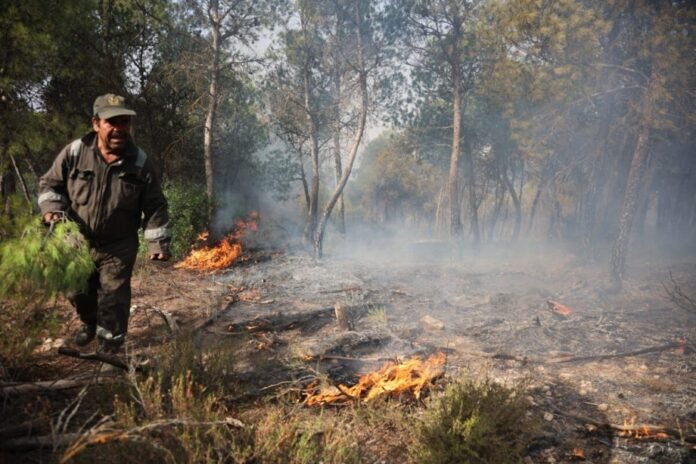
Civil defense and firefighting teams battle flames spreading through a forested mountainous area in El Hachimia, Bouira province, on July 21, 2026 in Bouira, Algeria. [Hamza Zait  - Anadolu Agency]

Civil defense and firefighting teams battle flames spreading through a forested mountainous area in El Hachimia, Bouira province, on July 21, 2026 in Bouira, Algeria. [Hamza Zait – Anadolu Agency]

Six people have been killed in forest fires affecting several provinces across Algeria in recent days, the Interior Ministry said Tuesday, Anadolu reports.

In a statement carried by the state-run APS news agency, the ministry said provincial governors had been instructed to begin a comprehensive assessment of all losses caused by the fires.

It said compensation for those affected would be based on reports prepared by provincial committees conducting detailed field investigations.

The ministry said authorities had mobilised material and human resources, including firefighting aircraft and helicopters, to protect lives and property and extinguish remaining fire outbreaks across the country.

Rubio: Iran Not Serious About Talks; Tehran Warns US Against Striking Nuclear Sites 

0
rubio:-iran-not-serious-about-talks;-tehran-warns-us-against-striking-nuclear-sites 
Rubio: Iran Not Serious About Talks; Tehran Warns US Against Striking Nuclear Sites 


The United States said Tuesday that Iran is not seriously pursuing negotiations to end the conflict, while Tehran warned that any US strike on its nuclear facilities would constitute a major escalation and prompt attacks against American and allied interests across the region.

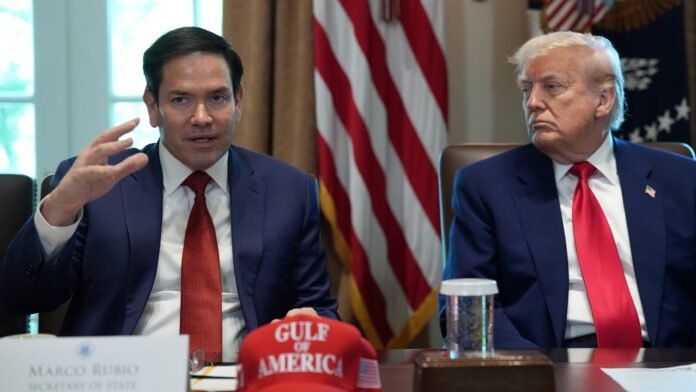
Secretary of State Marco Rubio said Washington remains willing to negotiate but accused Tehran of failing to engage in meaningful talks.

“The US is open to dialogue and resolving the conflict. The problem is that Iran is not serious about the talks,” Rubio said.

He added that Iran’s blockade of an international waterway had “created a dangerous precedent that could repeat itself in other parts of the world-including in Asia.”

“The global economy is threatened, as are international trade laws and commerce–this cannot be allowed,” Rubio said.

Iran’s Khatam al-Anbiya Central Headquarters responded by warning that any US attack on the country’s nuclear sites would constitute “an expansion of war in the region” and that “all US and its allies’ interests in the region will be attacked,” according to Iranian state television.

The warning followed President Donald Trump’s comments that the United States would likely strike Iran’s Pickaxe Mountain “pretty soon” and “very heavily.” Speaking during a White House meeting with Lebanese President Joseph Aoun.

According to Israeli intelligence, Pickaxe Mountain is believed to house centrifuges and could serve as an underground site for Iran’s nuclear program.

Military operations continued overnight as the conflict entered its 11th consecutive night.

US Central Command (CENTCOM) said it completed strikes against military operations centers, naval capabilities, aircraft hangars, unmanned aerial vehicle storage facilities and logistical infrastructure. CENTCOM said the operation was intended to degrade Iran’s ability to threaten commercial shipping in the Strait of Hormuz after Iran attacked more than 30 commercial vessels there during the past three months. The attacks had endangered hundreds of civilian sailors, violated freedom of navigation, CENTCOM added.

Iranian media reported explosions in several locations. Fars reported blasts near Bandar-e Mahshahr and Sirik in southwestern Iran. Tasnim reported explosions in Bushehr on the Persian Gulf coast and in Tabriz, adding that initial assessments indicated two sites had been struck.

Separately, Nour News reported that air defense systems were activated in Tehran, while Reuters reported that Kuwait deployed its air defense systems to intercept Iranian drones.


How Australia resisted PRC economic coercion: lessons for others

0
how-australia-resisted-prc-economic-coercion:-lessons-for-others
How Australia resisted PRC economic coercion: lessons for others

The People’s Republic of China has used its statecraft to weaponize its trade with other countries on several occasions in recent years. Such behavior usually arises when the PRC interprets another country’s actions as hostile to its political interests and resorts to nonofficial sanctions, tariffs, regulations, and consumer boycotts that damage a host nation’s economy.

These actions don’t follow market sentiments and can be revoked without a change in any underlying economic concerns the PRC initially used to justify its imposition. Many targeted countries use terms such as economic coercion to refer to trade decisions intended to alter a nation’s policies, behaviors or decisions.

Among the many advanced economies experiencing trade deficits with the PRC, Australia is a unique case. Australia possesses abundant natural resources, from iron ore to coking coal to barley and fisheries. Many of these products became major trading commodities between Australia and the PRC.  However, during the 2010s, concerns arose due to foreign political influence, university funding dependence and Chinese state-linked investment with national security concerns.

Subsequent suspicion of the PRC grew, eventually culminating in Canberra’s call for an investigation into the origin of the Covid-19 virus in the PRC. Beijing responded with retaliatory tariffs against Australia’s exports. However, the PRC has failed to coerce Australia into changing its policies toward China. This, along with Australia’s economic resiliency, has policy implications.

Deteriorating relations

Beginning in 2015, suspicion spiked regarding Chinese state-linked campaigns to influence Australian elites and shape their perceptions of the PRC’s human rights issues, the US-Australia security alliance and the South China Sea. The Australian Security Intelligence Organization reportedly warned various elites and politicians of this issue in 2015.

The suspicion became public in 2016 with the Sam Dastyari case in which Dastyari, a Labor Party politician, made comments in opposition to the Labor Party’s support for Freedom of Navigation Operations (FONOP) in the South China Sea in exchange for donations from the PRC through a donor by the name of Huang Xiangmo. Dastyari reportedly helped Huang avoid the security intelligence apparatus of Australia.

This proved indicative of Chinese espionage tactics, since the United Front Work Department of the PRC prefers to blur the line between legitimate influence and illegal interference, taking advantage of legal gray zones in democratic states to advance Chinese state activities.       

This led Australia to react with stricter legislation and a tougher stance on Chinese interference. Most important was the legal distinction between influence – which includes lobbying, diplomacy and advocacy – and interference, including covert, deceptive, coercive and other actions directed by a foreign state/proxy.

Australia later imposed anti-interference laws and investment screening on Chinese companies to enhance national security, followed by banning Chinese companies such as 5G telecommunication providers Huawei and ZTE from involvement in critical national infrastructures as well as becoming more vocal via diplomatic channels on issues regarding Xinjiang, Hong Kong, Taiwan and the South China Sea.

Origin of the clash

All of the abovementioned culminated in the announcement of an investigation into the origins of Covid-19 by the Australian government, focused on the PRC. In April 2020, Marise Payne, the foreign minister of Australia, called for an independent international investigation into the origin and the global handling of Covid. The call was backed by then-Prime Minister Scott Morrison of the Liberal Party.

Australia partially got what it wanted in May 2020, when the World Health Organization agreed to convene an investigation committee of more than 100 countries, including the PRC, to look into the global response efforts regarding Covid, rather than looking into the virus’s origin.

Despite claiming victory (with no origin inquiry, the findings were less substantial than expected), the PRC then retaliated by imposing and encouraging restrictions on numerous Australian imports, including barley, wine and coal. It also simultaneously claimed that Australia was no longer a suitable education and tourism destination.

In November 2020, the Chinese ambassador in Canberra provided journalists with 14 points of grievance against Australia, including blocking Chinese investments on national security grounds, banning Huawei and ZTE from Australia’s 5G network and issuing the calls for Covid origin investigation

The 14 points became significant because this was one of the rare occasions in which the PRC explicitly claimed political grievances tied to economic coercion. This essentially became the PRC’s “ask” of Australia. Saying trade relations had deteriorated because their policy was not to the PRC’s liking fits a textbook definition of economic coercion.

Australia’s response

Under Morrison, Australia found alternative destinations for its exports. The nominal damage to Australia’s GDP between 2020 and 2023 was less than 1%, though the toll was concentrated in specific sectors.

The Department of Agriculture, Fisheries and Forestry reported a 416% growth (A$251.6 million, or US$173.4 million) in barley exports to Latin American countries between 2022 and 2023, while overall barley exports rose to A$3.3 billion in 2023 despite exports to the PRC dropping to 0%. Australia’s agricultural and fisheries exports in general have also diversified to ASEAN countries, with ASEAN surpassing the PRC as the largest agricultural and fisheries importer during FY 2021-22(21% vs the PRC’s 20%).

Studies have also found that Japan was able to surpass the PRC as the largest importer of Australian coal, taking up 35% (vs the PRC’s 9%) of Australia’s coal export by 2023.

It is important to note that lobster fisheries and wineries weren’t able to diversify as successfully as other targeted industries, with wine exports falling by 30% and lobster exports by 64% between 2020 and 2023.

But it’s also noteworthy that the PRC couldn’t get around Australia’s iron ore export. So, despite restricting agricultural products, the PRC did not put an import restriction on Australian iron ore, which continued to generate significant income for Australia. In fact, one can argue that Australia weathered the storm despite massive tariffs from the PRC because of its rich iron ore export industry.

The economic resiliency of Australia paved the road for its political resiliency. Despite warmer diplomatic exchanges under Anthony Albanese, the current prime minister who has governed since his Labor Party’s victory over Morrison’s Liberal Party in 2022, Australia has not changed its strategy. It continued to supply other countries with the stated goods and at higher volume prior to Chinese sanctions.

Australia still doesn’t allow Huawei or ZTE to participate in its 5G network, similar to most developed countries; Australia didn’t revoke the foreign interference law, neither did it pause reviews of existing cases; Australia didn’t change its stance on Hong Kong, Taiwan or the South China Sea; nor did it further distance itself from the US – instead becoming part of the landmark AUKUS (Australia, UK, and US) alliance, whose main goal is to provide Australia with nuclear submarines as well as advanced deterrence capabilities in the Indo-Pacific.

Other actions from Australia include blocking a state agreement to the Belt and Road Initiative and increasing cybersecurity surveillance in cooperation with allies, something the Chinese ambassador explicitly mentioned in his 14 points and urged Australia not to do.

This is highlighted by how the PRC resumed imports and began gradually removing restrictions after Albanese’s meeting with President Xi Jinping of the PRC during the G20 summit. Despite rhetoric on expanding cooperation, the truth is that the PRC removed its import restrictions without Australia changing its political stance or economic model.

Even during the warming-up period between Australia and the PRC, Australia has pursued actions that are against Chinese interests such as promoting rugby league funding to Pacific Island neighbors contingent on their not having security or policy ties to the PRC, as well as criticizing the PRC for conducting military exercises in international waters between Australia and New Zealand.

Australia is a telling case because, unlike those countries that have to worry about whether their dependence on the PRC is mostly upstream or downstream, Australia is itself the upstream producer that exports raw materials to the PRC. This means that Australia’s economic methods during coercion are hard to replicate, since not many developed countries have trade surpluses with the PRC.

What can be learned from this case, and should act as a policy model, is the advantage of pursuing a de-risking strategy, aimed at diversifying a country’s supply chain to rely less on the PRC.

In the case of Australia, the PRC took great offense at being targeted internationally, and sought to punish Australia economically to extract political concessions. Yet, once there was no Australian concession, either economically or politically, the PRC was quick to realize the economic necessity of continued trade, so the meeting between Albanese and Xi became a staircase for the PRC to dial back on its coercion despite fundamentally changing nothing.

In order to reduce the economic damage of coercion, it is important to understand which part of the supply chain one stands upon instead of assuming, by looking at the PRC’s size, that it is indispensable. View economic leverage as inevitable in extrapolating political concessions. With the PRC’s economic coercion methods becoming more sophisticated, it’s imperative for countries to pursue de-risking strategies if they wish to avoid constant and random trade restrictions from the PRC.

Henry Xuan (henry@pacforum.org) is a research intern at the Pacific Forum and a master’s student in Asian Studies at Georgetown University. His area of research is international business and economics – in particular, in the Indo-Pacific, supply chain resiliency, economic policies and geopolitical risks’ impact on businesses.

Let Tom Hiddleston be your guide to Pompeii’s final day

0
let-tom-hiddleston-be-your-guide-to-pompeii’s-final-day
Let Tom Hiddleston be your guide to Pompeii’s final day

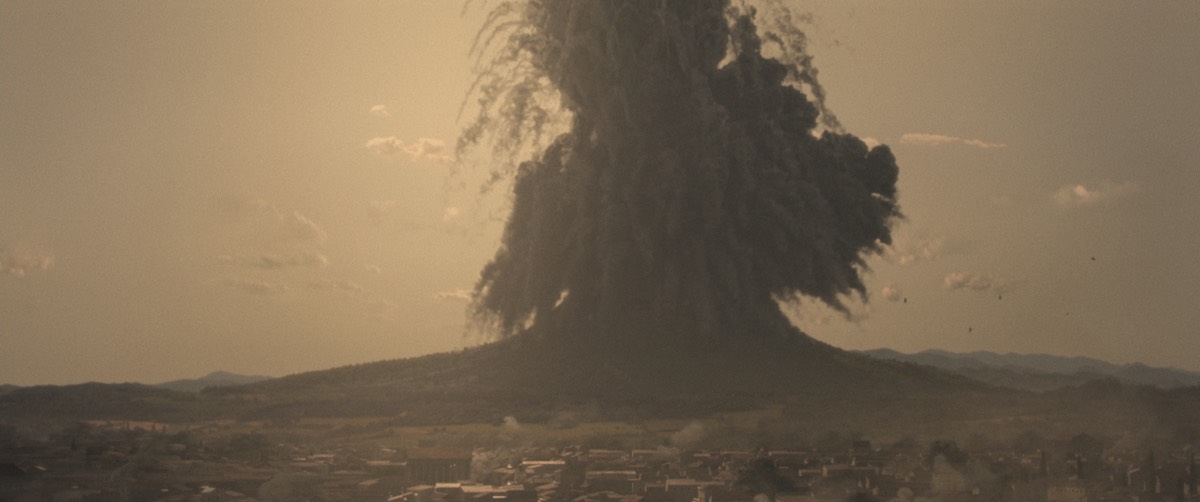
When Mount Vesuvius erupted in 79 CE, it spewed molten rock, pumice, and hot ash over the cities of Pompeii and Herculaneum, killing thousands of people. It’s one of the most famous natural disasters in human history, so naturally there have been countless documentaries about Pompeii (and at least one popular song). But only one features actor Tom Hiddleston taking on the role of a “time detective” to bring the people of Pompeii to vivid life. That would be National Geographic’s new three-part docuseries, Pompeii: Out of Time.

The Marvel connection made Out of Time happen. Executive producer Kevin Wright was also a producer on the Disney+ series Loki, which included a scene where Hiddleston’s Loki travels through time to visit Pompeii. Hiddleston also studied classics at Cambridge University and had visited the Pompeii archaeological site as a teenager, which the Marvel star attributes to indirectly influencing his career path into acting.

“There is just a passion to the way Tom tells stories that’s infectious,” Wright told Ars. “We knew that if we could capture that and put it into [the series], it might interest people who wouldn’t normally want to watch a documentary about Pompeii. “

The docuseries combines the usual historical and scientific facts with Hiddleston’s personal journey of discovery. He homes in on three people in particular and follows them over the city’s final 24 hours to discover whether or not they survived: a teenage boy, a local businesswoman, and a Praetorian guard. Stilted re-enactments are replaced with scripted dramatic scenes and high production values to make it all feel more cinematic. It’s an unusual approach, if only because we’re so conditioned to what a documentary “should” be. But the blended approach makes for a powerful experience.

“We felt we could use the imagination to make a more human story. This isn’t just ancient history; these were real people, and their lives were not dramatically different than ours even though they lived 2,000 years ago,” said Wright. “One of the most freeing moments was when we came to this idea of ‘historia,’ the merging of imagination and historical fact, and that ‘storytelling’ and ‘history’ in Latin are the same word. It was Hiddleston who put us onto that. When we went to our historians, our experts, with that word, we were met with nothing but enthusiasm. There seems to be a real movement in archaeology of, ‘This is how you have to approach it now.’”

A time detective

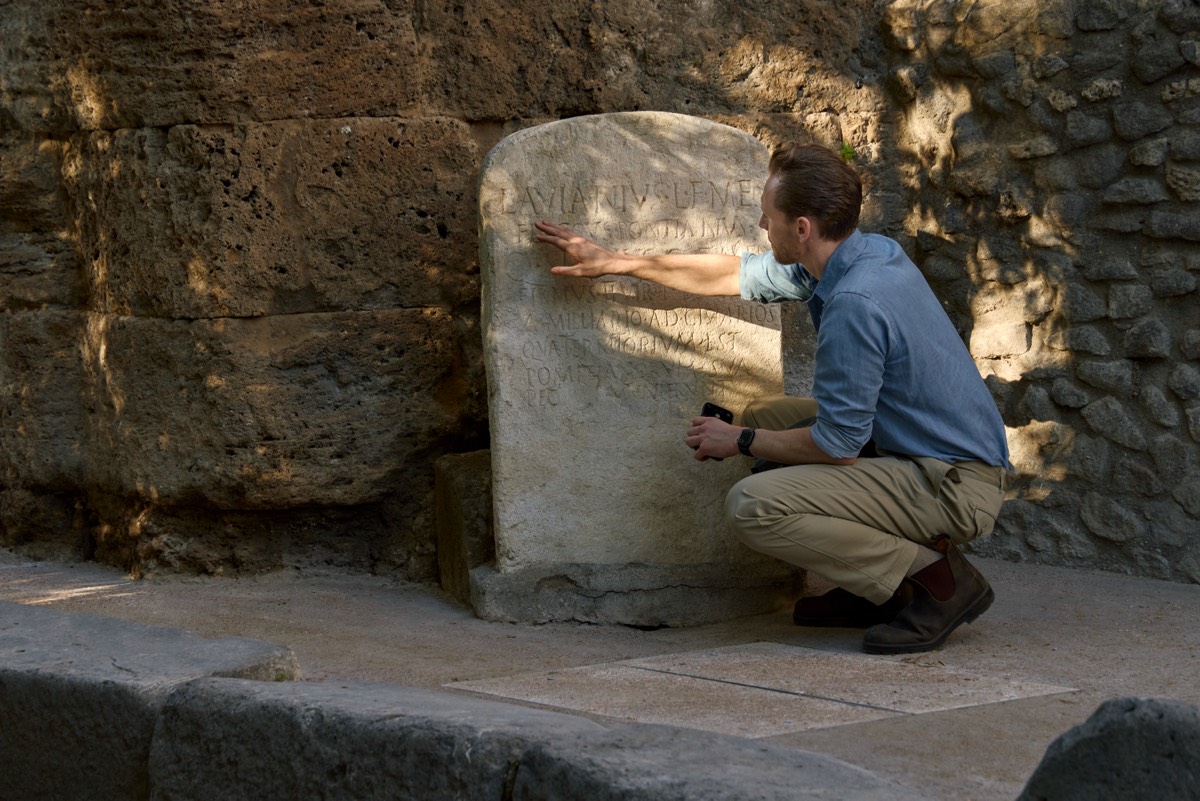
Tom Hiddleston examines an inscription at the Gatehouse ruins in Pompeii.

Tom Hiddleston examines an inscription at the Gatehouse ruins in Pompeii.

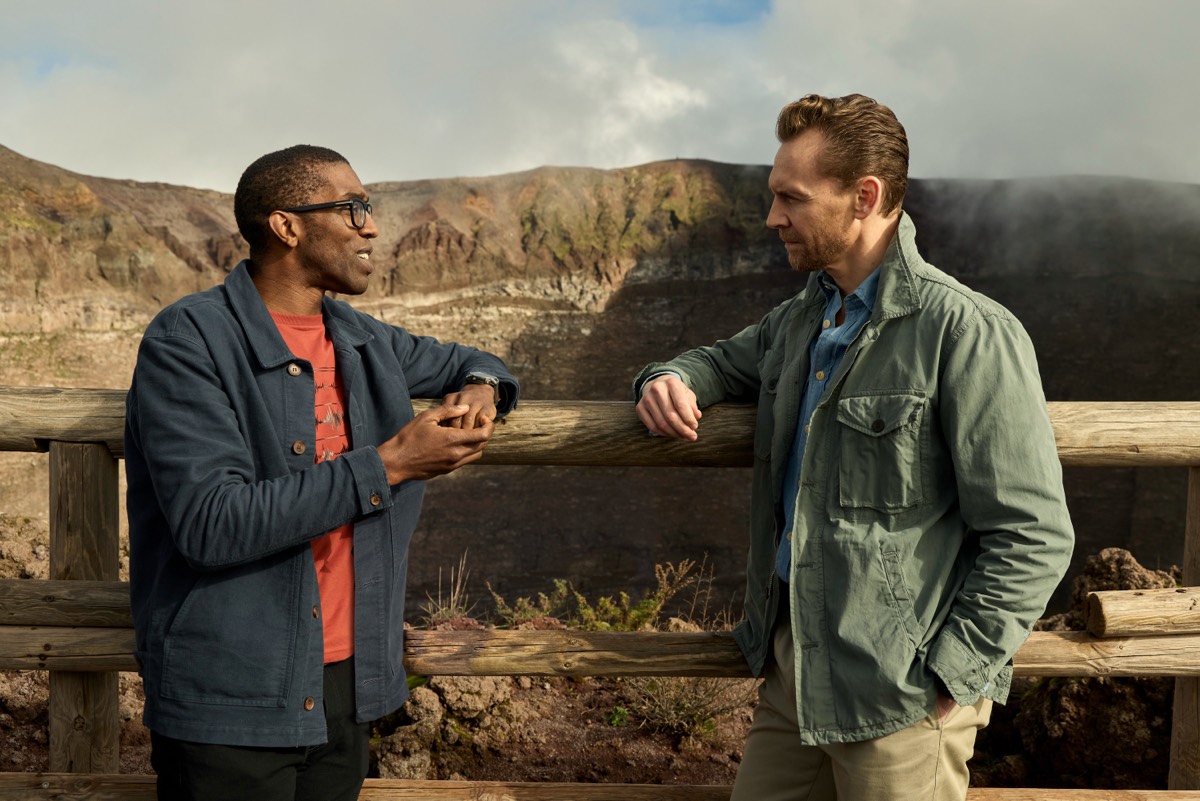
Chris Jackson and Tom Hiddleston discuss the events at Pompeii from atop Mt. Vesuvius.

Geologist Chris Jackson and Hiddleston discuss the events at Pompeii from atop Mt. Vesuvius.

Hiddleston examines a pinboard with clues as to how the events at Pompeii unfolded after the eruption of Mt. Vesuvius.

Hiddleston examines a pinboard with clues as to how the events at Pompeii unfolded after the eruption of Mt. Vesuvius.

Hiddleston with Dr. Darius Arya in the Gulf of Naples, behind-the-scenes

Hiddleston with Darius Arya in the Gulf of Naples.

Factual science does get its due. Geologist and science communicator Chris Jackson, for instance, is on hand to clear up any misconceptions the general public might have about the eruption and its aftermath. “The most common misconception people have about Pompeii was the belief that people were killed by lava,” Jackson told Ars. “That’s understandable. In Pompeii and Herculaneum, around all of Naples, a lot of the buildings are made from these black hard igneous rocks, cooled lava. When you tell people that what led to the devastation in 79 AD was nothing to do with lava, their faces sort of drop. It’s a bit sad to hear that it was this more devastating thing called a pyroclastic flow.”

Outrunning those flows would not have been an option. Based on reconstructions, Jackson estimates that the pyroclastic flows would be moving between  100 and 200 kilometers per hour (60–120 mph). “Imagine the speed you can drive on the freeway in the US and double that,” he said. “You can’t outrun a car. So there was no way you were going to outrun these things.  That’s what makes these so devastating. And remember the depth perspective. It’d be traveling a few hundred kilometers an hour. But to you from 10 kilometers away, you’d be like, ‘That’s going pretty slowly.’ So it needs to be seen through the lens of the understanding of people 2,000 years ago.”

The eruption of Vesuvius dramatically altered the geography of the Bay of Naples, per Jackson. “These pyroclastic flows actually changed the shoreline shape,” he said. “Some went through Vesuvius and Pompeii, which at the time had beaches. They were next to the sea. Now there’s some distance from it because [the flows] added new land beyond the settlement and reshaped the coastline.” The eruption also triggered a small tsunami.

That said, “A lot of what’s causing some of the strange shape of the Bay of Naples is actually related to another volcano to the northwest of Vesuvius that nobody talks about, Campi Flegrei,” said Jackson. “Nobody makes TV shows about Campi Flegrei, but that’s a supervolcano. The eruption of that in the geological past is actually what’s believed to have caused that big bite in the bay.”

The human factor

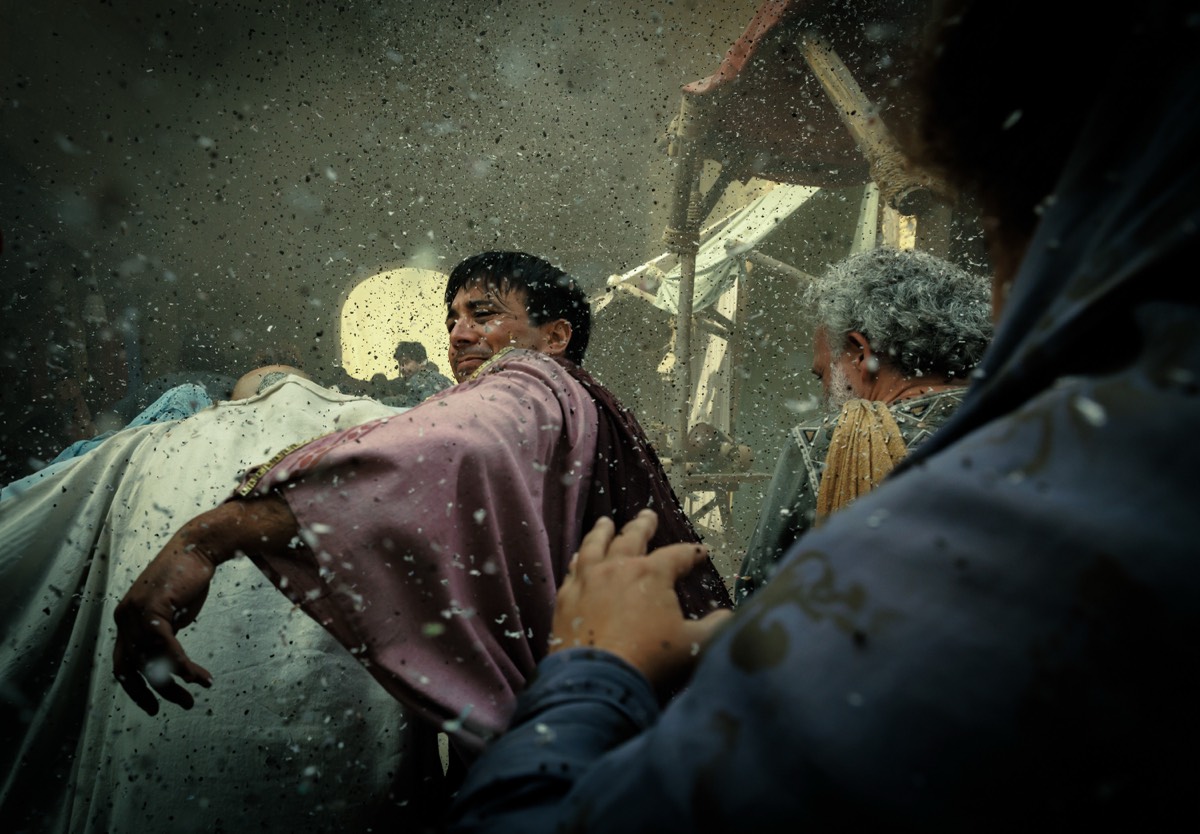
A Pompeii civilian battles his way through the crush of people rushing to evacuate the city of Pompeii as ash falls from the sky.

A Pompeii civilian battles his way through the crush of people rushing to evacuate the city of Pompeii as ash falls from the sky.

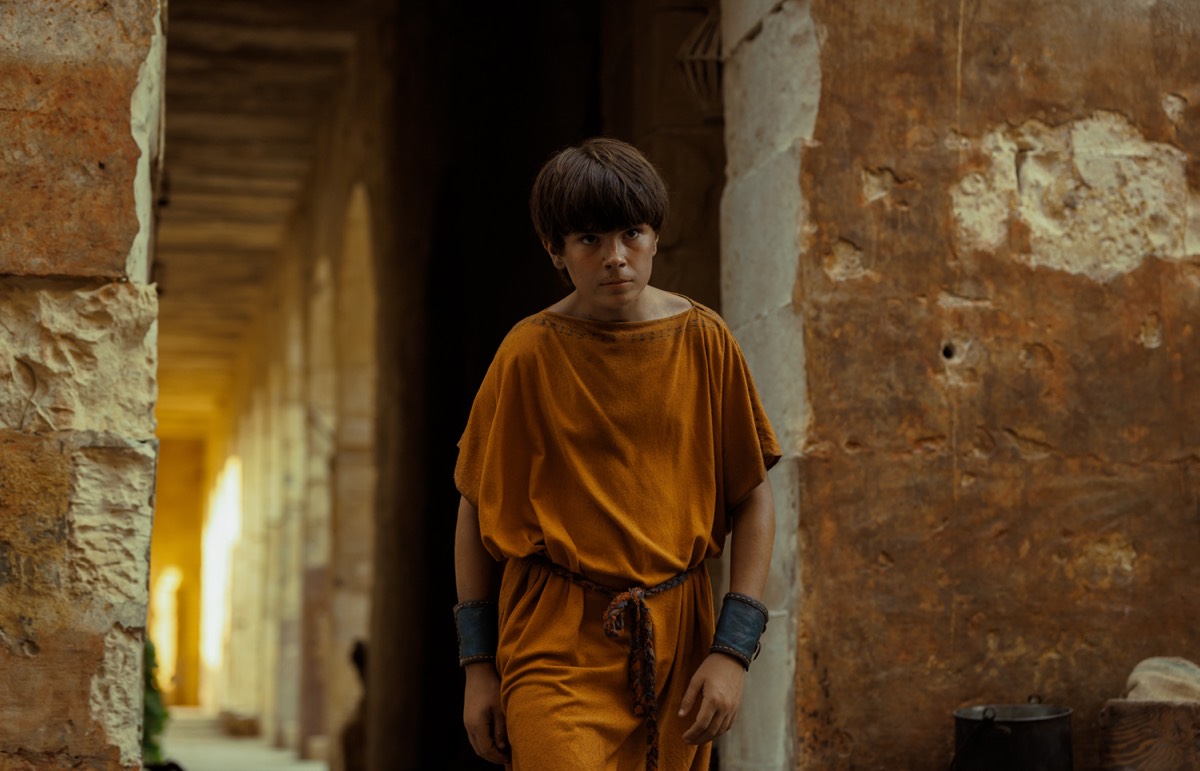
Avianius, played by Frankie Treadaway, strides home through Pompeii after his argument with Marcus Masurius.

Avianius (Frankie Treadaway) strides home through the streets of Pompeii.

Wright didn’t have a Marvel budget for Out of Time, but he did have the expertise of showrunner Tom Barbor-Might. “As you’re writing [the script], you have to put out of your mind how to actually shoot this,” said Wright. “It really is, how do you tell the best story? But Tom could keep that whole vision in his head. A volcano has to go off in this story. It has to look good. It has to look engaging. And that comes from having people at the helm like Tom who know how to break this down.”

“You have to be very precise in how you budget this, how you shoot it, how you storyboard it,” Wright continued. “Sometimes you need that big VFX shot, you need the big drone to sell the story, because that’s the only way you can do it justice. That was where the worlds really merged. I was able to bring some of my experience from Marvel. Tom was able to bring his experience to get that Marvel production value, but with a small footprint. Maybe we don’t need a hundred people on set. Maybe we can do this with 10 people and our actors.”

Even simple and cost-effective special effects can turn out to be emotionally evocative on screen, such as the wispy flakes of falling ash that rain down on Pompeii in the immediate aftermath of the eruption. “That was all practical,” said Wright. “We have some VFX in there, but the soft falling ash—we worked with a really amazing Italian special effects team that figured out how to safely blow a bunch of stuff into the air that was safe for our actors and looked great on camera. A lot of it was just newspaper and things like that. It was a nice merging of old and new techniques.”

The team also hired high-caliber professional actors to perform the scripted scenes. “The word docudrama has a stigma to it,” said Wright. “I think National Geographic very generously is saying, ‘We’re coming up with a new form of storytelling.’ It’s always been there; we’re just trying to refresh it. A big part of that is the drama’s got to be real. The mistake a lot of those shows maybe made in the past is your experts, your historians, your presenter tells you something, and then you just see that thing exactly as you were told. What we were trying to do was bring to life these people’s emotional interiors. And to do that, you have to have great actors.

Credit: National Geographic

“Luckily, we were based out of London. A lot of great actors are based around there, and there were others like Lubna Azabal who plays Julia Felix. She was the lead in an amazing movie [directed by Denis Villeneuve], Incendies.  The casting was just as important as hiring our cinematographer or our production designer. You’re really looking for people that get the material and understand, ‘Hey, you’re not just in a flashback.’ Hiddleston might not be on-screen with you, but he’s saying something that is going to bring your character to life. You’re going to do something emotional that he has to react to emotionally.”

The famous plaster casts of the victims don’t appear in the documentary until the very end—a very deliberate choice. “We felt that the plaster casts had been, just through sheer passage of time, decontextualized a bit,” said Wright. “You can go to Pompeii. It is an active archeological site. It is also a tourist site so [the plaster casts] become props for photos. We wanted to help reframe them in the pop culture: This is a grave site. The person in any of those casts had a story. We chose three of those stories. There are hundreds of stories, maybe thousands. That was something from the very beginning: How can we add some power back to these people and some respect? If you really sit with it, it’s incredibly moving.”

“If somebody were to follow you and I around and write down everything we did today, you would have all the facts, but it would be missing your emotional context, your interior life context that you can only get through psychology, through imagination, through the cultural storytelling,” said Wright. “The history will only get you so far. The only way you can fill in those gaps is through those techniques. We can’t go, ‘Hey, that’s exactly what happened.’  But as one of our experts says, ‘That’s a story that we could believe. That is a story we know could be true.’”

Pompeii: Out of Time premieres on July 21 on National Geographic, and it will be available for streaming on Disney+ and Hulu the following day.

Caitie Barrett and Tom Hiddleston discuss the archaeological record pertaining to Julia Felix at Pompeii.

Caitie Barrett and Tom Hiddleston discuss the archaeological record pertaining to Julia Felix at Pompeii.

The Praetorian's sword and belt, which was excavated on the beach of Herculaneum, on a table in the archaeological relics storage at Herculaneum Archaeological Park.

The Praetorian’s sword and belt, which was excavated on the beach of Herculaneum, on a table in the archaeological relics storage at Herculaneum Archaeological Park.

0FansLike
0FollowersFollow
0FollowersFollow
0SubscribersSubscribe
- Advertisement -
Google search engine

Recent Posts