28.1 C
London
Thursday, July 16, 2026
Home Blog

Has the World Cup been a soft power failure for the US?

0
has-the-world-cup-been-a-soft-power-failure-for-the-us?
Has the World Cup been a soft power failure for the US?

Hosting the Men’s Fifa World Cup is supposed to be one of the biggest soft power wins a country can score. When Germany hosted the tournament in 2006, it did so under the official slogan “a time to make friends”. It sought to transform its global reputation for being serious and reserved, presenting itself as a welcoming host instead.

Two decades later, the 2006 World Cup is still cited as one of the clearest examples of a country using a sporting mega-event to improve how the world sees it. In fact, the atmosphere was so optimistic that the tournament is fondly remembered in Germany as the “Sommermärchen” (the summer fairy tale).

Developed by American political scientist Joseph Nye in 1990, soft power is the idea that a country can win influence abroad through attraction rather than force. A nation seen as open, fair and welcoming gains real advantages such as more trade, tourism and goodwill in international politics.

Sporting mega-events are one of the most effective tools for building this kind of image because they put a country in front of a global audience for weeks at a time. Millions of people form impressions about a country from what they see and experience directly. This is one of the main reasons the US, alongside co-hosts Canada and Mexico, wanted the 2026 World Cup.

Hosting the tournament was supposed to project a US that is open to the world. Andrew Giuliani, head of the White House’s World Cup taskforce, explained in a July 8 press conference that months of preparation had gone into ensuring millions of visitors experienced “the hospitality that only Americans can offer and provide”.

The World Cup was also a chance for the US to build goodwill and boost a global image that has undergone strain in recent years due to the war in Iran and the Trump administration’s verbal attacks on traditional US allies. However, a string of controversies look set to turn the tournament into a lesson in how soft power can fail.

Florian Balogun in action during a match for the US national team.

Florian Balogun, the US striker at the centre of a controversy sparked by Donald Trump intervening to suspend his red card. Christopher Torres / EPA

Red cards and outrage

The most recent controversy came in early July when the US president, Donald Trump, personally called Fifa chief Gianni Infantino to request a review of a red card shown to US striker Folarin Balogun. This red card, which Balogun picked up in a knockout game against Bosnia and Herzegovina, should have resulted in an automatic one-match suspension.

But Fifa suspended the ban, allowing Balogun to play in the US national team’s ultimately unsuccessful last-16 tie against Belgium. This was an unprecedented decision. It sparked outrage worldwide and drew sharp criticism from European football’s governing body, Uefa. Many observers saw it as an example of political pressure shaping a sporting outcome.

Various other scandals had already occurred in the preceding weeks. Fifa-listed Somali referee Omar Artan was barred from entering the US over unspecified “vetting concerns”, despite holding valid documents. He was removed from the tournament altogether. Iraqi striker Aymen Hussein was detained for seven hours at a Chicago airport before being allowed to continue his journey.

Visa restrictions, including a travel ban covering 39 countries, have stopped fans from several qualifying nations from attending matches. And Iran’s team was made to base itself in Tijuana, Mexico, rather than the US. The Iranians were required to leave the US immediately after each of their matches, prompting their coach Amir Ghalenoei to call them “the most oppressed team” in the tournament.

Each incident is likely to work against the welcoming image the US hoped to project. This is an example of what researchers call “soft disempowerment”, a concept first developed to explain the criticism Qatar received when it hosted the 2022 Men’s Fifa World Cup. It is used to describe what happens when a host country’s own conduct before and during a mega-event pushes people away rather than attracts them.

Reports of migrant worker deaths during stadium construction, as well as bribery allegations and a last-minute reversal on allowing alcohol in stadiums, harmed Qatar’s efforts to use the World Cup to boost its international image. Research from 2025 concluded that, while Qatar held a visually successful tournament, social media scrutiny caused a persistent negative shift in how global audiences perceived the country.

Omar Artan sat on the shoulders of a crowd member as he is welcomed back to Somalia.

Omar Artan was given a hero’s welcome on returning to Mogadishu in Somalia afterUS authorities denied him entry to the 2026 World Cup. Said Yusuf Warsame / EPA

Lessons for future hosts

The implications of soft disempowerment reach well beyond the 2026 World Cup. A growing number of countries consider hosting sporting mega-events a central pillar of their long-term national strategy. These include Morocco, which is set to co-host the 2030 World Cup alongside Spain and Portugal, as well as Saudi Arabia where the following tournament will be staged in 2034.

Soft power through sport depends on a country delivering on the promises it makes to the people an event brings through its door. Where politics visibly overrides fair process, or where visitors are met with suspicion rather than welcome, the same visibility that makes sport such a powerful tool of soft power becomes the mechanism of its undoing.

For prospective hosts planning their own turn on this stage, the 2026 World Cup may prove to be a far more instructive case study in failure than success.


‘Seismic shift’: More than 100 House Democrats vote to cut Israel military aid

0
‘seismic-shift’:-more-than-100-house-democrats-vote-to-cut-israel-military-aid
‘Seismic shift’: More than 100 House Democrats vote to cut Israel military aid

In what is being viewed as a “seismic shift,” more than 100 Democrats in the US House of Representatives voted yesterday to end $3.3 billion in annual military assistance to Israel. The vote marks a dramatic break with decades of bipartisan support for the occupation state and signals that unconditional backing for Israel is becoming an electoral liability.

The amendment, introduced by Republican representative Thomas Massie of Kentucky, failed by 314 votes to 104, while ten lawmakers voted present. However, the roll call showed that 103 Democrats supported the measure, compared with 98 who opposed it. Massie was the only Republican to vote in favour, while 215 members of his party rejected it.

The result meant that nearly half of the entire Democratic caucus, and a slim majority of Democrats who cast a definitive vote, backed ending the military funding. The scale of the revolt represented a significant change from April 2024, when only 37 Democrats opposed a separate package of military assistance for Israel. The number of Democratic lawmakers prepared to vote against Israeli aid has almost tripled in just over two years.

The amendment would have removed funding from a State Department spending bill and blocked the $3.3 billion in annual security assistance provided under the existing US-Israel agreement.

The vote divided the Democratic leadership. House minority leader, Hakeem Jeffries, opposed the amendment, calling it overly broad, but declined to pressure members to follow him. House Democratic whip, Katherine Clark, supported it, declaring that “the status quo is not tenable” and argued that Washington should not provide a blank cheque to a government which fails to meet US legal and human-rights standards.

Former House speaker Nancy Pelosi, one of Israel’s most longstanding supporters in Congress, also voted for the amendment. Pelosi described it as flawed but said she wanted to send a message that Israeli Prime Minister Benjamin Netanyahu’s government could not continue on its present course.

Pro-Israel Democrat Josh Gottheimer, described the scale of opposition as a “seismic shift” and accused colleagues of responding to political pressure.

That political pressure reflects a dramatic change in public opinion. A Pew Research Center survey published in April found that 60 per cent of Americans now hold an unfavourable view of Israel, compared with 53 per cent in 2025 and approximately 42 per cent in 2022. Among Democrats and Democratic-leaning independents, the proportion holding an unfavourable view has reached 80 per cent, rising from 53 per cent in 2022.

The shift also extends beyond the Democratic base. Pew found that 57 per cent of Republicans under the age of 50 view Israel unfavourably, although older Republican voters remain broadly supportive.

Gallup recorded an even more striking reversal in February. For the first time since it began its annual measurement in 2001, Americans were no longer more likely to sympathise with Israelis than Palestinians. Forty-one per cent expressed greater sympathy for Palestinians, compared with 36 per cent for Israelis.

Read: Poll shows majority of Americans oppose aid to Israel

Among Americans aged between 18 and 34, 53 per cent sympathised more with Palestinians and only 23 per cent with Israelis. Among those aged between 35 and 54, Palestinians led by 46 per cent to 28 per cent — an almost complete reversal from 2025, when Israelis led within the same age group by 45 per cent to 33 per cent.

A July poll from the Associated Press-NORC Center for Public Affairs Research also found that 58 per cent of Democrats believe Washington is too supportive of Israel, up from 45 per cent in January 2024. Sixty-two per cent said the US does not provide enough support to Palestinians, while 52 per cent of Democrats said that Israel’s actions in Gaza constitute genocide.

Analysts view the recent shift in voting patterns as an indication of Politicians responding to shift in public attitude. Candidates who placed opposition to Israel’s genocide in Gaza and rejection of pro-Israel lobby funding at the centre of their campaigns have defeated establishment Democrats in recent New York primaries. In Colorado, democratic socialist Melat Kiros, a vocal critic of Israel, defeated 15-term incumbent Diana DeGette.

An internal Democratic review of the 2024 presidential election also reportedly concluded that former president Joe Biden’s unconditional backing for Israel was a “net-negative” which cost the party support among younger, progressive and Arab-American voters.

The polling, primary results and congressional vote reflect a broader decline in support for Israel, particularly among Democratic voters. Unconditional military assistance to Israel is widely seen as a potential electoral liability for candidates seeking the support of younger and progressive voters.

Iran war leaves crisis-weary European airlines ready for a shakeout

0
iran-war-leaves-crisis-weary-european-airlines-ready-for-a-shakeout
Iran war leaves crisis-weary European airlines ready for a shakeout


As renewed conflict in the Gulf drives up oil prices, airline investors and industry executives see mounting signs that Europe’s financially ​weaker carriers may be headed for a shakeout.

British budget carrier easyJet is nearing a U.S.-led takeover that would see the 30-year-old airline go private at a valuation far ‌below its pre-pandemic peak, airBaltic is looking for short-term financing to stave off default and Norway’s Norse Atlantic is undertaking a strategic review.

While much of the industry cleaned up its finances after COVID-19, the fuel spike has weighed on share prices and exposed the fragile balance sheets of some carriers that are now pondering restructurings, buyouts or even bankruptcy protection.

“We are pitching, I think, four or five very large airlines on restructuring situations just at the moment across ​Europe,” Barema Bocoum, head of EMEA at financial advisory firm Interpath, told Reuters.

The global airline industry last month nearly halved its 2026 profit forecast, citing the Middle East conflict that has ​driven up fuel costs, disrupted key air corridors and exposed the fragility of a sector operating on thin margins.

Bankers, investors and analysts said the ⁠grinding Iran war, which sparked a huge jump in fuel prices this year, has compounded cost pressures that have persisted since the pandemic.

“It feels as though the cycle is over almost before it began,” ​said UK-based aviation analyst Rob Morris.

AIRLINES IN ‘PRUDENT’ MODE

The tougher environment has led airlines to temper expansion plans. Airbus this month revised down its 20-year passenger aircraft demand forecast as war and trade tensions curbed ​what had been a sharp post-pandemic rebound in activity.

“Airlines are mostly maintaining very modest growth in U.S., Europe and Southeast Asia,” said aviation adviser and former sector banker Bertrand Grabowski.

“Apart from some exceptions like Turkish Airlines, carriers are mostly being very prudent in increasing capacity.”

Elevated jet fuel costs, which can make up over a third of airline spending when prices are high, have triggered worries over the financial health of carriers this year.

While jet fuel prices have ​stabilised in recent weeks, renewed volatility in the Middle East has raised fresh doubts over whether weaker European airlines can generate enough cash during the crucial summer season to survive the winter.

“The smaller (airlines) ​are the ones probably in danger,” said London-based aviation analyst James Halstead, adding that losing traffic in the key summer season could prove fatal for some carriers in an industry that relies heavily on available cash.

He ‌said airlines may ⁠muddle through the summer, but could face bigger challenges early next year. “The usual thing is that airlines run out of cash in February,” he said.

Poland’s LOT has been a suspected consolidation target for years and Latvia’s airBaltic has seen the yield on its 2029 bond spike this year, reflecting higher perceived investor risk. Norse’s shares have collapsed to near zero since its high-profile listing in 2021.

An airBaltic spokesperson declined to comment. LOT said its performance over the past several years demonstrated the strength of its business model and long-term strategy. Norse did not respond to a request for comment.

AIRLINE SECTOR HAS ​A HISTORY OF DEFYING FAILURE PREDICTIONS

The industry has ​often defied predictions of widespread failures by ⁠showing resilience to outside shocks, but some analysts say there are early warning signals that the bullish trend seen since the pandemic is wavering due to higher fuel prices.

Capacity plans, second-hand plane prices and the volume of bankruptcies are among the indicators analysts are watching for signs that the strong ​run is losing steam.

In the U.S., rising fuel, labour, maintenance and leasing costs have steadily eroded low-cost airlines’ cost advantage and contributed to ​the collapse of Spirit Airlines ⁠in May.

Analysts have warned that budget carrier Wizz Air’s balance sheet is vulnerable, making it a possible consolidation target.

The airline says it has enough liquidity, though CEO Jozsef Varadi told reporters in April he expected more bankruptcies to hit the sector at the end of summer as forward bookings for the less lucrative winter season slump.

He said, however, that Wizz might benefit from other companies’ woes and pick up some ⁠routes from them.

“We ​remain opportunistic,” he said.

Willie Walsh, director general of industry trade body the International Air Transport Association, told Reuters in June ​that some airlines would go out of business or be acquired by larger carriers – especially if fuel prices remain high.

“Unfortunately, I think there will be some carriers that will find this high fuel price very difficult to cope with,” Walsh said.

Source:  Reuters

Africa’s Greater Horn region is facing a looming polycrisis fueled by conflict, prices, climate and disease

0
africa’s-greater-horn-region-is-facing-a-looming-polycrisis-fueled-by-conflict,-prices,-climate-and-disease
Africa’s Greater Horn region is facing a looming polycrisis fueled by conflict, prices, climate and disease

The impacts of a strengthening El Niño and the lingering effects of the war in Iran highlight two separate and seemingly unrelated global hazards. But in the Greater Horn of Africa, an area already beset by prolonged crisis and conflict, these factors are combining with others to potentially create a major, multicountry polycrisis.

As experts in famine, conflict and humanitarian crises, our concerns about such a grave risk for the region in the second half of 2026 and into 2027 are based on a series of overlapping trends that include El Niño, the broader effects on food prices and fertilizer of the Iran war, internal conflicts and other localized factors. We fear the consequences could be catastrophic.

Several factors underpin this risk.

First, the short rains in the eastern Greater Horn of Africa – parts of Somalia, eastern Kenya, eastern Ethiopia – were well below average in the fall of 2025. The long rains in March to May of 2026 were also well below normal for much of that area, affecting both crops production and grazing and water for livestock, deepening the crisis of rural livelihoods.

The regional forecast for the northern Horn of Africa, where for the most part there is only one rainy season per year, is also projected to be below average. This includes the heavily populated highlands of Ethiopia, much of South Sudan and Sudan.

A man sits on the ground next to a donkey

An elderly man waits to refill his donkey-drawn water tank during a water crisis in Port Sudan on April 9, 2024. AFP via Getty Images

The super El Niño now forming could cause both drought and extensive flooding in parts of the Greater Horn of Africa, causing population displacement and tremendous loss of livelihoods.

Second, an unpredictable variant of the Ebola virus has taken hold in Congo and Uganda. Although it hasn’t yet spread to the rest of the region, the concern is that if Ebola spreads across the border to South Sudan, it will not only add a major epidemic risk but will also render the response to other shocks more difficult.

Third is the fact that all of the countries in the Greater Horn, with the exception of Kenya, are experiencing protracted, violent conflicts, with multiple parties jockeying for power and military advantage. This makes the task of dealing with the impact of climate, health and price shocks that much harder and risks further exacerbating or accelerating individual drivers.

Regional analysts have warned of an uptick in violence for Ethiopia and South Sudan. Violent conflict is a common denominator of contemporary famine, and famine or the risk of famine has already been noted in several countries in the region.

Conflict outside the region is also complicating matters. The war in Iran has already led to significant increases in transportation and food costs in the short term. But potentially more concerning is the fertilizer shortage caused by the war, which is projected to reduce harvests later in the year. If this happens, food prices will remain high long after the active conflict ends.

The Horn of Africa will be doubly affected by the fertilizer bottleneck – local production will be reduced, and global food prices will be higher. The bottleneck affects regional surplus-producing areas that might normally help to even out availability and prices in areas that do not produce enough to feed themselves. The El Niño effects, in combination with the high fertilizer costs, will likely reduce opportunities for agricultural work while also increasing the amount that food laborers – among the poorest people – have to spend on produce.

This combination of climatic, conflict, market and epidemic shocks are not simply additive but multiplicative, with each intensifying the other. Climate and epidemic shocks almost inevitably exacerbate conflict and encourage crackdowns on population movements.

A devastating aid cliff

To make matters worse, there are reasons to believe that the region will be less prepared to cope with the looming crisis than during previous El Niño years.

In the background is the deliberate gutting of much of the global humanitarian response infrastructure that people would have relied on in the past to mitigate the impacts of such a crisis.

In particular, the closure of USAID and the major cuts in spending on foreign aid – not only by the U.S. but by most Western nations – has undermined much of the international system’s capacity to respond to major shocks. Combined with longer-term political and governance challenges in eastern Africa, this conjunction of existing and anticipated factors in the Horn of Africa risks both further displacement and a rise in mortality.

A woman carries cans of water in front of a row of tents.

A Sudanese woman carries a jerry can of water at the Al-Afad camp for displaced people in northern Sudan on Nov. 21, 2025. Ebrahim Hamid/AFP via Getty Images

There have already been calls by aid groups and regional bodies for higher levels of funding to be allocated through what remains of the international system.

But by itself, more money cannot solve this problem. Humanitarian programs have been shut down, staff have been laid off and infrastructure sold. Government-led programs in epidemic tracking and the provision of healthcare and other areas have likewise been curtailed.

Washington has recently increased its level of funding slightly, but U.S. humanitarian assistance is now more politicized and transactional, less sufficient and limited in its support of effective local systems and responses.

Local efforts addressing the problem

With the international humanitarian system compromised by funding cuts, the onus will be more heavily on governments, civil society and local communities in the Horn to mitigate anticipated shocks and their fallout.

The first responders in any crisis are usually next of kin, neighbors and local mutual aid groups. Since the collapse of the international aid system a year ago, long-standing efforts by local communities and organizations have ramped up significantly and effectively. These local mutual aid efforts are typically self-managed and financed through their own networks and diaspora remittances. But given the size of budget cuts in the formal humanitarian response system, these local initiatives can be better supported with complementary funding. Several intermediary organizations have recently emerged to support this effort.

Local mutual aid efforts can also be supported through more flexible public policies, for example, by easing restrictions on banking transfers to enable more effective diaspora support. Donors and the U.N. can also ensure that greater proportions of funding in the formal global humanitarian system go to local initiatives

Fundamentally, however, the most worrisome driver behind this polycrisis is violent conflict – wars in this region and elsewhere. In addition to the impacts of the conflicts in Ukraine and the Middle East, civil wars and ongoing insurgencies in Sudan, South Sudan, Ethiopia and Somalia have also been dragging on for years and in some cases have drawn in more countries – either directly through financial support and weapons sales or indirectly through political support.

Not only does violent conflict complicate any response to crisis, it also raises the risk of starvation being used as a weapon of war – something already alleged in Sudan and the Tigray region of Ethiopia. But for the most part, the international community has been unwilling to hold warring parties and their foreign supporters accountable for intentionally starving parts of their populations.

Finally, data and monitoring systems have also been significantly crippled by aid cuts and misinformation, making it difficult to understand the gravity of these crises or to keep actors accountable. Improved monitoring and evidence, including evidence of atrocities and the use of starvation as a weapon, need to be supported if there is to be effective assistance and accountability.

The conjunction of so many potential hazards has all the hallmarks of the proverbial perfect storm. Not only will people’s access to adequate food be devastated, it will also affect civilian protection, access and mobility. Without immediate prevention measures, the looming polycrisis will have widespread impacts on basic health, nutrition and water services – and the potential for mass mortality and displacement.

Why the US economy stays strong despite Trump’s shockwaves

0
why-the-us-economy-stays-strong-despite-trump’s-shockwaves
Why the US economy stays strong despite Trump’s shockwaves

The US economy is continuing to grow faster and generate more new jobs than Europe. Annual national income growth over the past five years has averaged 3.3% in the US against 2.6% in the EU. In the first quarter of 2026, the EU’s GDP was just 0.7% higher than a year before, while that of the US was up 2.6% on comparable measures.

These figures defy the widespread predictions that the US would lose its growth advantage after its government imposed a global trade tariff regime in 2025 and, one year later, started a war with Iran. Economists see several factors behind the resilience of the US economy.

The US runs consistently wider budget deficits than the EU, UK or China. By spending more than it collects in tax, the US government creates more income for the people it employs and the businesses it buys from. This extra income in theory boosts demand in the economy, pushing output growth higher and reducing unemployment.

Most European governments also run budget deficits. The average budget deficit of EU countries in 2025, for example, was 3.1% of GDP. But the US deficit, at 5.8% of GDP that same year, is giving a much stronger stimulus.

The US also channels a higher proportion of its GDP into business investment and research and development than the EU. Europe was spending 270 billion euros less than the US on innovation in 2021, with this spending concentrated on its century-old car industry rather than new technologies.

Since 2025, AI has been the focus of US investment. This has helped the US maintain its hold over global technology and digital platforms. Rapid uptake of AI across US industry has also widened the margin by which its labor productivity growth is outpacing Europe’s.

Output per hour in professional services has increased by over 18% since 2019 in the US compared to just 5% in the EU.

A man works at a computer in an office.
Uptake of AI across industry has also boosted labour productivity growth in the US. DC Studio / Shutterstock via The Conversation

Economy-wide productivity gains have allowed US real wages (wages adjusted for inflation) to edge higher since 2019. This has sustained consumer demand while also enabling the strong profit growth that has lifted US share prices to record levels. In contrast, average real wages in the EU have barely grown over the past 20 years while corporate profits in Europe remain subdued.

The US technological lead could be dented by Donald Trump’s immigration clampdown, which extends to skilled scientists and students. Research suggests annual GDP growth rates in the US could currently be as much as 0.8 percentage points lower than if net unauthorised immigration had stayed on its pre-2025 trend.

But the Trump administration and its tech-entrepreneur supporters also credit their success to more freedom to gamble with new ideas, while Europe regulates them more heavily and China tries to harness them for state control. Although the EU generates as many tech start-ups as the US, many relocate there when they start to expand.

Another factor explaining the resilience of the US economy is that American industry benefits from substantially lower energy costs than in Europe. The US produces more fossil fuels than Europe and taxes them less. It is also advancing fast with cheap renewable sources, despite the government’s scepticism towards solar and wind.

Reliance on fossil fuels, and indifference to carbon emissions, may raise the US’s long-term economic vulnerability. But for now they ensure a cost advantage that is allowing the US to regenerate its manufacturing and meet much of the global demand for data-based services such as e-commerce and generative AI.

Favorable financial engineering

The US spends more on goods and services than it produces domestically. This results in a large current account deficit, which widens as US growth picks up. To finance this deficit, the US has to borrow from the rest of the world continuously.

For most countries, the resulting rise in liabilities to other countries would lead to a weakening currency and higher inflation, or a spell of slower growth to rebalance the current account. However, the US benefits from global use of the US dollar.

The US dollar is the universal standard for trade in commodities. And due to a perception that the US will continue delivering high returns on investment and repaying its debts, the rest of the world typically responds to shocks such as wars by moving money into US assets – even if US policy is responsible for those shocks.

Valéry Giscard d'Estaing sat alongside John F. Kennedy in the White House.
Valéry Giscard d’Estaing meeting with the then-US president, John F. Kennedy, in the White House in 1962. Abbie Rowe / US National Archives and Records Administration /

In the 1960s, France’s then-finance minister, Valery Giscard d’Estaing, who later served as its president, railed against what he called the “exorbitant privilege” the US gains from printing the world’s currency. The US will retain this privilege as long as global trade and finance are mostly conducted in US dollars.

This situation is unlikely to change. The EU’s efforts to unify its financial markets to support its single market have proceeded slowly and were set back by Britain’s 2016 decision to leave the bloc. Britain and the EU have lost global financial marketshare since the UK broke away.

Attempts by China, Russia and major oil-exporting countries to launch an alternative reserve currency have also made little progress. But they might not regret this. The dollar’s global role makes it harder for the US to control its inflation, as it has to watch the wider impact of raising interest rates.

When inflows of foreign capital strengthen the dollar, US industry also becomes less competitive on the global stage. And with so many governments worldwide under pressure to balance their budgets, America’s deep-pocketed consumers and businesses might still be the “engine of growth” that enable other regions to expand.

Impressive economic performance between 2021 and 2024 did nothing to revive the political fortunes of Trump’s predecessor, Joe Biden. Continuing the positive trend has proved similarly fruitless for Trump. At only 36%, his approval rating is extremely low.

This is the downside of growth driven by government deficits and rising corporate profits. Many Americans feel they are paying for higher prices out of wages that are rising only marginally, and will struggle to afford any future rise in living costs.

Alan Shipman is senior lecturer in economics, The Open University

This article is republished from The Conversation under a Creative Commons license. Read the original article.

Move over, GPS: Navigation satellites in low-Earth orbit are making a comeback

0
move-over,-gps:-navigation-satellites-in-low-earth-orbit-are-making-a-comeback
Move over, GPS: Navigation satellites in low-Earth orbit are making a comeback

New navigation satellites in low-Earth orbit could provide 100 times stronger signal strength compared to GPS and other global navigation satellite systems operating from higher orbital altitudes—enabling greater location accuracy within dense cities, under thick foliage, and even inside buildings. Such signals would also likely prove more resilient to interference at a time when commercial flights, maritime shipping, and even various smartphone apps face increasingly widespread disruption from GPS jamming.

That vision may start to take shape when the first six production satellites of California-based Xona Space Systems are scheduled to launch in October 2026, with early service starting in 2027. Once the full constellation of 258 Pulsar satellites has been launched in the following years, Xona claims that customers will be able to accurately pinpoint their locations anywhere on Earth to within several centimeters.

“That added power means that we can get into that indoor environment that GPS can’t get to today,” Adrien Perkins, co-founder and VP of engineering at Xona Space Systems, told Ars. “Our higher power allows you to get into those jamming environments a lot further than you would with GPS by itself.”

Xona has already launched its first satellite, called Pulsar-0, aboard a SpaceX Falcon 9 rocket rideshare mission on July 1, 2025. The Pulsar-0 satellite has participated in multiple “live-sky jamming tests across multiple countries” to show how having signals 100 times stronger than GPS can help to reduce a jammer’s effective area by 95 percent, according to a Xona blog post. The company also tested an anti-spoof watermark built into Pulsar signals to help receivers authenticate the satellite signals and used software updates to improve the initial satellite’s “native positioning accuracy” from a 4.2-centimeter ranging error to 1.5-centimeter accuracy.

Like other global navigation satellite systems that deliver positioning, navigation, and timing (PNT) services, Pulsar satellites could also start providing intermittent timing signals to customers in mid-latitude regions following the launch of the six production satellites in October. Xona has already signed up several precision-timing customers to use Pulsar satellite signals in timing and synchronization services for financial markets, telecommunications, data centers, and transportation systems.

Xona expects its satellites to eventually deliver a timing reference accurate to within 10 nanoseconds. But unlike GPS satellites that carry expensive atomic clocks for accurate timekeeping, Pulsar satellites would rely on a much cheaper software-based solution for precision timing.

The Pulsar timing services would become more persistent and available in urban environments once the constellation grows to about 16 satellites in orbit, enabling at least one satellite to be in view on a regular basis, according to Xona. The company also described centimeter-level positioning capability as becoming possible with four Pulsar satellites in view over a region, which it expects to accomplish for “priority regions” before the full constellation is completed.

The first customers for Xona and other companies planning satellite navigation systems in low-Earth orbit (LEO) will likely be “organizations that place an exceptionally high value on availability, resilience, integrity, authentication, and precision, and are already accustomed to paying for premium PNT services,” Zak Kassas, director of the Autonomous Systems Perception, Intelligence, and Navigation (ASPIN) Laboratory at The Ohio State University, told Ars. He suggested that such customers would be “defense and national security users and government agencies responsible for resilience.”

A view of the Xona Space Systems satellite factory in Burlingame, California. The foreground shows a signpost with signs pointing toward "propulsion unit," "guidance & navigation" and "thermal testing."

A view of the Xona Space Systems satellite factory in Burlingame, California.

A view of the Xona Space Systems satellite factory in Burlingame, California. Credit: Xona Space Systems

Using satellites in LEO to deliver location and timekeeping services is “both a blessing and a curse,” Kassas explained in his column for Inside GNSS. The blessing is that LEO satellites can provide stronger signals to ground receivers by operating closer to Earth, and their relatively fast movements across the sky can be measured in ways that provide additional information useful for geolocation and navigation on Earth.

The curse is that hundreds of LEO satellites are required to reliably provide near-instantaneous location and timing services across the entire world. The prospect of deploying so many satellites is no longer daunting since the advent of lower-cost rocket launches driven by SpaceX, which has enabled the growing megaconstellations with thousands of satellites such as Starlink. But it represented a serious constraint during the US military’s deployment of the world’s first satellite navigation system, called Transit, in the 1960s.

Helping the Navy’s Silent Service

Before GPS, there was Transit. The idea for the Transit satellite system began with physicists at Johns Hopkins University’s Applied Physics Laboratory figuring out how to calculate the orbit of the Soviet Union’s Sputnik-1, which had become the world’s first artificial satellite. Their work relied on calculating the Doppler shift—the change in observed signal frequency—of radio signals coming from Sputnik as it passed overhead. But additional discussions led to the realization that the Doppler shift from a satellite with a known position could also be used to calculate the location of a signal receiver on Earth.

That paved the way for prototype satellite launches starting in 1959 and the operational start of the Transit satellite navigation system in 1964. With ground stations tracking satellite orbits and calculating their positions, the Transit system was designed to allow the US Navy’s Polaris ballistic missile submarines to pinpoint their own locations anywhere in the world. Navigators aboard a submarine or ship could determine their own location by measuring the Doppler shift of a Transit satellite passing overhead while also receiving the satellite’s pre-calculated orbital and location data as a transmission.

However, because the full constellation was just 36 operational satellites, Transit could only provide location-fixing services every hour or two at best whenever a satellite appeared over the horizon. That was good enough for the system’s main purpose of helping US submarines calculate their own locations as a foundation for making the necessary missile launch calculations to strike their targets. But it would seem like an eternity to modern-day sensibilities accustomed to getting accurate location information in real time.

Transit eventually gave way to the rise of GPS and other global navigation satellite systems that operate from medium-Earth orbits, where they can use a similar number of satellites to provide near-instantaneous PNT services across the world. Unlike the Transit system’s use of Doppler shifts, the GPS system provides location information by using a combination of radio signals from at least four satellites to calculate the position of a receiver on Earth and to resolve timing errors.

To replicate the performance of GPS, a satellite navigation system in low-Earth orbit would need about 10 times more satellites than a similar satellite constellation in medium-Earth orbit, Kassas explained. But as the recent rise of Xona and other competitors shows, lower manufacturing and launch costs have made it possible to build and launch such a satellite constellation dedicated to delivering PNT services from low-Earth orbit.

Tim Graham is leading satellite development across hardware, software and propulsion at Xona Space Systems.

Tim Graham is leading satellite development across hardware, software, and propulsion at Xona Space Systems.

Tim Graham is leading satellite development across hardware, software, and propulsion at Xona Space Systems. Credit: Xona Space Systems

Building and launching the satellite fleet

Xona has contracted with Aerospacelab, a satellite manufacturer in Belgium, to build some of the first satellites that will carry Xona’s PNT payloads into orbit. But the company is focused on developing its own in-house satellite bus to manufacture most of the planned 258 Pulsar satellites at the company’s factory in Burlingame, California.

“Our first hire on this internal satellite team was a little over a year ago, and seeing what the team has accomplished to date is incredibly impressive,” Perkins said. “Being able to bring in folks that have that experience can help us derive from what the first version looks like to how we continue to streamline that.”

One of Xona’s latest notable hires, Tim Graham, worked on engineering challenges at SpaceX for a decade, eventually becoming the engineering manager for avionics on the Raptor engines that propel SpaceX’s Starship rocket. But he saw an opportunity to lend his expertise and experience in scaling up hardware production to Xona and joined the company earlier this year to lead satellite development across hardware, software, and propulsion.

“If you look at the historical impact of major technological developments, GPS is up there as world-changing,” Graham told Ars. “Bringing a more modern design for a modern technology GPS system to the world is a pretty exciting mission.”

Graham also appreciated joining a company headed by Xona co-founder and CEO Brian Manning, who previously worked as a SpaceX engineer on redesigning components of the Falcon 9 rocket’s thrust structure. “SpaceX people have kind of been through the grinder together, and so it was a good match,” Graham said.

The company has already produced the two in-house satellite buses that are scheduled to join the launch in October 2026. When Ars spoke with Xona’s team in June, the satellite buses were undergoing vibration testing to see how well they could endure the simulated stress of rocket launches. Pushing the limits of hardware early and often can provide insight into failures that are much easier to understand and mitigate well before the satellite launches into orbit, Graham said.

“I cut my jib with the SpaceX mentality of tests… a test that doesn’t break something or show you something new is not super valuable,” Graham explained. “Let’s just try it and see what works, see what breaks, and then make it stronger.”

Xona is also designing and building the Pulsar satellites to be compatible with practically any rocket launch provider. “There’s a whole range of new launch providers that are just starting to come online and are coming in at some pretty competitive cost points,” Graham said. “So we’re really trying as part of our overall satellite design to be compatible with that future of the launch ecosystem, so that we can leverage both launch opportunities and lower launch costs as things come up within that sector.”

The goal is to enable maximum flexibility and minimize the time needed to launch the Pulsar constellation, while planning ahead of time for how many Pulsar satellites may fit each launch option. “We want to work with absolutely everyone,” Perkins told Ars. Such planning necessarily requires design trade-offs on each satellite’s mass and form factor, but “the engineers love nerding out on this bit,” he said.

A group photo of the Xona Space Systems team inside the company's factory in Burlingame, California.

A group photo of the Xona Space Systems team.

A group photo of the Xona Space Systems team. Credit: Xona Space Systems

Hardware compatibility and accessibility

Xona is not alone in working toward establishing PNT services based on low-Earth orbit satellites. For example, the Virginia-based startup TrustPoint aims to deliver early PNT services from low-Earth orbit starting in 2027 and eventually build out a constellation of 300 satellites. TrustPoint has focused on using C-band satellite signals in the 4 to 8 gigahertz range instead of L-band signals in the 1 to 2 gigahertz range to allow for greater data transmission and to complicate jamming or spoofing efforts, according to SpaceNews.

However, Xona took a different route by instead making Pulsar satellite signals compatible with ground receivers designed for L1 or L5 band signals. That decision helps to make Pulsar satellite signals work more readily with ground receivers and chipsets that are currently designed for L-band signals from GPS and other global navigation satellite systems. The company claims some existing hardware and receivers would only require a firmware and software update.

“Our engineers review the manufacturer’s product and its intended application, develop a tailored test plan together, and validate that the implementation receives the signal,” Perkins told Ars. “The beauty is that it doesn’t actually require the hardware to be redesigned.”

Toward that end, Xona announced its Pulsar Verified program on July 9, 2026, that provides the custom test plan for each hardware manufacturer to ensure compatibility with Pulsar signals. Companies that have already signed up for the program include leading PNT companies such as Trimble and Septentrio, along with STMicroelectronics, Safran, StarNav, and Keysight.

“What makes Xona stand out from other contenders is that they’re aiming to create receiver ecosystem adoption,” said Kassas at Ohio State.

The rise of more satellite constellations in low-Earth orbit has even created new opportunities for independent navigation solutions. Kassas and his colleagues have used off-the-shelf antennas and created software algorithms to harness the signals from satellites operated by Xona and many other satellite providers that do not even operate dedicated PNT services, including Starlink. Their navigation solution’s eavesdropping technique measures the signals’ Doppler shifts—a throwback to the Transit satellite system’s pioneering demonstration of satellite-based navigation capabilities.

What China’s sub-launched missile test really signaled

0
what-china’s-sub-launched-missile-test-really-signaled
What China’s sub-launched missile test really signaled

This article first appeared on Pacific Forum and is republished with permission. Read the original here.

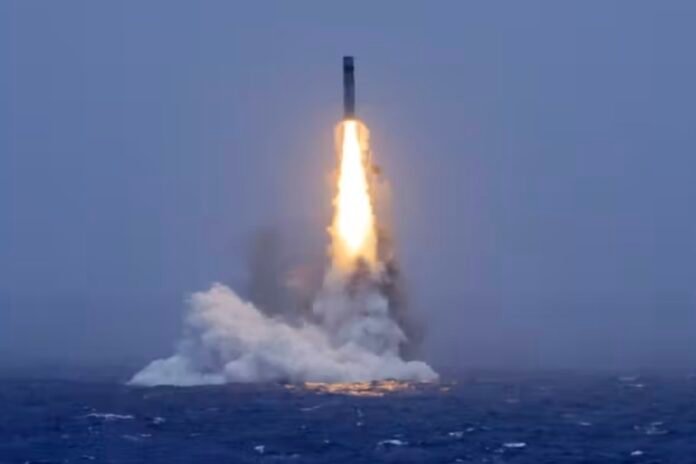
According to Chinese media reports, at 12:01 pm on July 6, a People’s Liberation Army Navy strategic nuclear-powered submarine successfully launched a submarine-launched strategic missile carrying a “training simulation warhead” toward “relevant high-seas areas in the Pacific.”

The missile reportedly “accurately fell into the designated sea area.” Chinese Foreign Ministry spokesperson Mao Ning stated that the launch was part of China’s “routine annual military training,” was “consistent with international law and international practice,” and was “not directed at any particular country or target.”

Subsequent analysis suggested that the missile’s final impact area was likely located in the South Pacific, in waters between Nauru and Tonga. Chinese authorities also released two images: one showing the missile emerging from the sea surface, and another showing the missile ascending after launch.

However, Beijing did not disclose the submarine type, missile model, launch location, flight distance or exact impact coordinates. Notably, a post on the PLA’s X account appeared deliberately ambiguous, placing images of both the JL-3 and JL-2 missiles side by side.

Based on available analysis, the launch was likely conducted by a Type 094 strategic nuclear submarine and involved a submarine-launched ballistic missile. The missile may have been either the JL-2 or JL-3, with a flight distance exceeding 7,000 kilometers.

The JL-2 is China’s second-generation intercontinental submarine-launched ballistic missile. The baseline version has an estimated maximum range of around 7,400 kilometers, while improved versions may reach 8,000 to 9,000 kilometers. It is believed to be capable of carrying one to three nuclear warheads.

The JL-3, which was publicly displayed for the first time during China’s September 3, 2025, military parade, reportedly has a range exceeding 10,000 kilometers. This would allow the PLA to strike the continental United States directly from nearby waters such as the South China Sea. The JL-3 is also believed to use multiple independently targetable reentry vehicle technology and may be capable of carrying six to ten warheads.

The PLA’s previous intercontinental missile test toward the Pacific occurred on September 25, 2024. That event marked China’s first ICBM test into the Pacific in more than four decades, as earlier tests had generally been conducted toward desert areas in Xinjiang.

At the time, outside observers assessed that the PLA likely launched a DF-31 land-based intercontinental ballistic missile from Hainan Island toward the Pacific south of Hawaii. In the latest case, some analysis argues that the launch area may have been located in the Philippine Sea, suggesting that a PLA submarine had crossed beyond the First Island Chain. 

Other assessments, however, suggest that the submarine may have departed from the Yulin naval base on Hainan Island and launched the missile from the South China Sea. Still others argue that the launch may have taken place in the Bohai Gulf, where China has previously conducted multiple submarine-launched ballistic missile tests.

The test has triggered concern among several Indo-Pacific countries, including the United States, Australia, New Zealand and Japan.

Launch location, timing and missile body

Although some reports suggest that the launch may have taken place beyond the First Island Chain, the PLA regards its nuclear submarines as major strategic assets of national power. It is therefore unlikely that Beijing would have risked sending such a submarine deep into the Philippine Sea for a high-profile test.

A more plausible scenario is that the missile was launched from an area more firmly under Chinese control, such as the Bohai Gulf, waters off Guangdong, or the South China Sea, toward the South Pacific. Prior to the launch, China likely positioned the Liaowang-1 and Yuanwang-series tracking ships across the Pacific to monitor the missile’s trajectory and collect relevant flight data.

As for the missile body, to effectively track and analyze the relevant data, the JL-series missile’s warhead was most likely a training simulation warhead carrying sensor equipment.

From the perspective of the PLA’s traditional pattern of “developing one generation, fielding one generation, and exporting one generation,” this test was more likely to involve an improved version of the JL-2, namely the JL-2A.

This would be similar to the DF-31AG launched in 2024. Although China already possesses the DF-41, testing often involves upgraded versions of weapons that are already in service. Therefore, an improved JL-2A, whose range may have been extended from roughly 8,000 kilometers to 9,000 or nearly 10,000 kilometers, is a plausible candidate.

Strategic signal to the United States

In the context of US-China strategic competition, nuclear weapons remain a fundamental element of great-power rivalry.

This explains why China displayed several nuclear-capable systems during its September 2025 military parade, including the air-launched JL-1 (Jing Lei-1) nuclear-capable ballistic missile, the underwater-launched JL-3 (Ju Lang-3) submarine-launched ballistic missile, and the DF-5C liquid-fueled land-based strategic missile.

By prominently showcasing nuclear weapons capable of striking the US homeland, China further underscored the deterrent significance of the 2025 military parade vis-a-vis the United States.

This type of land-sea-air nuclear triad capability formed the basis for the Soviet Union’s ability to compete with the United States during the Cold War. China’s successful test launch of a JL (Ju Lang)-series missile is therefore most significant because it signals to Washington that Beijing possesses a second-strike nuclear capability.

Although there is no indication that the United States and China are on the verge of war, the development and testing of nuclear capabilities can still serve the purpose of strategic nuclear deterrence. This test launch of a SLBM demonstrates that China has developed a credible second-strike nuclear capability.

It also shows that the nuclear threat facing the United States is not limited to the PLA Rocket Force’s land-based ICBMs. The PLA Navy’s SLBMs have already become an important component of China’s nuclear deterrence posture toward the United States.

As a result, Washington will need to assess not simply what China can do, but how Beijing intends to use sea-based nuclear forces within its broader strategy of great-power deterrence. After all, nuclear weapons formed the foundation of deterrence strategy during the Cold War, and they remain central to great-power competition today.

For example, in October 2022, the China Aerospace Studies Institute under Air University published a 255-page report on the PLA Rocket Force. The report provided detailed descriptions of Rocket Force units, bases, commanders and deputy commanders, and equipment.

Many recent studies by US think tanks have likewise focused heavily on the Rocket Force. This explains why China’s September 2024 test launch of the DF-31AG intercontinental ballistic missile drew significant attention from Washington.

This latest successful submarine-launched missile test indicates that, from the US perspective, future research and monitoring can no longer focus only on the Rocket Force. The PLA Navy’s second-strike nuclear capability must also become a major object of study.

Implications for Taiwan

Although China is unlikely to use nuclear weapons against Taiwan itself, the growth of China’s nuclear capability may cause foreign countries to reconsider the degree and form of their involvement in a Taiwan Strait contingency.

Therefore, while the PLA’s successful submarine-launched missile test may not directly affect Taiwan in operational terms, it could create a delaying effect on future US support for Taiwan.

This is especially important if the JL-2 or JL-3 has sufficient range to threaten the United States from the South China Sea. For Washington, the question will be how to work more closely with Japan, Taiwan, and the Philippines to strengthen anti-submarine warfare efforts.

Beyond ASW platforms themselves, this will also require greater exchange of hydrological data, acoustic signatures, and underwater surveillance information. Preventing Chinese nuclear submarines from breaking through the first island chain and entering the Pacific for missile tests may become an important area for Taiwan to strengthen cooperation with surrounding countries in the future.

Dr. Ying Yu Lin (singfredrb@hotmail.com) is an Associate Professor at the Graduate Institute of International Affairs and Strategic Studies at Tamkang University in New Taipei City, Taiwan and a research fellow at the Association of Strategic Foresight. He has played a significant advisory role for Taiwan’s Ministry of National Defense, contributing to critical defense-related initiatives such as the Quadrennial Defense Review and the National Defense Report from 2017 to 2025.

Move over, GPS: Navigation satellites in low Earth orbit are making a comeback

0
move-over,-gps:-navigation-satellites-in-low-earth-orbit-are-making-a-comeback
Move over, GPS: Navigation satellites in low Earth orbit are making a comeback

New navigation satellites in low Earth orbit could provide 100 times stronger signal strength compared to GPS and other global navigation satellite systems operating from higher orbital altitudes—enabling greater location accuracy within dense cities, under thick foliage, and even inside buildings. Such signals would also likely prove more resilient to interference at a time when commercial flights, maritime shipping, and even various smartphone apps face increasingly widespread disruption from GPS jamming.

That vision may start to take shape when the first six production satellites of California-based Xona Space Systems are scheduled to launch in October 2026, with early service starting in 2027. Once the full constellation of 258 Pulsar satellites has been launched in the following years, Xona claims that customers will be able to accurately pinpoint their locations anywhere on Earth to within several centimeters.

“That added power means that we can get into that indoor environment that GPS can’t get to today,” Adrien Perkins, co-founder and VP of engineering at Xona Space Systems, told Ars. “Our higher power allows you to get into those jamming environments a lot further than you would with GPS by itself.”

Xona has already launched its first satellite, called Pulsar-0, aboard a SpaceX Falcon 9 rocket rideshare mission on July 1, 2025. The Pulsar-0 satellite has participated in multiple “live-sky jamming tests across multiple countries” to show how having signals 100 times stronger than GPS can help to reduce a jammer’s effective area by 95 percent, according to an Xona blog post. The company also tested an anti-spoof watermark built into Pulsar signals to help receivers authenticate the satellite signals, and used software updates to improve the initial satellite’s “native positioning accuracy” from a 4.2-centimeter ranging error to 1.5-centimeter accuracy.

Like other global navigation satellite systems that deliver positioning, navigation, and timing (PNT) services, Pulsar satellites could also start providing intermittent timing signals to customers in mid-latitude regions following the launch of the six production satellites in October. Xona has already signed up several precision-timing customers to use Pulsar satellite signals in timing and synchronization services for financial markets, telecommunications, data centers, and transportation systems.

Xona expects its satellites to eventually deliver a timing reference accurate to within 10 nanoseconds. But unlike GPS satellites that carry expensive atomic clocks for accurate timekeeping, Pulsar satellites would rely on a much cheaper software-based solution for precision timing.

The Pulsar timing services would become more persistent and available in urban environments once the constellation grows to about 16 satellites in orbit, enabling at least one satellite to be in view on a regular basis, according to Xona. The company also described centimeter-level positioning capability as becoming possible with four Pulsar satellites in view over a region, which it expects to accomplish for “priority regions” before the full constellation is completed.

The first customers for Xona and other companies planning satellite navigation systems in low Earth orbit (LEO) will likely be “organizations that place an exceptionally high value on availability, resilience, integrity, authentication, and precision, and are already accustomed to paying for premium PNT services,” Zak Kassas, director of the Autonomous Systems Perception, Intelligence, and Navigation (ASPIN) Laboratory at The Ohio State University, told Ars. He suggested that such customers would be “defense and national security users and government agencies responsible for resilience.”

A view of the Xona Space Systems satellite factory in Burlingame, California. The foreground shows a signpost with signs pointing toward "propulsion unit," "guidance & navigation" and "thermal testing."

A view of the Xona Space Systems satellite factory in Burlingame, California.

A view of the Xona Space Systems satellite factory in Burlingame, California. Credit: Xona Space Systems

Using satellites in LEO to deliver location and timekeeping services is “both a blessing and a curse,” Kassas explained in his column for Inside GNSS. The blessing is that LEO satellites can provide stronger signals to ground receivers by operating closer to Earth, and their relatively fast movements across the sky can be measured in ways that provide additional information useful for geolocation and navigation on Earth.

The curse is that hundreds of LEO satellites are required to reliably provide near-instantaneous location and timing services across the entire world. The prospect of deploying so many satellites is no longer daunting since the advent of lower-cost rocket launches driven by SpaceX, which has enabled the growing megaconstellations with thousands of satellites such as Starlink. But it represented a serious constraint during the US military’s deployment of the world’s first satellite navigation system called Transit in the 1960s.

Helping the Navy’s Silent Service

Before GPS, there was Transit. The idea for the Transit satellite system began with physicists at Johns Hopkins University’s Applied Physics Laboratory figuring out how to calculate the orbit of the Soviet Union’s Sputnik-1, which had become the world’s first artificial satellite. Their work relied on calculating the Doppler shift—the change in observed signal frequency—of radio signals coming from Sputnik as it passed overhead. But additional discussions led to the realization that the Doppler shift from a satellite with a known position could also be used to calculate the location of a signal receiver on Earth.

That paved the way for prototype satellite launches starting in 1959 and the operational start of the Transit satellite navigation system in 1964. With ground stations tracking satellite orbits and calculating their positions, the Transit system was designed to allow the US Navy’s Polaris ballistic missile submarines to pinpoint their own locations anywhere in the world. Navigators aboard a submarine or ship could determine their own location by measuring the Doppler shift of a Transit satellite passing overhead while also receiving the satellite’s pre-calculated orbital and location data as a transmission.

However, the full constellation of just 36 operational satellites meant that Transit could only provide location-fixing services every hour or two at best whenever a satellite appeared over the horizon. That was good enough for the system’s main purpose of helping US submarines calculate their own locations as a foundation for making the necessary missile launch calculations to strike their targets. But it would seem like an eternity to modern-day sensibilities accustomed to getting accurate location information in real time.

Transit eventually gave way to the rise of GPS and other global navigation satellite systems that operate from medium Earth orbits, where they can use a similar number of satellites to provide near-instantaneous PNT services across the world. Unlike the Transit system’s use of Doppler shifts, GPS provides location information by using a combination of signals from four or more satellites to

To replicate the performance of GPS, a satellite navigation system in low Earth orbit would need about 10 times more satellites than a similar satellite constellation in medium Earth orbit, Kassas explained. But as the recent rise of Xona and other competitors shows, lower manufacturing and launch costs have made it possible to build and launch such a satellite constellation dedicated to delivering PNT services from low Earth orbit.

Tim Graham is leading satellite development across hardware, software and propulsion at Xona Space Systems.

Tim Graham is leading satellite development across hardware, software, and propulsion at Xona Space Systems.

Tim Graham is leading satellite development across hardware, software, and propulsion at Xona Space Systems. Credit: Xona Space Systems

Building and launching the satellite fleet

Xona has contracted with Aerospacelab, a satellite manufacturer in Belgium, to build some of the first satellites that will carry Xona’s PNT payloads into orbit. But the company is focused on developing its own in-house satellite bus to manufacture most of the planned 258 Pulsar satellites at the company’s factory in Burlingame, California.

“Our first hire on this internal satellite team was a little over a year ago, and seeing what the team has accomplished to date is incredibly impressive,” Perkins said. “Being able to bring in folks that have that experience can help us drive from what the first version looks like to how we continue to streamline that.”

One of Xona’s latest notable hires, Tim Graham, worked on engineering challenges at SpaceX for a decade, eventually becoming the engineering manager for avionics on the Raptor engines that propel SpaceX’s Starship rocket. But he saw an opportunity to lend his expertise and experience in scaling up hardware production to Xona and joined the company earlier this year to lead satellite development across hardware, software, and propulsion.

“If you look at the historical impact of major technological developments, GPS is up there as world-changing,” Graham told Ars. “Bringing a more modern design for a modern technology GPS system to the world is a pretty exciting mission.”

Graham also appreciated joining a company headed by Xona co-founder and CEO Brian Manning, who previously worked as a SpaceX engineer on redesigning components of the Falcon 9 rocket’s thrust structure. “SpaceX people have kind of been through the grinder together, and so it was a good match,” Graham said.

The company has already produced the two in-house satellite buses that are scheduled to join the launch in October 2026. When Ars spoke with Xona’s team in June, the satellite buses were undergoing vibration testing to see how well they could endure the simulated stress of rocket launches. Pushing the limits of hardware early and often can provide insight into failures that are much easier to understand and mitigate well before the satellite launches into orbit, Graham said.

“I cut my jib with the SpaceX mentality of tests… a test that doesn’t break something or show you something new is not super valuable,” Graham explained. “Let’s just try it and see what works, see what breaks, and then make it stronger.”

Xona is also designing and building the Pulsar satellites to be compatible with practically any rocket launch provider. “There’s a whole range of new launch providers that are just starting to come online and are coming in at some pretty competitive cost points,” Graham said. “So we’re really trying as part of our overall satellite design to be compatible with that future of the launch ecosystem, so that we can leverage both launch opportunities and lower launch costs as things come up within that sector.”

The goal is to enable maximum flexibility and minimize the time needed to launch the Pulsar constellation, while planning ahead of time for how many Pulsar satellites may fit each launch option. “We want to work with absolutely everyone,” Perkins told Ars. Such planning necessarily requires design trade-offs on each satellite’s mass and form factor, but “the engineers love nerding out on this bit,” he said.

A group photo of the Xona Space Systems team inside the company's factory in Burlingame, California.

A group photo of the Xona Space Systems team.

A group photo of the Xona Space Systems team. Credit: Xona Space Systems

Hardware compatibility and accessibility

Xona is not alone in working toward establishing PNT services based on low Earth orbit satellites. For example, the Virginia-based startup TrustPoint aims to deliver early service positioning, navigation and timing (PNT) services from low Earth orbit starting in 2027 and eventually build out a constellation of 300 satellites. TrustPoint has focused on using C-band satellite signals in the 4 to 8 gigahertz range instead of L-band signals in the 1 to 2 gigahertz range to allow for greater data transmission and to complicate jamming or spoofing efforts, according to SpaceNews.

However, Xona took a different route by instead making Pulsar satellite signals compatible with ground receivers designed for L1 or L5 band signals. That decision helps to make Pulsar satellite signals work more readily with ground receivers and chipsets that are currently designed for L-band signals from GPS and other global navigation satellite systems. The company claims some existing hardware and receivers would only require a firmware and software update.

“Our engineers review the manufacturer’s product and its intended application, develop a tailored test plan together, and validate that the implementation receives the signal,” Perkins told Ars. “The beauty is that it doesn’t actually require the hardware to be redesigned.”

Toward that end, Xona announced its Pulsar Verified program on July 9, 2026, that provides the custom test plan for each hardware manufacturer to ensure compatibility with Pulsar signals. Companies that have already signed up for the program include leading PNT companies such as Trimble and Septentrio, along with STMicroelectronics, Safran, StarNav and Keysight.

“What makes Xona stand out from other contenders is that they’re aiming to create receiver ecosystem adoption,” said Kassas at Ohio State.

The rise of more satellite constellations in low Earth orbit has even created new opportunities for independent navigation solutions. Kassas and his colleagues have used off-the-shelf antennas and created software algorithms to harness the signals from satellites operated by Xona and many other satellite providers that do not even operate dedicated PNT services, including Starlink. Their navigation solution’s eavesdropping technique measures the signals’ Doppler shifts—a throwback to the Transit satellite system’s pioneering demonstration of satellite-based navigation capabilities.

How ICE Arrests Went Quiet — and Got Even More Deadly

0
how-ice-arrests-went-quiet-—-and-got-even-more-deadly
How ICE Arrests Went Quiet — and Got Even More Deadly


For the second time in a week, Immigration and Customs Enforcement agents have shot a man dead. Joan Sebastian Guerrero, a 26-year-old father from Colombia, was driving slowly in Biddeford, Maine, when an agent shot into his vehicle.

As is now par for the course, ICE representatives are already lying about the incident. Homeland Security Secretary Markwayne Mullin reportedly at first told Maine Sen. Angus King that the driver had attempted to use his car as a weapon — the same lie used to justify shooting 52-year-old Lorenzo Salgado Araujo dead just one week ago in Houston and Renee Good months before that. ICE has made the same bogus claim in a number of recorded incidents involving agents shooting into moving cars.

In a contradictory but equally baseless statement, the Department of Homeland Security claimed on X that the “vehicle attempted to flee the scene and, fearing for public safety, an officer discharged his weapon.” An eyewitness told reporters that before the victim died, his face covered in blood, he could be heard saying, “I tried to stop.”

Both shootings highlight the agency’s pattern of violent racial profiling and reckless indifference to human life.

Like Araujo in Texas last week, Guerrero had not been the target of ICE operations. This is not to say that either death would be any more justified had ICE been seeking the men for arrest; no immigration violation should carry a death sentence. But both shootings highlight the agency’s pattern of violent racial profiling and reckless indifference to human life.

Thousands protested in Houston following Araujo’s killing. Immediately after news spread of the Maine shooting, protesters took to the streets and rushed to Republican Sen. Susan Collins’s Biddeford office. Collins cast a deciding vote in the Senate last month to deliver a staggering $70 billion in funding over three years to ICE and Border Patrol. “Vote her out,” the demonstrators chanted.

Every elected official who is complicit in this border regime should be ousted. It should be a minimum requirement for Democrats running for Congress that they commit to abolishing ICE. Wherever there is legislative, municipal, city, or local power to do so, political leaders must combat ICE with more than words or face organized pressure campaigns and removal.

Following the high-profile ICE killings of Good and Alex Pretti, two Minnesotans, in January, people took to the streets nationwide. Minneapolis residents responded with work stoppages, blockades, and powerful community resistance. The need to escalate organized resistance to ICE nationwide is again all too clear. Community mutual aid networks, neighborhood defenses, mass strikes, and major disruptive protests are as necessary as ever. But all such actions face the challenge of sustainability when opposing President Donald Trump’s endlessly resourced deportation machine.

Guerrero’s killing in Maine is the eighth fatal ICE shooting in Trump’s second term, according to The Trace. At least fifty-two people have died in ICE custody over that same period, which Human Rights Watch called a “soaring mortality rate.” Meanwhile, ICE is further scaling up its quotidian activities to serve Trump’s project of ethnic cleansing: In just five days at the end of June, ICE agents quietly made a reported 10,000 arrests.

The vile spectacle of city-based ICE surges, which were the agency’s calling card under former DHS Secretary Kristi Noem, have given way to dispersed but constant round-ups. The terror for immigrant communities is no less acute; the difficulty when it comes to fighting back has only sharpened. It is high time that anti-ICE action receives more robust political and institutional support.

It is not sufficient, for example, for New York Mayor Zohran Mamdani to assert that the New York Police Department does not coordinate with ICE for deportation operations if the NYPD is dispatched to clear streets for ICE vehicles to travel through disruption-free. It is not enough to have a court order in place barring ICE from making arrests at New York City immigration courts if that order isn’t enforced. “Sanctuary city” has to be a label with meaning beyond Trump using it as a slur against blue cities. It’s a promise, one that must also entail taking action against the racist municipal policing under which immigrants suffer and antifascist organizing is targeted.

Houston Mayor John Whitmire vowed last week to “pursue an independent and transparent” local investigation into the ICE shooting in his city. He also said that the federal government has taken control of the evidence, making such an investigation extremely difficult. The idea that the federal government will hold its jackbooted thugs accountable is, of course, utterly laughable.

But so, too, is the idea that an investigation by Houston or Texas law enforcement will deliver justice to Araujo’s loved ones, let alone the millions of people whose lives are being destroyed by the American deportation machine. An independent investigation into ICE killings is not even the floor, it’s the basement.

As the federal government expands extremist efforts to criminalize and imprison antifascist activists and ICE watchers as terrorists, political leaders — especially those who claim to represent so-called sanctuary cities — must step up to support and protect targeted organizers. It is a disgrace, albeit not a surprise, that Democratic leaders have not spoken out against the unprecedented, draconian sentences — ranging from 30 to 100 years in federal prison — handed down to eight people in Texas over an ICE detention center protest.

The struggle against Trump’s border regime will continue to be led by immigrant communities and their neighbors. The front-line work on the neighborhood level remains the most crucial — from street to street, workplace to workplace, building to building — and in collective efforts against detention centers and in the direct surveillance of and confrontation with ICE agents on the ground. No work of legislation or policy can supplant that. But as the stakes for taking part in anti-ICE work heighten, as immigrant round-ups grow and the death counts climb, it’s high time that Democrats join the work of abolishing ICE with everything at their disposal — or be replaced.

DHS Plans “All-Out War” on Immigration Scammers as Fraud Complaints Double

0
dhs-plans-“all-out-war”-on-immigration-scammers-as-fraud-complaints-double
DHS Plans “All-Out War” on Immigration Scammers as Fraud Complaints Double

The Department of Homeland Security is investigating a sophisticated network of scammers who target people caught in immigration proceedings, bilking them of their savings and causing some to be deported, following a ProPublica report that complaints of such fraud doubled under the second administration of President Donald Trump.

Homeland Security Investigations, the subagency known for tracking international crimes such as human trafficking, has asked about specific cases detailed in the story, including the tale of a woman who, fearful of Trump’s nationwide immigration sweeps, enlisted someone she thought would help her keep her legal status. After the scammers got her money and caused her to miss a court date, she was deported to Nicaragua.

Read More

That was one of thousands of cases in which scammers lured their marks through social media posts and sent them through fake court hearings and other official-looking steps, charging large sums along the way. Now, the federal government is ramping up its efforts to track the scams, according to sources involved in the investigation.

A DHS statement said the agency was “declaring an all-out war” on the scammers.

“Immigration scammers contribute to a lawless environment, undermining our immigration system and posing risks to national security and public safety,” the statement said.

DHS is looking for URLs, WhatsApp numbers and identifying information on the payment app Zelle that might trace back to scammers, said sources knowledgeable about the inquiry. The department’s investigation is ramping up as such scams skyrocket.

ProPublica analyzed Federal Trade Commission data and found that victims and advocates reported at least $94.4 million was stolen over five years. The more than 6,200 complaints included everything from fake Immigration and Customs Enforcement agents demanding personal details and threatening deportation to fraudsters asking international students for money by exploiting their visa status.

Scammers often pretend to be lawyers offering ways to avoid in-person court hearings, taking advantage of anxieties among even lawful residents after ICE officers began rounding up people during immigration proceedings.

Experts say the scammers often advertise on places such as Facebook and TikTok before shifting the conversation to the encrypted messaging platform WhatsApp, asking for money in exchange for real-looking immigration filings. Sometimes known as “notario fraud,” these scams often rely on a mistranslation of the word “notary,” which implies legal credentials in many Latin American countries.

In recent weeks, agencies including the New York Department of State, Florida Bar and local police departments issued warnings about these scams. The American Bar Association, which has also warned about impersonators, has recently been in contact with DHS investigators.

In South Florida, immigration attorney Angel Leal encountered hundreds of AI-generated videos of his likeness offering aid on WhatsApp. His office had to hire an anti-piracy agency to remove the content and over 6,000 fake profiles, according to local news reports.

The videos, hundreds across Instagram, are strikingly realistic. “Leal” sits on an office chair, his facial hair and expressions matching that of the real attorney. The AI-generated figure speaks fluent Spanish with enthusiastic hand gestures, a potted plant or mug in the foreground and a law degree behind him. Slight details betray the ruse: some mouth movements don’t match the words, gibberish text appears on documents and objects meld together.

Advocates and law enforcement say people targeted should document all ads, text conversations and payment information. And DHS warns consumers to be wary of lawyers advertising directly on social media, operating on WhatsApp and taking payments over Zelle.

In April, ProPublica spoke to several victims who attended fake court hearings via WhatsApp, recounting their stories to “agents” wearing phony government uniforms. Spanish speakers are the primary targets, experts say, and the scammers often pretend to be affiliated with prominent advocacy groups such as Catholic Charities USA, which has been inundated with reports of fraudsters using their brand to find potential marks.

“Directly reaching out to people via an ad or via WhatsApp and asking for money over Zelle, that is not something Catholic Charities agencies would ever do,” said Kevin Brennan, vice president for media relations at Catholic Charities USA.

Such groups have found it difficult to get imposter ads and accounts removed. Even when they do, it’s cheap and easy for scammers to create new websites and accounts.

“It’s Whac-a-Mole,” said Charity Anastasio of the American Immigration Lawyers Association, another group whose staff and image have been impersonated.

0FansLike
0FollowersFollow
0FollowersFollow
0SubscribersSubscribe
- Advertisement -
Google search engine

Recent Posts