28.4 C
London
Wednesday, July 15, 2026
Home Blog

Google and Epic cancel settlement; third-party app stores coming to Google Play

0
google-and-epic-cancel-settlement;-third-party-app-stores-coming-to-google-play
Google and Epic cancel settlement; third-party app stores coming to Google Play

Big changes are coming to Android apps, but they’re not the changes Google wanted. The settlement between Google and Epic that aimed to put to rest the companies’ long-running antitrust battle is being withdrawn, and that means third-party app stores are coming to the Play Store. Google has confirmed that it will begin distributing rival app stores next week, setting the stage for competing platforms to take a bite out of Google’s Android revenue stream.

This case has the potential to upend software distribution on Android, and it’s all because of V-Bucks. In 2020, Epic Games was frustrated that it had to pay a 30 percent cut to Apple and Google every time someone bought a bundle of V-Bucks in a mobile version of Fortnite. The publisher added a direct purchase option to the game in violation of both Apple’s and Google’s rules. Naturally, Fortnite was pulled from the App Store and Google Play, kicking off the antitrust lawsuit that is only now reaching its conclusion.

While Apple suffered little penalty in its Epic case, Google was tripped up by its anti-competitive management of the supposedly open Android ecosystem. Google used its market position to discourage device makers from promoting or pre-loading non-Google app stores and attempted to hide that conduct. The remedies set by Judge James Donato included lower fees, mirroring Google Play apps in other stores, and most vitally, placement of alternative app stores in Google Play.

The court felt adding third-party app stores to Google Play was the best way to ensure fair access. After all, Google was found guilty of anticompetitive conduct, which entrenched the Play Store and made it the only source of software for most Android users. The network effects of Google’s dominant position would therefore make it difficult for a competitor to attract significant market share with sideloading.

When Google and Epic announced their settlement in late 2025, the Google Play distribution provisions were gone. Instead, Google promised to launch a Registered App Store program globally, allowing stores to access streamlined installation and other system features, making them first-class citizens on Android. They would have to get users to sideload the app store clients, though.

App Store flow from filing

An earlier legal filing included an early look at how registered app stores will work.

An earlier legal filing included an early look at how registered app stores will work. Credit: Google

From the start, this modification of the remedies was on shaky ground. Donato expressed skepticism about the proposal in early 2026, noting that it may not serve the market’s interests. Still, Google forged ahead with Registered App Stores, planning an international rollout before expanding to the US with court approval.

A brave new app store

Google and Epic were set to return to court on July 16 to argue in favor of the settlement. However, the writing may have been on the wall. In a recent expert analysis provided to the court, MIT economics professor Nancy Rose noted that the settlement was “unlikely to enable Google Play’s potential competitors to overcome their long-standing network-effect disadvantage in a timely manner.”

With settlement approval looking increasingly unlikely, Epic and Google agreed this week to call the whole thing off. Here’s how Google Trust and Reputation Communications Lead Dan Jackson explains the company’s decision:

“We’ve agreed with Epic to withdraw our motion to modify the US Court’s injunction rather than prolonging this process which creates uncertainty for the ecosystem. This allows us to focus on executing our recently announced global business model evolution to deliver greater app store choice, lower prices, and more opportunities for developers and users. We remain committed to maintaining Android’s industry-leading security and fostering a competitive ecosystem where every app store and developer has the freedom to compete. In parallel, we continue to comply with the US Court’s injunction.”

In a brief filing, Google’s legal team informs the court that Google is prepared to begin distributing third-party app stores in Google Play on July 22. Under the terms of Judge Donato’s original injunction, these stores will have access to the full catalog of Google Play apps by default. Developers will have the option to opt out of distribution in these stores, and Google has a support page explaining how to do so.

Google also has documentation on how app stores can get access to the Google Play catalog. It won’t be mirroring those apps in any shady storefront that asks. The court has allowed Google to charge reasonable fees to cover its security and compliance review of third-party stores, which will be $5,000 per year.

Google will also require approved stores to block malware, respect intellectual property, and include mechanisms to update and uninstall apps. App stores can be removed from the program if more than 1 percent of attempted app installs appear to be malware or unwanted software. It’s unclear if there will be separate, possibly more stringent requirements for storefront distribution in the Play Store. However, Google is prohibited from unreasonably blocking third-party store clients uploaded to Google Play.

The changes Google has announced under the Epic agreement will proceed for now. That means Registered App Stores will happen globally, but they will probably only appear in the Play Store for US users. Google hasn’t specified if there will be any differences in the features available to the stores downloaded from Play versus registered stores. We’ve asked for clarification and will update if Google provides more information.


The folly of making Bali into a financial hub

0

JAKARTA – Indonesia’s Bill on the Indonesia International Financial Center — first proposed in May 2024 to modernize the domestic financial sector and make Indonesia an Asia-Pacific capital hub — has become a top legislative priority.

The government and House of Representatives have agreed to fast-track the bill, known as PFII, giving lawmakers just 20 days to finish deliberations before a targeted enactment date of July 21, 2026.

The government says the rush is justified by global volatility, including the wars in Ukraine and the Middle East, which it sees as a chance for Indonesia to attract a surge of global liquidity seeking a safe haven.

Under the bill, the PFII would operate as a zone with financial and administrative autonomy and a special legal framework modeled on international standards. Its structure would include a PFII Council reporting directly to the president, supported by a management agency, a financial services supervisory agency and a specialized commercial court.

Capital would flow through the Daya Anagata Nusantara Investment Management Agency, known as BPI Danantara. A contentious clause would bar the PFII Management Agency from being declared bankrupt.

The choice of Bali as the PFII’s home has sparked sharp debate. The resort island offers non-fiscal advantages — a premium lifestyle and a global reputation as an elite tourist destination — that the government considers well-suited to a family office ecosystem.

But economists say Bali lacks the fundamentals that support financial hubs, unlike Jakarta, which has a more developed workforce, a stronger industrial base and closer ties between corporations and top universities.

Bali’s rigid building-height restrictions and other land-use rules would also limit the kind of vertical development typical of global financial hubs.

Risky legal loopholes

Critics warn the PFII bill, combined with Article 50A of Law No. 4/2026, which amends the P2SK financial sector law, could open the door to money laundering.

The article authorizes new debt instruments, the Patriot Bond and Merah Putih Bond, and grants buyers broad immunity from criminal and civil prosecution. Data on primary-market purchases can not be used for tax assessments or as court evidence, which critics say creates room for de facto pardons, despite the government’s denials.

Combined with a 100% tax exemption for family offices in Bali, that immunity could create a near-complete money-laundering pipeline: Illicit funds could be moved into state-backed financial assets without fear of prosecution, then funneled into family offices that offer trusts and special purpose vehicles without requiring disclosure of ultimate beneficial owners.

Critics say this could damage confidence in Indonesia’s financial system and jeopardize its standing in the Financial Action Task Force, the global anti-money-laundering body.

Analysts distinguish between a genuine international financial center — built on deep markets, legal certainty and strong transparency standards — and a tax haven, marked by minimal tax rates, little information-sharing and no requirement for real economic activity.

They say the PFII Bali draft currently resembles the latter more than the former.

Speculation and inequality

Building a financial center is not just a financial question, but also a matter of urban planning.

Jakarta already has the ecosystem to handle complex financial transactions; Bali does not. Forcing the resort island to become Indonesia’s sole financial hub without the necessary infrastructure risks creating an economic enclave cut off from the rest of the country’s industry.

Property speculation already underway in South Bali is an early warning sign, suggesting the development may drive asset inflation for a small group rather than broader economic growth.

That could deepen inequality, leaving local residents as bystanders to a wealthy enclave disconnected from their economic reality, while rising land prices push housing and commercial space out of reach.

Relying on a single sector with no ties to the broader real economy would also leave Bali exposed to swings in global financial markets. Without requirements for real economic activity — such as local hiring or building digital infrastructure — much of the expected economic benefit could simply move offshore, leaving Bali as a financial center on paper without lasting benefits for Indonesia’s long-term development.

Safeguards needed

Analysts say the PFII bill needs structural changes. The government could cap the corporate tax deduction at 70% to 80% to guard against moral hazard and ensure the zone contributes to state revenue.

A limited revision to Article 50A would ensure legal protections are not absolute and remain subject to due diligence and oversight by PPATK, Indonesia’s financial transaction reports and analysis unit, to screen the proceeds for crime.

Rather than concentrating all financial activity in one location, some propose a multi-hub model: Jakarta as the center for banking and capital market transactions, Batam as a cross-border fintech cluster, and Bali focused narrowly on niche areas such as green finance.

They also call for requiring PFII-registered family offices to invest at least 20% of managed funds domestically for the long term, to ensure a real multiplier effect on the economy rather than simply enriching speculators.

Financial autonomy and economic progress cannot be built on weak foundations or come at the expense of legal integrity. Substance, transparency and good governance are what separate a world-class financial center from a haven for illicit funds.

Indonesia’s future economic credibility and success depend on whether its policies can protect financial stability without sacrificing the rule of law or social justice.

Ronny P. Sasmita, PhD, is senior international affairs analyst at the Indonesia Strategic and Economic Action Institution.

Sotheby’s big T. rex auction raises concerns hype and wealth are upending science

0
sotheby’s-big-t.-rex-auction-raises-concerns-hype-and-wealth-are-upending-science
Sotheby’s big T. rex auction raises concerns hype and wealth are upending science

Forget the sale of the century. The auction house Sotheby’s has geared up for the sale of the epoch. On July 14 it opened live bidding on assorted fossils, but the pièce de résistance is lot 20, a rare 67-million-year-old Tyrannosaurus rex skeleton.

The specimen—dubbed Gus—is billed as one of the largest, most complete T. rexes ever found. Gus is expected to fetch up to $30 million and will go to the highest bidder, whether public museum or private collector. The latter have played an increasingly prominent role in buying fossils, with auction houses, according to paleontologists, contributing to the trend by building hype. But when private collectors swoop in and buy fossils at auction as luxury assets, those pieces of history are effectively lost to science.

By nearly all accounts, Gus is a big deal. In its description, Sotheby’s boasts that the specimen, which was discovered on a ranch in South Dakota, comprises “an incredible 183 fossil bone elements” making it “approximately 61% complete by bone count.” The fossil remains have been mounted in a custom steel armature along with replicas of the missing bones. The result is a reconstructed skeleton posed as if in hot pursuit, its mouth full of dagger teeth ready to tear into prey.

“It does seem to be a spectacular specimen,” says Thomas Holtz, a tyrannosaur specialist at the University of Maryland. The completeness of the skeleton and the high quality of the bone make Gus “scientifically significant,” he says.

Gus is the latest major dinosaur fossil to go up for sale at auction in the US. That trend began in earnest in 1997 when Sotheby’s auctioned Sue, the most complete T. rex on record. That specimen sold for roughly $8.4 million—the most money ever paid for a fossil at auction at the time.

“Before Sue was sold, there were no laws about who owned fossils. There was no value truly ascribed to them,” says Cassandra Hatton, vice chairman and head of the science and natural history department at Sotheby’s. In many other countries the state owns the fossils. But court cases around Sue clarified that in the US, whoever owns the land also owns whatever fossils are on it, Hatton explains. The market has been booming ever since.

But whereas Sue went to a scientific institution—the Field Museum in Chicago—in recent years ultrarich individuals have been snapping up dinosaur fossils at auctions for their private collections, prompting paleontologists to be concerned about the fate of rare specimens. Tech entrepreneur Dan O’Dowd owns a T. rex called Samson. And he’s not the only private collector to own a tyrant lizard king. A study published in 2025 found that there are more fossils of T. rex in private collections than there are in public trusts.

It’s not just T. rex that’s ending up in personal coffers. In 2024, Sotheby’s sold a Stegosaurus named Apex to hedge fund billionaire Ken Griffin for the record-setting sum of $44.6 million. And last year the auction house sold the only known juvenile Ceratosaurus in the world to an anonymous buyer for $30.5 million. These examples highlight another trend: As prices soar, museums simply cannot compete at auction.

Auction houses say the sales help science by rescuing fossils from the erosion that occurs when they are exposed to the elements, and by helping to get them expertly excavated, prepared, and assessed.

“If a fossil is not excavated, it’s lost to everyone,” Hatton says.

Paleontologists counter that the incentive to sell specimens to the highest bidder and appeal to high-net-worth collectors actively undermines science every step of the way. That begins at excavation, with commercial outfits that take the fossils out of the ground but fail to exhaustively document the geological context in which a fossil was found, which is essential for understanding the age of the organism, how it died, and the ecosystem it inhabited. Mounting the bones for artistic display makes them impossible to study using modern techniques such as computed tomographic imaging, which can reveal hidden features of fossils noninvasively.

Paleontologists also argue that the auction firms play it fast and loose with science to market the fossils in a way that may make them more appealing to untrained buyers. In the case of Gus, Sotheby’s describes holes in the jaw and elsewhere on the specimen as tyrannosaurid bite marks—signs that Gus might have battled with or been scavenged by his own kind. The description does not offer any evidence to support this interpretation of the holes, nor does it mention alternative explanations for such damage.

It’s a dramatic story, but it’s probably wrong, according to Stuart Sumida, a paleontologist at California State University, San Bernardino. Puncture marks are irregularly shaped and have splintered fractures around the edges. The holes on Gus’ bones, in contrast, are perfectly round and smooth-edged. Holes like these are common on tyrannosaur bones and have been previously hypothesized to be the result of infections. “It’s much sexier to say they’re puncture wounds, but this isn’t how puncture wounds look,” Sumida says of the hole in Gus’ jaw. “T. rex probably just had really bad breath.”

When asked by WIRED about the origin of the bite-mark claim, Hatton replied, “The bite marks are very clear, and are not all straight punctures but lateral bites where you can clearly see the shape of the tooth. You can also tell from the edges of the hole whether the break is clean, or if the hole is gradual (which would be more likely the result of a parasitic or other infection that gradually and evenly eats the bone).” She did not indicate where this analysis came from.

But the central issue with auctioning fossils, researchers contend, is that when specimens end up in private hands, they become unavailable for scientific study. Even if a private collector loans a fossil out for display or study at a museum, as happened last year when the American Museum of Natural History in New York City secured a four-year loan of Griffin’s Stegosaurus, such an arrangement violates a central tenet of paleontology: Scientific reproducibility requires that researchers other than those conducting the original examination have access to those same fossils in perpetuity.

That approach allows paleontologists to validate findings, test new hypotheses, and build knowledge of the past. To ensure access, fossils must be held in public repositories on a permanent basis. So vital is this covenant that established scientific journals won’t publish a study on a specimen that isn’t in the custody of a publicly accessible museum, Sumida explains.

Everything scientists have been able to piece together from fossils about prehistory—from the origin of multicellular life to the dawn of humankind—rests on this system.

“A scientifically important fossil isn’t just a static object; it’s a permanent source of data that future generations of scientists will study with tools that haven’t even been invented yet—but only if the fossil remains in the public trust,” says Kristi Curry Rogers, a paleontologist at Macalester College. “Think about all the cool discoveries that have been made in the last 50 years about dinosaur diets, body temperatures, coloration, reproduction, vocalization, neurobiology—none of these discoveries would have been possible if the fossils had disappeared into private collections.”

Sales of fossils to private individuals in the US won’t stop, Sumida acknowledges. So he and Rogers are taking a different tack to help keep important fossils in science’s fold. In their respective roles as president and vice president of the Society of Vertebrate Paleontology, they are working to set up the society to act as a liaison between private collectors and museums. Their goal is to persuade private collectors to donate the fossils they buy to science museums right after the gavel falls rather than keeping them as trophy acquisitions.

“When it comes to these public auctions of our shared history, the best outcome is when those with the means to acquire an extraordinary fossil choose to immediately place it in the public trust, where everyone benefits,” Rogers says.

Private buyers can avoid the bad PR that comes from opposition to these sales by making their purchase anonymously, which could hinder efforts to persuade them to engage in philanthropy. But the Society of Vertebrate Paleontology is hoping that if it can convince even just a few known individuals to donate their fossils to science, they, in turn, will influence others to do the same.

The society is in talks with some collectors and museums, though Sumida declined to share specific details. It doesn’t have a plan in place to approach Gus’ buyer, but it might develop one depending on who purchases the fossil.

“A specimen of this quality deserves to be in a museum collection so that not merely the current generation but future researchers (to say nothing of museum-goers) would be able to study and admire it far into the future,” Holtz says of Gus. “Let us hope that whoever acquires it keeps this in mind.”

This story originally appeared at wired.com.

Donald Trump is running out of options in Iran

0
donald-trump-is-running-out-of-options-in-iran
Donald Trump is running out of options in Iran

Serious hostilities between the US and Iran have resumed. On July 8, Donald Trump said that the ceasefire agreed by the two countries in June was “over”. Since then, he has ordered the US military to carry out intensive airstrikes on Iran and has reimposed an economic blockade of the country.

The US president has also begun to recycle threats he made earlier in the war. These include striking civilian targets and seizing Iran’s Kharg Island, which is host to most of its oil refining capacity.

Hope within the White House of achieving a deal to address Iran’s nuclear capabilities is fading. But Trump is hoping that his latest moves will force Iran to relinquish its control of the Strait of Hormuz, allowing global energy markets to return to normal.

There’s just one problem: none of these things have worked before, and there is no reason to think they will work now. In fact, Trump’s return to the same playbook that has previously failed to end the war on terms acceptable to the US shows just how limited his options have become.

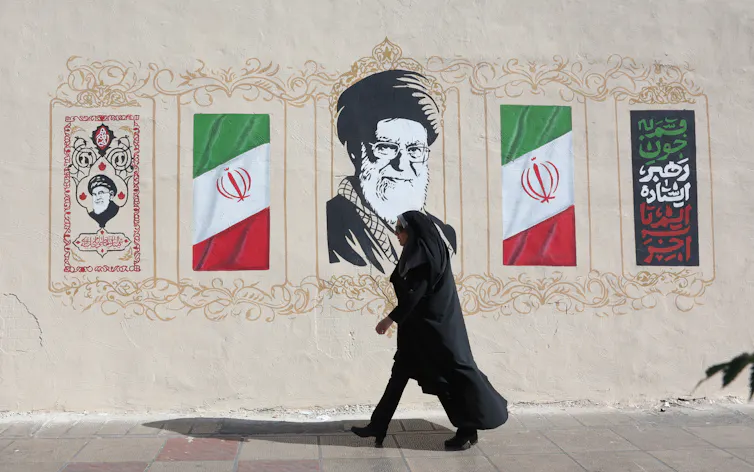
A woman walks past a mural of Iran's late former supreme leader, Ali Khamenei.

Iran’s former supreme leader, Ayatollah Ali Khamenei, was killed by a US-Israeli strike in February. Abedin Taherkenareh / EPA

The war began with an attempt by Trump and the Israeli prime minister, Benjamin Netanyahu, to damage Iran’s nuclear capabilities and perhaps topple its regime. However, the conflict’s centre of gravity has since shifted.

Nuclear matters have taken a back seat to the issue of whether shipping through the strait will in the future operate only under what Iran’s chief negotiator, Mohammad Bagher Ghalibaf, has called “Iranian arrangements”. This means ships will only be allowed to transit on Tehran’s terms.

The US rejects the idea of Iranian control of the strait and wants a return to the situation of free transit that existed before the war. Yet, after all of these months, it has still not figured out a way to achieve this goal at an acceptable cost. To understand why, it is helpful to break down US options into three groups: military, diplomatic and economic.

Trump’s limited options

Militarily, nobody fully controls the Strait of Hormuz. It is a contested zone into which various countries can project military power. However, Iran does not need to control the strait entirely to achieve its aim. It only needs to continue to pose enough of a credible threat to vessels that they are too worried to transit.

Iran’s ability to menace shipping in the strait stems from its stockpile of missiles, drones and fast boats. These are relatively easy to conceal and launch, and the CIA assesses that Iran still has healthy supplies of them. To stop these capabilities, the US would have to seize a vast swathe of Iranian territory, risking great casualties. And even then, success would not be guaranteed.

Seizing Iran’s Kharg Island would likewise be highly risky. Occupying it may be easy initially, but any US forces stationed there would be exposed to Iranian attacks. A lengthy occupation would probably cost lives, making it hard to hold on to the island long enough to use as leverage in negotiations.

As cynical – and probably illegal – as military strikes on civilian targets would be, Trump perhaps thinks they might force Tehran to the table. But they also might not and risk kicking off a round of Iranian retaliation, which could do much greater damage to energy and civilian targets across the Gulf.

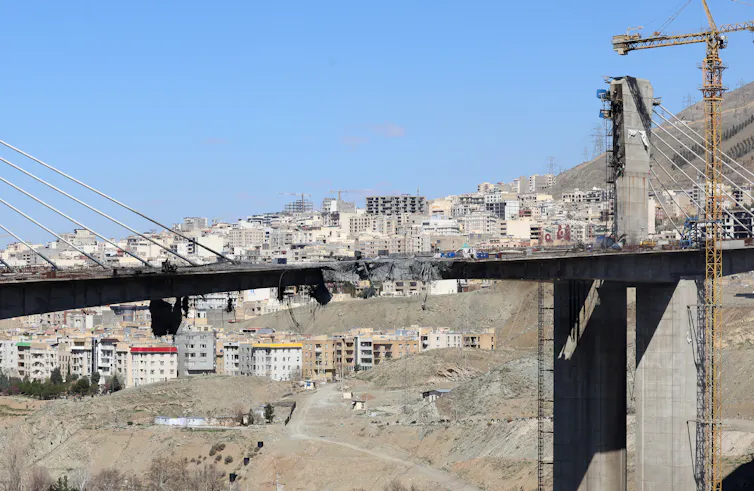
A damaged suspension bridge in the city of Karaj.

A suspension bridge in the city of Karaj, northern Iran, was damaged by a US airstrike early in the war. Abedin Taherkenareh / EPA

The risks and probable futility of these military options are what have pushed Trump to instead explore a diplomatic solution to the conflict over the past few months. But success here has also proven elusive, and it is likely to continue to do so.

The results of diplomacy usually reflect the state of the battlefield. With the US lacking any credible military option to neutralise Iranian influence in the Strait of Hormuz, there is little reason for Tehran to relinquish it.

Mohsen Rezaee, an adviser to Iranian Supreme Leader Mojtaba Khamenei, recently referred to Iran’s influence in the strait as “more important than dozens of nuclear bombs”. His statement reflects the importance the waterway has taken on in the country’s strategic calculations.

Being able to control shipping through the strait gives Iran leverage against the US. It will not give this up without a very good reason.

Economic tools

A lengthy economic blockade of Iranian ports is perhaps the most effective way Trump has to inflict pain on the Iranian government, whose domestic support may fray in a prolonged economic crisis. Economic grievances, including high inflation, contributed to a wave of unrest in Iran in early 2026 that was met with brutal repression.

However, the economic pain cuts both ways. While the blockade is in place, Iran is unlikely to allow oil and gas to transit the strait. That raises global energy prices, which is a perilous political proposition for Trump, too.

Imposing the blockade is costly in another way for the US – it requires a permanent military deployment to enforce. Given the competing demands made on the US military from other missions, such as deployments in Europe and the Indo-Pacific, this blockade cannot be kept in place forever.

Yet when the blockade is lifted and US forces leave the region, Iran will still be physically next to the Strait of Hormuz, able to menace shipping anew.

Ultimately, Trump has backed himself into a corner from which there is no apparent escape. For all the immense military power available to the US, there are limits to what it can achieve. In this war of his own making, Trump is running hard and fast into them.

Palestinian NGOs at Odds with European Donors, Reject Peace Efforts in Joint Statement  

0
palestinian-ngos-at-odds-with-european-donors,-reject-peace-efforts-in-joint-statement  
Palestinian NGOs at Odds with European Donors, Reject Peace Efforts in Joint Statement  


Palestinian nongovernmental organizations (NGO), including several that receive European government funding, issued a joint statement on July 11 rejecting Israeli-Palestinian peacebuilding initiatives and the June 2026 “Paris Call for the Two-State Solution” conference, saying such efforts “reproduces a harmful political approach which has the effect of erasing Palestinian agency.” 

The statement, published on behalf of what the groups described as “Palestinian civil society,” was signed by the Palestinian NGO Network (PNGO), Al-Haq, Al Mezan, the Palestinian Center for Human Rights (PCHR), the Independent Commission for Human Rights (ICHR), MIFTAH-The Palestinian Initiative for the Promotion of Global Dialogue and Democracy, and the Women’s Center for Legal Aid and Counselling. It also endorsed “resistance in all its forms to occupation, apartheid and colonisation.” 

The signatories include organizations that have received millions of euros in funding from European governments and institutions that publicly support a two-state solution. Disclosed funding includes a €1.3 million European Union grant to PNGO for 2021-2024, €475,000 from the European Commission to PCHR for 2023-2024, €125,561 to Al Mezan in 2025, and CHF 3 million from Switzerland to ICHR for 2023-2027. 

PNGO, an umbrella organization representing more than 140 Palestinian NGOs, has repeatedly opposed European Union anti-terror funding requirements. In a 2021 publication, it said it “will continue to work with all parties … to develop or change the European Union’s position on the [anti-terror] conditions.” In June 2017, it defended a youth center named after Dalal Mughrabi, saying “there is a difference between freedom fighters and terrorists.” 

After the Oct. 7, 2023, Hamas attack, PNGO issued a statement saying, “We in PNGO salute this honorable image that our people are sketching.” The network includes Al-Haq, Addameer, Defence for Children International–Palestine, the Union of Agricultural Work Committees and the Bisan Center for Research and Development. 

Al-Haq, PCHR and Al Mezan have also drawn international attention. In September 2025, the U.S State Department imposed sanctions on the three organizations for “directly engag[ing] in efforts by the International Criminal Court to investigate, arrest, detain, or prosecute Israeli nationals, without Israel’s consent.” In 2021, Israel designated Al-Haq a “terror organization.” 

Other signatories have also faced scrutiny. In October 2025, Switzerland, Sweden, Denmark and the Netherlands reportedly opened investigations into funding provided to ICHR over concerns it may have been diverted to Hamas. Denmark’s foreign minister later said, “ICHR had not made funds or other financial assets available to organizations or individuals subject to sanctions.” 

Denmark’s foreign minister later said, “ICHR had not made funds or other financial assets available to organizations or individuals subject to sanctions.” 


European Parliament committee advances overhaul of EU organic food rules

0
european-parliament-committee-advances-overhaul-of-eu-organic-food-rules
European Parliament committee advances overhaul of EU organic food rules


European Parliament lawmakers have backed updated rules governing organic food production, labeling and imports, aiming to strengthen consumer confidence while shielding EU producers from what they describe as unfair competition from outside the bloc.

The Parliament’s Agriculture and Rural Development Committee on Tuesday approved its negotiating position on proposed revisions to EU rules covering the production, labeling, certification and trade of organic products by a vote of 37-4, with eight abstentions.

Under the proposal, products imported from non-EU countries would be allowed to display the EU organic production logo only if they meet equivalent standards and comply with additional production and control requirements. Lawmakers said the changes are intended to improve consumer trust in organic food while ensuring fair competition between EU and non-EU producers.

The committee also endorsed changes to certification exemptions for small operators selling unpackaged organic products directly to consumers. Current rules exempt qualifying businesses from organic certification based on turnover, sales volume and certification costs.

MEPs said rising prices have pushed some producers above the existing turnover threshold, causing them to lose the exemption. The proposal would raise the annual turnover limit from €20,000 to €25,000 and increase the annual sales volume threshold from 5,000 kilograms to 10,000 kilograms.

Lawmakers also agreed to modify requirements governing poultry housing for fattening birds and daytime outdoor access, saying the changes would reduce administrative and logistical costs.

Rapporteur Camilla Laureti said the objective is to provide the sector with a stable regulatory framework that simplifies certain rules without reversing reforms introduced only a few years ago.

“It is a framework that maintains the quality and therefore the reputation of the sector, in Europe and globally, while respecting consumers,” Laureti said.

In a separate vote, the committee approved opening negotiations with the Council of the European Union on the final legislation by 40 votes to eight, with one abstention. The proposal is expected to be submitted to the full European Parliament for approval before negotiations begin.

EU lawmakers are seeking to finalize the legislation before the end of 2026, when the current rules governing organic food imports expire.

The European Commission proposed the amendments after a 2024 ruling by the Court of Justice of the European Union found that imported products recognized under equivalence arrangements cannot use the EU organic logo. The Commission said the changes are intended to provide greater clarity for consumers and avoid disruptions to trade.

According to a 2024 Eurobarometer survey, the EU organic production logo is the most widely recognized food label among Europeans and serves as a key identifier for organic products marketed across the bloc.

Musicians Killed in Island Plane Crash-Landing

0
musicians-killed-in-island-plane-crash-landing
Musicians Killed in Island Plane Crash-Landing


A short flight to an Independence Day celebration in the Bahamas ended in tragedy when a small passenger plane crashed while trying to land, killing all 10 people on board.

The Cessna 402, operated by Flamingo Air, had left Nassau shortly after 1 p.m. on July 10. It was headed for San Andros Airport on Andros Island, the Bahamas’ largest island.

The trip should have taken about 20 minutes.

Instead, the aircraft ran into trouble just before landing. According to the Aircraft Accident Investigation Authority, the plane “encountered difficulties and crashed into bushes prior to landing.”

Several of the victims were well-known local musicians who had been traveling to perform at an Independence Day event on the island.

Among those killed were five members of the popular Caribbean group Da Pond Band: Giovanni McKenzie, Mateo Winder, Rashad Storr, Tonique Gilot, and Travis Johnson.

Melvin Henfield, better known as DJ Fresh, was also among the victims.

The deaths have left the country’s music community in shock, turning what was supposed to be a holiday celebration into a devastating day of mourning.

Authorities have not yet said what caused the crash.

The investigation remains ongoing.

Viktor Orbán is gone, but scores of public monuments show the potency of his legacy and Hungarian nationalism

0

When newly elected Hungarian Prime Minister Péter Magyar delivered a June 4 address to mark Hungary’s Day of National Unity, he did so facing a long stone trench known as the Monument of National Unity. The memorial pays homage to the Treaty of Trianon in 1920, which formally ended Hungary’s involvement in World War I but also resulted in the nation losing about two-thirds of its territory, economy and population.

The monument is provocative in several ways. Its walls are covered with the Hungarianized names of more than 12,000 towns and cities that were once part of “Greater Hungary.” That’s the colloquial name for Hungary’s territory before World War I, when it was still a part of the Austro-Hungarian Empire. The monument incorporates thousands of places now in Slovakia, Romania, Serbia, Ukraine, Croatia, Slovenia, Austria and Poland. The names are intermixed rather than grouped geographically, suggesting the indivisibility of Greater Hungary despite modern borders.

When former Prime Minister Viktor Orbán unveiled such a nationalistic monument in Budapest, the cosmopolitan bastion of the Hungarian political left, it was interpreted as a victory lap. Orbán, a pro-EU capitalist turned right-wing populist, was ousted in April 2026 after 20 total years in power. He was replaced by Magyar, a former member of Orbán’s Fidesz party whom many observers hope will be a more cooperative international partner.

The Monument of National Unity in Budapest

The Monument of National Unity in Budapest stands directly opposite the eastern steps of the Hungarian Parliament Building. Brett R. Chloupek, CC BY

However, those same individuals across the United States and Europe who cheered Magyar’s surprising victory with hopes it might signal a significant break from Orbánism will likely be disappointed. That’s because Magyar’s huge political mandate should be understood as a referendum on the endemic corruption in Hungarian politics and a desire to return to the political norms of civil society.

What it was not was a clear repudiation of Orbán’s national-historical worldview. Such an outlook, shared by Magyar and a majority of Hungarians, is evident in the more than 125 public monuments built under Orban as part of his Civic Circles movement. Indeed, as a geographer who studies the symbolism of monuments, I see them as a visible manifestation of a nationalist spirit that is pervasive throughout Hungary’s society and politics.

The memory politics of Trianon

The dismemberment of Greater Hungary at the end of World War I via the Treaty of Trianon remains the most traumatic blow to the modern Hungarian psyche. As a result of the treaty, millions of ethnic Hungarians today live in neighboring countries, with the largest populations in Romania and Slovakia, followed by Serbia and Ukraine.

The desire of Hungarian nationalists to regain these territories and peoples has been described as “Trianon Syndrome.” That was the primary factor for Hungary’s fascist government making common cause with Nazi Germany during World War II, when Germany similarly made use of its own claims on territory lost after World War I. Many lost Hungarian territories were temporarily reclaimed through the Vienna Awards but reverted once again after World War II. The Beneš Decrees that ethnically cleansed tens of thousands of Hungarians from southern Slovakia after the war are still affecting contemporary Slovak-Hungarian relations today.

Trianon Syndrome also helps explain the close relationship Orbán developed over the past 16 years with Russian president Vladimir Putin. Orbán had hoped the Russian leader would be receptive to his wish to regain the Transcarpathian Ruthenia region and its Hungarian population from Ukraine in the event that Russia’s war reconfigured Ukraine’s national borders.

Orbán’s 2022 appearance at a Hungarian soccer match wearing a scarf depicting a map of Greater Hungary sparked a major political row with neighboring countries, especially Slovakia. Similarly, Magyar’s repetition of the adage that “Hungary is the only country in the world that borders itself” has provoked anger among the same neighboring countries by implying that the borders created by Trianon are not settled.

A man in a suit claps with a giant flag behind him.

Hungarian Prime Minister Peter Magyar applauds in front of the Hungarian Parliament after taking his oath of office in Budapest, Hungary, on May 9, 2026. AP Photo/Denes Erdos

One of Magyar’s first official acts as prime minister was securing broad minority rights for Transcarpathian Hungarians in Ukraine that had been curtailed starting in 2012. He accomplished this by making the repeal of such anti-Hungarian laws a prerequisite for dropping Hungary’s veto on Ukraine’s EU membership.

Magyar’s political methods may be less heavy-handed than Orbán’s, but his view of Hungary as a disrespected, once-great power are, I would argue, essentially the same.

The symbolic landscape of Trianon

Monuments like those Orbán built during his tenure are sites where complex historical narratives can be distilled to their essential elements. Having been built so recently, the symbolic meaning of these neo-Trianon memorials is largely for a contemporary, domestic audience.

The Civic Circles movement was one of the most effective grassroots elements of the Orbán political machine, of which Magyar was an integral part until his break with the party in 2024. These local community associations had a menu of civic project ideas from which they could choose to act. A common choice was to create a neo-Trianon memorial in the public spaces of their towns and villages.

Most Trianon monuments exhibit traditional elements of Hungarian nationalism. These often include a map outline of Greater Hungary, sometimes aflame or mounted on a crucifix; the Turul, a mythical falcon carrying the sword of St. Stephen; and a half-staff flag of the Kingdom of Hungary used prior to 1920. Some take on more elaborate forms, such as burial mounds filled with silk bags of soil collected from each of the historical counties of Greater Hungary.

A stone memorial in the shape of a helmet.

An elaborate neo-Trianon memorial in Maglód, Hungary, takes the form of a burial mound containing soil from all the historical counties of Greater Hungary. Brett R. Chloupek, CC BY

The persistent relevance of Trianon

A ubiquitous nationalist slogan found on Trianon memorials is “Nem, Nem, Soha!” which means “No, No, Never!” This phrase reveals that the essential meaning of such monuments is to map the historical grievances of Trianon onto modern European politics.

That’s especially the case regarding Hungary’s relationship with the Western powers that dominate the European Union. They are cast as a modern analog for the Allied powers of World War I that dictated the terms of Hungary’s surrender via the treaty and dismantled a 1,000-year-old Hungarian state.

Thus, any contentious issues between the EU and Hungary can be made to fit this template. Orbán did this extensively, including over his refusal to accept migrant quotas, which in late 2020 led the European Court of Justice to impose a 200 million euro fine plus a 1 million euro-per-day penalty.

So long as Hungary believes that the rights of Hungarian minority communities remain unsecured, the acceptance of thousands of new migrants will likewise remain a nonstarter for Magyar and his Tisza party. On this and other issues, such as Ukraine’s admittance to the EU, Magyar’s approach may be less adversarial than Orbán’s but still uncooperative going forward.

Migration may becomes less of a sticking point for Hungary vis-à-vis the EU now that the European Parliament has moved toward Orbán’s anti-immigrant politics and acquiesced to the idea of offshore migrant detention camps and increased deportations.

More broadly, many outside observers are mistaking anti-Orbán politics for anti-nationalist politics. Magyar’s participation and remarks at National Day of Unity commemorations should put to rest the idea that Hungarian nationalism rooted in memory politics is weakening. Rather, the ubiquitous neo-Trianon memorials dotting the country are a physical reminder of how central these politics have become.

All that glitters isn’t gold for Asia’s central banks

0
all-that-glitters-isn’t-gold-for-asia’s-central-banks
All that glitters isn’t gold for Asia’s central banks

TOKYO — Cue the jokes about “SAFE” — the acronym for the People’s Bank of China division entrusted with managing Beijing’s reserves.

The folks at the PBOC’s State Administration of Foreign Exchange are likely having an anxious July. Last month marked the 20th straight month the PBOC added to its reserves. The 15-ton June purchase was its biggest purchase of 2026.

The 20% drop in gold since then wasn’t in the plan for Governor Pan Gongsheng’s team. Nor is it China’s problem alone: Japan and India have been hoarding gold too, making this an Asia-wide plight. That raises two questions as gold trades around US$4,000 an ounce.

First, why is gold plunging when most expected it to keep rallying toward $5,500 or $6,000 an ounce? Instead, it topped out just over $5,600 in January and has slid roughly 27% since.

Second, what will central banks do now? Will the PBOC, Reserve Bank of India and others buy the dip — or sell gold to protect state assets?

Much of gold’s slide defies logic, not least a stubbornly stable US dollar. By rights, the dollar should be losing ground to gold this year: US national debt is nearing $40 trillion, inflation is running 3.5%-4% year-on-year, and Trump’s tariffs and military adventurism are alienating friends and foes alike.

That backdrop made gold’s January rally look rational to many. And it seemed to set the yuan up to capture more global market share. Instead, the opposite happened.

The Iran war is central to this story. The conflict that began on February 28 has been dollar-positive, confounding the bears. Surging oil prices pushed US inflation expectations higher, stiffening the Federal Reserve’s resistance to rate cuts.

That flipped the expected 2026 script: instead of rushing into gold as a safe haven, investors leaned into the petrodollar dynamic. Energy-related worries boosted the currency that oil is priced in, not the metal that normally feeds on fear.

Also, typical oil-gold dynamics aren’t working this time. Normally, oil and gold typically move in tandem during geopolitical shocks, as investors hedge against inflation and market turmoil. The Iran conflict inverted that, benefiting the dollar.

Kevin Warsh’s arrival at Fed headquarters last month accelerated the dollar’s momentum — and unexpectedly so. Warsh so far hasn’t seemed to be the aggressive dove Trump hoped for when he named him to the chairmanship.

With inflation still hot and traders betting the Fed is more likely to hike than cut, real yields remain elevated — a drag on an asset that pays no interest. Layer on heavy exchange-traded fund (ETF) outflows as investors rotate back into tech shares, buying the dip, and gold lost its luster just as it lost its safety bid.

To be sure, the structural case for gold hasn’t disappeared. US debt keeps surging, central banks still want to diversify away from Treasuries, and sanctions risk tied to Russia’s frozen 2022 reserves continues to worry global investors.

The question now is whether the PBOC, RBI, Bank of Japan and other top monetary authorities — having bought into a rally that’s now unwinding faster than expected — treat this drawdown as a buying opportunity consistent with their long-term de-dollarization logic, or as reason to reverse course.

Count officials in Warsaw firmly in the buy-the-dip camp. The National Bank of Poland, the world’s biggest gold holder, has added 82 tons to its reserves so far this year.

“We’ve been consistently buying gold, taking advantage of the recent price drops,” Governor Adam Glapinski told reporters last week.

He added that “this isn’t some kind of race or a purchase made merely for the sake of it. There is a deep sense in the state’s role in ensuring the security of Poland and Poles under all circumstances, including wartime, which of course we’re not expecting.”

Bob Haberkorn, senior market strategist at Stone X Group, noted “there’s some bargain hunting coming in here” after the recent drop, adding that “in the short term, the main driver for gold is the Fed.”

Carsten Minke, head of next-generation research at Julius Baer, agrees: “All that the gold and silver markets care about right now is whether the Federal Reserve will raise interest rates or not. We do not expect the Federal Reserve to raise interest rates, as it is likely that part of the inflationary pressure is temporary.”

Wednesday’s US inflation data may have further muddied the Fed outlook. Consumer prices rose a less-than-expected 3.5% year-on-year in June, down from 4.2% in May — the first decline in the annual rate since January.

The softer reading “gives the Fed breathing room in deciding whether and when to raise interest rates,” said Nationwide chief economist Kathy Bostjancic.

To Moody’s Analytics chief economist Mark Zandi, the report “suggests the worst is over, we’re past the peak and inflation should moderate” from here.  As Zandi noted, “the biggest threat is that things unravel and we’re back to full-blown war with the Strait of Hormuz shut down.”

Goldman Sachs Research, meanwhile, worries that “a serious re-escalation of the conflict would threaten to revive the key upside risk to inflation and raise the odds of rate hikes.”

Testifying before Congress this week, Warsh cautioned against premature celebration. “There might be some that look at this morning’s data and say, ‘Oh, mission accomplished! Everything is swell.’ That is not my view.”

Despite chatter branding him a Trump/MAGA Fed chair, he stressed the Fed has “no tolerance” for the risk of a years-long inflation surge. “If we get policy right — and I can assure you we will — the inflation surge of the last five years will be a thing of the past,” he said.

Saxo Bank strategist Ole Hansen doubts the Fed will hike this year at all, which could support gold in the months ahead. “We hold onto the view that easing inflationary pressures in the coming months may start to change the rate hike narrative,” he said. “Warsh wants to assert his credentials while not upsetting Trump too much.”

Nick Twidale, chief market analyst at AT Global Markets, warned that confusion over oil traffic through the Strait of Hormuz could make for a “volatile” week — one that “could test the glass half full mentality we have seen recently.”

Even so, this is no time for Treasury Secretary Scott Bessent’s team to get cocky about dollar strength. The forces behind the gold surge haven’t gone away — including fears that Trump’s fiscal plans ahead of November’s Congressional elections might unnerve the bond market.

The fiscal fallout from the “One Big Beautiful Bill,” enacted by Trump’s Republicans in July 2025, accelerated Washington’s debt explosion. The Committee for a Responsible Federal Budget calls it the most expensive reconciliation bill in US history, projecting it will add $4.1 trillion to the national debt through 2034 — ballooning to $5.5 trillion if its temporary provisions are made permanent.

That, combined with Trump’s tariff obsessions and military interventions from Venezuela to Iran — and perhaps Cuba next — has governments like China rethinking their reliance on the dollar. So does Trump’s push to curb Fed independence, which could sharply boost government debt yields. If Warsh doesn’t steer the Fed toward rate hikes soon, Trump could turn on his handpicked successor to Jerome Powell.

The broader BRICS bloc — Brazil, Russia, India, China, South Africa — hasn’t been shy about wanting to sideline the dollar, and the push for an alternative could kick into overdrive as Washington turns up the pressure on Brazil in uniquely personal terms.

In 2025, Trump tied the 50% tariff he slapped on President Luiz Inácio Lula da Silva’s economy to what he calls Brazil’s “witch hunt” against former President Jair Bolsonaro, a Trump ally prosecuted over his role in efforts to overturn the 2022 election.

BRICS members read it as one more instance of Washington weaponizing its financial dominance — on top of tariffs and threats to penalize any country that flirts with dollar alternatives.

Of course, the dollar isn’t about to be dethroned overnight, nor is the yuan ready to assume the full burdens of a global reserve currency. Ten years after Xi got serious about yuan internationalization, China’s currency accounts for just 2% of foreign-exchange reserves compared with 57% for the dollar and roughly 20% for the euro.

Yet, paradoxically, the more turmoil Trump kicks up, the more global investors appear to favor the dollar – for now, at least. Suffice to say, though, 2026 is not working out the way gold bulls expected.

Follow William Pesek on X at @WilliamPesek

Podcast by Jasim Al-Azzawi with Gideon Levy: A War Council, Elections Fever, or Mending Relations?

0
podcast-by-jasim-al-azzawi-with-gideon-levy:-a-war-council,-elections-fever,-or-mending-relations?
Podcast by Jasim Al-Azzawi with Gideon Levy: A War Council, Elections Fever, or Mending Relations?

Middle East Monitor

Creating new perspectives since 2009

Middle East Monitor

Gideon Levy is an Israeli journalist and author. Levy writes opinion pieces and a weekly column for the newspaper Haaretz that often focus on the Israeli occupation of the Palestinian territories.

WATCH: Podcast by Jasim Al-Azzawi with Elhanan Miller: Netanyahu: Gasping for Life, Will Another War Save Him?

  • Subscribe to our newsletter

Islam Race and Rebellion in the Americas: Transatlantic Echoes of the West African Jihads

Engaging the World: The Making of Hamas’s Foreign Policy

Related Posts

Trending

0FansLike
0FollowersFollow
0FollowersFollow
0SubscribersSubscribe
- Advertisement -
Google search engine

Recent Posts