17.1 C
London
Wednesday, July 15, 2026
Home Blog

US military sent explosive drone boats into combat for the first time

0
us-military-sent-explosive-drone-boats-into-combat-for-the-first-time
US military sent explosive drone boats into combat for the first time

For the first time in its history, the US military sent explosive-laden drone boats into combat by attacking an Iranian midget submarine and naval port. The unprecedented use of such kamikaze sea drones by the United States comes nearly a decade after Iranian and Houthi forces first demonstrated such weapons.

The US military shared a video showing three “one-way attack surface drones” exploding after approaching an Iranian midget submarine and ship maintenance facility at Iran’s Bandar Abbas Naval Base on the night of July 12. US Central Command, the US military combat command responsible for Middle East operations, described the strikes in a social media post as the “first time American forces have employed sea drones in combat operations.”

The US drone boats were able to “make a low-speed, uncontested approach” to their targets before exploding, according to USNI News, a news service from the nonprofit US Naval Institute. USNI News also identified one of the targets as an Iranian Ghadir-class midget submarine that was out of the water while being suspended from a gantry.

Kamikaze drone boat attack.

The technology behind the strikes involved Saronic Corsair autonomous surface vessels developed by Saronic Technologies, a defense company based in Austin, Texas. The company’s website describes the drone boat as being 24 feet in length and capable of carrying up to 1,000 pounds over 1,000 nautical miles at a top speed surpassing 34 knots.

Such Corsair drone boats supposedly have the capability to operate autonomously without direct human control, including long-range navigation and patrol missions along with regulating power consumption and engine use to loiter at a specific position, according to a Saronic blog post. They are designed to perform a wide variety of missions and were likely equipped with explosives for this specific strike.

This marks the second notable US military use of drone boats during the war, which began with the United States and Israel attacking Iran on February 28, 2026. The US military already used a Corsair sea drone to rescue two US Army helicopter pilots in the waters off the coast of Oman on June 8, after their US Army AH-64 Apache helicopter was taken down by a cheap Iranian Shahed drone.
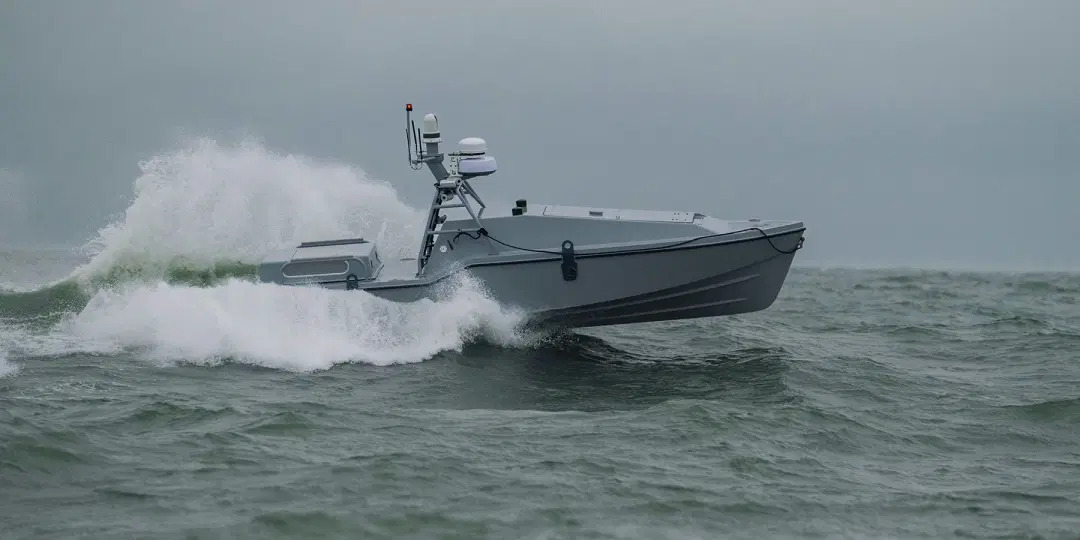
An image of the Corsair autonomous surface vessel developed by Saronic Technologies racing across the surface of a blue-gray ocean with white water foam in its wake.

The Corsair autonomous surface vessel developed by Saronic Technologies is one of the drone boats in the US Navy’s service.

The Corsair autonomous surface vessel developed by Saronic Technologies is one of the drone boats in the US Navy’s service. Credit: Saronic Technologies

A history of drone boat violence

The United States is far from the first country to have used exploding drone boats, also colloquially described as kamikaze or suicide drone boats. The first confirmed use of such weapons occurred on January 30, 2017, when the Houthi faction based in Yemen struck the Royal Saudi Naval frigate Al Madinah using an uncrewed remote-controlled boat. A US Navy commander told Defense News that the Houthi weapon was likely developed with the technical assistance of Iran, which has long supported the Houthis.

In more recent years, the Ukrainian military has also developed and deployed drone boats for asymmetric warfare at sea since Russia launched a full-scale invasion of Ukraine in February 2022. Despite lacking a traditional navy, Ukraine has used a combination of flying drones and explosive drone boats to strike Russian warships and tankers, forcing Russia to withdraw its Black Sea Fleet to bases farther from Ukraine and cutting off vital Russian shipping routes.

Ukrainian drone boats have also achieved several milestones in military history by using missiles to shoot down Russian helicopters and acting as surface platforms to deploy small flying drones to strike Russian air defenses. Most recently, a Ukrainian drone boat even deployed an armed ground robot onto contested coastal territory in an unprecedented amphibious operation.

It’s unclear how the US military may continue deploying drone boats as President Donald Trump once again ramps up the war with Iran following the collapse of a supposed ceasefire. The US drone boat strikes came as part of a broader attack by conventional US military forces on Iranian targets in recent days, including strikes by US fighter aircraft and warships.

The US military has also been using one-way aerial attack drones for the first time during its war with Iran—LUCAS drones based in large part on Iranian-developed Shahed drones. Along with the drone boats, the United States is following the example of less powerful countries or factions that have used inexpensive drone weapons to pursue asymmetric warfare. The US military is currently trying to procure a new generation of cheaper surveillance and strike drones, especially after losing dozens of costly hunter-killer Reaper drones collectively worth more than $1 billion in the war against Iran.
Prepare for wild and dangerous scenarios on the Korean Peninsula

0
prepare-for-wild-and-dangerous-scenarios-on-the-korean-peninsula
Prepare for wild and dangerous scenarios on the Korean Peninsula

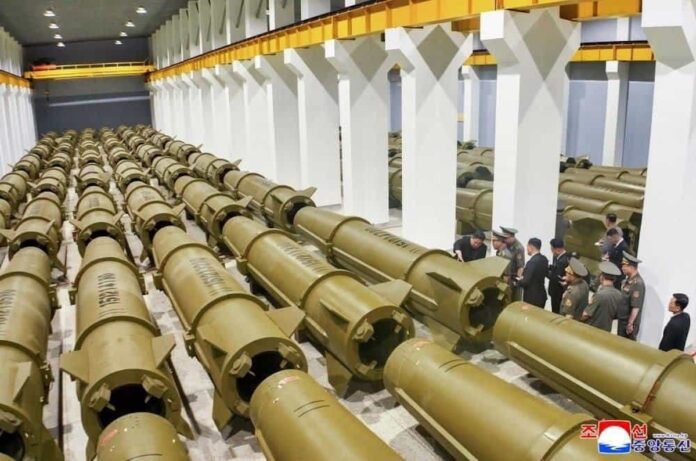
Kim Jong Un inspects Hwasong missiles in storage this month. Photo: KCNA

North Korea and Russia have approaches to the value of human life and risk that are radically different from those of the West – a reality that US and South Korean defense planners must prepare for.

State-sanctioned violence and militarism form the foundation of the rejuvenated North Korea-Russia partnership, and that should shape how US and South Korean alliance planners read the North’s tolerance for risk. 

But the relationship lacks the dynamics of 21st-century alliances. North Korea and Russia share no ethnic or religious linkage, no common political system and no joint economic vision. They do not trade goods and services to improve domestic living conditions. They trade weapons, ammunition, and soldiers to destabilize regions.

Both regimes accept far higher human costs than democratic governments do, and that is the assumption that the United States and South Korea should carry into any contingency planning.

In a 2003 essay, political theorist Achille Mbembe explained the concept of necropolitics and said that “the ultimate expression of sovereignty resides, to a large degree, in the power and the capacity to dictate who may live and who must die.”

Using necropolitics as a conceptual framework to explain the North Korea-Russia relationship allows us to see this partnership in a different light. Unlike the collective West, which traditionally upholds universal human rights and the rule of law, the North Korean and Russian regimes view these liberal values and principles as inherent weaknesses.

The inability of Western publics to stomach high body counts in war and sacrifice economic stability for military needs is seen as a strategic opportunity for the dictatorships in Pyongyang and Moscow.  

While Mbembe mainly uses necropolitics to explain the Israel-Palestine situation, extending this idea to diplomacy is a useful tool for explaining international partnerships such as the North Korea-Russia relationship that fall outside traditional definitions of alliance structures.

The North Korea-Russia partnership is centered around facilitating the means and ends of warfare. With both nations on a permanent wartime footing, Kim Jong Un offers artillery shellssoldiers, and landmine sweepers to Vladimir Putin in exchange for military technology. The two nations send each other the tools and instruments of death.

What makes this different from arms sales between democracies is the fact that this military-centered trade between Pyongyang and Moscow forms the core of this diplomatic partnership. While the United States may sell weapons systems to South Korea and vice versa, the two governments do not see those arms sales as the primary driver of the alliance. 

Beyond the diplomatic realm, necropolitics defines North Korean and Russian domestic politics. Russian dissidents “accidentally” fall out of apartment windows or end up in Siberian gulags. Kim enlarges an already expansive political prison system and ruthlessly kills potential political rivals, including his half brother.

Most of the people living in both North Korea and Russia would qualify under Mbembe’s category of the “living dead.” Malnourishment and the inability to escape precarious socioeconomic conditions characterize much of life in the rural regions of both countries.

Moreover, the mandatory military conscription of North Korean and Russian men renders them as living in a “death world” where personal agency is taken away and their lives are at the whims of their commanders. 

More than 350,000 Russian soldiers have died in Putin’s war against Ukraine. This gruesome statistic parallels Stalin’s disregard for human life during World War II. While many in Washington and Seoul see these body counts as a sign of Russian weakness in the war, it is useful to remember that dictators do not view humanity similarly.

These illiberal necropolitical values, embraced by Pyongyang and Moscow, change the risk calculus on the Korean Peninsula. While most pundits do not believe Kim would be foolish enough to launch a full-scale invasion of South Korea, it is still worthwhile to understand that the North approaches risk and the value of human life from an entirely different perspective.

While South Korea has matured into a robust liberal democracy with strong institutions and rule of law, North Korea has descended into Kim’s personal fiefdom. With absolute control of party-state affairs, he willingly sacrificed thousands of his own soldiers for a conflict in a faraway European theater. It is therefore useful to consider that Kim might be willing to do something equally reckless on the Korean Peninsula to pursue his own goals. 

The inability to understand the nature of the North Korean regime has long clouded analyses and assessments of the Kim family regime. But despite the opacity of North Korea’s inner workings, it is clear from defector testimony and human rights organization reports that Pyongyang has a radically different conception of the value of individual human life.

Given this fact and Pyongyang’s history of reckless behavior, it is imperative that both Washington and Seoul prepare for wild and dangerous scenarios on the peninsula. While Kim is not an irrational figure, he operates from an entirely different vantage point that only a handful of other dictators in the world understand. 

Benjamin R. Young is an assistant professor of intelligence studies at Fayetteville State University and a non-resident fellow at the Korea Economic Institute of America. KEI originally published this article, which is republished with permission. The views expressed here are the author’s alone.

Wife Grabs onto Husband’s Legs After He was Sucked Out of Plane

0
wife-grabs-onto-husband’s-legs-after-he-was-sucked-out-of plane
Wife Grabs onto Husband’s Legs After He was Sucked Out of Plane


A wife has described the terrifying moment she grabbed onto her husband’s legs after he was pulled toward a shattered window on a Ryanair flight at 20,000 feet.

Svetlana Grković said she reacted on instinct when her husband, Ljubiša Karović, was suddenly thrown into a nightmare scenario during a Friday flight from Thessaloniki, Greece, to Memmingen, Germany.

The couple, who are from Serbia, had been returning from a summer holiday in Greece when chaos erupted on board Ryanair flight FR1879.

According to passengers, there was a deafening bang shortly after takeoff. Moments later, a window beside Karović shattered after what Grković described as part of the engine breaking away and striking the aircraft.

The Boeing 737-800 was forced to turn back and make an emergency landing in Thessaloniki.

“It was as if a part of the engine broke off and hit the window next to which my husband Ljubiša was sitting,” Grković told Nova.

What happened next left passengers fearing they might not survive.

Karović, who had been sitting next to the window, was pulled toward the opening. His wife said she immediately grabbed his legs and refused to let go.

“I reacted immediately and grabbed his legs,” she said. “I thought: ‘If we die, we die together.’ It was horrible.”

Grković reportedly held onto her husband for about five minutes before other passengers were able to help pull him back inside the cabin. Oxygen masks dropped as panic spread through the plane.

“Some people came to my aid,” she said. “I remember one man and one woman. That man helped me a lot, Ljubiša and I.”

Grković said she wants to find and personally thank the passenger who helped save her husband’s life.

Karović remains in the hospital and is believed to be unable to speak because of his injuries. His wife said his hand is badly injured and that he suffered a series of burns, including friction burns. He is also reportedly in severe shock.

She said her husband lost consciousness several times during the ordeal and has little memory of what happened.

One passenger told Informer that Karović was lucky he had not unbuckled his seat belt.

“His wife Svetlana Grković held his legs for five full minutes, until the other passengers ran to help and managed to pull him back into the cabin,” the passenger said.

Another witness told Greek broadcaster ERT that the man’s “head and shoulders were sticking out of the broken window.”

Passengers said they feared the plane “wouldn’t make it” as it flew for around 30 minutes with the damaged window.

One traveler who had been sitting toward the back of the plane said they initially had no idea what had happened.

“We thought we were falling,” the passenger said. “We were wearing oxygen masks, we didn’t know if we would make it.”

The same witness said Karović “had blood on his head” and “fainted several times.”

Footage reportedly shared by a Ryanair flight attendant appeared to show damage to the aircraft after the incident, including a missing engine blade, a smashed window, and a large hole in the side of the engine casing.

A Ryanair spokesman told the Daily Mail that the flight returned to Thessaloniki shortly after takeoff after “a passenger window dislodged inflight.”

“The aircraft landed normally and passengers returned to the terminal,” the spokesman said.

The airline said one passenger requested and received medical assistance on the ground in Thessaloniki.

“To minimise any delay, a replacement aircraft was arranged to bring passengers to Memmingen which departed Thessaloniki at 9.53am local this morning,” the spokesman added.

According to publicly available flight data, the plane landed back in Thessaloniki after one hour and 14 minutes.

A pregnant woman who was also on board was taken to the hospital, according to local media. She is reportedly in good health and has since been released.

The president of the Panhellenic Federation of Public Hospital Employees, known as POEDIN, said the incident came dangerously close to disaster.

He claimed there was “almost a tragedy” and said the damaged window gave way before part of the passenger’s body was pulled outside the aircraft.

Karović is from Vrnjačka Banja in central Serbia, but has spent much of his time in Greece, where he sells and rents apartments in the resorts of Paralija and Olympic Beach.

For Grković, the horror of the flight came down to one instinctive choice: hold on, no matter what.

Trump’s Intel Pick Played Key Role in NYT Subpoenas — But Some Democrats Still On the Fence

0
trump’s-intel-pick-played-key-role-in-nyt-subpoenas-—-but-some-democrats-still-on-the-fence
Trump’s Intel Pick Played Key Role in NYT Subpoenas — But Some Democrats Still On the Fence


Progressive groups are demanding that Democrats on the Senate Select Committee on Intelligence oppose Jay Clayton’s nomination as director of national intelligence, pointing to his role in an attempt to intimidate the New York Times over critical reporting on the Trump administration.

Some key Democrats, however, have so far not committed to opposing President Donald Trump’s nominee for the nation’s top intelligence job.

Clayton, who serves as the top federal prosecutor in the Southern District of New York, signed the subpoenas sent Friday that targeted New York Times journalists for their reporting on serious security flaws in the Qatari-donated Air Force One jet.

“It seems Jay Clayton is up to his eyeballs in sending intimidation subpoenas to reporters.”

Two Democrats on the intelligence committee did not indicate whether the subpoenas were a dealbreaker for Clayton’s nomination, which is set to be the subject of a Wednesday hearing.

Sen. Mark Warner, D-Va., the vice chair of the committee, has not said whether he intends to vote in favor of Clayton’s nomination. He previously praised Clayton for having the “right temperament” when Trump tapped him, but has said he still wants to press the prosecutor about whether he will use the DNI post to pursue Trump’s 2020 election obsession.

Asked for comment about the subpoenas Tuesday, Warner said he anticipated that Clayton would be quizzed about the matter during his hearing.

“I think it’s important that we stand up for the independence of the press,” he said.

When asked by The Intercept whether the subpoenas were disqualifying for Clayton’s nomination, fellow intelligence committee member Sen. Mark Kelly, D-Ariz., said, “I’ve got questions about it.”

The cautious position staked out by the Democrats stood in sharp contrast to that of Sen. Ron Wyden, D-Ore., the committee’s longest serving member and a frequent skeptic of the intelligence agencies when it comes to civil liberties. In a social media post Sunday, Wyden noted that federal agents hand-delivered some of the subpoenas to the reporters who co-authored the article.

“It seems Jay Clayton is up to his eyeballs in sending intimidation subpoenas to reporters and armed thugs to their homes,” Wyden said. “This is not acceptable in a DNI.”

Dems Pushing for Clayton

The subpoenas came at an awkward moment for some Democrats in Congress aligned with the intelligence community. Those Democrats, including Connecticut Rep. Jim Himes, the ranking member of the House Permanent Select Committee on Intelligence, had hoped to swiftly confirm Clayton in order to cut short the temporary appointment of housing czar Bill Pulte as director of national intelligence.

Clayton was seen by Democrats such as Himes as an acceptable alternative to Pulte, who was handed the reins of the country’s intelligence apparatuses with a mandate from Trump to stoke baseless conspiracy theories about the 2020 election.

Some Democrats like Wyden, however, have noted that Clayton himself has also publicly indulged in election fraud conspiracy theories.

His role in the subpoenas should make him a non-starter for intelligence chief, a coalition of progressive groups including Indivisible and Reporters Without Borders said in a letter Monday.

“Members of Congress across the aisle have embraced Clayton as a more respectable option than Pulte and hope to see the nomination process quickly,” the groups said. “Measuring Clayton’s qualifications against Pulte’s rather than the demands of the office would be a detriment to national security.”

Caitlin Vogus, a senior adviser with Freedom of the Press Foundation, said intelligence committee members should grill Clayton over the subpoenas.

“Anyone who hides behind fabricated ‘national security’ claims to demand journalists expose confidential sources can’t be trusted to lead America’s intelligence agencies,” Vogus said in a statement to The Intercept. “Senators should demand to know whether Clayton issued these outrageous subpoenas at the explicit behest of the White House, and whether he’d use similar tactics as DNI against journalists and whistleblowers who expose intelligence failures or abuses.”

Trump admin puts Americans in Congo on “do-not-board” list, barring return

0
trump-admin-puts-americans-in-congo-on-“do-not-board”-list,-barring-return
Trump admin puts Americans in Congo on “do-not-board” list, barring return

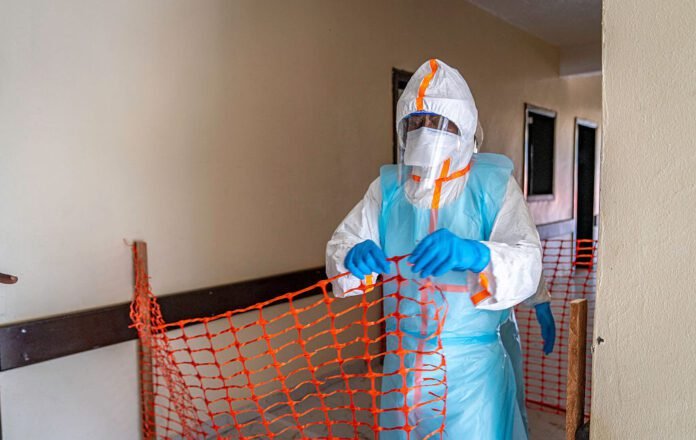
The Trump administration on Monday barred US citizens in the Democratic Republic of the Congo from returning home amid an Ebola outbreak that continues to outpace response efforts.

Reuters first reported late Monday that Americans currently in the DRC or those who have recently traveled to the Ebola-stricken country have been put on a “do-not-board” list. They cannot travel back to the US until they have spent 21 days in a third country. The order, taken under a transportation authority known as Title 49, was independently confirmed by Politico on Tuesday.

Both outlets noted that roughly two dozen Americans who had been set to board flights home on Tuesday have already been blocked by the new rule. It remains unclear if the bar also applies to government workers. The Centers for Disease Control and Prevention has at least two dozen employees working in the DRC.

The move adds to the already extremely stringent and controversial travel restrictions imposed by the Trump administration in an effort to wall itself off from the outbreak. Health experts continue to be critical of such restrictions, as they have historically been unsuccessful and harmful. Specifically, they discourage countries and people from being transparent about outbreaks and disease risks, hurt economies, and create stigma. There is also concern that such restrictions will limit humanitarian aid workers.

Ebola threat

Ebola is not a disease that readily spreads like respiratory viruses. It transmits via contact with bodily fluids while people are actively sick or recently deceased. It has been described as a disease of compassion because it primarily spreads to family, loved ones, caregivers, and medical personnel who have extensive contact with cases when they are most ill and infectious. In other words, it’s not a disease one would pick up by sitting next to someone who is merely coughing on an airplane.

According to the CDC, “do-not-board” lists are intended to bar travelers who are “known or suspected to have a contagious disease,” not simply anyone who has been in a country with an outbreak.

Still, if people unknowingly carried Ebola into the US, the country is well-equipped to handle the situation. The US has built an elite network of medical facilities that can safely isolate Ebola patients while offering high-quality care.

In past Ebola outbreaks, no such stringent travel restrictions were implemented, and the US repatriated eight cases for high-level care. None of the repatriated patients transmitted the virus.

Amid the Trump administration’s isolationist strategy, the World Health Organization is warning that the outbreak continues to spread out of control. On Tuesday, the United Nations health agency said it has less than half the funding it needs to properly respond to the outbreak. WHO has struggled with funding after the US withdrew its membership, removing a significant funding source.

WHO said last week that four out of every five new Ebola cases have no link to known cases, indicating undetected spread. Officials warned that the true scale of the outbreak could be two- to four-times larger than current case counts. As of July 14, the DRC is reporting 1,963 cases and 719 deaths.

South Korean strategy responds deftly to Trump’s unpredictability

0
south-korean-strategy-responds-deftly-to-trump’s-unpredictability
South Korean strategy responds deftly to Trump’s unpredictability

US President Donald Trump’s whimsical and profoundly ill-advised war against Iran has shredded the US reputation for probity. Trump committed a huge strategic blunder. The global consensus views the current crisis as an artificial emergency, and US allies are now suffering for Trump’s mistakes, both economically and potentially militarily, for example by the unilateral redeployment of PAC-3 and THAAD missile defense systems from East Asian allies to the Middle Eastern theater.

So what is the impact of the US-Iran War, specifically on the South Korea-US Alliance? Amid the international disorder generated over the past nine months by Trump’s military interventions in Venezuela and Iran, South Korean President Lee Jae Myung has pursued a strategy of “Pragmatic Diplomacy Centered on National Interest.”

Prioritizing national interest is a universal goal for any sovereign state, but this author initially doubted whether such a pragmatic approach could effectively counter the current US National Security Strategy and National Defense Strategy – which are distinctively unilateral and coercive, aggressively demanding increased burden-sharing from allies.

Upon deeper analysis, however, the pragmatic diplomacy of the Lee Jae Myung administration has proven to be a highly substantive, practical, and effective national security strategy for protecting South Korea’s interests against President Trump’s erratic behavior, for several reasons:

First, with a US administration that unilaterally takes unpredictable military actions, driven by the principles of America First and “Make America Great Again,” President Lee’s pragmatic diplomacy offers helpful flexibility. In contrast, a rigidly principled, conventional response would be of little use when the US routinely ignores its own strategic doctrines and international law in favor of President Trump’s personal whims.

Second, historically, whenever the US released a new National Security or National Defense Strategy, its allies would rush to publish their own corresponding security and defense blueprints, to align their roles with the US During the current Trump administration, however, very few allies have issued formal written responses, having concluded that proactively committing to specific principles and roles offers no strategic advantage.

Third, under previous US administrations, international law served as the ultimate shield for smaller nations resisting superpower coercion, but President Trump has repeatedly disregarded such niceties. US allies are therefore shifting toward flexible, case-by-case strategies tailored to make the best of Trump’s erratic behavior, rather than naively relying on international law as a fixed rule.

Accordingly, South Korea and other nations are focusing less on formal US strategic documents and more on monitoring where Trump’s personal attention is moving, adopting a “situation-to-situation response” framework.

This dynamic explains why President Trump’s call for allies to join a coalition against Iran’s blockade of the Strait of Hormuz was met with a lukewarm response, since US allies felt that Trump had manufactured the crisis himself. Encountering difficulties, Trump began aggressively bullying allies, including South Korea – one of the primary users of the strait – to deploy forces to help him out.

This coercive approach, was more appropriate for a primary school child than for an American president. Trump complained, for example, that the UK was not helping, then said that he did not need British help – and, anyway, UK forces were useless. Public opinion about Trump, as well as the US, has turned sharply negative in Trump’s second turn, this reversal being particularly strong in South Korea.

In fact, President Lee’s pragmatic diplomacy has secured a number of substantial concrete achievements, as detailed in this table:

Key Achievement Area Specific Outcome & Strategic Leverage
ROK–US Summits Minimized the fallout of Trump’s tariff wars, leveraging commitments for large-scale South Korean investment in the US and its domestic shipbuilding base.
Nuclear Technology Support Alleviated doubts regarding the US extended deterrence commitment by securing US support for South Korea’s civilian and naval nuclear technology, formalized in a Joint Fact Sheet released by the White House on November 13 last year.
Indigenous SSN Project President Lee personally took charge of the ROK Navy’s independent nuclear-powered attack submarine (SSN) program. On May 26, he chaired the historic 1st Future Defense Development Committee at the Submarine Command in Jinhae. A US working-level inter-agency delegation visited Seoul on June 12 for a two-day kick-off meeting, agreeing to hammer out technical specifics in upcoming expert panels.
OPCON Transition Roadmap Announced a concrete roadmap for the transition/recovery of Wartime Operational Control (OPCON) to the ROK Armed Forces. Operating under the reality that the terms of both administrations conclude in 2028, Seoul is actively pushing the Trump administration to establish the end of 2028 as “X-Year” for the final OPCON handover.

We are now entering a transitional phase which requires a fundamental reinterpretation of the South Korea-US alliance. The role of United States Forces Korea (USFK) is changing, and a new division of labor between USFK and the Republic of Korea military is required. Trump has asserted that while the US will handle global confrontations with China and Russia, allies must increase their defense spending to counter regional military threats within their respective theaters, a concept he describes as a “decent peace.”

In support of a stronger role for its military, South Korea has emerged as the world’s fourth-largest defense exporter, very capable of mass-producing the heavy weaponry and hardware vital for modern and future warfare. Indeed, at the recent G7 meeting, President Trump explicitly asked President Lee, Can South Korea urgently build 10 naval warships for the United States?” and President Lee responded, “In the spirit of our 70-year alliance, and with South Korea’s world-class defense industrial capacity, we are fully capable.”

On June 23, the New York Times published an op-ed arguing that even a global superpower like the United States cannot maintain its status without allies, and must therefore delegate roles and missions to them. This logic aligns nicely with President Lee’s policy of building a self-reliant defense and a strong military, which does not imply isolating the ROK military, it means evolving into a highly complementary military alliance with USFK.

The OPCON transition will boost the ROK military’s expertise in combined operations and significantly strengthen the mission capability of the ROK Joint Chiefs of Staff. While some critics point out that only a small minority of ROK generals have fully digested the combined operational plan, OPLAN 5015, this transitional window is precisely the time to pivot toward a South Korean-led combined operations framework.

Trump’s America First policy threatens to alter the traditional contours of the combined defense posture, as seen for example by the recent provocative comments of USFK Commander General Xavier Brunson about the Korean Peninsula being a “dagger” aimed at China. We must seize this opportunity: it is time for the ROK military to take the steering wheel and guide USFK forward.

Domestic security and military analysts have had a tendency to treat the ROK–US alliance as eternal and unshakeable. This needs to change. In the past, assignments to the ROK–US Combined Forces Command were often seen as marginal, and were sometimes filled by officers waiting out the time until retirement. The OPCON transition will require a drastic change in this mindset: only the best of the best will do for the core of our combined defense commands.

This will enable the ROK military to take the lead in upgrading our defensive posture against North Korea, moving from a legacy-based, conventional framework to build an advanced, future-warfare-ready capability. Our next generation of military leaders will guide USFK and design future operational doctrines, using OPCON recovery as a springboard to a genuinely strong military.

OPCON transfer has been discussed since 2007, but its execution has long suffered from political timidity. At the working level, staff worried more about their English language proficiency than about strategic command. Today, the English language capability of ROK service members ranks among the highest in the world.

What does the Trump administration, or any subsequent administration, really want from South Korea? Surely, they need a strong, self-reliant, and capable ally. It is time to trust the institutional capacity of the ROK military to back our pragmatic diplomacy with hard power, and time to get on and complete the OPCON transition.

Captain Sukjoon Yoon (ROK Navy, Ret.) is a Policy Advisory Committee Member, Ministry of National Defense, since last December and a visiting research fellow, Korea Institute for Military Affairs (KIMA).

Israel kills 11 Palestinians, including police chief, in Gaza

0
israel-kills-11-palestinians,-including-police-chief,-in-gaza
Israel kills 11 Palestinians, including police chief, in Gaza

At least 11 Palestinians, including the director of the police station in Jabalia refugee camp, and several police officers, were killed Tuesday in a series of Israeli attacks across the Gaza Strip, according to Palestinian officials.

The strikes came amid continued Israeli violations of the ceasefire that took effect on Oct. 10, 2025.

The bodies of seven Palestinians, including a woman, were taken to Al-Shifa Medical Complex and the American field hospital after an Israeli strike near Shadia School in the Al-Falouja area west of Jabalia refugee camp, a medical source told Anadolu.

In a statement, the Gaza Interior Ministry said those killed included Col. Mohammed Marwan Salem, director of the Jabalia refugee camp police station, along with several police officers and personnel, after an Israeli strike targeted a police post in the area.

An Israeli drone struck the police post in an area crowded with tents sheltering displaced Palestinians and temporary evacuation centers, witnesses told Anadolu.

READ: Katz boasts of Gaza’s destruction, says it is the result of a ‘well-thought-out policy’ and announces plan for three military outposts

Two Palestinians were also killed in Israeli shelling of a tent southwest of Gaza City, a medical source said.

In a separate incident earlier Tuesday, one Palestinian was killed and three others were wounded when an Israeli drone struck a tent housing displaced people near the Tayba Towers area west of Khan Younis in southern Gaza, the source added.

The identity of the person killed in that strike was not immediately available, and the conditions of the wounded were unknown.

In another incident, the same source said child Moataz Abu Shaar was killed by Israeli army gunfire in the Al-Mawasi area of Rafah in southern Gaza.

According to the Gaza Health Ministry, Israeli attacks since the ceasefire began have killed 1,108 Palestinians and injured 3,578 others as of Monday.

Since Israel’s genocide began on Oct. 8, 2023, more than 73,000 Palestinians have been killed and more than 173,000 injured, according to the ministry. Palestinian authorities say about 90% of Gaza’s civilian infrastructure has been damaged or destroyed.

READ: Pro-Palestinian activist Mahmoud Khalil sues Heritage Foundation, Stephen Miller, others

Is Syria Ready for American Investment? First US-Syria Business Forum Tests New Economic Opening

0
is-syria-ready-for-american-investment?-first-us-syria-business-forum-tests-new-economic-opening
Is Syria Ready for American Investment? First US-Syria Business Forum Tests New Economic Opening


Syrian journalist Ayman Abdel Nour told TML: “There is no reason to wait until every sanction is removed. The government should begin eliminating obstacles facing investors now. Those who move early will be best positioned to benefit.”

[DAMASCUS] Government officials and Syrian-American business leaders gathered in Damascus on Monday for the first US-Syria Business Forum held in the country, seeking to transform recent political rapprochement between Damascus and Washington into tangible economic partnerships and investment opportunities.

The forum brought together members of the US-Syria Business Council, Syrian-American investors, seven cabinet ministers, the governor of the Central Bank of Syria, the head of the Syrian Investment Authority, and dozens of Syrian business leaders.

The gathering comes months after significant shifts in US-Syria relations, including Washington’s easing of some economic restrictions and the launch of the process to remove Syria from the US list of state sponsors of terrorism, developments widely viewed as opening the door to renewed economic engagement after years of isolation.

Participants watch a recorded address by Jacob McGee, Deputy Assistant Secretary of State, during the opening session of the First Annual US-Syria Business Forum in Damascus. (Ayman Abdel Nour)

Leading the initiative is Jihad Al-Salqini, president of the US-Syria Business Council, an organization established to strengthen commercial ties between the two countries and encourage members of the Syrian diaspora to invest in Syria. Before convening its first forum in Damascus, the council had organized three previous business forums in the United States.

Al-Salqini said the event is primarily about rebuilding confidence rather than triggering an immediate wave of American investment.

“This forum is first and foremost about rebuilding trust and reopening channels of communication between the business communities in both countries,” Al-Salqini said in exclusive comments to The Media Line.

We do not expect companies to enter the Syrian market immediately, but this forum is an important first step

“American investment requires time, feasibility studies, and legal and financial guarantees. We do not expect companies to enter the Syrian market immediately, but this forum is an important first step that can pave the way for future investments.”

According to Al-Salqini, American companies have already expressed interest in opportunities in energy, technology, agriculture, food industries, healthcare, infrastructure, and logistics, although most inquiries remain exploratory rather than investment commitments.

“The biggest obstacle remains uncertainty,” he said. “American investors need legal clarity, financial stability, and confidence before committing capital.”

The biggest obstacle remains uncertainty,” he said. “American investors need legal clarity, financial stability, and confidence before committing capital

He added that the US-Syria Business Council has spent recent years building networks between entrepreneurs in both countries, organizing business events, and introducing American companies to opportunities in Syria.

Looking ahead, he said the council aims to facilitate partnerships, provide market information, and help address obstacles facing bilateral economic cooperation.

Asked what advice he would offer an American investor considering Syria, Al-Salqini replied, “I would encourage them to visit Syria themselves, see the reality on the ground rather than relying on preconceived impressions, carefully study the market, and begin with well-planned projects alongside trusted local partners.”

I would encourage them to visit Syria themselves, see the reality on the ground rather than relying on preconceived impressions

He added, “Syria offers significant opportunities during its economic recovery, but success requires a thorough understanding of the market and prudent risk management.”

Central Bank Governor Safwat Raslan said Syria has entered “a new phase based on stability, reform, and economic openness,” stressing that the government welcomes investors from around the world as partners in rebuilding the country’s economy.

In exclusive remarks to The Media Line, Raslan said the greatest remaining challenge is reconnecting Syria’s financial sector with the international banking system.

“We have made positive progress on many fronts,” he said. “However, the biggest challenge is completing Syria’s reintegration into the global financial system by expanding correspondent banking relationships and facilitating international payments and transfers. These are essential steps for any international investor.”

Raslan said the Central Bank continues to strengthen financial regulations, anti-money laundering measures, and international compliance standards while rebuilding banking relationships abroad, steps he believes will significantly improve investor confidence.

These efforts come as international institutions estimate that rebuilding Syria’s devastated infrastructure will require hundreds of billions of dollars, making foreign investment one of the country’s most pressing economic priorities after more than a decade of conflict.

Meanwhile, Syrian journalist and political analyst Ayman Abdel Nour, who divides his time between Syria and the United States, cautioned against overstating the forum’s significance.

“The forum is important, but it would be an exaggeration to describe it as the real turning point,” Abdel Nour told The Media Line exclusively.

“The real turning point came when US President Donald Trump announced the process of ending the effects of the Caesar Act sanctions and later launched the process of removing Syria from the list of state sponsors of terrorism. Those developments laid the foundation for today’s economic opening.”

Abdel Nour noted that the Damascus forum follows three previous US-Syria Business Council events held in the United States and reflects growing government interest in rebuilding economic ties with Syrian American investors.

Panel discussion on “Investing in Syria: Legal and Practical Considerations,” bringing together representatives of the Syrian Investment Authority, international legal experts, and private-sector executives. (Ayman Abdel Nour)

He argued that while investment opportunities are emerging, legal and financial reforms must continue.

“There is no reason to wait until every sanction is removed,” he said. “The government should begin eliminating obstacles facing investors now. Those who move early will be best positioned to benefit from future opportunities.”

Not everyone, however, believes the focus should remain solely on large-scale investments.

Mazhar Makhlalati, founder of the financial technology company Likasa, said small and medium-sized enterprises received too little attention during the forum.

“I hoped to hear clear government plans to support SMEs through financing programs and partnerships with banks,” Makhlalati said in exclusive comments to The Media Line. “This sector creates the largest number of jobs and forms the backbone of any healthy economy.”

Nevertheless, he praised the Finance Ministry’s decision to streamline Syria’s tax system, describing the move as an encouraging signal to investors and as evidence of a changing relationship between the government and the private sector.

Makhlalati added that while the forum did not yield immediate agreements for his fintech company, it created valuable networking opportunities that could lead to future partnerships.

He also argued that although technology will be one of Syria’s most important sectors in the future, the country’s immediate priorities should be rebuilding its energy sector and basic infrastructure.

Technology alone cannot drive development. Reliable energy and infrastructure must come first

“Technology alone cannot drive development,” he said. “Reliable energy and infrastructure must come first. Technology can then become a major engine of economic growth.”

Participants broadly agreed that the forum represents an important first step toward reconnecting Syrian American investors with Syrian institutions.

Whether it ultimately succeeds, however, will depend less on the meetings held in Damascus than on whether the momentum generated by the gathering can be translated into concrete investments supported by continued legal, financial, and banking reforms.

Microsoft’s Secure Boot has been broken for a decade and no one noticed until now

0
microsoft’s-secure-boot-has-been-broken-for-a-decade-and-no-one-noticed-until-now
Microsoft’s Secure Boot has been broken for a decade and no one noticed until now

An industry-wide standard Microsoft invented to protect Windows, and later Linux, devices from firmware infections has been trivial to bypass for 13 of its 14 years of existence. The discovery was made by researchers at security firm ESET after identifying 11 firmware images, at least one from 2013, that were known to be defective but remained signed by the software company anyway.

The images are known as shims, which were invented to extend Secure Boot to Linux devices and utility software. Using a technique simple enough to be performed by novice hackers, these old, forgotten shims can be used to completely circumvent the protection, which is embedded into the UEFI (Unified Extensible Firmware Interface) of the device’s motherboard. The gaffe is the result of Microsoft, which oversees the signing of shims, failing to revoke the publicly available images once vulnerabilities were found in them.

Threat extends to Windows and Linux users

The threat extends to Windows and Linux users alike, since the shim can be installed on devices running both operating systems. From there, an attacker can subvert the mandated chain of digitally signed firmware to install malicious firmware that loads early in the boot process and persists after either the OS is reinstalled or a hard drive is replaced.

“What makes these old shims dangerous is not a novel vulnerability,” ESET researcher Martin Smolár wrote Tuesday. “It’s that no new vulnerability is needed to bypass UEFI Secure Boot. An attacker needs no complicated exploitation primitives—only a copy of an old, still-trusted, but unrevoked shim binary and a basic understanding of how UEFI shims work. That is enough to bypass such an essential security feature as UEFI Secure Boot.”

Secure boot was introduced in 2012 to blunt the threat of bootkits, the term for such malicious firmware. Without Secure Boot, attackers with brief physical access to a device—even when it’s turned off—can install bootkits similar to LoJax used by Russia state hackers in 2018, MosaicRegressor found in 2020, CosmicStrand in 2022, and BlackLotus in 2023. A handful of other in-the-wild bootkits are tracked under names including ESpecter, FinSpy, and MoonBounce.

Most but not all bootkit malware requires attackers to have physical access to targeted devices. Such access is one of the threat models Secure Boot is explicitly required to protect against.

A list of all 11 shims compiled by CERT shows that some were used by Linux distributors such as Redhat, OpenSuse, and Oracle. Others were part of third-party software such as PC-Doctor Finland’s Matriculation Examination Board. Many of them were built before certain protections, including SBAT and MOK deny lists, existed. Others contain accumulated bugs in their code or in second-stage binaries they authorize.

Microsoft’s digitally signed UEFI bootloader for Windows is the sole anchor of trust on Windows machines. For a component to load during the boot process, the certificate must explicitly sign all other code executed during bootup.

Shims work differently. They’re a secondary trust anchor, and they’re signed by Microsoft using one of its other UEFI certificates. From there, a certificate belonging to the motherboard or software maker that is embedded into the shim authorizes all software that’s subsequently loaded.

When vulnerabilities are found in shims, Microsoft revokes them. In the case of the 11 shims, the company failed to do so, in some cases for more than a decade. The company finally revoked them in its regular monthly patch release in June, after ESET brought them to CERT’s and Microsoft’s attention.

Complexity is the enemy of execution

Microsoft has yet to explain how or why the lapse occurred. One possible cause is the highly complex way that Secure Boot works. Both the Windows Boot Manager and UEFI shims load two databases. The db database lists all allowed signing certificates and Authenticode hashes. The dbx contains certificates and hashes that are no longer trusted. For a component to be loaded, it must be authorized through the db and not revoked in the dbx.

Given the high number of Linux components executed during bootup, listing each of them in these databases isn’t possible, since the dbx is allotted only 32kb of space. So Microsoft has resorted to other revocation methods, specifically SBAT (Secure Boot Advanced Targeting) and Secure Boot Security Version Number (SVN).

“In short, where dbx revokes binaries, SBAT and Microsoft’s Secure Boot SVN revoke versions,” Smolár explained. “When a vulnerability is found in a UEFI application supporting one of these version-based revocation mechanisms, what really needs to be kept out is every build up to and including the broken one—and that can be captured by a version number much easier than by a long list of hashes.”

Each component in the UEFI loader carries metadata that is signed by the same certificate authenticating the binary itself. This metadata names the component and assigns it a generation number that is incremented each time a new security fix ships.

A boot-only variable in the UEFI stores the minimum acceptable generation number allowed for each component. The variable number is enforced by the shim rather than the firmware.

The shim also embeds the policy so enforcement doesn’t rely exclusively on the external variable. This allows the incorporation of new policy through a mechanism known as the SbatLevel.

“At every boot, the shim first verifies its own SBAT metadata against the policy—so an outdated shim can be made to reject itself—and then applies the same test to every binary it loads, refusing anything whose generation number falls below the minimum that the policy demands,” the researcher wrote.

The complexity of the process doesn’t stop there. The upshot is that shims embed both a vendor-managed and built-in shim certificate that authorize all bootloaders and utilities loaded subsequently. Readers who want a more thorough description can consult this section of Tuesday’s post.

Further complicating the process, even the expiration of the Microsoft certificate that signed the shims, which took place late last month, isn’t enough to revoke the ones ESET identified.

A rogue’s gallery of defective shims

The shims identified by ESET authorize secondary components that are known to be vulnerable to various exploits. The Oracle shim, for instance, signs a binary vulnerable to CVE-2015-5381. Smolár said the skill required to exploit the vulnerability is low. Other vulnerable shims fail to support protections, such as MOK deny-list enforcement and SBAT enforcement, both of which came into effect after the affected shim was released. Still other identified shims contain vulnerabilities in their own code.

In the interest of brevity, many additional details included in Tuesday’s report are omitted from this article.

An unsettling prospect

As noted, these vulnerable shims can be used against Windows and Linux machines alike, although likely not Windows 11 Secured-core PCs in their default state. Any Windows user who has installed Microsoft’s June update batch is no longer vulnerable. Linux users should check the Linux Vendor Firmware Service or consult their distributor. Revocation statuses are available using the uefi-dbx-audit script.

The prospect that attackers have had the means to bypass Secure Boot for more than a decade through what amounts to hack-by-numbers scripts isn’t much of an endorsement of the mechanism proposed by Microsoft in partnership with hardware makers. As mentioned earlier, a key contributor to this debacle is its complexity.

“This is a solid rebuke of the entire secure boot model,” HD Moore, a firmware security expert, CEO and founder of runZero, and a long-time critic of Secure Boot, said in an interview. His complaints include Microsoft being the de facto root of trust for the entire UEFI platform, the inability of the protection to scale sufficiently, and the ability for components to boot even after top-level certificates expire.

“The end result is a huge number of unknown (to everyone but Microsoft) signed things that bypass Secure Boot—some of which can then be used to boot other things—and both have normal security bugs and other mistakes that mean they can be used to boot nearly anything,” Moore added. “The whole ecosystem is somewhat broken and needs a reboot.”

Myanmar’s conscription drive killing the junta from within

0
myanmar’s-conscription-drive-killing-the-junta-from-within
Myanmar’s conscription drive killing the junta from within

On June 21, in the hills of Hpapun Township in Karen State, the commander of the junta’s Light Infantry Battalion 19, Major Kyaw Min Thant, was killed by the bodyguard he had personally chosen from his own ranks — a forcibly conscripted civilian from Bago Region, abducted from his home five months earlier.

Within days, he and 21 other conscripts, several of them recaptured deserters under death sentence, walked into Karen National Liberation Army lines and defected.

The incident was emblematic of a controversial conscription policy that briefly gave the Myanmar junta the manpower to look like it was recovering after significant losses on the battlefield — and is now, two and a half years in, running out of runway.

Western policymakers being told the regime has “stabilized” should look hard at what the battlefield actually shows before they weigh engagement, sanctions relief or post-election recognition.

The bubble and its leaks

The Tatmadaw activated the dormant 2010 People’s Military Service Law on February 10, 2024, after losing more than half the country’s townships in a coordinated resistance offensive.

It has since inducted roughly 120,000 men through 25 conscription cycles, with over 60,000 forcible recruitments in 2025 alone — six times the army’s 2020 intake. Unlawful Conscription Watch has verified 32,974 individual cases between May 2025 and May 2026.

The conscripted manpower bought the regime a window. It let coup leader Senior General Min Aung Hlaing retake roughly 20 towns, including Falam, Lashio and Myawaddy, and push columns into Hpapun and Kyaukphyu, while expanded drone units, mechanized paratroopers and gyrocopters added new tactical options.

But resistance forces still controlled approximately 87 towns as of mid-May, and most of the junta’s headline “recaptures” are urban pinpoints — a battalion planted in a town center for a propaganda photograph, while resistance forces reorganize in the surrounding villages.

The 2024 law set a nominal two-year term for conscripts, and that clock has now expired for the first wave. Fearing the next intake will collapse if it doesn’t release anyone, the regime has let a token cohort go home. But the “emergency” clause lets it retain conscripts for up to five years, and it is using that clause aggressively.

Accounting for men killed at the front, disappeared or deserted, fewer than half of all conscripts have returned to civilian life. Only about 12% have been formally released.

Conscripts are sent to the front straight from training, in violation of the junta’s own February 2024 pledge. At Kyaukphyu’s besieged Taung Maw Oo naval base in Rakhine State, hundreds of new recruits have not helped to break the Arakan Army’s siege and are quickly winding up as casualties or deserters.”

Resistance fighters on the Karen front describe having to pause fighting periodically to let junta units collect the bodies of freshly conscripted troops killed in wave after wave.

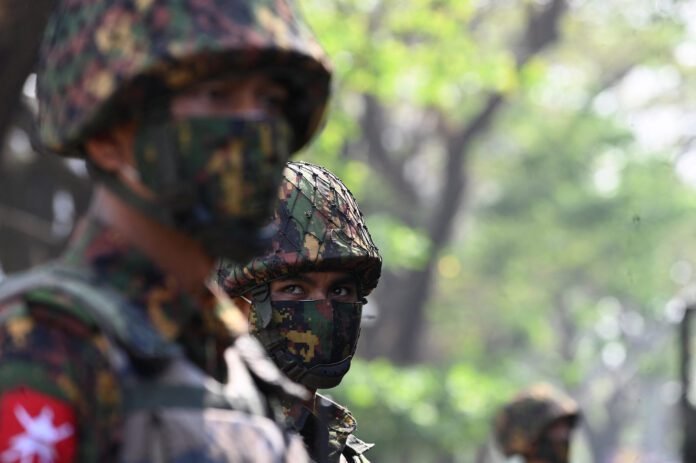
Desertion and defection have become structural features of the junta’s fielded force. The Hpapun conscript who killed his commander planned it from the moment his column left base, gained the officer’s trust to be assigned as bodyguard and coordinated 22 personnel in a single defection cluster.

Similar cases surface almost weekly. The resistance’s task, increasingly, is not to defeat these conscripts on the battlefield but to receive them when they cross the line.

Pinned down and undermanned

The junta is fighting simultaneous campaigns in every state and region except Yangon, and every front is bleeding manpower. In Arakan, an 18-month offensive has produced almost nothing; the Arakan Army now threatens Sittwe and Kyaukphyu, and allied formations are pushing into Ayeyarwady, Bago and Magway.

In Chin, the push from Hakha into Kanpetlet and Mindat has stalled. In Kachin, Regional Military Command 4’s offensive toward Shwegu has been broken up by repeated ambushes — the RMC commander himself was evacuated after being wounded.

In Sagaing, guerrilla interdiction has cut the regime’s main logistics corridors. In Karen, relief columns trying to reach the besieged Waw Lay Kone garrison have collided with intensified fighting around Minlatpan. In Karenni, the regime holds urban pinpoints and nothing more; in Tanintharyi, tempo is rising against a thin junta presence.

The unit picture is the most telling. All ten of the Tatmadaw’s Light Infantry Divisions — LIDs 11, 22, 33, 44, 55, 66, 77, 88, 99 and 101 — are simultaneously pinned to active fronts, with no strategic reserve rotating out to rest and refit.

Of the army’s 20 Regional Military Commands, 15 are committed to forward combat operations. RMC 16 was overrun and is being rebuilt from scratch in Lashio; RMCs 5, 9 and 15 have collapsed and cannot be reconstituted at all.

This is what strategic exhaustion looks like in an order of battle. The manpower the regime pulled in during 2024 and 2025 has been largely spent. The resistance is now destroying not just outposts but entire regime columns.

Shredded social contract

The Tatmadaw’s social contract with the Bamar majority is gone. Mandalay lawmakers have publicly likened the junta’s recruitment teams to human traffickers.

Yangon families stay indoors after 7p.m. to avoid overnight inspections, and a parallel extortion economy in deferment bribes has emerged around the ward administration system.

Skilled labor is fleeing. The International Organization for Migration (IOM) recorded 2.3 million registered Burmese migrant workers in Thailand alone, with undocumented numbers more than double that; three in four Myanmar youths are no longer in education or training. The World Bank warns of “long-lasting implications for productivity and household incomes.”

The border crisis originates on the ground that the junta itself controls. The narcotics, scam compounds and trafficking flows alarming Bangkok, New Delhi, Dhaka and Beijing all come out of territory where the junta either no longer governs or governs by predation.

The European Union (EU) has formally told the International Labor Organization (ILO) that Myanmar’s conscription and travel controls “expose workers to trafficking and forced labor across the migration cycle”; Thailand now repatriates detained Burmese nationals knowing men aged 18–35 are conscripted immediately on return.

The functional partners for border stabilization are the authorities actually administering those zones — the Karen National Union (KNU), the Kachin Independence Organization (KIO), the Arakan Army (AA), Chin National Front (CNF) and National Unity Government-aligned interim administrations — not a command structure in Naypyidaw that cannot police its own recruitment teams.

Civilian casualties are inflicted by the junta directly — and cannot be resolved by negotiating with it. Roughly 3.7 million people are internally displaced. The Office of the UN High Commissioner for Human Rights (OHCHR) documented 702 verified civilian deaths in the six months around the junta’s January 2026 election alone, including 224 women and 153 children, with airstrikes accounting for the majority.

These deaths are the operational pattern of a single belligerent — the same belligerent now abducting civilians to replenish the force that kills them with airstrikes.

The response that should follow is not another ASEAN Five-Point dialogue with the perpetrator. Rather, it should seek to degrade the perpetrator’s capacity to inflict harm on civilians through aviation-fuel sanctions, arms-supply interdiction and direct support to the resistance.

Proper international response

Min Aung Hlaing’s regime controls a smaller share of the population than at any time since 1962, and is fielding an army whose own soldiers are killing its officers, with its entire divisional structure committed forward without reserve.

Three implications follow. First, no recognition, sanctions relief or post-election engagement should rest on the claim that the regime has restored order. It has militarized the abduction of its own civilians, is hemorrhaging the soldiers it abducts and has burned through its strategic reserve.

Second, sanctions on the financial, aviation-fuel and arms-supply networks sustaining the conscription-and-airstrike model — particularly the Russian aviation-fuel pipeline and the regional banking conduits moving conscription-bribery revenue — remain the most effective non-kinetic levers available. There are no fresh divisions behind the ones now in the field.

Third, support for the NUG, federal-democracy coordinating bodies, ethnic resistance organizations and the defector-reintegration infrastructure is the highest-leverage strategic investment that can be made in Myanmar. Every conscript who crosses the line is a former junta soldier, a future federal-army cadre and a witness to the regime’s crimes.

The bodyguard in Hpapun was not a resistance fighter when his column left Kamamaung. He was a kidnapped civilian in a junta uniform. By the time he reached the front, he had chosen which Myanmar he intended to serve and live in.

International policy should be calibrated with the same recognition: federal-democratic Myanmar is not a future possibility to be debated, but a present reality being assembled by the people the junta itself is forcing into a choice.

James Shwe is an independent Myanmar American democracy advocate based in California, writing on Myanmar resistance strategy, sanctions enforcement, and Indo-Pacific policy.

0FansLike
0FollowersFollow
0FollowersFollow
0SubscribersSubscribe
- Advertisement -
Google search engine

Recent Posts