The US government warns that Russia state hackers are coming after your router
The federal government is warning users of home and small office routers to secure their devices as Russia state hackers continue to mass-compromise them for use in obscuring nefarious actions against sensitive organizations in the public and private sectors.
Both the Russian and Chinese governments have been compromising routers for years, sometimes in prolonged tugs-of-war to wrest control of devices the other has already commandeered. The US government has occasionally issued covert commands and taken other steps to disinfect routers. Google and other companies have also worked to disrupt the massive botnets that control compromised routers in lockstep. The actions to date are little more than whack-a-mole exercises as the operators simply replace their botnets with new ones.
Proxy networks: The go-to tool
“Russian Federal Security Service (FSB) Center 16 cyber actors continue to exploit poorly configured and vulnerable networking devices worldwide, opportunistically compromising multiple critical infrastructure sector networks,” the Cybersecurity and Infrastructure Security Agency said Monday. The hacking groups are tracked under various names, including Berserk Bear, Energetic Bear, Crouching Yeti, Dragonfly, Ghost Blizzard, and Static Tundra. The advisory was co-issued by governments from around the world, including Australia, Denmark, New Zealand, and the UK.
The primary means of compromise the agency warned about was hackers scanning IP ranges with active Simple Network Management Protocol (SNMP) agents that accept common or default authentication credentials. These scans are run by the very sorts of router botnets the actors are trying to enroll the targeted device in. By sending malicious traffic from spoofed addresses, the hackers can use the SNMP agent on poorly configured routers to run malware. SNMP allows users to collect and organize information about managed networking devices or to modify that information to change device behavior.
Credit: CISA
Credit: CISA
With control of a device, the hackers then use it as an exit node when probing or attacking targets in the communications, defense, energy, financial services, and government sectors. By funneling the malicious traffic through a benign-appearing device on a trustworthy IP address, the attackers are able to lower the chances of getting blocked by firewalls and other security defenses.
Monday’s advisory made no mention of identical operations carried out in recent years by China. So-called residential proxies are also a go-to tool used by financially motivated criminal hackers to obscure their true IP address. In many cases, these sorts of proxies are made up of millions of streaming devices that are sold with preloaded malware.
The agency urged router users to lock down their devices. Chief among the suggestions is to ensure SNMP versions 1 and 2 are disabled, because they don’t encrypt passwords or follow other common-sense security practices. Instead, only SNMP version 3 should be used. A better option is to disable SNMP altogether unless it’s needed for a specific use. Other safeguards include disabling Cisco Smart Install on all devices, using strong passwords, updating firmware regularly, and avoiding the use of other networking protocols.
Iconic Actor’s Chilling Words Resurface After Sudden Death
Sam Neill, the beloved actor known around the world for Jurassic Park, Peaky Blinders, and decades of memorable film and television roles, has died at 78.
His family announced that Neill passed away Monday, July 13, in Sydney, Australia. The news stunned fans, especially because the actor had recently been declared cancer-free after a long private battle with blood cancer.
In a statement shared on Instagram, Neill’s family said his death was “sudden and unexpected,” but added that he was surrounded by family and passed “with the dignity that has characterized his whole life.”
They also thanked the staff at St. Vincent’s Private Hospital for their care and asked for privacy as they grieve the “immeasurable loss.”
For fans who followed Neill’s health journey, the news felt especially heartbreaking. Just a few years before his death, the actor had spoken openly about mortality in a way that was classic Sam Neill: honest, calm, and touched with dry humor.
In an October 2023 interview with ABC, Neill said he was not afraid of dying.
“I’d be annoyed because there are things I still want to do,” he said.
At the time, Neill was already dealing with cancer, but he made it clear that fear was not what weighed on him.
Death, he said, had “never worried” him from the beginning. He was not “in any way frightened of dying.”
Still, Neill was not ready to leave. In a separate interview with The Guardian, he said he hoped for “another decade or two” because there was still more life he wanted to enjoy.
That makes his passing even more painful for longtime admirers. Neill had come through a frightening illness and was looking ahead again.
The actor was first diagnosed about five years ago with T-cell lymphoma, a rare and aggressive form of non-Hodgkin lymphoma. He kept much of his treatment private, but later opened up about how difficult the road had been.
In April, Neill told 7News that chemotherapy had stopped working.
“I was at a loss and it looked like I was on the way out, which wasn’t ideal obviously,” he said.
Neill then tried a different path. He entered a trial for CAR T-cell therapy, a treatment that trains a patient’s T-cells to attack cancer cells.
After the treatment, doctors performed a scan and found no trace of cancer in his body.
“That’s an extraordinary thing,” Neill said.
His family later confirmed that he was cancer-free at the time of his death.
Neill had also been thinking about returning to the screen. After years of illness and recovery, he sounded excited about acting again.
“I’m very, very excited that this can happen,” he said. “It’s time I did another movie.”
That kind of enthusiasm was no surprise to those who followed his career. Neill was never just one thing. He moved easily between blockbusters, thrillers, prestige dramas, horror, television, and independent film.
He began acting in university theater before landing his first screen role in the 1971 television film The City of No.
His major breakthrough came in 1977 with Sleeping Dogs, a New Zealand film that helped bring him attention outside Australia and New Zealand.
By 1981, Neill’s career had gone international. He appeared in Omen III: The Final Conflict and Possession, proving he could handle both commercial projects and intense, unsettling roles.
Over the years, he built one of the most varied careers in the business.
To millions of moviegoers, he will always be Dr. Alan Grant in Jurassic Park, the paleontologist who helped make movie history when Steven Spielberg’s dinosaur blockbuster took over the world in 1993.
But Neill’s career stretched far beyond that one role. He also appeared in films and shows including The Piano, Dead Calm, The Hunt for Red October, Event Horizon, Peaky Blinders, and The Twelve.
His final major performance came in the TV miniseries The Twelve.
Off screen, Neill was known for his warmth, wit, and self-deprecating charm. He became a fan favorite on social media, often sharing glimpses of his life, his animals, and his vineyard.
That made the news of his death feel personal to many fans. He was not just a familiar face from the movies. He came across as decent, funny, thoughtful, and deeply human.
In the end, Neill’s own words now carry a sad weight.
He was not afraid of dying. He was simply “annoyed” by the thought of leaving before he had done everything he still wanted to do.
For an actor whose career spanned more than five decades, that feels painfully fitting.
Sam Neill leaves behind a body of work that moved across countries, genres, and generations. He also leaves behind the memory of a man who faced illness with honesty, humor, and grace.
Vietnam’s total fertility rate (TFR) fell from 2.11 children per woman in 2021 to 1.91 in 2024, the third consecutive year below the replacement level of 2.1. Significantly, the decline is sharpest where economic activity is highest. Ho Chi Minh City recorded a rate of between 1.32 and 1.39 in 2024, depending on the source.
Across the country, the number of provinces with below-replacement fertility surged from 22 in 2019 to 32 in 2024, concentrated in the southeastern provinces (1.48) and the Mekong Delta (1.62).
Vietnam’s GDP per capita sits at around US$5,000. A joint World Bank and JICA report in 2021 described Vietnam as at risk of “getting old before getting rich,” undergoing its demographic transition “at an earlier stage of economic development and a lower level of per capita income than other countries who have experienced a similar shift.”
Japan and South Korea reached comparable fertility rates, even as high-income economies with mature welfare systems were already in place. Vietnam, in comparison, has none of that cushion, and its adaptation window is correspondingly narrower.
Although enforcement had already been progressively dismantled in practice, the law formally closes out the legal framework and replaces it with what Health Minister Dao Hong Lan described as a shift from “population and family planning policy” to “population and development.”
Its provisions fall into three categories. The first is leave. Women giving birth to a second child now receive seven months of maternity leave (up from six), and fathers receive 10 working days of paternity leave.
The second is financial support. Eligible mothers can claim a one-off payment of at least 2 million dong (approximately US$77), with higher amounts for women who have two children before 35, women from very small ethnic minority groups, and women in provinces with below-replacement fertility, while families with two or more biological children receive priority access to social housing.
The scale of the shift becomes clearer against the regime it replaces. Vietnam’s two-child policy, introduced in 1988 during the early years of Doi Moi, was enforced on two tracks.
Administrative penalties for the general population were abolished in late 2013, near-simultaneously with China’s initial relaxation of its one-child policy. But for the Communist Party’s approximately 5.3 million members, a stricter regime continued: under Politburo regulations, a third child meant reprimand, a fourth could result in removal from leadership and a fifth led to expulsion.
That Vietnam’s party discipline track was the last mechanism to fall, more than a decade after its own administrative relaxation and several years after China’s formal reversal, suggests the instrument was embedded in the party’s broader disciplinary architecture and served a governance function that outlived its demographic rationale.
The Population Law was in development well before To Lam became General Secretary in August 2024, but its passage and implementation were accelerated under his leadership, moving from Politburo directive to implementing regulations in under 18 months.
That pace is consistent with To Lam’s broader governance agenda, which has emphasized quantitative benchmarks over doctrinal formulations.
The demographic dividend that has underwritten Vietnam’s growth will, on current trends, expire before the development target is reached. The Population Law is, in part, a response to this convergence: an attempt to slow the narrowing of the window through which Vietnam must pass to avoid the scenario the World Bank warned of in 2021.
The scale of Vietnam’s initial package is modest by regional standards. The maximum cash bonus amounts to approximately $228, roughly two-thirds of the average monthly salary, as a one-off payment.
Singapore’s baby bonus scheme provides S$11,000 ($8,500) for the first and second child, scaling to S$13,000 for the third and subsequent children. Yet even at those levels, results have been limited.
The structural constraints that sustain low fertility in urbanizing economies, including housing costs, childcare availability and the opportunity cost of female workforce participation, have proven resistant to financial incentives alone across the region.
Vietnam faces the same structural pressures in its most developed regions. Sociologists estimate that raising a child from birth to age 22 costs 10 to 20 million dong per month ($380 to $760), exceeding the average monthly income.
Against those figures, the law’s initial cash incentive covers a fraction of a single month’s child-rearing costs. The UNFPA has noted that “continuous support through child-rearing is often necessary to change parents’ minds.”
The law’s architecture of screening programs, leave provisions, housing preferences and social insurance linkages is designed with a horizon extending to 2035.
Whether that framework is expanded in subsequent policy cycles will be a more telling measure than the initial funding alone, and Ho Chi Minh City’s TFR over the next two to three years will be a useful early indicator.
If it remains flat, it would confirm that the two-child limit was never the binding constraint, and that the structural barriers driving the decline, including housing costs, childcare availability and female workforce participation, require a different order of policy response.
Vietnam’s timeline for demographic adaptation is compressed relative to its regional peers. The Population Law ends a nearly four-decade regime of reproductive discipline and opens a developmental framework that is new to the Vietnamese policy landscape.
The regional evidence is clear, however, that one-off cash incentives at any scale have not reversed fertility decline in urbanizing economies, and Vietnam’s initial package is modest even by those standards.
If the framework the law establishes is not expanded substantially in subsequent budgetary cycles, the 2036 aged-society threshold will arrive with the welfare and childcare architecture still incomplete, constraining Vietnam’s capacity to sustain the growth rates its 2045 high-income target requires.
The law has created the institutional scaffolding. What it has not yet provided is the scale of investment the evidence suggests is necessary to fill it.
Lam Duc Vu is a risk analyst writing on Indo-Pacific security and regional affairs.
Apple sues OpenAI after ex-engineer allegedly used bug to steal trade secrets
Apple is gunning for OpenAI, demanding steep penalties after stumbling on a “rare” bug that temporarily allowed a poached employee that joined OpenAI to maintain access to confidential information on Apple servers for weeks after his termination.
In a lawsuit filed Friday, Apple sought several injunctions blocking OpenAI from using confidential information allegedly stolen by former employees. According to Apple’s complaint, OpenAI conspired with former Apple employees as part of a grand scheme to “take an unlawful shortcut” and launch a line of AI-powered devices as marketable as Apple’s iPhone.
Apple explained that it found a bug while investigating internal messages between a then-current employee, Yu-Ting “Alyssa” Peng, and an engineer who spent eight years “working on some of Apple’s most sensitive product development programs,” Chang Liu.
Liu left Apple for OpenAI in January 2026. However, on February 9, Liu discovered an “authentication bug” that was unknown to Apple at the time. The bug allowed him to “access Apple’s shared network folders,” while using an Apple-issued work laptop that he should have returned, the lawsuit said.
Rather than report the bug to Apple, Liu allegedly seized the opportunity to download files detailing various aspects of Apple’s business.
Specifically, Apple alleged that “over several weeks, while developing hardware for OpenAI, Mr. Liu surreptitiously accessed and downloaded dozens of Apple’s confidential hardware-related files, including voluminous, detailed information about unreleased products, engineering presentations, technical specifications, and proprietary project data,” the lawsuit claimed.
Particularly concerning to Apple, Liu allegedly downloaded a presentation on Apple’s complex circuit boards that Apple claimed would be “invaluable to anyone developing hardware.” Some files were “expressly labeled as confidential,” Apple claimed.
“LOL,” Liu wrote in a message to Peng, which was among many mocking Apple that Liu apparently left on his Apple-issued work laptop. “I found out I can access the [network storage], so funny.”
In a footnote, Apple confirmed that the bug was “quickly fixed” after they found Liu’s messages and that it did not appear to be widely exploited.
“Although Apple is still investigating, server logs show that, unlike Mr. Liu, the few other users affected by this bug do not appear to have accessed or stolen Apple’s confidential information,” the lawsuit said.
Yet fixing the bug won’t end the alleged theft of Apple trade secrets, the complaint said.
The exchanges between Liu and Peng, as well as other evidence that Apple cited—including support for allegations that Apple’s former vice president of product design for iPhone, Tang Yew Tan, is spearheading the OpenAI scheme—are just the “tip of the iceberg,” Apple claimed.
In a statement provided to Ars, a spokesperson confirmed that OpenAI is still reviewing Apple’s complaint but disputes the core claim that OpenAI is relying on Apple insights to build a hardware business that could rival Apple’s device empire.
“We have no interest in other companies’ trade secrets,” OpenAI’s spokesperson said. “We remain focused on building innovative technology that empowers people everywhere.”
This weekend on X, OpenAI CEO Sam Altman went further when responding to another user claiming that OpenAI was afraid of Apple’s lawsuit. In a post, Altman wrote, “I am not afraid of Apple, but I have tremendous respect for them.”
OpenAI requested Apple “show and tells”
Apple is urging the court to intervene and stop OpenAI from benefiting from the allegedly rampant theft after poaching more than 400 former Apple employees.
Beyond Liu and Peng’s alleged conspiring, the discovery process will reveal an even broader “pattern of theft of Apple’s trade secrets by OpenAI employees who were formerly at Apple,” the smartphone manufacturer alleged.
Supposedly directing the recruiting scheme is Tang Tan, who spent 24 years at Apple before joining former Apple design chief Jony Ive’s io Products and then becoming OpenAI’s chief hardware officer in 2025.
According to Apple, Tan has relied on his insider knowledge, like knowing secret project code names, to get Apple employees to discuss unreleased products during job interviews. He also allegedly used an internal Apple document to create a checklist to help departing Apple employees evade security measures when stealing trade secrets.
Perhaps most egregiously, Tan is accused of asking Apple employees to bring in computer parts for “show and tell” sessions that Apple claimed “would disclose Apple’s proprietary technologies” way beyond what reverse-engineering the parts might allow OpenAI to learn about Apple’s tech.
Those claims seemingly also rest on messages left on Liu’s laptop discussing Tan’s alleged instructions to Apple employees to share information, which Liu allegedly referred to while coaching Peng on how to “avoid trouble” when she left Apple for OpenAI, the lawsuit said.
Liu also allegedly sent Peng messages on how to get hired by OpenAI and avoid repeating mistakes of other former Apple staffers who “fumbled” their interviews by failing to give desired insights into Apple’s “top-secret projects” and unreleased products, the complaint said.
The Wall Street Journal noted that it’s common for engineers to bring computer parts to job interviews, and it’s possible that only non-proprietary information was discussed. So it remains unclear what evidence Apple may use to justify such explosive claims against a former senior executive or any of its former staffers.
Apple calls OpenAI plan “rotten”
Of course, it’s not the first time Apple has accused a rival device maker of poaching staff to steal its technology, and Apple hasn’t always finished those legal battles in court. Apple settled a long, expensive fight with Samsung in 2018 and dropped a chip design fight with Nvidia in 2023, The New York Times reported.
In the OpenAI case, the WSJ suggested that Apple might be motivated to bring the lawsuit just to slow down either OpenAI’s device development or the poaching of its employees.
But Apple seems determined to expose any possible avenue OpenAI might take to use its secrets to race ahead to make rival devices. And Liu’s messages with Peng appear to be the strongest evidence Apple has yet that OpenAI is potentially willfully and/or maliciously striving to copy not only Apple’s technical solutions but also the carefully guarded elements of its business strategy.
Apple’s complaint acknowledged that “Apple lacks visibility into what’s been happening behind closed doors at OpenAI, where such misconduct is normalized and exemplified by leadership.”
“This much is clear, however: at every level, from members of its Technical Staff to its Chief Hardware Officer, and in coordination with business partners, OpenAI has been stealing Apple’s trade secrets and confidential information,” Apple’s complaint said. “As a natural result, OpenAI’s nascent hardware business now rests on the shakiest of foundations, rotten to its core by its illegal reliance on misappropriated trade secrets.”
Climate-impacted communities across Asia are taking their fight to court
This story was produced by The Xylom, a nonprofit news outlet covering the world’s most pressing health and environmental disparities, and co-published by Grist. Subscribe to The Xylom’s newsletter here.
When Super Typhoon Rai — equivalent to a Category 5 hurricane — began battering Batasan Island in Bohol, Philippines in December 2021, Trixy Elle and her husband, two children, and father waded into the storm, fearing they would be trapped in their home. Holding on to one another, they were determined not to let go.
By morning, the house Elle and her husband had spent years building was gone. So was much of the island. They were left with just the clothes on their backs. In the days that followed, the family survived in conditions that stripped life to its barest terms, at one point, eating livestock they had found dead in the storm’s aftermath.
“As a mother, it was up to me to find ways to feed my family,” Elle, a fish vendor, told The Xylom. “It got to the point where we were eating dead chickens, dead pigs. We got to that point because the government’s response took so long.”
The 35-year-old mother felt a deep sense of injustice. The typhoon — locally known as Odette — affected 10.6 million people in the Philippines, killing more than 400 and displacing 1.4 million from their homes. Elle began to question why communities like hers had to endure such devastation despite contributing so little to the climate crisis. “Why are we the ones struggling the most?”
That question propelled her towards climate justice. In December 2025, 67 survivors of the typhoon sued Shell at the Royal Courts of Justice, arguing that the company’s historic emissions contributed to climate change and so worsened disasters like Rai, seeking compensation for the damages caused. Shell did not respond to The Xylom’s requests for comment.
Residents salvage belongings from their destroyed homes in the coastal town of Dulag in Leyte province on December 17, 2021, a day after Super Typhoon Rai hit. Bobbie Alota/AFP via Getty Images
The plaintiffs also contended that Shell has known since the 1960s about the risks climate change posed to vulnerable communities and the role its operations played in worsening those risks. Scientists agree that climate change is making storms like Rai more frequent and more intense.
The case is said to be the first civil case to directly link a major fossil fuel giant to deaths and injuries from climate impacts in the Global South.
Asia lags in climate litigation
Climate litigation has surged globally over the past decade, but the Global South — home to many of the world’s most climate-vulnerable communities — still accounts for less than 10% of the cases.
As of mid-2025, 3,099 climate change cases had been filed, with nearly two-thirds of all cases stemming from the United States, according to the Sabin Center for Climate Change Law. Excluding the U.S., Europe accounts for the largest share of climate cases at 32%. Asia and Africa are the least represented at 6% and 2%, respectively.
“I remember years ago people would say climate litigation would never take off in Asia because it’s not part of the Asian culture to fight poverty and … to litigate,” Jolene Lin, director of the Asia-Pacific Centre for Environmental Law, said.
Lin disagrees with this line of thinking: she believes that the biggest obstacles to climate litigation stem from weak rule of law.
Read Next
“In Asia, there are many jurisdictions where judicial corruption is a problem [as well as] the lack of judicial independence,” Lin said. Many judges across the region are still unfamiliar with climate litigation and tend to shy away from such cases, she added.
Another challenge is the shrinking space for activism. In several countries, restrictions on free speech and association make it harder to organize, campaign, and bring cases to court.
Still, more people across Asia are turning to the courts. Lin described 2024 as a “particularly meaningful year” for climate litigation in the region.
That year, South Korea’s Constitutional Court ruled that parts of the country’s Carbon Neutrality Act were unconstitutional because they failed to protect the rights of future generations. The case was filed by the environmental organization Youth 4 Climate Action in South Korea, a youth-led movement that leads climate strikes and advocates for clean energy.
Alongside this, the Supreme Court of India recognized protection from the adverse impacts of climate change as a fundamental constitutional right. It stemmed from efforts to protect a critically endangered bird, the Great Indian Bustard, amid concerns that the birds were being killed by collisions with overhead power transmission lines linked to expanding renewable energy infrastructure.
Similar legal challenges are now emerging elsewhere in Asia. In January, a Malaysian climate watchdog sued the federal government in a first-of-its-kind greenwashing case. The complaint alleges a fossil fuel company falsely marketed a fossil fuel-based product as “carbon neutral.”
Read Next
Win or lose, the case matters. As Malaysia’s first climate litigation, it will test how judges interpret climate obligations under existing laws and expose where resistance lies, which will create a roadmap for future cases, said Kuberan Hansrajh Kumaresan, head of legal advocacy at Malaysia-based environmental watchdog RimbaWatch.
In April, Malaysian youths sued the government over deforestation, asking the court to enforce the country’s pledge to maintain at least 50% forest cover. They argue continued forest loss threatens generations to come.
“My peers are losing hope for a decent future. It feels like we are more and more out of control of our lives. We cannot sit and continue to watch our government risk our future with every tree they cut down,” Amira Aliya, the youngest applicant in the case, said in a statement.
Cases abroad
Plaintiffs are also increasingly filing cases outside their home countries. The Super Typhoon Rai survivors filed their case in the United Kingdom because Shell is headquartered there. This is a strategic move, as according to Jefferson Chua, a campaigner with Greenpeace Philippines, courts in jurisdictions like the U.K. have more developed climate jurisprudence and stronger mechanisms for assessing corporate responsibility.
Similar cases have increasingly been filed outside plaintiffs’ home countries. For example, in 2023, four residents of Pari Island in Indonesia — where rising sea levels have caused persistent flooding — filed a litigation against the construction company Holcim. They are asking the Swiss cement giant to cut its emissions by 69% by 2040, relative to 2019 levels, as well as to compensate for damages already incurred and fund flood protection measures. The Cantonal Court of Zug in Switzerland admitted the case in December last year.
“[We] don’t contribute to island damage, but our island is now threatened by tidal floods and will be submerged because of the company’s activity,” said Arif Pujianto, a 55-year-old resident of Pari Island.
Ibu Asmania, also a plaintiff in the case against Holcim, said they have the right and the responsibility to protect their island because the place where their families are born is at stake.
The case is still in early stages, but it has already had ripple effects. It has been cited in an Australian challenge to a coal mine permit, and in Switzerland, major commercial law firms have issued alerts to corporate clients warning of the legal risks associated with high emissions, said Johannes Wendland, a legal advisor at HEKS-EPER Swiss Church Aid, which supports the Pari plaintiffs.
Justice in a changing climate
Lin expects a continued rise in climate lawsuits in Asia as awareness grows that the window to act on climate change is narrowing. She also anticipates more cases focused on “loss and damage,” with plaintiffs seeking compensation for climate-related harms.
The rise in climate litigation reflects a broader strategy of seeking accountability on multiple fronts. “This is a very powerful tool for affected communities in the fight for climate justice, but it’s not the only tool,” Wendland said. “It’s not a silver bullet.”
Beyond setting legal precedents, these cases are also creating space for affected communities to be heard and to act.
“What we really want is to inspire other communities to say that this is actually possible,” Greenpeace Philippines’ campaigner Chua said. “We can hold big companies like Shell accountable. And that’s something that even if it takes time, it will take years to do it [and] it’s still possible.”
For litigants like Elle, the fight is about the future.
“That’s what I hope I can do, even though I’m just an ordinary person,” she said. “If one day my grandchildren ask me what I did for nature, at least I have an answer: I fought for your future.”
Saudi air defenses intercept Houthi ballistic missiles amid Yemen tensions
Yemen’s Houthi group shows the firing of the so-called surface-to-surface ‘hypersonic ballistic missile’ at an unrevealed site in Yemen on September 16, 2024 [Houthi Media Center via Getty Images]
Saudi air defenses on Monday intercepted ballistic missiles launched by the Houthi group from Yemen, the Saudi-led coalition supporting the internationally recognized Yemeni government said, Anadolu reports.
The missiles targeted Saudi Arabia’s southern region, coalition spokesman Turki al-Malki said on the US social media company X.
The attack came hours after Yemen’s Defense Ministry said its forces struck the Sanaa airport runway after the Houthis prevented Yemeni flights from landing and allowed an Iranian plane to land “in violation of the Yemeni territory.”
Houthi military spokesman Yahya Saree vowed that the strike “will not pass without retaliation and punishment.”
Saree accused Saudi Arabia of carrying out the strike on Sanaa airport and declared that it ended the de-escalation and ceasefire agreement with the Yemeni government.
There was no comment from the Saudi authorities on the Houthi accusation.
READ: Iranian plane lands in Yemen’s Hudaydah after strike on Sanaa airport: Reports
Allies to muster more air defence aid for Ukraine as battlefield momentum shifts
Western allies will seek to secure more air-defence commitments for Ukraine when they meet in Paris on Monday, as shortages have left it increasingly exposed to Russian ballistic missiles, despite recent shifts in momentum on the battlefield.
Ukrainian President Volodymyr Zelenskiy will be joined by at least 25 leaders for a meeting of the Coalition of the Willing, part of broader efforts that include putting together a common position that could be taken to Russia, and security guarantees to support any eventual peace deal.
Monday’s meeting comes days after a NATO summit that aimed to show transatlantic unity and long-term support for Ukraine.
Russia has stepped up strikes on Kyiv and the surrounding region in recent weeks, killing dozens. Officials said Russian missile and drone attacks across Ukraine on Saturday left eight dead and many more wounded.
“Today, the Russians have once again ‘triumphed’ over absolutely civilian targets,” Zelenskiy said in a social media post after more attacks on Monday.
“The pressure on Russia must work. New sanctions against the aggressor. New packages of support for Ukraine, new projects-like our European anti-ballistic project FREYJA- everything must work.”
Russia says it only attacks targets of military relevance and denies targeting civilians.
COALITION SEEKS TO HELP UKRAINE DOWN BALLISTIC MISSILES
Briefing reporters, a French presidency official said the focus would be anti-ballistic-missile cooperation, ranging from sourcing more U.S. Patriot interceptors and advancing the deployment of the Franco-Italian SAMP-T air defence system to looking at how the European and Ukrainian defence industries can develop alternatives.
Nine countries, including Italy, Germany, Sweden, Denmark and Norway, will meet with about a dozen companies, including the SAMP-T manufacturer Eurosam, Leonardo, Thales and Saab ahead of the summit to push them to do more on air defence, diplomats said.
They said there was likely to be an announcement on formalising the Freyja project — Ukraine’s attempt to build a European-backed, lower-cost alternative to the Patriot system.
French President Emmanuel Macron, Zelenskiy and NATO officials will also attend the meeting.
One option under consideration is for different European nations to cooperate on a system that would complement SAMP-T and/or Patriot and give Ukraine a significant role in production.
Ukraine is critically low on munitions for its systems and has been largely unable to down ballistic missiles, which travel at several times the speed of sound, over the past month.
It has pleaded with allies for more supplies and has also pushed Europe to work with it on its own anti-ballistic air defence system.
“The ballistic missiles launched by (Russian President) Vladimir Putin are deliberately targeting civilian zones and June was one of the most murderous (months) since the start of the war,” Foreign Minister Jean-Noel Barrot said in an interview with Ouest-France newspaper on Sunday.
As Russia’s strikes have increased, Kyiv has intensified drone attacks inside Russia, targeting oil facilities and weapons production as it has shifted the battlefield momentum in the war.
In Paris, leaders will also mull how to crimp Moscow’s sources of revenue, notably the “shadow fleet”, tankers with opaque ownership structures used to evade oversight to ship Russian oil.
The EU is set to adopt a 21st package of sanctions on Russia next week.
Macron has promised announcements on Monday, some of them bilateral, potentially concerning joint arms production.
He also said the coalition could announce joint military exercises as it seeks to make the concept of a future multinational force in Ukraine (MNFU) more of a practical reality.
“What must be remembered is that the MNFU consists of land, air, sea and training. All of these pillars are intended to be tested continuously, to varying degrees, with all participants in order to guarantee their credibility,” the official said.
“It’s not a question of conducting exercises in Ukraine.”
Himalayan snowfall has been miscalculated for years, here’s how we found a new way to measure it
Mountain snow and meltwater from glaciers in the Himalayas determine how much water is available for drinking, farming and hydropower for millions of people in India, Pakistan, Nepal, China and Afghanistan.
This is especially important during the spring and early summer crop-growing season when meltwater helps sustain the flow of rivers and provides the region with a vital buffer against the worst impacts of a dry season or drought. Because many of these rivers cross national borders, changes in water supply can also heighten regional tensions when resources are scarce.
Meltwater from snow is one of the pillars of survival – but it’s proved difficult in the past to get accurate measurements across this challenging terrain.
So measuring where and how much snow falls is essential. My team’s new research gives improved estimates of snowfall across the west-central Himalayas. Results show that in just one winter, the previous best available snowfall analyses underestimated total seasonal snowfall by 37% over Lake Hampta area in Himachal Pradesh. By including new snowfall observations, we reduced that error dramatically.
Why snowfall predictions have been wrong
Because most instruments were originally designed to measure rain over very small areas, rather than snowfall spread across large areas, most calculations of snowfall levels have historically been inaccurate. A rain gauge around the size of a dinner plate was used in the past – too small for the purpose and therefore missing large amounts of snow. These small devices were particularly bad at catching snow during strong winds. As a result, mountain water resources are often misunderstood and have been underestimated by 50–100% over the years.
To change this, we developed a new way to measure snowfall using commercially available water-pressure sensors deployed on the lakebeds. The team installed these instruments at three lakes – Ghepan and Hampta in the western Himalayas, and Mugu in Nepal. Unlike conventional instruments, these sense the whole lake surface – an area of thousands to billions of square metres – to measure the timing and intensity of snowfall. These use water pressure in lakes to directly measure the mass (water content) of accumulating snow, providing an accurate and unbiased estimate of snowfall. This is based on Archimedes principle of displacement: as snow accumulates on a frozen lake, it changes the water pressure beneath.
Snowfall sensor used in a Himalayan mountain lake.Photo: Hamish Pritchard and Federico Covi, British Antarctic Survey, Author provided (no reuse)
Snowfall from these devices was analysed and used to refine physical processes in a weather model. This is the same model which provides weather predictions over the UK but is customised for mountainous regions. The results show the model can generally reproduce both when the snow falls and how much accumulates, and is particularly good at representing extreme snowfall events. We now have new insights into where and when snow falls across the region at much finer detail than previous estimates, making mountain water resources more predictable. In contrast, a snowfall map based on previous analysis shows a much more uniform distribution and considerably less snowfall.
New snowfall estimates from the weather model refined using our new snowfall observations (left). Previous best-estimates of snowfall (right) for just one winter season.
Planning for water shortages
This information could help regional communities adapt and improve water planning, help manage reservoirs and protect vulnerable infrastructure from snow-related hazards. It could also support engineering interventions such as snow harvesting in areas that receive abundant snowfall, for example, by artificially storing meltwater in community-managed reservoirs and into ice stupas (an artificial glacier) designed to gradually release water during the growing season.
An understanding of when snow falls will be crucial for predicting when it will melt and how much water will flow into rivers and help communities and policymakers better prepare for future water shortages.
With this region starting to see more water shortages it’s time to start reassessing reliance on mountain water supplies. But how much water the mountains provide, and how it will change, remain remarkably uncertain.
Good measurements of snowfall are now more important than ever for predicting the future of water resources, which until now have been lacking. For example, a single long-running active weather station above 4,000 metres has provided one of the few continuous snowfall records across the vast 566,000 square kilometres of Himalayan headwaters that feed the Brahmaputra, Indus and Ganges river basins.
Lake Hampta at 4600 meters in the Himalayas where the team used a snowfall sensor on the lakebed.Author provided (no reuse)
This work is also deeply personal for me. I grew up in a city just 50 kilometres from the outer Himalayas. On family holidays, I was captivated by the thriving beauty of pines and junipers against the backdrop of the Himalayas, while learning that mountains and rivers are more than just landscapes. Those experiences fostered a lasting connection to the region, and I continue to return to the mountains whenever I can.
Water is a precious commodity upon which every society depends, and shortages can cause untold misery.
With better snowfall estimates, we are already beginning to understand how to make the future of the mountain eco-system more predictable, and help people cope.
Nineteen years ago, on February 6, 2007, Pakistan signed away Gwadar Port’s commercial future for four decades.
The government would build the roads, the airport, the expressway, and the breakwater. A private concession-holder would run the port, fill the Free Zone, bring in the shipping lines and turn the deep-water harbor on the Arabian Sea into the trade gateway the Master Plan had promised.
The government has now put a number on how that bargain has played out: 4,789. That is the cumulative total of containers Gwadar has handled since operations began, measured against an installed annual capacity of 240,000 twenty-foot equivalent units (TEUs). Not per year – total, since 2007.
Alongside it sits a Free Zone that is 1.2% occupied out of 2,323 acres allotted, fewer than 300 jobs created against 38,140 promised under the Master Plan, and a concession-holder that has deployed roughly US$250 million of a committed $1.2 billion while collecting 91% of port revenue to the state’s 9%.
These figures come from a strategic research brief prepared for the Minister of Planning, Development and Special Initiatives and presented on June 16 by Noor Ul Haq Baloch, chairman of the Gwadar Port Authority (GPA).
It is, in effect, the government’s own, blunt scorecard on the deal it made. The state, it concludes, has met its side of the bargain. Islamabad has poured 61.2 billion rupees (US$219.7 million) into public outlay since 2007, built the Eastbay Expressway linking the port to the national highway network, and opened the new Gwadar International Airport in January 2025. What has not materialized is the commercial engine the concession was designed to build.
The port was handed over under a 40-year Build-Operate-Transfer agreement, originally signed with PSA Gwadar and novated to the China Overseas Port Holding Company Limited (COPHCL) in April 2013. The deal bundled three integrated businesses, the Multipurpose Terminal, the Container Terminal, and Marine Services, together with a separate 923-hectare Free Zone lease executed in 2015, all under exclusive commercial rights.
In exchange, GPA was to receive 9% of terminal revenue, 15% of Free Zone revenue and 9% of marine services revenue. What the agreement did not include, according to the brief, were clear performance milestones.
No Key Performance Indicators (KPIs) were written into the concession, no minimum throughput targets, no timeline for attracting shipping lines, no occupancy benchmarks for the Free Zone.
Two decades on, the absence of that scaffolding shows. GPA’s cumulative receipts across every revenue head combined come to just 313 million rupees against 61.2 billio rupees n in public money spent building the port’s surrounding infrastructure.
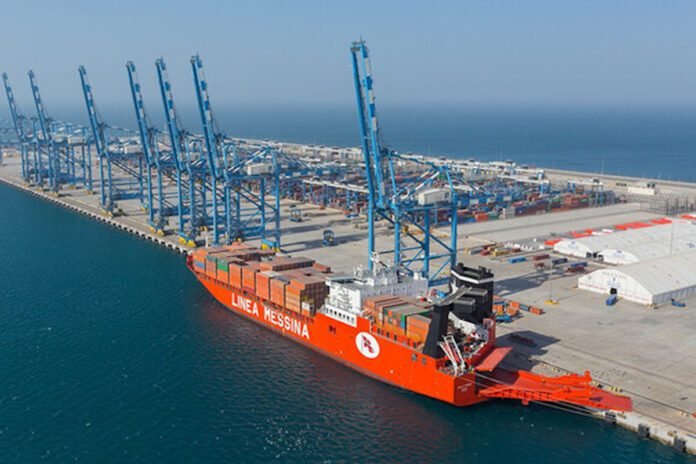
Three berths are operational, fitted with five ship-to-shore cranes. But the port has never secured a main-line liner relationship — the regular, scheduled vessel calls from major global shipping alliances that turn a terminal into a functioning trade node rather than a berth waiting for business.
Without those calls, even the most modern terminal would struggle to generate meaningful container traffic. The scale of the underperformance becomes even clearer when viewed against an international benchmark.
The brief reaches for an uncomfortable benchmark: Tanger Med, the Moroccan port that began, like Gwadar, on an empty coastline. Within 15 years, Tanger Med had reached 10.2 million TEUs annually and attracted more than 1,100 export-oriented firms into its free zone. Gwadar, at a comparable stage in its own development, has 1.2% Free Zone occupancy and no equivalent industrial base to show for it.
The brief’s central diagnosis is that Tanger Med succeeded because the port and its surrounding industrial zone were built and filled as a single program, not as sequential projects.
Gwadar, by contrast, built the quay and left the rest — the connecting road corridor to the mineral belt in Chagai, the border facility at Gabd, 87 kilometers from Iran’s already-built Rimdan zone, and reliable water and power for industrial tenants — either incomplete or entirely absent.
The brief counts five such connectivity gaps in total, from an unfinished hinterland corridor to a single 1.2 million gallons per day (MGD) desalination plant serving a city still on grid load-shedding. Fine infrastructure on the quay, the brief notes dryly, is not the same as a working connection to the cargo and markets that would fill it.
The stakes go beyond one underperforming terminal. The brief frames 2026 as a closing window: competing regional transshipment hubs, Duqm in Oman, Salalah, the Grand Faw project in Iraq are advancing now, while Gwadar’s structural advantage as a port 180 nautical miles from the Strait of Hormuz sits largely unused.
Pakistan is also facing a specific and newly urgent case for developing Gwadar as an energy hub. The brief describes the 2026 Hormuz crisis as having turned an “Oil City” concept — strategic fuel storage and an eventual out-of-Hormuz refinery from a long-range ambition into a near-term necessity, with an indicative first-phase cost of $1-2 billion.
Layered on top is Balochistan’s mineral wealth. The Reko Diq copper-gold deposit alone represents a projected $74 billion over 37 years under its Barrick joint venture, and the brief identifies a 650-kilometer mine-to-port corridor to Gwadar as the logical export route — one that also happens to be over a third shorter than hauling ore to Karachi instead. None of it moves without a functioning port at the other end.
To its credit, the document does not stop at diagnosis. It lays out five specific, time-bound actions: dredge the channel from its current 12.5-metre depth to the 16 meters main-line vessels actually require; activate the Gabd–Rimdan special economic zone, currently stalled awaiting an FBR regulatory order on transit trade; commit to a mine-to-port corridor route; secure the 100,000-acre Oil City site and commission a Phase-I feasibility study; and the item with the most direct bearing on everything else, reopen and reform the concession agreement itself, introducing the performance milestones it should have carried from the start.
That last point is arguably the crux. A 40-year exclusive concession without enforceable KPIs is, functionally, a concession with no mechanism for accountability. The brief’s recommendation to open additional operators where COPHCL cannot deliver main-line calls is a modest but pointed acknowledgment that exclusivity, absent performance, has not served Gwadar’s interests.
Gwadar still has geography on its side. It sits closer to the Strait of Hormuz than any other deep-water port in the region, at the southern end of a CPEC corridor built specifically to reach it, and within reach of Central Asian markets that pay a 40% premium in trade costs for lacking their own sea access.
What it has been short of, on the government’s own account, is a concession structure that converts that geography into cargo. Nineteen years and 61.2 billion rupees into the project, that is the reform Islamabad’s own numbers say can no longer wait.
Mujtaba Arshad is an economist and research associate at the Centre of Excellence for CPEC (a joint project of PIDE and the Ministry of Planning, Development & Special Initiatives), where he researches China-Pakistan economic engagement and regional connectivity. He holds an MPhil in economics, econometrics and quantitative economics from Quaid-i-Azam University, Islamabad.
Oil Prices Surge More Than 3% as US-Iran Strikes Fuel Hormuz Fears
The price of oil jumped more than 3% on Monday as renewed military strikes between the United States and Iran raised fresh concerns about the movement of energy supplies through the Strait of Hormuz, a major route for global oil and gas shipments.
Brent crude futures gained $2.39, or 3.14%, to $78.40 at 1321 GMT. U.S. West Texas Intermediate crude rose $2.17, or 3.04%, to $73.58 a barrel. Both contracts had climbed more than 4% earlier in the session.
During peacetime, around 20% of the world’s oil and gas is transported through the Strait of Hormuz, making disruptions to shipping a key concern for energy markets.
“The focus will remain on the number of inbound tankers as a lower number could impact production, so currently we see a risk premium and a disruption risk supporting prices,” UBS analyst Giovanni Staunovo said.
US Central Command (CENTCOM) said it completed a wave of strikes against dozens of targets in Iran using precision munitions. The military said the operation was intended to limit Tehran’s ability to carry out attacks in the Strait of Hormuz.
CENTCOM said the targets included Iranian air defense and coastal radar systems, missile and drone sites, and small boats.
“The Strait of Hormuz is a vital maritime corridor for global trade. Iran does not control it,” CENTCOM said.
Iran, however, maintains that it exercises full control over the Strait of Hormuz. Tehran claims the waterway is Iranian sovereign territory and says foreign commercial and military vessels must obtain explicit permission and authorization from the Islamic Revolutionary Guard Corps before passing through it.








![Yemen's Houthi group shows the firing of the so-called surface-to-surface 'hypersonic ballistic missile' at an unrevealed site in Yemen on September 16, 2024 [Houthi Media Center via Getty Images]](https://i0.wp.com/www.middleeastmonitor.com/wp-content/uploads/2024/10/GettyImages-2172431646-e1728373262310.jpg?fit=920%2C614&ssl=1)