There is a particular rhythm to America’s Middle Eastern wars that has become almost liturgical: the strikes, the declaration of victory, the memorandum of understanding signed with great ceremony, and then, within weeks, the recognition that a piece of paper signed at a palace in France does not repeal the underlying logic of the conflict it was meant to end.
Iran and the United States have now performed this cycle twice in a single year, and Washington’s foreign policy class is once again mistaking a pause in the fighting for its resolution.
President Donald Trump’s recent declaration that the ceasefire is “over,” followed a day later by his insistence that no “long-term” military action is intended, is not a contradiction so much as a symptom.
It reflects an approach to Iran that has, for two decades now, oscillated between maximalist rhetoric and tactical restraint without ever settling on what Washington actually wants the endgame to look like.
Is the objective regime change? Denuclearization? Freedom of navigation through the Strait of Hormuz? Each strike seems to answer a different question, which is another way of saying that no one in Washington has really decided.
This is worth dwelling on, because the war’s origins in February — the strikes that killed Iran’s Supreme Leader and a tier of the regime’s leadership — were sold as a decapitation operation that would break the Islamic Republic’s capacity to make trouble.
What followed instead was a hardening of exactly the security-state logic that decapitation strikes are supposed to short-circuit. Iran’s hardliners, rather than being cowed, have used the humiliation of a slain leadership to justify precisely the kind of asymmetric harassment of shipping in the Strait that now serves as the pretext for renewed American strikes.
This is a familiar pattern to anyone who has watched Washington’s post-9/11 wars unfold: the application of force against a state actor produces not the intended capitulation but a scattering of the threat into forms harder to deter and easier to escalate.
Notice, too, who is absorbing the costs of this brinkmanship. It is not principally Washington. It is Bahrain, sheltering the Fifth Fleet and now living under recurring air-raid sirens.
It is Kuwait and Qatar, drawn into a fight over a waterway they did not start. It is the global economy, still paying down the largest oil-market disruption in modern history, months after the “ceasefire” was supposed to have ended it.
The Gulf Arab states that Washington has spent decades cultivating as partners are discovering that proximity to American power in this region is not the same as protection by it — a lesson Iraq’s neighbors could have told them in 2003, and Lebanon’s could have told them more recently still.
There is also the question, so rarely asked plainly in Washington, of what a de facto Israeli veto over American Iran policy is costing the US.
Israeli leader Benjamin Netanyahu’s public jabs at Turkish leader Recep Tayyip Erdogan this week, delivered from inside a NATO summit meant to showcase Western unity, and his lobbying against the sale of F-35s to a NATO ally, are a reminder that Jerusalem’s regional priorities and Washington’s alliance architecture do not always point in the same direction – and that American presidents have shown themselves consistently unwilling to let daylight show between the two, even when the strategic interests plainly diverge.
A foreign policy genuinely oriented around American interests, rather than the maintenance of a permanent security guarantee for one regional patron, would ask harder questions about that arrangement than either party in Washington currently seems willing to pose.
None of this is an argument that Iran’s conduct in the Strait of Hormuz — attacking commercial tankers, threatening the arteries of global trade — is defensible. It plainly is not, and a regime willing to strangle its neighbors’ economies to assert control over a waterway invites the consequences it is now receiving.
But recognizing that Tehran’s behavior is provocative is different from concluding that Washington’s answer to it — a war without a defined objective, prosecuted in a country where the last two decades of American military intervention in the region offer little evidence that force alone produces durable settlements — is wise.
The strategic question American policymakers should be asking is not merely “how do we respond to the last attack” but “what does five more years of this look like, and is it one we can afford?” On present evidence, nobody in Washington has stopped long enough to answer it.
This article was originally published on Leon Hadar’s Global Zeitgeist and is republished with kind permission. Become a subscriber here.
Hundreds in Sweden protest Israeli attacks, ceasefire violations in Gaza
Hundreds of people, holding banners and flags, gather to protest Israel’s attacks on Gaza, violations of ceasefires, and restrictions on the entry of humanitarian aid into the region in Stockholm, Sweden, on July 11, 2026 [Atila Altuntaş – Anadolu Agency]
Hundreds of people gathered in the Swedish capital Stockholm on Saturday to protest Israel’s attacks on Gaza, ceasefire violations, and restrictions on humanitarian aid entering the enclave, Anadolu reports.
The demonstrators gathered at Odenplan Square following calls by several civil society organizations.
Protesters carrying Palestinian flags chanted slogans against Israel and called for the immediate lifting of the blockade on Gaza.
They also accused Israel of violating the ceasefire reached on Oct. 10, 2025.
Dror Feiler, a Swedish Jewish activist and chair of European Jews for a Just Peace, told Anadolu that the demonstrators were standing up for Palestinian rights, justice and equality.
READ: Spain’s National Court opens probe into Israeli military officials over Gaza flotilla interception
“A peace achieved without justice is not real peace and will ultimately lead to another war,” Feiler said.
He accused the international community of turning away from alleged crimes against humanity and violations of international law in Gaza.
Feiler also criticized what he described as the collapse of the international order and laws established following World War II and the Holocaust, arguing that powerful actors apply rules according to their own interests.
Rejecting accusations of antisemitism against the demonstrations, he said protesters opposed oppression regardless of who carries it out.
“Criticizing the Israeli government or Zionism … does not make someone antisemitic,” Feiler said.
READ: Poll: 40 % of non-religious US Jews accuse Israel of genocide in Gaza
An orbiting disco ball gave Einstein’s theory its most precise test yet
Albert Einstein’s general theory of relativity predicts that a rotating mass like the Earth pulls the fabric of space and time around with it in a perpetual swirl. This phenomenon is known as frame dragging or the Lense-Thirring effect, after the two physicists who modeled it back in 1918. Frame dragging becomes more significant with larger masses and faster rotation, so we’ve mainly observed it around huge black holes.
Measuring how much the Earth twists spacetime as it rotates has been much more challenging because our pale blue dot of a planet is millions of times lighter than a typical black hole and rotates rather slowly.
But now, a team of astronomers led by Ignazio Ciufolini, a physicist at the Wuhan Institute of Physics and Mathematics in China, reports the most accurate measurement of the terrestrial Lense-Thirring effect to date. Their work brings our uncertainty down from a few percentage points to just 0.2 percent. And they did it with a satellite that looks like a cross between a golf ball and a disco globe.
Disco globe satellite
The disco globe satellite that Ciufolini and his colleagues use in their experiment is called LARES-2 (Laser Relativity Satellite 2) and has been developed by the Italian Space Agency. It’s a solid sphere of Inconel 718, a dense nickel-chromium alloy, covered with 303 corner-cube retroreflectors and measuring a bit over 40 centimeters across. It has no thrusters, no solar panels, and no electronics of any kind. It weighs 294.8 kilos. That combination of small size and large mass gives it the lowest area-to-mass ratio of any satellite in medium-Earth orbit.
This was exactly what the scientists needed, since it helped them minimize the impact of other forces.
“The idea is that we want to measure gravitation,” Ciufolini said. “We have non-gravitational effects like photons impinging on the satellite and pushing it. So, the mass must be very large and the cross-section of the satellite very small, so the acceleration induced by photons is very, very small.” In theoretical physics, satellites of this kind are called test particles, meaning an object whose motion is governed almost entirely by the gravitational field. LARES-2 was placed in orbit at an altitude of roughly 12,265 kilometers by a Vega-C rocket in July 2022.
Once the LARES-2 was in position, the researchers started shooting it with ground-based lasers.
Synchronous flying
The retroreflectors on LARES-2 are designed to reflect a beam of light exactly in the direction this beam came from. When Ciufolini and his colleagues fired short laser pulses at the satellite, they could pinpoint its position down to roughly 1 millimeter based on the light that came back. About 200,000 such observations, spanning July 2022 to June 2025, formed the dataset the team used to measure Earth’s frame dragging.
But even such precise positioning was not enough to achieve the accuracy the team wanted.
The problem with measuring frame dragging using Earth-orbiting satellites is that the Earth is not a perfect sphere. Its equatorial bulge produces classical Newtonian forces on satellite orbits that are orders of magnitude larger than the frame dragging signal. The solution Ciufolini proposed decades ago while working with physicist John Archibald Wheeler was to use two satellites in supplementary orbits, meaning with orbital inclinations that sum to 180 degrees.
“Suppose we have a satellite orbiting around a perfectly spherically symmetric object—the orbit of this satellite would act like a gyroscope,” Ciufolini said. Under ideal conditions, the orbital plane and its orientation in space would remain fixed, and the only thing altering this orientation should be frame dragging.
“But the Earth is not spherically symmetric,” Ciufolini said. “It is oblate, and this oblateness produces a change in the orientation of the orbital plane.” With two satellites at supplementary inclinations, the Newtonian perturbations are equal and opposite in the two orbital planes and cancel each other out. The Lense-Thirring effect, which pushes both orbital planes in the same direction, adds algebraically—the noise vanishes and the relativistic signal survives.
That’s why LARES-2 was working in synchrony with its older and larger cousin called LAGEOS, a NASA satellite designed exclusively for high-precision laser-ranging, launched in 1976. The orbital inclinations LAGEOS and LARES-2 summed up to 180.01 degrees, which the team considered close enough.
But the Earth’s irregular shape was not the only challenge.
Fighting the tide
With the Newtonian noise solved by clever geometric cancellation, one remaining perturbation to deal with was something called the K1 lunisolar tide, a gravitational disturbance from the Moon and Sun that modulates Earth’s gravitational field. “The Sun and the Moon change the shape of the Earth, and the shape of the Earth changes the gravitational field around it, which changes the orbit of the satellite a little bit,” Ciufolini said. “The main challenge of this experiment was to get rid of this one tide.”
The team’s solution was to collect measurements from exactly one complete 1,050-day precession cycle of the satellites. Over that period, the tidal perturbation, with well-measured period and phase, averages out and can be removed from the data.
After removing the tidal signal and six smaller tidal components with known periods between 135 and 910 days, the researchers were left with a clean, steady drift in the satellites’ combined orbits of about 61.3 milliarcseconds per year—the signature of spacetime twisting.
This final measured value came in incredibly close to Einstein’s general relativity predictions, carrying a tiny margin of error of just one to two parts per thousand based on their statistical models.
Post-Einstein physics
The measurement confirmed general relativity once more, but Ciufolini thinks its true value lies in what it rules out. General relativity is incompatible with quantum mechanics, despite our best efforts to reconcile the two, and does not explain dark energy. The Chern-Simons theory, one of the leading alternatives that emerged from quantum gravity frameworks, modifies Einstein’s equations and introduces mathematical corrections expected to make them work at ultra-small scales where quantum mechanics and gravity must coexist.
While it does not fully reconcile Einstein’s physics with quantum mechanics and does not offer a universally accepted solution to the dark energy issue, many physicists think Chern-Simons brings us one step closer to the complete Theory of Everything. The problem, though, is that it predicts a different magnitude for frame dragging. “By measuring frame dragging very precisely, we have been able to put limits on what is predicted by Chern-Simons theory,” Ciufolini said. His measurement does not rule it out, but severely narrows its scope, eliminating a large range of its potential variations.
But there are other implications of Ciufolini’s study that are more down to Earth—quite literally. By pinpointing and filtering out the gravitational distortion of the K1 tide from the satellites’ tracking data, the experiment also yielded a much more precise measurement of the tide’s actual strength, a bonus finding that could provide new insights for earth science. “My Chinese colleagues tell me that if we improve the knowledge of tides, we can indirectly improve the study of earthquakes,” Ciufolini said. And he expects the experiment to keep on giving.
“These laser-ranged satellites have a peculiar characteristic: They last for hundreds of years,” Ciufolini said. “The more you wait, the more data you accumulate, and the better the results of frame dragging measurements will be. So, we can wait maybe 100 years, and they’ll become even more useful for theoretical physics.”
US, Ukraine strike PAC-3 missile production deal — with a catch
During their bilateral meeting on the sidelines of the NATO summit in Ankara, US President Donald Trump and Ukrainian President Volodymyr Zelensky reached a major agreement regarding Patriot Advanced Capability-3 (PAC-3) missile interceptors. The PAC-3 is the premier hit-to-kill air defense missile used by the US and many of its allies. The weapon has played a major role in the Iran conflict.
The proposed arrangement for Ukraine has two parts: a political agreement to give Ukraine a license to manufacture PAC-3 interceptors; and a short-term supply of PAC-3 interceptors from US inventory, “to bridge the gap.” Ukraine is confident it can manufacture PAC-3 missiles under license.
Today, the only production of PAC-3 missiles outside the US is in Japan, where Mitsubishi Heavy Industries produces them under license.
The designation “PAC-3 Interceptor” is important. The US is focusing on expanding production of the PAC-3 MSE interceptor missiles, which offer significantly greater range and other improvements over the PAC-3. While it needs clarification, it appears President Trump offered PAC-3 but not PAC-3 MSE to Ukraine.
The US and Ukraine will soon start “technical talks” where many of the major issues, still undecided, can be addressed.
The MSE variant represents a comprehensive redesign optimized to defeat more complex, faster tactical ballistic missiles and hypersonic threats. There are many changes to the MSE. One of them is to go from a single pulse to a dual pulse rocket motor.
The MSE’s motor can ignite its first pulse to clear the launcher and accelerate toward the target area, then coast before igniting a second pulse later in flight. This provides a critical burst of kinetic energy right during the terminal phase, allowing the missile to pull high-G maneuvers against actively evading or high-velocity incoming threats.
It is not clear if the MSE version can defeat Russia’s hypersonic missiles such as the Kinzhal, Zircon or Oreshnik. The PAC-3 version would face problems against the Kinzhal and Zircon and probably not be able to stop the Oreshnik.
The US is struggling to manufacture a significant number of PAC-3 missiles, both standard ones and MSE versions. The US Army requested an unprecedented 2,798 PAC-3 MSE interceptors and the Navy requested an additional 405 modified variants for AEGIS ships, both part of the FY 2027 Budget Request. There are serious questions if these procurement targets can be met.
Lockheed Martin is the license holder for the PAC-3 interceptor. However, Lockheed depends on some 400 suppliers including Boeing, which manufactures the all-important sensor package for the missiles and Rocketdyne that makes the rocket engines.
Even when there are no supplier problems, it takes Lockheed two years to manufacture a missile. However, many of the suppliers have fallen way behind in producing critical components, including Boeing and Rocketdyne.
Mitsubishi is a solid aerospace company with lots of defense manufacturing experience including meeting US requirements for defense products. At the present time, Mitsubishi produces around the same rate as Lockheed, but in much lower numbers.
Last year, Mitsubishi delivered 30 PAC-3 MSE interceptors. The company claims it could increase production to 60, but it is prevented from doing so because critical supplies, especially missile seekers from Boeing, are in short supply.
The US has asked Mitsubishi to increase production to 100 missiles assuming supply chain problems are resolved and if Mitsubishi can increase its staff and production capacity.
Keep in mind that typically two PAC-3 interceptors are fired at each target to raise the probability of a kill (although we do not have reliable kill probabilities against different threats). This means Mitsubishi’s annual production is a drop in the bucket given the multiplicity of threats and the proliferation of enemy missiles, cruise missiles and drones.
There are no hard numbers on the currently remaining number of PAC-3 missiles in the US inventory. The figures are classified, meaning all we have are guesstimates.
The US and its Gulf allies fired a large number of PAC-3 missiles in the war with Iran. On top of that, Ukraine used large numbers of Patriots to fend off Russian missile and drone attacks.
The US inventory size is variously estimated by defense specialists at around 2,000 to 2,500. Even taking into account the US effort to ramp up manufacturing, the build time and supply issues suggest that the US can’t really augment its inventory significantly before 2028 at the earliest, and more likely not until 2030.
If Ukraine starts from scratch with a Lockheed license, and possibly given some priority in the supply chain (which is not a sure thing), Ukraine can only hope to produce PAC-3 interceptors starting in 2029 to 2030.
If the scale is similar to Mitsubishi and Ukraine can manage the technology demands and produce enough skilled labor, the output will fall far short of Ukraine’s military requirements.
There is a lot of risk in Ukraine producing PAC-3 interceptors. Risks include Russian penetration of manufacturing know-how and technology, theft of critical components, and exposure to attack from Russian missiles and drones.
Increasingly, Russia is targeting known Ukrainian defense factories, and one would think a PAC-3 production line would be a prime target for the Russians.
There is also a question of who will pay for a Ukrainian factory. The Trump-Zelensky agreement did not cover financial issues, but the US will be requesting NATO countries to foot the bill.
Ukraine has few options for sophisticated air defenses. Europe has some, but in short supply and with their own set of bottlenecks. There also is increasing resistance in Europe to part with critical air defenses, especially because the US has little of its own to spare and is pulling back from its NATO defense responsibilities.
Other possible sources include South Korea, but it isn’t certain whether South Korea has a system that can perform as well as the Patriot. Another possibility is Israel, but Israel manufactures in partnership with US companies, including Lockheed, Raytheon (RTX Corporation) and Boeing. Israeli supplies are also down because of the recent Iran war.
The US Army is working on a Low Cost Interceptor (LCI) program, which would supplement Patriot and other air defense systems. The project is in a very early stage, but it aims to produce low-cost rocket motors, low-cost seekers, cheaper fire control and guidance software, and easier integration for battlefield use.
LCI could be very attractive for Ukraine. Kyiv is well positioned to participate if the US allows foreign companies to participate in the program, which is essential to its success.
It might be a more productive solution for Ukraine, as a four-to six-year time frame for a possible LCI is about the same as trying to produce small numbers of PAC-3 interceptors domestically.
Stephen Bryen is a former US deputy undersecretary of defense and special correspondent at Asia Times. This article was first published on his Weapons and Strategy Substack and is republished with permission.
Oil heads for weekly gain as Middle East supply risks persist
Oil prices eased on Friday but remained on track for weekly gains as renewed U.S.-Iran fighting disrupted shipping in the Strait of Hormuz, stoking concerns over supply disruptions.
Brent futures were down 68 cents, or 0.9%, at $75.62 a barrel by 0817 GMT. U.S. West Texas Intermediate (WTI) crude dropped 64 cents, or 0.9%, to $71.44.
For the week, Brent was set for a gain of about 5% and WTI was on track for an increase of about 4%.
“Prices have backed off the midweek highs, but there is still a substantial risk premium as Hormuz transits are back to a near-standstill with no clear signs of when normal reopening might resume,” said Vandana Hari at oil market analysis provider Vanda Insights.
Iranian armed forces launched attacks on U.S. military infrastructure in Gulf states on Thursday after U.S. strikes on Iran’s southern coastal and eastern provinces, further straining a creaking ceasefire.
Separately, Iranian media reported multiple explosions across southern Iran. The area included Bushehr, where one of the country’s nuclear plants is located.
The developments also have delayed a full reopening of the Strait of Hormuz, which carried about 20% of daily global oil and gas supplies before the start of the war on February 28.
The lack of any new U.S. strikes on Iran overnight is probably weighing on oil prices, though a drop in flows through the Strait of Hormuz is limiting the downside, said UBS analyst Giovanni Staunovo.
Tanker traffic through the strait was at a near-standstill on Thursday, ship-tracking data showed, as vessel owners assessed the risk after Iran hit a Qatari LNG ship exiting the waterway near Oman to trigger the latest strikes.
However, U.S. President Donald Trump said on Wednesday that he did not think the war would restart and that “anything that happens is going to be over very quickly“.
“Despite the U.S. ramping up attacks on military sites in Iran, the market drew some reassurance from the Trump administration’s decision to avoid targeting Iranian energy infrastructure,” said ANZ commodity strategist Daniel Hynes.
Harrison Ford and Blade Runner director Ridley Scott may have made a sci-fi classic together, but behind the scenes, things were not exactly smooth.
As Ford prepares to turn 84, some of the longtime stories from the Blade Runner set are getting another look, including the blunt reason Scott once called the actor the biggest “pain” he had ever worked with.
The tension was not all that surprising. By the time Blade Runner was being made, both men were already major forces in Hollywood.
Ford had become a global star as Han Solo in Star Wars and had just helped launch another blockbuster franchise as Indiana Jones in Raiders of the Lost Ark. Scott, meanwhile, had already made his own mark with Alien, the 1979 sci-fi horror film that turned into a major franchise.
But when the two came together for Blade Runner, their visions did not always line up.
In a 2006 BBC interview, Scott was asked who had been the “biggest pain in the a–e” that he had worked with over the years. His answer was Ford.
“He’ll forgive me because now I get on with him — but it’s got to be Harrison,” Scott said at the time. “Now he’s become charming. But he knows a lot, that’s the problem.”
Scott suggested part of the tension came from his own position at the time. He described himself as somewhat of a “new kid on the block,” even though he had already directed Alien. Still, he made clear that the difficult working relationship did not ruin the end result.
They still “made a good movie,” Scott said.
One of the biggest disagreements between Ford and Scott involved a question that Blade Runner fans have debated for decades: Was Rick Deckard a replicant?
In the film, Ford plays Deckard, a former police officer and “blade runner” assigned to hunt down and “retire” four biologically engineered humanoids known as replicants.
The movie, based on Philip K. Dick’s novel Do Androids Dream of Electric Sheep?, leaves plenty of room for interpretation. Over the years, many viewers have pointed to clues suggesting Deckard may actually be a replicant himself, possibly implanted with false memories.
Scott has said he believes Deckard is definitely a replicant.
Ford has never been on board with that idea.
The actor has pushed back on Scott’s interpretation and has even joked that the director “doesn’t know what he’s talking about.”
That was not the only issue Ford had with the film.
He was also unhappy with the voice-over narration used in the original U.S. theatrical version of Blade Runner. The narration was added back into the movie after concerns that audiences would have trouble following the story.
Ford later told Variety that he preferred any version of the film without the narration.
“I like any cut without the voice-over,” he said. “When we first saw the film in script form, it had a narration. I felt strongly that the narration was not right for the film.”
According to Ford, he worked with Scott, the screenwriter, and a producer for three weeks at his dining room table to remove the information from the voice-over and build it naturally into the scenes instead.
But Warner Bros. was not convinced.
“And then at the end of the film, Warner Bros. said, ‘What the h— is going on here? I don’t understand this at all. Explain it.’ And the voice-over came back,” Ford recalled.
The actor said he recorded the narration about six times, but nobody seemed satisfied with the results.
“I did the voice-over about six times, and nobody was ever happy with it,” he said.
That is why Ford was relieved when later versions of Blade Runner were released without the narration.
“I was glad that the film was finally released without it,” he said, explaining that he believed removing the voice-over allowed the audience to be more present in the story.
Decades later, Blade Runner is considered one of the most influential science-fiction films ever made. But its legacy came with plenty of friction.
Ford and Scott may not have agreed on Deckard, the narration, or even the best way to tell the story. But their creative clash helped fuel a movie that fans are still arguing about more than 40 years later.
Israel Warned US of Alleged New Iranian Plot Targeting President Trump
Israel alerted the United States to intelligence indicating Iran had recently formulated a new assassination plot targeting President Donald Trump, CNN reported, citing two people familiar with the matter.
One of the sources said the intelligence was conveyed this week. Another said US officials had already been receiving a steady flow of information in recent weeks about potential threats against President Trump but described the Israeli warning as the first to identify a specific plan.
The nature of the reported plot was not disclosed. Two people familiar with the matter told CNN that US agencies had neither independently verified the intelligence nor been monitoring the plan before receiving Israel’s warning.
Some US officials told CNN they believed the Israeli intelligence could have been intended to shape President Trump’s deliberations over possible expanded military operations against Iran.
The White House declined to address the reported warning directly and instead referred to the president’s recent public comments about Iranian threats. The Wall Street Journal first reported the Israeli intelligence.
“They want to take out the US leader—me,” President Trump told reporters Wednesday. “I’m on whatever list. I saw this morning I’m on every single one of their lists. And so far, I guess I’ve been a bit lucky, but maybe that doesn’t last very long. These are evil, sick people. And we have to root out that cancer. That cancer. You know what you do? You’ve got to cut out cancer early. And that’s the way I feel.”
President Trump also said he had recently been informed of a list placing him at the top of Iran’s assassination targets, though it was not clear whether he was referring to the intelligence reportedly supplied by Israel.
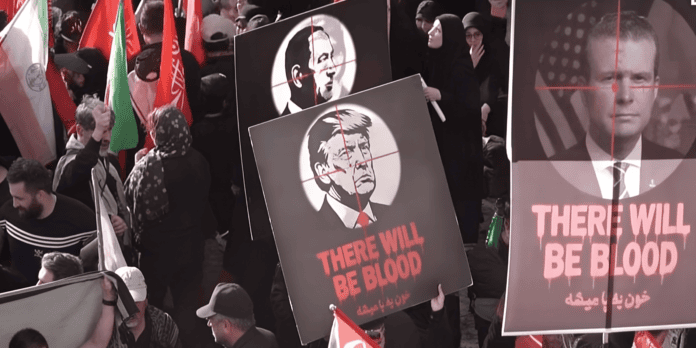
At the funeral procession this week for late Supreme Leader Ali Khamenei, demonstrators chanted calls for President Trump’s death and revenge for the Feb. 28 airstrike that killed the Iranian leader. Protesters pelted a billboard showing the US president with a bullet aimed at his head that read, “The US killed our father,” followed by, “We won’t let you go!” Others burned US and British flags, raised signs reading “KILL TRUMP,” and displayed posters depicting President Trump, Vice President JD Vance, Defense Secretary Pete Hegseth and Israeli Prime Minister Benjamin Netanyahu in the crosshairs of a gunsight alongside the words, “There will be blood.”
The president survived assassination attempts in July and September 2024 and has asserted that Iran was behind them, although no evidence has linked Tehran to either attack. Federal prosecutors have, however, filed charges in two separate alleged Iranian murder-for-hire cases. Iranian threats against President Trump date back to the US strike that killed Gen. Qasem Soleimani in January 2020.
A Jupiter-size planet that escaped its star’s death
WD 1856 b is the only confirmed case of a planet that survived the death of a Sun-like star. It’s a Jupiter-size world orbiting a white dwarf—the burned-out remnant of a Sun-like star. Now, a team of astronomers has used the James Webb Space Telescope to take a closer look at this planet for the first time, and what they found makes an already strange system even stranger.
A feeding frenzy
WD 1856 b was an accidental discovery. Astronomers pointed the TESS observatory at a sample of roughly 2,000 white dwarfs in 2020. These stars are the remains of a Sun-like star that have already gone through a red-giant phase, leaving behind an Earth-size body that’s primarily composed of elements like carbon and oxygen. The TESS team was searching for small objects like comets or asteroids that might transit across the face of these dead stars.
What they found in the WD 1856 system was a gas giant. “As soon as they looked at it, they said, okay, that’s weird,” said Christopher O’Connor, a theoretical astrophysicist at Cornell University and co-author of the recent Nature study on WD 1856 b.
The white dwarf is about seven times smaller than the gas giant circling around it. Its brightness should be dropping to nearly nothing each time the planet crosses in front of it, but instead it’s dipping by about half. O’Connor thinks the reason is a grazing transit, where only the edge of the planetary disk clips the face of the star. “That’s a very unlikely viewing angle,” he said, “but it’s the only way to explain what we actually see.”
What’s more, the planet orbits at about 0.02 AU from the white dwarf, which goes against our ideas of how the death of a star should reshape its system. “When the star expands to become a red giant, it consumes the inner planets,” O’Connor explains. Then, in the process of shrinking down to a white dwarf, it loses about half of its original mass, which means its gravitational pull becomes weaker. “The outer planets, like gas giants, should migrate outward by about a factor of two,” O’Connor said.
WD 1856 b, though, apparently did not migrate outward. It got closer.
The discovery immediately has the science community buzzing. “It sent theoretical astrophysicists into a feeding frenzy,” O’Connor said. “When you find something that’s totally bizarre, totally in the wrong place, totally unexpected from any previous way of thinking about things—that’s the Universe inviting us to get creative.” First, though, scientists needed more data to get creative with, so O’Connor’s team booked time on the James Webb Space Telescope to take a closer look at what was going on in the WD 1856 system.
Eight minutes of light
The JWST observations were done on April 27, 2023, and captured a single transit that lasted just eight minutes. The viewing angle and the unusual size mismatch between the star and its planet posed an immediate technical problem. Standard exoplanet transmission spectroscopy assumes a smaller planet is entirely silhouetted against the face of a much larger star, which was not the case here.
To get around it, the team developed new equations to express the transmission spectrum as the time-varying area of the planet overlapping the star’s disk. Then, they modified POSEIDON, software for reconstructing exoplanets’ atmospheres based on JWST data to account for the grazing transit geometry (the software had been developed by Ryan MacDonald, the lead author of the study). When the scientists were done crunching numbers, WD 1856 b’s atmosphere proved somewhat surprising.
It turned out the planet is shrouded in aerosol hazes, and its atmosphere contains methane. It is also far hotter than the team expected. WD 1856 b apparently emits roughly 25 times more energy into space than it receives from its cooling host star. Even though its star, according to O’Connor, has been dead for about 6 billion years, the planet is glowing.
This extraordinary temperature, O’Connor argues, tells us a lot about WD 1856 b’s history.
Running hot
“We expected this planet to be roughly as hot as Jupiter, but it wasn’t,” O’Connor said. At about 0.02 AU from a white dwarf that has been cooling for 6 billion years, WD 1856 b should be somewhere between 150 and 200 Kelvin, close to the temperature of Jupiter’s cloud tops. Instead, it is around 400 Kelvin. “Whatever is causing this planet to glow, it must be an internally derived heat rather than just re-radiating energy from the star,” O’Connor said.
The planet, according to the team, cannot be radiating warmth left over from its formation. Something must have heated it at some point. Working backward through planetary cooling models, the team managed to estimate when it happened. Doing so, the scientists figured out the most probable reason why WD 1856 b got so close to its star.
The team initially came up with two competing scenarios to explain how WD 1856 b ended up in its current orbit. The first is a common-envelope model, in which the planet was originally in a close orbit and survived being engulfed when its star expanded into a red giant, emerging from the stellar envelope hot and tight against the remnant core. In the second, a high-eccentricity migration model, the planet started farther out, had its orbit destabilized by gravitational interactions with companion objects (WD 1856 has two distant stellar companions) and then spiraled inward over billions of years through a sequence of highly eccentric plunges.
One of the points at which these two scenarios differ is timing. Common-envelope evolution concludes when the star finishes its red giant phase, in this case roughly 5.4 billion years ago. High-eccentricity migration could deliver a planet to its current orbit billions of years later.
Running the planet’s current temperature backward through their cooling models, the team found that the reheating event most likely occurred 3 billion to 5.5 billion years after the end of the red giant phase—far too late for the common-envelope scenario. “We interpret the planet’s temperature as residual heat from its migration process,” O’Connor said. “And we think the timing is such that it can only have been through gravitational interactions with the companion stars.”
But this explanation comes with a caveat.
Search for survivors
The cooling models used in the calculation were built for objects with Jupiter-like atmospheric compositions, where methane accounts for roughly 0.3 percent of the atmosphere. On WD 1856 b, the methane content stands at roughly 7 percent. Because methane is a very potent greenhouse gas, this discrepancy might have skewed the models’ predictions. O’Connor says building new models of objects with atmospheric compositions closer to those of WD 1856 b might be necessary to ensure we have the evolution of the survivor planet right. “That’s going to take a pretty dedicated effort,” he said. Efforts like this, though, might soon pay off.
WD 1856 is only about 75 light-years from Earth—it’s practically our galactic neighbor. O’Connor takes the proximity as a hint that there might be more planets that outlived their stars out there. “Having one so close to us is a suggestion that there might be a lot more of these waiting to be found,” he said. Before embarking on the wide search for planetary survivors, though, the team wants to examine the WD 1856 system in more detail.
“We’ve already taken additional James Webb Telescope observations of this system. Those happened long after we submitted this paper. Our team has only really just started,” O’Connor said.
Last spring, President Donald Trump issued the “Restoring Truth and Sanity to American History” executive order, taking aim at federal parks, monuments, museums, and sites that have cast the United States’s “founding principles and historical milestones in a negative light.” On the Fourth of July this year, the White House published its 162-page “Saving America’s Story,” attacking the Smithsonian Institution directly for “anti-white activism,” “illegal alien activism,” “transgender activism,” and more broadly for adopting “an ideological framework that no longer treats the American story as a shared national inheritance to be taught or celebrated, but as a political instrument to divide, dispirit, and discourage our citizens.”
“We’re in this moment where we are fighting over how America tells its past,” journalist Rebecca Nagle tells The Intercept Briefing. “It can be scary in a moment when it feels like the stakes are really high to really interrogate the myths that we all carry, that we all hold about who our country is and where it started because it’s really tempting to want to think, ‘OK, if we just wind the clock back 10 years, if we just go back a few election cycles, we’ll be back to a democracy that’s strong, that’s stable, that’s solid, and we’ll all be fine.’ It’s much more scary to say, ‘Oh, actually, if we want to talk about where authoritarianism comes from in the United States, it’s actually at the foundation.’”
As the United States celebrates its 250th birthday this year, the Trump administration has been ramping up its efforts to erase not just the dark parts of U.S. history but also the contributions of basically anyone who isn’t a white, Christian man. That project has included taking concrete steps to remove all traces of the history of people who don’t fit that description, Black people, immigrants, civil rights advocates, women and gay and trans people — including the first people to live on this land: Native Americans.
This week on the podcast, Nagle speaks to host Akela Lacy about her new podcast series “First America,” which examines how Native people have been largely written out of the American story, and how that story informs the current political crisis in the U.S.
“One of the big claims that the series makes is that the foundation is in itself is a myth. Because at the same time that our founders were building a democracy, they were also building an empire. The way that you govern an empire, the way that you govern other people by force, is not democratic,” says Nagle, a citizen of Cherokee Nation. “This identity crisis we’re having around authoritarianism and democracy, and how could authoritarianism be sneaking into our democracy — what we argue is that it’s actually always been there.”
“A lot of what is happening now — it’s not new, it’s not un-American, it’s not unprecedented. Sometimes it’s not even unconstitutional! It’s actually just taking these parts of our government that for a long time most Americans didn’t know was there or didn’t really think about, and Trump is just pulling it into the center,” says Nagle.
For more, listen to the full conversation of The Intercept Briefing on Apple Podcasts, Spotify, YouTube, or wherever you listen.
Transcript
Akela Lacy: Welcome to The Intercept Briefing. I’m Akela Lacy, senior politics reporter at The Intercept.
The United States is celebrating its 250th birthday this year.
President Donald Trump kicked off festivities by hosting a UFC cage match on the White House lawn to also celebrate his 80th birthday.
CBS: President Trump and UFC President and CEO Dana White kicked off the historic event that started with the national anthem and a joint Air Force and Navy flyover.
VO: From the south lawn of the White House.
[Clip ends]
AL: Then there was Trump’s two-week-long Great American State Fair in D.C., which aside from the Fourth of July, ended up being a giant bust.
[Clips montage]
MS Now: Donald Trump’s long-awaited Freedom 250 Great American State Fair went off with a whimper this weekend with what looked like tens, dozens of people showing up for the event.
FT: Donald Trump has said that this event is packed with happy people loving it, but it is 6 p.m. in the middle of the week, and there is hardly anyone here.
MS Now: This was the scene on Tuesday when there were actually more people in the band on stage than there were in the crowd watching them.
AL: Meanwhile, the Trump administration has been ramping up its efforts to erase not just the dark parts of U.S. history, but also the contributions of basically anyone who isn’t a white, Christian man. That project has included taking concrete steps to remove all traces of the history of people who don’t fit that description: Black people, immigrants, civil rights advocates, women and gay and trans people — including the first people to live on this land: Native Americans.
After reviewing nearly 2,000 flagged materials from National Parks and Monuments, The Guardian found that one Trump executive order resulted in the targeted removal of signs about “Native American history, slavery, the climate crisis, and the civil rights movement.”
Native American history is already poorly understood or misunderstood in the U.S. A new podcast series called “First America” examines how Native people have been largely written out of the American story. Host and creator Rebecca Nagle, a citizen of Cherokee Nation, argues our current political moment is 250 years in the making.
[Clip plays]
Actor: We hold these truths to be self-evident, that all men are created equal.
Nick Estes: The Declaration, which is full of these beautifully rendered sentences and paragraphs about Enlightenment ideals, does also have this darker history to it.
Actor: The merciless Indian savages whose known rule of warfare is undistinguished destruction of all ages …
Nick Estes: If we don’t understand the full context in which our nation was founded, we won’t understand the full context in which our nation now finds itself.
Rebecca Nagle: So, it’s been 250 years since 1776. How’s this democracy of ours going?
[Ambient sounds. Clip ends]
AL: Rebecca Nagle is an award-winning advocate and writer focused on advancing Native rights and ending violence against Native women. You might remember Nagle from her hit podcast “This Land,” which focused on treaty rights and tribal sovereignty in Oklahoma. She joins me now.
Rebecca Nagle, welcome to The Intercept Briefing.
Rebecca Nagle: Thank you so much for having me.
AL: Before we jump in, I want to let our listeners know that we’re also going to drop the first episode of “First America” into our feed so you can listen.
Rebecca, you have a new podcast series out, called “First America.” In the first episode, you open with this scene where you and history professor Nick Estes visit Fort Snelling in Minnesota. It’s January 2026. Set the scene for us? Why did you start the series there?
RN: Nick is a citizen of the Lower Brule Sioux Tribe and a historian. We were visiting Fort Snelling, which was a concentration camp in the 1860s during the Dakota Wars.
Dakota families were held there as actually part of a broader effort to force all Dakota people to leave the state of Minnesota, and that effort included death marches, it included open-air prisons, it included mass executions. It was extremely violent. We were there, actually, really to just see how the site talked about it.
The site doesn’t really know, it seemed like, how to integrate the history. There’s this giant replica for it that school kids visit that’s mostly celebrating the military history of the site. Then in this sort of tucked away corner, if you walk down a long, snowy path, there’s a memorial to the victims of this chapter of genocide.
The history of the fort is not really integrated in the way that Minnesotans tell the history at that site. While we’re there that day, Nick got a call from his wife that ICE had just shot and killed someone; it was the day that ICE killed Renee Good. The next day, I was actually back at Fort Snelling — this time not to visit the historic fort, but actually for a protest.
So where ICE is headquartered in Minneapolis is on the Fort Snelling campus. There’s the historic fort, but then there’s this broader Fort Snelling campus. ICE is there because it’s federal land, and it’s federal land because it was once a military reservation. So what you see is the federal government doing the same thing — rounding people up and detaining them — in the same place.
When I first started this project, I thought I was just making a history podcast. I thought I was talking about the founding and how Native people have been left out of that story and correcting the record. The project actually started as conversations between me and Nick about how Native people are left out of American history and the American story.
And then this thing kept happening where I would be somewhere learning about America’s past, and the same thing would happen in our present. What I realized is that this history — that as a country we don’t know how to talk about, that we haven’t reckoned with — the history that we keep in a memorial that’s tucked away in a corner, that history is why the present moment is happening.
“What you see is the federal government doing the same thing — rounding people up and detaining them — in the same place.”
AL: I also want to mention for our listeners, Nick Estes has written some really great reporting for The Intercept, which I encourage people to check out.
We’re talking about your series a few days after the Fourth of July weekend, and the United States is still celebrating its 250-year birthday which dates back to, obviously, the Fourth of July signing of the Declaration of Independence in 1776, a document which you dive into in the podcast.
But I will quote for our listeners who might not have it on hand. The Declaration reads, “We hold these truths to be self-evident, that all men are created equal,” while also describing Native Americans as “merciless Indian savages whose known rule of warfare is undistinguished destruction of all ages, sexes, and conditions.”
It’s well known that this and many other contradictions exist in our founding document, but why was this important for you to underscore here? What does it tell us both about our history, but also about today?
Rebecca Nagle: One thing that is important is the meaning of the word “savages,” and what does it mean for our founders to call Native people savages?
We all know the part of the Declaration of Independence that we’re taught in school — that all men are created equal; life, liberty, pursuit of happiness. But alongside those Enlightenment ideals, the founders included really their deep hatred for Indigenous people. The word “savages” has a really specific meaning in the late 1700s, which is that there are societies and groups of people that are seen as civilized, as deserving of human rights, and then there are people that are something less than human, and those are savages.
It’s a term that at the time carries a lot of meaning, and the founders are saying, “We’re not going to extend these Enlightenment ideals to these Indigenous people, to these savages.” The other reason that it’s really important is because it was important to our founders, right?
This isn’t just a throwaway line in the Declaration of Independence. Many historians think that the Declaration of Independence has an order. A lot of people, we know the preamble, but we don’t actually know what the majority of the document is. So the majority of the document is just this long list of grievances, and it’s basically the founders’ reasons for why they’re rebelling against the Crown.
A simple way I like to explain it is that it’s almost like a breakup letter — at least like a bad breakup, where you tell the person everything that they did wrong. The founders are doing that to King George, where they’re just like, “And you were a jerk, and you left your laundry everywhere.” It’s kind of like that list.
A lot of historians think that that list has an order and that it starts with smaller things and then ends with the things that the founders were most upset about.
The last grievance — the 27th grievance — is this line about “merciless Indian savages,” and there’s a whole history to why that line is in the document.
“What we see in that last grievance and the history behind it is that actually one of the main motivating factors for the Revolution itself was hunger for more Indigenous land.”
That history tells us a different story than the one we’ve all grown up knowing: It was about taxation and representation, and this is why the Revolution happened. This is what the founders were fighting for. What we see in that last grievance and the history behind it is that actually one of the main motivating factors for the Revolution itself was hunger for more Indigenous land.
The colonists wanted to expand west. The king of England was telling them no. They were really angry about that. They did a lot of different things, but they also put that anger in the Declaration of Independence. To me, it just goes to how deeply Native people are erased from the American story. It’s not like you have to rifle through Thomas Jefferson’s personal papers to be like, “Oh, look here. He said here in this journal that he was mad about Indigenous people.” They put it right there in our country’s most famous document. But somehow as Americans, we don’t know this story.
AL: We’re talking about this in the U.S. particularly when it comes to the “founders.” As you mentioned, most people don’t know that the first president, George Washington, was a land speculator interested in seizing Indian land. Can you tell us a little bit more about that history?
RN: For people who don’t know, and it’s not just George Washington, a lot of the gentry men of this era —
AL: The good men.
RN: — are involved in this business called land speculation. Actually George Washington’s family did it. It was a pretty well-established practice. But basically what they would do is they would buy land that either England and then later the United States claimed in this racist, abstract way where they would sail somewhere and plant a flag and be like, “This is our land.” But it’s still governed and controlled on the ground by Indigenous people.
They would buy that land, and then like a modern-day real estate developer would flip it, they would flip it. Once Indigenous people were forced off that land, they would sell the land to settlers for a profit. Sometimes they would sell the land while Indigenous people were still living there.
What happened is in the 1760s, there was this Indigenous uprising where a group led by an Odawa chief named Pontiac sacked a bunch of British forts.
So Britain, in a very loose way, claims all this land in the Great Lakes region. The way they claim that land on the ground is by having these forts; they’re these military outposts. And Indigenous nations sack a bunch of them.
The Crown is looking at fighting a very expensive war in North America. It’s just been fighting this big global war, sometimes called the French and Indian War, sometimes called the Seven Years’ War, and it’s broke — the Crown is broke. It doesn’t want to fight another war with Indigenous nations. What the Crown does is it makes this line, this proclamation, issues a royal proclamation, and that royal proclamation draws a line basically down the Appalachian Mountains, and it tells settlers, colonists: “You can live to the east of this line, but everything to the west is reserved for Indigenous nations.”
And what we have is George Washington telling his kinda business guy, “Hey, ignore the proclamation and continue to buy land and speculate in land west of the King’s boundary. We’re not going to follow this law.” We know that the elite didn’t like the Royal Proclamation of 1763, and it also upset regular folks too who felt entitled to more Indigenous land out west.
AL: You’re talking about this project as a way to correct the record, as you said, when it comes to U.S. history and Native peoples. It brings to mind another effort by journalist Nikole Hannah-Jones who published “The 1619 Project,” recasting the way we understand how slavery shaped the founding of the country.
There was a massive backlash to that project. I’m curious, have you gotten any pushback on this series in that vein?
RN: Not to the extent that “The 1619 Project” did, by a long shot.
AL: It would be hard to replicate that.
RN: Yeah, I also just think we don’t have the visibility of The New York Times. It’s a different cultural moment. There have been a few right-wing websites that have criticized the podcast and perhaps there’ll be more. We’ll see what happens.
What I will say, broadly speaking, is that we’re in this moment where we are fighting over how America tells its past. That fight is really important, which is also why projects like “The 1619 Project” are really important and are definitely an inspiration for the work we’re doing with First America.
But I think that the fight over who we are as a country, where we come from, how we started — that fight is so bitter because so much power flows from the stories that we tell ourselves. The stories that we tell ourselves as a country about who we are and where we come from, I believe, really shape public policy and public sentiment, and how we have these conversations around law, around equity, today.
What I will say as a Native person is what I often feel like I experience is both sides leaving us out. So we’re left out of the “America was great, 250, rah, rah, rah, the founders were perfect” version of the story, because obviously genocide doesn’t fit easily into that version. But we’re also left out of the more progressive side, too — things like the No Kings protest, or this idea of wanting to go back to this democratic foundation.
“At the same time that our founders were building a democracy, they were also building an empire.”
One of the big claims that the series makes is that the foundation is in itself is a myth. Because at the same time that our founders were building a democracy, they were also building an empire. The way that you govern an empire, the way that you govern other people by force, is not democratic. So this identity crisis we’re having around authoritarianism and democracy, and how could authoritarianism be sneaking into our democracy — what we argue is that it’s actually always been there. I don’t think people, on both sides of the aisle, I feel like most people aren’t having that conversation.
[Break]
AL: There are a lot of people — similar to the critics of “The 1619 Project” — there are a lot of people out there who might brush off efforts to look into the past, as you’ve mentioned, or say they’re not reflective of how much progress has been made since then on things like racial equality or civil rights.
As you’ve said, this is a history that is uncomfortable for people that they don’t want to talk about. But what’s your response to someone, including potentially people among our listeners, who might have that perspective?
RN: I’ll just give one example. So there’s been a lot of talk around presidential war powers and what power the president has to go to war, to bomb another country without congressional oversight.
There’s been a lot of moments of controversy in Trump’s second term: bombing boats in the Caribbean, abducting the leader of Venezuela, the war with Iran. A lot of people have said, “Oh, the president really shouldn’t be able to do this without congressional approval, without a formal declaration of war.”
The first undeclared war that the U.S. fought was fought under the George Washington administration in the late 1700s. It was a war with Indigenous nations. That war is not only precedent for why presidents can fight wars without congressional oversight, but is also why we have such a big military, is why we even have a central military. At first, we didn’t actually really have a big standing army, and the founders didn’t want one. It also is a big part of why the wars that the U.S. fight is plagued by human rights abuses.
So for people who want to say, in kind of a vague way of, “Oh, we shouldn’t be talking about history. We should be focused on the present” — I don’t think we can understand where we are as a country and how we got here without understanding where we came from. I actually think that so much of our current political crisis is from us not really knowing how our country started, and really what the full structure and character of our government is.
AL: On a similar note, you explore in the series how Native Americans have been erased and left out of the 250-year history of the United States. This has long been the case, as you lay out time and time again, absence in museums, cultural sites, National Parks, et cetera.
Now we’re living under a president who wants to further erase that history. Why does Donald Trump want to try to further erase Native history, and what does he get out of it? What does anyone get out of that?
RN: I am not an expert in authoritarianism and fascism. We talk about it in relationship to colonialism in the podcast, but what I will say is that an important part of those types of leadership is having a very specific kind of national narrative.
What you see happening right now, whether it’s banning books, changing curriculum, taking down signs at National Parks, is really this effort to have a very specific type of image of the United States and a very specific kind of national narrative that aligns with people’s political goals.
It can be scary in a moment when it feels like the stakes are really high to really interrogate the myths that we all carry, that we all hold about who our country is and where it started because it’s really tempting to want to think, “OK, if we just wind the clock back 10 years, if we just go back a few election cycles, we’ll be back to a democracy that’s strong, that’s stable, that’s solid, and we’ll all be fine.
It’s much more scary to say, “Oh, actually, if we want to talk about where authoritarianism comes from in the United States, it’s actually at the foundation.” That’s really scary to think about, but it’s really important because if we don’t understand how deep it goes, we actually won’t be able to root it out.
It’ll be like chopping the head off of a weed; it’ll just grow back stronger. And I actually think we already saw that between Trump 1.0 and Trump 2.0. We did the thing where we all voted, Trump was out of office. It was really scary — didn’t look like maybe there would be a peaceful transition of power.
Then the second administration has actually been stronger than the first, and accomplished, I would say, more of their goals. It’s really important for us to get really specific if we want to defeat authoritarianism in America, for us to get really specific about where it comes from, and that process is going to be, for all of us, interrogating some of the myths that we hold about the United States and about U.S. democracy.
AL: Something that’s interesting about this is the question comes up, OK, what is so horrifying about conceding that the founders were calling Indian savages, viewing people as less than human, owning slaves, fighting to keep themselves in the same socioeconomic class at whatever cost? And part of it is potentially that if living in the U.S. today is a product of a document that was rooted in authoritarianism, then do we know what authoritarianism looks like?
Obviously, we didn’t stop it, right? Because we’re now in Trump 2.0, and I think that it’s like we can confront all of these other horrific things in the world day in and day out, like how is this still a conversation that we’re having?
RN: The story we’ve been told about American democracy, it has been ingrained in us so deeply. Then at the same time, the other thing that’s been ingrained in us so deeply is the erasure of the people that our government colonized. We erase what our government did to Native people. Where we do talk about it, it’s in passing mention.
“The other thing that’s been ingrained in us so deeply is the erasure of the people that our government colonized.”
We also erase what our government did to places like Guam and Puerto Rico and the Philippines. So we have this long history of our government ruling through force, like taking over other people’s land by usually through extreme violence and military control.
It’s not just that we did that and it went away — we built a government to do that. We built departments and secretaries and methods and technologies and got better at it as we did it more, really to pull it apart is to see that at the same time that our founders were building a Constitution for themselves, they called it an empire of liberty, but they were also building an empire and an arm of the American government that did not operate with elections, that did not operate through consent, that did not have due process or freedom of speech or freedom of religion.
At different times in U.S. history, the U.S. federal government has controlled where Native people can live, where Native people can even move their bodies, how we raise our children, if we can have children, what languages we can speak, what religion we can practice, what food we can eat — all against our will. That’s not democracy. Again, you can call it colonialism, you can call it empire, but it’s government by force, which is also another way to say authoritarianism.
What we have to pull apart in this moment is understanding how deep that goes. This is really from the scholarship of a legal scholar that we talk to pretty extensively in the podcast named Maggie Blackhawk, who is at NYU and is Ojibwe.
But what we’re seeing in the present moment is these practices of our government around how much power the president has, how much power the courts have to intervene, that have built up over time. Now we have someone like Trump in office, and oops, we gave the president a ton of power over war when we were fighting Indigenous nations. We gave the president a ton of power over things like the military and foreign affairs.
A lot of what is happening now — it’s not new, it’s not un-American, it’s not unprecedented. Sometimes it’s not even unconstitutional! It’s actually just taking these parts of our government that for a long time most Americans didn’t know was there or didn’t really think about, and Trump is just pulling it into the center.
“They were also building an empire and an arm of the American government that did not operate with elections, that did not operate through consent.”
AL: You’ve given a couple of examples of this, but I wonder if you can zoom out a little bit and connect the dots a bit more on how, as you’ve put it, the specific Native part of our history helps to explain the current political crisis.
RN: Again, this is from the scholarship of Maggie Blackhawk, who’s Ojibwe and her work is amazing.
I’ll tell a story. The same summer our founders were drafting the Constitution in Philadelphia; at the time New York is where Congress met, the Congress at the time. A bunch of people actually leave the Constitutional Convention in Philadelphia so Congress can have a quorum in New York.
So you’ve got these two meetings happening at the same time. In New York, Congress passes the Northwest Ordinance to govern an area that’s like Ohio to Minnesota. It’s like the Great Lakes region. The founders actually call this area America’s first colony, and they’re going to govern it like a colony.
The person who oversees the colony is appointed, is not elected. There aren’t elections, even for the white people — it’s majority Native — but even for the white people who are living there, they don’t have elections. They don’t have a representative in Congress. It’s not democracy the way that we would think about it.
It’s top-down government. That’s how we’ve ruled every territory as we stretch from sea to shining sea, and then as we stretch from the Philippines and Guam and Puerto Rico, and as we governed big, huge swaths of area that way. This isn’t a small subset of the United States. Under Thomas Jefferson’s presidency, two-thirds of the land mass of the United States was governed by unelected appointed leaders.
The way that we governed those areas built up certain practices. It’s a big legal term, it’s called plenary power. But it basically built up a stronger president. These are areas where the president could get away with a lot and kinda do what the president wanted. It’s an area where also the courts have this tradition of saying, “Ah, like this isn’t really our business. We’re not going to intervene. We’re going to defer.” There are also areas where constitutional rights don’t apply as much. Native people were the first example of that. We’re the first example where we developed some of these areas of laws, but then it’s been applied to other groups of people. It’s been applied to places like Puerto Rico and Guam; it’s been applied to immigrants. What we’re seeing right now is it getting applied to everybody.
The other thing that’s happening is that the Trump administration is pushing on some of these weaknesses in our democracy. You can see that in the controversy over war powers. You can see that in the birthright citizenship case. Even in the fund for like January 6th defendants, part of the precedent for that fund comes from settlement funds with tribes that had been established under previous presidents.
The way I think about it is what our government did to Native people, it set up these fault lines in our democracy, and what we’re living through right now is the earthquake — those fault lines moving everything around to where it feels like it’s going to fall apart. There are these very concrete ways — whether it’s birthright citizenship, detaining migrant families, the war in Iran, threatening to annex places like Greenland or Canada or Panama — that actually come from this long colonial history in the United States that I think as Americans we’re not used to seeing.
We have this knee-jerk reaction as a public of “This is unconstitutional. This is unprecedented. This is un-American.” You heard that a lot around the ICE surge in Minneapolis of “This is unprecedented.” It’s not the first time a president has sent federal troops to the land that is now Minnesota to round people up and remove them. We’ve actually done that before as a government, and we never went back and said, “Oops. That’s bad. We don’t want to do that. That is against our values as a democracy. That’s dangerous.” It’s no surprise that a lot of that history is repeating itself.
“It’s not the first time a president has sent federal troops to the land that is now Minnesota to round people up and remove them.”
AL: You have alluded to your answer to this question several times already, but I’m going to ask you directly. Knowing that you are not an expert in authoritarianism, but you’ve raised the question in the podcast, are we really a democracy? Can you give us your answer?
RN: I think we’re both.
AL: Sorry, both meaning authoritarianism and democracy?
RN: Yeah! I think there’s parts of our government that are democratic, and I think there are parts of our government that are authoritarian. Like a lot of empires, we thought we could keep those things separate. That we could have colonialism over there, and democracy over here. That we could rule this group of people by force, and we could rule this group of people by consent. But history tells us that’s not how it works, and what we’re seeing right now is those things come together.
There’s this theory of where authoritarianism comes from that actually became popular at the end of World War II as a way to explain the rise of fascism in Europe. What theorists said is, why are you surprised about the violence and the horrors of World War II and Nazi Germany when Europe has been doing these things to colonized people across the globe? Germany committed genocide in Africa before it committed genocide in Europe.
“We oftentimes think about colonialism as just impacting the people who are colonized.”
This theory is called the boomerang of empire, and the idea, like in the way that you throw out a boomerang and it comes back to you, is that colonialism works the same way. We oftentimes think about colonialism as just impacting the people who are colonized. So we think of the terrible history of what our government did to Native people as just impacting Native people, that’s the bad thing that happened to Native Americans.
But it changed our government. It changed the structure of our government permanently, indelibly. What we’re seeing in this moment is those arms of our government that we thought could be authoritarian towards some people coming back home and coming back to impact everybody.
AL: Speaking of that, this is an apt transition.
I want to pivot to some current issues affecting Native communities. Donald Trump is pushing Republicans to pass the so-called SAVE Act, which even members of his party have said is dead on arrival. This is a bill to require people to prove their citizenship in order to vote, an extremely restrictive measure that’s being compared to the controversial Arizona “Show Me Your Papers” bill.
Speaker Mike Johnson announced on Sunday that the House would pass the SAVE Act “one more time” through budget reconciliation despite that process holding many potential pitfalls, even for his own caucus. If passed and enacted, even though it’s a long shot, how would this legislation impact Native voters?
RN: Not everybody has the kind of documentation that the bill would require. It requires people to have things like a birth certificate or a Social Security card. A lot of folks just don’t have those papers, and getting them isn’t always easy and is sometimes also very expensive.
AL: Apparently, there’s more than 21 million Americans who do not have either their birth certificate or passport. Apparently, there’s half of Americans who don’t have a passport.
RN: It’s important that Native people have access to the vote. It’s essential, and it’s something that Native people have been fighting for a very long time. There are also times that our ancestors were fighting not to be U.S. citizens, and there are times that citizenship was the carrot and the stick was assimilation. The promise of citizenship was used to take more land. So that’s how my great-grandfather became a U.S. citizen, through the privatization and then the eventual taking over of Native land — of Cherokee land — by white settlers.
“If your government is an invading army, you don’t want to vote in the invading army’s next election if they just burned your village to the ground, right?”
When we think about the weaknesses of our democracy, we think that voting and inclusion and equality are how we fix those weaknesses. That doesn’t actually fix colonialism. If your government is an invading army, you don’t want to vote in the invading army’s next election if they just burned your village to the ground, right? You want them to leave your land. That’s the demand that generations of Native people made, was not for citizenship, was not for voting, but was for us to have our own land, our own territory, our sovereignty intact.
In this moment, the crisis that we’re facing, because it has these roots in colonialism, we have to think bigger than just, how do we protect the vote. We have to ask some of these harder questions like why does the president have so much power to bomb another country without more oversight? What are we doing when we bomb school children in another country? How can we call ourselves a democracy and do that, right? How are we holding people — who the only thing that they did is live in the United States without papers — how are we holding them without due process? Those are questions that we also have to ask.
That whole voting election thing isn’t the only thing that’s breaking down right now. And if we only have that conversation, we’re not going to catch some of these other problems, if that makes sense.
“We have to think bigger than just, how do we protect the vote. We have to ask some of these harder questions, like why does the president have so much power to bomb another country without more oversight?”
AL: Are there any other major takeaways from the reporting that you’ve done that you want to mention that I haven’t asked you about yet?
RN: One of the things we talk about in the podcast is the Revolutionary War itself. In the United States, we have this very neat and tidy way we like to talk about the war, where it’s the colonists against England. We get to be David, England is Goliath. They’re bigger, they’re more powerful, but we’re brave, and we fight hard, and we beat them.
That’s not the full story of the Revolutionary War because it was also a sprawling conflict over who would control land in North America. Indigenous nations fought on both sides of that conflict. Also to stake out their claim, the U.S. was willing to commit some very extreme acts of violence.
My own ancestors experienced scorched-earth campaigns from colonial militias in Cherokee Nation, where about half of Cherokee villages were burned to the ground. During one of those campaigns, the militias purposely waited until it was too late in the growing season for the corn to be replanted to then invade and burn the fields of corn to the ground so that people would starve. They burned food storage. They took time to chop down fruit orchards and destroy fruit orchards so even when people returned, we wouldn’t have our fruit trees and that source of food. That was how much they wanted to destroy our way of life.
The Haudenosaunee was a powerful confederacy further to the north, in what is today New York state. Part of the confederacy sided with the British, and as punishment for that choice, George Washington ordered a scorched-earth campaign against the Haudenosaunee, which was later known as Sullivan’s campaign. That’s the name of the general who led it.
The general took about a third of the Continental Army — this wasn’t some small campaign. It was a huge effort. They burned about 40 Haudenosaunee villages to the ground, and historians estimate that between direct killing, but then also exposure and malnutrition that winter, that about half of the population died. And so when we talk about the Revolutionary War, we really have to change the way that we tell the story of that war because it was also a campaign of genocide.
“When we talk about the Revolutionary War, we really have to change the way that we tell the story of that war because it was also a campaign of genocide.”
In the podcast, I talk about the history of that war, and then I’m trying to ask if this is how American democracy began, what does that mean? If this is the war that started our country, what does that even mean for our democracy? And where I get to is the stuff that we’ve been talking about, where a part of our government has always functioned through force and not elections and consent and due process and all these things that we hold dear. Oftentimes, that force was extreme violence because people don’t let you control their lives just because you ask nicely. You take over other people’s lands and territories, often only through extreme violence, and that’s how the U.S. government began.
AL: That is a fitting place to wrap up our conversation. Rebecca Nagle, thank you so much for joining us on The Intercept Briefing. We are excited to listen to the forthcoming episodes of “First America.”
RN: Yeah, thank you so much for having me.
AL: Is there an issue you’re concerned about and what to see more reporting on? Let us know. Email us at podcasts@theintercept.com or leave us a voicemail at 530-POD-CAST, that’s 530-763-2278.
That does it for this episode.
This episode was produced by Laura Flynn. Ben Muessig is our editor-in-chief. Maia Hibbett is our managing editor. Fei Liu is our product and design manager. Nara Shin is our copy editor. William Stanton mixed our show. Legal review by David Bralow.
Slip Stream provided our theme music.
This show and our reporting at The Intercept doesn’t exist without you. Your donation, no matter the amount, makes a real difference. Keep our investigations free and fearless at theintercept.com/join.
And if you haven’t already, please subscribe to The Intercept Briefing wherever you listen to podcasts. And leave us a rating or a review, it helps other listeners find our reporting.
Overhaul of public lands grazing regulations seeks to cut public involvement
The federal government is rewriting its rules governing ranching on public lands to increase the number of cattle, sheep, and other livestock grazing on 155 million acres in the West, an area twice the size of New Mexico.
Public lands grazing is overseen by a nearly century-old system that heavily subsidizes some of the wealthiest Americans while doing little to address its harms to the environment, ProPublica and High Country News found last year.
Even though rangeland management experts say overgrazing has degraded public lands, the new rules being drafted by the US Department of the Interior’s Bureau of Land Management—the first overhaul since 1995—would instead expand the practice.
The proposed rules would also ratchet back public participation in the agency’s decisions to allow grazing on federal public lands. The BLM’s proposed updates would strictly limit who has a say and when they can object, eliminating many steps where the public has been able to observe and comment on decisions to issue or renew permits.
“They’re clearly trying to reduce involvement of anyone other than ranchers,” said one BLM employee who works on rangeland management.
The BLM did not respond to questions about the proposed regulations, which were released publicly in May and, after a period for public comment, will go back to the agency in mid-July for further review.
In a June news release announcing the action, the agency said it “reflects the Trump administration’s priority to reduce unnecessary regulatory burdens, promote productive working lands and strengthen local economies.”
ProPublica and High Country News spoke to multiple current and former BLM employees to gauge the impact of the proposed regulations. Some, like the BLM staffer who works on rangeland management, requested not to be named because they still are employed by the agency. The employees agreed that the updated regulations offer several concrete benefits, including a requirement that the agency study the ecological impacts of all uses of public lands—from timber harvesting and recreation to mining and oil drilling. The current rules limit such reviews to the livestock industry, where they have uncovered tens of millions of acres of damage due to overgrazing.
The regulations would also allow the BLM to handle low-level violations of grazing regulations more informally, avoiding potentially unnecessary fights between ranchers and regulators; clean up sections of the code that may be at odds with recent court decisions and laws; and offer the agency and ranchers more flexibility in how they manage the range, allowing for quicker decision-making responding to a local ecosystem’s needs.
Tim Canterbury, president of the Public Lands Council, a ranching trade group, in a news release called the update “a massive step forward.”
He said the existing regulations grew from the “cattle free by ’93” movement of the early 1990s that was hostile to ranching and aimed to rid public lands of livestock. “The resulting regulations all but ensured ranchers did not have the flexibility to take full advantage of the scientific and management advances that the industry has made over the last 35 years,” Canterbury said.
Other groups working on rangeland management say the regulations go too far in the opposite direction, tipping the scales toward ranchers. They point to proposals allowing ranchers to continue business as usual if they appeal agency decisions limiting grazing, threatening Native American tribes’ ability to graze bison and enshrining highly subsidized grazing fees. (ProPublica and High Country News found that in 2024 the federal government charged ranchers $284 million below market rate for the use of public lands.)
“We can expect considerably more places where cows and sheep are going to be and more damage,” said Josh Osher, public policy director of the Western Watersheds Project, a conservation group. “I think we see big impacts on wildlife.”
“Back to the Ronald Reagan years”
The livestock industry influenced the regulatory rewrite from both outside and inside the Interior Department.
The National Cattlemen’s Beef Association and Public Lands Council, two main trade groups, publicly celebrated their meetings with the secretaries of the Interior and Agriculture departments in the spring. Among their agenda items was a memorandum of understanding allowing the trade groups to give guidance to the departments, including on a “Grazing Action Plan” that involved updating regulations.
The groups did not respond to requests for comment. (The Western Landowners Alliance, which represents conservation-minded ranchers and landowners, said it’s still evaluating the regulations.)
Representatives of Native American tribes and conservation groups, meanwhile, told ProPublica and High Country News that the administration offered them no opportunity to provide input on the draft regulations before they were published.
They also take issue with the process due to the involvement of Karen Budd-Falen, a high-ranking official in the Interior Department and a long-time grazing advocate whose family is in the ranching business. She served in the first Trump administration and was barred from discussing grazing policy due to potential conflicts of interest. But after rejoining the department, she received an ethics waiver allowing her to work on grazing policy.
“You want to know what put the public ranchland out of business — it was Bruce Babbitt’s regulations,” she told Lummis, referring to President Bill Clinton’s Interior secretary from 1993 to 2001. “By the first of next year, you will see fully new regulations that don’t just fix a few of the Babbitt things. We went back to the Ronald Reagan years and are putting back in those regs.”
“I am so excited about these regulations,” she said.
Native American tribes that manage bison herds say Budd-Falen’s efforts to aid ranchers could hurt their operations. Several rancher and stock grower associations in Montana, which at one time were represented by Budd-Falen, have railed against a conservation group called American Prairie that uses permits to graze bison herds to revitalize local ecosystems. The ranchers worry this will cost them subsidized leases and that the bison could spread disease to their cattle.
The Trump administration has sided with the ranchers in the dispute — first by revoking American Prairie’s permits and then by redrafting grazing regulations to mandate public lands livestock operations be “production-oriented,” potentially eliminating permits for herds used to revitalize ecosystems. Tribes fear they too could lose permits for the bison herds they manage to preserve cultural practices or restore the land.
“We’re really concerned about this,” said OJ Semans Sr., a member of the Rosebud Sioux Tribe and executive director of the Coalition of Large Tribes, which represents more than 15 tribes. “I’m just kind of confused about how badly it was written.”
Less public input, more public lands grazing
Ranchers have long complained that conservationists are quick to sue to prevent them from placing their herds on public lands, miring their businesses in litigation. The BLM’s updates would reduce green groups’ ability to challenge decisions.
The agency proposes changing the definition of “interested public,” meaning those who have a say in rangeland management. Under the new proposal, the public would have to prove a “cognizable” interest in the grazing in question. The agency did not respond to a request to define its use of the word. But a former BLM higher-up said that would likely set a higher bar for who gets advance notice of agency decisions and their ability to comment on them. Environmentalists assume it means only those with a business interest would be allowed to influence agency decision-making.
The new regulations would also remove a mandate that the BLM include the public in “consultation, cooperation and coordination,” the agency’s process of gathering feedback when preparing to take actions such as authorizing grazing. The update would significantly narrow who must be involved, staff said.
Throughout the regulations, the agency proposed changes that would keep animals on the land.
Mark Squillace, a law professor focused on natural resources at the University of Colorado Law School, noted that if a rancher appeals an unfavorable ruling, it is automatically paused, meaning the rancher can continue the very practices that had been found to be harmful. “That effectively invites everyone to appeal to avoid the decision,” Squillace said. “That is a disaster.”
The new regulations also elevate cows’ status as firefighters, making it easier to place herds on public lands under the justification that they eat vegetation that could become fuel for wildfires.
Nada Culver, deputy director of the BLM during the Biden administration, said that some provisions would make it more difficult for agency staff to tell ranchers to take animals off the land, hindering their ability to address overgrazing. And renewing permits to continue grazing would be even easier under the new regulations, she said.
“The most text in this regulatory proposal is devoted to explaining why the public no longer gets to participate in pretty much every step of the process,” Culver said.
The Trump administration has also prioritized restocking vacant areas, which may be without cows and sheep because they are far from a water source, they need time to recover from wildfire, or the agency is attempting to eradicate invasive species. Within months of President Donald Trump returning to the White House, political appointees instructed staff to build lists of every vacant plot that might be eligible for more livestock.
“By the end of next year,” Budd-Falen said in her discussion with Lummis, “every single vacant allotment will be filled by a rancher.”
This story was originally published by ProPublica, a nonprofit newsroom that investigates abuses of power. Sign up for Dispatches, a newsletter that spotlights wrongdoing around the country, to receive our stories in your inbox every week.
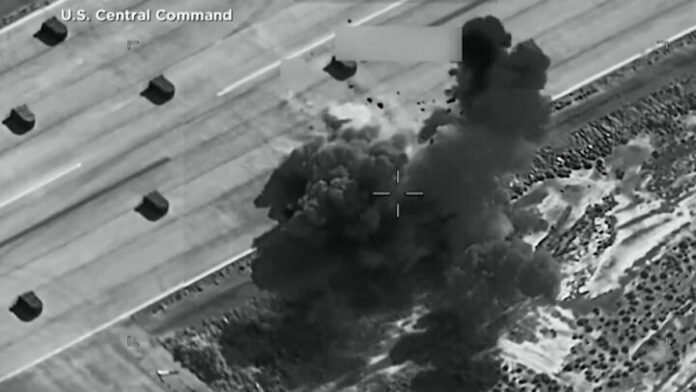


![Hundreds of people, holding banners and flags, gather to protest Israel's attacks on Gaza, violations of ceasefires, and restrictions on the entry of humanitarian aid into the region in Stockholm, Sweden, on July 11, 2026 [Atila Altuntaş - Anadolu Agency]](https://i0.wp.com/www.middleeastmonitor.com/wp-content/uploads/2026/07/AA-20260711-41952055-41952052-ISRAELS_ATTACKS_ON_GAZA_AND_CEASEFIRE_VIOLATIONS_WERE_PROTESTED_IN_SWEDEN-1-1.jpg?fit=920%2C613&ssl=1)