As Syria’s first post-Assad parliament takes shape, activists say a rise in female lawmakers will matter only if women can shape legislation and oversight
[DAMASCUS] Aisha al-Khatib, a 32-year-old law student and coordinator of the “Power of Decision Through Women’s Voices” initiative, began her day with household chores, caring for her children, and attending a meeting with the Norwegian ambassador during the ambassador’s visit to Aleppo.
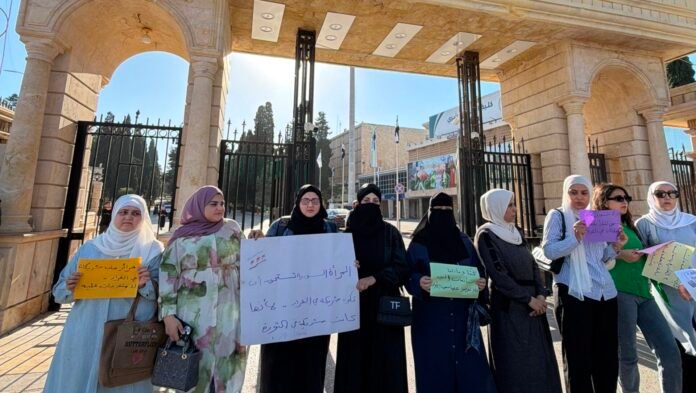
Hours later, she stood in central Aleppo holding a placard that read: “Representation Is Not Just Numbers.”
As al-Khatib and dozens of women gathered for a licensed protest demanding greater female participation in political decision-making, authorities in Damascus announced the completion of Syria’s first People’s Assembly since the fall of former President Bashar Assad, marking a major milestone in the country’s political transition.
For al-Khatib, the timing underscored a contradiction. While the new parliament includes more women than initially elected, she believes numbers alone do not guarantee meaningful political representation.

Women activists protest in Aleppo against what they say is inadequate female representation in Syria’s newly formed People’s Assembly, July 2. (Yafa Nawaf/The Media Line)
Syria’s People’s Assembly has 210 seats, although only 207 lawmakers have been named because elections for three seats in the southern province of As-Suwayda could not be held following sectarian violence.
Under the Constitutional Declaration governing the transitional period, 137 lawmakers were chosen through indirect elections conducted by electoral bodies established by the Higher Committee for People’s Assembly Elections. President Ahmed al-Sharaa has now appointed an additional 70 members—the so-called “presidential third”—to broaden representation by including professionals, specialists, and social groups that might otherwise have been excluded from the electoral process.
The appointments included 15 women, significantly increasing female representation in the assembly. Depending on the count used by different news organizations, the new parliament includes either 21 or 22 women, representing about 10% of the chamber.
While the appointments significantly boosted women’s presence in parliament, the figure remains well below the global average and has reignited debate over whether such appointments can compensate for women’s limited electoral success—or simply postpone addressing the structural barriers that prevent them from winning elected office.
The Aleppo protest was organized only hours after the final list of parliament members was announced. Participants argued that the new assembly still fails to reflect the depth of female expertise and leadership that emerged during Syria’s years of conflict and political upheaval.
“I joined because I believe change comes through action, not words,” al-Khatib told The Media Line.
“I felt it was my duty as a Syrian woman to help create space for women’s voices, especially after years in which women carried enormous responsibilities during the revolution—within their families, at work, and in their communities—yet remained largely absent from positions where decisions are made,” she said.
I felt it was my duty as a Syrian woman to help create space for women’s voices
She argued that rebuilding Syria requires “justice and democracy based on merit rather than gender,” adding that women should become genuine partners in shaping the country’s future rather than serving as symbolic representatives.
For al-Khatib, speaking publicly carried its own significance.
For many years, expressing an opinion publicly was associated with fear and danger
“For many years, expressing an opinion publicly was associated with fear and danger,” she said. “Standing peacefully in a public square today and demanding our rights was an extraordinary feeling.”
Asmaa al-Mahmoud, 28, a human rights advocate and governance consultant, said she studied law because it aligned with her longstanding interest in justice and public governance.
Like al-Khatib, she believes the issue extends beyond the number of women serving in parliament. “We support merit and technocratic governance at every stage,” al-Mahmoud told The Media Line. “But during this transitional period, I believe a temporary gender quota is necessary.”
She pointed out that Aleppo, Syria’s largest province by parliamentary representation, was allocated 46 seats in the new assembly, yet only two women from the province ultimately secured seats.
“That simply does not reflect the number of qualified women in Aleppo,” she said. “Women are not decoration. The current percentage is too low to create meaningful influence inside parliament, and the representation does not reflect all segments of Syrian society.”
That simply does not reflect the number of qualified women in Aleppo. Women are not decoration.
Yafa Nawaf, a Syrian political activist focused on women’s political participation, said the figures illustrate the structural challenges women continue to face in reaching elected office.
“Syrian women were active participants in the struggle for freedom and justice,” Nawaf told The Media Line. “They stood at the forefront of demonstrations against repression, endured imprisonment, displacement, and the loss of family members. That contribution should now be reflected more clearly in the country’s decision-making institutions.”
Government officials say that the presidential appointments were designed to address those shortcomings.
Mohammad Taha al-Ahmad, head of the Higher Committee for People’s Assembly Elections, told The Media Line that the appointments were made under powers granted by the Constitutional Declaration.
According to al-Ahmad, the president appointed 55 men and 15 women representing a broad range of professional and social backgrounds, including academics, legal experts, community leaders, former political detainees, people wounded during the Syrian revolution, and individuals with disabilities.
“The objective,” he said, “was to achieve more balanced representation within the assembly.”
Al-Ahmad said the parliament was ready to convene its inaugural session, during which members will elect the speaker and the assembly’s leadership, formally launching Syria’s first legislative body of the transitional period.
The increase in the number of women lawmakers has also brought greater diversity in professional backgrounds, something Syrian authorities say was intentional in order to broaden representation during the transition. Critics, however, argue that the true measure of success will not be diversity itself but whether these women can shape legislation and hold the executive branch accountable.
Among the more prominent appointees is Rozina Lazkani, 36, a Syrian actress from Hama province. A graduate of Damascus’ Higher Institute of Dramatic Arts with a specialization in scenography, Lazkani began her television career in 2013 and has since appeared in some of Syria’s best-known television dramas.
Speaking to Syrian media following her appointment, Rozina Lazkani described her new role as “both a vote of confidence and a great responsibility,” saying she hopes to represent citizens’ concerns and contribute to rebuilding Syria during its transitional period.
The appointments also included Samira Ayman al-Wattar, a member of the Higher Committee for People’s Assembly Elections’ legal committee; Aisha al-Dibs, who headed the Women’s Affairs Office in Syria’s post-Assad transitional administration; and Houda al-Atassi, an architect and women’s and children’s rights advocate who previously served on the preparatory committee for Syria’s National Dialogue Conference.
The appointees also include women from academia and scientific research.
Among them is Israa al-Mashhour, an agricultural researcher from Deir ez-Zor specializing in soil science and plant nutrition. She previously headed a department at the General Commission for Scientific Agricultural Research and has published research in scientific journals.
In a statement released following her appointment, Israa al-Mashhour described her parliamentary appointment as “a responsibility before it is an honor,” saying Syria’s next phase requires translating the sacrifices of its people into legislation that “strengthens justice, protects rights, and reinforces the rule of law.” She added that serving the country “must be achieved through sincere work, not merely words.”
Other newly appointed women include Lara Qadid, a researcher specializing in higher education policy; Madonna Bishara, a civil society activist focused on human rights and women’s issues; and Hanan Ibrahim al-Balkhi, an academic who earned a master’s degree from the University of Oslo and previously served in both the Syrian National Council and the Syrian Opposition Coalition.
The list also includes community figures such as Najwa Qassas, known for supporting development initiatives and women’s economic empowerment, and Asmaa Farhan al-Sibai, a former political detainee and social activist.
Supporters say that range of backgrounds could strengthen parliamentary debate, while critics argue the real test will be whether women can influence legislation and oversight.
The international benchmark of at least 30% female representation … is precisely the figure demanded by the women who protested in Aleppo
Mahmoud Hammam, a lawyer, legal researcher, and former parliamentary candidate, said that increasing the number of women through presidential appointments alone would not resolve the deeper obstacles to women’s political participation.
“The international benchmark of at least 30% female representation is widely regarded as the minimum threshold at which women can form a parliamentary bloc capable of influencing legislation and public policy,” Hammam told The Media Line. “That is precisely the figure demanded by the women who protested in Aleppo.”

Women activists protest in Aleppo against what they say is inadequate female representation in Syria’s newly formed People’s Assembly, July 2. (Yafa Nawaf/The Media Line)
He said improving women’s political participation requires more than increasing the number of seats allocated to women. It also depends on creating a political environment in which qualified women with legal, political, and administrative experience can compete on equal footing and reach decision-making positions.
At approximately 10%, women’s representation in Syria’s new parliament remains low by regional and international standards.
In neighboring Iraq, the constitution guarantees women at least 25% of parliamentary seats. Jordan has expanded its quota system in recent years, though women still hold about one-fifth of the seats in the House of Representatives. Lebanon, which lacks a parliamentary quota, continues to have fewer than 10%, making Syria’s current level broadly comparable despite the countries’ different political circumstances.
According to the Inter-Parliamentary Union, women now hold more than 27% of parliamentary seats worldwide on average, leaving Syria’s new legislature well below the global benchmark.
Women’s underrepresentation is not a new phenomenon in Syria. Parliamentary records and Inter-Parliamentary Union data show that no women served in the Syrian parliament following the 1947 or 1953 elections. Women’s representation gradually increased over subsequent decades, reaching 2.7% in 1973, 3.6% in 1977, 6.7% in 1981, and 8.4% in 1990.
During Assad’s rule, women generally held between 10% and 13% of parliamentary seats, peaking at 13.2% in 2016 before declining to approximately 9.6% in the parliament elected in 2024.
The issue is particularly significant because the new People’s Assembly is Syria’s first legislature since Assad’s fall. During the transitional period, it will be responsible for debating and passing legislation, approving the state budget, ratifying international agreements, and exercising legislative authority until a permanent constitution is adopted and new national elections are held.
Aqeel Hussein, an elected member of parliament representing Aleppo, told The Media Line that the success of women’s participation should not be measured solely by the number of seats they occupy.
“The real test,” he said, “will be their presence in key parliamentary committees and their ability to influence legislation and exercise meaningful oversight of the executive branch.”
For al-Khatib, however, the debate ultimately goes beyond the composition of the current parliament.
“We want women’s participation to become the natural result of merit and equal opportunity,” she said, “not an exception achieved only through appointments.”
We want women’s participation to become the natural result of merit and equal opportunity not an exception achieved only through appointments
As Syria’s new parliament prepares to convene for the first time, the debate over women’s representation is moving beyond percentages and political appointments. The coming months will show whether the increase in female lawmakers marks a meaningful shift in women’s role in shaping the country’s future.