15.2 C
London
Friday, July 3, 2026
Home Blog

Google faces EU top court ruling on record €4.1 billion fine

0
google-faces-eu-top-court-ruling-on-record-e4.1-billion-fine
Google faces EU top court ruling on record €4.1 billion fine


The European Union’s top court is set to rule on Thursday on Google’s appeal against a record €4.125 billion ($4.67 billion) antitrust fine over alleged anti-competitive practices.

The European Commission imposed a €4.3 billion penalty in 2018, accusing Google of abusing its Android system’s market dominance by requiring phone makers to pre-install Google Search and Chrome.

The EU’s executive branch accused the tech giant of restricting competition while imposing the bloc’s highest antitrust fine ever.

The EU’s General Court upheld the findings in 2022, but reduced the fine from €4.34 billion to €4.125 billion.

Appealing the 2022 ruling, Google filed a new challenge before the European Court of Justice, the bloc’s top court.

Google claimed the case was unfounded, saying that the sanction penalized innovation and that Android users were free to download rival apps.

Earlier, the tech giant had also accused the EU of being blind to practices by Apple pushing its own services on iPhones.

Google fined more than €8 billion

The latest case is one of several antitrust disputes between Google and the EU, which fined the company more than €8 billion between 2017 and 2019 over antitrust violations.

The EU has other open investigations into the tech giant under its Digital Markets Act (DMA).

Among the other EU sanctions Google is facing for exploiting its market dominance are:

  • €2.95 billion fine handed down in September 2025 for favoring its own advertising services
  • €2.4 billion competition fine for promoting its own shopping services

Last year, US President Donald Trump accused Brussels of unfairly targeting American firms and threatened the EU with retaliatory tariffs.

Read more via Deutsche Welle

A realist reading of the Israel-Turkey rupture

0
a-realist-reading-of-the-israel-turkey-rupture
A realist reading of the Israel-Turkey rupture

There is a temptation, whenever two regional powers start hurling accusations of genocide and dictatorship at each other, to read the moment as a clash of civilizations or of irreconcilable values.

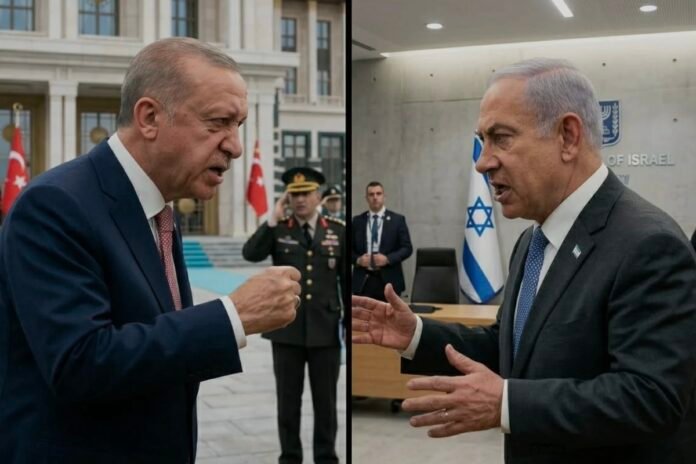
The Turkey-Israel rupture invites exactly that kind of reading: Recep Tayyip Erdogan comparing Benjamin Netanyahu to Hitler, Israeli ministers calling Turkey “an enemy state in every sense,” Jerusalem suddenly discovering, after a century of careful avoidance, that it has a “moral obligation” to recognize the Armenian genocide.

But a realist lens suggests something less dramatic and more familiar: two middle powers, each overextended, each losing the regional order that once constrained them, reaching for whatever instruments — historical memory included — serve an immediate strategic purpose.

Genocide recognition as statecraft, not epiphany

Start with the Armenian question, because it is the clearest case of history being conscripted into present-day leverage.

For decades, Israeli governments of every stripe declined to use the word “genocide” for the Ottoman-era massacres of Armenians. That was not out of historiographical doubt — the scholarly consensus was never in serious dispute — but because Turkey was a valued military and diplomatic partner, and later because Azerbaijan, an important source of oil and an intelligence partner against Iran, also strongly opposed recognition.

That calculus held for 100 years. It changed in a matter of weeks in June 2026, not because new archives surfaced, but because Ankara and Jerusalem are now open rivals across Syria, the Eastern Mediterranean and Washington’s corridors of influence.

The timing tells the story. This was not a reckoning with conscience; it was a message aimed less at Yerevan than at Ankara — and, more precisely, at the US Congress, where an energized Armenian-American lobby can complicate Turkey’s defense-industrial ambitions and its case for renewed American favor.

Realists have long argued that “moral” foreign policy gestures deserve scrutiny for the interests hiding underneath them; this is as clean an example as one is likely to find.

That doesn’t make the underlying history any less real — the genocide happened, and the historical record has never seriously been in dispute — but it should make observers skeptical of the idea that Israel discovered a moral truth in 2026 that it somehow couldn’t see in 1996 or 2016. The truth didn’t change – the utility of saying so did.

Turkey’s response was equally instrumental: officials framed the recognition as a deflection from Israel’s own conduct in Gaza, not as an occasion for historical reflection. Both governments, in other words, are using a century-old atrocity as a rhetorical weapon in a very current fight.

Neither side’s position on the underlying facts should be confused with the reasons each is voicing it now.

The deeper drivers: geography, not ideology

Strip away the rhetoric and the structural sources of friction are unglamorous and entirely predictable from a balance-of-power standpoint:

Syria. With Bashar al-Assad gone and Iranian-aligned militias degraded, both Ankara and Jerusalem are filling the vacuum, and their preferred clients don’t overlap. Turkey backs the new government in Damascus and is arming and training its military.

Israel has struck Syrian military assets repeatedly and backs Druze and, more cautiously, Kurdish communities that Ankara regards with deep suspicion given the Kurdistan Workers’ Party’s (PKK’s) history. This is a textbook security dilemma: each side’s defensive hedge reads as an offensive threat to the other.

The Eastern Mediterranean. A deepening Israel-Greece-Cyprus defense and energy partnership — joint exercises, an Israeli air-defense sale to Cyprus, a new US-backed energy hub — lands directly on top of Turkey’s “Blue Homeland” maritime claims and its decades-old dispute over Cyprus.

Ankara reads encirclement; Jerusalem reads diversification of alliances away from a Turkey it no longer trusts. Both readings are rational given each capital’s vantage point, which is exactly what makes the dynamic hard to defuse through goodwill alone.

NATO’s awkward middle. Turkey’s membership is the strangest variable in the equation. It gives Ankara a security umbrella it increasingly resents relying on, while giving Washington a headache: an alliance built to deter Russia now has to worry about managing a rivalry between one member and its closest non-member partner.

Any American administration serious about avoiding a wider Eastern Mediterranean crisis has an interest in keeping this rivalry rhetorical rather than kinetic. But Washington’s bandwidth for that kind of quiet mediation has never been thinner.

The case for restraint

None of this counsels indifference to what’s happening — a NATO member (Turkey) and a nuclear-armed US partner (Israel) sliding toward confrontation is not a minor story. But it does counsel against treating either government’s public framing at face value.

Erdogan’s talk of “liberating Jerusalem” is aimed at a domestic and pan-Islamist audience as much as at Israel. Israeli officials branding Turkey “the new Iran” serve to justify further entrenchment in Syria and closer alignment with Greece and Cyprus, alignments that carry their own escalation risks.

Genocide recognition, invoked now rather than in any of the previous 40 years it could have been invoked, serves Israel’s immediate contest with Ankara over Washington’s attention.

The realist instinct is not to dismiss the moral content of any of these claims — the Armenian genocide occurred, Turkey’s authoritarian drift is real, Israel’s conduct in Gaza has drawn serious international scrutiny — but to separate the claims from the timing of their deployment, and to resist the pull toward treating a regional power rivalry as a referendum on civilizational values.

What’s unfolding between Ankara and Jerusalem is what unconstrained middle powers do when a regional hegemon (in this case, an exhausted American security guarantee) recedes: they hedge, they posture and they reach for whatever historical or moral instrument is lying closest to hand.

The job of outside observers, and especially of Washington, is to see that clearly rather than pick a side in what is, underneath the rhetoric, an old-fashioned contest for regional position.

This article was originally published on Leon Hadar’s Global Zeitgeist and is republished with kind permission. Become a subscriber here.

Rouzaina… the true face of Syria

0
rouzaina…-the-true-face-of-syria
Rouzaina… the true face of Syria

I did not regret missing Rouzaina Lazkani’s television work as much as I regretted discovering—too late—that Syria had been hiding its true face in a place we had not looked closely enough. Rouzaina, chosen by President Ahmad alShar’a as part of the complementary third of the People’s Assembly, is not merely an actress stepping into politics. She is a distilled image of a Syria trying to break free from the era of rigid interpretations and step into the era of life.

I cannot write about Rouzaina the actress; I was not fortunate enough to watch her performances. But I can write about the Syria I know well through years of journalism—Syria that now reveals itself in small but decisive details: a beautifully crafted airline advertisement, a flight returning to Europe after a decade of isolation, and a familiar artistic face entering parliament to say something larger than politics.

The advertisement released by Syrian Airlines as its first flight departed Amsterdam for Damascus was an event that transcended aviation. It was crafted with enough emotional force to pierce the heart, not merely the viewer’s mind.

Dutch media described the flight as “a symbolic step reconnecting Syria with Europe after years of isolation,” while a European aviation journal called it “a turning point in Syria’s reintegration into the global airspace.”

This Western language, emerging from distant newsrooms, quietly aligns with the Syrian advertisement’s message: Syria returning to the world not as a security file, but as a city longing to be seen again.

Placed alongside Rouzaina’s appointment, the scene becomes one picture: Syria redefining itself through art, beauty, and knowledge—not through the narratives imposed upon it. President alShar’a, in this moment, does not appear concerned with defending his choices against “interpretive risks.” He appears concerned with changing the substance of interpretation itself.

By choosing a young artist, a face known in Syrian drama, to join the legislative institution, he cuts off the path to rigid readings and declares that the new Syria is unashamed of its beauty, its art, or the presence of women at the heart of decision‑making.

And here, the comparison with Iraq becomes unavoidable. At the very moment Rouzaina ascended to the Syrian parliament, members of the Iraqi parliament were displaying bags of stolen state money on camera—as if hosting a television show about looting the public treasury. What Syria achieved in less than two years—rebuilding institutions, reopening international routes, and bringing artistic and scientific figures into parliament—Iraq has failed to achieve in twentythree.

READ: Syrian Airlines launches first flight from Amsterdam to Damascus after years of suspension, media says

International airports still classify Iraqi Airways under operational restrictions for failing to meet global safety standards. Syria, emerging from a devastating war, is rebuilding its image through art and knowledge; Iraq, blessed with every opportunity, continues to reproduce the same political class that turns parliament into a stage for scandals rather than a chamber for legislation.

Rouzaina is not “decoration” for the scene. She is an implicit declaration that Syria wishes to be seen as it truly is: a country with a deep artistic memory, unmistakable Levantine beauty, and the ability to turn art into political language. This meaning becomes clearer when we look at the rest of the complementary third: doctors, educators, academics, women with civic and educational experience, and a cohort of PhD and master’s degree holders. This is not a list—it is a conscious attempt to institutionalize parliamentary work through specialized committees, as noted by UN analyses describing the opening session of the People’s Assembly as “a significant marker in Syria’s political transition.”

Western think tanks have begun linking Syria’s renewed air routes to Europe with a broader trajectory of reintegration into regional economic and political structures. One report called the Amsterdam–Damascus flight “a test of Syria’s ability to rebuild its connectivity after years of sanctions and conflict.”

This technical reading carries a deeper acknowledgment: Syria is no longer seen solely through the lens of war, but through its ability to rebuild daily life—travel, work, movement, and political representation.

READ: 6 killed, 22 injured in bomb explosion at cafe in Syrian capital

Rouzaina, along with the medical, educational, and civic figures entering parliament, becomes part of a larger narrative: Syria shifting from the image of a “besieged state” to that of a “society reorganizing itself.”

The real Syria is not the one reduced to sanctions reports or maps of influence, but the one appearing in small details: a graceful airline advertisement, an actress stepping into parliament, a pediatrician becoming a legislator, an educator shaping new laws.

And so, every time others attempt to interpret Syria from the outside, President alShar’a appears busy redefining it from within—through faces that resemble the country, through an artistic and intellectual history that emerges from Damascus to the world, not from negotiation rooms to statements.

Rouzaina is not a name on a list; she is a declaration of the Syria that wishes to be seen: a Syria opening its window to life, reclaiming its beauty, and rebuilding its institutions with faces unafraid of the light.

In this sense, the debate over “the president’s choices” becomes far less important than the image these choices draw for Syria’s future—a future built not on fear, but on life; not on closure, but on an openness to beauty, knowledge, and women.

OPINION: Zero‑sum exhaustion: The new shape of global conflict

The views expressed in this article belong to the author and do not necessarily reflect the editorial policy of Middle East Monitor.

Tel Aviv University Researchers Identify Immune Process That May Fuel Cancer Growth

0
tel-aviv-university-researchers-identify-immune-process-that-may-fuel-cancer-growth
Tel Aviv University Researchers Identify Immune Process That May Fuel Cancer Growth


Researchers at Tel Aviv University’s Gray Faculty of Medical and Health Sciences have identified a mechanism by which cancerous tumors can redirect a normal immune system process to support tumor growth, a discovery they say could lead to new treatment strategies that restore the immune system’s ability to fight cancer.

The study was led by Dr. Merav Cohen and doctoral students Roi Balaban and Ori Moskowitz and was published in the journal Science Immunology.

The research focused on macrophages, immune cells responsible for removing damaged and dead cells from the body. While this process normally helps maintain healthy tissue and prevent inflammation, the researchers found that within cancerous tumors it can instead change the behavior of the immune cells in ways that promote tumor development.

To investigate the process, the team developed a new technology called Effero-seq, which tracks changes in immune cells after they engulf dead cells. Using the method, the researchers found that macrophages that consumed dead cancer cells underwent what they described as “reprogramming,” activating genes associated with tumor growth.

The team used a melanoma model to examine the effects of the altered immune cells. They found that macrophages that had consumed dead cancer cells encouraged the formation of new blood vessels inside tumors. The additional blood vessels supplied tumors with oxygen and nutrients, allowing them to grow more rapidly. The researchers also found that these macrophages became less responsive to signals that normally trigger anti-cancer immune activity.

The researchers expanded the study by analyzing data from patients with uveal melanoma, a form of eye cancer. They found that patients whose tumors showed higher expression of immune cells carrying the genetic signature identified in the study generally had lower survival rates.

According to Dr. Cohen, the findings offer new insight into how tumors influence the immune system to support their own growth.

“The better we understand these mechanisms, the better equipped we will be to develop treatments that block them and restore the immune system’s ability to fight cancer,” she says. “This research points to a new and promising therapeutic target, one that focuses not only on the cancer cells themselves, but also on the processes that enable them to thrive.”

Trump gets OpenAI to offer US 5% stake, far lower than Sanders’ target

0
trump-gets-openai-to-offer-us-5%-stake,-far-lower-than-sanders’-target
Trump gets OpenAI to offer US 5% stake, far lower than Sanders’ target

OpenAI CEO Sam Altman is reportedly in active talks with the Trump administration about the US potentially acquiring a 5 percent stake in the leading AI firm.

Insider sources told the Financial Times that these talks are in “early stages,” but Altman “has argued that giving the public a financial stake in the company is the best way to share the upside of AI.”

Donald Trump favors the idea, and his administration has reportedly been talking to several AI firms about the possibility. According to FT’s sources, other companies approached to share similar stakes include Google and Meta.

None of the firms are commenting on FT’s report, though, and Google and Meta have not indicated that they agree with Altman that a 5 percent stake would be an appropriate size to cede to the public. Perhaps notably, Meta has not even voluntarily agreed to share frontier AI models with officials for safety testing, The New York Times reported last week.

But AI firms may be willing to give a little if they expect it will help them gain a lot.

Currently, AI firms like OpenAI are combating what Axios billed as an “AI hate wave.” Recent polls find that 70 percent of Americans don’t want AI data centers built in their area and half of Americans are more concerned than excited about AI. In June, Pew Research Center noted that although chatbots and AI summaries are becoming more popular, “views about AI and how fast it’s advancing tilt negative—even for younger adults.”

Both parties are aware this could impact upcoming elections—and possibly even elections well into the future. Earlier this week, NBC News reported that voters across party lines want tighter AI regulations. Trump and AI firms have claimed that overregulation could threaten America’s lead in the AI race with China.

To combat anti-AI sentiment and try to encourage the American public to embrace AI, OpenAI has suggested that the US create a sovereign wealth fund similar to the Alaska Permanent Fund. That fund invests Alaska’s oil wealth “into stocks and pays dividends to the state government and residents,” FT reported.

In the spring, OpenAI first proposed creating an AI wealth fund that “provides every citizen—including those not invested in financial markets—with a stake in AI-driven economic growth,” FT reported. For society to benefit as much as possible, an OpenAI blog said, an “AI-led future” will likely require “new approaches that give people durable stakes in the systems creating value.”

So far, OpenAI has talked with Trump officials such as Treasury Secretary Scott Bessent and Commerce Secretary Howard Lutnick, as well as Senator Bernie Sanders (I-Vt.), sources told FT.

Sanders has made it clear he’s not impressed with the numbers OpenAI is discussing, though. Last month, sources familiar with Sanders’ discussions with Altman told AP News that Altman remained “far apart” from the senator on how much stake in OpenAI the American public should have.

At that time, Sanders revealed his legislative proposal, which would create a much larger sovereign public wealth fund.

Sanders’ plan requires leading AI firms to pay a one-time 50 percent tax on their stock. Sanders estimated that the tax would yield about $7 trillion, which could be disbursed as direct payments to Americans or invested in programs such as health care, education, and housing.

According to FT, OpenAI has claimed that gifting a 5 percent stake to the US would give Americans more control over AI. But Sanders said the best way to ensure the public benefits from AI is to create a bipartisan Independent Commission for Democratic AI, with members nominated by the president and confirmed by the Senate. That commission could use voting shares to block leading AI firms from making decisions that could harm the public, Sanders told AP News.

“The public has got to have a significant seat at the table to make sure that terrible things do not happen to ordinary people, and that in fact, AI benefits ordinary people, not hurts them,” Sanders said.

For OpenAI’s “conceptual” proposal to work, Congress may have to get involved to implement the mechanisms that would allow the US to take a stake in any AI firms, FT reported. So it seems likely that OpenAI and other firms will be locking horns with Sanders to negotiate what’s fair and what keeps the public safe as AI technology rapidly advances and Americans fear job losses, cybersecurity risks, and a range of harms associated with massive data centers needed to power AI innovation.

Ars could not immediately reach Sanders for comment.

India ramps up nukes while China, Pakistan probe for holes

0
india-ramps-up-nukes-while-china,-pakistan-probe-for-holes
India ramps up nukes while China, Pakistan probe for holes

India’s nuclear buildup is sharpening its deterrent, but Pakistan and China are turning the space below nuclear war into the real battlefield.

Last month, the Stockholm International Peace Research Institute (SIPRI) reported that India expanded its nuclear arsenal to an estimated 190 warheads by January 2026, driven by its longstanding rivalry with Pakistan and an increased strategic emphasis on countering China.

According to SIPRI, India grew its stockpile from 180 warheads in 2025 by steadily developing and maturing a nuclear triad composed of aircraft, land-based missiles, and nuclear ballistic missile submarines (SSBNs).

This ongoing expansion is heavily driven by deep-seated regional rivalries and heightened tensions, seen in Operation Sindoor in May 2025 involving Indian conventional strikes on Pakistani bases with nuclear missions.

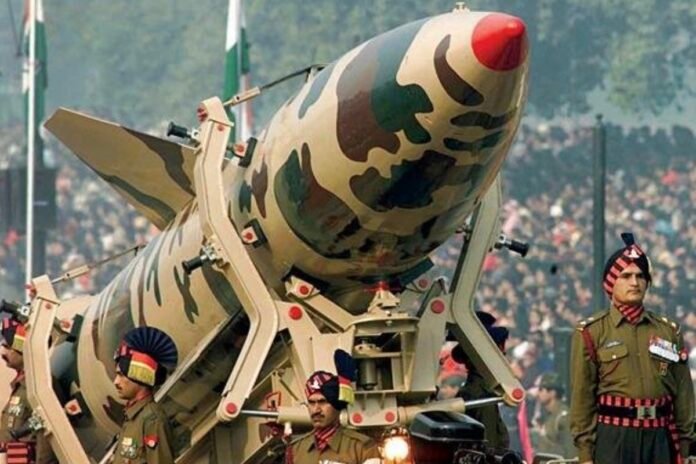
To build a secure second-strike capability and strengthen deterrence against China, India is investing in longer-range weapon systems while continuing to produce fissile materials. This expansion is driven by significant technological advances, such as the military’s recent deployment of MIRVs on the Agni-V intermediate-range ballistic missile (IRBM).

Additionally, India is shifting its peacetime posture by placing land missiles in canisters and deploying a small number of nuclear warheads on a single submarine conducting occasional deterrence patrols, signaling a move toward mating warheads with operational launchers.

But India’s maturing nuclear triad is emerging just as hybrid warfare, asymmetric capabilities and risk-taking below the nuclear threshold are weakening older assumptions about strategic deterrence.

Rose Gottemoeller, in a June 2026 Foreign Policy article, argues that recent conflicts such as the Russia-Ukraine War, the Iran-Israel War, and Operation Sindoor show that strategic deterrence isn’t foolproof, with state and non-state actors increasingly calling out nuclear powers’ bluff.

She notes that nuclear retaliation alone did not stop conventional or hybrid wars, since nuclear assets like strategic bombers, intercontinental ballistic missiles (ICBMs), and SSBNs appear ineffective against massed cheap drone attacks, especially while nuclear states are reluctant to deploy them.

Beyond that vulnerability, Gottemoeller says that the nuclear taboo established in 1945 remains strong and that leaders contemplating the use of nuclear weapons risk severe backlash and infamy.

But despite the growing vulnerability of nuclear weapons against hybrid and conventional states, they remain a powerful psychological weapon. Patrick Cronin notes in a 2026 Hudson Institute article that nuclear-armed states have become more skilled at exploiting nuclear fears to achieve conventional goals, with some believing that even tactical nuclear use might only provoke conventional retaliation.

However, Cronin points out that coercion and conflict, along with the entanglement of conventional and nuclear domains, increase ambiguity and the risk of miscalculation.

For India, that ambiguity is no longer theoretical. Pakistan and China are testing the seams between nuclear deterrence, conventional restraint and hybrid coercion, forcing India to think less in terms of deterring war outright and more in terms of managing violence below the nuclear threshold.

From India’s perspective, Pakistan has fused gray zone warfare with nuclear deterrence. Ashok Shivane notes in a March 2026 report for the Center for Land Warfare Studies (CLAWS) that Pakistan’s nuclear posture provides strategic insulation for proxy warfare, lowering the nuclear threshold to deter India from exploiting its conventional military superiority.

In effect, Shivane says Pakistan seeks to fragment India’s escalation calculus while preserving room for sub-conventional coercion.

However, Siddhant Kishore argues in a November 2025 article for the Bulletin of the Atomic Scientists that India strongly discounts Pakistan’s nuclear threats, in part because Islamabad lacks a credible sea-based second-strike capability.

By contrast, he notes that India’s nuclear triad improves the survivability of its arsenal, while India maintains strategic ambiguity over its No First Use (NFU) posture and promises massive retaliation to any first strike.

This gap is significant because it demonstrates that nuclear deterrence can limit escalation without stopping competition. Instead, it can push rivals into more ambiguous forms of conflict where drones, cyber operations, precision strikes, information warfare and coercive signaling become tools for fighting without formally crossing the nuclear line.

From Pakistan’s perspective, Rabia Akhtar notes in a June 2026 report for the French Institute of International Relations (IFRI) that, despite the conventional escalation in May 2025, Pakistan’s nuclear deterrent did not fail, as it prevented the border clashes from escalating into a major war. However, Akhtar says that Pakistan’s nuclear deterrent left dangerous gaps for conventional exchanges, information warfare, and coercive signaling.

Muhammad Faisal and other authors write in a May 2026 War on the Rocks article that Pakistan is also developing conventional tools to manage escalation rather than relying solely on nuclear signaling.

They argue that Pakistan is prioritizing multi-domain integration, combining AI, electronic warfare, cyber capabilities and precision-strike systems with centralized command to maintain escalation discipline.

The China front presents a different but no less complex deterrence problem. Rakesh Sood argues in a February 2026 article for the Carnegie Endowment for International Peace (CEIP) that India-China border tensions are structurally insulated from nuclear escalation by shared defensive frameworks.

Sood points out that India and China’s strict NFU policies create a more symmetrical nuclear posture, limiting nuclear rhetoric even during tense confrontations such as the 2020 Aksai Chin clash.

As a result, he says India has responded to Chinese advances primarily with conventional forces and deterrence by denial, since limited territorial disputes in remote areas such as eastern Ladakh do not pose the kind of existential threat likely to trigger nuclear escalation.

Still, China’s rapid nuclear buildup — even if not aimed primarily at India — leaves India uneasy. Rajesh Basrur notes in a June 2026 article for the Lee Kuan Yew School of Public Policy that China views the US, not India, as its peer competitor. Yet Basrur says China’s nuclear expansion to compete with the US still creates significant concerns for India.

Highlighting the growth of China’s nuclear forces, SIPRI reported that China had 620 nuclear weapons as of January 2026, up from 600 in 2025. Mark Schneider, writing this month for the National Institute of Public Policy (NIPP), argued that China could reach parity with the US in deployed nuclear weapons in the next four or five years. SIPRI reported that the US had deployed 1,770 nuclear weapons as of January 2026.

Richa Sharma noted in a May 2026 United Service Institute of India (USI) article that China’s advances in MIRVs, SSBNs, intelligence, surveillance and reconnaissance (ISR), and counter-space systems could increase its confidence in conducting counterforce strikes against India’s retaliatory forces.

Thus, India’s nuclear expansion may strengthen deterrence at the level of national survival, but its real test will be whether it can fight, absorb and respond to hybrid, conventional and gray zone pressure without being trapped by Pakistan’s nuclear shadow or distracted by China’s larger strategic rise.

The next phase of Indian deterrence will depend less on warhead numbers alone than on calibrated escalation control: the ability to punish sub-threshold aggression, deny faits accomplis and keep every rung of conflict below the point where nuclear weapons become thinkable.
Google loses long-running appeal of record EU fine, will have to cough up $4.7 billion

0
google-loses-long-running-appeal-of-record-eu-fine,-will-have-to-cough-up-$4.7-billion
Google loses long-running appeal of record EU fine, will have to cough up $4.7 billion

Back in 2018, Google was handed a record-setting 4.34 billion-euro ($4.9 billion) fine in Europe for abusing its monopoly on Android. The company has spent the intervening years challenging that decision, but the continent’s highest court has put a stop to that. The Court of Justice of the European Union has affirmed the penalty, meaning Google is out of options.

Google’s fight may not have turned out the way the company wanted, but it wasn’t for nothing. The initial amount was trimmed slightly by a lower court in 2022, bringing the total to a still record-setting 4.1 billion euros ($4.7 billion). And that looks like the amount Google will have to pay since there are no further avenues for appeal.

The fine stems from the way Google bundles apps and services with Android phones. The EU took issue with Google search and Chrome being the default options on Android. Even devices made by other companies, such as Samsung and Xiaomi, include Google apps as the default per the Android licensing agreement, giving Google an unfair advantage, according to European antitrust regulators. This is not to be confused with a 2.95 billion euro ($3.45 billion) fine against Google’s advertising monopoly issued by the European Union last year.

“The appeal ​brought by Google and its parent company Alphabet against the judgment of the ‌General Court is dismissed, thereby confirming the ​penalty imposed for Google Search’s abuse of a dominant position in the context ⁠of the Android operating system,” the judge’s ruling (PDF) said.

The case mirrored Europe’s actions against Windows years earlier when Microsoft was forced to add browser ballot screens to crack Internet Explorer’s dominance. Of course, Microsoft’s browser dominance was crumbling by the time the EU managed to get that implemented. Google’s market position, however, remains firmly in place despite creating similar ballot screens on Android when the ruling was first handed down.

Throughout the case, Google has taken the same position as Microsoft did in its day. There is plenty of competition on Android, Google said, pointing to all the alternative search services and apps users can freely access. CEO Sundar Pichai said in 2018 that Android has created “more choice, not less.” However, as Google well knows, people rarely change the default settings on their phones.

Europe isn’t done

Google still disagrees with the ruling, but it’s moving forward. “In any event, we adapted our agreements to comply with the initial decision back in 2018 and we remain focused on continued innovation and openness for our users, partners and developers,” the company said in a statement.

However, much of Android’s continued focus on openness is a function of legal wrangling. For example, Google is increasing support for third-party app stores and alternative payment methods in the Play Store. That’s great, but it’s only doing so as a result of Epic’s antitrust lawsuit. And at the same time, Google is planning to lock down app distribution on Android with developer verification, which advocates for open source projects characterize as a serious threat.

This case may have reached its conclusion, but the EU isn’t done going after Big Tech. Regulators now have a more powerful tool at their disposal with the Digital Markets Act (DMA), which designates Google and other tech behemoths as “gatekeepers” that warrant additional oversight. The European Commission is currently deciding how it may use the DMA to force Google to open up Android to more AI services and share search data with competitors.

Princess Diana’s Chilling Death Predictions Revealed

0
princess-diana’s-chilling-death-predictions-revealed
Princess Diana’s Chilling Death Predictions Revealed


Princess Diana reportedly made a series of terrifying predictions about how she believed she might die—warning friends she could be shot, blown up in a helicopter or killed in a carefully staged car crash.

The beloved royal, who died at age 36 following a high-speed crash in Paris in 1997, had long feared powerful enemies wanted to silence her, according to people who claimed she confided in them during the final years of her life.

While Diana’s alleged fear of dying in a road accident has been widely reported, sources claimed her private warnings were even darker and more violent.

Diana reportedly worried she could be gunned down like her close friend, fashion designer Gianni Versace, who was murdered outside his Miami Beach mansion on July 15, 1997—just weeks before Diana’s own death.

The 50-year-old designer was shot by serial killer Andrew Cunanan, who took his own life eight days later.

Versace and Diana had become friends as both helped blur the lines between celebrity, fashion and traditional high society. The designer regularly sent Diana glamorous gowns to wear during high-profile appearances.

His brutal murder reportedly shook the princess deeply.

Bodyguard Lee Sansum claimed he found Diana standing alone on the deck of the yacht Jonikal early the following morning, staring sadly out at the water.

According to Sansum, Diana suddenly turned to him and asked: “Do you think they’ll do that to me?”

Although Versace’s killing was later determined to be the work of Cunanan, Diana initially feared it may have been a terrorist assassination, according to the account.

Sources said the princess struggled to escape the feeling that she was being watched—even while relaxing beneath the Mediterranean sun.

She reportedly had rooms at Kensington Palace searched for hidden listening devices on more than one occasion and allegedly believed an international plot could be forming against her.

During a trip to Rome with her Argentine friend Roberto Devorik, Diana allegedly became alarmed after seeing a portrait of Prince Philip hanging on a wall.

“He hates me,” she reportedly said. “He really hates me and would like to see me disappear.”

Diana is also said to have told Devorik she believed her death would be disguised as a tragic accident.

According to one insider, the princess warned a friend: “I am a threat in their eyes.”

She allegedly continued: “They are not going to kill me by poisoning me or in a big plane, where others will get hurt. They will blow me up, do it when I am in a small plane, in a car when I am driving, or in a helicopter—or shoot me like Gianni.”

When Devorik reportedly questioned why anyone would want her dead—and why she refused continued royal protection—Diana allegedly said she believed the security officers were spying on her.

She had become tired of being followed and reportedly no longer trusted the system that was supposed to protect her.

After losing her “Her Royal Highness” title following her divorce from Prince Charles, Diana allegedly told Devorik the royal establishment was gradually stripping away her power and access to her sons.

“Roberto, you are so naïve,” she reportedly told him.

“Don’t you see, they took my H.R.H. title and now they are slowly taking my kids? They are now letting me know when I can have the children.”

Diana died on August 31, 1997, after the Mercedes carrying her and Dodi Fayed crashed inside Paris’ Pont de l’Alma tunnel. Dodi and driver Henri Paul were also killed. Bodyguard Trevor Rees-Jones survived.

Official investigations concluded the crash was caused by Paul driving at high speed while impaired and being pursued by photographers.

However, Diana’s alleged warnings and predictions have continued to fuel conspiracy theories surrounding her death for nearly three decades.

Some theorists have also claimed Diana was pregnant when she died and that the couple was targeted to prevent her from having a child with Dodi, whose father was Egyptian businessman Mohamed Al-Fayed.

Those claims have never been proven, and official investigations found no credible evidence that Diana was pregnant or that the crash was part of an assassination plot.

Still, the eerie remarks attributed to the princess remain haunting—especially because one of the violent scenarios she reportedly feared involved dying inside a car.

Eastern U.S. hit by historic heatwave ahead of July 4 holiday

0
eastern-us.-hit-by-historic-heatwave-ahead-of-july-4-holiday
Eastern U.S. hit by historic heatwave ahead of July 4 holiday


Record-breaking ​temperatures spread to the eastern U.S. from the Midwest on Wednesday, putting tens of millions of people under heat warnings expected to last into the July 4 holiday ‌weekend, when Americans will celebrate the nation’s 250th anniversary.

The extreme heat was expected to push “real-feel” temperatures to 100 to 115 degrees Fahrenheit (37.8 to 46.1 degrees Celsius) across much of the region, elevating the risk of heat-related illness for vulnerable populations and threatening to overwhelm power grids already strained by rising consumption from data centers and electric vehicles.

In Hill City, Kansas, a tiny high plains town 270 miles east of Denver, mail carrier Sabrina Hooper was struggling with the 100-plus-degree temperatures ​just one week after starting her job.

“It’s completely debilitating,” said Hooper, 34, of the heat’s effect on her work, which entails walking up to 10 miles each day to deliver ​parcels. She said she gets some relief from lawn sprinklers: “It’s so nice. You can take your hat off, get it wet, slap it back on ⁠your head.”

Hill City was the nation’s hottest spot for five consecutive days in 2012, when another record-breaking heatwave swept the region, pushing the town’s heat index up to 108 degrees. The heat index measures ​how it feels when humidity is factored into the air temperature.

Dana Robles, who lives in Brownsville, Texas, a city just off the Gulf Coast at the U.S.-Mexico border, worried on Wednesday about the mounting costs ​of cooling her home as the heat index rose to 108 degrees. During peak temperatures, her family’s monthly power bill can exceed $300, which is nearly one-third what they pay for rent.

Robles also fears blackouts due to the overtaxed power grid.

“I’m scared the electricity is going to go off all day and our food is going to get spoiled,” she said.

In Chicago, high-school science teacher Michelle Klein, 57, had started preparing for the heat over the weekend. She filled ​her car with gas, did her weekly grocery shopping early, stocked the refrigerator with extra cold drinks and gave her plants a deep soak.

“The basil was being a diva and needed another drink of water this ​morning,” Klein said on Tuesday evening after going on her usual evening walk despite the 103-degree heat index.

In the city’s suburbs, property investor Amy Kaspar got an urgent call Monday night from a tenant whose air conditioner ‌was only ⁠blowing out warm air. Kaspar discovered that the appliance was working fine – it simply could not keep up with cooling the tenant’s unit, given the intense heat and humidity.

“Combined with the wind, it feels like standing behind the exhaust of a bus right now in Chicago,” said Kaspar, 50.

COOLING CENTERS, CHECK-INS

Chicago’s Office of Emergency Management and Communications urged residents on Wednesday to periodically check in with relatives, neighbors, seniors and other vulnerable populations. If contact cannot be made, the office said, Chicagoans can request a well-being check from the city by calling 311.

The scorching U.S. temperatures mirrored those in western Europe, which recently has been engulfed ​in its own record-breaking heatwave, an event scientists said ​would have been “virtually impossible” without human-caused climate ⁠change. Scientists have confirmed through years of studies that greenhouse gas emissions are making heatwaves around the world both more likely and intense.

The extreme heat only began creeping into New York City as of Wednesday morning, by which point the city had opened hundreds of cooling centers and deployed more ​than a dozen “cool vans” equipped with water, electrolytes, sunscreen and meals for New Yorkers in need of relief, Mayor Zohran Mamdani said at a ​press conference.

Air conditioning was on ⁠full blast at a senior center in Harlem on Wednesday, where a sign in 13 languages advertised the space as a “cooling center” for the public. The senior center’s director, Richard Allman, said it would remain open beyond its usual hours over the July 4 weekend.

“We try to make this a comfortable place for people on an extra-hot day,” he said.

Ahead of the heatwave, city leaders had asked operators of signs in ⁠the city’s iconic ​Times Square to reduce the brightness of their billboards to lower energy consumption, and requested that businesses set thermostats no lower ​than 78 degrees. The city’s energy provider, Con Edison, urged customers to limit energy use from 2 p.m. to 10 p.m.

The city has also extended public pool hours, opened additional cooling centers in libraries and municipal buildings, and expanded street outreach ​efforts.

China’s EV fleet is world’s most underestimated AI asset

0
china’s-ev-fleet-is-world’s-most-underestimated-ai-asset
China’s EV fleet is world’s most underestimated AI asset

History has a habit of concealing its most consequential turning points inside the mundane. The invention of the shipping container did not announce itself as a revolution in global trade. The rise of the mobile phone was initially dismissed as an expensive novelty for businessmen.

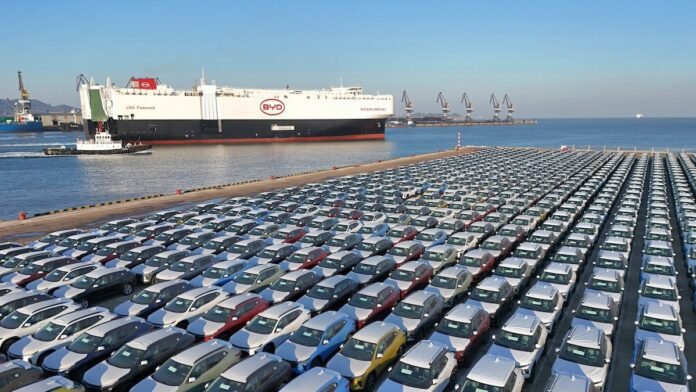
Today, something similarly quiet and similarly transformative is unfolding across the parking lots, highways, and residential streets of China’s sprawling cities. Forty million EVs, each sitting idle for roughly 23 hours a day, are poised to become something the world has not yet named: the most distributed artificial intelligence infrastructure ever assembled.

The observation did not come from a futurist or a technology journalist. It came from Robin Zeng, the founder and chairman of CATL, the world’s largest EV battery maker, speaking at the World Economic Forum’s Summer Davos in Dalian last week.

China’s vast EV fleet, Zeng argued, could be reimagined as distributed token factories: computing infrastructure that uses onboard batteries and AI chips to produce the outputs feeding large language models at scale.

It was arguably the week’s most underreported remark. It deserves to be the most studied.

Misread story from the start

For the better part of a decade, the global conversation about China’s EV industry has been dominated by a single, reductive framing of it as a trade threat. Western governments have debated tariffs, imposed import duties and commissioned studies on the industrial displacement that Chinese EVs might cause.

The European Union levied additional duties. The United States raised its own. The underlying assumption, almost universally shared, was that China’s EV success was a manufacturing story with trade consequences.

A dispassionate reading of the evidence, however, suggests this framing has always been incomplete. China’s drive to electrify its transport system was not, at its core, a plan to conquer foreign car markets. Rather, it was a national energy security calculation.

A country that imports the majority of its crude oil and has watched energy supply chains weaponized amid geopolitical rivalry wanted a transport fleet that ran on electricity it could generate domestically.

What that imperative produced, as an elegant byproduct, was the world’s largest networked fleet of mobile energy storage assets: 40 million batteries on wheels, all connected to an increasingly intelligent charging infrastructure.

Clean energy sectors drove more than a third of China’s GDP growth in 2025. The “new three,” meaning EVs, batteries and solar panels, generated two-thirds of the value added across the entire clean energy sector.

Battery exports grew 41% year-on-year. These numbers have been reported widely, but almost exclusively through a trade-and-competition lens. What has been missed is the deeper infrastructure logic that the fleet represents.

Platform as much as product

Modern electric vehicles in China, whether built by BYD, Nio, Xpeng or dozens of other domestic manufacturers, carry substantial onboard processing capability. Their chips handle navigation, driver assistance, over-the-air software updates, and increasingly sophisticated AI functions.

For roughly 23 hours every day, that capability sits dormant. Zeng’s insight is that this dormant compute capacity, aggregated across tens of millions of vehicles simultaneously, constitutes a distributed AI processing layer that already exists, costs nothing additional to build and requires no new land, no new permits and no new centralized data centers to operate.

The technical mechanism that makes this vision coherent is vehicle-to-grid technology, or V2G, which allows parked EVs to discharge stored electricity back into the grid during peak demand. China has been building the regulatory and physical architecture for V2G since 2024.

By the end of 2027, the country plans to have 28 million charging facilities and 5,000 bidirectional stations operational. Chinese officials project that a fleet of 100 million EVs by 2030, if networked bidirectionally, could unlock one billion kilowatts of flexible energy capacity.

Zeng’s token factory vision extends that logic one critical step further: the vehicle gives back not only electricity but compute.

This is not the first time China has extracted multiple economic functions from the same fixed investment. Its high-speed rail network was built for passengers and became a logistics and regional integration tool.

Its renewable energy infrastructure was designed for energy security and became a globally dominant export industry. The pattern is consistent and deliberate: absorb the capital cost once, then extract value across multiple domains across time.

Capital follows the vision

What elevates Zeng’s Dalian remarks from visionary speculation to credible industrial strategy is the investment trail CATL has left in the preceding months.

In April 2026, CATL invested approximately $600 million for a 49% stake in Zhongheng Electric’s controlling shareholder, one of China’s primary providers of high-voltage direct-current power systems for AI data centers.

In May, a CATL-affiliated fund committed up to $942 million to acquire 38.1% of VNET Group, a major data center operator. In June, TechNode reported that CATL committed approximately $740 million to DeepSeek’s $7.4 billion first external funding round, making the battery giant one of the two largest outside investors in China’s most consequential AI laboratory.

These three transactions, totaling roughly $1.5 billion across two months, form a vertical chain: battery storage upstream, power conversion in the midstream, data center operations downstream and AI model development at the end.

CATL told Reuters in June 2026 that it expects energy storage to account for half of its global sales by 2030, up from roughly a quarter today. The company is already using AI to auto-bid for low-cost electricity from China’s grid, a capability that has reduced its own manufacturing energy costs by approximately 30%.

Taken together, these moves describe a company that spent 15 years mastering energy storage for transport and is now systematically applying the same supply chain discipline and capital patience to AI energy storage.

The broader implication

There is a temptation, particularly in Western policy circles, to interpret every Chinese industrial advance primarily through the lens of competition and strategic risk. That temptation, understandable as it is, tends to obscure the structural significance of what is actually being built.

What China is constructing, through its EV fleet, its V2G infrastructure, its sodium-ion battery development and now its AI data center investments, is a layered, multi-purpose energy and compute system in which the same physical assets serve transport, grid stability and digital intelligence simultaneously.

CATL’s Zeng captured the spirit of this at Summer Davos with characteristic brevity: “Less geopolitical calculation, more cooperation will bring a better future for all.”

That is a call for a particular kind of global engagement, one grounded in the recognition that the infrastructure being built in China will, one way or another, shape the digital economy that the entire world eventually inhabits.

0FansLike
0FollowersFollow
0FollowersFollow
0SubscribersSubscribe
- Advertisement -
Google search engine

Recent Posts