Inside the Collapse of Global Accountability for Israel | Palestine This Week
This episode of Palestine This Week opens with Israel’s renewed push to promote the so-called “voluntary migration” of Palestinians from Gaza, asking whether ethnic cleansing is now being pursued without even the pretence of concealment.
This episode of Palestine This Week opens with Israel’s renewed push to promote the so-called “voluntary migration” of Palestinians from Gaza, asking whether ethnic cleansing is now being pursued without even the pretence of concealment. We also look at Trump’s proposed Gaza board and warnings that it could create a legal black hole for officials and contractors, before turning to the unprecedented lawsuit filed by ICC judges against US sanctions they describe as an attempt to punish and coerce the court.
The episode also explores growing threats to journalism, from the UK’s State Threats Bill to double standards in how the media defines press freedom, alongside new revelations about the Hannibal Directive during the events of 7 October. We then assess whether Israel’s confrontation with Iran has punctured the myth of Israeli military invincibility, and close with Lebanon, where Israeli media figures speak openly about pushing the country towards civil war as part of a wider regional strategy.
WATCH: Is Israel Losing Its American Shield? | Palestine This Week with Mouin Rabbani
A space history mystery: What happened to the Viking arm used 50 years ago?
Michael Collins looked down at his watch.
The Apollo 11 astronaut had already beaten the original schedule for the opening of the National Air and Space Museum by three days, but no one would remember that if these final 36 minutes didn’t go perfectly.
President Gerald Ford and Vice President Nelson Rockefeller took 35 seconds to find their seats on the red, white, and blue bunting-lined outdoor stage. The flyover by the Thunderbirds was quick enough. At any other event, it would have been the only time-dependent concern of the day.
Collins kept glancing at the time. The Presentation of Colors took 20 seconds.
The national anthem, performed by the Air Force Band, took about 85 seconds. Then came the invocation delivered by the Bishop of Washington, and then the Secretary of the Smithsonian, Dillion Ripley, welcomed everyone who had come out for the ceremony.
Warren Burger, Chief Justice of the United States and the chancellor of the Smithsonian, made short work of introducing the president. Ford then took to the podium at 11:13 am.
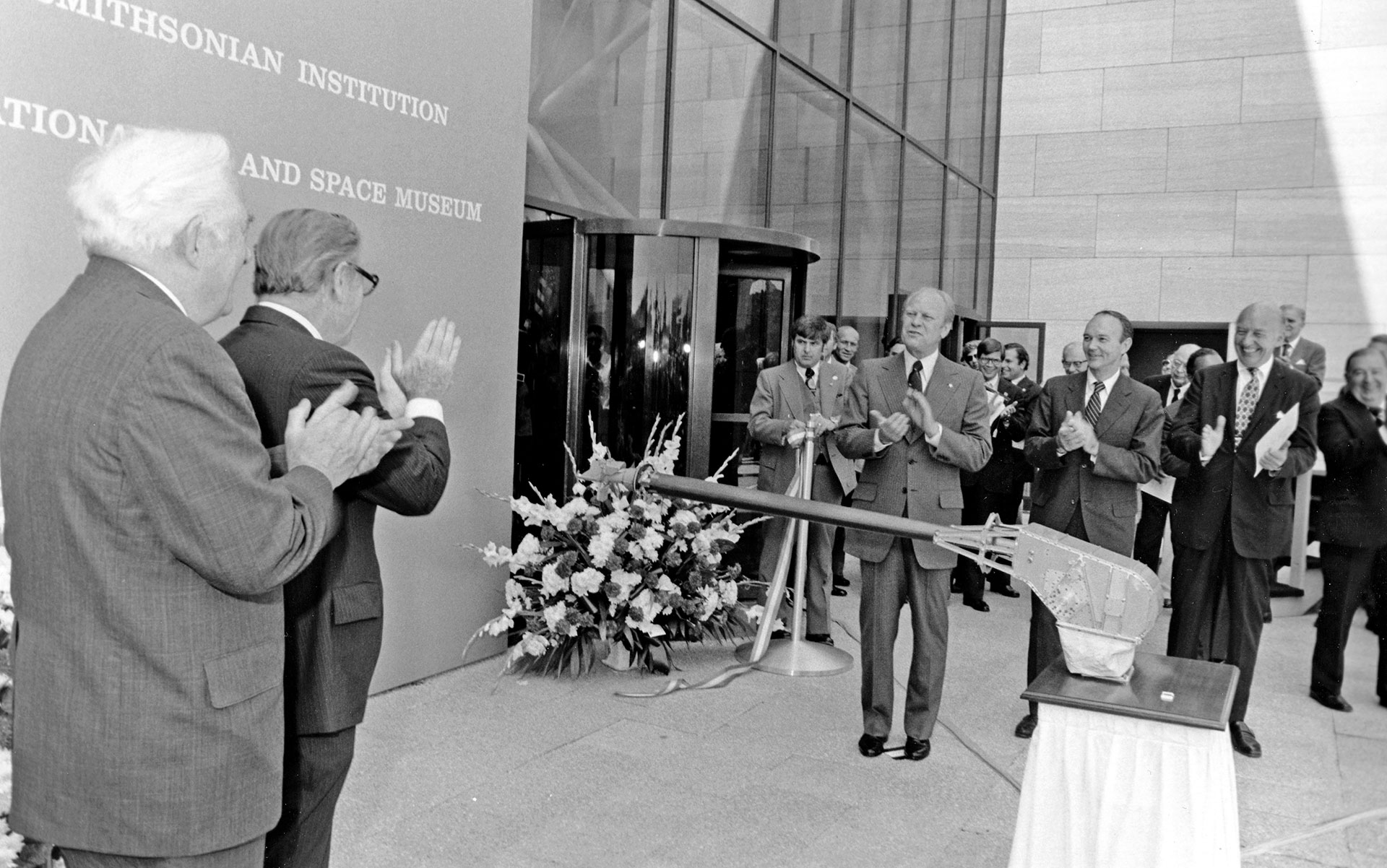
President Gerald Ford and Michael Collins, National Air and Space Museum director, react to the Viking arm cutting the ribbon, opening the building to the public on July 1, 1976.
Credit: Smithsonian
President Gerald Ford and Michael Collins, National Air and Space Museum director, react to the Viking arm cutting the ribbon, opening the building to the public on July 1, 1976. Credit: Smithsonian
“This beautiful new museum and its exciting exhibits of the mastery of air and space is a perfect birthday present from the American people to themselves,” he said. “Although it is almost impolite to boast, perhaps we can say with patriotic pride that the flying machines we see here, from the Wright brothers’ 12-horsepower biplane to the latest space vehicle, were mostly ‘Made in USA’.”
Nine and a half minutes later, Ford concluded. “Thomas Jefferson said, ‘I like to dream of the future better than the history of the past.’ So did his friendly rival, John Adams, who wrote of his dream ‘…to see rising in America an empire of liberty, and a prospect of two or three hundred millions of freemen, without one noble or one king among them. You say it is impossible. If I should agree with you in this, I would still say, let us try the experiment.’”
Everyone on the stage then moved over to the entranceway of the new building, the “Smithsonian Institution National Air and Space Museum,” as inscribed on a 12-foot-tall (4-meter) teal backdrop. Mounted atop the temporary wall were two sets of traffic lights, a pair of side-by-side green lights (currently off) and a set of red lights, now blinking.
Centered in front of the wall, about 11 feet (3.45 meters) away, was a small table draped in white cloth supporting a piece of NASA hardware. It may not have been clear to all of the ceremony’s guests and spectators, but mounted to a wood base sitting atop the table was the surface sampler arm from an engineering model of a Viking Mars lander.
A red, white, and blue ribbon was strung between the arm and the wall, passing through the center of the arm’s sampler end.
After the National Air and Space Museum’s opening-day (July 1, 1976) ribbon-cutting concluded, NASA reportedly packed up and took back the Viking engineering arm assembly.
Credit: Smithsonian
After the National Air and Space Museum’s opening-day (July 1, 1976) ribbon-cutting concluded, NASA reportedly packed up and took back the Viking engineering arm assembly. Credit: Smithsonian
About 36 minutes earlier, NASA initiated a signal to the real Viking 1 probe—then 20 days from landing on Mars—which it then relayed back to Earth. At the distance separating the two planets that day, communications took about 18 minutes one way. The well-traveled command was then received by a tracking station and sent to the engineering arm sitting in front of the museum.
As Ford, Collins and Ripley looked up, the green lights blinked on, confirming the signal had been received.
“I was holding my breath,” said Collins in an interview decades later recalling his role as the first director of the National Air and Space Museum. “I was thinking about all those electrons going lost up there in space and all these VIPs standing around looking at this ribbon and this mechanical shearing device and nothing would happen.”
Part of the challenge was that the time of the opening kept changing. Originally, the museum was scheduled to open on July 4 as a birthday gift to the nation, but it was felt that it would compete with other bicentennial celebrations, and besides, the museum was ready to open.
Then there was the lander at Mars.
Viking 1 was supposed to land on July 4, but when it arrived in its certification orbit two weeks earlier, imagery of the primary landing site showed its terrain was too rough to guarantee a safe landing. NASA delayed the landing to July 20 as a more suitable landing site was sought.
So Collins was already dealing with date and time changes beyond his control.
“But believe it or not, all of the electrons did their cute little things and the ribbon got snipped and the building got opened. It was good,” he said.
The Viking proof test article, seen here in the Boeing Milestones of Flight Hall, was donated to the National Air and Space Museum in 1979 by NASA.
Credit: Smithsonian National Air and Space Museum
The Viking proof test article, seen here in the Boeing Milestones of Flight Hall, was donated to the National Air and Space Museum in 1979 by NASA. Credit: Smithsonian National Air and Space Museum
The doors then opened, and the public got their first look at the Wright brothers’ 1903 Flyer, Charles Lindbergh’s “Spirit of St. Louis” and NASA space capsules, including the command module Columbia that Collins flew to the moon in 1969.
Of course, NASA and the Smithsonian were not going to allow a wayward signal to ruin the day. There was always a backup plan.
“We were prepared to cheat,” said Don Lopez, who was a member of the museum’s original staff and later its deputy director before his death in 2008. “We had a guy in the back with a button to push if it didn’t happen.”
A mystery 50 years in the making
With the ribbon cutting a success, contemporary reports suggest NASA packed up the sampler and took it back with them.
So what became of that arm?
Inside the museum on July 1, 1976, Viking was represented by a static model that had previously been in the US pavilion at the 1975 Paris Air Show and then was on display in the “Life in the Universe?” gallery.
It was not until a few years later (1979) that NASA donated the Viking that millions have since seen in the Boeing Milestones of Flight Gallery—the proof test article that was used on Earth during the Viking 1 and Viking 2 missions to gauge the probes’ behavior and to test their responses to radio commands.
The same model had earlier been used to verify that the landers could survive the stresses they would encounter during launch and landing. It is therefore unlikely, though not impossible, that NASA removed the arm from the test article in 1976 to be used in a ceremony.
The current signage in the National Air and Space Museum mentions and pictures the ribbon cutting but does not identify the Viking surface sampler arm.
Credit: Smithsonian National Air and Space Museum
The current signage in the National Air and Space Museum mentions and pictures the ribbon cutting but does not identify the Viking surface sampler arm. Credit: Smithsonian National Air and Space Museum
At least three other active arms were made. In addition to the two on Mars and one at the National Air and Space Museum, engineering models of the sampler are on display today at the Virginia Air and Space Science Center in Hampton (referred to as the science test/thermal effects article) and the California Science Center in Los Angeles (which is either the landers’ static or dynamic test model).
The last one was on exhibit at the Kennedy Space Center Visitor Complex in Florida until 2019, when it was returned to NASA. Today, it’s believed to be at a planetarium in New Jersey.
Unfortunately, photographs and footage from the 1976 ceremony are not clear enough to read the serial or part numbers off the arm assembly, and no one at the museum seems to remember or know which model the arm came from (if any).
On Wednesday morning (July 1), before opening five newly renovated galleries to the public, the National Air and Space Museum will host a private ceremony to mark its 50th anniversary. The event will feature remarks by NASA Administrator Jared Isaacman and Amanda Wright Lane, the great-grandniece of Orville and Wilbur Wright.
The half-century celebration will not hinge on a signal from space. But perhaps on some future commemoration, the arm that opened it all can be identified and given its long-awaited due.
Trump Has Already Launched More Death Penalty Prosecutions Than in His Entire First Term
Less than halfway through Trump’s second term, the U.S. Department of Justice has authorized a rash of new death penalty prosecutions, already surpassing the total number of capital cases brought during Trump’s previous four years in office.
Since Trump returned to the White House, DOJ prosecutors have moved to seek the death penalty against at least 42 defendants in 34 cases, according to figures compiled by The Intercept, based on legal records and data from the Justice Department and Federal Capital Trial Project. In at least two additional cases, federal prosecutors have conveyed their plans to seek death but have not yet submitted a notice of intent — the formal legal filing telling the defense and presiding judge that the DOJ seeks to execute a defendant. By comparison, the DOJ authorized some 38 capital defendants total over the course of Trump’s first term.
Many of the new cases have originated in places where the death penalty has been abolished — states like New Mexico, Colorado, and Maryland — as well as jurisdictions where there is no history of capital punishment, like the U.S. Virgin Islands. More than 70 percent of the defendants are people of color, most of them Black.
The spike in new death penalty cases is a striking illustration of Trump’s longtime enthusiasm for capital punishment, which led him to carry out an unprecedented execution spree in the months before he left office in 2021. It’s also in stark contrast to the Justice Department under President Joe Biden, who put capital prosecutions almost entirely on hold — and whose attorney general, Merrick Garland, deauthorized dozens of pending death penalty cases upon taking office.
Trump’s ramped up authorizations won’t necessarily bring a wave of new death sentences. Only a relative handful of federal capital authorizations end up going to trial — and fewer still result in a death sentence. Although executions have been on the rise across the United States since Trump retook office, new death sentences have been on a consistent decline for decades. Prosecutors have become more reluctant to seek death sentences, and jurors have also been less and less willing to send defendants to death row.
“The American public has made a very, very decisive turn away from the death penalty during the last 20 years,” said Robin Maher, executive director of the Death Penalty Information Center. “Twenty years ago, we had five times the number of new death sentences than we had last year.” Although Trump’s DOJ “purports to be acting consistent with the will of the American people,” she said, “those are American juries that are making different decisions now.”
The Trump administration’s death penalty plans have already come apart in many cases. Since then-Attorney General Pam Bondi first started filing notices of intent last year, roughly a third of the defendants have seen the death penalty taken off the table. In numerous cases, the presiding judge has struck down the government’s authorizations. In one case involving two co-defendants, the DOJ has withdrawn its prior authorization. And two cases have been resolved with guilty pleas.
This still leaves at least 27 defendants currently facing capital trials. With Blanche, who was previously Trump’s criminal defense lawyer, vying to become attorney general, there is no reason to expect the push to send people to death row to slow down anytime soon.
The defendants facing the death penalty under Trump have been accused of grisly crimes, from mass shootings to gang murders. But if there’s one thing driving Trump’s escalating pursuit of new death sentences above all else, it is his sustained rage at Biden, who took the historic step of commuting 37 death sentences before leaving office, leaving three people on federal death row. Trump railed against the commutations in a Truth Social post on Christmas Day, wrongly referring to them as pardons and telling the commuted prisoners themselves to “GO TO HELL!”
Upon returning to the White House in January 2025, Trump immediately signaled his intent to repopulate federal death row, proclaiming in an executive order that his administration would “pursue the death penalty for all crimes of a severity demanding its use.” Framed as a rebuke to Biden’s act of clemency, which he derided as a “mockery of justice,” it also called on states to step up their own efforts to execute people — and to try to seek new death sentences at the state level against the 37 men whose federal sentences were commuted.
A month later, in February 2025, newly installed Attorney General Pam Bondi issued a memo to DOJ prosecutors directing them to seek death wherever possible. “Absent significant mitigating circumstances, federal prosecutors are expected to seek the death penalty in cases involving the murder of a law-enforcement officer and capital crimes committed by aliens who are illegally present in the United States,” Bondi wrote. She ordered prosecutors to prioritize capital cases involving gang members and people accused of international drug crimes. And in an unprecedented move, Bondi announced that the DOJ would review every decision in which the Biden administration declined to seek a death sentence to determine whether prosecutors should pursue the death penalty after all.
The attempt to turn Biden’s “no-seeks” into capital prosecutions has proven mostly unsuccessful. Of hundreds of cases reviewed by the DOJ, prosecutors ended up filing a notice of intent against 15 defendants who had previously been told they would not face the death penalty. One by one, the new capital authorizations were smacked down by presiding judges, several of whom scolded Trump’s prosecutors for their ham-fisted efforts to win death sentences in cases that, in many instances, were already set for trial. Currently three cases remain in which prosecutors are still seeking to move forward with a capital trial despite the Biden DOJ’s previous decision not to seek death.
It did not take long after Bondi was fired for her replacement, acting Attorney General Todd Blanche, to make clear he intended to continue Trump’s death penalty push. In late April, he released a 48-page report by the Office of Legal Policy, which outlined in detail Trump’s plans to ramp up new death sentences and speed up executions. Titled “Restoring and Strengthening the Federal Death Penalty,” the document again framed Trump’s commitment to capital punishment as a response to Biden’s dereliction of duty — and in particular to his betrayal of victims’ families.
“It was more like a campaign website instead of a measured legal document by a government agency.”
The report included a chart showing Biden’s DOJ’s rejection of capital cases, casting Garland as an outlier among other attorneys general. By contrast, the report devoted little space to Trump’s new authorizations, avoiding entirely its mostly failed attempts to reverse Biden’s “no-seeks.” Nor did it hint at the fact that Blanche, like previous attorneys general, would himself issue a flurry of no-seeks in death-eligible cases upon taking over — something that is standard practice at the DOJ. Death penalty cases are, after all, at least in theory, reserved for only the most serious crimes. “To pursue use of the death penalty in the manner that is set forth in Trump executive order would require an almost singular focus on seeking death sentences to the exclusion of so many other priorities,” Maher said.
While the Blanche report is certainly cause for concern, Maher said a lot of it read as a wishlist more than an achievable blueprint. “The majority of that report, I thought, reflected the Trump administration’s grievances about lawful decisions made by the previous administration,” she said. “To me it was more like a campaign website instead of a measured legal document by a government agency.”
“These executive orders, these memoranda — everything is changing by the day,” she said. “We just don’t know how this is all going to play out.”
What might be most sobering about Trump-era capital punishment is not the way it differs from past presidents but how it remains consistent. In the hands of an administration overtly committed to white supremacy, the defendants chosen by Trump’s DOJ for capital trials look a lot like the defendants who have always faced the federal death penalty.
More than 70 percent of Trump’s authorizations have been against people of color, most of them Black. This is strikingly consistent with the federal death penalty’s overall track record; according to the Death Penalty Information Center, 73 percent of capital defendants authorized for death penalty prosecutions from 1989 to June 2024 were people of color.
The racial disparities in the federal system have been well-documented for decades. Yet, apart from the most high-profile cases, Americans are generally unaware of capital prosecutions brought at the federal level since most authorizations never lead to a death penalty trial — let alone a death sentence. This leaves the most dramatic racial disparities hidden from view. Data from the Federal Capital Trial Project shows that, in the state of Maryland, for example, which has sent only one person to federal death row since the late 1980s, DOJ prosecutors have authorized death penalty prosecutions against more than 30 people, the majority of whom were Black. The rest were Latino.
Trump’s recent authorizations replicate this trend, with DOJ prosecutors in Maryland filing notices of intent against four defendants, three of them Latino and one of them Black. (The former three, alleged MS-13 gang members from Baltimore, have since seen their authorizations thrown out by a judge.)
Since last year, Trump’s DOJ has also authorized death penalty prosecutions of four people in the Eastern District of Missouri, which is home to St. Louis. As with every other federal authorization from the same jurisdiction to date, all of them are Black. (Two of these defendants have since seen their authorizations withdrawn by the DOJ.)
Trump’s execution spree six years ago briefly put the racism of the federal death penalty on display. The eighth man put to death, Orlando Hall, had been sentenced to die by an all-white jury in Texas, where, according to his lawyer’s last legal filings, federal prosecutors were “nearly six times more likely to request authorization to seek the death penalty against a Black defendant than a non-Black defendant.” Co-defendants Christopher Vialva and Brandon Bernard, who were executed less than three months apart, were sent to death row by a federal prosecutor who openly told me that people considered him “crazy” for allowing a single Black man to serve on their jury.
At that time, the U.S. was experiencing a supposed reckoning over race, which made such cases all the more disturbing to those paying attention. Yet the executions had been made possible by a Democratic party that paved the way for Trump’s killing spree by expanding the death penalty in a way that was racially skewed from the start. That Trump’s aggressive death penalty push is no more racist than what came before speaks volumes about what capital punishment has always been.
The logical case for admitting Bangladesh into ASEAN
For decades, Bangladesh’s foreign policy operated on a predictable, singular axis. Under the sixteen-year tenure of ousted Prime Minister Sheikh Hasina, Dhaka’s strategic and economic relations were deeply tethered to New Delhi.
A flurry of bilateral agreements spanning digital connectivity, transit rights, and maritime security signaled a tight, almost exclusive alignment with Indian interests. But the youth-led democratic uprising that ousted Hasina’s autocratic regime altered the scenario.
First under the erstwhile interim administration led by the Nobel laureate and economist Muhammad Yunus, and then under the newly elected Prime Minister Tarique Rahman Bangladesh is quietly but confidently recalibrating its geopolitical posture.
The most significant manifestation of this shift is a strategic pivot eastward toward the Association of Southeast Asian Nations (ASEAN).
Dhaka’s diplomatic overtures to the eleven-member bloc are born of necessity rather than mere sentiment. While full membership remains a distant prospect, the country’s formal request to become a sectoral dialogue partner represents a conscious effort to diversify its diplomatic and economic portfolio.
Sectoral partnerships, which allow for targeted cooperation in trade, climate policy, and regional security, offer a pragmatic backdoor. They lay the institutional groundwork for deeper integration and eventual accession, signaling that Bangladesh no longer views itself merely as the eastern bookend of South Asia, but as a vital bridge to Southeast Asia.
The economic rationale for this reorientation is compelling. Once dismissed by Western diplomats as an economic basket case in the 1970s, Bangladesh has maintained consistent GDP growth rates above 6% for the past two decades.
It has emerged as the world’s second-largest exporter of ready-made garments and a formidable hub of affordable manufacturing. For ASEAN, an economic bloc increasingly preoccupied with supply-chain resilience and decoupling from over-concentrated manufacturing hubs, Bangladesh offers a highly competitive alternative.
As traditional Southeast Asian manufacturing powerhouses like Thailand, Singapore and Vietnam grapple with rapidly aging demographics and shrinking domestic labor pools, Bangladesh presents a massive, underutilized demographic dividend characterized by a young workforce and a rising consumer class.
Crucially, this labor pool is evolving. Bangladesh is no longer merely a source of low-cost, low-skilled migrant labor, though its workers already form the backbone of the construction and agricultural sectors across Malaysia and Singapore.
The country produces thousands of graduates in science, technology, engineering, and mathematics every year who face limited opportunities at home. For ASEAN states currently pouring billions into high-tech industries and semiconductor manufacturing, Dhaka represents a ready reservoir of technical talent.
Formalizing these human capital flows through structured regional mechanisms would allow ASEAN to climb the value chain while offering Bangladesh a path to modernize its labor export model.
Geography further strengthens Dhaka’s hand. Bangladesh commands the busiest port infrastructure in the Bay of Bengal. Chattogram and the deep-sea developments at Matarbari are not merely national infrastructure projects; they are critical nodes for Indo-Pacific maritime trade.
Positioned just off the primary shipping lanes connecting China, the Middle East, and Southeast Asia, Bangladesh controls the maritime gateway to landlocked South Asian markets.
For ASEAN, looking to expand its strategic horizon beyond the Mekong and the heavily contested South China Sea, deep integration with Bangladesh offers direct functional access to the broader Indian Ocean littoral.
Yet the current state of commercial engagement highlights how much potential remains untapped. Trade with ASEAN currently accounts for a meager 10% of Bangladesh’s total trade volume, a stark contrast to the 42% conducted with non-ASEAN Asian nations and the 31% bound for Europe.
This asymmetry underlines a glaring structural disconnect. Greater integration would not only rectify this imbalance but also insulate both sides from the volatilities of a global trading system increasingly fractured by protectionism and geopolitical rivalry.
For Dhaka, closer alignment with ASEAN promises eventual entry into comprehensive trade architectures such as the Regional Comprehensive Economic Partnership (RCEP), thereby embedding its industries in global production networks.
However, the institutional hurdles to formal accession are formidable. Article 6 of the ASEAN Charter sets out strict criteria for new members, chief among them is location within the recognized geographical boundaries of Southeast Asia.
While strategic geography argues that Bangladesh’s shared border with Myanmar and its historical maritime ties to the Malay world make it functionally Southeast Asian, conventional maps place it squarely in South Asia.
This distinction matters deeply within an organization that operates strictly on consensus and treats its regional identity with protective deference. The recent expansion to include Timor-Leste offers a sobering lesson: despite being unequivocally Southeast Asian, Dili took more than a decade of institutional auditing and political cajoling to transition from applicant to full member.
Furthermore, ASEAN is currently beset by internal anxieties that limit its appetite for enlargement. The bloc is deeply divided over the post-coup paralysis in Myanmar, with maritime members advocating a hard line against the junta while continental neighbors favor quiet diplomacy.
Introducing Bangladesh, which shelters nearly one million Rohingya refugees driven out by the Myanmar military, risks importing an intractable, emotionally charged bilateral crisis into ASEAN’s delicate forums.
Some member states fear that Dhaka’s entry would drag the volatile geopolitics of South Asia—specifically the structural rivalries involving India, China, and Pakistan—into an organization that prides itself on maintaining neutrality and avoiding external entanglements.
To overcome these anxieties, Bangladesh must employ a strategy rooted in institutional utility rather than emotional appeals. The administration has already begun this slow work; in late 2024, Dr Yunus personally secured an encouraging nod of support from Malaysia, a key cultural partner that assumed the ASEAN chair.
Moreover, Dhaka’s successful, peaceful resolution of maritime boundary disputes with India and Myanmar through the International Tribunal for the Law of the Sea demonstrates a sophisticated commitment to international law—a trait that ASEAN, constantly managing maritime frictions in its own backyard, should find highly valuable.
Ultimately, Bangladesh’s shift toward ASEAN represents an exercise in reimagining the regional map. If Dhaka receives a polite deferral of its membership ambitions, it should not be viewed as a diplomatic failure but as an invitation to build institutional credibility.
By focusing first on securing sectoral dialogue status, modernizing its customs and port infrastructure, and deepening bilateral ties capital by capital, Bangladesh can make itself indispensable to Southeast Asia’s economic future.
Harvey Weinstein has reportedly been rushed from jail to a hospital prison ward after suffering a frightening heart failure scare behind bars.
The disgraced former Hollywood titan, 74, was allegedly struggling to breathe when he was transferred from New York’s Rikers Island jail to Bellevue Hospital’s prison unit in Manhattan for emergency treatment.
According to TMZ, Weinstein developed pneumonia, which sources claim triggered heart failure. He has reportedly been hospitalized for the past two weeks while doctors keep a close eye on his condition.
Insiders said the fallen movie mogul has been placed on an IV, hooked up to a heart monitor and given antibiotics as doctors treat the pneumonia.
While his condition has reportedly improved, sources warned Weinstein is still “not out of the woods.”
The latest medical scare comes as Weinstein remains behind bars while awaiting sentencing in September over his 2025 sexual assault conviction.
It is not the first time the convicted sex offender has been hauled from jail to Bellevue. In 2024, Weinstein was also taken to the same hospital unit after what his lawyer described as an “alarming” blood test result.
At the time, his legal team claimed he had been suffering from poor medical care and “deplorable and inhumane conditions” inside Rikers Island.
Weinstein has also been diagnosed with chronic myeloid leukemia, a form of bone marrow cancer, adding to a long list of health problems he has complained about while in custody.
Once one of the most powerful men in Hollywood, Weinstein became one of the most notorious figures in America after more than 100 women accused him of rape, sexual assault or misconduct. Some of the allegations date back decades.
The explosive accusations against him helped ignite the #MeToo movement and triggered a worldwide reckoning over sexual abuse and power in Hollywood.
Weinstein has repeatedly denied the allegations, insisting in court earlier this year: “I know I was unfaithful, I know I acted wrongly, but I never assaulted anyone.”
He was originally sentenced to 23 years in prison in 2020, but that conviction was overturned by the New York Court of Appeals in a stunning legal twist.
Earlier this year, Weinstein described his life behind bars as a “slow march toward death,” claiming his body was breaking down inside the notorious jail.
“The isolation is unbearable. My body is failing,” he told the court, according to reports.
Weinstein has also claimed he was attacked by another inmate while waiting to use a phone at Rikers.
“One time while I was waiting to use the phone, I asked the guy in front of me if he was done,” he told The Hollywood Reporter. “He got off and punched me hard in the face. I fell on the floor, bleeding everywhere. I was hurt really badly.”
The former producer claimed he is often kept alone in his cell for up to 23 hours a day because officials believe it is too risky for him to mix with the general jail population.
“It’s too dangerous for me to be around anyone else,” Weinstein said. “Every time I’m out there, I feel like I’m under siege.”
Now, with his latest hospitalization and his sentencing still looming, Weinstein’s once-glamorous life as a Hollywood kingmaker has been reduced to court dates, prison cells and hospital monitors.
A Troubling Milestone: Most Supreme Court Rulings Are Secretive Votes With Little Justification
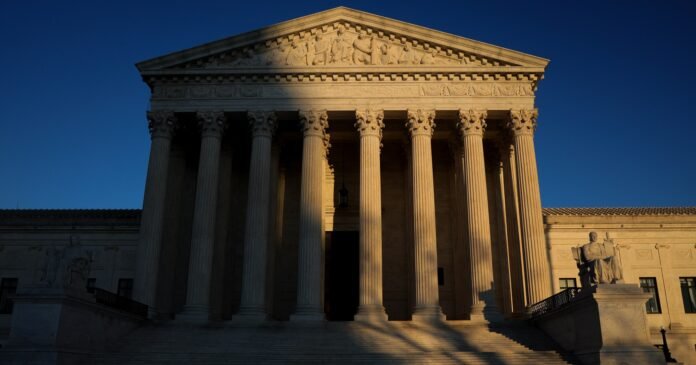
In its term that ended last October, the Supreme Court passed an important milestone that went unnoticed: For the first time, it decided more cases by secret ballot, and with few signed opinions, than it did for cases argued in open court.
These decisions, which make up the court’s “shadow docket,” are a fast-track way to get a decision from the top court. They rarely include arguments, have limited briefings and have expedited timetables, and justices infrequently provide explanation of how they voted or to cite legal precedent.
The Supreme Court’s increased willingness to bypass its regular process has empowered President Donald Trump at the same time as the administration has increased use of executive authority. The court has repeatedly green-lit policies of his that lower courts have blocked — and has done so with little to no explanation.
These emergency decisions have thrown lower courts’ processes into turmoil and have sometimes directly contradicted longstanding legal precedent. The outcomes have been consequential: The high court has used the process to limit federal courts from issuing nationwide injunctions and diminished Congress’ authority over federal agencies, and it has allowed for the detention of American citizens by immigration agents.
ProPublica analyzed over two decades of Supreme Court rulings, which cover all of the years under Chief Justice John Roberts and go as far back as the online archives allow. We found that when the last court term ended, justices had issued 63 orders on the shadow docket, as opposed to 56 orders on the more traditional merits docket — where the court hears oral arguments scheduled months in advance and the justices issue signed opinions.
Legal scholars and court watchers were shocked by our finding. They told ProPublica it’s likely the first time in modern history that so many consequential decisions were made in secret by its nine members.
“The patterns show a court going out of its way to enable Trump,” said Stephen Vladeck, a law professor at Georgetown University and a Supreme Court analyst. He said that our findings reinforce the appearance that the justices are voting on their political preferences.
“That’s the real blow to the court’s credibility,” he said.
Representatives from the Supreme Court did not respond to a detailed list of questions.
In a statement, a spokesperson for the White House wrote, “President Trump has faced a historically unprecedented number of injunctions by liberal lower court judges, the same judges who would rather push their own policy schemes and undermine the Administration’s lawful agenda. President Trump will not stop implementing the America First initiatives on which he was elected.”
For the First Time in Two Decades, Decisions on the Supreme Court’s Shadow Docket Outnumber the Merits Docket
Note: Supreme Court terms run from October to October.Ken Morales/ProPublica
There are two ways to get a decision from the Supreme Court. One is to exhaust your appeals to lower courts and ask to argue your case in front of the high court. The justices determine whether to take the case on, and if they do, lawyers argue their case in front of them. The other is to petition the justices directly via the emergency docket — to freeze a lower court ruling or government policy while the case goes through appeal.
The appeals to the emergency docket have long outnumbered those to the merits docket, but most are procedural requests or requests to stay execution for capital offenses. When those are removed, what’s left is known as the shadow docket — cases that seek to skip the usual order of things and ask for a quick ruling from the court’s justices.
The modern shadow docket was born in 2016 when the Supreme Court issued an emergency stay against President Barack Obama’s Clean Power Plan, experts say. Papers obtained by The New York Times show that liberal justices at the time urged Roberts not to decide the case on an emergency basis because it broke with longtime precedent. The conservative justices, meanwhile, forcefully argued that the president’s plan would eventually be overturned by the court anyway and that it would put too much of a burden on the energy industry.
Driven by its numerous losses in lower courts, the current Trump administration appeals to the emergency docket significantly more often than previous administrations, and the court has increasingly agreed to take quick action on its appeals.
The Obama and George W. Bush administrations together filed just eight petitions in 16 years. The Trump administration filed 32 in 2025 alone, an analysis by the Brennan Center for Justice found.
The increased willingness of the Roberts court to intervene on Trump’s behalf — as well as in other issues that favor conservatives and Trump allies — has upended American life, said Donald Ayer, a former deputy solicitor general and deputy attorney general who served under the Reagan and George H.W. Bush administrations.
“On many subjects of real importance to our future, they’ve demolished what used to be the law,” he said.
Public scrutiny of the shadow docket ramped up in September 2021 after the Supreme Court used it to issue a one-paragraph, unsigned opinion that further rolled back abortion rights established in the 1973 Roe v. Waderuling. In the order, the court refused to block Texas’ Senate Bill 8, the “Heartbeat Act,” which banned abortion after an embryo’s cardiac activity is detectable, typically at six weeks of pregnancy and before many people know they are pregnant. Protests erupted nationwide, and the Senate held a hearing on the shadow docket.
In an unusual public acknowledgement, Justice Elena Kagan referenced the shadow docket by name in her scathing dissent, accusing the majority of green-lighting a “patently unconstitutional law” with only a cursory review in less than 72 hours.
“In all these ways, the majority’s decision is emblematic of too much of this Court’s shadow docket decisionmaking — which every day becomes more unreasoned, inconsistent, and impossible to defend,” Kagan wrote.
That an opinion was even issued and that four of the justices signed their names to it was uncommon. On the shadow docket, justices do not have to make their votes known. In rare cases, their votes are revealed in terse indications that they grant or deny the application, or even more rarely, as an opinion. We found that just 17% of votes cast had any sort of public record of a vote or opinion.
Responding to public criticism, Justice Samuel Alito contended that the court isn’t to blame for the rise in shadow docket cases. “We do not file these emergency applications,” he said. “Parties file them.”
The debate has continued. “We cannot expect the public to have faith in our judicial system if, without clear explanation, we consistently green-light harmful acts that do real damage,” Justice Ketanji Brown Jackson said during an April speech on the shadow docket at Yale Law School.
Until this past Supreme Court term, emergency applications fluctuated year to year but showed no clear upward trend. The applications are given first to a single justice, who decides if a case is worth referring to the full court. In recent years, justices have referred more of such appeals for a review and vote by the full court.
Last term, when there were both more cases and more referrals to the full court, the appeals to the shadow docket finally overtook those to the merits docket.
Emergency Applications Referred for a Full Court Vote Have Risen Sharply
Total applications have varied over the last two decades, with a surge last term under President Donald Trump.
Ken Morales/ProPublica
The cases were consequential. On June 23, 2025, after a lower court had ruled that eight men being deported to South Sudan should have due process, the Supreme Court intervened after a request from the administration to stop that order. The men were deported. The majority didn’t issue an opinion justifying its ruling.
Three months later, the Supreme Court voted to allow immigration agents to stop people based on racial or ethnic characteristics while still-ongoing litigation against it proceeded. To justify the decision, Justice Brett Kavanaugh wrote a rare shadow docket opinion that people who were in the country legally would be “free to go after the brief encounter.” These became known as “Kavanaugh stops.” Last year, ProPublica found more than 170 citizens who had been stopped and detained by ICE agents. The more than 50 Americans held even after agents learned of their citizenship were almost all Latino.
And in May, while an election in Louisiana was already underway, the justices allowed the state to immediately redraw its electoral map, removing one of the two majority-Black voting districts. Louisiana can now use that map for the 2026 midterms as part of a nationwide redistricting battle for control of the House of Representatives — an effort touched off by Trump’s call for Republican-led states to create more safe seats for themselves.
Roberts once signed on to a Kagan dissent that assailed the shadow docket. But our analysis found that he has referred more substantive cases for a vote by the full court than any other justice, going from just one in the 2005 term when he joined the court to nearly half of all referrals in the last term.
There is an additional difference between the shadow docket and the merits docket. After the court holds public argument, the justices’ ultimate merits decisions are closely watched and extensively covered by the press. The summer’s “decision season,” when the final and most significant rulings come down, has a predictable cadence that ends when the justices go on summer recess. Not so with the shadow docket. Increasingly, the justices are making big decisions after they’ve issued their final merits docket decision, when public attention has waned.
A group of Democrats led by Rep. Jamie Raskin, D-Md., have sponsored legislation to make the shadow docket more transparent.
Raskin told ProPublica that the court’s legitimacy has fallen with every significant decision made without “real opinions or analysis.”
“Lower federal courts have been deciding against the Trump administration in an overwhelming majority of cases with weighty and well-reasoned opinions,” Raskin said in a written statement. “Yet when things get to the twilight zone of the shadow docket, the Supreme Court is overturning 100-page opinions with a flippant sentence or two.” He added, “The result is a body that looks less like a Supreme Court and more like a Royal Court rubber stamping the madness and folly of the Trump Administration.”
“The jurisprudence of the Roberts Court today is as murky as the green algae water in the Reflecting Pool.”
How We Reported This Story
To compare the number of cases on the Supreme Court’s shadow docket to the traditional merits docket, we compared emergency applications listed on the court’s online docket searchwith counts of decisions compiled in Penn State’s Supreme Court Database (Version 2025 Release 01). For the merits docket, we counted only signed decisions in argued cases, the typical format for those rulings.
The court’s online docket goes back to the year 2000, but our analysis looks at Supreme Court terms from October 2003 to October 2025, where emergency applications are easily identified by the letter “A” in their docket number.
We identified more than 27,000 emergency applications during that period, including thousands of requests that are not commonly understood to be a part of the shadow docket. Most appeals to the emergency docket are the type of requests that were traditionally handled there: procedural requests, such as extending the time to file, and requests to stay execution for capital offenses. The remainder are the focus of our reporting.
Substantive Shadow Docket Cases Are a Small Fraction of All Emergency Applications
Note: The COVID-19 lockdown impacted applications for filing relief in the 2020-21 term.Ken Morales/ProPublica
We defined a substantive application on the shadow docket as any filing where the full court was asked to intervene in the traditional appeals process, such as staying a lower court’s order.
Most of the cases we excluded are decided by just one justice, each of whom oversees one or more federal circuits and has the power to refer filings to the wider court. When the cases are referred to the full court, they are the subject of a vote by the justices. We ran our approach by multiple experts, all of whom found it sound.
A filer can appeal to another justice if their application is denied. The next justice to receive the application always refers it to the full court. We did not include these renewed applications because our analysis found the court has never granted one.
The court has labeled capital punishment cases only since the October 2017 term. To identify them prior to that, we flagged applications for stays of execution. We then manually reviewed every case referred to the full court. For applications decided by a single justice, we used an AI model to flag potential capital cases by examining the parties on the application and the relief requested. The model flagged over 60 possible capital cases, and those were manually reviewed. Despite our effort, it is possible some capital cases may still be included in our final tallies before the 2017 term.
Although rulings on the shadow docket are typically unsigned and do not include vote breakdowns, we were able to identify how a justice voted in some cases. The analysis is based on either the opinions issued by the justices, most of which are dissenting opinions, or if the justice indicated they would have granted or denied. In some decisions, the justices issued a statement not attached to either a grant or denial. We did not record these as votes.
UK likely to intervene in Paramount takeover of Warner Bros Discovery
The British government could intervene in the $111 billion takeover of Warner Bros Discovery by Paramount Skydance, citing concerns around the need for a plurality of views in news as well as media ownership in the UK.
UK culture secretary Lisa Nandy said on Tuesday that she was “minded to intervene” in the deal, which would create one of the world’s largest media and entertainment groups.
The takeover would lead to WBD media franchises such as CNN, HBO ,and Warner Bros movies being added to Paramount’s stable of assets, which include CBS in the US and Channel 5 in the UK.
Nandy said in a statement to parliament that she had written to the current and proposed owners of WBD to inform them that she was minded to intervene on public interest grounds.
These included the need for a sufficient plurality of views in news media in the UK, and the need for there to be a sufficient plurality of ownership of media enterprises.
The focus will be those businesses that operate in the UK and provide a range of services available to UK audiences, including Channel 5, TNT Sports, Cartoon Network, Nickelodeon and CNN International, as well as streamers Paramount+ and HBO Max.
A final decision on the intervention had not been taken, Nandy added, with Paramount given until July 6 to respond. If she decides to proceed, the deal will be scrutinised by Ofcom and the Competition and Markets Authority, which has already launched a separate merger inquiry on antitrust grounds.
A “minded to” statement by the government is the first step before any legal action to stop a merger or acquisition. The investigative process can then hold up deals. Paramount Skydance—led by David Ellison, the billionaire son of Oracle founder Larry Ellison—has said that it expects to complete the deal in the third quarter of this year.
A Paramount spokesperson said that the company was “confident that our proposed transaction does not pose any media plurality issues in the UK and [we] remain confident in our stated transaction timeline.”
An intervention could further complicate relations between the Trump administration—which backs Paramount’s takeover—and a UK government led by prime-minister-in-waiting Andy Burnham.
The deal has already been approved in other countries, including in the US. The Justice Department waved the deal through this month without concessions, while the EU is set to approve the takeover with certain remedies, which could include a requirement for Paramount to exit its joint venture with Universal Pictures.
A separate deal to sell the Telegraph newspaper in the UK was held up for months after Nandy pushed ahead with a Public Interest Intervention Notice, the official legal notice issued to trigger a government and regulatory investigation into the proposed media merger.
This deal was finally completed on Tuesday, with confirmation of the acquisition of the newspaper by Germany’s Axel Springer.
Nandy also said that legislation was drafted to largely cover broadcast linear channels but should also consider streaming or video-on-demand services.
She added: “If I decide to intervene in this merger on the basis, I will bring forward secondary legislation to finalize this public interest consideration.”
Unchecked AI progress may pose catastrophic risks, UN panel warns
Developments in artificial intelligence are outpacing scientific understanding and government policy, meaning there are no guarantees the technology will not cause catastrophic harm, a United Nations independent panel warned on Wednesday.
A preliminary report by the UN’s Independent International Scientific Panel on Artificial Intelligence said policymakers face a growing dilemma: they need robust evidence to regulate AI effectively, yet such evidence is struggling to keep pace with the technology’s rapid evolution.
“AI capabilities are outpacing both scientific understanding and governments’ ability to adapt,” said Yoshua Bengio, co-chair of the panel, comprised of 40 cross-regional experts.
“With growing evidence of deceptive AI behaviour, science currently cannot guarantee that as capabilities continue to increase, AI will not cause catastrophic harm, either on its own or due to malicious users.”
Described as the first global independent assessment of AI’s risks and opportunities, the report aims to give up-to-date evaluations of the science to help guide decision-making as governments contend with fast-evolving systems.
In the near term, it expects a shift towards agentic AI systems capable of carrying out real-world tasks, although growth may be constrained by energy and high-quality data shortages. Over time, it foresees self-improving AI embedded more deeply in the economy and converging with technologies such as quantum computing and biotechnology.
AGENTIC AI DEVELOPING RAPIDLY
AI already demonstrates expert-level reasoning in mathematics and science and is accelerating drug and vaccine development, and its task complexity is doubling every four to seven months, potentially allowing systems to complete work that takes humans days or weeks, according to the report.
While this could deliver significant economic benefits, it remains unclear whether productivity gains from using AI will translate into broader growth or affect jobs.
The panel also outlined a range of safety concerns, such as the risk of losing control over AI systems as they become increasingly autonomous, and deceptive.
AI is already being used to generate misinformation and other harmful content and could be exploited for fraud, cyberattacks and biological threats.
Governance remains fragmented, with many countries lacking the capacity to assess or shape advanced AI systems, leaving them reliant on technologies they cannot fully understand or control. Existing safety tools often depend on limited testing data disclosed by companies, the report said.
UN Secretary-General António Guterres urged governments to act swiftly.
“The world cannot govern what it cannot understand,” Guterres said in a statement.
“The potential is great, but the risks are real, and the cost of waiting is rising,” he added.
3 Murdered Across Israel Within a Single Hour, Including Netanya Rabbi
Three people were killed in separate attacks across Israel between 5:30 a.m. and 6:30 a.m. Wednesday, including the fatal stabbing of a well-known rabbi in Netanya, the deadly shooting of a bus driver in Shefa-Arm and the fatal shooting of a young man near Yagur.
In Netanya, Rabbi Amos Guetta, 75, was fatally stabbed inside a synagogue. Police later arrested a Netanya resident in his 20s on suspicion of murder.
Investigators said the suspect was a regular visitor to the rabbi’s yeshiva, where Guetta was known for his extensive work on behalf of people in need. A preliminary investigation found that the suspect went to the rabbi’s home, stabbed him, and fled the scene.
Police said the suspect had arrived asking to pray with the rabbi. At some point, an argument broke out between the two, during which investigators believe the suspect ran toward Guetta and stabbed him several times before fleeing. Initial police assessments indicate the suspect may be mentally unstable.
In Shefa-Amr, 24-year-old bus driver Ali Suweid was shot to death in a parking lot while on his way to work. Magen David Adom medical teams pronounced him dead at the scene. Police suspect the killing is connected to an ongoing violent feud between two local families.
Near Yagur, 21-year-old Amil Abu Kalib of Basmat Tab’un was shot to death inside his vehicle in the parking lot of a shopping complex. Police and media reports said the shooting is linked to an ongoing conflict between rival criminal organizations.
The Yagur killing is suspected to have been carried out in retaliation for a fatal shooting that took place Tuesday in Haifa as part of a dispute involving Arab crime families.
Police continued investigating all three killings Wednesday. Authorities have taken one suspect into custody in the Netanya case, while the shootings in Shefa-Amr and near Yagur remain under investigation as detectives examine suspected links to ongoing criminal disputes.
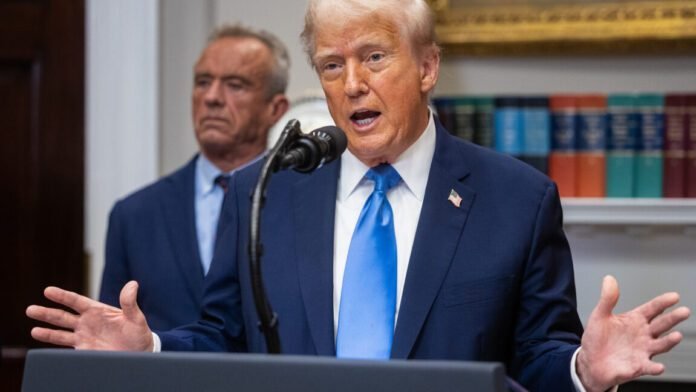
In September, Trump and Kennedy held a press conference in which they stated without clear evidence that the common fever and pain reducer acetaminophen—sold as Tylenol in the US and also known as paracetamol—causes autism in children if taken during pregnancy. Trump repeatedly warned pregnant people not to take Tylenol and instead “tough it out” with fever and/or pain.
Medical organizations decried Trump’s message, emphasizing that acetaminophen is a safe pain and fever reliever during pregnancy and that untreated fever during pregnancy is known to increase the risk of autism in babies as well as other conditions, including miscarriage, birth defects, and premature birth. Still, the president’s warning was effective. Texas sued the maker of Tylenol over the alleged connection. And a study in The Lancet in March found that use of acetaminophen in pregnant patients in emergency departments fell by 10 percent after Trump’s press conference.
In the new study published in JAMA Internal Medicine, researchers analyzed electronic health records from 2001 to 2023 for more than 700,000 pairs of mothers and children in Hong Kong. Of those pairs, about 43 percent of children had exposure to acetaminophen in utero.
Sibling-matched design
The researchers then performed a sibling-matched analysis, comparing autism and ADHD cases among siblings, some of whom were exposed to acetaminophen in utero and some who weren’t. This study design helps account for unmeasured family factors that influence the likelihood of the conditions, particularly genetics and shared environmental conditions. The autism analysis included over 124,000 sibling-matched children, and an analysis of attention-deficit/hyperactivity disorder (ADHD) included a cohort of over 97,000 sibling-matched children.
The researchers saw no link between prenatal acetaminophen use and either condition. It didn’t matter what dosage of acetaminophen was taken, when it was taken during the pregnancy (which trimester), how often it was taken, or how old the mother was at the time. There was simply no link between acetaminophen and autism or ADHD.
Interestingly, there was a link when the researchers dropped the sibling-matched design and instead compared acetaminophen-exposed with unexposed children, which is a finding that has come up in other studies. But when the researchers performed a “negative control” analysis and compared children whose mothers had taken acetaminophen before ever getting pregnant or after they had given birth compared to mothers who didn’t use the painkiller, they also saw an association—one that is “biologically implausible.”
“Collectively, these findings suggest that the positive signal observed in both conventional and negative control analyses reflect residual familial confounding, rather than a true pharmacologic effect of prenatal paracetamol exposure,” the researchers concluded.
The finding of no association between acetaminophen use in pregnancy and neurodevelopmental conditions in children was also found in large sibling-matched studies in Sweden in 2024 and Japan in 2025.