17.5 C
London
Tuesday, June 30, 2026
Home Blog

Pope Leo: human dignity in the AI age

0
pope-leo:-human-dignity-in-the-ai-age
Pope Leo: human dignity in the AI age

This is the first part of a series.

Pope Leo XIV’s first encyclical offers theological and humanistic insights into the potential and risks of artificial intelligence for human dignity.

It is also a declaration of the “dream of a new modernity,” in which the Catholic Church, nations, peoples, and international institutions collaborate to create ways of inhabiting the world that are worthy of every human being.

In his encyclical Magnificent Humanity (MH), Pope Leo XIV proposes two ways of inhabiting the world as a starting point for reflecting on human dignity in the digital age.

The first is the “dream of Babel,” a totalizing project that can only be achieved by destroying all differences. This scene imagines an all-encompassing, supreme power that aims to transcend the subtle boundary between heaven and earth, which God established through creation.

The second draws on the scene in the Book of Nehemiah depicting the reconstruction of the walls of Jerusalem “brick by brick.” Here, the material reconstruction of the city symbolizes building the human community as a project in which everyone participates—without exclusion.

This is a metaphor for collective power shared by many that restores the city, upon which God’s glory rests, to its role as the human place that, in Jesus, will become the tent pitched by God among us.

Cultural birth of human dignity

These two opposing ways of inhabiting the world are both embodiments of human dignity, as Pico della Mirandola first articulated in his work Oratio de hominis dignitate.

For Pico, human dignity stems from the indeterminacy with which God places human beings in the world. Unlike the rest of creation, human beings are not governed by a fixed law determining their place and purpose within the created order.

Human beings are the only living beings who must determine themselves, deciding how to inhabit the world, what direction to give it, and how to relate to their fellow human beings.

“The nature of all other creatures is defined and restricted by laws that we have laid down. You, by contrast, unhindered by any such restrictions, may, by your own free will—to whose care we have entrusted you—trace the contours of your own nature. It will be within your power to descend to lower, brutish forms of life. You will be able to rise again to superior orders whose life is divine” (Pico della Mirandola).

Pico’s phenomenology is ahead of its time. He interprets human reality through the work of redemption accomplished by Jesus Christ. He acknowledges the depths to which human beings are capable of sinking but also recognizes the “possibility” that Jesus has made available to everyone. This indeterminacy is precisely what defines the inherent dignity of every human being.

Above all, it tells us that human dignity, however unalterable because willed by God Himself, is not a concept but a reality to be realized anew at every moment.

Therefore, the only way to honor this dignity—to bring it into being—is to realize it in the practice of everyday life, from the most astonishing scientific discoveries to neighborly relationships and political choices, and in hospitality toward the stranger, who is truly one of us and never an outsider. Never one without the other.

When human dignity appeared in Western civilization, it was affirmed as a practical matter concerning the construction of society, the relationship with nature, and the opening up of a new “possibility” with every discovery and advancement.

According to Pico, inhabiting the world in a way that preserves the cultural markers through which previous generations sought to make it welcoming to humanity represents the core of our relationship with the God of the Incarnation. In this relationship, humanity’s ability to give practical expression to its dignity is put to the test.

The School of Salamanca later brought the theme of human dignity to the theological, philosophical, and legal spheres in order to affirm the full humanity of the indigenous peoples of the newly discovered lands across the ocean. This also marked the beginning of what we now call international law.

The global community of nations subsequently affirmed human dignity as the foremost principle of fundamental human rights following the terror and horror of World War II on December 10, 1948. Mindful of its guilt and responsibility for the Holocaust, post-Nazi Germany made human dignity the first article of its Basic Law, which took effect on May 23, 1949: “Human dignity shall be inviolable.

To respect and protect it shall be the duty of all state authority.”

MH and the Catholic Church

Pope Leo draws upon the great tradition of European humanism, integrating the Catholic Church’s actions into that tradition.

MH marks the shift—already initiated by Pope Francis—in the Church’s public presence, shifting the focus from individual morality to the social ethics of the Catholic faith. Therefore, for the Church itself, the way it inhabits the world becomes a profession of faith in the God who, in Jesus, made the world and its vicissitudes the tent of his presence in human history.

This paradigm shift stems from the realization that the exclusivity granted to individual morality has proven insufficient to effectively imprint the Gospel on contemporary societies.

The weight attributed to positions on individual morality in the public life of Catholics has also functioned as an internal criterion within the Church for selecting individuals who could rely on support and recognition from the Vatican in political life.

On this point, the distance taken by American bishops from Biden is exemplary, in contrast to the discreet but convinced closeness of Pope Francis.

Furthermore, during the pontificates of John Paul II and Benedict XVI, issues of individual morality were used more as a tool to oppose the legislative activity of states than as a constructive contribution to the human community.

MH does not render individual morality obsolete in public affairs but rather links it structurally to the social dimension of action. This shapes a way of inhabiting today’s world that can practically honor the dignity of every human being and social collective through which people and nations organize their coexistence.

In this sense, there is no good life for the individual without effective justice for humanity as a whole. Every lack of justice, every violation of human dignity, and every failure to do justice is the responsibility of every person, both as a believer and a citizen.

This approach to navigating the Church’s social doctrine amid the “change of age” (Pope Francis) disturbs and unsettles worldly powers that claim absolute dominion over the world and the ways human beings inhabit it.

It represents a radical challenge to the all-encompassing power that seems to characterize the primary interest of today’s digital techno-financial system, much like the “dream of Babel.”

Pope Leo’s Church recognizes that to fulfill the evangelical mission of liberating the world from digital totalization, it must collaborate with other agencies to develop ways of inhabiting the world that embody the dignity of every individual and all peoples.

Affirming the evangelical primacy of the social realm means placing institutions at the center of human practices and faith today. The social dimension of faith is certainly directed toward real people in their concrete life situations.

However, if this practice is to transform the conditions in which those people live, it must also involve the institutions of humanity and peoples. Private individualism and economic neoliberalism have converged to dismantle the institutional framework of human coexistence and global governance.

In their struggle to survive, institutions of modernity have failed to sustain themselves while simultaneously upholding their purpose of fostering human coexistence.

With MH, the Catholic Church enters the “new era” of our world as well. Pope Leo affirms the necessity of institutions, including the state, democracy, multilateralism, and international law, which the Church had previously viewed with extreme suspicion.

Furthermore, the Church recognizes that these institutions can act autonomously in exercising power, something it had previously reserved only for itself. This encyclical represents a kind of “dream of a new modernity,” in which the Catholic Church and public institutions collaborate to create a world fit for human habitation.

However, it also denounces the current trend toward privatizing state institutions and using them for personal gain, which supports the totalization of power and the world that seems to lie at the heart of the interests driving the digitization of the world itself.

Marcello Neri is senior fellow at Appia Institute (Religion and Politics); professor of ethics and political anthropology at the Higher Institute of Educational Sciences G. Toniolo of Modena; and professor of “Religion and Public Square” at the Faculty of Political Sciences of the Catholic University in Milan.

This article first appeared on Appia Institute and is republished with kind permission.

Sony erases digital content from libraries; we’re reminded we don’t own what we buy

0
sony-erases-digital-content-from-libraries;-we’re-reminded-we-don’t-own-what-we-buy
Sony erases digital content from libraries; we’re reminded we don’t own what we buy

Sony recently informed its PlayStation customers in the United Kingdom that they will no longer be able to watch previously purchased movies and shows from production and distribution company StudioCanal. As of September 1, affected customers will no longer be able to stream 551 titles from the PlayStation Store.

In a legal notice first spotted by gaming news outlet PlayStation LifeStyle, Sony said that affected customers will lose the ability to stream titles including Outrage: Way of the Yakuza, Paddington, Paddington 2, Pan’s Labyrinth, Rambo 3, Terminator 2: Judgment Day, and The Boy in the Striped Pajamas “due to our content licensing agreements.” As of September, Sony will remove any affected titles that UK users bought from their PlayStation library, per the notice.

It’s possible that Sony may still make a deal with StudioCanal by September 1, or even after, that would allow users to keep watching the content they bought. This happened in 2023, when Sony said it would have to pull 1,318 seasons of Discovery shows from customers’ libraries. A few weeks after its announcement, Sony said that it would not pull the content because it had updated its licensing arrangements with Discovery.

Still, affected customers shouldn’t keep their hopes too high. Sony already pulled 314 StudioCanal titles from libraries in Germany and Austria in 2022. More recently, Sony deleted people’s Funimation digital libraries after it decided to merge the anime streaming service with Crunchyroll. Sony has also been scaling down its digital store and stopped selling movie and show rentals and purchases in August 2021. Even if StudioCanal were willing to make a deal with Sony, it’s feasible that Sony has less interest in retaining digital titles than before.

Regardless, the incident is a reminder that we don’t own the stuff we purchase digitally . Instead, digital rentals and purchases are merely long-term licenses that are only valid for as long as the streaming service has the right to distribute said content. Often, that’s a finite amount of time.

Still, Sony’s announcement has frustrated some, including those who believe Sony should offer refunds or who think digital stores should stop using terms like “purchase” for long-term rentals. 

Louisiana Supreme Court Frees Death Row Prisoner, Calling Evidence Against Him “Scientifically Indefensible”

0
louisiana-supreme-court-frees-death-row-prisoner,-calling-evidence-against-him-“scientifically-indefensible”
Louisiana Supreme Court Frees Death Row Prisoner, Calling Evidence Against Him “Scientifically Indefensible”

Former Louisiana death row inmate Jimmie “Chris” Duncan is officially a free man following a unanimous ruling Monday by the Louisiana Supreme Court. In the opinion, justices upheld a lower court’s decision to toss out Duncan’s 1998 conviction for killing his former girlfriend’s toddler, Haley Oliveaux, citing flawed forensics practices used to convict him. 

Justice Cade R. Cole wrote on behalf of the seven-member court that new evidence presented by Duncan’s legal team left no doubt that his conviction should be overturned.

“The post-conviction evidence undermined the core factual premises on which the state depended,” Cole wrote in the official opinion.

Two other justices, including Chief Justice John Weimer, issued opinions concurring with Cole.  

“I am flooded with relief,” said Chris Fabricant, a member of Duncan’s legal team and director of strategic litigation with the Innocence Project in New York, in an interview. “It would have been a moral outrage for the conviction to be reinstated.”

The court’s ruling came after a 2025 Verite News and ProPublica investigation examined the reliability of the key forensic evidence used to convict Duncan, now 57. At the time, he faced the possibility of being put to death as Gov. Jeff Landry, a staunch death penalty advocate, made moves to expedite executions after a 15-year pause.

Duncan’s conviction was based largely on now-discredited bite mark evidence presented by forensic dentist Michael West and pathologist Steven Hayne. Their analysis, which was critical to Ouachita Parish prosecutors securing Duncan’s conviction, claimed to match marks on Haley’s body to Duncan’s teeth. 

But experts have since deemed such evidence, fairly common at the time of Duncan’s 1998 trial, to be junk science. Meanwhile, the longtime partnership between West and Hayne has come under scrutiny from civil rights attorneys, forensic experts and the courts over concerns about the validity of their techniques.

In the 28 years since Duncan’s trial, nine other prisoners have been set free after being convicted in part on inaccurate evidence given by West and Hayne. Three of those men were on death row. Duncan was the last person awaiting an execution based on the pair’s work.

In his opinion, Cole reexamined the use of supposed bite marks, which were the only physical evidence tying Duncan to the alleged crime. Cole pointed to a video of West’s 1993 examination of Haley, which was not shown to jurors at trial. In that recording, West can be seen taking a mold of Duncan’s teeth and grinding it into and across the girl’s body, seemingly creating bite marks where none previously existed. Referencing previous testimony from a defense expert, Cole wrote that “it was ‘scientifically indefensible’ to identify those marks as having been made by Duncan, and that the angles shown in the West Video were physically impossible for a human bite.”

West has previously said he was simply using what he called a “direct comparison” technique — in which he presses a mold of a person’s teeth directly onto the location of suspected bite marks.

Read More

Weimer wrote in a concurrence that the bite mark evidence used to prosecute Duncan was similar to “trial by water” tests used by witch-hunters in the 17th century, in which suspected witches were bound with rope and lowered into a body of water. If they floated, they were considered guilty of witchcraft, while those who “passed” the test by sinking often drowned. 

“We now look back at those practices as asinine and absurd, since those who fell victim to those practices often did not survive, regardless of whether they were found guilty or innocent,” Weimer wrote. “The bite mark evidence and the sexual abuse evidence used in the trial against the accused has proven to be similarly specious.”

Duncan’s prosecution “demonstrates we cannot be too careful in determining whether the death penalty should be implemented in cases such as this case because of the finality of the sentence and the impossibility of rectification,” Weimer wrote.“Such an irreversible and tragic consequence is inimical and deleterious to our system of justice if carried out based on evidence that is devoid of legitimacy.”

“This Should Be the End of This Case”

Police arrested Duncan on Dec. 18, 1993. He was babysitting Haley that day in the home he shared with the girl’s mother in West Monroe. Duncan told law enforcement he had put the child in the bath, then went downstairs to wash dishes. When he heard a noise coming from the bathroom, he rushed upstairs to check on her and found Haley floating face down in the water. She was pronounced dead a few hours later.

Duncan was initially booked for negligent homicide, but prosecutors upped the charge to first-degree murder after Hayne and West conducted Haley’s medical exam and claimed they discovered evidence, including the purported bite marks, that she had been sexually assaulted and intentionally drowned. Following two weeks of testimony during the trial in 1998, the jury found Duncan guilty and sentenced him to death.

While Duncan awaited an execution date, his new team of postconviction attorneys uncovered evidence that pointed to his innocence, including an expert witness who said that the child’s death was not a homicide but the result of an accidental drowning. In addition, investigators working for Duncan’s legal team interviewed a jailhouse informant who recanted his earlier trial testimony that Duncan had confessed to the crime.

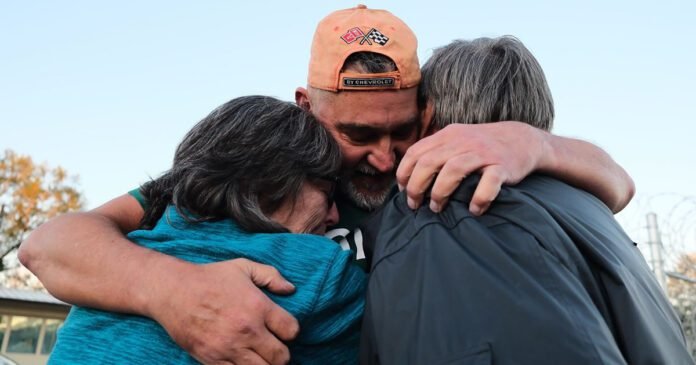
Duncan’s conviction was overturned in April of last year by former Ouachita Parish Judge Alvin Sharp. He was let out of prison on bail in December, but he continued to await a final decision on his case after prosecutors appealed Sharp’s ruling. 

Steve Tew, district attorney for Ouachita and Morehouse parishes, has never wavered in his insistence that Duncan was guilty of murder and that he should be put to death. His office appealed Sharp’s decision to the state Supreme Court.

During oral arguments in April, Tew said that since Duncan was the only person with Haley at the time of her death, his guilt could not be debated. “We don’t need the bite mark evidence to put Mr. Duncan in the apartment alone with this child,” Tew said.

Haley’s mother, Allison Layton Statham, has publicly supported Duncan’s release from prison and the overturning of his conviction; so have family members of Haley’s father, Lloyd Donald Oliveaux, who died in 1996. They have excoriated the state’s tactics, claiming they repeatedly asked for a meeting with prosecutors to express their concerns, but never received a response.

Tew, who did not immediately respond to a request for comment on Monday, said at the April hearing that should the Supreme Court refuse to reinstate Duncan’s conviction, he would retry him, though he did not say what charge he might pursue.

When asked about the prospect of Duncan being retried for murder, Fabricant, the Innocence Project attorney, said, “If there is any sense of fairness and justice left, this should be the end of this case.”

In addition to the Innocence Project, Duncan’s legal team includes the Mwalimu Center for Justice in New Orleans and the Bryan Cave Leighton Paisner law firm in Atlanta. 

Katz: US Linking Lebanon to Iran Ceasefire Prevented Hezbollah’s Destruction

0
katz:-us-linking-lebanon-to-iran-ceasefire-prevented-hezbollah’s-destruction
Katz: US Linking Lebanon to Iran Ceasefire Prevented Hezbollah’s Destruction


Israeli Defense Minister Israel Katz said Monday that US insistence on linking Lebanon to the Iran ceasefire memorandum of understanding prevented Israel’s military from destroying Hezbollah.

Addressing the halt in Israel Defense Forces (IDF) operations during a briefing for military and diplomatic reporters that focused on Iran, Katz argued that “the pause prevented a massive blow the IDF had planned to continue inflicting on Hezbollah. Linking the arenas saved Hezbollah from a devastating blow, perhaps even its collapse.”

Katz stressed that Israel would not withdraw from its security zone in Lebanon.

“In any case, we would not have withdrawn, and we will not do so in the future as long as Hezbollah is there,” he said.

He added that Israel has no territorial ambitions in Lebanon but said any future withdrawal would depend on the Lebanese Army removing Hezbollah from the areas vacated by Israeli forces.

“We have no territorial ambitions in Lebanon. The Lebanese Army will have to do the job in the areas from which the IDF withdraws. The IDF will have to verify that this has happened and that Hezbollah is no longer present in the areas from which it withdraws. The current mission is to remove Hezbollah from the Litani area.”

Katz added: “I have no illusions. In the end, the one that will have to do the job is the IDF.”

He also said Israel had made clear to the Americans that it would not withdraw from security zones in Gaza, Lebanon, or Syria.

“This is Israel’s new security doctrine,” Katz said. “The condition for leaving these areas is the disarmament of the terrorist organizations.”

Katz noted that, as previously reported by N12, Israel offered to transfer responsibility for the Ali Taher Ridge to the Lebanese Army, but the Lebanese Army declined.

He concluded: “We will respond to every Hezbollah violation. We will not tolerate violations. The equation still stands: rocket fire toward northern Israel and the frontline communities will be answered with strikes in Dahiyeh.”

Katz also warned that fighting with Iran could resume at any time and said Israel was preparing for another military confrontation.

Presenting Israel’s security doctrine for the northern front and the confrontation with Iran, Katz said the IDF had been instructed to prepare for what he described as a “Blue and White operation in Iran.”

“If we have definitive intelligence about Iranian decisions, we will act on it,” Katz said. “If Iran attacks us with missiles, we will respond with force, and this has been made clear to the Americans.”

He added: “The war with Iran will resume under one of two scenarios: if President Trump decides and we join, or if they fire at us, it will be the Third Iran War. Israel’s position is clear—there is no scenario in which Israel will allow missile fire on its territory.”

Supreme Court ruling guts government’s use of geofence warrants

0
supreme-court-ruling-guts-government’s-use-of-geofence-warrants
Supreme Court ruling guts government’s use of geofence warrants

The Fourth Amendment protects a user’s “location history,” the Supreme Court ruled Monday.

The same logic already applied to a cellphone’s tracking, and the high court found “no good reason exists to reach a different result for Location History” collected by third parties like Google.

Split 6-3, the majority agreed that the government needs a warrant and must show reasonable cause to turn a phone’s location-tracking services into a government surveillance tool.

The decision came in a case where cops used so-called geofence warrants to track down an armed bank robber from a list of all phones logged in the area. Applying a three-part process, cops worked with Google to narrow down the list of suspects and eventually arrested Okello Chatrie, who had opted in to share his location with Google every few minutes. Chatrie was sentenced to 12 years in prison but challenged the geofence warrant as an unconstitutional search.

The US tried and failed to argue that no search was conducted under the Fourth Amendment, partly because they only searched a little bit of Chatrie’s location data, which the government considered too small to warrant privacy protections.

They also claimed that Chatrie was aware that voluntarily sharing his location with Google could mean that law enforcement might get access to the data. And along similar lines, the government argued that Chatrie’s data simply showed his movements in public, where he supposedly had no reasonable expectation of privacy.

However, Justice Elena Kagan, penning the majority opinion, said it didn’t matter how much data the government obtained. It was still a search under the Fourth Amendment because people carrying cellphones today commonly opt in to location-tracking, so that their apps work.

“Google repeatedly prompts users to turn on the service, often warning that devices will not ‘work correctly’ otherwise, while not disclosing in that prompt how frequently users’ location information would be recorded, how precise it would be, or how it might be given to the government,” the majority agreed.

Much like carrying a cellphone is part of modern life, so is allowing a third party to track your movements, and that doesn’t diminish a person’s right to privacy, the majority ruled. Justice Sonia Sotomayor noted that “even short-term monitoring” of where a person has been can reveal “a wealth of detail about [his] familial, political, professional, religious, and sexual associations”—particularly if he’s seen visiting a sensitive location, like a clinic, an attorney’s office, or a strip club.

“An individual has a reasonable expectation of privacy in records about his cell phone’s location, and police intrude on that constitutionally protected interest when they demand the information—even though for only a limited time, and from a third-party tech company,” Kagan wrote.

Privacy advocates cheered the ruling, even though it “stopped short of striking down these warrants as inherently unconstitutional,” the surveillance litigation director of the Electronic Frontier Foundation, Andrew Crocker, said in a statement provided to Ars.

“We applaud the Court’s decision,” Crocker said. “The Court reaffirmed that you have an expectation of privacy in location data that reveals your movements in the physical world, and that even short-term surveillance of these movements is a search subject to the Fourth Amendment.”

Tech companies also moved to support the ruling. Matt Schruers is CEO of a trade association that counts Google and Apple among members, the Computer & Communications Industry Association. In a statement, he celebrated the ruling for clarifying that “the Fourth Amendment fully protects people’s rights to privacy from government intrusion.”

“We are encouraged to see the Court recognize that privacy interests persist regardless of the technology involved, and that law enforcement must seek judicial authorization to obtain Americans’ geolocation information,” Schruers said.

Dissent argued for app-by-app basis

Most justices agreed that a common standard that the Fourth Amendment applies to all location history was necessary to avoid future court battles that could potentially draw different lines between different apps and phone features.

Kagan suggested that in arguing for an app-by-app basis, the government was trying to “disconnect the activities people do on their cell phones from the mere act of carrying a turned-on cell phone,” with “only the latter receiving assured Fourth Amendment protection.”

In his dissenting opinion, Justice Samuel Alito wrote that the majority had destabilized longstanding Fourth Amendment jurisprudence. He suggested that an app-by-app basis would have been appropriate, while warning against rushing to judge “new technologies” that “we barely understand.”

According to Alito, the majority announced a “new rule” that will “unleash” “upheaval” in Fourth Amendment law, requiring that “the police must obtain a warrant every time they access any cell-phone location information from a third party, however brief the duration, however innocuous the request, and however voluntarily that information was disclosed by the user.”

“One is left wondering on which side of the line location data from a mobile-payment service like Apple Pay falls,” Alito wrote in a footnote.

But Kagan said the majority agreed that “the point of carrying smartphones is to use what is on them.”

“A cell-phone user is not to be viewed as sharing private information with third parties—which then can be freely passed on to the government—just by doing the ordinary things cell-phone users do,” Kagan wrote. She further suggested that Alito and the government were misapprehending “the very nature of modern cellphone use.”

According to Alito, the Supreme Court never should have taken up the case, because settling this legal question doesn’t help Chartrie’s case, since cops can likely show it was a reasonable search under the Fourth Amendment.

However, the majority disagreed that their opinion was merely “advisory,” as Alito suggested, and remanded the decision on whether the search was reasonable to the lower court to decide within the bounds of the Fourth Amendment that the ruling clarified.

Accused CEO Killer Luigi Mangione Gets Trapped in Elevator

0
accused-ceo-killer-luigi-mangione-gets-trapped-in-elevator
Accused CEO Killer Luigi Mangione Gets Trapped in Elevator


Luigi Mangione’s latest court appearance spiraled into bizarre chaos Monday when the accused assassin of UnitedHealthcare CEO Brian Thompson was reportedly trapped in an elevator with armed guards before finally facing a federal judge.

The stunning courthouse mishap delayed the high-profile hearing by nearly 30 minutes and added yet another strange twist to the sensational murder case now gripping national attention.

Mangione, 28, was being brought to his June 29 federal hearing when the elevator carrying him and several deputies suddenly got stuck inside the courthouse, according to reports from the scene.

Building engineers had to be called in to free Mangione and the guards before the accused killer could be taken into court.

When he finally emerged, the drama was not over.

Instead of making a routine entrance, Mangione reportedly had to come through a different door and awkwardly weave his way through the courtroom gallery before reaching the defense table.

But witnesses said Mangione did not appear shaken.

In fact, he allegedly seemed cheerful.

Journalist Laurin Conlin, who was inside the courtroom, said Mangione was seen laughing, smiling, and chatting with his attorneys after the elevator scare.

“When he sat down, he was very, very chatty with his defense attorneys,” Conlin wrote on X. “He appeared to be really happy. He was laughing; he was smiling. They were all kind of laughing. And he seemed like he was telling them a story or something.”

Once the elevator drama ended, the case took an even bigger turn.

Judge Margaret Garnett announced Mangione’s federal trial will now be pushed back until January 2027, giving his legal team time to first battle the separate state murder case against him.

That state trial is currently scheduled to begin Sept. 8.

Mangione’s federal trial had originally been expected to begin in October, but the judge said the timeline no longer worked with the state case moving first.

“In my view, it’s simply impossible to be moving through the jury selection process in this case while the defendant and his counsel are fully occupied by conducting the state trial,” Garnett said.

Mangione’s lawyers offered little explanation outside court. Defense attorney Karen Friedman Agnifilo briefly addressed the elevator delay as reporters pressed for answers.

“It was some sort of elevator issue; that’s all I know,” she said before rushing away.

The bizarre elevator incident was not the first time Mangione’s court proceedings were thrown into confusion.

Earlier this month, another hearing in his New York state murder case had to be canceled after Mangione was never brought to court at all.

Prosecutors later admitted they failed to send the required paperwork to the jail telling officials to transport him.

“It’s on us,” Assistant District Attorney Joel Seidemann admitted to the judge. “We got the writ signed, but we failed to serve it.”

Judge Gregory Carro gave a blunt response: “That’s unfortunate.”

Outside court, Agnifilo tried to downplay that embarrassing mistake, telling reporters, “Mistakes happen. People make mistakes.”

Mangione is currently being held at a federal jail in Brooklyn while awaiting trial in the shocking Dec. 4, 2024, killing of UnitedHealthcare CEO Brian Thompson outside a midtown Manhattan hotel.

The case has become one of the most closely watched murder prosecutions in the country, fueled by the victim’s powerful role in the health insurance industry, the violent public nature of the killing, and the stunning legal drama that has followed.

There had reportedly been talk of a possible plea deal after Mangione’s attorneys held discussions with federal prosecutors. But so far, no agreement appears to have come from those conversations.

Mangione is now expected to face trial in the New York state murder case on Sept. 8.

His federal trial, which includes stalking charges, is scheduled to begin Jan. 27, 2027.

Mangione has pleaded not guilty in both cases.

If convicted, he could spend the rest of his life behind bars.

O Tsinghua – the long and winding road leads me to your door

0
o-tsinghua-–-the-long-and-winding-road-leads-me-to-your-door
O Tsinghua – the long and winding road leads me to your door

The long and winding road

That leads to your door

Will never disappear.

I’ve seen that road before.

It always leads me here.

Lead me to your door.

– The Beatles

Steelhead. Seafaring rainbow trout. Anadromous oncorhynchus mykiss. Steelhead are a puzzling fish. Are they salmon? Are they trout? Apparently, oncorhynchus mykiss’s life outcome is highly path dependent. Some spend their entire lives in the rivers and streams of their birth, feeding on insects, snails and leeches. In adult form, these homebodies are delicate and pretty with mottled olive-green backs, silvery bellies and a pink lateral band.

“Do you have a plan B?” asked a family friend. Stupidly, we did not. Han Feizi Junior would be the second student from his mucky muck international school in Hong Kong to attend Tsinghua University. As bilingual as this school claims to be, English was still the default language and its graduates were funneled to the usual suspects – Ivy-plus, Oxbridge, near peers and wannabes. Chinese universities were not popular. Not even Tsinghua. Perhaps especially not Tsinghua.

Fly fishermen pursue rainbow trout with dainty nymphs, dry flies and streamers. A rainbow taken on a fly rod should be lovingly cradled in the palm of one hand. The sport is in the chase, in the presentation, in the seduction. Which flies are working? It’s looking… is it just looking? Will it take the fly? Stream bound oncorhynchus mykiss reward and frustrate sportsmen with their beauty and their artifice.

Do you have a plan B? That did give us pause. Were we in over our heads? Han Feizi Junior’s credentials were generic Ivy League wannabe. Tsinghua’s admissions criteria for Hong Kong, Macau and Taiwan were considerably less rigorous than for mainland students. Mercifully, the gaokao, the world’s largest annual standardized test, was not required.

A recent Peking University graduate explained, “We give international students a chance. But they have to prove themselves.” Non-gaokao admits walk around campus with an asterisk – often confirmed by their bottom quartile class rankings.

It was an eccentric idea. Many Hong Kong applicants to Tsinghua are recent mainland emigres. They went to primary school on the mainland and speak native Mandarin. Han Feizi Junior’s roots are diaspora. His Mandarin was merely functional – at best. That, I told him, was why he had to do undergrad in China!

“You will learn so much more at Tsinghua,” I told him, “not just computer science but you’ll get the equivalent of a Chinese language and Asian studies major as byproducts.”

I was just making things up that I hoped were true.

Some oncorhynchus mykiss, however, have other ideas. Bucolic streams may have everything a trout needs – insects to eat, rocks for protection and companions with whom to frolic and mate – but c’mon, they’ll be lucky to hit ten inches. How many calories could a mayfly possibly have? Where is the ambition?

It was a multi-year hard sell. Han Feizi Junior did not have much of a say. He would go to Tsinghua because of his old man’s eccentric fantasies. He did not oppose mostly because he had no idea what he was getting into. Truth be told, neither did his old man.

We did not have a plan B. The trepidation felt for Han Feizi Junior by concerned parents was palpable. Can he keep up with China’s gaokao mutants? Everyone knew Han Feizi Junior as thoroughly Westernized with subpar Mandarin. What if it just did not take? 

The anadromous or ocean going variant of oncorhynchus mykiss somehow discover their inner salmon. A metamorphosis takes place. Leaving the rivers and streams of their birth and venturing into the ocean, these oncorhynchus mykiss become steelhead. Anabolic hormones are released. Growth goes exponential as they feed heavily on baitfish and krill. Flesh turns blood-red from krill carotenoid.

Han Feizi Junior graduated from Tsinghua University this past weekend.

Tsinghua graduation on June 27. Photo: Tsinghua University

Four years ago, his mother dropped him off at the gates after two weeks of COVID quarantine. First year was miserable. We feared we had made a horrible mistake. Along the way, it got easier. Mandarin fluency improved in large step changes. Classes suddenly became easier to follow. A secret girlfriend helped (thank you). The gaokao mutants chilled out. He learned to work the system. Professors opened their labs. He published his first SCI paper. Senior year, he strutted campus like he owned the place.

It all went according to plan. Shockingly well. For better or for worse, Chinese Universities take in loco parentis seriously. Dorms are gender segregated. Students are assigned academic advisors. Sleep is enforced with a midnight lights-out policy. Hong Kong, Macau and Taiwan students have their own administrative office with additional resources (international students as well).

Counseling and mental health support are readily available. Social life tends to be wholesome – student clubs, intramural sports, high speed rail trips, dinner with the gang. For better or for worse, nobody is falling off a frat-house roof after an ill-advised keg stand. While video games are a menace, nobody is holed up in their rooms with massive bongs baking themselves for days on end. 

Academically, Han Feizi Junior overcame first year struggles partly by utilizing personal strengths – organization and time management – and partly because high-strung Tsinghua students loosened up as gaokao trauma receded in the rear view mirror. Professors were generous with undergrad research opportunities of which Han Feizi Junior took full advantage, publishing his first AI conference paper.  

In adult form, steelhead are two shades of gunmetal, gray back and chrome belly. Vestigial flashes of pink may be faintly visible on cheeks and along the lateral line. Compared with normal rainbow trout, steelhead are enormous. Sportsmen pursue steelhead the same way they pursue salmon … because, for all intents and purposes, they are salmon. The sport is in the fight which, pound for pound, steelhead concede to no other fish. Steelhead reward and frustrate sportsmen with stamina, direction changes and dogged attempts to throw the hook with aerial acrobatics.

It worked. Tsinghua did it. Not only did Han Feizi Junior graduate with a degree in computer science, he got the equivalent of Chinese language and Asian studies degrees as byproducts. The old man was not just making things up. Han Feizi Junior is now the luminous being, the unicorn I had been looking for in my investment banking career – the perfectly bilingual and bicultural creature, schooled in a highly quantitative field, with a demonstrated ability to do independent research. Thankfully, Junior has no interest in banking.

“Anadromous” is a word rarely used outside ichthyology. It describes fish born in freshwater, carried to the ocean as juveniles, reaching adult size in the ocean and then migrating back to their freshwater origins to spawn, completing the lifecycle. Salmon are the most well known example. Sturgeon as well. And some fish, like rainbow trout, have anadromous variants.

Salmon and steelhead can travel 3,000 miles from ocean feeding grounds to upriver spawning beds. They do not swim up just any river; salmon have an uncanny ability to find not just the exact stream of their birth but the exact section of the stream where they were hatched. Ichthyologists attribute this natal homing ability to olfactory imprinting and magnetic navigation.

The Fujianese are the most anadromous Chinese. Our diaspora are spread out in every nook and cranny of the world. We have cornered the market on America’s small town Chinese take-outs. We control business networks across South East Asia – from blue chip concerns like the Kuok Group (Shangri-la Hotels, Kerry Properties, Wilmar International) to unsavory scam centers in Cambodia.  

Over the decades, strains of the Fujianese diaspora have completed the anadromous cycle. After WWII, the family patriarch returned to Fujian from Indonesia to help rebuild China. He was among many, the most illustrious of whom was Tan Kah Kee, founder of Xiamen University. Subsequent generations went abroad again. And now, the patriarch’s great grandson has just graduated from Tsinghua University. He is also among many as the popularity of mainland universities has surged among the Fujianese diaspora in Malaysia and Indonesia.

Paul McCartney wrote that the long and winding road will always lead to your door. Lu Xun’s most famous quote is about long and winding roads as well.

“Hope cannot be said to exist, nor not to exist. It is just like roads across the earth. For actually there were no roads to begin with, but when many people pass one way, a road is made.”

The Trump Administration’s Shameless Snuff-Film Fixation

0
the-trump-administration’s-shameless-snuff-film-fixation
The Trump Administration’s Shameless Snuff-Film Fixation


Turning Murder Into Content

Half a decade later and I still remember his voice. A young man lies on the ground, begging, pleading, screaming as another man, swinging a machete, forces him to place his right arm on a small wooden bench. The attacker wants to make things easier on himself.

But it was never going to be easy.

The assailant begins hacking away. Swinging the panga again and again and again, taunting his victim as he delivers the blows. It unfolds slowly. You learn that even for a strong man with a large, sharp blade, it’s difficult to amputate an arm. Excruciatingly difficult.

It’s got to be the longest 1 minute and 18 seconds ever. After the final swing, you see the victim kicking his legs back and forth — in a way I’ve never seen another human move — writhing in agony on the ground.

For a while, my sources in conflict zones, and others who knew I investigated atrocities, would regularly send me such gruesome videos. There was the man lying in a street in the Democratic Republic of Congo as an assailant with a machete attempts to cut off his leg below the knee; I can still remember the exact sound of his cries. There’s the video of the captured Kurdish fighters. I recall how the second woman to be killed — just before she’s shot, point blank, in the head — watches the execution of her comrade. She doesn’t plead or cry or even flinch.

I would dutifully watch the videos, analyze them, and then pitch an article if I could make something of the footage. “You are going to die,” said a Cameroonian soldier, speaking to a group of women he referred to as “BH” — shorthand for the terrorist group, Boko Haram. In that video, which I reported on for The Intercept back in 2018, soldiers force their victims to kneel, including a woman with a toddler strapped to her back. One of those men directs the tiny girl to stand next to her mother. He then pulls the little girl’s shirt over her head, blindfolding her. You can guess what follows.

Videos of war zone violence, from Myanmar to Ukraine to the Middle East, have proliferated even more in the years since. Drones chasing panicked soldiers, or even toying with their quarry, before killing them, have grown into a popular modern motif. And graphic video of ambushes, executions, and traditional trophy “photos” are a commonplace. This type of footage, which used to lurk at LiveLeak and deeper recesses of the internet, is now more ubiquitous, circulating in more accessible online locales like Reddit.

Watching footage of such slaughter comes with a price. In 2015, Eyewitness Media Hub conducted a survey of people who often work with graphic “user-generated content.” Even back then, more than half of the 209 respondents reported that they viewed distressing media several times weekly. Twelve percent of the responding journalists and almost a quarter of the human rights and humanitarian workers said they viewed such traumatic content daily. Forty percent of respondents said that viewing such distressing images and video had a negative impact on their personal lives, leaving them with feelings of isolation, flashbacks, nightmares, and other stress-related symptoms. One quarter reported high or even very high “professional adverse effects.” More recently, a 2023 study of 300 Pakistani journalists found more than 66 percent reported experiencing indirect trauma.

Intrusive recollections — re-seeing traumatic images one has been working with — are not unusual,” wrote Gavin Rees at the Dart Center for Journalism and Trauma, where I was once a fellow. “Our brains are designed to form vivid pictures of disturbing things, so you may experience images popping back into consciousness at unexpected moments.”

Strange as it may sound, some gruesome videos have had more staying power than horrors I saw in person.

I’ve certainly found this to be true. As a conflict and crisis reporter, I saw some disturbing things in the field which lodged in my brain. But strange as it may sound, some gruesome videos have had more staying power than horrors I saw in person. It’s a phenomenon that I’ve also encountered among other journalists, soldiers, veterans, and witnesses of war violence. I once knew a man who saw something incredibly traumatic — an almost unthinkable atrocity — which his mind blocked out almost entirely. He watched a movie where nearly the same type of murder-spectacle played out and was horrified. He told me that after watching the film, he couldn’t believe someone would do such a thing — and yet, he had seen exactly that same horror show.

In recent months, my laptop has been filling up with a different type of snuff film. The footage is very similar to those Cameroonian clips: defenseless people being slaughtered as the murderers film. In these cases, however, the videos are shared not by some low-ranking murderer or accomplice-in-arms. The first of them was posted on social media by the commander-in-chief of the U.S. armed forces, President Donald Trump. Several later videos were posted online by self-styled Secretary of War Pete Hegseth. The most recent clips have been shared by a military command headed by a four-star Marine Corps general, Southern Command chief Gen. Francis L. Donovan.

Under Operation Southern Spear, the U.S. military has conducted more than 60 attacks on so-called drug boats in the Caribbean and Eastern Pacific Ocean, killing more than 200 civilians, since September 2025.

Experts in the laws of war, as well as members of Congress from both parties, say the strikes are illegal, extrajudicial killings. These summary executions are a deviation from the standard practice in the long-running U.S. war on drugs, in which law enforcement agencies generally detained suspected drug smugglers and brought them to trial. After each of these double or triple or mass murders, Trump, Hegseth, or SOUTHCOM have posted a video of those civilians being executed from above.

Snuff films have become a signature of the second Trump administration. Just eight days after Trump took office for a second time, Sebastian Gorka, the senior counterterrorism director on the National Security Council, said he presented Trump with a target in Somalia. “Kill him!’” Trump replied, and the man was slain in an airstrike. “He declassified the video because the president wanted to post it. So he posts the video of the hammers of hell being dropped on this ISIS leader,” Gorka recalled with a laugh. “President puts it on Truth Social. … He got 120 million likes in like 18 hours. And at the bottom of that post, he wrote, ‘We will find you and we will kill you.’ Which we have made into the motto of our directorate.”

This cavalier attitude toward turning murder into online content stands in stark contrast to past U.S. military responses to videos of killings released by foes. Twenty years ago, U.S. military officials condemned terrorist “snuff films” — snipers filming their kills — in Iraq. And when it came to a video of two dead American troops shared online, the U.S.-led Multinational Division Baghdad “condemn[ed] the release of the video in the strongest of terms.” The command added: “It demonstrates the barbaric and brutal nature of the terrorists and their complete disregard for human life.”

A decade later, as the Islamic State group released shocking execution videos, one of Hegseth’s predecessors — Chuck Hagel — expressed revulsion at the group’s spectacle of slaughter. “I think regardless of your background, your experience, just as a human being with having some sense of decency and respect for human life and other people, it makes you sick to your stomach,” he said of the group’s videos of the killing of defenseless civilians. “But it again reminds of the kind of brutality and the barbarism that is afoot in some of these areas of the world.”

But Gorka — back then the national security editor of Breitbart News — had a different takeaway. He also mentioned ISIS’s brutality but seemingly with more than a hint of admiration. “Every American, everybody who stands for the values of this republic needs to watch these videos because then you understand the nature of the threat of the brutality of the people we’re facing,” he said of ISIS’s snuff films in 2014. “It’s very, very slick. Think about one thing — just two weeks ago, Ayman al-Zawahiri, the head of al Qaeda, issued a 55-minute lecture in Arabic. … That’s not going to bring you recruits. That’s not going to further your cause as a jihadist. These people do instant little messages. They do these short videos. They have a very, very professional audio/visual social media crew.”

Whether or not Gorka has been the driving force behind the snuff film fixation, the Trump administration seems to be larded up with MAGA minions channeling their inner ISIS. When the Iran war began, military officials began spoon-feeding Trump so-called highlight reels of strikes on targets, according to reporting by NBC: “The daily montage typically runs for about two minutes, sometimes longer, the officials said. One described each daily video as a series of clips of ‘stuff blowing up.’”

The White House has then taken such footage and spliced in clips from action films, TV shows, and video games to create online content. In one, the White House combined clips from Nintendo’s Wii Sports with videos of attacks on Iran. Another — captioned “STRIKE” — featured a former professional bowler, anthropomorphic AI bowling pins labeled “Iranian regime officials,” a fake fighter jet, and real airstrike footage. Videos of airstrikes were also combined with short clips — “Gladiator,” “Braveheart,” “John Wick,” “Superman,” “Better Call Saul,” “Dragon Ball Z” — to create “JUSTICE THE AMERICAN WAY,” a video posted by the White House and eagerly shared online by top administration officials. It ends with a voiceover saying “flawless victory” — an audio clip from the video game “Mortal Kombat.”

“Hey White House, please remove the Tropic Thunder clip. We never gave you permission and have no interest in being a part of your propaganda machine. War is not a movie,” Ben Stiller, who directed and starred in the movie “Tropic Thunder,” featured in the aforementioned Justice video, wrote on social media. Three months later, the White House’s murderous mash-up remains on X.

The White House employs a media strategy that melds influence operations with influencer culture, muddying the news cycle, laundering lies, and countering critical coverage by flooding the zone with shoddy propaganda, TikTok-style memes, rancid AI slop, and music videos. “We’re here. We’re in your face. It’s irreverent. It’s unapologetic,” Kaelan Dorr, a deputy assistant to the president who runs the digital media team, told the Washington Post last year, after countering criticism of its brutal anti-immigrant policies with social media that turned federal viciousness into a joke. The Trump administration’s viral war porn provides another layer of calloused cruelty obscuring the human costs of America’s global killing spree.

In a 2002 New Yorker essay on images of the suffering wrought by war or torture, Susan Sontag reflected on photographs of Black victims of lynchings from the 1890s to the 1930s. “The lynching pictures tell us about human wickedness. About inhumanity. They force us to think about the extent of the evil unleashed specifically by racism. Intrinsic to the perpetration of this evil is the shamelessness of photographing it,” she wrote. “The pictures were taken as souvenirs and made, some of them, into postcards; more than a few show grinning spectators, good churchgoing citizens, as most of them had to be, posing for a camera with the backdrop of a naked, charred, mutilated body hanging from a tree.”

The Trump administration’s snuff films are no less dehumanizing or shameless — even if the victims are censored in the footage — and the cheering replies on social media celebrating the boat strikes and murder memes are the modern-day equivalent of those churchgoers’ grins. But unlike the singular images of horrific violence meted out on black victims across the U.S., we are — 100 years later — drowning in endless videos of boat strikes and drone attacks and impacting missiles and bombs dropped on apartment buildings. The voyeuristic nature of the content dehumanizes the victims and debases us all.

Trump, Hegseth, Gorka, and Donovan might be immune to any shame, regret, or guilt. Serial killers — people who murder a series of victims over a period of time — often lack empathy or remorse. But the entire kill chain involved in strikes and the propaganda apparatus that transforms footage of murders into social media content is filled with thousands of people — military personnel, members of the intelligence community, White House workers, and others — for whom these videos might not be so easy to dismiss and forget.

Most of the Trump administration’s boat strike footage plays like the movies of his childhood, flickering black-and-white footage, and the movies of his parents’ youth, silent films. You don’t hear the explosion of a missile’s impact or the cries of the wounded and dying. In that respect, it’s different than a homemade video of a young man having his arm hacked off with a machete. Those sounds, those cries got stuck in my head — more so than even the visual horror. The Americans who make the snuff films possible might be spared this. But in the end, that might actually be worse.

A veteran once told me of a murder he replayed again and again in his head for the rest of his life. Like the boat strike footage, he said there was no sound. That’s what he said was so terrifying. This veteran always saw the victim, mouth agape, screaming in agony. But he could never conjure a soundtrack. It was awful. Unnerving. Maddening. Agonizing. It caused his head to ache, his chest to tighten, and his guts to twist into knots. This horrific hush was deafening. He told me that, decades and decades later, it was — above all — this “silent scream” that tortured him.

Fresh Israeli strikes kill 8 in Gaza despite ceasefire

0
fresh-israeli-strikes-kill-8-in-gaza-despite-ceasefire
Fresh Israeli strikes kill 8 in Gaza despite ceasefire

A new wave of Israeli attacks in the Gaza Strip on Monday killed eight people, including a woman and her young daughter, and injured dozens amid ongoing violations by Tel Aviv of a ceasefire in effect since last October, medical sources said, Anadolu reports.

The sources told Anadolu that a woman and her daughter were killed when an Israeli strike hit tents housing displaced families in Al-Mawasi, west of Khan Younis in southern Gaza.

The attack caused extensive damage to the tents and the displaced residents’ belongings, eyewitnesses said.

Shortly before that, an Israeli drone struck a beach tent in Al-Mawasi, killing two Palestinians and injuring 27 others.

Medical sources said the wounded, whose injuries ranged from minor to moderate, were transferred to Nasser Medical Complex and the Kuwaiti and Al-Mawasi field hospitals in Khan Younis.

Another Palestinian was killed and a young girl wounded after Israeli forces opened fire on a gathering of civilians near the Bani Suheila roundabout east of Khan Younis, according to another medical source.

Three other Palestinians, including a child, were killed and several others wounded in a drone strike that targeted a gathering of civilians on Al-Baraka Street in Deir al-Balah, central Gaza.

In northern Gaza, a young man and a woman sustained moderate injuries after Israeli artillery shelled the Al-Salatin area in the town of Beit Lahia, according to a medical source.

Meanwhile, the Israeli military demolished buildings and facilities northeast of Khan Younis, while local residents reported hearing massive explosions caused by the demolitions amid heavy gunfire from Israeli military vehicles stationed east of the city.

In a separate development, local sources and eyewitnesses reported that several Israeli military vehicles advanced into Salah al-Din Street in the Nuseirat refugee camp in central Gaza while opening fire and conducting artillery shelling.

According to witnesses, the Israeli vehicles removed concrete barriers marking the so-called “Yellow Line,” moving them approximately 150 meters westward toward Wadi Gaza Bridge.

Residents also reported discovering new concrete barriers placed along Salah al-Din Street on Monday morning, indicating an expansion of Israeli-controlled territory in violation of the ceasefire agreement.

The Israeli military is deployed along what is known as the “Yellow Line,” a security strip inside the Gaza Strip that bars Palestinians from accessing nearby areas. It currently controls more than 70 percent of the territory, according to Israeli officials.

According to data from Gaza’s Ministry of Health, Israeli ceasefire violations since the Oct. 10, 2025 truce took effect have resulted in the deaths of 1,045 Palestinians and injuries to 3,380 others, the majority of them women and children.

Since October 2023, over 73,000 Palestinians have been killed and more than 173,000 wounded, in addition to widespread destruction affecting around 90% of Gaza’s civilian infrastructure.

South Korea to spend $1T on more memory chip production and humanoid robots

0
south-korea-to-spend-$1t-on-more-memory-chip-production-and-humanoid-robots
South Korea to spend $1T on more memory chip production and humanoid robots

South Korea’s government and top tech companies are committing $1 trillion to several flagship megaprojects that could bolster global memory chip supply, build new AI data centers and spur commercial deployment of humanoid robots by 2028.

The announcement comes as South Korean companies such as Samsung and SK Hynix have enjoyed record profits and stock valuations due to the AI industry’s demand for memory chips—with the subsequent supply strain leading to memory chip shortages and higher prices for consumer electronics. Meanwhile, Hyundai Motor Company is racing to mass manufacture humanoid robots developed by its subsidiary, Boston Dynamics, so that the robotic workers can start taking over certain laborious tasks in automotive factories and other workplaces.

“We must secure the core elements of AI faster than any other country,” said South Korean President Lee Jae Myung in a televised speech on June 29, as reported by BBC News and other media outlets. “Semiconductors, physical AI, and AI data centers are the triple axis for a great leap forward.”

But the initiatives also coincide with public debates about South Korean chipmakers’ huge profits during the AI boom and even policymaker proposals to distribute the excess wealth, along with South Korean labor unions pushing back against the prospect of humanoid robots entering the workforce.

More memory chips and data centers

The most costly of the megaprojects involves Samsung and SK Hynix committing $585 billion to building new chip fabrication plants in the southwest provinces of South Korea, along with boosting semiconductor fab construction in the Seoul capital region, according to Reuters. The government’s goal is to double South Korea’s production of dynamic random-access memory (DRAM) within five years.

However, the new fabs in South Korea’s southwestern region may need more time to get up and running, with SK Hynix Chairman Chey Tae-won commenting that it took nine years for the company to build a cluster of chip manufacturing facilities in Yongjin within the Seoul metropolitan area.

So it’s unclear how soon global consumers can expect relief from sky-high memory chip prices and elevated prices for Apple’s Macs and Valve’s Steam Machine—especially if the AI boom continues and tech companies continue to buy up memory for AI data centers.

The second flagship megaproject involves a $357 billion investment by the South Korean tech companies SK Group, GS Group, and Naver into building large-scale AI data centers in more outlying provinces, including South Chungcheong Province in the west, Gangwon Province in the east, and the North and South Jeolla Provinces in the southwest corner of South Korea.

However, the new semiconductor chip fabs and the AI data centers require substantial electricity and water to operate. South Korea’s Ministry of Climate, Energy and Environment said it was working to secure 6.3 gigawatts of electricity and 650,000 tons of water for the southwestern chip plants, along with an additional 8 gigawatts of power to support the new AI data centers, according to The Korea Times.

Renewable power and nuclear power plants would help supply the electricity needed for chip fabs and AI data centers, alongside fossil fuels, government officials said. Nuclear power and coal power both accounted for more than 30 percent of South Korea’s electricity generation in 2024, but the country’s reliance on natural gas for nearly 25 percent of electricity generation has left it vulnerable to supply shortages and surging prices during the ongoing Strait of Hormuz crisis.

Physical AI push and resistance to robots

The third flagship megaproject revolves around the South Korean government assigning a “national strategic industry” designation to physical AI—the AI systems that enable robots and self-driving vehicles to interact more autonomously with the real world. The government aims to develop a Korean “general-purpose foundation model” based on a world model to support robots within three years, according to The Chosun Daily.

Hyundai Motor Company has also committed $5.8 billion to build a robot manufacturing facility and AI data center in the Saemangeum region of North Jeolla Province in the southwest, The Chosun Daily reported. The South Korean automaker has already been helping Boston Dynamics—the US robotics company it acquired in 2021—use the South Korean supply chain in scaling up manufacturing to produce 30,000 Atlas humanoid robots each year by 2028.

Similarly, the South Korean government announced it would aim to commercialize humanoid robots in 10 major industries by 2028, along with training 10,000 human workers as “AI robotics specialists” over the next five years, Reuters reported.

However, South Korean workers are not feeling so optimistic about the prospect of competing with more robots. On June 25, Hyundai Motor’s labor union overwhelmingly approved a potential strike as it negotiated with the South Korean automaker about profit-sharing and job protections to offset the company’s planned deployment of Atlas humanoid robots, according to The Korea Times.

A state labor mediation committee also granted the union the legal right to strike after suspending the arbitration process, with Hyundai Motor appealing to the union to return to the negotiating table.

Other societal tensions have already arisen around South Korean chipmakers’ burgeoning profits from the AI boom. South Korean government officials have encouraged tech companies to share some of their unprecedented profits with their workers and smaller supplier companies. In May, the South Korean presidential chief of staff for policy even offhandedly proposed a “national dividend” for citizens based on excess tax revenue from South Korean’s companies’ AI-driven profits—though the government later described that as a personal view rather than an official proposal.

0FansLike
0FollowersFollow
0FollowersFollow
0SubscribersSubscribe
- Advertisement -
Google search engine

Recent Posts