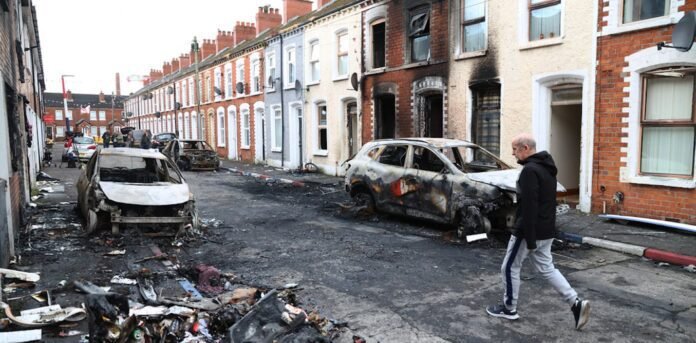
It tends to start with a violent assault. Then video documentation of the incident quickly circulates online, priming people to see not just an individual crime but a broader story about perceived dangerous outsiders.
So it was on June 8, 2026, when an assailant badly injured a man in an evening knife attack in Belfast. Within hours, a graphic video of the assault was all over social media, and masked rioters had set homes, cars and a bus on fire. Moreover, police said properties believed to belong to immigrants were deliberately targeted after authorities charged a Sudanese asylum-seeker with attempted murder.
As the unrest spread, immigrants and immigration lawyers repeatedly found their addresses and personal information released online, with social media users urging so-called patriots to act.
What played out in Northern Ireland was not a one-off. As a civil rights scholar who studies racial threat narratives and immigration politics, I see the Belfast episode as indicative of a now familiar script. A similar cycle of events occurred in Dublin in 2023 and in Southport in northern England in 2024. In each, a single, shocking crime allegedly involving a foreign-born suspect was quickly reframed into a broader indictment of migrants, asylum-seekers and minorities.
And while these events all played out in the U.K. and Ireland, I would argue that the same basic logic behind the pattern runs through contemporary U.S. immigration rhetoric and policy.
A playbook with repeatable stages
The first stage is the triggering event: a shocking crime, often involving children or a graphic video, that primes people for blaming a group of people.
The second is what I call “categorical expansion.” Instead of treating the suspect as an individual defendant, activists and online networks recast the incident as evidence of criminality among a larger category: immigrants, asylum-seekers or other racialized outsiders. Often this is conveyed through disinformation and social media narratives that depict such people as a security threat.
The third is amplification. In Belfast, social media helped circulate both the attack footage and the lists of addresses supposedly linked to immigrants and their defenders. In Dublin and in later Irish protests outside asylum housing, far-right networks and online influencers used digital platforms to intensify grievances and spread anti-migrant views.
The fourth stage is political translation. Fear becomes mobilization, and mobilization becomes demands for exclusion, detention, deportation or harsher border enforcement. Once people are primed to see isolated criminal acts as collective proof, punitive policy can begin to sound like common sense rather than ideology.
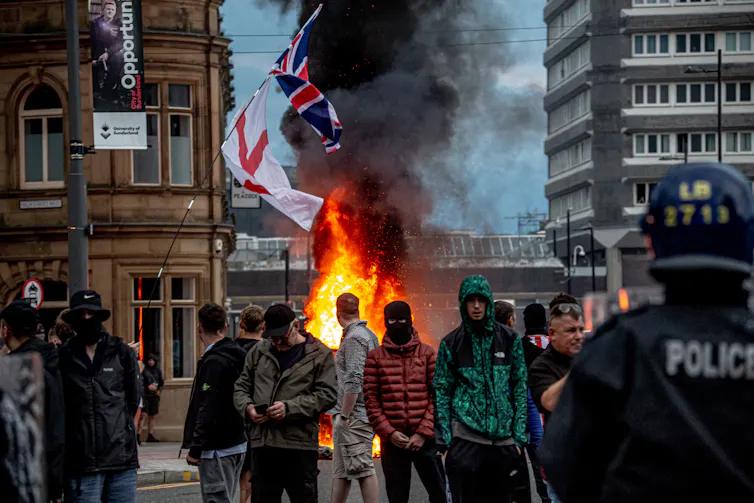
Dublin and Southport show the same pattern
Dublin provided a vivid earlier example. After the stabbing of three children and a care worker in November 2023, the suspect was described as a foreign‑born man. Far-right groups seized on that fact, blaming “immigrants” for the assault and fueling riots in the city center; dozens of people were later charged in the unrest. Civic groups and trade unions called the unrest racist and xenophobic violence directed at migrants, not the kind of public safety protest that far‑right organizers claimed it was.
By late 2024, immigration had become markedly more salient in Irish politics, with anti-immigration candidates gaining traction and political observers tying that shift directly to the riots. That turn is notable in a country that has prided itself on keeping the far right at the margins, and whose own history of colonization and emigration has generally made such politics a hard sell.
Southport, a seaside town close to Manchester, England, offered another version. After a knife attack at a children’s dance event in 2024, misinformation spread online claiming the attacker was a Muslim immigrant, and anti-immigration protests and riots followed across parts of the U.K. Later reporting identified the attacker as a British teenager, underscoring how quickly false narratives about migrant criminality can take hold before basic facts are established.
Across Belfast, Dublin and Southport, the details differ, but the storyline is the same: a shocking crime, a suspect cast as alien or foreign, and then a rush to treat an isolated incident as a warning about the perceived dangers of largely male immigrants, justifying hostility toward entire communities.
The US version is more institutionalized
In the United States, the same script in recent years has often traveled less through street riots than through political rhetoric, legislative branding and government enforcement. In 2025, President Donald Trump signed into law the Laken Riley Act, named after a Georgia nursing student who was murdered by an undocumented immigrant from Venezuala. The legislation would, as the White House described it, require “the Secretary of Homeland Security to take into custody aliens who have been charged in the United States with theft or burglary” and related offenses.
It was promoted as a way to keep “dangerous criminal aliens” off the streets. Major news coverage presented the law as an early marker of the administration’s broader effort to link immigration enforcement to public safety and crime prevention, including coverage of the signing.
The White House has likewise framed stricter enforcement, increased removals of people it labels “criminal aliens” and expanded cooperation with state and local authorities as measures that protect communities from the consequences of unauthorized immigration. I would argue that such framing also appears in Trump’s 2025 executive order, titled Protecting The American People Against Invasion, which directs agencies to intensify immigration enforcement against people without legal immigration status.
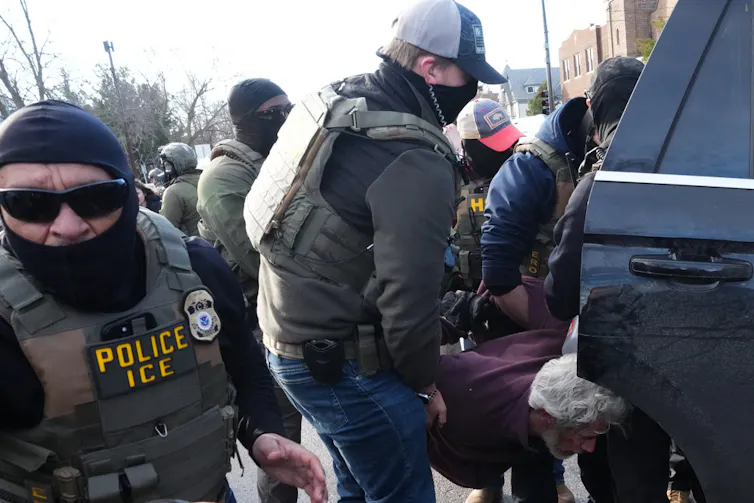
This script does not need a riot to operate. It works by linking immigration and criminal danger so consistently that the association begins to feel natural. In that context, the language of immigrant criminality becomes part of the rationale for detention rules, enforcement surges and legal changes that treat noncitizens as a standing public safety risk. Belfast shows the script in accelerated street form; the U.S. often shows it in durable bureaucratic form.
Why the phenomenon keeps happening
One reason this narrative process endures is that it converts complex social stress into an intuitive moral drama. The immigrant-threat frame offers a quicker villain and a simpler solution to persistent social problems such as violent crime.
Another reason is infrastructure. Belfast was not only a reaction to one stabbing; it was also an event organized and accelerated through far-right networks that already knew how to circulate footage, identify targets and call people into the streets. The same underlying machinery appears in Ireland and the U.K., where far-right online ecosystems have repeatedly converted individual criminal allegations into collective anti-migrant agitation.
For analysts of racial and immigrant threat narratives, this pattern is now familiar. It is not mere concern about immigration, and it is not a neutral response to crime. Rather, it is a repeatable narrative that takes one perpetrator, assigns representative meaning to that person, and then directs fear toward a much larger population.
What Belfast reveals
Belfast matters because it makes visible, in compressed form, what is often harder to see when the same dynamics unfold through speeches, policy proposals or election messaging. The city shows how quickly a violent act can be transformed into collective punishment. That’s more true than ever in the age of social media and instant, unvetted content pushed out to millions with a click.
It also shows why journalists, scholars and policymakers often treat each episode as a discrete eruption, even when the underlying pattern is similar. The through line from Belfast to Dublin to Southport to the U.S. is not identical institutions or identical laws. Rather, it is a common reactive pattern.
Recognizing that script helps explain why each new incident can so quickly become a story about all immigrants – and why future crimes, wherever they occur, are likely to be read through the same lens.



















![Pakistan Prime Minister Muhammad Shehbaz Sharif along with US Vice President J.D. Vance and Prime Minister and Foreign Minister of the State of Qatar Sheikh Mohammed bin Abdulrahman bin Jassim bin Jaber Al Thani deliver a speech prior to the commencement of the technical level talks between the US and Iran, hosted by Pakistan in Burgenstock, Switzerland, on June 21, 2026. [Government of Pakistan's X Account - Anadolu Agency]](https://i0.wp.com/www.middleeastmonitor.com/wp-content/uploads/2026/06/AA-20260621-41742297-41742295-PAKISTANI_PM_SHARIF_MEETS_US_VICE_PRESIDENT_VANCE_ON_SIDELINES_IN_SWITZERLAND-scaled-e1782135697291.jpg?fit=920%2C613&ssl=1)