Home Blog

How Donald Trump has changed the way diplomacy is done

0

The negotiations to end the US-Iran war, resulting in the signing of a memorandum of understanding on June 17, have been something of an acid test of Donald Trump’s approach to diplomacy. What does it tell us? And has this US president changed the way diplomacy is done?

When Trump was inaugurated for his second presidency in January 2025, he announced his intention to be both a peacemaker and to pursue an “America first” foreign policy, focused on avoiding wars and bringing direct benefits to the US. By November 2025, he declared he had already settled eight “raging conflicts” across the world.

In January this year, the forced removal of Nicolas Maduro as president of Venezuela and installation of Delcy Rodríguez as a more US-friendly successor led Trump’s deputy chief of staff, Stephen Miller, to tell CNN: “You can talk all you want about international niceties and everything else. But we live in a world, the real world … that is governed by strength, that is governed by force, that is governed by power.”

But the Iran war has shown Trumpian diplomacy colliding with a real world that does not always bend to his will or succumb to US displays of force. The real world, it seems, is more complex than he thought.

Hitherto, five elements have characterised Trump’s approach to diplomacy. First, he prefers to eschew the traditional institutions and mechanisms of diplomacy. The State Department languishes, the UN is ignored. Traditional alliances, multilateral organisations and international gatherings have been disdained, unless they provide a platform for Trump to demonstrate his power and “call the shots”.

Rather than use US ambassadors or diplomats to tackle international issues, Trump relies on a small cast of trusted personal envoys – including his son-in-law Jared Kushner, real-estate developer Steve Witkoff and Massad Boulos, a Lebanese-American businessman who is father-in-law to his daughter Tiffany – to negotiate on his behalf. Even the secretary of state and national security advisor, Marco Rubio, is given a limited role, mainly in the western hemisphere.

Second, Trump’s approach to diplomacy, as to government as a whole, is distinctly personal. He likes to deal with other leaders directly, man-to-man, provided they are leaders he respects.

This tends to comprise a small group that includes Chinese president Xi Jinping, Russian president Vladimir Putin, Israeli prime minister Benjamin Netanyahu and (sometimes) Saudi Arabia’s ruler Mohammed bin Salman. Trump will see others but, as the Ukrainian president Volodymir Zelensky and South Africa’s Cyril Ramaphosa found, he likes to publicly demonstrate his superiority to them.

US president, Donald Trump, vice-president, J.D. Vance, and UKrainian president Volodymyr Zelensky argue in  the Oval Office, February 2025.

Humiliation: Donald Trump and his vice-president, J.D. Vance, browbeat the Ukrainian president Volodymyr Zelensky in the Oval Office, February 2025. EPA/Jim Lo Scalzo/pool

Third – as Miller reflected – Trump sees power as deriving from military might and economic strength. He is willing to use both freely in bilateral relations to get what he sees as a good deal for America. Appeals to principle, to the international rule of law, to human rights or to the value of democracy have all gone out of the window.

He has also demonstrated his willingness to strike first – by unilaterally imposing the so-called Liberation day tariffs, or by sending marines to Caracas – and talk later. Other leaders recognise that having friends can be a source of power – but this, it seems, is not an approach that appeals to the US president. Having friends requires building trust and accepting a reciprocal – not just transactional – relationship.

Fourth, public messaging is crucial. How do his actions look on the media, to his Maga faithful, to the markets and to the world? Trump’s use of his TruthSocial platform to negotiate in public – with friend and foe alike – is the antithesis of traditional diplomacy, where secret channels, confidential negotiations and trusted interlocutors play a central role.

His ability to “flood the zone”, by overwhelming the media and any critics while spinning his own message, has given him a big advantage in this social media-driven world. But as the Iran negotiations have shown, it has drawbacks when the hyperbole and spin are shown to be hollow.

Finally, Trump’s focus is relentlessly short term. “Strategic patience” – using restraint and timing to achieve his ends – does not appear in his lexicon. Results must be immediate, and the declaration of victory or peace or a deal is what matters – not the actual delivery of those outcomes.

The “deal” to end the conflict in Gaza, struck in October 2025, remains stuck in limbo as Trump’s interest has wandered. The Ukraine war that was to be settled in 24 hours grinds on relentlessly.

Trump’s weaknesses exposed

The war in Iran, in particular, has challenged Trump’s model of diplomacy and exposed its weaknesses. The Iranians refused to “cry uncle”, as he put it, when their leadership was wiped out, their nuclear facilities were pounded by bunker-buster bombs, and their economy was brought to its knees by sanctions.

Instead, they challenged the US to put boots on the ground, closed the Strait of Hormuz to hurt the US economy, and struck its erstwhile allies in the Gulf. They refused to talk to Trump’s envoys – who they distrusted after twice feeling betrayed when the US attacked them mid-negotiation – and they exposed the deception of his constant statements and social media posts claiming agreement had been reached, or victory was at hand.

As a result, Trump has had to rely on third-party intermediaries Pakistan and Qatar to negotiate with the Iranian regime. The UN remains firmly on the shelf, as Trump is resolutely opposed to the political constraints that operating through international organisations might impose on American freedom of manoeuvre. But even so, he has found himself in need of neutral third parties to do the deal that he could not.

Will Trump change? Yes and no. He has no ideological constraints, only pride and faith in his own abilities. So he could change course at any moment. But his antipathy to multilateralism and traditional diplomacy are unlikely to disappear.

Nato chief Mark Rutte with US president DOnald Trump in the Oval Office, October 2025.

Nato chief Mark Rutte has been dubbed a ‘Trump whisperer’ for his ability to charm the US president. EPA/Aaron Schwartz/pool

The world at large is already adjusting to these new ways of doing diplomatic business. Some are seeking out “Trump whisperers” such as Nato’s chief Mark Rutte, or Maga-friendly lobbyists that, for example, Nigeria and the Democratic Republic of Congo have employed to secure US support for their respective struggles against Boko Haram and Rwanda.

Others are picking envoys to liaise with the likes of Witkoff and Kushner. The UK’s pick for this role is national security advisor Jonathan Powell, whose contacts with Witkoff played a significant part in calming US relations with Ukraine. As bilateral diplomacy replaces multilateral, the air miles of such envoys multiplies exponentially, while small countries are cut out of the action.

And yet, Trump’s last two summits with Putin and Xi yielded little – and he found himself spending more time at the latest G7 summit in France than at previous ones. Perhaps, the US president has found he needs some friends after all.
Israel plans to reduce forces in southern Lebanon under US pressure ahead of Lebanese army deployment

0
israel-plans-to-reduce-forces-in-southern-lebanon-under-us-pressure-ahead-of-lebanese-army-deployment
Israel plans to reduce forces in southern Lebanon under US pressure ahead of Lebanese army deployment

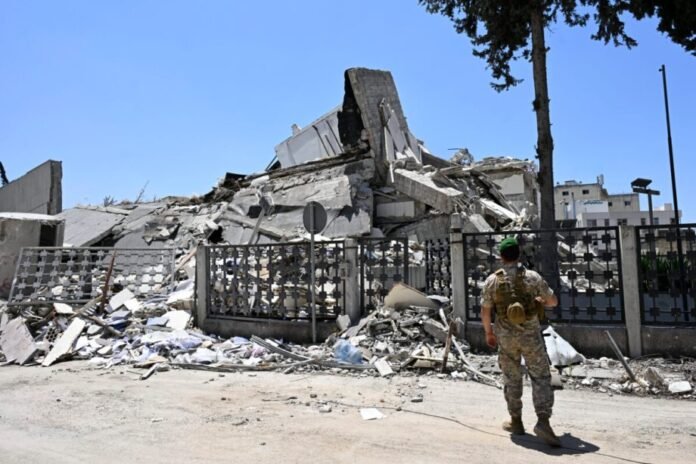
The Israeli army is expected to reduce the size of its ground forces operating in southern Lebanon, according to a report published on Sunday by Israeli public broadcaster KAN.

The broadcaster said the gradual reduction is due to the fact that “most offensive missions have been completed and there is no longer a need for all the soldiers currently deployed in the security zone”.

KAN added that another reason is an expected meeting this week between Israeli and Lebanese negotiating teams, during which pilot areas in southern Lebanon will be defined.

According to the report, these areas will be free of Hezbollah, with the Lebanese army taking responsibility for them to test its ability to prevent the group from re-establishing control.

The US administration wants Israeli forces to return to positions along the Yellow Line, located about eight kilometres from the border. Israel says the line is intended to protect northern towns from anti-tank missile attacks.

Over the past two months, Israel has expanded its military deployment in southern Lebanon beyond the Yellow Line.

Quoting an Israeli official familiar with the matter, KAN said the Israeli army would not withdraw from the Yellow Line itself, but could pull back from areas occupied more recently as part of the negotiations.

Why Gaza’s genocide death toll is deliberately undercounted

0
why-gaza’s-genocide-death-toll-is-deliberately-undercounted
Why Gaza’s genocide death toll is deliberately undercounted

The mainstream media has no problem guesstimating the deaths (500,000) from the Assad dictatorship’s civil war in Syria, nor the estimated deaths in the wars in UkraineSudan or Iran.

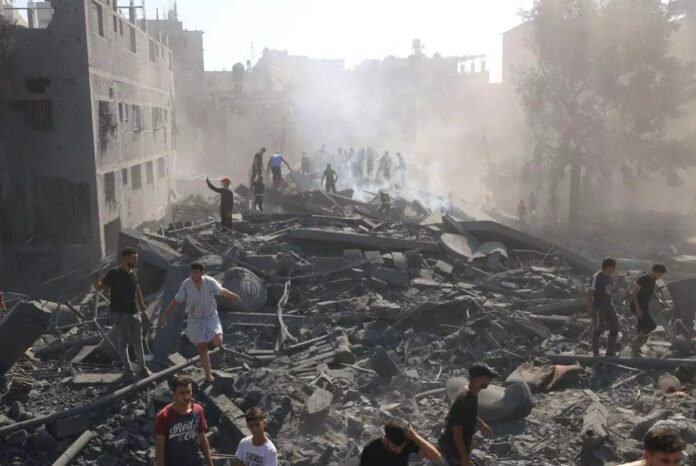
Somehow, media editors do not let their investigative reporters assess the extent of Israel’s mass murder of civilians in Gaza — an exposed, defenseless population of 2.3 million people in an enclave the geographic size of Pennsylvania.

The Associated Press notes that US military historian Robert Pape believes, “Gaza is one of the most intense civilian punishment campaigns in history” and that, “It now sits comfortably in the top quartile of the most devastating bombing campaigns ever.”

Why? One reason is that the Hamas-controlled Ministry of Health certifies deaths in Gaza based on reports from hospitals and morgues that were mostly blown up well over a year ago. (They report presently around 73,000 fatalities.)

But Hamas has admitted that there are tens of thousands of bodies under the rubble, thousands more blown into bits or incinerated and unidentifiable.

They also say their figures do not include the collateral deaths (e.g., spreading fires) from the Israeli military F-16 bombings and relentless shelling of the people of Gaza or the deaths caused by the Israeli government-imposed blocking of food, medicine, healthcarewater, fuel, electricity and shelter.

From other conflict zones around the world, the ratio of collateral deaths is anywhere from 3 to 13 times the deaths by violent weaponry.

The Israeli regime is fine with the Hamas undercount because they and the US State Department know the real death toll (along with the injury count) is much, much higher. Hamas knows that on October 7, 2023, the multi-layered Israeli border security apparatus was shaky.

They then launched what turned out to be a suicide-homicide assault over the border, resulting in some 1,400 deaths as compared with the nearly 1,200 people — about 400 of them soldiers and police — shot by the Hamas raiders.

To this day, with most Israelis skeptical, Netanyahu has blocked an independent official investigation of the mysterious collapse of the multi-tiered Israeli border security complex.

Netanyahu attributes it to negligence. There were, however, too many separate warnings, including 24-hour Israeli spotters from the Israeli side, plus Israel having the Hamas plans a year earlier, to accept that improbable pretext.

Hamas, on the other hand, doesn’t mind the world media repeating again and again their minimal, identifiable death count.

They certainly do not want the realistic estimate death count to further outrage their subjects because Hamas did not protect the civilian population, and did not have any air-raid shelters.

Hamas certainly knew what was coming from the ultra-modern, savage Israeli military backed by co-belligerent Joe Biden’s US ultra-modern and lethal military industrial complex.

There is another media reluctance operating. The reports by eyewitnesses, and scholarly and military weaponry specialists, who arrive at minimum and maximum ranges of deaths (most of whom are children and women) bring repulsive denunciations and charges of anti-Semitism.

Moreover, apologists for endless Israeli slaughter, like Bret Stephens, the mouthpiece of Netanyahu on the New York Times opinion page, have used the low Hamas figures to counter charges of Israeli genocide. If it was genocide, they inaccurately claim, the death toll would be much higher.

In 2025, two major Israeli human‑rights organizations – B’Tselem and Physicians for Human Rights Israel – each issued reports concluding that Israel is committing genocide against Palestinians in Gaza (see reporting from Amnesty International).

Well, the death toll is much higher, over 600,000 lives destroyed or over 25% of Gaza’s original population. This leaves an improbable nearly 75% still alive, though most are sick, injured or dying.

Reporting reality would intensify the political, diplomatic and civic determination to stop the killing, let in adequate humanitarian aid and move toward resolving this conflict.

Analysts reported by The Lancet, international relief organizations, universities and UN agencies all estimate hundreds of thousands of dead Palestinians from violent bombs, artillery, snipers and the resultant, related secondary effects noted above.

For example, Professor Emeritus Paul Rogers of the University of Bradford in the UK, back in April 2025 estimated the tonnage of explosives dropped on Gaza was the equivalent of six Hiroshima bombs, but more lethal because these daily projectiles are more targeted.

Tarek Loubani, a Canadian physician who has served tours of duty at crumbling Gaza hospitals, puts the estimate at “hundreds of thousands of dead.”

In a detailed, footnoted series of reports (“The Truth About Gaza’s Dead”), Feroze Sidhwa, an American trauma surgeon who worked in Gaza’s killing fields, has published much probative evidence by dozens of other health workers who experienced the ghastly horrors.

These included the deliberate targeting by Israeli terrorist snipers of little children receiving bullets in their brains and hearts. (See Foreign doctors say Israel systematically targeting Gaza’s children: Report – Al Jazeera, September 14, 2025).

The recent report by Francesca Albanese, the United Nations Special Rapporteur on the Occupied Palestinian Territories, referred to a consensus of 680,000 deaths.

The respected chair of Global Public Health at the University of Edinburgh, Professor Devi Sridhar, long ago was offering estimates far higher than those of Hamas.

The Hill reported that in November 2023, Assistant Secretary of State for Near Eastern Affairs Barbara Leaf testified to a House committee that the actual number of Palestinians killed in Gaza was likely higher than the figures then being reported by Gaza health authorities at that time.

She was immediately silenced and never again spoke about Israel’s genocidal casualties. The State Department has been blocking a Freedom of Information demand for two years.

The huge Israeli bloc in Congress, of course, has allowed no hearings on the toll made possible by deadly US weapons (including shipping over white phosphorus artillery shells)— costing billions of dollars paid for by US taxpayers. 

Human Rights Watch and Amnesty International have reported that Israel used white phosphorus munitions in military operations in Gaza and along the Israel–Lebanon border shortly after the October 7 Hamas attacks.

Reporters could have gotten informed assessments and estimates about the Israeli-inflicted carnage in Gaza from Doctors Without Borders, Save the Children, the World Central Kitchen and other aid groups.

Scores of infants and children in Gaza are dying every day from disease, malnutrition and untreated injuries.

There are no healthcare facilities for them. The shameful US newspapers, magazines, television and radio disrespect the Palestinians in both life and death, something they would never dare to do if the shoe were on the other foot.

Why aren’t brave reporters like Ryan Grim, Jeremy ScahillAmy Goodman and Sy Hersh looking deeply into the ghastly indifference to the undercount in Gaza? Truth and the mournful survivors need you.

Ralph Nader is a consumer advocate and the author of “The Seventeen Solutions: Bold Ideas for Our American Future” (2012). His new book is “Wrecking America: How Trump’s Lies and Lawbreaking Betray All” (2020, co-authored with Mark Green). He tweets at @RalphNader

Common Dreams

Starmer Announces Resignation as UK Prime Minister Amid Growing Pressure from Burnham

0
starmer-announces-resignation-as-uk-prime-minister-amid-growing-pressure-from-burnham
Starmer Announces Resignation as UK Prime Minister Amid Growing Pressure from Burnham


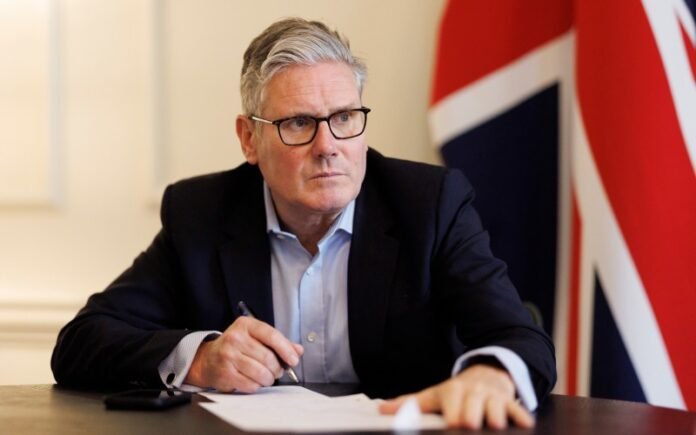
British Prime Minister Keir Starmer announced his resignation on Monday, saying he had informed King Charles III of his decision and triggered a Labour leadership contest.

The move follows a decisive by-election victory by Andy Burnham in Makerfield, a result that strengthened his position within the Labour Party and increased pressure on Starmer’s leadership.

Speaking outside Downing Street, Starmer said Labour’s National Executive Committee would open nominations for the leadership race until July 9, with the process expected to conclude before Parliament’s summer recess. He pledged to remain in office until a successor is chosen to ensure an orderly transition.

Starmer’s departure comes less than two years after Labour secured a large parliamentary majority in the 2024 general election. Despite that mandate, his government struggled to maintain momentum, facing setbacks in local elections, mounting internal criticism, several political controversies and a series of policy reversals.

The leadership contest is expected to determine Labour’s future direction, with Burnham emerging as a leading contender to replace Starmer.

via Politico

Fan Runs Onto NASCAR Track During Race and Tries to Climb into Driver’s Car

0
fan-runs-onto-nascar-track-during-race-and-tries-to-climb-into-driver’s-car
Fan Runs Onto NASCAR Track During Race and Tries to Climb into Driver’s Car


A wild NASCAR moment unfolded in San Diego when a fan jumped a fence, stormed onto the track during a race, and tried to talk his way into a driver’s car.

The bizarre scene happened Saturday, June 20, during the O’Reilly Auto Parts Series race at Naval Base Coronado — the first time in NASCAR history that a race has been held on an active military base.

The event was already unusual enough. Drivers were racing around a 3.4-mile road course built inside the highly secured military base. Fans had to go through tight security just to get inside.

But once the race was underway, one spectator somehow managed to turn the historic event into a security nightmare.

The chaos began late in the race after driver Sam Mayer clipped the inside wall at Turn 1. His car slammed into Anthony Alfredo’s before crashing hard into the outside wall, triggering a nasty pileup.

The wreck was so severe that it damaged the retaining wall, forcing officials to throw the red flag and stop the race while crews made repairs.

That’s when one fan apparently decided it was his moment.

During the red flag delay, the man climbed over a fence and walked onto the track. He then approached driver Sheldon Creed’s car and stuck his head through the driver’s window.

Creed was still sitting inside his car when the shocking encounter happened.

Moments later, Creed got on his team radio and seemed just as stunned as everyone watching.

“I think he’s wasted,” Creed said. “I didn’t even understand what he was saying.”

After his brief and bizarre pit-stop-style visit, the fan climbed back over the fence and left the track area.

He was later apprehended, according to reports, and likely faced serious consequences for trespassing onto an active NASCAR track — especially one set up on a military base.

As shocking as the incident was, it was not the first time a fan has wandered onto a NASCAR track during a race delay.

Back in 2007, a fan at Watkins Glen International in New York walked onto the track while trying to get an autograph from driver Matt Kenseth.

Still, Saturday’s stunt was especially alarming given the location, the security concerns, and the fact that it happened during a historic NASCAR weekend at an active naval base.

NASCAR fans are known for being passionate. But jumping a fence, walking onto the track, and trying to chat up a driver from the window is one way to make sure you leave the race in handcuffs instead of with a souvenir.

The Caspian Sea has lost an area nearly the size of Sicily: human activities are a major reason why

0
the-caspian-sea-has-lost-an-area-nearly-the-size-of-sicily:-human-activities-are-a-major-reason-why
The Caspian Sea has lost an area nearly the size of Sicily: human activities are a major reason why

The Caspian Sea, the largest inland body of water on Earth, is shrinking. Not fluctuating, not entering another natural cycle, but shrinking.

For decades, scientists and policymakers treated changes in the Caspian as part of the basin’s natural variability. Water levels in the sea have always risen and fallen.

But our new study shows something far more troubling: the current decline is increasingly driven by human decisions to dam and divert rivers, and by fragmented decision-making across five countries that border this body of water.

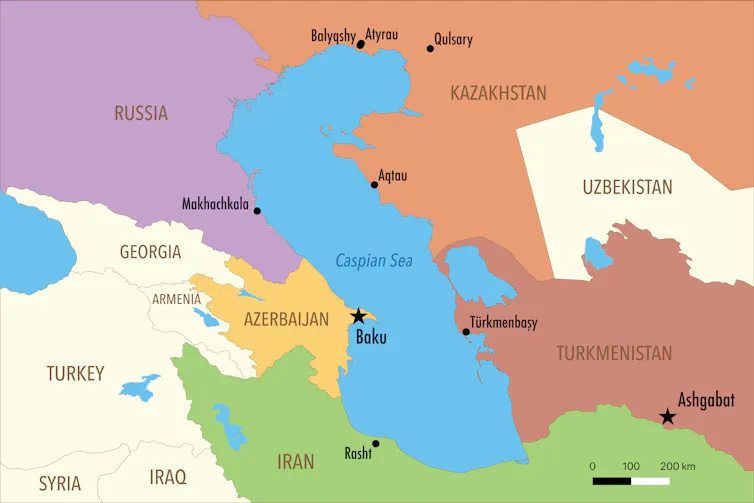
Using satellite observations together with ground-based hydrological records from rivers across all five shoreline states (Iran, Russia, Turkmenistan, Azerbaijan and Kazakhstan), we found that flow into the Caspian Sea has declined sharply over the past three decades.

The main reason is not declining rainfall. In fact, rain over the Volga Basin, which supplies roughly 80% of the Caspian’s inflow, has slightly increased. That finding matters because it overturns one of the most common assumptions surrounding the Caspian crisis. The common narrative has been straightforward: climate change increases evaporation, rainfall declines, and the sea shrinks.

Climate change certainly plays a role: our analysis confirms that evaporation across the Caspian has increased significantly as regional temperatures rise. But evaporation alone explains only about 40% of the observed water loss since the mid-1990s.

The remaining decline points overwhelmingly toward human activity. The Volga River has been heavily engineered for decades. Dams, reservoirs, use for irrigation, industrial consumption and navigation systems have fundamentally altered the hydrology of the basin).

Water that once flowed naturally into the Caspian is increasingly intercepted upstream. One critical but rarely discussed example is the Volga–Don canal system, which links the Caspian basin to the Black Sea through Russia’s internal waterways. Geopolitically and economically, the canal is strategically valuable. But it diverts water away from the Caspian system.


Read more: Why the Caspian Sea has become so important in both the Ukraine and Iran wars


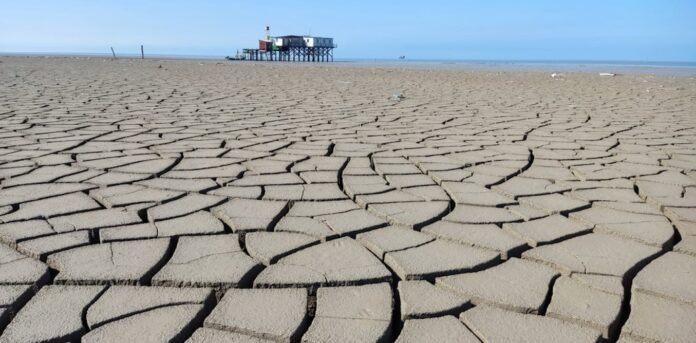
The cumulative effect is now visible from space. Since the mid-1990s, the Caspian Sea has lost roughly 24,000km² of surface area, an area approaching the size of Sicily. Water levels have fallen by about two metres.

The shallow northern Caspian, ecologically one of the most productive parts of the sea, is drying particularly rapidly. This matters because the northern Caspian is not empty water. It is a critical ecological zone supporting fisheries, wetlands, migratory birds and spawning grounds for sturgeon, the ancient fish species that produce most of the world’s caviar.

Threats to shipping

As water retreats, ecological stress intensifies. Our study also detected a long-term rise in chlorophyll-a concentrations in the northern Caspian, a key indicator of algal activity and declining water quality. In plain terms, the sea is becoming warmer, shallower and increasingly nutrient-rich: ideal conditions for harmful algal blooms.

This is not merely an environmental story. The Caspian region sits at the centre of major energy and trade corridors linking Europe and Asia). Russia’s north-south transport routes and China’s international development plan, the Belt and Road Initiative, plus offshore oil infrastructure and regional shipping networks all depend on the Caspian remaining navigable and stable.

Falling water levels threaten ports, shipping lanes and coastal infrastructure. Declining depths reduce cargo capacity and increase transport costs. What appears initially as an environmental issue gradually becomes an economic constraint.

The Caspian Sea region

A colour map of the Caspian Sea and surrounding countries.

Shutterstock

Political problems

Then there is the political dimension. Unlike oceans, inland seas cannot rely on global circulation to buffer local mismanagement. Their survival depends directly on the behaviour of neighbouring states. And the Caspian is surrounded by countries with competing strategic interests, uneven governance systems and limited transparency over their water use.

That fragmentation has become one of the greatest risks facing the sea. Although regional agreements exist, including the 2018 Aktau Convention (formally the Convention on the Legal Status of the Caspian Sea), there is still no comprehensive and enforceable system governing water allocation, hydrological monitoring or ecological protection across the basin. Data sharing remains limited. Water withdrawals are often opaque. Environmental management is fragmented.

This resembles a pattern seen repeatedly across modern environmental crises: governments prefer to discuss climate change because it externalises responsibility. It allows leaders to portray ecological decline as an unavoidable planetary process.

But the Caspian story is more uncomfortable than that. It is also a story about political choices. Rivers were dammed. Water was diverted. Wetlands were degraded. Pollution controls remained weak. Oil and gas development expanded while ecological safeguards lagged behind. Economic growth consistently outranked hydrological sustainability.

The danger is not simply that the Caspian shrinks, but that ecological thresholds may be crossed – beyond which, recovery becomes extraordinarily difficult.

The Aral Sea, the world’s fourth largest lake, demonstrated how quickly collapse can accelerate once a chain reaction begins. Exposed lakebeds generate dust storms. Fisheries collapse. Salinity rises. Biodiversity crashes. Local climates shift. Economic systems unravel around the drying basin.

The Caspian has not yet reached that stage – but the warning signs are becoming increasingly visible.

There is still time to slow the trajectory. However, doing so would require something historically rare in the region: long-term coordination that prioritises hydrological stability – safeguarding the sea’s natural water balance and keeping water levels from dropping past a dangerous point of ecological collapse – over short-term extraction and geopolitical competition.

This would mean transparent water accounting – the open tracking and sharing of data on exactly how much water each nation is pulling from the feeding rivers for agriculture and industry. It would mean negotiated environmental flow releases from upstream reservoirs, and recognition that the Caspian is not simply an energy corridor or a shipping route, but a fragile water system.

Nature eventually imposes consequences on societies that ignore those limits. The Caspian Sea is beginning to deliver that message.

Reading the air on being Japanese

0
reading-the-air-on-being-japanese
Reading the air on being Japanese

As birth rates fall and countries turn to immigration to address their labor shortages, a lot of countries around the world are struggling with crises of national identity. Japan is one of them. Over a decade ago, Japan began opening itself up to mass immigration.

Because Japan did this later than other rich nations, immigrants aren’t yet as numerous as in Europe or the US, but the percentage is rising fast. And so discussions about what it truly means to be Japanese are starting to emerge.

I thought it would be useful for my readers — most of whom live in America or other English-speaking nations that are going through their own crises of national identity right now — to get some perspective on how Japanese people think about these issues.

And so I asked my friend Hiroko Yoda to write me a post about it. Hiroko is a Japan-based entrepreneur, cultural historian, and writer. She’s the author of a new book, “Eight Million Ways to Happiness“, which is a memoir exploring Japan’s modern secular-spiritual landscape. She also writes on Substack.

In this post, she writes about how shared culture, rather than adherence to a particular religious doctrine, is what binds Japan so tightly together. Interestingly, “culture” is the same answer I arrived at when I asked the question of what will bind America together in the future.


Although I live in Japan, as a Japanese person married to an American, and who studied at American universities for my undergrad and graduate degrees, I probably pay more attention to happenings in the US than many Japanese people.

One of the topics I have found most interesting is the ongoing struggle to define what an American is. The reason being, we Japanese are grappling with this issue as well.

As Noah has written, Japan is accepting more immigrants than ever before. When my husband and I moved to Tokyo in 2003, international couples were still uncommon, and we’d sometimes draw stares if we walked hand in hand.

These days, it’s completely unremarkable. The numbers of tourists visiting Japan increase year by year, and so does the number of people taking permanent residence. I see many international families in the suburb where we live, and I don’t think we are unusual, at least as regards urban centers.

As Japanese are finding new ways to co-exist and live alongside non-Japanese, they are also revisiting what it means to be Japanese. As I’ve written in my own newsletter, the question once centered simply on ethnicity, but now many are coming to believe that shared cultural values are more important.

Are you Japanese simply because of where you were born, or are you Japanese because of how you participate in society? Superficially, this resembles the arguments going on in America. Are you American because of some kind of heritage, or are you American because you embrace shared values, like those laid out in the Constitution?

But there is an interesting difference, too. Japan is (or was) a country with relatively little immigration; that’s why the question of who’s Japanese traditionally hinges on ethnicity. On the other hand in America, an immigrant melting pot, the litmus test often seems to return to faith.

It comes up again and again in American discussions about what it means to be American. Take this recent essay from The New York Times opinion writer Ross Douthat:

One doesn’t need to be a specific kind of religious believer to be a good believer in the Declaration [of Independence]. But if you look at the sweep of American history, it’s very hard to disentangle the advance of equality from the religious belief that our rights come from God and that human beings are equal in his eyes… it has more power in a context where most Americans believe in a providential God.

And then there’s Derek Thompson, who in a recent conversation with religious scholar Ryan Burge, noted:

There’s this category of Americans who have gone into religion as if it’s a foreign country, harvested certain souvenirs, and brought them back to the world of secularism. They practice yoga but have no interest in understanding its religious origins. They meditate but are not remotely interested in any Buddhist version of nirvana.

To which Burge replies:

They only wanted the parts of religion they liked and left the others behind…

You can’t just pick and choose…A lot of people are doing that with religion right now. They’re walking down the buffet line, picking one piece, putting it on their plate, and calling it a spiritual life. That doesn’t endure.

And Thompson concludes:

If you don’t have that central spine of purpose, the community won’t last. If your only purpose is “let’s get together,” that’s not enough. You need that higher purpose—that vertical spine—in order to build a truly strong horizontal community.

These pundits are arguing that ideas alone – the values of the Declaration of Independence or the Constitution – aren’t enough to keep Americans together, whether in communities or as a country. America’s loneliness epidemic, its polarization, its young citizens’ loss of hope: a big part of it can be attributed to the fact Americans don’t go to church or synagogue or temple or what have you anymore.

All of which makes me want to say: have you ever been to Japan?

Japanese, as a nation, don’t subscribe to any one faith. In fact, there’s a popular saying “born Shinto, married Christian, buried Buddhist.” We pick and choose, bringing what we like from various traditions – the purifications of Shinto, the pretty aspects of Christian weddings, the traditions of Buddhist funeral rites – into our secular lives. We’re so flexible about it that we often answer no when people ask if we’re religious. Look at this chart:

I’m going to put aside the question of how accurate this is. I actually wrote an entire book on how I believe surveys like this can miss the forest for the trees. (Spoiler: it involves how one defines “religion.”) But Burge and others argue Americans are “setting themselves up for failure” in becoming less religious, or at least in not going to religious institutions.

America is a flexible society that is rigid when it comes to religion; Japan is the opposite, a rigid society with a surprising flexibility when it comes to faith. There’s an old phrase that sums up Japan’s traditional spiritual cosmology: yaoyorozu no kami, which means eight million deities. It isn’t an accounting; it’s an expression of awe at the infinite nature of the sublime in all its forms. It incorporates, absorbs, rather than draws lines. In short, it’s radically inclusive.

I get that America is a religious country. I was taken to Sunday school every week when I was a homestay student in Indiana in the 1990s. I recited the Pledge of Allegiance alongside the other students every day. But there’s no pledge of allegiance in Japanese schools. The Japanese flag wasn’t even displayed in any of my classrooms. None of my classmates ever went to anything resembling a Sunday school.

But we were united in other ways. Ways that look like faith to outsiders, but just felt like everyday life to us. We made New Year’s visits to shrines or temples for hatsumode, a first prayer for the year. Many of us had Buddhist-style altars in our homes, where we kept photos of departed family members. Many of us carried omamori, Shinto or Buddhist amulets for scholarship or travel safety on our schoolbags.

But if you’d asked the majority of us what our faith was, or who we were praying to, we’d have reacted with utter confusion. None of us saw amulets as a replacement for studying, or looking both ways before crossing the street. They were simply cute ways to wish. If you’d asked us what we believed, I honestly don’t think we would have even understood the question. We just did.

So if institutional faith is core to the communities that form a healthy society, why is Japan’s so successful without it?

First, let me be clear here. I don’t see Japan as some kind of utopia or even a role model. I just see it as different. But the fact it is different – and not struggling in the ways many commentators seem to think America is struggling, at least regards faith as an identity – is what might make the Japanese counterpoint relevant. Let me also be clear that I believe faith can nurture a life or a community. If your personal faith nourishes you, I cheer you on.

But speaking broadly, if Japan can maintain a stable society without faith, it would seem to indicate it isn’t a necessity for a healthy society.

So what is keeping Japan together?

For a long time, Japanese could rely on clear lines to define themselves, like language (Japanese being little spoken outside the nation) and terrain (being an archipelago). But things are changing, and changing fast. It isn’t particularly difficult to get to Japan anymore. More people outside Japan are learning and speaking Japanese than ever before. More want to live here than ever before.

And Japan is aging and shrinking. We’ve “lost” three million citizens over the last few years alone, as deaths outpace births. The numbers of foreign visitors and permanent residents are higher than ever before. All of these factors are driving the question of what it means to be Japanese, which is playing out in online forums, TV shows, newspapers, and election contests throughout Japan.

recent Stanford survey about immigration shows that race isn’t a major factor in resistance to immigration. Rather, Japanese language ability is. In this chart, you can see how many more respondents chose to admit a hypothetical immigration applicant based on their ability to speak fluently.

Now, this might seem like a no-brainer. Of course, you want to admit people who can communicate with you. But “fluent” is doing a lot of lifting here that might not be obvious in English.

Japanese is classified as a “high-context” culture, meaning that a large amount of cultural knowledge is required to speak fluently. (Other high-context cultures include China, Korea, and many Arab countries.)

There’s a lot of implicit communication, meaning context is often implied rather than expressed directly. Meanwhile, Americans, Germans, and Scandinavians (among others) are framed as “low-context,” meaning conversations tend to be explicit, with context usually spelled out.

Anyone who’s studied Japanese will know what I mean. We often leave pronouns and even subjects out, in casual speech. You’re expected to kuuki wo yomu – “read the air” and intuit meaning. So when Japanese say they want immigrants to master Japanese, they’re talking less about the linguistics of speaking than they are context – “the air,” in other words.

In a recent survey, 62% of Japanese reported that they wanted immigrants to not only follow the rules, but also “etiquette and customs.” Some interpret this as draconian or authoritarian, but I don’t think so.

If you correlate it with that Stanford survey, you can see that once Japanese fluency is achieved, locals ranked people of a wide variety of ethnic backgrounds as acceptable (the dot at far right in each graph.)

Of course, not everyone in Japan agrees with this thinking. There are those who have a vested interest in keeping the definition of Japanese as strict as possible, who use foreigners as scapegoats for society’s failings, who wish to keep the number of outsiders who immigrate here as low as possible. The far-right party that rode an anti-immigrant platform to a surprising number of seats in parliament in the 2025 elections is one example.

But I believe the winds are against people who think in this way. The demographics are against them. The technologies that let us cross borders physically, and share our ideas across them virtually, are against them.

And most of all, I think our cultural traditions are against them. When our cosmology, so to speak, is so inclusive, it’s hard to square why our society should not be. Anyone who trumpets conservative values in Japan is eventually going to run up against that conundrum.

As a Japanese, it isn’t my place to say who is or isn’t an American. But I can say what I personally envision for my country’s identity going forward. I see it in little moments all over the city today. Non-Japanese employees greeting customers in polite Japanese. Foreign folks showing respect at temples and shrines.

The caucasian man and his daughter I saw commuting to kindergarten on a mama-chari bike, her tiny pastel backpack slung incongruously over his big shoulders. In other words, the stuff of everyday life. To me, Japanese isn’t what you look like; it’s how you act. In other words, it’s how you read the air.

Hiroko Yoda is a Tokyo-based translator, photographer and author. She specializes in re-contextualizing Japanese culture in a fun and engaging way for English readers. Read and subscribe to her Substack here.

This article was first published on Noah Smith’s Noahpinion Substack and is republished with kind permission. Become a Noahopinion subscriber here.

Netanyahu Says as Long as He’s PM, ‘Iran … Will Never Have a Nuclear Weapon’

0
netanyahu-says-as-long-as-he’s-pm,-‘iran-…-will-never-have-a-nuclear-weapon’
Netanyahu Says as Long as He’s PM, ‘Iran … Will Never Have a Nuclear Weapon’


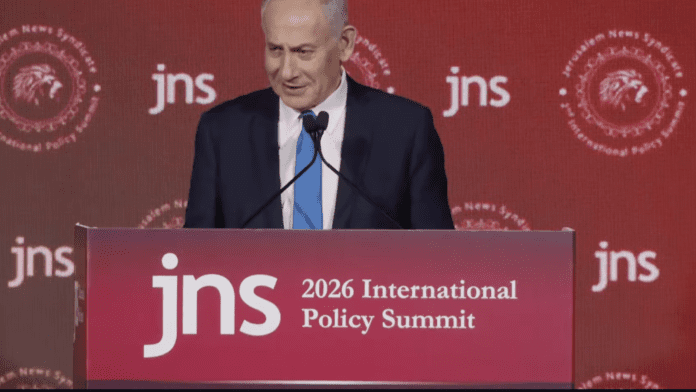
Israeli Prime Minister Benjamin Netanyahu told the JNS International Policy Summit on Sunday that Israel’s military campaigns against Iran and its regional allies have removed major threats to the country’s security, defended Israel’s continued presence in security zones in Lebanon, Syria, and Gaza, and pledged that Iran will never obtain a nuclear weapon while he remains in office.

Addressing the gathering, Netanyahu said Israel’s recent actions were taken despite opposition from critics who had urged him not to enter Rafah, strike Hezbollah, or confront Iran.

“What have we achieved?” Netanyahu asked, before outlining what he described as the results of those decisions.

He said Israel prevented Iran from obtaining a nuclear weapon and, together with the United States, carried out extensive strikes against Iran’s military and nuclear infrastructure. Netanyahu credited cooperation with the American military for what he called the largest airstrike campaign in Israel’s history.

“We destroyed Iran’s nuclear infrastructure,” he said. “We knocked out 20 of their top nuclear scientists–12 in Rising Lion, another eight in Roaring Lion.”

Netanyahu said Israel also targeted Iran’s missile industry, military industries, navy, and air force, while inflicting what he described as hundreds of billions of dollars in economic damage on the Islamic Revolutionary Guard Corps.

He argued that the military pressure had weakened the Iranian regime and created conditions that could eventually lead to its collapse.

“But we didn’t just confront Iran. We shattered Iran’s terror axis.”

The prime minister said Israel eliminated senior terrorist leaders, killed tens of thousands of terrorists, and secured the return of all hostages held in Gaza.

“And despite those who said it couldn’t be done, we brought back to Israel every single hostage, every single hostage, every last one of them.”

Turning to Lebanon, Netanyahu said Israel had severely degraded Hezbollah’s military capabilities, including destroying more than 90% of what he said were 150,000 rockets and missiles amassed by the group.

He said Israel had established security zones in Gaza, Syria, and Lebanon and would maintain them for as long as necessary.

“As long as we need to protect our people, we will remain in the security zone in South Lebanon,” Netanyahu added.

The prime minister also defended the Israel Defense Forces’ conduct in Lebanon and Gaza, saying Israeli forces make extensive efforts to limit civilian casualties while targeting terrorists.

Netanyahu concluded by reaffirming his commitment to preventing Iran from obtaining nuclear weapons.

“No matter what happens in the talks, with an agreement, without an agreement, I pledge to you that Iran, as long as I’m Prime Minister, will never have a nuclear weapon, never,” he said. “As long as I am the Prime Minister of Israel, I will not let that happen.”

How America’s war crowned Iran as the Gulf’s new hegemon

0
how-america’s-war-crowned-iran-as-the-gulf’s-new-hegemon
How America’s war crowned Iran as the Gulf’s new hegemon

There is a particular irony — the kind that history savors — in the fact that the United States set out in February 2026 to destroy Iran as a regional power and instead ended up cementing its dominance.

This is not a paradox – it is a pattern. Anyone who has paid attention to American foreign policy in the Middle East over the past three decades will recognize it immediately, because it has happened before, and because many of us said, in advance and in print, that it would happen again.

I wrote in “Quagmire” in 1992 that the United States had no strategic interest in becoming the permanent arbiter of Middle Eastern politics and no capacity — military, cultural or institutional — to remake the region in its image.

I wrote in “Sandstorm” in 2005 that the invasion of Iraq had not diminished Iranian power but enormously magnified it, by eliminating Tehran’s primary regional counterweight and handing the country’s Shia majority a state.

Washington’s response to both arguments, then and now, was to produce more think-tank papers, schedule more Senate hearings and launch more wars.

Now we are living in the aftermath of the latest iteration of this catastrophe, and the picture is becoming unmistakably clear: Iran has emerged from the 2026 war not as a broken state but as the preeminent power in the Persian Gulf.

The mullahs whom Donald Trump promised to sweep from the stage have been replaced, yes — but by a harder, younger, more capable military leadership under Mojtaba Khamenei and the Islamic Revolutionary Guard Corps that has shed the theological defensiveness of the founding generation and adopted the cold strategic calculus of a state that knows it survived, and knows what it survived.

This is not the Iran that signed the JCPOA. This is an Iran that has been to war and won.

Let us be precise about what “winning” means here, because Washington’s defenders will dispute the term. Iran did not win in the sense of defeating the United States militarily — no one is suggesting the IRGC routed the Seventh Fleet.

Iran won in the sense that matters strategically: it preserved the regime, demonstrated the resilience of its military and industrial capacity, neutralized the political will of its adversaries to continue the campaign and emerged with enhanced legitimacy at home and elevated prestige across the region.

It survived the decapitation attempt. It reconstituted its missile forces faster than anticipated. And it now, in practical terms, controls the Strait of Hormuz in a way that gives it leverage over the global economy that no amount of American naval presence can easily negate.

Trump declared “total and complete victory” in early March. By June, the picture had changed entirely. This, too, is a pattern. Americans in positions of power have a remarkable talent for declaring victory at the moment the consequences of the war are only beginning to accumulate.

The realist tradition in American foreign policy — the tradition of George Kennan, of Hans Morgenthau, of the Cato Institute think tank where I spent many years — warned against precisely this. It warned that states have national interests rooted in geography, history and demography that cannot be bombed away.

It warned that Iran, a civilization of three millennia with a population of 90 million and a strategic location astride the world’s most important waterways, is not a problem to be solved by air campaigns.

It warned that regime change fantasies, indulged by people who have never read Clausewitz seriously, tend to produce not compliant successor governments but radicalized, nationalized and militarized versions of the adversary one sought to eliminate.

The Gulf Arab states understood this, which is why — with the partial and characteristically cynical exception of Saudi Arabia — they denied Washington access to their airspace and made their opposition to the war unusually public.

They live next door to Iran. They cannot afford to mistake a temporarily weakened adversary for a permanently defeated one. They knew that a post-war Iran, whatever its internal configuration, would still be there in the morning, and that they would have to negotiate the terms of their coexistence with it long after the American aircraft carriers had sailed home.

The miscalculations that produced this outcome were not intelligence failures in the narrow sense. The intelligence was, by most accounts, reasonably accurate about Iran’s military capabilities, the robustness of its dispersed missile infrastructure and the IRGC’s preparations for a prolonged campaign.

The failure was political and strategic — a failure of judgment at the highest levels, rooted in the same magical thinking that sent American troops into Baghdad in 2003 expecting to be greeted with flowers.

Washington convinced itself that Iran’s restraint in 2024 and 2025 was evidence of weakness. It was, as I wrote at the time, evidence of patience.

Iran’s leadership had studied the 2003 Iraq war. They had studied the Libyan intervention of 2011. They drew the same conclusion that any serious strategist would draw: that American military operations in the region tend to be swift in their opening phases and increasingly purposeless thereafter, and that the optimal strategy for a targeted adversary is to survive the initial blow, preserve capacity and wait for American political will to erode.

This is not a novel insight. It is the strategic logic of nearly every successful asymmetric campaign of the past half-century.

The consequences now being registered across the Middle East are predictable to anyone who was not wishfully thinking. American credibility with Gulf partners has been severely damaged — not because America launched a war, but because it launched a war over their explicit objections, inflicted collateral economic damage on them through Hormuz disruptions and insurance premium explosions and then failed to achieve the objectives it promised would justify the exercise.

The United States has demonstrated, again, that it is an unpredictable partner whose grand strategic commitments are subject to the enthusiasms of whatever administration happens to be in office.

Meanwhile, Iran’s new leadership has learned the lesson of the war with the unsentimental clarity that tends to follow near-death experiences. It has shed the performative anti-Americanism of the Khomeini era — which was always as much theater as policy — and replaced it with something more purposeful and therefore more dangerous: a strategic orientation focused on deterrence through capability rather than deterrence through rhetoric.

The new generation running the Islamic Republic did not come to power defending a revolution. They came to power administering a state that had just survived a superpower’s attempt to destroy it. That is a different kind of authority, and it produces a different kind of foreign policy.

I have been writing about the Middle East and American foreign policy for four decades. In that time, I have watched Washington make the same category of error with remarkable consistency: confusing the desire for a particular outcome with the analysis required to achieve it; mistaking military dominance for political influence; and refusing to ask, before any intervention, the question that Carl von Clausewitz identified as the first obligation of the statesman — what kind of war are we entering, and what are its realistic ends?

The answer to that question, had it been asked seriously in the American winter of 2026, would have pointed toward a negotiated limitation of Iran’s nuclear program, toward the patient containment and deterrence strategies that had managed the Soviet threat for four decades without a nuclear exchange, toward the recognition that a country of Iran’s size, history and strategic position cannot be eliminated from the regional equation and must instead be managed.

It would have pointed, in short, toward the boring, unglamorous, institutionally demanding work of diplomacy that the foreign policy establishment tends to find insufficiently satisfying.

Instead, the United States got a war. And now, surveying the landscape of the post-war Middle East — with Iran’s new leadership consolidated, its regional prestige elevated, its control of critical waterways more firmly established than at any point in the Islamic Republic’s history and American influence with its Gulf partners at a multi-decade low — we are left to contemplate, once again, the distance between what was promised and what was delivered.

The hegemon that the United States sought to destroy, it created. This is the lesson. Whether Washington is capable of learning it remains, as always, the open question.

This article was originally published on Leon Hadar’s Global Zeitgeist and is republished with kind permission. Become a subscriber here.

Iran says Switzerland talks with US focus on ending war, easing sanctions, releasing frozen assets

0
iran-says-switzerland-talks-with-us-focus-on-ending-war,-easing-sanctions,-releasing-frozen-assets
Iran says Switzerland talks with US focus on ending war, easing sanctions, releasing frozen assets

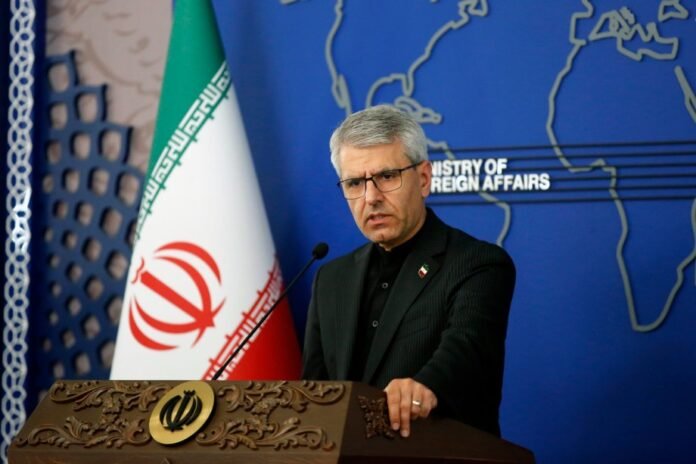
Iran’s Foreign Ministry said Sunday that talks in Switzerland are focused on implementing key provisions of the June 18 memorandum of understanding with the US, including ending the war, easing sanctions, and releasing frozen Iranian assets, Anadolu reports.

Iran “is determined to pursue the implementation of the other side’s commitments with precision and seriousness,” ministry spokesman Esmaeil Baqaei said in comments carried by state broadcaster IRIB.

He said the Switzerland meeting was convened to follow up on the implementation of the memorandum ending the war, adding that Article 13 makes the start of negotiations on a final agreement “conditional” on the implementation of Articles 1, 4, 5, 10, and 11.

“Without the implementation of these provisions, particularly Article 1, which concerns ending the war on all fronts, including Lebanon, it is not possible to enter the stage of negotiations for a final agreement,” he said.

READ: Iran’s negotiating team protests Trump ‘threats,’ says they violate memorandum of understanding

Since March 2, Israel has carried out attacks in Lebanon, killing 4,106 people, injuring 12,531 others, and displacing more than 1 million people, according to figures released by the Lebanese Health Ministry.

According to Baqaei, Sunday’s discussions focused on implementing those provisions, especially Article 1, as well as reviewing measures related to Article 10, which covers US waivers to facilitate Iranian oil exports, and Article 11, which concerns the release of Iran’s frozen assets.

The first round of four-party talks involving Iran and the US, with mediation by Qatar and Pakistan, concluded in Switzerland Sunday, Iran’s semi-official Fars news agency reported, citing a source familiar with the Iranian negotiating team.

READ: Iranian side ‘very straight’, handled crisis to de-escalate: Pakistani Premier Sharif

0FansLike
0FollowersFollow
0FollowersFollow
0SubscribersSubscribe
- Advertisement -
Google search engine

Recent Posts