12.7 C
London
Wednesday, October 28, 2026
Home Blog

The Mecca pact goes to Tehran. Can it keep the region out of another war?

0
the-mecca-pact-goes-to-tehran.-can-it-keep-the-region-out-of-another-war?
The Mecca pact goes to Tehran. Can it keep the region out of another war?

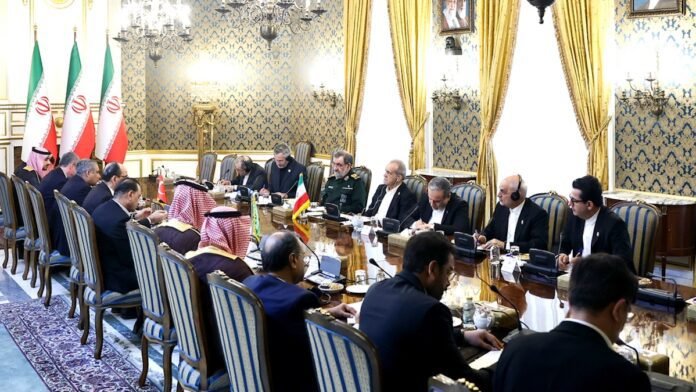
Mecca Joint Defense Agreement members – Saudi Arabia, Turkey and Pakistan – held their first joint high-level meeting with Iranian officials in Tehran on October 26, 2026. Photo: Fars News Agency

On Monday, the Mecca Joint Defense Agreement did something a defense treaty is not usually built to do. Its members went to Tehran to talk.

Saudi Defense Minister Prince Khalid bin Salman, Pakistan’s Field Marshal Asim Munir and Turkey’s intelligence chief Ibrahim Kalın met President Masoud Pezeshkian and Supreme National Security Council Secretary Mohsen Rezaei.

The four sides agreed to continue their dialogue on regional peace and security. Iranian state television called it the first joint meeting of the four since Yemen’s Houthis intensified attacks on Saudi Arabia.

The attacks did not pause for diplomacy. The same day, the Houthis claimed drone strikes on Saudi pipeline pumping stations and Riyadh’s King Khalid airport. That is the real tension. Three countries that treat an attack on one as an attack on all are negotiating with Tehran while Iran-aligned forces hit one of them.

The clock

The timing is hard to ignore. The meeting came a day before Israelis voted and eight days before the US midterms. Israel’s election left the country deadlocked, according to exit polls, with neither Benjamin Netanyahu nor Gadi Eisenkot near a majority.

In Washington, Donald Trump said on October 23 that the US may do “another little Epic Fury,” his military’s name for the war that began in February. Earlier this month he said there would be no attack before the midterms. Now the Wall Street Journal reports that Washington has told Gulf states to prepare for a short, intense campaign after November 3. Trump has not made a final decision, but he is reportedly leaning toward a large operation, with a negotiated deal as the alternative.

Gulf states would absorb the consequences. Iran has warned it would strike economic and civilian targets across the region, as it did earlier in the war.

Deterrence and diplomacy are not opposites

Some will call it contradictory that a defense pact is courting Iran. There’s no real contradicion. Alliances routinely show they can defend themselves and then show they would rather not have to.

The sequence fits. On October 5, the pact’s committee met in Riyadh after attacks on Saudi Arabia and moved toward implementing collective defense. Three weeks later its members were in Tehran, a day after Qatari mediators had been there. Riyadh says the visit supports the mediation led by Qatar and Pakistan.

The pact also has a built-in brake. Turkey’s foreign affairs committee chair says the collective-defense clause would not automatically trigger military action, and any Turkish deployment would need separate parliamentary approval. Foreign Minister Hakan Fidan has said the alliance is not directed against Iran. That is why Tehran can talk to it at all.

Where it can fail

The Houthi front. If attacks on Saudi Arabia continue, Riyadh’s patience and the pact’s commitments will be tested, and the diplomacy will look like cover.

Competing readings. After the meeting, Rezaei said regional security should be homegrown, with foreign intervention prevented. Tehran will want that treated as a shared position. Washington, and NATO-member Turkey’s own politics, may read it very differently.

Ratification. Saudi Arabia and Pakistan have completed theirs. Turkey’s full assembly has not voted, and its opposition warns the pact could drag Ankara into others’ wars. A bloc with a member still ratifying has less weight in Tehran.

Hormuz. Ship attacks in the strait hit a record in October, according to Reuters. A fresh round of strikes would make that worse, and energy importers across Asia – Pakistan included – would pay for it.

What the pact could do now

First, make Houthi de-escalation the opening ask. Request a time-limited halt to attacks on Saudi infrastructure, paired with a reciprocal step that Riyadh is willing to take.

Second, work as one channel with Qatar and Pakistan rather than as a rival one.

Third, publish what collective defense means in practice, including thresholds. Ankara’s assurance that it is not automatic should be a public commitment, not a committee remark, so nobody in Tehran, Tel Aviv or Washington has to guess.

Fourth, offer a Hormuz incident-prevention arrangement that Washington and Tehran can both join, with independent verification.

Monday was not a breakthrough. The gaps between Washington and Tehran on sanctions, the nuclear program and the strait remain wide. But the pact has told both sides it wants to be useful before it is tested.

The measure of this alliance will not be how many missiles it can intercept. It will be whether Riyadh, Ankara and Islamabad can make a negotiated outcome look better than another round of war.

Mansoor Qaisar is an independent writer based in Islamabad, writing on foreign and public policy and social issues shaping Pakistan and the region. He can be reached at mansoor.qaisar@gmail.com and on X at @MansorQaisar.

Extreme weather is creating a perfect storm of misinformation. Here’s what’s at stake.

0
extreme-weather-is-creating-a-perfect-storm-of-misinformation-here’s-what’s-at-stake.
Extreme weather is creating a perfect storm of misinformation. Here’s what’s at stake.

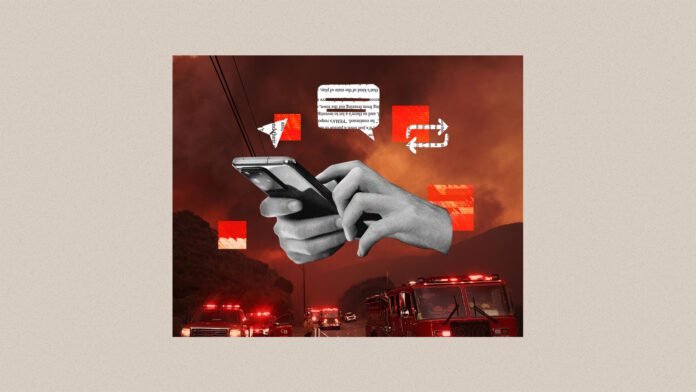
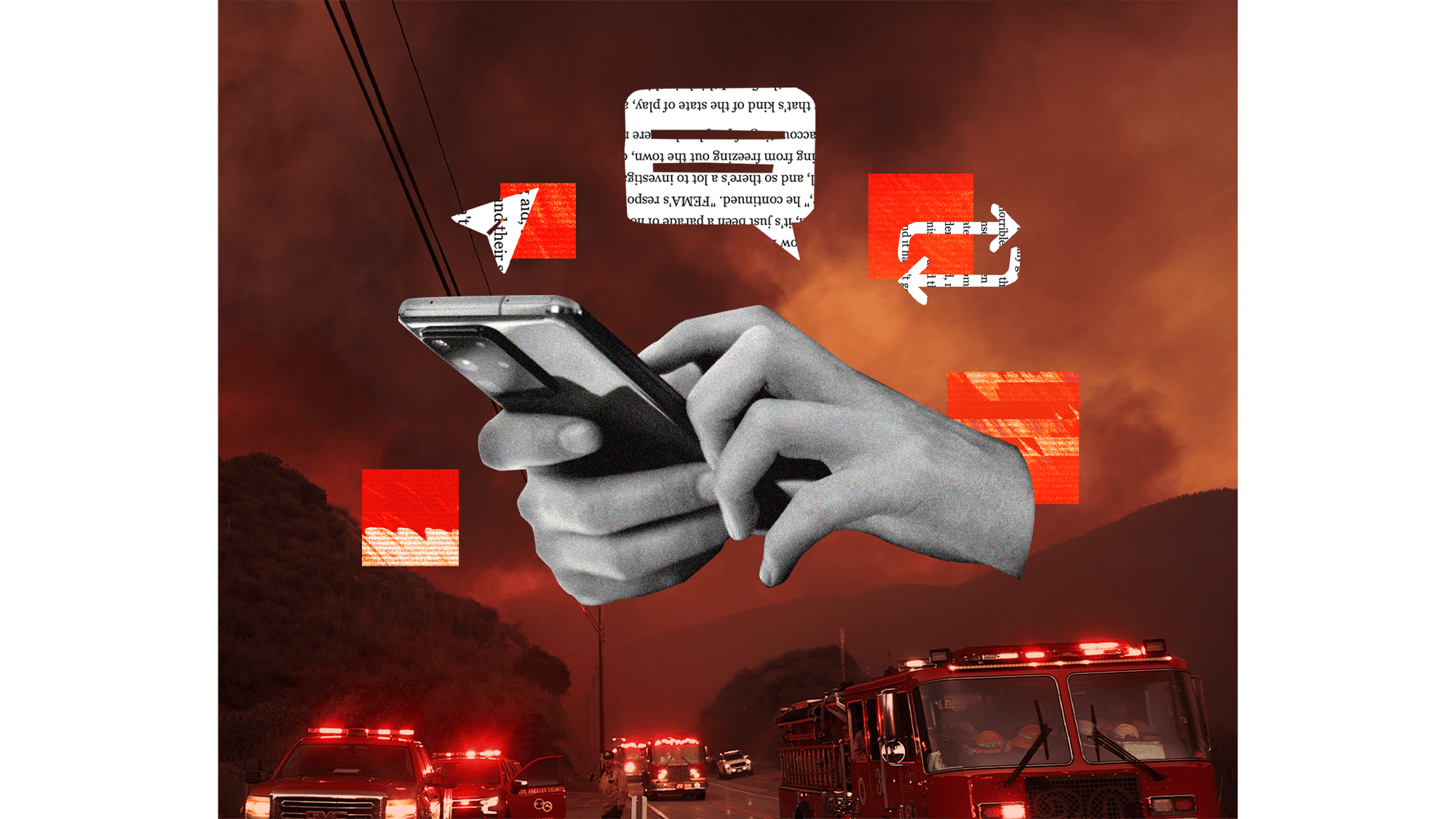
A collage of hands holding a smartphone and text messages and social share buttons in front of a photo of a wildfire

Rumors and conspiracies are spreading too fast for emergency managers to keep up. This information chaos is slowing disaster relief and putting lives at risk.

This story is part of Distorted, a Grist series exploring the spread of misinformation in the wake of extreme weather. It is published with support from the CO2 Foundation.​

You likely remember the 2023 Maui wildfires, a tragedy that killed more than 100 people and destroyed nearly 2,000 homes, all but erasing a historic island community. You may also remember that the fires began when a broken power pole owned by the local electric utility sparked against dry vegetation on a windy day. 

But do you really know that? Were you there? How can you prove it?

In the aftermath of the Maui fires, thousands of people across all the major social media platforms shared posts and videos alleging that the fires had a more sinister origin. They posited that the government had used a “direct energy weapon,” or a form of laser, to ignite the area. Depending on the post you saw, this was part of a plot to reclaim the area for a high-speed rail line, or a high-tech “smart city.” A number of right-wing activists and social media personalities amplified these claims, including the late Charlie Kirk. At the same time, the Federal Emergency Management Agency saw accounts linked to China circulating rumors that a “weather weapon” had caused the fires. Other accounts alleged that the agency was going to seize the homes of people in Maui who applied for emergency aid, a claim that raised traumatic memories of colonization in a community with significant Indigenous historical and cultural ties.

Extreme weather events are always chaotic, and it’s always been easy for rumors to spread during moments of calamity, but the problem has never been as bad as it is now. The escalating pace of climate change has produced a series of supercharged wildfires, rapidly intensifying hurricanes, devastating drought, and sudden floods, all of which plunge communities into confusion and disarray. At the same time, the information landscape has never been more fragmented — major social media companies have given up on any pretense of fact-checking and content moderation; politicians often distort or politicize disasters; government agencies are short-staffed following DOGE cuts; and generative AI models have created an entirely new and little-understood way to source information. It’s not just your weird uncle seeing these rumors  on Facebook: A recent report from the News Literacy Project found that a vast majority of teens encounter social media conspiracies, and a vast majority of teens who encounter those theories are inclined to believe them.

“Disasters are, by their nature, very urgent and have a lot of uncertainty surrounding them,” said Amber Silver, a professor of emergency management at the University at Albany and an expert in disaster communications. Victims of extreme weather events have an urgent need for facts, she said, but almost no way to get reliable data about their situation. “So now we have essentially all of the perfect conditions for the spread of misinformation.”

This confluence of factors does more than sow confusion. A void of good information after a disaster can lead to lost lives, traumatic displacement, or a slow recovery. It also strains the relationship between public authorities and their citizens. A growing body of research from around the world shows the consequences of this strain: A Department of Homeland Security study found that an inaccurate map tweeted out during a 2017 California flood caused an unnecessary mass evacuation, while another study, from the Inter-American Development Bank, found that an earthquake in Mexico led to an 11 percent drop in people’s trust in government. The federal government in the United States now often creates fact-checking and myth-busting websites in an attempt to dispel rumors after disasters.

A review of recent research found that this kind of bad information has often “led to resource misallocation, overwhelmed emergency services, and diverted attention away from genuine needs.”

At Grist, we have been hearing for years from emergency managers and disaster victims in the U.S. about this growing chaos. In our new series, Distorted, we’re exploring this fragmented information landscape: Who do people actually trust when disaster strikes, and why do so many people believe conspiracies that are clearly false? Is there anything the authorities can do to fight social media rumors and post-disaster hysteria? What would it actually take to establish a shared sense of truth as a hurricane or a wildfire is bearing down?

The concepts of “misinformation” (unintentional deception) and “disinformation” (intentional deception) have been the subject of innumerable academic papers and policy initiatives, and the Biden administration even appointed a “disinformation governance board” at the Department of Homeland Security in 2022. In truth, the concepts are a little hard to pin down — the question of whether a certain piece of information is “dis” depends on the beliefs and attitudes of the person who’s reading or hearing that claim. Even so, it’s clear that many people believe things about disasters that simply aren’t true, and they often mistrust the people whose job it is to keep them safe. 

When disaster strikes, this lack of trust can be the difference between life and death. 

Anatomy of a conspiracy

How a series of unrelated photos morphed into a climate conspiracy theory. 


It all starts with an innocuous photo taken on January 16, 2018. The Marathon Petroleum Refinery in Canton, Ohio, conducts a flare in response to a mechanical issue. A local resident captures a blurry picture of the flare, which includes a lens flare pointing upward, and posts it on Facebook. ​
​

May 2018: Santa Barbara County, California​

SpaceX posts an Instagram photo of their Falcon 9 rocket launch from Vandenberg Space Force Base in California. 
​

May 2023: Santiago, Chile​

A windstorm in Santiago, Chile, causes an electrical transformer to explode. A resident captures the event on video, which includes a lens flare from the bright explosion, and posts the video on TikTok.
​

August 2023: Maui, Hawai‘i

A brush fire in Maui, Hawai‘i, spreads out of control, destroying the town of Lahaina. The fires caused over $5.5 billion in damages and killed more than 100 people.​

Old photos become a conspiracy

Soon after the fires ignite, social media posts on Instagram, TikTok, and X start to resurface these old photos of the refinery flare, the electrical explosion, and the rocket launch, attributing them as evidence of some kind of energy weapon used to ignite the Maui fire.

These posts were viewed and reshared millions of times, and often would take on a life of their own. ​

​

​

The conspiracy can’t be stopped

Hawai‘i-based Instagram user @for_our_rights_kauai, for example, posted the old photo of the refinery flare and suggested the Maui fires were the result of an “attack.” A few days later, she acknowledged that the photo was unrelated to the fires.

“I want to apologize for contributing to spreading that photo that I was told came from Maui on the day of this event. It turns out it was not true,” she said in a follow-up video. “It is very important for us to vet our information.” ​

​

The conspiracy spreads

But it was too late. The instagram account @cultivateelevate, run by an influential MAHA-adjacent health food entrepreneur, had already published a video containing a screenshot of @for_our_rights_kauai’s later-deleted post. “My friend in Hawai‘i,” the host said, pointing to the screenshot, “showed a laser beam coming out of the sky, directly targeting the city.” @cultivateelevate’s video received 432,000 views, over 40 times more views than the video apologizing for the mistake. ​

Out of control

Other accounts, like Instagram user @mama_speaks_truth, also contributed to the spread, posting screenshots of screenshots of screenshots, each getting further and further from the original photo of a refinery, taken five years earlier and 4,500 miles away. This is just one example of the twisty way that misinformation can spread in the wake of a disaster. Images and facts can blend together with old fears and suspicions, morphing into a conspiracy with a new meaning and a life of its own. ​

Experts have identified a few main vectors where communication can collapse in the lead-up and aftermath of a disaster:

Mistrust in government

The most important source of information around extreme weather is the government itself. Federal, state, and local agencies and officials are responsible for predicting the weather, sending out warnings about disasters, coordinating mandatory evacuations, and leading disaster response. If people don’t trust them, or if they can’t get their messages out effectively, lives are at stake. The background trends are already bad: Less than 20 percent of Americans say they believe the government does the right thing most of the time, the lowest level on record. 

The most visible avatar of the government in a disaster is the Federal Emergency Management Agency, so it’s no coincidence that FEMA is also the most frequent subject of conspiracies and disinformation. Even though the agency is supposed to act as a backstop for state and local authorities, disaster-affected communities often swirl with allegations that federal relief is absent, that the government is restricting freedom of movement, or, as in the case of Maui, that officials are going to seize land and disenfranchise victims.

“FEMA has been the source of misinformation since its inception,” said Deanne Criswell, who led the agency under the Biden administration. She pointed to the famous allegations that the agency plans to imprison disaster victims in government-run “FEMA camps”; these allegations have circulated almost since FEMA was founded. “It’s this [idea] of the black arm of government. It makes it harder for us to actually get the assistance to the people who really need it, because they don’t know who to trust and who to believe.” There’s no knowing how many victims never show up to apply for FEMA aid because of these rumors and fears.

During Hurricane Helene in 2024, this misinformation became dangerous: A rumor about a man who had come to North Carolina to shoot FEMA disaster response officials forced Criswell to shut down field operations for several hours during the immediate aftermath of the storm. At the same time, both Criswell and her deputy chief of staff had their homes “swatted,” meaning anonymous trolls called police with false accusations that resulted in the deployment of SWAT teams. These disruptions further stressed an aid system that was already strained, which likely meant more victims in North Carolina had to wait longer to receive aid and shelter.

Hurricane Helene also hit just a few weeks before a consequential presidential election, which likely helped fuel the spread of mis- and disinformation. Right-wing accounts with names like End Wokeness accused Biden of starving North Carolina of aid, racking up millions of views despite a complete lack of evidence for their claims. Elon Musk claimed on his own platform, X, that FEMA was barring him from flying in to deliver aid, only to walk back those claims later. His retraction got 1 million views, but his initial accusation got almost 30 million, and it’s likely that many people in North Carolina and elsewhere still believe that Biden tried to restrict aid.

In other cases, mistrust in government can look very different. It doesn’t have to be about political animus — it can also be about blithe confidence, or even fear. Some people who’ve experienced storms that didn’t live up to early projections may dismiss evacuation warnings later, while others may be afraid to evacuate because they’re undocumented and fear retribution. The end result is the same — more people putting their lives at risk, and more people unwilling to get the help they need after a disaster. 

“It could just be a person who says, ‘I’m a conspiracy theorist, I don’t trust the government,’ but there are also people who can’t or won’t trust that government for very different reasons,” said Silver, pointing to the example of undocumented migrants or communities that have traumatic experiences with law enforcement. “There is some skepticism and doubt, and that is hard to overcome.”

Based on the pervasiveness of social media in Americans’ lives, it may not come as a total surprise that these platforms act as the incubator for almost all major disaster conspiracy theories in the modern age. Rumors have swirled around extreme weather events since the dawn of disaster — from allegations that a group of wealthy industrialists caused the 1889 Johnstown flood, which killed more than 2,000 people in Pennsylvania, to claims that FEMA put disaster survivors in concentration camps after Hurricane Katrina. But platforms like Facebook, Instagram, and X have allowed for these rumors to achieve global circulation in minutes. The networks also make it near impossible to trace the origin or the trajectory of a given rumor, unless you’re a university or nonprofit lab doing “network analysis” of many millions of tweets. 

There is little good data about how these rumors spread, but it’s clear enough that they do spread. One study on a 2023 earthquake in Turkey found that around a quarter of polled residents believed at least some version of a conspiracy theory that the U.S. had caused the earthquake with a seismic weapon or a bomb. Those who believed these theories were more likely to be supportive of the incumbent government ahead of an election that year. A comprehensive study by the Center for Countering Digital Hate found that most conspiracy posts were from verified accounts. Even benign fakes, like a famous doctored image of a shark on a flooded highway, have duped media outlets and at least one U.S. senator.

If you’ve spent any time on social media, you already know how pervasive this kind of misinformation can be. One meta study last year found that “misleading messages … often outpaced official communications, resulting in reduced trust and exacerbating anxiety, stress, and fear.” This mistrust can have real-world consequences: A study on a 2018 Japanese earthquake found that communities with low trust in government tended to evacuate even when they didn’t need to, which risked clogging up the roads for people who actually did need to flee. After the Maui fires, Criswell worried that the fear of a colonial land grab caused families who needed help to reject it. 

Even though many people blame bots and malign actors for the spread of rumors, some studies have found that most people who spread false rumors believe what they are sharing. While accounts in Russia and China may have stoked outrage about the fires in Maui, it seems clear that many people who shared such misinformation believed it to be true. One prominent source of conspiracies belonged to  an account called Cultivate Elevate, with over half a million followers. It’s run by a MAHA-adjacent health food entrepreneur who posted a number of videos alleging that the fires had been set on purpose through some kind of government scheme. (The owner of the account did not respond to a request for comment.)

The rise of AI

The proliferation of large language models like Gemini and ChatGPT is the latest wrinkle. About a quarter of U.S. adults now use AI chatbots daily, and searching for information is the most common usage. These models are more likely to draw on news articles and official sources than social media rumors when they answer user queries, which can cut against misinformation — if I type in “Maui directed energy weapon” into ChatGPT, it hectors me that “there is no credible evidence supporting” that theory, and even offers to debunk the actual origins of alleged images that show lasers starting the fire — but that doesn’t mean these models would always be trustworthy in an emergency. 

What if a model were to scrape a news article from last week, for example, that said there’s no evacuation from a storm, but the weather had since progressed or a new event had since formed? Can I really trust the bot to give me an accurate summary of my eligibility for FEMA benefits?

Generative AI is developing so rapidly that most researchers have yet to conduct peer-reviewed studies of how it operates in the disaster space, but it’s clear that the intersection is growing. In addition to dozens of startups that purport to map flood risk or storm damage, the Red Cross has developed a chatbot named Clara that can help navigate disaster situations, and MIT has created a similar technology called Crisischat. The Trump administration’s own chatbot, America.gov, offers information on how to get FEMA assistance. When it comes to analyzing how people trust these tools and standard chatbots like Gemini, however, we are still flying blind.

“You need to learn if the information’s accurate, but then you also need to know, Do people trust it, regardless of the objective veracity?” said Anita Atwell Seate, a professor of communication and a crisis expert at the University of Maryland. “If people trust it, they’re going to act on it whether it’s accurate or not.” Seate is working with other researchers to develop a longitudinal study about how people in disaster areas use AI tools.


It’s hard to know what it would even mean to “solve” the problem of mis- and disinformation in a landscape as fragmented as the 21st century United States. There’s no way to measure the number of people who believe a false rumor, and efforts to debunk inaccurate information will always be of necessity slower and less viral than that information itself. It’s not great for politics if someone in Iowa believes that a laser started the Maui fires, but the more urgent question is how to ensure people in disaster areas have accurate information before, during, and after extreme weather events. That could make the difference between a slow recovery and a fast one, or even between life and death. 

Experts in the field tend to say that the only way to fight disinformation is to establish strong communication channels beforehand, and for emergency managers to partner with people who have organic trust in their communities. Toward the end of the Biden administration, FEMA started to experiment with such efforts. The agency partnered with a Native Hawaiian FEMA employee in Maui who reassured his broader network that the government wasn’t planning to take anyone’s home. While there are still people out there in the U.S. who believe Biden set the fire with a laser, eventually most people in the vicinity of the fire did come to the agency for aid. FEMA also partnered with the Rosalynn Carter Institute for Caregivers to distribute disaster info to home health aides and caregivers, putting information in the hands of trusted messengers who would have credibility when the disaster arrives.

“From a government perspective, they’re just like, ‘They don’t know us,’” said Seate, describing the communication difficulties that she’s observed at the National Weather Service. “But they don’t have to know us, they know Jim down at the fire station and Jim, you know, rings the alarm and posted on Facebook for us.”

The tough part is this only tends to work if you lay the foundations before a disaster. Even then, it isn’t always successful — there are people out there who will choose to believe a social media hoax over a trusted weatherman, whether because it confirms their prior beliefs or just because that’s how their brain works. Fighting misinformation isn’t like swordplay, where one side wins and another side loses. It’s more like trench warfare, where emergency managers and recovery leaders have to slog to increase their share of the information environment.

“It’s at a level that we’ve never really seen before, because the systems and the silos of information have gotten so siloed and quick,” said Justin Knighten, a risk communication consultant who led FEMA’s external affairs team under President Biden during several major disasters. “When trust is low, you have a lot of work to not only build up that trust, but to also get ahead of those upcoming threats, so you’re really working at a deficit.”
Syria, Jordan Reopen Sole Border Crossing After Strikes, Agree To Joint Investigation 

0


Syria and Jordan reopened the Nasib-Jaber border crossing Wednesday, restoring the only open route for passenger and commercial traffic between the countries after it was temporarily closed following Jordanian airstrikes in southern Syria. 

Traffic through the crossing returned to normal after Tuesday’s closure, according to Syria. 

The reopening came as the two governments moved to address the strikes through a joint security committee. Syrian foreign affairs chief Asaad al-Shaibani and Jordan’s minister of foreign affairs and expatriates, Ayman Safadi, agreed to establish the committee during a telephone conversation, Syrian state news agency SANA reported early Wednesday. 

Monday evening’s Jordanian airstrikes hit several locations in southern Syria, reportedly killing seven civilians, including three children, and injuring three others. 

Jordan said the raids struck hideouts belonging to armed terrorist groups and neutralized more than 20 gunmen. Jordan’s Armed Forces identified the targets as Islamic State militants and said the operation was carried out in coordination with Damascus. 

Syrian authorities disputed Jordan’s account of the coordination. Damascus said it had not been consulted beforehand and objected to military operations conducted inside Syrian territory without advance consultation. 

Jordan linked its military action to a deadly attack during a church funeral in Karak governorate last Friday. According to the Jordanian military, those responsible for the attack had ties to terrorist organizations operating in southern Syria. 

Safadi conveyed his condolences to the families of those killed in the Jordanian strikes and expressed deep regret over the civilian casualties during his conversation with al-Shaibani. 

The two officials also agreed that their countries’ security authorities should coordinate directly in efforts against terrorism and cross-border arms and drug smuggling. Both reaffirmed their commitment to maintaining close relations between Jordan and Syria.  

The last, best hope for space tourism just rolled onto a runway in Arizona

0
the-last,-best-hope-for-space-tourism-just-rolled-onto-a-runway-in-arizona
The last, best hope for space tourism just rolled onto a runway in Arizona

The private space tourism era looked so very promising five years ago. Blue Origin and Virgin Galactic had begun flying customers—real people with zero space experience—on suborbital missions. And at about the same time, private citizens were going to orbit for days at a time aboard SpaceX’s Crew Dragon.

But that was then. Consider the state of play today:

  • It has been 10 months since Blue Origin’s New Shepard spacecraft flew its last mission in January. The program was subsequently “paused,” but let’s be real. Blue Origin has moved on. New Shepard’s engineering teams are now supporting the New Glenn rocket and Blue Moon lander programs.
  • SpaceX flew its final free-flyer mission on Dragon, Fram2, in April 2025. A handful of non-NASA missions bound for space stations remain on the spacecraft’s manifest, but all are likely to carry at least one government astronaut. Then Dragon will be retired. There is no credible timeline for SpaceX’s Starship to fly humans into space from Earth.
  • As for Virgin Galactic, the company flew its final suborbital mission on the VSS Unity spacecraft more than two years ago, in June 2024.

So we are now 10 months, and counting, without a space tourism mission in the United States.

Hello Apeiron, you shiny object

At the time of Unity‘s final flight, Virgin Galactic said it was moving on to the second generation of its suborbital spacecraft. It planned to bring two of these Delta-class ships into service by the year 2026. Of course, it is now 2026, and there are no Delta-class ships in service.

But apparently we are getting closer to that goal. On Wednesday, the first Delta-class ship received a name: Apeiron. According to Virgin Galactic’s news release, the name is drawn from the ancient Greek concept of the boundless, which is an interesting choice for a vehicle that will forever be bound by Earth’s gravity. It was chosen through a public vote.

“We’re proud that the lead ship in Virgin Galactic’s Spaceship fleet will carry a name chosen by the people who share our excitement for what comes next,” said Michael Colglazier, chief executive officer of Virgin Galactic.

But more significantly, the company said Apeiron would be moved from its Spaceship Factory in Mesa, Arizona, to Spaceport America in New Mexico later on Wednesday.

Apeiron won’t be making a free flight anytime soon. After being carried to New Mexico by the VMS Eve, aircraft engineers and technicians there will complete work on the vehicle’s avionics equipment and flight software. Following additional ground tests, Apeiron will be mated again to Eve for captive carry tests, followed by a drop test and ultimately a powered test flight above 80 km.

Is this the future of space tourism?

Presently, the company is saying it now expects Apeiron’s first commercial spaceflight to take place “early” in the second quarter of 2027. As with every other projected date in aerospace, this should be taken with a grain of salt. But it seems plausible that Apeiron may begin flying paying customers on suborbital space tourism missions over the next 12 to 18 months.

There is considerable skepticism about the commercial viability of Virgin Galactic’s space tourism ambitions. Success will require its vehicles to fly nearly flawlessly and with unprecedented durability to bring hundreds of people to space each year briefly. As this reality has dawned on investors, the markets have not been kind to the company in recent years. In 2021, at the height of space tourism euphoria, the company’s stock briefly reached a stratospheric valuation of $1,118 a share. More recently it has been trading in the vicinity $2.50 a share.

Whatever you might think of Virgin Galactic, however, it seems clear that any hopes of expanding the aperture of space tourism in the next decade will be flying beneath its wings.

Great White Shark Suddenly Lunges at Woman in Terrifying Video

0
great-white-shark-suddenly-lunges-at-woman-in-terrifying-video
Great White Shark Suddenly Lunges at Woman in Terrifying Video


A woman enjoying a fishing trip off the Georgia coast got a frightening reminder that some animals are better admired from a distance after she reached into the water to pet a great white shark — only for the massive predator to suddenly whip around and lunge in her direction.

The heart-stopping encounter, captured on video near Tybee Island, has stunned social media users, with many questioning what possessed the woman to treat one of the ocean’s most powerful predators like a friendly household pet.

The woman, identified only as Jen, was participating in an expedition with Knot Lucky Fishing, a Savannah-based nonprofit that organizes free fishing trips for military veterans, active-duty service members and their families. The organization also operates a shark-tagging program that helps researchers track the movements of great whites along the Atlantic coast.

But during this particular outing, an encounter with a shark took an unexpected turn when Jen decided to get a little too friendly with the enormous animal.

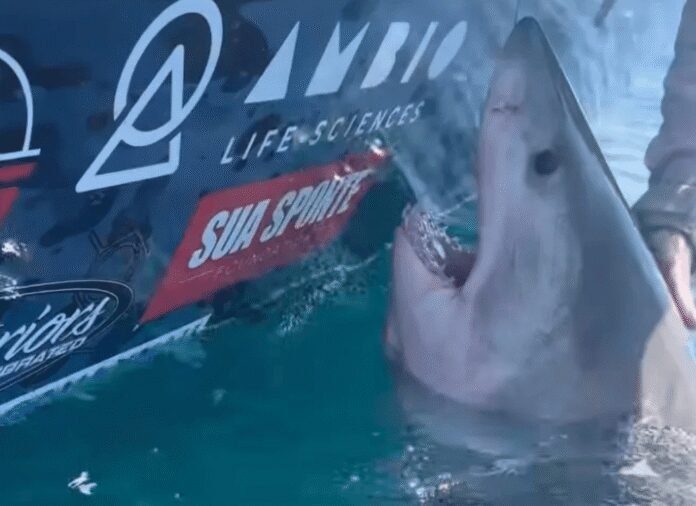
Footage shared by the organization shows the great white positioned alongside the boat as Jen leans over the edge and extends her hand toward its head. For a brief moment, the animal appears relatively calm as she gently strokes it.

Then, without warning, everything changes.

The shark suddenly twists its head and lunges toward the boat, sending water splashing as Jen pulls her hand away. The startling movement happens in an instant, turning what appeared to be a peaceful interaction into a moment nobody aboard was likely to forget. WJCL+1

Jimmy Lee Armel, the founder of Knot Lucky Fishing, shared the footage on Facebook and described how quickly the situation unfolded.

According to Armel, Jen had been treating the wild shark like the family dog before it abruptly reacted. He acknowledged that the unexpected movement startled everyone watching.

Fortunately, Jen escaped unharmed, and Armel insisted the situation was never as dangerous as the dramatic footage might suggest.

He explained that the experienced crew maintained control of the shark throughout the encounter and that the animal never got close enough to injure her.

Still, the footage quickly sparked a heated debate online, with viewers questioning why anyone would attempt to pet a great white shark in the first place.

“Why are we petting great white sharks?” one Facebook user wondered.

Others defended the animal, suggesting its sudden movement may have been a reaction to being hooked rather than an attempt to attack the woman.

That distinction matters. Although great whites have a fearsome reputation, a sudden movement toward a person does not necessarily mean a shark is deliberately trying to attack. According to the National Oceanic and Atmospheric Administration, sharks rarely attack humans, who are not part of their natural diet. The agency also advises people against touching marine wildlife because physical contact can endanger both the animal and the person involved. LADbible+2

Beyond the viral moment, the expedition had a more serious purpose.

Knot Lucky Fishing works with conservation and research partners to catch, tag and release great white sharks, collecting information that can help scientists better understand their movements and migration patterns.

The organization also honors fallen military personnel by naming each tagged shark after a service member who lost their life.

Armel told FOX Weather that the program had already tagged 10 great white sharks, with additional encounters expected as the animals return to waters near Tybee Island during the winter months.

However, the shark involved in Jen’s frightening encounter was never tagged. Armel explained that the crew did not have a safe opportunity to complete the procedure and refused to put either the animal or the people aboard at unnecessary risk.

Instead, the shark was released back into the ocean, bringing the unforgettable encounter to a peaceful conclusion. Fox Weather+1

For Jen, the experience ended without injury. For viewers watching the viral footage, however, it offered a striking reminder that even a seemingly calm great white shark can react with astonishing speed — and that the ocean’s most formidable predators are nothing like the family dog.

French Senate backs bill making protesters pay up to €10,000 for unrest damage

0


France’s Senate approved a bill that would make protesters financially responsible for damage caused during demonstrations.

The Senate passed an expanded version of the bill by 229 votes to 105, backed by a right-wing and centrist alliance which holds a majority.

The legislation now heads to the politically divided National Assembly for debate and a vote.

The bill was introduced following riots that broke out after Paris Saint-Germain defeated Arsenal in the UEFA Champions League final in May.

It has since gained new significance after protests over inequality and rising prices turned violent on 17 October, leaving thousands of businesses damaged or looted.

Speaking in parliament, Interior Minister Laurent Nuñez stressed the “urgency” of responding to the damage and scenes of chaos seen on 17 October.

“We can no longer allow the vast majority of our fellow citizens to pay for a minority of vandals,” he said.

The bill would also allow welfare benefits and housing assistance to be seized to cover damages, drawing criticism from left-wing lawmakers and human rights groups.

This is not the first time a European government has implemented tougher security measures in response to violent protests.

In Italy a new security decree introduces tougher penalties for violent protests, including prison sentences of four to 12 years for organising groups involved in violent demonstrations.

Halloween Caprese Eyeball Skewers

0
halloween-caprese-eyeball-skewers
Halloween Caprese Eyeball Skewers
Halloween Caprese Eyeball Skewers made with tomato halves, mozzarella, basil, and black olive rings.
Halloween Caprese Eyeball Skewers turn simple Caprese ingredients into a playful no-cook appetizer for a Halloween party platter.

Halloween Caprese Eyeball Skewers turn a familiar tomato-and-mozzarella appetizer into a playful party bite. Each little eye tucks a soft mozzarella ball between two juicy tomato halves, with fresh basil peeking out around the edges. A black olive ring creates the pupil, while a simple trick keeps it right where it belongs.

What makes these especially fun is that they still taste like a good Caprese salad. Sweet tomatoes, milky mozzarella, fragrant basil, and a little lemon-kissed olive oil keep everything fresh and balanced. A few drops of balsamic glaze add just enough tang without covering up those funny faces.

They’re easy to prepare, simple to pick up, and make a memorable addition to a Halloween appetizer platter. Even better, there’s no cooking required. Just a little assembly and a good sense of humor.


Halloween Caprese Eyeball Skewers made with tomato halves, mozzarella, basil, and black olive rings.
Halloween Caprese Eyeball Skewers turn simple Caprese ingredients into a playful no-cook appetizer for a Halloween party platter.

Recipe Yield: 6 servings (12 skewers, 2 per serving)

INGREDIENTS

12 round cherry tomatoes (about 1–1¼ in. across)
12 fresh ciliegine mozzarella balls, drained
12–24 small fresh basil leaves (1–2 per skewer)
12 black olive rings (about 1/8 in. thick, sliced from large pitted black olives)
1 tsp plain cream cheese, softened
1 tbsp extra-virgin olive oil
1/4 tsp finely grated lemon zest
1/4 tsp kosher salt
1/8 tsp freshly ground black pepper
2 tsp thick balsamic glaze
12 wooden cocktail skewers (about 4 in. long)

INSTRUCTIONS

1. Prepare the ingredients:
Slice each tomato crosswise into two rounded halves, keeping the matching halves together. Drain and gently pat the mozzarella and olive rings dry. Shave a very thin slice from the front of each mozzarella ball to create a small flat surface.

2. Assemble the eyeballs:
Starting at the pointed end of each skewer, thread an upper tomato half, 1–2 small basil leaves, lightly folded, a mozzarella ball, and the lower tomato half. Keep the tomato cut sides facing the cheese and the mozzarella’s flat surface facing forward.

3. Attach the olive pupils:
Spread a tiny dab of softened cream cheese on the back of each olive ring. Gently press onto the flattened mozzarella surface, centering the ring to create an eyeball.

4. Add the seasoning:
Combine the olive oil and lemon zest. Lightly brush over the exposed tomatoes and basil, avoiding the olive pupils. Sprinkle evenly with salt and black pepper.

5. Finish and serve:
Arrange the skewers on a serving platter with the eyeballs facing up. Add a few small drops of balsamic glaze over the tomato halves, keeping the mozzarella faces clean. Serve fresh.


Helpful Tips to Perfect This Recipe

  • Choose matching sizes: Round cherry tomatoes slightly larger than the mozzarella balls create the best eyeball shape. Use fresh ciliegine mozzarella rather than tiny pearls, which are too small to decorate easily.
  • Secure the olive pupils: Pat the mozzarella and olive rings dry before decorating. A small flat spot and a tiny dab of cream cheese help the pupils stay in place. Keep oil away from the olive rings so they don’t slide.
  • Make ahead carefully: Assemble up to 3 hours ahead, cover, and refrigerate. Add the seasoned olive oil, salt, pepper, and balsamic glaze just before serving. Keep chilled until serving and avoid leaving at room temperature for more than 2 hours.

Rate This Recipe

Enjoyed this recipe? Your rating helps other home cooks!

Starlink disruptions in Ukraine: what Elon Musk’s alignment with US geopolitics means for Europe

0
starlink-disruptions-in-ukraine:-what-elon-musk’s-alignment-with-us-geopolitics-means-for-europe
Starlink disruptions in Ukraine: what Elon Musk’s alignment with US geopolitics means for Europe

While Elon Musk was on stage in Texas advertising a flying Tesla on October 16, his other venture, SpaceX, was reshaping geopolitics in Ukraine.

SpaceX operates Starlink, the satellite communication system that has played a crucial role in Ukraine’s resistance to Russia’s full-scale invasion. Its military-grade spin-off, Starshield, has become a backbone of Ukrainian military communications and of its drone warfare.

On October 14, reports emerged that Starlink services in Ukraine had been cut off for Ukrainian drones moving at speeds exceeding 100mph. Initial disruptions had even affected slower units, reportedly causing them to fall from the skies.

The restrictions hampered Ukraine’s ability to conduct drone strikes in Russian-occupied territory. They also made it harder to detect and intercept Russian attacks. This was felt in Kyiv and other big cities, where nightly strikes killed civilians and left hundreds of thousands without electricity.

The Ukrainian president, Volodymyr Zelensky, also implied that intelligence sharing with the US had temporarily stopped, leaving early-warning systems unable to detect the incoming strikes.

Musk remains firmly in control over SpaceX – and, by extension, Starlink. After taking the company public this year, a special type of stock provides Musk with about 82% of voting power.

Musk’s decisions have interfered with Ukraine’s war efforts before, as my research highlights.

Shortly after Russian forces crossed into Ukraine in February 2022, SpaceX began supplying large numbers of Starlink terminals. In the years since, the Ukrainian military has become deeply dependent on the system – both on the battlefield and for defending its cities from Russian attacks.

But, as counter-attacking Ukrainian troops began to liberate territories occupied by Russia, they reported outages in communication which were hampering their efforts.

Musk subsequently refused a Ukrainian request to use Starlink services over Crimea, saying that the peninsula belonged to Russia historically and predicting that the Kremlin could use nuclear weapons if Ukraine were to retake it.

In February 2023, SpaceX imposed speed limits to prevent Ukrainian drones from using the system, arguing that Starlink was “never intended to be weaponized”.

These measures meant that just as Ukraine successfully began to recapture occupied territory, its advances were constrained by the US company.

It is important to remember who was in the White House at this stage. Joe Biden was an active supporter of Ukraine’s war efforts, both diplomatically and in terms of military aid. So the Biden administration negotiated arrangements with SpaceX to secure the future provision of Starlink, which deepened its military ties with the company.

SpaceX and US geopolitics

With the Trump administration, the situation has fundamentally changed. The US has concluded a controversial “diesel deal” with the Kremlin, securing Russian diesel supplies to the US in exchange for sanctions relief.

The deal will depend on Ukraine stopping its campaign of drone strikes against Russian oil infrastructure, which has effectively crippled Russia’s diesel sector. Against this backdrop, a Ukrainian government spokesman surmised that the disruptions to Starlink “cannot be a coincidence” but were “associated with the current political situation”.

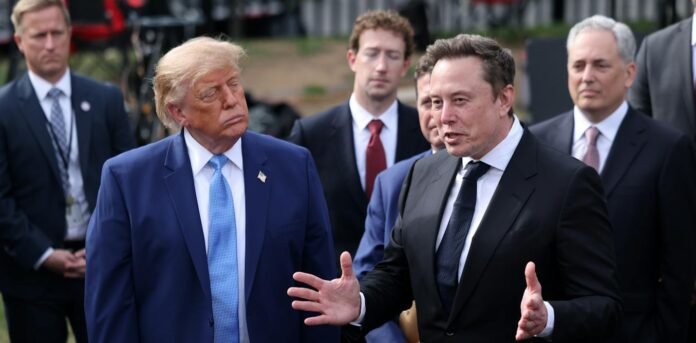
Unlike in 2022, geopolitical visions in the Trump White House and at Musk’s Starbase in Texas now appear to align. Both Donald Trump and Elon Musk are arguing that Putin wants peace. Both have said that Zelensky should be replaced as Ukrainian president.

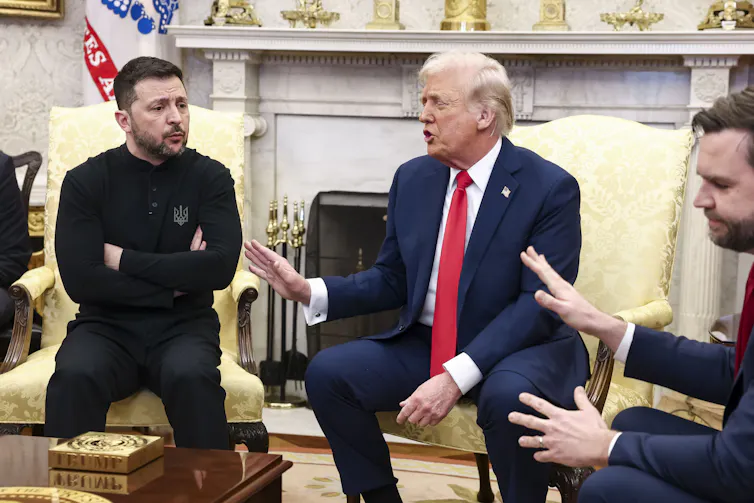
Ukrainian president, Volodymyr Zelensky sits with his arms folded as US president, Donald Trump, gestures at him in the Oval Office, February 2025.

US president, Donald Trump, and Ukrainian president, Volodymyr Zelensky, argue in the Oval Office, February 2025. EPA/JIim Lo Scalzo/pool

Much attention has focused on who ordered the latest restrictions on Starshield. Musk initially argued that the system is owned and controlled by the US government and that “any limits on speed or usage are decided by the US military and ultimately POTUS”.

He has since accused Ukraine of violating Starlink’s “terms of service” by using the “civilian commercial service, for offensive drone strikes to kill people”. On his platform X, Musk announced that the “loophole” had been closed, reminding his audience that “were Starlink to be turned off, the Ukrainian front line would collapse immediately”.

European concerns over technological dependency

This episode has rung alarm bells with European politicians about their countries’ dependence on US technology.

French MEP Christophe Grudler called it “unacceptable” that Ukraine’s and Europe’s security “depend on the goodwill of a single American billionaire or on Donald Trump’s decisions”.

Work continues on IRIS², a European communication satellite constellation meant to make the continent less reliant on Starlink. However, as I found when I researched Europe’s push for technological independence in satellites, the project is not expected to become operational until 2030 due to political frictions and financing issues.

For now, the priority is to quickly integrate Ukraine in Govsatcom, a programme pooling public and commercial satellite resources to provide secure government communications. This may offer a stopgap, yet EU foreign policy chief Kaja Kallas has acknowledged the limits: “Starlink is really necessary for Ukraine. And unfortunately, in short term, Europe can’t replace this capability.”

Time could well be an issue. Elections across Europe next year could shift the EU’s geopolitical compass away from its concerted support of Ukraine. Meanwhile, member states are locked in disputes over the next EU budget. It’s a less than optimal time for Zelensky to lobby for €70 billion (£61 billion) in additional military aid amid diminishing US support.

The Starlink episode is not the first wake-up call for Europe’s sovereignty ambitions – but it may be the most consequential yet. Member states now face a monumental task. They must maintain their unified geopolitical front while looking beyond financial disagreements to find the resources necessary to support Ukraine and develop European strategic technology.

In any other scenario, the EU risks watching from the sidelines as the most significant geopolitical conflict in Europe’s recent history is decided by Washington, Moscow and the world’s first trillionaire.

Will Israeli opposition parties join forces to eject Netanyahu?

0
will-israeli-opposition-parties-join-forces-to-eject-netanyahu?
Will Israeli opposition parties join forces to eject Netanyahu?

Israel’s opposition parties appeared to have secured enough Knesset seats in Tuesday’s elections to oust Prime Minister Benjamin Netanyahu from power and end a four-year reign marked by genocidal war in Gaza and escalating terror and dispossession against Palestinians in the West Bank.

But will they?

With about 86% of ballots counted as of Wednesday morning, Netanyahu’s far-right religious bloc is projected to have lost about 11 seats, putting them at 53, eight shy of an outright majority.

The Jewish opposition bloc, led by Yashar party leader Gadi Eisenkot, is projected to win 48 seats, putting it in a position to take control. But it would likely have to cooperate with the parties representing Israel’s Arab minority, which together won a record 19 seats on Tuesday thanks to unprecedented turnout among Arab voters who braved racist incitement from the Netanyahu camp and widespread suppression tactics at the ballot box.

Graphic by The Petek

Ameer Fakhoury, an analyst at Israel’s Van Leer Jerusalem Institute think tank, described the mobilization of Palestinian citizens in the elections as a “truly historic development.”

“They went to the polls in extraordinary numbers to confront a political leadership responsible for what they regard as the gravest crimes against their people: devastation in Gaza, ethnic cleansing in the West Bank, and years of persecution and intimidation at home,” he told Middle East Eye.

“History has placed Palestinian citizens of Israel in an extraordinary position. Having mobilized first and foremost to protect their own people, they may now also help rescue Jewish Israelis from their country’s destructive trajectory,” he said.

‘Bibi or Tibi’

With a limited window for the parties to negotiate a new government before another election is triggered, the Arab parties now hold leverage to press their demands.

Mansour Abbas, the leader of the smaller of the two Arab factions, Ra’am, signaled his willingness to compromise on Tuesday evening as the results emerged, saying his priority was to “bring down Benjamin Netanyahu” along with Finance Minister Bezalel Smotrich and National Security Minister Itamar Ben-Gvir “in this election.”

Ra’am has featured in further-right governments before, previously helping to cobble together the majority that briefly allowed former Prime Minister Naftali Bennett – also part of the Eisenkot coalition – to form one in 2021. But with the current parliamentary math, Abbas’s seven seats alone would not be enough to form a majority.

The larger Arab coalition, the left-wing Joint List, has also offered to back Eisenkot’s government. Its parliamentary leader, Ahmad Tibi, has been vocal about his demands for concessions, including commitments to fight crime in Arab communities, end the demolition of homes that were built without authorization (often due to permit discrimination), halt racist incitement against Arab citizens and offer a potential “political horizon” for Palestinian self-determination.

He said the choice was between “either Bibi or Tibi.”

Eisenkot has likewise described “Netanyahu’s retirement from political life” as a central goal. But in an effort to court Jewish Netanyahu voters hostile to Arabs and hold together his own bloc, he ruled out working with Arab parties unless they recognize Israel as a Jewish state, accept conscription of Palestinian citizens of Israel into the Israeli military and denounce Hamas as a terrorist organization.

Amjad Shbita, the general secretary of Hadash, the socialist party that is the biggest faction in the Joint List, has expressed hostility to the idea that Eisenkot would get to dictate terms.

“Laying down conditions won’t work with the Joint List,” Shbita said. “We will negotiate as equals because we need each other.”

Tibi said the opposition could form a coalition “if it wants to, if it is brave enough to.”

Making things more complex is pressure from within Eisenkot’s bloc. Bennett and former Defense Minister Avigdor Liberman have rejected forming a government dependent on Arab parties’ support or abstention.Liberman has urged members of Netanyahu’s Likud party to defect and join the opposition to form a “true” right-wing government. One potential opening would be to peel away Likud hawks opposed to Netanyahu’s concessions to ultra-Orthodox parties, most notably draft exemptions for yeshiva students.

On the other side of the opposition, Yair Golan, the leader of the left-wing Democrats party, has urged Eisenkot to cooperate with the Arab parties and form a coalition that would decisively push Netanyahu out of power.

נתניהו הפסיד. אני יודע לספור עד 120. 65 זה יותר מ-55. ככה עובדת הדמוקרטיה הישראלית. נקודה.

תמונת המציאות חייבת ללמד אותנו לקח אחד מהדהד: אין לנו עתיד כאן אם לא נפסיק לפחד. ואם לא נפסיק עם הגזענות. אסור לנו לקבל יותר את החלוקה הגזענית של נתניהו בין קולות יהודיים לקולות ערביים.…

— Yair Golan – יאיר גולן (@YairGolan1) October 28, 2026

“Netanyahu lost. I know how to count to 120. Sixty-five is more than 55. That’s how Israeli democracy works. Period,” Golan wrote Wednesday on social media. “The reality must teach us one resounding lesson: We have no future here if we don’t stop being afraid. And if we don’t stop with the racism. We must no longer accept Netanyahu’s racist division between Jewish votes and Arab votes.”

“Anyone who tries to erase the voices of Arab citizens is surrendering to Netanyahu and giving up on Israel,” he said.

Another possibility on the table is a “national unity government” that would involve a power-sharing agreement between the Netanyahu and Eisenkot factions, likely boxing out the Arabs entirely.

Eitan Tzelgov, an expert on Israeli populism and democratic backsliding at the UK’s University of East Anglia, presented the choice for Eisenkot’s bloc as a binary one: “govern with the Arab parties, or with Netanyahu.”

“Israel is a tribal society, with cohesive right-wing tribes and a shrinking liberal tribe that will need to make a decision,” he said in an email to Common Dreams. “Over the years, Netanyahu and the far right have built an ideological firewall around the Arab parties by presenting any Jewish-Arab collaboration as support for terrorism.”

“The leaders of the change bloc, representing Israel’s liberal camp, now must decide if they are willing to break it,” he continued. “That is the only way to bring about a U-turn from the current government’s policies in Gaza and the West Bank.”

He was not optimistic about their stomach for it: “A more likely outcome at the moment,” he said, “is a split within the change bloc and collaboration of some of its components with Netanyahu, a result [US President Donald Trump] reportedly supports.”

Joint List Chair Yousef Jabareen put the stakes in plain terms: “Anyone who wants to offer a substantive and genuine alternative to Netanyahu’s blood-soaked government will have to talk to us,” he said. “It’s either the continuation of racism, the continuation of exclusion, and the continuation of supremacy, or a genuine Jewish-Arab partnership.”

–Common Dreams

Iranian foreign minister says Tehran in talks with mediators to implement 7-day plan with US

0
iranian-foreign-minister-says-tehran-in-talks-with-mediators-to-implement-7-day-plan-with-us
Iranian foreign minister says Tehran in talks with mediators to implement 7-day plan with US

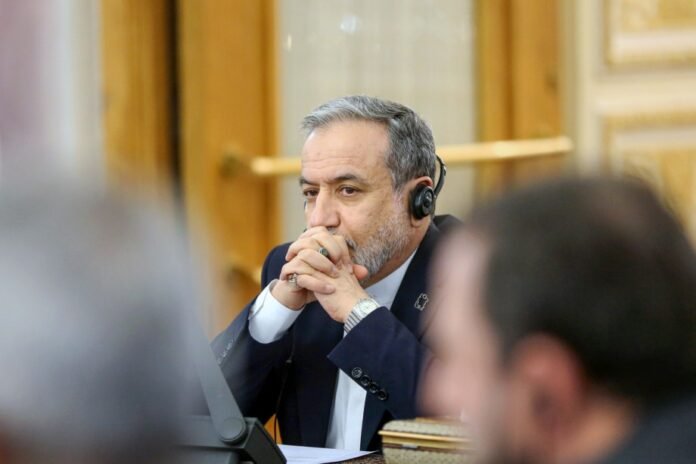
Foreign Minister Abbas Araghchi said Wednesday that Iran is in contact with mediators to review proposals to implement a seven-day plan with the US, Anadolu reports.

Araghchi wrote on US social media company X that Tehran continues to give diplomacy a chance despite tensions with Washington.

“While our Brave Armed Forces are fully prepared to defend the Homeland, Iran continues to give diplomacy a chance to succeed,” he said. “We remain in close and ongoing contact with intermediaries to review ideas that can ensure implementation of our 7-Day Plan in even less than a week.”

Iran’s seven-day plan, presented to Washington through Qatari mediators in September, proposes reopening the Strait of Hormuz and resuming negotiations with the US within a week if Washington meets Tehran’s conditions.

The US would take agreed steps during the first five days, including ending hostilities, lifting its naval blockade on Iranian ports, easing restrictions on Iranian oil exports and releasing frozen Iranian assets.

READ: Jordan, Iran discuss efforts to reach sustainable ceasefire between US, Tehran

On the sixth day, Iran would reopen the strait to normal commercial shipping, while negotiations between Tehran and Washington toward a comprehensive agreement would resume on the seventh day.

The proposed measures remain subject to agreement.

On Oct. 8, Araghchi said Tehran was reviewing Washington’s response to the proposal, with messages continuing to be exchanged through mediators.

The latest remarks come amid diplomatic efforts to maintain a fragile ceasefire between Iran and the US following months of military confrontation.

The two countries signed the Islamabad Memorandum on June 18 following negotiations mediated by Pakistan and Oman.

That agreement addressed several disputed issues, including maritime security in the strait, sanctions relief and the withdrawal of US naval restrictions.

Oman, Pakistan and Qatar have maintained diplomatic contacts aimed at resolving differences between Tehran and Washington.

READ: UN nuclear watchdog chief urges Iran to grant IAEA access to verify nuclear material

0FansLike
0FollowersFollow
0FollowersFollow
0SubscribersSubscribe
- Advertisement -
Google search engine

Recent Posts