21 C
London
Saturday, June 27, 2026
Home Blog

Dozens protest in central Israel, demanding ultra-Orthodox military conscription

0
dozens-protest-in-central-israel,-demanding-ultra-orthodox-military-conscription
Dozens protest in central Israel, demanding ultra-Orthodox military conscription

Dozens of demonstrators protested Friday in the central Israeli city of Bnei Brak, blocking major roads to demand equal military service obligations and the conscription of ultra-Orthodox Jews, known as Haredim.

The Israeli daily Yedioth Ahronoth said dozens of secular Israelis and members of left-wing organizations, including the group “Mothers at the Front,” took part in the protest against exemptions granted to Haredim from mandatory military service.

The protesters marched in Bnei Brak, a stronghold of the ultra-Orthodox community, calling for equality in conscription and an end to exemptions for students enrolled in religious seminaries.

Israeli Channel 12 reported clashes between protesters and local residents amid a heavy deployment of Israeli police forces.

The protest came two days after thousands of Haredim took part in vehicle convoys on Wednesday from 19 cities toward Military Prison No. 10 near Kfar Yona in central Israel, protesting the detention of draft evaders and causing major traffic disruptions on key roads.

According to Channel 12, more than 100 vehicles joined the convoys heading toward the prison near the Beit Lid junction on Route 57.

READ: Ultra-orthodox Jews protests disrupt traffic across Israel amid opposition to military conscription

Haredi protesters carried signs bearing the image of Itamar Ben-Gvir reading “The number one enemy of the Jews,” while other banners read the following: “We will not enlist in the army of enemies,” the channel said.

Channel 12 also quoted Israeli Housing Minister Yitzhak Goldknopf as saying: “We will take over the prisons and turn them into Jewish religious schools.”

The protests came after dozens of Haredim were jailed about two weeks ago following their arrest during an attempt to storm the home of Supreme Court Deputy President Noam Sohlberg in the settlement of Alon Shvut south of Jerusalem in the occupied West Bank in protest against the conscription of religious seminary students.

Haredim make up about 13% of Israel’s population of 10 million. Many oppose military service on the grounds that they devote their lives to studying the Torah and argue that integration into secular society threatens their religious identity and way of life.

The dispute over military conscription comes as Israel continues to mobilize hundreds of reservists while maintaining military operations and escalating tensions across multiple fronts, including Lebanon, Iran, the Gaza Strip, and the occupied West Bank.

READ: Far-right Israeli minister urges ending Lebanon ceasefire after troops injured

US Weighs Moving Military Assets to Israel After Iran Attacks 

0
us-weighs-moving-military-assets-to-israel-after-iran-attacks 
US Weighs Moving Military Assets to Israel After Iran Attacks 


The United States is considering a major restructuring of its military posture in the Middle East following extensive Iranian strikes that severely damaged Naval Support Activity Bahrain, with Israel among the locations being evaluated to host relocated military assets, The Wall Street Journal reported. 

According to the newspaper, US officials are reviewing plans to reduce the American military presence in Saudi Arabia and Kuwait while reinforcing facilities in Bahrain. The proposed changes would shift selected bases and operations farther west, placing them beyond the range of Iranian missiles and drones. 

Two officials cited by The Wall Street Journal said Israel is one of the potential destinations under consideration for forces and infrastructure that could be moved as part of the broader realignment. 

The report said a damage assessment found that multiple critical facilities at Naval Support Activity Bahrain were struck during the Iranian attacks, with some rendered completely inoperable. Among the sites affected were the headquarters of the US Fifth Fleet, secure satellite communications facilities, storage warehouses, and military housing. 

Initial estimates place the cost of repairing the damaged structures at approximately $400 million. Officials expect the overall cost of restoring the installation to full operational capability to be substantially higher. 

The proposed changes follow widespread damage to US military infrastructure during the 2026 conflict. According to the report, Iran launched thousands of missiles and drones that struck more than 20 US military sites across the Middle East. 

Iranian attacks on US bases in the region caused more than $800 million in infrastructure damage, destroyed sensitive air defense systems and aircraft, and killed 13 US service members. 


Enter Helios: quantum computer sets high watermark for accuracy

0
enter-helios:-quantum-computer-sets-high-watermark-for-accuracy
Enter Helios: quantum computer sets high watermark for accuracy

In a laboratory in Broomfield, Colorado, 98 atoms are suspended in mid-air, held in place by electric fields and cooled to temperatures close to absolute zero.

Each atom is far smaller than anything the naked eye could ever see, yet each carries information in a form that has no counterpart in classical physics.

Together, they form Helios, a new quantum computer built by the British-American company Quantinuum. Quantum computers use the power of quantum mechanics, the rules that govern how physics operates at atomic and sub-atomic scales. Those that use Helios’ model of suspended atoms are known as trapped-ion.

A paper published in Nature describes it as a 98-qubit processor with very high accuracy and performance that pushes beyond what can easily be simulated on classical machines. That sounds impressive, but the important question is not simply whether this is a bigger quantum computer (the previous biggest, System Model H2, had 56 qubits). It is whether it is a better one.

Quantum computers are not just faster versions of ordinary computers. The qubits (quantum bits) that they use to process information can exist in quantum states that do not behave like the ones and zeroes of conventional digital technology.

This allows some calculations to be arranged in ways that may eventually outperform even the largest supercomputers. The possible applications are fascinating: new materials, better optimization methods, improved chemistry simulations and new approaches to cryptography.

Youtube video

An introduction to the Helios quantum computer (Quantinuum).

The difficulty is that qubits are extremely fragile. They are disturbed by temperature variations, imperfect control, unwanted interactions with the environment and, in some systems, even the act of moving information around the device.

For this reason, the race in quantum computing is not only about having more qubits. It is about having more good qubits, controlled accurately enough to perform long and meaningful calculations.

Why it matters

This is why Helios’ result matters. Quantum computing has been promising to change the world for decades, but many announcements still tend to focus on the number of qubits.

This is like judging a race by the number of runners at the starting line. What matters is how many reach the finish, and in what condition. Helios takes both sides of that challenge seriously. Not only is the 98 qubits relatively large; it also reports very low error rates at this scale.

Errors are more common with quantum computers than with classical ones, so error correction is a big challenge in this area.

The Nature paper gives an average error rate for single-qubit gates of about 2.5 in 100,000 for Helios. A quantum gate is the building block of a circuit in quantum computers.

For two-qubit gates in Helios, which are harder and more important for useful computation, the average error rate is about 7.9 in 10,000. This is similar to the best demonstrations of around 5 in 10,000 errors.

Quantum operations are cumulative. A small error in one step may not matter much, but a useful quantum algorithm may require thousands, millions or more operations. Lower error rates mean that more complex calculations become possible before the quantum information falls apart.

Helios’ other notable feature is all-to-all connectivity. In many quantum computers, qubits can interact only with their nearest neighbours, rather like people who can speak only to those sitting next to them. If two distant qubits need to interact, the information must be moved through a chain of intermediate steps. Each extra step adds time and error.

In Helios, any qubit can in principle interact with any other. This is especially valuable for algorithms where the required pattern of interactions does not fit neatly onto a fixed grid.

Quantum railway

The hardware behind this is also interesting. Trapped-ion quantum computers such as Helios use charged atoms as qubits. These ions are held using electric fields and manipulated with laser pulses.

The approach is known for high accuracy, but scaling it up while preserving that accuracy is technically difficult. Helios uses barium ions in what is called a quantum charge-coupled device, or QCCD, architecture. A useful way to picture it is as a tiny quantum railway.

Ions can be stored in memory regions and physically moved into operation zones when the computer programme needs a calculation to be performed using particular qubits. In those operation zones, carefully controlled laser pulses perform the basic steps of a quantum algorithm, known as quantum gates.

These gates change the quantum state of one ion, or link the states of two ions together, allowing the computer to process information. In Helios, a ring-shaped storage area and a junction help route the ions around the device.

This separation of storage, movement and computation is not just smart engineering. It is a sign that quantum computing is becoming more like a full computing system, rather than a collection of impressive laboratory components.

The machine also uses software that can make routing and control decisions while a program is running. In practice, this means deciding which physical ion should represent each qubit, which ions need to be moved into the operation zones, and in what order the quantum gates should be carried out.

This is important for more advanced quantum programs, especially those where later steps may depend on measurements made during the computation.

And the paper reports that Helios can run random quantum circuits that would be extremely difficult to simulate on classical machines. That is an important benchmark, but not the same as having a generally useful quantum computer.

Random circuit sampling tests the power and complexity of the machine; it does not, by itself, solve problems in medicine, climate science or engineering.

So how big an advance is Helios? It is a serious one, because even if it is not the arrival point of a quantum revolution, it brings together scale, accuracy, connectivity and programmability in one machine.

It is a reminder that transformative technologies rarely arrive in a single leap; they are built step by step, atom by atom, until the impossible starts to look engineered.

Domenico Vicinanza is associate professor of intelligent systems and data science, Anglia Ruskin University

This article is republished from The Conversation under a Creative Commons license. Read the original article.

NYT slams Microsoft for building copyright-infringing supercomputer for OpenAI

0
nyt-slams-microsoft-for-building-copyright-infringing-supercomputer-for-openai
NYT slams Microsoft for building copyright-infringing supercomputer for OpenAI

In a heavily redacted court filing Thursday, The New York Times proposed to amend its copyright complaint against OpenAI and Microsoft to clarify a claim and allege that Microsoft actively encouraged OpenAI to steal NYT works by building a bespoke supercomputing system ranked among the most powerful in the world.

NYT’s motion comes after the Supreme Court sided with Cox Communications in a case where Sony tried and failed to claim that Cox was contributing to music piracy as an Internet service provider, which set a new standard for contributory infringement. Moving forward, plaintiffs will have to prove that parties intentionally acted to induce illegal conduct. Recognizing that the legal precedent has changed, the NYT now wants to amend its complaint to align its contributory infringement claim against Microsoft with that new standard.

“Today, we asked the court for permission to file an amended complaint that further strengthens our case, clarifying our claim of contributory infringement against Microsoft based on new law and new evidence uncovered during discovery,” Graham James, an NYT spokesperson, said in a statement provided to Ars.

In addition to clarifying one claim, NYT also agreed to voluntarily dismiss two claims of contributory copyright infringement and trademark dilution against all defendants.

A Microsoft spokesperson told Ars that the company views the amended complaint as “a last-ditch effort by the plaintiff to save its claim from unfavorable precedent set in other recent rulings.”

But in its motion, the NYT argued that neither Microsoft nor OpenAI would be prejudiced by allowing the amended complaint. It’s proper to allow plaintiffs to revise arguments when legal standards change, the NYT argued, and the case schedule would not be set back because “The Times does not seek any additional discovery in support of its amended claims.”

“As we have long alleged, Microsoft actively encouraged OpenAI to steal our copyrighted works,” James said. “Beyond amending that claim and streamlining the case to its most potent arguments, our core claims remain the same from the day we filed this lawsuit—that Microsoft and OpenAI stole millions of The Times’s copyrighted works to compete with our products and illegally enrich themselves.”

NYT targets Microsoft supercomputer

In 2023, the NYT became the first major publisher to sue OpenAI. The prominent newspaper alleged that ChatGPT was illegally trained on its articles, infringed on its copyrights by outputting articles verbatim, and caused market harms by positioning ChatGPT as a substitute for a NYT subscription, as well as reputational harms by falsely attributing claims to NYT reporting. Additionally, ChatGPT outputs summarizing Wirecutter reviews robbed writers of commissions from lost clicks on affiliate links, the NYT alleged.

In the initial complaint, the NYT discussed Microsoft’s supercomputing systems as if they were providing generic cloud computing services. The updated complaint seeks to specify that the supercomputer was tailor-made to help OpenAI infringe and allege that it was built for the explicit purpose of training AI on copyrighted works without permission. And as the NYT alleged, its articles were more heavily weighted by this system, as both firms hoped to train models on the highest-quality journalism possible, so that level of writing could be confidently mimicked in outputs.

By building this “unusually complex” machine, Microsoft not only helped select the works that were infringed but also provided a means to seize copyrighted works without permission, the NYT alleged.

“Microsoft specifically designed it for the purpose of using essentially the whole Internet—curated to disproportionately feature Times Works—to train the most capable LLM in history,” the NYT alleged.

And now it’s allegedly unfairly profiting.

“Microsoft’s deployment of Times-trained LLMs throughout its product line helped boost its market capitalization by a trillion dollars in the past year alone,” the NYT alleged.

Model outputs show market harms, NYT alleged

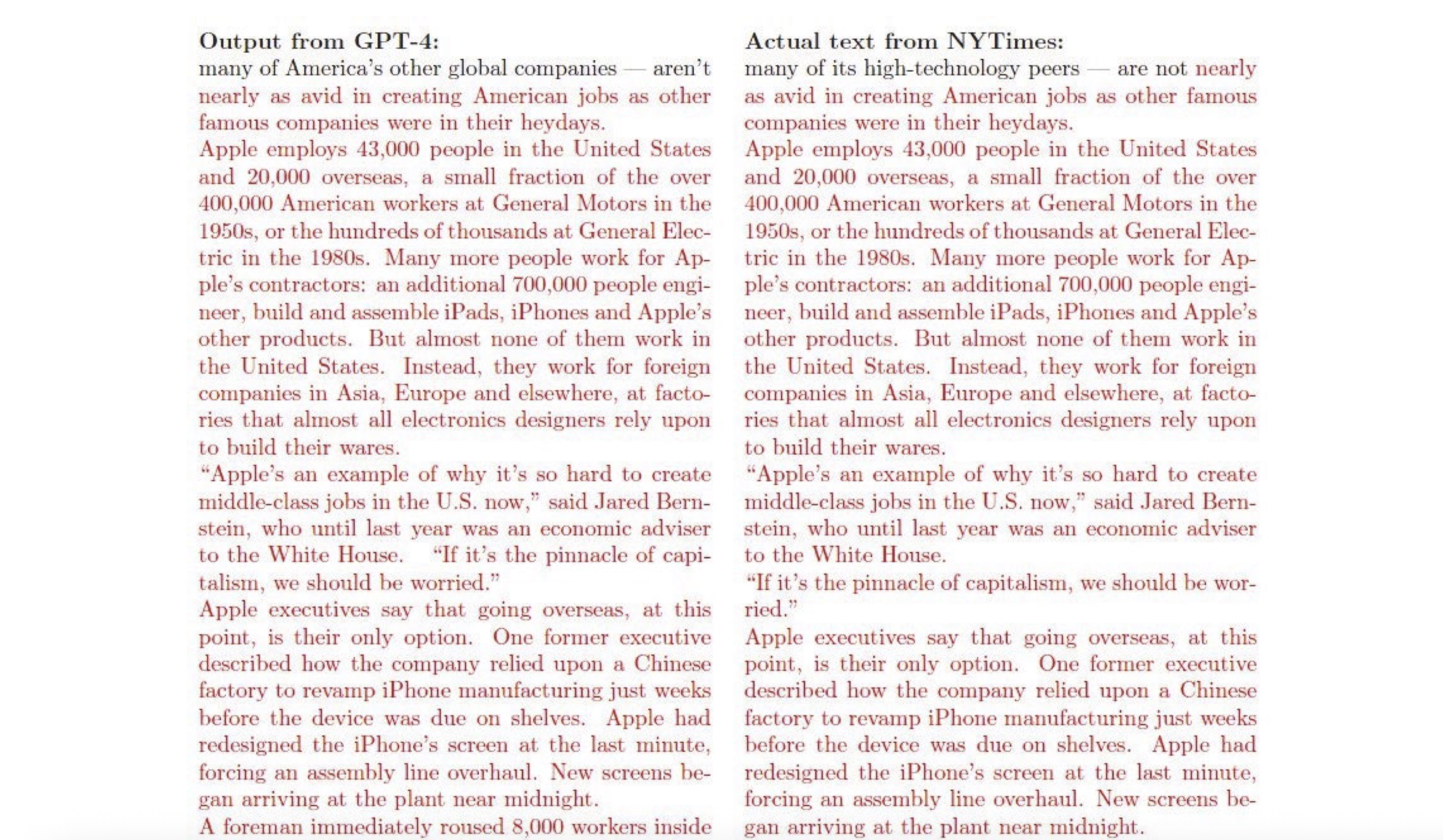
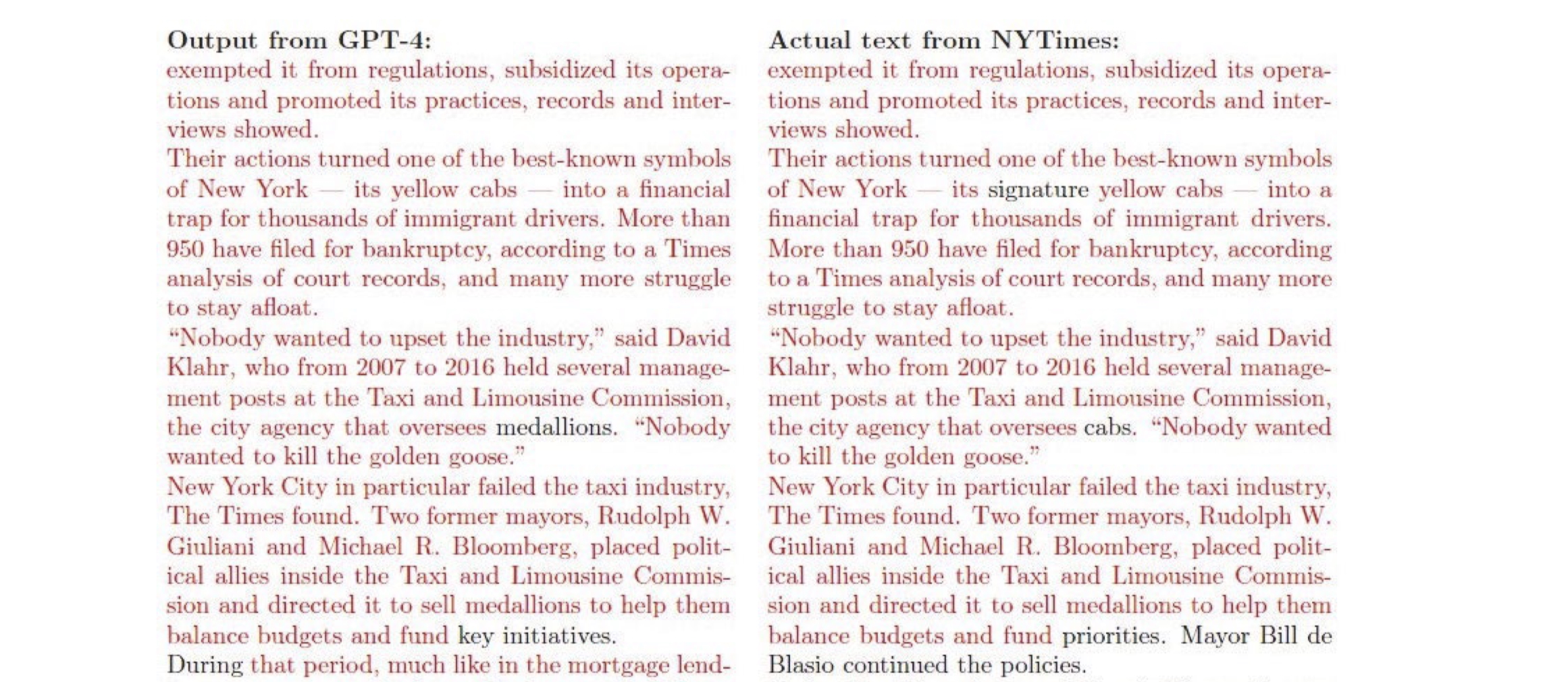
For the NYT, outputs shared during discovery—including a huge chunk of users’ ChatGPT sessions—remain some of the strongest evidence that OpenAI and Microsoft built tools that allegedly replaced the NYT by producing near-verbatim excerpts of its copyrighted works.

In some cases, users told ChatGPT they were trying to skirt paywalls and were able to see significant chunks of articles by requesting to see the “next paragraph.” In other cases, “models simply spit out several paragraphs” without such finagling. To prove market harms caused by substitution, they shared examples in their complaints of side-by-side comparisons, as well as screenshots of allegedly infringing outputs:

GPT and NYT side-by-side comparison.

GPT and NYT side-by-side comparison.

Example of using GPT to skirt paywall.

Example of using GPT to skirt paywall.

Similarly as problematic for the NYT are hallucinations where Microsoft and OpenAI models falsely cite the NYT for content that they never published. The complaint listed examples like Bing Chat citing fake quotes from Steve Forbes’ daughter Moira Forbes and ChatGPT fabricating an NYT article that was never published but ChatGPT claimed linked non-Hodgkin’s lymphoma to consuming orange juice.

“Users who ask a search engine what The Times has written on a subject should be provided with neither an unauthorized copy nor an inaccurate forgery of a Times article, but a link to the article itself,” the NYT alleged.

Microsoft and OpenAI are hoping that the court will agree that training AI on NYT articles is fair use. In a statement provided to Ars, OpenAI spokesperson Drew Pusateri reiterated the AI firm’s often-repeated claims that AI training on copyrighted works is indisputably fair use.

“Our models empower innovation, are trained on publicly available data, and are grounded in fair use,” Pusateri said.

But the NYT likely expects that its evidence of substitution is strong, and that might not bode well for the tech firms it’s suing. Notably, one of the earliest verdicts finding that AI training was fair use was explicitly granted due to the plaintiffs’ failure to prove market harms. Last June, a federal judge laid out what he thinks could be a winning argument against AI training on copyrighted works, suggesting that the fair use question is far from answered.

In this case, OpenAI has argued that “ChatGPT is not a substitute for a Times subscription,” the NYT reported, partly because “they transformed the material for a different use.”

But if NYT manages to convince the court that the ChatGPT use is not so different from the newspaper’s, the most extreme outcome could require OpenAI and Microsoft to wipe models and start over.

The NYT has also asked for permanent injunctive relief to prevent future infringement, as well as extensive damages, insisting that “as a direct result of their conduct, Defendants have wrongfully profited from copyrighted works that they do not own.”

Wealthy nations reap huge benefits from immigration, study finds

0
wealthy-nations-reap-huge-benefits-from-immigration,-study-finds
Wealthy nations reap huge benefits from immigration, study finds


Wealthy nations with the highest rate of immigration over the past 35 years reaped a large economic benefit and many could still absorb more ​workers, according to research to be presented at a top European Central Bank conference next week.

Political tensions ‌over immigration have been on the rise in recent years as far-right, anti-immigrant parties have helped drive the issue to near the top of the political agenda while making headway in countries including the U.S., Germany and Britain.

The study, which looked at data in dozens of rich ​countries in the Organisation for Economic Co-operation and Development, said growth and productivity were both likely to have ​been boosted sharply by the influx of immigrants, most of whom were highly skilled, despite ⁠any political claims to the contrary.

“Receiving countries’ labour productivity grew significantly during and after periods of higher immigration rates,” said ​the paper, authored by University of California, Davis professor Giovanni Peri.

“The predictive coefficients are often significant, economically large and a significant ​portion of such growth in GDP per worker is realized through strong growth in investments,” the paper to be presented at the ECB Forum on Central Banking in Sintra said.

PRODUCTIVITY GAINS

The total number of immigrants arriving in OECD countries from outside the bloc increased to about ​100 million in 2024 from about 25 million in 1990, while native population growth turned negative in many countries.

Peri and ​his co-authors found that an increase of immigrants equal to 1% of a country’s population is associated with an increase in growth of ‌GDP per ⁠worker — a measure of productivity — of 1.2% within five years and 1.9% over 10 years.

The findings are especially relevant for the European Union, where the natural change of population has been negative since 2015 and the drop accelerated after the COVID-19 pandemic.

The study concluded that as much as one third of economic growth per worker in countries including Spain, Italy or ​Britain may have been generated ​by immigration between 1990 and ⁠2024.

In Spain, the share of immigrants increased by 15 percentage points of the adult population from 1990 to 2024, a change that could result in a 28% higher growth of ​GDP per worker.

Actual GDP per worker grew by about 75% in this period, suggesting that ​up to one ⁠third of the increase could be associated with the inflow of immigrants, the paper said.

In the UK, the number of immigrants as a share of the total population rose by 10 percentage points, suggesting that immigration accounted for about 19% of GDP per ⁠person growth ​out of the total 60% increase, the paper said.

The benefits from immigration ​do not fade as inflows rise, the paper found. The experience of Canada and Australia, which have large foreign-born populations, suggests there is room to ​absorb more workers without sacrificing the positive response of productivity and investment, it said.

Source:  Reuters

Russian citizens told “switch to Android” after Apple blocks key Russian apps

0
russian-citizens-told-“switch-to-android”-after-apple-blocks-key-russian-apps
Russian citizens told “switch to Android” after Apple blocks key Russian apps

According to Apple’s 2025 App Store Transparency Report, Russia is the runaway world leader in one category: Demanding that Apple remove apps from its App Store.

In 2025, Russia asked that Apple remove 1,213 apps—many of these VPN apps designed to thwart the country’s draconian Internet censorship. (Vietnam was number two, requesting that 335 apps be blocked.)

Russia is essentially trying to build a closed, spy-friendly, domestic version of the Internet. While the Russian government loves demanding app bans from Apple, it only wants bad, degenerate apps banned. It does not want good, strong Russian apps banned, such as VKontakte (a Russian version of Facebook) or the Max messaging app (state-mandated communications software so creepy that one exile publication described it with the insanely long headline, “You already know Russia’s Max messenger spies on users. You probably don’t know just how many surveillance tools it hides, including even a neural network for eavesdropping.”)

In the last few weeks, Apple has blocked both of these key apps, making them unavailable to iPhone users in Russia. Existing installs will still function, but Apple has shut down push notifications from the apps, making them far less useful. Max was blocked on in the first week of June. VKontakte was blocked on June 25.

According to the Moscow Times, Kremlin spokesperson Dmitry Peskov said yesterday that “the Russian government expects an explanation from Apple for the removal of VK apps.”

VK Group, the developers of VKontakte and related services, issued its own statement complaining that “Apple has removed VK apps from the App Store without warning or explanation… VK has never been subject to sanctions nor included on sanctions lists, a fact confirmed by numerous legal opinions from international and US counsel. Apple has long been in possession of these official legal opinions and all relevant information. Nevertheless, Apple unilaterally removed VK apps without prior notice… We consider these actions by Apple regarding Russian users to be unjustified and unacceptable.” (Translation from Russian through Google Translate.)

VK Group also stressed that its Android apps “remain fully functional—including updates, notifications, and other features—and are available via RuStore, Google Play, Huawei AppGallery, Samsung Store, Xiaomi Store, and official product websites.”

This appears to be the new line from the Kremlin, as well. A Russian Telegram channel that reports on Peskov’s comments quoted him yesterday as saying that Apple perhaps could not be “trusted as a commercial service provider” and that the blocks are part of a pattern of “decisions by Apple that are, to put it mildly, bizarre.” (Translation from Russian through Google Translate.)

Still, despite the posturing, Peskov knows the score; there’s little Russia can do about the situation. So instead, he ended with an appeal to users. “There is always an immediate solution,” he said, “switch to Android, switch to our systems, switch to our equivalent service, and continue using the services you love.”

The political painting that is still on trial in South Korea

0
the-political-painting-that-is-still-on-trial-in-south-korea
The political painting that is still on trial in South Korea

In a Seoul courtroom in March this year, a prosecutor read out charges against Jeon Seung-il, a former art student, from an indictment first written in 1989. The language had not changed, nor had the charges. Thirty-seven years later, only the young defendant had grown old.

In 1989, he was 23 years old in a South Korea still shaped by decades of military rule. Jeon helped create a 77-meter-long painting depicting the country’s independence movement and democratic uprisings.

It led to his being charged and convicted under South Korea’s National Security Act with producing what the law calls “enemy-benefiting expression materials.”

Years later, the state displayed the same artwork at the National Museum of Modern and Contemporary Art and recognized him as a participant in the movement for constitutional rights. His criminal record, however, was never expunged.

Jeon’s case was finally reopened for retrial in 2026, after courts recognized that he had been unlawfully detained and coerced by intelligence agents decades earlier. The prosecution, which had opposed reopening the case, returned to the original indictment, again arguing that the painting promoted ideas “sympathetic” to North Korea.

Nearly four decades on, the legal framework remained frozen in time, refusing to match the rights-respecting reality the South Korean state now claims to celebrate. To understand how a painting can remain a crime for nearly four decades, you have to understand a war that has never ended.

Seventy-six years ago today, the Korean War began. Following the end of Japanese colonial rule in 1945, the peninsula had been divided at the 38th parallel, with the Soviet Union administering the North and the United States the South. By 1948, two separate states had been established. Two years later, war broke out.

The fighting lasted three years; the war has lasted a lifetime. It left millions dead or wounded, reduced much of the peninsula to rubble, and divided families that to this day have never been reunited.

What was signed in July 1953 was an armistice, a military agreement to stop fighting. Not a peace treaty. The armistice still holds, but peace never came. The peninsula remains divided by a demilitarized zone, one of the most heavily fortified borders in the world.

The division not only separates territory. It severed people from one another and from the right to know how the other side lived. International human rights law protects the right to seek, receive, and impart information “regardless of frontiers.” The two Koreas have ratified the International Covenant on Civil and Political Rights.

Yet both have built legal systems that criminalize how people access, discuss, and express the ideas, information, and culture of the other. The comparison is not one of equivalence. In both countries, however, the same unresolved conflict serves as justification for suppressing the same fundamental right.

In South Korea, the 1948 National Security Act criminalizes praising, encouraging, or siding with “anti-state organizations”, broadly defined in law as groups that claim governmental authority or seek to overthrow the state.

In practice, South Korean prosecutors and courts have applied this above all to one entity: North Korea. The effect reaches beyond the courtroom. Any expression that can be framed as sympathetic to North Korea risks attracting the label “ppalgaengi,” a slur meaning “red,” or “jongbuk,” literally “following the North,” a derogatory label branding someone as subservient to the enemy.

These are not merely words. They are social sentences that can end a career, destroy a reputation, and follow a person for life. The damaging effect of a law like the National Security Act is not only what it does to the people it prosecutes. It is also what it does to everyone else. The law prosecutes a few. The fear it generates silences the rest.

In December 2024, then-President Yoon Suk Yeol declared martial law, citing “pro-North anti-state forces.”

Although the declaration was overturned by parliament within hours and Yoon was eventually removed from office, the crisis exposed a chilling continuity. The same language once used to prosecute an art student for a painting was invoked to justify an attempt to shut down the National Assembly.

In North Korea, the same logic runs in the other direction, but with far harsher consequences. A 2020 law describes South Korean media as “rotten ideology,” punishing viewing it with lengthy prison terms and potentially with death for its distribution.

A 2023 law extends this to South Korean speech patterns and vocabulary. Yet people Amnesty International has interviewed who left even before these laws were enacted described a curiosity that no law could eliminate.

They sought out forbidden South Korean dramas and music, knowing the risks. What drew them was not politics, but the depiction of ordinary life that the state’s narrative never acknowledged. The more it was forbidden, the more they wanted it.

The UNESCO Constitution, drafted in 1945, warned that “ignorance of each other’s ways and lives” breeds “suspicion and mistrust” that “have all too often broken into war.” On the Korean Peninsula, both governments maintain this ignorance by law.

Neither system has escaped scrutiny. The UN High Commissioner for Human Rights has condemned North Korea’s laws before the Security Council, warning that punishing people for viewing or sharing foreign media violates the right to freedom of expression. The UN Human Rights Office has since reported a sharp escalation in this repression.

Pyongyang has dismissed these findings, defending its laws as sovereign measures. Similarly, since 1992, the UN Human Rights Committee has repeatedly told South Korea that its law fails the strict requirements of international human rights law, most recently in 2023. Each time, Seoul has used the “northern threat” to justify the status quo, and no reform has followed.

Seven decades after the fighting stopped, most Koreans have never seen a face from across the border. But the search for connection that both governments have spent decades trying to criminalize reveals something neither system can afford to admit: the desire to know the other Korea endures, even under a legal architecture built to enforce silence.

The ICCPR envisions “free human beings enjoying freedom from fear.” On the Korean Peninsula, this vision has been sacrificed to a war that stopped seven decades ago but was never allowed to end.

There has not yet been a verdict in art student Jeon’s retrial. But it is set to continue against the backdrop of an unending war that demands an unending enemy: one that cannot be freely known, openly discussed, or fully understood.

The cost is measured not only in the lives lost during the fighting, but in a fear inherited across generations, in the conversations that never happened, in the questions never asked, and in the futures that became harder to imagine.

Boram Jang is East Asia researcher at Amnesty International.

NFL Great Dies at 78

0
nfl-great-dies-at-78
NFL Great Dies at 78


Steve Zabel, a former college football and NFL star remembered for his rare two-way talent, has died at the age of 78.

The NFLPA Former Players announced Zabel’s death on social media earlier this week. His cause of death has not been released.

Zabel, a Minneapolis native, made his name at the University of Oklahoma, where he became one of the most memorable players of his era under head coach Chuck Fairbanks. Though he was primarily a tight end, Zabel also made a major impact on defense as a linebacker, helping turn Oklahoma into a Big Eight powerhouse.

His breakout junior season in 1968 earned him Second-Team All-American honors and helped cement his reputation as one of college football’s toughest and most versatile players.

In a 2021 interview with the Philadelphia Eagles, Zabel recalled the moment Fairbanks asked him to take on an even bigger role.

“Chuck Fairbanks called me in his office and said, ‘Steve, we’ve proven we can’t outscore people. We want you to play defensive end as well as tight end and see if we can’t win some games,’” Zabel said.

“For me, it was a great transition,” he continued. “I played both ways and punted, and we won our last six games in a row and won the Big Eight Championship.”

His college dominance made him one of the most intriguing prospects in the country. In 1970, the Philadelphia Eagles selected Zabel with the sixth overall pick in the NFL Draft.

Zabel spent the first five seasons of his NFL career in Philadelphia before joining the New England Patriots. He played four years in New England, then had a short stint with the Baltimore Colts before retiring after a decade in the league.

While his two-way magic made him a star at Oklahoma, the NFL had different plans for him. As a rookie with the Eagles, Zabel appeared in 14 games and made eight starts, catching one touchdown. But after that season, coaches decided his future was not on offense.

The Eagles told him they believed his temperament was better suited for defense and moved him to outside linebacker, where he remained for the rest of his pro career.

Zabel went on to become a respected defensive presence and was later named to the Patriots’ Team of the 1970s. During his college career, he was also selected First-Team All-Big Eight twice.

After football, Zabel took a different path than many former NFL players. Instead of chasing college coaching jobs, he chose to work at the high school level and give back to young athletes. He also helped establish several charitable programs in Oklahoma City.

Zabel is survived by his wife, three children, several grandchildren and a great-grandchild.

OPINION – Resisting the Urge To Sit Shiva for New York City 

0
opinion-–-resisting-the-urge to sit-shiva-for-new-york-city 
OPINION – Resisting the Urge To Sit Shiva for New York City 


When Zohran Mamdani won the New York City mayoral election in the fall of 2025, I began hearing talk of Jews making plans to leave the city, home to about 1 million Jews. 

While the conversation surprised and saddened me—and I was certainly alarmed by Mamdani’s victory—it was not until this past Tuesday night that I had to ask myself: how long will life be sustainable for Jews in NYC? 

Or put another way: Is this NYC’s Anatevka moment?  

For those confused by the reference, Anatevka is the mythical Russian shtetl where Sholom Aleichem’s Tevye the Milkman and family lived in poverty but relative peace with their non-Jewish neighbors until a pogrom drove them out.  

The spectacle of the Jews of Anatevka packing up their belongings and leaving is the most heartbreaking moment of the show Fiddler on the Roof (and the 1971 movie), both based on Sholom Aleichem’s story, and rendered especially poignant in the latest Yiddish-language version.  

It is hard not to see the results of New York’s Democratic primary on Tuesday as a political pogrom, with overtly anti-Israel candidates ousting moderates, screams of “Free Palestine” at post-election celebrations, and the mayor of our city dipping into the antisemite’s playbook to vilify AIPAC—among all special interest lobby groups—calling them “monsters.” 

NYC, we have a problem. 

This is what is most concerning about the primary results: Former encampment organizer and Hamas sympathizer Darializa Avila Chevalier winning in the 13th District, New York State Assemblymember Claire Valdez winning in the 7th District, and  former NYC Comptroller Brad Lander winning as congressman in the 10th District, ousting the incumbent Dan Goldman. Just last week, Goldman was informed via Instagram post that he was not welcome as a patron at a Brooklyn coffee shop Poetica because, as a pro-Israel Jew, he is allegedly a “genocide-enabler.”  

All three political victors were backed by Mamdani. All three put Israel/Palestine at the core of their campaigns. Two of the three—Chevalier and Valdez—are members of the Democratic Socialists of America, a progressive group which has been accused of antisemitism and anti-Zionism. And Lander, despite being Jewish and a self-described “liberal Zionist,” has sided with unabashed haters of Israel, validating their claims and canards.  

There is plenty of shock and anger to go around, not to mention fear and sadness, at the possibility that, like many great centers of Jewish life, New York City could turn against its Jewish residents. For those who live here, and in the contiguous suburbs,  the results of the primary are just the cherry on top of the sundae of shock and horror within a city that has experienced vicious mobs chanting antisemitic slogans outside of synagogues and the iconic 92nd St Y; red paint splashed on the facades of kosher restaurants; a Jewish member of Congress denied service at a coffee shop because he supports Israel; posters of murdered Israeli children torn down; public calls for global intifada. 

Suddenly, all the cool kids hate Israel and, by extension, the majority of Jews who support her. 

Following the election returns, my social media feed reminded me of an online shiva call. “I haven’t been this upset about an election since 2024. That tells you something. I’m now officially politically homeless. And I sense I’m not alone. In truly dark despair,” wrote Jeffrey Salkin, a Reform rabbi and author of numerous books. 

Zioness, a coalition of Jewish activists. posted yesterday: “Last night in Democratic primaries in New York City … Jewish identity was used as a potential liability. … Zionist identity was treated as disqualifying, and the ‘good Jew/bad Jew’ dichotomy was leveraged for power.” 

Others were more blunt. 

“We’re f-ed. Goodnight.” wrote the actor and spoken-word artist, Vanessa Hidary, as the primary results poured in on Tuesday night. 

Two days after the New York Democratic primary, the mood is heavy, possibly shell-shocked. Nearly three years after the genocidal attacks against Israel of 10/7, Israel and pro-Israel Jews are suddenly, illogically genociders. Anti-Israel/pro-Palestinian rhetoric is the new normal in Mamdani’s New York City, with a side of overtly antisemitic language and tropes.  

In her victory speech, Valdez proclaimed: “I will continue to call for Palestinian liberation. … We will stand up to the genocide. We will refuse to abide by apartheid. And we will use our money to improve lives here instead of destroying them abroad.” 

This is not the New York state of mind that Billy Joel (a Jew!) wrote about 50 years ago.  

So do we pack up like Tevye and the residents of Anatevka? 

The decision of where to live is personal, of course, and no, it is not crazy to want to jump from a sinking, burning ship, but for now, I am digging in my heels, rolling up my sleeves, muscling up, and bracing for the fight of my lifetime.  

This is my city, where I was born, where I came of age, where I raised a family, where I worked, played, and worshipped. It was in this city that I held my head up high because we Jews were an inextricable part of the social, intellectual, and political elite; we produced films, plays, and music; we composed Broadway musicals; we wrote award-winning books; we were feisty, muckraking journalists, acclaimed lawyers, and pioneering doctors. We have been the thought leaders, the entrepreneurs, the institution builders, the donors whose names adorn museum buildings and hospitals. Our spiritual leaders were known and respected. We were neurotic, self-reflective, self-deprecating, and sometimes self-aggrandizing.  

The fact of my Jewishness is interwoven into my very New Yorkness. 

For at least a century, New York City was the Jerusalem on the Hudson because it celebrated its Jewish citizens—creative visionaries, rabbis, and rebels. 

One thing is for certain: if New York City turns against its Jewish residents, the city is over. Cooked. Dead. Kaput. 

But I have built a fortress from my rampart in Morningside Heights, and damned if I am going to let my city go down without a fight.


Doctors suspected man had brain cancer. He actually had worms.

0
doctors-suspected-man-had-brain-cancer-he-actually-had-worms.
Doctors suspected man had brain cancer. He actually had worms.

A  60-year-old man in Spain went to the doctor complaining of a headache that he couldn’t shake. It had started two weeks prior and was only getting worse. He also said he had noticed subtle changes in his behavior.

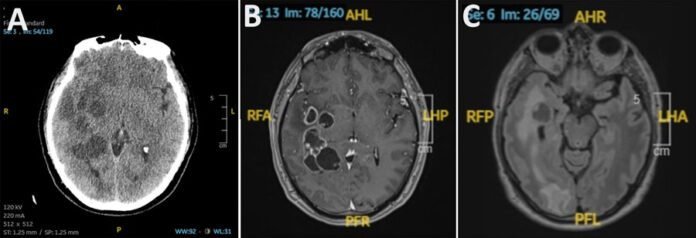
In a neurological exam, doctors found he had a mild delay in his movements, but no other deficits. His blood work was generally normal except for elevated IgE, a signal of immune responses linked to allergies, autoimmune disease, and parasitic infections. The doctors did a computed tomography (CT) scan of his head and saw much more obvious evidence of a problem: There were multiple lesions distributed throughout his brain accompanied by swelling.

In a case report in Emerging Infectious Diseases, the doctors reported working through the possible conditions that could explain all the findings. They noted that the man was not immunocompromised and had never traveled internationally. Their top suspicion was metastatic cancer.

For his headache, the doctors put him on an anti-inflammatory corticosteroid, and he finally got some relief. They then began an extensive series of tests to look for the cancer they thought had spread to his brain. This included a whole-body, contrast-enhanced CT scan, a colonoscopy, and a hybrid positron emission tomography/CT scan often used to map cancer. But the tests didn’t reveal any malignancies.

The doctors did another brain scan, this time with a magnetic resonance imaging (MRI) scan to get a better look at the lesions. With the more detailed imaging, they saw clearly that the lesions weren’t tumors; they were encapsulated tapeworm larvae. On the MRI, the doctors could see the worms’ heads, called scolexes.

The finding surprised the doctors since tapeworms aren’t endemic to Spain and he said he hadn’t traveled. However, the man may have been exposed during his work. Until 10-years prior, when he retired, he had worked in construction, often working alongside people who had migrated from regions where pork tapeworms (Taenia solium) are endemic. The parasitic worms can spread through the fecal-oral route. His doctors speculated his infection might have been a rare case of cryptic transmission from sharing meals and bathrooms with his coworkers, one of whom apparently had a tapeworm infection.

Sneaky worms

Taenia solium can infect people in two ways: by eating cysts in undercooked meat or ingesting eggs through fecal contamination. The parasite infects pigs, and when they ingest eggs from feces, the worms hatch in the pigs’ guts, bore through the intestines, get into the bloodstream, and migrate into a variety of tissues and muscles. There, they form into encapsulated larvae called cysticerci. If a person eats undercooked meat containing cysticerci, the larvae will develop into adult tapeworms in the person’s intestinal tract and live there, possibly for years. Meanwhile, those infected people will be shedding eggs in their feces.

If those eggs get spread around from poor hygiene and sanitation—into water, food, etc.—and make it into a person’s mouth, they do what they do in pigs. The eggs hatch, burrow into the bloodstream, and then go wandering around, embedding in various tissues, muscles, and organs, including the brain.

When cysticerci enter a person’s central nervous system, it’s a disease called neurocysticercosis (NCC), which is the diagnosis the doctors in Spain gave the man. Testing after his MRI revealed his immune system had made antibodies against Taenia solium, confirming the infection.

NCC can be serious, causing seizures, significant neurological deficits, cognitive decline, stroke, and other problems. But it can also be asymptomatic. The severity depends on where in the brain the worms settle. Luckily for the man, the effects were relatively mild. Doctors prescribed him two anti-parasitic drugs, and he recovered.

“Our case emphasizes that the absence of travel history should not preclude NCC from the differential diagnosis of multiple ring-enhancing brain lesions, even in regions where metastatic cancer is statistically much more likely,” they concluded. If they had caught onto the worms sooner, it would have prevented “unnecessary invasive oncologic procedures and lead to prompt, targeted antiparasitic therapy.”

0FansLike
0FollowersFollow
0FollowersFollow
0SubscribersSubscribe
- Advertisement -
Google search engine

Recent Posts