The European Central Bank (ECB) released its updated wage tracker this week, indicating that negotiated wage pressures remain stable as the year progresses.
Data covering agreements signed up to the end of May 2026 suggests that negotiated wage growth will reach approximately 2.6 per cent by the end of December 2026.
The headline indicator, which uses smoothed one-off payments to describe quarterly and monthly dynamics, shows growth of 3.2 per cent for 2025 and 2.3 per cent for 2026.
For 2026, this headline tracker averages 1.8 per cent in the first quarter, 2.1 per cent in the second quarter, and 2.6 per cent for the final two quarters of the year.
The increase observed over the year reflects the fading mechanical downward effect of large one-off payments that were distributed in 2024 but not in 2025.
This specific mechanical effect is expected to disappear almost entirely over the course of 2026 within the headline indicator.
The ECB wage tracker with unsmoothed one-off payments, which is better suited for describing yearly dynamics, indicates negotiated wage growth of 3.0 per cent in 2025 and 2.6 per cent in 2026.
Meanwhile, the wage tracker excluding all one-off payments points to an easing of negotiated growth from 3.8 per cent in 2025 to 2.6 per cent in 2026, reflecting more moderate dynamics in negotiated base wages.
Employee coverage for the 2026 data currently stands at 46.4 per cent for the first quarter, 44.8 per cent for the second, 41.1 per cent for the third, and 40.4 per cent for the final quarter.
The forward-looking horizon for the tracker remains fixed at the end of December 2026 for this release.
As new agreements are signed and coverage for contracts extending beyond 2026 increases, the horizon will be extended to the first quarter of 2027 in the July 2026 data release.
The bank cautioned that the tracker is subject to revision and its forward-looking component should not be interpreted as a formal forecast since it only captures currently available information from active collective bargaining agreements.
For a more comprehensive assessment of euro area wage developments, the bank pointed towards the June 2026 Eurosystem staff macroeconomic projections, which indicate a yearly growth rate of compensation per employee of 3.2 per cent for 2026.
Over the last few years, the world has seen unspeakable violence, death, and devastation from Israel’s war on Gaza. During that time, global perception has shifted as the scale of Israel’s destruction grew, with the death toll climbing to more than 73,000 people. Since the October 2025 “ceasefire,” Israeli military attacks have killed more than 1,000 Palestinians in Gaza.
“Spending years building a movement for an end to this genocide around the slogan ‘Ceasefire now’ alone, it was successful in building quite a substantial following,” Tariq Kenney-Shawa, an associate fellow at Palestinian think tank Al-Shabaka, tells The Intercept Briefing. “It was vague enough to bring a lot of people into the movement against genocide — because who’s going to disagree with calling for an end to war?”
“But at the end of the day, what it really laid the groundwork for was … the potential of signing this empty ceasefire agreement, in which there is an agreement on paper, there is a framework, and a phased approach to this.”
Since the U.S.-brokered ceasefire last year between Israel and Hamas, Gaza has largely fallen out of the news, as Israel, along with the U.S., launched attacks on Iran and Lebanon. But Israel’s genocidal assault on Palestinians never really stopped. “Palestinians continue to be killed every single day, albeit at a more piecemeal slower pace that is more difficult for the international community to oppose,” says Kenney-Shawa.
This week on the podcast, Intercept reporter Jonah Valdez speaks to Kenney-Shawa about how the fight for Palestinian rights and sovereignty can’t end at demands for ceasefires and conditioning aid — and should shift to sanctions and arms embargoes — and about how Gaza fits into Israel’s ambitions for the region and efforts to more deeply enmesh the U.S. and Israeli military.
“This is the most important thing to look at in the course of the next few months and few years,” says Kenney-Shawa, warning of new Israel-led initiatives like Section 224, an unprecedented integration of the U.S. military–industrial complex and Israeli defense and technology sectors. Israel and American leaders “recognize the fact that criticism of Israel in the U.S. is skyrocketing. … In many ways, they’ve recognized the need to shift this U.S.–Israel relationship from one of dependency, both militarily and financially, to one of further entrenchment.”
“Obviously, it’s a very strategic move by the Israelis to take advantage of this period in time where there is this huge chasm between public opinion and actual policy,” says Kenney-Shawa. “They’re essentially recognizing that, ‘Hey, we might not have total impunity in the United States forever, but we do for now while establishment Democrats and Republicans are running the ship. We have a Trump administration that’s essentially willing to do whatever we want.’ So what they’re trying to do now is essentially push this process through while Trump is in power, while Republicans have a majority in the Senate and the House.”
For more, listen to the full conversation of The Intercept Briefing on Apple Podcasts, Spotify, YouTube or wherever you listen.
Transcript
Jessica Washington: Welcome to The Intercept Briefing, I’m Jessica Washington, politics reporter at The Intercept.
Jonah Valdez: I’m Jonah Valdez, also a reporter at The Intercept, and I cover politics and Israel and Palestine.
JW: Glad to have you here, Jonah.
So on Wednesday, President Donald Trump signed an interim ceasefire to end military operations in both Iran and Lebanon for 60 days. The agreement would reopen the Strait of Hormuz, and bars Iran from having a nuclear weapon. The White House agreed to end their blockade and waive economic sanctions against Iran.
The deal also requires the U.S. and regional partners to develop a “mutually” agreed upon reconstruction and economic development fund worth at least $300 billion. However, the U.S. is not required to contribute.
Jonah, earlier this week on a special live Intercept Briefing, you spoke to Al-Shabaka U.S. Policy Fellow Tariq Kenney-Shawa about the particulars of ceasefires especially when it comes to Iran, Lebanon, and most notably Gaza.
In your conversation, you talk about the role the term “ceasefire” plays in our political imagination. Jonah, should a “ceasefire” be the end goal, or is there something more we need to push for here if what we’re really looking for is an end to the suffering?
JV: I think anyone should see even the recent deal between the U.S. and Iran with some skepticism as far as whether it will hold, given previous ceasefires it’s been a part of.
The term “ceasefire” has been weaponized against those that it’s supposed to bring peace to.
Something that Tariq Kenney-Shawa and I talk at length about during our conversation is how this term “ceasefire” has been — in many ways, in an Orwellian way — weaponized against those that it’s supposed to bring peace to. That’s exactly what we saw in Gaza.
The term “ceasefire” was this massive slogan — a very effective slogan — throughout the 2024 presidential campaign cycle, as well as congressional races that year. Pro-Palestinian protesters, the movement at large, was really pushing and using a ceasefire as a rallying cry to get people to care about Palestinian rights.
What conversely happened is you get this Trump-concocted ceasefire with a lot of hands from the Israeli government, which is essentially a fake ceasefire. They’ve continued the bombing campaign in Gaza. Since the ceasefire that was signed in October of last year, more than 1,000 Palestinians have been killed in Israeli strikes. So I think the term “ceasefire” just completely doesn’t apply in Gaza.
As a part of the Iran war, they have also invaded and are occupying southern Lebanon, and of course, Israel and the U.S. and their joint strikes in Iran. I think it’s important to see Gaza in this context of a broader conflict that Israel is trying to push on the region.
JW: On a related note, I know that you’ve consistently covered a lot of the momentum around calls for an arms embargo to Israel. I know this came up in your conversation with Tariq as well.
Are we giving an arms embargo too much weight, or to put another way, are we giving politicians who say they agree with an arms embargo the ability to skirt the actual issue here, which is our decades of perpetuating and being complicit in violence in the Middle East? What’s your take on that?
JV: This is a difficult one that Tariq and I had a really good back and forth about. An arms embargo, similar to a ceasefire, has been a huge rallying cry for the movement for Palestinian rights, for Palestinian sovereignty, really for decades now. Past U.S. governments have used an arms embargo [at] varying degrees of effectiveness of leverage against the Israeli government when the U.S. government wants Israel to do certain things.
It is still worth mentioning that Israel is still very reliant on the U.S. government for its military capabilities. Just the very fact of defending against Iranian attacks, that’s made possible because of U.S. weapons. Its ability to have a chokehold on Gaza and the West Bank, also due to U.S. weapons. Its ability to even strike in Iran and Lebanon, a lot of that is U.S. weapons capabilities. A lot of the aggression we’re seeing is because of its partnership with the U.S.
Again, there’s this danger, though, similar with the ceasefire, where an arms embargo might not be enough, and that’s what Tariq gets at as well, which is something he’s been saying since even before October 7, which is, the movement might have to go further than an arms embargo.
The reason is what we’re already seeing with certain conversations in Congress is there’s real efforts by Israel supporters and the Israeli government to further enmesh the U.S. and Israeli militaries in a way where even if we were to have a halt to weapon sales to Israel, even if we were to stop the flow of taxpayer dollars to Israel, they can still acquire weapons through a new kind of partnership they’re trying to form through the Pentagon directly.
This is something where, it could also be the case, where the movement gets what it wants. Again, this is a very effective rallying cry. We’re having an arms embargo, at least calls for stopping offensive weapons to Israel as a huge litmus test in the midterm elections. And it’s I think affecting the outcome of a lot of elections as we’ve seen in Pennsylvania and New Jersey and beyond.
It is having a lot of ripple effects in U.S. politics right now, and halting it would be a big deal. But, further down the line, Israel is already anticipating the halt of the flow of weapons or at least the flow of taxpayer dollars to Israel and is looking to create an even deeper relationship with the U.S. that could last indefinitely, really.
JW: This does really seem to be a cyclical issue in U.S. politics and in organizing. You pick an endpoint and of course, your enemies, they move around that endpoint. So, you may reach the goal, but what you actually wanted to achieve still feels elusive.
Jonah, thanks for giving us that preview. We’re going to hear your conversation with Tariq Kenney-Shawa, an Al-Shabaka U.S. policy fellow and co-host of Al-Shabaka’s Policy Lab series. Let’s listen to that now.
JV: Tariq, to start, I just want to give a little background on when you and I first connected. It was last summer, so July 2025, thereabouts, and it was the height of Israel’s manufactured famine in Gaza that, at the time, there seemed to be a huge shift toward how people in the U.S. were viewing Gaza.
You had mainstream media airing images of starving Palestinians. You had even more moderate Democratic leaders criticizing Israel. More lawmakers were referring to the conflict as a genocide for the first time. In the Senate, a historic vote, a majority of Democrats for the first time voted to block some weapon transfers to Israel.
But amid all that, you told me even then you were worried about a scenario where Israel would enact what you called a “performative ceasefire,” where Israel would continue the bombing and the blockades on humanitarian aid, the ethnic cleansing, but in your words, “a bit more piecemeal and gradual.”
So sure enough, several months later, last October, we got this iteration of a ceasefire, and here we are. The scenario you worried about is unfolding. So question to you, I’m wondering: In the last seven months, what’s been affirmed for you, and what has been more surprising?
Tariq Kenney-Shawa: It’s pretty clear that, yeah, everything that we were as a movement warned about — that these meaningless, toothless ceasefires can be agreed to and then not actually implemented — that has actually, as we’ve seen over the last couple months since October ’25, that’s played out exactly as expected.
What it’s really showed me was that, or what it’s really confirmed, was that spending years building a movement for an end to this genocide around the slogan “Ceasefire now” alone, it was successful in building quite a substantial following. It was vague enough to bring a lot of people into the movement against genocide because who’s going to disagree with calling for an end to war, calling for a ceasefire, right?
But at the end of the day, what it really laid the groundwork for was — again, like you just mentioned, and like I said last year — the potential of signing this empty ceasefire agreement, in which there is an agreement on paper, there is a framework, and a phased approach to this.
However, Israel has refused to implement any steps of the ceasefire agreement, and that includes continued carrying out daily airstrikes across the Gaza Strip. They’ve continued expanding the land they control. At the beginning Israel controlled about 53 percent of the Gaza Strip, delineated with that yellow line that people keep talking about that chopped Gaza in half. And now they’ve been, bit by bit, inching that line further and further westward and forcing 2 million Palestinians into an ever-shrinking strip of land that is now about 40, 30 percent of what the Gaza Strip was prior to the genocide.
Israel has also refused to let in the full agreed amount of humanitarian aid. They flood the Strip with commercial aid that people can’t really afford, but they refuse to let in sustainable products and things that people need to survive. Tents, building material, equipment to dig people’s bodies out of the rubble. What that has done is put those 2 million Palestinians who are caged in on that other side of the yellow line into a state of deliberate purgatory.
Since October 2025, that’s what we’ve seen. Palestinians continue to be killed every single day — albeit at, again, a more piecemeal slower pace that is more difficult for the international community to oppose. A lot of people within the now quite large movement in support of Palestinian rights and an end to a genocide, they look at the situation now and they say, “Well, they agreed to a ceasefire. What else can we do? What’s the next step for us?” At the end of the day, this is exactly what we were worried about last year.
Now we’re in this really difficult position in which other regional issues have come to the fore in terms of attention and media coverage, and Gaza has really slipped away from the public’s attention. Not that at the end of the day that really stopped a genocide, but there was a lot of movement in terms of this gradual push to hold Israel accountable.
The fact that we really predicated our entire movement around nothing really more than achieving a ceasefire has really come at the detriment of the Palestinians who are now living under this pseudo-ceasefire, while the movement in support of them abroad is a little bit in limbo, immobilized, and unsure of how to move forward.
“The fact that we really predicated our entire movement around nothing really more than achieving a ceasefire has really come at the detriment of the Palestinians now living under this pseudo-ceasefire.”
JV: It’s this Orwellian situation of language being weaponized in a way.
TKS: Absolutely.
JV: Out of that came the “Board of Peace” set up by the Trump administration that is supposed to govern this so-called ceasefire. Speaking of deals, this week we’re seeing a deal between the U.S. and Iran in, supposedly, ending the war there.
That war itself dominated the headlines and drew a lot of the attention away from Gaza. But now that the U.S. and Iran seem very close on this deal to end the war, Netanyahu, for his part, he said that he won’t withdraw Israeli troops from Lebanon despite this deal. And of course, the Israeli military continues to occupy more than half of Gaza.
How should we be viewing Gaza in the context of the Iran war or vice versa?
TKS: It’s important to see Gaza as the elephant in the room and just really part of this cycle of war. The fact that Israel was able to agree to this pseudo-ceasefire in Gaza allowed it to direct and move a lot of its attention, a lot of its resources, a lot of its military manpower to these other fronts that opened up. It was able to dedicate more time and energy to fighting this war in Iran, to going on this offensive against Hezbollah in Lebanon. And also, can’t ignore the fact that Israel is also holding occupied territory in Syria. So it’s really important to view this as a cycle.
It’s obviously very early, we don’t quite know what’s going to happen with the MOU [memorandum of understanding] between the U.S. and Iran. But if it does move forward, and if that front does shut down and quiet down — unfortunately, what that likely means is that Israel is going to have a lot more resources, a lot more manpower to turn its attention back to Gaza.
“The fact that Israel was able to agree to this pseudo-ceasefire in Gaza allowed it to direct and move a lot of its attention, a lot of its resources … to fighting this war in Iran.”
That shift in the regional wars that are ongoing is also coinciding with the fact that we’re basically in the run-up to Israeli election season. The opposition is really in a dead heat against the current far-right Israeli government. But the opposition in Israel isn’t criticizing Netanyahu because they’re against these forever wars that Israel is fighting. They’re criticizing Netanyahu because they just don’t like the way he’s conducting them. Just the other day, one of the main opposition candidates posted about how basically the war against Iran is going to basically reignite when there’s a new government in power in Israel.
“Israelis … are supportive of this concept of total victory that is quite elusive.”
That just goes to show that Israelis by and large are supportive of these war processes. They are supportive of this concept of total victory that is quite elusive. Netanyahu in particular, and the far-right coalition that he leads, is going to be particularly thirsty to, again, prove themselves in the face of these narratives that are coming out in light of the potential Iran deal that this was a strategic loss for Israel.
What Netanyahu and his coalition are thinking is, “OK, if we have to wind down our offensive activities in Iran and potentially even Lebanon, how else are we going to prove that we are the right party and the right people to defend Israel from our perceived threats?” They’re going to do that by reigniting their assault and genocide in the Gaza Strip. How they’re going to justify that is where we are at right now in terms of the ceasefire process itself. Despite the fact that Israel has not implemented any of the phase one parts of the agreement, they’re now demanding that Hamas agree to a component of phase two, which was disarmament.
But Hamas is basically putting its foot down and saying, “Listen if you guys aren’t going to adhere to stopping the bombing campaigns, if you guys aren’t going to let in humanitarian aid like you allowed to, if you guys are still eating up land every single day and not even adhering to phase one of the agreement, then basically why should we agree to phase two if there’s no mutual engagement on that side?”
Unfortunately, it does not bode well for Palestinians in Gaza because they’re the punching bag that Israel will turn its attention to undoubtedly.
“It does not bode well for Palestinians in Gaza because they’re the punching bag that Israel will turn its attention to.”
JV: Thanks for walking us through the political landscape in Israel. Sometimes we in the U.S. run the risk of overstating the influence of U.S. politics on Israel, specifically when it comes to Netanyahu’s decision-making and how he’s coming to those decisions. And we don’t talk enough about Israeli politics.
But I wanted to zoom in on something that you mentioned just a second ago about Hamas and their position right now and why ongoing negotiations with the “Board of Peace” continue to fall apart. For those who don’t know: The “Board of Peace” was set up as a part of the ceasefire and is supposed to, on paper, move the ceasefire process and rebuilding process of Gaza forward. It has a footnote essentially of like toward some further-off notion of Palestinian statehood.
I don’t think we talk enough about Hamas as a political entity and what its position is right now. What leverage does it have right now? What are they actually trying to argue for? Also, with other Palestinian factions, as trying to be a voice of what they see as this is the last remaining resistance of Palestinian freedom, in this context here, what does that look like? And, how is that stalling within this “Board of Peace,” very flawed structure?
TKS: It’s pretty obvious that Hamas itself doesn’t really have much leverage at all. They never had many offensive weapons to begin with. If you could consider the homemade makeshift rockets that they fire at Israel to be offensive; many of them have been depleted. I think it’s also important to be clear that Hamas is open, has explicitly stated that they are open to handing over their offensive weapons.
But they have clearly tied this to the process that was agreed upon. They very much see that as the only tidbit of leverage that they have left in this process. Basically, their argument is saying, “Listen, we’re open to handing over our weapons, but Israel has to withdraw as agreed upon in the ceasefire agreement, or there have to be steps that make it clear that Israel will be held accountable to the standards that was agreed upon.”
It’s really important to bring in the role of the “Board of Peace” here. It’s a misconception that the “Board of Peace” has been designed and will operate with the objective of building a new Gaza for Palestinians. What the “Board of Peace” exists to achieve is to create, effectively, this wonderland that Trump and Israel have agreed to.
What that looks like if you look at the presentations that, for example Jared Kushner has pushed out and the Trump administration has presented on how they view the Gaza Strip in 10, 20 years down the line — very little of it is actually for the Palestinians who live there, who will be basically concentrated into these disparate camps that are spread out throughout the Gaza Strip, put under intense surveillance, and basically serve as cheap labor for these luxury resorts and hotels and apartment complexes and data centers that Israel and the U.S. envision building in the Gaza Strip.
Palestinians will “basically serve as cheap labor for these luxury resorts and hotels and apartment complexes and data centers that Israel and the U.S. envision building in the Gaza Strip.”
When we think about the “Board of Peace” is, that shrinking territory that Hamas does still control of is basically the only thing that is stopping the Trump administration and Israel from embarking further on that dystopian future of, again, herding Palestinians into these effectively concentration camps distributed throughout the Gaza Strip and having them just serve as cheap labor for this personal enrichment opportunity for the Trump administration and his Israeli partners.
JV: You’ve written about your own experiences growing up a Palestinian American. Your grandfather, I believe, was the former mayor of Gaza City, Rashad Shawa. Your father is from Gaza. Your aunt, Laila Shawa, is a renowned Palestinian visual artist, also from Gaza. You have another aunt, Rawya Shawa, a Palestinian journalist and legislator.
There’s a lineage to the work you do. Could you talk a bit about your family, your father, how you came to start doing this work advocating for Palestine?
TKS: I’m Palestinian American. I was born in New York. Something that I’ve asked my parents about — they never wanted to make me feel like I had to advocate for Palestinian rights. They were always hoping that I wouldn’t have to do any of this and that eventually it would be figured out someday, and that we wouldn’t have to make this our lives or our careers. But I first started becoming aware of the politics of my heritage when I was very young.
I was in middle school. I remember this one time I went to a friend’s place. He introduced me to his parents, and his dad asked where I was from, and I said, “Palestine.” He said, “What is that? It doesn’t exist.” I was a middle schooler, so at the time it was shocking, and I didn’t really understand it. Only later in life did I realize that that was pointed and had a lot of history behind it.
As you mentioned, my father grew up in Gaza until he was about college age and came to the U.S. Just hearing about the stories about growing up in Gaza and then seeing his reaction to later events, for example, the 2008 Israeli offensive on the Gaza Strip — really, that kind of ended up awakening me to the real weight behind being Palestinian and pushed me to obviously get involved.
“That’s been one of the most difficult parts of, in addition to obviously just all the loss, is just knowing that we might never, never go back.”
The past two years have been extremely difficult just because there’s always been that hope of being able to return to Gaza and see the land that my father grew up in, my grandfather grew up in, my great-grandfather grew up in and played these really central roles in governance.
But it’s now — Gaza effectively doesn’t exist in the way it once did. So part of that process is just wrapping your mind around that as well. That’s been one of the most difficult parts of, in addition to obviously just all the loss, is just knowing that we might never, never go back. And if we do, it won’t be the Gaza that my father left and my grandfather led and all that.
JV: Your Aunt Rawya, she lost her home in that 2008 offensive from an Israeli strike?
TKS: Yep. And it wasn’t the first time. Israeli tanks had shelled her home before. That was the culmination of that whole process.
“ I very quickly had to become an expert in Palestinian history in order to defend myself.”
So it was very visceral for me at a very young age. But also, the fact that I was witnessing it all from a distance also played another role too. Because as a Palestinian American growing up in New York City, again, it very quickly became about defending myself. I very quickly had to become an expert in Palestinian history in order to defend myself from the people like my friend’s father who claimed I didn’t exist and my people didn’t exist.
Something that gives me hope in terms of the direction things are headed is that back in 2011, 2012, when I was a high schooler, the parameters for discussion around the Palestinian right to resist occupation, around some of the myths of Israel’s existence — for example, the myth that they made the desert bloom, or that it was a land without a people for a people without a land — so much of those have been eroded.
So much of American public opinion has, over the course of obviously two and a half years of genocide, shifted. There is much more space for having real conversations about this. More importantly, sharing the Palestinian perspective, which is very fundamentally different than it was even five, 10 years ago.
JV: Those shifts are incredible. Recent polling has shown time and time again that the vast majority of Democratic voters, somewhere north of 70 — more than 70 percent — in the U.S. see Israel unfavorably.
It’s playing a big role in U.S. electoral politics, whether or not a candidate supports blocking military aid to Israel has really become a litmus test in many of these races.
Some Democrats have found success in their primary elections running on that as a part of their platform and winning. You have Adam Hamawy in New Jersey, former Army surgeon who volunteered in Gaza; he won his primary against a moderate Democrat a couple weeks ago. Last month in Pennsylvania, you have Chris Rabb, whose campaign not only called for an arms embargo on Israel, but also — controversially for a lot of people — the right of return for Palestinians under international law.
I’m wondering, how would you diagnose this moment the Democratic Party is in with its attitude toward Israel–Palestine? Or do you see this as more than a moment? I’m curious how lasting you think these shifts will be.
TKS: I definitely see this as more than just a moment. It’s not just Democrats and people on the left who are feeling more pro-Palestinian than ever before. It’s across the political spectrum. It was Pew or Gallup, I forget which one, their most recent poll on where American sympathies lie between Israelis and Palestinians. For the first time ever, more Americans sympathize with Palestinians than with Israelis, and that’s across the political spectrum. Obviously that’s a lot more skewed when it comes to Democratic voters or progressives and people on the left. But it very much is across the political spectrum.
It’s more useful to look at the polling that we’re seeing around actual policy measures. For example, arms embargo or “block the bombs” and calls to actually either at the very least condition U.S. military aid to Israel, but, even better, cut it entirely. We’re seeing upwards of 60, 65 percent of Americans, again, across the political spectrum, who support these types of actual, solid policies.
That’s the difference right now between when you’re looking at just sympathy and people who are actually willing to potentially even make voting decisions out of what they’re seeing right now and out of the outrage that they’ve been witnessing when it comes to two and a half years of genocide. They also are now more cognizant of the fact that we send Israel billions of dollars to do that genocide and to engage in forever wars across the region that many Americans see or believe Israel is dragging the U.S. into. That is the bigger change that we’re seeing, and that arguably might be a little bit more lasting, is that more and more Americans today are critical of Israel and critical of that “special U.S.–Israel relationship.”
What concerns me sometimes is that a lot of the shift in public opinion isn’t necessarily tied to support for Palestinians, and we’re obviously seeing that on the right. On the far right, where we’re seeing a rise in actual antisemitism. Across the right, we’re seeing just a general rise in the “America-first — MAGA — we don’t want to be sending anyone our tax dollars,” and they’re now starting to include Israel in that.
But the other thing I will mention is, what we’re seeing right now in the Democratic Party is really a widening chasm between the Democratic establishment and the voting base. The Democratic establishment, some of the older representatives that we have in Congress — Chuck Schumer is a great example of some of these more old-school politicians who are resistant to recognizing this new reality. What I’m trying to say is that, there is this very, very big generational gap that is emerging. So despite the fact that we are seeing such a substantial shift in U.S. public opinion, we’re not seeing it in policy. That’s largely because these establishment Democrats remain in power.
But what I hope to see over the next five, 10 years is that that starts to fundamentally change when the younger generation emerges as the bigger voting bloc. Unfortunately, these policy changes are glacial. It’s too late to end the genocide.
The one thing I am hopeful for in that long-term process, is that long-term movement that we have built and are continuing to build that will be borne out by these younger generations as they rise into political power.
JV: All this discussion around blocking military aid to Israel is as old as the state of Israel itself. You had President Dwight D. Eisenhower in the 1950s threatening an arms embargo as leverage against Israel and other presidents after that.
We’ve been mostly talking about a post-October 7 world where it’s been this rallying cry for anti-genocide protesters, progressive lawmakers in the U.S., and, as I’ve mentioned, we saw Democrats win primary elections running on this. The message is pretty clear: Our taxpayer dollars are being used to help Israel acquire weapons from American companies to commit a genocide. All the while, there’s this economic side of it — all the while our economy suffers, people are struggling to afford rent, just daily life, healthcare. So let’s use the leverage we have as Americans and stop the flow of weapons.
To your point, a lot of it is leaning toward anti-Israel, not so much for the Palestinian people. And yet there is this huge shift. But now we’re increasingly hearing Netanyahu and the Israeli government, and supporters of the Israeli government signal that they are getting ready and almost championing a world without the same funding from the U.S., and basically a post-State Department funding mechanism where the same amount of taxpayer dollars isn’t flowing into Israel as much so that they could buy these weapons.
And in Congress you’re seeing a lot of pro-Israel lobbying happening around a new bill, and it would essentially intertwine the U.S. and Israeli militaries and weapons industries in a new way — we don’t do this with any other ally, it’s worth mentioning — in a new way that will reshape how Israel gets weapons. Could you talk about the dangers of that and where things are headed?
TKS: To be completely honest with you, and we’ve talked about this before, this is the most important thing to look at in the course of the next few months and few years. That’s the difference between conditioning U.S. military funding and aid to Israel, and completely cutting U.S. military weapons to Israel through an arms embargo.
I argued as early as summer 2023 — and this was before the genocide — that even conditioning U.S. military aid to Israel would not go far enough if the objective is for Israel to end the occupation. And that was prior to the genocide. It’s also important to recognize that the Israeli military is deeply dependent on U.S. weapons, U.S. military cooperation, intel sharing.
If the U.S. withdrew that relationship or fundamentally changed it or stopped providing Israel with the weapons — whether through conditioning that aid or cutting it entirely — that would fundamentally alter Israel’s ability to get away with whether it’s genocide in Gaza or regional wars.
However, conditioning doesn’t go far enough because if Israel’s committing a genocide, and if we recognize that, then selling Israel the weapons on the open market is arguably just as bad as giving those weapons to Israel for free with U.S. tax dollars.
“Selling Israel the weapons on the open market is just as bad as giving those weapons to Israel for free with U.S. tax dollars.”
It’s avoiding another movement trap that is reminiscent of the “Ceasefire now” trap. Because if we get stuck in limiting ourselves — our movement — to simply calling for conditioning U.S. military aid to Israel on Israel adhering to international law, or U.S. law even, then there are so many ways for Israel to wriggle around that.
More importantly, at the end of the day, Israel can continue to buy the weapons it needs to get away with genocide on the open market, and that’s the problem.
Right now, there are a couple Israel-led initiatives that actually recognize this moment we’re in. So Israel’s leaders Benjamin Netanyahu, and a lot of American — some of the most stalwart pro-Israel figures in the U.S., Lindsey Graham comes to mind — recognize the fact that criticism of Israel in the U.S. is skyrocketing; and potentially the future of this formerly special “U.S.–Israel relationship” is not sustainable in the long run, especially as more Republicans turn against this status quo. In many ways, they’ve recognized the need to shift this U.S.-Israel relationship from one of dependency, both militarily and financially, to one of further entrenchment.
How they’re going to do that, there’s basically two concurrent initiatives that are ongoing right now. The first and the most important one probably, is the fiscal year 2027 National Defense Authorization Act, or NDAA. In specific, Section 224, which is proposing basically an unprecedented integration of the U.S. military–industrial complex and Israeli defense and technology sectors. That’s dangerous because what that does is that entrenches the U.S. military within the United States military–industrial complex, and gives it access that no country has, not even the U.K., not even France, not even these core allies that the U.S. has built their relationships with over decades.
Apart from that, why that is dangerous is that it becomes much harder for the pro-Palestine movement, or the movement in support of Palestinian rights and an end to genocide, to decouple that new much more entrenched relationship. That would mean that we would have to then go up against the U.S. military as well as the Israeli military and make that case to Americans.
Obviously, it’s a very strategic move by the Israelis to take advantage of this period in time where there is this huge chasm between public opinion and actual policy. Because they’re essentially recognizing that, “Hey, we might not have total impunity in the United States forever, but we do for now while establishment Democrats and Republicans are running the ship. We have a Trump administration that’s essentially willing to do whatever we want.” So what they’re trying to do now is essentially push this process through while Trump is in power, while Republicans have a majority in the Senate and the House.
Another example is the negotiations that are ongoing around the memorandum of understanding, the MOU, between Israel and the US. The last one being signed under the Obama administration, which was a 10-year MOU that agreed to basically be giving Israel $3.8 billion every year of U.S. tax dollars. What the new MOU that they’re thinking about is a 20-year MOU in which a couple years of increase in U.S. military aid before it eventually decreases. They also pursue this entrenchment approach, making the two militaries more dependent on each other rather than this Israel dependency relationship.
JV: There’s this really fantastic archival footage you shared on Twitter sometime last year showing your grandfather, former mayor of Gaza City — again, Rashad Shawa — talking about the annexation of Gaza. This was in the 1980s, more than 40 years ago. Here we are having similar discussions, if not in a more dire place.
I’m wondering where you think the movement goes from here. And, with thinking about BDS — Boycott, Divestment, Sanctions — if Israel doesn’t care about its place on the international stage as much as it used to, as that increasingly isn’t playing a factor, as the U.S. is more officializing its entrenchment with the Israeli military, where do you see the movement going from here?
TKS: Israel remains very much dependent on the United States and its relationship with the West, and I’m talking about mainly Western Europe. Yes, they are recognizing that their relationships based on impunity are not a given forever, which very much explains why they are effectively going so hard across the region right now. They very much see this as a moment of opportunity for them that they might not have forever. They might not have a Trump administration in the White House forever that is effectively willing to allow them to get away with whatever they want. That’s why they are taking these unprecedented steps ranging from the genocide in Gaza to the war in Iran that no other U.S. president agreed to, except for Trump.
“That’s why I spend so much time advocating for arms embargoes, for economic sanctions, anything that goes past these previous demands that we’ve had.”
That is why it’s all the more important that we recognize that the movement itself — the movement in support of Palestinian rights — has made huge strides over the last couple of years. And now, however, it’s increasingly important to shift our efforts to punitive measures — sanctions — everything in our power to hold Israel accountable through actual punitive measures like economic sanctions, arms embargoes that make it more difficult for Israel to get away with the war crimes and atrocities and genocides it’s committing.
That’s why I spend so much time advocating for arms embargoes, for economic sanctions, anything that goes past these previous demands that we’ve had — the “Ceasefire now” demands, the conditioning aid demands.
It’s increasingly important now that we take these steps and hold Israel accountable through arms embargoes and sanctions so that we don’t get to the point in the future where Israel can live its “super Sparta” strategy that it is really investing in. Basically creating a world in which Israel can carry out these forever wars and these genocides without the U.S.’s and the West’s permission. It’s really imperative that we see these changes sooner than later because time is not on our side in terms of that process.
JV: I hate to be the pessimist in the room here, but aren’t we there already where Israel can just — maybe it’s not its fullest iteration, not fully evolved Sparta form, as you mentioned — but aren’t we there already where they’re acting outside of the U.S. interest?
TKS: Yeah. Everything we’re doing, it’s too late to stop the genocide in Palestine. An inconceivable number of Palestinians have been killed, and they’re not coming back. Gaza is — we’ve lost so much of it. A lot of this accountability is already too little too late.
But it’s also very important to recognize that, again, Israel remains very much dependent on the United States in particular, not even to mention just Europe and Western Europe, for its military activity and military prowess and being shielded on the international stage.
Just look at the Iran war, for example. There’s no way that Israel would have been able to sustain this type of regional conflagration without the U.S. This ranges from the offensive strikes that the U.S. was partnering directly with Israel on, the intelligence sharing, and the defensive capabilities that the U.S., its vassal states in the region, like Jordan, Saudi Arabia, and then even other European countries that ended up sending missile defense systems and naval ships to defend Israel from the rockets that were coming from Iran.
“Israel is very much still basically like a U.S. military outpost.”
So it’s very much like, we’re in this moment right now — and we will be for many years to come — in which Israel is still extremely dependent on U.S. on the U.S. military umbrella. Israel is very much still basically like a U.S. military outpost. So these types of actions — arms embargo and sanctions — can have an effect on Israel.
The timeline for Israel to be fully self-sufficient in its military procurement system and its own economy — that’s a far way off. Israel is a very integrated economy, and economic sanctions would have a very substantial effect on Israel’s ability to wage war and genocide. However, it is imperative that the sooner we can do this, the better.
JW: That was Intercept reporter Jonah Valdez and Al-Shabaka U.S. Policy Fellow Tariq Kenney-Shawa speaking at a special live Intercept Briefing earlier this week. If you don’t want to miss the next Intercept Briefing live, sign up for our newsletter at theintercept.com.
This episode was produced by Laura Flynn. Ben Muessig is our editor-in-chief. Maia Hibbett is our managing editor. Fei Liu is our product and design manager. Nara Shin is our copy editor. William Stanton mixed our show. Legal review by David Bralow.
Slip Stream provided our theme music.
This show and our reporting at The Intercept doesn’t exist without you. Your donation, no matter the amount, makes a real difference. Keep our investigations free and fearless at theintercept.com/join.
And if you haven’t already, please subscribe to The Intercept Briefing wherever you listen to podcasts. Do leave us a rating or a review, it helps other listeners to find us.
Let us know what you think of this episode, or If you want to send us a general message, email us at podcasts@theintercept.com.
Trump’s MOU is an IOU: the severe US losses of his misbegotten war
The Memorandum of Understanding, which ostensibly ends the four-month war between the US and Iran, illuminated the profound US defeat.
In addition, a Quincy Institute webinar on military lessons from the war, shortly before the MOU’s release, enumerated numerous ways in which the US failures in its misbegotten war reveal how drastically US military dominance has been undermined for the long term.
On the subject of the relative decline of US power and influence, the impacts of the war on world energy supplies—especially in Asia—will reinforce political and economic pressures for alternative—non-fossil—energy sources.
China is already light years ahead of the US in clean energy production technologies, while President Donald Trump thinks only in the very short term as he maximizes oil and gas production and exports while attempting to revitalize filthy coalmining.
Bottom line: The US loss in this totally avoidable imperial war of choice was severe. That said, countries and territories as small and weak as Cuba and Greenland remain profoundly vulnerable.
The MOU’s commitments include:
Immediate termination of military operations including in Lebanon.
The US and Iran “refrain from the threat or use of force against each other.”
Mutual respect of US and Iranian sovereignty.
The US and Iran commit to negotiating a final agreement within 60 days, although this timetable can be extended by mutual consent.
The US and regional partners will develop a $300 billion plan for reconstruction and economic development in Iran. The mechanism for implementation is to be finalized within 60 days.
The US commits to “terminate all types of sanctions against the Islamic Republic” including United Nations sanctions.
The US will fully remove its naval blockade within 30 days and will remove its forces “from the proximity of the Islamic Republic within 30 days after the final deal.”
Iran will engage in dialog with the Sultanate of Oman “to define the future administration of maritime services in the Strait of Hormuz in discussion with other Persian Gulf littoral states in line with the applicable international law” and rights of coastal states.
Iran “reaffirms that it shall not procure or develop nuclear weapons” as was its stated policy before the war. Additionally, under International Atomic Energy Agency supervision, its current stocks of highly enriched uranium will be blended down, and enrichment for “Iran’s nuclear needs” will be agreed in the final deal.
Pending the final deal, Iran will maintain the status quo of its nuclear program, and the US will not impose any new sanctions or deploy additional forces to the region.
Perhaps like the “decent interval” with which the Nixon administration sought to minimize the domestic political costs of the US defeat in Vietnam, by dragging out negotiations and agreeing to a remarkably vague framework, President Trump hopes to minimize the impacts of his lost war on the November midterm elections.
Iran will dominate and ultimately control the Strait of Hormuz for the foreseeable future. How it exercises that power, with its global economic implications, will be a new feature of the emerging multipolar world disorder. The escape clause that allows for the extension of negotiations beyond the 60-day timeline should prepare us for a long, difficult, and drawn-out process.
And in true Trumpian form, despite the commitment to “refrain from the threat or use of force against each other,” within hours of the MOU’s release, our president threatened to resume bombing if he was not satisfied with the outcome of negotiations. (This may have been more for domestic political consumption than a threat that Iran will take seriously.)
With 1,000 Gazans having been killed since the declaration of that ceasefire, and with Israeli Prime Minister Benjamin Netanyahu more concerned with winning his nation’s October election and staying out of jail, the US ability to enforce the termination of Israeli military operations in or its occupation of its northern neighbor is in doubt. Iran’s confirmation that it will it not procure or develop nuclear weapons is nothing new.
That was the case before President Trump withdrew from the Joint Comprehensive Plan of Action nuclear agreement negotiated by President Barack Obama and was reiterated numerous times by Iranian leaders before the Trump-Netanyahu regime change attempt, which resulted in a harder-line government.
Like Japan, South Korea, Sweden and Poland, Iran will remain a threshold nuclear state, and the MOU allows for enrichment for medical and power generation use, as Iran has insisted for years.
But Trump’s defeat will reverberate globally. Elites in many nations will be taking a North Korean lesson from this and the Ukrainian wars: If you have nuclear weapons, nuclear weapons states won’t attack you.
Diplomatically, between this globally disastrous war, Trump’s total disregard of allies in launching and fighting the war, the US cessation of military aid to Ukraine and its inability to facilitate either a ceasefire or peace negotiations in that war, the Euro-Atlantic alliance is on life support and solidarity among US people and Europeans is but a memory.
And as we look to possible future crises, Europeans are overestimating Russia’s military power and are racing to create a European Union superpower—either within or independent of NATO.
Then there is the lesson from the Iran war for the US-Chinese competition for Asia-Pacific regional hegemony. The failure of Trump’s Iran war illuminated US-Chinese dynamics and realities at play over the last decade or more.
As enumerated in the Quincy Institute’s webinar with military analysts Brandon Carr, Jennifer Kavanagh, and Kelly Grieco, the war demonstrates that the US is not in a position to militarily defend Taiwan, nor will it be able to credibly threaten to defeat China in a non-nuclear war. (No one wins a nuclear war!!!)
The destruction of infrastructure, warplanes, missiles, and more in US Persian Gulf bases demonstrated the vulnerability of the hundreds of US bases within the First Island Chain (Japan, Philippines, Taiwan) along China’s East Coast, and this could likely apply as far away as Guam.
France, Spain, and Italy denied US use of its bases and airspace in their countries to attack Iran. This illustrates that the US cannot be assured of the ability to use its hundreds of bases and military assets in East Asia in a future war with China. Japan, which has its most militarist government since 1945, would likely consent to use, but use of bases in South Korea and the Philippines cannot be counted on.
Iran’s drones and missiles established area deniability, albeit it at lower altitudes. China, with its much greater number of missiles and an industrial capacity much greater than that of the US, will be able to similarly dominate US forces within the First Island Chain.
The draw down on US missile defense missiles to defend Israel and its Gulf bases was severe. Given the United States’ weak industrial capacity, it will take years to restore the arsenal to its pre-war levels, while China continues to build missiles and drones at levels unmatched by the US.
China’s navy is already larger than the Pentagon’s, and the US shipbuilding industry is anemic.
Bottom line: If the war accomplished anything, it accelerated the decline of US power, influence, and economic security.
Instead of wasting billions on White House human cockfights, futile efforts to regain military superiority, subsidizing the military-industrial-congressional complex, and turning the clock back to Jim Crow America, we would do better to take a page from President Franklin Roosevelt’s New Deal and rebuild economic and human security for the US people.
Dr. Joseph Gerson is the president of the Campaign for Peace, Disarmament, and Common Security; co-president of the International Peace Bureau; and author of Empire and the Bomb.Follow him on X at @gerson4peace
As global warming threatens corals, scientists search for reefs that can take the heat
MAJURO, Marshall Islands—Perched on the bow of an aluminum landing craft, Anne Cohen gazed a few yards ahead of the vessel toward a yellow robot gliding across the emerald Majuro lagoon.
The unmanned surface vehicle, called Yellowfin, was quickly becoming one of the coral researcher’s most dependable guides in these Central Pacific waters.
“She’s the best dive buddy,” said Cohen, a tenured scientist at the Woods Hole Oceanographic Institution in Cape Cod. Programmed to navigate to a precise set of coordinates, the robot cut through small swells like a tiny sailboat without a mast, directing Cohen toward a destination she had traveled thousands of miles to revisit.
When the robot finally paused, hovering in place, Cohen recognized it as her cue. Somewhere below should be a patch of reef she’d been observing over the last few years, and she was eager to see how it was faring. Each visit carried a growing weight of uncertainty.
Since 2023, record-breaking marine heat waves have swept through the tropics, fueling the most severe global coral bleaching event ever recorded. More than 80 percent of the world’s reefs have been impacted in at least 83 countries and territories. Corals have been so stressed by the extreme temperatures, they’ve expelled the tiny algae living inside their tissues that provide them with food and their brilliant hues, leaving them pale, ghostly and struggling to survive. Many have not recovered.
Cohen hoped the reef beneath her might be different.
She yanked on her black and yellow snorkel fins, spit into her mask so it wouldn’t fog underwater and slid off the boat, her slight frame barely making a splash. Within seconds of peering into the blue, she let out a squeal muffled by her snorkel, astonished at the scene unfolding beneath her.
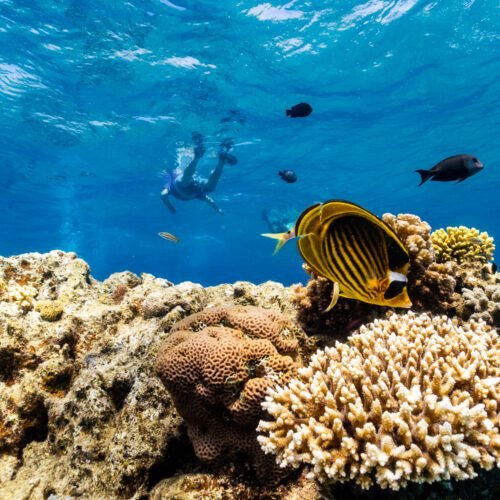
Towering pinnacles of chestnut-colored tabletop corals rose from the sandy seafloor like trees, their broad plate-like canopies sheltering fish hiding in their shadows. Dense thickets of staghorn corals stretched in every direction, their golden antler-like branches twisting across a sprawling reef extending as far as the eye could see, bursting with shades of mustard yellow, pink and lavender pastels.
“It’s like a wonderland,” Cohen said, popping her head above the surface, beaming. “I feel like Alice.”
In today’s oceans, the scene felt almost surreal, said Cohen, 62, who has spent the last 30 years studying coral reefs and the impacts of climate change on marine environments.
But it was a confirmation of something she had long believed: that even as hotter temperatures devastate coral reefs, some still possess an extraordinary ability to endure. She was determined to find out how.
Unlocking the secrets behind their resilience, she said, could one day help scientists and conservationists restore, or even cultivate, reefs better equipped to survive a warming planet.
Searching for super reefs
Over the last decade, a significant part of Cohen’s research has focused on tracking down these reefs that are somehow defying the odds.
In 2018, she started a project dedicated to this search called Super Reefs, named after a number of reefs she’d encountered around the world that seemed to be thriving even while others nearby bleached or died.
“We saw these corals that were behaving as if there was no heat wave at all,” she recalled. “I kind of felt like there was Superman or Superwoman coming in there and flexing their muscles, being super, super strong.”
Three years later she launched a joint global initiative with The Nature Conservancy and Stanford University aimed at not only finding heat-tolerant communities, but also protecting them.
Even the hardiest of reefs are not invincible, she said.
Coastal development projects such as ports or harbors that require dredging can bury corals beneath sediment. Agricultural runoff, sewage and plastic pollution introduce harmful pathogens and excess nutrients that spark coral disease or toxic algal blooms that suffocate the tiny animals. Bottom trawling—a fishing method that drags weighted nets across the seafloor—can crush entire reefs, while dynamite fishing can shatter centuries-old coral colonies in seconds.
“That would be like taking a sledgehammer to crush a hermit crab,” Cohen said.
Already, the world has lost more than half of its coral reefs to the combined pressures of climate change and other human activity. Some scientists warn that without significant intervention, more than 90 percent of tropical reefs could disappear in the next 25 years.
The goal of the new Super Reefs initiative was to specifically identify coral strongholds in places where governments had already demonstrated an invested interest in creating marine-protected areas—designated zones in the ocean where human activities are limited or prohibited to safeguard critical ecosystems.
Belize, Hawaii, and the Marshall Islands fit the bill. All had plans to create or strengthen already established marine-protected areas when the project launched.
This was important, Cohen said. She didn’t want to collect data just for the sake of it. She wanted to make sure the research her team conducted could inform practical decisions related to where and how to protect super reefs. The next challenge was narrowing their search.
Not every reef that shows signs of resilience is a super reef.
By definition, Cohen said, super reefs have to have scientifically proven capabilities of surviving hotter temperatures over time, either because they have genetically adapted to extreme heat or because local ocean conditions like cooler currents have shielded them. They also have to be able to potentially reseed other reefs.
“If we can protect these more climate-resilient reefs and make sure that they are protected from other human impacts like pollution or dredging or other things, then we’re securing those more heat-resistant strains for the future until we can really get global warming under control,” said Lizzie McLeod, global ocean director at The Nature Conservancy, who supported Cohen in the initial stages of the Super Reefs project.
Over the last few years, the Super Reefs team has identified resilient reefs in each of its target locations. But Cohen is convinced they have only scratched the surface.
“There are so many potential super reefs out there that we don’t even know exist,” she said. “We have to go find them.”
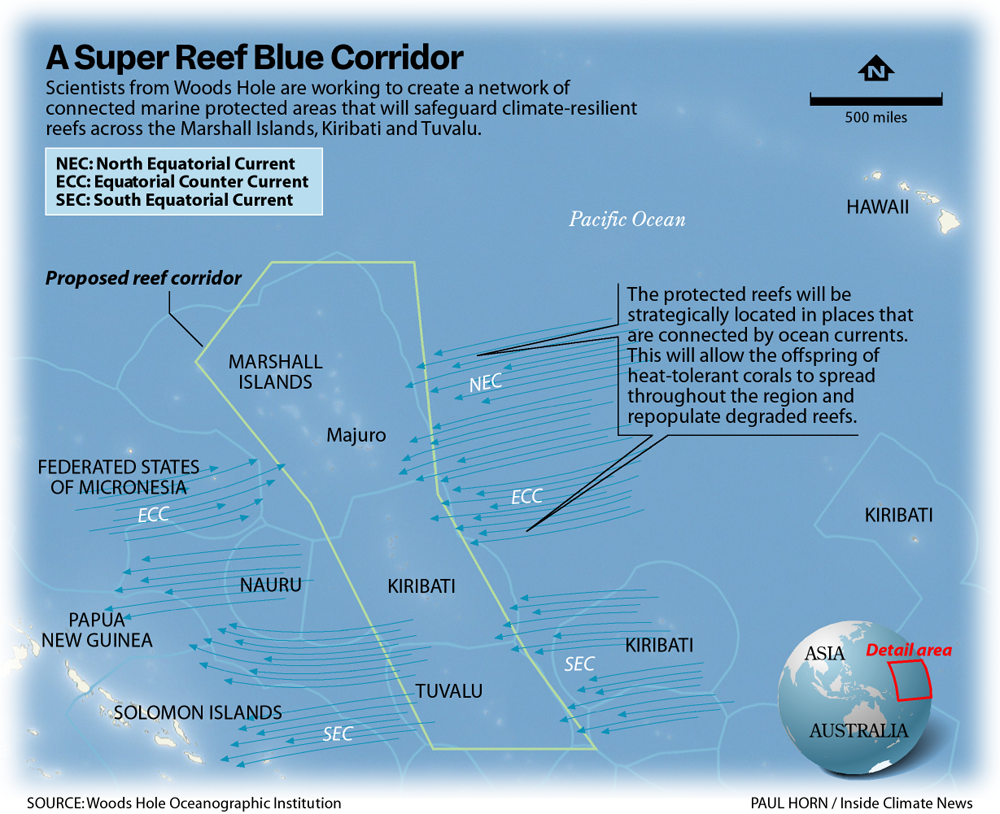
In the Marshall Islands, Cohen hopes some of these reefs might eventually become part of something larger. For years, she’d been dreaming of creating a vast network of protected super reefs that would span multiple Pacific island nations and be linked by ocean currents so that their offspring could help replenish reefs throughout the region.
“We want to create the first ‘super reef blue corridor’ across millions of square kilometers of ocean, connecting the Marshall Islands, Kiribati, and Tuvalu,” she said.
In April, Cohen visited the Marshall Islands to formally pitch her idea and test new technology she believed could dramatically accelerate the search for super reefs in the Pacific.
A nation built on coral
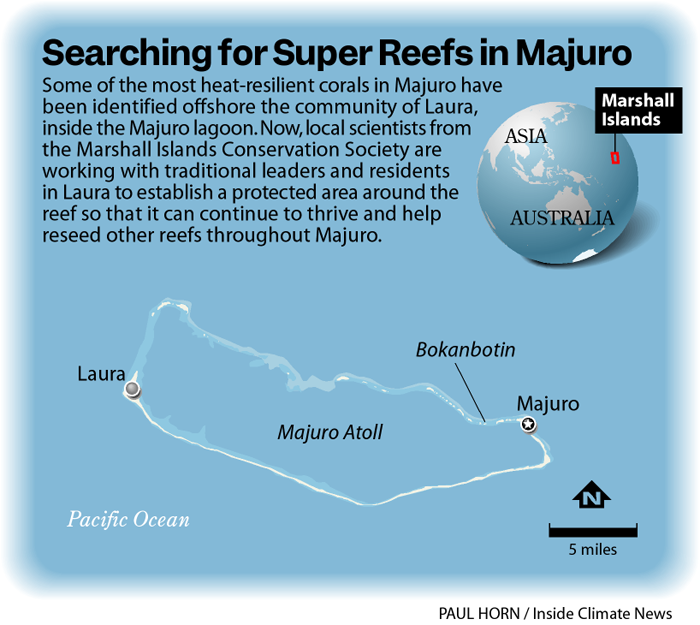
It was her seventh trip to the Pacific nation made up of 29 low-lying atolls and five islands. Majuro—the capital of the Marshall Islands—was one of those atolls, consisting of more than 60 tiny islands that encircle a lagoon spanning more than 100 square miles.
Each visit, she was struck by how intimately the Marshallese peoples’ lives are connected to coral. It formed the very foundation beneath their feet.
“Everything that you see, all the sand, all the land, is all made of coral,” Cohen said. “We wouldn’t be here without it.”
Long before people settled on these atolls, ancient corals built them over millions of years, slowly growing around the rims of volcanoes that eventually sank beneath the sea, leaving rings of reef encircling shallow turquoise lagoons. Over time, broken coral skeletons, rubble and sand accumulated into the thin ribbons of land where Marshallese communities have lived for thousands of years, in many places only a few feet above sea level.
Now, many of these are facing existential threats due to climate change.
A 2021 World Bank analysis shows 40 percent of existing buildings in Majuro are endangered by rising sea levels driven by global warming. Several of them are local schools.
“We’re the first to go with the sea level rise,” said Anthony M. Muller, the Marshall Islands’ minister of natural resources and commerce, speaking from his office overlooking the Majuro lagoon, where giant commercial fishing vessels flying flags from China, Panama, Liberia and Hong Kong sat anchored offshore.
For the Marshallese people, the prospect of losing coral reefs to climate change is also deeply unsettling, said Dua Rudolph, deputy director of the Marshall Islands Conservation Society (MICS), a Majuro-based non-government organization that has been collaborating with the Super Reefs team since 2020.
The majority of Marshallese people, he said, rely on fishing for subsistence or their livelihoods. And those fish depend on the reefs. It’s their home, source of food and spawning grounds. “When the reef leaves, the fish leave also,” Rudolph said. “People are going to start going hungry.”
Already, he said, many reefs throughout Majuro have experienced periods of extensive bleaching. He’d seen it firsthand while conducting in-water surveys to monitor reef health in recent years, especially in 2024, during the last El Niño event—a climate pattern that typically occurs every two to seven years and is often associated with intense marine heat waves.
The majority of Majuro’s formerly “pristine” reefs turned white, they were so stressed, he said. “To see it at that scale was pretty sad.”
So when Cohen first reached out to him via email about the possibility of working together to find and protect coral refugia defying such trends, he thought it sounded almost too good to be true—practically a “fairy tale,” he said.
It felt like this was an opportunity, he said, to “fight back” the “one big enemy that we’ve all been facing.”
Science for action
To begin searching for Majuro’s super reefs, Cohen worked with Woods Hole oceanographers Weifeng Zhang and Yan Jia to build a computer model that could simulate a decade’s worth of temperatures, currents and wave energy throughout the atoll’s lagoon. The goal was to pinpoint Majuro’s hottest waters—places where any surviving corals would likely possess an unusual ability to withstand extreme heat.
To test the model, Cohen asked Rudolph’s team to deploy underwater temperature loggers and current sensors on reefs throughout the Majuro lagoon. They identified several sites of interest, but one in particular stood out just offshore a community on the southwestern edge of Majuro, named Laura. There, the water temperature appeared to run nearly two degrees hotter than much of the rest of the capital, Cohen said.
Then Rudolph’s team from MICS collected samples from a variety of coral species at each site to test for heat tolerance with scientists from the Resist, Recover and Rebuild group at Stanford University, which studies how corals adapt to climate change.
Together, they built their first coral-testing lab on a local dock using picnic coolers, aquarium heaters, chillers and temperature controllers. Inside the coolers, they exposed the collected coral fragments to carefully controlled bursts of heat “designed to mimic the extreme temperatures reefs experience during hot days at low tide,” said marine biologist Stephen Palumbi, who oversees the coral recovery program at Stanford University’s Hopkins Marine Station. It soon became apparent, he said, which corals bleached quickly under heat stress and which ones could endure.
By the end of the experiments, Palumbi said they were able to rank which corals appeared most capable of surviving extreme heat and pinpoint where they came from. True to what Cohen’s model had indicated, some of the toughest were from Laura, inside the Majuro lagoon.
Rudolph and his team at MICS, along with staff from The Nature Conservancy, have since shared these findings with the community of Laura, with the hopes of building support for creating a locally managed marine area around the super reef identified off their shores. The effort is being guided by a process called Reimaanlok—Marshallese for “looking to the future”—a community-led conservation framework that brings together local leaders, landowners and residents to determine whether and how an area should be protected based on both traditional knowledge and modern science.
“The Reimaanlok process is designed to ensure conservation areas are community-led, culturally appropriate and sustainable over the long term,” said Alicia Edwards, the protected areas’ network coordinator for the Marshall Islands Marine Resources Authority, the government agency responsible for managing the country’s marine resources and fisheries.
At first, Rudolph said, some leaders were hesitant. The idea of limiting fishing in any area did not sit well in a community of about 900 people—almost all of whom are fishers.
The super reef site is a common fishing ground. At night, community members wade along the shallow reef flat using spears and machetes to snag fish and octopus, oftentimes crushing fragile corals beneath their feet without knowing it, said Jina David, a local councilman in Laura who has been advocating for the proposed protected area. Fishing boats regularly drop their heavy anchors onto the reef too, he said.
But after explaining the science and reasoning behind the idea of creating a protected area around the reef, Rudolph said, some attitudes have begun to shift, especially after learning that it would not only benefit Laura residents long-term, but likely other communities too.
“We don’t just do things that would benefit only one or two people,” Rudolph said of Marshallese culture. “More often, you see communities agreeing on things that will benefit more people.”
Research has shown that reducing fishing pressure and other human disturbances inside marine protected areas can help fish populations rebound and even spill into surrounding areas. Coral reefs that retain their diversity and ecological balance are also generally better equipped to recover from the impacts of climate change such as coral bleaching, said Edwards.
Cohen’s team had also found evidence that Laura’s super reef could serve as a source of recovery for the broader atoll. Using ocean current data to model where coral larvae released from the reef would likely travel, they found that the offspring from Laura’s most resilient reef could spread throughout Majuro, potentially helping populate distant reefs with the next generation of heat-tolerant corals.
Still, David said, it will probably be at least two years before the community comes to consensus to protect Laura’s super reef.
“We’re going to have to find a way to convince people this is something we really need,” he said. Otherwise, “we might overfish and kill everything here. Nothing would be left for the future generation.”
Just beyond his beachside home, David had already observed a once thriving reef disappear.
“We don’t do fishing out here on our beach because all the corals on this side of the island have been dying,” he said. “If you go snorkeling here, you will hardly see any live coral.”
He worries the situation will only worsen as ocean temperatures continue to rise. “The water is heating up,” he said. “It’s hot, actually, to the touch.”
Science for scale
For Cohen, the case of Laura was proof that the Super Reefs strategy could work. Scientists can identify reefs that could withstand extreme heat and generate the data communities and governments need to make informed conservation decisions.
But this case study also underscored a larger challenge. Finding just a handful of reefs in Majuro had taken years of modeling and lab experiments. And testing a coral’s heat tolerance in a cooler is just the beginning of understanding its threshold, Cohen said.
To identify the strongest of super reefs, she said, she needed to be able to monitor vast areas of reef year after year to see how they respond to heat waves in their natural environment.
“We want to do it bigger, better, faster,” said Cohen. But, she added, “We need new tools.”
That’s where Yellowfin comes in.
Originally, the vehicle had been built by Cohen’s colleague, Peter Traykovski—a coastal oceanographer and engineer at Woods Hole—to map underwater seascapes and track erosion along shifting coastlines using sonar. But Cohen asked Traykovski to adapt it for her research by mounting a GoPro beneath its hull so it could continuously take photographs as it surveyed a coral reef.
Yellowfin can now capture up to 20,000 images while surveying 40 miles of reef in a single day.
That’s far more than a team of divers can cover in weeks using traditional coral monitoring methods, which require researchers to swim or dive along a reef to assess the state of its health, Cohen said.
“Nobody can do that,” she said of Yellowfin’s capabilities. “Not even if you had a team of 100 divers.”
By conducting multiple surveys year after year of the same reef and comparing the images from each of those, Cohen said she can easily identify areas that have bleached, died or recovered. She can also pinpoint which coral colonies seem completely unphased by higher temperatures.
“You’ve got corals in the same area with very different responses to heat, and that’s what Yellowfin is finding,” she said. And it’s doing it fast. “We can do this over huge areas, very easily and in a very short amount of time.”
But the system is still a work in progress. This past trip to Majuro was, in part, an opportunity to refine and practice using the technology, so they could be assured that when the next heat wave hits, Yellowfin can be deployed without any glitches, Traykovski said.
To do that, Cohen and Traykovski spent multiple days returning to the reef Cohen had described as a “wonderland” early on in the expedition. It was the perfect testing ground for Yellowfin to survey a large area of reef and for Cohen to collect samples of corals that showed promising signs of resilience, she said. She could see from past years’ photos that some sections that had bleached had since recovered.
One afternoon, seated at the back of the boat with a laptop and remote controller in hand, Traykovski guided Yellowfin along a series of GPS waypoints, sending the bright yellow vessel back and forth across the reef in precise “lawnmower” patterns.
“Heads up,” he yelled to Cohen and other snorkelers in the water. “Watch out for Yellowfin.”
As it cruised by, it continued snapping two photographs every second of the seafloor below. Each image was tagged with GPS coordinates, which would allow researchers to return to the same section of reef, or even the same coral colony, during future expeditions.
Previously, Cohen would scan these images manually after each trip, spending hours on end looking for corals that stood out because of their ability to resist or recover from heat stress.
Recently, her team at the Cohen Lab at Woods Hole has begun training AI models to analyze these images automatically.
They are also using Yellowfin images to create detailed three-dimensional models of the reef to get a better idea of how the depth, angle or orientation of individual coral colonies may affect how much heat they are exposed to.
“With 3-D models we can see how a coral’s position relative to the coral next door can influence its survival during a heat wave,” Cohen said. “This information is not captured from the 2-D top-down images created by Yellowfin and may explain why some bleach and others don’t.”
When Yellowfin finished its survey, Traykovski then directed it to start finding particular corals Cohen wanted to check on.
She was especially interested in tabletop corals that form large circular flat-topped platforms on the reef, some bigger than a queen-sized bed. Their broad canopies provide shelter for countless fish and other marine creatures, making them some of the most iconic and ecologically important species in the Marshall Islands. They’re also notoriously sensitive to heat stress and are often among the first corals to bleach, she said.
She carried laminated photos of some of the corals Yellowfin had helped photograph in previous surveys to bring underwater with her so she could examine how they were doing now compared to then.
“Both of these pictures were taken here in the Marshall Islands in 2024,” she said, showing off one of the laminated pages. “What you can see in each picture is one coral that’s bleached and the other—exactly the same species—that’s not bleached. That’s not sick. That’s absolutely healthy, almost like it’s been immunized or vaccinated against the heat.”
That contrast was what fascinated her.
Why had one coral succumbed to heat stress while the other remained healthy, she wondered. Did it possess a genetic trait that made it more tolerant of heat? Or was it actually a different species that only looked similar? Cohen suspected there was far more genetic diversity among tabletop corals than scientists have previously documented in Majuro.
A few moments later, Yellowfin slowed to a stop. “They should be right there,” Traykovski said, pointing to the robot hovering at the surface.
Still, spotting them underwater wasn’t always straightforward, Cohen told AJ Alik, a fisheries officer at MICS who was on board to help for the day. A coral that had bleached, died or broken apart might look nothing like it did in the photographs, she explained.
As she prepared to enter the water, Cohen studied her laminated images for clues, searching for landmarks near the corals that she could look for on the reef, if necessary, to confirm she was in the right place.
But after freediving down about 10 feet below the yellow robot, Cohen quickly found what she was looking for. She popped her head up to breathe. “I think that’s it.”
One of the two massive tabletops was still alive, to her relief.
Then, Alik and Cohen dove down again together to clip a small fragment from the living coral. They tagged the colony with an identification number and attached a matching label to the sample bag so the fragment could later be traced back to the colony it came from.
Later, Cohen would send the samples to collaborators at James Cook University in Australia for genetic analysis, along with others she’d collected on this expedition from tabletop corals that had bleached—according to Yellowfin’s photos—but now seemed recovered, as well as from seemingly healthy corals persisting alongside neighbors showing signs of heat stress. If researchers could identify the traits associated with heat tolerance, Cohen said, they could return to those same corals later on and use them in future reef restoration efforts.
Rebuilding resilient reefs
Globally, coral researchers and conservationists have dedicated enormous efforts to replanting fragments of corals on damaged and depleted reefs with hopes that they will help build a new reef. But in general, Cohen said, the long-term success rate of these initiatives is not very high. Many of the corals they’ve been planting are the same ones vulnerable to bleaching elsewhere, she said.
Effective restoration, she said, must employ the help of corals that can take the heat.
That approach—using scientifically proven heat-resilient corals to rebuild damaged reefs—is very new, said Palumbi. While scientists have spent around a decade testing corals for heat tolerance, only recently have they begun applying those findings to restoration.
“The idea of using them as a supply chain for restoration projects is something that really grew out of the Super Reefs project,” Palumbi said.
Alik and his colleagues at MICS are in the early stages of experimenting with this approach by planting small underwater plots of corals that they tested with Palumbi for heat tolerance. In time, Alik said, those colonies could become a nursery of sorts—a source of coral fragments that could be used in larger restoration efforts in Majuro, and possibly beyond.
A Super Reef blue corridor
It was time to think bigger, Cohen said.
To really give reefs a greater chance of enduring more frequent and severe heat waves, it would not be enough to protect a few super reefs here and there in isolation, she said. They needed to be connected.
On a hot, humid Sunday afternoon, she presented her idea to several Marshallese authorities in charge of managing the country’s marine resources and a group of teachers and high school students from Majuro who had come to learn about super reefs.
They gathered on Bokanbotin, a small island about a 10-minute boat ride away from downtown Majuro owned by a local family that had established the waters around the island as a legally recognized marine protected area. Recently, Cohen had begun working with the island’s owner, Sherwood Tibon, to build a small science lab and education center where local children could learn about coral reefs. Eventually, she hopes Bokanbotin will become one of the primary research hubs for her next initiative.
Having grown up in South Africa, Cohen told the group she had long been inspired by protected wildlife corridors there, which give elephants, lions, wildebeest, and other animals the freedom to roam, migrate, and breed across landscapes and neighboring country borders to ensure they sustain healthy, genetically diverse populations.
More recently, conservationists have started to advocate for the protection of “blue corridors”—migratory pathways used by marine megafauna, such as whales and sharks, to travel between different habitats used to feed, mate, or give birth to their young.
Now, Cohen wanted to create something similar, but specifically for heat-tolerant corals—a “super reef blue corridor.”
Nowhere else was there such a thing yet, she said. She believed the Marshall Islands had an opportunity to help create the first.
This corridor, she said, would include a network of protected super reefs and restoration sites, where she envisioned heat-tolerant corals being planted like underwater “forests,” throughout the Marshall Islands, Kiribati, and Tuvalu. Most importantly, she added, each of the selected sites would be strategically connected by ocean currents to encourage interbreeding of these resilient animals.
“We need to create maximum opportunity for them to create this oceanic shield of heat tolerance,” she said.
It would be like a “super highway” for “super corals,” she said, where their eggs and sperm would have the best chance of meeting to produce more “super babies.”
It was an ambitious idea, she said, that would require political support and significant financial backing—about $10 million by her estimate—as well as community buy-in. Not every super reef can be cordoned off to fishing and other activities, she said.
“People need to live. People need to eat. They need to fish.” It would be critical, she said, to consult with and co-design any protected areas in this corridor with communities that would be impacted, as is being done in Laura.
But overall, the idea seemed feasible, the Marshall Islands Marine Resources Authority’s Edwards said. “The idea of creating a multi-national network of marine-protected areas connecting resilient reefs across the Marshall Islands, Kiribati, and Tuvalu is a very promising concept,” she said.
Other experts agree. “Protecting source reefs and well-placed stepping stones between them can maintain dispersal networks that can share heat-tolerant adaptations and provide new coral larvae to help degraded reefs recover,” said Emily Darling, director of coral reefs at the Wildlife Conservation Society. “Accounting for connectivity between high-integrity, climate-resilient reefs multiplies their conservation value across an entire region.”
Once established, Cohen said, this first Super Reef corridor could serve as a proof of concept for creating similar protected networks around the globe.
Future corridors might be created between Indonesia, the Philippines, and Malaysia, she said, or India, the Maldives, and the Chagos Islands in the Indian Ocean.
Ultimately, she said, the success of these networks would depend on countries’ willingness to collaborate and select which reefs they would prioritize. Her role, as she sees it, is to deliver the scientific data to inform those choices. She wants to ensure that resources are directed where they can have the greatest impact—as quickly as possible.
“This is an urgent mission,” she said.
Forecasters recently warned that El Niño conditions have formed once again in the tropical Pacific and are expected to strengthen by this fall.
In the coming months, Cohen said, “We have a pretty strong chance of having a heat wave in the Marshall Islands.” She was already having nightmares of it ravaging the vibrant reefs she’d just visited.
“It’s just a horrible feeling,” she said, gazing out toward a shallow reef offshore Bokanbotin.
But she wanted to be there when it hit. She had already started to plan her return trip to the Marshall Islands before she left.
“We want to be there in the peak of that heat wave to send Yellowfin out and see how the corals are doing,” she said. “I have a pretty good idea which corals will resist because we’ve seen them do it before. But we need to make sure.”
This article originally appeared on Inside Climate News, a nonprofit, non-partisan news organization that covers climate, energy, and the environment. Sign up for their newsletter here.
German Nun Awarded Order of Merit After Decades of Caring for Leprosy Patients in Pakistan
[ISLAMABAD] Germany has honored a long-serving humanitarian worker at the Rawalpindi Leprosy Hospital with the Order of Merit (Federal Cross of Merit) of the Federal Republic of Germany in recognition of decades of medical and social service to some of Pakistan’s most vulnerable patients.
In a ceremony held on Wednesday at the German Ambassador’s Residence in Islamabad, the award was presented by German Ambassador Ina Lepel on behalf of German President Frank-Walter Steinmeier, who had approved the distinction on April 29.
The Order of Merit is Germany’s highest civilian honor and is awarded for exceptional contributions to society, including humanitarian work and public service.
This year’s recognition was given to Sister Annette Dimigen, a member of the Protestant Sisterhood of the Christ Bearers, for nearly 30 years of service at the Rawalpindi Leprosy Hospital, also known as the German Leprosy Hospital.
She arrived in Pakistan in 1997 and has since played a key role in both administrative operations and humanitarian outreach through the Aid to Leprosy Patients (ALP) Association.
Born in Hanover in 1964, Sister Annette initially worked as an agricultural engineer and inspector before joining the sisterhood and dedicating her life to volunteer service in Pakistan.
Over the decades, she has helped support thousands of patients affected by leprosy, tuberculosis (including multidrug-resistant TB), and cutaneous leishmaniasis.
The embassy praised her long-standing commitment, saying she served “with deep dedication, guided by charity and compassion for those in need,” and described her as one of Germany’s most effective humanitarian representatives in Rawalpindi.
It also highlighted her collaborative work with hospital colleagues, including Dr. Chris Schmotzer, and the broader medical and nursing teams who have worked for decades to expand treatment access and reduce stigma around leprosy.
The Rawalpindi facility remains one of the region’s key specialized centers, providing care to hundreds of thousands of patients annually through both inpatient and outpatient services.
Rawalpindi Leprosy Hospital was founded by Sister Ruth Pfau, a German-born physician and Catholic nun who devoted her life to fighting leprosy in Pakistan.
She arrived in the country in 1960 and played a pioneering role in establishing a nationwide network for the treatment and rehabilitation of leprosy patients, which later expanded into specialized care centers, including services linked to Rawalpindi.
Through her leadership and collaboration with local medical teams, she helped introduce modern treatment approaches, train healthcare workers, and significantly reduce the stigma surrounding the disease.
Her lifelong humanitarian work earned her widespread national and international recognition, and she is remembered as one of the most influential figures in Pakistan’s public health history.
Pakistan didn’t just appreciate her informally, it officially decorated her with some of its highest civilian awards, treating her as a national humanitarian icon.
She passed away on August 10, 2017, in Karachi, at the age of 87.
State-level recognition and national respect were bestowed upon her. In 2017, after her death, she was afforded a state funeral in Karachi, accompanied by full military honors.
Wasian and proud — but does the label uplift or divide?
“Wasians” are having a moment right now. Think of Winter Olympians Alysa Liu and Eileen Gu, singer-songwriter Olivia Rodrigo, actors Lola Tang (The Summer I Turned Pretty) and Hudson Williams (Heated Rivalry), or singer/dancer Megan Skiendiel from Katseye.
In fact, Icelandic-Chinese singer Laufey featured many of these same “Wasians” in her recent Madwoman music video.
“Wasian” is a portmanteau of the words white and Asian. It has been popularised in coverage around a growing cohort of high-achieving young Gen Z artists, athletes, and actors of mixed white and Asian heritage – and proud of it.
The hype around “Wasianness” has galvanized mixed- or half-Asian meetups trending on social media. This includes the recent “largest half-Asian gatherings ever” in New York and San Francisco in May. One is planned for Melbourne later this month.
Many of these meet-ups have sought to include non-Wasian half-Asians – people with, for instance, one Asian parent and one Black parent. Yet much of the recentmediafocus has been on “Wasians.”
But not everyone loves the term – and the ideas underpinning it are ripe for interrogation.
A language for shared experiences
Part of the appeal of the term lies in its ability to create community. Mixed-race people often feel they must choose one side, or be excluded from both.
A common experience for many “Wasians” is being seen as “not Asian enough”, especially when it comes to Asian language or cultural knowledge skills. Your family background or appearance may also be deemed “insufficiently Asian.”
Mixed-race Asians can find themselves in a paradoxical position; too Asian to be fully accepted as white, yet insufficiently Asian to be recognized as “properly” Asian.
“Wasian” can provide a language for shared experiences that don’t fit neatly in conventional racial categories.
The increasing visibility of mixed white-Asian public figures also conveys a sense that (some) mixed-race identities are becoming more recognized and celebrated.
If you’ve grown up navigating multiple cultural worlds, the idea can be empowering. It can serve as a form of self-identification and resistance to labels often imposed by others. It can be about strategically reclaiming space through coming together over shared experiences.
Viral “waydar” or “mixed Asian radar” social media clips highlight “superpowers” of connection between mixed Asians against experiences of marginalization.
Yet, much of the “Wasian” discourse centres whiteness in ways that other mixed-race descriptors do not. This label specifically highlights white-Asian ancestry rather than mixed-raceness more broadly.
This can reinforce the idea that whiteness remains the desirable point of reference. Race upholds hierarchies. As such, not all mixed-race identities are valued equally.
As some social media users have observed, the “Wasian” label raises questions about a society that values proximity to whiteness. We must ask whether mixed white-Asian identities are afforded social advantages unavailable to other minority groups.
These debates are further complicated when considering beauty standards and representation.
The current “Wasian” moment has emerged alongside media that frequently privileges lighter skin, Eurocentric features and racially ambiguous appearances. This reflects colourism shaped by racial and class hierarchies, among others.
Yes, greater visibility for mixed-race people can be positive. But it can also reproduce longstanding hierarchies. Certain kinds of racial diversity are presented as more palatable because they more closely reflect dominant white norms.
The celebration of “Wasian” identities can even sometimes slide into a celebration of “acceptable” Asianness. It is a version of Asianness that is softened, diluted or made more palatable through association with whiteness.
It raises questions about who can claim an identity, how racial belonging is policed, and why some forms of racial mixture attract celebration over others.
One of us (Aaron Teo) is a parent of a mixed-race child, and the other (Alexandra Lee) is mixed-race. For us, the issues surrounding “Wasianness” underscore the fact race remains deeply shaped by histories of exclusionary hierarchy and unequal power.
In other colonial contexts, such as India and French colonial Indochina, mixed children were born under wider conditions of (sexual) violence perpetrated by white male colonizers against local populations.
Racial mixedness has been the norm in many Meso- and South American countries, and a feature of non-Western scholarship. Chicana (Mexican-US) feminist writer Gloria Anzaldúa, for instance, writes about what she calls “mestiza consciousness.” This is a fluid way of navigating multiple identities that embraces contradiction rather than seeking strict definitions.
However, these kinds of perspectives seem to be diminished or even absent from much of the current “Wasian” discourse, reflecting the dominance of white Western perspectives.
Questioning racial hierarchies
The label “Wasian” goes some way to disrupting conventionally separate categories of white and Asian. But it can still fail to meaningfully disrupt existing racial hierarchies and race-based categorization.
The current “Wasian” discussion presents an opportunity to shake up conversations about race and identity. If we’re interested in disrupting the status quo, it’s important to think carefully about how the discourse fits with broader systems that perpetuate racism and celebrate whiteness.
Indonesia needs not only GCC investors, but also bankable green projects
In a previous essay, we argued that Indonesia’s sovereign wealth fund, Danantara, could serve as a bridge between the Gulf’s immense pools of capital and Indonesia’s vast renewable energy potential. That argument remains valid. As Gulf Cooperation Council (GCC) countries diversify beyond hydrocarbons and seek long-term investments in emerging markets, Indonesia stands out as one of the world’s most promising destinations for renewable energy development.
Yet capital alone cannot deliver an energy transition. If Indonesia is serious about achieving President Prabowo Subianto’s ambition to build up to 75 gigawatts of renewable energy capacity in the coming decades—a transformation that could require at least US$235 billion in investment—it will need not only GCC investors, but also something far less discussed: a pipeline of bankable green projects.
This distinction matters because green investment has become one of the defining economic priorities of our era. The Monetary Authority of Singapore estimates that ASEAN requires approximately US$200 billion in green investment annually through 2030 to meet climate and development goals. Despite this enormous demand, investment flows continue to fall short, reflecting not only financing gaps but also the difficulty of generating commercially viable projects capable of attracting capital at scale.
Indonesia exemplifies this challenge. For years, the country has announced increasingly ambitious renewable energy targets while paying insufficient attention to the institutional, social and bureaucratic foundations necessary to achieve them.
Renewable energy plans are unveiled, investment figures are celebrated and gigawatts are promised. Yet much less attention is devoted to project preparation, local participation and capacity building.
Ask financiers what constrains green investment in emerging markets, and many offer a surprisingly consistent answer: money is not always the problem. Rather, the shortage lies in bankable projects. A bankable project is more than an engineering blueprint or political aspiration. It requires clear regulations, predictable revenue streams, manageable risks, community support and business models that can generate long-term returns.
This problem is particularly acute in Indonesia. Even institutions established to facilitate energy transition financing often face limitations in preparing investment-ready projects. Designing renewable energy investments requires expertise that spans engineering, project finance, land acquisition, environmental safeguards and stakeholder engagement. Such capabilities cannot be built overnight, yet they are essential if Indonesia hopes to translate ambitious targets into actual infrastructure.
The experience of GCC investors offers important lessons in this regard. Investors from the Gulf have demonstrated a greater willingness than many conventional financiers to enter frontier sectors and support projects from an early stage.
The UAE-backed Cirata floating solar project illustrates how Gulf capital can help pioneer new technologies and business models in emerging markets. What this experience suggests is not that Indonesia lacks interested investors, but that attracting sustained investment requires a stronger pipeline of projects that meet international standards of bankability.
OPINION: Danantara and the Gulf could finally turn Indonesia’s renewable energy ambition into reality
Increasingly, therefore, the bottleneck lies on Indonesia’s side. The country still lacks a comprehensive blueprint for renewable energy development that integrates project preparation, institutional coordination and community readiness. Announcing large investment targets is important, but targets alone cannot substitute for the painstaking work of developing projects capable of convincing investors that risks are manageable and returns are achievable.
This challenge extends beyond economics and finance. Renewable energy transitions are not merely technological transformations; they are also social transformations. Indonesia has often approached infrastructure development from the top down, with government institutions dominating nearly every stage of project implementation. Yet renewable energy may deliver its greatest benefits when built from the bottom up, through stronger participation by local governments, cooperatives and communities.
Community-based renewable energy projects can create stronger local ownership, reduce resistance and ensure that the economic benefits of investment extend beyond state institutions and large corporations. Such an approach generates broader trickle-down effects while helping communities become active participants rather than passive recipients of development. A green transition rooted in society is ultimately more durable than one imposed solely through government policy.
Indonesia’s broader development experience reinforces this lesson. The World Bank has argued that faster growth and better jobs depend on business-enabling reforms, regulatory certainty and investments in both physical and human capital. Weaknesses in regulation, competition and market reforms have constrained private investment and kept resources concentrated in lower-value activities. Similar barriers continue to hinder renewable energy development, limiting the country’s ability to attract new technologies, expertise and capital.
Danantara therefore has an opportunity to become more than an investment vehicle. It can become an institution that prepares projects. Establishing a dedicated green project preparation facility under Danantara or PT SMI—a Special Mission Vehicle under the Ministry of Finance and Indonesia’s designated ETM Country Platform, though one that has itself been criticized for lacking the technical capacity to structure bankable green projects—with international technical partners would strengthen project readiness. Standardizing power purchase agreements and improving State Electricity Company’s credit-enhancement mechanisms could reduce uncertainty for investors. Expanding capacity-building programs for project finance professionals within state institutions would further strengthen Indonesia’s renewable energy ecosystem.
Most importantly, Indonesia should pilot several fully bankable renewable energy projects with GCC partners before announcing ever larger investment portfolios.
Indonesia’s renewable future will not be determined solely by the amount of capital it can attract. It will depend equally on whether the country can build institutions, communities and project pipelines capable of transforming ambition into reality. GCC investors can become important partners in this transition, but even the deepest pools of capital require projects worthy of investment.
Indonesia’s green transition therefore requires two things at once: investors willing to finance the future and institutions capable of building it. Without both, ambitious targets will remain on paper. With both, Indonesia could emerge as one of the most important renewable energy success stories in the Global South.
OPINION: The latest Indonesia-Qatar defence agreement needs deliverables, not diplomacy
The views expressed in this article belong to the author and do not necessarily reflect the editorial policy of Middle East Monitor.
Android verification is coming: Google confirms timeline and supported app stores
Almost 20 years ago, Google pitched Android as the more open alternative to Apple’s walled garden. Last year, Google announced it would begin erecting its own walls through developer verification. The company has issued an update on its plans, affirming that the verification system will begin rolling out in select countries later this year. We’re also learning which app stores are participating in verification and the timeline for key features like the recently revealed “advanced flow” for bypassing verification.
Google has claimed that developer verification is a necessary change to smartphone software distribution, pointing to the increased prevalence of scams that trick Android users into installing malware apps. Google’s solution requires verifying the identities of developers outside the Play Store just like it does for devs publishing on its platform. This has proven to be a contentious change for myriad reasons.
In the new blog post, Google’s Matthew Forsythe confirms that the developer verification system is slated to come online on September 30 of this year. The initial deployment will be limited to countries with a high level of app scams: Brazil, Indonesia, Singapore, and Thailand.
Google released its new developer console back in March, giving external developers the opportunity to pay $25 and verify their identities early. Developers who don’t register will find that their apps cannot be sideloaded on Google-certified Android devices once verification has rolled out. Google says that almost every app in the Play Store is now ready for the change, and a “large majority” of apps outside Google Play have completed verification.
This system places more burden on developers who want to make software for Android, even if they don’t want to deal with Google directly. There are a few updates that aim to streamline the experience. Google is following through on its promise to extend verification to trusted third-party stores—if a developer is verified in one of these storefronts, they are verified on Google’s side. Google says it will verify the apps in the following stores when it begins enforcing the new restrictions.
Google (Google Play)
Honor (HONOR App Market)
OPlus (OPPO App Market)
Samsung (Galaxy Store)
Transsion (Palm Store)
vivo (V-Appstore)
Xiaomi (GetApps)
Developers will also have access to new APIs to make registering as an external developer less arduous. In the coming months, Google will release an Android Developer ID Status API that will check if a package name is already registered with Google. The Android Developer Console API will let you register and manage your app package names without leaving your development environment, too.
The countdown begins
The next step toward verifying apps will come this month as Google deploys a new system service on most certified devices. The package (com.google.android.verifier) will appear on phones and tablets running Android 8 or higher, allowing Google to block the installation of unverified apps. It will remain dormant until verification is activated in your specific region.
Credit: Google
Credit: Google
In July, Google plans to roll out the new developer APIs and begin testing for “limited distribution” accounts. This is Google’s solution for hobbyists who want to make their own apps and share them with a small group. Limited accounts won’t require a fee or government ID verification, but you can install these apps on up to 20 devices.
In August, the advanced flow will become available globally ahead of verification becoming mandatory in the first markets. As detailed a few months ago, the advanced flow will allow users to bypass verification, but the process isn’t easy. You’ll have to navigate to a buried menu, confirm you understand the risks multiple times, and wait a whole day before completing the process.
And that brings us to September, when Android devices in Brazil, Indonesia, Singapore, and Thailand will begin checking verification status before installing apps. However, things get murky after that. Google will undoubtedly monitor how verification works as millions of users are suddenly limited to verified apps, which could affect how it moves forward. Google says it intends to expand developer verification in 2027, eventually making it a global device policy.
All 380 fixtures for 2026/27 Premier League season
The 2026/27 Premier League fixtures have been released and the dates of all 380 matches are below.
The kick-off times of weekend and Bank Holiday matches are 15:00 UK time, while for midweek matches it is 20:00 unless otherwise stated.
Friday 21 August 2026 20:00 Arsenal v Coventry City (Sky Sports)
Saturday 22 August 12:30 Hull City v Manchester United (TNT Sports) Everton v Crystal Palace Ipswich Town v Sunderland Nottingham Forest v Leeds United 17:30 Brentford v Tottenham Hotspur (Sky Sports)
Sunday 23 August 14:00 Brighton & Hove Albion v Aston Villa (Sky Sports) 14:00 Manchester City v AFC Bournemouth (Sky Sports) 16:30 Newcastle United v Liverpool (Sky Sports)
Monday 24 August 20:00 Fulham v Chelsea (Sky Sports)
Saturday 29 August AFC Bournemouth v Everton Aston Villa v Arsenal Chelsea v Brighton & Hove Albion Coventry City v Hull City Crystal Palace v Manchester City Leeds United v Brentford Liverpool v Nottingham Forest Manchester United v Ipswich Town Sunderland v Fulham Tottenham Hotspur v Newcastle United
Saturday 5 September Arsenal v Chelsea Brentford v Sunderland Brighton & Hove Albion v Leeds United Everton v Manchester United Fulham v Crystal Palace Hull City v Aston Villa Ipswich Town v Liverpool Manchester City v Coventry City Newcastle United v AFC Bournemouth Nottingham Forest v Tottenham Hotspur
Saturday 12 September AFC Bournemouth v Brentford Aston Villa v Nottingham Forest Chelsea v Hull City Coventry City v Brighton & Hove Albion Crystal Palace v Ipswich Town Leeds United v Newcastle United Liverpool v Fulham Manchester United v Manchester City Sunderland v Arsenal Tottenham Hotspur v Everton
Saturday 19 September AFC Bournemouth v Liverpool Brentford v Chelsea Brighton & Hove Albion v Arsenal Everton v Ipswich Town Fulham v Manchester United Leeds United v Crystal Palace Manchester City v Sunderland Newcastle United v Hull City Nottingham Forest v Coventry City Tottenham Hotspur v Aston Villa
Saturday 10 October Arsenal v Leeds United Aston Villa v Brentford Chelsea v AFC Bournemouth Coventry City v Newcastle United Crystal Palace v Nottingham Forest Hull City v Everton Ipswich Town v Fulham Liverpool v Manchester City Manchester United v Tottenham Hotspur Sunderland v Brighton & Hove Albion
Saturday 17 October AFC Bournemouth v Sunderland Brentford v Liverpool Brighton & Hove Albion v Crystal Palace Everton v Chelsea Fulham v Hull City Leeds United v Manchester United Manchester City v Ipswich Town Newcastle United v Aston Villa Nottingham Forest v Arsenal Tottenham Hotspur v Coventry City
Saturday 24 October Arsenal v Everton Aston Villa v Manchester City Chelsea v Tottenham Hotspur Coventry City v Fulham Crystal Palace v Newcastle United Hull City v Brentford Ipswich Town v Nottingham Forest Liverpool v Brighton & Hove Albion Manchester United v AFC Bournemouth Sunderland v Leeds United
Saturday 31 October AFC Bournemouth v Leeds United Aston Villa v Fulham Brentford v Nottingham Forest Chelsea v Manchester United Coventry City v Sunderland Hull City v Ipswich Town Liverpool v Arsenal Manchester City v Brighton & Hove Albion Newcastle United v Everton Tottenham Hotspur v Crystal Palace
Saturday 7 November Arsenal v Hull City Brighton & Hove Albion v Brentford Crystal Palace v Liverpool Everton v Coventry City Fulham v Newcastle United Ipswich Town v AFC Bournemouth Leeds United v Tottenham Hotspur Manchester United v Aston Villa Nottingham Forest v Manchester City Sunderland v Chelsea
Saturday 21 November AFC Bournemouth v Nottingham Forest Aston Villa v Sunderland Brentford v Everton Chelsea v Leeds United Coventry City v Crystal Palace Hull City v Brighton & Hove Albion Liverpool v Manchester United Manchester City v Fulham Newcastle United v Arsenal Tottenham Hotspur v Ipswich Town
Saturday 28 November Arsenal v Manchester City Brighton & Hove Albion v Newcastle United Crystal Palace v Hull City Everton v Liverpool Fulham v AFC Bournemouth Ipswich Town v Aston Villa Leeds United v Coventry City Manchester United v Brentford Nottingham Forest v Chelsea Sunderland v Tottenham Hotspur
Wednesday 2 December 20:00 AFC Bournemouth v Brighton & Hove Albion 20:00 Aston Villa v Everton 20:00 Brentford v Arsenal 20:00 Chelsea v Crystal Palace 20:00 Coventry City v Ipswich Town 20:00 Hull City v Nottingham Forest 20:00 Liverpool v Sunderland 20:00 Manchester City v Leeds United 20:00 Newcastle United v Manchester United 20:00 Tottenham Hotspur v Fulham
Saturday 5 December AFC Bournemouth v Hull City Aston Villa v Crystal Palace Brentford v Manchester City Chelsea v Liverpool Everton v Fulham Leeds United v Ipswich Town Manchester United v Coventry City Newcastle United v Sunderland Nottingham Forest v Brighton & Hove Albion Tottenham Hotspur v Arsenal
Saturday 12 December Arsenal v AFC Bournemouth Brighton & Hove Albion v Everton Coventry City v Aston Villa Crystal Palace v Manchester United Fulham v Brentford Hull City v Tottenham Hotspur Ipswich Town v Newcastle United Liverpool v Leeds United Manchester City v Chelsea Sunderland v Nottingham Forest
Saturday 19 December AFC Bournemouth v Coventry City Arsenal v Manchester United Brentford v Newcastle United Brighton & Hove Albion v Ipswich Town Chelsea v Aston Villa Leeds United v Fulham Liverpool v Tottenham Hotspur Manchester City v Hull City Nottingham Forest v Everton Sunderland v Crystal Palace
Saturday 26 December Aston Villa v Leeds United Coventry City v Chelsea Crystal Palace v Arsenal Everton v Sunderland Fulham v Brighton & Hove Albion Hull City v Liverpool Ipswich Town v Brentford Manchester United v Nottingham Forest Newcastle United v Manchester City Tottenham Hotspur v AFC Bournemouth
Wednesday 30 December 20:00 Aston Villa v Liverpool 20:00 Coventry City v Brentford 20:00 Crystal Palace v AFC Bournemouth 20:00 Everton v Manchester City 20:00 Fulham v Arsenal 20:00 Hull City v Leeds United 20:00 Ipswich Town v Chelsea 20:00 Manchester United v Sunderland 20:00 Newcastle United v Nottingham Forest 20:00 Tottenham Hotspur v Brighton & Hove Albion
Saturday 2 January 2027 AFC Bournemouth v Aston Villa Arsenal v Ipswich Town Brentford v Crystal Palace Brighton & Hove Albion v Manchester United Chelsea v Newcastle United Leeds United v Everton Liverpool v Coventry City Manchester City v Tottenham Hotspur Nottingham Forest v Fulham Sunderland v Hull City
Wednesday 6 January 20:00 Arsenal v Brentford 20:00 Brighton & Hove Albion v AFC Bournemouth 20:00 Crystal Palace v Chelsea 20:00 Everton v Aston Villa 20:00 Fulham v Tottenham Hotspur 20:00 Ipswich Town v Coventry City 20:00 Leeds United v Manchester City 20:00 Manchester United v Newcastle United 20:00 Nottingham Forest v Hull City 20:00 Sunderland v Liverpool
Saturday 16 January AFC Bournemouth v Ipswich Town Aston Villa v Manchester United Brentford v Brighton & Hove Albion Chelsea v Sunderland Coventry City v Everton Hull City v Arsenal Liverpool v Crystal Palace Manchester City v Nottingham Forest Newcastle United v Fulham Tottenham Hotspur v Leeds United
Saturday 23 January Arsenal v Newcastle United Brighton & Hove Albion v Manchester City Crystal Palace v Tottenham Hotspur Everton v Brentford Fulham v Aston Villa Ipswich Town v Hull City Leeds United v Chelsea Manchester United v Liverpool Nottingham Forest v AFC Bournemouth Sunderland v Coventry City
Saturday 30 January AFC Bournemouth v Fulham Aston Villa v Ipswich Town Brentford v Manchester United Chelsea v Nottingham Forest Coventry City v Leeds United Hull City v Crystal Palace Liverpool v Everton Manchester City v Arsenal Newcastle United v Brighton & Hove Albion Tottenham Hotspur v Sunderland
Saturday 6 February Arsenal v Liverpool Brighton & Hove Albion v Hull City Crystal Palace v Coventry City Everton v Newcastle United Fulham v Manchester City Ipswich Town v Tottenham Hotspur Leeds United v AFC Bournemouth Manchester United v Chelsea Nottingham Forest v Brentford Sunderland v Aston Villa
Wednesday 10 February 20:00 Aston Villa v AFC Bournemouth 20:00 Coventry City v Liverpool 20:00 Crystal Palace v Brentford 20:00 Everton v Leeds United 20:00 Fulham v Nottingham Forest 20:00 Hull City v Sunderland 20:00 Ipswich Town v Arsenal 20:00 Manchester United v Brighton & Hove Albion 20:00 Newcastle United v Chelsea 20:00 Tottenham Hotspur v Manchester City
Saturday 20 February AFC Bournemouth v Crystal Palace Arsenal v Fulham Brentford v Coventry City Brighton & Hove Albion v Tottenham Hotspur Chelsea v Ipswich Town Leeds United v Aston Villa Liverpool v Hull City Manchester City v Newcastle United Nottingham Forest v Manchester United Sunderland v Everton
Saturday 27 February Aston Villa v Chelsea Coventry City v AFC Bournemouth Crystal Palace v Sunderland Everton v Nottingham Forest Fulham v Leeds United Hull City v Manchester City Ipswich Town v Brighton & Hove Albion Manchester United v Arsenal Newcastle United v Brentford Tottenham Hotspur v Liverpool
Wednesday 3 March 20:00 AFC Bournemouth v Tottenham Hotspur 20:00 Arsenal v Crystal Palace 20:00 Brentford v Ipswich Town 20:00 Brighton & Hove Albion v Fulham 20:00 Chelsea v Coventry City 20:00 Leeds United v Hull City 20:00 Liverpool v Aston Villa 20:00 Manchester City v Everton 20:00 Nottingham Forest v Newcastle United 20:00 Sunderland v Manchester United
Saturday 13 March AFC Bournemouth v Newcastle United Aston Villa v Hull City Chelsea v Arsenal Coventry City v Manchester City Crystal Palace v Fulham Leeds United v Brighton & Hove Albion Liverpool v Ipswich Town Manchester United v Everton Sunderland v Brentford Tottenham Hotspur v Nottingham Forest
Saturday 20 March Arsenal v Sunderland Brentford v AFC Bournemouth Brighton & Hove Albion v Coventry City Everton v Tottenham Hotspur Fulham v Liverpool Hull City v Chelsea Ipswich Town v Crystal Palace Manchester City v Manchester United Newcastle United v Leeds United Nottingham Forest v Aston Villa
Saturday 10 April AFC Bournemouth v Manchester City Aston Villa v Brighton & Hove Albion Chelsea v Fulham Coventry City v Arsenal Crystal Palace v Everton Leeds United v Nottingham Forest Liverpool v Newcastle United Manchester United v Hull City Sunderland v Ipswich Town Tottenham Hotspur v Brentford
Saturday 17 April Arsenal v Aston Villa Brentford v Leeds United Brighton & Hove Albion v Chelsea Everton v AFC Bournemouth Fulham v Sunderland Hull City v Coventry City Ipswich Town v Manchester United Manchester City v Crystal Palace Newcastle United v Tottenham Hotspur Nottingham Forest v Liverpool
Saturday 24 April AFC Bournemouth v Arsenal Aston Villa v Coventry City Brentford v Fulham Chelsea v Manchester City Everton v Brighton & Hove Albion Leeds United v Liverpool Manchester United v Crystal Palace Newcastle United v Ipswich Town Nottingham Forest v Sunderland Tottenham Hotspur v Hull City
Saturday 1 May Arsenal v Tottenham Hotspur Brighton & Hove Albion v Nottingham Forest Coventry City v Manchester United Crystal Palace v Aston Villa Fulham v Everton Hull City v AFC Bournemouth Ipswich Town v Leeds United Liverpool v Chelsea Manchester City v Brentford Sunderland v Newcastle United
Saturday 8 May AFC Bournemouth v Manchester United Brentford v Aston Villa Brighton & Hove Albion v Sunderland Everton v Hull City Fulham v Ipswich Town Leeds United v Arsenal Manchester City v Liverpool Newcastle United v Coventry City Nottingham Forest v Crystal Palace Tottenham Hotspur v Chelsea
Saturday 15 May Arsenal v Nottingham Forest Aston Villa v Newcastle United Chelsea v Everton Coventry City v Tottenham Hotspur Crystal Palace v Brighton & Hove Albion Hull City v Fulham Ipswich Town v Manchester City Liverpool v Brentford Manchester United v Leeds United Sunderland v AFC Bournemouth
Sunday 23 May AFC Bournemouth v Chelsea Brentford v Hull City Brighton & Hove Albion v Liverpool Everton v Arsenal Fulham v Coventry City Leeds United v Sunderland Manchester City v Aston Villa Newcastle United v Crystal Palace Nottingham Forest v Ipswich Town Tottenham Hotspur v Manchester United
Sunday 30 May Arsenal v Brighton & Hove Albion Aston Villa v Tottenham Hotspur Chelsea v Brentford Coventry City v Nottingham Forest Crystal Palace v Leeds United Hull City v Newcastle United Ipswich Town v Everton Liverpool v AFC Bournemouth Manchester United v Fulham Sunderland v Manchester City
When does the Premier League season start?
The new campaign will start on Friday, 21 August – 34 days after the World Cup final in the United States.
The Premier League season will end on Sunday, 30 May 2027, with the Champions League final six days later.
Both the start and end dates of the 2026-27 season are later than usual as a result of the World Cup.
There will be 33 rounds of weekend fixtures next term, with the remaining five taking place midweek.
The Premier League has said the schedule will be designed to “avoid domestic competition clashes with Uefa competition dates, wherever possible”.
A joint-record nine Premier League teams have qualified for European competition next season.
Arsenal, Manchester City, Manchester United, Aston Villa and Liverpool will play in the Champions League.
Bournemouth, Sunderland and Crystal Palace will feature in the Europa League, with Brighton qualifying for the Conference League.
During the Christmas and New Year period, no two rounds of matches will take place within 60 hours of each other in keeping with commitments made to clubs to address congested schedules.
Rather than the traditional three two-week international breaks during the opening months of the season, there will now be two.
September and October’s international breaks will merge into a new three-week break beginning after the weekend of September 19/20, while November’s two-week international break will remain.
Power paradox: F-35 readiness crisis clouds US airpower over Taiwan
The US’s airpower edge faces a growing paradox: the F-35 is indispensable for a war over Taiwan, yet increasingly unavailable for such a fight.
This month, the US Government Accountability Office (GAO) reported that persistent supply chain bottlenecks and flawed contractor oversight have caused the F-35 fighter jet program’s full mission capable rate to plummet to just 25%, down from 38% in fiscal year 2021.
The US Congressional watchdog found that fleetwide readiness has systematically degraded, with the broader mission-capable rate dropping from 67% to 44 % over the same period.
In response to these critical shortfalls, the F-35 Joint Program Office (JPO) updated its sustainment strategy via the Global Support Solution (GSS) Reset, an overhaul requiring an additional US$13.7 billion through 2031.
However, investigators warned that achieving readiness goals is severely threatened by ongoing private-sector capacity limits on key components and an annual funding gap exceeding US$1 billion by the mid-2030s. Furthermore, the JPO consistently mismanaged performance incentives, paying Lockheed Martin millions in fees for metrics that failed to align with military service readiness requirements.
The US Department of Defense (DoD) has concurred with the watchdog’s recommendations to implement formal risk mitigation plans and restructure future defense sustainment contracts.
The implications reach well beyond maintenance metrics, directly affecting the US’s ability to prevail in a potential conflict over Taiwan. In an August 2025 report, the US Department of the Air Force stresses that the F-35 is the foundation of the US’s future fighter force structure, with its cutting-edge suppression of enemy defenses (SEAD) capability being critical for future combat success.
While the US has the F-22 stealth fighter, the F-22 is optimized for air superiority, whereas the F-35 is a multirole aircraft. Moreover, the US stopped building F-22s in 2011, leaving just 187 irreplaceable aircraft, while the F-35 remains in production. The result is that no other US fighter combines the F-35’s stealth, versatility and scalability.
Those readiness challenges are becoming more acute as China rapidly expands the industrial capacity behind its next-generation fighter force.
J. Michael Dahm reports in an April 2026 Air & Space Forces Magazine article that China’s state-owned Aviation Industry Corporation of China (AVIC) is expanding production infrastructure to build 300 fourth- and fifth-generation fighters annually.
Dahm says that Chengdu Aircraft Corporation (CAC) operates 5 J-20 production lines, producing 100–120 stealth jets annually after adding 4.3 million square feet of space.
He adds that Shenyang Aircraft Corporation (SAC) added 500,000 square feet for J-15, J-16, and initial J-35 fifth-generation batches, while building an entirely new 4-million-square-foot facility with a 12,000-foot runway north of Shenyang.
Dahm notes these expansions total over 8 million square feet, eclipsing Lockheed Martin’s entire US F-35 complex in Fort Worth. Consequently, he says the People’s Liberation Army (PLA) is projected to outpace combined US Air Force, Navy and Marine Corps fighter inventories by 2028, securing the world’s largest fighter force by 2029.
The problem for the US is that the aircraft best suited to penetrate China’s defenses is also the one increasingly unavailable to do so. That dependence on the F-35 stems from the increasingly hostile air-defense environment US forces would probably face over Taiwan.
While the US has a substantial force of older fourth-generation fighters such as the F-15, F-16, and F-18, their lack of stealth features makes them unsuitable for penetrating the heavily defended airspace likely to be encountered in a near-peer conflict with China over Taiwan.
In such a scenario, China is likely to deploy land and naval-based surface-to-air missiles (SAMs) to cover much of Taiwan, the Taiwan Strait, and the surrounding waters.
Exploring that possibility, Lonnie Henley notes in a March 2023 China Maritime Studies Institute (CMSI) report that China’s integrated coastal air defense umbrella employs imported Russian-built S-400 systems with a 400-kilometer range and S-300PMU variants with a 200-kilometer range.
Henley adds that these systems are paired with advanced domestically built HQ-9B systems reaching 300 kilometers, providing overlapping proximity that allows Chinese military forces to isolate the contested airspace tightly, readily attack incoming allied combat cargo aircraft, and subject all potential landing strips across Taiwan to repeated, devastating bombardment.
Hence, it is possible that only stealth aircraft such as the F-35, F-22, B-21, B-2, alongside stealthy drones such as the RQ-170 and RQ-180 could operate inside that umbrella to perform SEAD missions, with older types such as the F-15, F-16, and F-18 restricted along the edges of denied airspace, launching long-range air-to-air missiles at targets cued in by stealth platforms.
Nor are emerging drone wingmen likely to solve the problem anytime soon. Brian Moscioni notes in a June 2025 Belfer Center report that whereas advanced AI software can successfully manage low-level flight maneuvers, high-level cognitive functions—including final target prioritization and overall engagement strategy—still require human reasoning and clear decision-making.
Furthermore, Moscioni says that extensive adoption in military operations remains heavily constrained by unresolved systemic issues, including computational processing latency, software hallucinations, complex ethical concerns, and a fundamental human trust gap.
More broadly, the F-35’s struggles reflect a readiness crisis affecting the US tactical air fleet as a whole. John Venable and Joshua Baker point out in a September 2025 report from the Mitchell Institute for Aerospace Studies that chronic underfunding of spare parts has driven the average mission-capable rate of the US fighter inventory to just 59%.
Venable and Baker note that despite US DoD directives targeting an 80% combat readiness goal, the collective availability of the F-16, F-22 and F-35 fleets has never exceeded 70%. They stress that this overarching logistical gridlock leaves only 354 combat-coded F-15E, F-16, and F-35 strike assets capable of immediate warfighting employment to counter peer-adversary threats.
A May 2026 report by the China Aerospace Studies Institute (CASI) suggests that China’s quantitative gains have translated into substantial force expansion, with the People’s Liberation Army Air Force (PLAAF) now fielding approximately 2,400 combat aircraft, including 15 brigades of J-20 stealth fighters.
However, the CASI report says that the quantitative advantage faces strong headwinds, such as a historical reliance on imported Russian engines and component designs. It also notes that sweeping anti-corruption purges and procurement disruptions across the wider defense industrial base continue to threaten high-end modernization timelines.
The US’s challenge in a Taiwan contingency may be less about developing advanced military capabilities than keeping them available for combat. In a conflict where stealth aircraft could determine control of the skies, the decisive question may not be how many F-35s the US possesses, but how many are ready to fly when the war begins.