17.8 C
London
Thursday, June 18, 2026
Home Blog

India keeps undermining the Bangladesh reset it claims to want

0
india-keeps-undermining-the-bangladesh-reset-it-claims-to-want
India keeps undermining the Bangladesh reset it claims to want

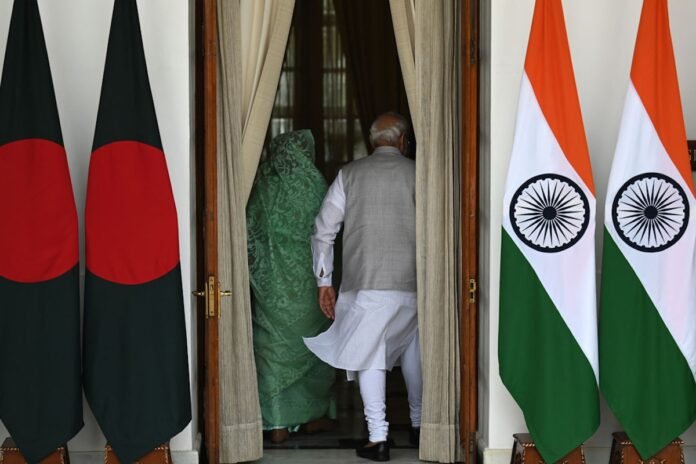
When Bangladesh’s newly elected Prime Minister Tarique Rahman took office earlier this year, there was a tentative hint that New Delhi and Dhaka might finally transcend the bitter recriminations that followed ex-leader Sheikh Hasina’s dramatic ouster in a 2024 uprising, from which she fled into exile in India.

Early indicators were positive. India’s diplomatic tone softened, officials preached the gospel of continuity and analysts heralded a long-overdue reset after nearly two years of corrosive mistrust.

Yet, in South Asian geopolitics, statecraft is rarely defined by the sterile pleasantries of communiqués. It is revealed in the unvarnished realities of border posts and airport terminals.

The friction became undeniable with the recent treatment of Zahed Ur Rahman, an adviser at the rank of a State Minister to Bangladesh’s prime minister, at Delhi’s Indira Gandhi International Airport.

Asked to wait for hours under the clinical guise of a “verification process,” Indian media later revealed he had been flagged on an immigration watchlist for past anti-India commentary.

The reaction in Dhaka was swift and unequivocal. Bangladesh’s Foreign Ministry summoned the acting Indian High Commissioner and lodged a formal protest, viewing the episode as an affront to a senior representative of the prime minister’s office.

New Delhi, however, offered little beyond a brief explanation that Rahman had been stopped for “verification,” a response that many in Bangladesh saw as inadequate, given that the individual involved was not an ordinary traveler but a high-ranking government adviser.

For a relationship attempting to find a new footing, this incident is, of course, detrimental. If New Delhi genuinely seeks to cultivate a functional rapport with Rahman’s administration, subjecting one of his close confidantes to an abrasive airport ordeal signals the exact opposite.

In an editorial, The Daily Star, Bangladesh’s largest English-language daily, branded the episode “unfortunate and avoidable,” warning that it cast a long shadow over bilateral ties precisely when both capitals needed to dismantle accumulated distrust.

If New Delhi harbored legitimate grievances regarding the adviser, the paper noted, discreet diplomatic channels — rather than public humiliation — should have been employed.

This airport skirmish was not likely an isolated bureaucratic hiccup; it was, in all likelihood, a symptom of a deeper malaise. Notably, it coincides with an increasingly volatile confrontation along the two sides’ 4,000-kilometer shared border, where Dhaka has protested India’s aggressive “pushbacks” of alleged undocumented migrants.

While Indian officials maintain they are merely repatriating illegal residents, Bangladesh counters that these unilateral expulsions lack proper verification and violate established bilateral protocols. The issue is a political tinderbox in Dhaka, directly bruising national sovereignty and public dignity.

Images of destitute individuals stranded in the borderlands feed a potent domestic narrative of Indian heavy-handedness, complicating matters for a Bangladeshi administration trying to stabilize relations with its overbearing neighbor.

The result is a stark, widening chasm between diplomatic rhetoric and transactional reality. On paper, the incentives for alignment are overwhelming. Bangladesh remains India’s vital security buffer and its gateway to regional connectivity, while New Delhi is an inescapable economic and geographic reality for Dhaka.

Yet, the institutional muscle memory developed during the Hasina era has proven remarkably resistant to change. For over a decade, India’s Bangladesh policy was mono-focused on a cozy, exclusive partnership with Hasina’s Awami League. The cataclysm of 2024 demolished that diplomatic architecture.

While India has formally accepted Bangladesh’s democratic transition, deep institutional discomfort persists toward a political class long viewed with suspicion by New Delhi’s security establishment.

The airport incident perfectly encapsulates this myopia. Immigration officials may view the enforcement of a watchlist as a routine administrative exercise, but diplomacy demands an acute sensitivity to optics. What a bureaucrat deems standard operating procedure can easily be interpreted by a neighbor as a deliberate, calculated insult.

Compounding this friction is the reality that India’s foreign policy toward Dhaka is increasingly hostage to its own provincial politics. New Delhi’s stance is heavily contaminated by electoral calculations in West Bengal. In the hyper-polarized environment of border-state politics, illegal migration and demographic shifts are potent electoral currency.

This reality incentivizes a hawkish posture that may yield domestic dividends in Kolkata and Delhi, but severely cripples India’s diplomatic maneuverability with Dhaka.

Dhaka’s strategy has also yielded meager returns. Since the post-Hasina transition, the interim administration, largely through its appointed High Commissioner, leaned heavily on a strategy overly dependent on cultural symbolism.

Exhibitions of sarees, culinary festivals and events highlighting a shared heritage became the preferred instruments of engagement. While soft power possesses inherent value, it is effective only when it serves as a handmaiden to hard political diplomacy. It can never serve as its substitute.

History is replete with examples of this structural limitation. Decades of cricket diplomacy and cultural exchanges between India and Pakistan have evaporated instantly whenever hard security crises — from Kargil to Pulwama — occur, exposing the underlying absence of foundational political trust.

Similarly, Sri Lanka’s deep cultural and religious affinity with India has never sufficed to resolve thorny, politically sensitive disputes over Tamil rights and regional security. When hard questions arise, regional states judge one another by political actions rather than cultural showcases.

Trapped in symbolism at a time when borders, water sharing and migration demand hard-nosed negotiations, Dhaka’s strategy has yielded predictable results. Sarees produced photographs and biryani generated headlines, but neither facilitated genuine strategic breakthroughs.

Furthermore, an overreliance on soft diplomacy during moments of geopolitical tension carries a distinct reputational cost. Nations that substitute cultural programming for rigorous political engagement risk appearing unserious or incapable of defending their core interests. In international affairs, visibility should not be confused with influence.

A state that remains absent from critical political chambers while staying highly visible on the cultural circuit signals either a lack of leverage or a deficiency in confidence. Consequently, Dhaka made no significant diplomatic inroads with Delhi during this critical transition.

The overarching risk is thus cumulative. An airport detention, a border pushback, a formal protest, a hostile headline — individually, these are manageable crises. Collectively, they solidify a toxic perception in Dhaka that goodwill with Delhi is a one-way street.

The Zahed Ur Rahman affair matters because it serves as a litmus test for whether one of South Asia’s most critical bilateral relationships can decouple itself from the ghosts of 2024. For now, the verdict leans toward pessimism.

While official statements will continue to extol cooperation, actions on the ground reveal a colder truth that the promised bilateral thaw remains a mirage, constrained by old habits, domestic anxieties and enduring suspicion.

Faisal Mahmud is a Dhaka-based journalist.

Hulk, Punisher join Peter Parker in Spider-Man: Brand New Day trailer

0
hulk,-punisher-join-peter-parker-in-spider-man:-brand-new-day-trailer
Hulk, Punisher join Peter Parker in Spider-Man: Brand New Day trailer

We’re about six weeks out from the debut of Spider-Man: Brand New Day, the follow-up to 2021’s No Way Home. It’s been five years since Spidey graced the big screen, so naturally Sony Pictures has released a new trailer to build audience anticipation.

(Spoilers for No Way Home below.)

As previously reported,  No Way Home ended on a pretty bleak note, with Peter Parker (Tom Holland) asking Doctor Strange (Benedict Cumberbatch) to erase him from everyone’s memory to protect the multiverse, including MJ (Zendaya).

Brand New Day is directed by Destin Daniel Cretton (Shang-Chi and the Legend of the Ten Rings). Per the official synopsis:

Four years have passed since the events of No Way Home, and Peter is now an adult living entirely alone, having voluntarily erased himself from the lives and memories of those he loves. Crime-fighting in a New York that no longer knows his name, he’s devoted himself entirely to protecting his city—a full-time Spider-Man—but as the demands on him intensify, the pressure sparks a surprising physical evolution that threatens his existence, even as a strange new pattern of crimes gives rise to one of the most powerful threats he has ever faced.

Naturally, Holland is reprising his role as Peter Parker/Spider-Man, along with Zendaya as MJ and Jacob Batalon as Peter’s former bestie Ned Leeds. The film also features Jon Bernthal as Frank Castle/Punisher, Mark Ruffalo as Bruce Banner/Hulk, Michael Mando as Mac Gargan/Scorpion (captured by Spider-Man in Homecoming), Marvin Jones III as albino crime lord Lonnie Lincoln/Tombstone, and Charlie Cox as Matt Murdock/Daredevil (briefly Peter’s lawyer in No Way Home). Sadie Sink, Liza Colon-Zayas, and Trammel Tillman join the case in as-yet-undisclosed roles.

We learned from the first trailer back in March that something strange is happening to Peter physically; he woke up surrounded in webbing and sought the help of Banner. It’s possible that Peter’s DNA is mutating, which, said Banner, “would be enormously dangerous.” But if Peter can make it through this new cycle, he might just get a rebirth—and a fresh trilogy of Holland-starring Spider-Man.

In this latest trailer, Peter specifically asks Banner if there is a way to get rid of the bad parts and keep the good parts of whatever is going on with his mutation. Banner’s response: “How would you decide what parts of nature are good or bad?”

Meanwhile, our friendly neighborhood Spider-Man is faced with a new threat that nobody can see. Peter is the only person who seems to immune to whatever strange power is affecting everyone else—and the “only one who can sense it.” He does have an ally in Banner, who naturally Hulks out when the situation calls for it. Peter gets a chance to save MJ, who still doesn’t remember their previous reality.  And he gets a grumpy pep talk from Frank Castle: “If you’re gonna do something you’d better do it now.” Perhaps those new powers will come in handy in the inevitable showdown.

Spider-Man: Brand New Day hits theaters on July 31, 2026.


Why dropping ‘Indo-Pacific’ clarifies the Pentagon’s China strategy

0
why-dropping-‘indo-pacific’-clarifies-the-pentagon’s-china-strategy
Why dropping ‘Indo-Pacific’ clarifies the Pentagon’s China strategy

On June 16, the US Department of Defense announced that the US Indo-Pacific Command (INDOPACOM) will officially revert to its previous name, the US Pacific Command (PACOM).

The move reverses a decision made during President Donald Trump’s first term to include “Indo” in the name of its largest combatant command.

This publication reported in June 2018 that the original change “highlights the increasing significance of India in Washington’s strategic thinking and also marks India’s re-entry into the American government’s ‘Asia Nexus.’”

As much as New Delhi may protest, this change signals the opposite: the decreasing significance of India in Washington’s strategic thinking – and its exit from the American government’s “Asia Nexus.”

There were already hints of this in US Defense Secretary Pete Hegseth’s speech at the Shangri-La Dialogue in late May. “India was mentioned last,” an Asian diplomat in attendance recalled.

Hegseth praised the efforts of South Korea, the Philippines, Japan, Australia, Singapore, Indonesia, Malaysia, Thailand and Vietnam before finally turning to India.

A strong India, “acting in its own self-interest,” advances a shared goal of maintaining a regional balance of power, he said – hardly a description of a core ally in a coordinated strategy.

This name change, however, does not represent a toning down of competition with Beijing. On the contrary, it clarifies where competition with China will actually be fought — and where it will not.

The decision moves the strategy in the right direction. There are three key takeaways.

First, the fact that the Pentagon made this significant move absent any immediate trigger suggests it is sending a deliberate message: the Indian Ocean is not central to dealing with China.

That message is aimed at both allies and Beijing itself. To its allies, it signals that in a potential conflict with China, the United States will concentrate on the Taiwan Strait, operating primarily from Japan and the Philippines.

In all other regions, allies and partners will be expected to take primary responsibility for conventional defense. South Korea will deter North Korea, Europe will confront Russia and the Indian Ocean will largely fall to India to monitor and control.

Symbolically, Hegseth made no mention of “Indo-Pacific” in his Shangri-La speech, nor did he reference Japanese Prime Minister Sanae Takaichi’s efforts to “update” the Free and Open Indo-Pacific concept championed by her mentor, the late Shinzo Abe. Japan’s region-wide strategic framing may soon require a rethink.

To China, the message is equally clear: the US is laser-focused on the Taiwan Strait. 

Second, the shift signals that India is being written out of the core contingency that matters most: Taiwan.

Washington believes Chinese President Xi Jinping has instructed the People’s Liberation Army to be ready to take Taiwan by force, if necessary, by 2027. The Trump administration has little patience for fence-sitters.

It is prioritizing allies such as South Korea and the Philippines – who act like they “live on the front lines,” as Hegseth said. India is not aligned, and Washington is no longer hoping that one day it will be.

Third – and most intriguingly – by treating India as a normal partner rather than a strategic centerpiece, Washington gains greater flexibility in dealing with Pakistan, India’s archrival.

Trump has turned to Pakistan’s Field Marshal Asim Munir as a key backchannel to Tehran, relied on him in defusing the 2025 India-Pakistan crisis and invited him to discussions on expanding the Abraham Accords.

Pakistan matters not because of India, but because of China’s westward pivot.

Over the past 15 years, China has steadily reduced its reliance on maritime energy routes through Indian Ocean chokepoints, such as the Malacca and Hormuz straits, shifting instead toward overland pipelines across Central Asia.

In responding to this Chinese pivot to Eurasia, Pakistan – not India – emerges as the more relevant partner.

The return to PACOM reflects these strategic realities. It is a recognition that clarity, not geographic sprawl or vague values-based alignments, will define how the US competes with China. And it is the right move.

Ken Moriyasu, a former correspondent for the Japanese newspaper Nikkei, is a senior fellow at the Hudson Institute.

Gold fever sends some vintage luxury watches to the melting furnace

0
gold-fever-sends-some-vintage-luxury-watches-to-the-melting-furnace
Gold fever sends some vintage luxury watches to the melting furnace


Omega’s Constellation watch has been flashed in campaigns, movies and at the Met Gala by stars like George Clooney and ​Nicole Kidman, turning it into a symbol of luxury and glamour.

But with gold prices near record highs struck in January, some such classic watches are being melted ‌down as the value of their metal content outstrips their resale worth.

Used models by the likes of Omega and LVMH’s TAG Heuer are most hit by the trend, according to Reuters interviews with over a dozen traders, industry experts, and investment advisers.

British dealer Jon White of Gold Traders melted down an 18-carat late-1970s Constellation in excellent condition in May, one of dozens of mainstream luxury watches he has had scrapped this year as demand for ​investment gold has risen.

“Beautiful watch. But in reality, had the customer consigned that to auction, what would they have achieved?” White, who also manages an auction house, told Reuters.

The ​gold content of the Constellation watch, one of many models produced by Swatch-owned Omega, was worth £5,750 ($7,749), 35% more than its estimated £4,000-4,500 auction value, White ⁠said.

James Lamdin, founder of Watches of Switzerland’s second-hand unit Analog Shift, said melting was “primarily happening with contemporary pre-owned and also with older vintage watches that are not already collectible.”

Spokespersons for Swatch and ​Rolex said they would not comment for this story. LVMH, Richemont, Patek Philippe and Audemars Piguet did not respond to requests for comment.

LIQUID GOLD

Gold prices surged to a record $5,600 an ounce in January as ​geopolitical concerns and trade worries pushed investors towards safe-haven precious metals. Gold now hovers around $4,200 per ounce, almost double its 2024 average.

The market price for used watches has not moved in the same way, however.

“I find it very sad, because obviously once something has been melted, it’s gone forever,” said Adrian Hailwood, a specialist in horological history.

There are no official figures showing how many luxury watches are being melted. World Gold Council data shows overall ​gold recycling in the first quarter rose 5% to 366 tonnes, while gold jewellery demand rose 31% in value to $47 billion.

Watches can hold anything from a sliver of gold to more than ​200 grams, meaning their scrap value can run into tens of thousands of dollars. In an Omega Constellation, the gold can be found in the case and the strap.

With gold expected to reach between $5,400 and $6,300 ‌an ounce this ⁠year, the pressure to dismantle some watches will continue, especially as traders that resell them must cover costs and the expense of providing a warranty.

New watches that are over-produced might also be melted down.

“I’ve seen a lot of totally mediocre watches get melted down,” said Lamdin. “There’s a lot of unsold overstock in the Swiss market. And those watches are basically brand new, unworn, and they’re just getting stripped down… they made too many of them.”

“But when you have something that’s vintage and rare and has some story or some patina, that’s where it becomes a short-sighted tragedy.”

THE RESALE TRAP

High-end ​brands that tightly manage new production like privately ​owned Patek Philippe and Rolex command the highest ⁠premiums over melt value, three industry experts said.

For some models “the wait lists are astronomical. You’re talking anything from two to eight years,” said Simon Lazarus, head of PR and content at online luxury watch platform Chrono Hunter.

“I’ve seen a lot of totally mediocre watches get melted down,” said Lamdin. “There’s a lot of unsold overstock in the Swiss market. And those watches are basically brand new, unworn, and they’re just getting stripped down… they made too many of them.”

“But when you have something that’s vintage and rare and has some story or some patina, that’s where it becomes a short-sighted tragedy.”

Rolex accounted last year for 61% of the sales value of new Swiss ​watches priced above 3,000 Swiss francs ($3,770), up from 57% in 2023 despite lower volumes, according to Vontobel.

Less exclusive brands like TAG Heuer, Breitling ​and Omega struggle to ⁠command high new retail prices, however, as buyers can buy a second-hand timepiece for much less.

Models like Omega’s Speedmaster often depreciate sharply once sold, exposing them to scrapping, three experts said.

TO SELL OR NOT TO SELL

Higher gold prices motivated retired New York engineer Mitchell Talisman to sell two gold watches and a chain containing a combined 35 grams of gold with 58% purity for $2,660 cash in December.

“I’d had a ⁠bunch of stuff ​sitting in a safety deposit box for over 10 years,” he told Reuters.

For some owners however, the idea of ​selling a watch only for it to be melted by a dealer is too much to bear.

“It may be a family piece, it may be their first watch,” said Hailwood.

“They don’t like the idea of it being destroyed, so they ​keep it.”

Source: Reuters

AI coding agents taught robots how to install GPUs and cut zip ties

0
ai-coding-agents-taught-robots-how-to-install-gpus-and-cut-zip-ties
AI coding agents taught robots how to install GPUs and cut zip ties

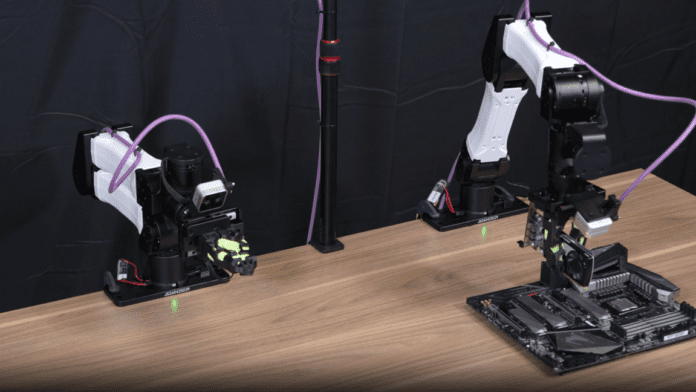
What happens when you give AI coding agents a lab full of robotic arms, some compute resources, and a “generous token budget” for teaching the robots various tasks? The agents can apparently figure out a training regimen that teaches the robots to successfully cut zip ties and even insert GPUs into thin sockets on motherboards.

That glimpse into how AI can act in a fully autonomous way to automate robot training was made possible by a new agent harness framework—software that wraps around AI models to enable their use of various tools while also providing capabilities such as memory, context, constraint, and feedback loops. That agentic harness, called ENPIRE, was developed by robotics researchers at the Nvidia GEAR (Generalist Embodied Agent Research) lab alongside collaborators from Carnegie Mellon University in Pittsburgh and the University of California, Berkeley.

“A part of our NVIDIA GEAR lab now self-improves tirelessly overnight,” wrote Jim Fan, director of AI at NVIDIA, in a LinkedIn post. “We just read the reports in the morning.”

Fan also jokingly described the goal of such AI-directed robot training, saying, “We all take a holiday and Jensen wouldn’t even notice,” in reference to Nvidia founder and CEO Jensen Huang. But it’s not only Nvidia robotics researchers who could benefit—Fan said the team would be open-sourcing everything so anyone can host their own “self-running robot lab at home.”

The ENPIRE harness has four modules that enable AI coding agents to perform automatic reset and verification on tasks, refine policies that guide robotic behavior, evaluate such policies across multiple physical robots working in parallel, and address failures by analyzing logs, ingesting research papers, and improving training infrastructure and algorithm code. More technical details are available in the research paper uploaded on June 16, 2026.

The harness was tested with three different AI coding agents, including OpenAI’s Codex with GPT-5.5, Anthropic’s Claude Code with Opus 4.7, and Moonshot AI’s Kimi Code with Kimi K2.6. Teams of the coding agents independently developed different algorithmic approaches to robot training, tested them in real-world experiments, and then retained whatever changes helped raise the overall success rate over repeated cycles of self-directed testing.

The success and limits of AI-directed robot training

Equipped with ENPIRE, the AI coding agents developed strategies for robotic self-improvement that achieved a 99 percent success rate across several manipulation tasks, including the standard “Push-T” task that challenges robots to move a T-shaped block to fit a target position on top of a table. Other tasks included organizing pins in a pin box, tying and cutting zip ties, and placing a GPU into a motherboard before unplugging the graphics card again to reset for the next trial.

The most promising result may have come from the pin insertion and organization task. In that robot-training scenario, AI coding agents achieved nearly 100 percent success faster than a “frontier human-in-the-loop method” developed by many of the same human researchers.

Such experiments also showed how larger teams of up to eight AI coding agents could achieve high success rates in robot training more quickly than smaller four-agent teams or single agents working alone. For example, the eight-agent team achieved 99 percent success on the Push-T task in two hours of research time, compared to the four-agent team requiring three hours and the single-agent team requiring nearly five hours.

But the human researchers also discovered some crucial limitations when unleashing AI coding agents as autonomous robot trainers. The robots often sat idle and unused while the coding agents were busy “reading logs, writing code, debugging, or waiting for the language-model backbone.” Larger teams of coding agents also spent more time summarizing each other’s ideas and less time actually using the robots, and the coding agents sometimes failed to make full use of available compute resources when launching parallel training sessions.

The faster success rates enabled through more agents and robots working together also came at the cost of higher token consumption—a noteworthy consideration at a time when AI developers such as Anthropic are weighing pricing changes that would significantly increase the token-related costs of using AI services.

Flush with cash from the AI boom, Nvidia has been busily pushing its vision for physical AI through multiple robotics initiatives. On May 31, the company announced a partnership with the prominent Chinese robotics company Unitree to provide a “Reference Humanoid Robot” for research labs developing general-purpose AI-powered robots.

During a whirlwind tour of South Korea in early June, Nvidia founder and CEO Jensen Huang also met with Hyundai Motor Executive Chair Chung Euisun to discuss scaling up the mass manufacturing of AI-powered robots. Hyundai Motor Group owns the US robotics company Boston Dynamics, which is already well-known for its four-legged “robot dog” Spot and has been working to commercialize its Atlas humanoid robot.

Senate Democrats Aren’t Happy About Trump’s Spy Law Ultimatum

0
senate-democrats-aren’t-happy-about-trump’s-spy-law-ultimatum
Senate Democrats Aren’t Happy About Trump’s Spy Law Ultimatum


Before President Donald Trump threw his latest hand grenade into congressional negotiations over a key domestic spying law, two factions of Senate Democrats seemed to believe they were on the verge of a breakthrough.

Privacy advocates thought they had their best chance in years of passing reforms, including a warrant requirement for searching American communications collected abroad.

Centrists allied with U.S. intelligence agencies, meanwhile, thought they were close to renewing Section 702 of the Foreign Intelligence Surveillance Act with only minor tweaks.

Then Trump, who had once already thrown the renewal process into chaos, announced on Wednesday that he wouldn’t sign it unless Congress passed an unrelated voter suppression bill.

Claiming that Democrats were poised to walk away from a spy law compromise, Trump said that “to add a slight bit of intrigue but, for the Good of the Nation, and the People of our Country, I will not approve FISA without THE SAVE AMERICA ACT going along with it.”

Trump’s surprise outburst on Truth Social on Wednesday scrapped the confirmation hearing set later in the day for Jay Clayton, a federal prosecutor in New York, to serve as the permanent director of national intelligence. Senate Majority Leader John Thune, R-S.D., had said that he hoped to quickly confirm Clayton.

Clayton’s impending confirmation had appeared to solve a problem — at least for some Democrats — that Trump created by tapping lapdog housing chief, Bill Pulte, as the Cabinet-level intelligence chief. It might also have opened a route for Congress to renew Section 702, the surveillance law that allows federal agents to conduct “backdoor,” warrantless searches of Americans’ communications collected abroad.

In a joint press conference on Wednesday, top Senate Democrats revealed the cracks in their coalition over next steps on FISA.

A key reformer, Sen. Ron Wyden, D-Ore., said he still hopes to pursue adding a warrant requirement to Section 702, while a centrist aligned with the intelligence agencies, Sen. Mark Warner, D-Va., expressed disappointment that the easiest route to renewal without major changes had been foreclosed.

“We had a path forward, as of yesterday, and today we don’t, and that’s because of this president.”

“This has become a complete debacle, and now it’s up to the White House to figure out a path forward here,” said Sen. Mark Kelly, D-Ariz., a member of the intelligence committee. “We had a path forward, as of yesterday, and today we don’t, and that’s because of this president and his advisers.”

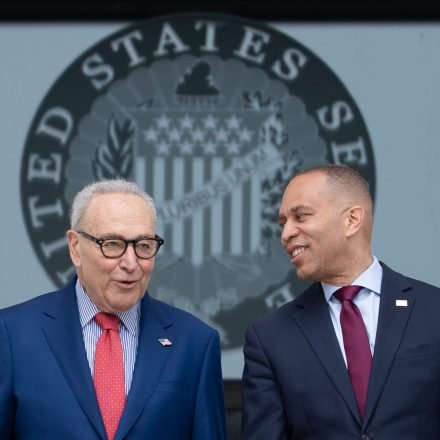
Senate Minority Leader Chuck Schumer, D-N.Y., remained cagey about what version of the law he would like to see ultimately passed. But in comments at the joint press conference, he sought to portray Democrats as the more responsible party when it came to Section 702.

“It’s on our Republican colleagues to work with us to find A) a capable director, not someone who is a menace, and second, then to work with us on renewing FISA. It is up to them,” Schumer said at the press conference. He said he was deeply concerned about Trump’s appointment of Pulte, who appears likely to step into the office on Friday.

Republicans “have got to have the courage to buck the president, who clearly doesn’t want a DNI director and doesn’t want FISA renewed,” Schumer said. “All he wants is Pulte.”

Warner, the top Democrat on the Senate Intelligence Committee, claimed Sunday that Section 702 renewal was on a “glide path” before Pulte’s nomination. He also praised Clayton’s selection, while reserving the right to ask about Clayton’s views on election integrity.

Reformers said Thursday, however, that Section 702’s renewal was never as assured as Warner and Senate Intelligence Committee Chair Tom Cotton, R-Ark., have suggested in public comments.

Majorities of both Republicans and Democrats voted in recent weeks against advancing the law’s renewal in versions of the bill that do not include a warrant requirement.

“They don’t want to have to deal with people who want things like warrants.”

“They want that to be the narrative, because they don’t want to have to deal with people who want things like warrants,” said Kia Hamadanchy, a senior policy counsel at the American Civil Liberties Union. “At no point have they actually demonstrated that they have a deal that one, has 60 votes in the Senate, and two, has any chance of going anywhere in the House.”

Wyden expressed alarm about Trump’s actions at the joint Senate Democrat press conference. Wyden said that he always wanted to reform the law — not allow it to expire.

“It is now even clearer than before that the only path to 60 votes in the United States Senate on intelligence is real reform, actual black-letter law, that addresses these issues,” Wyden said.

Privacy advocates argue that the way out of the congressional logjam is to allow members of Congress to vote on whether to add a warrant requirement, something that Thune and House Speaker Mike Johnson have not been willing to allow so far. Even then, however, Trump could veto whatever version of the law emerges from that process.

Belfast unrest including racist attacks shows social media power

0
belfast-unrest-including-racist-attacks-shows-social-media-power
Belfast unrest including racist attacks shows social media power

Photo: Sipa US / Alamy Live News

Footage of a horrific knife attack in Belfast began to circulate on social media on Monday evening. A Sudanese asylum-seeker in his 30s, who entered the UK in 2023, has been charged with attempted murder. Meanwhile, the far-right was quick to exploit the situation to further an anti-immigration agenda.

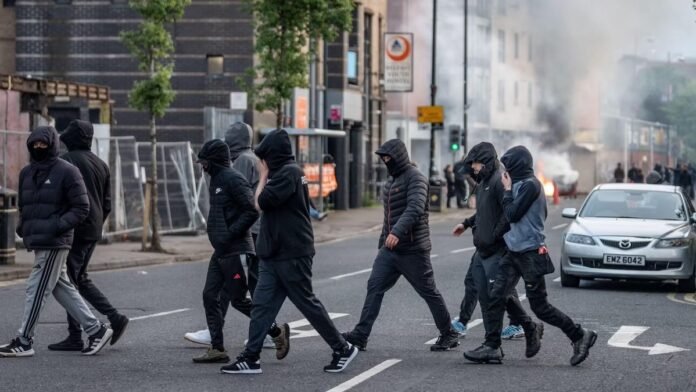
Violent unrest followed on the streets of Belfast and beyond on Tuesday evening. Houses, cars and a bus were set alight, and masked men were seen smashing in windows. Some of the attacks on property were reportedly racist in nature.

Posting earlier on social media, activist Tommy Robinson (real name Stephen Yaxley-Lennon) urged supporters to join street protests against this “invader attack.” Robinson provided a list of locations across Great Britain and Northern Ireland where protests were planned on Tuesday night.

His post on X was shared by tech billionaire Elon Musk, who called for citizens to protest “repeatedly and loudly” to change government policies around immigration.

Elon Musk. Photo: Wikimedia Commons

The leader of Restore UK, Rupert Lowe, pledged that his party would begin mass deportations and reintroduce the death penalty to prevent attacks committed by “barbarians.”

At the same time, WhatsApp messages from anonymous accounts began to circulate, calling for men aged 18 and over in Northern Ireland “be prepared to fight or be arrested.”

Calls for calm

Politicians from across Northern Ireland’s political divide appealed for calm with some condemning rightwing English politicians like Lowe for appearing to exploit the attack for their own ends.

And the chief constable of the Police Service of Northern Ireland (PSNI), Jon Boutcher, urged citizens not to be “duped” into violent disorder by people online intent on provoking trouble.

The fact that a man had been charged with attempted murder did little to deter the crowds of mostly young men who gathered across Belfast, setting a bus on fire on the Lower Newtownards Road and engaging in sporadic clashes with police across the city.

Youtube video

There were reports of violence in towns such as Ballyclare and Portadown. In Ballyclare, the premises of a Turkish barber was attacked. There were also arrests made after demonstrations in Glasgow in which three members of the public were injured.

You could be forgiven for thinking this playbook has been seen before. In the past two years, far-right actors have used online platforms to weaponise incidents involving minorities as part of their anti-immigration campaigns. These incidents include allegations of an attempted rape of a teenage girl in Ballymena, the murder of three young girls in Southport and the murder of Henry Nowak in Southampton.

Misinformation frequently circulates in online spaces as authorities come under pressure to confirm the ethnicity and asylum status of suspects. The PSNI were very quick to give these details, presumably to avoid creating an information vacuum in which falsehoods might spread quickly.

Emergence of a toxic discourse

Facts don’t appear to matter to those leveraging shock and trauma to advance their claims that immigration is to blame for acts of violence. Condemnations of online far-right agitators from politicians usually follow amid criticism of big tech companies for not doing more to stop agitators inciting violence on their platforms.

Politicians and public figures must do more than say “not in our name”. They must take some of the blame for helping to create a toxic discourse around immigration that “others” asylum-seekers and migrants.

The Overton Window, the barometer of what is considered a politically acceptable argument, has shifted towards the right, as demonstrated by Lowe’s remarks. Misinformation and disinformation about immigration take root in some communities because they frequently hear how asylum-seekers receive priority access to already under-funded public services.

A frequent refrain among politicians is that these are “legitimate concerns”, even when there is little evidence to support these claims. This often leads to minority communities being blamed for issues that are nothing to do with them.

The mainstreaming of rightwing views on immigration is reinforced by media coverage that frequently fails to fact-check claims about issues such as asylum-seekers and welfare benefits. In this context, it is perhaps unsurprising that immigration features among the issues of most concern to voters in Great Britain.

It is now for politicians to decide how to respond to the violence seen in Belfast and elsewhere this week. While online platforms can clearly do better when it comes to removing inflammatory posts, public figures must also fix the problem they helped to create. The public needs a fact-based narrative on immigration that stops blaming asylum-seekers and refugees for broader societal problems.

Paul Reilly is a senior lecturer in communications, media and democracy, University of Glasgow.

This article is republished from The Conversation under a Creative Commons license. Read the original article.

President Trump Defends Iran Deal, Warns US Could Resume Strikes

0
president-trump-defends-iran-deal,-warns-us-could-resume-strikes
President Trump Defends Iran Deal, Warns US Could Resume Strikes


The emerging agreement would reopen the Strait of Hormuz, extend the ceasefire, and commit Iran not to produce or acquire nuclear weapons

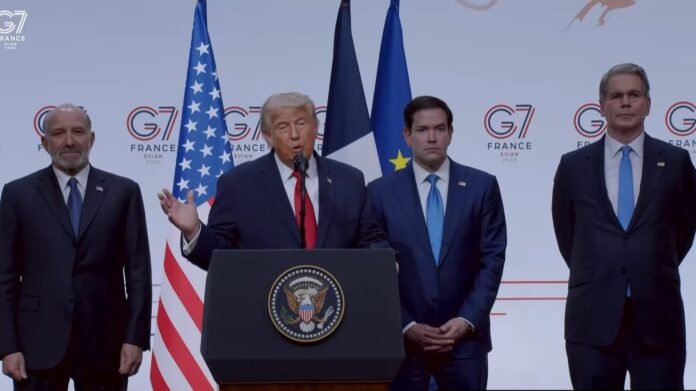
President Donald Trump, in a wide-ranging press conference at the G7 summit in Évian-les-Bains, France, on Wednesday, defended an emerging US-Iran agreement, argued that it would prevent Iran from obtaining a nuclear weapon, and warned that US military strikes could resume if Tehran violates its commitments. He also criticized Israel’s military operations against Hezbollah in Lebanon.

The agreement, a memorandum of understanding expected to be formally signed in Switzerland on Friday, is intended to extend the ceasefire, reopen the Strait of Hormuz, and create a framework for further negotiations over Iran’s nuclear program and related regional issues. US officials have said the deal was signed electronically over the weekend, though the timing and format of the final signing remained in flux on Wednesday.

“On Sunday, we reached an agreement with Iran that achieves everything we set out to accomplish—everything, and much more—ending the current conflict, reopening the Strait of Hormuz, and preventing Iran from ever obtaining a nuclear weapon,” President Trump said.

The president repeatedly returned to what he called the central provision of the agreement: Iran’s nuclear program.

Iran cannot have a nuclear weapon. They can’t develop it, buy it. They can never have a nuclear weapon.

“Iran cannot have a nuclear weapon. They can’t develop it, buy it. They can never have a nuclear weapon,” he insisted.

The memorandum of understanding, which senior US officials read to reporters on Wednesday ahead of an expected formal signing on Friday, includes language stating that Iran will not produce or acquire nuclear weapons.

Read the full text of the US-Iran Memorandum of Understanding

President Trump contrasted the agreement with the Obama-era nuclear deal, which he canceled during his first term and repeatedly criticized throughout the press conference.

“The Obama deal was a road to a nuclear weapon,” he argued. “The Trump deal was a wall for a nuclear weapon that the nuclear weapon could not get through.”

Although President Trump said the agreement could be signed within days, he emphasized that compliance would determine whether it remains in force.

If it doesn’t get done in 60 days, that’s all right. We go back to bombing.

“If it doesn’t get done in 60 days, that’s all right. We go back to bombing,” he said.

The president repeatedly warned that military action remains available if Iran does not adhere to the framework.

“If they don’t honor the agreement, we’ll probably go back to bombing them until they honor it,” President Trump said.

Later, when pressed about enforcement provisions, President Trump offered an even more direct warning.

“I let them know. I said, look, if you don’t adhere to the agreement, I don’t want to do that, but we’re going to bomb the hell out of you.”

He argued that the threat of renewed military action is sufficient to ensure compliance.

“Doesn’t have to be,” he said when asked whether the agreement contains enforceable mechanisms. “They don’t want to get bombed. They don’t want to get hit.”

President Trump also defended allowing Iran to retain some conventional missile capabilities, arguing that ballistic missiles are not the core issue addressed by the agreement.

“We’ll be working on a parallel effort with the Gulf nations to address non-nuclear issues, such as the conventional ballistic missiles,” he said.

Israeli Prime Minister Benjamin Netanyahu has insisted on several occasions that a provision targeting Iran’s ballistic missile program must be part of any framework.

In February, Netanyahu told reporters after returning from a trip to Washington to meet with President Trump that an agreement should address “not only the issue of nuclear weapons but also ballistic missiles and Iranian proxies in the region.”

At the press conference, President Trump dismissed suggestions that Iran should be barred entirely from possessing missiles.

“What am I going to do? Am I going to let Saudi Arabia have missiles, but they can’t have them? It doesn’t work that way.”

He argued that nuclear weapons, not ballistic missiles, represent the principal threat.

“Missiles aren’t the problem. Missiles are—they hurt a little location, but they don’t blow up the planet.”

President Trump said the United States had already significantly reduced Iran’s missile capabilities through military action.

“We knocked out probably 84%, 85% of their missiles,” he said.

The president spent a significant portion of the press conference discussing Israel and Netanyahu, praising the relationship between the two leaders while also expressing frustration with Israeli operations in Lebanon.

“In all fairness to Bibi Netanyahu, who happens to be a good man, gets a little excited sometimes. But he happens to be a very good man. We’ve had an amazing partnership.”

At the same time, President Trump acknowledged differences over Hezbollah and Lebanon.

We have a little dispute over Lebanon. I say, you can do a little softer touch, Bibi. You don’t have to knock down a building every time somebody walks into it that’s from Hezbollah.

“We have a little dispute over Lebanon. I say, you can do a little softer touch, Bibi. You don’t have to knock down a building every time somebody walks into it that’s from Hezbollah.”

The president said he had sent a copy of the agreement to Israel and argued that the deal delivers Israel’s most important strategic objective.

“I told Bibi, Bibi, your biggest risk was that they’d drop a nuclear weapon into the middle of Israel. They’d only need one, and there would be no more Israel.”

“Think of it, Bibi. You got the best—the most important thing that you were asking for is that.”

President Trump also criticized recent Israeli strikes in Beirut, specifically referencing attacks against Hezbollah targets.

“I’m not saying they shouldn’t protect themselves,” he said. “They could behave better.”

Referring to a recent strike, the president added: “That was a big hit. That was unnecessary in my book.”

He expressed sympathy for Lebanon and said the country had suffered decades of instability and conflict.

“I feel very bad for Lebanon,” President Trump said. “They have been living in hell.”

A major component of President Trump’s defense of the agreement centered on economic arguments. He repeatedly claimed that the deal prevented a broader crisis in global energy markets and would help stabilize oil prices.

“If we didn’t do this deal, we could have dropped more bombs for another three weeks, two weeks, four weeks, two years,” he said.

“You would never have the Hormuz Strait open.”

According to the president, reopening the Strait of Hormuz will restore maritime traffic and energy shipments while helping reduce oil prices worldwide.

“Maritime traffic through the Strait of Hormuz has already increased very substantially, and the normal flow of energy will resume in the coming days.”

President Trump argued that continuing the conflict risked severe economic consequences.

“Rather than possibly going into a depression,” President Trump said, the agreement provides stability for global markets and energy supplies.

He also defended the military campaign that preceded the agreement, including strikes against Iranian nuclear facilities and military infrastructure. He claimed US operations had devastated Iran’s military capabilities and left Tehran in a position where it was willing to negotiate.

“If we didn’t hit that with the B-2 bombers, they would have had a nuclear weapon,” he said.

Beyond Iran, President Trump briefly discussed a range of international issues. He praised mediation efforts by Qatar and Pakistan, thanked China and President Xi Jinping for maintaining what he described as a neutral position during the conflict, and said he hopes the agreement will lead to broader regional normalization and an expansion of the Abraham Accords.

The president also addressed the war in Ukraine, meetings with world leaders at the G7, efforts to combat Ebola in Africa, artificial intelligence, energy policy, and immigration.

Still, President Trump repeatedly returned to the Iran agreement as the central achievement of the summit.

“The most important clause,” he said, is the commitment that Iran “will never have a nuclear weapon.”

“This agreement now provides Iran with a historic opportunity,” the president said. “If they follow the path of cooperation, we’ll have opened for them. Their country will have a chance to survive.”

Trump says US will have to give Iran’s money back

0
trump-says-us-will-have-to-give-iran’s-money-back
Trump says US will have to give Iran’s money back

President Donald Trump said Wednesday that the US has taken “a lot of” Iranian money and will have to give it back, Anadolu reports.

“We have taken a lot of their money, and we have their money,” Trump said at a news conference in France as the G7 summit ended.

“It’s not our money, it’s their money, and we froze it at a certain point in time. I guess we’re going to have to give it back, you know, if we didn’t give it back, nobody would ever invest in the dollar again,” he added.

A memorandum of understanding (MOU) was signed between the US and Iran electronically on Sunday, which includes an end to the military operations on all fronts and reopening the Strait of Hormuz while setting the stage for talks on Iran’s nuclear program linked to sanctions relief. The signing ceremony is scheduled for Friday in Switzerland.

READ: Trump turns on Israel over Lebanon war, says Syria could fight Hezbollah better

The US undertakes with regional partners to develop a “definitive, mutually agreed plan” with at least $300 billion for the reconstruction and economic development of Iran, according to the deal.

“We’re not putting up money. Only if they’re doing things right. If they’re doing things right, if people want to invest, they can invest … They have this $300 billion fund … It’s only if they’re doing things right,” Trump said.

“Remember this also, when you talk about ‘billions of dollars,’ they’ve had much more than a trillion dollars worth of damage done,” he added.

About possible sanctions relief for Iran, Trump said that “something will happen as soon as they behave.”

The 14-point MOU released by the US said Washington undertakes to terminate “all types of sanctions” against Iran, including the UN Security Council resolutions, IAEA (International Atomic Energy Agency) Board of Governors resolutions, and all unilateral US sanctions, primary and secondary, in an agreed upon schedule as part of the final deal.

WATCH: Is Israel Losing Its American Shield? | Palestine This Week with Mouin Rabbani

Tesco moving 40,000 server workloads off VMware amid Broadcom’s “abusive conduct”

0
tesco-moving-40,000-server-workloads-off-vmware-amid-broadcom’s-“abusive-conduct”
Tesco moving 40,000 server workloads off VMware amid Broadcom’s “abusive conduct”

Tesco, a retail conglomerate headquartered in the United Kingdom, is moving 40,000 server workloads off of VMware amid “abusive conduct” from Broadcom, recent legal filings claim.

Tesco filed a lawsuit in the UK’s High Court against Broadcom alleging breach of contract last year. According to a September report from The Register, the lawsuit claimed that in January 2021, Tesco bought perpetual licenses for VMware’s vSphere Foundation and Cloud Foundation, a subscription to VMware Tanzu, plus support services until 2026, with the option to extend support for four additional years.

But when Broadcom took over VMware in November 2023, it would not honor the deal and instead tried to get Tesco to pay “excessive and inflated prices for virtualization software for which Tesco has already paid” and would not allow it to buy support services for its perpetually licensed software without buying “duplicative subscription-based licenses for those same Software products,” the initial complaint read, The Register reported at the time.

Tesco, which reported 73.7 billion pounds (about $98.7 billion) in revenue in its fiscal year 2026, has since started migrating away from VMware and Broadcom’s mainframe products, according to late-May court filings reported on by The Register today.

In January, Broadcom stopped supporting Tesco’s VMware products, Tesco said, and Tesco has been paying for third-party support since. In its initial filing, Tesco also said that Broadcom refused to upgrade software or provide all security updates to customers without subscriptions.

One of Tesco’s recent filings, per The Register, reads:

Faced with Broadcom’s abusive conduct, and given the criticality of virtualization and mainframe software and services to its business, Tesco has been forced to incur material costs to procure alternative solutions with reduced functionality, and to migrate to that software in a manner, and on a timeframe, that creates very significant risks to its business.

If it works “at exceptional pace,” Tesco will be completely off VMware by the end of 2027 at the earliest. However, “the timeframe in which that migration must be undertaken has created and continues to create operational and commercial risk, and at material ongoing cost and disruption to the business,” Tesco reportedly noted.

Tesco is also dealing with migration challenges related to data security because its new, unnamed virtualization software is incompatible with the Veeam and Zerto products it uses.

“Manifestly unfair and excessive” price hike

Tesco initially requested at least 100 million pounds (about $133.6 million) in damages each from Broadcom, VMware, and reseller Computacenter, plus interest.

In its recent filings, Tesco said it turned down at least four offers from Broadcom to continue using VMware and Broadcom’s mainframe tech. One offer charged $23.5 million (about 17.6 million pounds) for VMware Cloud Foundation 9.0 and mainframe software and support services for a year, The Register reported. Tesco said that was “around 175 percent” more expensive than what it believes it should have had to pay for VMware and a 350 percent price hike for the mainframe offerings. The prices were “manifestly unfair and excessive,” one of Tesco’s filings said, according to The Register.

In an amended defense, Broadcom denied that the price hike was unfair, The Register reported. Additionally, Broadcom argued that it shouldn’t have to pay damages in relation to Tesco struggling to find VMware and Broadcom alternatives before Tesco’s support expired, as the retail firm has since found replacement products.

The case is expected to go to court between November 1, 2027, and February 25, 2028, The Register reported. Afterward, it could go to trial.

Although the companies will continue their dispute in UK courts, the disagreement mirrors frustrations that VMware customers and partners around the world have expressed since Broadcom bought VMware. With users often being heavily dependent on VMware products, many have delayed or avoided migration or are only moving some workloads, due to complications around cost, time, support, and compatibility.

Still, virtualization rivals, like Hewlett Packard Enterprise and Nutanix, have been making aggressive pushes to attract disgruntled VMware users.

Simultaneously, Broadcom has stuck to its VMware strategy and has reported financial success, especially among its target of large enterprises. It has also dealt with other public legal disputes with large customers, including AT&T, with which it reached an undisclosed settlement, and Siemens, which Broadcom accused of software pirating in an ongoing case in the US District Court for the District of Delaware.

0FansLike
0FollowersFollow
0FollowersFollow
0SubscribersSubscribe
- Advertisement -
Google search engine

Recent Posts