17.1 C
London
Friday, June 12, 2026
Home Blog

Trillionaire welfare baby Elon Musk is born

0
trillionaire-welfare-baby-elon-musk-is-born
Trillionaire welfare baby Elon Musk is born

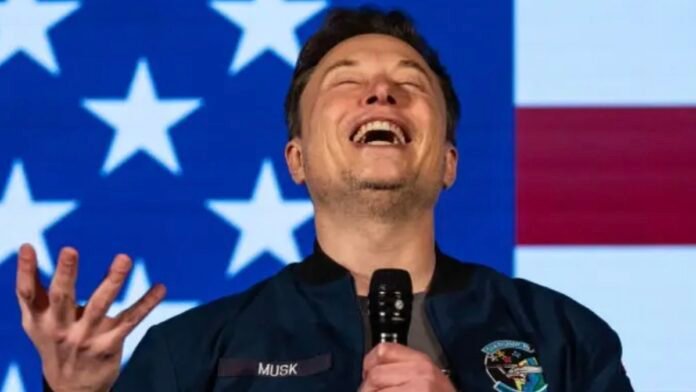
SpaceX goes public Friday (June 12) at around US$1.7 trillion. Elon Musk owns enough SpaceX stock that, on top of everything else he holds, Musk becomes the first person in human history to cross the trillion-dollar line. The coverage will be all hype. Unprecedented. A genius. Where’s he going next? What does the future hold?

It wasn’t like Elon Musk invented some amazing capacity. He didn’t do something transformational for the world. He didn’t harness electricity. He didn’t invent the transistor. He didn’t invent rocket flight. He didn’t invent satellite technology. He didn’t even make them much better.

What he did was learn how to game the system. He took what America built through generations of investment and generations of hard work and turned it into a profit center for himself. He took American loans, American intellectual property, American space, American airwaves, and turned them into a wealth engine for one man.

Tesla exists because of a half-billion-dollar loan from the American government, handed over in 2010 when the banks wouldn’t touch him. The deal gave the government the right to buy three million shares of Tesla stock at a locked-in cheap price. That was our cut if the company took off.

The company took off, and Musk rushed to pay the loan back nine years early, because under the deal, early repayment canceled the government’s shares. They were worth about $270 million the week he wired the money, and Tesla’s stock has multiplied many times over since. The press called the repayment a triumph. We got our money back with a little interest, and he kept the stock the American people were due.

SpaceX is the same story just bigger. In a purely capitalist system, SpaceX wouldn’t exist. It would’ve died in 2008. The company was broke, three rockets had failed, and Musk was burning the last of his money.

Then NASA wrote a $1.6 billion contract for cargo runs to the space station, and that money built the Falcon 9. The people who study this industry say it plainly. NASA is what saved the company when it was on the brink of bankruptcy.

And NASA by then was an agency we’d been squeezing since the 1980s. We decided, instead of doing things ourselves as a nation, instead of demanding the lion’s share of what we’d developed over sixty years of rocketry and satellites and spaceflight, that we’d hand it off to billionaires and let them compete for the contracts.

SpaceX now holds around $22 billion in federal contracts. Across the whole Musk empire the public money runs closer to $38 billion. The launch pads, the airwaves, the satellites overhead, the early customers, the technology our space program spent two generations developing. He built on all of it, and we kept no share of it.

I’m not saying SpaceX is bad at rockets. The rockets work. But outbidding Boeing and Lockheed, the most bloated contractors in America, is a low bar, and he cleared it with technology our space program developed, on contracts we paid for. And China is proving right now that none of it was one man’s miracle.

They’re behind on reusable rockets and behind on launch rates, sure. They’re also closing fast, as a national project, with state companies and state-backed startups and satellite constellations in the tens of thousands. Getting to space is something a country can decide to build and own. We decided to hand it to one man instead.

The rest of his fortune sits in Tesla, and that deal is even worse. Tesla is worth more than every other major carmaker on the planet combined. Toyota, BYD, GM, Ford, Volkswagen, Honda, Mercedes, BMW, all of them together, still short of Tesla. Plenty of those companies earn more actual profit than Tesla does.

Toyota alone makes several times Tesla’s money. The valuation isn’t a measure of the business. It’s an obvious bubble, one of those bubbles people will look back on like the tulip bubble and ask how anybody ever believed it.

Meanwhile the tariffs are the only reason Chinese carmakers aren’t whipping us in our own market. BYD passed Tesla as the biggest seller of electric cars in the world, and it makes a good one for around ten thousand dollars. Musk has admitted himself that without trade barriers, Chinese automakers would demolish most of their rivals.

The tariff wall protects the whole American industry, and Tesla is its single biggest beneficiary. We’re babying these companies instead of pushing them to get better, and we’re not taking a dime of ownership while we do it.

They’ll tell you the wall is national security. It isn’t. We haven’t kept our means of production. We don’t make enough steel even for ourselves, and that’s while we’re barely building anything.

Start building at scale again and we’d be importing even more of it. We can’t build transmission lines or move energy around this country. We’ve lost the machine tools. We shipped the means of production to China and other countries, and now we’re handing what’s left to a handful of billionaires.

National security would be making these companies better. It would be forcing them to share the patents we paid to develop. It would be forcing a universal charger. It would be making them earn their money through quality production that competes on the open market, not through bubble valuations.

Then they handed him our retirement accounts. When a company joins a major stock index, every fund tracking that index has to buy it. Nobody decides the company is worth the money. The rule says buy. So every two weeks tens of millions in paychecks pour in on autopilot. SpaceX wanted that money sooner than the rules allow, because Elon Musk is special, apparently.

His advisers pushed the index providers to change the rules, and two of the three folded. Nasdaq rewrote its policy so a company like SpaceX can join in 15 trading days instead of three months. Russell cut its wait to five. Somewhere around $22 to $27 billion in automatic buying will hit a stock with almost no shares actually trading. The S&P 500, the biggest index of them all, refused.

It said earn your way in, a company that loses money doesn’t qualify. One gatekeeper said no. Two said yes. The rules got bent for him, and that’s not speculation. It happened. One more handout, except this time the money is yours, pulled out of your paycheck and pointed at his stock whether the price makes sense or not.

We’ve watched this movie before. Amazon went a decade without real profits and the market funded it anyway, because everyone could see the government handing it advantage after advantage.

Bezos planted the company in Washington State to dodge sales tax, and for 20 years Amazon skirted sales taxes across most of the country, a built-in discount on every order that local stores couldn’t match, because they had to charge the tax. It crushed them. Then cities lined up to hand the richest man alive billions more in breaks for a headquarters. We supported these guys, who then took everything and ran.

Now we’ve created a class of men who hold more wealth than many states. Musk holds more than many countries. That concentration gives one human incomprehensible power, and we will hand him more of it every year. We outsourced our production to China. Now we’re outsourcing our state itself to a few men, who just sub it back out to us.

The answer is not a wealth tax. Tax Musk and Bezos and Zuckerberg, pull the money into the government, push it back into broken systems, and you haven’t restructured a thing. Pull wealth from Musk and pour it into a healthcare system that already swallows a huge percentage of dollars before they reach a patient, and you don’t get better health or longer lives. You get more valuable healthcare companies.

Pull it into housing allowances and down payment assistance, and you don’t get cheaper homes. You push the prices up, hand the gain to private equity firms that already own the housing, and make it harder for the next family that wants to own a home. A wealth tax spreads a little money around the top and leaves the same people owning the same things.

It doesn’t move power. Tax the oligarchy and the money flows back as rent to the same oligarchs, the medical ones, the housing ones, the tech ones, and we get nothing for it. No power, no stability, no better income. We get a company town as a national economy.

The answer is ownership. Take back a stake in what was built with our money, our research, our protection. And before anyone says it can’t be done, Donald Trump has shown us it’s possible. His administration has taken a 10% stake in Intel, stakes in lithium and rare earth companies, and a golden share in US Steel. The taboo is broken. The government demanding equity for its support is now just a thing that happens.

But the golden share in US Steel is veto power with no money in it, a say with no stake. The Intel shares are also money with no say. None of it comes with the part that matters, which is input on where these companies go and what they do with the resources we let them use.

We protect their intellectual property, most of which we developed. We protect their markets. We give them our military, our courts, our FBI, a stable country to get rich in. And what we’re getting back is poorer and sicker, with a shrinking share of the things that are ours.

Real public ownership means both. The profits and the say-so, together, the demands any investor would make. When the public builds the thing, the public owns a piece of the thing. Call it American Equity. We knew how to do this. The New Deal did it. The Arsenal of Democracy did it.

The country that built the Transcontinental Railroad and the New York City subway did it. That system, the one Hamilton started with public credit behind American manufacturing, is the system China runs today. They took our playbook. We traded it for stock market rackets.

We can raise hospitals. We can send rockets into space. We can launch satellites, and we can do it for ourselves. There’s nothing particularly amazing about Elon Musk except his willingness to fleece the American people out of what’s theirs. So stop. Stop handing him the contracts. Strip the special treatment. Claw back the intellectual property and the advantages we built for him, and go to the moon ourselves again.

There’s a cycle to this. Countries in the spot we’re in generally stop existing. Not because they lack potential. Not because they have nothing worth producing. They stop existing because they fail to come together and remove the rot, the corruption, the inequality and demand accountability from the people who’ve dodged it the longest. We’re at the part of the cycle where we take our stuff back, or we fail.

Today they crown the first trillionaire. They’ll say he earned it. The truth is simpler and uglier. He’s a welfare trillionaire. Half a billion in government loans, tens of billions in government contracts, sixty years of our research. We made him.

And a wealth tax won’t unmake him, because taxing the mega oligarch just funds the baby oligarchs. The only way to reclaim the power they’ve taken from us is to take back some of what’s ours, some of our capacity, some of our infrastructure, our share of the things we paid to build. 

Bernie Sanders said it this week, the public should own half of the big AI companies. We need to be thinking a lot more along those lines. If we want homes people can afford, healthcare that doesn’t bankrupt us, and work that pays, it starts with owning things again.

Corbin Trent is an Appalachian-born general contractor and political organizer. He co-founded Brand New Congress and Justice Democrats, helped recruit AOC, and served as her first communications director. He publishes AmericasUndoing.com, a project exposing America’s economic decline and calling for bold, public-led rebuilding. Find morework on his TikTokYouTube and Facebook channels.
Controversial FISA spying law expires tonight. The spying will continue.

0
controversial-fisa-spying-law-expires-tonight-the-spying-will-continue.
Controversial FISA spying law expires tonight. The spying will continue.

Title VII of the Foreign Intelligence Surveillance Act (FISA) is set to expire at midnight tonight after Congress failed to pass an extension of the controversial spying law. But that doesn’t mean the government’s spying powers will disappear.

Surveillance under Section 702 of FISA “operates under yearlong certifications approved by the FISA Court,” the Brennan Center for Justice at New York University School of Law explained this week. The current certification will remain in place until March 2027 under the yearlong certification issued by the Foreign Intelligence Surveillance Court on March 17, 2026.

“In order to pressure members to accept a bill without meaningful reforms, surveillance hawks are claiming that Section 702 surveillance will ‘go dark’ on June 12 if Congress hasn’t renewed the law,” the Brennan Center said. “Contrary to that claim, Congress planned for potential lapses and made very clear that Section 702 surveillance may continue under existing certifications even if the statute sunsets. Members must not be fearmongered into passing a reauthorization without protecting Americans from warrantless government access to their private communications.”

The Cato Institute concurs, with senior fellow Patrick Eddington writing that “Section 702 operates under annual programmatic certifications approved by the Foreign Intelligence Surveillance Court (FISC), together with the directives served on providers under them. Under the FISA Amendments Act’s transition provision, acquisitions authorized by certifications and directives in effect at the moment of sunset may continue until those certifications expire.”

Rep. Jamie Raskin (D-Md.) said that “government surveillance activities will continue unchanged” after Friday, according to CBS News. “Everything that’s already been authorized and certified is already in motion, and current FISA authorizations will continue unaffected, at least through March 17, 2027,” he said.

Americans’ messages swept up in FISA surveillance

Title VII, including Section 702, was added to the FISA law in 2008. It was last reauthorized in 2024 when President Biden signed a bill to continue and expand warrantless surveillance under Section 702.

“FISA Section 702 allows US intelligence agencies to spy on foreign targets without a warrant, but the practice constantly sweeps up the communications of Americans who are in contact with people outside of the country,” the Electronic Privacy Information Center (EPIC) said yesterday. “It’s a loophole that government agencies have increasingly exploited to surveil Americans without having to obtain permission from the court.”

In March, two Democrats and two Republicans opposed to the law’s broad spying authority introduced a bill to limit the government’s ability to obtain Americans’ private communications without a warrant. This week, lawmakers failed to pass even a short-term extension of FISA amid disputes over proposed surveillance reforms and President Trump choosing Bill Pulte as acting director of national intelligence. Pulte has no experience in national security; he previously led the Federal Housing Finance Agency and used the post to accuse Trump critics of mortgage fraud.

While some Republicans have sought reforms of FISA, House Majority Leader Steve Scalise (R-La.) told Politico that “anybody who votes ‘no’ is casting a dangerous vote to put American lives at risk.”

Arguments that surveillance efforts could suffer from the law’s expiration even before March 2027 require some speculation. As NPR writes, electronic communications service providers “will still be legally required to turn over material to intelligence agencies. Still, some lawmakers worry that the companies compelled to turn over communications may attempt to challenge the law in court, possibly leading to an indeterminately long window during which they stop providing intel.”

FISA not the only US spying authority

House members left for a recess after yesterday’s attempts to extend the law. No further House votes are expected until June 23. While there’s plenty of time between now and March 2027 to finalize a FISA extension, the Electronic Frontier Foundation points out that the government has other spying authority it can use even if no deal is struck.

“If Section 702 does stay expired past March 2027, the United States government will likely revert to using other programs and authorities to justify the surveillance of overseas national security targets, namely 12333, a shadowy executive order from the 1980s that gives the US government nearly unlimited power to spy on people overseas,” the EFF said.

Executive Order 12333 isn’t merely an alternative spying power, wrote Eddington, who focuses on homeland security and civil liberties at the Cato Institute. The order accounts for more intelligence than Section 702, he wrote.

“The overwhelming bulk of overseas signals intelligence never depended on Section 702 in the first place,” Eddington wrote. “It runs under Executive Order 12333, the daily operating charter for the executive branch’s intelligence components, which requires no statute and no FISC order. A Title VII lapse removes not one 12333 collection platform.”

European allies push Moscow for talks as Crimea fuel crisis deepens

0
european-allies-push-moscow-for-talks-as-crimea-fuel-crisis-deepens
European allies push Moscow for talks as Crimea fuel crisis deepens


Ambassadors from the UK, France and Germany – the so-called E3 group – have urged Russia to enter direct negotiations with Kyiv during a rare meeting at the Russian foreign ministry in Moscow. The talks follow a London summit between the three European leaders and Ukrainian President Volodymyr Zelenskyy, where renewed diplomatic efforts were discussed.

In a joint statement, the E3 said they conveyed support for Zelenskyy’s call for direct Russia–Ukraine talks. Moscow, however, accused the ambassadors of pursuing a “destructive” policy and insisted Western states were prolonging the war.

Diplomatic contacts between European capitals and Moscow have remained limited since the invasion, with Russia often preferring direct engagement with the United States rather than European intermediaries.

Meanwhile, the conflict on the ground continues to escalate. Ukrainian forces have intensified strikes on Russian supply routes leading into occupied Crimea, severely disrupting logistics and fuel deliveries. Ukrainian drone attacks have damaged key bridges and transport corridors, with officials reporting a significant drop in military traffic along major routes.

Fuel shortages have now emerged across Crimea, with stations running dry and long queues reported in several cities after repeated strikes on supply lines. Russian-installed authorities have acknowledged disruptions to deliveries.

Elsewhere, both sides reported casualties in cross-border strikes, while Ukraine says it has increased grain exports despite continued attacks on its rail infrastructure.

via The Guardian

Reading Marjane Satrapi’s comic book Persepolis during Iran war

0
reading-marjane-satrapi’s-comic-book-persepolis-during-iran war
Reading Marjane Satrapi’s comic book Persepolis during Iran war

Comic book author Marjane Satrapi passed away last week in Paris at age 56, just before conflict between Israel and her native Iran re-erupted. While her work has enjoyed enduring fame, the present conflict has made it more relevant than ever before.

Satrapi’s work is unique for how it weaves her own personal story with Iran’s history and politics. In her comics and film Persepolis, for instance, there is a scene where the Iranian officer Reza Khan overthrows the Qajar Shah after World War I, seeking to establish a secular republic. The British, who had installed monarchies in Iraq and Jordan, encouraged him instead to declare himself Shah in 1925. This gave rise to the Pahlavi dynasty in Iran, which would in turn be overthrown during the Islamic Revolution in 1979.

Satrapi’s characters inhabit these historical moments. They are influenced by them, and their lives are determined by their outcomes. Her stories are built on a deep understanding of Iranian resentment of foreign interference, told through a bold, monochrome comic format. But they haven’t always been to everyone’s liking.

Polarised opinions

Her comic Persepolis in particular is not without controversy. Critics claim it contains historical inaccuracies, but this expectation of total accuracy is a common misunderstanding of Satrapi. She was not a historian. She was an author who drew on her own experiences of life both within Iran and outside it.

Cover of the book Persepolis, by Marjane Satrapi. Photo: BalkansCat

I have first-hand experience of the controversy her work can cause. When I was teaching a history of Iran class at Bogazici University in Istanbul, Turkey, in 2007, I assigned Persepolis. Students affiliated with the campus Communist party objected to my having assigned the comic. They argued that, because much of Persepolis highlights religious oppression under the Islamic Republic, I had included it to argue surreptitiously for regime change.

This was not the case. I assigned it for the reasons a teacher assigns any text: because it was relevant to the subject, it was artistically worthwhile and I knew it inside out.

But it didn’t matter. Protests outside my classroom endured to the point where I was eventually forced to resign, and left the country.

Personal, political, historical

Persepolis begins with the revolution, when Marjane’s father, Ebi, tells his daughter why they took to the streets to fight: “2,500 years of tyranny and submission. First our own emperors. Then the Arab invasion from the west. Followed by the Mongolian invasion from the East. And finally modern imperialism.”

By “modern imperialism,” he is referring not just to British support for Reza Shah Pahlavi’s ascension in 1925 but to a litany of foreign meddling in Iran of which that was the start. After bringing the Shah to power, the British overthrew him during World War II due to his pro-German leanings, replacing him with his pliant younger son, Mohammad Reza. After an internal coup led by Prime Minister Mohammad Mossadegh in 1953, MI6 and the CIA reinstalled Mohammad Reza.

A black and white comic strip.
Satrapi’s comics tell the story of foreign influence throughout Iran’s history. Marjane Satrapi/Penguin Random House

From then on, the US provided the newly reinstated shah with all manner of weapons to counter the neighboring Soviets during the Cold War. Those included F-14s, the most advanced American fighter jets at the time. US military advisors and soldiers were present on Iranian soil, contributing further to the nationalist sentiment that led to the 1979 revolution and the overthrow of the monarchy.

Like the Russian Revolution, the Iranian Revolution led to an overthrow of a monarch. But just as it took time, effort and violence for the Bolsheviks to seize and retain power, the path to power for Khomeini’s Islamic Republicans – and for the Iranian people – was not smooth.

Persepolis shows us what it was like to come of age during this period, when Khomeini’s faction consolidated power as a result of the Iraqi invasion of Iran in September 1980. The resulting war led to a resurgence of Iranian nationalism and support for the republic.

‘Ey Iran’

During the early years of the Iran-Iraq War, Marjane remembers hearing the song “Ey Iran” on Iranian state radio, to accompany the news that Iran’s F-14 fleet had raided Iraq in retaliation for bombing Tehran and other locations.

But the song was the anthem neither of the monarchy nor of the Islamic Republic of 1979. Its origins date back to the second world war, when American troops entered Iran, joining British and Soviet forces who had invaded the country to prevent it from falling into German hands.

The presence of so many foreign troops on Iranian soil led to a nationalist backlash among the Iranians. “Ey Iran” was written by poet Hossein Gol-e-Golab after he witnessed an American soldier beating an Iranian greengrocer. Its opening lines are:

Oh Iran, oh bejewelled land

Oh, your soil is the wellspring of the arts

Far from you may the thoughts of evil be

May you remain lasting and eternal

Oh enemy, if you are of stone, I’m of iron

May my life be sacrificed for my pure motherland

Out of Iran’s fleet of 79 F-14s, one was flown by the father of Marjane’s school friend, who died in the attack, fulfilling the last line of the song playing on the radio to celebrate the raid.

She does not shy away from the complex, awkward mark the twentieth century left on the Iranian people. She describes how her own father – a leftist who initially sought the overthrow of the shah only to end up resenting the formation of the Islamic Republic – would shed tears upon hearing the song.

To this very day, any Iranian student of mine who hears the song becomes tearful. If one encounter with an American soldier during the Second World War created such an enduring artistic legacy, we can only wonder what the outcome will be of the latest American war with Iran.

While the ubiquitous words and melody of “Ey Iran” emerged from the tumult of the 1940s, Perspolis was the product of the 1980 invasion and the early days of the Islamic Republic. Satrapi’s unique and irreplaceable talent lay in synthesising so many pieces of her own lived experience – the invasion, multiple regime changes, songs, stories, wars – and capturing them in striking black and white.

Ibrahim Al-Marashi is an adjunct professor, IE School of Humanities, IE University; California State University San Marcos.

This article is republished from The Conversation under a Creative Commons license. Read the original article.

Ben Stiller Slammed for Walking Past ‘Overdosing’ Homeless Man (Video)

0
ben-stiller-slammed-for-walking-past-‘overdosing’-homeless-man-(video)
Ben Stiller Slammed for Walking Past ‘Overdosing’ Homeless Man (Video)


Ben Stiller is catching heat after a video showed the Hollywood star strolling past a shirtless homeless man slumped on a New York City sidewalk as he headed into Madison Square Garden for a prime seat at the Knicks game.

The Meet the Parents actor, 60, was filmed arriving more than four hours before tipoff Wednesday night for Game 4 of the NBA Finals between the New York Knicks and the San Antonio Spurs.

In the clip posted by WABC sports anchor Ryan Field, Stiller is seen smiling, waving and shaking hands with a fan while walking right by the man on the ground. The footage quickly lit up social media, with critics accusing the outspoken liberal actor of ignoring the very kind of crisis he has publicly urged others to care about.

“Ben Stiller arrived more than 4 hours before tipoff once again,” Field wrote alongside the video.

The backlash was swift.

“This is America. Rich celebrity just walks past a guy overdosing on fentanyl,” one X user wrote.

Another blasted the scene as a perfect snapshot of modern celebrity privilege, writing: “A celeb casually walking by a fentanyl addict on his way to a $100,000 courtside ticket is SO 2026.”

It is not clear from the video what condition the man was in, or whether Stiller noticed the severity of the situation as he walked by.

Still, the clip struck a nerve because Stiller has previously spoken out about homelessness. In 2016, he supported New York City’s Homeless Outreach Population Estimate campaign and even urged New Yorkers to volunteer.

“Are you enjoying home right now? Thousands of others can’t,” Stiller said in a 2016 video, according to the Daily News.

The Zoolander star has also been involved with the United Nations High Commissioner for Refugees as a goodwill ambassador, advocating for people displaced from their homes around the world.

In 2022, Stiller traveled to Ukraine and met with President Volodymyr Zelenskyy, telling the wartime leader, “You’re my hero.”

But critics say the Madison Square Garden clip showed a very different kind of reality — one where a suffering man on the street was passed by as celebrities made their way to luxury seats.

Stiller has become a familiar face at Knicks games, often shown cheering from high-profile seats near the court. In a pre-game interview with ESPN, he pushed back on the idea that he holds a season ticket.

“I don’t have a season ticket. I just get the tickets,” Stiller said. “The celebrities… the Knicks give us tickets.”

That comment only added more fuel online, where detractors slammed the image of a wealthy star heading to VIP seats while a man lay on the sidewalk just steps away.

Stiller has not publicly addressed the backlash.

Iran’s 14-Point Proposal Demands $300 Billion ‘Recovery Plan,’ Complete Troop Withdrawal, Leaves Missile Program Off the Table

0
iran’s-14-point-proposal-demands-$300-billion-‘recovery-plan,’-complete-troop-withdrawal,-leaves-missile-program-off-the-table
Iran’s 14-Point Proposal Demands $300 Billion ‘Recovery Plan,’ Complete Troop Withdrawal, Leaves Missile Program Off the Table


Iranian media outlets close to Tehran’s negotiating team have published details of a reported 14-point draft framework that would govern a potential agreement between the United States and Iran on sanctions, regional security and nuclear issues. 

A notable feature of the reported proposal is the absence of any provisions addressing Iran’s ballistic missile program. Israeli Prime Minister Benjamin Netanyahu has repeatedly told its ally, the United States, that any acceptable agreement must address both Iran’s nuclear activities and its missile capabilities. 

The framework also reportedly calls for a $300 billion economic recovery and reconstruction package for Iran, despite repeated US statements rejecting the idea of paying reparations to Tehran. 

Separately, a pro-Hezbollah media outlet reported that the provision concerning the withdrawal of foreign forces from areas surrounding Iran could be interpreted to include demands that Israel abandon its remaining strategic positions in Lebanon. 

According to Mehr, the proposal is still being reviewed by Iranian authorities and has not yet received final approval. The framework reportedly combines immediate confidence-building measures with a longer-term negotiating process aimed at reaching a final nuclear agreement. 

The reported provisions are: 

1. Ceasefire across regional fronts

An immediate and permanent ceasefire would take effect on multiple fronts, including Lebanon.

2. US commitment to respect Iranian sovereignty

Washington would pledge not to interfere in Iran’s internal affairs.

3. Removal of naval restrictions

Naval measures imposed on Iran would be lifted within 30 days

4. Reduction of US military presence near Iran

American forces would be withdrawn or reduced in areas Tehran considers strategically sensitive.

5. Reopening of the Strait of Hormuz

The waterway would resume normal operations within 30 days under arrangements agreed with Iran.

6. Suspension of energy sanctions

Restrictions on Iranian oil, petrochemical and related exports would be removed.

7. Economic recovery package

The United States and allied countries would provide at least $300 billion in reconstruction and development assistance.

8. Sixty days of nuclear negotiations

A two-month negotiating period would be established to reach a final agreement on Iran’s nuclear program and the removal of sanctions imposed by the United States, the United Nations and the International Atomic Energy Agency.

9. Reaffirmation of non-proliferation commitments

Iran would formally reaffirm its adherence to the Nuclear Non-Proliferation Treaty and restate that it does not seek nuclear weapons.

10. No additional pressure during talks 

The United States would refrain from increasing troop deployments in the region or imposing new sanctions while negotiations continue.

11. Release of frozen Iranian funds

A total of $24 billion in Iranian assets frozen abroad would be released, with half made available before final negotiations begin.

12. Monitoring and verification mechanism

A system would be established to oversee compliance with commitments undertaken by both parties.

13. United Nations ratification

Any final agreement would require approval through a United Nations Security Council resolution.

14. Conditions and scope of final negotiations

Final negotiations would not begin until half of Iran’s frozen funds had been released, energy sanctions had been suspended and naval restrictions had been lifted. The talks would focus on nuclear issues, sanctions and economic recovery, while Iran’s ballistic missile program and support for regional proxy groups would remain outside the scope of the negotiations. 


PeopleSoft 0-day affecting hundreds of organizations steals gigabytes of data

0
peoplesoft-0-day-affecting-hundreds-of-organizations-steals-gigabytes-of-data
PeopleSoft 0-day affecting hundreds of organizations steals gigabytes of data

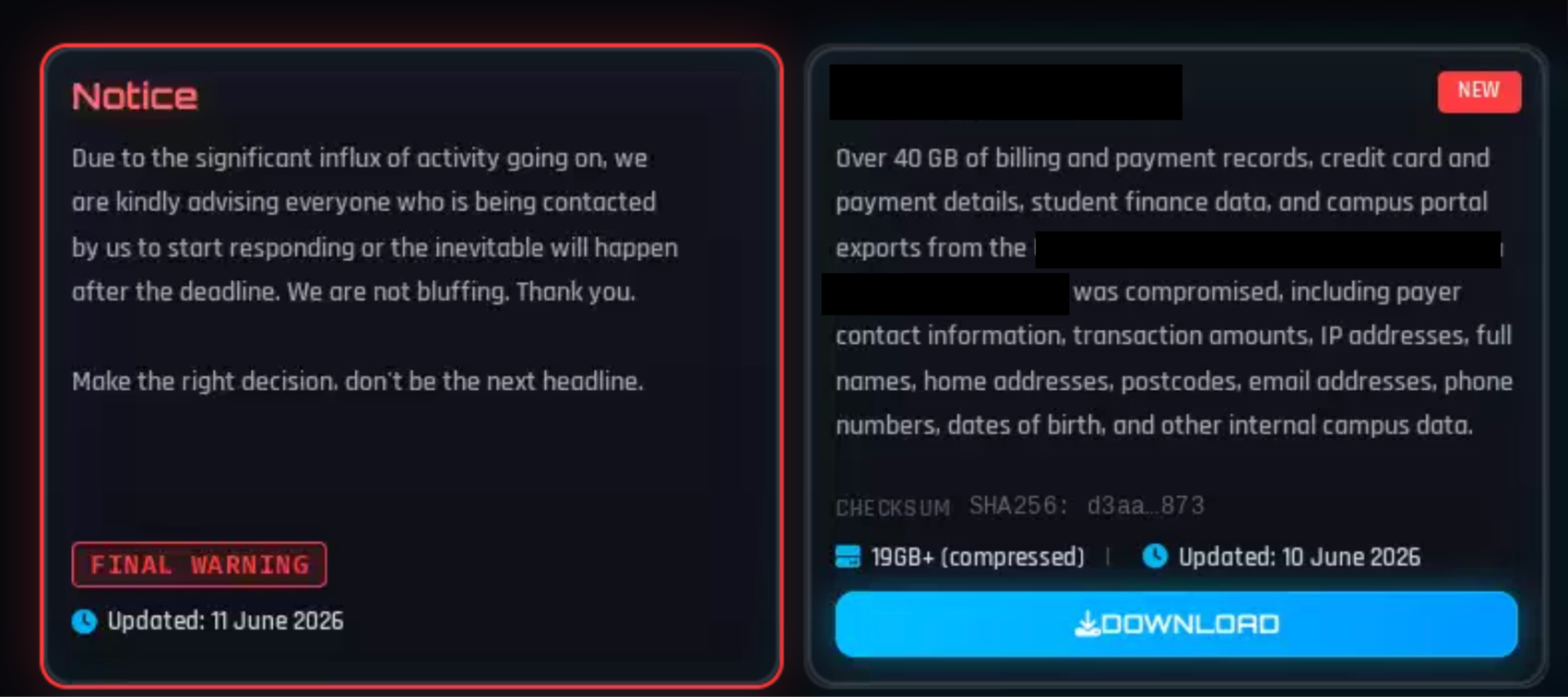
One of the world’s most active ransomware groups exploited a critical vulnerability in Oracle’s PeopleSoft software suite and used it to target about 100 customers and extort at least one of them to pay up in exchange for not leaking stolen data, researchers said.

The group, tracked as ShinyHunters, had been exploiting the PeopleSoft vulnerability for more than two weeks before Oracle flagged it. CVE-2026-35273, as the vulnerability is tracked, carries a severity rating of 9.8 out of 10, making the former zero-day one of the year’s most critical vulnerabilities to be exploited.

Google’s Mandiant security team said it’s an SSRF (server-side request forgery), a vulnerability that allows attackers to send requests from a susceptible server to systems used by the targeted organization. Oracle said the SSRF is remotely exploitable, and the company has issued a stopgap mitigation but has yet to fully patch the flaw. Google has confirmed that victims are receiving extortion demands.

9.8 0-day exploited for 2 weeks

The University of Nottingham confirmed on Wednesday that it was the victim of a hack that put a “significant” amount of student data in the hands of a threat actor. The confirmation came after ShinyHunters claimed the university was one of its recent victims and published gigabytes of data it claimed to have stolen in the hack.

Mandiant said ShinyHunters has been exploiting the vulnerability since May 27. As of Wednesday, the group had targeted roughly 300 endpoints belonging to 100 user organizations. About 68 percent of the organizations operated within the higher education sector. A researcher said on Tuesday that the group responsible had “exposed several directories revealing ongoing targeting of PeopleSoft.” The attackers also left available a staging server containing tools used in the attack.

“While several organizations successfully blocked the activity or remediated the vulnerabilities, others experienced compromise, resulting in stolen data being published on the ShinyHunters DLS,” Mandiant said. (DLS is short for data leak site.)

An analysis of a bash script left in the staging environment shows the attackers performed reconnaissance on compromised organizations, including mapping the PeopleSoft configurations, viewing process scheduler, and WebLogic server XML configurations. Eventually, the threat actors established an outbound SSH connection to 176.120.22.24, the IP address hosting ShinyHunters’ DLS. The stolen data was first compressed using the zstd tool. The DLS claimed to have recovered 48GB of data from a single victim.

A partially redacted section of the ShinyHunters’ DLS.

A partially redacted section of the ShinyHunters’ DLS. Credit: Mandiant

ShinyHunters has been active since at least 2019. Over the past several years, it has executed scores of hacks against some of the world’s largest companies, affecting millions of people downstream. A small sample of victims includes Ticketmaster (through the breach of Snowflake, which hosted the data), Spain’s biggest bank, Santander, and Salesforce (and, through it, Google and, reportedly, many other companies). ShinyHunters uses various techniques to gain initial access, including exploiting cloud misconfigurations and software vulnerabilities, stealing OAuth tokens, supply chain attacks, voice phishing, and other forms of social engineering.

Mandiant and Rapid7 are providing detailed indicators of compromise. They are also advising PeopleSoft customers on the steps they should take immediately. Given ShinyHunters’ success rate, all PeopleSoft users would do well to heed the calls.

What’s driving up your expenses? Many Americans say climate change.

0
what’s-driving-up-your-expenses?-many-americans-say-climate-change.
What’s driving up your expenses? Many Americans say climate change.

For decades, American politicians have been slow to take on climate change and curb carbon dioxide emissions, under the assumption that doing so might pass along costs to their voters. Ironically, their failure to rein in fossil fuel emissions has yielded the same result: Expenses for everyday Americans have soared as a result of more extreme flooding, fires, and heat.

“What’s striking is that already, households are bearing serious costs,” said Kimberly Clausing, a law professor at the University of California, Los Angeles. She co-authored a paper from earlier this year finding that families were paying between $400 and $900 more each year because of the effects of climate change, with the costs above $1,300 in the 10 percent hardest-hit counties, many of them found in Florida, Louisiana, Nebraska, Colorado, and California. 

On Wednesday, the Commerce Department reported that the annual inflation rate reached 4.2 percent in May, the highest rate in three years. Though the war in Iran is mostly responsible for this recent increase, a surprising number of Americans are attributing the general economic pinch they’re feeling to the changing climate. Two-thirds of U.S. voters agree that global warming is affecting the cost of living to some degree, according to new survey data from the Yale Program on Climate Change Communication, including most Democrats and moderate Republicans. Of those two-thirds, a majority of them said that climate change was driving up what they pay for groceries, utility bills, and home insurance.

Rising energy prices were at the top of people’s lists, a concern that some climate advocates are tapping into ahead of the midterm elections this November. On Monday, the LCV Victory Fund, a political action committee, announced that it will target “energy bill voters” with messages about how clean, affordable energy can trim their monthly expenses, and how Republicans have held back renewable power. That follows successes for Democrats in the off-year elections in 2025, where energy prices played a role in state races in Georgia, New Jersey, and Virginia.

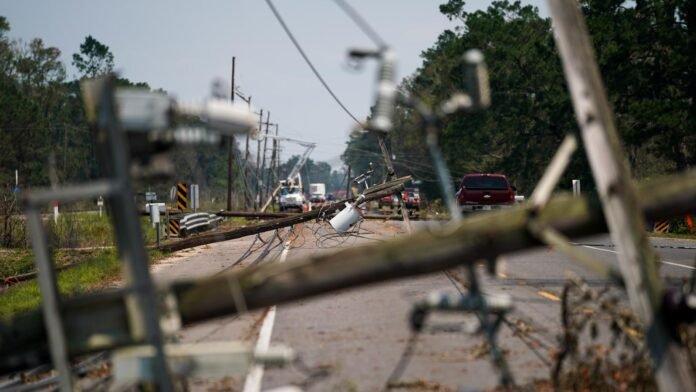
There are many factors pushing up electricity prices, but in some parts of the country, efforts to revamp the electric grid to handle more extreme weather is the primary reason. In California, utilities are upgrading their infrastructure to reduce wildfire risk; in the Southeast, they are rebuilding after hurricanes and flooding and billing their customers for it. In Arizona, residents are cranking up the air conditioning during scorching heat and paying more for power simply because they’re using more AC.

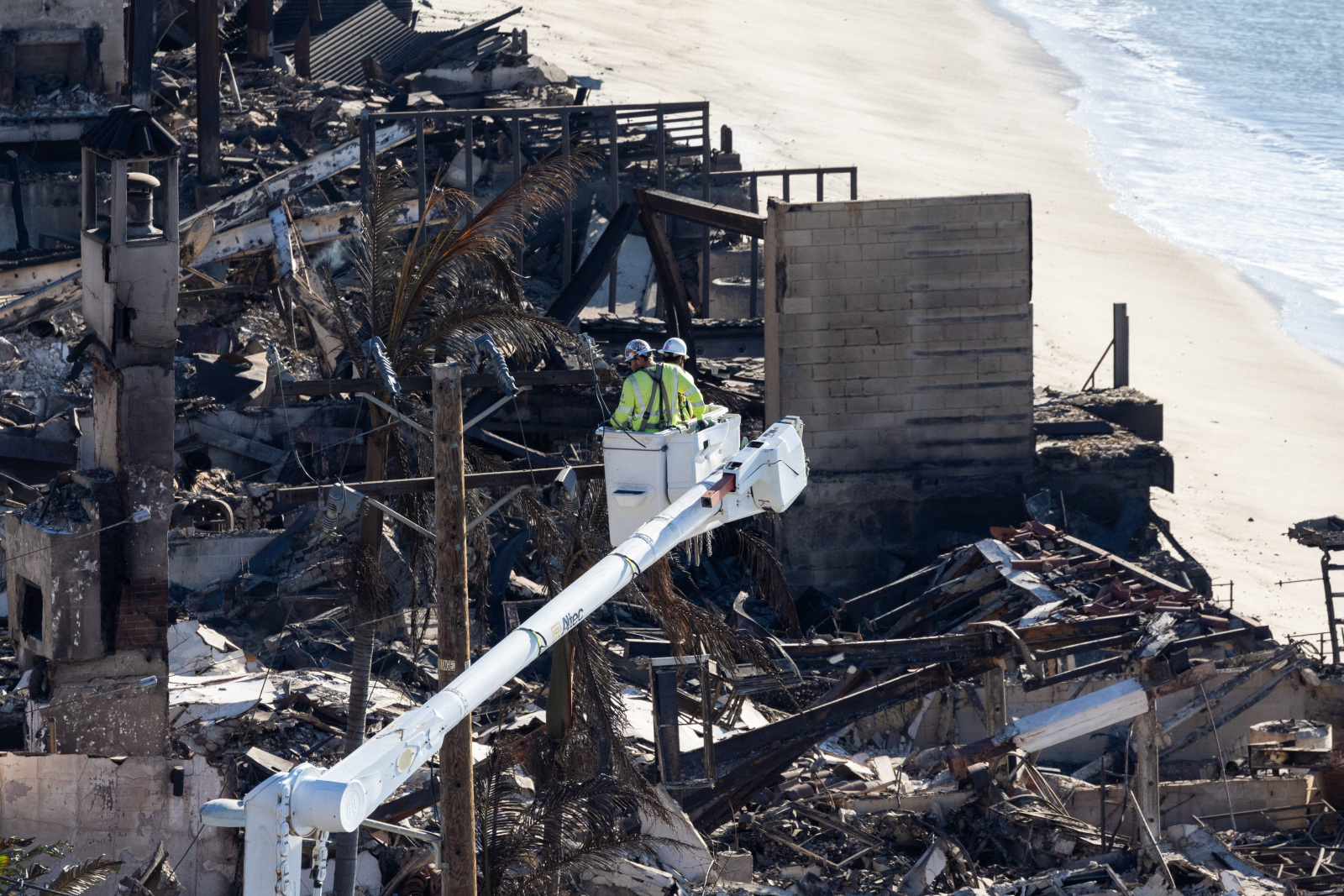
Photo of utility workers in a lift over a background of burned homes and palm trees by the beachaverage of about $35 more on electricity per year, compared with an extra $356 on homeowners’ insurance premiums, the biggest cost. Clausing, who owns a house in Portland, Oregon, said the insurance premium on her home skyrocketed from around $1,000 five years ago to about $2,200 today — an increase that her insurance company said was to help recoup the costs of wildfire damage in Oregon.


Another major category of costs in Clausing’s study was the health effects of climate change. As wildfire smoke grows more common, exposing people to harmful particulate matter, it’s leading to early deaths. The estimated economic damage of these premature deaths works out to $103 for every household in the United States each year. That’s not to mention the other ways climate change damages the public’s health, from lengthening allergy seasons to expanding the geographic spread of infectious diseases as temperatures warm, allowing ticks and mosquitoes to explore new territories. 

But it seems like many Americans haven’t made the connection: Only 35 percent of those in the Yale survey who agreed that climate change was driving up prices saw a link to higher health care costs. That’s because these health risks haven’t been adequately communicated to the public, said Anthony Leiserowitz, the director of the Yale Program on Climate Change Communication. “Health is one of the most powerful ways we have of saying, ‘Actually, this affects our lives right here, right now. It’s already affecting the people and places and things that we love,’” he said.

Read Next

Though most of the respondents thought climate change made groceries more expensive, it’s hard to measure the effect of extreme weather on food costs, according to Catherine Wolfram, a co-author of the study and a professor of applied economics at the MIT Sloan School of Management. That’s mainly because the United States’ food supply comes from all over the world, mitigating the impact of, say, a drought in Brazil or a heat wave in the Great Plains. Still, other research has found that hot summers can lead to higher food prices, with more increases projected as the world warms. 

As the effects of global warming grow more extreme, it’s becoming clear that they’re posing a problem for the budgets of lower-income Americans. Clausing is studying ways to design policies that tackle climate change without burdening poor families, through rebates or other mechanisms that can offset costs. 

“I’m glad people are connecting the dots,” Clausing said. “I think, at the moment, if you pursue better climate policy, the benefits to households, for the country as a whole, would exceed the costs.”


ICE Should Show It Hasn’t Been “Infiltrated by Violent Extremists,” Senator Urges

0
ice-should-show-it-hasn’t-been-“infiltrated-by-violent-extremists,”-senator-urges
ICE Should Show It Hasn’t Been “Infiltrated by Violent Extremists,” Senator Urges


A Democratic senator has asked newly confirmed Homeland Security Secretary Markwayne Mullin to explain the department’s racist social media presence and assure the agency has not been “infiltrated by violent extremists.”

Sen. Sheldon Whitehouse, D-R.I., pointed to a March bulletin from Colorado law enforcement analysts that was unearthed by The Intercept last month. It warned that DHS posts using language popular with neo-Nazis could inspire acts of far-right violence within the U.S. as well as prompt white supremacists to join the agency.

The bulletin by the Colorado Information Analysis Center cited repeated instances of DHS recruitment posts spurring discussion among neo-Nazis about enlisting in ICE with the hope of spurring a race war. It noted at least one instance of white supremacists claiming online that someone in their organization “had already been a captain at an ICE-contracted detention facility.”

The DHS posts, which sometimes appeared to borrow material verbatim from racist memes, songs, and tropes, were made as part of a recruiting push under then-DHS Secretary Kristi Noem. Noem and former U.S. Border Patrol official Greg Bovino, who became the public face of Trump’s draconian mass deportation agenda, were pushed out of their positions by the White House this year.

Whitehouse said that Mullin should disavow his predecessor’s “dangerous recruitment campaign.”

“I cannot believe that you support the messages associated with these recruitment campaigns, or want anyone under your supervision to use the imprimatur of the United States Government to promote those messages,” Whitehouse said in a letter dated Wednesday.

In response to a request for comment, a DHS spokesperson criticized Whitehouse and the Colorado law enforcement analysts. The analysts’ report came from a fusion center, part of a network of information clearinghouses for local, state and federal police that spread across the U.S. following 9/11.

“It is gross that Senator Whitehouse and the state of Colorado are actively weaponizing official law enforcement bulletins to promote dangerous anti-ICE conspiracy theories,” the agency wrote in a statement. “Comparing recruitment efforts aimed at filling critical public safety roles to extremist rhetoric is not only absurd, but it also dangerously undermines the mission and sacrifices of federal officers.”

Mullin also rejected criticism of the department’s social media accounts when he was questioned by Rep. Shri Thanedar, D-Mich., about the Colorado fusion center’s report at a June 3 hearing.

“I’m very concerned that your department is promoting white nationalist, anti-immigrant sentiments on official social media accounts,” Thanedar said.

Mullin brushed off Thanedar’s assertion that this concern was backed by the facts.

“There is no facts,” Mullin said. “You throw out ‘nationalism,’ ‘Naziism,’ and that is exactly what causes the hatred and the violence that happens to our officers every single day.”

Whitehouse initially wrote to Noem on Feb. 23 with a detailed list of questions about the origin of the ICE recruiting posts. Noem never responded, according to Whitehouse’s more recent letter.

Since Trump installed Mullin atop DHS, the former U.S. senator from Oklahoma has taken small steps to distance the department from some of Noem’s most controversial moves, including a decision to lower training standards for newly hired ICE officers. DHS also appears to be posting fewer of the most provocative posts since Mullin took office.

In his latest letter to Mullin, Whitehouse said he was still trying to get to the bottom of who authorized and crafted the posts. He’d also previously asked whether there were sufficient checks in place to prevent the hiring of individuals with connections to “violent extremist or terrorist organizations.”

“DHS and ICE have deployed recruitment ads featuring white nationalist slogans, songs, and imagery while lowering recruitment standards—facilitating the hiring of agents with histories of violent extremism. I renew my request about what DHS has done to ensure it has not been infiltrated by violent extremists, and who is responsible for this dangerous recruitment campaign,” Whitehouse said in this week’s letter.

Noem has stayed out of the public eye since her March ouster, taking a role as special envoy for Trump’s so-called Shield of the Americas program. Bovino has been more outspoken. He attended a “remigration” conference with white nationalists in Portugal. In an interview before the conference’s start, the now-retired Border Patrol commander-at-large compared himself approvingly to Nazi general Erwin Rommel, describing the Third Reich strategist as someone who captured the imagination of the public.

Trump has backed away from renewed war with Iran – here’s why

0
trump-has-backed-away-from-renewed-war-with-iran-–-here’s-why
Trump has backed away from renewed war with Iran – here’s why

The US and Iran stepped back from the brink of returning to all-out war on June 11. Hours after saying the US military would carry out strikes against Iran for a third consecutive night, Donald Trump postponed the attack. The Iranian military had said the US would “receive a more severe response than before” if it followed through on its threats.

Trump claimed to have cancelled the strikes because of progress in negotiations between the two countries. In a statement posted on social media, Trump said: “Discussions and final points have been, in both concept and great detail, approved by all parties involved.” He later added that the deal is set to be signed over the “next few days”.

Whether this will happen remains to be seen. Trump has declared that a deal between the US and Iran is imminent on numerous occasions only for no agreement to be signed. Iran’s foreign ministry has also called claims that an agreement has been reached speculative, insisting that “nothing has been finalised”.

And, even if it is signed, the agreement Trump is talking about is far from a final peace deal. It appears to be a memorandum of understanding, establishing a framework for the two countries to talk about unresolved issues. These include Iran’s ballistic missile capabilities and nuclear programme.

Iranians walk past a poster featuring the late Iranian supreme leader, Ayatollah Ali Khamenei, alongside his son and successor, Ayatollah Mojtaba Khamenei.

Iranians walk past a poster featuring the late Iranian supreme leader, Ayatollah Ali Khamenei (left), alongside his son and successor, Ayatollah Mojtaba Khamenei (right) in Tehran on June 11. Abedin Taherkenareh / EPA

Rather than the supposed diplomatic progress, perhaps more significant in persuading Trump to pull back from renewing an all-out war with Iran was that a return to conflict simply would not have been in the interests of the US.

War, as Prussian military strategist Carl von Clausewitz observed in his 1832 book, On War, is the continuation of politics by other means. Its enormous costs can be justified only when they are tied to a coherent strategy and when there is a clearly defined political objective that there is a reasonable prospect of achieving.

Measured against this standard, there was no argument for returning to war with Iran. The difficulty begins with the absence of any discernible plan in Washington. Trump has articulated no strategy and no definition of victory beyond a vague aspiration to prevent Iran from obtaining nuclear weapons.

He was drawn into prosecuting a war based on intelligence about the fragility of the regime in Tehran that proved flawed and on scenarios that were overconfident and have not come to pass. These scenarios suggested the decapitation of Iran’s leadership would lead to sudden regime collapse and a popular uprising that would see the country transition to democracy.

There is also very little a return to all-out war could have accomplished. The reason for this is that the Iranian regime is not a conventional state that can be brought down by overwhelming firepower. The regime, which is now dominated by the powerful Islamic Revolutionary Guard Corps, can best be described as a militia with a state.

It is operating through a dispersed network of forces across air, land and sea, which were designed as an asymmetric instrument of power capable of absorbing, scattering and outlasting precisely the kind of concentrated military pressure the US military was built to deliver.

Weeks of intensive bombing earlier in the war did not shatter the regime’s centre of gravity. Rather, it consolidated the regime and has left it more cohesive and determined than it was before. In contrast to the more cautious regime of Iran’s late supreme leader, Ayatollah Ali Khamenei, which tended to wait and to respond, the new regime has become assertive.

It has been quick to retaliate against US and Israel attacks with severity and to set the pace of escalation. On June 8, for example, Iran launched barrages of missiles towards Israel in protest at the Israeli military’s escalating campaign in Lebanon.

A man drives a tractor near the remains of an Iranian missile that landed in a field in Syria.

A man drives a tractor near the remains of an Iranian missile that landed in a field near the Syrian town of Najha on June 8. Mohammed Al Rifai / EPA

Costs of war

Iran also retains the capacity to impose intolerable costs on everyone while retaining a high threshold of pain itself. If an all-out war returned, there was a very real risk that Iran would have moved to close the Bab al-Mandab Strait between Yemen and the Horn of Africa by mobilising its ally, the Houthis.

This threat is already on the table. The Houthis paused their attacks on shipping in the region after a ceasefire was signed in Gaza in October 2025, but have warned these will resume if the Iran war escalates. The Bab al-Mandab Strait serves as the principal bypass route for Saudi oil and for much of Gulf maritime trade, both of which are currently unable to transit the closed Strait of Hormuz.

Iran is also likely to have resumed direct attacks on the Gulf states with greater scope and intensity than before, which could have converted an already severe global energy crisis into something far worse. Perhaps the most consequential impact of returning to all-out war, therefore, was the prospect that it would have cost the US its valuable Gulf partners.

Every Iranian strike that American installations in the region attract reinforces a lesson the Gulf monarchies are increasingly inclined to draw, which is that the presence of American bases on their soil makes them targets rather than affording them protection.

Faced with a closed Strait of Hormuz, the global economy in decline and a looming defeat for his Republican party in November’s US midterm elections, Trump is clinging to the hope that he can pressure Iran into accepting a deal. The chances of this strategy proving a success are slim.

0FansLike
0FollowersFollow
0FollowersFollow
0SubscribersSubscribe
- Advertisement -
Google search engine

Recent Posts