16.4 C
London
Thursday, June 11, 2026
Home Blog

Beijing reins in Alibaba, JD.com over destructive 618 price cuts

0
beijing-reins-in-alibaba,-jd.com-over-destructive-618-price-cuts
Beijing reins in Alibaba, JD.com over destructive 618 price cuts

Shares in China’s biggest e-commerce companies fell on Thursday after Beijing’s market regulator summoned five of the country’s largest online shopping platforms over deceptive promotional practices ahead of the annual “618” (June 18) shopping festival.

Alibaba’s Hong Kong-listed shares dropped 5.4% to HK$107.40 (US$13.8) while JD.com fell 2.9% to HK$108.9. Nasdaq-listed shares of PDD Holdings Inc, which operates the international shopping app Temu, also declined in early US trading.

The Beijing Municipal Administration for Market Regulation accused Taobao, JD.com, Pinduoduo, Douyin and Xiaohongshu of violations including false promotional claims, non-transparent business practices and failure to properly disclose sellers’ information.

The action came days before the “618” shopping festival, one of China’s biggest annual retail events, as Beijing pushes a broader campaign to stamp out what it calls “rat race” competition among e-commerce platforms. 

It came after the National Bureau of Statistics (NBS) said on Wednesday that China’s consumer price index (CPI) rose 1.2% year-on-year in May, unchanged from April but below market expectations of 1.3%. The figure fell 0.1% month-on-month, a sharp reversal from the 0.3% gain recorded in April.

Alibaba launched Singles’ Day, or Double 11, on November 11, 2009, through its Tmall platform, making it the world’s largest online shopping event by gross merchandise volume. Just months later, in June 2010, JD.com introduced the “618” festival to mark its founding anniversary, a mid-year event comparable to Amazon’s Prime Day, which was established in 2015 to boost sales before the historically quiet mid-July period.

“The Chinese e-commerce platforms’ subsidy and consumption voucher campaigns failed to display promotional rules in prominent positions. Some did not specify the actual amounts invested or the funding split between the platforms and merchants,” said the Beijing Municipal Administration for Market Regulation. “Platforms must shift from competing on subsidies and prices to competing on innovation and service.”

Pinduoduo’s business rules were also found to unilaterally absolve the platform of liability in product disputes, which the administration said violates statutory duties.

The administration ordered all five platforms to immediately rectify their “618” promotional rules and said it would continue to monitor their activities.

Before this, on May 25, it had already summoned 17 e-commerce platforms to spell out a broader set of prohibitions ahead of the “618” festival. Platforms were told to avoid irrational large-scale subsidy campaigns and to keep pricing and advertising practices in line with fair competition rules. The key prohibitions issued across multiple regulators include:

  • no irrational or oversized subsidy promotions during the “618” period;
  • no false or exaggerated advertising claims in promotional campaigns;
  • no platform terms that unilaterally absolve companies of liability in consumer disputes;
  • no sending of marketing messages to consumers without their prior consent;
  • no failure to display refund and cancellation terms clearly for travel and accommodation products.

Merchants bear the cost

The crackdown dates back to March, when the administration jointly summoned 12 online platforms, including Ctrip, Meituan, Douyin and Kuaishou, over a first batch of violations. Some platforms had enrolled merchants in promotions without consent and used technical tools to enforce platform-wide minimum pricing, stripping merchants of their right to set their own prices.

Taobao Flash Buy was singled out for enrolling food and beverage merchants in discount campaigns without authorization and cutting product prices without their knowledge. One merchant’s mutton skewer and stuffed pancake set, originally priced at 19.8 yuan (US$2.74), netted just 2.58 yuan per order after the platform intervened. Another merchant’s dumplings, normally sold at 18 yuan, were repriced so that the merchant received 1.25 yuan, well below the cost of ingredients.

Online travel platform Ctrip was found to have weaponized its “customer diversion” rules against hotels, penalizing properties with traffic restrictions and demands for full commission even when guests simply extended their stay at the front desk or switched platforms after canceling for personal reasons. 

Regulators ordered Ctrip to remove a price-tracking tool that monitored hotel rates across all channels and pressured properties to match the lowest price found.

“Guests checking in through one channel and extending their stay offline should not be treated as customer diversion,” the administration said. “Platforms must not penalize hotels for transactions that were not genuinely facilitated by the platform.”

A Xinjiang-based columnist using the pen name “A Wen” says platform subsidies are widely misunderstood by the public as acts of corporate generosity.

“Their subsidies are not generosity, but a tool for market domination. Platforms use them to strong-arm merchants into compliance and to lock consumers into habits that translate into long-term control,” he says. “The money is never simply a platform’s to spend as it pleases. Behind every subsidy campaign is traffic manipulation, rule-setting and the financial survival of merchants.”

“The most destructive pattern in Chinese e-commerce has been to hold up low prices as the only measure of success, then drag everyone into a race to the bottom. Platforms subsidize a little, merchants concede a little, consumers feel they got a deal. But no one actually profits. Established brands get squeezed into generic products, generic products get undercut by street-stall goods, and street-stall goods give way to counterfeits. The entire supply chain ends up competing on who can hold out the longest,” he says.

He describes the subsidy war as a classic prisoner’s dilemma, in which no single player dares to stop first even though all of them know the spiral is unsustainable. He said regulation was not simply a warning shot but a necessary intervention to define where legitimate competition ends and destructive attrition begins.

Some analysts warn that curbing aggressive discounting could backfire. If platforms are barred from heavy subsidy campaigns, consumers accustomed to rock-bottom prices may simply buy less rather than trade up to more expensive products. A drop in online sales would further slow the growth rate of China’s total retail sales of consumer goods, which has already decelerated sharply.

NBS data show total retail sales of consumer goods grew just 1.9% year-on-year in the first four months of 2026, a steep deceleration from 4.7% growth over the same period in 2025.

Online retail of physical goods rose 5.7% year-on-year in the first four months of 2026, roughly in line with the 5.8% recorded over the same period in 2025, and outpacing overall retail growth.

Generally, the trend points to a deflationary spiral that policymakers are already struggling to contain. Beijing has repeatedly signaled its determination to boost domestic consumption, but with household income growth under pressure and consumer confidence fragile, spending is unlikely to recover on its own.

In December 2022, Beijing announced the end of its nearly three-year nationwide Covid-19 lockdown policy, with a full reopening taking effect in 2023. Total retail sales of consumer goods rebounded 7.2% that year, but growth has slowed considerably since then.

In March 2024, the State Council launched a trade-in subsidy program to encourage consumers to replace old smartphones, home appliances and automobiles with new ones. The scheme partially contributed to retail growth of 3.5% in 2024 and 3.7% in 2025. Under the scheme, buyers of smartphones and digital products are eligible for a 15% rebate capped at 500 yuan per item. The program has been extended to 2025 and 2026.

Read: Beijing vows to retaliate as EU warns of China Shock 2.0

Follow Jeff Pao on X at @jeffpao3
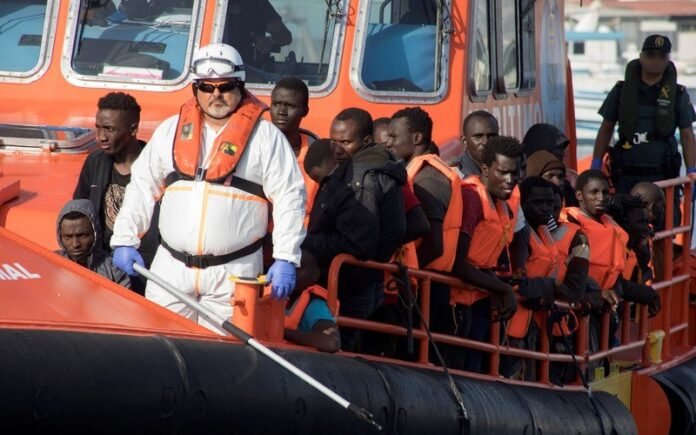
More than 1,300 migrants have died trying to reach the Spanish coast in 2026

0
more-than-1,300-migrants-have-died-trying-to-reach-the-spanish-coast-in-2026
More than 1,300 migrants have died trying to reach the Spanish coast in 2026


More than 1,300 migrants died while attempting to reach Spain during the first five months of 2026, according to a report published on Wednesday by advocacy group Caminando Fronteras (Walking Borders).

The report, released ahead of Pope Leo’s visit to Spain’s Canary Islands, said 1,317 people lost their lives on migration routes to the Spanish coast between January and May. The figure includes 142 women and 129 children.

According to the group, 27 boats disappeared during the period with everyone on board presumed lost.

The Canary Islands, a Spanish archipelago off the northwest coast of Africa, have experienced a surge in irregular migration over the past decade. The shortest distance between the islands and the West African coast is about 100 kilometres (62 miles).

Pope Leo has focused attention on the treatment of migrants during his visit to Spain this week, describing their situation as a challenge to the ethical foundations of the international order.

Rights groups say migrants are increasingly taking longer and more dangerous routes across the Atlantic Ocean in an effort to avoid detection, as authorities intensify efforts to prevent crossings in countries such as Mauritania, which lies close to Europe.

The report follows figures from 2025, when 3,090 people either died or disappeared while trying to reach the Spanish coast.

In addition to the Atlantic route to the Canary Islands, migrants also attempt to reach Spain from Morocco by crossing a stretch of water that is roughly 20 kilometres wide, sometimes by swimming.

Source:  Reuters

For Iran’s diaspora, a tough World Cup call: To support the national team or protest – or both?

0
for-iran’s-diaspora,-a-tough-world-cup-call:-to-support-the-national-team-or-protest-–-or-both?
For Iran’s diaspora, a tough World Cup call: To support the national team or protest – or both?

When Iran’s national soccer team walks onto American soil this summer for the 2026 FIFA World Cup, it will do so against the backdrop of an Iranian government crackdown against protesters in January, an ongoing war launched by the U.S. and Israel in February, and a four-month digital blackout affecting some 92 million people. It has left many Iranian fans feeling conflicted about who exactly they’ll be cheering for.

Even before a ball has been kicked, the tension has been clear among not only supporters but team members, too. Iranian players were issued visas to the United States at the 11th hour, and the team only arrived at their training base in Tijuana, Mexico, days before the tournament kicks off.

That came after a request to move their camp from Arizona, citing concerns over unfair treatment on U.S. soil, a move that required the formal endorsement of FIFA before it could proceed. Even with the team finally getting settled, however, multiple Iranian soccer fans have been denied visas to the U.S. Iran’s soccer association has also said its ticket allocation had been denied, leaving fans who had made the trek disappointed.

With a host nation actively at war with a competing one for the first time in World Cup history, the pitch will be a stage not just for soccer but for grief, resistance and competing nationalism. The Iranian diaspora, buffeted by the one-two punch of internal crackdowns and external interventions, now faces a deeply unsettling question: How do you express pride in one’s national team without tacitly supporting the government that it represents?

Diasporic identity crises

Along with many Iranians, mainly expatriates in the U.S., I plan to attend Iran’s opening game against New Zealand on June 15 in Los Angeles. The location is important – Los Angeles is a city that is home to the largest Iranian diaspora, so much so that it is often referred to as “Tehrangeles” within the community.

It is also a community among whom feelings toward the Islamic Republic run deep, with many of them having left Iran during or following the Iranian Revolution of 1979. Many in the community have remained loyal to the deposed Pahlavi regime and the crown prince, Reza, and going so far as celebrating the joint U.S.-Israeli led war on Iran.

It is in this community that the Iranian national team – colloquially known as Team Melli to reflect the Farsi word for national – will face battle not only against New Zealand, but also the conflicted emotions of its ethnic brethren.

With the memory of the January protests still raw, calls have been circulating among some Iranian Americans to formally protest and boycott the occasion. Proposals range from purchasing tickets, only to leave seats conspicuously empty, to booing the national anthem and withholding any celebration of Iranian goals.

Supporters have also been urged within Iranian American communities to resist FIFA’s attempts to prohibit non-Islamic Republic flags inside stadiums, with some Iranian expats suggesting on social media of spray-painting over the symbols on the current flag, carrying plain green, white and red alternatives into the ground, or wearing clothing bearing political slogans. Others have proposed exposing politically motivated tattoos or using stuffed animals to caricature Iranian leaders.

In return, Mehdi Taj, the president of the Iranian Football Association, issued a statement demanding respect, stating: “We need a guarantee there, for our trip, that they have no right to insult the symbols of our system, especially the Islamic Revolutionary Guard Corps.”

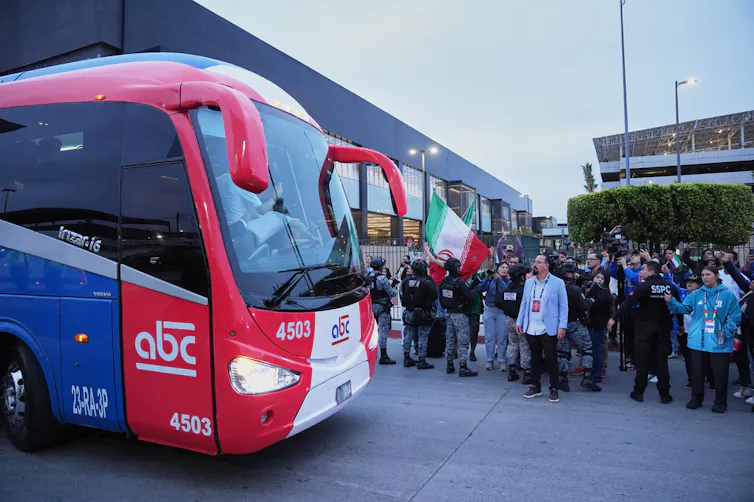
A bus passes by a crowd of people.

An Iranian national team bus arrives in Tijuana, Mexico, on June 7, 2026. AP Photo/Gregory Bull

There is a broader question that Iran’s World Cup appearance forces into view, and it sits uncomfortably alongside FIFA’s own record. While the governing body of world soccer awarded President Donald Trump its inaugural Peace Prize ahead of the tournament, it is now looking the other way as the U.S. remains at war and denies visas to would-be participants and spectators. The collision of sport and statecraft is nothing new, from the 1936 Berlin Olympics to the Soviet boycott of Los Angeles in 1984. But it has rarely been managed with such apparent indifference to its own contradictions.

When sport becomes a theater for competing political claims, it is the integrity of the game itself that is diminished. One is entitled to ask whether the notion of sport existing purely on its own terms — especially on the global stage — has ever been anything more than a convenient fiction.

Collision of politics and sport

Yet here lies the puzzle. Soccer occupies a place in Iranian life that borders on the sacred. One need only look to the fierce devotion surrounding Tehran’s great rival teams Persepolis and Esteghlal, a contest that ranks among the most intense club rivalries in world soccer, or to the scenes of street celebration that have swept Iran whenever the national team has won games at previous World Cups.

The memory of defeating the U.S. at the 1998 World Cup in France and the rematch in 2022 speaks to how deeply the game is woven into the fabric of Iranian culture. Supporting Team Melli has long been a source of collective pride, a point of unity that transcends politics and generation, regardless of religion, political views and social class. This creates the dilemma for the fans watching in Los Angeles and Seattle for Iran’s three group games.

A man in a suit puts a medal around his neck.

President Donald Trump puts on the inaugural FIFA Peace Prize presented to him by FIFA President Gianni Infantino. AP Photo/Evan Vucci

In Arizona, where I teach global politics at Arizona State University, several members of the Iranian diaspora articulated this dilemma to me, capturing the tension at the heart of current events. One person invoked the sporting rivalries of the Cold War as a reminder of soccer’s capacity to transcend conflict, yet acknowledged that the wounds of the January protests remained too raw for many in the diaspora to set aside. Another was more straightforwardly hopeful, expressing a wish to see Iran progress in the tournament and a belief that success on the pitch might, however tentatively, cut across political divisions.

Yet for those who have watched the events of recent years with grief and fury, cheering on a team that represents the Islamic Republic feels, to some, like an act of complicity. For its part, the Iranian government – as well as some Iranian critics – would argue that the national team stands apart from politics entirely. From this vantage point, soccer is a matter of national identity and cultural heritage that belongs to all Iranians regardless of their views on those in power. It is, moreover, a moment of proud participation, according to one Iranian official, and that to deny the players their support is to punish athletes for the decisions of politicians.

The protests that shook Iran, and the complex political landscape that followed, have left the diaspora navigating questions that go far beyond soccer.

The Islamic Republic, whatever one’s view of its conduct, remains the sovereign government of a nation with a rich and fiercely proud culture, and the players on the pitch represent that culture as much as they represent the state.

That they do so on the soil of a country with which Iran is actively at war renders this perhaps the most politically charged sporting occasion in living memory – one in which every goal, every flag and every empty seat carries a meaning that extends well beyond the 90 minutes. In that sense, the World Cup has not created a division so much as it has given an existing one a global stage.

Ted Cruz and Ron Wyden try to fight censorship with bipartisan JAWBONE Act

0
ted-cruz-and-ron-wyden-try-to-fight-censorship-with-bipartisan-jawbone-act
Ted Cruz and Ron Wyden try to fight censorship with bipartisan JAWBONE Act

US Senators Ted Cruz (R-Texas) and Ron Wyden (D-Ore.) today introduced the JAWBONE Act, a proposed law that could fuel lawsuits against federal officials who try to coerce broadcasters or tech platforms into restricting speech.

The Justice Against Weaponized Bureaucratic Overreach to Networked Expression Act would prohibit federal agencies and employees from coercing or trying to coerce broadcasters and providers of online services or AI services into changing content. The bill could apply to Federal Communications Commission Chairman Brendan Carr’s repeated attempts to pressure TV networks and broadcasters, or government pressure imposed on social media firms and AI chatbot makers.

The bill would create a private right of action for victims of “jawboning,” letting people recover compensatory damages in court. Individuals whose speech is stifled could bring cases against government officials, and the proposed law could be enforced by state attorneys general through civil actions.

“Jawboning occurs when the government pressures private companies to censor speech protected by the First Amendment,” said a press release issued by Cruz and Wyden today. The JAWBONE Act is “legislation to hold the government accountable for censorship and violations of the First Amendment,” it said.

The bill is bipartisan, and the Republican Cruz previously criticized the Republican Carr for coercing ABC into suspending Jimmy Kimmel. A quote from Cruz in today’s press release focuses only on actions taken by the Biden administration, though.

“The Biden administration weaponized the Cybersecurity and Infrastructure Security Agency to pressure Big Tech into ‘canceling’ Americans who spoke out against vaccine mandates and election fraud. Holding the government accountable and giving Americans the tools to fight back is essential,” Cruz said.

Wyden calls out “blatant” Trump threats

The joint press release has a quote from Wyden criticizing Trump for trying to censor late-night TV. “The most blatant example is Trump threatening cable companies because he doesn’t like their late-night shows, but jawboning isn’t partisan, and it isn’t new,” Wyden said.

Wyden said that “nearly all of Americans’ speech—including TV news, online streams and social media—flows through private corporations that are highly susceptible to government pressure.” A spokesperson for Wyden told Ars that the bill would apply to other scenarios not mentioned in the bipartisan press release, like the Trump administration pressuring app stores to take down apps such as ICEBlock.

A bill summary said that under current legal precedent, plaintiffs must prove that coercion succeeded in causing removal of or changes to content. The bill would let plaintiffs sue and obtain financial damages from “any government agency or employee that jawbones companies involved in social media, AI, or broadcasting, regardless of whether the jawboning succeeds.”

The bill specifically authorizes financial damages, because under current law, plaintiffs can only obtain injunctions that prevent future or ongoing violations, the summary said. With financial damages, government officials who engage in unlawful censorship could be held accountable even after leaving office. The bill effectively imposes a limit on financial payouts by allowing compensatory damages but not punitive damages.

Convenient “chokepoints” for censorship

The bill also “requires agencies to submit certain communications with social media companies, AI companies, and broadcasters to a portal with detailed public summaries and full access for Congress, helping ensure jawboning does not occur in secret,” the summary said.

The proposed portal would help individuals prove their rights were violated, the summary said. Without this measure, “plaintiffs may struggle to prove jawboning because the government has secretly communicated with the private companies it is coercing. Americans may not even know they were censored by their government,” the summary said.

The bill text said broadcasters, online services, and “speech-enabling artificial intelligence systems are critical for access to information and individual expression and have a right to independent editorial judgement. Such entities can also serve as chokepoints convenient for the government to target for censorship of disfavored speech and information.”

The bill defines broadcasters to include stations with FCC licenses and the national TV networks that provide programming to affiliate stations. This means coercion of local stations and national networks would violate the law.

“The term ‘coerce’ means to take a harmful, hostile, or unfavorable action, to imply the possibility of taking such action, or to threaten such action,” the bill said. The proposed ban has exceptions for lawful investigations, enforcement of federal or state laws, and actions taken under a warrant.

ACLU and Grover Norquist joined in support

The bill has a range of supporters, from the American Civil Liberties Union to Grover Norquist’s Americans for Tax Reform. ACLU Senior Policy Counsel Jenna Leventoff said the government has repeatedly “abused its authority to coerce private actors into censoring themselves,” and that the bill “would protect the First Amendment by stopping this kind of unconstitutional jawboning against broadcasters, platforms, and AI providers.”

Norquist said that “Twitter and Facebook were pressured by the FBI during the Biden administration to delete posts from the opposition,” and that the bill “will create a real recourse for victims of this indirect censorship and not let bad actors escape just by changing jobs.”

Another supporter, the Foundation for Individual Rights and Expression (FIRE), said:

If the JAWBONE Act becomes law, Americans will be able to sue federal officials for violating the First Amendment when they coerce social media companies, AI platforms, or broadcasters to change or take down protected speech. If the federal official did the jawboning “willfully and wantonly,” they’ll have to personally pay the damages. (Otherwise, the government will pay on their behalf.) That means federal employees will be personally incentivized to make sure they’re staying on the right side of the First Amendment when they reach out about speech on social media, AI platforms, TV, or radio.

The Knight First Amendment Institute at Columbia University endorsed the bill as “an important mechanism for accountability when government officials unlawfully coerce private intermediaries to suppress protected speech.” Government officials are free to speak directly to the public, but they must not “use threats or regulatory power to coerce private intermediaries into suppressing protected speech,” the group said.

Public Knowledge said the bill could rein in Carr’s campaign against broadcasters and Trump administration attempts to censor social media.

“From FCC Chairman Carr using the threat of the agency’s regulatory authority to coerce broadcasters over programming he (and the president) dislikes, to officials punishing social media platforms over their content moderation policies, government actors time and again weaponize their power to pressure platforms, AI providers, and broadcasters to suppress speech they themselves disfavor,” the group said.

Boy, 7, Killed by Grandfather’s Pet Monkey

0
boy,-7,-killed-by-grandfather’s-pet-monkey
Boy, 7, Killed by Grandfather’s Pet Monkey


A 7-year-old boy was killed in a horrifying attack after his grandfather’s pet monkey turned violent and mauled him outside the family’s home.

Little Ekkarat Srichan was playing near the house in Thailand when the macaque, named Choke, suddenly lunged at him, according to reports.

The animal sank its teeth into the boy’s chest and wrestled him to the ground in a terrifying attack that left neighbors shaken.

Witnesses said they heard the monkey shrieking as the child screamed in pain.

By the time relatives found Ekkarat, he was covered in bite marks and scratches. The monkey was still tied to a bamboo pole nearby with blood dripping from its mouth.

The boy was rushed to a local hospital, but doctors were unable to save him.

His devastated mother, Daranee Srichan, said doctors told her the monkey’s bite had punctured her son’s lung and struck a vital area.

“The doctor told me my son couldn’t survive because the monkey’s bite punctured his lung and hit a vital area,” the 27-year-old mother said. “If it hadn’t struck that spot, he would have been alright.”

The family said Ekkarat’s grandfather had rescued the monkey from the side of the road and kept it at the home.

But neighbors claimed the animal had already shown dangerous behavior before the deadly attack. They said Choke was known to growl, bare its teeth at people walking by and had even killed a stray cat that got too close.

After the boy’s death, the grandfather reportedly released the monkey into the mountains. That sparked fears among police and wildlife officials that the animal could attack someone else.

Authorities later found and captured the macaque.

Ekkarat’s grieving mother said the tragedy has changed her mind forever about keeping monkeys as pets.

“If I do, my other son might not survive,” she said.

Owning macaques is legal in Thailand, but the practice is strictly regulated. Keeping wild-caught or protected macaques without permission can lead to fines, prosecution and the animal being confiscated.

UK defense – a hole in the bucket

0
uk-defense-–-a-hole-in-the-bucket
UK defense – a hole in the bucket

In the 1950s and 1960s, a massive wave of underground humor swept across the USSR and the Eastern Bloc featuring a fictional broadcaster called Armenian Radio (known in the West as Radio Yerevan). Many of the jokes involved food lines and food scarcity, a fact of Soviet life.

In one widely circulated shaggy dog story, a man gets in different lines to try and buy some food for dinner. Each time, he reaches the end of the line to be told they are out of (meat, sausages, chicken etc.). He finally explodes in anger. A KGB man tells him to please behave better.

This is something new. The man in line comments that not only is the Soviet Union out of hamburger and chicken, it is out of bullets.

The Armenian Radio story reflects the condition of Great Britain today, not the Soviet Union of past years. The British military is out of everything. It even lacks bullets.

While the UK pretends to be a great power, it has a broken-down army, a fleet with submarines that can’t submarine and frigates that can’t frigate. Yet, despite these massive deficits, the UK promotes the war in Ukraine vociferously, thinking (one supposes) that as long as the Ukrainians are fighting and dying, the UK can worry less about defending itself.

As a member of NATO the UK depends on the United States for its survival, and on the “special relationship” it may have squandered under Keir Starmer. The near collapse of Britain’s fighting capability, including its dreadful lack of reserves and stockpiles, is paralleled by what looks like internal social collapse: a cultural crisis that is altering the UK, not for the better.

John Healey. Source: SCANPIX/AFP PHOTO/Wojtek Radwansk

The overall mess has now led to the resignation of the UK’s defense secretary, John Healey. Healey is a long-time Labor politician and Starmer stalwart. He is not a defense expert and has no particular national security background.

Healey reportedly demanded £18 billion in new funding to patch the critical structural holes in the armed forces (such as the idled submarine fleet, escort ship shortages and munitions stockpiles). The Treasury and Downing Street ultimately offered only £13.5 billion, with officials noting that only £10 billion of that was actually “new” money.

While Starmer previously pledged a long-term goal of hitting 3% of GDP on defense, Healey’s resignation letter revealed that the Treasury’s actual plan would only see defense spending reach 2.68% by 2030. Healey stated bluntly that this “falls well short of what is required for defense and the country at this dangerous time.”

  • At the end of the Cold War (1991), the British Army stood at roughly 155,000 active troops. Today, that number has dropped to approximately 72,500 – the lowest level since the Napoleonic era. The Royal Navy and Royal Air Force (RAF) have seen similar cuts, shrinking by 25% and 40% respectively since 2000.
  • The Ministry of Defense (MoD) has consistently missed recruitment targets. Privatized recruitment contracts have faced severe bureaucratic delays, causing applicants to drop out. Furthermore, social attitudes toward the military have shifted significantly among younger generations, hampering standard recruitment efforts.
  • Physical and mental health conditions mean that more than a fifth of remaining regular forces are classified as “not fully deployable” or completely undeployable.

The US has around 80,000 to 100,000 soldiers in Europe, more than the entire British army. US troops are better equipped and far better supported despite the huge distance between the US and Europe.

The level of UK support for NATO, defined as on or near the alleged front lines, is minimal. Roughly 800 to 1,000 British soldiers (typically an armored or mechanized infantry brigade combat team subunit equipped with Warrior infantry fighting vehicles or Challenger tanks) are stationed in Estonia. In Poland the UK maintains a smaller cavalry troop presence (usually around 150 personnel) integrated into the US-led NATO battlegroup in Orzysz.

While the UK is able to surge troops for NATO exercises, it is notably weak in supporting the Baltic States and Poland. The UK does provide intermittent RAF Typhoon deployments to bases in Lithuania, Estonia, or Romania.

Britain’s navy is in poor shape. There is a severe availability crisis for the hunter-killer submarine fleet. The Royal Navy has an operational availability rate of 0% for its deployed attack submarines. All of them are undergoing repairs. Britain’s ballistic missile submarines, Vanguard-class (Strategic Deterrence / SSBN) also are barely operational. The UK operates four Vanguard-class ballistic missile submarines based at HMNB Clyde (Faslane) in Scotland. They maintain the UK’s Continuous At-Sea Deterrent (CASD).

Under a doctrine active since 1969, at least one British nuclear missile submarine is hidden underwater at sea every single second of the year. Each carries American-made Trident D5 strategic ballistic missiles, armed with British-manufactured nuclear warheads. Commissioned in the 1990s with a 25-year design life, these boats are ancient and wearing out. Maintenance overhauls that used to take months now take years, forcing the remaining active crews into grueling, record-breaking deployments (sometimes exceeding six months underwater) just to keep a single boat on patrol.

The UK has not had funds to procure enough F-35B aircraft for its aircraft carriers. The UK simply does not own enough F-35Bs to fully stock even one carrier’s maximum flight deck capacity (~36 to 40 jets) purely with British airframes. To project maximum power during major deployments, British carriers routinely embed US Marine Corps F-35B squadrons alongside the Royal Air Force/Royal Navy joint squadrons to fill the empty spots on the flight deck.

British carriers also don’t have adequate fleet support. They have had to rely on NATO assets, especially the US, for escort duties. This is critical to protect carriers from enemy submarines and from missile and drone attack. Whether British carriers, without integrated escort, are supportable in combat scenarios is an open question.

HMS Argyll in the basin outside the Frigate Support Centre, Feb 2024. Photo: Tom Leach

The situation is also dire in the surface fleet, especially type 23 frigates (Duke Class). The operational readiness of the escort fleet is under intense strain. Only a single Type 23 frigate (HMS St Albans) was actively working up or operating at sea, with the remainder immobilized in various stages of maintenance, refit, or crew reallocation.

A notable portion of the remaining force is locked in extended upkeep blocks to keep them structurally sound and safe for sea. HMS Kent, for example, entered a major, planned deep maintenance and modernization cycle to sustain its baseline utility through the late 2020s.

To plug gaping personnel deficits across the fleet and preserve resources for incoming platforms, the Ministry of Defence prematurely retired HMS Argyll and HMS Westminster. HMS Westminster was decommissioned despite recently undergoing a massive, multi-million-pound refit, because the Navy could not sustainably crew the vessel while simultaneously preparing personnel for future platforms.

The UK has severely depleted its previously inadequate weapons stockpiles. So, too has the United States, but the difference is the US is stepping up defense manufacturing (as best it can with an obsolete defense manufacturing infrastructure) while the UK lacks funds and will power to increase defense production. The failure to meet financial targets (which led to the Defense Secretary’s resignation) means that the road ahead is full of potholes.

A related problem is that the UK has been moving much equipment to Ukraine, but this cannot be sustained. NATO is hoping, along with the Ukrainians, that their drone strategy will keep the Russians contained and force a negotiation that will end Russian occupation of Ukrainian territory. But this is a big wish, and drone “dominance” will sooner or later end as new counter-drone solutions get fielded.

The recently published UK Strategic Defence Review outlines a 10-year roadmap aimed at shifting the country toward true “warfighting readiness” rather than just looking good on a parade ground. The Defence Review is a solid assessment of Britain’s dire defense situation. It is unlikely under the current UK government that the Defence Review recommendations will be followed, or that funds will be found to change the current mess.

With plummeting defense capabilities, sooner or later UK politicians (and the supporting cast of defense experts) need to adjust to reality and rethink the country’s national security strategy. With a de minimis security role in NATO and empty stockpiles, the UK should be thinking more about home defense and less about power projection. In short, the UK needs to redefine its defense strategy from top to bottom.

As things now stand, the UK has a big hole in its defense bucket. It cannot continue without radical change in its plans and strategy.

Stephen Bryen is a former US deputy undersecretary of defense. This article, which originally appeared on his newsletter Weapons and Strategy, is republished with permission.

This unfathomably huge fungal network keeps Earth cool and green

0
this-unfathomably-huge-fungal-network-keeps-earth-cool-and-green
This unfathomably huge fungal network keeps Earth cool and green

Even if you don’t like eating mushrooms, you’re in debt to fungi. One group of them, known as arbuscular mycorrhizal fungi, form vast subterranean networks of tubes called hyphae, hooking up with the roots of plants to exchange nutrients. Earth is so verdant in large part thanks to these partnerships, as this expansive infrastructure is associated with nearly three-quarters of all plant species. But because the network sprawls underground, it’s been difficult for scientists to determine just how much arbuscular mycorrhizal fungi is out there. (Good luck digging everywhere on the planet and taking samples.)

Scientists have developed a workaround, which has produced some astonishing numbers. Using machine learning models, they’ve estimated that worldwide, the arbuscular mycorrhizal network stretches for 110 quadrillion kilometers, almost a billion times the distance from Earth to the sun. (Scoop up just a teaspoon of soil and you might find 10 meters of fungal strands.) Every year, these fungi shuttle around 4 billion metric tons of carbon, equal to 11 percent of humanity’s CO2 emissions. 

Because scientists have already taken thousands upon thousands of samples around the world, the researchers could train the models to build maps (you can play with them here) that predict where these fungi are more or less concentrated, even in the most remote environments. “We have started to have a clear picture of the full extent of these hidden living infrastructures that circulate carbon and nutrients in the soils beneath our feet,” said Toby Kiers, executive director of the Society for the Protection of Underground Networks and coauthor of the new paper, which published today in the journal Science.

enormous amounts of carbon underground in peat, or dead plant material that resists decay and accumulates over centuries.)

Toby Kiers and Merlin Sheldrake take soil samples in the mountains of Bhutan. Courtesy Tomás Munita

At the other end of the spectrum, the study found that in areas with large-scale agriculture, fungal network densities are about 50 percent lower on average. That may be because synthetic fertilizers provide crops all the nutrients they need, easing their reliance on arbuscular mycorrhizal fungi. Tillage also tears fungal networks apart at the end of a growing season. (Other research has found that tilling also disrupts soil’s ability to retain water.) “Maybe we can do better to have more fungal biomass in our agricultural systems, and in our terrestrial ecosystem as a whole, and capture more carbon dioxide,” said ecologist Smriti Pehim Limbu, who studies mycorrhizal fungi at Dartmouth College but wasn’t involved in the new paper.

Humanity has to feed itself, of course. But with this new data in hand, it can also take steps to protect these critical species hidden underground. “This map is for mycorrhizal fungi what the first detailed maps were for, I don’t know, ocean currents or river systems,” Kiers said. “Where you go from knowing a system exists to knowing where it is, how dense it is, and where it’s threatened.”


Next Article

U.S. President Donald Trump is joined by grocery store owners and supermarket in the Oval Office

No, rolling back these environmental rules won’t lower your grocery bill

A Point-by-Point Breakdown of Trump’s Failed Iran War Objectives

0
a-point-by-point-breakdown-of-trump’s-failed-iran-war-objectives
A Point-by-Point Breakdown of Trump’s Failed Iran War Objectives


At the very start of his war with Iran, President Donald Trump declared victory. “We won,” Trump announced on March 11, 11 days after launching the joint attack with Israel. “In the first hour it ⁠was over.” But more than 2,200 hours later, the conflict is obviously still raging.

This week, U.S. forces bombarded Iran after the downing of an American Apache helicopter near the Strait of Hormuz. Iran responded with strikes on targets across the Middle East and threats to “turn the entire region into hell.” Trump told Fox News’s Trey Yingst on Wednesday night that the U.S. fired 49 Tomahawk missiles at targets inside Iran, in addition to bombing raids by fighter jets. Yingst reported that Trump also said, “We’ll bomb the S out of them tomorrow night’” if Iran did not sign a peace agreement. Trump followed this on Thursday by declaring the U.S. would be “hitting Iran … VERY HARD TONIGHT.”

The burgeoning forever war contradicts months of reassurances by Trump that a peace deal with Iran is imminent.

An Intercept analysis of Trump’s claims about the Iran war, stated objectives, and supposed achievements finds the U.S. has fallen short or flamed out on all counts. The public record shows an administration that has consistently scaled back its goals and downgraded its claimed successes, without nearing anything resembling the victory Trump has touted. 

A Promise of World Peace

On the first day of the conflict, Trump laid out, with complete clarity, his most ambitious objectives. Claiming Iran was already “very much destroyed and, even, obliterated,” Trump said his war would bring peace to the region and, somehow, the globe. “The heavy and pinpoint bombing … will continue, uninterrupted … as long as necessary to achieve our objective of PEACE THROUGHOUT THE MIDDLE EAST AND, INDEED, THE WORLD!” Trump wrote on Truth Social on February 28.

The bombing campaign was, indeed, “heavy.” The “pinpoint” attacks included a strike on an elementary school that killed between 150 and 175 civilians, most of them children. And thousands more civilians died in other strikes. Almost 149,000 civilian infrastructures, including homes, hospitals, and schools, have been damaged in the U.S.–Israel war, according to an April report from the Iranian Red Crescent Society. An estimated 400,000 people have been affected by damage to houses and apartments. But Iran was not “very much destroyed,” much less “obliterated.”

Peace in the Middle East, it goes without saying, never came to pass. The U.S.–Israeli strikes actually kicked off a regional war that grew to include more than a dozen countries, including Bahrain, Iraq, Jordan, Kuwait, Lebanon, Oman, Qatar, Saudi Arabia, and the United Arab Emirates. Beyond this, the inability of the self-proclaimed “peace president,” head of the world’s newly created Board of Peace, and recipient of the first FIFA Peace Prize to achieve “peace throughout … the world” may stand as Trump’s grandest failure.

Just two days after setting out his topline goals, Trump began publicly vacillating and dramatically scaling back U.S. aims. “Our objectives are clear. First, we’re destroying Iran’s missile capabilities,” he said during a March 2 White House ceremony. “Second, we’re annihilating their navy. … Third, we’re ensuring that the world’s number one sponsor of terror can never obtain a nuclear weapon. … And finally, we’re ensuring that the Iranian regime cannot continue to arm, fund and direct terrorist armies outside of their borders.”

Months later, these objectives remain unmet.

Eliminating Missiles

While the United States claims to have struck more than 13,000 targets in Iran, leaked U.S. intelligence assessments found evidence that Iran restored 30 of the 33 missile sites along the Strait of Hormuz to operational status, and retained 70 percent of its prewar missile stockpile and 70 percent of its mobile launchers. Reports emerged that in April and May, Iran began efforts to repair its Yazd Missile Base. In just one day last week, Kuwait says it was targeted by an Iranian barrage of “13 hostile ballistic missiles.” On Sunday, Iran launched ballistic missiles at Israel. And on Thursday, Iran attacked multiple countries in the region, including Jordan which said it shot down 20 Iranian missiles.

During an aborted interview with NBC News that aired on Sunday, even Trump admitted he had failed. “They have some missiles left,” he said. “I would say, percentage-wise, maybe 21, 22 percent of their missiles. It’s a lot of missiles.” 

Annihilating the Navy

While the U.S. sunk many Iranian ships, the Iranian Navy has not been annihilated. In fact, U.S. Central Command, which is overseeing the war effort, has repeatedly referred to actions by Iran’s Navy and the Islamic Revolutionary Guard Corps Navy in the months since Trump laid out his aims, demonstrating that both still exist, upending Trump’s frequent boasts to the contrary.

Just last week, Secretary of State Marco Rubio told the Senate Foreign Relations Committee that “there is no Iranian Navy,” and in the next breath admitted there was, referencing Iran’s “Boston Whalers with machine guns on them.”

Ending the Nuclear Program

Iran also still maintains its stockpile of enriched uranium. And there is no evidence that nuclear sites that were not attacked during Trump’s 2025 Iran war, such as Pickaxe Mountain, were ever damaged. Last week, in fact, Rubio confirmed that Iran’s “nuclear program” still exists. And during his recent NBC interview, Trump acknowledged that Iran still possessed its stockpile of highly enriched uranium and “they can get it, I guess, with years of work.”

Last week, Rubio even suggested Iran might be allowed to continue enrichment at some later date, noting it would need to accept “severe and long-term limitations, and/or cancellation, of enrichment.”

Halting Funding of Militias

The Trump administration has also failed to ensure “that the Iranian regime cannot continue to arm, fund and direct terrorist armies outside of their borders.” Days after Trump declared this war aim, House Republicans introduced legislation stating that “Iran remains the world’s largest state sponsor of terrorism and provides substantial financial and military support to groups including Hezbollah, Hamas, and the Houthis.” In the months since, even the Trump administration says the president’s goals haven’t been achieved.

In mid-April, the State Department said that Iran still “funnels the wealth of the Iranian people to Hizballah and other terrorists in the Middle East.” That same month, the Treasury Department took action against a “constellation of Iran-backed terrorist militias,” specifically “seven Iraqi militia commanders responsible for planning, directing, and executing attacks against U.S. personnel, facilities, and interests in Iraq,” including leaders of Kata’ib Hizballah, Kata’ib Sayyid Al-Shuhada, Harakat Al-Nujaba, and Asa’ib Ahl Al-Haqq. In May, the Treasury Department again targeted “Iran and its proxy militias in Iraq,” sanctioning “leaders of Iran-aligned terrorist militias Kata’ib Sayyid Al-Shuhada and Asa’ib Ahl Al-Haq” and referencing still “other Iran-aligned terrorist militias in Iraq.”

Unconditional Surrender

This assemblage of failures has been compounded by other unmet war aims. On March 6, Trump set the terms for an agreement with Iran. “There will be no deal with Iran except UNCONDITIONAL SURRENDER!” he wrote on Truth Social. In the months since, that hard-line stance has turned to mush.

“There is the prospect before us — which could happen today,” Rubio said last week of a potential peace deal, in a weak-kneed explanation to lawmakers. “We’re hopeful that something like that could happen in which the straits would reopen, we would enter into a period of negotiations on very specific topics — delineated negotiations in the hope of reaching an outcome that’s acceptable to us, and something they would be able to do as well.”

Reopening the Strait

The “straits” in question have become another sticking point and catastrophe. After failing to achieve all his initial war aims, Trump added another that was nothing more than a return to the status quo antebellum in the Strait of Hormuz: opening the waterway to traffic after Iran imposed a wartime blockade.

Before the war, the average number of vessels crossing the strait — a critical artery for the world’s oil, fertilizer, helium, critical materials for microchips, and numerous other goods — was more than 120 per day. It has never been close to that level again.

“I gave Iran ten days to MAKE A DEAL or OPEN UP THE HORMUZ STRAIT. Time is running out,” Trump declared on April 4. When the U.S. and Iran agreed to a ceasefire on April 7, Trump wrote on social media that he would “suspend the bombing and attack of Iran” on the condition that Tehran agree to the “COMPLETE, IMMEDIATE, and SAFE OPENING of the Strait of Hormuz.”

The next day, the White House declared: “Iran has now agreed to a ceasefire and reopening the Strait of Hormuz as the Trump Administration negotiates a broader peace agreement — once more proving Peace Through Strength victorious.” But that same day, Iran closed the strait, following continued Israeli attacks on Hezbollah targets in Lebanon. 

In response to Iran’s blockade, the U.S. imposed its own blockade of the strait on April 13, barring commercial vessels from entering or leaving Iranian ports. Then on April 15, Trump posted: “I am permanently opening the Strait of Hormuz.” Two days later, Trump claimed, “Iran has agreed to never close the Strait of Hormuz again.” On April 19, Trump said Iran had launched attacks in the strait and noted Iran had announced a blockade. On April 23, Trump ordered the Navy to attack Iranian ships laying mines in the strait. On May 6, Trump teased that the war might be “at an end, and the highly effective Blockade will allow the Hormuz Strait to be OPEN TO ALL, including Iran.” A day later, Trump said U.S. warships came under Iranian fire in the strait. The situation was still dragging on when Trump wrote, on May 29: “The Hormuz Strait must be immediately open, no tolls, for unrestricted shipping traffic, in both directions.” On Monday, a U.S. Army Apache helicopter gunship patrolling the strait was downed by Iran. 

The Strait of Hormuz remains functionally closed, except for a tiny trickle of traffic. “Last month, I directed our Great U.S. Military to execute a secret mission to support Oil Tankers and other Commercial Ships through the Strait of Hormuz,” Trump posted on Wednesday. “More than 200 Commercial Ships have safely traveled through the Strait.” (About 3,000 ships normally traverse it every month.) On Thursday, Iran announced that it, again, closed the strait to oil tankers and commercial ships.

Oil industry analysts say that global oil reserves are dwindling and that if the war doesn’t wrap up in the near term, petroleum prices could skyrocket to $150 a barrel. “The oil will go down,” Trump said on NBC, but acknowledged the war had driven up prices. “We’re going to have higher gasoline. We’re going to have a little higher fertilizer,” he admitted, before equivocating further when asked if gasoline prices had peaked. “Well, it depends. I mean, it depends where the war goes. It could be,” he waffled. “If we sign an agreement, it’ll go down now. Otherwise, it’ll go down after we’re finished.”

Oil prices rose to about $95 a barrel on Thursday as the U.S. and Iran continued to launch attacks. Trump said on Wednesday that the price of oil would have been at $250 a barrel had the U.S. government not been siphoning off “millions of barrels” of Iran’s oil over the course of the war. On Thursday, Trump posted that the U.S. would also soon seize Iran’s “oil infrastructure points, and assume total control of their Oil and Gas Markets.” Despite the rampant oil theft and threats of more to come, U.S. inflation accelerated for a third straight month in May, driven by energy prices which rose 3.9 percent over the month.

A Peace Deal

The “agreement” in question is still another failed aim. On March 23, Trump told reporters about supposed peace talks and cited “major points of agreement, I would ​say — almost all points of agreement.” Iran denied negotiations had taken place. Two days later, Trump claimed Iran wanted to “make a deal so badly.” On March 26, he said Iran was “begging to make a deal.” On April 15, he said the war was “very close to over.” On April 17, Trump claimed that Iran had “agreed to everything” and that “we will get a deal in the next day or two.” 

“An Agreement has been largely negotiated, subject to finalization,” Trump announced on May 23. On June 2, Trump wrote: “as I told Iran, ‘It’s time, one way or another, for you to make a Deal.’” Then Trump told NBC late last week: “We’re very close to having a deal.” But on Monday, Trump said a “Final Deal” has yet to be “reached.”

What such a “deal” will end shines a bright light on another flip-flop failure by the president. Trump went from claiming, in early March, that the U.S. won the war with Iran, to attempting to convince Americans that he never even went to war in the first place. “We don’t call it a war,” he said before the end of that month. “We call it a military operation.” By early May, Trump was calling it a “mini war” or “a little detour.”

Just Give Him Two Weeks

The deadline for when this “mini-war” will finally end may be the most telling of Trump’s failed aims and achievements. It’s well known that Trump’s lying and laziness coalesce around one simple phrase: two weeks. “We’ll have something in two weeks,” Trump said in January of an agreement with Europe to extend U.S. control over Greenland, to take one example.

Trump has long used this two-week delaying tactic when faced with vexing questions about anyone and everything, from Russian President Vladimir Putin and the war on ISIS to international trade and the Covid-19 pandemic. Two weeks really means later. Except when it means never.

The ceasefire with Iran, announced on April 7, was initially supposed to last “two weeks” while the two countries inked a deal to end the war, according to Trump. He claimed at the time that they were already “very far along with a definitive Agreement concerning Longterm PEACE with Iran, and PEACE in the Middle East.”

On Monday evening, Trump held a tele-rally for South Carolina Sen. Lindsey Graham where he addressed his failed war with Iran. “We’re negotiating now, and they want to make a very good deal. They’re willing to give us everything,” Trump claimed, noting, “It’ll happen very soon.” The president then added in his favorite faux time frame: “I think we are winning that battle, but you’re really going to win it over the next two weeks when we declare total victory.”

UK, Australia, Canada launch fund to support two-state solution efforts

0
uk,-australia,-canada-launch-fund-to-support-two-state-solution-efforts
UK, Australia, Canada launch fund to support two-state solution efforts

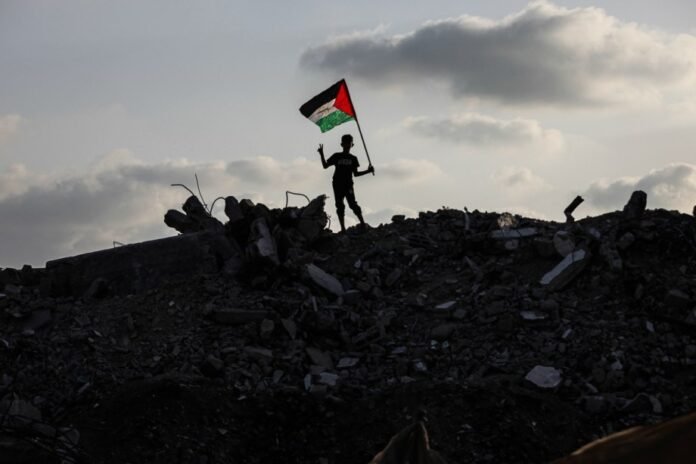
Group of Palestinian children in Bureyc Camp raise the Palestinian flag over the rubble of buildings destroyed by Israeli strikes following announcements of recognition of the State of Palestine by Canada, Australia, the UK, and Portugal, on September 22, 2025, in Gaza City, Gaza. [Moiz Salhi - Anadolu Agency]

Group of Palestinian children in Bureyc Camp raise the Palestinian flag over the rubble of buildings destroyed by Israeli strikes following announcements of recognition of the State of Palestine by Canada, Australia, the UK, and Portugal, on September 22, 2025, in Gaza City, Gaza. [Moiz Salhi – Anadolu Agency]

The United Kingdom, Australia and Canada announced Thursday the creation of a new International Peace Fund aimed at supporting efforts toward a two-state solution between Palestine and Israel, Anadolu Agency reports.

In a joint statement, the three countries said the multi-donor fund will support projects designed to advance the conditions for a negotiated two-state solution.

The governments said the initiative will complement ongoing diplomatic, humanitarian and development efforts by supporting organizations working to promote peacebuilding and mutual understanding.

The three countries reaffirmed their commitment to a negotiated two-state solution, describing it as the only viable path to lasting peace.

The UK, Australia and Canada will each contribute initial seed funding equivalent to £1 million ($1.3 million) over three years. The fund will also be open to contributions from other international partners.

READ: ‘A stain on our city’: UK urged to ban Israeli property fair selling stolen Palestinian land

After nearly breaking, NASA’s Deep Space Network “worked well” on Artemis II

0
after-nearly-breaking,-nasa’s-deep-space-network-“worked-well”-on-artemis-ii
After nearly breaking, NASA’s Deep Space Network “worked well” on Artemis II

NASA pushed its Deep Space Network beyond its limits during the Artemis I mission nearly four years ago. The global array of deep space communications antennas couldn’t keep up with the routine demands of 40 robotic science missions and the extraordinary surge required by NASA’s Orion space capsule as it flew around the Moon.

The experience in late 2022 reduced or delayed downlinks from several high-profile science missions, including the James Webb Space Telescope and Mars rovers, as the data-hungry Artemis I mission took priority on NASA’s communications network. And that was before the first Artemis mission with astronauts onboard. When Artemis II launched April 1, NASA called upon the Deep Space Network (DSN) again to connect Mission Control to the Orion capsule as it soared more than a quarter of a million miles from Earth.

With a crew of four flying inside the spacecraft, the agency’s appetite for data from Orion on Artemis II was even higher than it was on Artemis I. But at a little more than nine days, the Artemis II mission was shorter than the 25 days Artemis I spent in space, helping alleviate the communications overload. Artemis I also launched 10 small CubeSats into deep space, many of which required tracking and telecom services from the DSN. Artemis II carried fewer CubeSats.

“We learned a lot on Artemis I, and we actually put some new processes in place ahead of Artemis II, mostly focused around coordination and our scheduling processes with all the missions, not just the Orion vehicle itself,” said Greg Heckler, deputy program manager for capability development in NASA’s Space Communications and Navigation Program. “I think that worked well.”

Lessons learned

Heckler said NASA’s science division, responsible for most of the missions using the DSN, provided the network’s managers with “positive feedback” after Artemis II. But the limitations of the network and the high demand continue to “create some asset contention” among NASA’s missions.

“During Artemis I, we had a subsystem called the Private Cloud Appliance. This PCA actually failed during Artemis I. Because of that failure, that high visibility, we actually received some additional resources from our Moon to Mars program, and we were able to install, effectively, a new subsystem ahead of Artemis II,” Heckler said.

The demand for signal is only going up. NASA and its commercial and international partners plan to launch numerous missions to the Moon in the next few years. NASA is working with commercial providers to construct ground antennas for a dedicated network for Moon missions, called Lunar Exploration Ground Sites (LEGS), to free up more capacity on the DSN to support other spacecraft. Commercial companies are also developing data relay satellites to fly in orbit around the Moon, supporting future landers and construction of a Moon Base. High-bandwidth optical communications may be another solution. NASA successfully tested a laser communications terminal on the Orion spacecraft on Artemis II.

“We’re going to have to work as a community to deal with that higher level of contention during the Artemis missions themselves, but we’re doing everything to establish non-DSN, or new infrastructure, to take on that load and burden,” Heckler said Wednesday in a meeting of the Small Bodies Assessment Group.

Asking for more

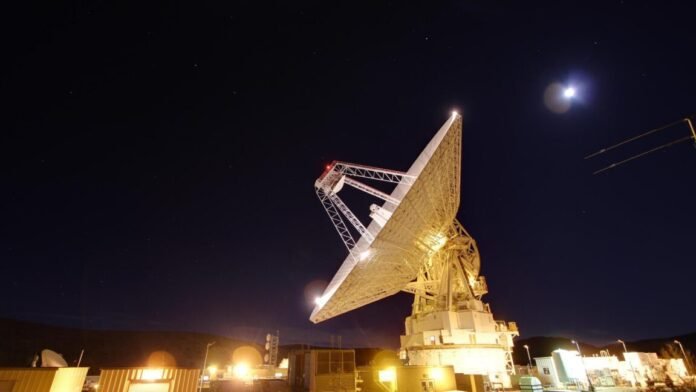
The burden currently includes around 40 operating missions that rely on the DSN’s antennas in California, Spain, and Australia to stay in communication with Earth. Most of NASA’s missions outlive their original design lives, so they put demand on the network for longer as the agency launches new spacecraft.

About 40 more missions are projected to need the DSN over the next 10 years, and many of the 40 missions currently using time on the network will likely still be operating over that time. One of NASA’s most data-intensive missions, the Nancy Grace Roman Space Telescope, is scheduled for launch in August. It will return more data through the DSN than all of NASA’s previous astrophysics missions combined.

The 10 CubeSats that launched as secondary payloads on Artemis I placed an unforeseen burden on the DSN. Some of the small satellites were lost soon after deploying from the rocket, and their operators called upon the DSN to use its giant antennas to search for the CubeSats as they headed into deep space, further exacerbating the communications crunch the network was already experiencing with the Orion spacecraft.

“Before onboarding new missions to the DSN, we now strictly require a feasibility study to see if there’s enough capacity to make that type of commitment,” Heckler said. “So we’re trying to balance, through data and analysis, the new demands coming onto the system versus those legacy missions we have to support until they fly out due to natural causes.”

DSN managers are also working with NASA’s older missions, some of which continue to pull on the network decades after their launch, to understand how much capacity they will use. As these older missions got extended, some of them did not update the network on their needs. “Some missions are using more than what their paperwork would say,” Heckler said.

“Once that is in place, as we move forward with new mission commitments, we will just be more focused, I think, and more process-oriented in being able to commit to new missions or not,” Heckler said.

Key antenna offline

One constraint on the DSN is an accident last year that knocked one of the network’s three 70-meter (230-foot) antennas offline at the Goldstone Deep Space Communications Complex near Barstow, California. This antenna, along with similar ones in Spain and Australia, is used to communicate with some of NASA’s most distant missions.

The 70-meter dish was tracking NASA’s Juno spacecraft at Jupiter last September when it “over-rotated” and damaged cables and water lines in the facility’s fire suppression system. An estimated 200,000 gallons of water flooded the base of the antenna. The water contained glycol, causing it to be classified as an environmental hazard, officials wrote in a report after investigating the accident. The resulting flooding rendered the antenna inoperable.

Investigators cited several technical and process causes. After troubleshooting a problem with the antenna’s emergency stops, technicians at Goldstone “overrode and bypassed multiple safeguards that normally would have prevented over-rotation,” officials wrote in the report.

“The investigation revealed inadequate training, insufficient written procedures, a reliance on undocumented behaviors and tacit knowledge, and deficiencies in the antenna’s control logic,” officials wrote. “In addition to the root causes listed above, the hydraulic limit system—the final fail safe against over-rotation—was discovered to have been severely damaged to the point of inoperability in an unknown and undocumented prior incident.”

Work logs indicated the hydraulic limit system was last tested in 2004.

NASA officials estimate it will cost between $4.1 million and $4.6 million to repair and restore the antenna to service. “Our plan for that system is to combine any of the remediation after the mishap with an already planned upgrade cycle that will keep that system down into 2028,” Heckler said.

0FansLike
0FollowersFollow
0FollowersFollow
0SubscribersSubscribe
- Advertisement -
Google search engine

Recent Posts