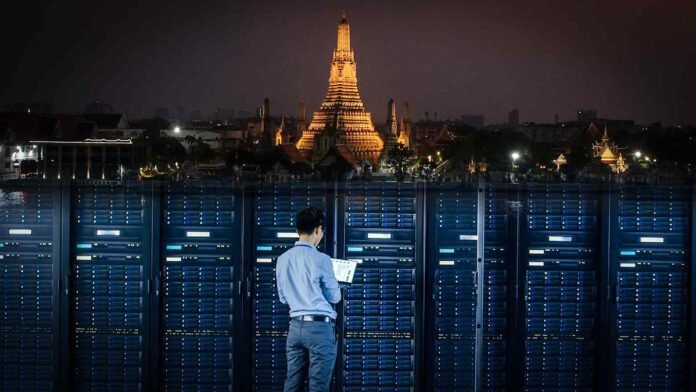
AI and cloud services do not run in the air. They need land, power, water, cooling, fiber, permits, and a lot of physical infrastructure. Thailand is now seeing more of that demand land inside its industrial estate ecosystem.
Thailand is no longer talked about only as a manufacturing base, a tourist destination, or a regional logistics hub. It is also attracting more attention as a digital infrastructure destination, especially for data centers and cloud services.
According to Thailand’s Board of Investment (BOI), investment promotion applications in Q1 2026 exceeded 1.01 trillion baht (US$30.7 billion) across 624 projects. The digital sector accounted for 873.7 billion baht of that total, with data centers and cloud-related services accounting for a major share of the activity.
That tells us one thing quite clearly: the AI and cloud boom is not only about chips, apps or software. It also needs buildings.
More specifically, it needs industrial land, reliable electricity, water systems, cooling capacity, fiber connectivity, regulatory approvals and long-term infrastructure planning. This is where Thai industrial estate operators such as WHA Corporation and AMATA Corporation become relevant to the story.
Expanding data center pipeline
Several research houses have described data centers as a long-term growth segment within Thailand’s digital infrastructure sector.
Maybank Securities has estimated that Thailand’s data center capacity could rise significantly over the coming years, potentially reaching around 2.6GW. Krungsri Research has also described data centers as part of a broader structural shift in Thailand’s digital economy.
In January 2026, BOI approved seven major data center and data hosting projects worth more than $3.1 billion. These included projects from True Internet Data Center, GSA Data Center, Stellar DC and other operators.
One of GSA Data Center’s projects is located at WHA Eastern Seaboard Industrial Estate 5 in Rayong. BOI has also approved a 4.6 billion baht data center project by Bridge Data Centres IIO (Thailand) in Chonburi, with an IT load of 134MW.
These projects show how Thailand’s digital infrastructure expansion is moving into established industrial zones, particularly in areas with land, utilities, transport links, and power infrastructure.
Still, it is important to separate approved investment value from actual financial recognition. A BOI approval does not automatically mean immediate revenue for any company.
Projects still need to go through land acquisition, construction, permitting, utility preparation, and commercial operation before they are reflected in operating results.
Data centers are not simple tenants. They have very specific requirements, especially around power reliability, land readiness, connectivity and cooling infrastructure.
Thailand has several factors that support this type of investment. First, data centers require a stable electricity supply. For large-scale facilities, power availability is one of the most important parts of site selection.
Second, the Eastern Economic Corridor, or EEC, already has industrial land, utilities, transport infrastructure, ports, roads, and investment incentives. The EEC covers key provinces such as Chonburi, Rayong and Chachoengsao.
Third, multinational companies continue to assess ASEAN locations as part of supply chain diversification and regional expansion strategies. Thailand remains one of the countries included in those discussions.
BOI’s Fast Pass mechanism also plays a role. It is designed to improve coordination and shorten approval timelines for selected strategic projects.
For data center operators, that can matter because projects often involve power allocation, land access, construction permits, work permits, and specialist technical requirements.
In short, Thailand is trying to make the process easier for large-scale investors. Whether that leads to completed projects depends on execution.
WHA Corporation
WHA Corporation operates across industrial estates, logistics, utilities and power, digital infrastructure and related services. That mix places WHA within the physical infrastructure side of Thailand’s data center development story.
Its industrial estate network includes locations in Thailand and Vietnam, with several estates located in the EEC. The company’s utilities and power businesses provide water, wastewater treatment and energy-related services to industrial customers.
For data center operators, this type of infrastructure is part of the site-selection equation.
They need land, but they also need supporting utilities, connectivity, and long-term infrastructure planning. Data centers are not just buildings with servers inside. They are high-demand facilities that require continuous operating support.
BOI’s approval of the GSA Data Center project at WHA Eastern Seaboard Industrial Estate 5 in Rayong is one example of data center investment activity within WHA’s estate network.
WHA’s role should therefore be viewed through its existing business segments: industrial estate development, utilities, logistics, power and digital infrastructure.
Any financial impact from data center-related activity would depend on project execution, contract terms, construction timelines, land transfer schedule, and future operating conditions.
AMATA Corporation epicenter
AMATA Corporation develops and operates industrial estates in Thailand and other regional markets, including Vietnam, Laos, and Indonesia.
For Q1 2026, AMATA reported total revenue of 4 billion baht, up 17.87% year-on-year. Net profit was 1.4 billion baht, up 52.25% year-on-year. Revenue from real estate sales reached 2.5 billion baht, supported by land transfers in Chonburi, Rayong and Vietnam.
Reports also indicate that data center clients were among AMATA’s land buyers during the period. China-based Vistas/ZDATA has been linked to an 80MW data centre project at Amata City Chonburi.
This places AMATA’s estate network within the broader discussion around Thailand’s data center and digital infrastructure investment. AMATA has also announced initiatives related to advanced industrial development, including the AMATA European Smart City project with B.Grimm Power.
The project is intended to attract advanced technology companies with requirements around ESG standards, clean energy and higher-specification infrastructure.
AMATA’s involvement in this theme should be assessed over time by its land sales, estate development activity, backlog, infrastructure readiness, and project execution.
Project timelines matter
One important point: approved projects do not become completed projects overnight.
Industry research notes that there is usually a time gap between investment approval, land acquisition, contract finalization, permitting, construction and commercial operation. That means data center approvals may take time before they appear in company financial statements.
For industrial estate operators, revenue recognition depends on factors such as land transfer schedules, customer readiness, infrastructure delivery, regulatory approvals, and project milestones.
So, when looking at BOI-approved investment figures, readers should separate a few things: Approved investment value, signed agreements, land transfers, construction progress, and recognized revenue. They are related, but they are not the same thing.
Thailand’s data center expansion still depends on several practical factors. Power supply is one of the main considerations. Large-scale data centers require substantial and reliable electricity capacity. BOI has also noted that power readiness remains an important issue for future data center investment, particularly in high-demand locations.
Regulatory approvals may also affect timelines, especially for multinational investors and cross-border projects. Parent-company approvals, construction timelines, and infrastructure readiness can all influence when projects move from announcement to operation.
For AMATA, reports have highlighted the need to monitor land sales progress against the company’s full-year target, as well as execution in overseas markets such as Laos.
For the broader sector, external factors such as global trade policy, US-China tensions, and changes in multinational investment flows may influence manufacturing and digital infrastructure investment into Thailand.
These are not reasons to dismiss the trend. They are simply part of the operating reality behind large-scale infrastructure projects.
Data-driven bottom line
Thailand’s data center story is becoming a larger part of the country’s digital infrastructure landscape.
BOI data shows strong investment promotion activity in digital and cloud-related sectors. Several data center projects have also received approval, with activity concentrated in locations such as Chonburi, Rayong, Bangkok, Samut Prakan and Chachoengsao.
Industrial estate operators such as WHA and AMATA are connected to this development through land, utilities, infrastructure, and estate development.
This does not make the story a simple stock-market call. More broadly, it reflects Thailand’s shift toward digital infrastructure, where data centers depend on the same fundamentals as industrial estates: land, power, water, connectivity, and execution.
The less visible side of AI is not the chatbot on the screen – it is the physical infrastructure behind it. And in Thailand, that infrastructure story is now moving deeper into the industrial estate sector.
Vivian Collins is a quantitative research analyst specializing in algorithmic trading and risk analytics. She uses big data and machine learning to conduct predictive market analysis, integrating financial engineering with macroeconomic insight to generate data-driven investment strategies.










![People mourn as 34-year-old Palestinian man Islam Hasan Salih dies at Al-Awda Hospital after getting severely injured in an Israeli attack on Nuseirat camp in Gaza, Palestine on June 11, 2026. [Hassan Jedi - Anadolu Agency]](https://i0.wp.com/www.middleeastmonitor.com/wp-content/uploads/2026/06/AA-20260611-41644678-41644675-ISRAELI_ATTACK_KILLS_34YEAROLD_PALESTINIAN_MAN_IN_GAZA-1.jpg?fit=920%2C613&ssl=1)