35.1 C
London
Wednesday, June 24, 2026
Home Blog

Vietnam graft case lifts veil on To Lam’s security-state economy

0
vietnam-graft-case-lifts-veil-on-to-lam’s-security-state-economy
Vietnam graft case lifts veil on To Lam’s security-state economy

When Vietnamese prosecutors indicted the leadership of Nam Trieu Company for allegedly inflating the prices of interrogation chairs and other specialized law-enforcement equipment, domestic media predictably focused on the headline figure of more than 18 billion dong (US$710,000) in state losses.

Yet the significance of the case goes well beyond the financial losses alleged in the indictment. According to publicly available information from Vietnam’s Ministry of Public Security, Nam Trieu operates under the Department of Security Industry and manufactures specialized vehicles, patrol boats, license plates and technical equipment for law enforcement agencies.

In other words, Nam Trieu operates within Vietnam’s state security sector, from which State President and Communist Party General Secretary To Lam rose to national power.

Its prosecution offers a rare glimpse into an area about which relatively little public information is available, raising broader questions about transparency, oversight and accountability in a sector that has become increasingly important to the Vietnamese state under To Lam.

The Nam Trieu case comes at a time when the Ministry of Public Security’s role extends far beyond traditional law enforcement responsibilities. In recent years, the ministry has assumed growing responsibilities in areas ranging from digital data management and cybersecurity to telecommunications infrastructure and the domestic security industry.

Economic actor

This trend reflects a broader state strategy aimed at strengthening control over critical infrastructure and information systems.

International attention was drawn to this development in 2025 when reports emerged that the ministry was seeking a controlling stake in FPT Telecom, following its earlier assumption of control of MobiFone.

Officials involved in those restructuring efforts argued that stronger state oversight was necessary to safeguard critical digital infrastructure and national cybersecurity interests.

The Nam Trieu case is not directly related to those developments. Nevertheless, it arrives at a moment when the ministry’s expanding economic footprint is attracting increased attention both domestically and internationally.

From a governance perspective, the participation of security institutions in strategic sectors is not unique to Vietnam. Similar arrangements exist in various forms around the world.

Scholars of security-sector governance have long noted that commercial activities undertaken by security institutions require particularly strong accountability mechanisms. Similar debates have emerged in countries where military- or security-linked enterprises play significant economic roles, including China, Egypt and Pakistan.

The challenge for policymakers is how to balance legitimate security considerations with transparency and accountability as institutions with security responsibilities assume broader economic roles.

Procurement beyond public view

Enter the alleged corruption at Nam Trieu. According to prosecutors, Nam Trieu executives inflated the production costs of thousands of specialized products to generate off-the-books funds for what court documents described as “external relations” and “hospitality” activities.

One contract involving interrogation chairs allegedly accounted for nearly 17 billion dong in losses. That’s raised an unusual amount of scrutiny of the ministry’s procurement practices.

Publicly available information provides only a partial picture of the scale of Vietnam’s security industry, the volume of public spending involved and the mechanisms used to evaluate procurement contracts.

It’s thus difficult to assess how pricing decisions are reviewed, how performance is measured and whether existing oversight mechanisms are functioning effectively.

Because many activities associated with security and law enforcement involve legitimate confidentiality concerns, transparency at the ministry will never match that of ordinary public procurement.

Nevertheless, the Nam Trieu case illustrates how limited public visibility can complicate efforts to evaluate accountability and institutional performance. The case therefore raises questions not only about the conduct of specific individuals but also about the effectiveness of existing governance and oversight mechanisms.

Where accountability and rights intersect

The implications of the case extend beyond budgetary oversight. Questions of transparency in the sector also raise broader issues concerning accountability and the protection of rights within systems of detention, interrogation and law enforcement.

Equipment used in detention facilities and investigative processes occupies a unique position in the state apparatus. That is, these are not ordinary government purchases comparable to office furniture or administrative supplies.

They are used in environments where state authority directly affects individuals’ liberty and rights. An interrogation chair, by itself, is not a tool of abuse. However, it forms part of a broader infrastructure associated with detention, questioning and law enforcement procedures in a state globally renowned for abuse.

In democratic countries, the procurement and use of law-enforcement equipment is subject to multiple layers of oversight, including auditors, legislative bodies, inspectors general and, in some cases, independent monitoring organizations.

The objective is not only to prevent waste or corruption but also to ensure that institutions exercising coercive authority operate within legal and rights-based frameworks.

Vietnam has not traditionally had a broad public debate about these issues. However, as the country’s security institutions assume wider economic and administrative responsibilities, questions concerning accountability and rights protections are likely to receive increasing attention.

Credibility on trial

The Nam Trieu case will eventually be resolved in court, and those found responsible may face criminal penalties.

Yet the significance of the case will extend beyond the verdict, offering a rare window into a sector that plays an increasingly important role in Vietnam’s governance, yet remains only partially visible to the public. It will be a de facto trial of whether existing oversight mechanisms are evolving at the same pace as the responsibilities these institutions now carry.

The verdict, of course, will not provide a complete answer. But it will provide a rare view of how transparency, accountability and public oversight operate within one of the least-scrutinized agencies of Vietnam’s security-state economy.

Nguyen Ngoc Nhu Quynh, also known as Mother Mushroom, is a Vietnamese writer, human rights commentator and former political prisoner based in Texas, United States. She is the founder of WEHEAR, an independent initiative focusing on Southeast Asian politics, human rights and economic transparency.
Slate Auto’s truck builder goes live for its $25k electric pickup

0
slate-auto’s-truck-builder-goes-live-for-its-$25k-electric-pickup
Slate Auto’s truck builder goes live for its $25k electric pickup

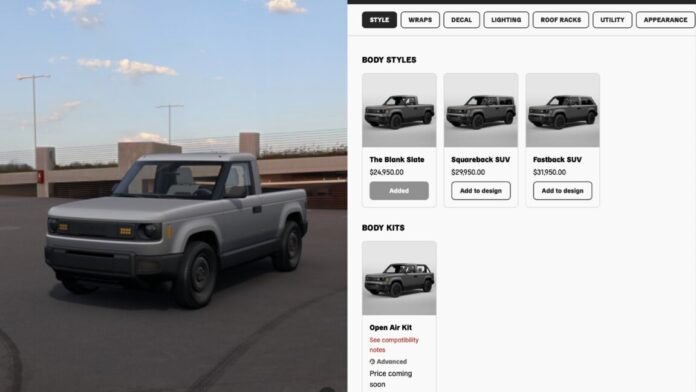
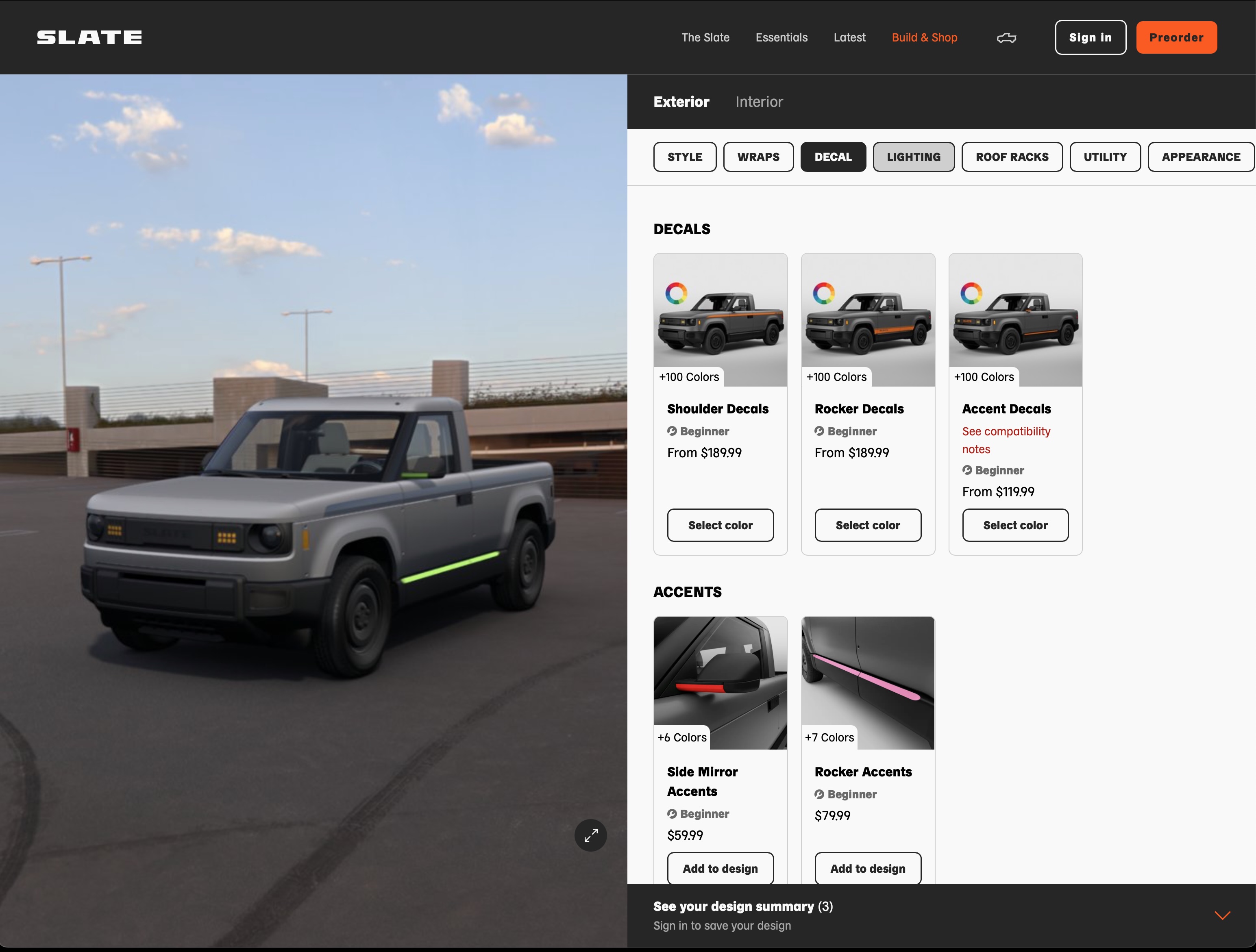
This morning, Slate Auto officially announced pricing for its Slate electric truck. Ars will have some time with a prototype later today, along with—hopefully—answers to many of our remaining questions. In the meantime, we decided to play around with Slate’s online configurator to see how much you might actually have to pay for one of these exciting new EVs. As expected, Slate has managed to achieve a sub-$25,000 starting price; if you ignore things like taxes or the as-yet unknown delivery charge, the Blank Slate pickup really does start at just $24,950.

The battery pack uses lithium iron phosphate cells, with 63 kWh useable energy (65 kWh gross) and a 181 hp (135 kW), 195 lb-ft (264 Nm) electric motor driving the rear wheels. In pickup configuration, with 17-inch steel wheels, the EPA range estimate is 205 miles (330 km). DC fast charging takes 30 minutes to charge from 20 to 80 percent at up to 120 kW via a NACS port, or four to 17 hours using AC, depending on whether you use a level 2 or simple wall socket.

Bare bones

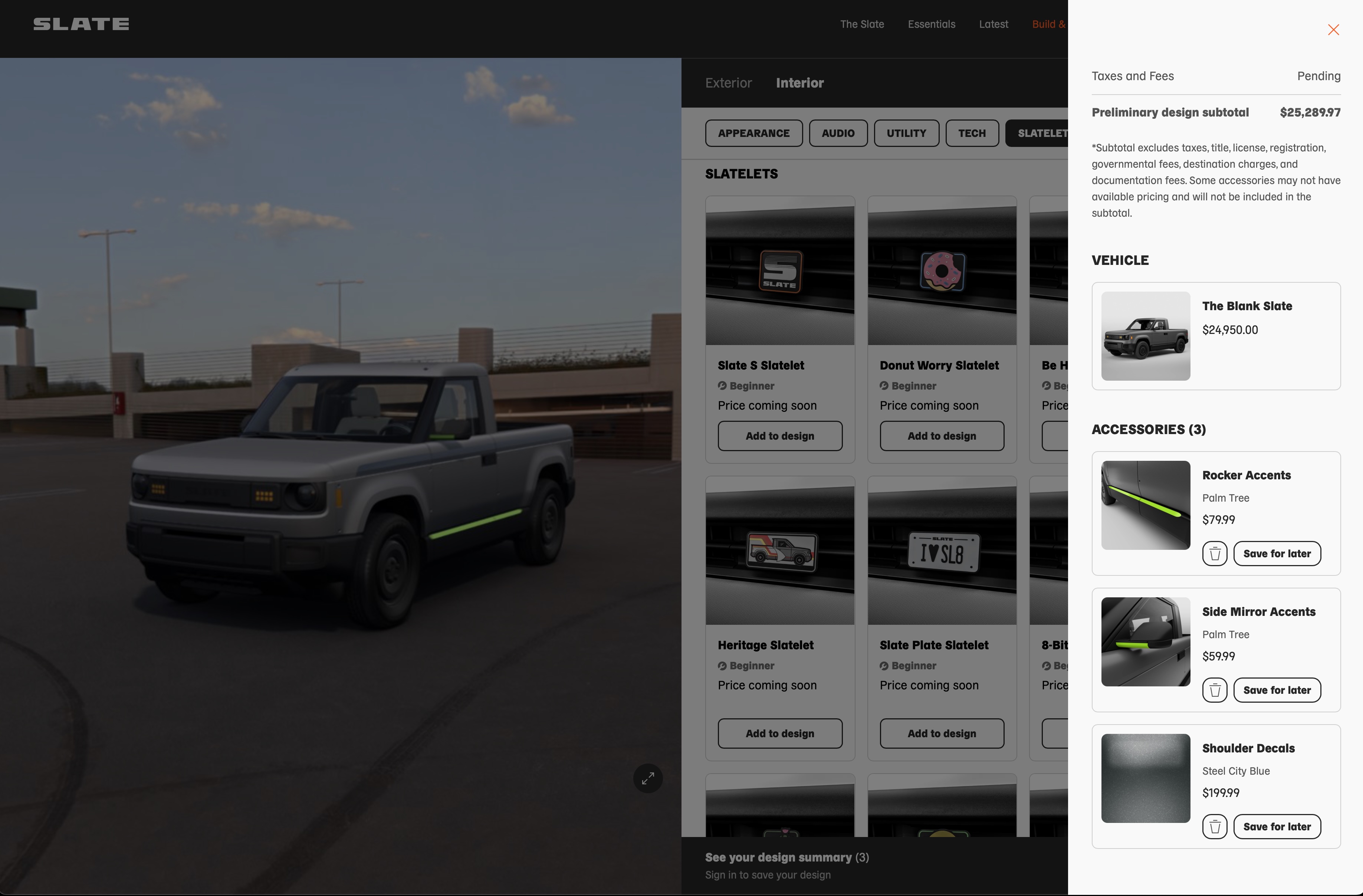
And if you really want a bare-bones pickup, here is your chance. The first variant I mocked up this morning came in at just $25,289.97—plus pending taxes and fees—and that’s just because I spent a little over $300 on some decals to make the truck look like my favorite pair of sneakers.

As you go through each option on the configurator, a little icon tells you how easy or hard it should be to install that part yourself, what kind of tools you might need, and how long it might take. For the wraps, Slate points out that these can be a “big commitment for a DIYer. We’d recommend professional installation if you’re not sure you can tackle it.”

A screenshot of Slate Auto's configurator

If you want an entirely gray truck, you can have that, too.

A screenshot of Slate Auto's configurator

That’s pretty cheap.

The work truck

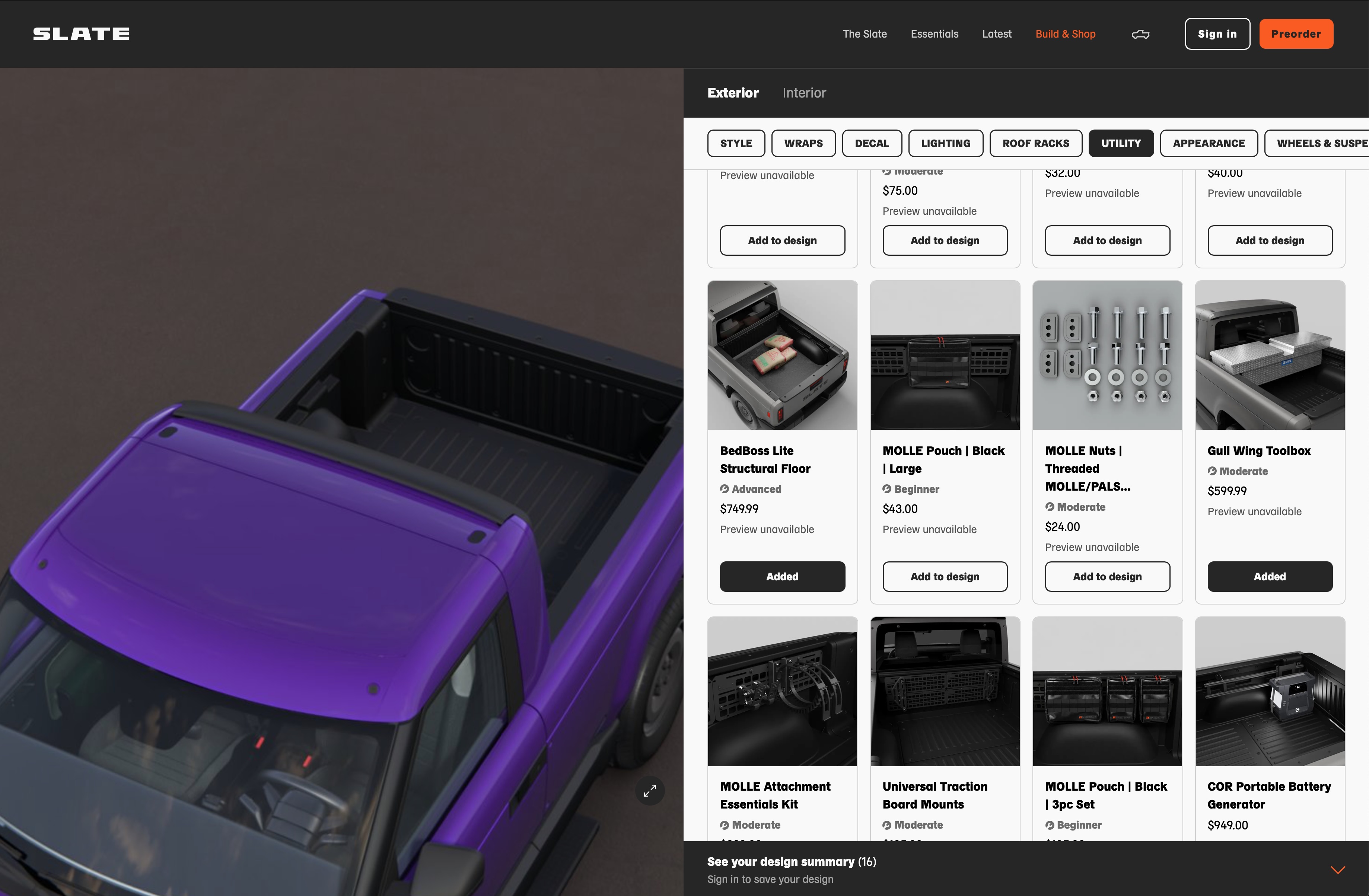
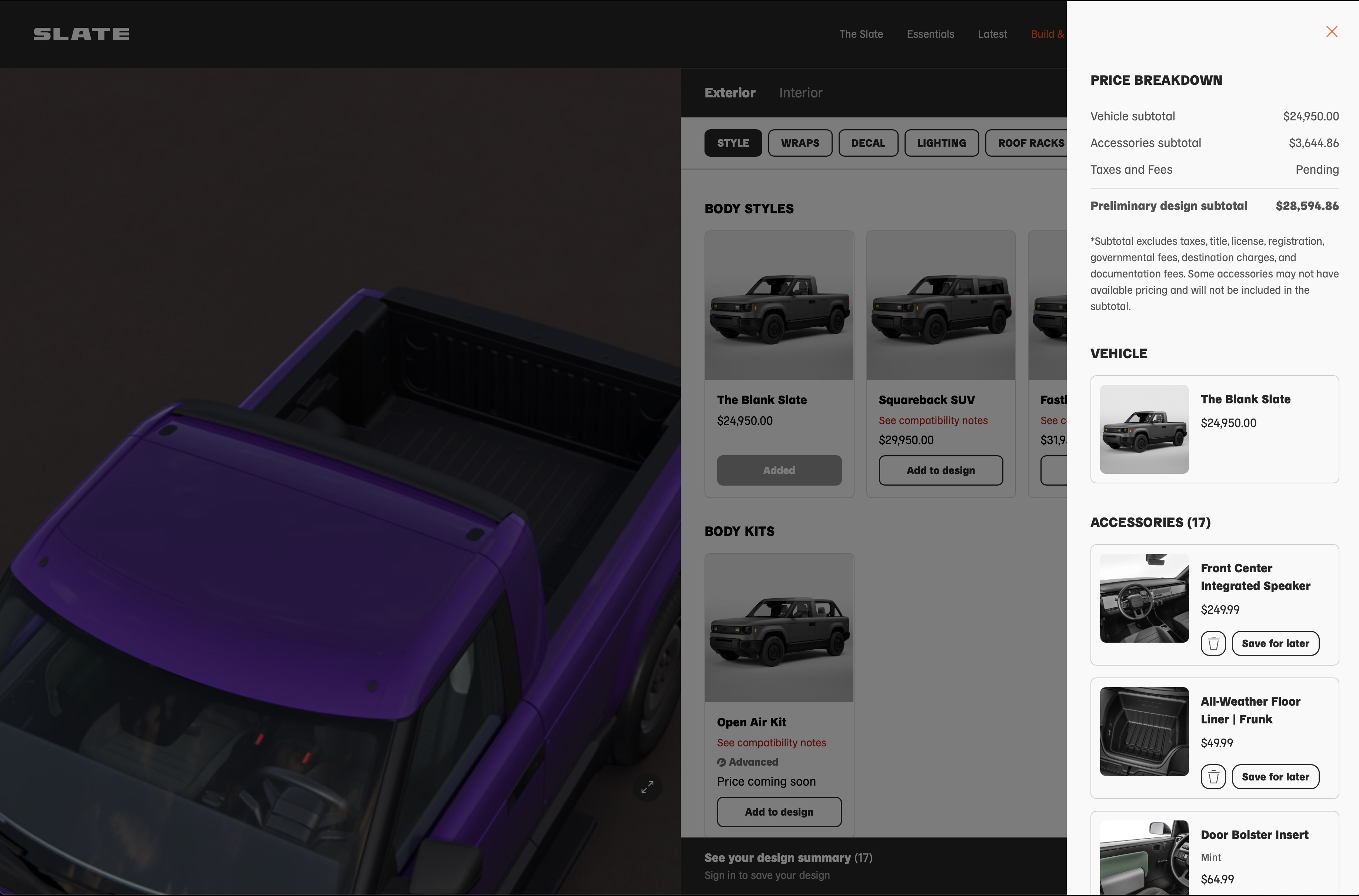
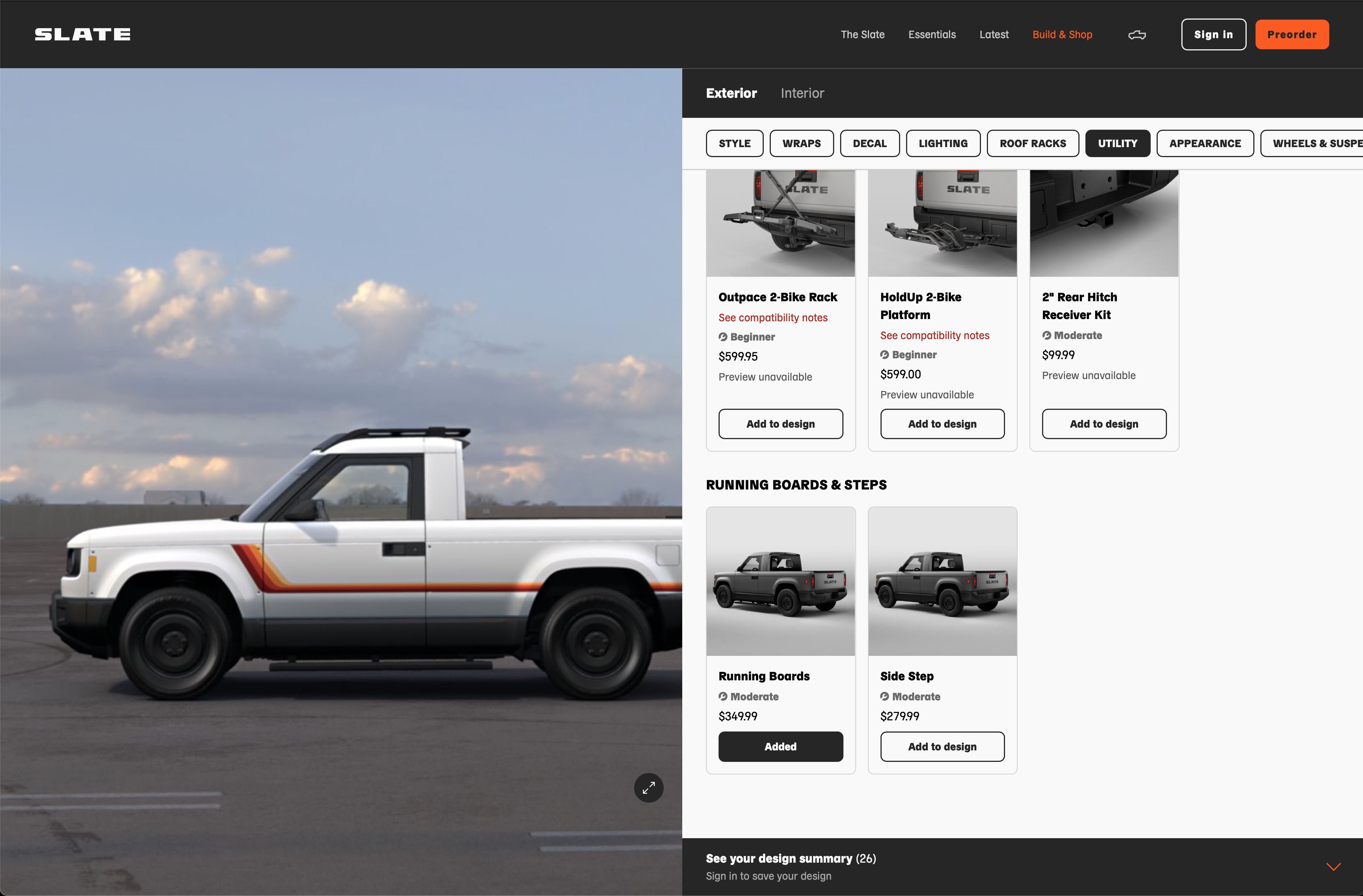
For many people, a pickup truck exists solely as a work truck for tradespeople to carry tools and supplies to job sites. It needs only two doors, seating for two or maybe three if there’s a bench, and that’s it. And a no-nonsense work truck spec is possible at a sticker price still under $30,000. Below is one I made for $28,594.

It has some interior trim that the bare-bones pickup did without, and it sports a fetching purple wrap to match my unicorn-servicing business’s uniforms, which admittedly adds $499 to the bottom line. But the rest is purely functional: a structural floor liner for the bed, a toolbox, a locking tailgate, and some MOLLE webbing into which I can strap things. There’s a tow hitch—rated for up to 2,000 lbs (907 kg), with up to 1,550 lbs (703 kg) in the bed, and a $275 telematics module because I do want to be able to track this truck online. Without this telematics module, you can’t connect your phone to the car via Bluetooth.

A screenshot of Slate Auto's configurator

Options for the job site.

A screenshot of Slate Auto's configurator

A sub-$30,000 work truck? It seems possible.

The off-road brodozer

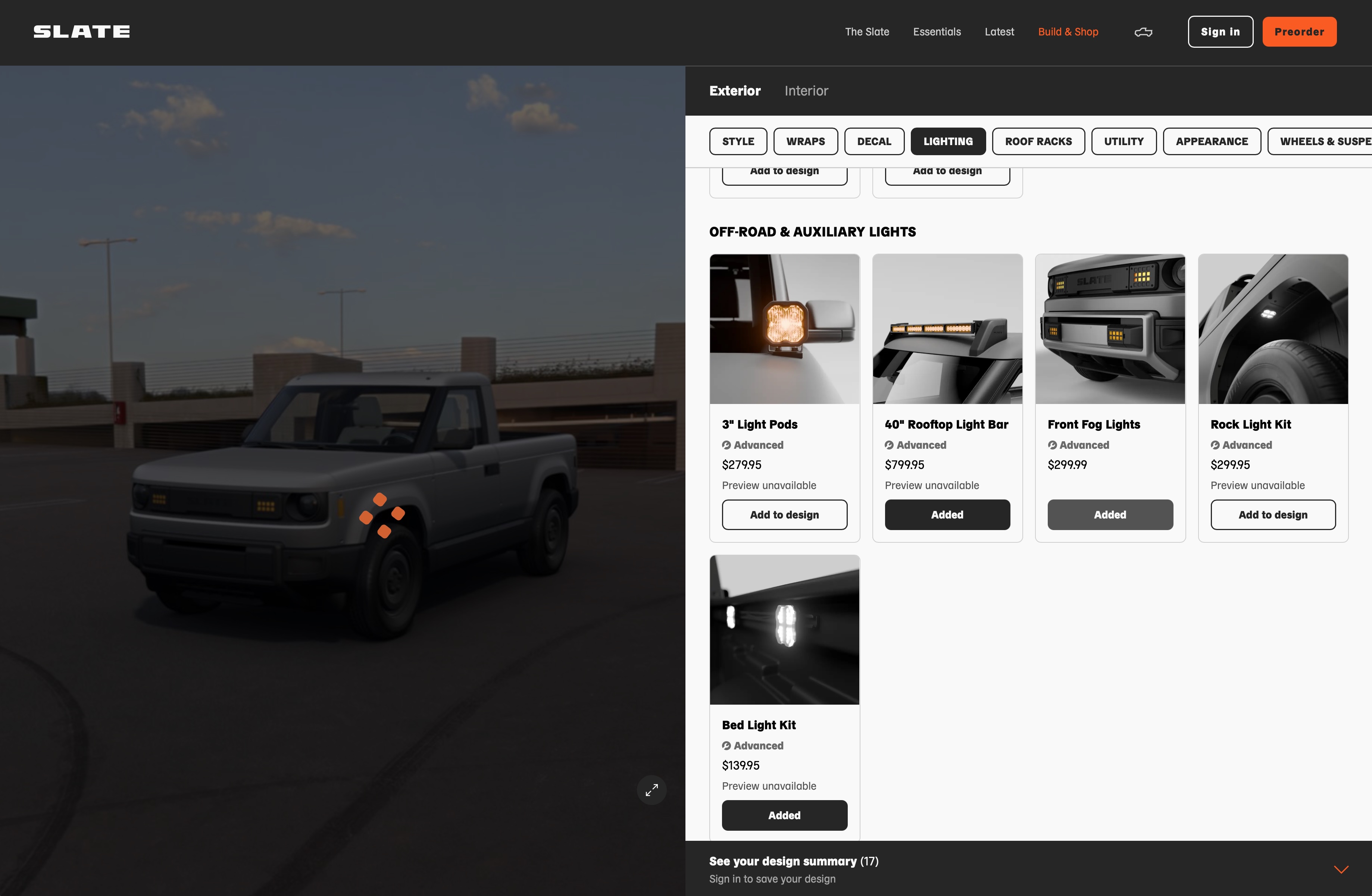
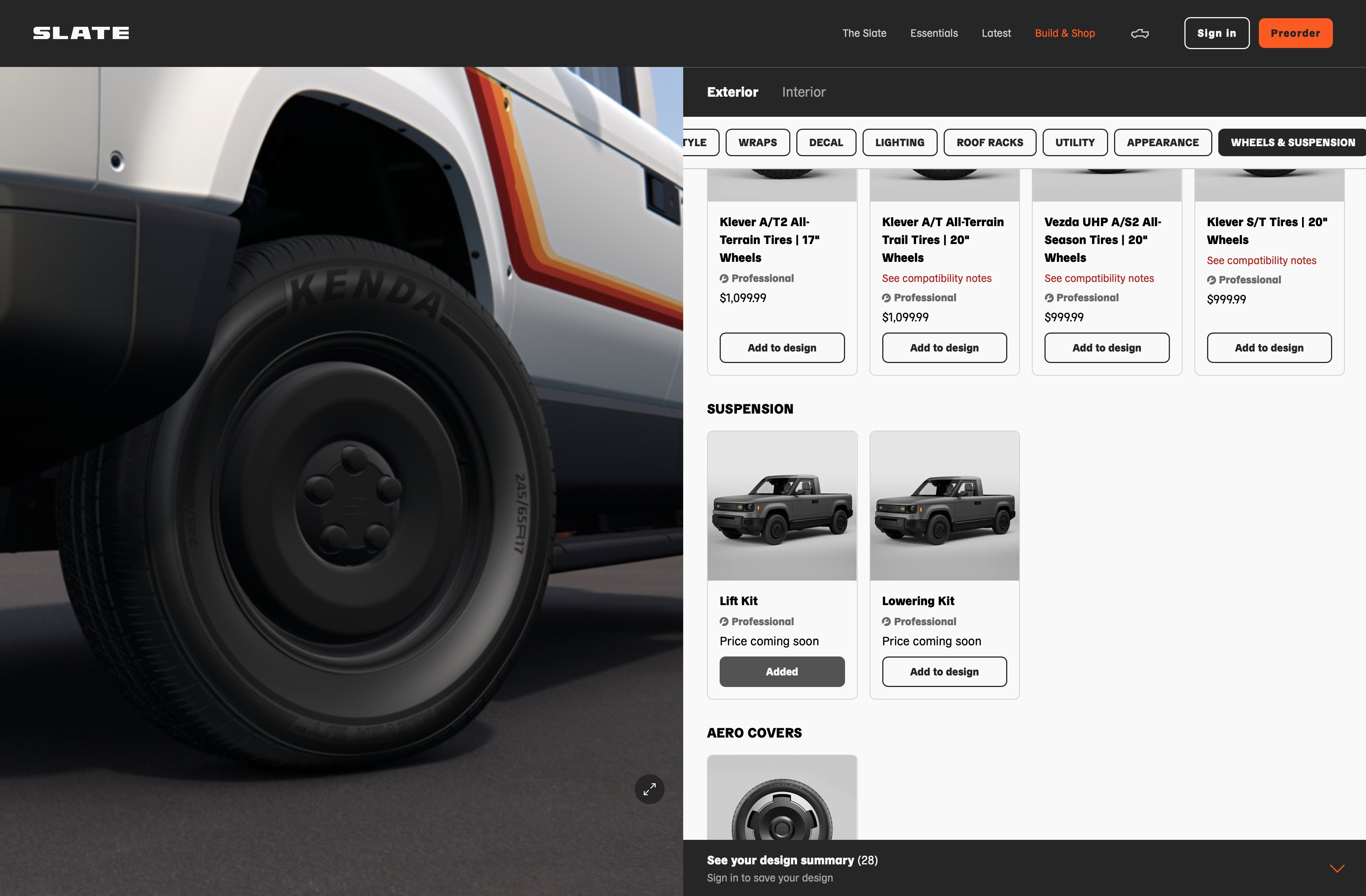
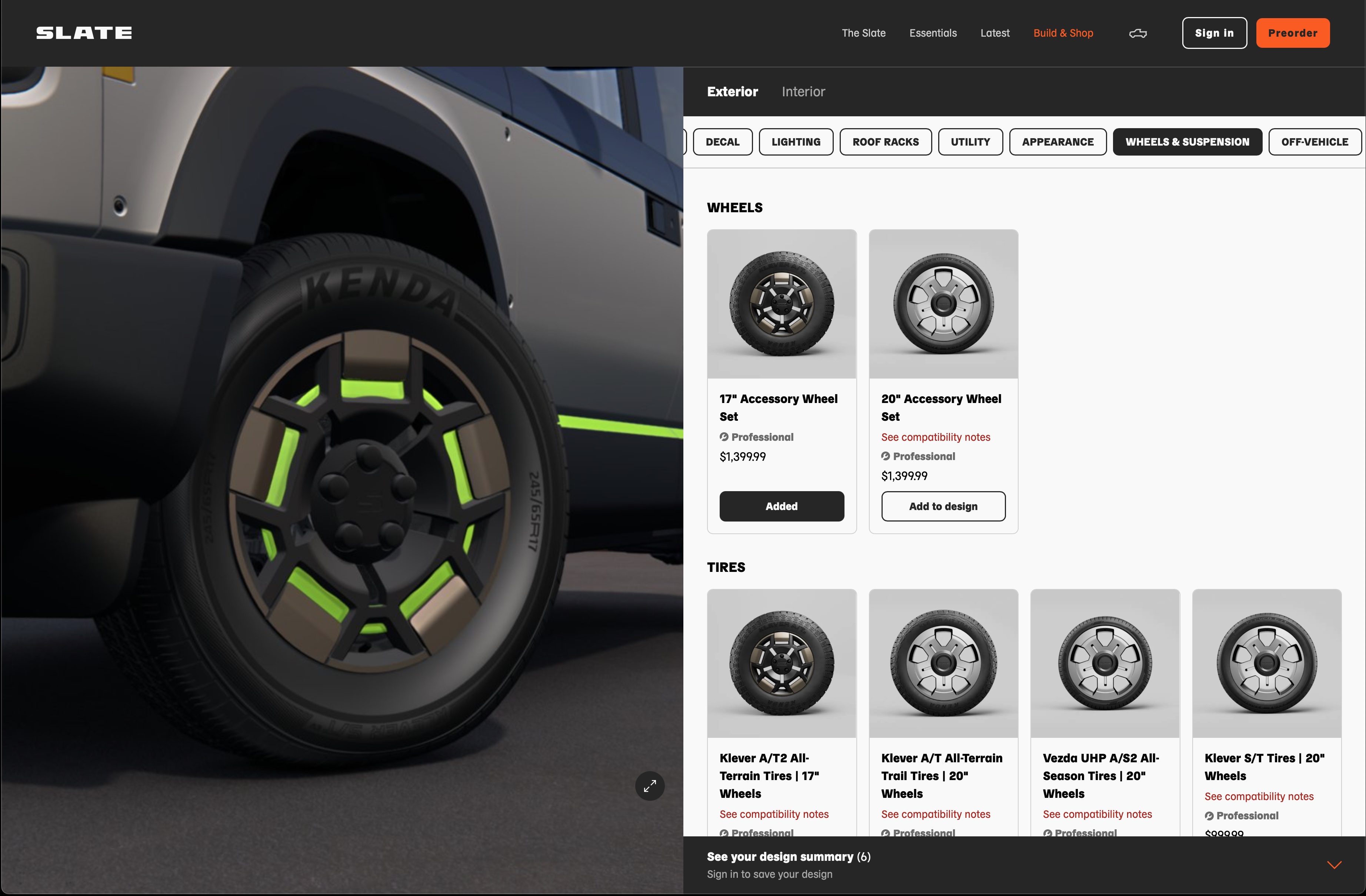
For my final pickup variant, I wanted to build something for adventuring, and my selections came in at a total of $32,923.64… plus whatever the lift kit ends up costing. Almost $8,000 in add-ons is a lot—much of the money went to the various exterior lights—and I probably could have kept going with some gear to help get unstuck from sand or mud. The all-terrain tires were a significant cost; upgrading from the stock 17-inch wheels will add at least $1,000 to your Slate.

A screenshot of Slate Auto's configurator

Not every option has a price right now.

A screenshot of Slate Auto's configurator

Other designs are available.

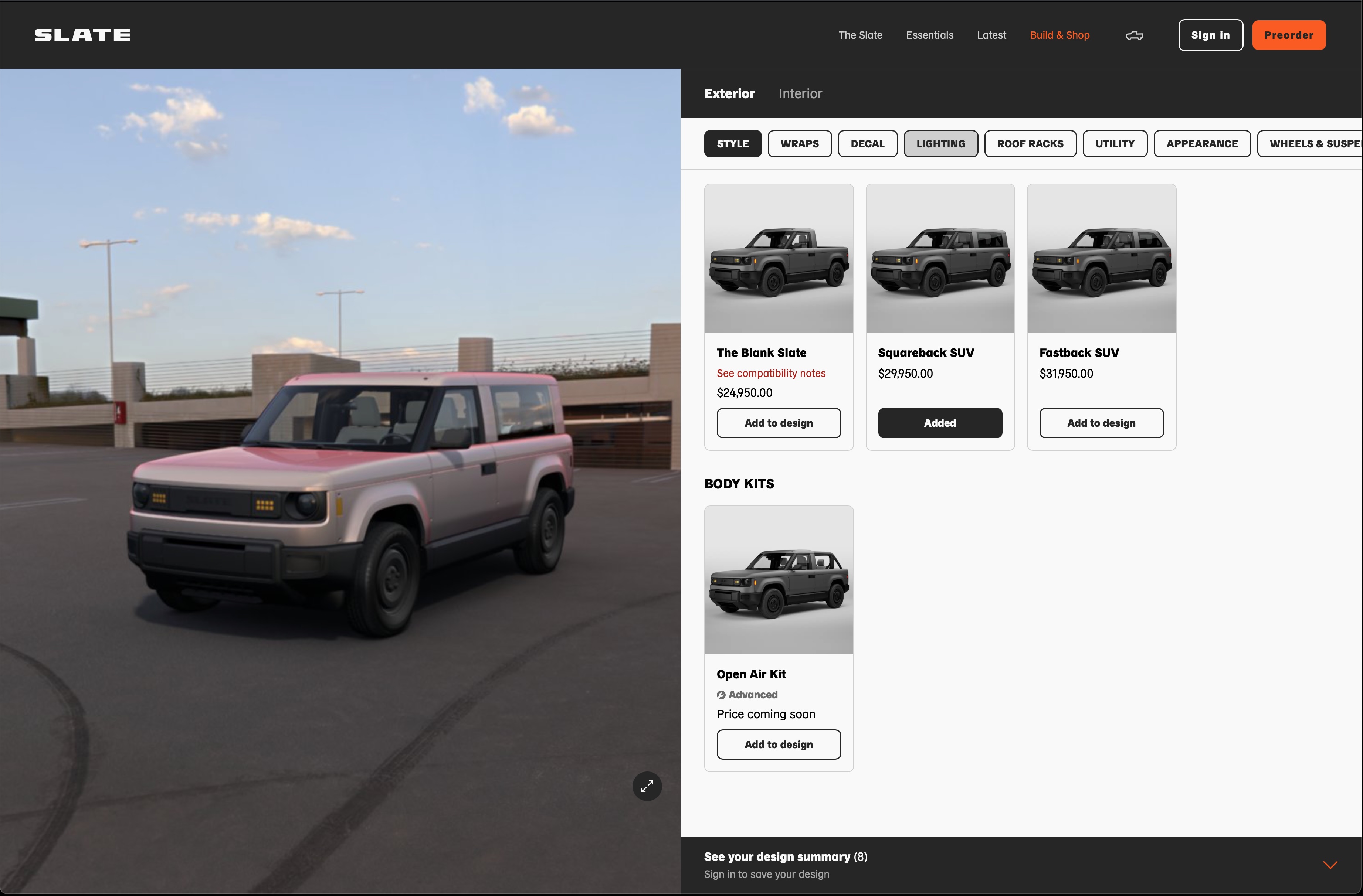
A fun fastback

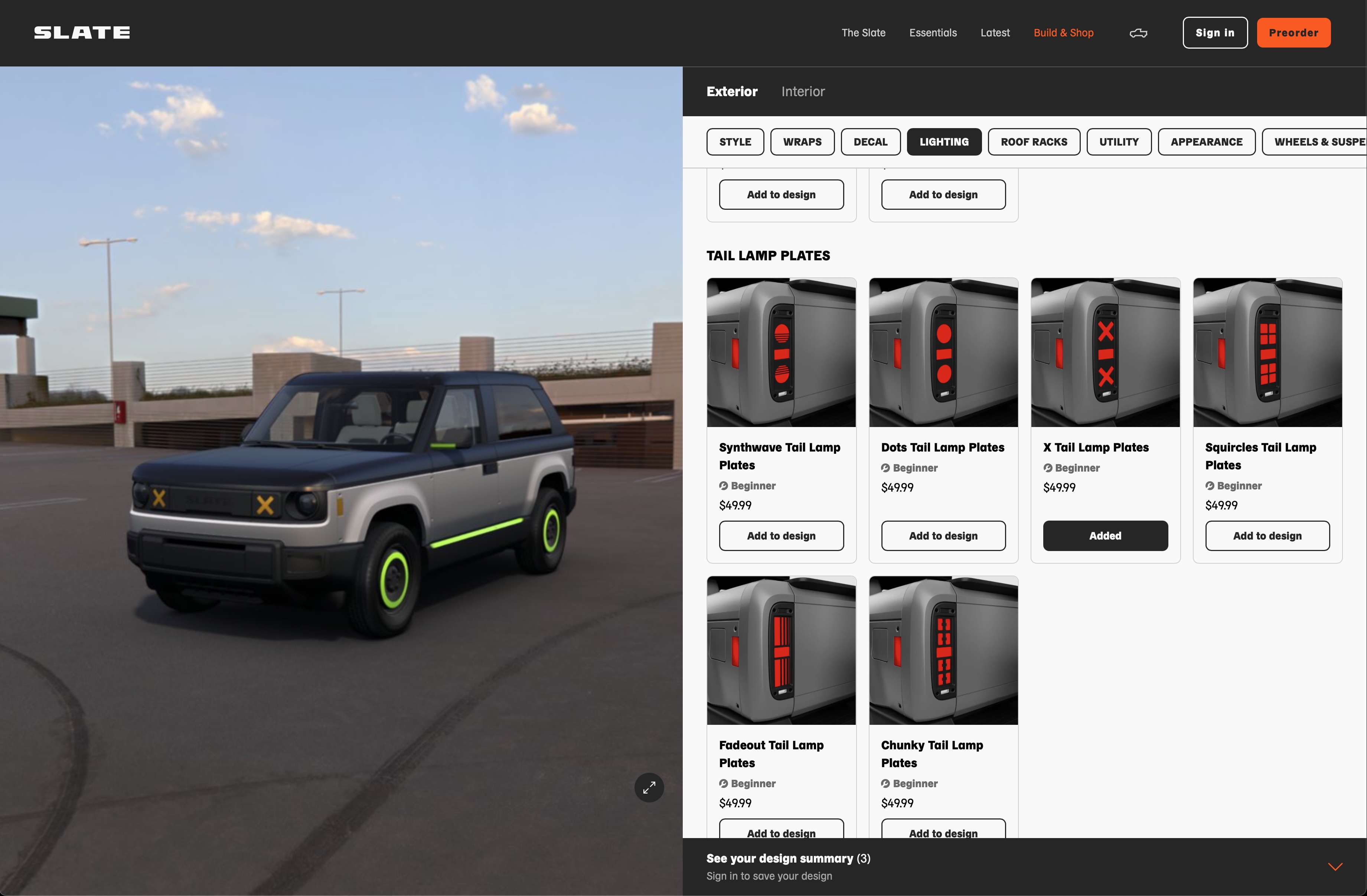
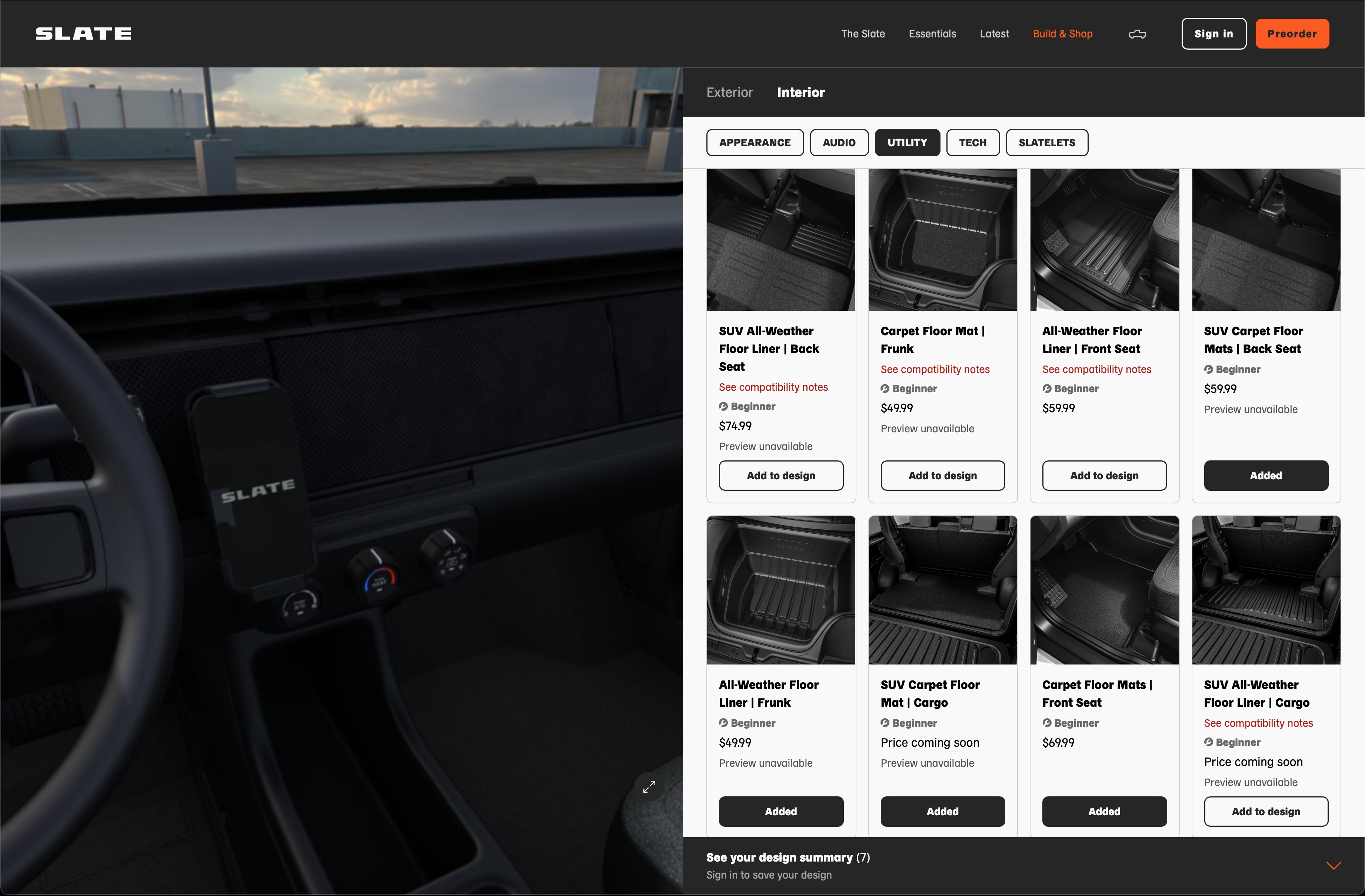
Two of Slate’s three alternative body styles are available. There’s the $29,950 Squareback SUV and the $31,950 Fastback SUV. Both add rear bench seats but stick with two doors. You also get a roll cage and extra airbags. My build ended up at $35,299.85, plus the usual caveats. This time, I went for a $799 wrap called Sub Lime that, like my first build, matches my favorite pair of sneakers. (I’m not a complicated man.) I also paid a bit more for some interesting front and rear lamp plates—alternatives that don’t look like murdered cartoon characters are available—and some interior trim like floor mats.

However, upon digging through the interior options, it seems that the ability to add electric window controls, which we believed would be possible, has not made the cut. If you buy a Slate, you will roll your own windows.

A screenshot of Slate Auto's configurator

Interior shades other than black are available.

A screenshot of Slate Auto's configurator

Yes, my wheels match my car (and my shoes).

This SUV’s not for squares

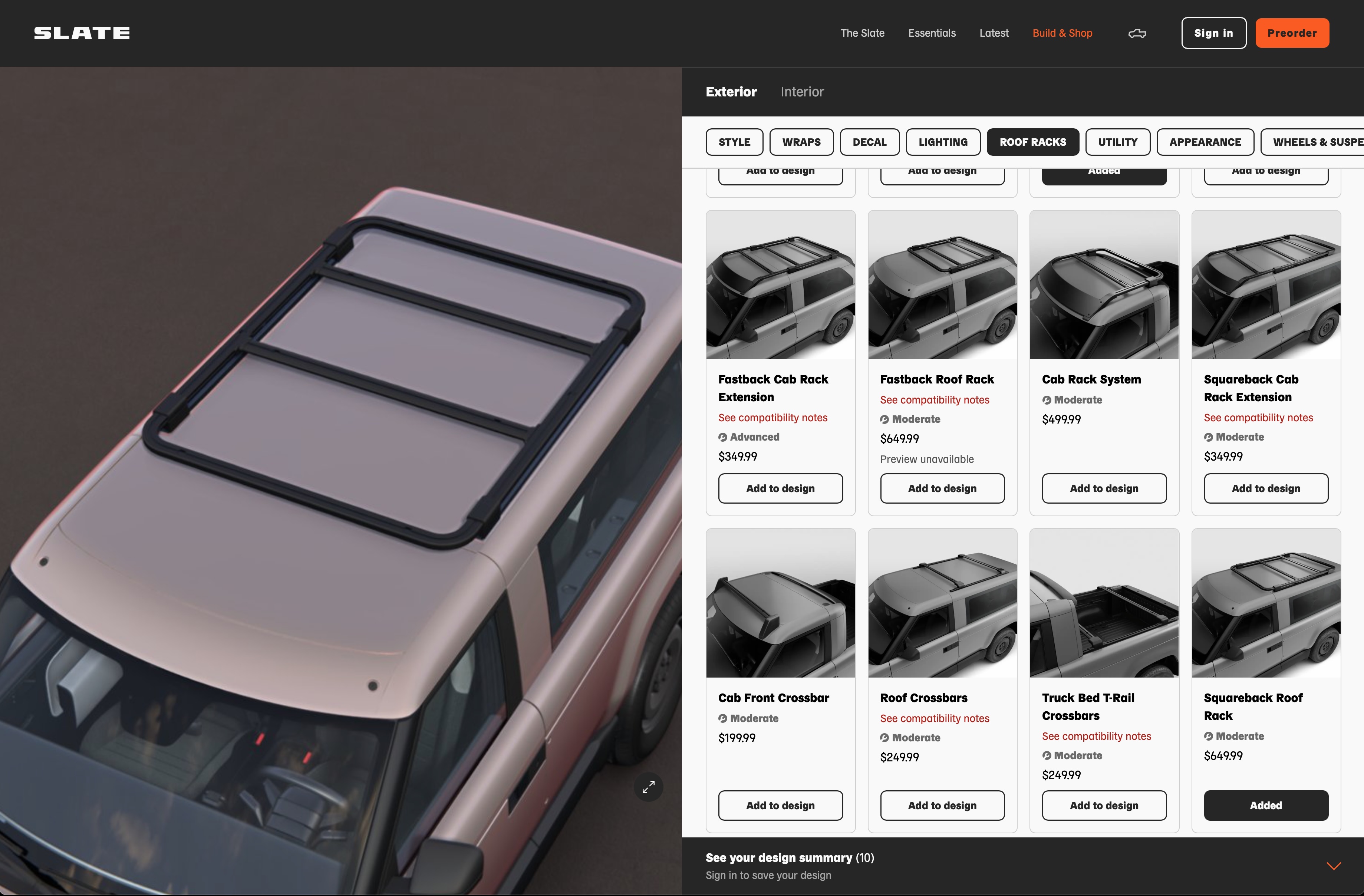
Finally, I configured a Squareback SUV, which clocked in at $36,819.80. The full wrap costs $1,139.99, and I spent a similar amount on upgraded front and rear bumpers, as well as larger wheels on all-season tires. The rest of the options are mostly interior add-ons and storage, plus the telematics module and some in-car speakers, so up to four passengers and I don’t have to play “I Spy” the whole time we’re driving.

A screenshot of Slate Auto's configurator

The pink SUV was my most expensive build, but it’s still far less expensive than most electric crossovers.

A screenshot of Slate Auto's configurator

Roof rails ahoy.

Marilyn Monroe’s Death Scene was ‘Staged’ According to New Doc

0
marilyn-monroe’s-death-scene-was-‘staged’-according-to-new-doc
Marilyn Monroe’s Death Scene was ‘Staged’ According to New Doc


More than six decades after Marilyn Monroe was found dead in her Los Angeles home, the mystery surrounding her final hours is being dragged back into the spotlight — and the latest claims are explosive.

A new TMZ special, Celebrity Crime Scene: Marilyn Monroe, takes another look at the Hollywood legend’s death and suggests the official story may not tell the whole truth.

Monroe died on August 5, 1962, at just 36 years old. Her cause of death was listed as a barbiturate overdose, and her death was ruled a probable suicide. But for decades, conspiracy theories have swirled around the blonde bombshell, her rumored relationships with President John F. Kennedy and his brother Robert F. Kennedy, and the strange details surrounding the scene where she was found.

Now, the TMZ documentary claims there are enough red flags to raise fresh questions about whether Monroe’s death scene was staged.

According to the special, one of the biggest issues was how “clean” the scene appeared. Monroe’s bedding allegedly looked unusually neat, and pill bottles were reportedly arranged with their labels facing outward. The documentary suggests that detail did not fit the chaos often associated with an overdose.

There was also reportedly no glass of water found near Monroe, despite toxicology reports showing high levels of sedatives in her system.

Former cold case investigator Paul Holes questioned the scene in the special, saying, “Nobody stages a suicide to look like a better suicide.”

The documentary also revisits one of the most controversial theories tied to Monroe’s death: that the Kennedy brothers were somehow involved.

For years, rumors have claimed Monroe had affairs with both JFK and RFK. The TMZ special focuses on those alleged relationships and asks whether the actress may have known too much.

Journalist Sid Skolsky, who knew Monroe for years, previously claimed he spoke with her shortly before her death. According to Skolsky, Monroe was upset with the Kennedys during that call and allegedly said she was meeting with one of them that night.

The special also brings up claims involving former vice detective Fred Otash, who said he had hidden a surveillance microphone inside Monroe’s home. Otash claimed the device captured a heated confrontation between Monroe, RFK, and English actor Peter Lawford.

Those recordings have never been verified.

According to Otash’s claims, Monroe and RFK allegedly argued violently over their relationship. Monroe reportedly accused him of making promises to her and then abandoning her.

“She said she was passed around like a piece of meat,” Otash claimed.

Otash also alleged RFK was searching for Monroe’s so-called “little red book,” which was rumored to contain political secrets and private details about her conversations with powerful men.

“Where the f— is it?” RFK allegedly said in the unverified recording, according to Otash. “We have to know. It’s important to the family.”

Then came the most chilling claim.

Otash alleged Monroe began screaming during the confrontation and that RFK used a pillow to silence her so neighbors would not hear.

“Bobby gets the pillow, and he muffles her on the bed to keep the neighbors from hearing,” Otash claimed. “She finally quieted down, and then he was looking to get out of there.”

Again, the alleged recording has never been authenticated, and no official finding has ever tied either Kennedy brother to Monroe’s death.

Still, the documentary leans into the long-running suspicion that Monroe’s final hours may have been far more sinister than the public was told.

Another theory raised in connection with the case claims Monroe may have been pregnant with JFK’s baby during his 1960 presidential campaign. Declassified FBI files have also fueled speculation that rogue government figures may have viewed the actress as a liability.

Monroe was discovered naked in her bedroom, lying on her back and clutching a telephone. Her death shocked the world and instantly became one of Hollywood’s greatest mysteries.

Now, 64 years later, the official ruling remains unchanged — but the questions around Marilyn Monroe’s death are clearly not going away.

Heatwave grips Western Europe, putting Italian cities on alert and killing poultry in France

0
heatwave-grips-western-europe,-putting-italian-cities-on-alert-and-killing-poultry-in-france
Heatwave grips Western Europe, putting Italian cities on alert and killing poultry in France


Italy placed 16 of its 27 largest cities on red alert on Wednesday as an intense heatwave continued to grip the country and much of Western Europe, while French authorities grappled with the deaths of hundreds of thousands of poultry caused by extreme temperatures.

Italy’s health ministry added the city of Latina to the highest heat alert, joining Ancona, Bologna, Bolzano, Brescia, Florence, Frosinone, Milan, Perugia, Pescara, Rieti, Rome, Turin, Verona, Venice and Viterbo.

The ministry said Bari will also move to the maximum alert level on Thursday, bringing the total number of cities on red alert to 17.

Italy’s warning system ranges from green, indicating no alert, through yellow and orange, before reaching red, which signifies that the heat poses a health risk to the general population rather than only vulnerable groups such as the elderly and those with existing illnesses.

In France, agricultural bodies said extreme heat had killed at least several hundred thousand poultry, overwhelming carcass collection services in the country’s two largest poultry-producing regions.

Yann Nedelec, head of French poultry industry group ANVOL, said excess poultry deaths were occurring on both indoor and outdoor farms in Brittany and Pays de la Loire, which together account for nearly 60% of France’s poultry flock. He said it was too early to provide a definitive figure but estimated that at least several hundred thousand birds had died.

The Chambers of Agriculture in both regions warned of “massive” poultry losses, saying rendering services were unable to cope with the volume of carcasses awaiting collection.

Farmers were advised to cover carcasses with sawdust or wood shavings to absorb liquids while awaiting collection or burial. Agricultural bodies said on-farm burials could only take place after technical and environmental checks.

The poultry losses come as Western Europe endures a record-setting heatwave that has killed dozens of people, forced school closures, disrupted electricity supplies and prompted farmers to harvest grain at night. France recorded a temperature of 44.3 degrees Celsius (111.7 degrees Fahrenheit) on Tuesday, with extreme conditions expected to continue in the coming days.

France is the European Union’s third-largest poultry producer after Poland and Spain. According to FranceAgriMer, a typical French poultry house contains around 20,000 birds, while the average farm operates two poultry houses.

Have Your SNAP Benefits Ever Been Stolen? Help ProPublica Investigate.

0
have-your-snap-benefits-ever-been-stolen?-help-propublica-investigate.
Have Your SNAP Benefits Ever Been Stolen? Help ProPublica Investigate.

Have you ever tried to use your electronic benefit transfer card to pay for groceries only to find that your SNAP benefits were gone? You may have been the victim of EBT theft. 

EBT theft happens when someone is able to get information off your EBT card in order to steal your Supplemental Nutrition Assistance Program benefits. You may not have immediately realized you were stolen from, only that there were less funds in your account than there should’ve been. If so, you’re not alone — it’s a widespread issue that affects hundreds of thousands of SNAP recipients each year.

If you think your benefits may have been stolen, we would like to hear from you. We need your help to understand the impact that EBT theft has on communities. 

To share your experience, fill out the survey below. Our reporters read every response and may follow up with you.

Don’t have SNAP benefits but know someone who does? You can also help by sending this form to them. If you have anything else you would like to share about SNAP or Medicaid generally, you can email us at [email protected].

Missouri’s Governor Is Opposed to Out-Of-State Funding, but Not for His Own Ballot Measure

0
missouri’s-governor-is-opposed-to-out-of-state-funding,-but-not-for-his-own-ballot-measure
Missouri’s Governor Is Opposed to Out-Of-State Funding, but Not for His Own Ballot Measure

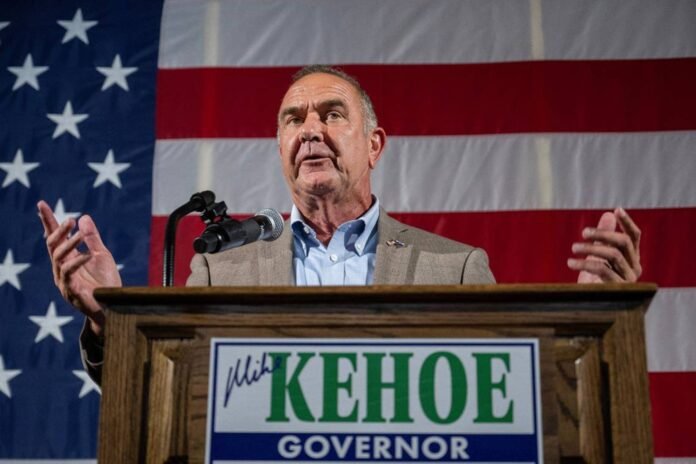
Missouri Gov. Mike Kehoe has spent months telling voters that the state constitution is under threat from “out-of-state special interests” using ballot initiatives to bypass the Republican-controlled legislature and enact major policy changes. The measures have included legalizing recreational marijuana, expanding Medicaid and restoring abortion rights

That argument is at the center of Kehoe’s support for Amendment 4, a measure in the Aug. 4 primary that would make it harder for Missourians to amend their constitution through citizen-led ballot initiatives.

“Our constitution shouldn’t be the victim of out-of-state special interests who spend millions to deceive voters and pass out-of-touch policies,” Kehoe said in a video posted to the social media site X.

But when it comes to a different constitutional amendment central to his own agenda, Kehoe is benefiting from financial support provided by a Delaware nonprofit that does not disclose the identities of its donors.

Kehoe has slated Amendment 5, which would put Missouri on a path toward eliminating the state income tax, on the ballot for the August election, along with Amendment 4.

While the governor and other proponents argue that phasing out the income tax would make Missouri more economically competitive and lower the overall cost of living, opponents say it would shift the tax burden onto working-class families by imposing new sales, use taxes on products and services not currently taxed, and increase Missouri’s existing sales tax rate. 

Critics also warn that the higher taxes could put Missouri retailers at a disadvantage, particularly in the Kansas City and St. Louis areas, where consumers can easily cross state lines to make major purchases. The cities are within a few miles of Kansas and Illinois, respectively.

A political action committee supporting Amendment 5, Missouri Promise PAC, has received $1.9 million from a nonprofit with almost the same name — Missouri Promise Inc. — that was incorporated late last year in Delaware. Neither the nonprofit nor the PAC discloses the identities or locations of the donors financing the campaign.

Three Facebook advertisements sponsored by an organization called Missouri Promise. Each ad campaigns in favor of a Missouri ballot measure, urging users to vote “Yes on Amendment 5” to phase out the state income tax and cut property taxes.
Ads like these on Facebook in support of Amendment 5 were paid for by Missouri Promise PAC. Facebook

Missouri Promise PAC has placed ads online and on TV. A 30-second ad follows the governor through a city neighborhood and a manufacturing plant before ending with him on horseback in cowboy attire.

“He made a promise,” the narrator says. “Now he’s going to deliver.”

Kehoe’s office did not respond to requests for comment.

Missouri Promise Inc. is led by Garrett Lott, a longtime Missouri Republican operative and political fundraiser, and Alex Melendez, a political consultant affiliated with Ohio-based Clark Fork Group, a firm that has provided consulting for conservative campaigns. 

Neither Lott nor Melendez responded to requests for interviews or to questions about the group’s operations. 

Marc Ellinger, a lawyer who serves as the treasurer of Missouri Promise PAC, said that the campaign had publicly disclosed all information required under Missouri law. Ellinger’s law office is also listed as the address for Secure Missouri, a Missouri nonprofit formed last year that recently contributed $1.5 million to the PAC.

Asked about the identities of donors to Missouri Promise Inc. and Secure Missouri, Ellinger said he could not address what disclosures the nonprofits themselves may eventually make about donors in their tax filings to the Internal Revenue Service. And he questioned whether any story would also examine financing behind opponents of Amendment 5. One campaign opposing Amendment 5 has been almost entirely funded by a $1,900,001 contribution from the Missouri Realtors PAC — a dollar more than Missouri Promise Inc.’s donation to the pro-Amendment 5 campaign. 

Ellinger suggested that the contribution was not necessarily more transparent than the funding behind Amendment 5, questioning whether the public knew the ultimate source of the Realtors’ money. But unlike Missouri Promise Inc. and Secure Missouri, which do not disclose their contributors, the Realtors’ political committee reports its donors in public filings with the Missouri Ethics Commission. Those filings allow the public to see who gave money to the committee and in what amounts.

Ellinger has been involved in Missouri tax-policy campaigns for years. In 2010, he served as spokesperson for a ballot initiative backed by St. Louis financier Rex Sinquefield that sought to require periodic votes on the 1% tax on wages paid by residents and workers in St. Louis and Kansas City. Missouri voters approved the measure, forcing both cities to submit the tax to voters every five years.

Sinquefield has spent millions of dollars over the past two decades supporting efforts to reshape Missouri’s tax system, including campaigns to eliminate the state income tax and curb local earnings taxes. Sinquefield did not respond to a request for comment.

Critics of both amendments said that Kehoe’s position is difficult to reconcile.

“The fact that the governor is benefiting directly from his face and image being plastered across Missouri TV screens by a dark money group from Delaware — or somewhere, not here — shouldn’t be lost on anyone,” said Mark Jones, a political strategist and spokesperson for the Missouri National Education Association, which opposes both amendments.

Ken Warren, a professor emeritus of political science at Saint Louis University and co-director for the SLU/YouGov Poll, said Kehoe’s complaints about out-of-state money shaping Missouri politics were somewhat surprising. Money from outside a state’s borders routinely flows into ballot measure campaigns and other political fights across the country. 

“It’s not good for democracy for dark money to be used,” Warren said. “Voters should be privy to where the money is coming from, whether it’s in state or out of state, because voters, when they make a choice, should know. So I agree in principle but note that he’s being hypocritical. Many Republican measures have been funded by out-of-state money and candidates. I don’t hold it against them because that’s the way campaigns are run.”

Taken together, the two amendments raise the stakes of what is typically a low-turnout August election. 

By placing them on the primary ballot rather than the November general election ballot, Kehoe ensured they would be decided by an electorate likely to be smaller and more Republican-leaning. The decision also separates the measures from a November ballot that will feature a high-profile fight over abortion rights, an issue that has proved capable of mobilizing large numbers of Missouri voters. 

The claim that outside interests have been driving constitutional change has become a familiar refrain among conservatives in Missouri and other Republican-led states, where voters have used ballot initiatives to enact policies that diverge from the priorities of GOP lawmakers. 

Republican lawmakers in Missouri and in other Republican-led states have responded by reversing voter-passed measures and making it more difficult for voters to amend state constitutions. 

Under Missouri’s current system, supporters of a citizen-initiated constitutional amendment must first collect signatures from voters across the state to qualify for the ballot. Once there, the proposal passes if it wins a simple majority of votes statewide. Under Amendment 4, citizen-led constitutional amendments would have to carry each of Missouri’s eight congressional districts in addition to winning statewide. As a result, a proposal that won statewide but fell short in a single district would fail, no matter how big the statewide margin. 

Critics say that requiring a measure to win in every district would require a level of political consensus that is increasingly rare in a state marked by sharp geographic and ideological divides. 

Supporters counter that such a requirement would ensure constitutional amendments reflect broad statewide agreement rather than support concentrated in a handful of population centers.

“There would have to be an even greater consensus to change the state’s primary document,” said state Rep. Brian Seitz, a Republican from Branson who supports Amendment 4. “It would give a consensus.”

The new requirement would apply only to constitutional amendments proposed by citizens through the initiative process. Amendments placed on the ballot by the Missouri General Assembly — like Amendments 4 and 5 — would still pass with a simple statewide majority.

That distinction lies at the center of the debate over Amendment 4. Critics argue the proposal would create two different sets of rules for amending the same constitution. If a statewide majority is no longer sufficient for citizens to amend the constitution, they ask, why should it remain sufficient when lawmakers propose an amendment? 

Supporters argue that citizen-led initiatives are especially susceptible to influence from wealthy donors and national interest groups, and therefore should be required to demonstrate support across Missouri’s diverse regions. Seitz said he is comfortable with the possibility that the higher standard could someday make it harder for Republicans to pass constitutional amendments if Democrats gain control of state government because, in his view, the goal is to make constitutional changes more difficult regardless of which party is in power.

Seitz said the legislature itself serves as a safeguard against one region of the state dominating another. Because lawmakers are elected from districts across Missouri, he argues that any proposal referred to voters has already been vetted by representatives from urban and rural areas alike.

“We’re not a democracy,” he said. “We are a representative republic.”

To make US-Iran deal stick, hold Trump’s war profiteers accountable

0
to-make-us-iran-deal-stick,-hold-trump’s-war-profiteers-accountable
To make US-Iran deal stick, hold Trump’s war profiteers accountable

Now that an initial diplomatic deal between the US and Iran has been signed and intensive negotiations are under way to fully end the war, Congress should do everything possible to ensure this agreement is fully implemented.

While the agreement is likely to have imperfections—thanks in large part to President Donald Trump harming US leverage and interests with a disastrous war—it would be a massive mistake to attack the deal simply because it comes from this president.

The key question to consider is what steps Congress can take to ensure it becomes a durable peace — rather than merely a pause before the next round of war.

With all the human loss, destruction, and global stakes, we must stop this war, but also ensure that the conditions of peace don’t lay the groundwork for a return to conflict—or inspire its repetition elsewhere. The political and financial cost of ending this war must fall on those who aided and profited from it. The question is whether we build the safeguards to make it last.

In June 2025, it was already clear that accepting President Trump’s false narrative of absolute victory (claiming to have fully obliterated Iran’s nuclear sites) would not end US-Iran tensions.

Any peace will remain fragile if the conditions that produced the war persist: the might-makes-right mindset that proved hollow against Iran’s strategic resilience; the preference for militarism over diplomacy, from Trump’s Joint-Comprehensive Plan-of-Action withdrawal to Biden’s failure to pursue a serious alternative to “maximum pressure” sanctions; the unconditional support for Israel even when it runs counter to US interests.

It is highly possible that during the initial 60 days of negotiations contemplated in the MOU, Israel will continue military action against Iran or in Lebanon to provoke a reaction and restart the cycle. The US cannot fully control what Israel would do. But it can stop aiding and abetting the war, which would make it far more difficult for Israel to sustain a campaign to spoil diplomacy.

Military action against Iran failed at producing any of its intended objectives, while it incurred costs that are in some cases irreversible and in others generational. The lives lost will not come back. The destruction of civilian infrastructure will shape Iranian society for decades.

And the war has granted perverse legitimacy to a brutal regime, recasting the government of the Islamic Republic not as the oppressor it is, but as David against Goliath, the underdog resistor against foreign aggression. Diplomacy produced better results at far lower cost on every measure that matters.

This war confirmed what few wanted to acknowledge: that US military bases across the Gulf, sold as a projection of strength, are also a profound vulnerability. Each base became a potential target, each host government a hostage to escalation.

For many Gulf governments, American military backing is a useful substitute for political legitimacy at home. Yet the war exposed the limits of that bargain: The same shield that promised security also turned them into targets.

Turning the Strait of Hormuz into a battlefield made this dynamic undeniable. Its closure hit energy markets and created rare pressure for de-escalation from Gulf elites who felt the costs directly. But while some elites were squeezed, others made billions.

The system is designed so the profiteers are never the ones paying the ultimate price. That is exactly why temporary market pressure is not a substitute for structural accountability to prevent future conflicts.

Those who profit from war have learned over many years that neither Republicans or Democrats will hold them accountable. A new Congress post November has a real opportunity to change that—to serve US interests, meaning the American people, not a select elite.

With US$72 billion spent on the Iran war, a $1.5 trillion military budget, and war contractors more powerful and unaccountable than ever, Congress needs to investigate all war profiteers, from arms contractors to companies like the drone firm backed by the Trump sons that sought to sell interceptors to the very Gulf states being attacked, a direct conflict of interest.

In a relatively new dystopian innovation in war capitalism during the war, prediction markets like Polymarket saw millions in bets on everything from the timing of strikes to casualty estimates. 

Suspected insider accounts netted $2.4 million on Iran War bets with a 98% win rate. This kind of betting on war outcomes by those with proximity to power blurs the line between forecasting and profiteering. It must also be addressed.

We do not even have to wait for elections in November to start this process. The growing support for War Powers resolutions with majority house support just this month, and the 40 senators backing the Joint Resolution of Disapproval to withhold certain arms from Israel, show what may be possible when Congress does its job. Congress should condition support, block escalation, and hold hearings on the legality of what has been done.

Such measures would serve a deeper purpose: signaling that a new Congress, and eventually a new administration, can offer something more than a return to the previous status quo: a set of concrete actions that change how war is authorized, how money is spent, and who benefits.

The problem is not a single president or party. It is the power structures that ensure those who profit from war never pay its cost, regardless of who holds office.

Corruption and war profiteering are not merely governance issues. They are theft from the American people, through unaccountable war spending, the unaffordable prices it produces, and an elite class that never pays for the policies it pushes.

A Congress that treats corruption and war profiteering as harm against the public and responds accordingly would demonstrate what a functioning democracy actually looks like.

Nancy Okail is the president and CEO of the Center for International Policy.

– Common Dreams

Pakistan PM: US-Iran memorandum excludes ballistic missile issue

0
pakistan-pm:-us-iran-memorandum-excludes-ballistic-missile-issue
Pakistan PM: US-Iran memorandum excludes ballistic missile issue

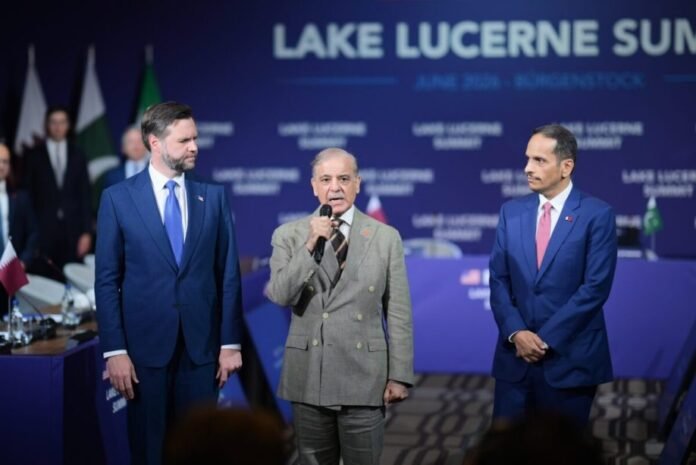
Pakistan Prime Minister Muhammad Shehbaz Sharif along with US Vice President J.D. Vance and Prime Minister and Foreign Minister of the State of Qatar Sheikh Mohammed bin Abdulrahman bin Jassim bin Jaber Al Thani deliver a speech prior to the commencement of the technical level talks between the US and Iran, hosted by Pakistan in Burgenstock, Switzerland, on June 21, 2026. [Government of Pakistan's X Account - Anadolu Agency]

Pakistan Prime Minister Muhammad Shehbaz Sharif along with US Vice President J.D. Vance and Prime Minister and Foreign Minister of the State of Qatar Sheikh Mohammed bin Abdulrahman bin Jassim bin Jaber Al Thani deliver a speech prior to the commencement of the technical level talks between the US and Iran, hosted by Pakistan in Burgenstock, Switzerland, on June 21, 2026. [Government of Pakistan’s X Account – Anadolu Agency]

Pakistani Prime Minister Shehbaz Sharif said on Tuesday that the memorandum of understanding signed between the United States and Iran, with Pakistani mediation, does not include any provisions related to Iran’s ballistic missiles.

Sharif made the remarks during a delegation-level meeting held as part of Iranian President Masoud Pezeshkian’s visit to Pakistan.

“There are no ballistic missiles in the Islamabad memorandum of understanding (MoU). The issue was never on the table, was never part of the agenda, and the Iranian side never even wanted to discuss it,” Sharif said.

He claimed that some parties around the world are seeking to scuttle the agreement.

“They don’t want the Iranian nation, a great nation, to come out of the ashes of war and touch the zenith of glory,” he said.

Turkey Gains Room To Maneuver as Israel Watches Its Regional Reach

0
turkey-gains-room-to-maneuver-as-israel-watches-its-regional-reach
Turkey Gains Room To Maneuver as Israel Watches Its Regional Reach


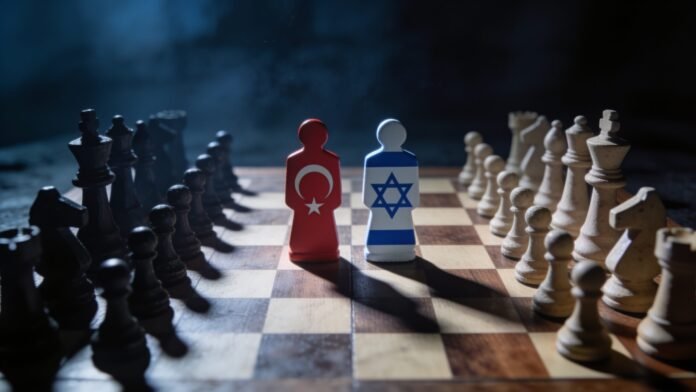
Giorgia Valente tracks a Middle East chessboard that has shifted after Iran’s weakening, leaving Turkey with more room to move—and more eyes watching its next steps.

The story centers on an Ankara-facing reading of the region after the US-Iran memorandum, the easing of tensions around the Strait of Hormuz, and the fading reach of Iran in Syria and beyond. Turkey, analysts say, has gained diplomatic weight with Washington and new space in Syria and Iraq. Yet that same rise has made Ankara more visible to Israel as a potential long-term strategic rival.

Barin Kayaoğlu, of the Social Sciences University of Ankara, describes Turkey’s response to the US-Iran memorandum as cautious relief. Ankara hopes the deal can lower shipping and energy risks, reopen room for trade with Tehran, and reduce the danger of wider war on its borders. But Kayaoğlu warns that Turkey does not want Iran to collapse. A fractured Iran could send refugees, armed groups, border insecurity, and Kurdish tensions toward Turkey.

Dr. Hande Ortay of KTO Karatay University offers the article’s more measured lens. She says Ankara does not see Israeli rhetoric as proof of imminent war, but as part of Israel’s broader concern over Turkey’s growing clout in Syria, the Eastern Mediterranean, the Palestinian arena, and regional diplomacy. Syria emerges as the main pressure point: Turkey wants a unified Syrian state; Israel wants freedom of action and a buffer against threats near its northern frontier.

Mustafa Metin Kaşlılar, of the Turkish Foreign Policy Research Center, gives the sharpest reading, arguing that Turkey’s voice against Israeli military action has boosted its regional standing. He also says Turkey and Israel still need quiet communication, especially in Syria, because a direct clash would carry heavy costs.

The full piece is worth reading because Valente captures the tension at the heart of Turkey’s moment: Ankara has gained influence after Iran’s setback, but influence in the Middle East rarely arrives without a bill attached.

Sony releases trailer for Taika Waititi’s Klara and the Sun

0
sony-releases-trailer-for-taika-waititi’s-klara-and-the-sun
Sony releases trailer for Taika Waititi’s Klara and the Sun

One of Taika Waititi’s greatest strengths as a director is his unique voice; he’s able to bring a light touch to tragedy (Jojo Rabbit) and a gentle sadness to offbeat comedy (Our Flag Means Death). That makes him an excellent choice to direct Klara and the Sun, based on the novel by Kazuo Ishiguro. Sony Pictures just released the first trailer, and it’s giving strong Hunt for the Wilderpeople vibes—a good thing, from my perspective, since that’s my favorite Waititi film.

Per the official premise:

Based on the bestselling novel from Nobel Prize winner Kazuo Ishiguro and written and directed by Academy Award winner Taika Waititi, Klara and the Sun introduces audiences to Klara (Jenna Ortega), an Artificial Friend who wants nothing more than to find the perfect home. When Klara meets Josie (Mia Tharia), each immediately senses a kindred spirit in the other. Josie has a fraught relationship with her mother (Amy Adams), and they’ve suffered great loss, but Klara’s innocent wonder and unwavering loyalty begin to heal the family and bring light to Josie’s complicated world.

The cast also includes Natasha Lyonne as an artificial friend (AF) store manager; Rachel House as the housekeeper, Melania; Aran Murphy (son of Cillian Murphy) as Josie’s best friend, Rick; and Sophia Bryant-Taukiri as Josie’s older sister, Sal. Steve Buscemi and Harry Greenwood also appear in as-yet-undisclosed roles.

Like Ishiguro’s novel, Klara and the Sun is set in an unidentified future, with Klara narrating. As a solar-powered AF, Klara has a special relationship with the sun, the source of her nourishment, but she also bonds with Josie when the girl and her mother are shopping for AFs. So Josie chooses Klara, despite the latter being an older model. Josie’s mom is skeptical but agrees on a trial basis, encouraged by the 20 percent discount. “Just remember everything you learned and hopefully they’ll come to love you like a member of the family or family dog,” Lyonne’s store manager tells Klara. Klara soon senses that something is wrong and turns to her old friend, the sun, for guidance. (Book readers will know what’s up.)

Ishiguro’s leisurely meditation on humanity’s relationship to technology might seem out of Waititi’s usual wheelhouse, but the director recently told Vanity Fair that he quickly realized he needed a new tonal approach to the material and adapted quickly to make his most dramatic film. “Sometimes I think you get caught up in, like, ‘Oh, people want the same tone as this other thing from eight years ago,’ and it’s nice to not have to cater to that so much or cater to your own expectations of what you think you want to do,” Waititi said.

Klara and the Sun hits theaters on October 23, 2026.

0FansLike
0FollowersFollow
0FollowersFollow
0SubscribersSubscribe
- Advertisement -
Google search engine

Recent Posts