12.1 C
London
Thursday, June 11, 2026
Home Blog

Ukraine war now longer than the first world war – but the similarities are unsettling

0
ukraine-war-now-longer-than-the-first-world-war-–-but-the-similarities-are-unsettling
Ukraine war now longer than the first world war – but the similarities are unsettling

The war in Ukraine has now exceeded the first world war in duration. And while the comparison between these two conflicts is imperfect, it is becoming difficult to ignore.

Some of the similarities are obvious. At the tactical level, the conflict in Ukraine has witnessed the return of artillery as the dominant arm of battle.

During much of the first year of the war, artillery was responsible for the vast majority of casualties. Although drones have since transformed the battlefield, artillery remains indispensable to both sides.

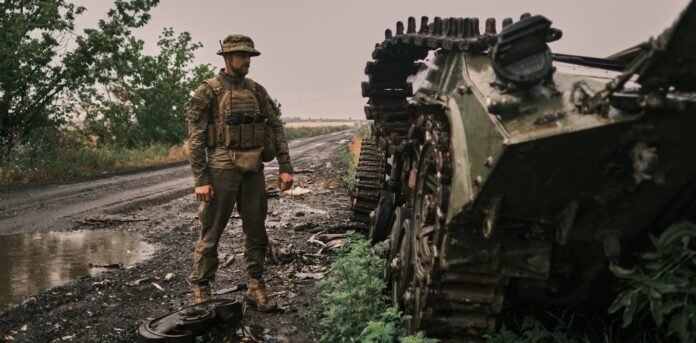
Equally striking has been the return of extensive trench systems. Not since the Iran-Iraq war, which was fought between 1980 and 1988, has a major interstate conflict depended so heavily upon field fortifications and prepared positions such as trenches, concrete obstacles and belts of barbed wire.

Large-scale manoeuvre has given way to attritional combat measured in hundreds of metres rather than tens of kilometres.

Yet the deeper similarities lie not in trenches or artillery, but in the underlying logic of the war itself. Like the first world war, the conflict in Ukraine has become a contest of endurance: manpower, industrial capacity, economic resilience and political will.

These factors, rather than any individual weapons system, are likely to determine its eventual outcome. Of these, the most important is manpower.

Ukrainian rescuers work at the site of a Russian strike on a car dealership in Kyiv.

Ukrainian rescuers work at the site of a Russian strike on a car dealership in Kyiv, Ukraine, on June 2. Sergey Dolzhenko / EPA

Broadly comparable losses

During the first world war, British, French and German governments routinely published casualty lists. The public knew that victories often came at immense cost.

Military leaders understood that the key question was not simply how many casualties the enemy had suffered, but whether their own societies could continue to bear comparable losses for longer than the opponent.

Battles such as Verdun and the Somme in 1916 and Passchendaele (also known as the Third Battle of Ypres) in 1917 generally produced losses that were severe for both sides. This was well understood on the home front.

Yet in the Ukraine war, we are regularly invited to believe that Russia sustains several times the number of dead than is suffered by Ukraine. In a particularly unlikely example, Ukraine’s president, Volodymyr Zelensky, claimed that 47 Russians were dying for every Ukrainian earlier in 2026.

About a year ago, I was having dinner at a London club with a well-connected former Ukrainian government official whom I have known for some time. Our conversation turned to casualties.

I asked them: “Tell me, no bullshit: what is the real casualty ratio?” My companion paused before replying quietly: “Same as the Russians.” Surprised, I asked for the source. “The General Staff,” they replied.

The General Staff of the Armed Forces of Ukraine is the senior military command headquarters of Ukraine’s armed forces – the body responsible for planning, directing and coordinating military operations at the highest level.

This is an anecdote, but publicly available evidence tends to support this assertion. Sources such as the New York Times have also confirmed that casualties on both sides are similar, with Russia sustaining more, but not multiple times more. Russia, of course, has a far larger population than Ukraine.

The precise casualty figures remain contested and are likely to remain so until long after the war ends. What matters for present purposes, however, is that the available evidence points towards a war of broadly comparable losses rather than one in which either side enjoys an overwhelming advantage in manpower attrition.

A member of the Ukrainian armed forces fires a rocket towards a Russian position.

A member of the Ukrainian armed forces fires a rocket towards a Russian position in the Donetsk region of eastern Ukraine on June 4. Mechanized Brigade / EPA

Even if these figures are broadly correct, Ukraine has held the line against a much larger adversary for over four years now and has shown extraordinary resilience in the face of invasion. Its capacity for innovation has repeatedly surprised observers.

New drones, autonomous systems and precision-strike technologies are often presented as solutions to the country’s growing manpower difficulties. Some commentators even suggest that robotic systems may compensate for shortages of personnel.

The difficulty with this argument is that war is an interactive contest. Almost every significant Ukrainian innovation has been met by a Russian adaptation and vice versa. The result has been a continuing cycle of measure and countermeasure rather than a decisive technological breakthrough by either side.

Technology matters enormously, but it rarely abolishes the need for manpower. Artillery, tanks, aircraft and machine guns transformed warfare between 1914 and 1918, yet none removed the requirement to occupy and defend ground with soldiers.

The same remains true today. As military doctrine has long recognised, drones, missiles and aircraft can destroy, disrupt and delay, but ground can only be taken and held by troops.

A Ukrainian drone pilot holds a first-person view drone at an undisclosed location near the frontline.

A Ukrainian drone pilot holds a first-person view drone at an undisclosed location near the frontline in the Druzhkivka area of eastern Ukraine. Maria Senovilla / EPA

There are other echoes of 1918. The small infiltration and assault groups employed by both sides in Ukraine’s drone-saturated battlefields bear a striking resemblance to the German stormtroopers who achieved remarkable successes during the Spring Offensive of 1918.

As so often in warfare, however, innovation did not confer a lasting advantage. The British and French adapted, developed countermeasures and eventually improved upon many of the new tactics themselves.

What transformed the strategic balance in the first world war was not tactical innovation or a decisive technological breakthrough, but the arrival of the US Army and Marine Corps. More than 2 million American soldiers ultimately served in Europe, and their battlefield presence convinced Germany that time was no longer on its side.

Ukraine faces no such prospect today. For all the discussion of technological revolution, the war in Ukraine remains a contest of human endurance – just like the first world war.
Trump’s ‘narco-terrorism’ war in Latin America evokes Reagan – then as now, it’s more about fighting leftists than drug runners

0
trump’s-‘narco-terrorism’-war-in-latin-america-evokes-reagan-–-then-as-now,-it’s-more-about-fighting-leftists-than-drug-runners
Trump’s ‘narco-terrorism’ war in Latin America evokes Reagan – then as now, it’s more about fighting leftists than drug runners

More than any other U.S. president in decades, Donald Trump has aggressively pursued military interventions in Latin America.

On Jan. 3, 2026, U.S. special forces captured Venezuelan President Nicolás Maduro on charges of narco-terrorism. In the months before the operation, U.S. Southern Command began targeting small, fast-moving boats in the Caribbean and eastern Pacific. The death toll from the continuing war on these alleged narco-terrorists has risen to over 200 people.

At the heart of these events is the Trump administration’s stated goal of combating drug trafficking organizations. The White House and State Department have designated a plethora of guerrilla groups, drug cartels, gangs and criminal enterprises as “foreign terrorist organizations.”

Washington has also expanded security ties with Ecuador and El Salvador, which are led by right-wing Trump allies. At the same time, the administration has pressured left-wing governments in Colombia, Guatemala, Brazil and Mexico to join the U.S. war on drugs or else risk Trump’s wrath.

When it comes to opening legal avenues for the application of armed force, the narco-terrorism label is useful. Indeed, it is how the Trump administration justified Operation Absolute Resolve to capture and indict Maduro. Yet Trump’s decision to pardon a right-wing ally – former Honduran President Juan Orlando Hernández – who was convicted and sentenced to 45 years in prison for drug trafficking and related weapons offenses, appeared to some observers to be “at odds with Trump’s war on drugs.”

The history of that war on drugs, however, especially during the presidency of Ronald Reagan, shows that the narco-terrorism label has always been politicized. My research on Reagan and the drug war suggests that the nebulousness of the concept aided U.S. policymakers in achieving fundamentally anti-communist and anti-leftist political objectives.

Shining Path and the roots of narco-terrorism

Peruvian President Fernando Belaúnde Terry first coined the term narco-terrorism in 1982 to describe the infiltration of Sendero Luminoso – or Shining Path – guerrillas into the drug trade.

An ultraradical offshoot of the Peruvian Communist Party, Shining Path was one of the most vicious insurgencies in Latin America. A truth and reconciliation commission later attributed at least half of the 70,000 conflict-related deaths and disappearances to the Maoist guerrillas in their campaign to overthrow the “bourgeois” democratic government. After the Peruvian army chased the guerrillas out of their home base in Ayacucho in the southern Andes, they moved north to the upper Huallaga Valley, the source of over half the world’s cocaine supply at the time.

The Peruvian police, together with the U.S. Drug Enforcement Administration, created special counternarcotics units focused on crop eradication in the upper Huallaga. This strategy sought to reduce the supply of cocaine by eliminating its source, the coca plant. Peasant growers’ resistance to these operations fueled the Shining Path insurgency by providing recruits and creating an opening for the guerrillas to interpose themselves between the farmers and the police.

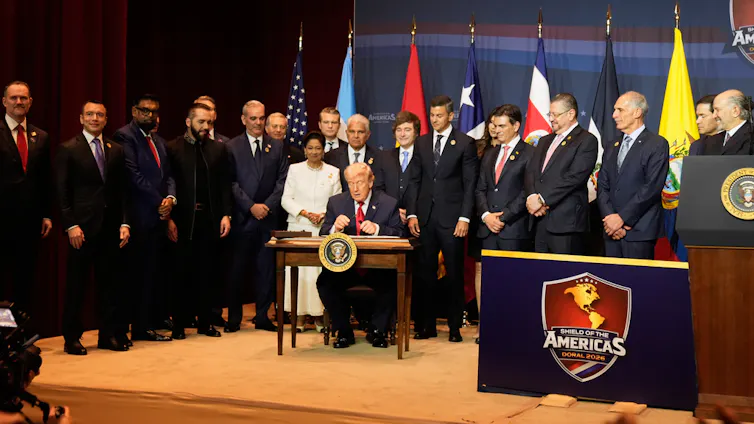
A gathering of world leaders in suits stand around a man at a desk.

President Donald Trump signs a proclamation committing the U.S. to countering cartel criminal activity on March 7, 2026, in Doral, Fla. AP Photo / Mark Schiefelbein

With the Cold War drawing to a close, a militarized drug war expanded under the administration of George H.W. Bush. As the federal counternarcotics budget nearly doubled, U.S. officials pressured the Peruvians to militarize their counternarcotics efforts, too. But it wasn’t until the Peruvian armed forces pursued a tacit truce with the traffickers that they were able to locate and capture Shining Path leader Abimael Guzmán in September 1992 and dismantle the insurgency.

The Peruvian counterinsurgency succeeded due to a strategy that deliberately cut ties between the guerrillas and the drug traffickers. Essentially, the armed forces of Peru took control of the drug trade from the leftist guerrillas. U.S. anti-narcotics officials, together with their Peruvian police colleagues, were less than thrilled with this strategy – as were the tens of thousands of people who were caught in the crossfire. But for myriad U.S. defense officials more interested in defeating Shining Path than stemming the tide of drugs, the narco-terrorism label had facilitated a clear success – and drafted a valuable blueprint.

Colombia and the ‘narco-guerrilla connection’

The incident that indelibly linked the drug cartels and the communist guerrillas in the U.S. concept of narco-terrorism was the November 1985 M-19 siege of the Colombian Palace of Justice, the country’s supreme court. The M-19, or 19th of April movement, so named for a disputed election, had as a main objective to establish socialism in Colombia. The guerrillas took the high court hostage and intended to subject the then-president to a trial. The resulting clash with the military left nearly 100 people dead, including soldiers, guerrillas and 11 of the justices.

Allegations surfaced that Pablo Escobar, head of the notorious Medellín cartel, had paid M-19 for the raid. The guerrillas had apparently stolen hundreds of documents, including U.S. extradition requests for Escobar. Though this motive is still disputed – and even the U.S. ambassador in Bogotá emphasized that the “narco-guerrilla connection” had not been proven – the shocking event hardened U.S. public opinion against the new threat of narco-terrorism.

In April 1986 the Reagan administration issued National Security Decision Directive 221, officially linking counternarcotics and counterinsurgency in U.S. foreign policy. The declaration of drugs as a national security threat widened the scope of U.S. involvement in the Colombian counterinsurgency against entrenched communist guerrilla groups such as the Revolutionary Armed Forces of Colombia and the National Liberation Army.

That cooperation continues to the present day, though it is currently jeopardized by hostility between Trump and Colombian President Gustavo Petro, himself a former member of M-19.

A man stands at a lectern alongside two others.

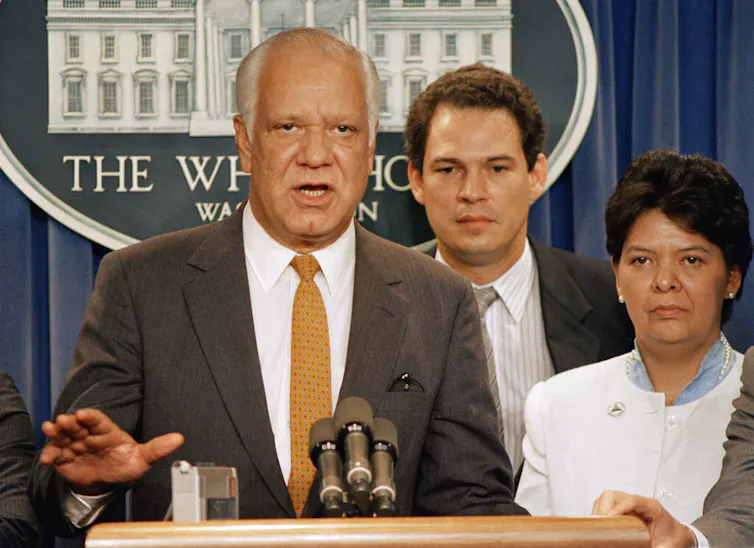
Contra leaders Adolfo Calero, left, with Pedro Joaquin Chamorro and Mario Azucena Ferrey, talk with reporters in 1987 in the White House briefing room after a meeting with President Ronald Reagan. AP Photo / Scott Stewart

The selective application of trafficking claims

The narco-terrorism label was selectively applied not only to left-wing guerrillas but to the two communist governments in Latin America. The Reagan administration seized upon allegations of Nicaraguan and Cuban drug trafficking to influence U.S. public opinion at a time when the American people worried about becoming bogged down in another Vietnam-style quagmire.

Vietnam had shattered the foreign policy consensus around the containment of Soviet communism, but the 1980s crack cocaine epidemic created a powerful new rationale for U.S. intervention. After Congress, citing human rights concerns, restricted aid to the anti-communist Contra forces fighting Nicaragua’s left-wing Sandinista government, Reagan publicly accused the Sandinistas of drug trafficking.

The only evidence produced to support the charge was likely obtained as the result of a joint DEA-CIA sting operation involving Barry Seal, an American drug smuggler turned DEA informant later played by Tom Cruise in the Hollywood cinematic version of the sordid tale, “American Made.” Questions arose as to whether the Nicaraguan trafficker identified by the sting was even linked to anyone in the Sandinista government.

At the same time, the Reagan administration ignored allegations that the Contras themselves were smuggling cocaine into the U.S. Indeed, a Senate investigation spearheaded by U.S. Sen. John Kerry revealed that administration officials had repeatedly ignored or obstructed evidence of Contra drug trafficking. The CIA’s inspector general found that the agency had received but neglected to verify similar allegations.

These activities were tolerated because they raised money for a cause that Reagan and his supporters viewed as righteous. The Contras were seen as “freedom fighters” struggling to liberate Nicaragua from communism.

Coming full circle

Then, as now, Washington policymakers pursued a regional approach designed to strengthen security cooperation and bolster the military capabilities of allied nations.

In March 2026 the Trump administration created the Americas Counter Cartel Coalition, or Shield of the Americas, a security alliance to stop illegal immigration, Russian and Chinese interference, and “narco-terrorist gangs and cartels.” In his remarks at the March 7 opening summit, Trump insisted that “the only way to defeat these enemies is by unleashing the power (of) our militaries.”

Then, as now, this collaboration appears to be aimed at the leftist and communist governments in the Western Hemisphere.

In many cases, the drug framing is an explicit rationale for action. That was most recently on display with the U.S. designation of the two largest criminal gangs in Brazil as foreign terrorist organizations, leading Brazilian officials of the leftist Lula government to warn that any pretext for intervention would be “unacceptable.”

In other cases the administration’s argument is broader. The ratcheting up of military maneuvers, rhetoric and sanctions against Cuba – including declaring the island nation an “unusual and extraordinary threat” to U.S. security – has led many to speculate that Cuba is the next target of regime change.

While the narco-terrorism label may be applied selectively depending on the case, the result remains the fulfillment of anti-communist political objectives dating back to the Cold War.

The opinions expressed are the author’s alone and do not reflect the views of the U.S. Naval War College, the Department of the Navy, or any other part of the federal government.

European Parliament Trials Shorter Debates to Improve Attendance

0
european-parliament-trials-shorter-debates-to-improve-attendance
European Parliament Trials Shorter Debates to Improve Attendance


The European Parliament is set to test new rules in its upcoming June plenary session to avoid empty seats during debates and improve engagement between lawmakers and EU Commissioners.

The decision was taken on Wednesday by the chairs of the Parliament’s political groups. President Roberta Metsola asked them last year to come up with proposals to make Parliament’s debates shorter and more meaningful.

The next session will see a clear start and end time for each debate. Under the current rules, debates often drag on beyond schedule, sometimes delaying an entire day’s programme. The upshot is that long discussions stretch into the late evening with very few MEPs present – often only the ones with allotted speaking time.

In the session from 15-18 June, sittings will have deadlines: 8.30pm on Monday, 7pm on Tuesday and Wednesday, and 4pm on Thursday.

Another new measure to improve MEPs’ participation is to move other parliamentary activities, such as political meetings or negotiations with member states, until after the plenary’s debates, which many MEPs regularly miss due to scheduling conflicts.

Lawmakers will be allowed to make a short personal statement immediately when one of their colleagues makes remarks directly relevant to them personally, and “blue cards”, a system allowing MEPs to ask a question to a colleague on stage, will be encouraged.

The Parliament will also maintain a special format used in the last few months for key debates, under which MEPs on the speaker’s list are not informed of its order in advance, giving them an incentive to follow the entire debate.

MEPs have also made clear they want more discussion with EU Commissioners, who already take part in the plenary’s debates with an initial statement and a closing remark. Under the new rules, they will also have the floor during the debates to reply to each lawmaker’s interventions.

The upcoming plenary will feature a specific debate to scrutinise the European Commission, with a “question time” similar to the ones held in some national parliaments. Next week, it will be held on 16 June at 3pm after the Commission’s college meeting, and will focus on the reporting burden for small and medium enterprises across Europe.

Via Euronews

US and Iran are unlikely to bomb their way to peace

0
us-and-iran-are-unlikely-to-bomb-their-way-to-peace
US and Iran are unlikely to bomb their way to peace

The United States has launched new airstrikes across Iran this week as President Donald Trump, losing patience over the protracted negotiations to end the war, has leaned into violence to ratchet up the pressure on the Iranian leadership.

The US secretary of defence, Pete Hegseth, made clear the airstrikes would likely continue if the peace deal continued to stall, saying:

If we need to negotiate with bombs, we’ll negotiate with bombs.

This came after Iran and Israel fired missiles at one another in recent days and Iran shot down a US helicopter.

Up to this point, both the US and the Iranian regime had respected the precarious ceasefire that had halted the war in early April. Both sides seemed to want it to continue. And Trump is still insisting a peace deal is imminent.

Why, then, are both sides firing on each other now, and where does this leave the negotiations? There are a few plausible explanations.

Escalate to deescalate

In conflicts, states often escalate to deescalate. This is when a country ramps up military action with the aim of intimidating the other side into submission.

Both the US and Iran want to show force to pressure the other side into accepting an agreement that meets their own core interests. However, the two sides remain at an impasse because their most critical interests are at odds with one another.

The US wants Iran to capitulate on its nuclear program and reopen the Strait of Hormuz to commercial traffic, with no constraints. Iran wants its frozen assets released and a lasting ceasefire between Israel and Hezbollah in Lebanon.

Both sides remain far apart on the nuclear issue, with Iran unlikely to fully agree to US demands that it dismantle its nuclear infrastructure and cease uranium enrichment altogether.

Given the stalemate, both sides want to show they are willing to escalate through military action. Yet, neither wants the ceasefire to break completely.

Trump wants to move on from the war and shift the political agenda domestically in an election year. Fewer than one in six Americans think the US is winning the war. The Iranian regime remains standing, but it cannot ignore the mounting economic pressures of a full-scale war for much longer.

The problem is that escalating in hopes of intimidating an adversary into a deal only works if the other side is not pursuing the same tactic at the same time. Otherwise, both sides end up in an escalation trap, each ramping up the severity of attacks and unable to back down.

An alternate explanation is that these escalations are the unintended but inevitable consequence of a tense ceasefire that includes a live military blockade in the Strait of Hormuz.

It remains unclear if the Iranian drone that downed the US helicopter this week, precipitating the retaliatory airstrikes, was intentional or an accident.

Existential regional conflict

Making things more complex is the fact this isn’t just a fight between two protagonists – Israel is simultaneously launching military strikes on an Iranian ally, Hezbollah, in Lebanon.

Israel’s military operation deep into southern Lebanon has fundamentally shifted the regional geopolitics. And it may undermine the tenuous ceasefire between the US and Iran, despite Trump’s efforts to maintain regional calm.

What the Trump administration does not seem to have fully grasped is that in the eyes of the Israelis and Iranians, this conflict runs much deeper and has been going on far longer than the current war.

For both sides, it is existential. The Islamic regime in Iran has long opposed Israel’s place in the region, and Israel has long viewed a nuclear-armed Iran as the chief threat to its survival.

As such, Iran will not abandon Hezbollah, which it has long funded and armed, and respect a ceasefire with the US, while Israel wages war in Lebanon. The reason: the regime see itself and Hezbollah as one front fighting the same battle.

And on the Israeli side, the October 7, 2023, Hamas attacks on Israel fundamentally shifted Prime Minister Benjamin Netanyahu’s approach to the region.

Since then, his far-right government has adopted an offensive military strategy of capturing territory in Israel’s neighbors – Syria, Lebanon and Gaza – and establishing security buffer zones. Netanyahu has also vowed to eliminate any threat coming from Iran, Hamas and Hezbollah.

However, the non-state actors of Hamas, Hezbollah and even the Houthis in Yemen cannot be eliminated with conventional military force. Militant groups like these can blend into civilian populations and reemerge, sometimes months or years later.

So, despite Israel’s significant use of military force and the widescale destruction of Gaza and now southern Lebanon, Israel will not succeed in eliminating Hamas or Hezbollah, and will keep fighting.

Trump’s approach to regional diplomacy has ignored these complexities. Trump leans heavily on bilateral and personal relationships to achieve his objectives. He has shown little interest or patience in addressing the underlying drivers motivating the multiple actors involved in the conflict.

Will the ceasefire hold?

The most important thing to understand here is how Trump views a “ceasefire.” In a news conference this week, he said in the Middle East, a ceasefire means “shooting in a more moderate manner.”

But we do know he doesn’t want to return to a full-scale war, which is why he demanded Israel and Iran stop striking one another earlier this week.

So, we could see more strikes between the three sides as they continue negotiating. And we may see a memorandum of understanding between the US and Iran in the coming days or weeks. However, this would likely be an agreement for both sides to continue talking. It is unlikely it will resolve the core issues.

Nor is Israel likely to withdraw its troops from southern Lebanon or halt its asymmetric war with Hezbollah.

As I’ve argued before, this has the making of a “frozen conflict”, or an unresolved war that continues at a low level, below the threshold of full-scale combat.

If the deeper roots of the conflict are not resolved, a “ceasefire” between the US, Israel and Iran can only ever be temporary.

Jessica Genauer is academic director, Public Policy Institute, UNSW Sydney

This article is republished from The Conversation under a Creative Commons license. Read the original article.

America’s war-based economy still strengthens its rivals — and Trump is accelerating this

0
america’s-war-based-economy-still-strengthens-its-rivals-—-and-trump-is-accelerating-this
America’s war-based economy still strengthens its rivals — and Trump is accelerating this

For more than two decades, experience has shown a clear pattern: whenever the United States rushes into wars, it does not weaken its enemies as it expects. Instead, it often opens wide doors for them to grow, expand, and build influence. The question is no longer whether rival powers benefit from Washington’s constant wars. 

The real question is: how much do these wars speed up America’s rivals economically and politically?

Today, with Donald Trump returning to the center of global influence and using escalating rhetoric and threats — commercial, military, and geopolitical — Beijing increasingly views “Trump’s wars” as a rare strategic opportunity, not an existential threat.

Wars drain Washington and disrupt its priorities

Any major war or military confrontation does not only consume money. It also consumes political attention, strategic capacity, and international credibility. The wars in Afghanistan and Iraq proved that getting trapped in “long wars” creates a costly swamp that is hard to escape. It keeps the United States focused on daily security and military details instead of the bigger challenge: competing with China economically, technologically, and militarily.

Beijing understands this well. When the U.S. spends its resources on military campaigns and naval deployments, it is not building new factories, not investing at the same speed in education, research, and technology, and not focusing on the long-term industrial race. That is exactly what China wants: more time and more space to speed up production, deepen innovation, and expand its influence.

READ: Iranian military source claims missiles penetrated US defences and hit majority of targets

Trump’s wars weaken allies before they weaken rivals

America’s direct rivals are not the only ones affected by war. Europe and NATO often pay a double price: rising energy costs whenever supply routes are threatened, disruption of shipping and maritime insurance, internal inflation, and growing political polarization driven by living-cost pressures and migration.

Here China sees the opportunity. The more Washington gets pulled into a new confrontation, the more Europe becomes anxious, divided, and less able to sustain a “long economic war” against China.

Beijing does not need to break the Western alliance by force; it is enough to let it weaken gradually under the weight of repeated crises.

This pressure is also felt by America’s Gulf allies, especially as the U.S. confrontation with Iran intensifies.

Wars create a “Fear Economy” and China presents itself as the economic alternative

Wars do not only create deaths and destruction. They also create a global “Fear Economy” that leads to markets panic, investors hesitate, and companies search for stability in supply chains. In economics, stability is as valuable as power.

China tries to present itself at this moment as the “more responsible economic actor”. This means a state focused on trade, infrastructure, and investment that offers itself as an alternative partner in Asia, Africa, and Latin America.

The more the U.S. moves toward war, the easier it becomes for China to sell a simple message:
We represent development; they represent chaos.

READ: Trump says Iran took ‘too long to negotiate a deal, will have to pay the price’

War accelerates the breakdown of U.S. dominance in the international order

U.S. dominance after World War II was not built by military power alone. It was built through a full system: international organizations (such as the World Bank and the World Trade Organization), alliances, economic leadership, and global confidence that the “system”, even if biased, was at least predictable.

But when U.S. policy becomes driven by rushed decisions, constant escalation, and ongoing threats, international confidence weakens and the search for alternatives speeds up. China sees “Trump’s wars” not only as military conflict, but as a force that breaks down the structure that kept the U.S. as the leading power.

Simply saying: every war makes it harder for Washington to lead the world by consent, so it tries to lead by coercion. And coercion does not create lasting stability — it creates economic shocks and repeated crises.

Global wars reduce pressure on China in its sensitive files

When crises explode in the Middle East, or tensions rise with Iran or in the Red Sea, international political and media attention shifts to those arenas. This gives China valuable time to work quietly on major strategic priorities: Taiwan, the South China Sea, the technology race, and control over rare minerals and global supply chains.

China does not want a direct confrontation now. It wants to accumulate power until it can negotiate from a stronger position. The longer Washington stays trapped in wars, the closer Beijing gets to that moment.

When war becomes an “economic model”, it becomes a gift to competitors

Modern U.S. history shows how often America links economic strength to military power: tax tariffs, huge arms budgets, overseas bases, and wars justified with security and moral language. The paradox is that this model, even if it benefits the domestic weapons industry, produces long-term negative results. America’s rivals gain time, build their economies, advance in technology, and rise in influence.

That is why Beijing sees “Trump’s wars” as an opportunity. When war becomes a political and economic habit, it does not exhaust the enemy only — it exhausts the one waging it.

And if economics is the foundation of power in today’s world, America’s continued strategy of “wearing itself out through wars” leaves one final question open:

Is Washington still fighting to win — or is it fighting in a way that helps its rivals rise?

OPINION: Gulf States have nothing but to talk to Iran, NOW

The views expressed in this article belong to the author and do not necessarily reflect the editorial policy of Middle East Monitor.

Several things I like about macOS 27 Golden Gate that have nothing to do with AI

0
several-things-i-like-about-macos-27-golden-gate-that-have-nothing-to-do-with-ai
Several things I like about macOS 27 Golden Gate that have nothing to do with AI

Apple Intelligence and Siri AI have sucked most of the oxygen out of the room at Apple’s Worldwide Developers Conference this year—understandable, maybe, given that the AI-powered Siri delays are all anyone has wanted to ask any Apple executive about for the last two years.

But Apple Intelligence is just one of the three big focus areas Apple outlined during its keynote this week. The second is new parental controls—overdue, but promising-looking, as the parent of a six-year-old with an iPad that I only begrudgingly connect to the Internet. And the third is “platform improvements,” a catch-all for a wide range of fit-and-finish changes aimed at boosting responsiveness and addressing common user complaints.

I have the first beta of macOS 27 Golden Gate running on an M1 MacBook Air—the oldest, slowest hardware Apple supports now that Intel compatibility is out the window. With some help from Apple’s densely packed wall-of-features slide, here are a few things from the “platform improvements” column I like the most, plus one item I’d still like to see.

Note that these are screenshots from an early beta and that things will continue to change as Apple releases more updates. Later betas, particularly those released after the public beta in July, will more closely resemble the finished version of the OS we get in the fall.

Liquid Glass and other UI changes

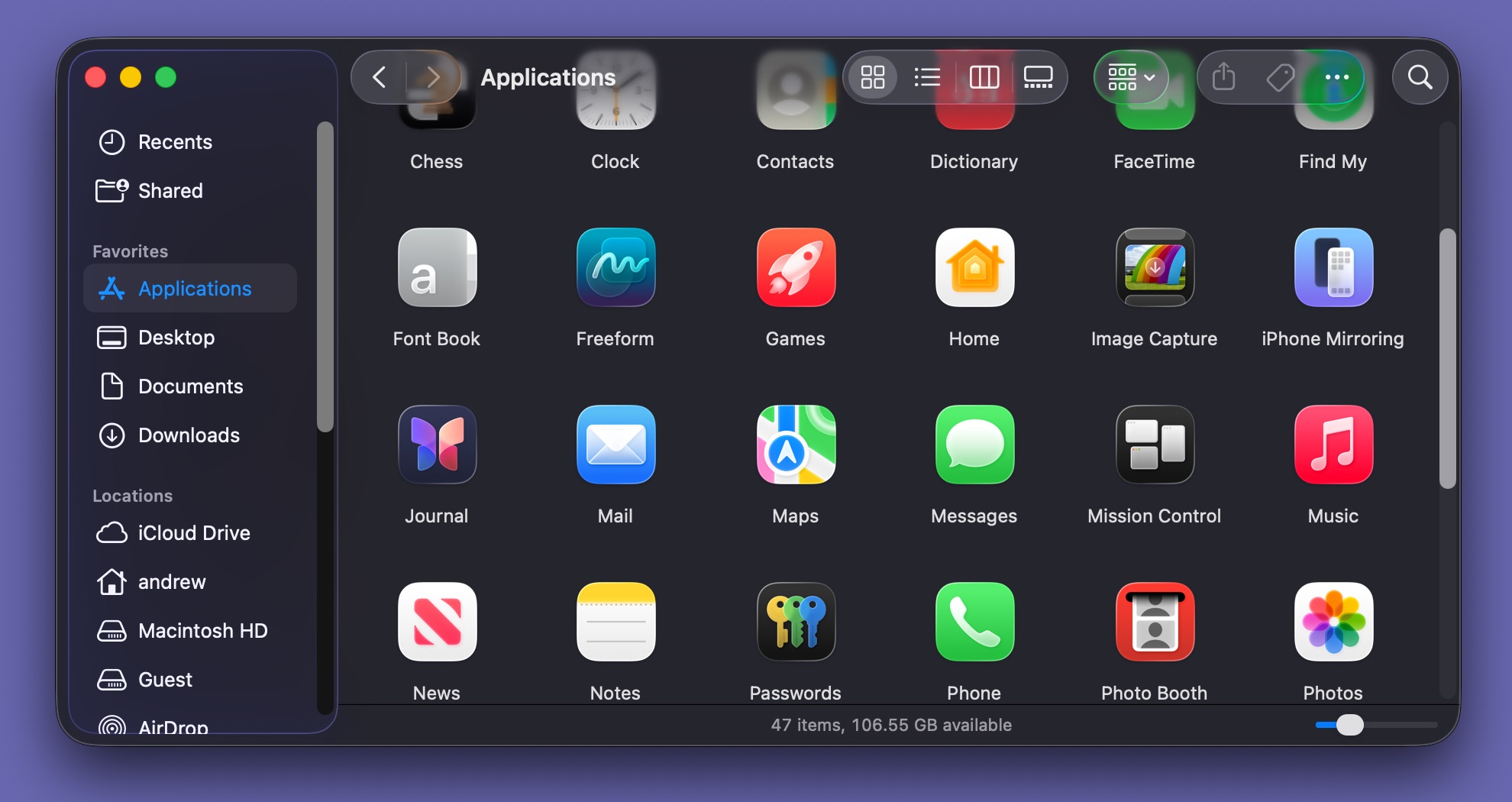
Here’s the same thing in macOS Golden Gate, with the slider set to maximize the Liquid Glass effect. The difference is subtle, but you can see how the refraction has been tweaked so that it’s harder to make out exact shapes underneath.

In Golden Gate, with the slider dragged as far in the Tinted direction as it will go. This is a fix that is available in Tahoe now, though it wasn’t included at launch.

Apple doesn’t retreat from Liquid Glass in macOS Golden Gate, but it does tone down the effect in a few places while reverting to a more Big Sur-ish design in a couple of crucial areas.

The most prominent tweak is the slider in the Appearance settings that gives users fine-grained control over Liquid Glass’ opacity. This replaces the binary “Clear/Tinted” toggle that Apple added in the macOS 26.1 release, and it’s been added to the macOS setup flow so users can choose what they want when they upgrade their operating system or get a new Mac.

Liquid Glass’ baseline appearance has been improved a bit, too, even for people who push that slider all the way to the left for maximum glassiness. But as we covered in our Tahoe review, the Mac’s version of Liquid Glass was already much less glassy than the iOS version, and even the slider’s glassiest setting leaves notifications, menu bar menus, Spotlight searches, and most other things looking more tinted than glassy.

The tweaked light refraction still leads to instances where text overlaps other text, creating visual conflict.

The default amount of glassiness, halfway between “clear” and “tinted,” generally doesn’t have this problem.

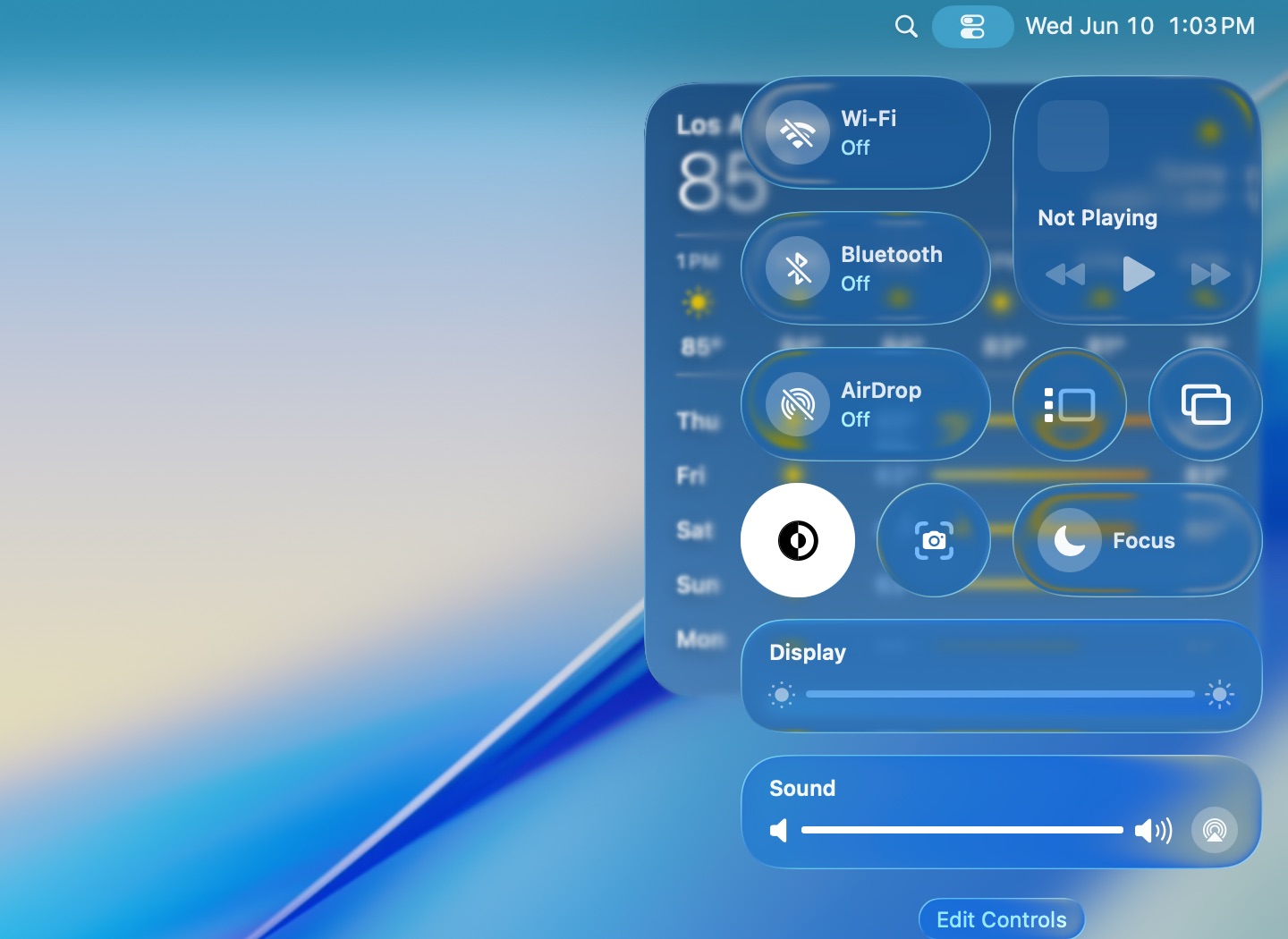
In the handful of places where Golden Gate does use glassier glass effect, including the Control Center and volume and screen brightness pop-ups, I can’t say I always find the tweaked light refraction to be an improvement. You still run into places where text overlaps other text, which is typically when Liquid Glass looks its worst. But at least now, people who are looking for maximum glassiness need to affirmatively choose it for themselves; the tinted view and the default halfway-between setting generally don’t cause as many problems.

A macOS Golden Gate window with the glassy slider turned all the way up. Note the hard barrier for the toolbar area and the less-pronounced visibility of the content underneath. The sidebar also extends from the edge of the window to the edge of the content area, as it did before.

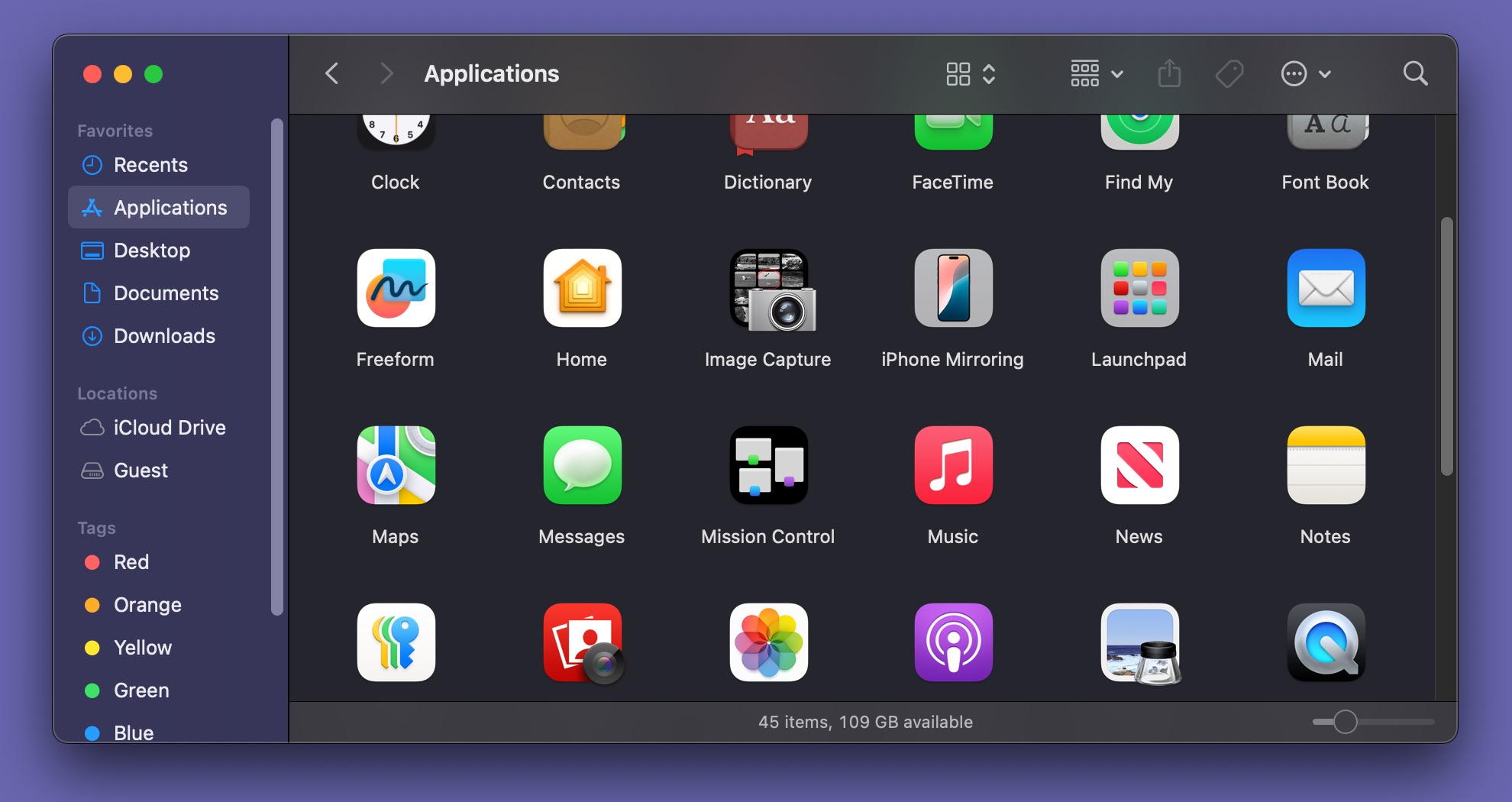
A window in macOS 15 Sequoia, for reference.


Tahoe’s version of Liquid Glass allowed apps to use an optional “hard-style” divider for toolbar areas; in these cases, you could still see a clearly defined toolbar boundary, and the visibility of objects beneath the toolbar area was much less pronounced. In Golden Gate, the “hard-style” divider seems to be the only option. This helps resolve some of the readability issues we pointed out in our Tahoe review, such as when faded gray text is displayed over a photo with a lot of gray in it in the Photos app.

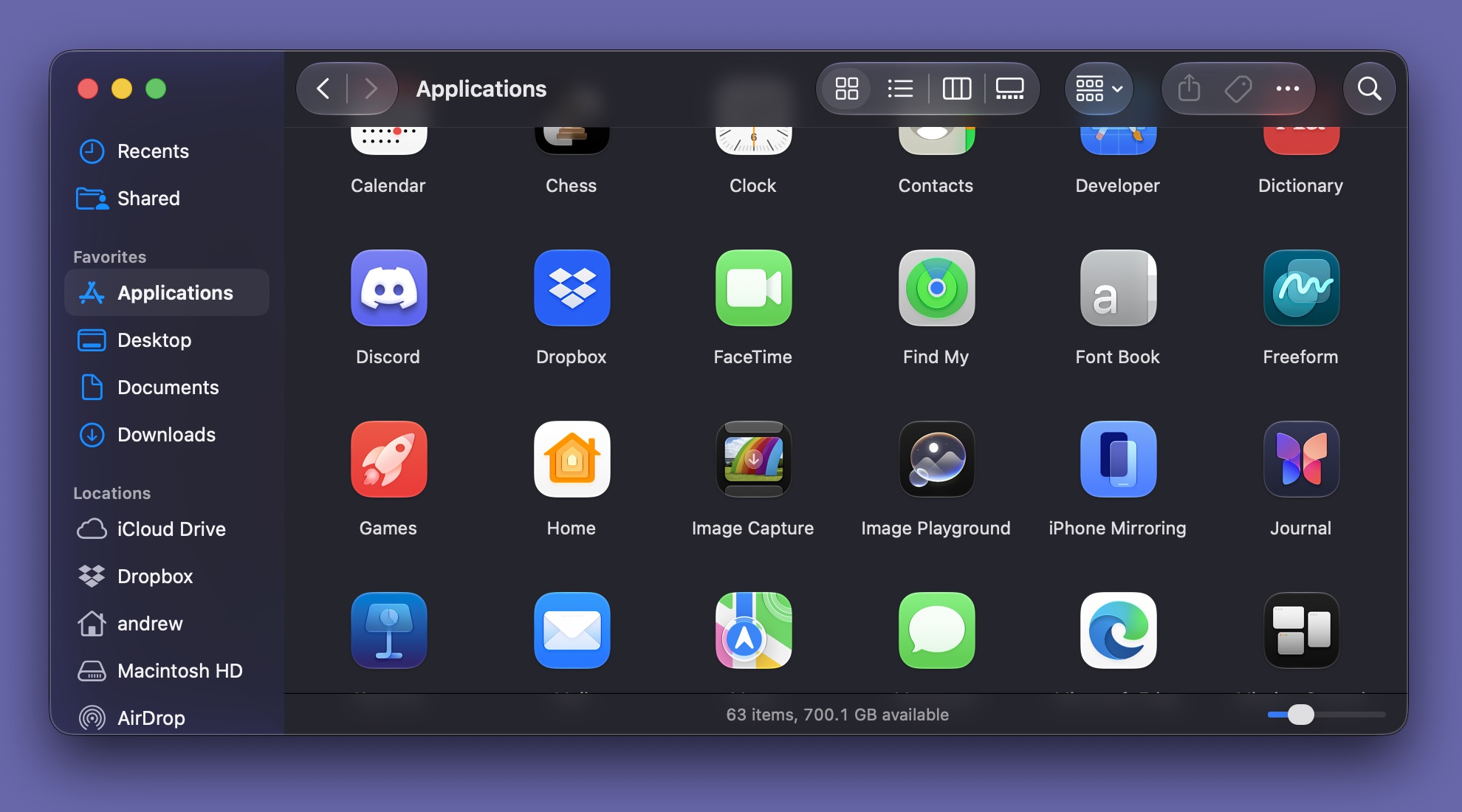
Though not directly related to Liquid Glass, Golden Gate also partially reverses other changes Tahoe made to the way windows and sidebars look and work. Sidebars now run from the edge of the window to the edge of the content area rather than in an extra layer of material that floats over the sidebar area. And window corners, while still more rounded than they were in the Big Sur-era design, are much less rounded than before. Crucially, this means that the place your cursor thinks the window corner starts and the place your eye thinks the corner starts are the same again.

Comparing three window corners, from hardest to softest. On the bottom of the stack is macOS 15 Sequoia; on the top of the stack is the rounded macOS 26 Tahoe styling. The new corners in macOS 27 Golden Gate split the difference.

Comparing three window corners, from hardest to softest. On the bottom of the stack is macOS 15 Sequoia; on the top of the stack is the rounded macOS 26 Tahoe styling. The new corners in macOS 27 Golden Gate split the difference. Credit: Andrew Cunningham

Golden Gate also removes most of the little SF Symbols glyphs from next to menu items. As Daring Fireball’s John Gruber highlights, Apple’s updated Human Interface Guidelines for its new OSes now say that the Tahoe-era design is the wrong way to do it, and that icons for menu bar items should be used “sparingly and with purpose.”

I tend to think that most of the gripes about Tahoe and Liquid Glass were overblown, but Apple does seem to have addressed many of the specific, substantive criticisms I’ve either seen repeated by others or that I’ve made myself. Collectively, I suspect they’ll mostly satisfy the “I refuse to upgrade because of Liquid Glass” people.

External display support

Golden Gate makes a couple of changes to improve the Mac’s support for external displays. Most concretely, it’s adding native support for 5K ultrawide displays (Apple didn’t define an exact resolution, but panels like this Dell Ultrasharp model run at 5120 by 2160). This is likely to vary somewhat based on the Mac you’re using; M1, M2, and M3 series Macs that top out at 60 Hz on regular 16:9 5K monitors will probably still be capped at 60 Hz.

Appls also says Macs will do a better job of remembering how windows were positioned on multi-monitor displays, useful for laptop owners who regularly dock and undock their systems to one or more external displays.

Spruced-up menu bar icons

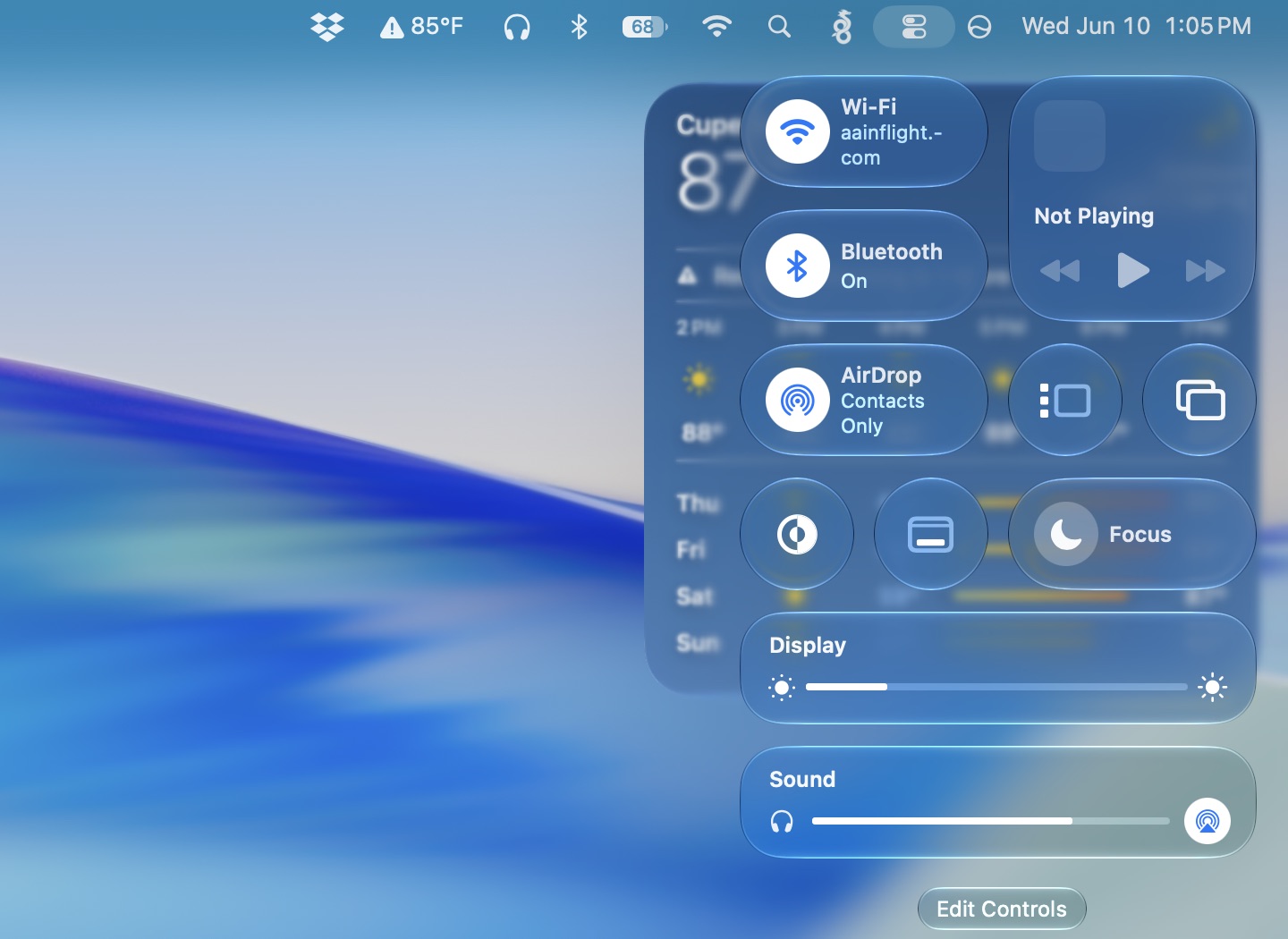
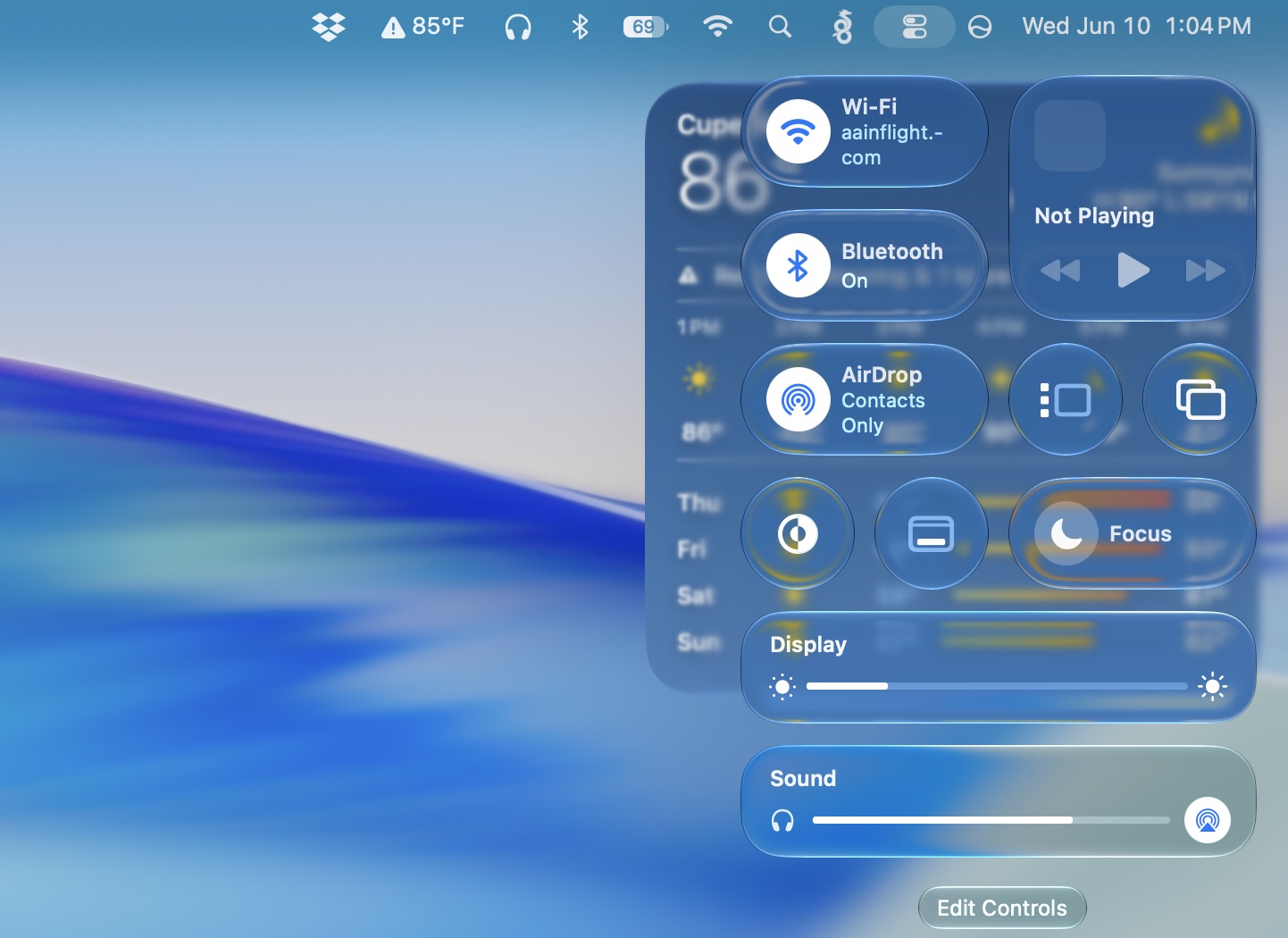
A new battery menu bar icon that displays its percentage inside the icon to save space.

A new battery menu bar icon that displays its percentage inside the icon to save space. Credit: Andrew Cunningham

I like menu bar icons, and for the ones I interact with most often (particularly Bluetooth and audio controls), I prefer to keep them visible in the menu bar and save myself the trip to the Control Center.

There are two menu bar icon changes I’ve noticed and liked so far. First, there’s an icon that indicates when your Mac is connected to Ethernet. Before, only your Wi-Fi connectivity would show up in the menu bar. This is a small thing, but people want it often enough that third-party solutions exist.

The other is a redesigned battery icon. I always choose to display the charge percentage alongside the battery indicator, and that number is now nested inside the battery icon, as it is on modern iPhones. This saves precious menu bar space, allowing you to add an additional icon before you start running underneath your laptop’s display notch or crowding out the menu bar’s actual menus.

Virtualization changes

I may be more enthusiastic about Apple’s virtualization technology because virtual machines make writing sprawling macOS reviews much easier, but these improvements are also handy for developers testing across multiple macOS versions or anyone running an Arm version of Linux on top of macOS.

Two WWDC developer sessions outline the improvements coming for anyone trying to run an OS on top of another. One explained the changes coming to virtual machines, including the ability to create user accounts and configure features like auto-login and SSH during the VM setup rather than having to do it manually. You also get USB passthrough, support for “advanced network topologies,” disk-images sharing between VMs with the new DiskImageKit, and Virtio support.

If you use one of the handful of lightweight free-to-use virtualization apps that plug into Apple’s Virtualization framework (I like VirtualBuddy; UTM is also a good choice), you’ll need to wait for those apps to be updated before they support these features.

Apple has also introduced container machines in this year’s release, building on both the Virtualization framework and containerization features the company announced last year. This video explains how container machines allow users to run Linux on top of their Mac in a way that makes Linux feel like “an extension of macOS.” They provide seamless access to existing user files without the need to maintain a separate virtualized install as a traditional VM does, and they allow quick switching between running macOS and Linux commands.

A pile of little performance improvements

Many of the entries on Apple’s wall of features are about speeding things up a little, including in corners of the OS that most people interact with only occasionally. These entries include smoother Safari scrolling (among many other claimed Safari improvements), faster AirDrop discovery and file transfer performance, faster switching at the lock screen, faster user account creation, faster browsing for networked storage, and faster OCR for photos and documents.

Many of these things will be difficult to measure objectively, and I hesitate to draw too many conclusions from how the very first beta is running on a test MacBook Air (though so far, it’s been one of the more stable Beta 1 versions of macOS in recent memory—definitely much better than Tahoe was at the same time last year). But the intended effect is “less waiting on your computer,” and it will be a solid win if Apple can pull it off.

What I still want: Xcode’s new window tinting

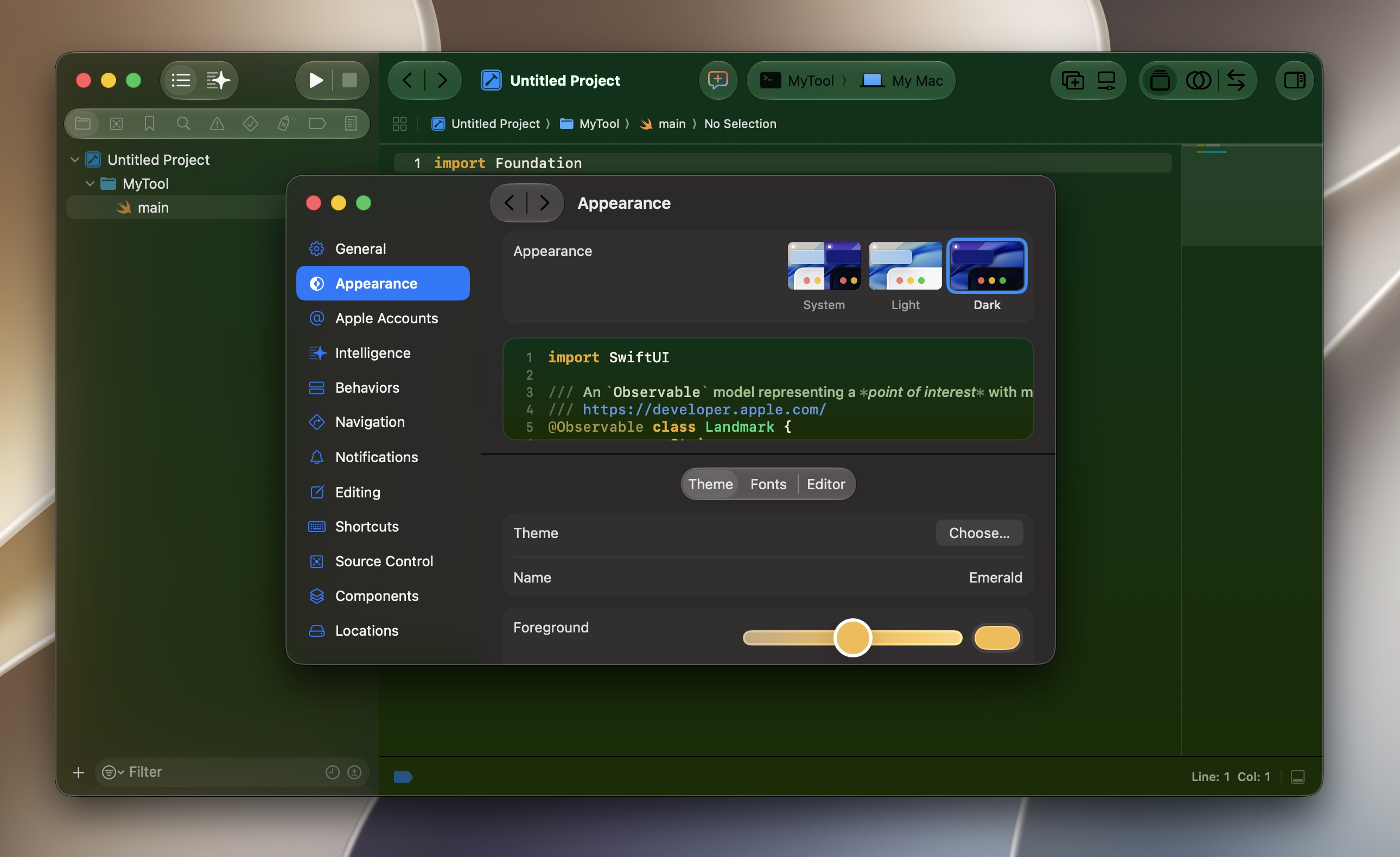
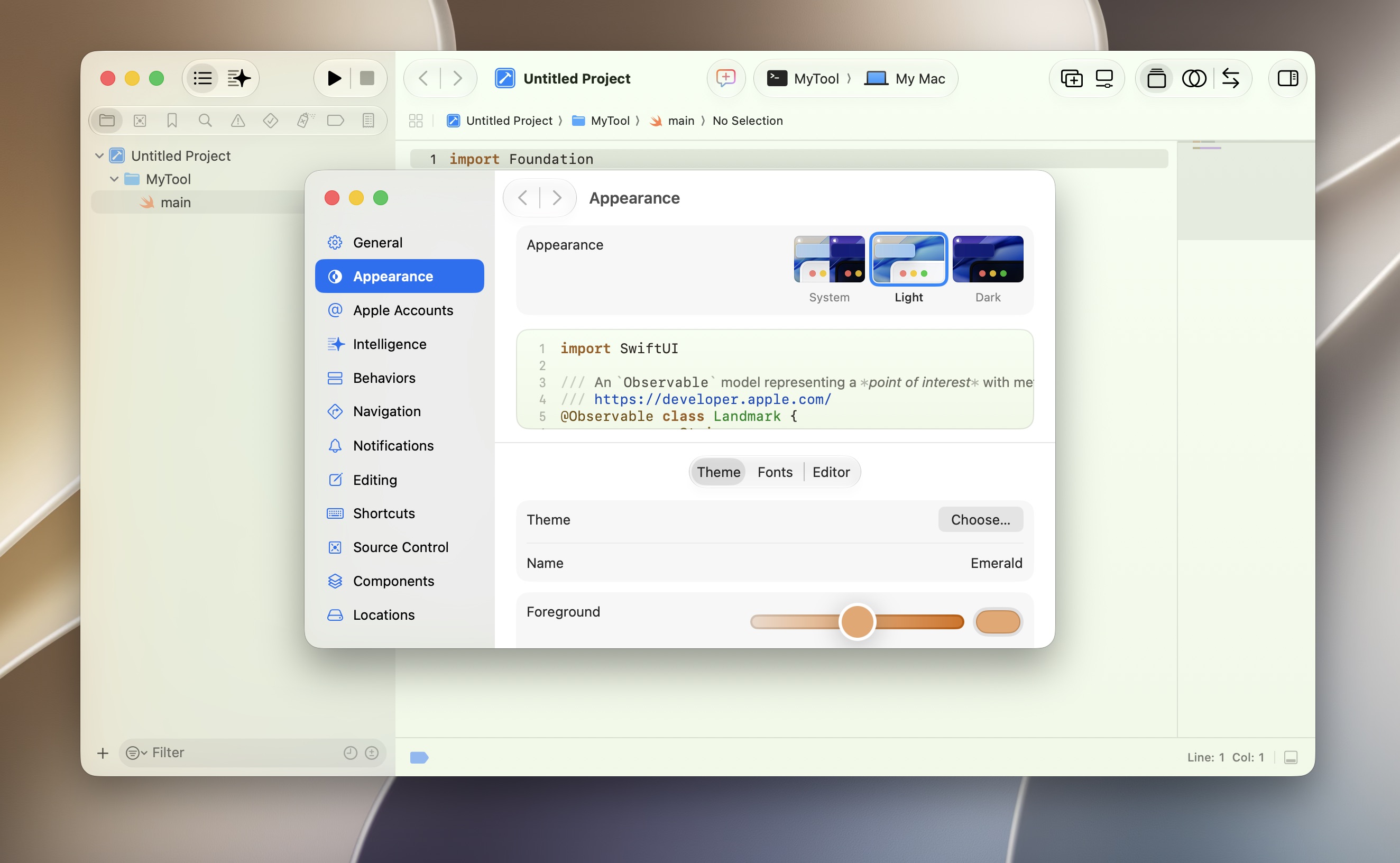
Xcode windows can have their own customizable window tints applied. Here’s the Emerald theme in dark mode, tinting the window slightly green.

The same Emerald theme in light mode. It would be nice to see this option elsewhere in the OS.

Xcode 27’s headlining new features mostly revolve around vibe coding. But there’s one new feature that isn’t directly about coding at all, and I’d like to see it implemented system-wide.

A new Appearance section in the Settings allows you to set a color theme independent of what you’re using in the rest of the OS—useful if you want to code in dark mode but prefer light mode for everything else, or vice-versa. On top of that, there’s a new “theme” setting that offers a bunch of color combinations to tint the Xcode window (and text and various highlights) in all kinds of colors.

This color is fully customizable and works for windows with both light and dark mode styling.

Of course, I could see this getting messy and exacerbating some of the readability issues people have had with the initial version of Liquid Glass. If you choose a green sidebar or toolbar icon for your app and the user sets their window to use the same shade of green, that’s a recipe for readability problems. But buttons and text in the OS can already change appearance based on the color that’s underneath them—extending that feature to support more flexible theming doesn’t seem like a huge leap.

I’m also not asking for quite the level of granularity seen in Xcode, where users can individually configure the colors of all kinds of OS elements, select different fonts, and even assign each project its own tint to differentiate it from the others. There’s such a thing as too many options, and the old Mac OS 9-era Appearance Manager gave users enough rope to hang themselves (aesthetically, I mean).

But even a limited list of window tint presets along the lines of the highlight colors Apple already offers feels like a logical next step for the company, a way to keep building on Tahoe’s icon customization options. Windows already pick up a tint automatically based on the content behind them! This would just be a way to let users choose their own persistent tint instead.

UK, Australia and Canada Launch $4 Million Israeli-Palestinian Peace Fund

0
uk,-australia-and-canada-launch-$4-million-israeli-palestinian-peace-fund
UK, Australia and Canada Launch $4 Million Israeli-Palestinian Peace Fund


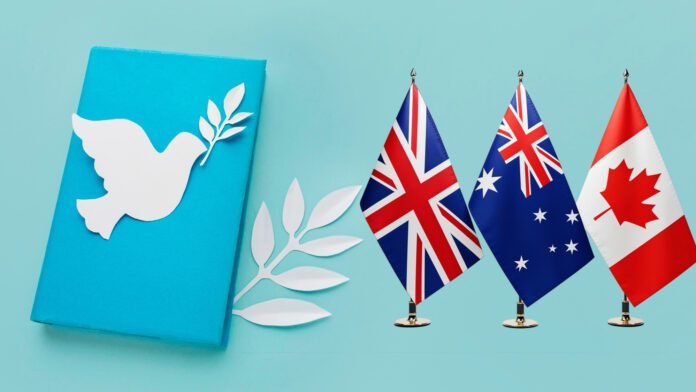
Britain, Australia, and Canada launched a £3 million ($4 million) International Peace Fund on Thursday at Chevening, the British foreign secretary’s country residence, to finance Israeli-Palestinian grassroots projects meant to rebuild trust and keep the idea of two states from becoming another diplomatic fossil.

Each country is putting in £1 million, with the money aimed at civil society groups, youth initiatives, women-led programs, and local projects that bring Israelis and Palestinians into direct contact. The fund is meant to support both existing programs and new ventures, and officials say they hope to bring in more donors once it is running.

UK Foreign Secretary Yvette Cooper announced the initiative while hosting Australian Foreign Minister Penny Wong and Canadian Foreign Minister Anita Anand for talks that also covered the Strait of Hormuz, Ukraine, Sudan, antisemitism, and the wider Middle East crisis.

“Peace, justice, and security in the Middle East depends on a two-state solution, and it is why our countries have recognized the State of Palestine alongside the State of Israel,” Cooper said.

The project is a small pot of money by the standards of Middle East diplomacy, where billions can vanish into rubble, bureaucracy, and border crossings. Its political message is larger: London, Canberra, and Ottawa are trying to pair state-level pressure with bottom-up peacebuilding at a time when formal Israeli-Palestinian talks remain frozen and public faith on both sides is badly battered.

The three governments said the fund will complement humanitarian support for Palestinians, efforts to support a 20-point Gaza peace plan, and action against violent settlers in the West Bank. Earlier this week, Britain, Canada, France, and Norway imposed sanctions on individuals and entities accused of financing or enabling attacks on Palestinians, while Australia and New Zealand had already announced coordinated measures.

The ministers also said Hamas must be disarmed, disempowered, and dismantled so it has no role in future Palestinian governance and poses no future threat to Israel. They also pledged to confront antisemitic violence after attacks on Jewish communities in the UK, Australia, and Canada over the past year.

Scott Pelley Shows How Legacy Media Got It Wrong — Before Bari Weiss Made It Worse

0
scott-pelley-shows-how-legacy-media-got-it-wrong-—-before-bari-weiss-made-it-worse
Scott Pelley Shows How Legacy Media Got It Wrong — Before Bari Weiss Made It Worse


The battle over “60 Minutes” can teach us a lot about how someone like CBS News editor-in-chief Bari Weiss can wreak havoc on our media ecosystem. What has gotten a lot less attention, however, is the way the fight shows us how ill-equipped our media institutions already were when it comes to covering the Trump administration and MAGA-era politics.

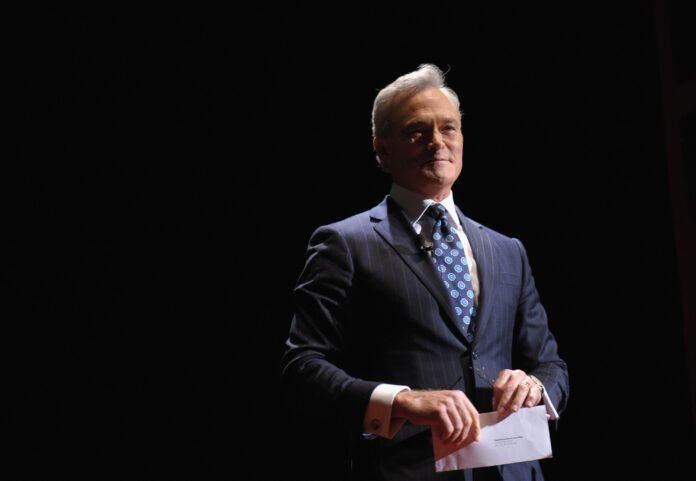
The strife at the famous magazine television news program reached a fever pitch last week, when, during a staff meeting, longtime correspondent Scott Pelley unloaded on Nick Bilton, Weiss’s pick to run the show. Pelley was fired and took to the media to defend himself.

In a long interview with the New York Times over the weekend, Pelley talked about how Weiss had injected herself into the show’s editorial process.

The most revealing part of the discussion centered on Pelley’s own “60 Minutes” coverage of President Donald Trump’s surge of immigration enforcement officers into Minneapolis, the uprising against the invasion, and the subsequent crackdown that led to the killings of Renee Good and Alex Pretti by federal agents.

Weiss’s role in the story was clearly toxic, but Pelley’s description of his own editorial process before Weiss got involved should also raise eyebrows.

“I felt it was very important to identify that the protesters themselves were being very aggressive.”

“I felt it was very important to identify that the protesters themselves were being very aggressive and that they were half of these confrontations, and so I instructed my producers to find images in which we see the protesters acting aggressively,” Pelley said. “I thought we’d done a really good job with this.”

Pelley said they found evidence of protesters chest-bumping officers and hitting them with snowballs. The Minnesotans screamed at federal agents, Pelley said, and Pretti himself could be seen in one picture kicking out a police car taillight.

Striving for “Balance”

It’s a striking passage because it shows a revered journalist searching for a balanced narrative where there simply wasn’t one. If, after scouring hours and hours video to find evidence of “aggressive” protesters, all you can find is a chest bump and a thrown snowball, perhaps that’s a sign that your narrative that both sides were aggressive isn’t all that accurate.

The truth is that the Minneapolis protesters were remarkably restrained in the face of egregious state violence and brutality. Yes, they were angry, loud, persistent, and rude. Demonstrators yelled insults at officers, blew whistles, and recorded with their cellphones. Yet that is all First Amendment-protected activity, no matter how many times Stephen Miller or Kristi Noem try to call it “terrorism.”

There’s a reason why the criminal charges against protesters have rarely held up in court: There was never any merit to them. Over and over, when it came time to present actual evidence, the government backed down, was reprimanded by a judge, or was rejected by a grand jury.

Likewise, Pretti’s confrontation with Immigration and Customs Enforcement days before he was killed has nothing to do with whether immigration officers were justified in killing him. Videos of the killing show that Pretti did nothing to justify being confronted, beaten, and shot 10 times.

Pelley’s remarks, by themselves, offer a lesson in the pitfalls of striving for “balance” under an administration that lies by default, lies when it doesn’t need to, and lies as a demonstration of its power.

Enter Weiss

Weiss, her billionaire Paramount bosses David and Larry Ellison, and the other tech billionaires who fund her publication the Free Press are all of the belief that the legacy media is overwhelmingly left of center.

They’re correct in a very broad sense. Generally, journalists who work for legacy outlets have personal politics that skew liberal, but it’s more complicated than that. Legacy media journalists also tend to be institutionalists and deferential to authority. That can make them defensive of power and often skeptical of those who challenge it.

Even the most revered journalistic institutions aren’t equipped to sort through the firehose of lies and propaganda pouring out of Trump’s far-right movement.

As Pelley’s Minneapolis story shows, these journalists also want to be seen as fair, which can drive them to seek balance even when there is no credible “other side.” Contrary to Weiss and the MAGA world’s claims that legacy media is hopelessly blinkered, the more urgent problem right now is that even the most revered journalistic institutions aren’t equipped to sort through the firehose of lies and propaganda pouring out of Trump’s far-right movement.

Weiss’s role at both the Free Press and now at CBS News has been to make that task even more even more difficult. Her editorial feedback for Pelley, for instance, only served to muddy the waters.

“About four hours after our deadline,” Pelley told the New York Times, “Bari Weiss sends an email to my boss, Tanya Simon. Two of the things in the email include — can we make the protesters look more violent? Now, I’m paraphrasing. I don’t have the quote, but that’s what was communicated to me. And the other thing: Renee Good’s car. You need to describe her as driving toward the officer.”

Weiss’s editorial advice to Pelley wasn’t about clearer or fairer or more contextual journalism. She was asking for propaganda.

Weiss’s editorial advice to Pelley wasn’t about clearer or fairer journalism. She was asking for propaganda.

If Jonathan Ross, the ICE officer who shot Good, reasonably feared for his life, he was legally justified in killing Good. And if Good was driving toward him, that bolsters his claim to have reasonably feared for his life.

The problem is that there’s no evidence that she was. In fact, CBS News did its own analysis of the video footage, which clearly demonstrated that Good’s wheels were pointed away from Ross — as did several other outlets. As television producer Tim Carvell pointed out, however, CBS’s analysis never aired on the network; it was relegated to YouTube.

Weiss’s alleged directive also glosses over how Ross and his fellow agents also created the very volatility they claimed justified his use of lethal force. And it ignores how the agents violated multiple Department of Homeland Security policies during the encounter — for example, by putting themselves in front of Good’s car, and by rushing toward her door.

At the time of Good’s death, the administration and its supporters had also been pushing a much more destructive and conspiratorial narrative: that a cabal of far-left donors had been training protesters and ICE watchers to weaponize their cars against immigration officers. Not only was there zero evidence for this, it provided cover for what the agents themselves were doing. Video and witness accounts repeatedly showed agents ramming and boxing people in with their vehicles, then falsely claiming they were the victims who had been rammed. Slandering Good just reinforced the narrative.

If Weiss had really wanted to provide relevant context for Good’s death, there were plenty of places to look. Perhaps Good feared for her safety because immigration officers surging into liberal cities were pulling people out of their cars and beating them. Or maybe it was relevant that Border Patrol officers have a long history of improperly placing themselves in front of moving vehicles, then using that as justification to fire at those vehicles.

Weiss didn’t demand any of that. For her, balance and nuance meant telling Pelley to make his story more palatable to MAGA.

Crisis of Disinformation

We now live in an era in which one of the two major parties has given itself over to wild conspiracy theorists, white nationalists, and the whims and biases of a disturbed billionaire.

The mere fact that Trump leads that party means the airwaves are already polluted with nonsense like whether windmills cause cancer, whether immigrants are eating neighborhood pets, and whether developing countries are “emptying their insane asylums” into the U.S.

The fact that half the Congress, about 40 percent of the public, and the entire executive branch now subscribe to anti-vaccine bullshit, election denialism, and “great replacement theory” doesn’t make any of those claims legitimate. So long as a good portion of the country is in the throes of MAGA, however, there will be ongoing pressure to platform even the looniest claims out of a sense of fairness and representation. Weiss isn’t the cause of all of this, but she is an accelerant.

Pelley told the New York Times that he refused to make Weiss’s changes, and that his piece aired without them. That may be encouraging, except that not everyone has the institutional stature of Scott Pelley to insulate themselves from reprisals — not even Scott Pelley, it turns out.

The request itself, however, testifies to a disinformation crisis that’s only going to get worse, particularly as Weiss starts replacing departed staff with her own people and Trump keeps leaning on media outlets.

Another way it could get worse is if media honchos like those who own CBS keep gaining clout. Weiss’s own bosses, for example, have now set their sights on CNN — with Weiss reportedly expected to lead editorial at both news operations.

Lawmaker Pushes for Ban on Special Treatment for Convicted Drug Traffickers After ProPublica Report

0
lawmaker-pushes-for-ban-on-special-treatment-for-convicted-drug-traffickers-after-propublica-report
Lawmaker Pushes for Ban on Special Treatment for Convicted Drug Traffickers After ProPublica Report

A federal lawmaker is pushing for a provision that would bar the Federal Bureau of Prisons from offering taxpayer-funded VIP perks to pardoned drug lords and child traffickers. 

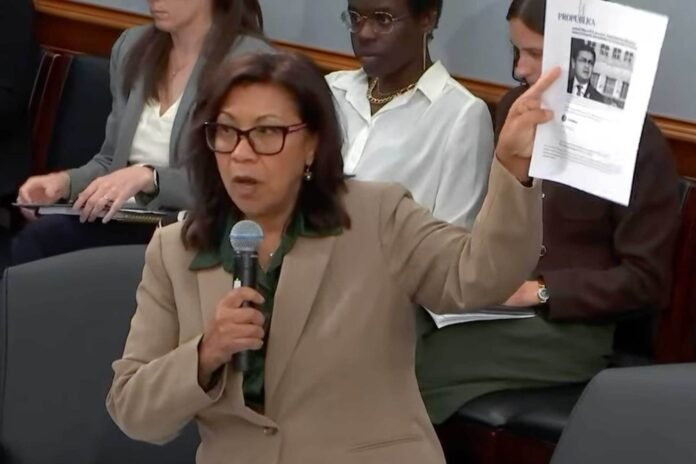
Rep. Norma Torres, a California Democrat, introduced the measure last month as an amendment to a House appropriations bill, telling her colleagues that there “should never be preferential treatment for narco leaders.”

The move comes in response to ProPublica reporting on the special treatment extended to one high-profile pardon recipient — former Honduran president Juan Orlando Hernández, who was released from a federal penitentiary late last year. Less than 18 months earlier, Hernández had been sentenced to 45 years in prison for taking bribes and allowing drug traffickers to export more than 400 tons of cocaine to the U.S. while he was in office.

But after President Donald Trump pardoned him in December, the Central American strongman — who has long maintained his innocence — got what Torres and others have described as the “red carpet” treatment. On the day of his release, ProPublica found, Hernández had in place what’s known as an immigration detainer, a formal request for law enforcement agencies to hold noncitizens for pickup by Immigration and Customs Enforcement. Yet instead of holding him, the Federal Bureau of Prisons scrambled to get the detainer removed so he could walk free. Then, instead of giving him a bus ticket or airfare to get home on his own, prison officials paid a four-man tactical team overtime to drive him six hours from a West Virginia high-security facility to the Waldorf Astoria in Manhattan, New York, according to records and three people familiar with the situation. 

Read More

Torres sought to stop that sort of treatment with a narrowly tailored amendment barring the bureau and several other agencies from using taxpayer dollars to give convicted drug traffickers and child traffickers — even those who have been pardoned or received a sentence commutation — special accommodations or transportation, as well as from lifting “any detainers not provided to other inmates.” 

Last month, the amendment hit an early stumbling block when the House Appropriations Committee voted along party lines against including it in its proposed 2027 spending bill. 

“Taxpayer dollars should not be used to give convicted criminals special accommodations, lifted legal holds, or government-funded transportation,” Torres said in a press release afterward. “We should be enforcing the law, not handing out favors. I’m shocked that my Republican colleagues didn’t agree with that common sense idea.” 

But that doesn’t necessarily mean the proposal is dead. Last week in a statement to ProPublica, Torres — a Guatemalan immigrant who last year criticized the decision to pardon Hernández — said she planned to raise the issue before the Rules Committee, which can decide whether previously rejected amendments still get a vote on the House floor.

“I am not giving up,” she said, adding: “The American people deserve a government that enforces the law fairly and holds powerful criminals accountable, regardless of who pardons them.”

A Bureau of Prisons spokesperson declined to comment on the measure out of respect for members of Congress. Previously, a spokesperson said that the bureau does not discuss conditions of confinement or security procedures and that employee standards of conduct prohibit staff from giving any prisoners preferential treatment. ICE had previously referred questions to the White House, which this week did not respond to a request for comment.


Long before his arrest and controversial release, Hernández had been a polarizing figure, plagued by allegations of corruption in his country. Still, he was seen as a key U.S. ally under the Obama and first Trump administrations, in part because of his apparent interest in tackling drug trafficking and migration issues.

But in 2018, the U.S. Drug Enforcement Administration arrested his younger brother, former Honduran congressman Tony Hernández, for weapons and drug trafficking charges. The following year, a jury found Tony Hernández guilty in a Manhattan federal trial.

And weeks after the elder Hernández left office in 2022, he was arrested in Honduras and extradited to the U.S. to face drug trafficking and weapons charges. Prosecutors said Juan Orlando Hernández funded his political career with money he got from “violent drug-trafficking organizations” in exchange for allowing them to “move mountains of cocaine” out of the country. At one point, they said during trial, he bragged that he would “stuff the drugs right up the noses of the gringos.”

After a federal jury voted to convict him in early 2024, Hernández was sent to a notorious high-security penitentiary in West Virginia to serve his time. Last year, he appealed to Trump’s sympathies, penning a four-page letter framing his case as a “political persecution” by the Biden administration. 

In November — two days before the Honduran presidential election that swept Hernández’s right-wing National Party back into power — Trump announced his intent to pardon his former Central American counterpart. Experts said the timing sent an obvious message on the eve of a tight race; as one former high-ranking U.S. diplomat previously told ProPublica, the pardon was a show of support that served as a “clear green light for the National Party to manipulate the vote.”

(The narrow victory for Nasry “Tito” Asfura, who had been trailing in multiple polls, came amid reports of voter intimidation and fraud allegations. After the election, Asfura promised to “work tirelessly for Honduras.”)

On Dec. 1, Trump formally granted Hernández the full pardon, and by the end of the day he was on his way to the swank, five-star hotel in New York City, ProPublica reported. Days later, Renato Stabile, Hernández’s court-appointed lawyer, filed a motion to vacate the judgment and dismiss the indictment in light of the presidential pardon. When prosecutors didn’t file a response opposing it, a federal court agreed to Stabile’s request.

Previously, Stabile told ProPublica his client’s treatment during the release process was appropriate, as Hernández could have been arrested or killed had he been deported to his home country. He also declined to comment on where Hernández stayed but said the government did not pay the bill. Hernández had declined to comment through his attorney.

At the time, Joe Rojas, a retired prison worker and former union leader, said that BOP staff were “disgusted” after the agency “rolled out the red carpet” for Hernández. 

Last month, when the amendment came up for debate in front of the 63-member House Appropriations Committee, Torres held up a printed copy of ProPublica’s investigation as she told her colleagues about the special treatment Hernández received and about how the prisons agency had used “our hard-earned taxpayer dollars” to pay for his transport to New York. 

“These actions can never be allowed to happen ever again,” she said.

Two other lawmakers spoke in support of the measure. One, Rep. Hal Rogers, a Kentucky Republican, opposed it, calling the amendment “performative and unnecessary.” He did not explain his reasoning to the committee, and his office did not respond to an emailed request for comment. 

Ultimately, 31 Republicans opposed the amendment and 27 Democrats supported it. None of the Republican members who voted against the amendment responded to requests for comment from ProPublica.

Though Torres plans to raise the issue again this summer in front of the Rules Committee, the 9-4 Republican majority there makes it unlikely the measure will garner enough support to move forward right now.

But if the House fails to agree on spending bills before the end of this Congress, the November elections could change the balance of power and give the Democrats more say in what amendments make it to the floor next year.

Su-57 could fill India’s stealth gap — if Russia can deliver

0
su-57-could-fill-india’s-stealth-gap-—-if-russia-can-deliver
Su-57 could fill India’s stealth gap — if Russia can deliver

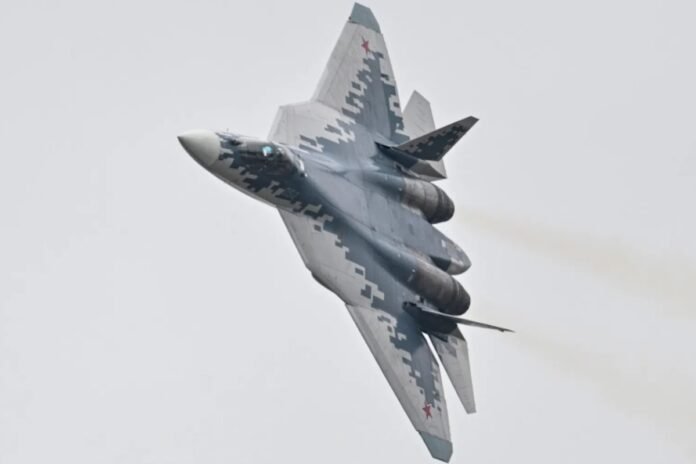
As India’s stealth fighter gap widens, Russia is pitching the Su-57 as a solution — but production realities may tell a different story.

This month, Defense News reported that Russian President Vladimir Putin renewed his offer of unrestricted joint production and technology transfer for Russia’s Su-57 fifth-generation stealth fighter during the St. Petersburg International Economic Forum.

This strategic proposal directly addresses India’s critical capability gap: the Indian Air Force currently lacks fifth-generation stealth platforms while neighboring China rapidly scales up its fleet and Pakistan reportedly plans to acquire Chinese J-35 stealth jets.

Though India previously withdrew from a similar co-development project with Russia in 2018 over cost and technology disputes, Hindustan Aeronautics Ltd. confirmed that they are now awaiting Russia’s financial quotation to present to air force officials.

Indian defense planners confront a significant dilemma: procuring two to three interim Su-57 squadrons could quickly address regional threats.

However, the multi-billion-dollar deal might divert crucial resources and reduce motivation to develop India’s indigenous fifth-generation fighter, which is unlikely to become operational before 2035.

The US Army’s ODIN database describes the Su-57 as an air-superiority and strike fighter that combines low-observable features, internal weapons bays, advanced sensor fusion and an active phased-array (AESA) radar with exceptional maneuverability.

According to the database, the Su-57 can supercruise at speeds up to Mach 2, sustain supersonic flight without afterburners, and has a combat range exceeding 1,500 kilometers. Its extensive use of composite materials enhances stealth and reduces weight, while its aerodynamic design supports extreme high-angle-of-attack maneuvers.

Furthermore, Russia has produced a two-seat version of the Su-57. The extra crew could enable long-range air defense and strike missions and possibly serve as a “mission commander” for loyal wingman drones such as the Okhotnik.

The Su-57 has already been exported, with two units delivered to Algeria in November 2025, as part of an order for 12 aircraft.

As for the Su-57’s combat record, Army Recognition reports this month that Russia has used the aircraft in Ukraine, launching standoff strikes with Kh-59/69 cruise missiles up to 400 kilometers behind the front lines rather than penetrating defended airspace.

The report adds that launch distance, altitude management, controlled flight corridors, electronic protection, and precision-guided weapons enhance the aircraft’s survivability.

Such employment mirrors the doctrine used by both sides during the May 2025 aerial skirmishes over Kashmir, in which no aircraft from either side crossed national borders, reflecting the seriousness with which both sides view each other’s air defense capabilities.

Beyond exercising caution, this doctrine may have been intended to prevent escalation, as the conflict became a war of drone and missile exchanges, precluding border crossings by either aircraft or land forces and mass mobilization.

In view of that, the Su-57 may offer a qualitative solution to the Indian Air Force’s modernization challenges exposed during the May 2025 aerial skirmishes over Kashmir.

Peter Layton mentioned in a November 2025 Airspace brief that India lost two, or maybe three fighters – a French-made Rafale, a Russian-made MiG-29, and perhaps a Russian-made Su-30. 

Most tellingly, a Chinese-made Pakistani J-10C using a long-range PL-15 missile was credited with downing one of India’s Rafale jets, suggesting that Chinese weapons may now be capable of competing with leading Western systems.

Furthermore, Pakistan’s Chinese-origin “ABC” aerial kill chain – locked on by ground systems such as the HQ-9P air defense system, PL-15 missiles launched by J-10C fighter jets, and guided by ZDK-03 airborne warning and control (AWACS) to their targets – stands in stark contrast to India’s mixed ecosystem combining Western, Russian, and domestically made systems, which may pose integration problems.

Moreover, the Pakistan Air Force may be on the verge of a major ecosystem upgrade, with Defense Security Asia reporting this month that, along with the J-35, Pakistan may acquire the KJ-500 AWACS and HQ-19 air defense systems, improving its Chinese-made kill chain but at the same time deepening its dependence on Chinese military hardware.

China has positioned J-20 stealth fighters at Shigatse Air Base in Tibet, close to the disputed Himalayan border with India. These aircraft are less than 160 kilometers from India’s Sikkim border and the Siliguri Corridor.

Taken together, these developments may be eroding India’s traditional qualitative edge in the air domain.

In addition, India may not have enough fighter aircraft for its needs, with the International Institute for Strategic Studies (IISS) noting in February 2026 that the Indian Air Force has about 29 fighter and ground-attack squadrons, well below the minimum target of 42 fighter squadrons.

Still, the question remains whether Russia can produce enough Su-57s to meet India’s needs. Peter Suciu points out in a January 2026 article for The National Interest (TNI) that as of that date, Russia appears to have only 32 Su-57 units, including prototypes and non-combat models – way short of its stated goal of having 76 units by 2027-2028.

Suciu says that deliveries have fallen short due to supply chain and funding constraints. He mentions that, with a price tag of US$100 million per aircraft, Russia has sought foreign buyers to subsidize the aircraft’s costs.

However, Ukrainian deep strikes in Russia have destroyed two Su-57s on the ground in April 2026, and a fire the same month at the Komsomolsk-on-Amur plant producing critical composite materials for the aircraft may further slow already low production rates by disrupting key supply-chain nodes.

Furthermore, India’s longstanding preference for Russian arms appears to be undergoing a significant structural shift. Multiple data sets from the Stockholm International Peace Research Institute (SIPRI) show that while Russia remained India’s top supplier from 2017 through 2025 — accounting for 46% of Indian imports in 2017-21, 45% in 2018–22, 36% in 2019–23 and 40% in 2021–25 — overall import volumes have steadily declined.

This drop stems from India’s expanding domestic defense manufacturing and a deliberate strategy to diversify its supplier base.

Driven by persistent geopolitical tensions with China and Pakistan, India is shifting toward Western suppliers, placing substantial new and planned orders with France, Israel, and the US rather than Russia.

Furthermore, Russia’s export capacity faces long-term constraints due to trade sanctions, international pressure, and a mandate to prioritize its domestic military needs following the 2022 invasion of Ukraine. Consequently, two-thirds of Russia’s shrinking global arms exports are now concentrated in just three states: India, China and Kazakhstan.

The Su-57 may offer India a faster path to fifth-generation capability, yet it remains unclear whether Russia can reliably supply the aircraft in the numbers India requires — or whether doing so would come at the expense of India’s long-term quest for defense self-reliance.

0FansLike
0FollowersFollow
0FollowersFollow
0SubscribersSubscribe
- Advertisement -
Google search engine

Recent Posts